Rüdiger Grimm
Jean-Noël Colin
Nr. 7/2012
Arbeitsberichte aus dem
Fachbereich Informatik
auszugsweiser Verwertung.
The “Arbeitsberichte aus dem Fachbereich Informatik“ comprise preliminary results which will usually be revised for subsequent publication. Critical comments are appreciated by the authors. All rights reserved. No part of this report may be reproduced by any means or translated.
Arbeitsberichte des Fachbereichs Informatik ISSN (Print): 1864-0346
ISSN (Online): 1864-0850 Herausgeber / Edited by: Der Dekan:
Prof. Dr. Grimm
Die Professoren des Fachbereichs:
Prof. Dr. Bátori, Prof. Dr. Burkhardt, Prof. Dr. Diller, Prof. Dr. Ebert, Prof. Dr. Frey, Prof. Dr. Furbach, Prof. Dr. Grimm, Prof. Dr. Hampe, Prof. Dr. Harbusch,
jProf. Dr. Kilian, Prof. Dr. von Korflesch, Prof. Dr. Lämmel, Prof. Dr. Lautenbach, Prof. Dr. Müller, Prof. Dr. Oppermann, Prof. Dr. Paulus, Prof. Dr. Priese,
Prof. Dr. Rosendahl, Prof. Dr. Schubert, Prof. Dr. Sofronie-Stokkermans, Prof. Dr. Staab, Prof. Dr. Steigner, Prof. Dr. Sure, Prof. Dr. Troitzsch, Prof. Dr. Wimmer, Prof. Dr. Zöbel
Kontaktdaten der Verfasser Rüdiger Grimm, Jean-Noël Colin
Institut für Wirtschafts- und Verwaltungsinformatik Fachbereich Informatik
10
thInternational Workshop for Technical, Economic and Legal
Aspects of Business Models for Virtual Goods
8
thInternational ODRL Community Group Meeting
Proceedings
Preface
This is the 10thinternational workshop for technical, economic, and legal aspects of business models for virtual goods incorporating the 8th ODRL community group meeting. This year we did not call for completed research results, but we invited PhD students to present and discuss their ongoing research work. In the traditional international group of virtual goods and ODRL researchers we discussed PhD research from Belgium, Brazil, and Germany. The topics focused on research questions about rights management in the Internet and e-business stimulation. In the center of rights management stands the conception of a formal policy expression that can be used for human readable policy transparency, as well as for machine readable support of policy conformant systems behavior up to automatic policy enforcement. ODRL has proven to be an ideal basis for policy expressions, not only for digital copy rights, but also for the more general “Policy Awareness in the World of Virtual Goods”. In this sense, policies support the communication of virtual goods, and they are a virtualization of rules-governed behavior themselves.
The virtual goods and ODRL workshop series have worked on the progress of ODRL language development and usage. The PhD workshop 2012 follows this line of research tradition. In three of the research works discussed, policy usage plays an important role, namely for usage rights management (D. P¨ahler’s work), purpose management (A. Rath’s work), and communication regulation (A. Kasten’s work):
1. Security modeling of usage rights management
2. Purpose Management and Enforcement for Sensitive Private Data 3. Policy-based Internet communication regulation
Regarding 1: The work of Daniel P¨ahler on “Security modeling of usage rights management” is supervised by Prof. R¨udiger Grimm, University of Koblenz, Germany. While following the strict rules of an IT security model, it looks at usage rights from the more realistic viewpoint of actual costs, rather than the usual approach of strictly legal or illegal actions. Consequently, this work focuses on “bridging the gaps between reality, security modeling and software”.
Regarding 2: The research of Annanda Thavymony Rath is supervised by Prof. Jean-No¨el Colin in the University of Namur, Belgium. This work looks on one of the hard challenges of privacy management, that is how to bind personal data on the agreed purpose of their processing. In particular, the goal of the research is to investigate the role and impact of purpose in the authorization process and in usage control for virtual goods, and to define a mechanism to manage and enforce them.
Regarding 3: Andreas Kasten’s research is embedded in the research environment of the IT risk management group of Prof. R¨udiger Grimm in the University of Koblenz, Germany. It looks on the phenomenon that the Internet is the informa-tion source number one of the modern world, not only for private communicainforma-tion, but even more for business. The Internet interconnects different countries and thus different jurisdictions. Although each Internet user can generally access any content from any country, the country’s laws in that the user is located may pro-hibit her from doing so. A. Kasten develops an ontological policy language for regulating Internet-based communication on both a technical and a legal level.
In two of the PhD works discussed, the stimulation of business in the Internet is in the focus of research. F. Zimmermann’s and J. N¨utzel’s work investigates semantic sentiments for business communication, and Miguel Said Vieira’s work looks for turning sharing into market behavior:
4. Real-time language independent sentiment analysis in social network 5. Intellectual commons, commodification and new business models
Regarding 4: The research work of Frank Zimmermann and J¨urgen N¨utzel is em-bedded in the market driven research of the “4FriendsOnly.com Internet Tech-nologies AG” in Ilmenau, Germany. According to J¨urgen N¨utzel’s close rela-tionship with the University of Technology in Ilmenau, this work is on a high academic level. In order to assess the meaning of mass communication across the Internet for any pragmatic purpose, especially for business, it is essential to understand the semantic sentiments behind this communication. Micro blogging systems like Twitter aggregate 24 hours a day a huge amount of user generated content. The authors develop an algorithm which extracts the sentiment of many different topics from these data. They filter out special regions which allow to compare the calculated sentiment values from different regions with each other.
Regarding 5: The research work of Miguel Said Vieira on “Intellectual commons, commodification and new business models” is supervised by Prof. Barbosa de Oliveira, University of S˜ao Paulo, Brazil. This research project analyzes the possible relationships between immaterial commons and commodification. Im-material commons refer to the practice of open sharing of intellectual or cultural goods. Commodification refers to the process of turning something into a com-modity: a private good produced to satisfy market needs. This research analyses ways to turn so-called “open business models”, which live in a world of sharing, into real market business of virtual goods.
Namur, September 25, 2012 R¨udiger Grimm, Koblenz Jean-No¨el Colin, Namur
Table of Contents
Virtual Goods Workshop 2012
Reality vs. Security Model vs. Software – Bridging the Gaps. . . 1
Daniel P¨ahler
Purpose Management and Enforcement for Sensitive Private Data in
Open Environments. . . 7
Annanda Thavymony Rath, Jean-No¨el Colin
Policy-Based Regulation of Internet Communication. . . 15
Andreas Kasten
Real-time Language Independent Sentiment Analysis in Social Network. . 21
J¨urgen N¨utzel, Frank Zimmermann
Intellectual Commons, Commodification and New Business Models. . . 31
Miguel Said Vieira
Reality vs. Security Model vs. Software –
Bridging the Gaps
Extended Abstract
Daniel Pähler
Institute for Information Systems Research, University of Koblenz-Landau, Germany [email protected]
Introduction
In [4], it was shown that existing formalizations of Digital Rights Management share some common weaknesses, for instance their vendor-centric point of view or the fact that they only distinguish between “legal” and “illegal”, without allowing for a “gray area”. A list of requirements for a new DRM model was derived, and a formal model was introduced that fulfills these requirements. This formal model, which has in the meanwhile been named “Formosa” (Formal Model for Secure Actions), follows in the tradition of other IT security models, as described by Grimm [1]. It specifies secure system states and rules for allowed state transitions which, if adhered to, aim to fulfill the superior security objective that each actor should be able to subjectively feel secure. Also similar to other IT security models, Formosa is not just meant to describe an existing situation, but to provide a sound basis for implementations that fulfill the same security objective. Therefore, the work on Formosa uses the research method of “Design Science Research” [5].
Reality versus Security Model
This section lists the challenges that have turned up in the process of creating Formosa on the basis of assumptions about the real world.
The general problem of modeling
In IT security models as well as in every other type of model, one central aim is to reduce complexity through abstraction. Inevitably, aspects of the original scenario have to be left out, and it can be difficult to decide which aspects these should be. Particularly during the first steps of creating a formal model, a trade-off is often necessary. On one hand, each feature that is added could turn out to be useful or even necessary later. On the other hand, each additional feature also makes the model more complex and might violate the scientific principle of “Occam’s Razor”1. In an informal model, e.g. in a UML class diagram, changes
1
As Heylighen explains in [2], “[Occam’s Razor] admonishes us to choose from a set of otherwise equivalent models of a given phenomenon the simplest one.”
might be easy to perform later in the development process; classes can be deleted or added, and it is rather easy to see which other classes are influenced by a change. In Formosa, there are numerous definitions that build on each other, and if one of the basic definitions is changed, each other definition has to be checked and possibly changed, too.
At first, ODRL 2.0 could be used as a kind of template for Formosa. It was considered that if entities such as assets, actors, permissions or duties could be used to describe usage control in real-world uses cases, they would provide a good foundation for a formal model. But since ODRL 2.0 itself is not formal and cannot reasonably be formalized (as pointed out in [4]), some features had to be left out. As a concrete example, Formosa was first created without a notion of time to avoid making an already complex model even more complex. Only lately was the decision made to include time so that temporally limited rights expressions and duty deadlines can be expressed. The downside is that Formosa is now even more difficult to understand than it was before.
Choosing an adequate notation
In order for Formosa to be both comprehensible and accurate, an appropriate notation has to be used. The current notation, which mainly uses mathematical set expressions, has the advantage that it allows for precise expressions and is still relatively easy to read for researchers in the area of computer science. But it is unclear if there exist other notations that could allow for expressions which are easier to read and write, or which could even be interpreted by a computer. The latter would not only help unveil errors in the model, it could also help when creating an implementation of the model.
This challenge is currently being worked on in a master’s thesis. The student will first try to get a broad overview of modeling methods (and thus, notations) used in the area of computer science and group them into clusters of similar methods. In the next step, he will analyze the aptness of some methods for the creation of IT security models in general and Formosa specifically, pointing out the advantages and disadvantages of each method. Eventually, this thesis’ goal is to aid in finding the ideal notation.
Checking the real world assumptions
One fundamental innovation of Formosa, when compared to other IT security models, is the fact that it allows for a “legal gray area”. Actors might perform illegal actions and still be in a legal state (if they are still able to pay a fine for their actions). In this regard, Formosa was created to reflect user behavior more realistically. It is assumed that many users behave “a little illegally” without feeling guilty about it, and that a DRM model should therefore distinguish between minor misdemeanors and actual crimes.
But the question arises, “Is this a valid assumption?”. The facts that many legal systems also make this distinction, and that trivial offenses are often con-sidered socially acceptable point to “yes”, but can this be proven?
It is the goal of a master’s thesis that was recently started to find an answer to the above questions. The student’s method is that of a literature analysis. Several studies about users’ attitudes toward DRM and DRM-related problems exist and should provide a good data basis for the analysis.
Security Model versus Software
When an IT security model is stable enough, it is desirable to transfer it into an implementation. In terms of the Design Science Research method, this step is needed for (and is already part of) the evaluation of the artifact created before. For Formosa, its similarity to the concept of Usage Rights Management (URM) [3] makes the Java-based URM implementation “TURM” (Toolkit for URM) a particularly attractive platform for an implementation. TURM can already deal with ODRL licenses as well as assets, and it tries to help the user keep an overview of their legal situation. But it turns out that the transition from the model to software is not trivial. The challenges outlined below are currently being worked on in a master’s thesis that aims to implement Formosa in TURM.
Features that were left out in Formosa
As was shown above, several features were deliberately left out in Formosa to avoid making it too complex. But in object-oriented software such as TURM, these features can more easily be dealt with, particularly those that are already part of TURM. For instance, Formosa has no notion of count constraints (e.g., “Alice is allowed to send the file xyz.mp3 to at most 3 other persons.”), whereas TURM does support them to a certain degree. In how far can the TURM im-plementation of Formosa make use of these features and still be an accurate representation of the model?
“Open” definitions in Formosa
In order to deal with real-world situations where potentially unlimited amounts of entities can occur, Formosa uses a number of “open” definitions. This means that some sets likeActorsare defined to include all actors, without listing them explicitly. Other sets likeActiontypesare defined with some exemplary elements (use, copy, buy,...), but are meant to be extended for specific use cases. Finally, many functions are defined as so-called “oracle functions”: they cannot actually compute output values for specific inputs, but they have to use lookup tables to find the right output for the respective input (e.g.,costreturns the cost of a specific action). Obviously, these lookup tables also have to be defined depending on the specific use cases. Since the implementation cannot work with Formosa’s open definitions, it has to be configured to use concrete values. But where do these values come from, and who should be able to configure them?
Controllability and observability
As was pointed out in [4], DRM systems often have the problem that in order to be effective, they need to have control over the user’s domain. Only if it can be assured that a user has no means of circumventing a restrictive DRMS does it make sense to use this DRMS (hence, assets are usually encrypted).
URM as well as Formosa follow a different approach: they do not use any rights enforcement measures and give the user the freedom to decide for them-selves whether they want to behave legally or not. One advantage of this is the fact that users can use assets managed by TURM with the same software that they would use for unmanaged assets. For Formosa’s implementation, this turns out to be a problem. Even though Formosa does not necessarilycontrol actions, it needs toobservethem. In the purely theoretical domain of Formosa as an IT security model, it is defined that each action can lead to a state change. But in the implementation, actions that cannot be observed obviously cannot lead to state changes.
A first approach to solve this problem includes a demon process which is always running and which can record certain events in the system; for other events, the user has to “manually inform” Formosa. It is still an open question how useful this approach can be in practice.
References
1. Rüdiger Grimm. A Formal IT-Security Model for a Weak Fair-Exchange Coopera-tion with Non-RepudiaCoopera-tion Proofs. InSECURWARE 2009, The Third International Conference on Emerging Security Information, Systems and Technologies, Athens, 18-23 June 2009. IEEE Computer Society Press, 06 2009.
2. Francis Heylighen. Occam’s Razor. Principia cybernetica web, 07 1997.
3. Helge Hundacker, Daniel Pähler, and Rüdiger Grimm. URM – Usage Rights Man-agement. In Jürgen Nützel and Alapan Arnap, editors,Virtual goods 2009, Nancy, France, 09 2009.
4. Daniel Pähler and Rüdiger Grimm. A formal Digital Rights Model without En-forcement. InVirtual Goods 2011, 2011.
5. Vijay Vaishnavi and Bill Kuechler. Design Science Research in Information Systems. website, 01 2004. last updated September 30, 2011.
Purpose Management and Enforcement for
Sensitive Private Data in Open Environments
Annanda Thavymony Rath and Jean-No¨el Colin Faculty of Computer Science
University of Namur, Namur, belgium
{rath.thavymony,jean-noel.colin}@fundp.ac.be
Abstract. This paper provides an overview of our research including the specification of research, primary result we achieved so far, and re-maining questions to be addressed. We set ourselves in the field of secure processing of sensitive private nomad data in open environments. The goal of the research is to investigate the role and impact of ”purpose” in authorization process (access as well as usage control) and define a mech-anism to manage and enforce them. The research includes: (1) study, analyze, and clear the meaning of purpose, (2) management of purpose binding of data, (3) study the possibilities to recognize purpose bind-ing and enforcement, and (4) clear the meanbind-ing and impact of personal relationship, context on purpose in authorization process.
1
Introduction
Purpose1 of access is one of the core concepts in privacy which considers the
requester’s intent as a factor in making access control decision. It has been also considered in major privacy legislations2 where the processing of sensitive private data is bounded to the specific purpose and the excessive use of them are prohibited. With this regard, in any processing environment dealing with such data requires great attention to make sure that system can provide adequate data processing security aligning with privacy legislation. This leads to the necessity of the effective management of purpose binding of data (including the recognition of purpose biding data) and enforcement.
The implication of ”purpose” in authorization process (for private data) has been actively studying. It is raised and argued in many literatures as an im-portant entity used to control access to sensitive private data. Byun et al [1] proposed a purpose-based access control of complex data for privacy protection, a model that relies on the well-known RBAC [2] access control model as well as the notion of conditional role which is based on the notion of role attribute
1
In the natural language, ”purpose” often refers to an action (or a set of actions) or the name of the abstract actions that need to be performed following the access of data.
2 Privacy legislations: the 95/46/EC Directive, U.S Privacy Act (1974), and Canada’s
and system attribute. In their paper, they provided also a general purpose tree applied in complex data management system and the solution to address the problem of how to determine the purpose for which certain data are accessed by a given user. Other research concerning purpose is done by Ni.Qun et al [3] who proposed a P-RBAC (Privacy-aware RBAC), in which they extended the con-cept of RBAC model by adding three entities that require to express the access control policy for sensitive private data. Those entities are purposes, conditions, and obligations. They argue that purpose is the important entity (it can not be missed) and serves as a key factor in determining the access to sensitive data.
While the previous researches focused mostly on how to express and represent ”purpose” in the access policy, the management and enforcement of ”purpose” have been poorly studied. Thus, by observing the lack of the study on purpose management and enforcement in open environment, we willing to contribute our research in this area. We focus our research in three main points. (1) study, analyze, clear the meaning of purpose, and the management of purpose binding of data; (2) the purpose enforcement; and (3) the study of the impact of the personal relationship, context on purpose for sensitive private data.
The rest of paper is organized as following. Section 2 provides the definition and scope of the ”purpose”. Section 3 talks about the purpose management and enforcement, in this section, we also discuss our proposed purpose enforcement structure. Section 4 is the past achievements and future work while Section 5 is the conclusion.
2
Definition and scope of purpose
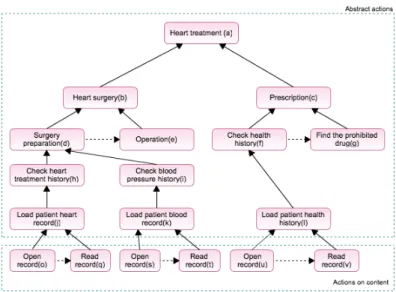
In dictionary, “purpose” is defined as “the object toward which one strives or for which something exists; an aim or a goal”. However, by observing how purpose is used in the natural language reveals that purposes often refer to an or a set of abstract actions. For example, accessing patient’s health record for the purpose of treatment, research, insurance, etc. all of which are names of some abstract actions. To our observation, purpose can be classified into two types: purpose as high-level action and purpose as future action (Figure 1).
Purpose as a High-Level Action3. In some contexts, purpose refers to a more abstract, or semantically higher-level action in a plan. Thus, doing something for some purpose, actually means doing it as a part, or a sub-action, for that higher-level action. For example, when Bob checks some patient’s blood pressure for the purpose of heart surgery, it means that checking the blood pressure is a part of a more complex and abstract action of heart surgery. Similarly, when it is said the surgery is performed for the purpose of treatment, it is because the high-level action of medical treatment includes surgery as a part. As presented
3 A common terminology Low-level actions such as read, write, etc. are well-known and
common across many domains with clear and standard meanings. More complex and abstract actions like surgery, marketing, etc. can be taken from standard vocabularies that exist in many domains such as clinical systems in healthcare.
Fig. 1.Example of purpose graph in healthcare where dashed arrows represent purpose as “future action” and solid arrows represent ”purpose” as “high level action”. They are read from bottom up for solid arrows (e.g, “surgery preparation” is a high level action of “check heart treatment history”). Dashed arrows are read from left to right (e.g, “operation” is a future action of “surgery preparation”)
in Figure 1, the abstract action ”purpose” (a) is considered as the high level action of ”(b) to (v)”.
Purpose as a Future Action. In some contexts, purpose is used to indicate that an action is performed as a prerequisite of another action in future. For example, when Bob withdraws money from a bank account for the purpose of paying the bills, it means the former action is done as a prerequisite to performing the latter. Another example as presented in Figure 1, when a doctor does the surgery preparation for a purpose of operation, it means the former action “surgery preparation” is done as a prerequisite to performing the later action which is “operation”. In Figure 1, (e)(g)(q)(t)(v) are considered to be the future action of (d)(f)(o)(s)(u) respectively.
3
Purpose management and enforcement
The main difficulty in purpose enforcement is how to identify the purpose of an agent when it requests to perform an action. Some common proposed mech-anisms for purpose management and enforcement are self-declaration in which the agent explicitly announces the purpose of data access [1] and role-based en-forcement [4] in which the purpose is identified based on the agent’s role in the system. The first method obviously cannot stop a malicious agent from claim-ing false purposes. The second method has been criticized to be inefficient in
Fig. 2.example of purpose enforcement phases
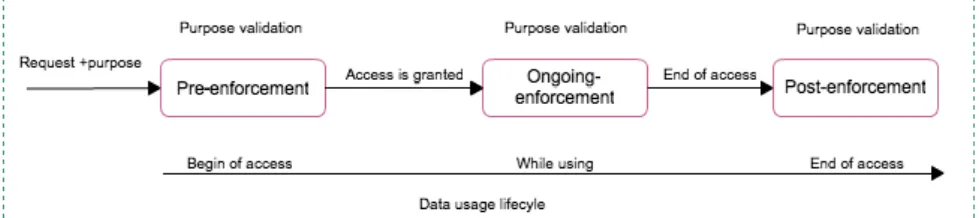
capturing purpose of an action since roles and purposes are not always aligned and members of the same organizational role may practice different purposes in their actions. Therefore, identifying the purpose of an action, or verifying a claimed purpose remains an open question. With this regard, we would like to set ourselves on purpose management and enforcement. Within this frame-work, we investigate into three types of enforcement, we term, pre-enforcement, ongoing-enforcement and post-enforcement of purpose. To our observation, we can enforce “purpose” in three different circumstances (phases) as presented in Figure 2, before access is granted, while using content, and at the end of content usage; however, the three enforcement phases require different mechanisms to handle them.
Pre-enforcement refers to a mechanism allowing system to validate the pur-pose before granting access to data. In this point, we work on defining or formal-izing a mechanism used to efficiently validate the declared purpose. This includes also the infrastructure/system architecture to support the defining mechanism. Ongoing-enforcement refers to a mechanism allowing system to continuously control purpose of usage during the usage period. It checks if the actions per-formed and the requesting actions are conper-formed with the declared purpose.
Post-enforcement refers to a mechanism allowing system to validate the pro-cessing of data and identify if the usage of data was inline with the requested-purpose or otherwise. In this part, we work on defining the mechanism that is able to trace and validate the usage of data.
Our preliminary conclusion is that the proposed enforcement structure would provide a full control over data usage because enforcement takes place over the entire lifecycle of data usage; hence, the immediate quest is the mechanism to effectively enforce the three phases of purpose validation.
4
Past achievements and future work
Privacy protection is a major issue of the systems dealing with sensitive private data, the most well-known of which are the healthcare information system and social network. As our research focus is on this type of data and processing envi-ronment, we started our work at this point by looking at distributed healthcare
information system. We conducted a case study on Walloon Healthcare Network (WHN)4 [5]. Following the work on WHN, we worked on Digital Right Man-agement system, the aim is to find out if the existing system is sufficient to be used for the protection of sensitive private data in the identified environment. Following the DRM system, we worked on right expression language and access as well as usage control model.
The latest study we have conducted relates to ”purpose”, the study includes the semantic foundation of purpose [6] for privacy policies to access control model based on purpose and its expression language. We went deeper into the policy expression languages like XACML, ODRL, or EPAL to find out if these languages can be used to express “purpose”. Our study shows that those languages are capable to support “purpose” expression; however, the enforcement of purpose binding policy is still a challenge.
Concerning “purpose” enforcement, we conducted the survey on existing en-forcement techniques [7] for access as well as usage control and we found that most techniques can address only a partial problem in ”purpose” enforcement, a more suitable approach is required. Thus, we settle in this area; concerning “purpose enforcement”, the main difficulties are: How to identify/verify the pur-pose of an agent when it requests to perform an action? How to ensure that the usage of data does not exceed the declared purpose? Thus, two important points need to be addressed.
1. System architecture, taking distributed healthcare as the main application domain.
2. The mechanisms for purpose validation for the three enforcement phases as mentioned in previous section.
In relation with purpose, our following research focus is to study the impact of the personal relationship, context on purpose for sensitive private data. This motivates by the fact that social-network and healthcare system dealing with sensitive private data seems to reflex the concept of personal relationship in their access as well as usage control management. Our research in this part is to de-fine a general access control model termed as ”privacy-aware relationship-based access control model ” and to prove that such model can provide a promising result as compared with other access control model such as P-RBAC if deployed in the above mentioned system environments.
5
Conclusion
We have presented in this document, the research objective and the progress we achieved so far. With the main objective of managing and enforcing “purpose” in privacy policy for private nomad data in open environment, we proposed the
4
WHN is a project aiming at providing an electronic healthcare facility to patients in Walloon region by joining together all healthcare institutions, clinics, and also physicians and allows exchanging patients record when needed
enforcement structure as presented in section 3. Through a preliminary study, it seems much can be achieved by using this approach. This approach allows us to have a full control over the data usage from earlier access (pre-enforcement of purpose) to end of access (post-enforcement of purpose).
References
1. Byun Ji-Won, Bertino Elisa, Li Ninghui: Purpose based access control of complex data for privacy protection. In: Proceedings of the tenth ACM symposium on Access control models and technologies. SACMAT ’05, New York, NY, USA, ACM (2005) 102–110
2. D.F.Ferraiolo, R.Sandhu, S.Gavrila, D.R.Kuhn, R.Chandramouli.: Proposed NIST Standard for Role-Based Access Control. In: ACM Transactions on Information and System Security. (2001) 4(3):222–274
3. Ni.Qun, Bertino Elisa, Lobo Jorge, Brodie Carolyn, Clare-Marie Karat, Trombeta Alberto: Privacy-aware Role-Based Access Control. ACM Transaction Information and System Security13(2010) 24:1–24:31
4. Jawad Mohamed, Alvarado Patricia Serrano, Valduriez Patrick: Design of priserv, a privacy service for dhts. In: Proceedings of the 2008 international workshop on Privacy and anonymity in information society. PAIS ’08, New York, NY, USA, ACM (2008) 21–25
5. WHN: (2009) Espace d´evelopeur de RSW (Walloon Healthcare Net-work):https://www.reseausantewallon.be/ developpement/ default.aspx, latest ac-cess: January 2012.
6. Jafari Mohammad, Fong Philip W.L., Safavi-Naini Reihaneh, Barker Ken, Sheppard Nicholas Paul: Towards defining semantic foundations for purpose-based privacy policies. In: Proceedings of the first ACM conference on Data and application security and privacy. CODASPY ’11, New York, NY, USA, ACM (2011) 213–224 7. Alexander Pretschner, Manuel Hilty, Florian Sch, Christian Schaefer, Thomas
Wal-ter: Usage control enforcement: Present and future. IEEE Security and Privacy 6 (2008) 44–53
Policy-Based Regulation of Internet
Communication
Andreas Kasten
Universit¨at Koblenz-Landau,
Universit¨atsstraße 1, 56070 Koblenz, Germany
Abstract. The Internet is a global communication medium which in-terconnects several content consumers and content providers of different countries. Since these countries have their own jurisdictions, the Inter-net can also be considered an interconnection of such. Although every content consumer is generally able to access any content from any con-tent provider, the jurisdiction of its own country may prohibit her from doing so. This paper outlines the research towards a policy language for regulating Internet communication. The language allows for model-ing such regulations on a technical level and also covers their legal and organizational background.
1
Problem Statement
The Internet provides different categories of content which can generally be accessed by any content consumer from any country. However, access to specific content may be considered illegal in some countries while still being legal in other countries. For example, the distribution of neo-Nazi material is legal in the USA but illegal in Germany according to§86 of the German Criminal Code [1]. Since the Internet interconnects different countries and jurisdictions, it also provides content for those consumers who are not allowed to access it according to their local law. A web server which is located in the USA and hosts neo-Nazi material can also be accessed by German content consumers although they are not allowed to do so. Although each Internet regulation is ultimately based on a set of laws issued by a country’s government, its implementation is generally carried out by private organizations such as Internet access providers. If these organizations interpret the laws themselves, their implementations may differ between each other which leads to inconsistent and possibly contradicting results [2]. In order to reduce such unintended side-effects, the regulation should be described as precisely as possible including all details for its technical implementation. Such a description can be achieved by using a formal policy language. A policy consists of several rules which follow the same purpose.
Existing approaches for regulating the access and the processing of Internet content cover access control, usage control, and policy-based network manage-ment. However, all of these approaches focus on a particular application and are
not suited for regulating Internet communication. Access control languages such as XACML [3] regulate the access to content at the content provider’s side. The content provider also creates and enforces access control policies which define the parties who are able to access the content. In the Internet, however, the party compiling the regulation’s rules is often a country’s government while the content provider may be located in a different country. Policy-based network management languages like DEN-ng [4] focus on regulating the communication flow within a closed network environment like that of an organization. It mainly requires low-level regulation systems such as routers or switches and does not allow for regulations on the application layer. This makes it difficult to use such languages for regulating global Internet communication. Usage control lan-guages such as ODRL [5] allow for regulating which actions a content consumer may perform on a digital resource. The enforcement of usage control policies is carried out by the content consumers’ systems since these systems are able to detect what actions the consumer wants to perform on the resource. However, usage control policies are rather abstract and cannot directly be interpreted by the enforcing system. Compared to network management policies, usage control policies require more human interaction for interpreting and enforcing them.
Since none of the existing approaches is suited for regulating Internet com-munication, the research outlined in this paper focuses on developing a policy language specifically designed for this issue. The language allows for describing flow control policies on a technical level and links them to their legal authoriza-tion. It is embedded into a workflow which covers the creation and processing of policies for regulating Internet communication.
2
Research Goal
The main research goal is to define and implement a workflow for regulating In-ternet communication which is transparent to all involved parties. These parties include among others the legislator who issues the laws on which an Internet reg-ulation is based, the party who implements the regreg-ulation on a technical level, and the content consumers who are affected by the regulation.
The achievement of this main goal covers several different steps and aspects. In order to minimize any misinterpretation of a particular regulation, the work-flow shall be based on a formal policy language. This language shall be able to describe the technical regulation details as well as its superior purpose such as a country’s law or the code of conduct of the enforcing party. The workflow must cover the creation, distribution, and technical implementation of a particular pol-icy. Each step in a policy’s lifetime must be transparent for all involved parties. According to these steps, the following research questions can be formulated:
What parties are involved in an Internet communication? Parties in this case are considered legal or natural persons including organizations, govern-ments, and individuals. A party is involved in an Internet communication if it directly participates in the communication process between two or more communicating parties.
What are their respective communication systems? A party participates in an Internet communication via its corresponding communication nodes such as web servers, web browsers, or routers. The specific communication nodes used by a party highly depend on the function that the party fulfills in the communication process.
What are possible mechanisms for technically regulating Internet com-munication? The mechanisms cover both abstract descriptions of a regu-lation and its technical implementation. A description is considered abstract if it does not rely on a particular implementation system but can be used for several systems instead.
How can a technical regulation be linked to its legal and organiza-tional background? Internet regulations are based on the jurisdictions of the countries in which they are active and/or on the code of conduct of the enforcing organization. An Internet regulation can therefore be linked to its background which covers its superior purpose as well.
How can the reasons for an Internet regulation be presented to the affected Internet users? Since each regulation is based on an legal and/or organizational background, this background should be presented to the af-fected Internet users. In doing so, the regulation itself becomes more trans-parent for the users.
In order to evaluate the practicability of the policy language, prototypical sys-tems shall be developed covering the different aspects of its corresponding work-flow. Such systems include routers, name servers, and application-level proxy servers which are usually used for enforcing Internet regulations [6].
3
Current Results
An ontology-based policy language for regulating Internet communication has already been developed. The language defines a policy as a collection of rules following the same purpose. Each rule describes the technical details for regulat-ing one particular communication flow. A policy links several rules to their legal authorization and/or their organizational motivation. The language is called InFO (short for Information Flow Ontology) and covers the basic regulation aspects independent from any enforcing system. Domain-specific extensions of InFO provide further details for a policy’s implementation. There are currently three different extensions available for routers, name servers, and application-level proxy servers. A prototypical name server implementation is also available which interprets and enforces policies created with InFO’s name server extension. A rudimentary workflow for creating and processing flow control policies has been developed as well. A dedicated rule creator interprets the country’s laws by collecting the technical regulation details and transforming them into a corresponding rule. This rule is then transfered to the rule enforcer who collects several rules from different rule creators and compiles them into a policy. The enforcer associates this policy with the rule’s legal background and its own code
of conduct. It then implements the policy on the enforcing system. If a content consumer tries to access blocked Internet content, she receives a corresponding message and can obtain further information about the regulation’s legal and organizational background.
The specification of the policy language and its domain-specific extensions is available athttp://icp.it-risk.iwvi.uni-koblenz.de.
4
Open Issues
In order to allow for a better validation and verification of Internet regulations, the workflow outlined above has to be further refined. For example, digitally signing the rules and their corresponding policies allows for identifying the par-ties who are responsible for creating a policy and its rules. This provides for more transparency in the process of Internet regulation.
In order to create rules and policies, corresponding software tools must be developed. Since the process of creating such rules and policies involves several different parties, the software tools must also provide for such a collaborative creation process.
Content consumers, who are affected by an Internet regulation, must be able to understand the reasons for this regulation. This requires that the regulation’s policy is presented to the consumer in a format which is easy to understand. A rather technical policy description must therefore be transformed into a more human-readable representation.
References
1. Bundesrepublik Deutschland:§86 StGB: Verbreiten von Propagandamitteln verfas-sungswidriger Organisationen (1975)http://www.gesetze-im-internet.de/stgb/ __86.html(last accessed: 27/08/12).
2. Dornseif, M.: Government mandated blocking of foreign web content. In von Knop, J., Haverkamp, W., Jessen, E., eds.: Security, E-Learning, E-Services: Proceedings of the 17. DFN-Arbeitstagung ¨uber Kommunikationsnetze. Lecture Notes in Infor-matics, D¨usseldorf (2004) 617–648
3. Moses, T.: eXtensible Access Control Markup Language (XACML) version 2.0. Oasis standard, OASIS (2005)http://docs.oasis-open.org/xacml/2.0/access_ control-xacml-2.0-core-spec-os.pdf(last accessed: 27/08/12).
4. Strassner, J.: Policy-Based Network Management: Solutions for the Next Genera-tion. Morgan Kaufmann (2004)
5. Iannella, R., Guth, S., P¨ahler, D., Kasten, A.: ODRL version 2.0 core model. Spec-ification, W3C ODRL Community Group (2012)http://www.w3.org/community/ odrl/two/model/(last accessed: 27/08/12).
6. Murdoch, S.J., Anderson, R.: Tools and technology of Internet filtering. In Deibert, R., Palfrey, J., Rohozinski, R., Zittrain, J., eds.: Access Denied: The Practice and Policy of Global Internet Filtering. The MIT Press (2008) 57–72
Real-time Language Independent Sentiment Analysis in
Social Network
Jürgen Nützel1, Frank Zimmermann1
1 4FriendsOnly.com Internet Technologies AG,
98693 Ilmenau, Germany {jn, fz}@4fo.de
Abstract. Micro blogging systems like Twitter aggregate 24 hours a day a huge amount of user generated content, which describes what happen around the world right now. We have developed an algorithm which extracts from these data the sentiment of many different topics. With the Twitter streaming API we access the live data feed. We filter out special regions which allow us to compare the calculated sentiment values from different regions with each other. With the live data feed we can recognize real-time sentiment changes, too. With the analyzing of the geo data of the Tweet we can determine the specific area of this sentiment changes.
Keywords: sentiment analysis, social networks, statistical text mining, smileys
1 Introduction and Motivation
Political parties, financial investors and commercial companies have all this common interest: They want to know all about the sentiments of ordinary people. Politicians want to know how their voters think about their decisions. Financial investors and commercial companies want to know how consumers like or dislike brands and their current or future products. They all have the opportunity to employ an opinion research center to ask hundreds or thousands of persons directly. But this option is expensive and time consuming. And if you want to know if sentiments have changed you have to do the polling periodically. On the other hand users of social networks create a huge amount of news, forum postings, product reviews and blogs containing numerous sentiment-based sentences. The micro-blogging service Twitter is a very special social network. 500 million1 (active April 2012) users write in Twitter every day more than day 340 million2 short messages (Twitter calls them tweets). These tweets are written in many different languages about almost every topic. But due to the tweet’s length limitation (140 characters only) most users use smileys to express their sentiment without wasting characters. Based on these language independent smileys we calculate a statistical sentiment value for each tweet and also for each
word found in the tweet. While analyzing all incoming tweets over a fixed time period of several weeks we are able to calculate for each word its average (normalized) sentiment value. The calculated sentiment value of words like “love”, “good” or “sad” is rather constant over time. The sentiment value of some other words like “weather”, “sun” or “Bahn” (the German railroad company) vary over time. Political parties, financial investors and commercial companies may be interested in the change of the sentiment value of those words or topics. Therefore it is worth to analyze their sentiment change in real-time. To do so we compared the long term sentiment values with values calculates in a shorter period (the last week or even the last day). This allows us to calculate the weekly and daily up and down of the sentiment of topics. The people’s sentiment on the weather is the most trivial result we are able to provide. Using the geo positing data of the tweets allows us to calculate regional differences in the change of people’s sentiment. All described algorithms have been implemented and tested with real data from Twitter users in the U.S. and Germany.
2 Twitter Streaming API and Geo Positioning Filtering
The algorithms we describe in this paper run on a server which is connected to Twitter via Twitter’s streaming API (https://dev.twitter.com/docs/streaming-apis). This provides us real-time access to all newly created Tweet data. As we have neither permission nor the computing power to consume all created Tweets we decided to focus on Tweets which have position data. Adding positioning data to the Tweet is optional. Therefore only 2% of all Tweets contain such data. Beside this limitation we found it worth working with this subset because it enables us to calculate regional specific sentiment values.
In our practical experiments we consumed and recorded Tweet data with positioning information from several regions. The streaming API allows filtering out Tweets by providing two coordinates which define a rectangle on the map. We defined four regions which covered Germany, New York City, parts of U.S. east coast (from Boston to Washington DC) and the San Francisco bay area.
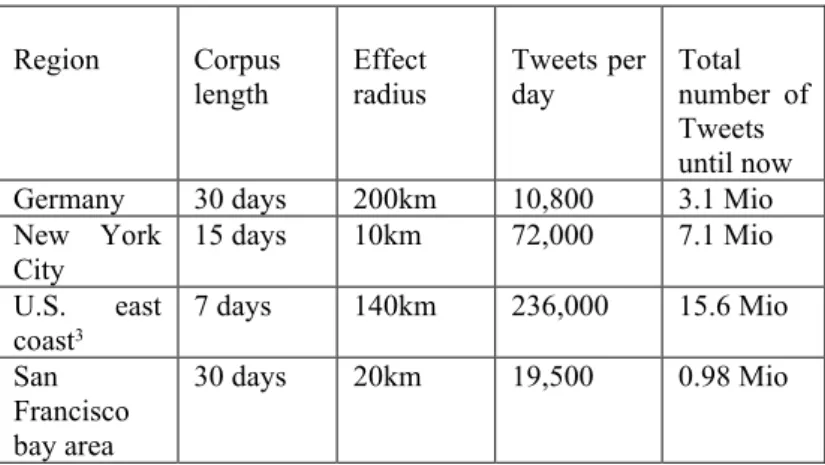
Table 1. Analyzed regions and the amount of recorded data (until 08/26/2012) Region Corpus length Effect radius Tweets per day Total number of Tweets until now Germany 30 days 200km 10,800 3.1 Mio New York
City 15 days 10km 72,000 7.1 Mio U.S. east coast3 7 days 140km 236,000 15.6 Mio San Francisco bay area 30 days 20km 19,500 0.98 Mio
We record the consumed Tweets on our server using a MySQL database. This allows us also later to compare different types of algorithms. The different corpus length and effect radius are related to different number of Tweets per day and the different size of the analyzed region. In the next chapter will describe these constants.
3 Real-time Language Independent Sentiment Analysis
The goal of our approach is to detect the change of topics’ sentiment values in real-time with any language specific settings. We detect smileys in Tweets to reach this goal.
Table 2. Smileys we currently use for sentiment calculation.
Sentiment Normalized Sentiment Value Smileys Positive +100 :-) ;) ;-) :P ;P ^.^ :D ;D :-D ;d -D <3 ,-) Negative -100 :( :-( :| :-| :~( :'-( :,(
The approach was already used by others [1, 2, 3]. The real-time demand is realized by direct connection to the Twitter API. The speed we can detect the change of sentiments depends on the amount of the data we get within a certain time period.
3.1 Calculation of Normalized Sentiment Values
We decided to design a very simply but fast algorithm to calculate the normalized sentiment value for each word we find in the Twitter input stream.
1. We put all Tweets of the selected region (one of the four regions from table 1) in the corpus. The corpus C of a region contains only the Tweets t of a certain time span; the corpus length l(C). As newer Tweets will be added to the corpus, older tweets leave the corpus. The corpus length for each region was found by experiments.
2. We calculate a sub corpus C’ of C. C’ includes only Tweets which contains a smiley from table 2.
3. For each word w we found in C’ we calculate how many Tweets are in C’
which contains w. We call it the Tweets with smiley of w: count(w). If
count(w) is smaller than a lower border (e.g. 10) the word w will be ignored. This means that we have too less data for a sentiment analyze of word w. 4. We calculate for each word w the value ss(w) (summarized sentiment) as
follows. For all wss(w) will be set to zero. For each word w we found in each Tweet t of C’ we add +1004 for a positive smiley we found in t and we add -100 for a negative smiley we found (see table 2).
5. The normalized sentiment value s(w) for the word w will calculated as follows:
)
(
)
(
)
(
w
count
w
ss
w
s
(1)3.2 The Variation in Time of Normalized Sentiment Values
We calculate for each word w from corpus C’ every day the normalized sentiment value s(w). As we got enough data from the BosWash area we could reduce the corpus length to 7 days. We have started recoding this area (and the area of San Francisco) July, 7th 2012. Until now (08/26/2012) we are able to calculate 21 sample points (which is not very much) for the variation in time of s(w). If we calculate for August 7th the normalized sentiment values we use the corpus C’ with data from August 1st to August 7th. For the 8th August we use the data from August 2nd to August 8th and so on.
We are still working on the right way to filter out noise. Currently we accept only words which are found in more than 10 Tweets which also have a smiley. To show a reasonable diagram for a word we should be able to calculate for at least 50% of the days a normalized sentiment value. For days we are not able to calculate a value we use the value of the day before.
4 Results from Recorded Data
For the area Germany we have data since August 2011. For New York we have been recording data since March 2012. This allows us to draw the variation in time with more than 130 sample points (which enough for a diagram).
For the region BoWash and the Bay Area we have started recording in July 2012. For the diagrams shown in this paper we used data from the New York area in period from April to mid of August 2012.
4.1 Different Types of Words
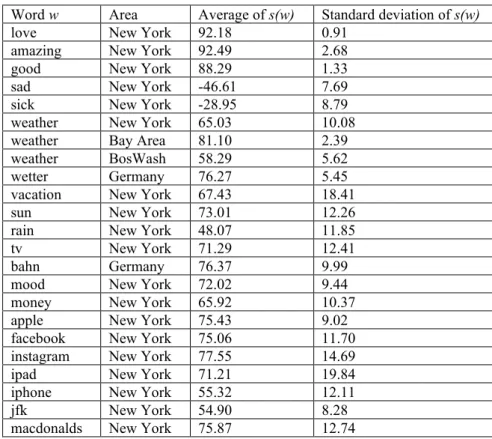
In table 3 we have a list of selected words. We have calculated the average value for the normalized sentiment. We also calculated the standard deviation. This shows us how much a value varies over time. Some “positive” words like “love”, “amazing” and “good” have constant high sentiment values. For “negative” words like “sad” and “sick” we have not been awaiting such high deviation.
Table 3. Some words with their average sentiment value and standard deviation.
Word w Area Average of s(w) Standard deviation of s(w)
love New York 92.18 0.91
amazing New York 92.49 2.68
good New York 88.29 1.33
sad New York -46.61 7.69
sick New York -28.95 8.79
weather New York 65.03 10.08
weather Bay Area 81.10 2.39
weather BosWash 58.29 5.62
wetter Germany 76.27 5.45
vacation New York 67.43 18.41
sun New York 73.01 12.26
rain New York 48.07 11.85
tv New York 71.29 12.41
bahn Germany 76.37 9.99
mood New York 72.02 9.44
money New York 65.92 10.37
apple New York 75.43 9.02
facebook New York 75.06 11.70 instagram New York 77.55 14.69
ipad New York 71.21 19.84
iphone New York 55.32 12.11
jfk New York 54.90 8.28
The most interesting type of words has average sentiment values in the range of 45 and 85 with standard deviation of above 9. Like “facebook” or “instagram”.
We also saw some interesting differences in the recorded areas for the word weather (and wetter in Germany). In the Bay Area the word weather has a more positive sentiment as in the other region. Therefore it is possible to assume that this is due to the sunnier climate there.
4.2 Real-Time Change of Sentiment
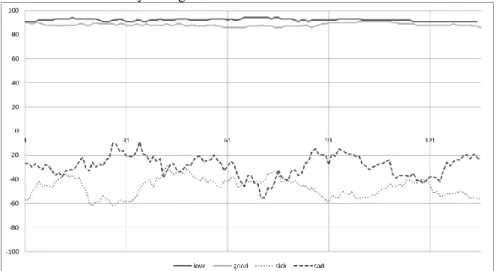
The figure 1 shows the change of the words “love”, “good”, “sick” and “sad” from April to mid of August 2012. We see the high variation of the two “negative” words. We have to investigate further here. Probably some of the positive smileys from table 2 will be used ironically in negative situations.
Fig. 1. The sentiment change of the words love, good, sick and sad from April to mid of August 2012 in the area New York
Figure 2 gives us a general overview of the mood change in area of New York for the period April to mid of August 2012. The sentiment value of “sun” and “rain” change most of the time in opposite directions. At the end of April and begin of May we see some correlation between “sun” and “mood”. Later the correlation is less obvious. To understand figure 2 fully we have to analyze New York’s weather data also.
Another very interesting word from table 3 is “money”. The sentiment of “money” varies a lot over time. We have to ask for the reasons also.
Fig. 2. The sentiment change of the words mood, sun and rain from April to mid of August 2012 in the area New York
Figure 3 compares two company names “facebook” and “instagram”. At the end of April we see a rise of sentiment for “facebook”. Is this related to upcoming going public in May? We don’t know. In the mid of July there was huge drop in sentiment for the photo service Instagram. Maybe this is related to some Twitter API limitations [4] for Instagram. We think it makes sense to investigate this further.
Fig. 3. The sentiment change of the words facebook and instagram from April to mid of August 2012 in the area New York
5 The Effect Radius
We decided to focus on Tweets which have GPS positioning data because it enables us to calculate local specific sentiment values. We think it is interesting to know how the sentiment differs in different areas of a country or city. In this paper we do not describe our work-in-progress approach in detail. Nevertheless we think it is worth to explain the core idea behind.
If we find in a region a Tweet with a smiley and the word w we do not count this word for the whole region. We limit the effect of this Tweet to circle with specific radius around the GPS position of the Tweet (the position of the writer of the Tweet). We call this radius the “effect radius” of this Tweet. In table 1 we gave different effect radius for different regions.
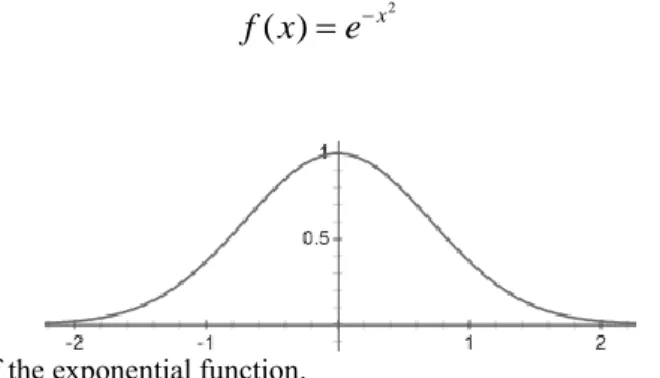
The effect radius defines the impact area around the word w. The basic idea is that the impact of a word on an observed position x is decreasing with the distance from writer’s position from this position x. We have two Tweets t1 and t2. Both have position data and include the word w. Tweet t1 is in the near of position x and has a positive smiley. Tweet t2 is far away from x and has a negative smiley. The Tweet t2
has no or only a very small impact on the sentiment for word w at position x. The impact of a word on the position x can be described by an exponential function. The simplest exponential function is:
2
)
(
x
e
xf
(2)
Fig. 4. Plot of the exponential function.
With an additional factor you can compress or stretch the curve and you can control the width of the curve. On the x = 2 position the function is nearly 0 (0.01). On this position, the impact of a word is very small and we can say it is nearly not existent. This position we call the effect radius.
6 Conclusion and Outlook
We have seen that social networks deliver us so much content that we can observe the sentiment of a large number of words. With a simple sentiment algorithm that uses the
that this method is language independent. With additional position data of the Tweets we can calculate the specific sentiment value of a word on a special position. The basic idea was that the influence of a word decreases with his distance. With these new ideas we could detect local sentiment jitter in real-time. So we can see for example the current weather only by the fact, that we observe the sentiment of the word “weather”.
Nevertheless many open questions and problems to solve in the future are left. On problem comes from the Tweets with positioning data. We think mobile users with the switched on positioning data option are not that type of users which normally write critical political statements. We also see improvement if we combine this approach with other methods [5, 6]. We see limitations if we work only with single words. We have to detect word pairs also. This would allow us to detect the mention of famous persons (by the detection of first name plus last name) much better.
Last but not least we want to mention that we use our platform not only to calculate the sentiment values. We are also able detect newly arising topics (words). In this approach we are also able to draw benefits from the positioning data of the Tweets. We hope to publish the work on that topic soon.
References
1. Davidov, D., Tsur, O., Rappoport, A.: Enhanced Sentiment Learning Using Twitter Hashtags and Smileys, http://aclweb.org/anthology-new/C/C10/C10-2028.pdf
2. Bifet, A., Holmes, G., Pfahringer, B., Gavaldà, R.: Detecting Sentiment Change in Twitter Streaming Data, in: JMLR: Workshop and Conference Proceedings 17 (2011) 5-11, 2nd Workshop on Applications of Pattern Analysis,
http://jmlr.csail.mit.edu/proceedings/papers/v17/bifet11a/bifet11a.pdf
3. Albert Bifet, Eibe Frank: Sentiment Knowledge Discovery in Twitter Streaming Data, University of Waikato, Hamilton, New Zealand,
http://www.cs.waikato.ac.nz/~eibe/pubs/Twitter-crc.pdf
4. Instagram: Twitter to Blame for Broken ‘Find Friends’ Feature
http://mashable.com/2012/07/26/instagram-twitter-to-blame-for-broken-find-friends-feature/ 5. Kubek, M., Nützel J.:, Novel Interactive Music Search Techniques, In: Proc. of the 7th
International Workshop for Technical, Economic and Legal Aspects of Business Models for Virtual Goods incorporating the 5th International ODRL Workshop (VG'09), Nancy (2009),
www.virtualgoods.org/2009
6. Kubek, M., Nützel J., Zimmermann F.: Automatic Taxonomy Extraction through Mining Social Networks, in: Proc. of the 8th International Workshop for Technical, Economic and Legal Aspects of Business Models for Virtual Goods incorporating the 6th International ODRL Workshop, Namur Belgium, www.virtualgoods.org/2010
Intellectual Commons, Commodification
and New Business Models
Miguel Said Vieira University of São Paulo,
[email protected],http://impropriedades.wordpress.com
Abstract. This research project analyzes the possible relationships be-tween immaterial commons (i. e., the practices of sharing around intel-lectual or cultural goods)1 and commodification (the process of turning something into a commodity: a private good produced to satisfy market needs); in particular, it poses the question of whether commodification can arise in or from within a commons, and how do so-called “open busi-ness models” affect that possibility.
Keywords:intellectual commons, commodification, open business models
1
Introduction
Since the advent of digitization (and, specifically, the “technical revolutions” brought about by microprocessors and global computer networks), we have seen a sharp rise in the possibilities of sharing immaterial goods. This trend, which has many positive consequences (particularly in fighting social inequality), par-alleled another, also observed since the second half of the 20th century, but that went in the opposite direction: the worldwide expansion and stiffening of intellec-tual property (IP) laws, which increased the possibilities ofcommodification of immaterial goods (a process with negative consequences that will be mentioned in the following sections). The first trend was caused in great part by the reduc-tion in costs of producreduc-tion, reproducreduc-tion and disseminareduc-tion of immaterial goods. Some costs – particularly those related to production –, however, remain, and a series of approaches to attempt to cover them are being developed. Among those approaches are the so called “open business models”; while it is feasible that they help sustain intellectual commons, it is not yet fully clear, on the other hand, if they can also avoid the negative consequences of commodification, and which approaches are better in this sense. Evaluating the possible interactions between open business models and commodification is the main practical goal of this research.
1
While this research does not directly explore the concept of virtual goods, it overlaps with the research’s main object: immaterial goods shared through digital technology.
2
Theoretical / methodological framework
As frequently happens with researches exploring collaboration and critical views of intellectual property, this project is interdisciplinary, drawing from the fields of media studies, economics, law, sociology and philosophy. Its perspective has, though, two features that stand out. The first is a philosophical approach (slightly favoring conceptual analysis and qualitative empirical examination), grounded particularly, but not exclusively, on political economy (Karl Polanyi, Karl Marx and David Harvey) and critical views of contemporary society (Hardt & Negri, Zygmunt Bauman, Elinor Ostrom). The second is an (also slight) focus in the field of education when analyzing the practical effects of these issues, in order to narrow down a bit the scope of the considerations.
The research is divided in three main topics: intellectual commons (in the context of commons theory); commodification (as a general societal issue, and as it affects intellectual commons); and open business models (a broad cate-gorization of types, exemplifying them and exploring how they each relate to commodification).
3
Intellectual commons
The main source for the research’s treatment of commons is the work of Elinor Ostrom. With a sophisticated mix of conceptual rigor and a broad empirical analysis, her work dealt a strong blow to the very popular idea of the “tragedy of the commons”: the belief that all commons are doomed by definition, because individuals are guided only by an extreme rational self-interest. Through the study of many examples gathered all over the globe (from collectively managed forests in Switzerland to shared systems of irrigation in the Philippines), she showed that in many cases commons do prosper, as people are able to commu-nicate and devise functioning systems. Her work also identified a series of design traits that are present in such commons.
While I recognize Ostrom’s research as a fundamental contribution to the field, I also try to provide a critical reading of it. One of her theory’s limitations is the fact that, in many ways, it is still based on a severely individualistic per-spective: the model of the individual as guided by rational self-interest is not discarded, but rather made more complex through the internalization of addi-tional variables, such as social norms and mid- and long-term considerations. That, along with the fact that her research was mostly focused on small-scale commons,2makes it difficult to attempt a more systemic approach to the
interac-tions between commons and society (as well as between different commons) with basis on the theory that she developed. For example, her categories display a certain blind spot with regard to the possibility that a commons might be based on the exploitation or dispossession of another commons somewhere else. This is 2 It would also be reasonable to contend, however, that this focus on smaller commons is as much a limitation as a deliberate characteristic of her approach, in order to allow for more detailed empirical work.
exemplified, in this research project, by an analysis of the linkages between the growing consumption of personal computers, smart-phones and tablets (that underpins development of Internet-based commons), and the dispossession of Congolese people because of civil war (largely financed by the mining of coltane, one of the minerals used in current gadgets).
In my research I also compare Ostrom’s commons approach to that of Hardt & Negri. While their work lacks the conceptual systematization and empirical operativeness which strongly characterizes Ostrom’s approach (and which has inspired many to work and collaborate on the field), they have the merit of attempting a more universal and systemic reading of commons. They try to go beyond the casuistic analysis of many localized commons, and look for unifying features of (and explanations about) all the shared “commonwealth” that humans generate through labor (particularly immaterial labor).
4
Commodification
The definition of commodification used in this research is mainly borrowed from Karl Polanyi. A commodity (the result of a process of commodification) is some-thing produced mostly to satisfy the needs of amarket system; that is, something produced according to “market signals”, in order to be sold in markets, and to generate money to purchase more commodities. This can be contrasted, for in-stance, with commons-based production, which aims to satisfy the need of a commons’ community (either directly, or in a more direct way than through market signals). One should note, however, that commodification is not a binary measure, but rather a continuum of shades of gray; and that commodification it is not the same as plain commercialization (the act of offering something for sale), which, even though a requisite to commodification, can coexist – as showed by plenty of ethnographic evidence gathered by Polanyi – with ways of production that place societal needs in first place with regard to market imperatives.
One of the negative consequences of commodification is that, being at best an indirect measure of communities’ needs, it frequently distorts them; this can be easily exemplified through the issue of neglected diseases in pharma-ceutical production. Although more than a billion people are affected by those life-threatening diseases, research to fight them receives practically no private investment, while less serious conditions for which there already are advanced treatments available (as is the case of erectile dysfunction) continue to receive lots of investment – for the development of so called “me too” medicines. This shows how, in important cases, market signals correspond much more to prof-itability than to communities’ needs; and how commodification can strongly reinforce social inequality and concentration of power.
Since the second half of the 20th century, one of the areas in which com-modification has significantly advanced is intellectual goods; a landmark in this trend is the Agreement on Trade-Related Aspects of Intellectual Property Rights (TRIPS), a section of the World Trade Organization treaty which effectively raised the bar on IP rights worldwide. IP rights are decisive for
commodifica-tion of intellectual goods, as they provide the possibility of holding exclusive rights over such goods. This is something necessary in order to legitimately sell a good, and particularly so in the case of intellectual goods, where – unlike what usually happens with material goods – ownership or possession are not easy to determine.
Commons and commodification appear to be in principle mutually exclusive, both because of this requirement of exclusive rights in order to sell a good, and because of the different aims guiding their processes. As contemporary society is growingly dominated by commodities-based production – and close to the market system described by Polanyi –, it should not be surprising, though, to encounter situations where commons exist side by side with (or embedded in) processes of commodification; but those are situations that will likely display a certain amount of conflict or contradiction – the main interest of the research’s next section.
5
New business models
This part of the research maps relevant “open business models” involving intel-lectual commons, and how they relate (positively or negatively) with commodifi-cation. By open business models, the research means those business approaches that do not rely on the kind of exclusive control of immaterial goods that char-acterized most of the IP-based industries. The main business models selected so far for analysis are those involving: sale of additional services; sale of additional goods (for instance, hardware, or “premium” proprietary versions of the shared intellectual goods); donations (crowd-financing, or direct corporate sponsorship); payment by authors; and financing through advertising. So far, the research ap-proaches those models as they manifest in free software projects, open access publishing and Wikipedia – selected because of their relevance with regard to education.
Donation and crowd-financing are probably the ones in whic