Dissertations UMSL Graduate Works
5-12-2014
Teacher Perceptions and Implementation of
Positive Behavior Support in Urban Language
Immersion Schools
Jeffrey Joseph Pauls
University of Missouri-St. Louis, [email protected]
Follow this and additional works at:https://irl.umsl.edu/dissertation Part of theEducation Commons
This Dissertation is brought to you for free and open access by the UMSL Graduate Works at IRL @ UMSL. It has been accepted for inclusion in Dissertations by an authorized administrator of IRL @ UMSL. For more information, please [email protected].
Recommended Citation
Pauls, Jeffrey Joseph, "Teacher Perceptions and Implementation of Positive Behavior Support in Urban Language Immersion Schools" (2014).Dissertations. 256.
TEACHER PERCEPTIONS AND IMPLEMENTATION OF POSITIVE BEHAVIOR SUPPORT IN URBAN LANGUAGE IMMERSION SCHOOLS
By
JEFFREY J. PAULS
M.A., Educational Administration, Lindenwood University, 2005 B.A., History, Truman State University, 1998
A DISSERTATION
Submitted to the Graduate School of the UNIVERSITY OF MISSOURI-ST. LOUIS In Partial Fulfillment of the Requirements for the Degree
DOCTOR OF PHILOSOPHY In
EDUCATION
With an emphasis in Teaching and Learning Processes May, 2014
Advisory Committee Alina Slapac, Ed.D. (Chairperson) Lisa Dorner, Ph.D. Virginia Navarro, Ph.D. April Regester, Ph.D.
© Copyright 2014 by
Jeffrey J. Pauls All Rights Reserved
Acknowledgements
I would like to thank the following people for their time, encouragement and contributions:
• The dedicated teachers and principals at the two language immersion schools where research was conducted;
• My dissertation committee and chairperson for sharing their expertise and guidance;
• Many friends and family members for their support and understanding throughout the process, especially my wife, Amy, two daughters, Lauren and Kendall, sister,
Table of Contents
Acknowledgements ...3
Abstract ...7
Chapter One: Introduction ...9
An Overview of the Classroom Management Literature ...10
Research Purpose ...14
Clarifying Terms ...14
Chapter Two: Review of Literature ...18
Positive Behavior Support ...18
PBS as an approach. ...19
SW-PBS as an approach. ...21
Research in the area of PBS. ...22
PBS and reward systems. ...25
Language Immersion Schools ...30
Urban Schools ...35
Culturally Relevant Classroom Management (CRCM). ...36
Interpersonal relationships. ...37
Using PBS in urban schools. ...38
Chapter Three: Research Methods ...43
Context ...43 Research Design...44 Participant Selection ...48 Data Collection ...53 Teacher survey. ...55 Teacher interviews. ...57 Principal interview. ...59 Classroom observations. ...60 Artifacts. ...61 Data Analysis ...62 Ethical Considerations ...67 My role as a researcher. ...68
Ways of increasing the validity of my study...69
What are the Ways in which Teachers Comprehend, Support and Utilize PBS? ....76
The classroom setting. ...80
Profesora Sandra. ...81
Profesora Benita. ...84
Three central themes. ...88
Connecting with students, families and teachers. ...88
Understanding/connecting with students. ...89
Hispanic culture. ...91
Parents. ...92
Challenges of urban language immersion. ...95
Urban school. ...95
Immersion. ...96
Tier 3 and children with special needs. ...98
Where we have been, where we are now, where we are going...101
Development. ...101
Training. ...105
Lesson plans. ...108
Improvement due to PBS. ...113
Ways to improve, difficulties, problems. ...116
Do Teachers' Understandings of PBS and their Adapted Classroom Management Practices Match the PBS Goals of the School? ...119
Comparing the schools. ...120
Defining characteristics of PBS at SIES. ...122
Individual adaptation of school-wide PBS. ...126
A school-wide system with room for individual teacher modification...126
Consistency. ...131
The “positive” in PBS. ...139
Chapter Five: Conclusion and Implications ...142
Summary of the study ...142
Major findings ...143
Limitations of the study ...152
Survey limitations. ...153
Suggestions for Further Research ...155
Appendix A: Informed Consent – Lead Teachers ...173
Appendix B: Informed Consent – Case Study Teachers ...176
Appendix C: Informed Consent – Administrator...179
Appendix D: Lead Teacher Survey...182
Appendix E: Interview Protocol with Case Study Teacher-Participants ...186
Appendix F: Initial Interview Protocol with Administrator ...188
Appendix G: Second Interview Protocol with Administrator ...189
Appendix H: PBS Classroom Observation Rubric ...191
Appendix I: Classroom Observation Rubric – Case Study Teacher A (Sandra) ...195
Abstract
Teachers at every level of schooling recognize the need for establishing a positive learning environment. Creating this type of classroom is a worthwhile but elusive goal due to ineffective approaches to managing student behavior. This is a common challenge for teachers and schools of every kind and every level but may be magnified for schools with specialized missions, such as language immersion schools.
This dissertation examines teacher perceptions of a classroom management and behavior support system called Positive Behavior Support, or PBS, specifically within urban language immersion schools. Research questions explored include: 1) In what ways do teachers at urban, language immersion schools comprehend, support and utilize the PBS system? and 2) How do teachers' understandings of PBS and adapted classroom management practices match (or not) the PBS goals of the school?
I surveyed lead teachers (n=28) at two language immersion elementary schools and completed a qualitative case-study examination of two teachers at one Spanish Immersion Elementary School (SIES); data included semi-structured interviews, observations in classrooms and an examination of PBS documents and artifacts.
Major findings from this study show that SIES teachers are informed of, and involved with, the school’s particular version of PBS and they are confident about the actual and potential benefit PBS offers in their own classrooms and throughout the school. SIES teachers have (1) made a conscious effort to utilize the school’s
implemented version of PBS, (2) prioritized the school’s goals and definition of PBS, and simultaneously, (3) thought and acted in ways demonstrating they had the flexibility to change the school’s approach to PBS to better fit their classrooms’ needs. Teachers feel
PBS has allowed them to develop better interaction with students, in particular, but also with parents and even other teachers. Finally, while teachers have identified a large number and type of PBS-related school improvements, they have also experienced difficulty when it comes to utilizing PBS in their unique immersion and urban contexts.
Key words: Positive Behavior Support (PBS), classroom management, language
Chapter One: Introduction
This dissertation study began as an idea during my tenure as a middle- and high-school foreign language teacher. As a secondary teacher I was interested in creating a positive classroom environment and maintaining a classroom management style that encouraged students to proactively and personally take responsibility for their behavior and performance in class. After four years of teaching I implemented Total Physical Response (TPR) and Total Physical Response Storytelling (TPRS) in my
foreign-language classroom which had a major impact on my students and me, as a teacher, as it not only changed how I taught and how students learned but, indirectly, how they were able to manage their own behavior as well. This helped me begin to think about how supporting positive student behavior in a foreign language classroom might be different from doing the same in other subjects.
For the past three years I have had the opportunity to work as a research assistant with significant involvement in organizing data and observation centered on the
classroom management challenges at two neighboring urban language immersion elementary schools, which represent the sites for the current study: Spanish Immersion Elementary School (SIES) and French Immersion Elementary School (FIES).1 This experience furthered my interest in finding out how teachers in language classrooms can be more productive and become more successful with supporting positive student behavior. Through this study, I addressed the multi-dimensional classroom management challenges faced by an urban language immersion elementary school. I also described the relatively small body of literature in the area of convergence between classroom
management and urban language immersion schools and the absence of research on these issues in combination with the Positive Behavior Support (PBS) approach.
An Overview of the Classroom Management Literature
The challenges facing urban schools in the area of behavior management are numerous
and have been well-documented (Brown, 2004; Bucalos & Lingo, 2005; Marx, 2001; Turner, 1993). The number of programs used to address these challenges are nearly as prevalent as the problems and challenges themselves (Macciomei, 1999; Turnbull et al., 2002). Despite the widespread documentation of such challenges and the myriad programs available to address them, many urban schools continue to face significant behavior management problems (Brown, 2004; Bucalos & Lingo, 2005; Marx, 2001; Milner, 2004; Turner, 1993). The continued difficulty in dealing with behavior issues in urban schools has led the researcher to conclude that relevant research can be gathered into three interconnected areas: (1) culturally relevant classroom management (CRCM) which adopts a cultural focus to address challenges in urban schools, (2) analyzing the characteristics of successful teachers of urban students, and (3) examining the
relationship between urban teachers and students.
Every school, according to the purposes and objectives of its mission, must evaluate and determine the guidelines for how teachers manage behavior. Language immersion schools, many of which provide instruction completely in a foreign language in the early grades (Center for Applied Linguistics, 2011), face unique issues (Curran, 2003). Though still somewhat rare in the U.S., have expanded significantly by number, type and location, from zero in 1971 to 448 in 38 states in 2011 (Center for Applied Linguistics, 2011). This total is comprised of all known language immersion programs
(one-way, two-way, etc.) by the Center for Applied Linguistics, categorized as pre-schools (97), elementary (337), middle (128) and high pre-schools (41), where pre-schools with more than one level (e.g., K-8 or K-12) were included in all relevant categories. The language immersion focus brings with it a whole new set of behavior management challenges for these schools. The challenges are numerous and multilayered but one of the most prominent could be the prevalence of foreign certified teachers who may have little training in classroom management techniques, who may have limited English proficiency, and who may not have the same type of authoritative approach to running a classroom as many U.S. teachers, especially U.S. teachers working in urban schools (Horowitz, 2005).
Another serious challenge in the area of behavior management for language immersion schools specifically is the fact that most students, of a new language, experience some difficulty with the academic demands and stress of interacting and learning in an unfamiliar language environment (especially those in immersion situations) (Slapac & Dorner, 2013). This type of frustration can lead to behavior problems. When students struggle academically, they are more likely to develop problem behaviors maintained by escape/avoidance of academic demands (McIntosh, Chard, Boland, & Horner, 2006; Preciado, Horner, & Baker, 2009). Off-task and disruptive behavior often occurs when the curricular expectations are not appropriately matched with the current skill levels of students (Preciado et al., 2009). This can be an excessively difficult demand for many teachers fluent in the target language but who are working with young students who progress in the language at very different rates.
Based on my previous observations in both the French Immersion Elementary School (FIES) and the Spanish Immersion Elementary School (SIES) and according to Slapac and Dorner’s (2013) research conducted at these schools, there is a need to assess the way in which teachers understand and incorporate classroom management strategies in their classrooms, especially now that SIES has adopted the schoolwide PBS approach. A careful examination of culturally relevant classroom management (CRCM) strategies and classroom management practices in language immersion schools such as the Positive Behavior Support (PBS) model is needed. Also important to understand is the
relationship between urban teachers and their students and the characteristics of
successful teachers in urban schools; this information helps provide important context for this study and the intersection of these issues.
Positive Behavior Support is a new model at SIES. It was introduced at this school officially in August, 2012 after a ten-month research and implementation period by the school district’s administrative team and the SIES- and FIES-comprised PBS implementation team. According to the principal, this decision was made due to increasing concern about behavior management and disciplinary policies at the school from both educators and families. It is valuable to understand the impetus for this
program as it provides context for how it is currently being implemented and received by teachers. A greater awareness of how teachers continue to interact with this approach in their classrooms is beneficial to the school’s administration, the PBS implementation team (comprised of administrators and teachers) and the teachers themselves. First and foremost, this research benefits these particular language immersion schools. Yet, the
results of this study should also help other schools identify possible areas of improvement related to classroom management and PBS.
Since there is a dearth of literature in the area of classroom management in language immersion schools, this study adds to the body of literature on this topic, specifically in the area of adaptation and use of the PBS model. The context of the research locations provided information-rich case-study opportunities which fostered a deeper understanding of how teachers at these unique schools perceived, used and adapted this new approach to supporting positive student behavior.
Research Purpose
The goal of this study was to examine the perceptions of teachers in an urban, charter language immersion school toward the newly implemented behavior support system, PBS. Teacher understanding, adaptation and use of the PBS approach was
measured and analyzed, focusing on the following questions: 1) In what ways do teachers at urban, language immersion schools comprehend, support and utilize the Positive Behavior Support system? 2) How do teachers' understandings of PBS and adapted classroom management practices match (or not) the PBS goals of the school?
The unique issues facing urban language immersion schools with regard to ensuring appropriate student behavior and establishing a comprehensive and productive behavior management program demonstrate the need for specialized research. Due to the relative recent rise and increased popularity of language immersion schools, this type of research is exploratory and an emerging area of study, especially as it relates to such schools in urban areas. This study documented teacher appropriation of PBS as a classroom management tool, including some of the difficulties, challenges, benefits and rewards of using this approach. Sharing findings encourages further interaction between teachers and administrators to identify the PBS needs of teachers as well as areas in need of reconsideration and adjustment to fully develop teacher understanding and utilization of PBS.
Clarifying Terms
Positive Behavior Support – PBS, also known as Positive Behavioral Support or
Positive Behavior Interventions and Supports (PBIS), is a system of supports that has been shown to result in more productive, preferred, and healthy lives for recipients (Dunlap, Sailor, Horner & Sugai, 2011). PBS has four core, defining features: (a) application of research-validated behavioral science; (b) integration of multiple
intervention elements to provide ecologically valid, practical support; (c) commitment to substantive, durable lifestyle outcomes; and (d) implementation of support within
organizational systems that facilitate sustained effects (Dunlap, et al., 2011). When PBS is employed in schools it is sometimes referred to as:
Schoolwide Positive Behavior Support –SW-PBS, is a term often used interchangeably
with PBS and PBIS but it more narrowly refers to a program of behavior support as applied schoolwide. It is specifically focused on ways to establish the social culture and individualized behavior supports needed for a school to be a safe and effective learning environment for all students (Sugai & Horner, 2011). It is the systematic and formal consideration of (a) measurable academic and social behavior outcomes, (b) information or data to guide decision-making and selection of effective behavioral interventions, (c) evidence-based interventions that support student academic and social behavior success, and (d) systems supports designed to increase the accuracy and durability of practice implementation (Sugai & Horner, 2002a; Sugai & Horner, 2011; Sugai, Horner, & McIntosh, 2008). Although PBS is the term that will primarily be used throughout this paper, it will be used synonymously with SW-PBS, with the specific schoolwide emphasis.
One-Way/Total Language Immersion Schools– Programs in which all or almost all
subjects taught in the lower grades (K-2) are taught in the foreign language; instruction in English usually increases in the upper grades (3-6) to 20%-50%, depending on the
program (Center for Applied Linguistics, 2011). The school under study is an example of the one-way language immersion design.
Urban School –School located inside urban areas which, as defined by the U.S. Census
Bureau (2001), have “core census block groups or blocks that have a population density of at least 1,000 people per square mile and surrounding census blocks that have an overall density of at least 500 people per square mile” (p. 1) and an overall population of at least 50,000 people (U.S. Census Bureau, 2012).
Since education literature also uses the phrase “urban school” to connote poor, minority, and English Language Learner (ELL) families, I also include the demographics of the two schools involved:
Spanish Immersion Elementary School (SIES) – Total enrollment for the 2012-2013
school year was 370 students. This total is comprised of 212 African-American students (57.3%), 85 Caucasian students (23.0%), 63 Hispanic students (17.0%), 2 Asian students (0.5%), and 8 students in the ethnicity classification of “other” (2.2%). 208 students qualified for Free and Reduced Price Lunch (56.2%).
French Immersion Elementary School (FIES) – Total enrollment for the 2012-2013
school year was 329 students. This total is comprised of 191 African-American students (58.1%), 122 Caucasian students (37.1%), 9 Hispanic students (2.7%), 1 Asian student (0.3%) and 6 students in the ethnicity classification of “other” (1.8%). 178 students qualified for Free and Reduced Price Lunch (54.1%).
With an understanding of key terms, an overview of the literature, a general description of the study, and an introduction to the research questions examined by this study it will now be possible to explore each of these areas in more detail. Specifically, the following chapter offers a review of the literature in the areas of Positive Behavior Support, language immersion schools and urban schools. Chapter Three discusses the study’s qualitative case study approach, outlining the data analysis process and the data collection tools including a descriptive survey, teacher and principal interviews,
classroom observations and PBS document analysis. Chapter Four proceeds with the presentation of the results of the study, focused around the two primary research questions driving the study: 1) In what ways do teachers at urban, language immersion schools comprehend, support and utilize the PBS system? And, 2) How do teachers' understandings of PBS and adapted classroom management practices match (or not) the PBS goals of the school? Finally, Chapter Five offers discussion of the major findings and central interpretations of the data and concludes with suggestions for future research.
Chapter Two: Review of Literature
In examining educators’ understanding, support and use of the PBS model there are several important and divergent themes that need to be explored before a proper understanding can be developed. The central theme focuses on the specific school-wide behavior support system, PBS, its SIES-specific structure and how complementary this particular approach is to the unique characteristics of this school and the singular
challenges it faces. The unique combination of urban and language immersion schools is a second theme and one that must be separated into two sub-themes (urban schools and language immersion schools) and addressed from both angles since there is little research on the convergence of these two types of schools in the area of classroom management.
Positive Behavior Support
Over the past thirty years Positive Behavior Support has become one of the most widely-utilized behavior support and management approaches in U.S. schools (Dunlap et al., 2011), having been implemented in over 20,000 schools across the country (Center on Positive Behavior Interventions & Supports, 2014). The two main goals of schoolwide PBS are to positively support teaching and learning environments so that the academic outcomes are maximized and to formalize the school and classroom organization and operation so that a positive social culture is established (Sugai & Horner, 2011). It is this approach to systematic school-wide behavior support that two language immersion schools chose to implement in 2012 to help address the aforementioned behavioral problems. In order to understand the PBS context, how these schools utilize PBS, and how the teachers relate to and adapt PBS in their own classroom contexts, it is important
to first examine the more general PBS approach and then survey SW-PBS, which, from a historical viewpoint in the literature, is drawn from PBS.
PBS as an approach. PBS is a decision-making framework that guides selection,
integration, and implementation of evidence-based behavioral practices. PBS emphasizes positive interactions and decisions that enable recipients to participate fully in day-to-day life (Dunlap, et al., 2011). The most common forms of PBS today offer “a comprehensive approach to preventing emergence of life-restricting behavior through increasing degrees of positive individualized supports across social systems” (Sailor, Dunlap, Sugai & Horner, 2011, p. vii). PBS represents an approach to behavior support and management that addresses all ages from early childhood through adulthood as well as the full
behavior and cognitive spectrum.
The PBS approach developed out of research in Applied Behavior Analysis (ABA) and function-based interventions (Dunlap et al., 2011). In 1987, the U.S. Department of Education established a non-aversive behavior management research center, based on early PBS research in ABA and function-based interventions. The goal for the researchers connected to the center was to promote community and educational inclusion for people with disabilities and functional, non-aversive interventions for behavior problems (Dunlap et al., 2011; Horner et al., 1990). The first formal iteration of PBS was presented in 1990 in a paper by researchers associated with the center who introduced this new, preferable term, “positive behavioral support” (Horner et al., 1990, p. 126). Research in the area of PBS rapidly expanded in the 1990s and early 2000s (Luiselli, Putnam & Sunderman, 2002; Sugai & Horner, 1999; Sugai et al., 2000;
of behaviorism and established methods of intervention developed by the ABA and function-based interventions researchers and turned the focus to “creating and sustaining school environments that improve lifestyle results (personal, health, social, family, work, recreation, etc.) for all children and youth by making problem behavior less effective, efficient and relevant, and desired behavior more functional” (Sugai et al., 1999, p. 6).
Specifically, PBS is conceptualized as a risk prevention system applicable to three levels of intervention: Primary-tier interventions, which are directed to all members across all settings and contexts of a specialized social ecology (e.g., a school).
Secondary-tier interventions are directed to individuals of a specific group or aspect of the total ecology (e.g., a classroom) because their behaviors have been unresponsive to primary-tier interventions. Tertiary-tier interventions are directed in more individualized and intensive forms to individuals whose behaviors are unresponsive to secondary- and primary-tier interventions (Dunlap et al., 2011). There are multiple iterations of PBS and another common description of the approach focuses more on three levels of
“prevention” and outlines specific percentages associated with each level: The first level, “primary prevention” is aimed at the majority (80 percent) of a school population and offers school- and classroom-wide systems for all students, staff and settings.
“Secondary prevention” is aimed at 15 percent of the school population and offers specialized group systems for students with at-risk behavior. “Tertiary prevention” targets the remaining five percent of the population and presents specialized individual systems for students with high-risk behavior (Sugai & Horner, 2002b; Walker et al., 1996).
SW-PBS as an approach. Schoolwide Positive Behavior Support (SW-PBS) has
many of the same defining characteristics and practices as PBS, including the three-tier intervention structure, but it was developed to address the specific social behavior and discipline needs of schools. SW-PBS originated in the late 1980s and early 1990s due to renewed interest in improving student social behavior development and implementing effective behavior management practices (Sugai & Horner, 2011). The renewal of interest is noteworthy because these issues have long been a source of concern and discussion as they relate to the field of education and our schools. In fact, both the general public and educators have rated behavior related issues in the top three concerns facing the public schools over the last 35 years in the 36th Annual Phi Delta
Kappa/Gallup Poll of the Public’s Attitude toward the Public Schools (Rose & Gallup, 2007). Perhaps the renewal of interest is due to recent major national legislative acts (e.g., Individuals With Disabilities Act [IDEA], which requires as part of the legislation that students receiving special education services be given PBS strategies before any other techniques to address challenging behavior, or the No Child Left Behind [NCLB]) or simply, that despite the longstanding concern about behavior-related issues in schools (e.g., classroom management challenges, disruptive student behavior, poor social
development of students, school safety concerns), such problems have seemingly only increased in rate and intensity (Sugai & Horner, 2011). To deal with these challenges many schools formulate reactionary rules that rely on escalating consequences and punishment to control and deter disturbing or disruptive behavior (Skiba & Peterson, 1999, 2000). SW-PBS was established as an alternative approach, to support social behavior development and teaching and learning environments of the school for all
students by emphasizing prevention, an instructional perspective, evidence-based
interventions, behavioral theory and behavior analysis, and a systems perspective (Sugai & Horner, 2011).
In addition to having behavioral roots, Sugai and Horner (2011) mention SW-PBS has several other defining characteristics: (1) a continuum of behavior support
interventions and systems (the three tier model of prevention), (2) an instructional focus (directly teaching social behaviors that increase social and academic success at school), (3) an emphasis on the selection, adoption, and use of evidence- or research-based behavioral practices (using practices that have been tested, replicated, and applied through experimental and quasi-experimental research designs), (4) the adoption of a systems perspective (rather than simply holding group training events, establishing local capacity and expertise, majority agreements and commitments, high levels of
implementation readiness, high fidelity of implementation, and continuous
implementation and outcome evaluation, (5) the collection and use of data for active decision-making (to determine if defined practices are being implemented with fidelity and if those practices are having a positive impact on student outcomes.
Research in the area of PBS. Extensive research on how PBS has been
implemented, how it functions and the levels of success experienced, in all kinds of schools is available (Handler et al., 2007; Sailor et al., 2006) and the same is true, specifically with regard to PBS and urban schools (Bohanon et al., 2006; Morrissey, Bohanon & Fenning, 2010; Putnam et al., 2011; Warren et al., 2003). There is evidence demonstrating the effectiveness of PBS and that PBS has a positive impact in the area of behavior management and discipline in urban elementary and middle schools. There is
less evidence of such success in high schools (Horner, Carr, Strain, Todd, & Reed, 2002; Morrissey, Bohanon & Fenning, 2010; Sugai, Flannery, & Bohanon-Edmonson, 2005).
Since this study is aimed at examining how teachers use PBS in their classrooms and their perceptions of the approach, it is helpful to be familiar with effective PBS measuring tools. These tools outline the ways and measure the extent to which teachers utilize PBS in schools where it has been adopted. Several such tools have been
established and proven useful to schools and evaluators of these programs (Albin, Lucyshyn, Horner & Flannery, 1996; Horner et al., 2004; Simonsen, Sugai & Negron, 2008). Since this study is on teacher understanding, support of and use of PBS structures and not on the implementation process or outcome of PBS in the school, these tools may be used simply to provide context for the observation rubric (Lewis, 2007) that I have adapted (Appendix D) in order to evaluate the ways in which actual teachers’ use of PBS matches (or not) the school’s own particular design of the approach. In seeking to analyze teacher use of PBS here, it is important for the researcher and readers to
remember that this approach is a new and ever-developing method of supporting positive behavior at these particular schools.
Finally, there is little research in the area of how this behavior management approach has been applied in language immersion schools, whether urban or another type. Thus, with regard to this particular study, it is entirely reasonable and helpful to utilize the existing research in the area of PBS and urban schools to foster a greater understanding of the context within which these teachers are working, but there is simply no such benefit in the area of language immersion. Despite the lack of a direct
look closely into the phenomenon of how teachers interact with, understand and utilize PBS in non-language immersion schools. McCurdy, Kunsch and Reibstein (2007) found, through use of the Intervention Rating Profile (IRP; Martens, Witt, Elliott, & Darveaux, 1985), which is a measure of teacher acceptability, that teachers demonstrated strong satisfaction with the PBS intervention. The mean score across all teachers involved in the intervention was 78 (range = 15–90; higher scores denote greater acceptability). These particular results serve to demonstrate that, despite the mixed outcomes for the eight students receiving the interventions (four of the students showing successful outcomes, two showing moderately successful outcomes, and two showing undesirable unsuccessful outcomes), teachers demonstrated a high level of acceptability of, and satisfaction with, the PBS intervention. The extent to which these results can be utilized is limited by the fact that teachers were not the focus of this research and their
perceptions were only minimally investigated (their measured level of “acceptability” of the PBS intervention).
In a more applicable teacher-focused examination of PBS, also conducted at an elementary school, Strout (2005) provides significant context and recommendations for teachers who are going through the process of adopting PBS structures into their
classrooms. She examines the case of a first grade teacher who has recently gone through the process of implementing PBS in her classroom. Together the researcher and teacher assert that utilization of the PBS approach can improve student success rates in areas of behavior and academic success (Strout, 2005). Specifically, she provides
recommendations to teachers with regard to using PBS to strengthen and highlight the following broad areas: prevention, teaching and maintenance of appropriate behavior.
Based on her findings in the area of preventative strategies, Strout (2005) encourages teachers to (a) keep high traffic areas free of congestion, (b) be sure students can be easily seen by the teacher, (c) keep frequently used teaching materials and student supplies readily accessible, and (d) be certain students can easily see whole-class presentations and displays. In the area of teaching strategies, she suggests teachers (a) create (and allow students to help) rules and guidelines that clearly communicate classroom expectations, (b) create a matrix of rules for each location or context in the classroom, categorized as examples of the schoolwide expectations (and be prepared to add/revise as necessary), (c) instruct students in what the expected behaviors are in the same manner as they provide instruction in how to read and how to complete a math problem. Finally, in the area of maintenance strategies, she stresses (a) consistency, (b) proximity control, and (c) student choice (Strout, 2005). Due to the
recently-implemented PBS approach in an elementary setting in which Strout researched, her recommendations provide important context and offer significant relevance to this study. The major difference between Strout’s research and that of the current study is the
addition of an urban, language immersion context. Once again, the broader nature of Strout’s research points to the need for this study which expands the field to include the unique challenges facing urban language immersion elementary charter schools and teachers who are implementing PBS in their classrooms.
PBS and reward systems. Not all of the research in the area of Positive
Behavior Support is “positive” and there is extensive and widely-respected research pointing to alternative methods of classroom management that offer distinctly different philosophies. It is beyond the scope of this literature review to examine all of the
competing and alternative approaches to classroom management but the Child
Development Project (CDP), or its more recent iteration, the Caring School Community (CSC), is one such example which provides excellent context for the rest of this section related to the idea of rewards and behavior, and even offers some significant overlapping context for the subsequent “Urban Schools” section of the literature review. CDP
became CSC in 2004, having developed and originated from:
research supported claims that students’ academic, social, and ethical
development benefit from: caring school communities, having their psychological needs for autonomy, belonging, and competence met; having a better sense of “connectedness” to schools; cooperative rather than competitive learning environments; and social support and guidance from teachers in formal and informal learning situations. (U.S. Department of Education, 2006, p. 2) One of the ways in which CDP became so popular with teachers and schools across the country is through the publication of Marilyn Watson’s (2003) influential book, Learning to Trust: Transforming Difficult Elementary Classrooms through
Developmental Discipline, in which the author works with a classroom teacher to do what the subtitle proposes and highlights the urban school’s use of CDP in its efforts to
manage student behavior. An idea central to Watson’s (2003) work is based on Nel Noddings’ writing in the area of caring and ethical education, or what Watson refers to as “Developmental Discipline”. Watson (2003, p. 4) states that Developmental Discipline stresses teachers:
• Help their students understand the reasons behind classroom rules and expectations
• Teach any relevant skills the students might be lacking
• Engage students in a collaborative, problem-solving process aimed at stopping misbehavior
• Use non-punitive ways to externally control student behavior when necessary These important aspects were developed from Watson’s (2003) research and experience working with children prone to misbehavior who, she writes, “are bound to feel coerced and alienated when their teachers try to curb their unacceptable behavior with punishments” (p. 3). Thus, it is evident that a central tenant of CDP, CSC and Developmental Discipline is a focus on finding alternative ways of stopping misbehavior and avoiding the use of more traditional rewards and punishments. In the forward to Learning to Trust, Alfie Kohn highlights this difference, stating that it is a “…myth that we simply must resort to bribes (‘positive reinforcement’), threats (‘consequences’), and other instruments of coercion in order to deal with angry, resistant students” (p. xv).
The information on CDP, CSC and Developmental Discipline is helpful in
demonstrating that PBS is not the only well-established and popular approach to behavior management, but more importantly, to provide valuable context in the discussion of PBS and reward systems. It would be an oversimplification of PBS, and in truth, inaccurate, to assert that PBS relies primarily on an external positive reward system to support behavior, but there is a dimension to this approach that lends itself to be used in just such a way. Due to the omnipresent viewpoint that sees PBS as a modified positive reward system and as additional explication of why this is not an appropriate or beneficial
understanding, Deci and Ryan’s (1980) influential Cognitive Evaluation Theory (CET) is presented. It, too, provides valuable context, as it was originally designed to explain positive and negative reward effects on intrinsic motivation. The authors explain CET from a psychological perspective:
Events that decrease perceived self-determination (i.e., that lead to a more external perceived locus of causality) [including the offering of rewards, the delivery of evaluations, the setting of deadlines] will undermine intrinsic motivation, whereas those that increase perceived self-determination (i.e., that lead to a more internal perceived locus of causality) will enhance intrinsic motivation….Finally, rewards (and other external events) have two aspects. The informational aspect conveys self-determined competence and thus enhances intrinsic motivation. In contrast, the controlling aspect prompts an external perceived locus of causality (i.e., low perceived self-determination) and thus undermines intrinsic motivation. (Deci, Koestner, & Ryan, 2001, p. 3)
As mentioned previously, since PBS does feature positive feedback and can offer reward systems as part of agreements and interventions, a controlling aspect can be associated with this approach. This is not a desired effect of the approach, as can be seen from the earlier description of the origins of PBS from non-aversive interventions to problem behavior but the approach has the potential to be used in such a way by teachers and administrators who are less familiar with its origins and with Deci and Ryan’s (2001) research on motivation and rewards systems. With regard to the potential rewards often associated with the PBS approach, even CET wouldn’t denounce all types, however:
Verbal rewards typically contain explicit positive performance feedback, so CET predicts that they are likely to enhance perceived competence and thus enhance intrinsic motivation….Nonetheless, verbal rewards can have a significant controlling aspect leading people to engage in behaviors specifically to gain praise, so verbal rewards have
the potential to undermine intrinsic motivation. The theory therefore suggests that the interpersonal context within which positive feedback is administered can influence whether it will be interpreted as informational or controlling….An interpersonal context is considered controlling to the extent that people feel pressured by it to think, feel, or behave in particular ways. Verbal rewards administered within such a context are thus more likely to be experienced as controlling rather than informational. (Deci, et al., 2001, p. 4)
Thus, it is imperative that teachers and administrators who use PBS understand how important the interpersonal context is upon the success of the approach and whether students consider positive feedback informational or controlling.
This is not necessarily the case with tangible rewards which, according to CET, is generally considered to be controlling, no matter the interpersonal context:
Unlike verbal rewards, tangible rewards are frequently offered to people as an inducement to engage in a behavior in which they might not otherwise engage. Thus, according to CET, tangible rewards will tend to be experienced as
controlling, and as a result they will tend to decrease intrinsic motivation. (Deci, et al., 2001, p. 4)
The overarching Cognitive Evaluation Theory is important in cautioning teachers and administrators who see PBS simply as a well-developed positive reward system. Whether within the PBS approach or not, Deci et al. (2001) suggest practitioners “focus more on how to facilitate intrinsic motivation, for example, by beginning from the students’ perspective to develop more interesting learning activities, to provide more choice, and to ensure that tasks are optimally challenging” (p. 15).
Since the two main goals of PBS are to “positively support teaching and learning environments so that the academic outcomes are maximized and to formalize the school and classroom organization and operation so that a positive social culture is established” (Sugai & Horner, 2011, p. 311), the following brief summary of the extensive results from Deci and Ryan’s meta-analysis of studies on motivation is especially relevant:
….Contexts supportive of autonomy, competence, and relatedness were found to foster greater internalization and integration than contexts that thwart satisfaction of these needs. This latter finding, we argue, is of great significance for
individuals who wish to motivate others in a way that engenders commitment, effort, and high-quality performance. (Ryan & Deci, 2000, p. 76)
In summary, the interpersonal contexts and PBS’s “consideration of each
individual’s well-being and overall quality of life” (Bradley, 2011, p. vi) and the intrinsic motivation with which students approach a subject must remain a priority for
practitioners of PBS. This is opposed to a large system of external rewards which can become an easy modification and a watered-down version of Positive Behavior Support.
The claim that immersion schools have a unique and powerful effect on students and their behavior is an important yet relatively unexplored topic. In this study it is an essential understanding and is explained in the limited research on the connection
between classroom management and language classrooms (Curran, 2003; Fortune, 2011; Preciado et al., 2009; Slapac & Dorner, 2013; Wright, 2005). Also, the convergence of language immersion and classroom management represents a distinctive context in which to study PBS and teacher perceptions and implementation of the approach. The broad research base focusing on the connection between academic difficulty and classroom management is also helpful. It is a well-established and well-researched phenomenon that when students struggle academically, they are more likely to develop escape and avoidance problem behaviors (McIntosh et. al., 2006). Moore, Anderson, and Kumar (2005) found that inappropriate expectation levels in terms of academic demands increase the likelihood of misbehavior. Preciado et al. (2009) also conducted important research demonstrating that when academic expectations are not correctly matched with the current skill levels of students, behavior problems will result.
Curran (2003) also provides direct support for the assertion that language immersion environments have an important impact on student behavior and present special challenges to teachers. She describes a number of “natural responses (e.g., boredom, attention-seeking behavior, first language use, silence, and fatigue) that occur when our students participate in interactions in which they are not proficient in the language” (p. 335). The extant research demonstrates the effects of immersion on classroom management, which are more widespread than initially thought.
More applicable to this study is the research by Slapac and Dorner (2013), which analyzes the classroom management challenges that surface in bilingual environments, specifically in total language immersion settings. This case study focused on a
kindergarten class and teacher at the French Immersion Elementary School (FIES). Such things as the political context, the open-style of the classroom space (FIES was formally located within a converted warehouse but has since moved; The Spanish Immersion Elementary School (SIES) remains at this location), foreign teacher training and background, FIES’ language policy (all teachers speak 100 percent in the target language) and the recent opening of the school itself, presented unique and significant challenges. Most relevant to the current study are Slapac and Dorner’s (2013) finding that three main factors shaped classroom management in this particular language immersion environment:
(a) this was a new charter school, using non-traditional classroom spaces; (b) this school
had a most diverse mix of children and teachers from different racial, ethnic, and socioeconomic backgrounds; and (c) FIES was trying to do both constructivist and immersion education without a range of support or training. (p. 269)
These findings are especially important in providing context for the current study since it also focuses on FIES and its sister school, SIES. Slapac and Dorner (2013) make a list of specific recommendations based on these findings which have important
implications for this study and for other language immersion schools that deal with similar challenges:
• …Administrators’ analysis of classrooms will help them best understand issues stemming from the building environment or high-stress and emotional moments. Collaborative or participatory action research, with a cycle of observing, reflecting, acting and evaluating, could contribute to professional growth and empowerment for teachers (Hendricks, 2013). Such studies will help educators work against the common notion (here) that language was the issue.
• Teachers must learn how to differentiate and implement culturally responsive behavior management, according to their classroom’s context as well as students’
family backgrounds, beliefs, values and cultural norms.
• If hiring native speakers, administrators need to consider the linguistic, cultural,
racial, and experiential diversity of teachers as well, in order to differentiate and provide appropriate professional development, such as visiting similar language immersion or urban schools for new ideas. Creating communities of practice through professional development or working with other immersion school educators “can give teachers relief from isolation, provide
opportunities for conscious reflection and evaluation of teaching, and support teachers’ efforts in action research” (Bloom, 2009, p. 84).
• Especially in new language immersion settings, communication among all stakeholders (teachers, administrators, parents, and students) is key; teachers can easily get overwhelmed, for instance, while developing new curricula.
Open and sincere communication in formal or informal ways would help energize the environment and address issues as they arise. (Slapac & Dorner, 2013, p. 270)
Another perspective related to how teachers combine classroom management and immersion contexts is demonstrated by the research of Horowitz (2005) and Walker and Tedick (2000). These studies describe how foreign teachers in language immersion schools can become contributors to the classroom management issues that arise. These authors mention that the majority of such teachers have had little experience in U.S. schools and many of them do not even understand why classroom management is a skill expected of teachers in the United States. Other cultures assume respect for teachers so authority is unquestioned. Authority in the eyes of U.S. students must be earned; teachers need to learn how to communicate classroom procedures and expectations to students (Horowitz, 2005). Walker and Tedick (2000) focus on the fact that many foreign teachers have to "learn on the job", lack opportunity to build on years of established practice, and struggle with navigating the complexities of an immersion classroom.
Another related issue, discussed at length by Horowitz (2005) and Emmer (1994) is the inability on the part of foreign teachers to identify misbehavior. This may be due to the language barrier, a lack of training in/understanding of classroom management
(Horowitz, 2005) or varying cultural expectations around “doing school”. Emmer and Evertson (2013) defined the phrase ‘withitness’ as a "general awareness of the classroom, which is communicated to students; prompt and correct identification and correction of misbehavior" (p. 98). Emmer (1994) also suggests that “being unfamiliar with American
schools and adolescents, it [is] difficult for the [teachers] to separate minor misbehavior from appropriate behavior and to determine the seriousness of the misbehaviors; they [are] therefore unable to show appropriate ‘withitness’” (p. 96).
A third perspective of classroom management and immersion schools focuses on the parents and families of students attending these schools. Fortune and Tedick (2003) have written widely on the added importance of parental and familial support for students enrolled at language immersion schools. Their research indicates that, even more than at regular schools, parents need to be involved, specifically to provide their children with opportunities to develop their English language and literacy development since this is often not a focus of language immersion schools (especially in total language immersion programs) until upper elementary grades. This is essential because Fortune and Tedick’s research (2003) shows that the stronger the development of the native language, the greater the proficiency in the immersion language. This provides an important tie to the previously-mentioned research of Curran (2003), Preciado et al. (2009), McIntosh et al. (2006) and Moore et al. (2005), regarding the connection between classroom
management problems and academic difficulty.
Urban Schools
Before examining some specific studies that investigate classroom management in urban schools, it is helpful to gain a broader awareness of other classroom management approaches used in urban settings that are oppositional in nature to the PBS approach. Such an understanding might help clarify the limitations of the particular classroom management approach highlighted in this study.
Culturally Relevant Classroom Management (CRCM). There have been a
number of important studies that have investigated the issue of classroom management in urban schools (Brown, 2004; Bucalos & Lingo, 2005; Marx, 2001; Milner, 2004; Turner, 1993). There have also been a number of thorough examinations of the types of
programs used to address these challenges (Macciomei, 1999; Turnbull et al., 2002). Culturally relevant classroom management (CRCM) is a continually emerging idea connected to the various classroom management approaches adopted by urban schools. The most significant study of CRCM is Brown’s (2003, 2004) direct study of how teachers in urban schools have effectively used CRCM to enhance classroom
management. Based on his findings, Brown (2003) proposes three ways to help teachers improve classroom management in urban schools: (1) caring for students, (2) being assertive and acting with authority, and (3) communicating effectively with students.
Further research solidifies Brown’s findings and demonstrates that successful urban teachers possess a unique set of characteristics which include being assertive, exhibiting personal power, establishing meaningful interpersonal relationships, demonstrating the belief that all students can learn, holding students’ attention, and gaining knowledge of students’ cultures (Bondy, Ross, Gallingane, & Hambacher, 2007; Delpit, 1995; Milner, 2004; Thompson, Warren & Carter, 2004; Weinstein, Curran, & Tomlinson-Clarke, 2003). This study relies on this area of research in order to compare how the specific PBS program implemented by these schools enhanced or weakened such characteristics of the teachers.
The research of Ladson-Billings (1994) is related but focuses more on effective teachers of African American students. Since African-American students are
overrepresented in urban schools (Markey et al., 2002), Ladson-Billings demonstrates which aspects of general behavior support systems might be more effective in helping teachers work with their African-American students in particular, but, by extension, with all of their urban students. Ladson-Billings (1994) emphasizes the need for teachers of African-American students to ensure their “psychological safety” (p. 73) and that students excel when they see their teachers as “coaches” who provide a structured and supportive learning environment. This would seem to be good advice for teachers of all types of students but the point, according to Ladson-Billings (1994), is that teachers who are successful in working with urban African-American students establish a particular balance of personal assertiveness, understanding of students’ cultures and a safe and supportive teaching style.
Interpersonal relationships. A final sub-theme of the articles on urban schools
is the idea that “to teach you is to know you” which McDermott, Rothenberg, and Gormley (1998) used to describe their research about the relationship between inner-city students and their teachers. This study, as well as the previously mentioned work by Brown (2003, 2004), Delpit (1995), and Milner (2004) and that of Bucalos and Lingo (2005) and Howard (2001), reflects the importance of positive interpersonal relationships between the teacher and student. Interestingly, the findings of McDermott et al. (1998) supported Ladson-Billings’ (1994) work in some areas (teachers’ excellence is at least partially due to their sense of efficacy with children and care for children) but
demonstrated quite different results in terms of the importance of excellent urban teachers’ political motivation toward education and a high level of cultural
practice of excellent urban teachers). The authors acknowledge that their “sample might reflect more of a conservative, status-quo point of view about urban education” (p. 18), which also represents an important alternate perspective of excellent urban teachers. Kohn (1996) and Lipton and Oakes (2003) deal with the same topic but from a
psychological perspective and focus on traditional, behaviorist approaches that tend not to work as well in urban schools.
Using PBS in urban schools. Since the connection between urban schools and
PBS is an essential one in the current study, it is helpful to develop a greater
understanding about this particular combination of research areas. There are a number of influential studies on the implementation of PBS in urban schools, which provide
important context. Putnam, McCart, Griggs, and Choi (2011) provide a comprehensive compilation of important PBS/urban schools studies and how they are situated within the literature in this area. The key findings of several of these studies are mentioned below.
The first of these is a study conducted by Netzel and Eber (2003) on the development of PBS in an urban elementary school in the Waukegan, Illinois school district, which found that regular SW-PBS self-evaluation is an influential factor in successful PBS implementation. This is of particular significance to the current study which, due to its case study nature, has the side benefit of helping teachers at SIES examine their use and adaptation of PBS. Netzel and Eber (2003) also presented data showing a significant reduction in discipline referrals and suspensions after one year of implementation, which is a common theme throughout the research on PBS and urban schools (Putnam et al., 2011). These common findings help to validate the schoolwide effort to implement PBS at SIES, a school that shares many characteristics with the urban
elementary schools examined in these studies. An important counterpoint question would be whether the decreased number of referrals and suspensions actually reflect a
corresponding decrease in problem behaviors. In one of the rare multi-year PBS studies, especially on the effect of PBS on behavior, Dunlap et al. (2010) found that problem behavior, overall, does diminish after implementation of PBS. Turnbull et al., (2002) also found similar results. The Dunlap et al. study provides the individual ratings for 21 participants over two years:
Inspection of these data for Year 1 indicate that 17 of the participants showed improvement with respect to their problem behavior, 2 were rated as showing no change, and 2 were considered to have gotten worse. For Year 2, 18 participants were rated as having improved relative to baseline, 1 was rated as showing no change, and 2 were rated as having their problem behavior worsen. (Dunlap et al., 2010, p. 270)
Finally, it is important to note that none of the studies Putnam et al. (2011) examined focus on language immersion schools, which is how this particular study is uniquely positioned to add to the literature on urban schools and PBS.
Despite the overall positive tone of the research on PBS in urban schools, the picture would be incomplete without mentioning the challenges of implementing PBS in urban schools (Bohanon et al., 2006; Netzel & Eber, 2003; Putnam et al., 2011).
Variables contributing to these challenges may include aspects associated with schools in urban areas such as large school enrollments, high poverty rates, limited resources, and highly diverse communities (Bohanon et al., 2006; Markey, Markey, Quant, Santelli, & Turnbull, 2002; Netzel & Eber, 2003). Markey et al. (2002) suggested that in all urban
environments “there are traditionally underserved communities. These are communities that are isolated because of racism and poverty, cultural and language differences, and/or because they are located in densely populated distressed areas” (p. 218). There is
evidence to indicate that many of these variables do indeed, make it more challenging to implement a sustained PBS program in urban schools (Bohanon et al., 2006; Markey et al., 2002, Netzel & Eber, 2003; Putnam et al., 2011).
To combat these issues, there are a number of proactive steps that teachers can take to help ensure the success of PBS in their classrooms and schools. Tied to the aforementioned research by Brown (2003, 2004) regarding Culturally Relevant
Classroom Management (CRCM) and that of McDermott et al. (1998) and Milner (2004) on the relationship between inner-city students and their teachers, is the more specific PBS-related research of Utley, Kozleski, Smith, and Draper (2002) which emphasizes the necessity for PBS programs in urban contexts to incorporate multicultural education principles, and to establish respectful relationships between teachers and students. Sugai et al. (2000) assert that PBS, as an approach, emphasizes the use of culturally appropriate interventions and suggest that the individualized learning histories of all students be utilized and analyzed in order to make behavioral support decisions. From a practical and schoolwide implementation standpoint, Utley et al. (2002) also discovered that all stakeholders benefitted from being exposed to:
multiple segments of performance-based evidence such as video clips that show a range of student deportment not only in the classroom but also on the school grounds, in the hallways, cafeteria, and library. By engaging families and students in reviews of actual student performance, the subsequent dialogue leads
to a broader agreement on what constitutes acceptable student behavior in the school….Of course, this may mean that teachers and other professionals need to moderate their standards of student comportment based on the dialogue and agreed standards of performance. Logically, it means that families and students need to develop a greater appreciation for the difficulty of managing behavior in group situations where the degrees of freedom may not be able to be as broad as they are in family and community settings. (p. 202-203)
Urban schools and classroom management research is wide-ranging but is most helpful for this study when a focus on CRCM, teacher-student relationships, developing school-home-community relationships and characteristics of successful urban teachers are combined with a PBS research emphasis. Incorporating the language immersion angle adds to the existing PBS/urban school area of study and expands upon the few studies completed in this unique area (Slapac & Dorner, 2013).
As a whole, this review of the literature representing urban schools, language immersion schools, and PBS is designed to provide a backdrop for, and a broad understanding of, the unique situation facing this particular urban language immersion school which has experienced significant behavior problems and related issues. The literature points to the substantial challenges urban schools face in general, and helps to situate this distinctive study within the body of research conducted in the convergence of these areas. The fact that there is no known research focusing on teacher utilization and perception of PBS in urban language immersion schools indicates the need for this study, which built upon the research in each of these three areas but is most helpful in its
teacher perceptions and adaptation of PBS in urban language immersion charter elementary school classrooms, but a recurring and inextricable aspect of the study was the important notion of how teacher understanding and utilization of PBS affects the behavior of students in these contexts.
Chapter Three: Research Methods
The purpose of this study was to examine the perceptions and practice of teachers in urban, language-immersion elementary schools using Positive Behavior Support (PBS) systems. Teacher use and adaptation of the PBS approach is observed, measured and analyzed. The research was oriented toward the following questions: 1) In what ways do teachers at urban, language-immersion schools understand and utilize the Positive
Behavior Support system? 2) How do teachers' understandings of PBS and adapted classroom management practices match (or not) the PBS goals of the school?
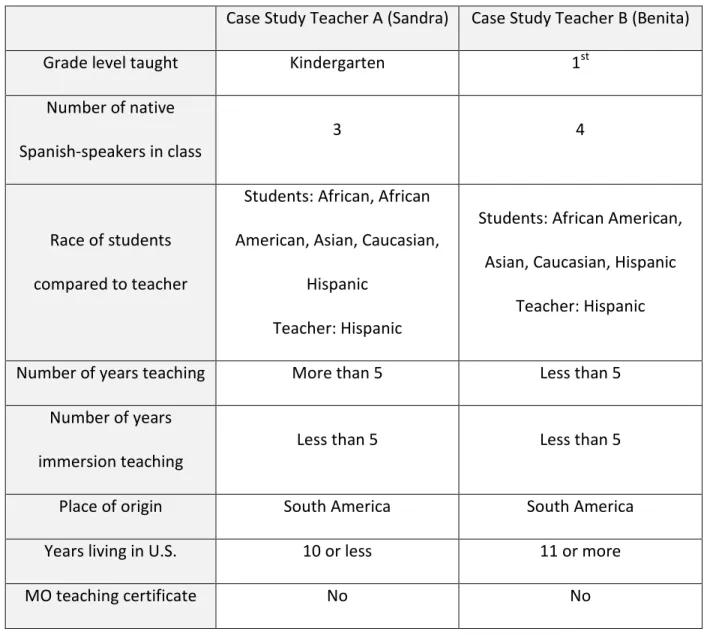
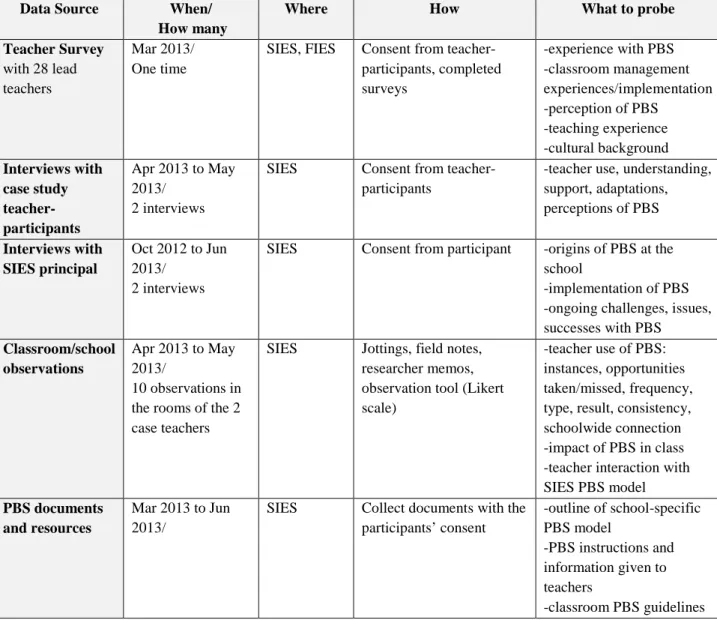
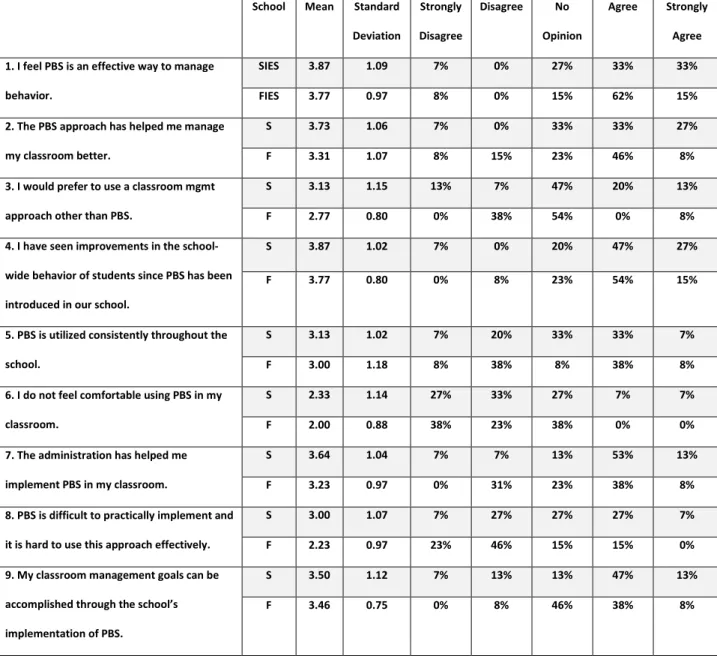
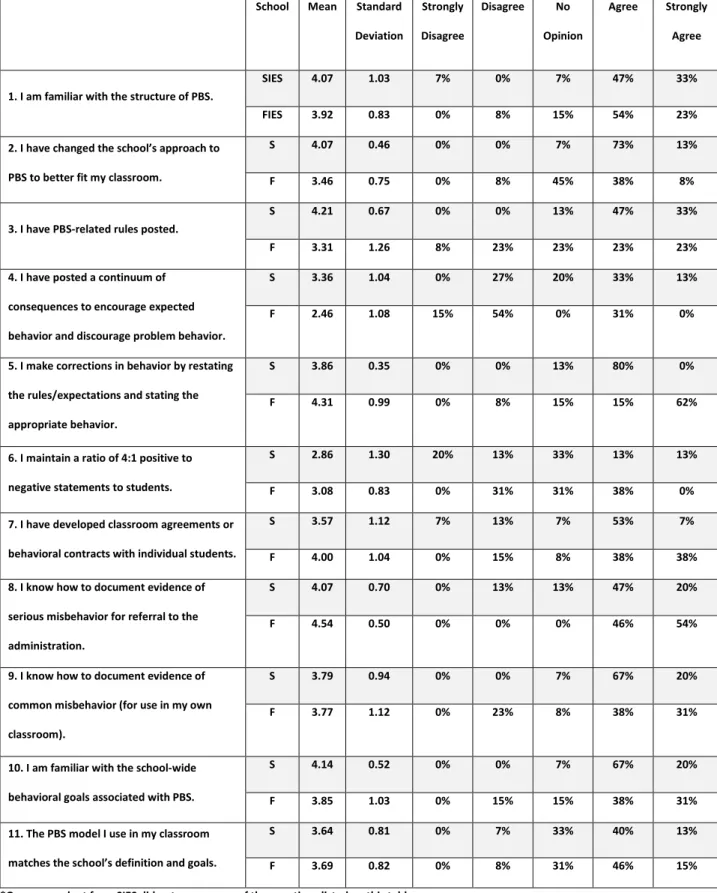
This study used a qualitative case study approach, and included a descriptive survey of 28 lead teachers at two neighboring schools, identified as French Immersion Elementary School (FIES) and Spanish Immersion Elementary School (SIES). The two teacher case studies were developed via teacher interviews, classroom observations and artifacts (school PBS documents, teacher PBS documents, teacher rules/procedures matrices, posters and classroom displays) and were informed by principal interviews as well.
Context
The Spanish Immersion Elementary School (SIES), and its neighboring French Immersion Elementary School (FIES), opened in 2009 with kindergarten and first grade classes. One new kindergarten class will be added each year until each grade of the K-5 elementary school is filled. They are urban, public, charter, elementary schools with a wide diversity of students and teachers. Teachers at SIES come from the U.S., many different Central and South American countries, and Spain. At FIES, most teachers come
from the U.S. and France. Over the past two years I have been involved as a Research Assistant in organizing and coding qualitative data related to classroom management at SIES and FIES. Slapac and Dorner (2013) initiated classroom research due to the
administration’s acknowledgement that some of their new teachers were having difficulty with managing students’ behavior, getting them to transition, and providing instruction. Several teachers noted the need for a schoolwide model of behavior support and
management. It was through a similar process of observation and reflection by
administration and teachers at SIES that led to the implementation of PBS in the 2012-2013 school year.
Research Design
This study was constructed using a sequential explanatory case study research design (Creswell, 1998; Creswell, Plano-Clark, Gutmann & Hanson, 2003; Yin, 2003). Creswell et al. (2003) states the purpose of the sequential explanatory design is typically to use qualitative results to assist in explaining and interpreting the findings of a primarily quantitative study. This study, however, represented an important variation of this
design, as described by Creswell et al. (2003) because “the qualitative data collection and analysis is given the priority” (p. 227). This is precisely how this study was arranged, as I used the descriptive survey data to inform the collection and analysis of the much more central and comprehensive qualitative case study data.
Yin’s (2003) definition places emphasis on the method and the techniques that constitute a case study of this type by asserting that “a case study is an empirical inquiry that investigates a contemporary phenomenon within its real-life context, when the boundaries between phenomenon and context are not clearly evident…” (p. 13).
Hartley’s (2004) broad definition is supportive: case study research "consists of a detailed investigation, often with data collected over a period of time, of phenomena, within their context…to provide an analysis of the context and processes which illuminate the theoretical issues being studied" (p. 323).
Additionally, Yin (2003) addresses a common concern about case studies: that they provide little basis for scientific generalization. "Case studies…are generalizable to theoretical propositions and not to populations or universes. In this sense, the case study…does not represent a 'sample', and in doing a case study, [the investigator’s] goal is to expand and generalize theories (analytic generalization) and not to enumerate frequencies (statistical generalization)" (p.10).
The second part of the Yin definition is important as it references the reason why a case study method, instead of an experimental design, was advantageous to this
particular study: the problem (teacher perceptions of the PBS approach and whether the use of the approach matches the school PBS design) must necessarily be studied “within its real-life context” and cannot be removed from its environment for examination in a laboratory.
Returning to the first part of the definition, Yin highlights the importance of combining methods of case study data collection and analysis:
The case study inquiry: (1) copes with the technically distinct situation in which there will be many more variables of interest than data points, and as one result, (2) relies on multiple sources of evidence, with data needing to converge in a triangulating fashion, and as another result, and (3) benefits from the prior
development of theoretical propositions to guide data collection and analysis. (Yin, 2003, p. 13-14)
The current study fit this description in a variety of ways. In endeavoring to understand ways in which urban language immersion teachers used, examined, perceived, and adapted the new behavior support and management system in their classrooms and at their elementary school, there were innumerable variables to consider (i.e., physical space of the school, teacher nationality, education, background and experience, students’ family situations and language skills, to name just a few quite divergent examples). Thus, the study relied on multiple sources of data to triangulate findings:
• survey of 28 lead teachers,
• four semi-formal interviews with the case study teachers at SIES (two each), • two semi-formal interviews with the principal at SIES,
• classroom observations, and
• archival records and physical artifacts such as school PBS documents, teacher PBS documents, teacher rules/procedures matrices, posters and classroom displays.
Yin (2003) labels such data collection methods as “sources of evidence for case studies” (p. 85), thus emphasizing that each case study will produce unique data sets. These multiple sources and methods are addressed in more detail in the subsequent section on validity. Finally, Yin’s definition mentions that the case study “benefits from the prior development of theoretical propositions to guide data collection and analysis” (Yin, 2003, p.14).