University of Huddersfield Repository
Alseddiqi, Mohamed, Mishra, Rakesh and Pislaru, Crinela
The New School-Based Learning (SBL) to Work-Based Learning (WBL) Transition Module: A
Practical Implementation in the Technical and Vocational Education (TVE) System in Bahrain
Original Citation
Alseddiqi, Mohamed, Mishra, Rakesh and Pislaru, Crinela (2012) The New School-Based Learning
(SBL) to Work-Based Learning (WBL) Transition Module: A Practical Implementation in the
Technical and Vocational Education (TVE) System in Bahrain. In: COMADEM 2012, 18th-20th
June 2012, University of Huddersfield, UK. (In Press)
This version is available at http://eprints.hud.ac.uk/13794/
The University Repository is a digital collection of the research output of the
University, available on Open Access. Copyright and Moral Rights for the items
on this site are retained by the individual author and/or other copyright owners.
Users may access full items free of charge; copies of full text items generally
can be reproduced, displayed or performed and given to third parties in any
format or medium for personal research or study, educational or not-for-profit
purposes without prior permission or charge, provided:
•
The authors, title and full bibliographic details is credited in any copy;
•
A hyperlink and/or URL is included for the original metadata page; and
•
The content is not changed in any way.
For more information, including our policy and submission procedure, please
contact the Repository Team at: [email protected].
The New School-Based Learning (SBL) to Work-Based
Learning (WBL) Transition Module: A Practical
Implementation in the Technical and Vocational Education
(TVE) System in Bahrain
M Alseddiqi, R Mishra and C Pislaru
School of Computing and Engineering, University of Huddersfield, Huddersfield, HD1 3DH, U.K
E-mail: [email protected]
Abstract. This paper diagnoses the implementation of a new engineering course entitled „ school-based learning (SBL) to work-school-based learning (WBL) transition module‟ in the Bahrain Technical and Vocational Education (TVE) learning environment. The module was designed to incorporate an innovative education and training approach with a variety of learning activities that are included in various learning case studies. Each case study was based on with learning objectives coupled with desired learning outcomes. The TVE students should meet the desired outcomes after the completion of the learning activities and assessments. To help with the implementation phase of the new module, the authors developed guidelines for each case study. The guidelines incorporated learning activities to be delivered in an integrated learning environment. The skills to be transferred were related to cognitive, affective, and technical proficiencies. The guidelines included structured instructions to help students during the learning process. In addition, technology was introduced to improve learning effectiveness and flexibility. The guidelines include learning indicators for each learning activity and were based on their interrelation with competencies to be achieved with respect to modern industrial requirements. Each learning indicator was then correlated against the type of learning environment, teaching and learning styles, examples of mode of delivery, and assessment strategy. Also, the learning activities were supported by technological features such as discussion forums for social perception and engagement and immediate feedback exercises for self-motivation. Through the developed module, TVE teachers can effectively manage the teaching and
learning process as well as the assessment strategy to satisfy students‟ individual requirements and enable them to meet workplace requirements.
1. Introduction
The objective of TVE system is to equip the students with the skills, knowledge and work ethic required for various industries such as electrical, electronic, telecommunication, building services, mechanical engineering and computer technology. This is obtained through a two-element system of education [1] which includes school-based learning (SBL) and work-based learning (WBL). The former comprises specialised technical modules (for industry-specific skills) and supportive modules (for generic
employability skills) [2]. The latter is intended to equip graduates with skills in the cognitive, affective and psychomotor learning domains required for their successful future careers.
2. Learning Elements in the Bahraini TVE system
2.1 School-Based Learning (SBL)
In SBL in Bahrain, the main outcomes are to prepare the TVE students for further academic study (technical certificate) or for direct entry into the job market (vocational certificate). The outcomes are achieved through:
- Strong general education modules (Arabic, Maths, English, Science, etc.).
- Specialised practical modules related to students‟ specialisations, such as Electrical Engineering.
- More than 14 engineering specialisations in the TVE institutions. - Competency-based assessment of practical modules.
- Introduction of new modules such as “working with others”, “problem solving”, “quality concepts”, and “health and safety” [3].
2.2 Work-Based Learning (WBL)
To meet local requirements, the WBL programme in Bahrain‟s TVE system places third-year students with companies and industries related to their field of specialisation for a period of four to six weeks. Students follow a specific training programme aimed at enriching their technical knowledge and preparing them for the labour market. In general, the WBL programme has met the desired outcomes:
- Strengthening the links and cooperation between TVE and local companies and industries. - Increasing job prospects of TVE graduates.
- Providing actual work experience.
- Receiving relevant feedback from industry regarding students‟ proficiencies. - Meeting with people from different cultures.
- Understanding the work rules and regulations.
However, some industries claimed that:
Four to six weeks is a limited period for a WBL programme. Students‟ performance in real work practical skills is inadequate.
The WBL programme has inconsistent quality standards, which vary from company to company.
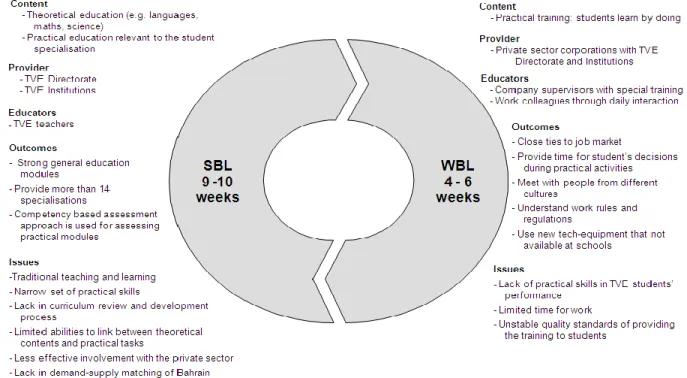
Figure 1 summarises the elements of the TVE system. The obvious problems in the system can be seen from this summary of both SBL and WBL.
Figure 1. The elements of the Bahrain TVE system.
The authors have analysed the existing skills requirements in both the Bahrain TVE system and the industrial companies. The modern industries have required employability skills of the graduating students which was not available in the TVE engineering education courses (EECs), meaning that the TVE system was unable to satisfy the marketplace requirements. The challenges come from the discrepancy between the SBL curriculum and modern industrial skills requirements. Students may be trained on obsolete equipment which is totally different from that in the modern industrial environment. For example, in the TVE system in Bahrain, logbooks which should be completed by students during WBL were designed by teachers (dealing with SBL issues) and contained lessons and activities which were not related to the industrial skills requirements. The industrial supervisors evaluating the students during WBL observed this discrepancy in the WBL assessment process. Also, it was recognised that the available technology in industry were not considered during the development of the industrial logbook content [4].
3. The Pedagogical guidelines of the New SBL-to-WBL Transition Module
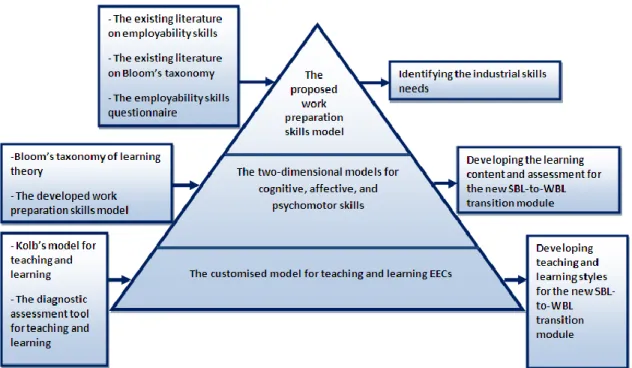
First of all and before the development of the guidelines of a new module entitled „SBL-to-WBL transition‟, the pedagogical context was identified and included investigation of various learning theories identified the learning resources, learning environments, and the intended outcomes from the learning activities. Biggs [5] described the pedagogical design as making sure that the learning outcomes, contents, learning activities, teaching and learning processes, assessment methods, and learning environments were effectively linked together. A complete pedagogical guideline for the new module was developed (see figure 2), comprising three complementary models: the work preparation skills model, the two-dimensional models for cognitive, affective and psychomotor skills and the customised model for teaching and learning.
Figure 2. The structure of the pedagogical guidelines of the SBL-to-WBL transition module.
After diagnosing the existing situation in Bahrain‟s TVE system, models for work preparation skills [6] content development based on the modern industrial requirements [7], and learning delivery styles based on TVE students‟ preferred learning styles [8] were proposed and developed. These models are the tools for developing the new module for SBL-to-WBL transition. It will provide a variety of learning approaches with different choices of learning activities [9]. In addition, it will be developed to meet the identified industrial skills requirements and motivate TVE students to learn and meet their individual needs. For example, specific job-related skills, team work skills, affective and behavioural attitude skills, and interpersonal skills should be included in the new module as well as taught during the process of delivery [10]. The aim of the new SBL-to-WBL transition module is to ensure that TVE students receive the necessary training in the work preparation skills required by industry before they join WBL programmes. It was developed with cognitive, affective and psychomotor skills and is intended to be delivered with innovative technology. The overall development process of the new module has three main contexts: institutional, pedagogical and technological [11]. It is expected to make a major contribution to the improvement of the TVE system because it challenges all students and teachers to recognise, make informed responses, and work comfortably with the diverse requirements that they encounter in the WBL environment.
More specifically and to satisfy the needs of the students and assist the teachers in the delivery of the learning activities, two well known and widely used learning theories have been identified: Bloom‟s taxonomy [12] and Kolb‟s experiential model of learning [13].
In the previous figure, Bloom‟s domains for cognitive, affective and psychomotor skills were developed in two-dimensional models for designing learning content. The cognitive skills domain was used to structure activities and exercises which measure students‟ knowledge; the affective skills domain to measure students‟ attitude during the delivery of the module; and the psychomotor skills domain to structure the content of the technical and practical competencies [12]. This has shown how Kolb‟s model
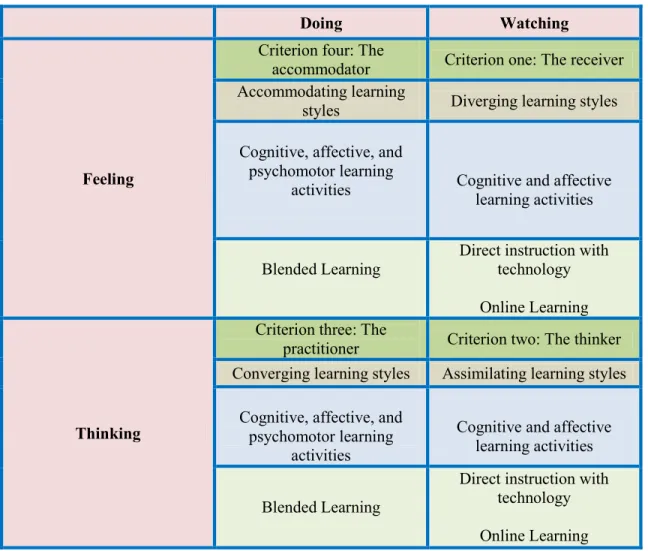
and its learning styles are used for delivering the cognitive, affective and psychomotor skills in EECs learning activities. It helps in scheduling the delivery of each learning activity, both timing and sequencing [13]. A customised approach for teaching and learning is proposed, incorporating the previous findings: the skills required by modern industry; Bloom‟s learning domains for content development and Kolb‟s learning styles for perceiving and processing information; the learning styles preferred by TVE students and teachers; learning modes and their examples; and examples of an integrated learning environment. Table 1 presents pedagogical guidelines for EECs. It is intended to meet the obvious needs of the TVE system and industry, improving the connection between SBL and WBL and teachers‟ ability to demonstrate theoretical and practical learning activities. Further solutions are recommended, such as integrating innovative information technology techniques in the process of learning.
Table 1. The pedagogical guidelines for EECs.
The guidelines determine the best of Kolb‟s styles for delivering each of Bloom‟s learning domains, moving to a more comprehensive approach to teaching and learning that takes into account the important aspects of substance and content as well as scientific methods of appropriate implementation. Table 1 illustrates the guidelines, showing that:
Doing Watching
Feeling
Criterion four: The
accommodator Criterion one: The receiver Accommodating learning
styles Diverging learning styles Cognitive, affective, and
psychomotor learning
activities Cognitive and affective learning activities
Blended Learning
Direct instruction with technology Online Learning
Thinking
Criterion three: The
practitioner Criterion two: The thinker Converging learning styles Assimilating learning styles
Cognitive, affective, and psychomotor learning
activities
Cognitive and affective learning activities
Blended Learning
Direct instruction with technology Online Learning
• The learning activities corresponding to the cognitive domain skills are delivered using the four approaches to learning style: thinking – watching (assimilating), feeling – doing (accommodating), feeling – watching (diverging), and thinking – doing (converging).
• The learning activities corresponding to the affective domain skills are delivered using the same four approaches identified above.
• The learning activities corresponding to the psychomotor domain skills are delivered using two approaches: feeling – doing (accommodating) and thinking – doing (converging).
The next section presents the implementation phase of the new SBL-to-WBL transition module.
4. The New SBL-to-WBL Module
A newly developed SBL-to-WBL transition module is available online. The aim is to ensure that TVE students receive the necessary education and training in the work preparation skills required by industry during SBL, before they join WBL programmes. It consists of different case studies, and was delivered during semester one of the academic year 2010-2011 (15 teaching and learning weeks according to the TVE study plan) in SBL, before students‟ progression to the WBL programme. The case studies were formulated after reviewing the existing learning resources for the Electrical and Electronic Engineering specialisation, and each is related to learning activities that students should understand and demonstrate during the WBL programme. The named case studies are real and based on industrial skills needs; they benchmark the available resources in SBL and industry, bridge the theory-to-practice gap, broaden perspectives beyond the students‟ specialist area, and are easily updated for flexible learning.
4.1 Case study one: Background to Workplace Environment
This case study presents the theory behind different workplace competencies. It gives a complete picture of the skills required by industry, introduced as pre-learning activities. It is available online and must be accessed under the teacher‟s instruction, supervision, and face-to-face discussions in the multimedia laboratory. In addition, there are some learning exercises which require field visits to different sections in TVE institutions. The aim is to motivate TVE students in understanding the importance of the competencies required by Bahraini industry. It also motivates them to gain the ICT skills required for online learning activities. Therefore, the case study introduces the fundamentals (prior knowledge competencies) for TVE students before they access the remaining case studies of the new module. The case study starts with the learning objectives along with the desired learning outcomes. The TVE students should meet the desired outcomes after the completion of the learning activities and exercises.
The case study incorporates ten learning activities to be delivered in a direct instruction teaching mode with technology. The case study is based on giving guided instructions to students during the learning process. Therefore, the learning activities were designed in such a manner as to support this approach to learning. In addition, technology is introduced for further learning opportunities and flexibility.
4.2 Case study two: Battery Charger for a Car Battery
The case study aims to encourage TVE students with learning activities including group discussion, learning examples and learning exercises. The case study was proposed as part of the hierarchal structure and focuses on the context of online learning [14]. It discusses effective online learning activities for a battery charger circuit and involves collecting information about battery specifications from the customers, and choosing the appropriate components for building the circuit.
In this case study, students should become familiar with recognising the importance of e-learning and susceptibility in following this learning approach. The learning case study has moved to clarify the importance of the students‟ interaction with the e-learning package to socially and emotionally engage
with the online learning activities. It is intended to improve students‟ social skills attitude as well as develop their emotional intelligence attitude, such as management of information, ICT skills, communication skills, self-motivation and initiative. With respect to knowledge acquisition and critical thinking, the learning activities were designed to encourage students in engaging in dialogues, listening, reading, writing statements, and accessing information. The learning activities are organised in a cumulative structure, moving from lower learning levels to higher learning levels of the cognitive and affective domains. For example, the students must understand the learning objectives and learning outcomes, follow the instructions to access the information introduced online, understand the purpose and the learning information of the case study, participate actively in exercises, justify and answer the various exercises, organise and suggest solutions to exercises reflecting the learning experience and case study assessments, and relate the learning experience to real work applications.
4.3 Case study three: Car Parking Counter
This case study is a technical competency case study which incorporates structured learning activities. It has a variety of information sources and communication tools such as face-to-face and online discussion forum/board. Moreover, it is broken down into two themes: theoretical (for knowledge acquisition and attitude understanding); and practical applications (for converting knowledge and attitude into technical skills applications). The theoretical theme is to be delivered to students using the e-learning environment in the multimedia laboratory and the practical theme in the EEE practical workshop.
The case study is designed to incorporate the required work preparation skills and improve students‟ abilities in SBL before they join WBL programmes. For example, it allows students to share information with other students, participate actively in group discussions, negotiate and justify the learning activities, solve problems in practical applications, suggest solutions, reflect on the learning experiences in written statements, and relate the learning experiences to a real work situation. The students should transfer their knowledge from online and face-to-face learning activities to practical applications. After understanding the structure of the content development, the process is taken into one step further, incorporating different teaching and learning styles from the customised model to assist teachers in meeting students‟ learning styles and assessment requirements. Examples of learning modes and learning environments are also considered.
The learning case study starts with the objectives and the learning outcomes. Discussion between students and teacher should be carried out to identify the learning requirements and goals to be achieved, but they depend mainly on the online contents as well as using animation, pictures, learning examples, lectures and formative assessments for knowledge acquisition and attitude understanding.
5. The Implementation Phase of the New Module
This section monitors the implementation phase of three case studies from the newly developed SBL-to-WBL transition module. The discussion was based on direct observational technique as a diagnostic tool in order to summarise the participants‟ (first author, TVE specialists, TVE teachers and TVE students) opinions. It has been delivered in an integrated learning environment that actively engages TVE students in online learning: a multimedia laboratory, a field visit, a classroom, and a practical engineering workshop.
During the first week of the academic year 2010/2011, the first author delivered an induction programme to students before the pilot implementation phase, to introduce the aims and objectives of the new SBL-to-WBL transition module. It was explained that the new module content would be available online and access would require authority and would be monitored by the pilot implementation teachers. Two teachers were assigned for the theoretical content in classroom and multimedia laboratory and three teachers for practical applications in the workshop.
Online registration was required for the entire pilot group of students, giving full access to the students‟ website. The teacher controlled the website and mentored students‟ participation.
The pilot was implemented over nine teaching and learning weeks. In each week, eight hours (equivalent to one full day) were allocated to the implementation phase of the new module. In total, three weeks were assigned to complete one case study; the full module should be taught over 15 weeks (one academic semester) as per the TVE study plan [3].
5.1 Positive outcomes
The students understood that the new module case studies were delivered to improve their knowledge and attitude understanding towards work preparation skills. The teachers were aware that each student must have a good foundation before becoming involved in the learning case studies.
The case studies showed that skills from the developed two-dimensional model were integrated in the content of the learning activities related to values, attitudes and behaviours. Moreover, some skills that related to knowledge understanding were also integrated in the content. The teachers agreed that various work preparation skills were embedded within the learning activities, considering both lower and higher learning levels from the cognitive and affective domains of Bloom‟s taxonomy. It was indicated that the teachers had acquired the necessary knowledge to use the guidelines presented earlier in the process of delivering the new module. For example, in case study one; the students were aware that two different learning styles, namely diverging and assimilating, were used to deliver the learning activities. This showed that the case study was developed to accommodate preferred learning styles by TVE students. Also, the case study encouraged TVE students to be thoroughly supervised and mentored by the teachers. On the other hand, teachers argued about the mode of delivery in case study one. They clarified that the teacher-centred learning in pre-learning activities would not help the students in the next case studies as they were based on the student-centred learning approach. They were uncertain about students‟ ability to accommodate to a totally new approach. They suggested that lectures should be given only on the background to the case study section. After that, the pre-learning activities should be student-centred with teachers‟ supervision. The idea was that the students would be more capable of understanding the student -centred learning approach before they became involved in the next module‟s case studies.
5.2 Limitations
It appeared that qualitative findings might not give the full picture if the new module overcomes the skills gap between SBL and WBL in order to meet industrial skills requirements. In this context, the authors recommended collecting more information from quantitative data analysis findings. The quantitative findings should support the qualitative outcomes in order to generate an appropriate conclusion and suggest recommendations for future.
6. Conclusion
The authors developed guidelines for the learning case studies of the new module. The guidelines incorporated of identifying two-dimensional models for content development in cognitive, affective and psychomotor skills and using the improved work preparation skills model to integrate the skills required by industry into the learning resources. The guidelines are an effective approach for delivering the developed learning case studies. From the above observations, the authors confirmed the existing problems in the TVE system, could be diagnosed, monitored and solved by introducing the new module for SBL-to-WBL transition using online technology in presenting the learning content. The implementation of the new module would overcome most of the limitations of the existing TVE system.
References
[1] TVE Directory, (2004): Technical and Vocational Education System in Bahrain, Internal Report: TVE Directorate in Bahrain: Bahrain.
[2] TVE Directory in Bahrain (2006): Private Sector Requirements in Kingdom of Bahrain, Internal Report from TVE System in Bahrain: Bahrain.
[3] TVE Directory in Bahrain (2008): Occupational Standards for Technical Education in Bahrain, Internal report from TVE system in Bahrain, Bahrain.
[4] TVE Directory in Bahrain (2010): Technical and Vocational Education System in Bahrain, Internal report from TVE system in Bahrain, Bahrain.
[5] Biggs, J. (1999): Teaching for Quality Learning at University, SRHE and Open University Press, Buckingham.
[6] Alseddiqi, M., Mishra, R. & Pislaru, C. (2009): Identification of skills gap between school-based learning and work-based learning in Technical and Vocational Education in Bahrain, Computing and Engineering Researchers‟ Conference, University of Huddersfield, Huddersfield: U.K.
[7] Alseddiqi, M., Mishra, R. & Pislaru, C. (2010): Design and Development of an On-Line Work-Based Learning (WBL) Module to Enhance the Technical and Vocational Education (TVE) System in Bahrain, Global Conference on Learning and Technology. Association for the Advancement of Computing in Education (AACE), Vancouver: Canada.
[8] Alseddiqi, M., Mishra, R. & Abdulrasool, S. (2011): “Improving Teaching and Learning Effectiveness in Engineering Education”, The International Journal of Learning, vol. 17, no.9.
[9] Det (2003): Blended Learning, Department of Education and Training.
[10] Heywood, J. (2005): Engineering Education Research and Development in Curriculum and Instruction, IEEE Press Editorial Board, USA.
[11] Hussein, S. (2005): Developing e-learning materials: applying user-centred design, National Institute of Adult Continuing Learning, England and Wales.
[12] Anderson, L. & Krathwohl, K. (2001): A taxonomy for learning, teaching, and assessing: a revision
of Bloom’s taxonomy of educational objectives, Longman, New York.
[13] Kolb, D (1984): Experiential learning: Experience as the source of learning and development, Englewood Cliffs, NJ, Prentice-Hall.
[14] Rossett, A. (2002): Waking in the night and thinking about e-learning-The ASTD e-learning handbook, McGraw-Hill, New York.