Learning Probabilistic Relational Planning Rules
Hanna M. Pasula
MIT CSAIL Cambridge, MA 02139 [email protected]Luke S. Zettlemoyer
MIT CSAIL Cambridge, MA 02139 [email protected]Leslie Pack Kaelbling
MIT CSAIL Cambridge, MA 02139 [email protected]Abstract
To learn to behave in highly complex domains, agents must represent and learn compact models of the world dynamics. In this paper, we present an algorithm for learning probabilistic STRIPS-like planning operators from examples. We demonstrate the effective learning of rule-based operators for a wide range of traditional planning domains.
Introduction
Imagine robots that live in the same world as we do. Such robots must be able to predict the consequences of their ac-tions both efficiently and accurately. Programming a robot for advanced problem solving in a complicated environment is an hard problem, for which engineering a direct solution has proven difficult. Even the most sophisticated robot pro-gramming paradigms (Brooks, 1991) are difficult to scale to human-like robot behaviors.
If robots could learn to act in the world, then much of the programming burden would be removed from the robot engineer. Reinforcement learning has attempted to solve this problem, but this approach often involves learning to achieve particular goals, without gathering any general knowledge of the world dynamics. As a result, the robots can learn to do particular tasks but have trouble generalizing to new ones. If, instead, robots could learn how their actions affect the world, then they would be able to behave more robustly in a wide range of situations. This type of learning allows the robot to develop a model that represents the immediate effects of its action in the world. Once this model is learned, the robot could use it to behave robustly in a wide variety of situations.
There are many different ways of representing action models, but one representation, probabilistic relational rules, stands out. These rules represent situations in which actions will have a set of possible effects. Because they are proba-bilistic they can model actions that have more than one ef-fect and actions that might fail often. Because they are rules, each situation can be considered independently. Rules can be used individually without having to understand the whole world. Because they are relational, they can generalize over Copyright c 2004, American Association for Artificial Intelli-gence (www.aaai.org). All rights reserved.
the identities of the objects in the world. Overall, the rules we will explore in this paper, encode a set of assumptions about the world that, as we will see later, improve learning in our example domains.
Once rules have been learned, acting with them is a well-studied research problem. Probabilistic planning approaches are directly applicable (Blum & Langford, 1999) and work in this area has shown that compact representations, like rules, are essential for scaling probabilistic planning to large worlds (Boutilier, Dearden, & Goldszmidt, 2002).
Structured Worlds
When an agent is introduced into a foreign world, it must find the best possible explanation for the world’s dynam-ics within the space of possible models it can represent. This space of models is defined by the agent’s representa-tion language. The ideal language would be able to com-pactly model every world the agent might encounter and no others. Any extra modeling capacity is wasted and will com-plicate learning since the agent will have to consider a larger space of possible models, and be more likely to overfit its experience. Choosing a good representation language pro-vides a strong bias for any algorithm that will learn models in that language. In this paper we explore learning a rule-based language that makes the following assumptions about the world:
• Frame Assumption: When an agent takes an action in a world, anything not explicitly changed by that action stays the same.
• Object Abstraction Assumption: The world is made up of objects, and the effects of actions on these objects gen-erally depend on their attributes rather than their identi-ties.
• Action Outcomes Assumption: Each action can only af-fect the world in a small number of distinct ways. Each possible effect causes a set of changes to the world that happen together as a single outcome.
The first two assumptions have been captured in al-most all planning representations, such as STRIPS opera-tors (Fikes & Nilsson, 1971) and more recent variants (Pen-berthy & Weld, 1992). The third assumption has been made by several probabilistic planning representations, including
probabilistic rules (Blum & Langford, 1999), equivalence-classes (Draper, Hanks, & Weld, 1994), and the situation calculus approach of Boutilier, Reiter, and Price (2001). The first and third assumptions might seem too rigid for some real problems: relaxing them is a topic for future work.
This paper is organized as follows. First, we describe how we represent states and action dynamics. Then, we present a rule-learning algorithm, and demonstrate its performance in three different domains. Finally, we go on to discuss some related work, conclusions, and future plans.
Representation
This section presents a formal definition of relational plan-ning rules, as well as of the world descriptions that the rules will manipulate. Both are built using a subset of standard first-order logic that does not include functions, disjunctive connectives, or existential quantification.
State Representation
An agent’s description of the world, also called the state, is represented syntactically as a conjunction of ground literals. Semantically, this conjunction encodes all of the important aspects of this world. The constants map to the objects in the world. The literals encode the truth values of all the possible properties of all of the objects and all of the relations that are possible between the objects.
For example, imagine a simple blocks world. The objects in this world include blocks, a table and a gripper. Blocks can be on other blocks or on the table. A block that has nothing on it is clear. The gripper can hold one block or be empty. The state description
on(B1,B2),on(B2,TABLE),¬on(B2,B1),¬on(B1,TABLE), inhand(NIL),clear(B1),block(B1),block(B2),¬clear(B2), ¬inhand(B1),¬inhand(B2),¬block(TABLE)
(1)
represents a blocks world where there are two blocks in a single stack on the table. BlockB1 is on top of the stack,
whileB2is belowB1and on theTABLE.
Action Representation
Rule sets model the action dynamics of the world. The rule set we will explore in this section models how the simple blocks world changes state as it is manipulated by a robot arm. This arm can attempt to pick up blocks and put them on other blocks or the table. However, the arm is faulty, so its actions can succeed, fail to change the world, or fail by knocking the block onto the table. Each of these possible outcomes changes several aspects of the state. We begin the section by presenting the rule set syntax. Then, the seman-tics of rule sets is described procedurally.
Rule Set Syntax A rule set,R, is a set of rules. Eachr∈
Ris a four-tuple,(rA, rC, rO, rP). The rule’s action,rA, is a positive literal. The context,rC, is a conjunction of literals. The outcome set,rO, is a non-empty set of outcomes, where
each outcomeo∈rOis a conjunction of literals that defines
a deterministic mapping from previous states to successor states,fo : S → S, as described shortly. Finally,rP is a
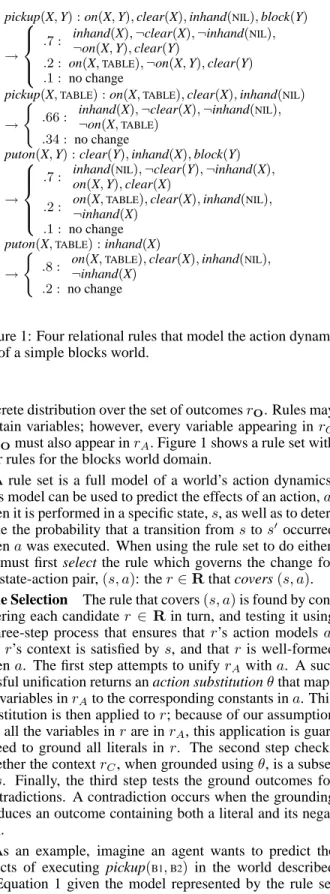
pickup(X,Y) :on(X,Y),clear(X),inhand(NIL),block(Y)
→
.7 : inhand(X),¬clear(X),¬inhand(NIL), ¬on(X,Y),clear(Y)
.2 : on(X,TABLE),¬on(X,Y),clear(Y)
.1 : no change
pickup(X,TABLE) :on(X,TABLE),clear(X),inhand(NIL)
→
(
.66 : ¬inhand(X),¬clear(X),¬inhand(NIL),
on(X,TABLE)
.34 : no change
puton(X,Y) :clear(Y),inhand(X),block(Y)
→
.7 : inhand(NIL),¬clear(Y),¬inhand(X),
on(X,Y),clear(X)
.2 : on(X,TABLE),clear(X),inhand(NIL), ¬inhand(X)
.1 : no change puton(X,TABLE) :inhand(X)
→
(
.8 : ¬on(X,TABLE),clear(X),inhand(NIL),
inhand(X)
.2 : no change
Figure 1: Four relational rules that model the action dynam-ics of a simple blocks world.
discrete distribution over the set of outcomesrO. Rules may
contain variables; however, every variable appearing inrC orrOmust also appear inrA. Figure 1 shows a rule set with
four rules for the blocks world domain.
A rule set is a full model of a world’s action dynamics. This model can be used to predict the effects of an action,a, when it is performed in a specific state,s, as well as to deter-mine the probability that a transition fromstos0 occurred whenawas executed. When using the rule set to do either, we must first select the rule which governs the change for the state-action pair,(s, a): ther∈Rthat covers(s, a). Rule Selection The rule that covers(s, a)is found by con-sidering each candidater ∈ Rin turn, and testing it using a three-step process that ensures that r’s action modelsa, that r’s context is satisfied bys, and thatris well-formed givena. The first step attempts to unifyrAwitha. A suc-cessful unification returns an action substitutionθthat maps the variables inrAto the corresponding constants ina. This substitution is then applied tor; because of our assumption that all the variables inrare inrA, this application is guar-anteed to ground all literals inr. The second step checks whether the contextrC, when grounded usingθ, is a subset of s. Finally, the third step tests the ground outcomes for contradictions. A contradiction occurs when the grounding produces an outcome containing both a literal and its nega-tion.
As an example, imagine an agent wants to predict the effects of executing pickup(B1,B2) in the world described
in Equation 1 given the model represented by the rule set in Figure 1. The action unifies with the action of the first rule, producing the substitution θ = {X/B1,Y/B2}; fails
to unify with the second rule’s action, because B2 doesn’t
equal TABLE; and fails to unify with the remaining rules
ap-B1
B2
B1
B2
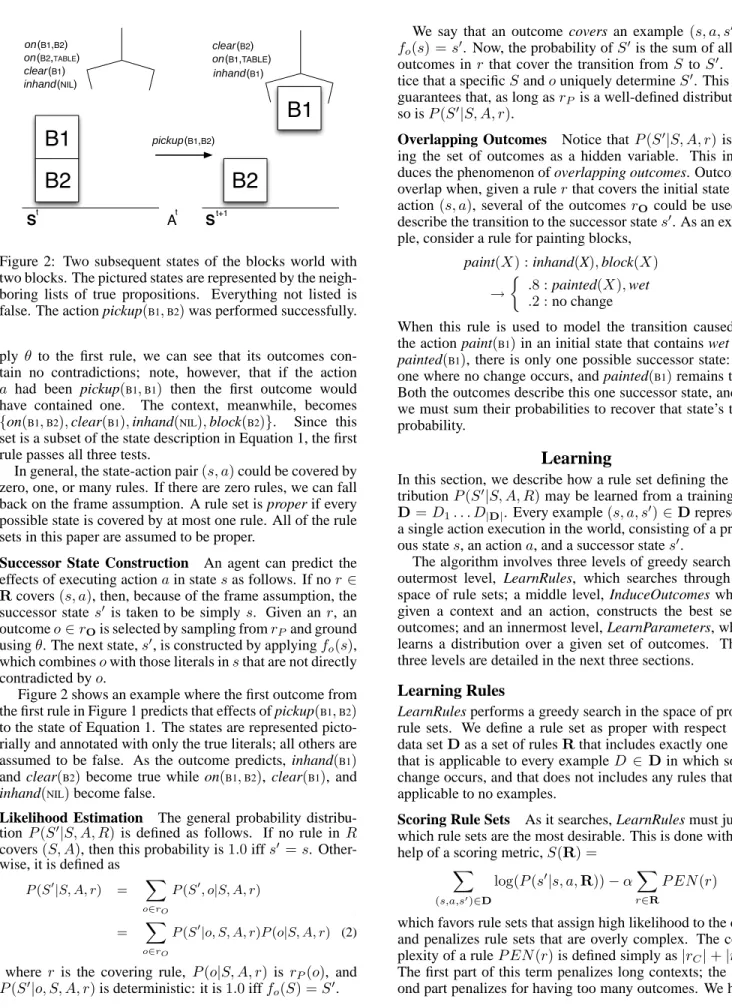
St At St+1 pickup(B1,B2) on(B1,B2) on(B2,TABLE) clear(B1) inhand(NIL) on(B1,TABLE) clear(B2) inhand(B1)Figure 2: Two subsequent states of the blocks world with two blocks. The pictured states are represented by the neigh-boring lists of true propositions. Everything not listed is false. The action pickup(B1,B2)was performed successfully.
ply θ to the first rule, we can see that its outcomes con-tain no contradictions; note, however, that if the action a had been pickup(B1,B1) then the first outcome would
have contained one. The context, meanwhile, becomes
{on(B1,B2),clear(B1),inhand(NIL),block(B2)}. Since this
set is a subset of the state description in Equation 1, the first rule passes all three tests.
In general, the state-action pair(s, a)could be covered by zero, one, or many rules. If there are zero rules, we can fall back on the frame assumption. A rule set is proper if every possible state is covered by at most one rule. All of the rule sets in this paper are assumed to be proper.
Successor State Construction An agent can predict the effects of executing actionain statesas follows. If nor∈
Rcovers(s, a), then, because of the frame assumption, the successor states0 is taken to be simplys. Given anr, an outcomeo∈rOis selected by sampling fromrPand ground
usingθ. The next state,s0, is constructed by applyingf
o(s), which combinesowith those literals insthat are not directly contradicted byo.
Figure 2 shows an example where the first outcome from the first rule in Figure 1 predicts that effects of pickup(B1,B2)
to the state of Equation 1. The states are represented picto-rially and annotated with only the true literals; all others are assumed to be false. As the outcome predicts, inhand(B1)
and clear(B2)become true while on(B1,B2), clear(B1), and
inhand(NIL)become false.
Likelihood Estimation The general probability distribu-tion P(S0|S, A, R)is defined as follows. If no rule in R covers(S, A), then this probability is1.0iffs0 =s. Other-wise, it is defined as P(S0|S, A, r) = X o∈rO P(S0, o|S, A, r) = X o∈rO P(S0|o, S, A, r)P(o|S, A, r) (2) wherer is the covering rule, P(o|S, A, r)is rP(o), and P(S0|o, S, A, r)is deterministic: it is1.0ifffo(S) =S0.
We say that an outcome covers an example (s, a, s0) if fo(s) =s0. Now, the probability ofS0is the sum of all the outcomes inr that cover the transition fromS toS0.
No-tice that a specificSandouniquely determineS0. This fact guarantees that, as long asrP is a well-defined distribution, so isP(S0|S, A, r).
Overlapping Outcomes Notice thatP(S0|S, A, r)is us-ing the set of outcomes as a hidden variable. This intro-duces the phenomenon of overlapping outcomes. Outcomes overlap when, given a rulerthat covers the initial state and action(s, a), several of the outcomesrO could be used to
describe the transition to the successor states0. As an exam-ple, consider a rule for painting blocks,
paint(X) :inhand(X),block(X) →
.8 :painted(X),wet .2 :no change
When this rule is used to model the transition caused by the action paint(B1)in an initial state that contains wet and
painted(B1), there is only one possible successor state: the
one where no change occurs, and painted(B1)remains true.
Both the outcomes describe this one successor state, and so we must sum their probabilities to recover that state’s total probability.
Learning
In this section, we describe how a rule set defining the dis-tributionP(S0|S, A, R)may be learned from a training set D=D1. . . D|D|. Every example(s, a, s0)∈Drepresents
a single action execution in the world, consisting of a previ-ous states, an actiona, and a successor states0.
The algorithm involves three levels of greedy search: an outermost level, LearnRules, which searches through the space of rule sets; a middle level, InduceOutcomes which, given a context and an action, constructs the best set of outcomes; and an innermost level, LearnParameters, which learns a distribution over a given set of outcomes. These three levels are detailed in the next three sections.
Learning Rules
LearnRules performs a greedy search in the space of proper rule sets. We define a rule set as proper with respect to a data setDas a set of rulesRthat includes exactly one rule that is applicable to every exampleD ∈ Din which some change occurs, and that does not includes any rules that are applicable to no examples.
Scoring Rule Sets As it searches, LearnRules must judge which rule sets are the most desirable. This is done with the help of a scoring metric,S(R) =
X
(s,a,s0)∈D
log(P(s0|s, a,R))−αX r∈R
P EN(r) (3) which favors rule sets that assign high likelihood to the data and penalizes rule sets that are overly complex. The com-plexity of a ruleP EN(r)is defined simply as|rC|+|rO|.
The first part of this term penalizes long contexts; the sec-ond part penalizes for having too many outcomes. We have
chosen this penalty for its simplicity, and also because it performed no worse than any other penalty term we tested in informal experiments. The scaling parameterαis set to
0.5in our experiments, but it could also be set using cross-validation on a hold-out dataset or some other principled technique.
Initializing the Search We initialize the search by creat-ing the most specific rule set: one that contains, for every unique(s, a)pair in the data, a rule withrC=sandrA=a. Because the context contains the whole world state, this is the only rule that could possibly cover the relevant examples, and so this rule set is guaranteed to be proper.
Search Operators Given a starting point, LearnRules re-peatedly finds and applies the operator that will increase the score of the current rule set the most. There are four types of search operators available, based on the four basic syntactic operations used for rule search in inductive logic program-ming (Lavraˇc & Dˇzeroski, 1994). Each operator selects a ruler, removes it from the rule set, and creates one or more new rules, which are then introduced back into the rule set in a manner that ensures the rule set remains proper. How this is done for each operator is described below. In each case, the new rules are created by choosing anrCand anrAand calling InduceOutcomes to completer.
There are two possible ways to generalize a rule: a lit-eral can be removed from the context, or a constant can be replaced with a variable. Given an old rule, the first gener-alization operator simply shortens the context by one while keeping the action the same; the second generalization op-erator picks one of the constant arguments of the action, in-vents a new variable to replace it, and substitutes that vari-able for every instance of the original constant both in the action and the context.1Both operators then call
InduceOut-comes to complete the new rule, which is added to the set. At this point, LearnRules must ensure that the rule set re-mains proper. Generalization may increase the number of examples covered by a rule, and so make some of the other rules redundant. The new rule replaces these other rules, removing them from the set. Since this removal can leave some training examples with no rule, new, maximally spe-cific rules are created to cover them.
There are also two ways to specialize a rule: a literal can be added to the context, or a variable can be replaced with a constant. The first specialization operator picks an atom that is absent from the old rule’s context. It then constructs two new enlarged contexts, one containing a positive instance of this atom, and one containing a negative instance. A rule is filled in for each of the contexts, with the action remaining the same. The second specialization operator picks one of the variable arguments of the action, and creates a new rule for every possible constant by substituting the constant for the variable in both the action and the body of the rule, and calling InduceOutcomes as usual. In either case, the new
1
During learning, we always introduce variables aggressively wherever possible, based on the intuition that if it is important for any of them to remain a constant, this should become apparent through the other training examples.
rules are then introduced into the rule set, and LearnRules must, again, ensure that it remains proper. This time the only concern is that some of the new rules might cover no training examples; such rules are left out of the rule set.
All these operators, just like the ILP operators that moti-vated them (Lavraˇc & Dˇzeroski, 1994), can be used to cre-ate any possible rule set. There are also other advanced rule set search operators, such as least general generaliza-tion (Plotkin, 1970), which might be modified to create op-erators that allow LearnRules to search the planning rule set space more efficiently.
LearnRules’s search strategy has one large drawback; the set of rules which is learned is only guaranteed to be proper on the training set and not on testing data. Solving this prob-lem, possibly with approaches based on relational decision trees (Blockeel & De Raedt, 1998), is an important area for future work.
Inducing Outcomes
The effectiveness and efficiency of the LearnRules algo-rithm are limited by those of the InduceOutcomes sub-procedure, which is called every time a new rule is con-structed. Formally, the problem of inducing outcomes for a ruleris the problem of finding a set of outcomesrOand
a corresponding set of parametersrP which maximize the score,
X
(s,a,s0)∈Dr
log(P(s0|s, a, r))−αP EN(r),
whereDr is the set of examples such thatrcovers(s, a). This score is simplyr’s contribution to the overall rule set score of Equation 3.
In general, outcome induction is NP-hard (Zettlemoyer, Pasula, & Kaelbling, 2003). InduceOutcomes uses greedy search through a restricted subset of possible outcome sets: those that are proper on the training examples, where an out-come set is proper if every training example has at least one outcome that covers it and every outcome covers at least one training example. Two operators, described below, move through this space until there are no more immediate moves that improve the rule score. For each set of outcomes it con-siders, InduceOutcomes calls LearnParameters to supply the bestrP it can.
Initializing the Search The initial set of proper outcomes is created by, for each example, writing down the set of atoms that changed truth values as a result of the action, and then creating an outcome to describe every set of changes observed in this way.
As an example, consider the coins domain. Each coins world containsncoins, which can be showing either heads or tails. The action flip-coupled, which has no context and no arguments, flips all of the coins to heads half of the time and otherwise flips them all to tails. A set of training data for learning outcomes with two coins might look like part (a) of Figure 3 whereh(C)stands forheads(C),t(C)stands for¬heads(C), ands→s0is part of an(s, a, s0)example wherea= flip-coupled. Given this data, the initial set of outcomes has the four entries in part (b) of Figure 3.
D1=t(c1), h(c2)→h(c1), h(c2) D2=h(c1), t(c2)→h(c1), h(c2) D3=h(c1), h(c2)→t(c1), t(c2) D4=h(c1), h(c2)→h(c1), h(c2) (a) O1={h(c1)} O2={h(c2)} O3={t(c1), t(c2)} O4={no change} (b)
Figure 3: (a) Possible training data for learning a set of out-comes. (b) The initial set of outcomes that would be created from the data in (a).
Search Operators InduceOutcomes uses two search op-erators. The first is an add operator, which picks a pair of non-contradictory outcomes in the set and adds in a new outcome based on their conjunction. For example, it might pickO1andO2and combine them, adding a new outcome
O5 = {h(c1), h(c2)} to the set. The second is a remove
operator that drops an outcome from the set. Outcomes can only be dropped if they were overlapping with other out-comes on every example they cover, otherwise the outcome set would not remain proper. Sometimes, LearnParameters will return zero probabilities for some of the outcomes. Such outcomes are removed from the outcome set, since they con-tribute nothing to the likelihood, and only add to the com-plexity. This optimization greatly improves the efficiency of the search.
In the outcomes of Figure 3, O4 can be immediately
dropped since it covers onlyD4, which is also covered by
bothO1andO2. If we imagine thatO5 = {h(c1), h(c2)}
has been added with the add operator, thenO1andO2could
also be dropped since O5 covers D1, D2, and D3. This
would, in fact, lead to the optimal set of outcomes for the training examples in Figure 3.
Our coins world example has no context and no action. Handling contexts and actions with constant arguments is easy, since they simply restrict the set of training examples the outcomes have to cover. However, when a rule has vari-ables among its action arguments, InduceOutcomes must be able to introduce those variables into the appropriate places in the outcome set. This variable introduction is achieved by applying the inverse of the action substitution to each exam-ple’s set of changes while computing the initial set of out-comes. So, for example, if InduceOutcomes were learning outcomes for the action flip(X) that flips a single coin, our initial outcome set would be{O1 ={h(X)},O2={t(X)},
O3 = {no change}} and search would progress as usual
from there.
Notice that an outcome is always equal to the union of the set of literals that change in every training example it covers. This fact ensures that every proper outcome can be made by merging outcomes from the initial outcome set. InduceOut-comes can, in theory, find any set of proper outInduceOut-comes.
Learning Parameters
Given a rulerwith a contextrC and a set of outcomesrO,
all that remains to be learned is the distribution over the outcomes,rP. LearnParameters learns the distribution that maximizes the rule score: this will be the distribution that
maximizes the log likelihood of the examples Dras given by X (s,a,s0)∈D r log(P(s0|s, a, r)) = X (s,a,s0)∈D r log X {o|D∈Do} rP(o) (4)
where Do is the set of examples covered by outcome o. When every example is covered by a unique outcome, the problem of minimizingLis relatively simple. Using a La-grange multiplier to enforce the constraint thatrP must sum to 1.0, the partial derivative of L with respect to rP(o)
is then |Do|/rP(o)−λ, and λ = |D|, so that rP(o) =
|Do|/|D|. The parameters can be estimated by calculating the percentage of the examples that each outcome covers.
However, in general, the rule could have overlapping out-comes. In this case, the partials would have sums overos in the denominators and there is no obvious closed-form so-lution; estimating the maximum likelihood parameters is a nonlinear programming problem. Fortunately, it is an in-stance of the well-studied problem of maximizing a convex function over a probability simplex. Several gradient ascent algorithms with guaranteed convergence can be found (Bert-sekas, 1999). LearnParameters uses the conditional gra-dient method, which works by, at each iteration, moving along the axis with the maximal partial derivative. The step-sizes are chosen using the Armijo rule (with the parameters s = 1.0,β = 0.1, andσ = 0.01.) The search converges when the improvement inLis very small, less than10−6. If problems are found where this method converges too slowly, one of the other methods could be tried.
Experiments
This section describes experiments that demonstrate that the rule learning algorithm is robust. We first describe our test domains and then we report the experiments we performed.
Domains
The experiments we performed involve learning rules for the domains which are briefly described in the following sec-tions. Please see the technical report by Zettlemoyer et al. (2003) for a formal definition of these domains.
Coin Flipping In the coin flipping domain, n coins are flipped using three atomic actions: flip-coupled, which, as described previously, turns all of the coins to heads half of the time and to tails the rest of the time; flip-a-coin, which picks a random coin uniformly and then flips that coin; and flip-independent, which flips each of the coins independently of each other. Since the contexts of all these actions are empty, every rule set contains only a single rule and the whole problem reduces to outcome induction.
Slippery Gripper The slippery gripper domain, inspired by the work of Draper et al. (1994), is a blocks world with a simulated robotic arm, which can be used to move the blocks around on a table, and a nozzle, which can be used to paint
the blocks. Painting a block might cause the gripper to be-come wet, which makes it more likely that it will fail to ma-nipulate the blocks successfully; fortunately, a wet gripper can be dried.
Trucks and Drivers Trucks and drivers is a logistics do-main, adapted from the 2002 AIPS international planning competition (AIPS, 2002), with four types of constants. There are trucks, drivers, locations, and objects. Trucks, drivers and objects can all be at any of the locations. The locations are connected with paths and links. Drivers can board and exit trucks. They can drive trucks between loca-tions that are linked. Drivers can also walk, without a truck, between locations that are connected by paths. Finally, ob-jects can be loaded and unloaded from trucks.
Most of the actions are simple rules which succeed or fail to change the world. However, the walk action has an inter-esting twist. When drivers try to walk from one location to another, they succeed most of the time, but some of the time they arrive at a randomly chosen location that is connected by some path to their origin location.
Inducing Outcomes
Before we investigate learning full rule sets, we consider how the InduceOutcomes sub-procedure performs on some canonical problems in the coin flipping domain. We do this to evaluate InduceOutcomes in isolation, and demonstrate its performance on overlapping outcomes. In order to do so, a rule was created with an empty context and passed to InduceOutcomes. Table 1 contrasts the number of out-comes in the initial outcome set with the number eventually learned by InduceOutcomes. These experiments used 300 randomly created training examples; this rather large train-ing set gave the algorithm a chance of observtrain-ing many of the possible outcomes, and so ensured that the problem of finding a smaller, optimal, proper outcome set was difficult. Givenncoins, the optimal number of outcomes for each action is well defined. flip-coupled requires2outcomes, flip-a-coin requires2n, and flip-independent requires2n. In this sense, flip-independent is an action that violates our basic structural assumptions about the world, flip-a-coin is a diffi-cult problem, and flip-coupled behaves like the sort of action we expect to see frequently. The table shows that Induce-Outcomes can learn the latter two cases, the ones it was de-signed for, but that actions where a large number of indepen-dent changes results in an exponential number of outcomes are beyond its reach.
Learning Rule Sets
Now that we have seen that InduceOutcomes can learn rules that don’t require an exponential number of outcomes, let us investigate how LearnRules performs.
The experiments perform two types of comparisons. The first shows that propositional rules can be learned more ef-fectively than Dynamic Bayesian Networks (DBNs), a well-known propositional representation that has traditionally been used to learn world dynamics. The second shows that relational rules outperform propositional ones.
Number of Coins 2 3 4 5 6 flip-coupled initial 7 15 29.5 50.75 69.75 flip-coupled final 2 2 2 2 2 flip-a-coin initial 5 7 9 11 13 flip-a-coin final 4 6.25 8 9.75 12 flip-independent initial 9 25 47.5 - -flip-independent final 5.5 11.25 20 -
-Table 1: The decrease in the number of outcomes found while inducing outcomes in then-coins world. Results are averaged over four runs of the algorithm. The blank entries did not finish running in reasonable amounts of time.
These comparisons are performed for four actions. The first two, paint and pickup, are from the slippery gripper do-main while the second two, drive and walk, are from the trucks and drivers domain. Each action presents different challenges for learning. Paint is a simple action that has overlapping outcomes. Pickup is a complex action that must be represented by more than one planning rule. Drive is a simple action that has four arguments. Finally, walk is a complicated action uses the path connectivity of the world in its noise model for lost pedestrians. The slippery gripper actions were performed in a world with four blocks. The trucks and driver actions were performed in a world with two trucks, two drivers, two objects, and four locations.
All of the experiments use examples,(s, a, s0)∈D, gen-erated by randomly constructing a states, randomly picking the arguments of the actiona, and then executing the action in the state to generates0. The distribution used to construct s is biased to guarantee that, in approximately half of the examples,ahas a chance to change the state: that is, that a hand-constructed rule applies tos.
Thus, the experiments in this paper ignore the problems an agent would face if it had to generate data by exploring the world.
After training on a set of training examplesD, the mod-els are tested on a set of test examplesEby calculating the average variational distance between the true modelPand an estimateP,ˆ V D(P,Pˆ) = 1 |E| X E∈E |P(E)−Pˆ(E)|.
Variational distance is a suitable measure because it favors similar distributions and is well-defined when a zero prob-ability event is observed, which can happen when a rule is learned from sparse data and doesn’t have as many outcomes as it should.
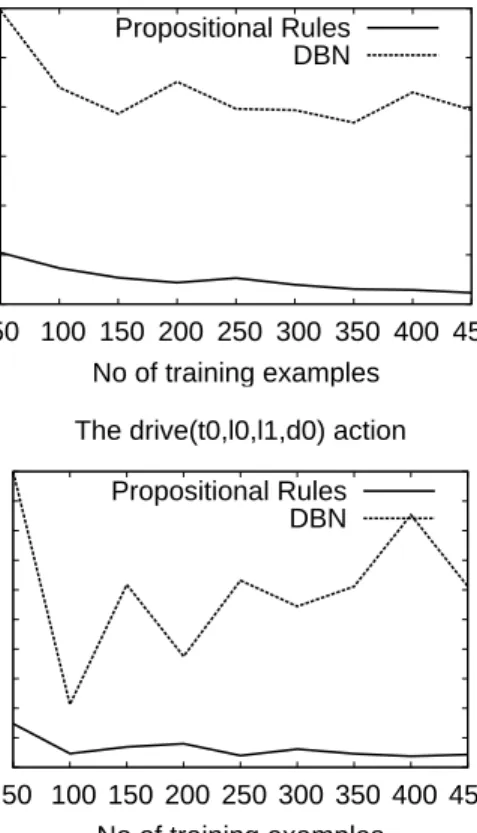
Comparison to DBNs To compare LearnRules to DBN learning, we forbid variable abstraction, thereby forcing the rule sets to remain propositional during learning. The BN learning algorithm of Friedman and Goldszmidt (1998), which uses decision trees to represent its conditional proba-bility distributions, is compared to this restricted LearnRules algorithm in Figure 4.
0 0.05 0.1 0.15 0.2 0.25 0.3 0.35 0.4 50 100 150 200 250 300 350 400 450 Variational Distance No of training examples The paint(b0) action Propositional Rules DBN 0 0.1 0.2 0.3 0.4 0.5 0.6 50 100 150 200 250 300 350 400 450 Variational Distance No of training examples The pickup(b0,b1) action
Propositional Rules DBN 0 0.05 0.1 0.15 0.2 0.25 0.3 0.35 0.4 0.45 0.5 0.55 50 100 150 200 250 300 350 400 450 Variational Distance No of training examples The walk(l0,l1,d0) action
Propositional Rules DBN 0 0.05 0.1 0.15 0.2 0.25 0.3 0.35 0.4 0.45 0.5 50 100 150 200 250 300 350 400 450 Variational Distance No of training examples The drive(t0,l0,l1,d0) action
Propositional Rules DBN
Figure 4: Variational distance as a function of the number of training examples for DBNs and propositional rules. The results are averaged over ten trials of the experiment. The test set size was 300 examples.
Notice that the propositional rules consistently outper-form DBNs. In the four blocks world DBN learning con-sistently gets stuck in local optima and never learns a sat-isfactory model. We ran other experiments in the simpler two blocks world which showed DBN learning reasonable (VD<.07) models in 7 out of 10 trials and generalizing bet-ter than the rules in one trial.
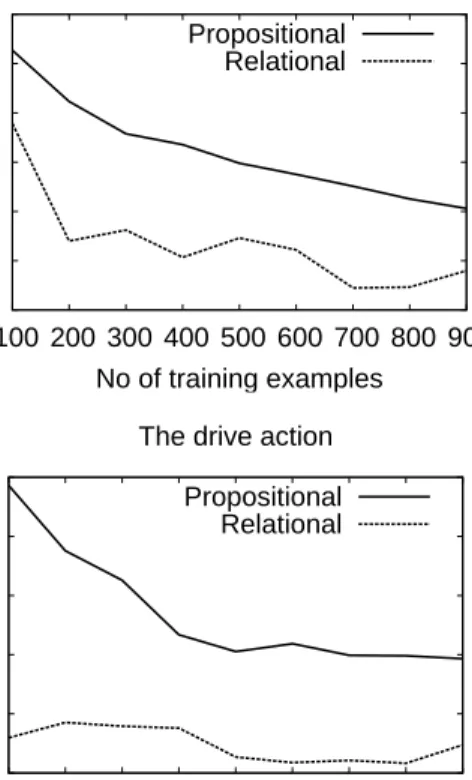
The Advantages of Abstraction The second set of exper-iments demonstrates that when LearnRules is able to use variable abstraction, it outperforms the propositional ver-sion. Figure 5 shows that the full version consistently out-performs the restricted version.
Also, observe that the performance gap grows with the number of arguments that the action has. This result should not be particularly surprising. The abstracted representation is significantly more compact. Since there are fewer rules, each rule has more training examples and the abstracted rep-resentation is significantly more robust in the presence of data sparsity.
We also performed another set of experiments, showing that relational models can be trained in blocks worlds with a small number of blocks and tested in much larger worlds. Figure 6 shows that there is no real increase in test error as the size of the test world is increased. This is one of the
major attractions of a relational representation.
Discussion The experiments of this section should not be surprising. Planning rules were designed to efficiently en-code the dynamics of the worlds used in the experiments. If they couldn’t outperform more general representations and learning algorithms, there would be a serious problem.
However, these experiments are still an important valida-tion that LearnRules is a robust algorithm that does leverage the bias that it was designed for. Because no other algo-rithms have been designed with this bias, it would be diffi-cult to demonstrate anything else. Ultimately, the question of whether this bias is useful will depend on its applicability in real domains of interest.
Related Work
The problem of learning deterministic action models, which is closely related to our work, is well-studied. There are several systems which are, in one way or another, more ad-vanced than ours. The LIVE system (Shen & Simon, 1989) learns operators with quantified variables while incremen-tally exploring the world. The EXPO system (Gil, 1993, 1994) also learns incrementally, and uses special heuristics to design experiments to test the operators. However, both of these system assume that the learned models are com-pletely deterministic and would fail in the presence of noise.
0.02 0.04 0.06 0.08 0.1 0.12 0.14 0.16 0.18 100 200 300 400 500 600 700 800 900 Variational Distance No of training examples The paint action
Propositional Relational 0 0.05 0.1 0.15 0.2 0.25 0.3 100 200 300 400 500 600 700 800 900 Variational Distance No of training examples The pickup action
Propositional Relational 0.06 0.08 0.1 0.12 0.14 0.16 0.18 0.2 0.22 100 200 300 400 500 600 700 800 900 Variational Distance No of training examples The walk action
Propositional Relational 0 0.05 0.1 0.15 0.2 0.25 100 200 300 400 500 600 700 800 900 Variational Distance No of training examples The drive action
Propositional Relational
Figure 5: Variational distance as a function of the number of training examples for propositional and relational rules. The results are averaged over ten trials of the experiment. The test set size was 400 examples.
The TRAIL system (Benson, 1996) limits its operators to a slightly-extended version of Horn clauses so that it can ap-ply ILP learning which is robust to noise. Moreover, TRAIL models continuous actions and revalued fluents, which al-low it to represent the most complex models to date, includ-ing knowledge used to pilot a realistic flight simulator.
Our search through the space of rule sets, LearnRules, is a simple extension of these deterministic rule learning tech-niques. However, our InduceOutcomes and EstimateParams algorithms are novel. No previous work has represented the action effects using a set of alternative outcomes. This is an important advance since deterministic operators cannot model even the simplest probabilistic actions, such as flip-ping a coin. Even in nearly-deterministic domains, actions can have unlikely effects that are worth modeling explicitly. Literature on learning probabilistic planning rules is rel-atively sparse: we know of only one method for learning operators of this type (Oates & Cohen, 1996). Their rules are factored and can apply in parallel. However, their rep-resentation is strictly propositional and it only allows each rule to contain a single outcome.
Probabilistic world dynamics are commonly repre-sented using graphical models, such as Bayesian net-works (BNs) (Friedman & Goldszmidt, 1998), a propo-sitional representation, and probabilistic relational models (PRMs) (Getoor, 2001), a relational generalization.
How-ever, these representations do not make any assumptions tai-lored towards representing action dynamics. In this paper, we test the usefulness of such assumptions by comparing BN learning to our propositional rule-learning algorithm. We would like to have included an comparison to PRM learning but were unable to because of various technical limitations of that representation (Zettlemoyer et al., 2003).
Conclusions and Future Work
Our experiments show that biasing representations towards the structure of the world they will represent significantly improves learning. The natural next question is: how do we bias robots so they can learn in the real world?
Planning operators exploit a general principle in modeling agent-induced change in world dynamics: each action can only have a few possible outcomes. In the simple examples in this paper, this assertion was exactly true in the underlying world. In real worlds, this assertion may not be exactly true, but it can be a powerful approximation. If we are able to ab-stract sets of resulting states into a single generic “outcome,” then we can say, for example, that one outcome of trying to put a block on top of a stack is that the whole stack falls over. Although the details of how it falls over can be very different from instance to instance, the import of its having fallen over is essentially the same.
0 0.02 0.04 0.06 0.08 0.1 0.12 0.14 4 6 8 10 12 14 16 18 20 Variational Distance Number Of Blocks The Paint Action
Training Set Size: 100 Training Set Size: 200
0 0.02 0.04 0.06 0.08 0.1 0.12 0.14 4 6 8 10 12 14 16 18 20 Variational Distance Number Of Blocks The Pickup Action
Training Set Size: 100 Training Set Size: 200
Figure 6: Variational distance of a relational rule set trained in a world four-block world, as a function of the number of blocks in the worlds on which it was tested. Results are given for three different training set sizes. The testing sets were the same size as the training sets.
An additional goal in this work is that of operating in ex-tremely complex domains. In such cases, it is important to have a representation and a learning algorithm that can op-erate incrementally, in the sense that it can represent, learn, and exploit some regularities about the world without having to capture all of the dynamics at once. This goal originally contributed to the use of rule-based representations.
A crucial further step is the generalization of these meth-ods to the partially observable case. Again, we cannot hope to come up with a general efficient solution for the problem. Instead, algorithms that leverage world structure should be able to obtain good approximate models efficiently.
References
AIPS (2002). International planning competition.. http://www.dur.ac.uk/d.p.long/competition.html. Benson, S. (1996). Learning Action Models for Reactive
Au-tonomous Agents. Ph.D. thesis, Stanford University. Bertsekas, D. P. (1999). Nonlinear Programming. Athena
Scientific.
Blockeel, H., & De Raedt, L. (1998). Top-down induction of first-order logical decision trees. Artificial Intelli-gence, 101(1-2).
Blum, A., & Langford, J. (1999). Probabilistic planning in the graphplan framework. In Proceedings of the Fifth European Conference on Planning.
Boutilier, C., Dearden, R., & Goldszmidt, M. (2002). Stochastic dynamic programming with factored rep-resentations. Artificial Intelligence, 121(1-2). Boutilier, C., Reiter, R., & Price, B. (2001). Symbolic
dy-namic programming for first-order MDPs. In Pro-ceedings of the Seventeenth International Joint Con-ference on Artificial Intelligence.
Brooks, R. A. (1991). Intelligence without representation. Artificial Intelligence, 47.
Draper, D., Hanks, S., & Weld, D. (1994). Probabilistic plan-ning with information gathering and contingent
exe-cution. In Proceedings of the Second International Conference on AI Planning and Scheduling.
Fikes, R. E., & Nilsson, N. J. (1971). STRIPS: A new ap-proach to the application of theorem proving to prob-lem solving. Artificial Intelligence, 2(2).
Friedman, N., & Goldszmidt, M. (1998). Learning Bayesian networks with local structure. In Learning and Infer-ence in Graphical Models.
Getoor, L. (2001). Learning Statistical Models From Rela-tional Data. Ph.D. thesis, Stanford University. Gil, Y. (1993). Efficient domain-independent
experimenta-tion. In Proceedings of the Tenth International Con-ference on Machine Learning.
Gil, Y. (1994). Learning by experimentation: Incremental refinement of incomplete planning domains. In Pro-ceedings of the Eleventh International Conference on Machine Learning.
Lavraˇc, N., & Dˇzeroski, S. (1994). Inductive Logic Pro-gramming Techniques and Applications. Ellis Hor-wood.
Oates, T., & Cohen, P. R. (1996). Searching for planning operators with context-dependent and probabilistic ef-fects. In Proceedings of the Thirteenth National Con-ference on Artificial Intelligence.
Penberthy, J. S., & Weld, D. (1992). UCPOP: A sound, com-plete partial-order planner for ADL. In Proceedings of the Third International Conference on Knowledge Representation and Reasoning.
Plotkin, G. (1970). A note on inductive generalization. Ma-chine Intelligence, 5.
Shen, W.-M., & Simon, H. A. (1989). Rule creation and rule learning through environmental exploration. In Proceedings of the Eleventh International Joint Con-ference on Artificial Intelligence.
Zettlemoyer, L., Pasula, H., & Kaelbling, L. (2003). Learn-ing probabilistic relational plannLearn-ing rules. MIT CSAIL Technical Report.