A Fast Cryptographic Protocol for Anonymous Voting L. Zahhafi, O. Khadir
Laboratory of Mathematics, Cryptography, Mechanics and Numerical Analysis. Fstm, University Hassan II of Casablanca, Morocco
[email protected] [email protected] Abstract
In this work, we discuss the problem of electronic voting. This notion has become widely sought in the world, which justifies the efforts made by researchers in this field. Voting by electronic means does not facilitate the task only for the organizers, but also for the voters who can send their choices from the home. Our system of binary electronic voting is based on Paillier cryptosystem. We chose this protocol as it is an additive homomorphism which will facilitate the calculation of the final vote results. The method presents a great difficulty in the decryption for attackers as it is based on the problem of factoring large numbers.
The protocol that we propose guarantees the anonymity of the vote, i.e. no one should know the vote of an elector. We also worked on the control of the parties holding the ballot. This increases the security, reliability and integrity of the vote. We have introduced several cryptographic notions to create an effective scheme. Indexing terms/Keywords
Electronic voting scheme, Paillier cryptosystem, RSA signature, Homomorphism, Encryption, Decryption, Identification, Anonymity, Security
SUBJECT CLASSIFICATION
E.g., Mathematics Subject Classification: 94A60, 91B12. Language: English
Date of Submission: 2018-03-01 Date of Acceptance: 2018-04-10 Date of Publication: 2018-04-30 Journal: MATHLAB Journal
Website: https://purkh.com
1. INTRODUCTION
Communication between people is a crucial need in their lives even before the appearance of computers. But with the development of the Internet network, it has begun having security risks. And this is where cryptography plays an indispensable role in protecting data transmitted by Internet. Today, several areas rely on this science to ensure the security of our services and online transactions.
Voting is an act allowing the expression of an opinion during a ballot to make a final decision. For a long time, we know the classic voting process, where voters move to the polling stations to mark their choices in paper envelopes. However, work on improving voting techniques has taken place over a long period of time.
In 1906, Boggiano [3] invented a voting machine to collect, count and automatically sum the results of a vote. Subsequently, the researchers do not stop on the automatization of the vote. Many of them have sought to develop methods of voting to make it more practical and effective. Based on public key cryptography, since 1981, Chaum [4] has been working on the problem of traffic analysis. Then, work on anonymous communication was integrated with the innovation of strong electronic voting protocols [2,9,11]. By observing the different conceptions of the researchers in the study of this concept, we note that several have worked on multi-authority schemes [5,6]. Which allows to generate the private key in cooperation between the different authorities. This type of model also leads to a deciphering in common. What strengthens the security of the voting system, since a single authority cannot decipher a voter's vote.
In 1994, other researchers as [10] gave the voter the opportunity to vote from a specific number of centers. As a result, the voter will not vote on a single destination. This prevents fraud and increases the level of security. It also enables the various centers to verify that all votes are considered.
The use of the homomorphic system [1,15] has facilitated the creation of simple and practical voting protocols. That allows to decipher just the product of all the votes cast to find the result of elections. This concept is considerable as it plays a very important role in ensuring the confidentiality of anonymous votes.
We relied on these ideas to create a new electronic voting scheme. Our paper presents the application of the Paillier cryptosystem [12] to model a binary electronic voting. And we note that this cryptosystem was also used by A. Acquisti in 2003 [1]. It is a homomorphic system. It means that from a single deciphering, we get the results of the vote. In our protocol, we manage a binary vote. So, electors will have only two choices yes or no. We detail below how this cryptosystem will give us exactly the number of electors who voted yes.
The paper is organized as follows: We show in the next section the different steps of the encryption and decryption by the Paillier cryptosystem, and an example to show its functioning. In the third section, we recall how the RSA signature works. Then, we will describe our voting protocol in the fourth section. In section five, we give an example and we finish by a conclusion in section six.
We denote by 𝑁 the set of natural numbers. By 𝑍 the set of integers. gcd(a,b) expresses the greatest
common divisor of a and b and φ(n) is the Euler function.
2. THE PASCAL PAILLIER CRYPTOSYSTEM
The Paillier cryptosystem [12] is a cryptographic algorithm proposed in 1999. This system presents an additive homomorphism. It means that we can calculate the encryption of the sum of two messages using the encryptions of each. The cryptosystem works as follow :
Alice chooses two prime numbers p and q and generates the public key 𝑛 = 𝑝𝑞 . She selects them such that: gcd(n , φ(n)) = 1. And she finds the secret key d such that: 𝑛. 𝑑 ≡ 1[φ(n)] and φ(n) = (p − 1)(q − 1).
2.1. Encryption
If Bob wants to send the message M to Alice, he will do it in two steps: 1. He chooses a random number 𝑟 ∈ {1,2,3, … , 𝑛 − 1}, with gcd(𝑟, 𝑛) = 1.
2. He sends 𝐶 ≡ (𝑛. 𝑀 + 1). 𝑟𝑛 [𝑛2] to Alice. 2.2. Decryption Theorem 1 : If 𝐶 ≡ (𝑛. 𝑀 + 1). 𝑟𝑛 [𝑛2], then 𝑀 ≡𝐶.𝑆−1 𝑛 [𝑛]. Where: 𝑆 ≡ 1 𝑟 𝑛 [𝑛2] and 𝑟 ≡ 𝐶𝑑[𝑛]. Proof : 𝐶 = (𝑛. 𝑀 + 1). 𝑟𝑛+ 𝐾. 𝑛2 → 𝐶𝑑= ((𝑛. 𝑀 + 1). 𝑟𝑛+ 𝐾. 𝑛2)𝑑 → 𝐶𝑑≡ 𝑟𝑛.𝑑 [𝑛] where: 𝐾 ∈ 𝑍 . Since 𝑛. 𝑑 ≡ 1[φ(n)] , so 𝑟 ≡ 𝐶𝑑[𝑛].
Alice determines the number s such as: 𝑆 ≡1
𝑟 𝑛
[𝑛2]. And finally, she finds the message M sent by Bob as
follows: 𝐶 ≡ (𝑛. 𝑀 + 1). 𝑟𝑛 [𝑛2] → 𝐶 𝑟𝑛≡ (𝑛. 𝑀 + 1) [𝑛 2] → 𝐶. 𝑠 ≡ (𝑛. 𝑀 + 1) [𝑛2] → C. s = n. M + 1 + 𝑘′. 𝑛2 → 𝐶.𝑠−1 𝑛 = 𝑀 + 𝑘 ′. 𝑛
This gives the following result: 𝑀 ≡𝐶.𝑆−1
𝑛 [𝑛]. Example 1 :
Suppose that Alice chooses (p, q) = (1657,1057), and generates the public key: n = p. q = 1817729. So, 𝜑(𝑛) = 1814976 and gcd(n, φ(n)) = 1.
We assume that Bob wants to send the message M = 654329 to Alice.
Bob selects the random number r= 754323 which is prime with 𝑛 = 1817729.
He sends 𝐶 ≡ (𝑛. 𝑀 + 1). 𝑟𝑛≡ 1861049193970 [𝑛2] to Alice. Alice finds the message M by these following steps:
1. She calculates her secret key 𝑑 ≡1
𝑛≡ 1
1817729 ≡ 1180097 [𝜑(𝑛)]. 2. She determines the value of r by using her private key d.
𝑟 ≡ 𝐶𝑑≡ 18610491939701180097 ≡ 754323 [𝑛]. 3. 𝑆 ≡1 𝑟 𝑛 ≡ 1 754323 𝑛 ≡ 343821977573 [𝑛2]. 4. 𝑀′≡𝐶.𝑆−1 𝑛 ≡ 654329 [𝑛]. 𝑀′= 𝑀 = 654329 . 3. RSA SIGNATURE (1978)
It is based on the problem of factorization of large numbers which presents great difficulties until now. We call Alice the person who wants to sign a message, and Bob the person who verifies Alice's signature. Alice
chooses two large primes p and q and makes their product 𝑛 = 𝑝𝑞. Then she chooses an integer 𝑒 ∈ 𝑁 such as gcd(𝑒, 𝜑(𝑛)) = 1. Its secret key d verifies : 𝑑 ≡1
𝑒 [𝜑(𝑛)]. 3.1. Signature equation
Alice signs the message M of Bob using its secret key d. She calculates: 𝑆 ≡ 𝑀𝑑[𝑛] and sends it to the verifier Bob.
3.2. Signature verification
After receiving Alice' signature S, Bob checks this fallowing equation using the public key e: 𝑆𝑒≡ 𝑀[𝑛].
4. OUR VOTING SCHEME
4.1. Description of the Protocol
In this section, we will apply the Paillier cryptosystem to implement a binary electronic voting scheme. Each elector will have only two voting choices: He either votes for (A = Yes = 1) or (B = No = 0).
4.1.1. Elements holding the vote
We are introducing four elements to organize this protocol. Each element has a specific and indispensable role for the continuity of the voting circuit. The objective of intervening several authorities is to reduce the power of each for increasing the level of security. Their tasks are as follow :
• Administrator : He generates the keys used in the voting process.
• Intermediaries : They receive the encrypted votes of the voters and calculate their product then send it to the Decipherer.
• Controllers : The role of these elements is to verify that intermediaries haven't cheat by changing the electors' vote.
• Decipherer : He decodes the encrypted vote and calculates the final result. 4.1.2. Keys generation
As we use the Paillier cryptosystem to encrypt electors' vote, the administrator generates two prime numbers
p and q, and calculates the public key 𝑛 = 𝑝𝑞 such that: gcd(𝑛, 𝜑(𝑛)) = 1. Then he finds the secret key d that
verifies : 𝑛𝑑 ≡ 1[𝜑(𝑛)]. This secret key will be used by the Decipherer in the calculation step of the result. So,
the administrator gives the value of d to the Decipherer. The value of n will be public and used to encrypt the votes.
The administrator also generates the signature keys for controllers. So, he assigns each one a public exponent
ejand its secret key dj such as: ej . dj ≡ 1[𝜑(𝑛)].
4.1.3. Polling steps
We suppose that there are 𝐾 ∈ 𝑁 electors { E1,E2,...,Ei,...Ek }, each of them will send his voting message Mi. The system will then encode this message using Paillier cryptosystem, and send the code Ci to an intermediary, a trusted party between electors and Decipherer.
To avoid cheating between this intermediary and the Decipherer, we introduce 𝑙 ∈ 𝑁 intermediaries and 𝑙
controllers. We associate every intermediary li to a controller Cti. Then we will not trust only one party. So, the ciphertext Ci of every voter will be sent to an intermediary in a random way. And the corresponding controller
Every intermediary Ij will collect the coded choices of a specific number of voters, then calculates their product:
𝐶𝑗 ≡ ∏𝑆𝑗 𝐶𝑖 [𝑛2]
𝑖=1 .
With: 𝑗 ∈ {1,2, … , 𝑙 } and sj is the number of electors who send their ciphertexts to the intermediary j.
In the same time, the controller corresponding to this intermediary collects squares of the coded choices, then calculates their product: 𝑓(Cj) ≡ ∏𝑆𝑗𝑖=1 𝑓(𝐶𝑖) ≡ ∏𝑆𝑗𝑖=1 (𝐶𝑖)2 [𝑛2] .
At the time t, end of the voting period, Ij sends the value Cj to the the controller Ctj.
In this step, every controller Ctj calculates: 𝑣𝑎𝑙 ≡ Cj2 [n2]and compares it with the value: 𝑓 (Cj). If they are
equal he signs Cj and sends S(Cj), the signed product, to intermediary 𝑙j.
To sign the values Cj, each controller must have his secret key. there are many digital signature protocols that can be implemented in our voting scheme as the signature of Elgamal [7] and the RSA protocol based on the factorization problem [14]. In our case, the work with RSA's signature is more suitable. Indeed, we assign the same public key 𝑛2 to all controllers but differents exponents ej. So every controller will have a private key that allows him to sign the value received from the intermediary.
After receiving S(Cj), each intermediary 𝑙j sends the couple (Cj, S(Cj)) to the Decipherer. Remark:
To participate in elections, each voter must go through an identification step. However, there are several methods of identification to limit access to the voting system such as the Fiat-Shamir [8] and Quillou-Quisquater [10] protocols which are inspired by the RSA algorithm. Also we can report the identification schemes of Shnorr [16] and Okamoto [13] which are based on the discrete logarithm problem. All of these schemes exploite the concept of zero-knowledge proof, which means that voters can identify to our voting system without disclosing their secret keys in order to guarantee the anonymity of the vote.
4.1.4. Calculation of the voting results
Now, Decipherer receive the couples { (C1,S(C1)), (C2,S(C2)),..., (Cl,S(Cl)) }, the product of all the electors' coded
choices of each intermediary with their signatures by controllers. In the first, he verifies the validity of signatures, then he calculates: 𝐶 ≡ ∏𝑙 𝐶
𝑖=1 i [n2] and decodes it to find the message: ∑𝑘𝑖=1𝑀i such as: • Mi presents the message of the elector number i . So Mi ∈ {0,1}.
• k is the total of electors participating in this vote.
• M presents the voting result, and more precisely, the number of voters who voted for the choice
𝐴 = 1 = 𝑦𝑒𝑠.
We show that M presents the voting result, in other words, the number of voters who voted for the choice 𝐴 = 1 = 𝑦𝑒𝑠.
We used the Paillier cryptosystem to code the choices of voters. This system is an additive homomorphic cryptosystem. It means that if we code two messages M1 and M2 to obtain C1 and C2, the encryption of (M1 +
M2) will be the product of C1 and C2 mod n2. Indeed: • C1≡ (n.M1 + 1).r1n [n2]
• C2≡ (n.M2 + 1).r2n [n2]
• C ≡ C1. C2 ≡ (n.(M1+M2) + 1).r n [n2]
Theorem 2:
If among the k voters k’ send (Yes=1) and k’’ send (No=0) then, the results M of this vote will be as follows: 𝑀 = ∑𝑘𝑖=1𝑀i = k’.1 + k’’.0 = k’.
Proof:
In the binary vote, the message presenting the choice of the voter is 0 or 1. So, we recapitulate the result of the vote like this : M voters voted by Yes and k – M voted by No.
4.2. Security analysis
Attack 1: Assume that Oscar is an attacker. If he intercepts the value of Ci and tries to find Mi, the choice of the elector i. While Mi ∈ {0,1}, he will replace Mi by its value, and check the result by using the value of Ci in
equation : Ci≡ (n.Mi + 1).ri n [n2]. But he will be confronted by the number ri that he doesn't
know. So the two tests don’t allow Oscar to know the voter's choice.
Attack 2: The Decipherer is the only party that has the secret key to decipher a message. Since our voting protocol ensures the anonymity of the vote, even this Decipherer must not decipher any voter's vote. And that's why we introduced intermediaries, the trusted parties, that collect the votes and calculate their products before sending them to the Decipherer.
Attack 3: If an intermediary tries to modify an encrypted vote, the controller will not sign his wrong product
Cj. Then, all intermediaries have to collect and transmit every information in an honest way. 4.3. Complexity
While k voters participate on the election, in the voting step, the system will encode k choices. So the number of operations that must be calculated is: 2k modular multiplications and k modular exponentiations.
And to control the work of intermediaries, the system will calculate the square of encrypted votes and send the results to controllers. Then, there will be k modular exponentiations to perform. Again, in the signing step, controllers sign 𝑙 values with the RSA signature which leads to perform 𝑙 modular exponentiations and k
modular multiplications.
In the result step, the decipherer will execute 𝑙 signature's verification by calculating 𝑙 modular
exponentiations. Then, he executes one decryption with Paillier cryptosystem. So, there are 𝑙+2 modular
exponentiations, tree divisions and one multiplication.
The time required to execute all the voting operations is as follows:
T = (3k + 1)Tmult + (2k + 2 𝑙 + 2)Texp + 3𝑇div
= (3k + 1)O(( 𝑙𝑜𝑔𝑛)2) + (2k + 2𝑙 + 2)O(( 𝑙𝑜𝑔𝑛)3) + 3O(( 𝑙𝑜𝑔𝑛)2) = O(( 𝑙𝑜𝑔𝑛)2) + O(( 𝑙𝑜𝑔𝑛)3)
= O(( 𝑙𝑜𝑔𝑛)2+ O( 𝑙𝑜𝑔𝑛)3).
Finally, as a result, we can assume that our voting system works on a polylogarithmic time.
Suppose there is a company wants to make a decision to accept or refuse a proposed program. It intervenes its employees to decide, then the management organizes an electronic voting to hang the decision.
There are 40 employees participating in the vote, 3 intermediaries, 3 controllers, one decipherer and an administrator.
So, the administrator chooses the primes (p, q) = (1861,1867), then generates the public key n = p. q = 3474487 that verifies: gcd(𝑛, 𝜑(𝑛)) = 1. He calculates the decryption key 𝑑 ≡1
𝑛 ≡ 1
3474487 ≡ 793423 [𝜑(𝑛)] and sends it to the decipherer.
The administrator affects signature keys for each controller. So, controller Ct1 receives (e1,d1) =
(7,6890920285783), controller Ct2 receives (e2,d2) = (11,5481413863691) and controller Ct3 receives (e3,d3) =
(13,7420991076997). Values e1, e2 and e3 are publics but d1, d2 and d3 are secrets. During the voting period the system calculates the following values:
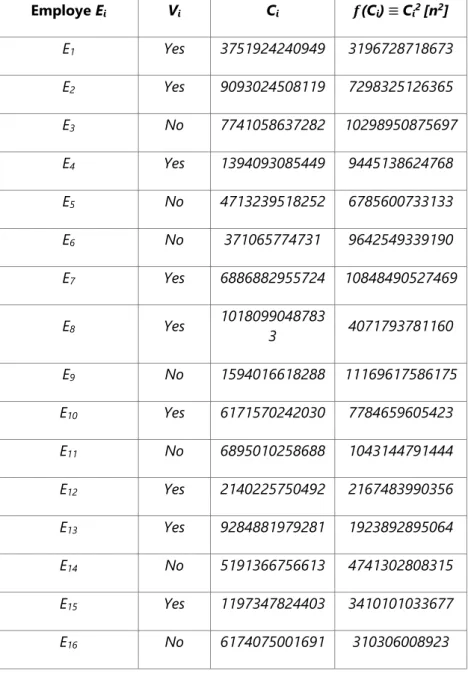
Table 1. The encrypted votes and their squares modulo n2
Employe Ei Vi Ci 𝒇(Ci) ≡ Ci2 [n2] E1 Yes 3751924240949 3196728718673 E2 Yes 9093024508119 7298325126365 E3 No 7741058637282 10298950875697 E4 Yes 1394093085449 9445138624768 E5 No 4713239518252 6785600733133 E6 No 371065774731 9642549339190 E7 Yes 6886882955724 10848490527469 E8 Yes 10180990487833 4071793781160 E9 No 1594016618288 11169617586175 E10 Yes 6171570242030 7784659605423 E11 No 6895010258688 1043144791444 E12 Yes 2140225750492 2167483990356 E13 Yes 9284881979281 1923892895064 E14 No 5191366756613 4741302808315 E15 Yes 1197347824403 3410101033677 E16 No 6174075001691 310306008923
E17 No 3691048252574 6163105694069 E18 No 8491779847275 1408824491056 E19 Yes 505407843581 5488423133733 E20 Yes 10309754374966 8542448775151 E21 No 11405127212374 10688613344789 E22 No 7267494479281 6615527600107 E23 Yes 3306090845272 11247684905599 E24 Yes 10546257855732 767600113655 E25 No 7500822411687 7994214161570 E26 Yes 11212869832108 8066840857816 E27 No 11201187123200 2951294666640 E28 Yes 8138992439477 9015284387417 E29 No 9205649525016 9287055286070 E30 Yes 6577761628034 7236715002874 E31 Yes 9280794787299 2446820418554 E32 Yes 4118980340965 3139535635085 E33 Yes 8126553658412 11716737228088 E34 No 11891079006375 7024588036317 E35 Yes 78455701533 11260474184520 E36 Yes 5556193502501 5359577845187 E37 Yes 6064836129774 9993804696757 E38 No 549700468882 9646579935070 E39 Yes 9700948743606 9595683981678 E40 No 8428306696272 6817835099665
Suppose the system sends: { C1, C2, ... , C15 } to the intermediary I1. So, controller Ct1 receives: { 𝑓(C1), 𝑓(C2), ... ,
𝑓(C15) }. Then, it sends: { C16, C17, ... , C30 } to the intermediary I2. Controller Ct2 receives: { 𝑓(C16), 𝑓(C17), ... , 𝑓(C30)
}. The last intermediary receives: { C31, C32, ... , C40 } and controller Ct3 gets : { 𝑓(C31), 𝑓(C32), ... , 𝑓(C40) }. After the end of the voting period:
• Intermediary I1 calculates: 𝑋 ≡ ∏15 𝐶
𝑖=1 i ≡ 751246028294 [𝑛2]. And sends the result to the controller Ct1.
• Intermediary I2 calculates: 𝑌 ≡ ∏30 𝐶
𝑖=16 i ≡ 8604416976262 [𝑛2]. And sends the result to the controller Ct2.
• Intermediary I3 calculates: 𝑍 ≡ ∏40 𝐶
𝑖=31 i ≡ 2355091856266 [𝑛2]. And sends the result to the controller Ct3.
We detail the control process as follows:
Controller Ct1 calculates: 𝑣𝑎𝑙1 ≡ ∏15𝑖=1𝑓(Ci) ≡ 9746762852670 [𝑛2]. And 𝑓(𝑋) ≡ 𝑋2≡
9746762852670 [𝑛2] Since 𝑣𝑎𝑙
1= 𝑓(𝑋), he signs X. So, he sends: 𝑆(𝑋) ≡ 𝑋𝑑1[𝑛2] to intermediary I1.
Controller Ct2 calculates: 𝑣𝑎𝑙2 ≡ ∏30𝑖=16𝑓(Ci) ≡ 3423401255655[𝑛2]. And 𝑓(𝑌) ≡ 𝑌2≡
3423401255655[𝑛2] Since 𝑣𝑎𝑙
2= 𝑓(𝑌), he signs Y. So, he sends: 𝑆(𝑌) ≡ 𝑌𝑑2[𝑛2] to intermediary I2.
Controller Ct3 calculates: 𝑣𝑎𝑙3 ≡ ∏40𝑖=31𝑓(Ci) ≡ 7812734475226[𝑛2]. And 𝑓(𝑍) ≡ 𝑍2≡
7812734475226[𝑛2] Since 𝑣𝑎𝑙
3= 𝑓(𝑍), he signs Z. So, he sends: 𝑆(𝑍) ≡ 𝑍𝑑3[𝑛2] to intermediary I3. Now, Intermediaries send values: { (X,S(X)), (Y,S(Y)), (Z,S(Z)) } to the decipherer.
In the first, the decipherer checks that S(X), S(Y) and S(Z) are correct using e1, e2 and e3 (see 3.2). Then, he
executes 𝐶 ≡ X. Y. Z ≡ 5893815063801 [𝑛2] and decodes this value as follows: He calculates 𝑟 ≡ 𝐶𝑑 ≡ 2188228 [𝑛], then he finds: 𝑠 ≡ 1
𝑟𝑛 ≡ 4010950335138 [𝑛
2] and finally, he gets the result: 𝑀 ≡𝐶.𝑠−1
𝑛 ≡ 23[𝑛].
So, the final result of this vote is: 23 employees are agree with the decision of the company and 40 − 23 = 17 are not.
6. CONCLUSION
In this paper we presented a new system of binary electronic voting based on Paillier cryptosystem. The protocol we presented is well secured as we have introduced several authorities, each one controls the work of the other. Also, we have involved solid cryptographic concepts as the homomorphe encryption system and the digital signature.
ACKNOWLEDGMENTS
REFERENCES :
1. A. Acquisti, 2004. Receipt-Free Homomorphic Elections and Write-in Ballots. International as sociation for cryptologic research, May 2, 2004, and Carnegie Mellon institute for software.
2. J. Benaloh, 1987. Verifiable secret-ballot elections. Ph.D. thesis, Yale university, Technical report 561. 3. Boggiano, 1906. Le pséphographe. Henry Bidou.
4. D. L. Chaum , 1981. Untraceable electronic mail, return addresses, and digital pseudonyms. Communications of the ACM, 24, 84 90.
5. R. Cramer, M. Franklin, B. Schoenmakers, and M. Yung, 1996. Multi-authority secret ballot elections with linear work. Advances in Cryptology EUROCRYPT ’96, volume 1070 of Lecture Notes in Computer Science,pages 72 83, Berlin.
6. R. Cramer, R. Gennaro, B. Schoenmakers, 1997. A secure and optimally efficient multi-authority election sheme. Advances in Cryptology- EUROCRYPT' 97, LNCS 1233, 103-118.
7. T. Elgamal 1985. A public key cryptosystem and a signature scheme based on discrete logarithms. IEEE Trans Inf Theory. 31 (4): 469-472.
8. A. Fiat and A. Shamir , 1987. How to prove yourself: practical solutions to identification and signature problems. Springer-Verlag, Lecture notes in computer science, No 263, Advances in cryptology,Proceedings of Crypto '86, pp. 186-194.
9. A. Fujioka, K. Ohta, T. Okamoto , 1993. A practical secret voting scheme for large scale elections. Y.Zheng, J.Seberry, (eds.) AUSCRYPT. LNCS, vol 718, 248-259.
10. L. Guillou and J. Quisquater. A Practical Zero-Knowledge Protocol fitted to Security Micro-processor Minimizing both Transmission and Memory. Proc. of EuroCrypt 88, Springer VerlagLNCS series. 11. K. Iversen, 1992. A cryptographic scheme for computerized general elections. Proc. CRYPTO ’91,
Springer LNCS 576, pp: 405 - 419.
12. P. Paillier, 1999. Key Cryptosystems based on composite degree residuosity classes. Eurocrypt, 223-238.
13. T. Okamoto, 1992. Provably secure and practical identification schemes and corresponding signature schemes. Brickell E.F. (eds) Advances in Cryptology Crypto '92. Lecture Notes in Computer Science, v.740. Springer, Berlin, Heidelberg.
14. R. Rivest, A. Shamir, L. Adleman, February 1978. A Method for Obtaining Digital Signatures and Public-Key Cryptosystems. Communications of the ACM. 21 (2): 120-126.
15. K. Sako and J. Kilian, 1994. Secure voting using partially compatible homomorphisms. CRYPTO '94: 14th International Cryptology Conference, volume 839 of LNCS, 411-424.
16. C.P. Schnorr, 1989. Efficient identification and signatures for smart cards. Brassard G (ed) CRYPTO, Lecture notes in computer science, vol 435. Springer, Berlin, pp 239-252.
Author’s short biography
Dr Omar Khadir received his Ph.D. degree in Computer Science from the University of Rouen, France (1994). Co-founder of the laboratory of Mathematics, Cryptography, Mechanics and Numerical Analysis at the University of Hassan II Mohammedia, Morocco, where he is a professor in the Department of Mathematics.He was head of the deppartement of Mathematics until January 2018. He teaches cryptography for graduate students preparing a degree in computer science. His current research interests include public key cryptography, digital signature, primality, factorisation of large integers and more generally, all subjects connected to the information technology.
Leila Zahhafi holds an engineer degree in Computer Science and Mathematics from the University of Hassan II of Casablanca Mohammedia (2016). Member of the laboratory of Mathematics, Cryptography, Mechanics and Numerical Analysis, she is currently a Phd Student. Her research interest is public key cryptography.