Exploration on Big Data Oriented Data Analyzing and
Processing Technology
Authors’ Names and Addresses: XIAO DAWEI, No.31 TieShan West Road, Economic and Technological Development
Zone Dalian, China,116600 XIAO DAWEI 1, AO LEI 2
1
Department of computer engineering, city institute, Dalian university of technology, Dalian, China
Abstract
At present, enterprises have urgent needs to conduct an effective and stable statistical analysis on big data. With a view to solving the issue of analysis and processing of big data in respect of enterprise business, this essay proposes a hybrid structure mode based on the MapReduce technology and the parallel database technology, discusses the principle on which the mode is used to realize the analysis and processing of big data and its advantages, and analyzes, expounds and proves the hybrid structure and provides a practical plan on big data processing. It is expected that this study has certain reference value in related researches. 103
Keywords: big data, MapReduce, parallel database, hybrid structure
1. Introduction
With the continuous improvement of informatization construction, most enterprises have completed the deployment of informatization system and the research and development, design and promotion of new products and new services have been greatly improved in respect of the operation efficiency of compared to traditional enterprises. However, although the enterprises have realized a high-efficiency and elaborate management, masses of business data are concurrently accumulated. Furthermore, there are categories of data and the requirement of being real-time is quite high. This is so-called “big data”. All of the internet of things, cloud computing, mobile Internet, large-scale e-commerce, mobile phone, tablet computer and the various sensors spread all over each corner of the earth are data sources or the carrying way. At present, as a relatively new concept, big data is not proposed directly as the proper noun to give policy support by the Chinese government. However, in December 8, 2011, the Ministry of Industry and Information Technology of People’s Republic of China issued the Internet of things " Twelfth Five-Year Plan", put forward as the information processing technology is
one of the 4 key technical innovation projects, including the analysis of massive data storage, data mining, image and video intelligent analysis, which are important parts of big data. The other 3 key technical innovation projects including information technology, information technology, information security technology, are closely related with the large data. Large data has four characteristics: first, a huge amount of data, using PB as the unit; second, various data types, including network log, video, pictures, geographic location information and other data; third, the low density of value, with video as an example, the valuable data may be only one or two seconds in the continuous monitoring process; fourth, fast processing speed, this point is essentially different with the traditional data mining. Big data contains masses of valuable mode and information. For example, Wal-Mart, a global retail giant, will mine geographic locations, sales performance and social information of stores in big data to improve customers’ understanding. For enterprise organizations, the value of big data is reflected in the two aspects: analysis and use and secondary development. The enterprises need to rely upon the technical platform on informatization system to mine in big data any needed important information and conduct intensive analysis and processing of these big data so as to construct a data warehouse and application and analysis platform based on important data information. By analyzing and processing the masses of the data information of enterprises, it will provide a correct guidance and policy-making for the existence and development of enterprises. Figure 1 illustrates big data management system structure. To design a system platform based on big data analysis, this essay proposes a solution which is big data oriented and integrates storage, management, analysis, processing and application. This proposal is very practical upon being tested and analyzed.
system management tool
System interface
Interactive tool Client layer
Visit layer system management:
load, select, data dictionary Operation support:
backups data, fault tolerance, recovery system
… Data layer
Fig.1 big data management system structure
2. Big Data Processing Technology
Theoretically, there are no limits to the improvement of the processing function of big data. At present, in the practical application on the processing of big data, the most often used and mainstream realization technology is the MapReduce technology, parallel database technology and the hybrid structure technology based on MapReduce technology and parallel database technology.
2.1 MapReduce Technology
In 2004, MapReduce was proposed by Google, it is an object-oriented programming model to deal with the large data, primarily used for processing internet data, such as document capture, inverted index construction. But because MapReduce has a simple and powerful data processing interface, and it hides many details on massively parallel execution, fault tolerance and load balance implementation, so the technology has been widely applied in the field of machine learning, data mining, data analysis, text tokenization, indexing research, creation of other kinds of data structures(e.g., graphs).
In a slide presentation, Google offers the following applications of MapReduce: distributed grep, distributed sort, web link-graph reversal, term-vector per host, web access log stats, inverted index construction, document clustering, machine learning, statistical machine translation.
The MapReduce technology realizes the abstract processing of complicated business logics involved in the parallel programming. It realizes complicated the computing process, provides simple and easily used interactive interface, and conceals the specific realization process for the parallel computing, processing, fault tolerance, data analysis and load balancing used in complicated businesses. The MapReduce technology includes two basic operation conceptions: Map(Mapping) and Reduce(Simplication). The Map technology mainly processes a group of input data record and distributes data to several servers and operation systems. Its means of processing data is a strategy based on the key/value. The Reduce technology mainly occupies itself in summarizing and processing the result after processing the above key/value. Issues and tasks in the real world may be modeled and described by means of this simple means of processing. Programs realized by this means will be distributed cluster. The data processing algorithm based on issues will be distributed to the distributed system formed by ordinary computers and then executed. The system will then solve the problem on the details in relation to the input of big data. Then the algorithm programs crossing computer cluster by means of the center server will be dispatched and managed: the management not only relates to the condition of each processing machine but to interactive communication request between the computers. Using such computing mode can help realize the mode of processing and computing of big data based on the distributed system structure for large-scale enterprises, without the need to grasp the process and details of the parallel processing. It will easily cause the realization of unified dispatch, management, storage, analysis and processing of the scattered resource information of the integration enterprise. It will realize the high-efficiency analysis and utilization of big data of enterprises by using the business data information of each branch of the enterprise.
MapReduce is designed for mass composed of low-end computer cluster, its excellent scalability has been fully verified in industry. MapReduce has low requirement to hardware, MapReduce allows to build cluster using inexpensive hardware. As a free open source system, MapReduce can store data in any format, can achieve a variety of complex data processing function. Analysis based on the MapReduce platform, without the need of complex data preprocessing and writing in the database process, can be directly analysed based on the flat file, and the calculation model which its use is mobile computing instead of moving data, therefore the analysis delay can be minimization. But the utility software based on MapReduce is relatively little, many data analysis function requires users to develop their own, which will lead to
increasing cost. Because the MapReduce does not want to become a database system, so it does not provide SQL interface.
2.2 Parallel Database Technology
During the present phase, the popularizing and applying of relational databases feature a widest scope and they are at a mainstream position in the whole database system field. The original design object of relational database is to realize the application of the large-scale machines based on the “Host Computer – Terminal Computer” mode; however, its application scope is very limited. With the popularity and application of the “Client - Service”, the relational database system brings about an application era of “Client - Service” and is widely developed and applied. However, with the popularizing of the Internet technologies, the Internet information resources begin increasingly complicated, and the relational database begins to become unable to apply to complicated Internet application and cannot be used to express and administer each type of complicated document type and multi-media resource information. Therefore, the relational database system is improved and adjusted on this regard, such as adding the support function on the database system that is object oriented, at the same time, adding the function on handling each complicated information data.
Database processing technology based on parallel computing is a technology blended with the parallel computing mode and database processing technology. It originated in the seventies of the 20th century, mainly studies the parallelism of the relational algebra operations and the hardware design for implementation of relation operation, hope to realize some function of relational database operation by hardware. Unfortunately, the study failed. In the late 80s of the 20th century, the research direction of parallel database technology turned gradually to the general parallel machine, and the research was focused on the physical organization of parallel database, operative algorithms, optimization and scheduling policy. From the 90s until now, with the development of the basic techniques for processor technology, storage technology, network technology, the parallel database technology rise to a new level, the focus of the research is also transferred to the time and spatial parallelism of the data operation. In the processing and analysis of the big data, data parallel processing manner is essential. Because the processing strategy of "divide and rule" provides unlimited reverie to extend system performance.
With the fast development and application of parallel processing and computing technology, people get to know that the processing of a parallel mode can be realized by means of the conceptions of time or space so that the
processing efficiency of system tasks can be improved. After the entry of enterprises’ business information data into the big data era, this parallel computing mode can help well solve the data processing issue for large-scale enterprises’ business data system. Parallel computing includes two aspects: data parallel processing and task parallel processing. In terms of the data parallel processing means, a large-scale task to be solved can be dissembled into various system sub-tasks with the same scale and then each sub-task will be processed. As such, compared to the whole task, it will be easy to process. Adopting the task-paralleling processing mode might cause the disposal of tasks and coordination of relationships overly complicated. Using the parallel database technology is a means for realizing the parallel processing of data information. Parallel database support standard SQL language, through the SQL to provide data access service, SQ L is widely used because it is simple and easy to apply. But in big data analysis, the SQL interface is facing great challenges. The advantage of SQL comes from packaging the underlying data access, but the packaging affects its openness to a certain extent. User-defined functions which provided by parallel database is mostly based on the design of a single database instance, and therefore they cannot be executed in parallel cluster, it means that the traditional way is not suitable for the processing and analysis of big data. Moreover, the user-defined functions often need to pass complex system interaction in parallel database, and is familiar with the database structure and system calls, so it is difficult to use. Parallel database design is based on high-end hardware, software fault tolerance ability is poor, so the augmentability of parallel database is limited, the traditional data warehouse based on parallel database usually completed data preprocessing and analysis show with the help of external tools, so the data processing and analysis process involves a lot of data migration and calculation, of course, the analysis delay is often higher.
3. Constructing the Pattern on Big Data
Processing
For the analysis and processing of big data, using a system based on the parallel database and data warehouse is not an ideal plan for the analysis and processing of big data. Using the combination of MapReduce and parallel database combines the advantages of the two means. After the analysis and comparison of the two means, the advantages and disadvantages of the two means can be seen. For such reasons, constructing a big data processing pattern based on MapReduce combined parallel data can on the one hand make up for their own disadvantages and can on the other hand improve the reliability of the system.
3.1 The hybrid structure mode of associating MapReduce with Parallel Database
SQL, as a universal relationship database system scripting language, has been widely used in the field of relational database, and SQL can be applied in the parallel database. Therefore, the SQL scripting language can act as a entry point for the combination of the two.
MapReduce defines a self-defined interface function for SQL scripting sentence and provides the same grammatical form as common SQL scripting sentence. Within the self-defined function realizes the data processing based on parallel computing. At the same time, such processing mode based on paralleling is applicable to the enterprise distributed system and can be used to hundreds of servers. These parallel processing machines and their computing of services conceal the realization details to users and are transparent for users, as a result of which big data processing can be realized by using MapReduce modules through SQL scripting sentence. The interface function of such MapReduce can normally operate under the database system circumstance, and its returned result sets remain a usable data table. Figure 2 illustrates the pattern on big data processing based on the MapReduce framework.
Reduce function: include SQL
Map Reduce construction Map function: include SQL
Relational database Fig.2 Pattern on Big Data Processing Based on the MapReduce
Framework 3.2 Data Analysis
The loading, analyzing and processing of a large amount of data supported by data warehouse engines based on MapReduce can satisfy the need for the construction and mining needed for enterprise big data and can apply to the need of the performances and functions of the present and future information system. Below is an example on a Hotel Chain as the data analysis of solutions.
3.2.1 System Environment 1) Database Servers
Branch 1: DELL Power Edge R910. Branch 2: DELL Power Edge R910. Branch 3: DELL Power Edge R910.
Master Server: Dell 2950.
Data Storage Equipment: 5 MD1000 Direct Connection Storage.
2) Operation System
Two branches and the master server are respectively fixed FreeBSD Linux 9.0.
3) Network Environment
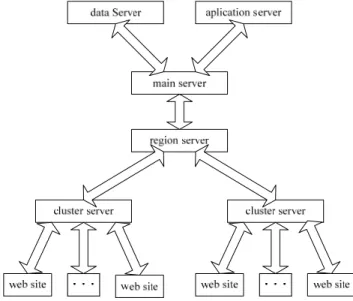
One switchboard for Gigabit LAN optical network, No Blocking Switch mode and Gigabit LAN optical network. 4) Figure 3 illustrates the Service Architecture of the Information System Clusters of a Hotel Chain.
Fig.3 Tthe Service Architecture of the Information System Clusters of a Hotel Chain
3.2.2 Performance Test of System
1) Table 1 illustrates Loading,Rate of Engine Data Table 1: Loading Rate of Engine Data
Filename Description of File
Size of File Time
Cinfo Customer Information Form 90,134,500 3s Userinfo Customer Information Form 70,104,400 5s
Cjyinfo Client Dealing
Information Form 802,325,126,105 60s Syslog Journal Information Form 6,427,634,543 30s Jysum Dealing Summary Form 23,898,856,777,988 104s
2) Statistical Analysis of Data
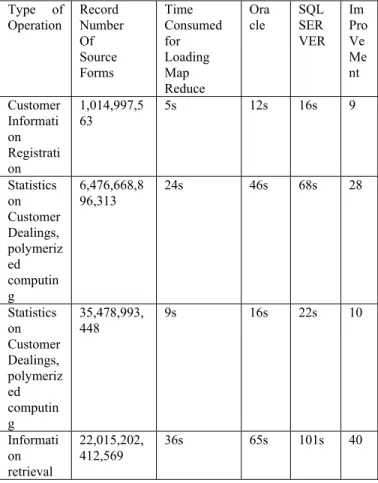
The same business data will be loaded to Greenplum, Oracle and separate SQLSERVER database, the same SQL sentences will be executed by MapReduce. The time for the execution of sentences will be taken notes of. The systematic structure based on MapReduce is found to be highly efficient through test comparison. Table 2 illustrates Data Statistic Analysis Result.
Table 2: Data Statistic Analysis Result
Type of Operation Record Number Of Source Forms Time Consumed for Loading Map Reduce Ora cle SQL SER VER Im Pro Ve Me nt Customer Informati on Registrati on 1,014,997,5 63 5s 12s 16s 9 Statistics on Customer Dealings, polymeriz ed computin g 6,476,668,8 96,313 24s 46s 68s 28 Statistics on Customer Dealings, polymeriz ed computin g 35,478,993, 448 9s 16s 22s 10 Informati on retrieval 22,015,202, 412,569 36s 65s 101s 40
4. Conclusion
This essay introduces the mode of big data analysis and processing based on combined and parallel by MapReduce technology into the processing of big data of a hotel chain’s information system, draws the loading rate of engine data, and makes comparison as to the execution time for loading the same data as such databases as Oracle and SQL SERVER. The result shows that a combined structure mode based on the combination of MapReduce technology and parallel database technology can improve the disposal efficiency of big data processing.
5. Research status and prospect
5.1 Research statusIn recent years, the industry has design a variety of data analysis and processing platform through a lot of research, the following will introduct three typical platforms. Greenplum MapReduce, MapReduce has been proven as a technique for high-scale data analysis by Internet leaders such as Google and Yahoo. gives enterprises the best of both worlds- MapReduce for programmers and SQL for DBAs- and will execute both MapReduce and SQL directly within Greenplum’s parallel dataflow engine, which is at the heart of the Greenplum Database. Greenplum MapReduce enables programmers to run analytics against petabyte-scale datasets stored in and outside of the Greenplum Database. Greenplum MapReduce brings the benefits of a growing standard programming model to the reliability and familiarity of the relational database. The new capability expands the Greenplum Database to support MapReduce programs. Greenplum use MapReduce to improve data processing function of parallel database, but the scalability and fault tolerance of parallel database does not change.
Hive, defines a simple SQL-like query language, called QL, that enables users familiar with SQL to query the data. At the same time, this language also allows programmers who are familiar with the MapReduce framework to be able to plug in their custom mappers and reducers to perform more sophisticated analysis that may not be supported by the built-in capabilities of the language. QL can also be extended with custom scalar functions (UDF's), aggregations (UDAF's), and table functions (UDTF's). HadoopDB, an open source parallel database. It is a hybrid that combines parallel databases with scalable and fault-tolerant Hadoop/MapReduce systems. HadoopDB is comprised of Postgres on each node (database layer), Hadoop/MapReduce as a communication layer that coordinates the multiple nodes each running Postgres, and Hive as the translation layer. The result is a shared-nothing parallel database, that business analysts can interact with using a SQL-like language. HadoopDB can’t still be pushed down to the database layer for the complex connection operation ( such as ring connection ), so it didn’t solve the performance problem fundamentally. Despite there are a lot of big data processing platform, and they all have their own advantages, but they can't still solve the fundamental problems.
5.2 Research prospect
Simple function integration can’t effectively solve the problem of big data processing, so the research on hybrid architecture also need further.
There is a distance between the scalability of parallel database and the demand of big data analysis, so it is a very challenging task to improve the scalability of parallel database.
Despite the performance of MapReduce is increasing rapidly, there is still a large promoted space on some hands such as the parallelization of multiple analysis, complex analysis operation display, data compression efficiency.
References
[1] Dean J, Ghemawat S. MapReduce: Simplified data processing on large clusters/ / Proceedings of the 6th Symposium on Operating System Design and Implementation(OSDΓ 04) .San Francisco, California, USA, 2004: 137-150.
[2] Xu Zipei , The Big Data Revolution. Guilin: Guangxi Normal University Press, 2012.
[3] Peng Hong, and Du Nan, " Research of parallel technology in massive commerce data management system ", Application Research of Computers, Vol. 26, No. 2, 2009, pp. 614-616. [4] Wang Guiqiang, and Lu Chaojun, “Probing Parallel
Technique-Based Statistical Analysis For Enormous Data”, Computer Applications and Software, Vol. 28, No. 3, 2011, pp. 162-165.
[5] Yu Chuli, Xiao Yingyuan, and Yin Bo, “A parallel algorithm for mining frequent item sets on Hadoop”,Journal of Tianjin University ofTechnology, Vol. 27, No. 1, 2011, pp. 25-28. [6] Wang Min, Zhang Hong, and Yan Peng, “Parallel Technique
Analysis for Effective Reducing Test Cost”, Computer and Digital Engineering, Vol. 38, No. 9, 2010, pp. 13-15.
[7] Das S, Sismanis Y, Beyer K S, Gemulla R, Haas P J, McPherson J, Ricardo: Integrating R and Hadoop. Proceedings of the SIGMOD. Indianapolis, the United States, 2010: 188-190.
[8] Zhang Li, SQL Server Database Principle and Application. Beijing: Tsinghua University Press, 2009.
[9] Li Huazhi, Database Solution, Beijing: Publishing House of Electronics Industry, 2010.
[10] Wang Shan, Wang Huiju, and Qin Xiongpai, “Architecting Big Data: Challenges, Studies and Forecasts”, Chinese Journal of Computers , Vol. 34, No. 10, 2011, pp. 1741-1752. [ 11] http://www.dbms2.com/2008/08/26/known applications of mapreduce/ [ 12] http://www.asterdata.com/product/mapreduce.php [ 13] http://www.greenplum.com/technology/mapreduce/ [14] https://cwiki.apache.org/confluence/display/Hive/Home [15]http://strata.oreilly.com/2009/07/hadoopdb-an-open-source- parallel-database.html
First Author Xiao Dawei, Dalian, China. Birthdate: October,1978, received her master degree in computer application from Shenyang Jianzhu University of China. She is currently working as a full-time lecture in city institute of Dalian university of technology. She has published a work named “Computer Composition and Design” and 6 journal papers. She received excellent guide teacher award in 2011 in National Undergraduate Electronic Design Contest. Her research field is computer composition principle, database theory,
MCU(microcomputer unit) design.
Second Author Ao Lei, Dalian, China. Birthdate:
February,1979, is a master of Computer Science, graduated from the software engineering of Northeastern University in 2008. He is a lecturer of Computer science and technology in City Institute of Dalian University of Technology. He has published “The study of the course content and teaching method on Neural Network”, “Computer network educational reform and practice”, “The Design of the network module in the Embedded Database Management System”, “The Design and Implementation of the Embedded Database Management System Based on VxWorks”, “Research of computer network training course content”, “The Design of RACK Laboratory Network” , “computer network experiment course”, “Comprehensive training of computer network Course” from 2009 to 2012. His research direction is Embeded System Development and network engineering.