CUPTRSS: A Web-based Research Support System
Hong Tang
†Yu Wu
‡J.T. Yao
§Gouyin Wang
‡Y. Y. Yao
§†
Office of Science and Technology,
‡Institute of Computer Science and Technology
Chongqing University of Posts and Telecommunications, Chongqing 400065, P. R. China]
Email:
{
tanghong,wuyu, wanggy
}
@cqupt.edu.cn
§
Department of Computer Science, University of Regina, Regina, Canada S4S 0A2
Email:
{
jtyao, yyao
}
@cs.uregina.ca
Abstract
Research Support Systems (RSS) provide research orga-nizations and scientists with information and facility for im-proving their research capacity, quality and productivity. Application of Web Intelligence technologies in developing the Web-based Research Support System (WRSS) will make such systems more effective and convenient. This paper an-alyzes research support services and proposes a Web-based intelligent system to provide integrated research support. A prototype system, CUPTRSS, is discussed, which will be im-plemented at Chongqing University of Posts and Telecom-munications (CUPT).
1. Introduction
With the never ending growth of the Internet and ever expanding of information on the Web, we have arrived at a new information age. The Web provides a new media for gathering, storing, processing, presenting, sharing, and using information. The impacts of the Web can be felt in almost all aspects of life. To meet the challenges and take advantages of the opportunities offered by the Web, a sub-field of computer science, called Web Intelligence (WI), has been emerged recently. There is fast growing interest in Web intelligence research [6, 16].
According to Yao et al. [15],
“Web Intelligence (WI) exploits Artificial
Intelli-gence (AI) and advanced Information Technology (IT) on the Web and Internet.”
The goals of WI research is to study, based on artificial in-telligence and information technology, theories, methodolo-gies, technolomethodolo-gies, and algorithms for the design and imple-mentation of Intelligent Web Information Systems (IWIS). Many types of IWIS are needed to serve different groups of users and purposes.
In this paper, we investigate and examine a special type of IWIS called Web-based Research Support Systems (WRSS) [10, 14]. WRSS could be viewed as a concrete re-search area of Web Intelligence. The objective is to build new and effective tools for research institutions, researchers and scientists in order to support their research activities. Such tools will assist researchers to improve their research quality and productivity.
The design and the implementation of viable Research Support Systems (RSS) depend on a clear understanding of research activities and process. Research activities can be broadly classified into two levels, the institutional level and the individual level. The institutional level activities deal with the management of research and research projects in an institution. The individual level is the the actual research precess of a scientist. A good support system at institutional level will maximize the efficiency of research activity and guarantee conditions where research staff can concentrate on research. At the individual level, the system assists re-searchers at every phase in the research process [14]. The support at institutional level is closely related to Decision Support Systems (DSS), and the support at individual level is concerned with the integration of existing software sys-tems and tools [14].
The study of Web-based research support systems on its own will lead to new theories, technologies and tools for supporting scientific research in the Web age. To illustrate the basic ideas, we discuss in detail a prototype system, CUPTRSS, which will be implemented at Chongqing Uni-versity of Posts and Telecommunications (CUPT). The ini-tial feedback from the research community in CUPT on the proposed system is positive and encouraging.
2. Motivations and Related Studies
In the management context, decision support systems (DSS) have been studied extensively to support and improve
decision making for managers [11]. To a large extent, DSS apply existing computer technologies to build systems that support management decision making in an organization. The development of computer science affects the design and implementation of DSS, as new computer technologies have been constantly added to DSS. For example, the de-velopment of the Web leads to Web-based decision support systems [8]. By applying the basic ideas of DSS to the con-text of research management and research process, one may consider the notion of research support systems (RSS). Tang considered RSS at the institutional level by focused on re-search management and administration tasks [10]. Yao pro-posed a framework of RSS at the individual level by focus-ing on the actual research activities of a researcher [14]. The combination of the two levels of support produces a com-plete model of RSS. Furthermore, the development of RSS on the Web results in Web-based research support systems (WRSS).
The notion of research support systems has been used by many organizations and research institutions. There is typi-cally a research office at a university or a research institution that provides supports to research activities. At the informa-tion age, every community runs a Web site to provide im-portant information and support in different scales. Some systems are called Research Support Systems and some are called Research Management Systems (RMS). By querying with the search engine Google with exact phrase “research support system” in February 2003, we obtained 515 hits. It returned 48 hits with exact phrase “research and develop-ment system” at the same time.
From the Web search results, it is found that many or-ganizations and research institutions adopt some kind of re-search support systems. Some of examples are presented below:
• The Research and Development Support Sys-tem at the Defense Threat Reduction Agency’s (DTRA) Center for Monitoring Research (CMR) (http://www.cmr.gov/) provides a broad range of support to the nuclear explosion monitoring R&D community.
• The Chinese Natural Language Processing (CNLP) platform (http://www.nlp.org.cn/), developed and maintained by Software Division of Institute of Com-puting Technology, Chinese Academy of Sciences, is providing sharing resources for the research on natural language processing.
• The Research Support Libraries Programme (RSLP) in United Kingdom (http://www.rslp.ac.uk/) aims to facilitate the best possible arrangements for research support in UK libraries. “The programme has been ‘managed’, and has attempted to take a holistic view of library and archive activity throughout the UK.”
• National Institute of Health (NIH, United States) has planned 3 NIH-wide information system projects (http://www.nih.gov/), they are CRIS (Clinical search Information System), eRA (Electronic search Administration) and NBRSS (Business and Re-search Support System).
• DCU Genius (http://rss.dcu.ie/GeniusSearch/genius.asp) is a research support system of Dublin City University in Ireland that contains comprehensive information on re-search staff at the university, including details of con-sultancies and other research outputs, publications etc. • InforShare (http://infoshare.mednet.ucla.edu/infosys.htm) is a Research Support System in University of Califor-nia at Los Angeles (UCLA). It integrates resources re-searchers need to conduct research such as a database of research equipment, a database of UCLA research databases, a database of grant funding information, faculty research interests, and grant application and fi-nancial systems.
Although research support systems have been widely used, there is still a lack of systematic study of such sys-tems. Furthermore, most of systems focus on the manage-ment and administration of research activities at the institu-tional level.
Existing studies on individual level support focus on some specific tasks of research activities. For example, search/retrieval, reading and writing may be considered as three basic activities. Support systems for such activities have been studied by many authors. As an illustration, we searched the Google in August 2003 and found the follow-ing results:
Exact Search Phrase Number of Hits search support system 114 search support systems 21 retrieval support system 141 retrieval support systems 121 reading support system 120 reading support systems 8 writing support system 92 writing support systems 18
A careful examination of the returned Web pages reveals several useful observations. Different types of support sys-tems have long been considered in many contexts. The re-cent advances in digital library and Web show the neces-sity of search/retrieval, and reading support. Many studies concentrate on the support of a particular research activity relatively independent to each other. For example, Web-based information retrieval support systems (WIRSS) assist retrieval related activities, such as browsing, searching, or-ganization, and utilization of information [12, 13] on the
Web platform. WIRSS provide models, languages, utili-ties, and tools to assist a scientist or researcher in explor-ing, searchexplor-ing, analyzexplor-ing, understandexplor-ing, and organizing a document collection and search results. These tools allow the user to explore both semantic and structural information of each individual document, as well as the entire collec-tion. There is clearly a need to integrate and study those systems in a unified model. A recently proposed framework of Web-based research support systems (WIRSS) attempts to address this problem. A brief description of this frame-work will be provided in the next section.
3. A Model of Research Support Systems
Based on the results of related studies reviewed in the last section, we propose a model of research support systems by considering the two levels of support. For simplicity, we used university in the discussion. A university research support system services two group of people, university re-search management staff and individual rere-searchers. It in fact represents two types of research support services. The former provides administrative support and guidance on all matters related to the research effort. The latter provides support to the full range of research activities in order to meet the needs of research.3.1. Research Support for Management Staff
Research management provides administrative support and guidance on all matters related to the research effort. According to a survey conducted by Association of Com-monwealth Universities in 2001, there are four research management models [9]:Model A: One Central Office or One Stop Shop One office administers grants and deals with industrial liaison and commercialization. Some offices are more comprehensive than others even dealing with financial management of awards.
Model B: Multiple Central Offices Two or more nonfi-nancial offices are involved in the main functions of research management. The most commonly involved offices are industrial liaison, technology transfer that make contact with businesses and deals with commer-cialization.
Model C: No research office The research management functions are carried out in the office of senior man-agement or in another administrative office.
Model D: Partial research office The central research of-fice carries out only part of the process, most com-monly grant administration.
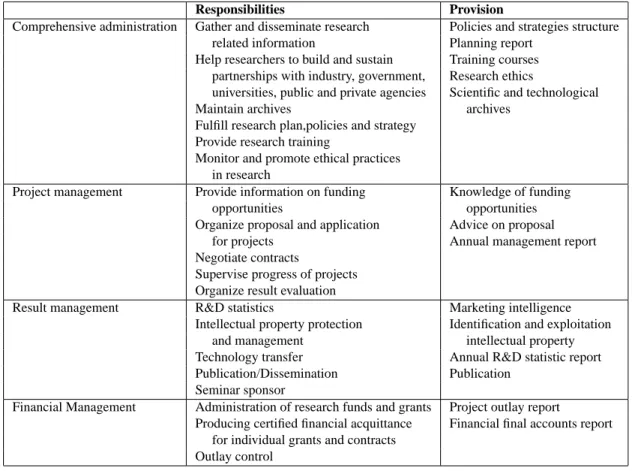
Model A and B count for 78% from the respondents. With a half of the remaining universities fall into Model C and D category are from Africa and Asia. The survey shows that over the past 10 years there has been consider-able movement towards centralized structures for research management [9]. Even though there are different research management strategies in different research communities, the research management services are concentrated in 4 ar-eas, as shown in table 1.
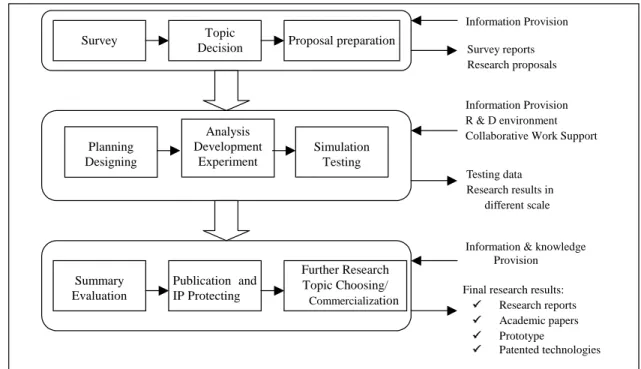
We may conclude from the above discussion that there are two types of services in research management: (1) To provide various information and guidelines related to re-search activities; (2) To deal with administrative transaction and collaborate with both of researchers and grand spon-sors. To support research managers to cope with the re-search management, an integrated, web-based management system, which combines Office Automation (OA) with the function of a Management Information System (MIS), is needed. Although individual researcher has his/her way of doing research, we can also roughly divide the procedure into three stages from management supporting of views: Survey and proposal investigating the interested
aca-demic field, assessing its state and finding the issues to be solved, making choice on topics to research and preparing the proposal
Research and development planning and designing how to do in research project, collecting and analyzing rela-tive information and data, developing related technolo-gies, making simulation and testing the results; Summarizing and evaluation making conclusion of the
project, evaluating the results, presenting publications and figuring out future research issues.
It is obvious that research information, research environ-ment and research collaboration are three critical factors leading to successful research. Research outcomes such as publication, commercialization, etc are also important to both researchers and funding agencies. Figure 1 shows the research activities in three stages from management per-spective. A Research Support System should provide both managers and researchers with services, including informa-tion services, sharing resources and collaborative work sup-port. In addition, it should be easily accessible.
In general, a WRSS should fulfill the needs of a research office such as,
• To help researchers effectively and efficiently identify funding opportunities, prepare grants proposals and contracts;
• To provides researchers with information retrieval sup-port that help them find their interested information ef-ficiently;
Responsibilities Provision
Comprehensive administration Gather and disseminate research Policies and strategies structure related information Planning report
Help researchers to build and sustain Training courses partnerships with industry, government, Research ethics
universities, public and private agencies Scientific and technological Maintain archives archives
Fulfill research plan,policies and strategy Provide research training
Monitor and promote ethical practices in research
Project management Provide information on funding Knowledge of funding opportunities opportunities Organize proposal and application Advice on proposal
for projects Annual management report Negotiate contracts
Supervise progress of projects Organize result evaluation
Result management R&D statistics Marketing intelligence Intellectual property protection Identification and exploitation
and management intellectual property Technology transfer Annual R&D statistic report Publication/Dissemination Publication
Seminar sponsor
Financial Management Administration of research funds and grants Project outlay report
Producing certified financial acquittance Financial final accounts report for individual grants and contracts
Outlay control
Table 1. Research Management Responsibilities and Provisions • To provide public resources sharing, such as data,
computing capacity, programming and testing environ-ment, experiment condition, etc.
• To help research managers effectively deal with ad-ministrative affairs
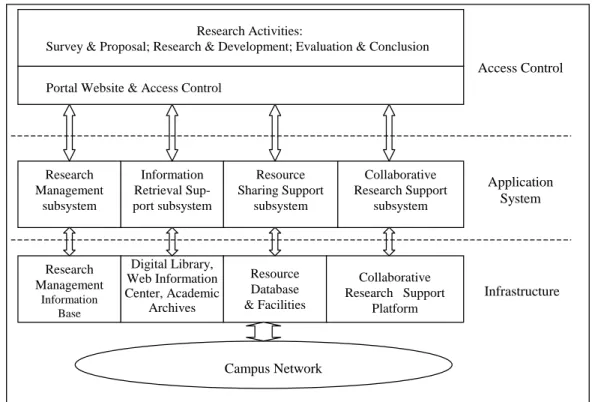
Therefore a WRSS could be designed as an integrated sys-tem which consists of 4 subsyssys-tems as shown in Figure 2. Research management subsystem provides research man-agement support services for research managers. Informa-tion Retrieval Support subsystem provides informaInforma-tion sup-port services. Resource Sharing Supsup-port subsystem pro-vides public research resources information and environ-ment. Collaborative Research Support subsystem provides a public platform to support collaborative work.
The system consists of three layers, namely infrastruc-ture, application system and user access control. The WRSS is established on campus network and interconnected with Internet. It is a distributed system that connects to the Re-search Support Office, the Finance Department, the Library, the Laboratory & Equipment Management Office, the Net-work Center and Academic Departments. Each unit op-erates and maintains related database. And it deploys the
“one-stop shop” model, namely all users access to the sys-tem and are served through a unique portal.
In fact, many universities have constructed various com-puter management information systems, such as Office Au-tomation system, Research Management System, Financial Management System, Asset Management System, Digital Library, Human Resource Management System, etc. These systems are usually separated in different departments or offices and are valuable in establishing the integrated Re-search Support Systems.
3.2. Research Support for Individual Researchers
For the individual level support, we briefly summarize the framework recently proposed by Yao [14].Research is a highly complex and subtle human activity, which may be difficult to formulate formally. By adopt-ing Graziano and Raulin’s model [4], we can model re-search procedures into seven phases, namely, Idea generat-ing, Problem definition, Observation/experimentation, Data analysis, Results interpretation phase and Communication phases.
Figure 1. Management Support to Research Activities
Survey Topic
Decision Proposal preparation
Planning Designing Analysis Development Experiment Simulation Testing Summary Evaluation Publication and IP Protecting Further Research Topic Choosing/ Commercialization Information Provision Survey reports Research proposals Information Provision R & D environment Collaborative Work Support
Testing data Research results in
different scale
Information & knowledge Provision
Final research results: Research reports Academic papers Prototype Patented technologies
Figure 1. Management Support to Research Activities
of interest to study. Initial ideas can emerge from vague thoughts and in very non-scientific ways. Lit-erature search and reading also play an important role in this phase.
Problem-definition phase. The objective of this phase is to precisely and clearly define and formulate vague and general ideas generated in the previous phase. Problem definition involves careful conceptualization and ab-straction. The success in problem definition increases the probability of a successful research project. Procedure-design/planning phase. The objective is to
make a workable research plan by considering all is-sues involved, such as expected findings and results, available tools and methodologies, experiments, sys-tem implementation, time and resource constraints, and so on. This phase deals with planning and orga-nizing research at strategic level.
Observation/experimentation phase. The objective is to observe real world phenomenon, collect data, and carry out experiments. Depending on the nature of the research disciplines, various tools and equipment, as well as different methods, can be used.
Data-analysis phase. The objective is to make sense out of the data collected. One extracts potentially useful in-formation, abstraction, findings, and knowledge from data.
Results-interpretation phase. The objective is to build ra-tional models and theories that explain the results from the data-analysis phase. The connections to other con-cepts and existing studies may also be established. Communication phase. The objective is to present the
re-search results to the rere-search community. Communi-cation can be done in either a formal or an informal manner. Books and scientific journals are the tradi-tional communication media. Web publication is a new means of communication. Oral presentation at a con-ference, or discussion with colleagues, is an interactive means of communication.
To assist researchers in each of the above phases, one needs to consider the following specific supporting func-tionalities:
• Exploring support. In the early stage of research, a scientist may have a vague idea and may not be aware of the works of fellow researchers. Exploration thus plays an important role. There are many means of ex-ploration, such as browsing databases, libraries, and the Web. If the Web is used for browsing, the historical data can be tracked. The collected data can be analyzed using machine learning and data mining tools to pro-vide a scientist useful information and hints. Currently, Web browsers are a useful exploration tool. Their functions need to be expanded for providing support to research.
50
Campus Network Research Activities:
Survey & Proposal; Research & Development; Evaluation & Conclusion
Research Management subsystem Information Retrieval Sup-port subsystem Resource Sharing Support subsystem Collaborative Research Support subsystem Research Management Information Base Digital Library, Web Information Center, Academic Archives Resource Database & Facilities Collaborative Research Support Platform Infrastructure Application System Access Control Portal Website & Access Control
Figure 2. An Architecture of Web-based Research Support Systems
• Retrieval support. Once a scientist forms relatively solid ideas, it is necessary to search literature to find relevant information. Retrieval support assists retrieval related activities, such as browsing, searching, organi-zation, and utilization of information [13, 14, 12]. A more detailed discussion on retrieval support will be given in the next section.
• Reading support. Reading critically and extensively is important, especially in the preparation stage [2, 5]. The advances in digital libraries and electronic publi-cations make the reading support a necessity [3]. Soft-ware packages exist so that a reader can add book marks, make notes, link different parts of an article, and make logical connections of different articles. A reading support system needs to assist a reader in ac-tively finding relevant materials, as well as construct-ing cognitive maps of the materials read. Readconstruct-ing sup-port systems can be combined with exploring and re-trieval support systems. Machine learning and text mining methods can be used to assist a reader by learn-ing from the readlearn-ing history. Agent technology can be used to actively look for useful information and period-ically inform scientists with new information. On-line dictionaries may also be useful in reading support. • Analyzing support. Successful analyzing support
de-pends on tool management. It is necessary to help a scientist find the right tool for a particular problem in
analyzing data. In addition, the system should also assist a scientist in using a tool. An explanation fea-ture may be needed, which answers the question why a particular tool is used. If the functions of tools are described as plain text, information retrieval systems can be used to find the right tool. Computer graphics and visualization may be useful in analyzing support. • Writing support. There are many writing support
software tools, such as word-processor and typesetting software. Many packages come with additional func-tions, such as spelling-checking, grammar-checking, and various other agents. A writing support system should also contain some functions mentioned in the retrieval support systems. For example, a writing sup-port system can find relevant articles based on the text written by a scientist and suggest possible references. A research support system for individual research con-sists of many sub-systems to support different activities. The sub-systems share common data and knowledge bases. As one can not have a clear classification of research activ-ities, it is difficult to have a clear classification of different types of support sub-systems.
4
A Prototype System: CUPTRSS
To support research and its activities at Chongqing Uni-versity of Posts and Telecommunications (CUPT), China,
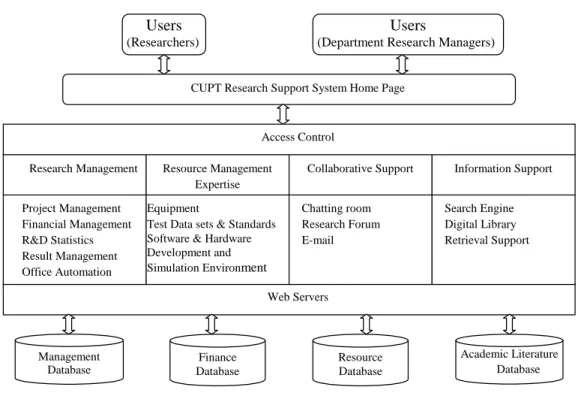
CUPT Research Support System Home Page Finance Database Management Database Resource Database Academic Literature Database Web Servers Research Management Project Management Financial Management R&D Statistics Result Management Office Automation Resource Management Expertise Equipment
Test Data sets & Standards Software & Hardware Development and Simulation Environment Collaborative Support Chatting room Research Forum E-mail Information Support Search Engine Digital Library Retrieval Support Access Control Users (Researchers) Users
(Department Research Managers)
Figure 3. CUPT Research support System
we design and implement a prototype system for web-based research support. The system is maintained by the Office of Science and Technology of CUPT. It aims at providing researchers with accurate and timely information, improv-ing research management and integratimprov-ing public research resources at the university. It is also aimed to implement the frame we introduced in previous section. The current design of the system is mainly for management support. The system is also acts as test bed or platform for further research in WI related technologies. The structure of the system is shown in Figure 3. We adopt multi-layered ar-chitecture. The top layer is different users of this systems. The homepage represents layers of presentation and busi-ness logic. Under these two layers are access control layer and databases. The users access to the system through the unique portal, namely CUPTRSS homepage. There is an authentication module to manage the access control. Users, databases as well as web servers are distributed in different offices and departments.
The main function of the system includes:
Research management It is a combination of an Office Automation (OA) system and a Management Informa-tion System (MIS) for supporting research managers in terms of dealing with administrative transactions and providing relative services. It includes project management, contract management, financial
manage-ment, result managemanage-ment, intellectual property, policy and strategy, research archives management and re-search and development statistics.
Research resource management This is an management subsystem that mainly focuses on research resources including personnel, data, software and hardware. It provides an online platform for instruments, simula-tion hardware and software. Acquisisimula-tion and supply, human resource and expertise database are also in-cluded. All resources can be shared by different de-partments.
Information Support It includes collection and dissem-ination of information about funding opportunities, project guidelines and procedures, science & technolo-gies news and marketing information. It provides in-formation retrieval support including a Chinese Bibli-ography search system. A web-based intelligent search engine employing fuzzy, rough etc soft computing technologies is also the function of this module. Collaborative work support It includes some subsystems
such as a research forum for posting research papers in order to get comments and feedback from peers, a research chatting room for exchanging research ideas and discussion with other researchers, and many oth-ers.
The CUPTRSS is an ongoing project and used while re-search and development are going on. An open platform is adopted for future improvement and adding new function-alities as the new needs appeared as time going.
5
Conclusion and Future Work
Developing Research Support Systems is a very impor-tant research topic in the domain of Web Intelligence. RSS especially WRSS support research activities for researchers and research offices in universities. They also aim to promote research and related activities in an institution. Web-based technologies make the WRSS easy to use and access. We present a model for Web-based research support systems. WRSS provide two level of support, namely institute level for management staff and individual level for researchers. We also present a prototyped WRSS implemented at CUPT. Its main function is to server the needs in the research office of CUPT. It may also support research activities for some researchers. There are some other issues remain unsolved such as how to merge the goals of researchers and management staff. Future work include fine tune the system and enhance it functionality. Acknowledgement
Tang, Wu and Wang would like to thank the partial support to this project from the National Science Foundation of P. R. China (No.69803014), the National Climb Program of P. R. China, the Foundation for University Key Teacher by the State Education Ministry of P. R. China (No.GG-520-10617-1001), the Application Science Foundation of Chongqing, the Science and Technology Research Program of the Municipal Education Committee of Chongqing, and the Research Foundation of Chongqing University of Posts and Telecommunications.
References
[1] G.D. Anderson, T. Snider, B. Robinson, J. Toporek, An Integrated Research Support System for Inter-package Communication and Handling Large Vol-ume Output from Statistical Database Analysis Opera-tions, Proceedings of the 2nd International Workshop
on Statistical Database Management, USA, 1983,
pp104-110.
[2] W.I.B. Beveridge, The Art of Scientific Investigation, Vintage Books, New York, 1957.
[3] G. Crane, Cultural heritage digital libraries: Needs and components, The 6th European Conference on
Digital Libraries, Rome, Italy, 2002, pp626-637.
[4] A.M. Graziano, M.L. Raulin, Research Methods: A
Process of Inquiry, 4th edition, Allyn and Bacon,
Boston, 2000.
[5] G.W. Ladd, Imagination in Research: An Economist’s
View, Iowa State University Press, Ames, Iowa, 1987.
[6] J. Liu, N. Zhong, Y.Y Yao, Z.W. Ras, The Wisdom Web: new challenges for Web Intelligence (WI), Spe-cial issue guest editors’ introduction, Journal of
Intel-ligence Information Systems, 20, 5-9, 2003.
[7] T. Ozono, S. Goto, N. Fujimaki and T. Shintani, P2P Based Knowledge Source Discovery on Research Support System Papits, Proceedings of the 1st
Inter-national Joint Conference on Autonomous Agents & Multiagent Systems, 2002, Italy, pp49-50.
[8] D.J. Power, S. Kaparthi, Building Web-based decision support systems, Studies in Informatics and Control, 11, 291-302, 2002.
[9] J. Stackhouse, J. Kubler, “Survey of Research Man-agement in Commonwealth Universities”, Research
Opportunities, No. 4, 12-15, 2002.
[10] H. Tang, Web-based research support systems, Manuscript, University of Regina, 2003.
[11] E. Turban, J. E. Aronson, Decision Support Systems
and Intelligent System, Prentice Hall, New Jersey,
2001.
[12] J.T. Yao, Y.Y. Yao, Web-based information retrieval support systems: building research tools for scien-tists in the new information age, Proceedings of the
IEEE/WIC International Conference on Web Intelli-gence, 2003.
[13] Y.Y. Yao, Information retrieval support systems,
Pro-ceedings of FUZZ-IEEE’02, 2002, pp773-778.
[14] Y.Y. Yao, A framework for web-based research sup-port systems, proceedings of COMPSAC’2003, Dal-las, USA, Nov 2003 (to appear).
[15] Y.Y. Yao, N. Zhong, J. Liu, S. Ohsuga,“Web Intelli-gence (WI): Research Challenges and Trends in the New Information Age”, in N. Zhong, Y.Y. Yao, J. Liu, and S. Ohsuga, (eds.) Web Intelligence: Research and Development, LNAI 2198, Springer-Verlag 2001, pp1-17.
[16] N. Zhong, J. Liu, and Y.Y. Yao (Eds.), Web