by
STEPHEN W. THOMAS
A thesis submitted to the School of Computing
in conformity with the requirements for the degree of Doctor of Philosophy
Queen’s University Kingston, Ontario, Canada
December 2012
M
INING SOFTWARE REPOSITORIES, which is the process of analyzing the data re-lated to software development practices, is an emerging field which aims to aid development teams in their day to day tasks. However, data in many software repositories is currently unused because the data is unstructured, and therefore difficult to mine and analyze. Information Retrieval (IR) techniques, which were developed specifically to handle unstructured data, have recently been used by researchers to mine and analyze the unstructured data in software repositories, with some success.The main contribution of this thesis is the idea that the research and practice of using IR models to mine unstructured software repositories can be improved by going beyond the current state of affairs. First, we propose new applications of IR models to existing software engineering tasks. Specifically, we present a technique to prioritize test cases based on their IR similarity, giving highest priority to those test cases that are most dissimilar. In another new application of IR models, we empirically recover how developers use their mailing list while developing software.
Next, we show how the use of advanced IR techniques can improve results. Using a framework for combining disparate IR models, we find that bug localization performance can be improved by 14–56% on average, compared to the best individual IR model. In addition, by using topic evolution models on the history of source code, we can uncover the evolution of source code concepts with an accuracy of 87–89%.
in source code has undesirable effects for IR models, and that by eliminating the duplica-tion, the accuracy of IR models improves. Additionally, we find that in the bug localization task, an unwise choice of parameter values results in an accuracy of only 1%, where optimal parameters can achieve an accuracy of 55%.
Through empirical case studies on real-world systems, we show that all of our proposed techniques and methodologies significantly improve the state-of-the-art.
First, I would like to offer deep and sincere gratitude to my co-supervisors, Ahmed E. Hassan and Dorothea Blostein. Leading by example, Ahmed pushed me to my limits. He provided keen insight into the academic world and helped me make sense of it all. He gave me resources, a sense of belonging, and encouragement to pursue my ideas. Dorothea brought experienced yet fresh perspective on all my work, incredible encouragement, and solid technical direction. She believed in me, helped me, and kept me on track. I am truly grateful for the one-two punch of Ahmed and Dorothea that was easily the most significant factor of my success.
I would also like to thank my committee members, Jim Cordy, Juergen Dingel, Prem Devanbu, Greg Lessard, and Pat Martin. Through expert, well-delivered critique as well as stimulating interaction, they helped me to shape my thesis and the ideas within.
I give thanks to my collaborators and coauthors: Bram Adams, Nicolas Bettenburg, Hadi Hemmati, Meiyappan Nagappan, and of course Ahmed E. Hassan and Dorothea Blostein. Draft after draft, experiment after experiment, they helped me navigate the complexities of statistics, LATEX 2ε formatting, deadlines, related research, Rcode, and everything else that
is needed to release a scientific idea into the wild.
The Software Analysis and Intelligence Laboratory (SAIL), of which I was a member since January 2010, was paramount to my success and defined my PhD experience. The evolving cohort of undergraduates, Master’s students, doctoral students, post doctoral re-searchers, and visiting scholars provided always-available interaction, feedback, motivation,
I would like to thank my Master’s supervisor and continued collaborator, Rick Snodgrass. Although he was not directly involved in this thesis, he has been a constant mentor in my academic life for more than five years. His sound advice, exceptional work ethic, brilliant ideas, and friendship have meant a great deal to me.
Finally, the love and support of my friends and family, both near and far, are what got me here in the first place, and keep me going to the next. A most special thanks goes to my wife, Tandy. Without her, I would be lost. Her love fuels my day.
For Tandy and Addison, my special ladies
Abstract i
Acknowledgments iii
Dedication v
List of Tables xi
List of Figures xiii
Related Publications xv
List of Notation and Abbreviations xvii
I Prologue 3
Chapter 1: Introduction . . . . 5
1.1 Thesis Statement . . . 8
1.2 Thesis Overview and Organization . . . 8
1.3 Contributions of Thesis. . . 10
Chapter 2: Background and State of the Art . . . 13
2.1 Mining Software Repositories . . . 13
2.2 Information Retrieval Models . . . 17
2.3 State of the Art . . . 31
2.4 Research Trends . . . 45
II New Applications of IR Models in Software Engineering 57 Chapter 3: Prioritizing Test Cases Using Topic Models . . . 61
3.1 Motivation. . . 61
3.2 Background . . . 63
3.3 Proposal . . . 70 vii
Chapter 4: Measuring the Interaction of Mail and Code . . . 97
4.1 Motivation. . . 97
4.2 Proposal . . . 100
4.3 Case Studies. . . 105
4.4 Results and Discussion . . . 108
4.5 Conclusion . . . 118
III Advanced IR Techniques 121 Chapter 5: A Framework to Combine Disparate IR Models . . . 125
5.1 Motivation. . . 125
5.2 Proposal . . . 126
5.3 Case Studies. . . 129
5.4 Results and Discussion . . . 138
5.5 Conclusion . . . 143
Chapter 6: Using Topic Evolution Models to Analyze Source Code Evolution. . . 145
6.1 Motivation. . . 145
6.2 Proposal . . . 147
6.3 Case Studies. . . 147
6.4 Results and Discussion . . . 155
6.5 Conclusion . . . 177
IV Understanding IR Model Assumptions and Parameters 181 Chapter 7: Addressing Data Duplication with the Diff Model. . . 185
7.1 Motivation. . . 185
7.2 Proposal . . . 188
7.3 Case Studies. . . 190
7.4 Results and Discussion . . . 195
7.5 Conclusion . . . 203
Chapter 8: Understanding the Effects of Data Preprocessing and IR Model Pa-rameters . . . 205
8.1 Motivation. . . 205
8.2 Proposal . . . 206
8.3 Case Study . . . 206
8.4 Results and Discussion . . . 210 viii
V Epilogue 219
Chapter 9: Conclusion . . . 221
9.1 Main Contributions of Thesis . . . 222
9.2 Future Research Opportunities . . . 224
Bibliography . . . 227
2.1 Example topics from JHotDraw source code version 7.5.1. . . 27
2.2 The stopword list we use in our case studies.. . . 30
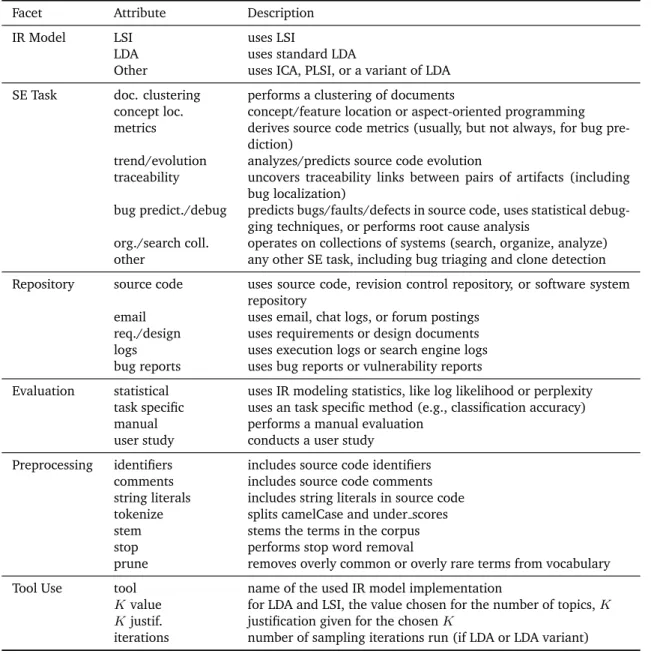
2.3 Article attributes. . . 52
2.4 Article characterization results of facets 1–4. . . 54
2.5 Article characterization results of facets 5 and 6.. . . 56
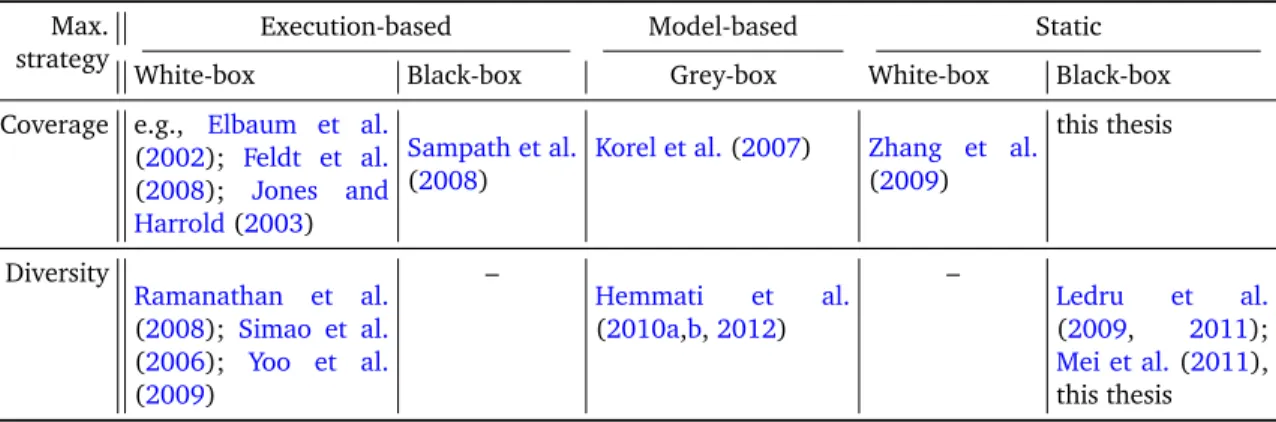
3.1 A two dimensional classification of TCP techniques. . . 66
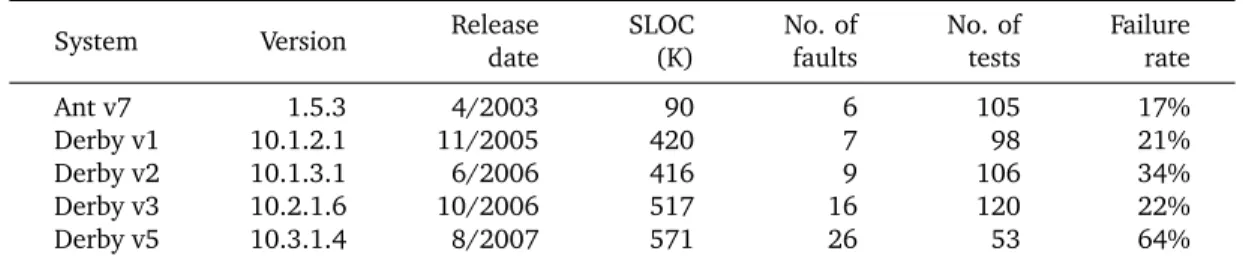
3.2 Systems under test. . . 75
3.3 Mean APFD results and comparisons for each technique. . . 80
3.4 The distances between four example test scripts in Derby.. . . 83
3.5 Characteristics of the fault matrices of the systems under test. . . 87
3.6 Results of the parameter sensitivity analysis. . . 89
3.7 Mean APFD results for the string-based technique without and with text pre-processing. . . 90
4.1 Systems under study. . . 105
4.2 Selected topics from Apache. . . 111
4.3 Selected topics from PostgreSQL. . . 112
5.1 Common IR parameters and values.. . . 131
5.2 The IR family of classifiers we study. . . 132
5.3 The EM family of classifiers we study. . . 132
5.4 Studied systems. . . 133
5.5 Example bug reports in the three studied system. . . 133
5.6 Classifier sets under consideration. . . 137
5.7 Top-20 performance of the four manually-created classifier sets. . . 140
5.8 Improvement of classifier combination. . . 141
6.1 Characteristics of our two systems under study, JHotDraw and jEdit. . . 148
6.2 Example topics from JHotDraw and jEdit. . . 156
6.3 Results of the manual analysis (RQ1) for JHotDraw and jEdit. . . 166
6.4 Relationship between code changes and topic evolutions. . . 171
6.5 Characteristics of the discovered evolutions for JHotDraw and jEdit.. . . 173
7.1 Change characteristics of JHotDraw and PostgreSQL. . . 188 xi
8.1 Summary of the classifier configurations used by existing work. . . 207
8.2 The best four and worst four configurations. . . 212
8.3 Performance dispersion amongst classifier configurations. . . 213
8.4 The results of Tukey’s HSD test. . . 213
2.1 A sample corpus. . . 18
2.2 The path from a raw corpus to an IR model. . . 22
2.3 Trends of LSI and LDA use. . . 46
3.1 Overview of our proposed topic-based TCP technique. . . 71
3.2 APFD results for each SUT and each technique. . . 81
3.3 Four abbreviated test scripts from Derby v1. . . 84
4.1 Example code snippet from PostSQL. . . 99
4.2 Our model of the interaction between emails and source code. . . 101
4.3 An overview of our technique. . . 101
4.4 Code weight ratio. . . 110
4.5 The four topic life cycle states.. . . 110
4.6 Topic life cycle states over time. . . 115
4.7 State transition diagrams for topic life cycles. . . 116
5.1 An illustration of our classifier combination framework. . . 127
5.2 Our evaluation procedure. . . 134
6.1 Data characteristics over time for JHotDraw and jEdit. . . 150
6.2 Replication guide for our study. . . 151
6.3 Number of detected events for variousδthresholds. . . 153
6.4 Topic trendlines for JHotDraw. . . 157
6.5 Topic trendlines for jEdit. . . 158
6.6 Heatmap views of the 45 topic evolutions. . . 160
6.7 Example topic similarity matrices.. . . 162
6.8 Topic similarity matrices indicating the stability of the topic models.. . . 163
6.9 An excerpt from our manual analysis tool. . . 165
6.10 An example of an assignment change caused by noise in the LDA model. . . 168
6.11 Example topic evolutions from JHotDraw and jEdit. . . 169
7.1 A graphical depiction of the three topic evolution models. . . 187
7.2 Example of data duplication. . . 187
7.3 Sample topic evolutions from JHotDraw and PostgreSQL.. . . 196
7.4 Sample topic evolutions for the simulated scenarios. . . 199 xiii
In all chapters of this thesis, and all related publications, I contributed in the following ways: bringing the initial idea to the table; researching background material and related work; collecting the necessary data for experiments and analysis (authoring tools and scripts if necessary); conducting the experiments and analyses (authoring tools and scripts if neces-sary); and writing and polishing all sections of the chapter and paper (including making all figures and tables). My coauthors supported me in refining my initial ideas, pointing me towards additional related work if necessary, and providing feedback on drafts of the chapters and papers.
Parts of this thesis have been published as follows:
1. Stephen W. Thomas. Mining Software Repositories Using Topic Models. In: Proceed-ings of the 33rd International Conference on Software Engineering (Doctoral Sympo-sium), pages 1138-1139, 2011. [Chapter1.]
2. Stephen W. Thomas. Mining Software Repositories with Topic Models. Technical Re-port No. 2012-586, School of Computing, Queen’s University. 39+iv pages. February 2012. [Chapter2.]
3. Stephen W. Thomas, Hadi Hemmati, Ahmed E. Hassan, and Dorothea Blostein. Static Test Case Prioritization Using Topic Models.Empirical Software Engineering. 30 pages. Accepted July 8, 2012. To appear. [Chapter3.]
4. Stephen W. Thomas, Nicolas Bettenburg, Dorothea Blostein, and Ahmed E. Hassan. xv
preparation. [Chapter4.]
5. Stephen W. Thomas, Meiyappan Nagappan, Dorothea Blostein, and Ahmed E. Has-san.The Impact of Classifier Configuration and Classifier Combination on Bug Localiza-tion. IEEE Transactions on Software Engineering. 16 pages. Submitted May 2012. [Chapters5and8.]
6. Stephen W. Thomas, Bram Adams, Ahmed E. Hassan, and Dorothea Blostein. Val-idating the Use of Topic Models for Software Evolution. In: Proceedings of the 10th International Working Conference on Source Code Analysis and Manipulation, pages 55-64, 2010. [Chapter6.]
7. Stephen W. Thomas, Bram Adams, Ahmed E. Hassan, and Dorothea Blostein. Study-ing Software Evolution UsStudy-ing Topic Models. Science of Computer Programming. 23 pages. Accepted August 20, 2012. To appear. [Chapter6.]
8. Stephen W. Thomas, Bram Adams, Ahmed E. Hassan, and Dorothea Blostein. Model-ing the Evolution of Topics in Source Code Histories.In: Proceedings of the 8th Working Conference on Mining Software Repositories, pages 173-182, 2011. [Chapter7.]
α: in LDA, a smoothing parameter for document-topic distributions
β: in LDA, a smoothing parameter for topic-term distributions
θ: the document-topic matrix of a corpus
θd: the topic membership vector of documentd
φ: the topic-term matrix of a corpus
A: the term-document matrix of a corpus
C: a corpus
d: a document
K: in LDA, the number of topics; in LSI, the reduction factor
N: the number of terms in a document
V: the vocabulary of a corpus
w: a term
z: a topic
APFD: Average Percentage of Faults Detected AOP: Aspect Oriented Computing
CVS: Concurrent Versions System EM: Entity Metric
ICA: Independent Component Analysis
IR: Information Retrieval LDA: Latent Dirichlet Allocation LOC: Lines of Code
LSA: Latent Semantic Analysis LSI: Latent Semantic Indexing MSR: Mining Software Repositories NLP: Natural Language Processing PCA: Principal Component Analysis
PLSA: Probabilistic Latent Semantic Analysis PLSI: Probabilistic Latent Semantic Indexing SLOC: Source Lines of Code
SUT: System Under Test
SVD: Singular Value Decomposition SVN: Subversion
TA: Testing Ability
TCP: Test Case Prioritization UML: Unified Modeling Language VCS: Version Control System VSM: Vector Space Model
Prologue
Introduction
Publications based on this chapter: Thomas(2011)
S
OFTWARE DEVELOPMENTpresents enormous challenges for both developers and man-agers (Glass,2003; Selby,2005). One of the primary difficulties lies in the ever-increasing complexity of the ever-changing source code. Changes lead to com-plexity and bugs, which in turn lead to skyrocketing maintenance costs and unhappy cus-tomers (Erlikh,2000;Hassan,2009;Lehman,1980;Moad,1990).Researchers in software engineering have attempted to improve software development by mining and analyzing software repositories, such as source code changes, email archives, bug databases, and execution logs (Godfrey et al.,2008; Hassan,2008). Research shows that interesting and practical results can be obtained from mining these repositories, allow-ing developers and managers to better understand their systems and ultimately increase the quality of their products in a cost effective manner (Tichy,2010). Particular success has been experienced withstructured repositories, such as source code, execution traces, and change logs.
However, automated techniques to understand theunstructuredtextual data in software repositories are still relatively immature (Hassan,2008), even though 80–85% of the data
is unstructured (Blumberg and Atre,2003; Grimes,2008). Unstructured data is a current research challenge because the data is often unlabeled, vague, and noisy (Hassan,2008). For example, the Eclipse bug database contains the following bug report titles:
– “NPE caused by no spashscreen handler service available”(#112600)
– “Provide unittests for link creation constraints”(#118800)
– “jaxws unit tests fail in standalone build”(#300951)
This data is unlabeled and vague because it contains no explicit links to the source code entity to which it refers, or even to a topic or task from some pre-defined ontology. In-structions such as “link creation constraints,” with no additional information or pointers, are ambiguous at best. The data is noisy due to misspellings and typographical errors (“spashscreen”), unconventional acronyms (“NPE”), and multiple phrases used for the same concept (“unittests”, “unit tests”). The sheer size of a typical unstructured repository (for example, Eclipse has received an average of 115 new bug reports a day for the last 10 years), coupled with its lack of structure, makes manual analysis extremely challenging and in many cases impossible. The end result is that this unstructured data is still waiting to be mined and analyzed.
Despite the challenges mentioned above, mining unstructured repositories has the po-tential to benefit software development teams in several ways. For example, linking emails to the source code entities that they discuss could provide developers access to the design decisions made about that entity. Determining which source code entities are related to a new bug report would significantly reduce the maintenance effort required to fix the bug. Automatically creating labels for source code entities would allow developers to more easily browse and understand the code, understand how certain concepts are changing over time, and uncover relationships between entities. All of these tasks would help decrease mainte-nance costs, increase software quality, and ultimately yield pleased, paying customers.
Advances in the field of Information Retrieval (IR), such as the development of statis-tical topic models (Blei and Lafferty, 2009; Blei et al., 2003; Griffiths et al., 2007), have helped make sense of unstructured data in other research communities, including the social
sciences (Griffiths et al.,2007; Ramage et al.,2009) and computer vision (Barnard et al., 2003). IR models, such as the Vector Space Model (VSM) (Salton et al.,1975), Latent Se-mantic Indexing (LSI) (Deerwester et al.,1990) and latent Dirichlet allocation (LDA) (Blei et al.,2003), are models that automatically discover structure within an unstructured cor-pus of documents, using the statistical properties of its word frequencies. IR models can be used to index, search, cluster, summarize, and infer links within the corpus, all tasks that were previously manually performed or not performed at all.
In addition to discovering structure, IR models are promising for several reasons. The models require no training data, which makes them easy to use in practical settings (Blei et al., 2003). The models operate directly on the raw, unstructured text without expen-sive data acquisition or preparation costs. (The textual data is often preprocessed, for example by removing common English-language stop words and removing numbers and punctuation, but these steps are fast and simple (Marcus et al.,2004).) Most models, even generative statistical models like LDA, are fast and scalable to millions of documents in real time (Porteous et al.,2008). Some IR models are well equipped to handle both synonymy and polysemy, as explained in Section2.2. Finally, all IR models can be applied to any text-based software repository, such as the identifier names and comments within source code, bug reports in a bug database, email archives, execution logs, and test cases.
Indeed, researchers are beginning to use IR models to mine software repositories. Re-cent studies focus on concept mining (e.g.,Cleary et al.,2008; Grant et al.,2008;Marcus et al.,2004,2005;Poshyvanyk and Marcus,2007; Poshyvanyk et al.,2006;Revelle et al., 2010;van der Spek et al.,2008), constructing source code search engines (e.g.,Bajracharya and Lopes, 2010; Tian et al., 2009), recovering traceability links between artifacts (e.g., Antoniol et al.,2008;Asuncion et al.,2010; de Boer and van Vliet,2008; De Lucia et al., 2004,2007;Hayes et al.,2006;Jiang et al.,2008;Lormans and Van Deursen,2006; Lor-mans et al., 2006; Marcus and Maletic,2003; McMillan et al.,2009), calculating source code metrics (e.g., Bavota et al.,2010; Gall et al., 2008; Gethers and Poshyvanyk,2010; Kagdi et al.,2010;Linstead and Baldi,2009; Liu et al.,2009; Marcus et al.,2008; Ujhazi et al.,2010), and clustering similar documents (e.g.,Kuhn et al.,2005,2007,2008,2010;
Lin et al.,2006;Maletic and Marcus,2001;Maletic and Valluri,1999).
Although recent studies have shown promising results, we performed a detailed analysis of the literature (Section2.4) and found several limitations. In particular, we find that most studies to date:
– focus on only a limited number of software engineering tasks; – use only basic IR models; and
– treat IR models as black boxes without fully understanding their underlying assumptions and parameter values.
In this thesis, we present techniques and empirical case studies that in aggregate help to alleviate these limitations and advance the state-of-the-art of using IR models in software engineering research and practice.
1.1
Thesis Statement
Our goal in this thesis it to encourage researchers and practitioners to go beyond the current state of affairs when using IR models to mine software repositories. We thus formulate our thesis statement as follows:
“The research and practice of using IR models to mine software repositories can be improved by (i) considering additional software engineering tasks, such as pri-oritizing test cases; (ii) using advanced IR techniques, such as combining multiple IR models; and (iii) better understanding the assumptions and parameters of IR models.”
1.2
Thesis Overview and Organization
We organize the thesis into five parts.
PartIprovides introductory material and reviews the current literature in using IR mod-els to mine software repositories.
Part IIdemonstrates new applications of IR models to existing software engineering tasks. By doing so, we hope to encourage researchers to move beyond the current, limited
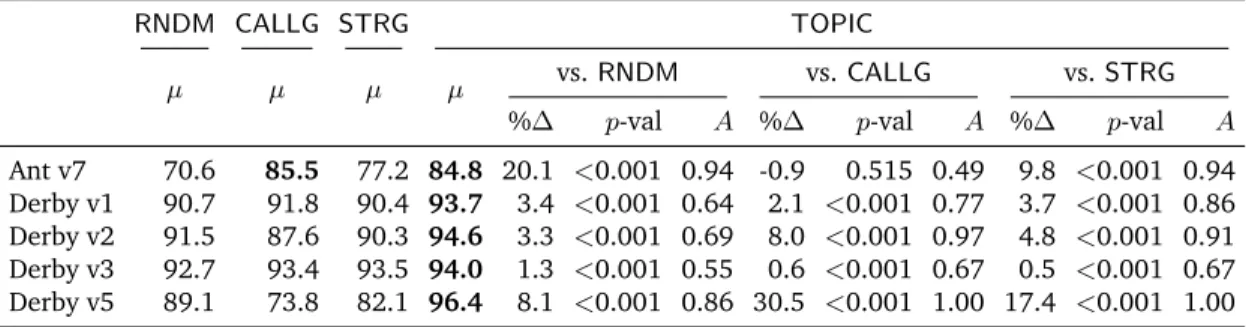
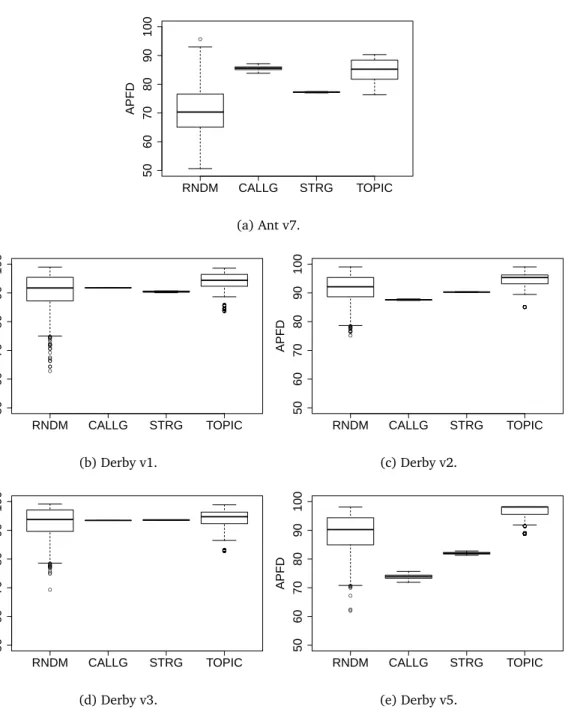
set of software engineering tasks, and explore how IR models can help tackle other tasks. We apply IR models to two new tasks. The first task, presented in Chapter3, is test case prioritization, which aims to uncover an ordering of a test suite that can detect as many faults in the source code as early as possible. We apply an IR model to the linguistic content of the test suite to calculate the similarity between test cases, and give highest priority to those test cases which are most dissimilar. We find that such a technique outperforms existing coverage-based prioritization techniques. The second application, presented in Chapter4, measures how developers use email to help them develop software. We apply a statistical topic model jointly to the source code history and mailing list archives of a software system. We define metrics that measure the amount of activity a certain topic experiences in the source code and mailing list over time, and use these metrics to quantify the information flow between the mailing list and source code. We find that there is indeed a strong relationship between the two repositories, and our results can be used to help managers guide documentation and training efforts and monitor project status, and can help developers recover past email discussions pertaining to a given source code entity.
PartIIIpresentsadvanced IR techniquesapplied to unstructured software repositories. In Chapter5 we present a framework to combine any number of disparate IR models. We conduct a case study in the context of bug localization, and find that model combination can significantly improve localization performance, even when the constituent models have poor performance. In Chapter6, we use an advanced IR technique—the Hall topic evolution model—as a means to automatically analyze the evolution of source code concepts. We find that the Hall model is able to accurately describe the actual changes made by developers, giving managers and developers the ability to better monitor their source code and answer questions such as “Who is working on what concepts” and “What concepts changed since last week?”
Part IV examines the assumptions and parameters of IR models and argues that we should move away from treating IR models as black boxes. In Chapter 7, we show that current research violates an implicit assumption of IR models, specifically that data will not be duplicated over time. We propose a new model, called the Diff model, which properly
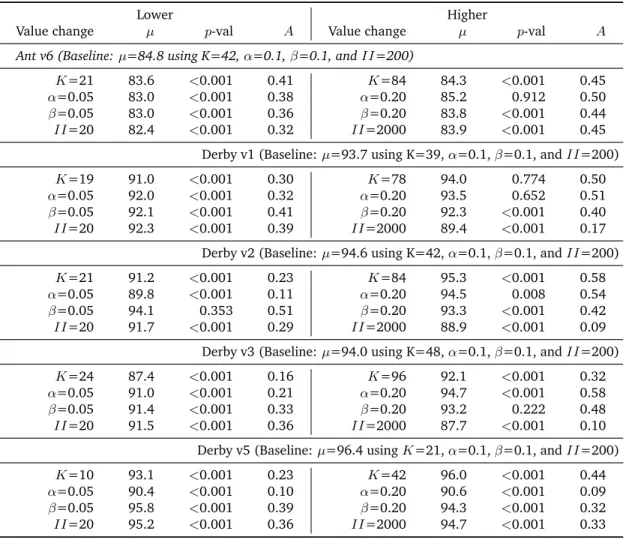
satisfies the IR model’s assumption by removing any duplication. We show that the Diff model produces more accurate topic evolutions and is therefore a better tool for software development teams. In Chapter 8, we show that data preprocessing steps and IR model parameters are critically important, even though they are often ignored by current research. In the context of bug localization, we perform a large empirical case study to investigate how sensitive the models are to these design decisions, and which design decisions are best. Finally, Part V provides concluding remarks, summarizes the thesis contributions, and outlines future research directions.
1.3
Contributions of Thesis
The conceptual contribution of this thesis is the argument that we, as a community of soft-ware engineering researchers and practitioners, need to move beyond the current state of affairs in using IR models to mine unstructured software repositories, and move towards new applications, better IR techniques, and better understanding the parameters and as-sumptions of IR models. The technical contributions of this thesis focus on the development of tools and the invention of techniques to show how to realize our overarching goal of mov-ing beyond the state of the art. The empirical contributions of this thesis are the application of all proposed techniques on several long-lived, real-world open source systems.
The main contributions of this thesis can be summarized as follows.
• Performing software engineering applications that are novel for IR models, i.e.,
– proposing and evaluating a technique to prioritize test cases; and
– proposing and evaluating a technique to analyze the interaction of source code and mailing lists.
• Using advanced IR techniques on software repositories, i.e.,
– proposing and evaluating a framework for combining disparate IR models; and – describing and evaluating an advanced IR technique to analyze source code histories.
• Going beyond the black box of off-the-shelf IR models, i.e.,
– proposing and evaluating a technique that overcomes the data duplication problem in large source code histories; and
– analyzing the sensitivity of IR models to data preprocessing and IR model parameters. Further contributions of this thesis include:
– A review of IR models and their current uses in software engineering (Sections2.2–2.3) – Publicly-available datasets corresponding to each case study in the thesis (available
Background and State of the Art
I
N THIS CHAPTER, we first describe the field of mining software repositories. We then introduce information retrieval models, starting with the seminal work in the 1980s on the Vector Space Model. We then provide a chronological summary of previous research that has used IR models to mine software repositories. Finally, we analyze the trends and shortcomings of previous research.2.1
Mining Software Repositories
Mining Software Repositories(MSR) is a field of software engineering research which aims to analyze and understand the data repositories related to software development. The main goal of MSR is to make intelligent use of these software repositories to support the decision-making process of software development (Godfrey et al.,2008;Hassan,2004,2008;Hassan and Holt,2005).
Software development produces several types of repositories during its lifetime, detailed in the following paragraphs. Such repositories are the result of the daily interactions be-tween the stakeholders, as well as the evolutionary changes to various software artifacts,
such as source code, test cases, bug reports, requirements documents, and other documen-tation. These repositories offer a rich, detailed view of the path taken to realize a software system, but they must be transformed from their raw form into something usable (Godfrey et al.,2008;Hassan,2008;Hassan and Xie,2010;Tichy,2010;Zimmermann et al.,2005). A prime example of mining software repositories is bug prediction. By mining the charac-teristics of source code entities (such as size, complexity, number of changes, and number of past bugs), researchers have shown how to accurately predict which entities are likely to have future bugs and therefore deserve more quality control resources.
2.1.1 Types of Software Repositories
We now describe the most common types of software repositories. These repositories con-tain a vast array of information about different facets software development, from human communication to source code evolution.
Source Code Source code is the executable specification of a software system’s behav-ior (Lethbridge et al.,2005). The source code repository consists of a number ofdocuments or fileswritten in one or more programming languages. Source code documents are gen-erally grouped into logical entities calledpackagesormodules. While source code contains structured data (e.g., syntax, program semantics, control flow), it also contains unstruc-tured data, such as comments, identifier names, and string literals. This unstrucunstruc-tured por-tion of source code, even without the aid of the structured porpor-tion, has been shown to help determine the high-level functionality of the source code (Kuhn et al.,2007).
Bug and Vulnerability Databases A bug database(orbug-tracking system) maintains in-formation about the creation and resolution of bugs, feature enhancements, and other soft-ware maintenance tasks (Serrano and Ciordia,2005). Typically, when developers or users experience a bug in a software system, they make a note of the bug in the bug database in the form of an issue, which includes such information as what task they were performing
when the bug occurred, how to reproduce the bug, and how critical the bug is to the func-tionality of the system. Then, one or more maintainers of the system investigate the issue, and if they resolve the issue, they close the issue. All of these tasks are captured in the bug database. Popular bug database systems include Bugzilla (Mozilla Foundation,2012a) and Trac (Edgewall Software,2012), although many exist.
A vulnerability database stores a list of information security vulnerabilities and expo-sures (Neuhaus and Zimmermann,2010). The goal of a vulnerability database is to doc-ument and share data (e.g., current vulnerabilities being found in large systems) between communities and applications.
Mailing Lists and Chat Logs Mailing lists(ordiscussion archives), along with thechat logs (or chat archives) are archivals of the textual communication between developers, man-agers, and other project stakeholders (Shihab et al., 2010a). The mailing list is usually comprised of a set of time-stamped email messages, which contain aheader(containing the sender, receiver(s), and time stamp), a message body (containing the text content of the email), and a set ofattachments(additional documents sent with the email). The chat logs contain the record of the instant-messaging conversations between project stakeholders, and typically contain a series of time-stamped, author-stamped text messages (Bettenburg et al.,2009;Shihab et al.,2009a,b).
Revision Control Database Arevision control databasemaintains and records the history of changes (or edits) to a repository of documents. Developers typically use revision con-trol databases to maintain the edits to the source code of the system. Popular revision control databases (such as Concurrent Versions System (CVS) (Berliner,1990), Subversion (SVN) (Pilato et al., 2008)), or Git (Bird et al., 2009b; Software Freedom Conservancy, 2012) allow developers to: checkout a copy of the global repository to their local file sys-tem; make local changes to existing documents, add new documents, delete existing docu-ments, or alter the directory structure of the repository; and commit these local changes to the global repository.
Requirements and Design Documents Requirements documents, usually written in con-junction with (or with approval from) the customer, are documents that list the required behavior of the software system (Lethbridge et al.,2005). The requirements can be cat-egorized as eitherfunctional, which specify the “what” of the behavior of the program, or non-functional, which describe the qualities of the software (e.g., reliability or accessibility). Design documents are documents that describe the overall design of the software sys-tem, including architectural descriptions, important algorithms, and use cases. Design doc-uments can take the form of diagrams (especially UML diagrams (Fowler and Scott,2000)) or free-flowing text.
Execution Logs Anexecution logis a document that logs the output of a system during its execution of one or more predefined test cases. The log generally contains a listing of which methods were called at which times, the values of certain variables, and other details about the state of the execution. Execution logs are useful when debugging the performance of large-scale systems with thousands or millions of concurrent users, since individual bugs are difficult to recreate on demand.
Software System Repositories A software system repository is a collection of (usually open source) software systems. These collections often contain hundreds or thousands of systems whose source code can easily be searched and downloaded for use by interested parties. Popular repositories include SourceForge (Geeknet,2012) and Google Code (Google, 2012).
2.1.2 Structured vs. Unstructured Data in Software Repositories
The term “unstructured data” is difficult to define and its usage varies in the literature (Bet-tenburg and Adams,2010;Manning et al.,2008). For the purposes of this thesis, we adopt the definition given byManning et al.(2008):
“Unstructured data is data which does not have clear, semantically overt, easy-for-a-computer structure. It is the opposite of structured data, the canonical example of which is a relational database, of the sort companies usually use to maintain product inventories and personnel records.”
Unstructured data usually refers to natural language text, since such text has no explicit data model. Most natural language text indeed has latent structure, such as parts-of-speech, named entities, relationships between words, and word sense, that can be inferred by hu-mans or advanced machine learning algorithms. However, in its raw, unparsed form, the text is simply a collection of characters with no structure and no meaning to a data min-ing algorithm. Examples of unstructured data in software repositories include: bug report titles and descriptions; source code linguistic data (i.e., identifier names, comments, and string literals); requirements documents; descriptions and comments in design documents; mailing lists and chat logs; and source control database commit messages.
Structured data, on the other hand, has a data model and a known form. Examples of structured data in software repository include: source code parse trees, call graphs, inheritance graphs; execution logs and traces; bug report metadata (e.g., author, severity, date); source control database commit metadata (e.g., author, date, list of changed files); and mailing list and chat log metadata.
2.2
Information Retrieval Models
“Information retrieval (IR) is finding material (usually documents) of an unstructured nature (usually text) that satisfies an information need from within large collections (usually stored on computers).”
—Manning et al.(2008, p. 1) IR is used to find specific documents of interest in a large collection of documents. Usually, a user enters a query (i.e., a text snippet) into the IR system, and the system returns a list of documents related to the query. For example, when a user enters the query
Predicting the incidence of faults in code has been com-monly associated with mea-suring complexity. In this pa-per, we propose complexity metrics that are based on the code change process instead of on the code.
(a) Documentd1.
Bug prediction models are often used to help allocate software quality assurance ef-forts (for example, testing and code reviews). Mende and Koschke have recently pro-posed bug prediction models that are effort-aware.
(b) Documentd2.
There are numerous studies that examine whether or not cloned code is harmful to software systems. Yet, few of these studies study which characteristics of cloned code in particular lead to software defects (or faults).
(c) Documentd3.
Figure 2.1: A sample corpus of three documents.
“software engineering” into the Google IR system, it searches every webpage ever indexed and returns those that are somehow related to software engineering.
IRmodels—the internal workings of IR systems—come in many forms, from basic keyword-matching models to statistical models that take into account the location of the text in the document, the size of the document, the uniqueness of the matched term, and even whether the query and document contain shared topics of interest (Zhai,2008).
Common Terminology
IR models share a common vernacular, which we summarize below. To make the discussion more concrete, we use a running example of a corpus of three simple documents shown in Figure2.1.
term (word or token)w: a string of one or more alphanumeric characters.
In our example, we have a total of 101 terms. For example, predicting, bug, there, have, bugandof are all terms. Terms might not be unique in a given document. documentd: an ordered set ofN terms,w1, . . . , wN.
In our example, we have three documents: d1, d2,and d3. d1 hasN = 34 terms,d2
hasN = 35terms, andd3 hasN = 32terms.
In our example, a user might query for “defects” (with|q|=1 term) or “cloned code” (with|q|=2 terms).
corpusC: an unordered set ofndocuments,d1, . . . , dn.
In our example, there is one corpus, which consists ofn = 3documents: d1, d2,and
d3.
vocabularyV: the unordered set ofmunique terms that appear in a corpus.
In our example, the vocabulary consists of m = 71 unique terms across all three documents: code, of, are, that, to, the, software,. . ..
term-document matrixA: anm×nmatrix whoseith, jthentry is the weight of termwiin documentdj (according to some weighting function, such as term-frequency). In our example, we have
A= d1 d2 d3 code 3 1 2 of 2 0 2 are 1 2 1 . . . .
indicating that, for example, the termcodeappears in documentd1 with a weight of
3, and the termareappears in documentd2 with a weight of 2.
topic (concept)z: anm-length vector of probabilities over the vocabulary of a corpus. In our example, we might have a topic
code of are that to the software . . .
z1= 0.25 0.10 0.05 0.01 0.10 0.17 0.30 . . .
indicating that, for example, when a term is drawn from topic z1, there is a 25%
chance of drawing the term code and a 30% chance of drawing the term software. (This example assumes a generative model, such as PLSI or LDA. See Section2.2for the full definitions.)
topic membership vectorθd: For documentd, aK-length vector of probabilities of theK topics.
In our example, we might have a topic membership vector
z1 z2 z3 z4 . . .
θd1 = 0.25 0.0 0.0 0.70 . . .
indicating that, for example, when a topic is selected for documentd1, there is a 25% chance of selecting topicz1and a 70% chance of selecting topicz3 .
document-topic matrixθ(also called document-topic matrixD): annbyKmatrix whose
ith, jth entry is the probability of topiczj in documentdi. Rowiofθcorresponds to
θdi.
In our example, we might have a document-topic matrix
θ=
z1 z2 z3 z4 . . .
d1 0.25 0.0 0.0 0.70 . . .
d2 0.0 0.0 0.0 1.0 . . .
d3 0.1 0.4 0.2 0.0 . . .
indicating that, for example, documentd3contains topicz3with probability 20%.
topic-term matrixφ(also called topic-term matrixT): a K by m matrix whose ith, jth
entry is the probability of termwj in topiczi. Rowiofφcorresponds tozi. In our example, we might have a topic-term matrix:
φ=
code of are that to the software . . .
z1 0.25 0.10 0.05 0.01 0.10 0.17 0.30 . . .
z2 0.0 0.0 0.0 0.05 0.2 0.0 0.05 . . .
z3 0.1 0.04 0.2 0.0 0.07 0.10 0.12 . . .
. . . .
Some common issues arise with any language model:
homonymy: A termwis ahomonymif it has multiple semantics.
We note that the term semantic is hard to define and takes on different meanings in different contexts. In the field of IR, often a manually-created oracle is used (e.g., Word-Net (Miller, 1995)) to determine the semantics of a term (i.e., relationships with other terms).
The Boolean Model
The Boolean model treats each document as a set of words, and allows queries with single keywords coupled with Boolean expressions to combine keywords (i.e.,AND,OR, andNOT). Using the three example documents in Figure2.1, the query “faultsORdefects” will match document d1 (because it contains the word “faults”) andd3 (because it contains the word
“defects”), but notd2 (because it contains neither “faults” nor ”defects”). The query “faults
ANDdefects” will not match any documents, because none of them contain both words. While simple to understand and implement, the Boolean model suffers from many draw-backs. First, too many documents may be matched if overly-general words are present in the query (e.g., “it” or “the”). Second, too few documents may be matched if the query is poorly formulated (e.g., “automobile” instead of “car”). Third, it is difficult to rank the matched documents by how relevant they might be, since all terms are weighted equally.
The Vector Space Model
The Vector Space Model (VSM) is a simple algebraic model based on the term-document matrix of a corpus (Salton et al.,1975). VSM represents documents by their column vector in the term-document matrix: a vector containing the weights of the words present in the document, and 0s otherwise. The similarity between two documents (or between a query and a document) is calculated by comparing the similarity of the two vectors in the term-document matrix. Example vector similarity measures include Euclidean distance, cosine distance, Hellinger distance, or KL divergence. In VSM, two documents will only be deemed
VSM terms docs Raw corpus terms docs do c s topics Preprocessed VSM Inputs topi c s terms TM Topic Models
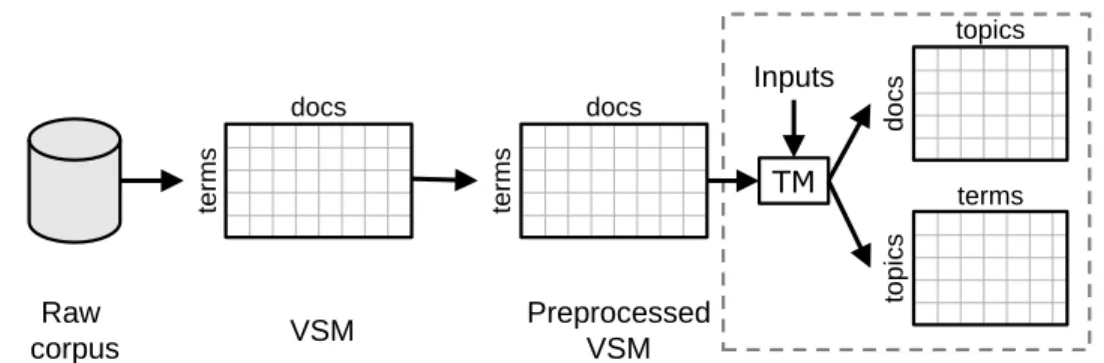
Figure 2.2: The path from a raw corpus to a basic IR model or a more advanced topic model (TM). Here, “Topic Models” includes LSI, ICA, PLSI, LDA, and all LDA variants.
similar if they contain at least one shared term; the more shared terms they have, and the higher the weight of those shared terms, the higher the similarity score will be.
VSM improves over the Boolean model in two ways. First, it allows for term weighting schemes to be used, such as tf-idf (term frequency, inverse document frequency) weighting. Weighting schemes help to downplay the influence of common terms in the query and pro-vide a boost to documents that match rare terms in the query. Another improvement is that the relevance between the query and a document is based on vector similarity measures, which is more flexible than the strict Boolean model.
Topic Models
Atopic model(orlatent topic model) is an IR model designed to automatically extracttopics from a corpus of text documents (Anthes,2010;Blei and Lafferty,2009;Steyvers and Grif-fiths,2007; Zhai,2008). Here, a topic is a collection of terms that co-occur frequently in the documents of the corpus, for example{mouse, click, drag, right, left}and{user, account, password, authentication}. Due to the nature of language use, the terms that constitute a topic are often semantically related (Blei et al.,2003).
Topic models were originally developed as a means of automatically indexing, searching, clustering, and structuring large corpora of unstructured and unlabeled documents. Using topic models, documents can be represented by the topics within them, and thus the entire
corpus can be indexed and organized in terms of this discovered semantic structure. By representing documents by the lower-dimensional topics, as opposed to terms, topic models (i) uncoverlatentsemantic relationships and (ii) allow faster analysis on text (Zhai,2008). Figure2.2shows the general process of creating basic IR models and more advanced topic models from a raw corpus; we describe several topic modeling techniques below.
Latent Semantic Indexing Latent Semantic Indexing (LSI) (or Latent Semantic Analysis (LSA)) is an information retrieval model that extends the VSM by reducing the dimension-ality of the term-document matrix by means ofSingular Value Decomposition(SVD) (Deer-wester et al.,1990). During the dimensionality reduction phase, terms that are related (in terms of co-occurrence) will be grouped together into topics1. This noise-reduction
tech-nique has been shown to provide increased performance over VSM in terms of dealing with polysemy and synonymy (Baeza-Yates and Ribeiro-Neto,1999).
SVD is a factorization of the original term-document matrixA that reduces the dimen-sionality of A by isolating the singular valuesof A (Salton and McGill, 1983). Since A is likely to be very sparse, SVD is a critical step of the LSI approach. SVD decomposesAinto three matrices: A=T SDT, whereT is anmbyr =rank(A)term-topic matrix,S is ther
byr singular value matrix, andDis thenbyr document-topic matrix.
LSI augments the reduction step of SVD by choosing a reduction factor, K, which is typically much smaller than the rank of the original term-document matrix r. Instead of reducing the input matrix tor dimensions, LSI reduces the input matrix to K dimensions. There is no perfect choice forK, as it is highly data- and task-dependent. In the literature, typical values range between 50–300.
As in VSM, terms and documents are represented by row and column vectors, respec-tively, in the term-document matrix. Thus, two terms (or two documents) can be compared by some distance measure between their vectors (e.g., cosine similarity) and queries can
1The creators of LSI call these reduced dimensions “concepts”, not “topics”. However, to be consistent with
by formulated and evaluated against the matrix. However, because of the reduced dimen-sionality of the term-document matrix after SVD, these measures are more equipped to deal with noise in the data.
Independent Component Analysis Independent Component Analysis(ICA) (Comon,1994) is a statistical technique used to decompose a random variable into statistically indepen-dent components (i.e., dimensions). Although not generally considered a topic model, it has been used in similar ways to LSI to model source code documents in aK-dimensional conceptual space.
Like LSI, ICA reduces the dimensionality of the term-document matrix to help reduce noise and associate terms. However, unlike LSI, the resulting dimensions in ICA are statis-tically independent of one another, which helps capture more variation in the underlying data (Grant and Cordy,2009).
Probabilistic LSI Probabilistic Latent Semantic Indexing(PLSI) (orProbabilistic Latent Se-mantic Analysis(PLSA)) (Hofmann,1999,2001) is a generative model that addresses the statistical unsoundness of LSI. Hofmann argues that since LSI uses SVD in its dimension-reduction phase, LSI is implicitly making the unqualified assumption that term counts will follow a Gaussian distribution. Since this assumption is not verified, LSI is “unsatisfactory and incomplete” (Hofmann,1999).
To overcome this assumption, PLSI defines a generative latent-variable model, where the latent variables are topics in documents. At a high level, a generative model has the advantages of being evaluable with standard statistical techniques, such as model checking, cross-validation, and complexity control; LSI could not be evaluated with any of these tech-niques. And since the latent variables are topics in documents, PLSI is also well-equipped to more readily handle polysemy and synonymy.
The generative model for each term in the corpus can be summarized with the following steps.
– Select a topiczkwith probabilityP(zk|di). – Generate a termwj with probabilityP(wj|zk).
Given the observations in a dataset (i.e., terms), one can perform inference against this model to uncover the topicszi, ..., zk. We refer interested readers to the original arti-cles (Hofmann,1999,2001).
As was shown in subsequent articles (e.g.,Blei et al.,2003;Zhai,2008), the generative model of PLSI suffers from at least two critical problems. First, sincedis used as an index variable in the first step, the number of parameters that need to be estimated grows linearly with the size of the corpus, which can lead to severe over-fitting issues. Second, since thezk vectors are only estimated for documents in the training set, they cannot be easily applied to new, unseen documents.
Latent Dirichlet Allocation Latent Dirichlet Allocation (LDA) is a popular probabilistic topic model (Blei et al., 2003) that has largely replaced PLSI. One of the reasons it is so popular is because it models each document as a multi-membership mixture ofK corpus-wide topics, and each topic as a multi-membership mixture of the terms in the corpus vocabulary. This means that there is a set of topics that describe the entire corpus, each document can contain more than one of these topics, and each term in the entire repository can be contained in more than one of these topic. Hence, LDA is able to discover a set of ideas or themes that well describe the entire corpus (Blei and Lafferty,2009).
LDA is based on a fully generative model that describes how documents are created. Intuitively, this generative model makes the assumption that the corpus contains a set ofK
corpus-wide topics, and that each document is comprised of various combinations of these topics. Each term in each document comes from one of the topics in the document. This generative model is formulated as follows:
– Choose a topic vectorθd∼Dirichlet(α) for documentd. – For each of theN termswi:
– Choose a termwifrom p(wi|zk, β).
Here, p(wi|zk, β) is a multinomial probability function, α is a smoothing parameter for document-topic distributions, andβ is a smoothing parameter for topic-term distributions.
The two levels of this generative model allow three important properties of LDA to be realized: documents can be associated with multiple topics, the number of parameters to be estimated does not grow with the size of the corpus, and, since the topics are global and not estimated per document, unseen documents can easily be accounted for.
Like any generative model, the task of LDA is that of inference: given the terms in the documents, what topics did they come from (and what are the topics)? LDA per-forms inference withlatent variable models(orhidden variable models), which are machine learning techniques devised for just this purpose: to associate observed variables (here, terms) with latent variables (here, topics). A rich literature exists on latent variable mod-els (Bartholomew,1987; Bishop,1998;Loehlin,1987); for the purposes of this thesis, we omit the details necessary for computing the posterior distributions associated with such models. It is sufficient to know that such methods exist and are being actively researched.
For the reasons presented above, it is argued that LDA’s generative process gives it a solid footing in statistical rigor—much more so than previous topic models (Blei et al., 2003; Griffiths and Steyvers, 2004; Steyvers and Griffiths, 2007). As such, LDA may be better suited to discover the latent relationships between documents in a large text corpus. Table2.1shows example topics discovered by LDA from version 7.5.1 of the source code of JHotDraw (Gamma,2012), a framework for creating simple drawing applications. For each topic, the table shows an automatically-generated two-word topic label, the top (i.e., highest probable) words for the topic, and the top three matching Java classes in JHotDraw. The topics span a range of concepts, from opening files to drawing Bezier paths. The discov-ered topics intuitively make sense and the top-matching classes match our expectations— there seems to be a natural match between the “Bezier path” topic and theCurvedLinear
Label Top words Top 3 matching classes file filter file uri chooser urichoos save filter set
jfile open
JFileURIChooser, URIUtil, AbstractSaveUnsavedChangesAction
tool bar editor add tool draw action button bar view creat
DrawingPanel, ODGDrawingPanel, PertPanel
undoabl edit edit action undo chang undoabl event overrid
NonUndoableEdit, CompositeEdit, UndoRedoManager
connect figur figur connector connect start end decor set handl
ConnectionStartHandle,
ConnectionEndHandle, Connector
bezier path path bezier node index mask point geom pointd
CurvedLiner, BezierFigure, ElbowLiner
Table 2.1: Example topics from JHotDraw source code version 7.5.1. The labels are automatically-generated based on the most popular bigram in the topic.
Topic Evolution Models
Several advanced techniques have been proposed to extract the evolution of a topic in a time-stamped corpus—how the usage of a topic (and sometimes the topic itself) changes over time as the terms in the documents are changed over time. Such a model is usually an extension to a basic topic model that accounts for time in some way. We call such a model atopic evolution model.
Initially, the Dynamic Topic Model (Blei and Lafferty,2006) was introduced. This model represents time as a discrete Markov process, where topics themselves evolve according to a Gaussian distribution. This model thus penalizes abrupt changes between successive time periods, discouraging rapid fluctuation in the topics over time.
The Topics Over Time (TOT) (Wang and McCallum, 2006) model represents time as a continuous beta distribution, effectively removing the penalty on abrupt changes from the Dynamic Topic Model. However, the beta distribution is still rather inflexible in that it assumes that a topic evolution will have only a single rise and fall during the entire corpus history.
The Hall model (Hall et al.,2008) applies LDA to the entire collection of documents at the same time and performs post hoc calculations based on the observed probability of each document in order to map topics to versions. Linstead et al. (2008b) and Thomas et al. (2010b) also used this model on a software system’s version history. The main advantage
of this model is that no constraints are placed on the evolution of topics, providing the necessary flexibility for describing large changes to a corpus.
The Link model, proposed by Mei and Zhai (2005) and first used on software repos-itories by Hindle et al. (2009), applies LDA to each version of the repository separately, followed by a post-processing phase to link topics across versions. Once the topics are linked, the topic evolutions can be computed in the same way as in the Hall model. The post-processing phase must iteratively link topics found in one version to the topics found in the previous. This process inherently involves the use of similarity thresholds to determine whether two topics are similar enough to be called the same, since LDA is a probabilistic process and it is not guaranteed to find the exact same topics in different versions of a cor-pus. As a result, at each successive version, some topics are successfully linked while some topics are not, causing past topics to “die” and new topics to be “born”. Additionally, it is difficult to allow for gaps in the lifetime of a topic.
Applying IR to Source Code
Before IR models are applied to source code, several preprocessing steps are generally taken in an effort to reduce noise and improve the resulting models.
– Characters related to the syntax of the programming language (e.g., “&&”, “->”) are
re-moved; programming language keywords (e.g., “if”, “while”) are removed.
– Identifier names are split into multiple parts based on common naming conventions, such as camel case (oneTwo), underscores (one two), dot seperators (one.two), and capital-ization changes (ONETwo)).
– Common English-language stopwords (e.g., “the”, “it”, “on”) are removed. See Table2.2 for a full list.
– Word stemming is applied to find the root of each word (e.g., “changing” becomes “chang”), typically using the Porter algorithm (Porter,1980).
– In some cases, the vocabulary of the resulting corpus is pruned by removing words that occur in, for example, over 80% or under 2% of the documents (Madsen et al.,2004).
The main idea behind these steps is to capture the semantics of the developers’ inten-tions, which are thought to be encoded within the identifier names and comments in the source code (Poshyvanyk et al., 2007). The rest of the source code (i.e., special syntax, language keywords, and stopwords) are just noise and will not be beneficial to the results of IR models. We have provided our preprocessing tool online (Thomas,2012).
a able about above according accordingly across actually after afterwards again against all allow allows almost alone along already also although always am among amongst an and another any anybody anyhow anyone anything any-way anyany-ways anywhere apart appear appreciate appropriate are around as aside ask asking associated at available away awfully b be became because become becomes becoming been before beforehand behind being believe be-low beside besides best better between beyond both brief but by c came can cannot cant cause causes certain certainly changes clearly co com come comes concerning consequently consider considering contain containing contains cor-responding could course currently d definitely described despite did different do does doing done down downwards during e each edu eg eight either else elsewhere enough entirely especially et etc even ever every everybody every-one everything everywhere ex exactly example except f far few fifth first five followed following follows for former formerly forth four from further further-more g get gets getting given gives go goes going gone got gotten greetings h had happens hardly has have having he hello help hence her here hereafter hereby herein hereupon hers herself hi him himself his hither hopefully how howbeit however i ie if ignored immediate in inasmuch inc indeed indicate in-dicated indicates inner insofar instead into inward is it its itself j just k keep keeps kept know knows known l last lately later latter latterly least less lest let like liked likely little look looking looks ltd m mainly many may maybe me mean meanwhile merely might more moreover most mostly much must my myself n name namely nd near nearly necessary need needs neither never nev-ertheless new next nine no nobody non none noone nor normally not nothing novel now nowhere o obviously of off often oh ok okay old on once one ones only onto or other others otherwise ought our ours ourselves out outside over overall own p particular particularly per perhaps placed please plus possible presumably probably provides q que quite qv r rather rd re really reasonably regarding regardless regards relatively respectively right s said same saw say saying says second secondly see seeing seem seemed seeming seems seen self selves sensible sent serious seriously seven several shall she should since six so some somebody somehow someone something sometime sometimes some-what somewhere soon sorry specified specify specifying still sub such sup sure t take taken tell tends th than thank thanks thanx that thats the their theirs them themselves then thence there thereafter thereby therefore therein theres thereupon these they think third this thorough thoroughly those though three through throughout thru thus to together too took toward towards tried tries truly try trying twice two u un under unfortunately unless unlikely until unto up upon us use used useful uses using usually uucp v value various very via viz vs w want wants was way we welcome well went were what whatever when whence whenever where whereafter whereas whereby wherein where-upon wherever whether which while whither who whoever whole whom whose why will willing wish with within without wonder would would x y yes yet you your yours yourself yourselves z zero
Table 2.2: The stopword list we use in our empirical case studies throughout the thesis. We obtain the list from the MALLET tool (McCallum,2012). The list contains a total of 521 terms.
2.3
State of the Art
In this section, we describe and evaluate related work that uses IR models to mine software repositories and perform some software engineering task. We organize the work into sub-sections by software engineering task. We provide a brief description of each task, followed by a chronological presentation of the relevant articles.
2.3.1 Concept/Feature Location
The task ofconcept location(orfeature location) is to identify the parts (e.g., documents or methods) of the source code that implement a given feature of the software system (Ra-jlich and Wilde,2002). This is useful for developers wishing to debug or enhance a given feature. For example, if the so-called file printingfeature contained a bug, then a concept location technique would attempt to automatically find those parts of the source code that implement file printing (i.e., parts of the source code that are executed when the system prints a file).
Related to concept location is aspect-oriented programming (AOP), which aims at pro-viding developers with the machinery to easily implement aspects of functionality whose implementation spans over multiple source code documents.
LSI-based Techniques
LSI was first used for the concept location task byMarcus et al.(2004), who developed a technique to take a developer query and return a list of related source code documents. The authors showed that LSI provides better results than existing methods (i.e., regular expres-sions and dependency graphs) and is easily applied to source code, due to the flexibility and light-weight nature of LSI. The authors also noted that since LSI is applied only to the comments and identifiers of the source code, it is language-independent and thus accessible for any system.
Marcus et al.(2005) demonstrated that concept location is needed in the case of Object-Oriented (OO) programming languages, contrary to previous beliefs. The authors compared
LSI with two other techniques, namely regular expressions and dependency graphs, for lo-cating concepts in OO source code. The authors concluded that all techniques are beneficial and necessary, and each possesses its own strengths and weaknesses.
Poshyvanyk et al. (2006) combined LSI and Scenario Based Probabilistic ranking of execution events for the task of feature location in source code. The authors demonstrated that using the two techniques, when applied together, outperform either of the techniques individually.
Poshyvanyk and Marcus (2007) combined LSI and Formal Concept Analysis (FCA) to locate concepts in source code. LSI is first used to map developer queries to source code documents, then FCA is used to organize the results into a concept lattice. The authors found that this technique works well, and that concept lattices are up to four times more effective at grouping relevant information than simple ranking methods.
Cleary et al.(2008) compared several IR (e.g., VSM, LSI) and NLP techniques for con-cept location. After an extensive experiment, the authors found that NLP techniques do not offer much of an improvement over IR techniques, which is contrary to results in other communities.
van der Spek et al. (2008) used LSI to find concepts in source code. The authors con-sidered the effects of various preprocessing steps, such as stemming, stopping, and term weighting. The authors manually evaluated the resulting concepts with the help of domain experts.
Grant et al.(2008) used ICA, a conceptually similar model to LSI, to locate concepts in source code. The authors argued that since ICA is able to identify statistically independent signals in text, it can better find independent concepts in source code. The authors showed the viability of ICA to extract concepts through a case study on a small system.
Revelle and Poshyvanyk (2009) used LSI, along with static and dynamic analysis, to tackle the task of feature location. The authors combined the different techniques in novel ways. For example, textual similarity was used to traverse the static program dependency graphs, and dynamic analysis removed textually-found methods that were not executed in a scenario. The authors found that no technique outperformed all others across all case
studies.
Revelle et al. (2010) performed data fusion between LSI, dynamic analysis, and web mining algorithms (i.e., HITS and PageRank) to tackle the task of feature location. The authors found that combining all three techniques significantly outperforms any of the in-dividual methods, and outperforms the state-of-the-art in feature location.
LDA-based Techniques
Linstead et al. (2007a) were the first to use LDA to locate concepts in source code in the form of LDA topics. Their technique can be applied to individual systems or large collections of systems to extract the concepts found within the identifiers and comments in the source code. The authors demonstrated how to group related source code documents based on comparing the documents’ topics.
Linstead et al. (2007b) applied a variant of LDA, the Author-Topic model (Rosen-Zvi et al.,2004), to source code to extract the relationship between developers (authors) and source code topics. Their technique allows the automated summarization of “who has worked on what”, and the authors provided a brief qualitative argument as to the effec-tiveness of this technique.
Maskeri et al. (2008) applied LDA to source code to extract the business concepts em-bedded in comments and identifier names. The authors applied a weighting scheme for each keyword in the system, based on where the keyword is found (e.g., class name, pa-rameter name, method name). The authors found that their LDA-based technique is able to successfully extract business topics, implementation topics, and cross-cutting topics from source code.
Baldi et al.(2008) proposed a theory that software concerns are equivalent to the latent topics found by statistical topic models. Further, they proposed that aspects are those latent topics that have a high scattering metric. The authors applied their technique to a large set of open-source systems to identify the global set of topics, as well as perform a more detailed analysis of a few specific systems. The authors found that latent topics with high scattering
metrics are indeed those that are typically classified as aspects in the AOP community. Savage et al. (2010) introduced a topic visualization tool, called TopicXP, which sup-ports interactive exploration of discovered topics located in source code.
2.3.2 Traceability Recovery and Bug Localization
An often-asked question during software development is: “Which source code document(s) implement requirement X?”Traceability recoveryaims to automatically uncover links between pairs of software artifacts, such as source code documents and requirements documents. This allows a project stakeholder to trace a requirement to its implementation, for example to ensure that it has been implemented correctly (or at all!). Traceability recovery between pairs of source code documents is also important for developers wishing to learn which source code documents are somehow related to the current source code file being worked on. Bug localization is a special case of traceability recovery in which traceability links between bug reports and source code are sought.
LSI-based Techniques
Marcus and Maletic(2003) were the first to use LSI to recover traceability links between source code and documentation (e.g., requirements documents). The authors applied LSI to the source code identifiers and comments and the documentation, then computed similarity scores between each pair of documents. A user could then specify a similarity threshold to determine the actual links. The authors compared their work to a VSM-based recovery technique and found that LSI performs at least as good as VSM in all case studies.
De Lucia et al. (2004) integrated a traceability recovery tool, based on LSI, into a soft-ware artifact management system called ADAMS. The authors presented several case studies that use their LSI-based technique to recover links between source code, test cases, and re-quirements documents. In subsequent work,De Lucia et al.(2006) proposed an incremen-tal technique for recovering traceability links. In this technique, a user semi-automatically interacts with the system to find an optimal similarity threshold between documents (i.e.,