Master Thesis Human Resource Studies
How do managers cope with dissenting employees?
Uncovering psychological contract breach, employee dissent behavior and management coping strategies.
Course: Master thesis Human Resource Studies Project theme: Psychological contract
Student: Joost van loon 292293 Mispelgaarde 9 5103 ES Dongen Tutor: prof. dr. M.J.D. Schalk
2
Abstract
This study develops a model on how and why employees show certain types of dissent behavior after a psychological contract breach and whether these dissent behaviors shift from one to another in the course of time. Furthermore, this study examined which influence tactics managers perform, to stop the dissent process and restore the breach in the employees’ psychological contract. In-depth interviews with 10 line managers of a large Dutch car lease company, offered a total of 27 case descriptions of a PCB that provide insight into managerial views on:
(1) the dissent categories used by employees, (2) the order of dissent level categories, (3) influence tactics used by managers, (4) effectiveness of the interventions as perceived by managers.
Based on detailed grounded theory-driven analyses of the qualitative data, a model emerged that positions the different dissent behavior categories and the effectiveness of the four major effective influence tactics. The model provides an employment relationship-centered managerial perspective on employee dissent behavior that can be applied for research and practice. Based on the results, it can be argued that making use of influence tactics to stop the dissent process is a strong tool in order to restore the employment relationship after a psychological contract breach. Limitations of the research are discussed and recommendations for future research are provided.
3
Table of Contents
Abstract ... 2
1. Introduction... 4
2. Theoretical framework ... 7
2.1 Psychological contract breach ... 7
2.2 Employee dissent behavior ... 7
2.3 Influence tactics ... 9
3. Methods ... 11
3.1 Study design ... 11
3.2 Data collection procedure ... 11
3.3 Sample ... 12
3.4 Analysis set-up ... 12
3.4.1 General analysis set-up ... 12
3.4.2 Coding procedure ... 13
4. Results ... 15
4.1 Dissent categories and process ... 15
4.1.1 Dissent categories ... 15
4.1.2 Dissent process ... 17
4.2 Influence tactics and their effects ... 17
4.2.1 Influence tactics ... 17
4.2.2 Effects of influence tactics ... 19
4.3 Dissent and Influence tactics process model ... 20
5. Discussion and conclusion ... 22
5.1 Interpretation and discussion of the results ... 22
5.2 Limitations ... 23 5.3 Future research ... 24 5.4 Practical implications ... 25 5.5 Conclusion ... 26 6. References ... 28 7. Appendices ... 30
Appendix 1 – semi-structured interview questions ... 30
Appendix 2 – dissent behavior ... 32
4
1. Introduction
Advancing globalization and growing competition are forcing organizations to continuously change in order to survive (Boxal & Purcell, 2011), the speed and flexibility of an organization’s response to a changing environment forms an important basis for competitive advantage (Guest, 2004). However, as in this permanently turbulent system “promises and deals made in good faith one day may be broken the next” (Guest, 2004, p. 543). Viewed from an employee perspective these promises and deals are based upon the perceived expectations of an organization towards its employees and vice versa and thus can be influenced by organizational interventions that are conducted to cope with the changing environment. However, such interventions have consequences as they may lead to a breach of an employee’s psychological contract (Rousseau & Ho, 2000).
In essence a psychological contract can be defined as ‘an individual’s belief regarding the terms and condition of a reciprocal exchange agreement between that focal person and another party’ (Rousseau, 1989). A breach of this psychological contract is in essence comparable to for instance a breach of a legal contract, in which one of the parties involved in the contract has performed less than perfect with regard to contract terms (Conway & Briner, 2002). When this is translated into terms of the psychological contract, one can speak of a breach when an employee perceives that the organization has failed to fulfil its obligations (Robinson & Rousseau, 1994). As Rousseau (1996) also argues, a direct reason for a breach in psychological contract is experienced by employees who have unmet expectations towards the organization. Moreover, according to
Rousseau (1996), a breach in psychological contract is expected to lead to negative outcomes for instance a lack of trust, dissatisfaction and feelings of injustice. Because of these outcomes
employees are expected to experience all kind of negative emotions that can lead to different dissent behaviors (Kassing, 1997; Suazo, 2009; Garner, 2009).
In general, dissent can be categorized in four different ways; upward dissent, downward dissent, lateral dissent and displaced dissent (Kassing, 2009). Upward dissent is when employees share their thoughts and behavior with management in an organization whereas downward dissent is when the management shares its thoughts with the employees (Kassing, 1997; 2009). Moreover lateral dissent is when employees direct their thoughts and behavior towards coworkers and displaced dissent is when this is shared with family and non-work friends (Kassing, 1997; 2009). According to Kassing (1997), employees display different kinds of dissent behavior when their psychological contract has been breached which fall under the category of upward dissent. These different kinds of behavior can vary between what is called ‘soft’ (e.g. constructive complaining) and what is called ‘hard’ (e.g. leaving the organization) behavior (Kassing, 1997; Suazo, 2009). This is the way that up until now upward dissent behavior has been categorized by authors such as Kassing
5 (1997) and others (e.g. Turnley & Feldman, 1999; Suazo, 2009; Parzefall & Coyle-Shapiro, 2011). This constitutes that there is a gap in how upward dissent behavior has been studied where previous research limits itself to using fixed categories when looking at upward dissent behavior and it is also thus far viewed mainly from an employee perspective (Kassing, 1997; Turnley & Feldman, 1999; Suazo, 2009; Parzefall & Coyle-Shapiro, 2011). Therefore, this study attempts to close these gaps by taking on a managerial perspective and a process view on psychological contract breach and its consequences. The reason for taking on a managerial perspective is because management plays a crucial and essential role in influencing for instance psychological contract content, psychological contract state and trust (Van den Heuvel, 2012). Moreover in contrary to downward dissent categories that solely focus on individuals expressing certain behaviors, the upward dissent categories have more emphasis on the managerial level and need management involvement (Kassing, 1997).Therefore, the focus of this study lies in viewing upward dissent categories from a managerial perspective, which is important because especially when managers do not show interest in the psychological contracts of their employees, they can be confronted with unexpected and unpredictable attitudes of those employees towards the organization and its management (Van den Heuvel, 2012). In addition, managers have to cope with the different types of employee dissent behavior after a psychological contract breach and thus need strategies in order to deal with these behaviors and restore the psychological contract (Yukl, Seifert & Chavez, 2008). Therefore, more in-depth research is needed on the dissent behavior process and management influence tactics to restore the psychological contract breach. Based on the above line of thought the following two research questions are proposed:
“What kind of upward dissent behavior do managers observe with their employees when their psychological contract is breached and do managers observe a possible shifting of employees between the different dissent behavior categories when they are faced with an organizational
intervention?”
“What kinds of influence tactics are used by managers, to cope with the different active dissent behavior categories and what kind of influence do these tactics have on the active dissent behavior
categories and process?”
The majority of research that has been conducted until now on the causal relationship between the occurrence of a breach in psychological contract and different forms of dissent behavior categorize the forms of dissent behavior as mutually exclusive and fixed (Kassing 1997, 2002; Garner, 2009; Suazo, 2009). However, there is a lack of substantial empirical evidence on the specific ways employees develop certain dissent behaviors after they perceive a breach in their psychological
6 contract. Furthermore, it is not clear whether employees persist in using one category of dissent behavior, or shift from one category to another (Kassing, 2009). Although Kassing (2009) highlighted the likelihood that employees can shift from a soft to a stronger dissent level category, the empirical research on the presumed hierarchical order is exceedingly scarce. Therefore the aim of this study is to try to obtain a better understanding of dissent behavior by means of looking at it, as a process employees go through and in which management can intervene to stop and turn around this behavior rather than in terms of fixed and mutually exclusive categories. Thus, this research will contribute to the literature, by developing a conceptual process model of employee dissent behavior that can clarify the mechanisms between dissent behavior and management influence tactics. In terms of influence tactics there are only a few empirical studies available on influence tactics of managers and the effectiveness of these influence attempts to achieve positive organizational outcomes (Yukl & Fable, 1990; O’Donnell, Yukl & Taber, 2012). Therefore, this research will examine the exchange relationship between managerial influence tactics and employee dissent by means of a process model. In practice this model can be used to perform interventions that can prevent
employees from shifting to another dissent category and can be used to restore their psychological contract. Thus when an enhanced insight in the process of dissent behavior is achieved, there can be added value for the understanding of the different management strategies that can be used to cope with the diverse active dissent employee behaviors. This might help organizations in practice to cope with dissent behavior and develop influence tactics that are useful in times such as economical crises when a lot of psychological contracts inevitably are breached.
In the theoretical framework, the proposed model will be further elaborated, explaining the concepts and their mutual relations. Subsequently the research method and results are documented. The study will conclude with the discussion of the results, limitations, future research suggestions and practical implications.
7
2. Theoretical framework
2.1 Psychological contract breach
Empirical research on psychological contracts has grown at an increasing rate over the past 15 years (Csoka, 1995; Deery, Iverson, & Walsh, 2006). The reason of this increase can be found in the changing nature of psychological contracts which are due to global competition, technology and downsizing (Csoka, 1995; Deery et al., 2006). A psychological contract is an individual’s beliefs regarding the terms and conditions of a reciprocal exchange agreement (Rousseau, 1989). Such a contract emerges when one party believes a promise of some form of future return has been made, a contribution has been given and thus there is an obligation to provide future benefits (Rousseau, 1989). Within psychological contracting, Rousseau (1995) argues that it has shifted from being relational in nature to being much more transactional in nature. ‘The failure of an organization to fulfill employee perceived promises and obligations’ has been defined as psychological contract breach (Rousseau, 1989).
The underlying assumption for psychological contract breach can be explained by means of the Social Exchange theory (Blau, 1964). This theory postulates that the parties involved in an exchange relationship provide benefits to each other in the form of tangible benefits such as money or intangible benefits such as support (Blau, 1964). When this exchange relationship is imbalanced in terms of what the employee expects from their psychological contract and what they receive from the organizations, the employee is likely to experience negative emotions (Haslam, 2004). These negative emotions in turn can lead to negative behaviors which are classified as dissent behaviors (Kassing, 1997) and which can ultimately lead to negative organizational outcomes such as productivity loss, absenteeism or increased turnover (Haslam, 2004).
2.2 Employee dissent behavior
According to Kassing (2009) dissent can be defined as “the expression of disagreement or
contradictory opinions about workplace policies and practices” (p. 314). In this light, dissent behavior can be seen as contra productive behavior towards organizational goals and thus is a dysfunctional response from the employee (Kassing & Amstrong, 2002). Within upward dissent, which entails dissent expressed directly from employees to supervisors and managers, Kassing (1997; 2009) describes four different types; the direct factual appeal which deals with employees gaining support for their claims with factual information, which is accumulated through a combination of physical evidence and personal work experience (Kassing 2009). The second category is the solution
presentation, which deals with employees presenting a solution for their claims rather than or even in addition to evidence of the problem (Kassing, 2009). The third category is circumvention, which deals with employees speaking up to someone above one’s direct supervisor in the organizational
8 hierarchy (Kassing 2009). The fourth and last category is threatening resignation, which can
constitute employees simply saying that they are going to leave the organization (Kassing, 2009). Psychological contract breach is considered a triggering agent of dissent behavior as it is characterized by the perception of a discrepancy between what was promised and what was received (Rousseau, 1989; 1995; Kassing, 1997; 1998; 2000). Because of this breach, employees are expected to perform a variety of employee voice or exit behavior (Rousseau, 1996). The underlying assumption is that when employees are faced with dissatisfying circumstances at work they must decide whether to say something or not (Hirschman, 1970). Moreover, Hirschman (1970) argues that employees have two choices when addressing workplace frustrations; they could either voice their frustrations or leave the organization. These different kinds of behavior thus vary between what is called ‘soft’ (e.g. constructive complaining) and what is called ‘hard’ (e.g. leaving the organization) behavior (Kassing, 1997; 2009). Not only do these behaviors vary between ‘soft’ and ‘hard’ dimensions, it can also be said that they vary in terms of intensity (Rousseau, 1989). For instance when there is a breach of psychological contract, the responses to this breach are likely to be more intense than when it is just a case of ‘unfulfilled expectations’, which is more contract violation than a direct contract breach (Rousseau, 1989).
Within literature there many different ways to look at the degree of dissent behavior that employees might display. Furthermore, dissent behavior literature also distinguished many different types of upward dissent behavior (e.g. Kassing, 2002; 2009; de Ruiter, Blomme, Schalk & van de Schoot, 2013, Garner, 2009). For instance Kassing (2002) identified five dissent strategies; building on this study, Garner (2009) identified additional strategies and postulates that these strategies should be grouped together in meta-categories in order to aid in measurement, analysis and understanding. Moreover, De Ruiter et al., (2013) postulate in their research proposal; that there are nine dissent strategies that are deemed relevant when looking at the context of psychological contract breach. However in one of his latest articles, Kassing (2009) shows some early insight into a process in which employees order their dissent behavior, however little is still known about how and when people mobilize their dissent strategies. This means that greater attention should be directed towards understating how employees sequence their dissent tactics, which is the focal point of this study.
Moreover, this study also focuses upon upward dissent strategies because immediate supervisors play a key role on employees’ psychological contracts as well as that employees see their immediate supervisors capable of reducing the negative impact of psychological contract breach (Yukl et al., 2008). Scholars studying organizational dissent focused on events that trigger upward dissent behavior (Kassing & Armstrong, 2002; Sprague & Ruud, 1988), such as ethical dilemmas and policy implementations. Therefore it is not only important to look at the different upward dissent behavior categories and how these form a certain process, but it is also of importance to turn
9 towards tactics managers can use to influence employees’ dissent behavior.
2.3 Influence tactics
Managerial effectiveness hinges on the ability of managers to influence their subordinates (Yukl & Falbe, 1990) and as Falbe and Yukl (1992) postulate managers can use several influence tactics to influence employees, often in very subtle ways. For this study, influence tactics that are called ‘Proactive tactics’ are deemed most interesting because it predicts the antecedents and consequences of an influence attempt in the best possible way (Yukl, et al., 2008) and could therefore be useful in terms of establishing how managers can exert influence within the employee dissent process. Proactive tactics refer to “an attempt to influence someone to carry out an
immediate request” (Yukl et al., 2008, p. 609). The 11 proactive tactics as established by Yukl et al., (2008) are listed and defined in Table 1.
Table 1: Definition of the 11 proactive tactics (Yukl, Seifert & Chavez, 2008)
Rational persuasion The agent uses logical and factual evidence to show that a request or proposal is feasible and relevant for important task objectives.
Consultation The agent asks the target person to suggest improvements or help plan a proposed activity or change for which the target person's support is desired.
Inspirational appeals The agent appeals to the target's values and ideals or seeks to arouse the target person's emotions to gain commitment for a request or proposal. Collaboration The agent offers to provide assistance or necessary resources if the target
will carry out a request or approve a proposed change.
Apprising The agent explains how carrying out a request or supporting a proposal will benefit the target personally or help to advance the target's career.
Ingratiation The agent uses praise and flattery before or during an attempt to influence the target person to carry out a request or support a proposal.
Personal appeals The agent asks the target to carry out a request or support a proposal out of friendship, or asks for a personal favor before saying what it is
Exchange The agent offers something the target person wants, or offers to reciprocate at a later time, if the target will do what the agent requests. Legitimating tactics The agent seeks to establish the legitimacy of a request or to verify that
he/she has the authority to make it.
Pressure The agent uses demands, threats, frequent checking, or persistent reminders to influence the target to do something.
10 Coalition tactics The agent enlists the aid of others, or uses the support of others, as a way
to influence the target to do something.
When it comes to psychological contracts; employees’ immediate supervisors have a key role in terms of influencing this psychological contract (Yukl et al., 2008). Moreover, when this
psychological contract is breached employees may voice this to their supervisors in order to rectify the loss of what it is they valued in the psychological contract (Turnley & Feldman, 1999).
Furthermore Parzefall and Coyle-Shapiro (2001) postulate that following a psychological contract breach employees will ask their supervisors to validate their behavior, provide explanations or take remedial action. When this is done inadequately employees will not be able to resume ‘as if nothing has happened’ (Parzefall & Coyle-Shapiro, 2011). However, when this is done effectively supervisors should be capable of reducing the negative impact of psychological contract breach and thus stop or intervene in the dissent behavior displayed by the employee as a response to the psychological contract breach (Yukl et al., 2008; Parzefall & Coyle-Shapiro, 2011). Even though the ‘Proactive tactics’ as described above are deemed most interesting for this study they are not seen as fixed but rather as a general framework to see whether or not these tactics are used by managers in practice or whether there also are different tactics managers use to influence the dissent behavior of employees.
11
3. Methods
In this section the study design, the procedure of data collection, the sample and the analysis set-up including the coding process will be discussed.
3.1 Study design
This study aims to discover whether or not employees shift between dissent categories which thus then can be seen as a process. Moreover, it tries to discover whether or not managers are able to use influence tactics to stop dissent behavior and restore the psychological contract breach. The study is a qualitative cross-sectional designed study; it can be classified as cross-sectional because data was gathered only in one single point in time. The test subjects for this study were managers from one specific organization that had undergone a series of mergers and acquisitions, with the specific feature that they have been working in managerial position as a direct manager of employees for at least 5 years.
3.2 Data collection procedure
The semi-structured interview questions used for this study were specifically designed for this study under supervision of prof. dr. M.J.D. Schalk. The questions were formulated based on the literature and with respect to the concepts in the proposed process model. Based on the research questions four themes were explored during the interviews, namely: observation of dissent behaviour, process of shifting between dissent behaviour categories, used influence tactic by the manager and the effect of these used influence tactics on the displayed employee dissent behaviour.
The interviews were conducted in May 2012 and each interview lasted between 40 and 60 minutes. At the beginning of each interview the respondents were assured that the interview was strictly confidential and that quotations used in publications of the research could not be tracked back to them or their organization. All the respondents had to give their permission to audio-record the interview before the interview took place. The interviews had been taken from a managerial perspective, since managers receive employee responses and they have daily contact with their employees and therefore influencing the extent to which employees perceive a breach. The questions were formulated in such a manner that they give insight into the direct observation of employees by the manager and their own concrete behaviour. Therefore the respondents were asked to answer the questions based on their personal experiences as a manager and thus the questions gave insight into the process of intervention reactions of managers on different employee dissent behavior categories and possible shifts between them.
For each of the four themes, several predetermined questions were formulated. Based on answers that were given to the predetermined questions, additional sub-questions were asked. Furthermore, the respondents were asked to answer the interview questions based on their
12 experiences as a professional throughout their entire career, so not only based on their experiences in their current organization or job role. For detailed information on the interview schedule and interview questions see appendix 1.
3.3 Sample
For this study the respondents were purposely selected through the network of the author where all of the respondents are working for one of the largest car-lease service providers in the Netherlands, which has a total of 400 employees. This organization was purposely selected on the fact that the organization had recently undergone a series of mergers and acquisitions which resulted in wide-spread changing in organization culture, performance and reward systems, work environment and work content. We presumably expected a large amount of examples of employees with a certain level of violation of their psychological contract.
A total number of 10 managerial-level employees participated in this research. The
demographics of the respondents can be described as followed and are summarized in table 2. Out of the participating managers 50% was male and 50% was female. The age of the respondents ranged between 21 and 50 years with an average of 34. The average organizational tenure of the respondents was 8.2 years and each of the respondents was responsible for a department with an average of 10.5 employees.
Table 2: Demographics
3.4 Analysis set-up
This part first addresses the general analysis and will continue with specifically describing the coding process used in this study.
3.4.1 General analysis set-up
At the beginning of each interview, the participants were asked to answer the questions based on their past experience as a manager. The first questions were asked to obtain information about their age, function, tenure, size of their team, education and work experience. Next the researcher elaborated about the different concepts, for example the Psychological Contract Breach and preliminary background information about the focus of the research. This information was required to provide the managers with a clear description of a breach in a psychological contract, thus they could easily imagine cases in which employees had a breach in their Psychological
Total
Women/Men (%) 50 / 50
Age (mean) 34
Tenure (mean) 8.2
13 Contract and consequently which behavior they observed after a PCB as a manager. In line with the definition presented earlier, the psychological contract was conceptualized as the individual
perception of mutual implicit and explicit promises between an organization and an employee. Each manager provided a minimum of 3 and a maximum of 5 examples, with a total of 35 examples. In total 8 examples were excluded of the data, as the examples did not comply to the definition of a PCB. Therefore a total of 27 examples of a breach in PC were included in the final analysis. The point of saturation within this inductive approach was reached after the interview with manager 10 example 2 because from that moment on the managers did not provide any additional new information that could contribute to the development of new concepts or themes. The information that was given by the managers was seen as sufficient, when the research
questions could be answered and examples of PCB's, observed employee reactions and influence tactics by managers was becoming repetitive and not providing any new data. Furthermore, the number of interviews was limited based on the bounded time schedule.
3.4.2 Coding procedure
All audio-recordings of the interviews were simultaneously coded and transcribed by the author with which the Microsoft office package Excel was used to create a codebook and support the analysis of the data. Based upon the work of Gelissen (2010), open coding and selective coding were used to structure and analyse the transcripts of the interviews that consisted of a large amount of raw data. Moreover, based on Strauss & Corbin (1998), a grounded approach was used to analyze the
transcripts of the interviews which resulted in a structured process used to summarize the raw data. Using these approaches ensured that the data was categorized in central codes, concepts and interrelations were determined. After the coding and transcript process, a member check has been carried out in which the respondents received the transcript file of their interview with the different codes and interpretations on which they could comment.
For each part of data that contributed to one of the four themes, a code was constructed. The actual coding of the raw data was performed by carefully selecting parts of the interviews of all 10 interviews that contributed to the four themes and simultaneously adding a representative code to illustrate; explanatory or striking words, phrases and paragraphs about events and examples. Each dissent behavior observed by a manager or influence tactic used by a manager in each incident was coded as one dissent category or influence tactic described earlier in the theoretical framework. During the codification process, also 4 new observed categories were created to give insight into the dissent process and the effect of influence tactics. In the larger scope of the analysis, the initial and follow-up parts of sequential incidents were treated as separate categories. Examples of codes that have been constructed are "displaying emotions", "direct factual appeal" or "threatening
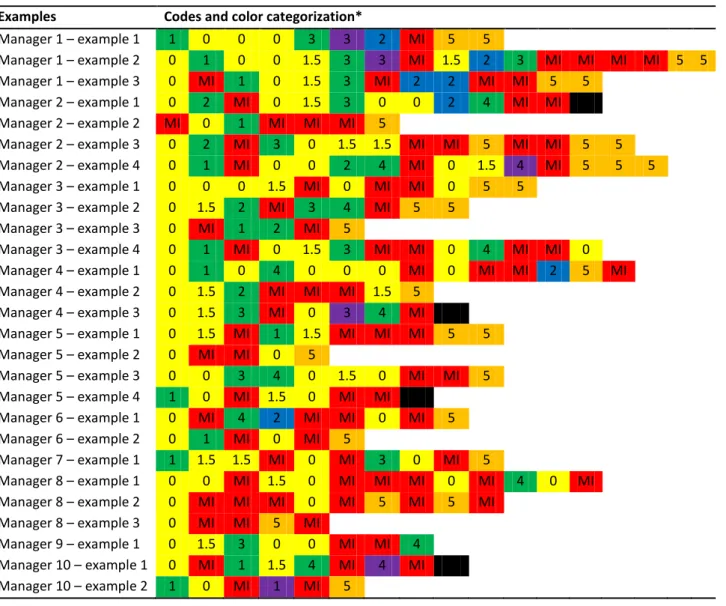
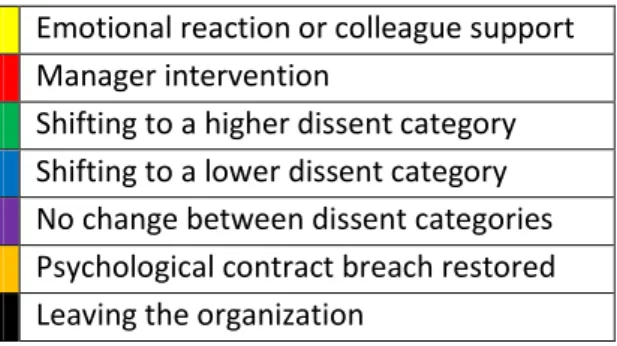
14 resignation" (for further details see appendix 2, table 3). In total an amount of 263 codes were assigned to different parts of text with a total of 12 unique categories of codes. Subsequently, to analyse the number of used codes and determine if a process between dissent behaviour categories or influence tactics could be observed, a number was assigned to each group of codes that were on the same level within the dissent process. Eventually 8 different codes were constructed to give insight into the dissent process and management influence tactics. Another Excel file table was created to determine which dissent categories have been used, if there was a process observed and what kind of effects the manager influence tactics had on the dissent process. The following colours were assigned to the different dissent categories to give insight into the dissent process: yellow represents “Emotional Reactions” or “Colleague Support”(not included in the analysis since the employee reactions were not belonging to the upward dissent categories), green represents an higher hierarchical dissent category, blue represents a lower hierarchical dissent category, purple represents the same dissent category, red represents “Management Intervention” and orange represent PCB recovered (for further details see appendix 2, table 3).
To simplify the analysis of categories, a limit was put to the number of behavior categories that could be coded in any single time period or phase of an incident to one. Thus, based on the literature the conceptual model that was elaborated in the theoretical framework and the coding process with its restrictions; the following codes were created: Emotional Reaction (0), Direct Factual Appeal (1), Colleague Support (1.5), Solution Presentation (2), Circumvention (3), Threatening
Resignation (4), Psychological Contract Recovered (5) and Management Intervention (MI). After that, for each of the 27 examples that were given by the managers, the number of shifts, initial dissent starting phase, shifting between categories, and management influence tactics were calculated and determined. Next, an inventory of the different influence tactics of the managers was collected. Then for each influence tactic was determined, to which extend it had a positive or negative effect on the employee dissent behaviour and therewith the possible recovery of the PCB (for a complete
15
4. Results
In this results section the results of the analyses will be presented; first for all 4 dissent categories followed by the influence tactics. These results serve as a basis for the creation of a dissent and influence tactics process model which will be presented and discussed last.
4.1 Dissent categories and process
This section presents the results of the main categories that have been created during the coding process and are organized based upon the themes that were stated in the research questions. First the results of the different dissent categories are presented where after the extent to which a dissent process is observed will be elaborated.
4.1.1 Dissent categories
After the coding process a total of 263 codes emerged from the data. The codes were divided into 8 main categories. Each category reflects a dissent category, an employee reaction, management influence tactic or changing of the PCB. Table 4 in appendix 2, shows the different categories observed by managers with the frequency of each category, representing color in the table with the dissent process and process code are presented.
Each manager described a number of situations in which they observed a PCB. For example a manager described "Within our company we have a certain performance appraisal system in which each employee is graded with a number from 1 till 5. One specific employee expected a 2, what entails an excellent performance, but was rewarded with a 3 instead. Resulting; the employee felt abandoned by me as a manager, lost his trust in the organization and had feelings of anger and injustice” (see accompanying CD, Manager 1; example 1). Another example given by one of the managers describes the following situation; "An employee was transferred to another department and had to do tasks different than before. Because of this she had much resistance to that change because she did not liked these new tasks and had now other expectations within her work and toward the organization (see accompanying CD, Manager 3; example 1). After each description of the situation that led to the PCB the managers were asked to reflect on the first reaction of the
employee. In almost every case the manager started to illustrate what kinds of emotions the employee experienced. The most common emotions that were mentioned are "injustice", "feelings of anger" and "sadness". Because the research focused on employee upward dissent strategies the employee reactions and emotions were not further included in the analysis.
According to the interviewed managers, the employees started with different kind of dissent categories. In total 12 employees started with "Direct Factual Appeal", four employees with "Solution Presentation", three with "Circumvention" and two with "Threatening Resignation". Although the focus of this study was on upward dissent categories, it is worth mentioning in 24 of the cases
16 described by the managers, employees tried to find support at their colleagues. According to four of the managers, getting support at their colleagues has a significant influence on the way employees perceive a PCB. One of the managers said during the interview "She constantly tried to get support at her colleagues. When she noticed that she did not receive any support, she realized that she had to cope with the current situation” (see accompanying CD, Manager 3, example 2).
The first and most apparent category in the results is the “Direct Factual Appeal”, which means that in most cases the employee first tried to convince their manager that they did not made a good decision. The employee for example tried to persuade the manager by presenting facts that are based on their experience, in which they stated the reason for their own opinion. One of the employees for example wrote an appendix, based on her perception of her own performance, that she wanted to include to her performance appraisal (see accompanying CD, Manager 3, example 1). Another example of "Direct Factual Appeal” is of an employee who presented all kind of facts of his performance to try to change his performance appraisal (see accompanying CD, Manager 4, example 1). The following hierarchical dissent strategy that has been used to demonstrate their dissatisfaction about the situation is "Solution Presentation". Managers observed in a number of cases a direct start with "Solution Presentation" or as a follow-up on "Direct Factual Appeal". For example an employee asked her manager, if she could work with another colleague because she had a very bad relationship with that colleague. (see accompanying CD, Manager 2, example 4). When employees raised their concerns with the manager of their manager they used the dissent category "Circumvention". In most cases the employee lost his trust in his or her direct manager and went to the manager of their manager to get support. In the case of manager 2 (see accompanying CD, example 3) and manager 3 (see accompanying CD, example 2) the manager gave support to the employee, but in the other cases the manager supported the direct manager and not the employee. The highest hierarchical dissent level category consisted of employees who threatened their manager with resignation. In those cases the employee lost their trust in the entire organization and could not think of any other solution than threatening the organization with resignation. For example manager 5 (see
accompanying CD, example 2) told that the employee said she could not longer work for the
organization in the way she was expected to work. She could cope with the situation and stay loyal to the organization or she must exit the organization. In the end of the dissent process she eventually left the organization, because the situation did not change to the way she wanted.
17
4.1.2 Dissent process
The next theme this research has focused on is based on the proposition, that managers observe an order in the dissent categories that employees use to display their PCB. In total employees shifted 52 times to another dissent category (see accompanying CD). This shifting meant they shifted to a lower or higher dissent category. On average employees shifted 1.96 times in each case. Only two
employees did not shift to another category or displayed any dissent categories. In 92.6% of the cases employees changed to another dissent category than they had started. In 6 of the shifts employees changed to a lower hierarchical dissent level and in 22 times they shifted to a higher hierarchical level. In 8 of the cases there was a moderate dissent process with 2 shifts to a higher dissent category and in 2 cases all four upward dissent categories were used by the employee and therewith there was a strong dissent process. These employees started with "Direct Factual Appeal", shifted to "Solution Presentation", then used "Circumvention" and ended with "Threatening
Resignation" to express their PCB. For example one manager said the following; "she started presenting facts about the situation but there was nothing I could do to change the situation as a manager. The employee tried to present solutions to change the work procedures but eventually she lost trust in me as a manager. She did not want to talk to me anymore and started to get support from other people in the organization like my own manager. When she realized the manager did not gave her support, because he could also do nothing to change the work procedures, she completely lost her trust in the organization, as a result, she started to threat the organization with resignation. As an organization we did not want to lose her, therefore we changed the working procedures, so she does not have to work with that certain colleague anymore. The employee is now still working in the organization and is well performing and motivated." (see accompanying CD; Manager 2, example 4).
4.2 Influence tactics and their effects
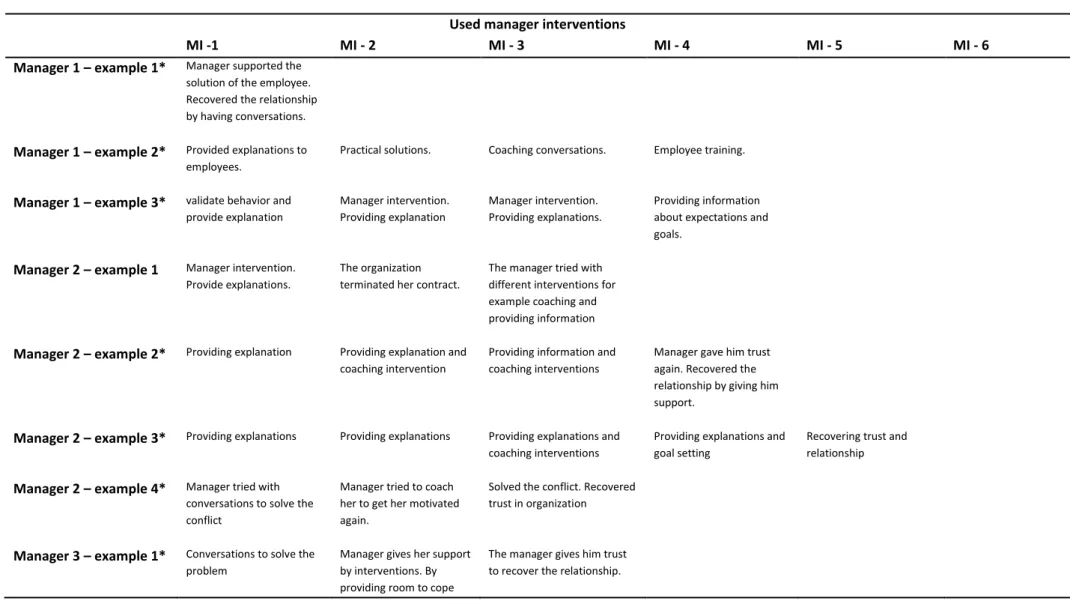
The second theme that is explored during the interviews is the influence tactics and the effects of these tactics. The different used tactics are presented in appendix 3, table 6.
4.2.1 Influence tactics
In the 27 cases that were described by the managers, a total of 80 interventions were applied. The most frequently used influence tactic, with a total number of 28 times used, was "Providing Explanations". The managers used this intervention to give explanations to an employee who expressed the first two dissent categories, namely "Direct Factual Appeal" and "Solution
Presentation". They provided this explanation to give insight into their motivation for their decision or to provide an explanation for organizational policies and procedures. For example one manager said "I had some conversations in which I told him that he had no other choice than conform to the
18 new situation. I also provided him with clear information about goals and targets that have to be met." (see accompanying CD, Manager 7, example 2).
The second intervention that was frequently used was "Coaching Interventions", with a total of 26, this influence tactic was used in almost every case. The intervention was mostly used to provide trust again to the employee and to help the employee to improve his or her behavior to meet organizational goals. One of the managers described the situation as followed: “An employee got a promotion to the sales department, because he performed very well in his current functions as a service desk employee. But from the start of his new function his motivation and performance went down. The employee did not have realistic expectations of the content of the work in his new function. He did not like the work content. I tried to give him the right tools to cope with the situation with coaching interventions. I really wanted to help him get back on track and be satisfied and motivated again." (see accompanying CD, Manager 8, example 1). Furthermore, 6 managers tried to restore the PCB by providing the employee extra conversations to talk about the subject that is causing the breach. The managers tried to listen to the employee to show their involvement about the case. The employees gain trust again in their managers because they provided them support. The last category of interventions that managers frequently used was "Providing Information". In the majority of the cases, the manager provided information about the targets that have to be met to achieve an excellent performance. In 7 cases the managers described a situation in which a PCB was manifested because the employee had other expectations towards the organization than the organization could offer them. One manager for example told during the interview “An employee expected a "2" as a performance grade but she got a "3". This made her very upset because she did not get a bonus and she thought she was performing on a higher level. She had other expectations towards the organization. He made clear what the organization expected from her to achieve a performance grade level of 2." (see accompanying CD, Manager 5, example 2). Lastly, in 9 cases the organization did not change the situation to restore the PCB. The employee could either cope with the situation or leave the organization. The organizational decision could not be influenced by the employee. For example one manager supported an employee when being rejected 3 times for applying on an internal function. However, the organization did not change their decision and the employee as well as the manager had to cope with the situation (see accompanying CD, Manager 8, example 2).
19
4.2.2 Effects of influence tactics
In each of the examples of PCB that were described by the 10 managers there were influence tactics used to alter the dissent behavior, thereby trying to recover the PCB. In 20 of the 27 cases the PCB was completely recovered by the interventions of the managers. In 4 cases the interventions did not had a positive effect on the dissent process. In each of those cases the employees shifted to a higher dissent category till they had reached “Threatening Resignation". Eventually their PCB was not recovered and they left the organization, sometimes forced by the organization. In three cases the PCB was partly recovered. In that cases the employees had to cope with a situation and still had other expectations towards the organization, than the organization could offer them. In appendix 2, (table 3) all the management interventions are displayed colored red. When a green or blue cell follows on the red cell, the manager observed a shift to a higher or lower dissent category. In 32 of the cases an employee shifted towards another dissent category directly after a management influence tactic. For example "Coaching Interventions" and Providing Explanations".
After 18 of the management interventions the PCB was directly recovered and therewith the dissent process stopped. In the following cases m1 e1, m1 e2, m1 e3, m2 e2, m2 e3, m3 e1, m3 e2, m3 e3, m4 e1, m4 e2, m5 e1, m5 e2, m5 e3, m6 e1, m6 e2, m7 e1, m8 e3 and m10 e2 the managers used an intervention that directly stopped the dissent process and recovered the PCB. In appendix 3 (table 6) it is shown that out of all different influence tactics that were used to influence employee dissent behavior, the last intervention in each of the examples turned out the most effective and led in the previously mentioned cases to a recovery of the PCB. Naturally, there were differences between the effectiveness of each intervention. In appendix 3 (table 6) the number of used
interventions, the number of times these led to positive changing of dissent behavior and percentage of effectiveness are presented. Employees reacted most positively to coaching interventions to restore their PCB. In 69.2 % of the used coaching interventions by managers, the intervention led to a positive effect on the dissent behavior of the employee. The second most effective influence tactic used by managers was "Conversations" to support the employee. By providing the employees with extra conversations the manager expressed his or her involvement to the problem or situation that is causing the PCB. In half of the cases when "Conversations" were used the intervention was successful to restore the PCB. The third intervention that had a large effect on restoring the PCB was "Providing Explanations". This influence tactic was effective in 42.9% of the cases. The reliability of the influence tactics "Coaching" and "Providing Explanations" is stronger because the frequency of the
20
4.3 Dissent and Influence tactics process model
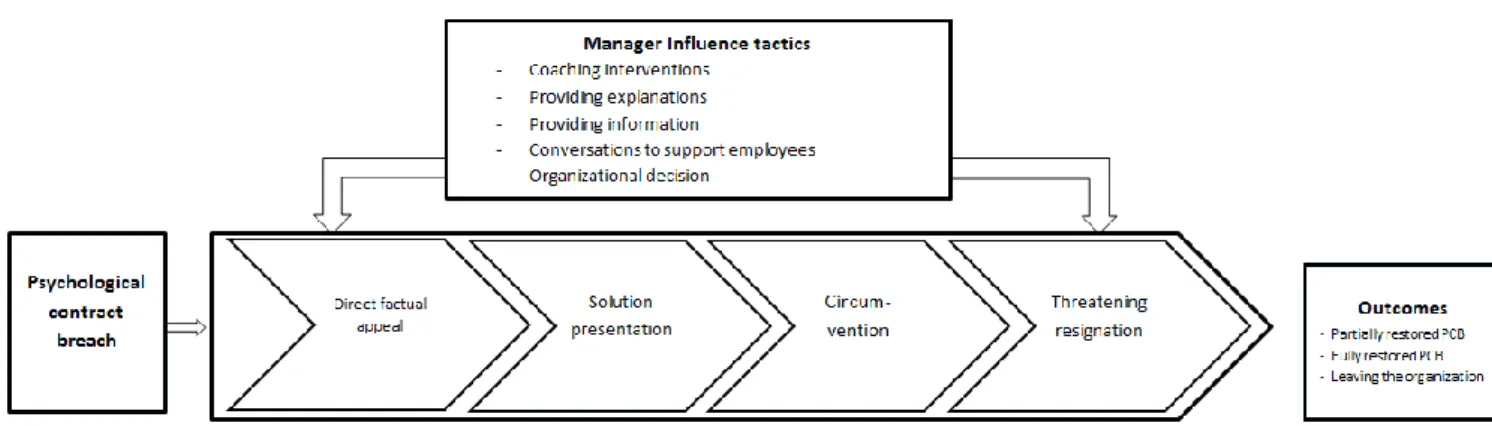
As explained in detail in the method section, the aim was to distinguish dissent behavior and its process and used influence tactics and their effect on the dissent process. This has resulted in the construction of a dissent and influence tactic process model (figure 2) that was constructed during the iterative selective coding process. This model comprises of all 4 dissent categories and influence tactics described in the result section.
Figure 2. Process model
Firstly, the model shows that a breach in a psychological contract, will lead to the start of expressing a certain kind of dissent behavior. The most employees started with a low dissent behavior category, however there were also employees who directly started with a higher dissent level. Noteworthy is that this is not directly expressed visually within this process model because it was only a relatively low amount of employees that started in a higher dissent level. Secondly, at the center of the model, the four dissent categories are positioned on a hierarchical process based manner. Almost every employee shifted to another dissent behavior category and most employees even shifted multiple times between categories after their psychological contract was breached. In only a few cases, referring to the blue cells of table 3 in appendix 2, an employee shifted to a lower dissent category. In the large majority of cases employees who shifted to another dissent category, shifted to a higher hierarchical dissent behavior category. All of the managers observed an order in the dissent process of the employees, who had a breach in their psychological contract. Notice the green cells in table 3, appendix 2 for an overview of all the shifts to a higher dissent category.
At the right side of the model, the different influence tactics of the managers are presented. The most effective interventions were "Coaching" and "Providing Explanations". These interventions were observed as the most effective interventions to stop the dissent behavior and therewith restoring the PCB. In seven cases the PCB was not restored or fully restored. These employees have
21 left the organization or are still working at the organization with a partly restored PCB. The four different dissent categories founded are in accordance to the findings of Kassing (2009). In his paper he postulates the proposition that there possibly is a dissent process, instead of mutual exclusive and fixed categories. The findings of this research confirm the shifting of employees to a higher
hierarchical dissent category and therewith indicating that there is a dissent process. Furthermore, there were 4 influence tactics that were frequently used by managers that were effective to stop the dissent behavior and restore the PCB, namely "Coaching", "Providing Explanations", "Conversations" and "Providing Information". In most cases the employee must get back his or her trust in the manager or the organization to fully restore their psychological contract.
22
5. Discussion and conclusion
5.1 Interpretation and discussion of the results
The aim of this study was to explore what kinds of dissent behavior categories managers observe at their employees, when their psychological contract is breached. Furthermore, this research focused on the fact if there was a process observable between dissent behavior categories. Next it was examined which influence tactics the managers used to stop the dissent process and restore their PCB. Finally this study gave insight into the effectiveness of interventions that were used by managers to stop the dissent behavior and restore the psychological contract breach of the employees.
The results demonstrate that, according to the observations of managers, employees express four levels of dissent behavior categories. This is also in line with the research of Kassing (2009). The results furthermore reveal four upward dissent behavior categories that, according to managers, were performed by employees after the breach in their psychological contract. As previously mentioned in the theoretical framework, numerous researches have been conducted whereby the dissent categories were seen as fixed and mutual exclusive. This research provides significant evidence of a process and a hierarchical order of dissent categories. In 20 of the 27 examples of a PCB described by managers, there was a shift to other dissent behavior categories. In 6 cases the employee shifted 2 times to another category and in 2 cases the employee used all four dissent level categories. Employees started their dissent behavior at different categories but approximately all shifts to another level were to a higher hierarchical dissent level category. The presumed order can be found in 74% of the cases. Therefore it can be stated that employees with a breach in their psychological contract, will start to express one of the four dissent behavior categories and is expected to shift to an higher hierarchical dissent level category. Furthermore, the results
demonstrate that managers use a wide variety of influence tactics to stop the dissent process and restore the PCB of the employee. The influence tactics that were most frequently used and that were the most effective were "Coaching", "Providing Explanations", "Providing Information" and
"Conversations". Especially with coaching interventions and providing explanations managers tried to influence the dissent behavior of the employees and restoring their breach in their psychological contract. An explanation for this can be found in the Social Exchange Theory (Blau, 1964). This theory postulates that the parties involved in an exchange relationship provide benefits to each other in the form of tangible benefits such as money or intangible benefits such as support (Blau, 1964). When this exchange relationship is imbalanced in terms of what the employee expects from their psychological contract and what they receive from the organization, the employee is expected to perceive a breach in their psychological contract and is likely to express forms of dissent behavior (Kassing, 1997).
23 The effectiveness of the influence tactics can be explained by the article of Van den Heuvel (2012). Herein it is described that managers play a crucial role in providing psychological contract trust. The common aim of the management interventions was to gain trust again in the organization or the manager. However, in most cases employees also tried to get support from their colleagues. Whether they received support or not, had a strong influence on their dissent behavior. When they did not receive support at their colleagues, they understood their dissent behavior was ineffective and they had to cope with the situation or problem that caused the breach in their psychological contract. The most effective influence tactics, found in this study, were focused on increasing trust to stop the dissent process and restore the PCB. This is in line with this study in which all of the
managers described trust as a strong factor to restore the PCB. Most of the breaches started after the employee lost trust in the manager or the organization. The interventions that were described by the managers and that were the most effective were focused on gaining back trust to the employee. The managers were providing support to the employees by giving extra tools and competences to cope with the problem or situation that was causing the breach.
5.2 Limitations
The research method used in this study has some limitations that should be acknowledged. First, because behavior was not experimentally manipulated or influenced in this study, it is difficult to infer causality with certainty. Any conclusions about the relative effectiveness of different influence tactics rest on the assumption that the results were not biased by confounding factors or sampling problems. For example, a manager’s experience may be related to how effectively a particular influence tactic is used. Moreover, because this study has a cross-sectional set-up this also implies difficulties regarding to causality.
Secondly, although a relative large number of 27 cases were used in this qualitative study, more empirical evidence is needed. The research is conducted on 10 managers in one single organization. Although the nature of a psychological contract breach does not differ, there can be other factors that can have an influence on the dissent process such as cultural differences, organizational culture, size of the organization and/or type of organization. For example, in a cross-national study, cultural differences could be taken into account.
Another limitation is that only four general dissent categories were created during the coding of the information. When more specific dissent behavior categories are created, the dissent process can be described in greater detail and the effectiveness of the different influence tactics can be determined more precise. Even Yukl et al., (2008) argue that the most effective way to evaluate relative effectiveness of influence tactics is examining outcomes involving only a single tactic, this can also be seen as a limitation. Using a more holistic approach could have figured out how and whether
24 different dissent categories combined with influence tactics could have led to different outcomes. Furthermore, the units of analysis were the managers. The managers described the dissent behavior of the employees, based on their own observations and knowledge of the situation. In reality there could be other subtle dissent behavior that the managers did not observe or have noticed. When a number of employees within the same organization were also included in the research, a more complete overview of the dissent process and effects of the influence tactics could be realized.
5.3 Future research
The results of this study have implications for researchers as well as for practitioners. In the remainder of this discussion section, these implications with related limitations and research recommendations are discussed. The first implication concerns the contribution of this study to understanding sense-making processes in times when a breach in the psychological contract of an employee is occurring. As Kassing (2009) has emphasized greater attention should be directed toward understanding how employees sequence and rotate dissent tactics while engaging in repetition. As Kassing (2009) also states, most qualitative studies on dissent behavior, have focused on mutual exclusive and fixed dissent categories. Whereas this study contains findings on the presence of a dissent process in which employees shift to higher hierarchical dissent level categories it is advised for future research to examine dissent behavior as a process and not as fixed categories.
This research gave insight into the shifting process of upward dissent categories used by employees, after they perceive a breach in their psychological contract. The conceptual model provides a starting point for further in-depth research, on the mechanisms that underlying the constructs of the dissent process. Moreover, because this research has focused on employee dissent behavior and influence tactics based on qualitative research methods. Future research could make use of empirical quantitative research methods to give insight into the level of variance between the different concepts.
Moreover, the focus of this study was on upward dissent strategies and therefore does not include other categories in the analysis. Therefore, it is suggested that future research takes other dissent categories into account to get a complete overview of the possible ways in which employees can display dissent behavior. Connected to this is that more research is needed to explore the underlying mechanisms that are determining the manner in which an employee addresses dissent behavior. For example research that includes concepts such as “trust” and “open communication”. This would presumably extend the model as it is suggested in this research by adding moderating concepts that are underlying the relationship between the exact moment when a breach is manifested and the start of the first dissent behavior. Researchers could focus on the mechanisms that directly activate the dissent behavior such as psychological reactions and emotions. Besides
25 this, there were four effective interventions explored that were performed by managers. For future research it is suggested to investigate these in a qualitative setting to demonstrate their
effectiveness and mutual relations, in order to truly establish which tactics are best used in the process of dissent behavior.
Lastly it is suggest that future research could be conducted from an employee perspective on how they perceive the PCB and what caused shifting between categories. If these perceptions are then combined with the managerial perspective it is then that a more complete view of the process can be established. A recommendation for future research would therefore be to study both
perspectives in a single organizational change context, and to identify whether there is a discrepancy between the two perspectives. More insight into the causes and consequences of discrepancies in views on individual needs, expectations and perceived promises would enable the identification of the relative importance of pre-change and change antecedents, as well as the importance of the psychological contract as pre-change antecedent.
5.4 Practical implications
The findings of this research have implications for improving managerial effectiveness, although caution is needed in offering guidelines until follow-up research verifies the present results. The first practical implication is that managers can benefit from an increased focus on developing
competences that can help them perform one of the four most effective interventions, to stop the dissent process and restore the psychological contract. Organizations can try to prevent situations whereby a psychological contract will be breached. This will be an ideal situation and in practice this can unfortunately not always be realized, since employees and an organization often have conflicting interests and therewith different mutual expectations. Organizations should train their managers to recognize dissent behavior. After a certain dissent behavior category is determined, the manager must be able to apply the most effective influence tactic to restore the PCB and stop the dissent process.
The second implication of this research concerns the adoption of the managerial perspective. Management plays a crucial role in the dissent process of an employee. Organizations should
stimulate an environment in which managers are provided with the right information, competences and opportunities to develop the effectiveness of the four most successful influence tactics described in this study. Meaning that; organizations must develop organizational wide systems that can
support managers in developing these influence tactics. For instance, organizations can implement learning and development practices that improve managerial conflict handling and communication. These competences can enhance the effectiveness of managers in situations where they have to restore the PCB. During these trainings managers can learn competences that can tribute to the
26 practice of the four most effective influence tactics. Furthermore, organizations should implement information systems that focus on providing information and developing competences, to improve the practice of the four most effective influence tactics to end the dissent process and restore the PCB. For instance, managers can learn during an e-learning program, to identify stages in the dissent process and thereby selecting the most effective influence tactic. Because line managers play a crucial role in the execution of organizational policies and building trust it is required for them to have the skills and competences to deal with psychological contract breach, especially because restoring a psychological contract breach can be perceived as problematic. Therefore it can be assumed preventing is preferable above restoring a psychological contract breach. Though in some cases a breach is inevitable since employees and organizations occasionally have conflicting interests and diverge expectations. It is of great importance that organizations create a work-environment in which opportunities are created for managers to develop competences and learn to perform interventions that are intended for improving their influence tactics, to increase coping with the variety of dissent behavior expressed by employees after they perceive a breach in their
psychological contract. Furthermore, employees do not express their dissent behavior fixed in mutual exclusive categories, but within a dynamic process in which they shift from lower to harder hierarchical dissent level categories. Because employees express more rigorous dissent behavior when their psychological contract breach is not restored, they might even shift to the highest dissent level category and are expected to initiate with threatening the organization with their resignation. Therefore it is of great importance that managers recognize early employee dissent behavior, consequently trying to stop the dissent process and restore the PCB, they must apply influence tactics that are found to be effective such as "Coaching", "Providing Explanations", "Conversations" or "Providing Information". When managers are capable applying these interventions, they could stop the process and restore the PCB.
5.5 Conclusion
This study has investigated which dissent behavior categories could be distinguished and whether or not these categories are mutually exclusive or represent a certain process employees go through. The results of this study provide evidence for the existence of a dissent process, whereby employees are expected to utilize "harder" dissent level behavior categories, till they achieve their objectives or leave the organization. Furthermore it has been researched which influence tactics are available to managers and what the effect is of these influence tactics on stopping dissent behavior and restoring the PCB. Results here show that there are four tactics that are most commonly used and can thus be seen as most effective. Knowing this it is crucial that managers have insight into employees’ needs, expectations and perception of promises. Business leaders with a lack of sincere interest in the
27 psychological contracts of their employees are likely to be confronted with unexpected and
unpredictable attitudes that can result in different kind of dissent behavior. Thus, organizations must have focus on preventing a breach in the psychological contract of an employee instead of having to deal with it once it happens. In case a PCB is inevitable, the manager must perform the most
effective influence tactics that are suitable for dealing with the different dissent behavior categories, to stop the dissent process and restore the psychological contract breach. Employees with a restored psychological contract perceive the mutual obligations and rewarding towards an organization as fair, therewith restoring PCB can result in positive outcomes for both the employee and the organization.
28
6. References
Blau, P. M. (1964). Exchange and power in social life. New York: Wiley.
Boxall, P., & Purcell, J. (2011). Strategy and human resource management. Houndmills: Palgrave MacMillan.
Conway, N., & Briner, R. B. (2002). A daily diary study of affective responses to psychological contract breach and exceeded promises. Journal of OrganizationalBehavior, 23(3), 287–302.
Csoka, L.S. (1995), “A new employer-employee contract?”. Employment relations today, 22, 21-31 Deery, S.J., Iverson, R.D., & Walsh, J.T. (2006). Toward a better understanding of psychological
contract breach: A study of customer service employees. Journal of Applied Psychology, 91(1), 166–175. doi: 10.1037/0021-9010.91.1.166
De Ruiter, M., Blomme,R. J., Schalk, M. J. D. & van de Schoot, R. (2013) Intervening Stages between Psychological Contract Breach and Employee Outcomes: An exploration of employee dissent. Unpublished research proposal
Falbe, C. M., & Yukl, G. (1992) Consequences for Managers of Using Single Influence Tactics and Combinations of Tactics. Academy of management journal, 35(3), 638-652.
Garner, J. T. (2009): When Things Go Wrong at Work: An Exploration of Organizational Dissent Messages, Communication Studies, 60:2, 197-218
Gelissen, J. (2010). Qualitative research methods. London: Sage.
Guest, D. E. (2004). The psychology of the employment relationship: an analysis based on the psychological contract, Applied Psychology, 53, 541–555.
Haslam, S., A. (2004). Psychology in Organization: The Social Identity Approach. SAGE Publications Inc. London
Hirschman, A. O. (1970). Exit, voice, and loyalty. Cambridge, MA: Harvard University Press. Kassing, J.W. (1997). Articulating, antagonizing, and displacing: a model of employee dissent.
Communication Studies, 48(4), 311-332.
Kassing, J.W. (1998). Development and Validation of the Organizational Dissent Scale. Management Communication Quarterly, 12(2), 183-229.
Kassing, J.W. (2000). Investigating the relationship between superior-subordinate relationship quality and employee dissent. Communication Research Reports, 17(1), 58-70.
Kassing, J.W. (2002). Speaking up: Identifying Employees’ Upward Dissent Strategies. Management Communication Quarterly, 16, 187-209.
Kassing, J. W. (2009). ''In Case You Didn't Hear Me the First Time'': An Examination of Repetitious Upward Dissent. Management Communication Quarterly 2009 22: 416 DOI:
29 Kassing, J. W., & Armstrong, T. A. (2002). Someone’s going to hear about this: Examining the association
between dissent-triggering events and employees’ dissent expression. Management Communication Quarterly, 16, 39-65.
O'Donnell, M., Yukl, G., & Taber, T. (2012). Leader behavior and LMX: a constructive replication.
Journal of Managerial Psychology, 27(2), 143 – 154. doi:10.1108/02683941211199545 Parzefall, M. R. & Coyle-Shapiro, J. A. M. (2011). Making Sense of Psychological Contract
Breach. Journal of Managerial Psychology, 26(1), 12-27.
Robinson, S. L., & Rousseau, D. M. (1994). Violating the psychological contract: Not the exception but the norm. Journal of Organizational Behavior, 15, 245–259.
Rousseau, D. M. (1989). Psychological and implied contracts in organizations. Employee Responsibilities and Rights Journal, 2, 121–139. doi: 10.1007/BF01384942
Rousseau, D. M. (1995). Psychological contracts in organizations: Understanding written and unwritten agreements. Thousand Oaks, CA: Sage.
Rousseau, D.M. (1996). Changing the deal while keeping the people. The Academy of Management Perspectives, 10(1), 50-59. doi: 10.5465/AME.1996.9603293198
Rousseau, D. M. & Ho, V. T. (2002). Psychological contract issues in compensation. In S.I. Rynes & B. Gerhart (Eds). Compensation in current research and practices (pp. 272-310). San Francisco, CA: Joessey-Bass
Sprague, J. A., & Ruud, G. L. (1988). Boat-rocking in the high technology culture. American Behavioral Scientist, 32, 169-193. doi:10.1177/0002764288032002009
Strauss, A., & Corbin, J. (1998). Basics of qualitative research: Grounded theory procedures and techniques (2nd ed.). Thousand Oaks, CA: Sage.
Suazo, M. M. (2009). The Mediating Role of Psychological Contract Violation on the Relations between Psychological Contract Breach and Work-Related Attitudes and Behaviors. Journal of Managerial Psychology, 24(1), 136-160.
Turnley, W.H., & Feldman, D.C. (1999). A discrepancy model of psychological contract violations.
Human Resource Management Review, 9(3), 367-386. doi: 10.1016/S1053-4822(99)00025-X Van den Heuvel, S. (2012). The influence of the psychological contract on attitude towards change
(Doctoral dissertation, Tilburg University, Netherlands).Retrieved from: http://arno.uvt.nl/show.cgi?fid=127790
Yukl, G., & Falbe, C. M. (1990). Influence tactics in upward, downward, and lateral influence attempts. Journal of Applied Psychology, 75, 132−140. doi:10.1037/0021-9010.75.2.132 Yukl, G., Seifert, C. F., & Chavez, C. (2008). Validation of the extended influence behavior