UNIVERSITA’ DEGLI STUDI DI PARMA
Dottorato di ricerca in Psicologia della Educazione e delle Disabilità
Ciclo XXIII
Comprehensive Application
of Behavior Analysis to Schooling in Italy
Coordinatore:
Chiar.ma Prof. ssa Silvia Perini
Tutor:
Chiar. Ma Prof. ssa Silvia Perini
Comprehensive Application of Behavior Analysis to Schooling in Italy
INDEX
1. Introduction: The CABAS® model and its components
• The CABAS® Model • CABAS® Components
2. CABAS® Verbal Behavior Development Theory
• Origins of Verbal Behavior
• From Theory to Research and from Research to Theory • Fundamental Speaker and Listener Repertoires.
• Interlocking Speaker and Listener Responses. • Speaker as own Listener Repertoires
3. The CABAS® Verbal Developmental Sequence
• Identifying and Inducing the Preverbal Foundational Cusps and Capabilities and the Listener Cusps
• Developing the Basic Speaker Verbal Operants • Joining of Listener and Speaker Function
4. The Pilot Project
5. Implementation in Regular Education Environment
6. CABAS® As a Teacher Training Camp
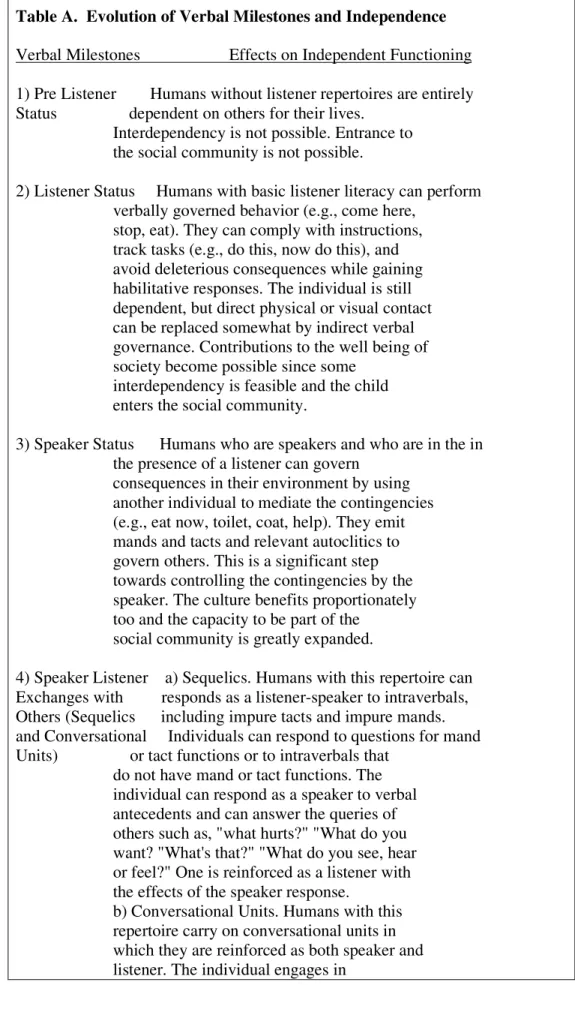
Table A. Evolution of Verbal Milestones and Independence Table B. Verbal Milestones and Components
1. Introduction: The CABAS® Model and its components
The CABAS® Model. The Comprehensive Application of Behavior Analysis to Schooling (CABAS®) is an international certification for programs characterized by defining quality components: (a) individualized instruction, (b) continuous measurement of teaching and student responses, (c) graphical display of teachers and students performance, (d) use of scientifically-tested tactics, (e) logically and empirically tested curricular sequences, (f) socially significant goals of instruction, (g) positive teaching environments and (h) teachers trained as strategic scientists of pedagogy (Greer, Keohane & Healy, 2002). The CABAS® model was designed since 1981 in the United States, was tested in Italy (Lamm & Greer, 1991), successfully replicated in Ireland, England and Spain, and is continuously modified based on ongoing research (Greer & Ross, 2008). CABAS® classrooms for children with and without disability function as cybernetic systems of education in which the individualized instruction of each student influences the behavior of every component of the education community (Twyman, 1998) and can be defined as research and in-situ training centers (Greer & Ross, 2008). These student-driven schools and programs apply the principles of behavior analysis to all components of the system, including parents, supervisors, administrators and University mentors (Lamm & Greer, 1991). Everybody’s progress is continuously measured, graphically displayed, analyzed and individually modified, and the behavior of the entire program is influenced by the performance of each individual within it (Selinske, Greer & Lodhi, 1991). Greer & Ross (2008) defined the objective of the CABAS® programs: providing research, demonstration and training sites for developing procedures that can be used by other behavior analysts, schools and educational systems. Replications of the system and research done by independent evaluators reported four to seven times greater learning, compared with baseline or control conditions, after CABAS® was implemented in schools or home-based interventions (Reed, Osborne & Corness, 2007; Perini & Casarini, 2009).
One of the main characteristics of the CABAS® programs is that all instruction is designed, provided and recorded as Learn Units. A Learn Unit (Greer & McDonough, 1999; Bahadourian, 2000; Greer, 2002) is a basic unit of teaching identified to measure the behavior of a teacher or a teaching device and the student response. It was described as the interlocking three-term contingencies of teacher and learner, with at least two contingencies for the teacher and a potential one for the student (Greer & Ross, 2008). The Learn Unit definition was based on Skinner’s programmed instruction frames (Skinner, 1968) and was developed including findings from the applied research about academic engaged time (Greenwood, Horton, & Utley, 2002), corrections (Skinner, 1968) opportunity-to-respond (Cooper, Heron, & Heward, 1984) and computer-based instruction (Kulik & Kulik, 1991). It was defined as an accurate predictor of educational outcomes in the classroom and at home (Bahadourian & Greer, 2005; Bahadourian, Tam, Greer & Rousseau, 2006) and, according to Greer & Ross (2008) “is necessary, if not sufficient, for teaching new operants”. Learn Unit’s main components are: (a) an antecedent stimulus presentation by the teacher, with unambiguous instruction provided to a student in optimum motivational and attending conditions, and without unwitting prompts; (b) an opportunity to respond (usually within 3 seconds); (c) an appropriate consequence, derived from the student’s instructional history (correct responses must be followed by reinforcing consequences and incorrect responses must be followed by a correction operations, with the teacher providing the answer and observing the student’s corrected response without delivering reinforcers). In CABAS® schools and programs, Learn Units are used to measure the accuracy of teacher’s teaching, student learning and the productivity of instructors (Greer & McDonough, 1999). Learn Unit data collected are daily graphed by curricular areas and individual programs for students, and by daily total instruction for teachers. Moreover, “learn units to criterion” data are calculated as a rate of learning, to measure improvements in the efficacy and efficiency of instruction at the level of the
individual students, instructors, classrooms and program-wide (Keohane, Luke & Greer, 2008).
CABAS® Components. Other key tools and tactics used to teach, improve performance and motivate professionals in the CABAS® system are: the Teacher Performance/Rate Accuracy Observation Protocol (Ingham & Greer,1992), the CABAS® Decision Protocol (Keohane, 1997; Keohane & Greer, 2005), implementation of parent education programs (Bahadourian & Greer, 2005), system monitoring and staff training (Greer, 1996).
The Teacher Performance Rate and Accuracy (TPRA) Scale is conducted by a supervisor and measures the teacher or experimenter’s accuracy and rate of Learn Units presentation, and students responding to the presentations. It focuses on each component of the Learn Unit, providing each teacher with contingent feedback about accuracy of data collection, fluency of instruction presentation, and acquisition of contingency-shaped behavior (Greer & Ross, 2008). Its frequent use was identified in literature as a good predictor of students’ improvement and quality of teaching (Keohane et al., 2008).
The Decision Tree Protocol was introduced to CABAS® schools since 1997 to outline rule-governed strategies for data-based decisions. Applied researches showed that the implementation of the Protocol can significantly decrease Learn Units to criterion values across all students (Keohane, 1997). In 2005, Keohane and Greer examined the effects of teaching instructors to use this verbally governed problem-solving procedure to solve students' learning difficulties and showed that learners reached a greater number of instructional objectives when their teachers used this analytic algorithm.
Parent Training is also an important component of the model: parent education in the CABAS® programs is usually offered to all parents on a voluntary basis, starting with instruction about how to deliver Learn Units in school and at home, then continuing with at-home consultations (Twyman, 1998). The objective of the 1:1 and group instruction
provided to parents is to give them tools to be better problem –solvers and educators at home. According with recent researches (Hart & Risley, 1995; Greer & Ross, 2008; Greer & Longano, 2010) one of the main goal for parent trainers is to teach parents how to increase language interactions with their children and promote spontaneous speech, to move them through higher verbal behavior development stages.
The CABAS® Board, whose members are behavior analyst supervisors in CABAS® schools, and University professors, serve as mentors to teachers, supervisors and administrators, and continuously analyze all of the components of the program. The CABAS® system for staff training was built on Keller’s Personalized System of Instruction (PSI) approach (Keller, 1968) with a rank system. CABAS® trainee move through the ranks or levels of expertise in an individualized fashion and during the internal career must demonstrate mastery of (a) verbal behavior about the science, (b)contingency-shaped repertoires of in class practice, and (c) verbally mediated repertoires to make independent decisions about applications of behavioral strategies (Healy, O’Connor, Leader, & Kenny, 2008).
All these components are necessary to define a CABAS® model of education, a system that, from the beginning, was designed to fulfill the dream of optimum behavioral schools capable of drawing on the other behavioral models of schooling, the tactics from the experimental and applied branches of behavioral analysis, the epistemology of behavioral selectionism and research on the model itself, applied in schools (Greer, 2002). To be complete and self-correcting, the model must be applied to all of the individuals involved in the school community: students, parents, teachers, supervisors and the university training program, and studied as a cybernetic system. As stated by its main representative, Dr. R.D. Greer (2002) “this system-wide analysis is used to determine or evoke […] relationships between all of the parties such that the effects on the students’ learning are the controlling variable for the relationships between roles”.
1. CABAS® Verbal Behavior Development Theory
Origins of Verbal Behavior. Complex language is recognized as one of the unique repertoires of the human species. Over the last 40 years linguists have proposed theories and provided evidence related to their interpretation of the structure of language (Chomsky & Place, 2000). Neuroscientists have identified neurological correlates associated with some aspects of language (Deacon, 1997, Holden, 2004), while behavior analysts have focused on the source of and controlling variables for the function of language (Catania, Mathews, & Shimoff, 1990; Greer & Ross, 2004; Michael, 1984; Skinner, 1957). More recently, scholars have come to view human language as a product of evolution. The experience of CABAS® schools produced a wide corpus of research that, incorporating Skinner’s (1957) Verbal Behavior theory, led to an inclusive new theory about how cultural selection gave rise to the function of language and how verbal behavior development happens for children with and without disabilities (Greer & Keohane, 2005; Greer & Ross, 2008).
Some researchers suggest that oral communication evolved from clicking and sucking sounds to sounds of phonemes, and focus on the existant clicking languages as an evidence for that (Pennisi, 2004). Greer & Keohane (2005) agreed that is likely that sign language and gesture predated both vocal forms; but, in their view, it is the evolution of the spoken and auditory components of language that are seen as critical to the evolution of language. Some of these include changes in the anatomy of the jaw. In Fact, homo sapiens have more flexible jaw than did Neanderthals. Also, the location of the larynx relative to the trachea is different for Homo sapiens, and this anatomical feature made it possible for the humans to emit a wider range of speech sounds (Deacon, 1997). The combination of these anatomical changes, together with the identification of separate, but proximate, sites
in the brain for speaking, listening, and imitation seem to be critical parts of what created the basis for spoken language (Deacon, 1997). The presence of these anatomical and physiological properties made it possible for the evolution of verbal functions through the process of cultural selection (Catania, 2001). The functional effects of speech sounds were acquired by the consequences provided within verbal communities. This latter focus is what, according to Greer & Keohane (2005), constitutes the subject matter of verbal behavior. Interesting, little, if any research work, is devoted to the function of language as behavior per se. Only the research associated with Skinner's (1957) theory of verbal behavior as behavior per se, and expansions of the theory by contemporary behavior analysts, provide the means for analyzing how cultural selection gave rise to the function of language (Greer, 2002; Greer & Ross, 2008; Hayes, Barnes-Holmes, & Roche, 2000;). Currently, the linguistic, neuropsychological, and behavior analytic foci remain separate sciences, even if they need not remain so (Catania, 1998). While the role of cultural selection in the evolution of verbal behavior for the species remains theoretical, the development of verbal behavior within the ontogeny of the individual is considered empirically verifiable (Greer & Keohane, 2005).
From Theory to Research and from Research to Theory. For decades after the publication of Skinner's (1957) book on verbal behavior, the majority of the publications on the theory remained theoretical. There is now a significant body of research supporting and expanding Skinner's theory of verbal behavior. Greer and Keohane (2005) have identified over 100 experiments devoted to testing the theory and its utility for educators. Also, there is a significant amount of research in relational frame theory that includes at least an equal number of studies that can be easily related to the verbal behavior theory (Hayes et al., 2000). In the CABAS® program of research alone, researchers have completed around 50 experiments and a number of replications. Greer and Keohane’s
(2005) particular research program was driven by the effort to develop schools that could provide all of the components of education completely based on scientific teaching and schooling. Cognitive psychology offered a great number of theories and findings about schooling too, and when they were compared and contrasted to CABAS® best practices, the findings identified many cognitive pedagogy methods that were operationally synonymous to those identified in behavior analysis. Skinner's Verbal Behavior (1957) was the first publication suggesting a way for a research program to fill in much of what was missing in the literature in a manner that allowed researchers to operationalize complex cognitive repertoires. In their commitment to a thoroughgoing scientific approach to schooling, CABAS® researchers needed functional curricula that could identify repertoires of verbal operants or higher order operants, including "generative" or "productive" verbal behavior: this was their challenge to build a modern theory of Verbal Behavior Development.
Brandon (2008) emphasized that one of the best discussions of the conditions necessary for acquiring the listener behavior was presented by Greer and Keohane (2005). In fact, as explained before, Greer and Keohane (2005) needed findings that worked in the day-to-day practice of their schools, the CABAS® schools, where their goal was to educate the "whole child." Experimental evidences suggested that they identified the verbal behavior cusps necessary for a child to move on from early capabilities to more complex verbal skills. Rosales-Ruiz and Baer (1996, p.166) stated that “A cusp is a change [a change in the capability of the child] that (1) is often difficult, tedious, subtle, or otherwise problemati to accomplish, yet (2) if not made, means little or no further development is possible in its realm (and perhaps in several realms); but (3) once it is made, a significant set of subsequent developments suddenly becomes easy or otherwise highly probable which (4) brings the developing organism into contact with other cusps crucial to further, more
complex, or more refined development in a thereby steadily expanding, steadily more interactive realm”.
Once Greer and Keohane (2005) identified prerequisites or co-requisites repertoires needed by each child to progress through the verbal behavior capabilities described in Table 1, they developed scientifically based tactics for moving children with the lack of a particular verbal capability from one level of verbal capability to the next level in the continuum. The authors demonstrated the ability to teach the missing repertoires, and when they did, the children made logarithmic increases in learning and emergent relations ensued. That is they acquired behavioral cusps or capabilities. Table 2 lists the verbal capabilities and the components and prerequisites that Greer and Keohane (2005) identified as well as some of the related research.
Greer (2011) focused on defining the critical experiences necessary to develop new behavioral cusps because of the need to identify all the components that, in typically developing children, allow to achieve new capabilities that exponentially expand learning. According to the new Verbal Behavior Theory (Greer & Ross, 2008) these capabilities, induced for children with special needs, would provide them with the means to learn or expand the capability to learn. For example, children would learn from observing others experiences instead of from direct teaching only, and this would lead to emergent or creative responding (Greer, 2011). Recently, research in the experimental and applied behavior analysis has begun to identify certain cusps and the specific experiences that bring about them in students in whom they are missing. CABAS® researchers progressively identified ways to induce them (Pistoljevic, 2008; Greer, Yuan & Gautreaux, 2005; Delgado & Speckman, 2008; Pistoljevic & Greer, 2007; Nuzzolo & Greer, 2004). These ways were called protocols (Greer, 2011) to differentiate them from tactics, and are
continuously applied to improve their property to allow teachers to use minimal instruction to induce untaught or emergent relations.
Greer and Keohane (2005) shown that certain environmental experiences evoked the capabilities for their students. However, they were mindful that providing particular prerequisite repertoires that are effective in evoking more sophisticated verbal capabilities in children with language disabilities or language delays does not necessarily demonstrate that the prerequisites are component stages in all children's verbal or cognitive development. While Gilic (2005) demonstrated that typically developing 2-year old children develop naming through the same experiences that produced changes in children with verbal delays, others can argue effectively that typically developing children don’t need specially arranged environmental events to evoke new verbal capabilities. A definitive rejoinder to this criticism awaits further research, as does the theory that incidental experiences are not required, as strongly stated by Pinker (1999).
Fundamental Speaker and Listener Repertoires. Verbal behavior was behaviorally defined as operants whose reinforcement is mediated by a change in behavior of a listener (Brandon, 2004). Many authors also specified that the listener and speaker can exchange roles, or as Ferster (2002) explained, share a common intraverbal repertoire. Greer and Keohane’s (2005) classification of children's verbal development adhered to Skinner's (1957) focus on the verbal function of language as distinguished from a structural or linguistic focus. Skinner focused on antecedent and consequent effects of language for an individual as a means of identifying function, clearly distinguishing it from structure (Catania, 1998). Greer and Ross (2004; 2008) suggested that this research effort might be best described as verbal behavior analysis, often without distinction between its basic or applied focus. The authors incorporated the listener role in their work, in addition to the speaker functions.
Pre-Listener Behavior
According to Keohane, Pereira-Delgado and Greer (2009) the basics for language development are observing responses associated with listener and speaker repertoires. These observing responses were defined by the authors as operant responses of looking, listening, tasting, smelling and touching. Greer & Ross (2008) also suggested that complex behaviors can emerge only when the observing operants are “selected out by the consequences that reinforce observation, and the stimuli that reinforce them are established by reinforcement conditioning processes”. Greer and Keohane (2005) listed the capabilities needed by each student in order to progress and ordered them as verbal development milestones or cusps. The first prerequisite for instruction was identified as compliance, or the presence of the teacher as a source of conditioned reinforcement. The first components of what was defined “self-awareness” (Keohane et al. 2009) were then behaviorally defined as responding to adults’ voices, making eye contact with the stimuli, matching stimuli across the senses and imitation through observation.
Decasper and Spence (1986) report evidence that mothers’ voices are conditioned reinforcers for observing shortly after birth, suggesting that the conditioning process occurs before birth with the pairing of nutrients with hearing the mothers’ voices. Once the child orients to the mother and can see the mother, the conditioned voice stimulus is paired with the mother’s face resulting in the face of the mother reinforcing observation. Other senses are involved also such as tactile stimuli and olfactory stimuli. Simultaneously, independent movements are present and they are separate from observing behavior, as Skinner proposed that they are simply emitted as part of the phylogenetic contribution. For example, Meltzoff and Moore (1983) reported that newborn infants imitate facial movements. Greer (2008) speculated that the conditioned reinforcement for observing the mother and the mother’s actions, as the child observes her own actions, leads to
correspondence between the mother’s actions and the infant’s actions and the acquisition of the correspondence itself as a conditioned reinforcer. In children evolution babbling is emitted early on, without connection with what is heard. When correspondence between the mother’s phonemic sounds and the child’s babbling occurs, parroting starts. When the child emits the phonemic sounds like those of the mother, the child’s response is automatically reinforced since they are producing the sounds like those of her mother. This reinforcement originates from a conditioning history that conditions correspondence between observing and producing itself as conditioned reinforcer. This is not yet verbal but set the basis for it. Sundberg (1996) and Yoon and Bennett (2000) conditioned babbling as automatic reinforcement in children with severe language delays (Esch, Carr, & Michael, 2005). Dinsmoor (1983) and Tsai and Greer (2006) found that preconditioning of stimuli as conditioned reinforcement for observing facilitated discrimination learning. Several studies have shown that conditioning reinforcement for caregivers’ voices (Keohane, Luke, et al., 2008) or visual stimuli (Keohane, Greer, & Ackerman, 2006, Pereira-Delgado, Speckman, & Greer, 2008) or combinations of these protocols (Keohane, Luke, & Greer, 2008) in preschool children lacking listener or speaker capabilities resulted in drastic acceleration in learning relevant discriminations. Moreover, developing the capacity to match across seeing, hearing, touching, tasting, and smelling such that the capacity for sameness across senses was mastered resulted in drastic accelerations in learning. These studies together with those described above suggest how conditioned reinforcement for observing stimuli resulted in accelerated learning that was not possible prior to acquiring these kinds of conditioned reinforcement (Keohane, Pereira-Delgado, & Greer, 2010). As in the cases of typically developing infants, acquiring conditioned reinforcement for observing led to developmental cusps that made other learning possible. This “learning to learn” was described as foundational to verbal behavior (Roche & Barnes-Holmes, 1997).
Most of all, mastery of the relation of matching across the senses would appear foundational to verbal behavior (Greer, 2008).
Listener Behavior
While Skinner's research focus was the speaker, a careful reading of Verbal Behavior (Skinner, 1957; 1989) suggests much of his work necessarily incorporated the function of listening (e.g., the source of reinforcement for the listener, the speaker as listener). This makes the behavior of the listener an important contribution to the theory and a necessary part of the analysis of verbal behavior. The behavior of the listener is characterized as rule governed, or as Shimoff and Catania (1998) suggest, defined as “verbally governed behavior”. Greer and Ross (2008) reported that for some students, listener behavior is the most important prerequisite for developing the other verbal repertoires such as speaker behavior, echoic responses, and social behavior (Novak & Pelaez, 2004).
The importance of listener instruction was emphasized by many authors not just because it contributes to the teacher gaining students’ compliance or “instructional control”, but most of all because it provides the child with the prerequisites to acquire the correspondence between his/her own non-verbal responses and the speech of others. This correspondence was defined as “fundamental in order for students to acquire listener and speaker functions, basic discriminations such as matching or discriminating colors, shapes, events and activities and other building blocks for more advanced learning” (Greer, 2008). Greer and Keohane (2005) research on the role of the listener was necessitated by the problems encountered in teaching children and adolescents with language delays, of both native and environmental origin, to achieve increasingly complex cognitive repertoires of behavior. Without a listener repertoire many of their children could not truly enter the
verbal community. The scientists needed to provide the listener roles that were missing, but that were necessary for the advancement of the repertoires of the speaker.
Moreover, new research and theories based on Skinner's work have led to a more complete theory of verbal behavior that incorporates the role of the listener repertoire. These include:
• Research done by relational frame theorists (Holmes, Barnes-Holmes, & Cullinan, 1999; Hayes, Barnes-Barnes-Holmes, & Roche, B., 2000),
• Naming research by Horne and Lowe and their colleagues (Horne & Lowe, 1996; Lowe, Horne, Harris, & Randle 2002),
• Research on auditory matching and echoics (Chavez-Brown & Greer, 2004)
• Research on the development of naming (Greer, et al., 2005b)
• Research on conversational units and speaker-as-own-listener (Donley & Greer, 1993; Lodhi & Greer, 1989), and
• Research on Learn Units (Greer & McDonough, 1999).
The levels of verbal capability identified by Greer and Keohane (2005) incorporate the listener as part of the verbal behavior evolution (Skinner, 1989). The main steps they identified are: (a) the pre listener stage (the child is dependent on visual cues, or, indeed, may not even be under the control of visual stimuli), (b) the listener stage (the child is verbally governed as in following others’ directions) (c) the speaker stage (the child independently emits mands, tacts, autoclitics, intraverbal operants), (d1) the stage of rotating speaker-listener verbal episodes with others (the child emits conversational units
and related components of learn units in interlocking operants between individuals), (d2) the speaker-as-own listener stage (the child engages in self talk, naming, speaker-as-own-listener editing function, and say-do correspondence), (e) reader (the child emits textual responding, textual responding as a listener and emergent joint stimulus control, and the child is verbally governed by text), (f) the writer stage (the child verbally governs the behavior of a reader for aesthetic and technical effects), (g) writer-as-own reader (the child reads and revises writing based on a target audience), and uses verbal mediation to solve problems (the child solves problems by performing operations form text or speech). Each of these categories has critical subcomponents, as shown in chapter 3.
Speaker behavior
Skinner (1957) described verbal operants as operant behavior that is mediated by the behavior of others. From the prospective of the speaker, verbal operants function to obtain certain outcomes through the mediation of others. As originally stated, “the form of a response is shaped by the contingencies prevailing in a verbal community. A given form is brought under the stimulus controls through differential reinforcement of our three-term contingency. The result is simply the differential reinforcement of our three-.term contingency. The result is simply the probability that a speaker will emit a response of a given form in the presence of a stimulus having certain broad conditions of deprivations or aversive stimulation. So far as the speaker is concerned, this is the relation of reference or meaning” (Skinner, 1957, p. 115).
Who mediates between the person and some other part of the environment is the listener (Greer, 2009). Verbal operants can be acquired through direct or indirect contact with mediated contingencies. The basic verbal operants described by Skinner (1957) are acquired through direct (non-observational) contact with mediated contingencies of a
listener and defined as the echoic, the mand, the tact, autoclitics, intraverbals and textual responses. Skinner (1957) also differentiated between pure and impure verbal operants. The pure verbal operants were defined as verbal operants controlled by the presence of an item or a motivational condition, while impure verbal operants have more than one controlling variable, such as the presence of a verbal antecedent and a motivational condition (Greer & Ross, 2008). In Verbal Behavior, Skinner (1957) differentiated pure verbal operants-those controlled by one controlling variable such as the presence of an item or a motivational condition such as hunger or thirst- from impure verbal operants, wich are controlled by more than one controlling variable such as motivational condition and a verbal antecedent. Skinner (1957) defined these spontaneous verbal initiations “pure mand” and “pure tact” verbal operants. Tacts and mands were identified by the author as two of the six elementary verbal functions and are essential acquisitions in children’s development because they are the basis for building all the verbal complex responses (Greer & Ross, 2008).
According to Greer and Ross (2008), early speaker behavior, including pure and impure verbal operants (intraverbals) and the speaker component of Naming, is usually first taught by developing the emergence of echoics. When basic teaching operations are ineffective, the authors suggested other procedures as presented in Table 2. Greer and Ross (2008) focused on how to teach all components of early speaker behavior: pure verbal operants, autoclitics, the speaker component of Naming, and impure verbal operants or intraverbals.
In detail, tacts can be defined as see-say point-to-point correspondences. Skinner (1957) created the word “tact” to define the verbal behavior a speaker emits to make contact with his or her environment. According to Greer and Ross (2008), tacts are verbal operants under the control of a prior controlling stimulus (i.e., a picture, a person or an
object). Prior to a tact there is no verbal antecedent and the reinforcing consequences are generalized reinforcers such as social attention or confirmation. In the CABAS® model of schooling (Greer, 1994, 2002), tacts are frequently taught immediately after or together with mands. The term “mand” comes from the words “command” or “demand”. Skinner (1957) introduced this term to define the verbal behavior that specifies its reinforcer. Mands are verbal operants emitted under state of deprivation and they specify their own reinforcers. Even when the form for tacts and mands is the same, their functional properties are different: the consequence for a mand is the delivery of the specified item whereas the consequence of a tact results in generalized reinforcement (Pereira Delgado & Oblak, 2007). Skinner (1957) underlined that during a child’s development, tacts and mands are learned independently from one another. Many researchers found that mands and tacts have functional independence both for children with developmental disabilities (Nuzzolo & Greer, 2004) and for children without developmental disabilities (Carr & Michael, 2005).
In the CABAS® model of schooling (Greer, 1994, 2002) tacts and mands are taught under the relevant antecedent conditions instead of under a vocal stimulus control. This is a good predictor of inducing spontaneous speech instead of mechanic or teacher-controlled verbal behavior (Pistoljevic & Greer, 2007; Delgado & Oblak, 2008). In fact, when mands and tact are taught with verbal antecedents, such as “what do you want?” or, “What’s that?” children often learn to respond to the verbal antecedent and not to the natural motivational conditions that are the real controls for natural verbal behavior. To illustrate the problem, Greer and Ross (2008) reported that the first author, early in his career, spent weeks teaching a child who would only eat peanut butter to eat a variety of foods. This instruction was done in a classroom such that before each bite the child was told “Eat”. The child eventually eat a wide variety of foods, but in the school cafeteria, the
child did not eat. However, when Greer told the child to eat, he did so. In other words, eating was not naturally controlled by hunger; the student had been taught to wait until the verbal antecedent occurred. A verbal stimulus was required for the child to eat. This illustrates the need of assessing the establishing operations for each behavior to teach, and the importance of teaching under the relevant antecedent conditions. So, spontaneous speech (e.g. vocal, signing or pictures) should be promoted as speaking behavior under the control of the stimuli and motivational conditions that do not have verbal antecedents. In order to teach spontaneity, the relevant antecedents must be taught and verbal antecedents are not always relevant.
Interlocking Speaker and Listener Responses. After the acquisition of the basic listener and speaker repertoires, effective teaching should help children to develop more complex communicative functions (Greer & Ross, 2008). Before teaching advanced verbal repertoire, Greer & Keohane (2005) suggest to replace all the non functional vocal behavior (i.e. echolalia and palilalia) with functional verbal behavior and replace inappropriate echoic responses with appropriate intraverbals. There is increasing evidence that after the process of teaching basic listener and speaker responses that have a function in the students’ verbal community, it’s important to build joint listener and speaker function responses (Greer & Keohane, 2005).
Three types of speaker as own listener repertoires are identified by Greer and Ross (2008): Naming, Say and Do correspondence and Self-Talk. Later in the typical evolution, the acquisition of Reader repertoires bring then the students to the capacity of use written text to extend their sensory experiences. The verbal material can be used by the reader without the limitations (time, distance or accessibility) that control the relation speaker-listener. Form the point of view of the writer, the acquisition of a writer status gives to the individual the opportunity to control environmental contingencies without distance or time
limitations, and represents an expansion of speaker repertoires. When writers can read their own written products from the point of view of their potential audience, they can become more effective in controlling their environmental contingencies and they reach the self-editing status (Greer & Keohane, 2005).
Another cue developmental stage for children is what Skinner (1957) called “verbal episode”: the acquisition of the repertoire of exchanging speaker and listener roles with others. A marker and a measure of one type of verbal episode is the Conversational Unit (Greer & Keohane, 2005). Epstein, Lanza, and Skinner (1980) demonstrated the existence of verbal episodes between two pigeons. According to Greer & Keohane (2005), these authors demonstrated a particular kind of interlocking verbal operants that CABAS® researchers identify as Learn Units. In the Epstein et al. study, special contingencies were arranged in adjacent operant chambers to evoke or simulate the teaching repertoire. Greer & Keohane, 2005 noticed that the pigeon that served as a student did not emit the reciprocal observation that needs to be present in a verbal episode characterized as a conversational unit. Premack (2004) supported this statement, noting that the kind of teaching observation necessary for a conversational unit to happen is one of the repertoires that are unique to humans. In fact, in a conversational unit both parties must observe, judge, and consequate each other’s verbal behavior. Greer & Keohane’s (2005) definition of a Conversational Unit includes what Vargas (1982) identified as a “sequelic”. According to the authors, in the first step of a conversational unit, a speaker responds to the presence of a listener with a speaker operant that is then reinforced by the listener. Next, the listener assumes a speaker role under the control of the initial speaker. That is, the listener function results in the extension of sensory experiences from the speaker to the listener as evidenced by the speaker response from the individual who was the initial listener. The initial speaker then functions as a listener who must be reinforced in a listener
function (i.e., the initial listener as speaker extends the sensory capacities of the initial speaker as a listener). A new unit begins when either party emits another speaker operant. Greer & Keohane (2005) suggested that conversational units are essential markers of and measures of social behavior and, they argued, their presence is a critical developmental stage for each individual. Moreover, they stated that coming under the contingencies of reinforcement related to the exchange of roles of listener and speaker is the basic component of being social. Donley and Greer (1993) induced first instances of conversation between adolescents who had never before been known to emit conversation with their peers through manipulation of the establishing operations for speaking and listening. Others (Chu, 1998; Carr and Durand, 1985) found that mand training with a training for social skills increased conversational units and decreased assaultive behavior between children with autism and typically developing peers.
Speaker as own listener
Greer & Keohane (2005) pointed out that the speaker may function as her own listener in the case of “self-talk.” Lodhi and Greer (1989) empirically identified speaker as own listener behavior in young typically developing children and suggested that this was the early identification of conversational units in self-talk. Horne and Lowe (1996)’ s studies on Naming suggested that speaker as own listener interchange occurs in this phenomenon as well. In Greer & Keohane’ s (2005) definition, Naming occurs when an individual hears a speaker emit a tact, and that listener experience allows the individual to emit the tact speaker function without direct instruction and further to respond as a listener without direct instruction. Horne and Lowe (1996) identified the phenomenon with typically developing children. Many (Greer &Keohane, 2005; Greer & Ross, 2008) described Naming as a basic capability that allows children to acquire verbal functions by observation. It is a bidirectional speaker listener episode that was found to be missed in
children with and without disabilities (Pistoljevic, 2007). Naming was also defined as a generative verbal repertoire that Skinner (1957) described as responding in different media to the same stimulus and Catania (1998) included in his definition of “higher order operant.” The Relational Frame Theorists described this particular higher order operant as an incidence of transformation of stimulus function (Hayes, Barnes-Holmes, & Roche, 2000).
The phenomenon of missed acquisition of this learning capability is often described as a lack of the capability to emit generative responses in which “understanding” is the automatic given of exposure to stimuli. In Greer’s and Keohane’s (2005) theory, the lack of Naming is a source learning difficulties for typically and non-typically developing children, as well as college students who demonstrate differences in their responses to multiple-choice questions (selection responding) versus their responses to short answer or essay questions (production responding). Greer, Stolfi, Chavez-Brown and Rivera-Valdes (2004) found that the instructional history that led to Naming might be isolated and produced experimentally. A multiple exemplar instructional intervention was implemented, with a subset of stimuli involving rotating match, point to, tact, and intraverbal responding to stimuli. Further research demonstrated that multiple exemplar instruction (MEI) experiences can induce Naming capability while single exemplar instruction (SEI) training can’t (Pistoljevic & Greer, 2008).
Reading
According to some authors (Greer & Keohane , 2005; Sidman, 1994), reading involves textually responding (seeing a printed word and saying the word), matching various responses to the text as comprehension (printed stimulus to picture or actions, the spoken sound and all of the permutations of this relationship). Despite the reader stage
appears to be simply an extension of the listener repertoire, Greer and Keohane, 2005 suggested that reading is necessarily an advanced speaker as own listener repertoire because the reader must hear what is read. In fact, in this view, reading consists of speaker-listener relationships under the control of print stimuli, actions or pictures. Textually responding requires fluent responding to print stimuli in order to “hear” the spoken word, something that Greer and Keohane (2005) defined as “effortless responding to print stimuli”. Listening and hearing the words was defined crucial for reading comprehension beyond the sixth grade, as suggested by studies with participants who are deaf from birth (Kretchmer, 2003). Good phonetic instruction results in children textually emitting untaught combinations of morphemes and if those words are in their listener repertoire they comprehend ( Becker, 1992) However, Greer and Keohane (2005) highlighted that even if a child can textually emit an accurate response to the printed stimuli, if the listener comprehension is not present the child “will not understand” what she has read or will not demonstrate reading comprehension. The lack of reading comprehension can easily be demonstrated by measuring the students’ capability to match the sounds to corresponding pictures or actions. As pointed out by the authors, assessing this function is a critical component for individualizing instruction and setting appropriate goals for each student based on his/her learning prerequisities; in fact reading fluently a foreign language does not necessarily mean to understand what is written.
Printed words and pictures as conditioned reinforcers is the basic prerequisite (Tsai & Greer) for accurate reading but the listener behavior appears to be the key component. The listener component of reading is as important as the textual speaking component; thus, a reader must be a reader as own listener (Greer & Keohane 2005).
In Greer and Keohane’s (2005) view, writing represents a separate repertoire from reading and represents an advancement in the verbal scale sequence. But, writing from a functional verbal perspective requires that the writer affect the behavior of the reader; that is they must observe the effects of their writing and in turn modify their writing until the writing affects the behavior of the reader. Writing, to be defined truly verbal, needs to be under the control of the relevant establishing operations, as in the case of speaking. Several authors contributed to define a tactic called writer immersion (Gifaldi & Greer, 2003; Keohane, Greer & Mariano-Lapidus, 2004; Jadlowski, 2000; Madho, 1997), based on manipulation of establishing operations. In this studies, experience taught the students to write such that they read as they were the target readers, or target audience. The editing experience appears to evoke writer as own reader outcomes of self editing, as an advanced speaker as own listener repertoire (Jadlowski, 2000). In other words, Greer and Keohane (2005) suggested that almost all difficulties in writing and reading are probably traceable to missing components of the speaker, listener, or speaker as own listener components.
2. The CABAS® Verbal Developmental Sequence
Identifying and Inducing the Preverbal Foundational Cusps and Capabilities and the Listener Cusps
# 1
TACT “product” Teacher presence results in instructional control over the student
CUSP/CAPABILITY Cusp
PREREQUISITES/ RATIONALE
Prerequisites: No. “The 5 attentional programs are designed to teach the attentional prerequisites to learning true listener responses” (Greer & Ross, p.73)
IDENTIFICATION 20-trials probes for the Five Attention Programs: Sit, Sit Still, Eye Contact (look at me), Imitation (do this), Generalized Imitation (pp. 73-74, Greer & Ross, 2008)
TACT “process”/ PROTOCOL TO INDUCE IT
The Five Attention Programs (pp.73-76 Greer & Ross, 2008)
Procedure: implement 5 20-learn units programs for the attentional programs. Sit: Antecedent: “sit”, Correct Response: student sitting down within 3 seconds. Intersperse with nonsense commands and use visual cues and prompts if needed. Sit still: Vocal antecedent”sit still”. Correct response: the child sit nicely (from 1 to 10 sec) with hands in lap within 3 sec. Eye contact: Antecedent “look at me”; Correct Response: the child immediately looks at the teacher for 1 to 10 seconds. Correction for incorrect response: ignoring. Imitation: Antecedent “do this” with teacher’s model; Correct Response: the child imitates the action with point-to point correspondence within 3 sec. (also use point to body parts). Generalized Imitation: extension of the prior program, implement after the student has 3-4 responses in repertoire. Use novel actions.
CRITERION/EVIDEN CE OF ACQUISITION
Sit/Sit Still: 19/20 correct responses across two 20-trials sessions (p. 74 Greer & Ross, 2008)
Eye Contact: 90% accuracy across two 20-trials session Imitation: 90% across 2 consecutive 20-trials sessions Generalized imitation: LTO = 80% correct during one session of 20 unreinforced probe trials (p. 59 Keohane, Pereira-Delgado & Greer)
IF THE PROTOCOLS DON’T WORK
Sit and Sit Still: use visual & gestural prompts
Eye Contact: use reinforcer as prompt and fade it out or zero-second time delay
Imitation & Generalized Imitation: zero-second time delay (pp. 74-76 Greer & Ross, 2008)
WHAT/HOW CAN BE TAUGHT AFTER ACQUISITION
All subsequent listener programs can be taught (p. 73 Greer & Ross, 2008). Probe for basic listener literacy through Listener Emersion (p. 76 Greer & Ross, 2008).
# 2
TACT “product” Human Faces as Conditioned Reinforcers CUSP/CAPABILITY Cusp
PREREQUISITES/ RATIONALE
Prerequisite: Teacher Presence Results in Instructional Control Over Child (p. 72 Greer & Ross, 2008)
Rationale: Implement if child does not look at others in the presence of antecedents or when attention is required in instructional and free play setting
IDENTIFICATION Duration of eye contact with individuals in 3 selected settings (10-20 probe trials per setting)
TACT “process”/
PROTOCOL TO INDUCE IT
Conjugate Reinforcement for Observing Faces Protocol
Procedure: Stimulus-stimulus pairing, with continuous reinforcement delivered by the experimenter by looking at the child, emitting sounds, words, songs (even using a gum) when the child looks at the face (and the mouth) of the experimenter. The teacher stops to move her mouth and emit sounds when the student stops making eye contact.
CRITERION/EVIDENCE OF ACQUISITION
160 cumulative seconds of sustained eye contact in 1 to 20 trials per 2 sessions.
IF THE PROTOCOLS DON’T WORK
Set short-term objectives: gradually increase duration of targeted eye contact, intersperse of known items, add tactile stimuli (touch)
WHAT/HOW CAN BE
TAUGHT AFTER
ACQUISITION
The child will learn at a faster rate. All programs should be re-introduced
# 3
TACT “product” Adult Voices as Conditioned Reinforcers CUSP/CAPABILITY Cusp
PREREQUISITES/ RATIONALE
Prerequisite: Teacher Presence Results in Instructional Control Over the Student and Auditory Matching of Words (if the A.M. Protocol doesn’t work, you can condition voices first, then go back to Auditory Matching)
Rationale: Implement if child does not orient toward adult voices and/or look at speakers (after controlling for the presence of hearing deficit (p. 46 Keohane et al., 2009)
IDENTIFICATION 20-probe trials using duration recording of each trial (for 1 or more sec trials) consisting of a variety of novel opportunities for child to respond to adult's attention (e.g. student turns toward adult when his/her name is called, when an adult enters the room or speaks to a child nearby, or rearranging environment) in 1:1, small group and free-play setting (p. 46 Keohane et al, 2009).
TACT “process”/
PROTOCOL TO INDUCE IT
Conditioning Adult Voices Protocol (p. 85-92 Greer & Ross, 2008; p. 46 Keohane et al, 2009) Procedure: Pairing-Test conditioning procedure, with edibles delivered while the student pushes a button that starts a voice (paining) followed by an interval of observation.
CRITERION/EVIDENCE OF ACQUISITION
90% of 5-sec whole interval recordings (90, 5 sec intervals) over 2 5-min consecutive sessions; Test of conditioned reinforcement = 90% correct resp. during the tests of the pair-test trials for 2 consecutive sessions with no stereotypy or passivity (p. 48 Keohane et al., 2009)
IF THE PROTOCOLS DON’T WORK
If after 5-sec pairing-test procedure the child doesn’t reach criterion for Adult Voices conditioning, go to 10-sec, 15-sec, 20-sec… pairing-test. (Provide only 2 or three pairings until child meets criterion). If the intervention is still unsuccessful, it can be because of lack of prerequisites, incorrect use of the procedure or faulty reinforcement pairing. (p. 91 Greer& Ross, 2008)
WHAT/HOW CAN BE
TAUGHT AFTER
ACQUISITION
Probe/teach basic listener literacy. Accelerated learning rates & increased attention should occur, student will attend to voices, Lu to criterion for listener programs will decrease (p. 87 Greer & Ross, 2008)
# 4
TACT “product” Conditioned Reinforcement for Visual Stimuli-a Observing 3D Tabletop Stimuli as Conditioned Reinforcement
CUSP/CAPABILITY Cusp
PREREQUISITES/ RATIONALE
Prerequisite: Teacher Presence Results in Instructional Control Over Child (p. 72 in Greer& Ross, 2008). Rationale: Implement when child does not attend to print stimuli, can’t master basic listener literacy sets after 1-2 days of instruction and/or has high number of LU to criterion on matching programs (p. 82 Greer& Ross, 2008 and p. 49 Keohane et al., 2009).
IDENTIFICATION 20- trials probe measuring the duration of sustained eye contact of a neutral or a non-preferred stimulus (1 or more sec-trials. ( p. 53 Keohane et al., 2009).
TACT “process”/
PROTOCOL TO
INDUCE IT
Visual Tracking Protocol (pp. 82-83 Greer & Ross, 2008; p. 49 Keohane et al.)
Procedure: Stimulus-stimulus pairing to pair reinforcers with the stumulus the student is tracking. Duration of eye contact with the stimulus is recorded for 20 trials. The timer is stopped when the child looks away. 2-3 identical transparent containers should be used (vary shape, size…) and preferred items and edibles should be used to track.
CRITERION/EVIDENCE OF ACQUISITION
160 cumulative seconds of sustained eye contact with the target stimulus in 20 or less trials. Then re-introduce previous programs and calculate Lu to crit. (Keohane et al. 2009)
IF THE PROTOCOLS DON’T WORK
If student doesn’t meet criterion after post-probe, go to 10, 15… pairing-test. If necessary, prompt the student to look at the container during the first STO, complete one-two rotations of the containers on the table for STO 2. Gradually increase duration of targeted eye contact, intersperse of known items and use the preferred item the student is tracking as a reinforcer for correct responding to the interspersed trials for previously mastered stimuli. If there are still problems with matching, probe for sensory-matching. (p. 83 Greer & Ross, 2008 and p. 52 Keohane et al.).
WHAT/HOW CAN BE
TAUGHT AFTER
ACQUISITION
Return to basic attentional programs (p. 83 Greer & Ross, 2008).
# 5
TACT “product” Conditioned Reinforcement for Visual Stimuli-b. Conditioning sustained eye-contact with Print Stimuli CUSP/ CAPABILITY Cusp PREREQUISITES/ RATIONALE
Prerequisite : Observing 3D Tabletop Stimuli as Conditioned Reinforcement & Teacher Presence Results in Instructional Control Over Child (p. 72 Greer & Ross, 2008).
Rationale: Implement when child does not attend to print stimuli and/or has high number of LU to criterion on matching programs (p. 53 Keohane et al. 2009)
IDENTIFICATION Record if the child looks at a page (use 5 different pages presented one at a time) of printed stimuli for 10 consecutive seconds. (p. 53 Keohane et al. 2009)
TACT “process”/
PROTOCOL TO INDUCE IT
Conditioning Print Stimuli on a Page Protocol
(Pereira Delgado et al. 2008)
Procedure: conditioning procedure with delivery of edibles (or non-interfering reinforcers) paired with observing at different pages with a variety of pictures, symbols, letters, numbers.
CRITERION/EVIDENCE OF ACQUISITION
For the conditioning intervention: 90% correct resp. across 2 consecutive sessions (5-min 5-sec intervals with whole int. recording)
the page for 10 s) Keohane et al, 2009
IF THE PROTOCOLS DON’T WORK
Design short-term objectives: gradually increase duration of targeted eye contact and/or intersperse of known items. If the student doesn’t reach criterion after the first conditioning intervention, go to 10, 15…. Sec trial/test. You can also include preferred pictures.
WHAT/HOW CAN BE
TAUGHT AFTER
ACQUISITION
Re-introduce matching and point-to programs. (p. 53 Keohane et al. 2009)
Repertoires that require child to observe print material may now be taught (e.g. matching 2D stimuli) (p. 65 Greer & Ross, 2008).
# 6
TACT “product” Capacity for Sameness Across the Senses CUSP/CAPABILITY Cusp
PREREQUISITES/ RATIONALE
Prerequisites: Teacher Presence Results in Instructional Control Over Child & Observing 3D Tabletop & Print Stimuli as Conditioned Reinforcement (p. 72 in Greer & Ross, 2008) Rationale: if adult voices and visual stimuli are conditioned reinforcers but LU to crit.are too high (over 80-120 Lu to c.) and matching programs are not successful. (p. 54 Keohane et al.)
IDENTIFICATION 20 trial probes in 3 different settings (1:1 instruction, small group and free play area) for child orientating toward others calling name, orientating toward others initiating a conversational unit, child emitting sustained eye contact of a stimulus relocated by an adult, child responding to instructions, & child emitting functional self-talk in play area (p. 55, Keohane et al. 2009)
TACT “process”/
PROTOCOL TO INDUCE IT
Sensory Matching Protocol (p. 83 Greer & Ross, 2008; p. 54 Keohane et al. 2009)
Procedure: stimuli to match are rotaded across the senses with 20-learn units presentation sessions.
CRITERION/EVIDENCE OF ACQUISITION
90% accuracy across 2 consecutive 20-trial sessions (p. 55 Keohane et al. 2009)
IF THE PROTOCOLS DON’T WORK
Use the student’s preferred items intersperse of known items (p. 83-85 Greer & Ross, 2008).
WHAT/HOW CAN BE
TAUGHT AFTER
ACQUISITION
Return to previous programs.
Return to the basic attentional instruction or begin the listener emersion program (p. 84 Greer & Ross, 2008). Accelerated learning rates & increased attention should occur; pointing and echoing programs should be successful (p.56 Keohane et al.).
# 7
TACT “product” Auditory Matching of Words CUSP/CAPABILITY Cusp
PREREQUISITES/ RATIONALE
Prerequisites: Teacher Presence result in Instructional Control, Capacity for Sameness, Visual Tracking, Voices as Conditioned Reinforcers (p.91 Greer & Ross, 2008)
Rationale: Use when you need to induce the capacity to be governed by spoken words and sentences emitted by a speaker. Implement when students have difficulties emitting/pronunciating echoics, achieving listener literacy or are not meeting the listener emersion criterion (pp. 91-92 Greer & Ross, 2008).
IDENTIFICATION The student can emit accurate echoic behavior and discriminate vocal directions
TACT “process”/
PROTOCOL TO INDUCE IT
Auditory Matching Protocol
Procedure: the student discriminate by matching sounds/no sounds, then different sounds, then different words/than similar words (using Big Mac or similar recordable buttons) in 20-learn units presentations sessions.
CRITERION/EVIDENCE OF ACQUISITION
Matching a set of novel word sounds during probe session (p. 98 Greer & Ross, 2008)
IF THE PROTOCOLS DON’T WORK
If the child has difficulties with this protocol, go to conditioning voices as reinforcersand then back to auditory matching
WHAT/HOW CAN BE
TAUGHT AFTER
ACQUISITION
You can teach using echoics to Tacts or Mands. Pronunciation should improve. Achieving Listener Literacy should be asier. The listener component of Naming may emerge.
TACT “product” Basic Listener Literacy CUSP/CAPABILITY Cusp
PREREQUISITES/ RATIONALE
Prerequisites: Teacher Presence results in Instructional Control and Voices as Conditioned reinforcers
IDENTIFICATION Fluent responding to commands (basic attentional programs)
TACT “process”/
PROTOCOL TO INDUCE IT
Listener Emersion Protocol (p.76 Greer & Ross, 2008)
Procedure: Select 16 target commands and 4 nonsense commands, divide them in 4 instructional sets and present them in 20-learn units sessionsFor impossible commands reinforce the absence of response.
CRITERION/EVIDENCE OF ACQUISITION
Acquisition of mastery (90% correct responses per 2 consecutive sessions of 100% correct responses per 1 session) and rate of responding (30 per minute) criteria.
IF THE PROTOCOLS DON’T WORK
For children responding slowly (delayed response, physical problems) you can set al slower rate criterion (12 minute was once used). Check for accuracy of Learn Units presentation and for management and motivation problems, you can put the edibles that you deliver as reinforcers in a cup and allow the student to have them at the end of the session. (p. 76 Greer & Ross, 2008)
WHAT/HOW CAN BE
TAUGHT AFTER
ACQUISITION
Should drastically improve the rate of learning (p. 76 GREER & ROSS, 2008). The student can move to more advanced listener stages.
Re-introduce all suspended programs (during the “immersion”, only listener and mand/tact programs can be run)
# 9
TACT “product” Generalized Imitation CUSP/CAPABILITY Capability
PREREQUISITES/ RATIONALE
Prerequisite: Presence of the Teacher resulting in Instructional Control and Observing responses, Voices as Conditioned Reinforcers and Faces as Conditioned Reinforcers.
Rationale: the student doesn’t have Generalized Imitation in his/her repertoire (or it’s not progressing in the attentional programs, including imitation) (p. 58 Keohane et al., 2009)
IDENTIFICATION The child can imitate novel behavior without direct reinforcement
TACT “process”/
PROTOCOL TO INDUCE IT
Mirror Protocol
Procedure: teach sets of actions presented by the experimenter in front of a mirror with 20-learn units presentation sessions.(Make sure the student had mastered 3-4 actions before starting the protocol)
CRITERION/EVIDENCE OF ACQUISITION
80% correct responses to unconsequated 20-trials probe with novel actions (p. 59 Keohane et al.)
IF THE PROTOCOLS DON’T WORK
You can use time delay and response prompts to teach the actions in the mirror.
WHAT/HOW CAN BE
TAUGHT AFTER
ACQUISITION
The student doesn’t need direct instruction and response prompts to learn to imitate novel actions. The see-do capability, which is a key stage for observational learning acquisition, is now present. You can teach using Model Learn Units.
# 10
TACT “product” Listener component of Naming CUSP/
CAPABILITY
Component of Naming Capability
PREREQUISITES/ RATIONALE
Prerequisite : Teacher Presence resulting in Instructional Control and basic listener literacy (p. 72 in Greer & Ross, 2008)
Rationale: Implement when child does not have the listener capability of naming (p.98. In Greer & Ross, 2008)
IDENTIFICATION Teaching match and probe with the same stimuli for pointing responses
TACT “process”/
PROTOCOL TO INDUCE IT
Multiple Exemplar Instruction across listener responses (p. 105 Greer & Ross, 2008)
Procedure: teach a novel set of 2D and/or 3D stimuli rotating the instruction across exemplars and response topographies (match and point to).
CRITERION/EVIDENCE OF ACQUISITION
80% correct untaught listener responses during probe (post matching) session
IF THE PROTOCOLS DON’T WORK
The student may not have the point to response topography, so you teach “point here” first. If, during probes, the child doesn’t emit pointing responses at criterion level, you can go to MEI instruction providing matching responses followed by pointing responses for the same stimulus. (p. 107 Greer & Ross, 2008)
WHAT/HOW CAN BE
TAUGHT AFTER
ACQUISITION
The student can respond as a listener without direct instruction. Probe for Speaker Half of Naming. (p. 108 Greer & Ross, 2008)
Developing the Basic Speaker Verbal Operants
# 1
TACT “product” Parroting (vocally producing sounds or words that match those in the environment resulting in automatic reinforcement)
CUSP/CAPABILITY Cusp
PREREQUISITES/ RATIONALE
Prerequisites: Teacher Presence Results in Instructional Control Over Child (p. 72 Greer & Ross, 2008), Adult Voices as Conditioned Reinforcers (p. 46 Keohane et al, 2009), and Auditory Matching (p. 98 Greer & Ross, 2008). Rationale: Implement when child does not emit parroting or echoic behaviors (p. 62 Greer & Ross, 2008)
IDENTIFICATION Record sounds that student emits in free play area during three 10-min sessions & during one 20-min instructional setting(p. 135 Greer & Ross, 2008).
TACT “process”/ PROTOCOL TO INDUCE IT
Stimulus-Stimulus Pairing Procedure to induce new sounds or words (p. 135-138 Greer & Ross, 2008).Procedure: After identifying one sound that the student doesn’t emit in any setting and use it as a target for the conditioning procedure. Each pairing session is 1 minute, during which different sensory reinforcers are paired with hearing an audio prompt (every 4 seconds) and saying the target sound.