Psychological Contract Inventory Technical Report
Denise M. Rousseau
Heinz School of Public Policy and
Graduate School of Industrial Administration Carnegie Mellon University
Pittsburgh, Pennsylvania 15213 USA
Email: [email protected] (Voice) 1-412-268-8470
(Fax) 1-412-268-7902
Version 2: February 2000
I wish to thank Michael Trick and the Carnegie Bosch Institute for their support of this research; Violet Ho for her help with data analysis, Janet Cohen and Dave
Blankenship for computer support, and Soon Ang, Gaye Fogarty, Carrie Leana, and Laurie Weingart for their assistance in data gathering.
Psychological Contract Inventory Technical Report
Denise M. Rousseau
Introduction
The Psychological Contract Inventory (PCI) is designed to serve two basic purposes: 1) as a psychometrically sound tool for assessing the generalizable
content of the psychological contract for use in organizational research, and 2) as a self-scoring assessment to support executive and professional education.
A psychological contract is an individual’s belief in mutual obligations between that person and another party, such as an employer (Rousseau, 1989). This belief is predicated on the perception that an exchange of promises has been made (e.g., of employment or career opportunities) to which the parties are bound. Most research on psychological contracts focuses on obligations in the context of the employment relationship (There are exceptions such as research addressing marketing channels, Lusch & Brown, 1996).
Psychological contracts can be operationalized from a variety of perspectives. A first cut on operationalization occurs with the decision whether or not to focus on aspects of the psychological contract believed to generalize across persons and settings. Morey and Luthans (1984) distinguished etic perspectives, addressing generalizable features, from emic ones, where the focus is on local and
idiosyncratic content. Assessments using standardized scales to assess the extent to which workers experience a “transactional” or “relational” arrangement with their employer generally are etic in nature, applying a common framework across a variety of situations. In contrast, ethnographic interviews probing the subjective experiences of workers, with no a priori framework to test, typically are emic in
nature. 1 Emic assessments provide a qualitative description of the idiosyncratic
meanings ascribed to employment (e.g., Arthur, Inkson, & Pringle, 1999; Inkson, & Rousseau, in press). An emic perspective characterized scholarly work on the psychological contract conducted by early seminal writers on the topic (Argyris, 1962; Levinson, Price, Munden & Solley, 1962; see Roehling, 1996 for an historical treatment of the development of psychological contract research). The PCI is etic in nature, designed to assess characteristics of the employment relationship based
1 Emic and etic approaches can be combined to permit a structured assessment of the psychological contracts in a particular setting in terms that are specific to that setting. For example, Rousseau and Tijoriwala (1999) conducted intensive interviews with key informants in a hospital setting to gather its nursing staff and managers’ understanding of their employment relationship. The obligations or terms these key informants described were then formulated into a structured questionnaire administered to the entire nursing population.
on a conceptual framework grounded in organizational theory and research (Rousseau & Wade-Benzoni, 1994; Rousseau, 1995).
A second cut on the operationalization of psychological contracts occurs with the decision of whether to focus upon content, features, and/or
evaluations(Rousseau & Tijoriwala, 1998). The content of psychological contracts refers to the terms and elements which comprise the contract (e.g., specific
obligations such as job security, or general types of obligations such as relational or transactional). Features of psychological contracts characterize them on some element or attribute (e.g., explicit or implicit, stable or unstable over time).
Evaluations assess the degree of fulfillment change or violation experienced within the context of the psychological contract. Researchers have been interested in any or all of these aspects of the psychological contract.
The PCI contains both content and evaluation measures. First, it assesses a variety of specific terms (e.g., “to train me only for my particular job”, “
opportunities for promotion”) that can arise in employment. It then assess the extent to which the respondent believes that he or she has fulfilled commitments made to the employer and whether that employer has fulfilled its commitments in turn.
The PCI assesses individual subjective reports regarding a particular
employment relationship. It can be used to measure the subjective experience of the employment relationship from various frames of reference: 1)
worker/employee/contractor, 2) supervisor or manager of a particular worker or group of workers, or 3) an “ideal” or preferred psychological contract as described by workers, managers, or others.
This technical report describes the psychometric properties of version 1.1 of the PCI, including its reliability and construct validity. It also presents statistical findings regarding the relationships observed among psychological contract scales and other variables. Findings from administration of this survey to professionals, managers, executives, and graduate students in the United States are compared with those from Singaporean managers and professionals. Another comparison sample provided by Ang and Goh (1999) will be used to asesss the generalizability of the psychometric properties of the instrument and as a basis for further
refinement of the PCI.
The conceptual framework
Beginning with Macneil (1985) scholars have proposed typologies for conceptualizing the forms that promissory contracts can take. Macneil
conceptualized contracts on a relational-transactional continuum. Transactional refers to short-term arrangements that are highly monetary or economic in focus (e.g., spot market sales). In contrast, relational refers to open-ended arrangements
that comprise socioemotional as well as economic terms (e.g., marriage,
friendships). In employment, arrangements can be transaction, relational or a hybrid form (as in the case of high performance work teams). A typology
characterizing employment arrangements along the dimensions of duration (short-term versus open-ended) and performance-reward contingencies (highly
contingent, low or non-contingent) reflects observed variation in psychological contracts across people and firms (Rousseau & Wade-Benzoni, 1994; Rousseau, 1995; Figure 1).
Relational—long-term or open-ended employment arrangements based upon mutual trust and loyalty. Rewards are only loosely conditioned on performance, derive from membership and participation in the organization.
Balanced---dynamic and open-ended employment arrangements conditioned on economic success of firm and worker opportunities to develop career advantages. Both worker and firm contribute highly to each other’s learning and development. Rewards to workers are based upon performance and contributions to firm’s comparative advantages, particularly in face of changing demands due to market pressures.
Transactional—employment arrangements with a short-term or limited duration, primarily focused upon economic exchange; specific, narrow duties and limited worker involvement in organization.
Transitional—not a psychological contract form itself, but a cognitive stated reflecting the consequences of organizational change and transitions that are at odds with a previously established employment arrangement.
To operationalize these four dimensions in a manner that produces scales with high convergent and discriminant validity, I elected to further sub-divide each dimension into conceptually homogeneous components (Figure 2).
Relational
1) Stability: Employee is obligated to remain with the firm and to do what is
required to keep job. Employer has committed to offering stable wages and long-term employment.
2) Loyalty: Employee obligated to support the firm, manifest loyalty and
commitment to the organization’s needs and interests. Be a good organizational citizen. Employer has committed to supporting the well-being and interests of employees and their families.
Balanced
1) External employability- Career development on the external labor market.
enhancing worker’s long-term employability outside the organization as well as within it.
2) Internal advancement—Career development within an internal labor market. Employee is obligated to develop skills valued by this current employer.
Employer has committed to creating worker career development opportunities within the firm.
3) Dynamic performance—Employee is obligated to successfully perform new and more demanding goals, which can change again and again in the future, to help the firm become and remain competitive. Employer has committed to promote continuous learning and to help employees successfully execute escalating performance requirements.
Transactional
1) Narrow—Employee is obligated to perform only a fixed or limited set of duties,
to do only what he or she is paid to do. Employer has committed to offer the worker only limited involvement in the organization, little or no training or other employee development.
2) Short-term—Employee has no obligations to remain with the firm; committed to
work only for a limited time. Employer offers employment for only a specific or limited time, is not obligated to future commitments.
Transitional
1) Mistrust—Employee believes that the firm sends inconsistent and mixed signals regarding its intentions; employee mistrusts the firm. Employer has withheld important information from employees. Firm mistrusts its workers. 2) Uncertainty—Employee is uncertain regarding the nature of his or her own
obligations to the firm. Employer measure assesses the extent that the
employee is uncertain regarding the employer’s future commitments to him or her.
3) Erosion—Employee expects to receive fewer future returns from his or her
contributions to the firm compared to the past; anticipates continuing declines in the future. Employer has instituted changes that reduce employee wages and benefits, eroding quality of work life compared to previous years.
The Instrument
With a goal of developing four-item scales for each construct, the PCI employed five items for each proposed scale. A self-scoring questionnaire was constructed for instrument development (using a scoring template printed on carbonless paper). This scoring feature permitted administration of the survey as part of in-class or executive development activities where participants could derive insights from their own answers as well as benefit from a general discussion of the patterns observed across participants.
The analyses presented here are based on the four-items (unless otherwise indicated) as having the highest item-total correlation and appropriate factor loadings (principal axes factor analysis with varimax rotation).
Each construct in Figure 2 described above is measured twice, first in terms of the respondent’s beliefs regarding the Employer’s obligations to the employee, and then again in terms of the Employee’s obligations to the firm. The original five items for each of the resulting twenty scales (10 sets of obligations each
operationalized according to Employer and Employee terms) are listed in the
Appendix. The instrument divided the items into four sets. The first set contained the seven Employer Obligations (Short-term, Loyalty, Narrow, Dynamic
Performance, Internal Development, External Development, and Stability) and had the following instruction: “Consider your relationship with your current employer. To what extent has your employer made the following commitment or obligation to you? Please answer each question using the following scale”:
1 2 3 4 5
not at all slightly somewhat moderately to a great extent
The second set contained the three Employer Transition scales (Mistrust, Uncertainty, and Erosion) and used the following instructions to accompany a 1-5 scale “To what extent do the items below describe your employer’s relationship to you?”.
The third set contained the seven Employee obligations (comparable to the Employer measures above) and used this instruction: “ To what extent have you made the following commitment or obligation to your employer? ” Again, the same 1 to 5 scale was used as above.
Lastly, the fourth set contained the Employee Transition scales comparable to those above for Employer Transition. The instruction read ” To what extent do the items below describe your relationship with your employer?” Again, the same 1 to 5 item scale was used.
Within each of the above four sets, items were sequenced such that an item from one scale was completed, then an item from another until all other scales were represented, and then the sequence repeated). no items on the same scale were near each other. The sequencing for the Employee and Employer Obligations was Short-term, Loyalty, Narrow, Dynamic Performance, Internal Development, External Development, Security. The sequencing for the Employee and Employer Transition items was Uncertainty, Mistrust, and Erosion.
The back page of the PCI 1.1 contained some additional questions.
A global measure of Employer Fulfillment containing two items used previously in Rousseau and Tijoriwala (1999): “Overall, how well does your employer fulfill its commitments to you” and “ In general, how well does your employer live up to its
promises.” Also included is the Rousseau and Tijoriwala two-item measure of Employee Fulfillment: “Overall, how well have you fulfilled your commitments to your employer” and “In general, how well do you live up to you promises to your employer.” A global measure of Satisfaction was used: “Overall, how satisfied are you in your job” where a five-item response set using smiley faces was employed (as a cultural and gender-neutral variation on the GM-Faces Scale, Kunin, 1955). To gauge whom respondent’s believed held the responsibility for the employer’s obligations, the following question was asked: “To what extent do you believe the commitments your employer has made to you are the responsibility of the
following: a) your coworkers/work group, b) your boss/manager, c) senior
management, d) the organization generally, e) other(s) (whom?___________________). Samples
A total of 630 respondents completed the Psychological Contract Inventory
1.1. Of these, 492 respondents were obtained in the Pittsburgh, Pennsylvania USA
region during 1997-1998. Within the Pittsburgh-based sample, 424 had work experience in the United States, with the remaining 68 having been employed only outside the US. Participants with a minimum work experience of 4 year (n=424) were obtained from several graduate management programs at Carnegie Mellon University. Participants with a minimum work experience of 7 years (n=33) were obtained from an executive education program at the University of Pittsburgh. Sixty additional Pittsburgh-based respondents were human resource management specialists attending a professional meeting. To investigate the generalizability of the psychometric results, 138 full-time employees attending an evening graduate program in Singapore also completed the PCI in 1999 (note that this Singaporean sample is different from that used by Ang and Goh (1999) which is described below).
Singapore provides a good test of the generalizability of the PCI across countries. Like the United States, Singapore is a highly developed country with a legal system based upon English common law, with relatively few labor laws, a factor creating wide latitude in the forms employment can take (Rousseau & Schalk, 2000). It has an open and dynamic labor market and English is the primary language of administration and instruction. Unlike the United States, Singapore society has Asian cultural roots, characterized by high emphasis on interpersonal relationships and greater power distance between employees and employers. Further, it is distinctive in that in 1999, the year of the assessment, Singaporean workers experienced a high degree of inter-organizational mobility due to a labor shortage and low social costs to leaving one employer for another (Ang, Yee & Ng, 2000). Its status as an island city-state also contributed to the ease of mobility since changing firms does not entail the need to change
residences.
In addition to the data included here, I cite the 1999 thesis completed in Singapore by Grace Ang and Karen Goh who gathered data using part-time MBA
students from Nanyang Technological University and graduate diploma students from another private university. Ang and Goh (1999) surveyed an additional 464 respondents using a subset of the PCI items. These students were working professionals taking evening classes; they too completed the questionnaire and formed 30% of the Ang and Goh sample. In addition to participating in that study as subjects, these students distributed questionnaires to colleagues and friends in nine professional groups targeted by the researchers:
Accounting/Banking/Finance, Engineering, IT, Education and Research,
Healthcare, Management, Sales and Marketing, Administration and Clerical, and Customer Service. Respondents were largely from Singaporean firms (52.6%) and US affiliates (36%). They ranged in age from 19 to 62, with the average being 32 years. The average work experience was 9.3 years, with 3 organizations. Average tenure with present employer was 4.5 years.
Results
These results are divided into five sections: 1) identification of the four-item scales that form the basis of subsequent analyses, 2) item-level factor analyses to examine their convergent and discriminant validities, 3) hierarchical factor
analyses at the level of the Obligation and Transition scales, 4) descriptive
statistics and mean comparisons between the U.S. and Singaporean sub-samples, 5) correlational and regression analyses to examine the interrelations among the scales and the relationship of Obligation and Transition scales with the Fulfillment measures, and 6) exploratory analyses involving the Responsibility measures.
1. Identification of four (or reduced)-item scales. The Appendix contains the original set of five items for each scale, identifies the four selected items based upon item-total correlations and initial factor analysis. In certain cases, three-items produced a highly internal consistent scale with a stable factor structure, where the remaining items did not enhance the scale’s reliability. Revised fourth items are proposed, which will form the basis of the next round of validation work
done using the PCI.2All subsequent analyses included in the tables below are on
the subset of items identified in the Appendix. (Note that for the reader’s ease at interpreting the final conclusions of this report, any revisions recommended to a scale are included in this Appendix.)
Initial analyses identified that several scales did meet the traditional standards for convergence and reliability (where a minimum Cronbach’s alpha coefficient is .70). Problematic scales were Employer Narrow and Employee
Security. In addition, Employer Short-term yielded an alpha of .69 for four items while a 3-item version does meet reliability standards and has an appropriate factor structure.
2 In those cases where three item scales are identified, researchers may wish to employ these in subsequent research. For purposes of the self-scoring system which I use for research and teaching purposes, I intend to work toward four-item scales to promote standardization and ease of self-scoring.
2. Item-level factor analyses (principal axes factor analyses with varimax rotation) were performed on the total sample (Tables 1 to 4), the US-based sample and for the Singaporean sample.
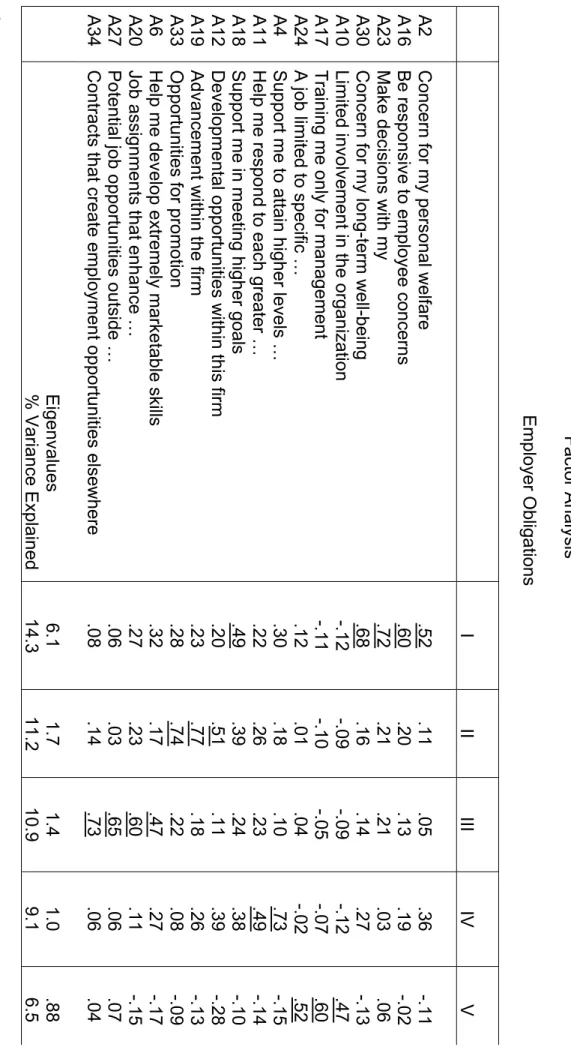
Table 1 presents a five-factor solution for Employer Obligations: I (Loyalty), II Internal Development, III (External Employability), IV (Dynamic Performance), and V (Narrow). (Note that fewer factors were expected than with that latter set of obligations because the Short-term measure was not included here do to poor inter-item correlations and low reliabilities.) All Employer scales meet the criteria for simple structure in this factor analysis with the exception of Dynamic
Performance, where one item (“Support me in meeting increasingly higher goals”) also loads on the Loyalty factor and the Internal Development factor. Revised items are proposed in the Appendix. Table 2 presents a six-factor solution for Employee Obligations: I (Narrow), II (Internal Development), III (External
Employability, IV (Loyal), V (Short-term) and VI (Dynamic Performance). Although simple structure (Comrey, 1973) does characterize the results generally, some departure from simple structure is evident in one case where an External Employability item loads not only with its own items but with Internal Development as well.
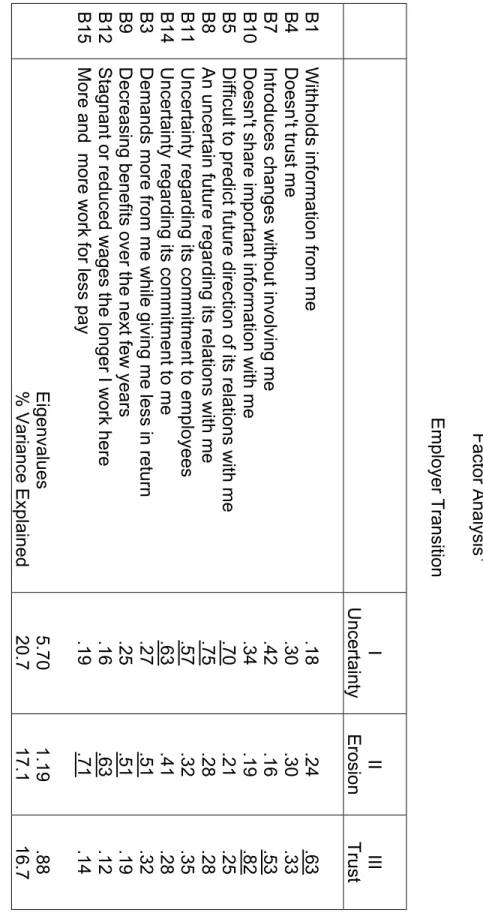
The two sets of Transitional scales each factor analyzed into three factors (Tables 3 and 4) consistent with the proposed measurement model. In the case of Employer Transitional scales, Uncertainty and Erosion manifest simple structure for all four items in each scale. However, Mistrust did so for three of its items with the fourth (“”doesn’t trust me”), splitting across all three factors. These three items do produce a highly internal consistent scale and a revised fourth item is
suggested in the Appendix. The three factors associated with Employee Transition also basically fell out into the proposed measurement model of Uncertainty, Trust, and Erosion. Employee Uncertainty yielded a simple structure for all four items, and the Mistrust scale did so for the three-item kept in following the initial
analyses (Appendix). However, Erosion, did so only for 3 of its four items. These three items do produce a highly internally consistent scale and a revised fourth item is proposed in the Appendix. Both factor analyses support the underlying measurement model on which the Transition measures were based.
Factor analyses on the US-based sample are highly consistent with the total sample, as would be expected given that this sub-sample is nearly _ of the total not shown). Factor analyses on the Singaporean sample show some divergent patterns. First, the Employer Obligations factor analysis yielded a 3-factor solution
compared to the 6-factor solution from the Total and US analyses. This solution collapsed the Employer Obligations of Loyalty, Internal Development, and Dynamic Performance into Factor I, External Employability items into Factor II, and Narrow obligation items in to Factor III. Second, the Employee Obligations factor analysis yielded a 5 factor solution, I (Balanced: Internal Development, Dynamic
and V (External Employability). Note that External Employability forms part of the Balanced factor as well as loading highly on its own factor. Employer Transition items yielded only a single factor with one large eigenvalue in the Singaporean sample. Employee Transition items yielded two factors in the Singaporean sample, I (Mistrust, Uncertainty) and II (Erosion). In both the Employee and Employer Transitional assessments, the Singaporean sample yielded a less fine-grained distinction between different aspects of transitions as characterized in
psychological contracts literature focusing on American experiences (Rousseau, 1995; 1996). In general, we note that Narrow and External Employability do tend to perform in Singaporean samples in a manner similar to that observed in the US sample. The Singaporean sample shows less discriminant validity among related obligations among the Balanced psychological contract form (Internal Development and Dynamic Performance). This convergence among Balanced contract forms can be due to societal differences in how these dimensions are interpreted, or it could be do to the lower levels of variation in the kinds of human resource strategies, and psychological contract forms, employed in Singaporean firms.
3. Hierarchical factor analyses to identify the observed relationships among obligation scales were conducted on the PCI scales separately for Employee and Employer (Tables 5 and 6). The Employee scales yielded a 3-factor solution where the Transition scales comprised the first factor. The second factor was
characterized by large positive loadings from Loyalty, Dynamic Performance and Internal Development (in effect combining dimensions conceptualized as Relational and Balanced) along with negatively loading Transaction scales (Stability and
Narrow). The third factor combines two of the Balanced dimensions (External and Internal Development). The employee analysis suggests that while the Transition scales are distinct from the obligation measures, Balanced and Relational
Dimensions are inter-related.
The Employer scales also yielded a 3-factor solution where the Transition scales comprised a separate factor (#2) form the obligation scales. The first factor comprised high positive loadings of Loyalty, Stability,Dynamic Performance,, External and Internal Development, again as in the Employee analysis above, combining Relational and Balanced dimensions. However, the third factor in this case was defined by a high loading on Narrow, the only Transaction scale available for inclusion in this analysis. This pattern of findings suggests that Transition measures are distinct from Obligation measures across both Employee and Employer indices. Relational and Balanced scales, although distinct at the item levels, are highly related. Dynamic Performance scales appear in particular to overlap the Relational and Balanced domains, rather than being associated only with the Balanced domain as conceptualized in the measurement model. With regard to the Transaction scales, findings are less easily intepreted, particularly because only the Employer and Employee measures of Narrow made the cut. This scale appears to function as the opposite of Relational and Balanced dimensions in the Employee analysis and as a distinct factor in the Employer one. Currently
research is being conducted to develop an appropriate measure of the other Transactional dimension Short-term, which should then permit a more useful examination of the factor structure with respect to the Transactional dimensions.
4. Descriptive statistics and U.S./Singapore Mean Comparisons. Descriptive statistics are presented in Table 7 for the Total Sample. Means and standard
deviations for the US and Singaporean subsamples are presented in Table 8 along with t-test results comparing these means. Note, that these results are presented solely for illustrative purposes since further research is needed on the calibration of the PCI for cross-national comparisons. However, taken at face value, the results indicate that the US-based sample reports higher levels of scores on obligations across most dimensions on both the Employee and Employer side of the exchange and higher levels of Employee and Employer Fulfillment of the psychological contract than the Singaporean sample. Such trends are consistent with the Ang, Kee & Ng’s (2000) discussion of low organizational commitment in the Singaporean workforce in the face of a shortage of skilled workers and worker concerns in obtaining maximum career advantage from the situation.
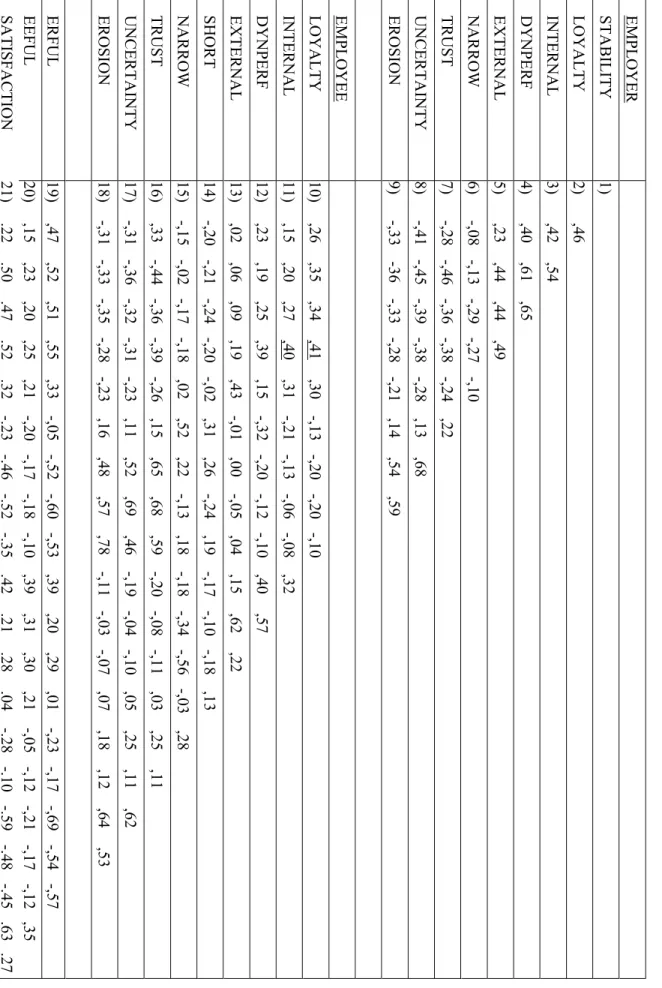
5. Correlations and multiple regression analyses. Correlations are presented in Table 9 for the entire sample. Multiple regression analyses were performed on the total sample (Table 10), and US (Table 11) and Singapore sub-samples (Table 12). These examine each scale’s relationship with measures of Employer and Employee Fulfillment. Note that the internal consistency reliability of Employer Fulfillment and Employee Fulfillment is .84 and .74 (Cronbach’s alpha),
respectively. To test whether evidence exists of an interaction between reported Employee and Employer Obligations and fulfillment, both Employee and Employer versions of each scale were used as predictors along with their joint product. Not surprisingly given the sample size and level of intercorrelation among the
measures, equations are significant in the total sample. But more interesting is the significance of the main effects and interaction terms in predicting both Employee and Employer Fulfillment in the Total and US sample (which is the largest segment of the Total sample) for the following: Narrow, Mistrust, and Uncertainty. These findings suggest that some degree convergence or
comparability between employer and employee in levels of obligations enhances a sense of psychological contract fulfillment for Narrow (Transactional) obligations. Moreover, where Transition features of Mistrust and Uncertainty are high for both Employee and Employer behavior, as experienced in this case by workers, higher levels of Fulfillment of obligations are reported, perhaps because expectations though diminished are aligned. There is no similar trend in the Singapore-based sample, even for the Employer and Employer Narrow obligations, which do factor similarly across both US and Singaporean samples.
6. Exploratory analysis of Responsibility measures. Rousseau (1995) observed that people frequently attributed the organization’s failure to honor its commitments to situational factors associated with one’s manager (e.g., “my boss
left”). In the interest of learning more about the locus of responsibility measures were included on this version of the PCI. Note that in Table 7, Boss/Manager, Senior Management and Organization have essentially the mean levels of Responsibility as rated by our respondents (4.01, 4.00, 3.57) and comparable standard deviations. Singaporeans and US-based respondents do different somewhat in their ratings (Table 13) with Singaporeans rating Coworkers as significantly more responsible than do US-based respondents, who rate the
Boss/Manager and Senior Management significantly higher. A fifth Responsibility item asked respondents to indicate whether any other party was responsible for fulfilling the employer’s commitments and to identify that party. While only a small portion of the total sample responded to the Other option, the typical responsible party identified was Self followed by Mentors.
Multiple regression analyses and t-tests are used to examine the link between ratings of whose Responsibility it is to fulfillment the Employer’s side of the psychological contract. These analyses can only be termed exploratory
because there is no theory I know of that addresses the locus of responsibility for fulfillment of the employer’s obligations. Multiple regression analyses (Table 14) predicting Employer and Employee Fulfillment using the four single-item measures of Responsibility (Coworker/Group, Boss/Manager, Senior Manager, Organization) indicate that Coworker/Group and Organization significant predicts Employer Fulfillment while only Boss/Manager predicts Employee Fulfillment.
T-tests were conducted to examine differences in Obligations and Transition scales and in Fulfillment depending on the locus of Responsibility for the
Employer’s Commitments (Table 15-18). Each Responsibility item was used to form two groups (High GE 4; Low LE 3) Where one’s immediate Manager/Boss is rated as high on Responsibility, Employer and Employer Loyalty, Internal Development and Dynamic Performance, and Employer Stability obligations were significantly higher than when that person’s responsibility was not rated as highly. In turn, those high in Manager/Boss Responsibility also report significantly lower Employee Narrow. Further, those rating their Manager/Boss as highly
responsible do score significantly lower on both Employee and Employer Mistrust and Erosion. Similar patterns exist for those rating the Organization and/or Senior Management as being high in Responsibility. Coworker Responsibility, however, yields fewer significant differences in the Obligation or Transition scales (only Employer Dynamic Performance and External Development are significantly higher and Employee Trust significantly lower). These exploratory data suggest that believing the Employer’s commitments are the responsibility of the firm itself or its managerial agents is associated with higher level of Relational and Balanced obligations and lower levels of Transactional obligations and Transitional scores. Moreover, fulfillment of those obligations is rated as consistently higher where the firm or its managerial agents are believed to be responsible for fulfillment.
Profiles
When used for feedback to individuals regarding their psychological contract responses, PCI profiles reveal some intriguing patterns. The following Employee and Employer profiles were obtained from respondents participating in executive education programs dealing with organizational change.
Profile 1 and 2 reflect aggregated responses form managers in the same
organization, but at different points in time. All were from a division within AT & T. The profiles 1 a and b reflect a strongly Relational and Balanced pattern
combining Loyalty, Internal Development and Dynamic Performance with little evidence of change of transition. Note the degree of similarity between Employee and Employer profiles across all scales. Respondents consistently described the organization as communicating a “common bond” shared between it and its employees. Features of that common bond, as reflected in company mission statements and other communiques included openness, trust, and concern for personal development.
Profile 2a and 2b are aggregates of several participants from AT & T at the time its restructuring and downsizing parts of its business. Respondents describe their Employer’s communications to them as signalling a high degree of Uncertainty and Erosion of existing commitments. Meanwhile, their own Employee commitments entail dimensions very similar to the Profile 1b. Respondents indicated that while they realized the organization was intent upon change, they themselves were still uncertain what their roles would be subsequent to the change. The patterns suggest that changes to the Employee profile may lag behind changes in the
Employer profile as workers seek to understand and respond to employer initiated changes.
Profile 3a and 3b describes student employees at Carnegie Mellon, hired to work while they are enrolled in the university. The Loyalty dimension on both Employee and Employer profiles indicates a relational quality while the short-term feature indicates a realistic assessment of temporariness of the job. Respondents
indicated that they felt part of the university community but that there role as employee was limited to supporting themselves while at the university.
Profiles can also be used to obtain respondent’s perceptions of their preferred or ideal psychological contract. Though these can take many forms, particularly as business strategy and employee needs vary, some sample ideal profiles obtained from senior executives suggest a tendency toward a mix of Balanced and Relational dimensions. Interestingly, External Employability, commonly described as feature contemporary employment relations, does not score highly on the “ideal” profile of the managers I have surveyed.
Discussion
The psychometric analyses presented here indicate that eleven of the fourteen PCI obligation scales meet established criteria for internal consistency reliability and convergent and discriminant validity (as assessed by the item-level factor analyses on the total sample). Three scales, both the Employee and
Employer Short-term obligations and the Employer Stability obligation, require revision. All six Transition scales also meet established criteria for reliability and validity. The Appendix indicates the scales and specific items that have met the criteria. Moreover, suggestions for revisions and clarifications are included with the goal of developing a robust and psychometrically sound assessment of the
generalizable content of psychological contracts in employment.
The data provide some support for the PCI’s cross-national generalizability at least to one non-American setting, Signapore. The Balanced contract
obligations tend to cluster together in the Singaporean sample but the Transactional obligation Narrow yields its own factor on both Employee and Employer assessments as does External Employability. Ang and Koh (1999) employed a 3-item scale version of the PCI in Singapore in their research into the relationship between Singaporean motivational traits and the forms of employment relationships workers were party to. Support for many of their central hypotheses suggests that the PCI has some construct validity in Singapore. While I am
cautious about overstating the case, these preliminary findings suggest that many aspects of both the conceptualization and operationalization of psychological contract dimensions can be generalizable across societies. Such a claim is
particularly reasonable regarding those dimensions of employment that are shared across nations, as would be the case with global employment practices.
References
Ang, G. & Goh, K. (1999) Motivational traits and psychological contracts in Singapore. Master’s thesis, Nanyang Business School, Nanyang Techological University, Singapore.
Ang, S., Tan, M.L. & Ng, K.Y. (2000) Psychological contracts in Singapore. In D.M.
Rousseau and R. Schalk (eds.) Psychological contracts in employment:
Cross-national perspectives. Newbury Park, CA: Sage, in press.
Argyris, C. (1962) Understanding organizational behavior. Homewood, IL: Dorsey.
Arthur, M.B., Inkson, K. & Pringle, J. (1999) The new careers: Individual action
and economic change. Thousand Oaks, CA: Sage
Comrey, A.L. (1971) An introduction to factor analysis. New York: Academic Press.
Inkson, K., Heising, A. & Rousseau, D.M. The interim manager: Prototype of the
21st century worker? Human Relations, in press.
Kunin, T. (1955) The construction of a new type of attitude measure. Personnel
Psychology, 8, 65-78.
Levinson, H., Price, C.R., Munden, K.J. & Solley, C.M. (1972) Men, management,
and mental health. Cambridge, MA: Harvard University Press.
Lusch, R.F. & Brown, J.R. (1996) Interdependency, contracting, and relational
behavior in marketing channels. Journal of Marketing,60, 19-38.
Macneil, I.R. (1985) Relational contract: What we do and what we do not know.
Wisconsin Law Review, 483-525.
Morey, N.C. & Luthans, F. (1984) An emic perspective and ethnoscience methods
for organizational research. Academy of Management Review, 9, 27-36.
Roehling, M. (1997) The origins and early development of the psychological
contract construct. Journal of Management History,3, 204-217.
Rousseau, D.M. (1989) Psychological and implied contracts in organizations.
Employee Rights and Responsibilities Journal, 2, 121-139.
Rousseau, D.M. (1990) New hire perceptions of their own and their employer’s
obligations: A study of psychological contracts. Journal of Organizational Behavior,
Rousseau, D.M. (1995) Psychological contracts in organizations: Understanding
written and unwritten agreements. Newbury Park, CA: Sage.
Rousseau, D. M. (1996) Changing the deal while keeping the people. Academy of
Management Executive, 10, 50-61.
Rousseau, D.M. (2000) Psychological contracts in the United States: Associability,
Individualism and Diversity. In D.M. Rousseau and R. Schalk (eds.) Psychological
contracts in employment: Cross-national perspectives. Newbury Park, CA: Sage, in
press.
Rousseau, D.M. & Schalk, R. Psychological contracts in employment: Cross-national
perspectives. Newbury Park, CA: Sage, in press.
Rousseau, D.M. & Tijoriwala, S.A. (1998) Assessing psychological contracts:
Issues, alternatives, and types of measures. Journal of Organizational Behavior,
19, 679-695.
Rousseau, D.M. & Tijoriwala, S.A. (1999) What’s a good reason to change?
Motivated reasoning and social accounts in organizational change. Journal of
Applied Psychology, 84, 514-528.
Rousseau, D.M. & Wade-Benzoni, K.A. (1994) Linking strategy and human
resource practices: How employee and customer contracts are created. Human
Figure 1
Types of Psychological Contracts
Performance Terms
Specified
Not Specified
Transitional/
No guarantees
Transactional
Duration
Short-term
Long-term
Balance
Relational
Figure 2
Assessment of Psychological Contract
RELATIONAL
T
RANSACTIONAL
TRANSITIONAL
BALANCED
Career
Development
-External Market
Dynamic
Performance
Requirements
No Trust
Uncertainty
Erosion
Career
Development
-Internal
Market
Loyalty
Other-Oriented
Security
Short-Term
Narrow
Denise Rousseau
1997
c
Table 1 Factor Analysis 1 Employer Obligations I II III IV V A2 A16 A23 A30 A10 A17 A24 A4 A11 A18 A12 A19 A33 A6 A20 A27 A34
Concern for my personal welfare
Be responsive to employee concerns
Make decisions with my
Concern for my long-term well-being
Limited involvement in the organization
Training me only for management
A job limited to specific …
Support me to attain higher levels …
Help me respond to each greater …
Support me in meeting higher goals
Developmental opportunities within this firm
Advancement within the firm
Opportunities for promotion
Help me develop extremely marketable skills
Job assignments that enhance …
Potential job opportunities outside …
Contracts that create employment opportunities elsewhere
Eigenvalues % Variance Explained .52 .60 .72 .68 -.12 -.11 .12 .30 .22 .49 .20 .23 .28 .32 .27 .06 .08 6.1 14.3 .11 .20 .21 .16 -.09 -.10 .01 .18 .26 .39 .51 .77 .74 .17 .23 .03 .14 1.7 11.2 .05 .13 .21 .14 -.09 -.05 .04 .10 .23 .24 .11 .18 .22 .47 .60 .65 .73 1.4 10.9 .36 .19 .03 .27 -.12 -.07 -.02 .73 .49 .38 .39 .26 .08 .27 .11 .06 .06 1.0 9.1 -.11 -.02 .06 -.13 .47 .60 .52 -.15 -.14 -.10 -.28 -.13 -.09 -.17 -.15 .07 .04 .88 6.5 1
Table 2 Factor Analysis Employee Obligations I II III IV V V I C3 C17 C24 C31 C1 C8 C15 C22 C9 C16 C23 C30 C5 C19 C26 C33 C4 C11 C32 C6 C20 C27 C34
Perform only required tasks
Do only what I am paid to do
Fulfill a limited number of responsibilities
Only perform specific duties
Quit whenever I want
I have no future obligations
Leave at any time I choose
I have much fewer commitments …
Make personal sacrifices for this organization
Take this organization's concerns personally
Protect this organization's image
Commit myself personally
Seek out assignments that enhance the value
Build skills to increase my value in this organization
Make myself increasingly valuable to this employer
Actively seek internal opportunities …
Accept increasingly challenging performance standards
Take personal responsibility …
Continually exceed my formal accomplishments
Build contacts outside firm …
Increase my visibility …
Building skills to increase future employment …
Seek out assignments that enhance my employability
Eigenvalues % Variance Explained .64 .81 .67 .71 .08 .18 -.06 .25 .15 .03 .03 -.11 -.30 -.11 -.25 -.14 -.42 -.40 -.38 -.03 .13 -.06 -.06 5.9 12.6 -.10 -.11 -.09 -.23 .02 -.04 -.06 .10 .08 .p9 .18 .14 .55 .65 .61 .60 .43 .21 .28 .14 .09 .39 .54 3.1 10.6 -.09 .05 .08 .00 -.01 .13 -.02 .21 .13 .06 -.03 -.03 .07 .15 .11 .20 .01 -.07 .08 .78 .83 .52 .49 2.1 8.8 -.13 -.01 .00 -.12 -.05 -.03 -.18 .03 .68 .56 .57 .64 .07 .33 .28 .14 .04 .23 .21 .08 .00 .02 .14 1.6 8.4 .13 .12 .12 .03 .74 .48 .73 .52 -.06 .03 -.05 -.18 -.01 -.10 -.04 -.10 .02 -.13 -.05 .05 .10 .08 .09 1.1 7.6 -.08 -.19 -.14 .03 -.05 -.08 .20 -.22 .02 -.01 .14 .06 .33 .05 .17 .05 .43 .62 .37 .06 -.05 -.02 -.01 .8 4.6
Table 3 Factor Analysis 1 Employer Transition I Uncertainty II Erosion III Trust B1 B4 B7 B10 B5 B8 B11 B14 B3 B9 B12 B15
Withholds information from me
Doesn't trust me
Introduces changes without involving me
Doesn't share important information with me
Difficult to predict future direction of its relations with me
An uncertain future regarding its relations with me
Uncertainty regarding its commitment to employees
Uncertainty regarding its commitment to me
Demands more from me while giving me less in return
Decreasing benefits over the next few years
Stagnant or reduced wages the longer I work here
More and more work for less pay
Eigenvalues % Variance Explained .18 .30 .42 .34 .70 .75 .57 .63 .27 .25 .16 .19 5.70 20.7 .24 .30 .16 .19 .21 .28 .32 .41 .51 .51 .63 .71 1.19 17.1 .63 .33 .53 .82 .25 .28 .35 .28 .32 .19 .12 .14 .88 16.7 1
Table 4 Factor Analysis 1 Employer Transition I Uncertainty II Trust III Erosion D1 D7 D13 D6 D9 D12 D15 D5 D8 D11 D14
I cannot believe what this employer tells me
I have no trust in this employer
Inconsistency exists between what this employer says and does
I'm getting less pay for more work
I'm doing more for less
I expect less from this employer tomorrow…
I expect increasing demands from this employer for little return
It's difficult to predict the future of this relationship
I cannot anticipate what my future relationship…
It's difficult to anticipate my future commitments
My commitments to this employer are uncertain
Eigenvalues % Variance Explained .29 .35 .32 .12 .20 .33 .28 .69 .78 .75 .57 5.70 23.2% .68 .65 .72 .22 .18 .47 .43 .32 .27 .21 .32 1.36 20.4% .22 .23 .23 .77 .90 .39 .54 .17 .19 .15 .16 .87 19.4% 1
Table 5
Hierarchical Principal Factor Analysis/ Varimax Rotation Employer Scales
I II III Community LOYAL STABILITY NARROW DYNPERF EXTERN INTERN TRUST UNCERTAINTY EROSION Eigenvalue % Variance .68 .45 -.12 .79 .54 .68 -.24 -.27 -.20 4.03 25.3% -.34 -.31 .00 -.17 -.15 -.22 .71 .82 .65 1.2 21.8% .00 .00 .60 -.26 .00 -.28 .00 .00 .00 .97 6.2% .50 .30 .13 .56 .29 .50 .53 .57 .40
Table 6
Hierarchical Principal Factor Analysis/ Varimax Rotation Employee Scales
I II III Communality LOYAL STABILITY NARROW DYNPERF EXTERN INTERN TRUST UNCERTAINTY EROSION Eigenvalue % Variance -.17 .00 .26 .00 .00 .00 .88 .72 .72 2.8 21.4% .35 -.67 -.32 .81 .00 .47 .00 -.12 .00 2.09 18.0% .20 .00 .12 .27 .85 .72 .00 .00 .00 1.19 15.3% .21 .37 .17 .53 .45 .60 .55 .44 .55
Table 7
Descriptive Statistics
N Minimum Maximum Mean Std. Deviation ERLOYAL ERNARROW ERDYNPRF ERTRUST ERSTABLE EREXTERN ERINTERN ERUNCERT EREROSN EENARROW EELOYAL EEDYNPRF EESHORT EEINTERN EEEXTERN EEEROSN EEUNCERT EETRUST ERFULFILL EEFULFILL SATISFACTION COWORKER MANAGER SENIOR MGT ORGANIZATION OTHER 623 622 620 623 623 621 624 624 625 623 623 621 623 624 624 623 624 625 435 435 425 362 363 360 360 72 1.00 1.00 1.00 1.00 1.00 1.00 1.00 1.00 1.00 1.00 1.00 1.00 1.00 1.00 1.00 1.00 1.00 1.00 1.00 2.00 1.00 1.00 1.00 1.00 1.00 1.00 5.00 5.00 5.00 5.00 5.00 5.00 5.00 5.00 5.00 5.00 5.00 5.00 5.00 5.00 5.00 5.00 5.00 5.00 5.00 5.00 5.00 5.00 5.00 5.00 5.00 5.00 3.03 2.51 3.39 2.40 3.61 2.62 3.23 2.44 2.22 1.99 3.58 3.92 2.72 4.02 3.51 2.31 2.55 2.43 3.59 4.24 3.55 2.68 4.01 4.00 3.57 3.22 .89 .84 .87 .90 .93 .97 1.05 1.02 .95 .92 .82 .77 1.04 .73 .97 1.04 1.02 1.07 .84 .60 1.02 1.16 1.05 1.07 1.16 1.65
Table 8
T-TEST SINGAPORE VS. U.S.
N Mean Std. Deviation t Sig.
ERTRUST 1,00 US 406 2,41 ,90 -.65 n.s. 9,00 SG 149 2,46 ,91 ERLOYAL 1,00 US 406 3,05 ,87 2.09 -.05 9,00 SG. 148 2,88 ,90 ERNARROW 1,00 US 407 2,53 ,89 -.31 n.s. 9,00 SG 146 2,50 ,72 ERDYNPRF 1,00 US 406 3,45 ,84 3.31 .001 9,00 SG 147 3,16 ,93 ERSTABLE 1,00 US 407 3,74 ,88 5.01 .001 9,00 SG 148 3,26 1,01 EREXTERN 1,00 US 405 2,60 ,96 -.50 n.s. 9,00 SG 148 2,65 1,01 ERINTERN 1,00 US 408 3,25 1,05 2.09 .05 9,00 SG 147 3,40 1,06 ERUNCERT 1,00 US 408 2,44 1,02 -1.41 n.s. 9,00 SG 147 2,58 1,02 EREROSN 1,00 US 408 2,17 ,92 -3.12 .01 9,00 SG 148 2,47 1,03 EENARROW 1,00 US 407 1,94 ,95 -2.35 .05 9,00 SG 149 2,14 ,83 EELOYAL 1,00 US 406 3,70 ,79 6.11 .001 9,00 SG 149 3,23 ,80 EEDYNPRF 1,00 US 406 3,98 ,77 2.46 .05 9,00 SG 148 3,80 ,76 EESHORT 1,00 US 407 2,85 1,04 3.52 .001 9,00 SG 148 2,52 ,94 EEINTERN 1,00 US 407 4,08 ,68 2.36 .05 9,00 SG 149 3,91 ,80 EEEXTERN 1,00 US 407 3,54 ,97 -.77 n.s. 9,00 SG 149 3,61 ,98 EEEROSN 1,00 US 407 2,26 1,03 -2.27 .05 9,00 SG 148 2,49 1,05 EEUNCERT 1,00 US 408 2,55 1,04 -.90 n.s. 9,00 SG 149 2,64 ,98 EETRUST 1,00 US 409 2,44 1,06 .08 n.s. 9,00 SG 149 2,43 1,11 ERFULFIL 1,00 US 252 3,69 ,79 3.95 .001
9,00 SG 149 3,34 ,89
EEFULFIL 1,00 US 252 4,36 ,57 5.12 .001
9,00 SG 149 4,04 ,61
SATIS 1,00 US 241 3,58 1,08 1.45 n.s.
Table 9
Correlation Matrix
EMPLOYER STABILITY 1) LOYALTY 2) ,46 INTERNAL 3) ,42 ,54 DYNPERF 4) ,40 ,61 ,65 EXTERNAL 5) ,23 ,44 ,44 ,49 NARROW 6) -,08 -,13 -,29 -,27 -,10 TRUST 7) -,28 -,46 -,36 -,38 -,24 ,22 UNCERTAINTY 8) -,41 -,45 -,39 -,38 -,28 ,13 ,68 EROSION 9) -,33 -36 -,33 -,28 -,21 ,14 ,54 ,59 EMPLOYEE LOYALTY 10) ,26 ,35 ,34 ,41 ,30 -,13 -,20 -,20 -,10 INTERNAL 11) ,15 ,20 ,27 ,40 ,31 -,21 -,13 -,06 -,08 ,32 DYNPERF 12) ,23 ,19 ,25 ,39 ,15 -,32 -,20 -,12 -,10 ,40 ,57 EXTERNAL 13) ,02 ,06 ,09 ,19 ,43 -,01 ,00 -,05 ,04 ,15 ,62 ,22 SHORT 14) -,20 -,21 -,24 -,20 -,02 ,31 ,26 -,24 ,19 -,17 -,10 -,18 ,13 NARROW 15) -,15 -,02 -,17 -,18 ,02 ,52 ,22 -,13 ,18 -,18 -,34 -,56 -,03 ,28 TRUST 16) ,33 -,44 -,36 -,39 -,26 ,15 ,65 ,68 ,59 -,20 -,08 -,11 ,03 ,25 ,11 UNCERTAINTY 17) -,31 -,36 -,32 -,31 -,23 ,11 ,52 ,69 ,46 -,19 -,04 -,10 ,05 ,25 ,11 ,62 EROSION 18) -,31 -,33 -,35 -,28 -,23 ,16 ,48 ,57 ,78 -,11 -,03 -,07 ,07 ,18 ,12 ,64 ,53 ERFUL 19) ,47 ,52 ,51 ,55 ,33 -,05 -,52 -,60 -,53 ,39 ,20 ,29 ,01 -,23 -,17 -,69 -,54 -,57 EEFUL 20) ,15 ,23 ,20 ,25 ,21 -,20 -,17 -,18 -,10 ,39 ,31 ,30 ,21 -,05 -,12 -,21 -,17 -,12 ,35 SATISFACTION 21) .22 .50 .47 .52 .32 -.23 -.46 -.52 -.35 .42 .21 .28 .04 -.28 -.10 -.59 -.48 -.45 .63 .271 2 3 4 5 6 7 8 9 10 11 12 13 14 15 16 17 18 19 20 r < ,15 p < ,001 N = 624