Graduate Theses and Dissertations Graduate School
3-20-2014
Communication as Yoga
Kristen Caroline Blinne
University of South Florida, [email protected]
Follow this and additional works at:https://scholarcommons.usf.edu/etd
Part of theCommunication Commons,Other Education Commons, and theOther Religion Commons
This Dissertation is brought to you for free and open access by the Graduate School at Scholar Commons. It has been accepted for inclusion in Graduate Theses and Dissertations by an authorized administrator of Scholar Commons. For more information, please contact
Scholar Commons Citation
Blinne, Kristen Caroline, "Communication as Yoga" (2014).Graduate Theses and Dissertations.
Communication as Yoga
by
Kristen C. Blinne
A dissertation submitted in partial fulfillment of the requirements for the degree of
Doctor of Philosophy Department of Communication
College of Arts and Sciences University of South Florida
Major Professor: Mariaelena Bartesaghi, Ph.D. Elizabeth Bell, Ph.D.
Michael LeVan, Ph.D. Gurleen Grewal, Ph.D.
Date of Approval: March 20, 2014
Keywords: Mindfulness, Relationships, Diversity, Spirituality, Contemplative Pedagogy Copyright © 2014, Kristen C. Blinne
DEDICATION
With the deepest gratitude and love, I take no ownership for what is contained herein as every word, gesture, act, moment, interaction, and experience has shaped all that I am and all that I know. I am compelled to see this work as the expression of and honor to life as it pulses through me, but also to every teacher, family member, friend, partner, stranger, and being who has walked before me, with me, towards me, away from me, or near me, even if only briefly, as well as all that will walk after me towards futures unknown. If, for a moment, you see yourself in me or even as me, then I have done what I set out to do and thus have accomplished the world, and for that I thank you with everything that I have been, am, and will someday be.
ACKNOWLEDGMENTS
I bow to my advisor: Dr. Mariaelena Bartesaghi, who has been so much more to me than a mentor, friend, and inspiration: she has been my guiding light: a truly innovative and brilliant teacher, a master of words, a theorist extraordinaire, and my navigator – always there for me, steering me through the turbulent waters of graduate school. She has influenced me to reach beyond myself while lovingly challenging me to question my beliefs and worldview. She has most importantly allowed me to flourish as a scholar by not inhibiting my path, supporting my search for who I am as a teacher and learner. Mariaelena, I will always be deeply humbled and grateful for what I have learned from you.
I bow to my committee: Dr. Elizabeth Bell, for reminding me that teaching and learning should inspire playfulness. Your wisdom and humor always serves as a bright light in dark times, and, as a result, I attempt to bring this same spirit to my teaching. Dr. Michael LeVan, for being an on-going inspiration to me. We started and finished this journey together and you were with me every step of the way, for which I will always be eternally grateful. Dr. Gurleen Grewal, for believing in my project and for sharing my passion for yoga and contemplative pedagogy.
I bow to my yoga teachers: Pam Schulte, Pichest Boonthumme, Oda Bogaire, Ashley Thesier, Melissa Carroll, Shannon Paige, Nancy Kate Williams, Gina Caputo, Nichole Golden, Sammy Beech, Nayano Burdine, Shiva Rea, Rod Stryker, and to my sadhana partners – Damien Contessa, Vicki Lewis, Tracy Branson, Scott Griffiths, Renee Orth, Carrieann Boyan McDonough, Nicole Elizabeth Paz, David Secondo, and Annette Delabarbara.
I bow to the learners with whom I have been honored to workas a teacher, mentor, and writing center consultant. Thank you for all that you shared and taught me. I bow to my mentors, friends, and colleagues at USF and beyond: Lawrence Frey, Karen Greiner, Marilyn Myerson, Lori Roscoe, Jim Eison, Navita Cummings James, David Payne, Ron Pelias, Bud Goodall, Daniel Makagon, Doug Jordan, Megan Pugh, Elizabeth Jeter, Joanna Bartell, Summer Cunningham, Sarah McGhee, Shelby Forbes, Ellen Klein, Mark McCarthy, Sean Currie, Michael Rowland, Amanda Firestone, David Purnell, Steve Johns, Maddie Southard, Tasha and Matthew Rennels, Aphrodite Kocieda, Jason Zalinger, Mary Catherine Whitlock, David Jenkins, Alexander Bear, Kelsey O’Morrow, Anne Copeland, Velencia Russell, Heidi Painter, Edgardo Valentin, Keysha Williams, Ted Osburn, Dean Sooter, Dallas Clements, Janet Rowell, Anne Shelton, Heather Russell, The Rainbow Family, and an anonymous being who supported this project as an act of seva.
I bow to my co-pilot, Gregory Sharpe, for helping me bring these words and intentions to life each day, and to Gayle and Allen Sharpe for welcoming me into their lives.
I bow to my mother, Lynette Blinne, for her unconditional love, fierce and playful spirit, and her lifelong devotion to my journey. You are my best friend and my greatest teacher. I bow to my father, Charles Blinne, for his unwavering support, generosity, and encouragement. Without you, I would not be where I am today. I bow to my sister, Tamara Wiesmann, for teaching me more than I can ever recount or repay. Not only do I deeply admire your quiet confidence, independent spirit, and strength of character, but I also strive to model it in every way. I bow to my dissertation kitties, Matcha, my little warrior, who has taught me to pick my battles wisely and to honor my energy, and Mr. Snow, my soul kitty, who has taught me to find patience and loving kindness in the face of adversity (aka Matcha).
TABLE OF CONTENTS
List of Tables ... ii
List of Figures ... iii
Abstract ... vi Invocation ...1 Namaste ...9 Namaskar ...35 Tadasana ...54 Svadhyaya ...61 Core Integration ...67
Sutra 1- Communication Energetically Stories Us ...79
Sutra 2- Communication is Ecologically Interdependent ...89
Sutra 3- Communication is Spiritually Transformative ...97
Ahimsa and Satya ...113
Vinyasa ...126
Wave One: Living in the Flow ...132
Vinyasa ...174
Wave Two: Cultivating Compassionate Awareness ...179
Asteya, Brahmacharya, and Aparigraha ...213
Wave Three: The Niyamas ...228
Vinyasa ...248
108 Asanas ...254
LIST OF TABLES
LIST OF FIGURES
Figure 1: What matters most to you right now? ...7
Figure 2: Yoga is…? ...36
Figure 3: Spirituality is…? ...46
Figure 4: Compassionate communication ...52
Figure 5: Practicing tadasana ...55
Figure 6: Points for reflection ...58
Figure 7: Wording yourself and the world ...64
Figure 8: Tips for self-study ...65
Figure 9: Ten things you can do now ...73
Figure 10: Noticing your breath ...75
Figure 11: How do you see me? ...107
Figure 12: My “core” message ...109
Figure 13: Violence is…? ...118
Figure 14: Practicing ahimsa and satya ...124
Figure 15: Discussion questions ...131
Figure 16: Trataka “gazing” meditation ...136
Figure 17: Hamsa breathing ...137
Figure 18: Nadi shodhana ...140
Figure 19: Love letter to self ...150
Figure 21: Making “sense” of your experience ...154
Figure 22: Embodied awareness ...155
Figure 23: Embodied knowing ...156
Figure 24: Touching and being touched ...157
Figure 25: Living in the flow through micropractices ...162
Figure 26: Mircopractice tips ...163
Figure 27: Closed communication ...168
Figure 28: Communicationmiropractices ...170
Figure 29: Be a tree ...181
Figure 30: Practicing P.E.A.C.E. ...185
Figure 31: “The Cost of a Livable Life” Instructions ...191
Figure 32: A Compassionate Communication Manifesto ...209
Figure 33: Being with asteya ...219
Figure 34: Experiencing brahmacharya ...221
Figure 35: Letting go with aparigraha ...224
Figure 36: The yamas and niyamas in practice ...226
Figure 37: Cultivating the opposite ...230
Figure 38: Understanding metacommunication ...231
Figure 39: Storying or drawing discrimination ...232
Figure 40: Gibberish meditation ...233
Figure 41: Privilege checklists ...235
Figure 42: Self-care is…? ...238
Figure 44: Playing with tapas ...243
Figure 45: Becoming “OM” ...244
Figure 46: Discussion questions ...253
ABSTRACT
In this dissertation, I am in conversation with the following questions: How can individuals and communities teach and learn to engage more peacefully, nonviolently, and compassionately with each other? Further, how can one practice a style of communication that helps at least one person suffer less each day? In asking these questions, my goal has been to imagine as well as attempt to actualize a world where individuals and communities work together to create less suffering in each other’s lives by first developing compassionate awareness of our interconnectedness, then “waking up” not only to our own divinity but also to that place in all of us where the entire universe dwells. In this dissertation, communication is situated as both a spiritual practice and as a practice of yoga.
To illuminate this notion, I have sequenced this text as a yoga practice in and of itself, employing Shiva Rea's "wave methodology" to introduce and support the peak purpose of this text –communication as yoga – via svadhyaya, or self-study, as a path to expand relational awareness through everyday small acts or micropractices. Communication, thus, becomes an emergent process based in yoga philosophy and practice wherein one learns to acknowledge and take responsibility for one's interactions with others and other realities by recognizing one's shared vulnerability. To heighten this awareness, this text includes 108 asanas or micropractices, which serve to explore my guiding questions as well as exemplify communication as yoga - as an everyday practice.
INVOCATION
The way of experience begins with a breath Such as the breath you are breathing now. Awakening into luminous reality
May dawn in the momentary throb Between any two breaths.
The breath flows in and just as it turns To flow out, there is a flash of pure joy –
Life is renewed. Awaken into that.
As the breath is released and flows out, There is a pulse as it turns to flow in. In that turn, you are empty.
Enter that emptiness as the source of all life.
- Lorin Roche, The Radiance Sutras1
For the first time in years, I feel my feet connecting to the earth beneath me. Shifting my weight forward then backwards, balancing in the space between, I embrace each step as a place of possibility. My awareness does not stop at my feet; it moves up my legs and torso to my arms
and neck, extending beyond the boundaries of my skin to the world around me, enveloping the soft breeze, the warmth of the sun, the smell of flowers, the sound of birds chirping in the distance. Deeply inhaling, I pause at the top of my breath, inviting my lungs to fill and expand, and then relax as I exhale, pulling my stomach towards my spine. I study my breath as I breathe in and out with awareness, still noticing my feet. It is through our feet that we become grounded in life, learning how to rise or reach for the sky. Opening myself to my breath via yoga practice continues to expand my boundaries in more ways than I ever thought would be possible. Finding small moments of pure flow and surrendering to the divinity of the present moment brings me back to my yoga mat again and again. In a sense, these moments blur the boundaries between myself and others, but also between living yoga “on the mat” and “off.” Once you realize that there is “no mat,” or that the whole world is your yoga mat, you can start practicing yoga in every part of your life. I continue to be excited about the lifelong learning process that this understanding inspires.
Looking back, I started my journey with yoga in my early twenties. At that point in my life, I was fully immersed in holistic healing traditions, and I was regularly teaching aromatherapy and herbology classes, with yoga becoming a natural extension of my love of dance and other physical activities. After practicing yoga for some time, I shifted my focus towards martial arts, specifically Brazilian jiu-jitsu. Converging paths carried me to Thailand to study traditional Thai bodywork, learning most extensively with Pichest Boothumme, and also with Lek Chaiya, Jack Chaiya, Hironori Ikeda, and Arno Le’Hermitte. I received certifications from Wat Pho, The School of Thai Massage Shivagakomarpaj - Old Medicine Hospital, The Sunshine Massage School, among others. With over 1500 hours of training in Thai bodywork, I deepened my studies in bodywork, energy cultivation practices, and Asian medical theories by
attending acupuncture school, which culminated in my certification as a Diplomate in Asian Bodywork by the National Certification Commission of Acupuncture and Oriental Medicine. My interests in holistic healing have also hugely shaped my spirituality. Studying yoga, tai chi, and acupuncture provided opportunities to explore Taosist and Tantric philosophies, all incorporated into my current spiritual practices, with love being the main tenet of my spirituality and permeating all of the activities in my life – my relationships, teaching, and research.
I am fortunate to have had the opportunity to live in eight U.S. states and four countries across three continents and this has allowed me to see the world through a variety of lenses, showing me repeatedly that there is not “one way” but many ways to live life.It is said that it is not the destination, but the journey that shapes our lives. In my case, my journey has involved experiencing a diversity of educational settings, ranging from dropping out of high school and taking the G.E.D. to pursuing visual art studies, followed by the study and practice of complementary and alternative therapies, including bodywork training, studying martial arts, dance, and yoga, and becoming a licensed skin care therapist. During my undergraduate studies, I taught classes and wrote for trade publications in the holistic health field, which complemented my research on how scent impacts creativity and artistic processes, resulting in a BA in Health Arts and Sciences from Goddard College.
After completing my Asian bodywork training, I was inspired to pursue a Master's degree program in Medical Anthropology at the Universiteit van Amsterdam. Having long been an advocate of feminism, with a strong interest in gender and sexuality studies, my interests in cultural theories related to body studies, sexuality, and relationships, which merged with my previous spa therapy work as a licensed skin care therapist, culminating in an MA thesis examining how partner preferences impact decisions regarding body hair removal or retention.
After completing my mixed methods research, involving ethnography, survey research, and focus group research, I graduated cum laude and moved to Tampa, Florida, to pursue a Ph.D. in Communication at the University of South Florida. Spiritual communication is the pathway interweaving my interests in health and relationships, examining specifically how Eastern and Western theories of communication constitute, inform, and maintain understandings of embodiment, identity, and relationality, all of which shape people's understandings of wellness and/or disease.
Ultimately, I came to the study of communication because I wanted to be a better communicator, wanting to enhance my everyday communication and improve my relationships to be more compassionate in my life. As a result, each day I ask myself how I can practice a style of communication that helps at least one person suffer less – myself included. This cycle of
inspiration pulls together breath and body, self and other, theory and practice to explore this question more fully. While studying communication offered many vistas to help me improve the quality of my life, I still felt like something was missing. For me, communication theory did not fully offer the practical everyday tools I was seeking to radically shift my relationships. It was not until I returned to the study of yoga that I found what I was looking for: namely, everyday skills that I could cultivate and practice that had the potential to greatly impact the lives of those around me. It was in this space between my communication studies and my yoga practice that this dissertation was conceived. Since that time, I have sought to deepen my practice and better understand the theory and philosophy of flow, completing a 200-hour teacher-training program at Om Time in Boulder, Colorado, with Shannon Paige, Gina Caputo, and Nancy Kate Williams. Most recently, I am advancing my yoga studies with Yogarupa, Rod Stryker. My yoga practice and training helped me rediscover what it means to love more fully. For me, love is what makes
our relationships sustainable, as it is our ultimate renewable (re)source. Each time we practice loving more deeply, we honor our selves and others. Consider the words of Jackson Kiddard,
Today I affirm that there is nothing in me but love. This love comes from total acceptance of myself and the understanding that I am a perfectly imperfect human being. I will walk through today and allow myself to fully express my perfection. I realize that all my ‘faults’ are actually the Universe's unique way of expressing itself through me. I let go of self judgment and any projected judgments of others that I have chosen to believe and finally allow myself to just be what I truly am: infinite. As this is true for me, so it is true for all other beings on the planet. I will choose to accept everyone in my life with the same radical acceptance I have for myself knowing that we are all perfectly imperfect human beings simply doing the best we can. And so it is.2
In seeking to create a more loving communication studies, my intention is to invite you to explore the present moment and your world through self-study, starting first by honoring your teachers and past experiences. I invite you to start now: Closing your eyes, visualize your day thus far as a moving picture. Start by rewinding to when you first awoke and then fast-forward through your day, briefly stopping to observe your interactions, movements, conversations, and sensory awareness until you arrive in the current moment, sitting with this book. When you are finished, I invite you to take a moment and reflect on the paths you have taken in your life thus far that have led you here. What is your intention for your journey? Placing one hand on your heart and inhaling deeply, hold this intention, allowing it to sink in deeply. Exhale, releasing all that you no longer need to move forward. By radically accepting our perfectly imperfect selves, as Kiddard states, we can open spaces of possibility, or as Ganga White queries:
What if our religion was each other If our practice was our life
If prayer, our words
What if the temple was the Earth If forests were our church
If holy water - the rivers, lakes, and ocean What if meditation was our relationships If the teacher was life
If wisdom was self-knowledge If love was the center of our being.3
What then? What if you challenged yourself to participate more fully in your life? To ask yourself each day, Just how good can I feel?4 and How can I bring yoga into my relationships so I may develop a greater intimacy with life?
Feeling my feet and returning my awareness to my breath, I know I am asking you to take a chance and travel with me into the mystery, complexity, and uncertainty that comes with unlearning who we think we are through the practice of communication as yoga, remembering, “Yoga does not remove us from the reality or responsibilities of everyday life but rather places our feet firmly and resolutely on the practical ground of experience. We don’t transcend our lives; we return to the life we left behind in the hopes of something better”; in doing so, “We may notice that while life has been living itself through us, we have been absent from the experience. Where did we go, and how can we come home to the larger life that is possible for us?”5
By inviting you to take a journey with me through this text, it is my greatest hope that by the end of our time together in this shared space, you will come to better understand yourself, inspiring you to continue the conversation and aid others in their journey to do the same. Vital to this exploration is the willingness to bear witness to oneself as a communicator, but also to be open to moving beyond these pages to experiment with the exercises contained within. I want to live in a world of questions, not answers; thus, I do not seek to propose or provide a set of answers. Instead, I hope to open space for on-going contemplation and conversation regarding yogaand its role in our everyday lives. In an often over-stimulating and individualized world, it is easy to fail to see how humans and non-humans are connected and that the ways we interact have real, everyday social consequences; thus, embracing yoga is much more than just learning to “pay attention.” Yoga can help us better understand how people can learn and teach to engage
nonviolently with each other through a recognition of our interconnectedness - but also by being able to choose many different peaceful paths of action.
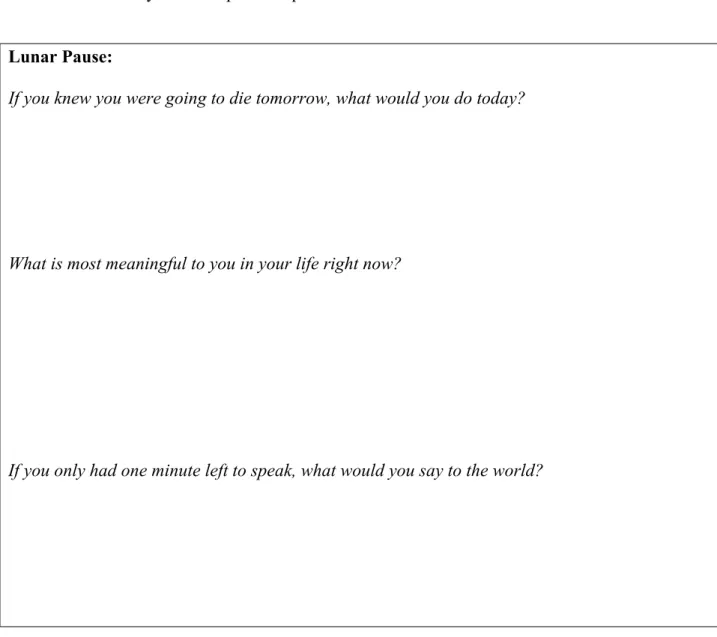
Lunar Pause:
If you knew you were going to die tomorrow, what would you do today?
What is most meaningful to you in your life right now?
If you only had one minute left to speak, what would you say to the world?
Figure 1. What matters most to you right now? Invocation Notes
1 Lorin Roche, The Radiance Sutras: 112 Tantra Yoga Teachings for Opening to the Divine in
Everyday Life (Marina del Rey, CA: Syzygy Creations, Inc., 2008), 1.
2 Mastin Kipp, “Today’s Quotes: There is Nothing in Me But Love,” The Daily Love, August, 3,
3 Ganga White, Yoga Beyond Belief: Insights to Awaken and Deepen Your Practice (Berkeley:
North Atlantic Books, 2007).
4 Deborah Adele, The Yamas & Niyamas: Exploring Yoga’s Ethical Practice (Duluth, MD:
One-Word Bound Books, Inc., 2009), 176.
5 Donna Farhi, Bringing Yoga to Life: The Everyday Practice of Enlightened Living (New York:
NAMASTE6
The divine in me bows to the divine in you
I have come to see communication as a spiritual practice or, as I will present in this dissertation, a practice of yoga. When I say spiritual practice, I consider spirituality to be a daily practice and process of “waking up,” as Anthony De Mello suggests.7 “Waking up,” to me, means developing awareness of the interconnectedness of all life - embodied and transcendent. From a yogic perspective, it also illustrates a “waking up” to our own divinity or that place in us where the entire universe dwells. Yoga teacher, Michael Stone, beautifully illustrates this notion by saying, “Yoga teaches us that everything is connected to everything else in the ongoing flux and flow of reality, beginning with the microcosm of the mind and extending all the way through the myriad forms of life.”8 For him, “waking up’” occurs when we begin to see ourselves as completely entangled in - and not separate from - the shared reality we call life, so we might ask ourselves, “How is our awakening going to contribute to the world at large?”9
Tirumalai Krishnamacharya, often considered the greatest innovator and founder of contemporary postural yoga most often practiced in the West, claims that “Yoga is India’s greatest gift to the world.” Though there is no one definition or interpretation of yoga, nor is there an agreed upon date of its origin, the term yoga is applied to many varying lineages, systems, and categories and is considered one of the six systems of Indian philosophy (Nyaya, Sankhya, Vaishesika, Vedanta, Mimamsa, and Yoga). What I refer to as yoga in this text is comprised of numerous schools and philosophies of yoga, all of which are interrelated and
employ each other’s methodologies for understanding the nature of reality in varying proportions. Each of these systems has its own history and complexity; however, what connects these philosophies and practices is a desire to experience the present moment as a path to Self-realization or union with the divine. I thus draw on the philosophies of Vedanta, Sankhya, and Tantra while remaining focused on the Yoga Sutras as an entry point into these complex traditions.10
Though the dates of origination are contested, scholars generally refer to the Yoga Sutras
as the primary text of classical yoga philosophy,11 containing a series of aphorisms (or sutras) in four chapters, written by Patanjali (said to be a pen name), who codified the practice of yoga as a method to transform how we think, communicate, and act in our everyday lives. A central focus of the sutras is calming the fluctuations of the “mind” through various practices that bring about a state of unsurpassed calm (achieved through spiritual discipline and non-attachment). Thus, a key component of this system is to experience an awareness beyond ourselves, a merging of consciousness wherein we no longer recognize a separation between us and the divine.
Patanjali, whose name means to “fall into an offering of the heart,” offers a variety of yoga paths, part of a rich, historical oral tradition, involving the passing of knowledge from teacher to student over a period of thousands of years. Within this dissertation, I shall focus on one of the paths, namely the eight-fold path or eight limbs of yoga, and more specifically, the first two limbs – the yamas and niyamas – which offer ethical guidelines for living a yogic life, studying one’s relationships and communication at the heart of this endeavor. These teachings are built on the notion that each person is a teacher, the teaching itself, and a student. The Yoga Sutras start with the concept of atha, which means the present moment or now, the highest teaching of the text. According to yoga teacher, Richard Freeman, the term atha can also be
interpreted to mean, “we have come to a point in our lives where we are ready to wake up from our conditioned existence and our habitual ways”; further,
Patanjali’s use of the word now implies that we have most likely tried many, many other things in order to wake up and find happiness. We have probably pursued all different kinds of pleasures, and perhaps we have explored various philosophical teachings and disciplines and maybe even religious practices in order to give life meaning. But still, something is not quite right. When all of our attempts to find meaning are seen to have been inadequate for the job, then we come into our present situation and this is where the practice of yoga truly begins – right here, right now.12
As a starting point, it is important to note that while I agree with Freeman, I, too, came to yoga searching for a way to change my own life. However, by situating communication as yoga, I am by no means suggesting that there is a “right” or “wrong” way to communicate; instead, I offer you an approach to communication grounded within varying streams of yoga philosophy, built from a foundation of everyday ethical guidelines as Patanjali outlines in the Yoga Sutras. These guidelines are deeply rooted within Indian culture and history, yet they are still applicable to contemporary life in the West as they offer specific tools to bring awareness to the habitual patterns that shape our lives. By engaging with communication as yoga, I hope to inspire you to critically, compassionately, and contemplatively reflect on the role your communicating plays in your life by practicing a range of yoga-based exercises.
My teacher, Rod Stryker, always concludes his courses saying that once we leave, he hopes that we will continue to practice whatever it is that helps us to find peace and brings joy into our lives. In my own experience, I practice yoga because it makes my life better in more ways than I can express, and I immediately notice the difference when I stop practicing. Even so, I recognize that this may not be the same result for others, as yoga is not a path that everyone will walk. Therefore, in the course of this text, my greatest hope is that you will depart from the yoga I offer here to create your own “yoga," continuing to practice what is beneficial to your
journey and letting go of what is not. Returning to Yoga Sutras, which end with the concept iti,
the reader is asked to refer to the first teaching and begin again. Between these two concepts is a whole world of knowing that teaches seekers to unpack these ideas. A wise friend I met in Thailand used to say to me, “You Americans are always trying to find yourselves. You are not lost; you are right here, right now.” In keeping with her words, I am also not suggesting that you are lost, but that there are parts of you (and your relationships) that might be worth contemplating and re-discovering through the practice of yoga – starting now.
The word yoga is derived from the Sanskrit13 root yuj, which loosely translates as “to yoke” or “bind together,” referring to a state of union (with the divine), which one attempts to achieve through various yogic paths such as jnana yoga (the study of texts and scriptural knowledge); bhakti yoga (devotional practice such as prayers and rituals); karma yoga (action and selfless service or seva); raja yoga (meditation); mantra yoga (the use of sound); and hatha yoga (purifying the body and mind through various practices). Thus, there are many philosophies and practices all operating with the same term - yoga - but employing different theories and methods aimed at spiritual transformation. Even so, each of these various practices of yoga sprang forth from the same source, containing similar principles and practices. Most importantly, perhaps, is the notion that in yoga there is no separation between practice and philosophy. For this reason, yoga scholar, Georg Feuerstein, refers to yoga as a “unitive discipline” or a “discipline of integration.”14 As a result, yogais a unique spiritual practice because it is not only a state of unitive awareness, but it is also a path or discipline to achieve this state. In other words, you must do yoga to reach yoga. Even so, yoga is not a religion, but it is a wisdom tradition of India. While yoga as a practice can complement any belief system or faith tradition, it is intimately tied and contextually bound to Indian history and culture despite yoga’s becoming a
billion dollar business in the West.
At its core, yoga traditions recognize that all beings are different forms of the same divine source (the many in the one and the one in the many), and through everyday practice and spiritual discipline, one can sacralize the mundane, interweaving the spiritual and the material realms of human existence and experience and recognizing everything as a manifestation of the divine in each other, as their term namaste invites. Gina Caputo, one of my yoga teachers, describes this source as an ocean of awareness wherein all beings are like bottles floating in the water – each filled with parts of the sea. As we float through our lives, we carry this source within us until we transcend our bodies (or bottles), returning back into the flow of this ocean. Regardless of whether one views the divine as within or outside of oneself, the yogic path works to illuminate the interconnectedness of these energies, recognizing that there are many manifestations of one reality or source. Yoga scholar, Douglas Brooks, states this in another manner as, “we are the point the universe is trying to make,” or we are the means for which divinity shows itself uniquely through each individual.
Therefore, yoga is a practice of atma vidya, or a science of the self, which illuminates the divinity within us by teaching us that there is no distinction or separation between you and divinity, which the words Tat Tvam Asi or “Thou Art That” illustrate.15 Through yoga daily practice, the boundaries that separate us from this source of our own divinity or connection to divinity soften towards integration or “union” with the flow of all life. Knowing that the self is divine involves a dance between the material, embodied self and the transcendent, interconnected world, which yoga practice seeks to discover through the lifelong study of the traditions of the self via svadhyaya or self-study. As a discipline of self-study, yoga teaches us to experience ourselves in relationship with the world around us, transforming our sense of separation by
extending our circles of compassion. Spoken another way, “When we open to to a greater world, we open to the greater good; spiritual awakening then becomes a process of cultural and ecological awakening,” so we can move beyond a world of “me” and “mine” to a world where we better understand the impact of our actions by developing practical skills, especially communication skills, that can inspire new ways of understanding how we relate to each other and understand both personal and social change.16 In the end, however, it is only through stillness and silence or a moving beyond our conditioned and habitual communication that we come to fully “yoke” with this source, thus, “waking up” to all that is beyond our “selves,” which we discuss more fully as we move forward.
If spiritual practices such as yoga ask us to “wake up” to a new relational paradigm, an understanding of our interconnectedness, then what does the notion of practice when applied to spirituality and communication actually entail? To consider communication as a spiritual practice or as a practice of yoga, it is imperative to transform the relationship between practical communication theories and the everyday applications of yoga so that a new way of being in the world together is possible. What might this look like in practice? Consider starting from the intention, “I want to make a difference in the world.” Through your everyday actions of doing so, you begin to connect to and unite with an increased awareness of and sensitivity to how your everyday choices affect individuals and events around you so you might transform your life and the lives of others via small acts of compassion. When we begin to live and embody our intentions, we not only start to “wake up” to a new world, but we also come to see that we are not different from the world around us - we are the world - and our everyday actions have a huge impact on all life.
We know that communication involves a wide range of activities such as talking, listening, reading, writing, performing, witnessing, and a whole host of other doings that could be easily recognizable as communicating, but in order to consider communication a practice, or more specifically, a spiritual practice, we must better define what this means in relationship to yoga. Robert Craig, describing communication as a practice, suggests that the term practice
denotes a set of activities, commonly engaged in and made meaningful in particular ways, encouraging both engagement with these activities but also reflecting and talking about these experiences.17 While he contends this involves both a theoretical or conceptual knowledge to aid the learning of a practice, he also suggests that theory must accompany direct experience to put this learning into action. Craig provides the example of breathing to illustrate this point. Just as everyone breathes, everyone also communicates, and he offers yoga as an example of a practice that teaches individuals to control, expand, or extend their breathing, thus moving breathing from an involuntary process to a conscious practice. Likewise, communication, once practiced from a similar frame, has the capacity to move from being an everyday taken-for-granted part of our lives to become a space of growth and transformation.
As Craig illustrates, simply communicating does not imply a practice, for it is only in the transformation of this practice into something meaningful to us in particular ways that we can focus our attention on the details of our communicative interactions in such a manner that new understandings and layers of experiences emerge. In other words, for communication to be a practice, it must cultivate new ways of being together that reveal connections through our everyday choices and how they impact others. Only then can communication create opportunities for reflecting on our lives so we might transform our relationships and grow as people through
the cultivation of new skills resulting from a serious attention to and engagement with the “practice of communication.”
Similarly, the terms abhyasa and sadhana are “practice,” both referring to the manner in which yoga transforms our relationship to ourselves, each other, and the divine. Sadhana is said to be a daily spiritual practice and could be considered the foundation of any spiritual endeavor or discipline that helps you actualize your life purpose. Abhyasa is a type of focused, repeated practice that one performs with contemplation that contributes to achieving a better understanding of your spiritual self. One cultivates abhyasa through one’s lifestyle, actions, and communication, attempting to transform negative or destructive patterns. Abhyasa goes hand in hand with vairagya, or the practice of letting go or nonattachment to parts of ourselves that carry us further away from our spiritual goals. Thus, sadhana is the sacred path we walk to recognize the divinity within ourselves and abhyasa is the daily processes and disciplined practices we engage to make this path possible. In both cases, communication is a vital part of discovering one’s spiritual purpose and potential.
Building on these ideas, I turn to John Shotter’s work to articulate how I visualize communication as a spiritual practice and how this intersects with yoga to become something new - both theoretically and practically. Leaning heavily on Wittgenstein, Shotter discusses the new relational paradigm I am seeking in this dissertation by providing a powerful communication lens for renewing our sense of relatedness and connectedness with each other and the world.18 In doing so, he proposes a radical revision of relating by placing the emphasis on the spaces we collaboratively create in the continuous flow of everyday communication that occurs between us. This allows us to refocus our understanding of communication as an always-changing process and practice of connection, seeking differing ways of being with one another in
our interactions, creating our identities, relationships, and realities in our moment-to-moment encounters, which he describes in more depth below:
Turning now to this paradigm, the task of constructing meaningful and worthwhile relationships between us, seems to consist in the task of making connections between things that might, at first sight, seem to have no connection at all: new connections and relations between ourselves and different kinds of others (or Otherness); between us and our past or future; between us and what we talk of as merely the imaginary, or the transcendental; and so on.19
Based on this understanding, I seek to build a bridge between yoga as a process of self-study or
svadhyaya and as a practice inspiring connection through enhancing our everyday relationships via our attention to how our words and actions impact others, which is quite apparent in Shotter’s communication paradigm. In both instances, the goal is to foster connection so we might better relate. Even more so, the focus is situated in the present moment as the interaction is happening, which is exactly what the practice of yoga attempts to do – call attention to life as it is currently unfolding around us so we might experience it more fully. First, however, we must “wake up” to the present moment. So I must ask you: Are you awake? Asleep? Dreaming? How do you know if you are awake or not?
Don Miguel Ruiz argues that most of us are living in a dream - a fog we mistake as reality - which we construct as the dream of our life, including all we believe and think we know about who we are in relation to ourselves, others, the world around us, and that which we consider to be divine.20 This dream is what separates us from each other and contains all of our learning, programming, and concepts that shape us, such as our culture, language, religions, and histories – all of which have taught us how to behave, what to believe, and what is good and bad and right and wrong. For Ruiz, “waking up” from this dream requires us to stop searching for answers outside of ourselves and to start observing ourselves without judgment. Only then can
we can wake up to the awareness that “we” are a part of all beings and things so we might develop a reverence for all life.
Similarly, for De Mello, “waking up” is a type of self-observation that involves watching your interactions as if they were happening to someone else. In yogic philosophy, this occurs by developing a witness consciousness that teaches you to watch your life without identifying with your experiences or personalizing all that happens to you. For instance, instead of declaring, “I am frustrated,” you might instead witness the frustration you are experiencing in that moment and remind yourself, “I am temporarily identifying with the feeling, which I am labeling -frustration.” This frustration is not me. While I am perceiving frustration right now, I am going to bear witness to my experience of it without letting it define me. In this example, self-observation or witnessing oneself in the moment is at the center of “waking up” because, as De Mello asserts, it is only when you start examining “Who is living in you,” and what you identify as “you” will you be able to see yourself in each unfolding interaction. Or alternatively, as he queries, “would you rather act and not be aware of your actions, talk and not be aware of your words? Would you rather listen to people and not be aware of what you’re hearing, or see things and not be aware of what you’re looking at?”21
Imagine for a moment the power this self-awareness might bring to your life. If we take seriously the notion that “Yoga also claims freedom from suffering as its primary objective,” as Stone contends, and that suffering exists in “me” as I identify myself with something within or outside of me, then it is indeed, “the entanglement in our stories of ‘I’, ‘me’, and ‘mine’ that keep us alienated from the flow of life, from ease, from intimacy.”22 If yoga claims freedom from suffering as a primary objective, we must first better understand what it means to suffer. While suffering can be defined in myriad ways, I situate suffering as an experience of
discomfort, pain, aversion, unpleasantness, or unsatisfactoriness, resulting from our embodied experiences (aging, illness, and so on); our perception of harm or threats of harm; our constructed understandings of change and certainty; contradictory impulses and desires; and need to control our realities (via our beliefs, projections, and discrepancies between what we desire and how we live). As such, we suffer when, “We wrongly imagine that life as we reorchestrate it is more worthy of being lived. Hence we lose considerable energy wanting to transform reality so that it corresponds to our plans, ideals, and beliefs.”23 By learning to focus our attention on how we respond, react, and entangle ourselves with each other communicatively, via spiritual practices that open us to the world beyond “me,” we can develop new and particular ways of relating so we might “reach out” and learn to “move” in a coordinated manner. In doing so, we can work together to cause each other less suffering.
Developing awareness alone is not enough to effect this change, which is where yoga enters this conversation. Yoga provides extremely specific guidelines, namely the yamas and
niyamas or ethical guidelines, to “move” communication and spirituality into a space where one can actually “wake up” and attend to life as it is versus how it has been in the past or how it will be in the future, enabling us to move together in the moment. By moving together, we learn subtle and nuanced ways of witnessing both our selves and others so we might “sensibly follow each other and intertwine our activities” as they occur. Shotter suggests new methods must be invented to highlight this emergent communicative process, focusing on whom we become together so we can study how we communicate in the moment - rather than after it has already happened.24 Instead of working to create “new methods,” as Shotter suggests, I have found yoga helps illuminate the spaces between us.
In this sense, the concern is not on what is hidden or unknown between us: the purpose is to study and practice new ways of understanding our differences that enhance our understandings of each other so we can “go on” or go with the flow of the interaction. Going on together requires a commitment to continuing our connection. It also asks us to be self-aware enough to be both responsible and accountable for our impact. To do so, we must first recognize that our words and actions are not our own, but they are spontaneously and simultaneously created between us. Moreover, to study interconnectedness, communication must become a practice that has the ability to change our ways of being in the world through our speaking, listening, witnessing, reacting, and responding. Thus, to situate communication as a spiritual practice involving yoga, the path people must walk to achieve enhanced awareness of and attention to these dynamics must be possible for ordinary people to be affected by and to participate with these methods. Additionally, Shotter contends that we must seek “ideal” connections of an impossible kind, these being realistically possible within our everyday lives. In order for communication to become a practice of yoga and type of everyday spirituality, we must be able to first recognize our relatedness as this new relational paradigm suggests before we can even begin to develop awareness as to how best to create change in our everyday communication.
First and foremost, I position communication as a connecting process with both yoga and communication sharing the same divine purpose - to bring us together. While communication has the power to both connect us and separate us from each other, as a practice of yoga, communication can become a spiritual practice whence we come to recognize the divine in each other. My interest in the relationship between yoga and communication emerged from discussions about metacommunication and meditation in my Interpersonal Communication courses. Over many conversations with my classes and many years of practicing yoga, I was
inspired to explore the intersections between communication theory and yoga philosophy in greater depth, later bridging these worlds to situate communication as yoga,25 which I describe as an emergent process wherein one develops awareness of how one communicates and how one’s communication impacts others. In collaboration with my classes, I witnessed how the study of yoga, as a process of awakening or awareness to our interconnectedness, positively impacted my students’ understanding of themselves and their relationships.
Moreover, I engage with both Eastern and Western philosophies of spirituality to consider how yoga practices can improve health and wellbeing, shape relationships and understandings of identity, as well as improve communication, and, as a result, an individual’s quality of life. In doing so, I suggest that the practicality of studying communication theory through the lens of yoga philosophy and practice lies in its combined power to change people’s ways of being in the world, which, in turn, can greatly impact how individuals respond and react to their surroundings and each other. After studying relational communication and teaching Interpersonal Communication, Family Communication, and Women and Communication, I began to see a gap in my students’ understanding regarding the everyday application of communication theory to their lives. Most expressed a deep desire to be better communicators, but the majority also did not feel confident that the theories alone would make this possible, which resulted in the various in-class activities and exercises we explored together to create this applied theory workbook so it could become a supplement to a variety of communication classes.
Daily, I see endless possibilities for developing more compassionate and peaceful modes of communication, bringing together theories and applied understandings from relational communication, including interpersonal relationships and group organizing, but also communication ethics and conflict studies. I do not seek to continue to carve up communication
into these sub-disciplines, believing scholars should move towards a more holistic approach to the interconnectedness of each of these areas of inquiry. To better understand this interrelationship between communication theory, yoga, and everyday life, I am always in conversation with the following questions: How can individuals and communities teach and learn to engage more peacefully, nonviolently, and compassionately with each other? Moreover,
How can one practice a style of communication that helps at least one person suffer less each day? In asking these questions, I seek to understand how individuals can become less violent and more peaceful or compassionate communicators, working to create less suffering in the lives of others through more loving words and actions. By studying the intersections between yoga and communication, or rather communication as yoga, it is my greatest hope that individuals can move towards developing a more compassionate, just, and humane world by learning how to bear witness to their communicative interactions with others.
Ultimately, I will illustrate that the awareness cultivated through yoga practice is not a solitary process of the “mind” or turning inward but is firmly grounded in relationships, which when explored through a communication framework, can create new ways to understand our interactions through the cultivation of John Shotter’s “witnessable knowing along with others.”26 By embracing this concept, we begin to unlearn old, tired, habitual, or destructive communication patterns as a tool to improve one’s relationship with oneself, others, and the world. This unlearning and undoing of who we think we are as communicators and how we think we communicate is at the core of this inquiry.
In agreement with communication scholar Amardo Rodriguez, "I continue to be struck by the absence of love, compassion, tenderness, and forgiveness in communication studies," and, as in his tradition, I aim to tell a new story of communication, drawing on the eight limbs or
eight-fold path of yoga as a new framework for communication studies.27 This text, however, does not serve to contribute to discussions surrounding yoga’s extensive history. There are many wonderful books that examine these ideas in great depth, but my approach to yoga philosophy centers primarily on contemporary understandings that have emerged from the modern hatha yoga movement, starting with Krishnamarcharya, and then flowing through a variety of teachers.
In this dissertation, I take seriously the notion that yoga is a spiritual path, but my interest is in cultivating a “householder” tradition wherein yoga techniques are made accessible for people’s modern lives with an emphasis on improving one’s life in the here and now so we might
practice falling in love with our humanity in order to tackle real-world, everyday problems, such as mounting inequalities and ecological crises, occurring all over the world. Utilizing yoga as a tool to realize this goal, this text strives to serve as a self-study guide grounded in an everyday, contemplative spirituality, offering experiential activities aimed at creating more loving, peaceful, and nonviolent modes of communication.
Further, I see spiritual communication as a vibrant sub-discipline that has yet to be fully explored by communication scholars28; thus, this text contributes to the growing field of contemplative communication studies and spiritual communication and also extends to non-academic contexts, serving as an introductory communication theory text for yoga teachers and enthusiasts as well as everyday readers. Similarly to Bud Goodall, I believe that communication is “the spiritual pathway capable of uniting diverse communities.”29 I further situate my project as contributing to sacred activism and everyday activist movements, with social transformation resulting from the everyday practices and actions of individuals helping to change the world one conversation at a time.
In previous work on spirituality and communication, Goodall has posed the following question: “What would a theory of communication include if we took seriously the idea that humans are first and foremost spiritual beings?”30 In like manner, I believe creating a better understanding of spiritual communication must start with the notion that first and foremost humans are spiritual beings; or, in the words of Pierre Teilhard de Chardin, “We are not human beings having a spiritual experience; we are spiritual beings having a human experience.”31 From this perspective, we can begin to reshape our understanding regarding what it means to communicate as well as what it means to be human. As Amardo Rodriguez asserts, this, in turn, has the ability to open up conversations about the interconnectedness of communication and spirituality, further extending discussions about the potential for both to create a better world.32
Beyond the notion of “waking up,” yoga involves a “transcendent sense of interconnection that moves beyond the knowable, visible material world.”33 As a way of life, yoga teaches that this sense of interconnection is an expression of the divine or what some may call “the sacred, “the spirit,” “the universe or cosmos,” among other names, which is both within and beyond ourselves. As such, I see spirituality, sustainability, and social change as interwoven concepts. By recognizing the divine in each other, we have an opportunity to work towards building a more sustainable world.
In so many ways, I fully believe as Krishnamurti suggests, “We are the result of all kinds of influences and there is nothing new in us, nothing original, pristine, clear,” but at the same time, I also believe as he does that, “What is important is not a philosophy of life but to observe what is actually taking place in our daily life.”34 Therefore, to know ourselves fully in the present requires us to step out of the past and future and to bring awareness to what each moment has to teach us. In keeping with this notion, I do not seek to provide a formula or serve as an authority
asking you to accept or follow my proposed ideology. While I write from my own stories and experiences, I hope to inspire questions in the space between us through my writing and your reading.
My goal is that you set out to learn about yourself and see what you discover, and in Krishnamurti’s words, consider this text as an opportunity to “investigate ourselves together- not one person explaining while you read, agreeing or disagreeing with him [me] as you follow the words on the page, but taking a journey together, a journey of discovery”; he continues, “Let us start on our journey together with all the remembrance of yesterday left behind – and begin to understand ourselves for the first time.”35 Thus, like him, I hope that in your reading of this text, you will come to see yourself as your own teacher and student at the same time, knowing, “To understand anything you must live with it, you must observe it, you must know all its content, its nature, its structure, its movement. Have you ever tried living with yourself? If so, you begin to see that yourself is not a static state, it is a fresh living thing.”36 Becoming present to (y)our presence in the world is, I hope, at the heart of (y)our journey through this text and (y)our life. Thus, as you read this text, I urge you to pay attention to how you respond (or react) to my words as this, too, is important to observe as it provides a window into your relational process. Also worth noting is that I am not recommending a particular outcome in this text. Instead, I hope that you will focus on your journey and view this text as a field guide to yourself.
In my own journeying, late one night, years ago, I arrived in snowy Plainfield, Vermont, to begin my undergraduate education. The cold, crisp air chilled my exposed skin. My breath formed soft clouds in the dark air. Walking down the main road toward the dining hall, I could feel and hear the ice crunch beneath my feet. After settling into the old hall, my fellow students and I were told, “Beginning one's learning journey is like taking a trek through uncharted
territory with no map or guidebook.” Asked to close our eyes, we were instructed to imagine this adventure by considering two examples: a train trip through the mountains and a backpacking- hiking trip through similar terrain. On the train journey, you sit back and watch the passing landscape as you travel down a pre-laid path that stops at specific times and locations. To make this trip, all you have to do is board the train and let life happen to you.
On your walking journey through the mountains, you have numerous choices on how to travel the landscape. You can take the trails already carved out by those before you or you can create new paths, side routes, or explore alternative trails to investigate the wilder, less-discovered places. With no clearly defined destination, you are able to explore a variety of routes to get to the other side. Unlike in taking the train, the walker is open to finding new places that the train rider may not have the chance to visit because of sticking to the main route. This text invites you to embrace the walking path to become more than a traveler - to become a self-explorer - hence, this text is designed to cultivate a sense of adventure in you by opening yourself to contemplating what you believe, how you feel, when you suffer, and how you relate to yourself, others, and the world. By doing so, your story is written alongside mine, for I wrote this text to re-discover and to remind myself what I believed about the world and my place within it. In essence, this text is a conversation that I have long been having with myself about communication and yoga and communication as yoga. Thus, it not only serves as a field guide to my learning and teaching, but it is also a conversation about how to make the world a better place.
When director Tom Shadyac set out to talk with people about what was wrong with the world and what could be done about it in his documentary, I am, he ultimately found out more about what was right about the world, focusing on the power of connection and compassion.37
Similarly, I, too, set out to learn how I could be a more loving communicator, and through this exploration, discovered that not only did I need to unlearn much of the habitual patterns I had created for myself, but also through self-observation, I had the power to greatly transform my life for the better or worse, depending on my practices.
You will notice that I lean heavily on the words of others, frequently eschewing the academic convention of paraphrasing to create a more polyvocal text, seeking to honor those who have inspired my learning, and to further illustrate the notion that we are always in conversation with the world around us. I also liberally employ the pronoun “we,” both as an invitational “we,” but also to pay tribute to our interconnectedness. Yoga is a practice of “we,” built in relationships; thus, by taking a “we-first” stance, I hope to move beyond the first person plural as a reflexive position to one of communion through contemplative communication as it unfolds in the present moment. If I approached this text from an “I” position as my primary orientation, I would be moving in opposition to my entire purpose, which is to teach, learn, and practice communication as an emergent process of yoga wherein we learn to acknowledge and take responsibility for our interactions with others and other realities by recognizing our shared vulnerability.
Finally, my goal in suggesting that communication is and can be a spiritual practice is to offer you, the reader, daily, repeatable mircopractices and experiential exercises so you can breathe new life into your everyday communication. In doing so, not only do you have the opportunity to change the quality of your own communication and life - but also the lives of those around you. In so many ways, yoga pushes back, asking us to unlearn what we think we know about our lives so we can breathe with ease during the moments that take our breath away. Moreover, the practice of yoga is an invitation to live differently, asking us to explore what is
meaningful to us right now by pulling us towards our center through an awareness and integration of reciprocal actions or dynamic tensions. Approaching communication in a similar manner offers us an opportunity to transform our relationships by cultivating compassionate awareness within our everyday interactions.
Employing yogini Shiva Rea’s “wave methodology,”38 this text follows a ritual arc or wave format, which gains momentum and intensity as it moves towards a “peak” purpose before descending back into the stillness and calmness of the sea. Thus far, we started our journey with an invocation or introduction, setting an intention for our journey, and hopefully cultivating a space of gratitude and curiosity. Next, we perform a namaskar, or purposeful and devotional action, bowing, honoring, and building heat, or tapas, which helps burn away obstacles, creating space for change. Within the namaskar, I introduce key actions or concepts that set the stage for later discussions, including an introduction to contemporary hatha yoga philosophy and its relationship to emerging definitions of communication.
Following this, I introduce the asana – tadasana, or mountain pose, as well as the fourth
niyama (ethical guideline) – svadhyaya, or self-study. We then engage our core, or the center of our body/being, so we can prepare ourselves for three waves, moving towards our peak idea. In
Core Integration, I introduce and offer three communication sutras or threads, which move us closer to our peak purpose: Communication Energetically Stories Us; Communication is Ecologically Interdependent; and Communication is Spiritually Transformative. Thereafter, I introduce the first two yamas – ahimsa (nonviolence) and satya (truthfulness or honesty). Concluding Part One, I integrate a narrative exemplar or vinyasa that links the previous material with our discussions in Part Two. The purpose of each vinyasa is to connect ideas from the previous chapter with the next via a story, highlighting some of the main points.
Moving from our core to the first of three waves, we explore yoga as a method of living in the flow and its importance in cultivating compassionate awareness within our everyday interactions. Between waves one and two, I have included a connecting vinyasa, which serves as a narrative exemplar linking the waves. In Wave Two, Cultivating Compassionate Awareness, we explore the notion of compassion and its role within yoga, communication, and diversity studies. Wave Two also introduces the concept of presence or awareness and sets the stage for our discussions on the remaining niyamas,which form the basis for Wave Three. Immediately preceding Wave Two, I present the last three yamas – asteya (nonstealing), brahmacharya
(nonexcess), and aparigraha (nonpossessiveness).
Wave Three explores the Niyamas, or ethical self-care guidelines, including: saucha
(purity); santosa (gratitude and contentment); tapas (spiritual effort); and, ishvara pranidhana
(surrender). The yamas and niyamas are guidelines for the study of our selves and our relationships, which I present within a communication studies framework. Up to this point, each part of the sequence works to introduce and support the peak purpose – communication as yoga –
by engaging with our central theme of svadhyaya, or self-study, as a path to expand relational awareness through everyday small acts or micropractices. After our final connecting vinyasa, we begin our regression or counter-poses. In this case, the practice of yoga is itself the ultimate counter-pose to our lives. Thus, once we reach the height of our discussion before the wave breaks and returns to stillness, I offer 10839asanas as daily practices to put our discussions into motion in your life. The term asana, as I am defining it, simply means to “sit in one’s skin.” These exercises thus serve as tools of self-study to help you rediscover your world.
Because I view communication as a practice of yoga, I invite you to rediscover your world over a 108 day period, engaging fully with these exercises, as shifting communication
patterns and developing new skills requires a great amount of commitment and practice. Finally, we move into the last stage of our sequence – savasana, or corpse pose. Savasana teaches us to recognize the benefits of our practice, much like the mythical phoenix, burning away old communication patterns to rise from the ashes reborn. Thus, I close the dissertation with this
asana, the text actually closing with the final chapter – Namaste - which you, the reader, create, based on your 108-day self-study - sadhana (practice).
By utilizing Shiva’s “wave methodology,” the relationship between yoga and communication unfolds gradually. I contend by moving from more simple to complex concepts, repeating ideas and building on new information in each stage, readers will be more prepared to fully place these ideas into practice by the end of this text. Because this methodology is designed to enhance the flow of understanding, I have purposefully eschewed the traditional chapter format present in many dissertations and books. Instead, I will incorporate lunar pauses, which are included to offer breaking points for reflection and further engagement with the material. As with any effort or spiritual discipline, these pauses are stopping points for you to catch your breath, serving as important cues within the sequence for you to further embody (y)our story. Thus, I urge you to give yourself the time and space to fully engage with these pauses before proceeding with the text. I also encourage you not to concern yourself with the outcome of these micropractices as many, if not all, could be practiced over a lifetime. Therefore, what is difficult today may not be several weeks from now.
Moreover, key to this process is (un)learning about how you respond or react to yourself and others - in this case, to me and these words. If you find yourself becoming uncomfortable along the way, I ask that you attempt to sit with your discomfort and observe it, treating it like a friend with whom you have not spoken in a great while. Over time, it is my greatest hope that