1 CHAPTER 1 INTRODUCTION
This chapter provides a brief explanation of the present study. It covers research background, research questions, research significances, rationale, research methodology, and research hypothesis and data analysis.
A. Background
Teaching English with Project-Based Learning method to make students improve their English skill is the focus of this study. The implementation of Project-Based Learning in the classroom becomes a concern of this study because it is considered important for some reasons:
First, Suyanto (2002) said that teacher must always change, develop, and upgrade the approach method for teaching-learning. Whereas teachers nowadays still use the traditional teaching method, for example, order their students to do exercise books (LKS) in teaching English. The teacher still stuck in exercise book method (Suhardi, 2016).
Second, the students’ understanding of what they do the activities and the purpose of the learning becomes the goal of teaching material. Students' abilities to acquire new understanding are enhanced when they are "connected to meaningful problem-solving activities, and when students are helped to understand why, when, and how those facts and skills are relevant" (Bransford, Brown, & Conking, 2000, p.
2
23). Before the student understands the material, they need to interest from what they learn. According to Slameto (2010:180), interest is the sense of joy and sense of attracted to something or activity without being told. Based on the writer’s experience, students take care of the activity that made them interested and it takes satisfaction for them.
Third, students lack motivation in attending English lesson. Project-based learning increases the motivation of students. Teachers often note improvement in attendance, higher class participation, and greater willingness to do homework (Bottoms & Webb, 1998). When teachers successfully implement project-based learning, students can be highly motivated, feel actively involved in their own learning, and produce complex, high-quality work (Blumenfeld et al., 1991).
Fourth, during the teaching practicum, the writer found students’ lack motivation when they taught by the old teaching method, the students’ creativity in learning becomes the reason why the writer choose Project-based learning as the experimental research.
Before conducting this study, there are several studies related to project-based learning to improve students’ writing skills. Generally, some related studies have shown the significance of the implementation of Project-Based Learning in improving learners’ English macro skills including the writing skills. Adawiyah (2014) after the implementation of Project-Based Learning in Tezi’s study (2006), thechildren’ writing ability ofthe experimental group students was significantly higher than that of another group which was taught using traditional teaching.
3
Besides, the experimental group students were more cooperative, enthusiastic, motivated and fun during the lesson than the other group. Tezi’s study also supported by Srikrai (2008) who stated that students’ macro skills, in this case, is writing skill, were enhanced through the implementation of Project-Based Learning.
The other researcher who conducted the research about project-based learning and writing is Pratomo (2014). The research investigated the implementation of project-based learning in teaching writing through collaborative classroom action research. The subjects of his research were junior high school students. The study was conducted because he found out that the students’ writing ability was far from being satisfactory, particularly in writing descriptive text. Based on the research, it is found that Project-Based Learning could effectively improve students’ writing skill.
Therefore, based on the successful implementation of Project-Based Learning in the previous related study, the implementation of Project-Based Learning in writing narrative text has been decided as a focus on this study. The differences between the previous study and this study are in the variable and the students in Indonesia who used English for a foreign language with a different situation in English Learning Teaching.
This studychooses two variables: Project-Based Learning and students’ writing ability. The title of the study is “The Effectiveness of Project-Based Learning to Improve Students’ Ability in Writing Narrative Text.”
4 B. The Research Question
The problems in this study are formulated in the following question:
1. How is the students’ ability in writing narrative text by using Project-Based Learning?
2. How is the students’ ability in writing narrative text by using Lecturing Technique?
3. How is the effectiveness of using Project-Based learning to improve students’ ability in writing the narrative text?
C. The Objectives of Study
Referring to the research questions, the study is intended to find out: 1. The students’ ability in writing narrative text by using Project-Based Learning. 2. The students’ ability in writing narrative text by using Lecturing Technique.
3. The effectiveness of using Project-Based Learning to improve students’ ability in writing narrative text.
D. The Significances of the Study
Theoretically, this study can be used as the references in choosing the appropriate method to improve students’ writing ability. Practically, this study can be useful:
For the researcher, this study can give the better way to teach students by applying this method in teaching writing process at school.
5
For the teacher, this study can give the inspiration in teaching English through the interesting method.
For students, this study can give contextual and meaningful learning by applying fun English in Project-based learning.
For other researchers, this study can be a reference in teaching writing to the student.
E. The Rationale
Writing is one of the most important skills that foreign language students need to develop. It is the last stage in learning English after listening, speaking, and reading. It can be said that writing is an indicator of students’ achievement in learning English. Hyland (2004:9) explained that writing is a way to share personal meanings. People construct their own assumptions on a particular topic then share it to the others. Therefore, they have to make it understandable and acceptable.
Tezi (2006) said project-based learning is an instructional model that involves students in investigations of compelling problems that culminate in authentic products. Projects for stronger classroom learning opportunities can vary widely in subject matter and it can be delivered at a wide range of grade levels. Nonetheless, they tend to share defining features. Projects put students in an active role such as problem solver, decision maker, investigator, or documentarian. The statement above is in line with Thomas(2000) who said that project-based learning can be defined briefly as “a model that organizes learning around projects.”
6
Project-based learning can increased attendance, growth in self-reliance, and improved attitudes toward learning (Thomas, 2000). According to Boaler (1997) : SRI (2000), academic gains better than those generated by other models, with students involved in projects taking greater responsibility for their own learning than during more traditional classroom activities. In line with SRI(2000), project-based learning has the opportunity to develop complex skills, such as higher-order thinking, problem-solving, collaborating, and communicating.
F. Research Methodology 1. Research Design
In this study, the research takes a quasi-experimental study. Cook and Campbell (1979) explained the quasi-experimental study aims to evaluate interventions but does not use randomizations. This is because the experimenter cannot artificially create groups for the experiment. Randomly assigning students to the two groups would disrupt classroom learning. According to Creswell (2012), “the most rigorous approach of experimental design is to randomly assign individuals to the treatments.”
The study takes one class as an experimental group and one class as an control group. Both groups have the same level but they used a different method of teaching in the teaching and learning process. Both groups were given pre-test which was conducted at the beginning of the study, and post-test was given at the end of the
7
study. The result of those tests was used to investigate whether or not there is any significant difference between experimental and control group.
2. Research Site
The research is conducted at SMP Bakti Nusantara 666 Cileunyi, Bandung. This school is chosen based on the writer’s teaching practicum. During the observation, it was found that the students have several difficulties like the lack of knowledge in vocabulary and generic structure of narrative text in doing the writing task and it makes students got low score of writing task.
3. Research Participants
According to Sugiyono (2014), population is the generalization area that has the object and subject. Thus, population in this study is the whole students in second grade of SMP Bakti Nusantara 666 Cileunyi, Bandung. Sample is the parts of the amount of the characteristics that are belonged to the population (Sugiyono, 2014:81). The study takes two classes as a sample. They are class VIII D as an experimental group and VIII F as a control group.
4. Research Instruments
In this study, the test(pre-test and post-test on appendix 5) was the most important instrument to collect the data. It was used to know the influence of Project-Based Learning on students’ ability in writing narrative text.
5. Technique for Collecting Data This research would be organized as follows: a. Pre-test
8
Pre-test is a preliminary test administered to determine a student's baseline knowledge or preparedness for an educational experience or course of study. The pre-test would be given to the experimental group and control group. A pre-pre-test is used to measure students’ ability in writing narrative text before the experimental group had been given the treatment.
b. Treatment
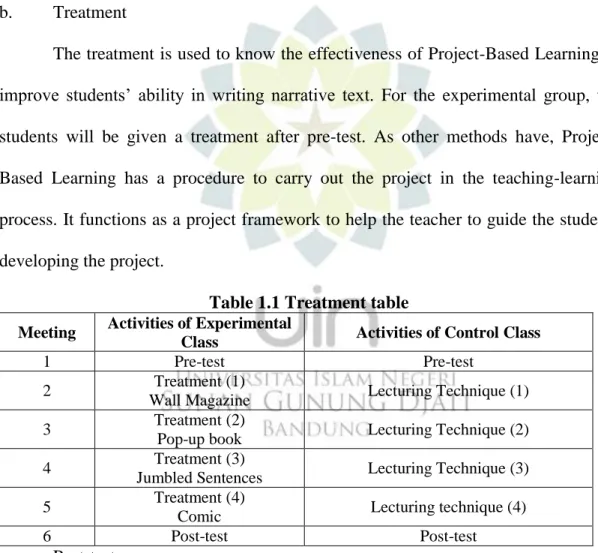
The treatment is used to know the effectiveness of Project-Based Learning to improve students’ ability in writing narrative text. For the experimental group, the students will be given a treatment after pre-test. As other methods have, Project-Based Learning has a procedure to carry out the project in the teaching-learning process. It functions as a project framework to help the teacher to guide the students developing the project.
Table 1.1 Treatment table
Meeting Activities of Experimental
Class Activities of Control Class
1 Pre-test Pre-test
2 Treatment (1)
Wall Magazine Lecturing Technique (1)
3 Treatment (2)
Pop-up book Lecturing Technique (2)
4 Treatment (3)
Jumbled Sentences Lecturing Technique (3)
5 Treatment (4)
Comic Lecturing technique (4)
6 Post-test Post-test
c. Post-test
Post-test is used to measure the student’s writing ability after the students have already been given a treatment in the experimental group. The test is given after
9
the students have been already given a treatment. The result of the test was scored and calculated. It was compared to the pretest. It was done to determine the result of students’ ability in writing narrative text by Project-Based Learning.
G. Hypothesis
The hypothesis is an idea or explanation that researcher then tests through study and experimentation.According to Arikunto (2010: 110), hypothesis meant as a temporary answering applicable to the research problem, until evidenced through the data are collected. Sudjana (2005: 219) also states that the hypothesis is an assuming or an expectation about something which is done to clarify it.
This research took null hypothesis (Ho) and alternative hypothesis (Ha). The hypotheses formulated in this study are:
Ho: There is no significant difference in students’ writing ability by using Project-based learning.
Ha: There is a significant difference in students’ writing ability by using Project-based learning.
Therefore, by rejecting Ho, this study was aimed at accepting Ha, which means that the experimental used in this study is worked.
H. Data Analysis
In this quasi-experimental research, there are three steps of data collection; conducting pre-test to both experimental class and control class, giving treatments
10
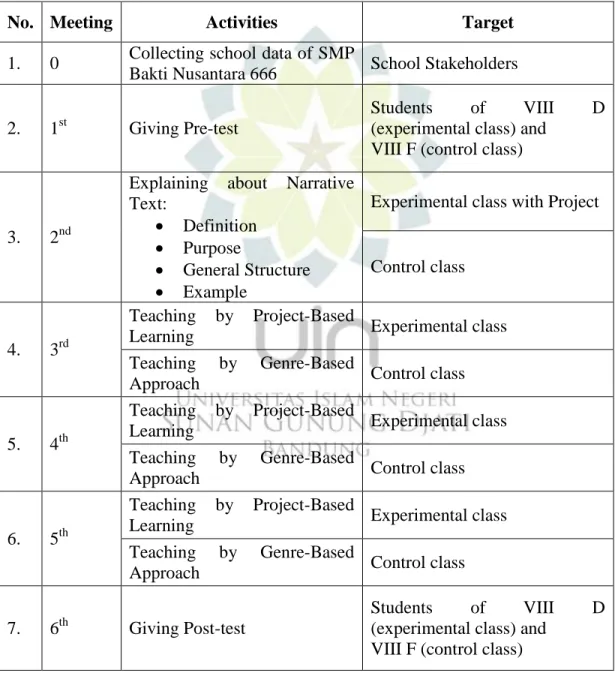
using PBL to theexperimental group, teaching writing skill in narrative text using conventional strategy to control class. To make the research process more understandable, here was the table of research schedule that lists some activities in collecting data.
Table 1.2 Research Schedule
No. Meeting Activities Target
1. 0 Collecting school data of SMP
Bakti Nusantara 666 School Stakeholders 2. 1st Giving Pre-test
Students of VIII D
(experimental class) and VIII F (control class)
3. 2nd
Explaining about Narrative Text:
Definition
Purpose
General Structure
Example
Experimental class with Project
Control class
4. 3rd
Teaching by Project-Based
Learning Experimental class
Teaching by Genre-Based
Approach Control class
5. 4th
Teaching by Project-Based
Learning Experimental class
Teaching by Genre-Based
Approach Control class
6. 5th
Teaching by Project-Based
Learning Experimental class
Teaching by Genre-Based
Approach Control class
7. 6th Giving Post-test
Students of VIII D
(experimental class) and VIII F (control class)
11
To analyze the quantitative data, statistic procedure is used and experimental analysis is determined. The procedure for analyzing data obtained from pre-test and post-test. The objective of this method is to compare two scores in answering the question.
Whether or not there is a significant difference between two scores; the test is done to get the average of two groups. The t-test is used to compare the mean of two groups. The step of analyzing data can be formulated as follows:
1. Testing the normality of the two variables
a. Looking for the (R) score to determining the range of data
𝑅 = 𝑡𝑒𝑖𝑔𝑒𝑟𝑠𝑐𝑜𝑟𝑒 − 𝑡𝑒𝑠𝑚𝑎𝑙𝑙𝑒𝑟𝑠𝑐𝑜𝑟𝑒 + 1 (Sudjana, 1996:47)
b. Looking for the (K) score to determining the class interval
𝐾 = 1 + 3.3 log 𝑛 (Sudjana, 1996:47)
c. Looking for the (L) score to determining the length of class
𝑃 = 𝑅/𝐾 (Sudjana, 1996:47)
d. Making the table of frequency distribution e. Counting mean 𝑋
𝑋 = ∑𝒇𝒊 .𝒙𝒊
𝑁 (Sudjana, 1996:47)
f. Looking for the (S2) score to determining the standard deviation
𝑆2 = ∑𝑓𝑖 𝑋𝑖−𝑋 2
𝑛−1 (Sudjana, 1996:95)
g. Making a table of frequency of expectation and observation h. Determining chi-square (𝑋2𝐶𝑜𝑢𝑛𝑡)
12
𝑋2 = ∑(𝑂𝑖−𝐸𝑖)2
𝐸𝑖 (Sudjana, 1996:237)
i. Looking for 𝑑𝑓 score to determining dethe gree of freedom
𝑑𝑓 = 𝐾 − 3 (Sudjana, 1996:293)
j. Determining chi-square table on significance 1% k. Interpreting the normality
2. To examine the homogeneity of two variances by conducting the following steps:
a. Determining score 𝐹 by using the formula
𝐹 =𝑆12
𝑆12 (Sudjana, 1996:249)
b. Looking for 𝑑𝑓 score to determine the degree of freedom
𝑑𝑓 = 𝑛 − 1
c. Determining score of 𝐹𝑡𝑎𝑏𝑙𝑒 with the significance 1% d. To determine the homogeneity of the data with criterion:
It is called homogenous data if 𝐹𝑡𝑎𝑏𝑙𝑒 > 𝐹𝑐𝑜𝑢𝑛𝑡 It is called no homogenous data if 𝐹𝑡𝑎𝑏𝑙𝑒 > 𝐹𝑐𝑜𝑢𝑛𝑡 e. Determining the degree of freedom of the data
𝑑𝑓 = 𝑛1+ 𝑛2− 2
3. Testing the hypothesis with the using of 𝑡- test by using formula
𝑡 = 𝑋 1− 𝑋 2
(𝑛1− 1)𝑆12+ (𝑛2 − 1)𝑆22
13
4. Determining score of 𝑡table with the significance level 1% 5. Interpreting the hypothesis