MANAGERIAL IMPLICATIONS IN SOLUTION BUSINESS RESEARCH
– TO WHAT EXTENT ARE THERE MANAGERIALLY
ROLE-RELEVANT IMPLICATIONS?
Risto T. Salminen, Lappeenranta University of Technology, [email protected]
Minna Oinonen, Lappeenranta University of Technology, [email protected]
Juha Haimala, Helsinki Metropolia University of Applied Science, [email protected]
ABSTRACT
The problem with managerial implications in academic studies in marketing is that the implications are not relevant enough to practitioners or managers. The purpose of the study is to gain new knowledge on the kinds of implications for practice that can be identified in academic journal articles on solution business. We apply Jaworski’s (2011) “role-relevant research approach” to pose our research questions: 1) What kinds of managerial implications can be identified in solution business in terms of the nature of the implications’ impact and timing? 2) Which kinds of knowledge needs would the studied implications for practice seem to satisfy? 3) On which kinds of managerial core tasks would the studied implications for practice seem to have an impact?
The research design comprises 1) a systematic literature review on solution business and 2) a content analysis of the selected literature with the help of qualitative analysis software (Nvivo10). The study might be one of the first studies to examine managerial implications’ nature in terms of their managerial role-relevance. The study has implications for research on managerial relevance and practical implications both for research on solution business and for the relevance research.
KEYWORDS: managerial implications, role-relevant implications, industrial marketing, solution business, integrated solutions
INTRODUCTION
The present study deals with managerial implications’ relevance to practitioners in academic journals. The studied articles are academic studies on solution business research. Solution business and industrial solutions are a theme that has been discussed recently in academic journals under such topics as “customer solutions” (Tuli, Kohli and Bharadwaj 2007), “solution provider” (Helander and Möller 2008), “solution business model” (Storbacka 2011) or “integrated solutions” (Brax and Jonsson 2009; Ceci and Masini 2011; Roehrich and Caldwell 2012). Academic studies under these topics can be considered as small emerging research streams.
A solution is most commonly considered from the suppliers’ perspective as a customized and integrated combination of goods and services to meet a customer’s needs from a supplier’s view (Davies, Brady and Hobday 2006), whereas Tuli et al. (2007) see a solution from a buyer’s view and consider it as a four-phase process comprising requirements’ definition, customization and integration, deployment and post-deployment support for the buyer. Briefly, there is an agreed definition neither of what a solution is nor of what solution business is. The reasons for this fragmented view might lie in the relatively short history of this type of industrial business labeled “solution.” Moreover, the solution type of business is characterized by high levels of both complexity and dynamics, in a similar way to project business (Cova and Salle 2007) and system business (Mattsson 1973; Helander and Möller 2008), creating several overlapping research streams in different countries.
As mentioned, industrial solution business is characterized by its complex and dynamic nature, just like project business and systems selling. The major challenges in marketing solutions have been identified as: 1) a change in the orientation of an industrial firm, 2) a need for new capabilities and skills for solution business, 3) a transformation of the structure and processes within the organization and 4) the implementation of the transformation process within the organization (Cova and Salle 2007).
Every academic study should result in implications for practice. The problem with managerial implications in academic studies in marketing is that the implications are not sufficiently relevant to practitioners or managers. A practice-based research problem with a well-formulated research design generally creates fruitful preconditions that should result in useful implications for practice. Furthermore, if the study’s chain of evidence is not interrupted and rigorous research methods are applied, useful implications are supposed to occur inevitably. But is this really the case? The extant academic knowledge on the practical relevance of academic studies in industrial marketing reveals that, for example, the research on inter-organizational relationships does not impress managers at all (Ankers and Brennan 2002). In a broader sense, it is worrying that according to many studies the majority of marketing managers do not read any academic marketing journals. What is especially worrying is that the relevance gap between academic studies and marketers’ needs seems to be increasing all the time (Reibstein, Day and Wind 2009; Lilien 2011).
It is notable that providing managerial implications is often considered an obligatory “by-product” when a young or inexperienced researcher is expected specifically to show his/her
capabilities in advancing or developing a theory. All in all, there are many reasons for the phenomenon in academic research in marketing that managerial implications are not paid the attention they deserve (see, e.g., Ankers and Brennan 2002; Ghoshal 2005; Reibstein et al. 2009).
Why is the lack of relevance of academic business studies then a problem? Every academic study is, or at least should be, targeted clearly to a certain audience. The audience can be seen as researchers, practitioners and policy makers (Creswell 2008), or academic colleagues, policy makers, practitioners and lay audiences (Silverman 2004). Practitioners’ expectations can be classified into four types: “a theoretical framework for understanding clients better, information, practical suggestions for better procedures, and reform of existing practices” (Silverman 2004, 365). Basically, practitioners expect to benefit from reading an academic article. What do we know about deriving implications for practice or deriving managerial implications? There are several textbooks on business research advising how to write an academic report and how to write the conclusions section as well as the implications that the study is proposed to have both for theory and for practice. In general, it is important to present the results in such a way that the reader can judge the validity and the relevance of the findings (Ghauri and Gronhaug 2002).
One possible way to approach business executives, depending on the selected target journal, is an executive summary. The summary should highlight the whole report, it should not include any new material, the reader should be able quickly and without any trouble to perceive the message of the report and the material should be reduced in a summary consisting of at the most 5 percent of the report’s full length or a couple of pages (Ghauri and Gronhaug 2002). The majority of academic journals in marketing do not apply an executive summary, however.
Ghauri and Gronhaug (2002, 136) give advice about reporting conclusions and recommendations, stating that “the best way is to refer back to the objectives or research questions and check whether or not you have provided conclusions for each of these. If the data collected and the analysis do not provide enough information, or support to draw conclusions, you should clearly state that. It is important to be specific and concise.” Furthermore, they state that “recommendations for future research or implications for business executives should be based on the findings and conclusions. There should be a logical congruence between conclusions and implications or recommendations” (Ghauri and Gronhaug 2002, 136).
Case studies are probably the most common research strategy in research on industrial marketing. Reporting them is challenging, because “there is no best practice to report case studies” (Kovalainen and Eriksson 2008, 130). Case studies are often pursued because of their potential to appeal to and benefit practitioners. Therefore, “the researcher should think carefully about how to make the report interesting, readable, and understandable from the point of view of business practitioners in addition to academics” (Kovalainen and Eriksson 2008, 131). What kind of research could be relevant to practitioners in industrial business? Jaworski (2011, 212), taking a critical view regarding typical “managerial research,” defines managerial relevance “as the degree to which a specific manager in an organization perceives academic knowledge to aid his or her job-related thoughts or actions in the pursuit of organizational
goals.” His central observation is that a “key to making a managerial impact is to thoroughly understand a particular role in the organization and to select a specific route to impact for a particular executive” (Jaworski 2011, 212). He calls research that is able to provide these kinds of implications “role-relevant research.” We applied Jaworski’s role-relevant research approach to discover the extent to which academic research in solution business provides role-relevant implications for practice or managers.
Thus, the purpose of the present study is to gain new knowledge on the kinds of implications for practice that can be identified in the selected academic journal articles on solution business. We selected the solution business literature for examination due to its complex and dynamic nature, which makes it probably one of the most challenging types of industrial business to study in terms of drawing role-relevant implications for practice.
Consequently, our research questions are as follows: 1) What kinds of managerial implications can be identified in solution business in terms of the nature of the implications’ impact and timing?; 2) Which kinds of knowledge needs would the studied implications for practice seem to satisfy when analyzing them in light of the types of marketing knowledge? (In Jaworski’s framework these types are: empirical findings, concepts, frameworks, theory, processes, measurement instruments, methods, models); 3) On which kinds of managerial tasks would the studied implications for practice seem to have an impact when analyzing them in light of the types of managerial tasks? (In Jaworski’s framework these types are: strategist, voice of market, marketing strategy, coordinator, head of marketing implementation, transformer of marketing, performance controller).
The present study’s first finding lies in the notion that the studied managerial implications in solutions business studies seem not to be very role-relevant, but the implications drawn generally are applicable only on the company level, or the implications are simply named as “implications for managers” without emphasizing any particular managerial roles. We also found that the majority of implications are meant to have an impact on the present actions of a company and not on the future thinking, for example.
Furthermore, we found that the majority of the types of the knowledge needs of managers on whom the implications are supposed to have an impact are empirical findings (such as “results” or “study findings”) and frameworks (such as “typologies” and “taxonomies”). Finally, we found that in terms of managerial types of managerial core tasks, the two dominating core tasks classes of the studied implications were “transformer of marketing” and “marketing strategy.”
The paper is organized as follows. First, the essential literature on relevance in academic business studies is discussed, resulting in the decision to adopt Jaworski’s framework for the present study. Then, the research design, comprising a systematic literature review and content analysis of the selected 29 journal articles on solution business with the qualitative analysis software Nvivo10, is described. Next, the results of the analysis are presented – both the descriptive findings and the findings related specifically to the three research questions. Subsequently, the implications for the academic discussion on relevance research in marketing are presented, as well as the implications for practice, i.e. for researchers of solution business. Finally, we contend the limitations of the study and suggest future research avenues.
LITERATURE ON MANAGERIAL RELEVANCE
There is a growing body of literature in which researchers’ concern about the lack of relevance in research is clearly pointed out. In fact, the emergence of the Industrial Marketing and Purchasing (IMP) research group was inspired by the belief that business-to-business marketing theory was out of touch with the realities of the business world (Bonoma and Johnston 1978; Håkansson 1982). The acknowledged managerial irrelevance of the IMP group has been seen as a microcosm of the greater managerial irrelevance of scholarly research in marketing, however (Brennan and Turnbull 2002). Brennan and Turnbull argue that IMP research has generated much knowledge that is applicable, but the applications have seldom been high up on the researchers’ list of priorities. This divergence between theory and practice has even been considered detrimental to the long-term health of marketing. The academic marketing society has too long neglected the basic tenet of any science that “the role of marketing is not just to advance theory and methods but also to have an impact on the practice of marketing” (Reibstein et al. 2009, 1).
The lack of managerial relevance has been discussed from many perspectives for a long time (Ankers and Brennan 2002). It has even been claimed that bad management theories are destroying good management practices (Ghoshal 2005). Business schools especially have been criticized because of the claimed lack of relevance in their teaching (Bennis and O’Toole 2005). Management teachers and researchers have been increasingly dissatisfied with the management education in business schools (Starkey and Madan 2001; Khurana 2007), and the relevance of management education from the perspective of management practice is increasingly questioned (Mintzberg 2004; Kieser and Leiner 2009). The reasons for business schools’ irrelevant teaching are considered the dominant MBA focus on narrow analytical and cognitive skills, stylized treatment of complex issues by teachers with no direct business experience, self-centered careerism and the declining recognition that management is as much a clinical art as a science (Reibstein et al. 2009). Reibstein et al. (2009) claim that “there is a lot of narrowly specified and fragmented research that is produced by ‘solo scholars’ or small teams that cannot address the multifunctional and interconnected problems of managers.”
Some researchers see the quantitative methodologies used as a problem, and therefore strongly favor qualitative research to provide managerially relevant results, especially when the studies deal with complex, context- and persona-dependent phenomena (Gummesson 2006). On the other hand, there are quantitative researchers who see many advantages in quantitative research. Lilien (2011) discusses particularly the role of the context in creating marketing decision models when bridging the academic–practitioner divide in marketing research. He states that marketing decision models provide several benefits for practice. Models improve the consistency of decisions, enable the exploration of more decision options, assess the relative impact of decision variables, facilitate group decision making and update the mental models of decision makers (Lilien 2011). The gap between potential and realized implementation of these models is proposed to be explained by applying Rogers’s (2003) diffusion of innovation factors: perceived advantage or benefit, riskiness of purchase, ease of product use/complexity of the product, immediacy of benefit, observability, trialability, price, extent of behavioral changes required and return of investment.
Conceptual thinking is one of the most important skills of a manager. The higher the position, the more important it is to be able to see complex business phenomena through applicable concepts. MacInnis has developed a typology of conceptual contributions. Conceptual thinking is “the process of understanding a situation or a problem abstractly by identifying patterns or connections and key underlying properties” (MacInnis 2011, 140). Identifying interesting problems, developing hypotheses, interpreting data and deriving implications all involve thinking conceptually. Purely conceptual articles include “conceptual frameworks,” “intergrative models,” and “state-of-the-art reviews.” Purely analytical (mathematical) articles are also conceptual articles, in which ideas are represented mathematically as opposed to verbally. Inspired by this problematic lack of relevance, the present study adopts Jaworski’s (2011) recent framework especially to examine the extent to which academic studies on solution business are role-relevant.
JAWORSKI’S FRAMEWORK AS THE BASIS FOR THE ANALYSIS OF THE STUDY
Jaworski (2011, 212), taking a critical view on typical “managerial research,” defines managerial relevance “as the degree to which a specific manager in an organization perceives academic knowledge to aid his or her job-related thoughts or actions in the pursuit of organizational goals.” We applied Jaworski’s role-relevant research approach to discover the extent to which academic research in solution business provides role-relevant implications for practice or for managers.
Jaworski makes three observations about his own definition as follows: 1) managerial relevance is an assessment by a specific manager of a particular role; 2) there are multiple categories of managerial relevance: the categories can be classified according to the outcome that is sought, and the outcome can be classified in terms of the timing of the impact (present vs. future) and the nature of the impact (thought vs. action); 3) managers consume many types of marketing knowledge (Jaworski 2011). Based on his three observations, Jaworski then formulates his role-relevant research approach based on five guiding questions when planning role-relevant business research (Figure 1).
Chief marketing Decision to focus Present or future Thinking or Research finding officer or brand on role requirements time period? action? or conceptual
manager “A” versus “B” framework?
Figure 1. Developing a role-relevant research approach: Five guiding questions and their illustrative options (Jaworski 2011)
In reference to the research questions two and three in Figure 1, Jaworski identifies seven core tasks of a manager and eight knowledge needs of managerial knowledge. In terms of the timing
5 Which information will achieve the desired impact? 4 What is the desired impact? 3 When is the impact expected to occur? 2 Which role task is the focus of the research? 1 Who is the target manager?
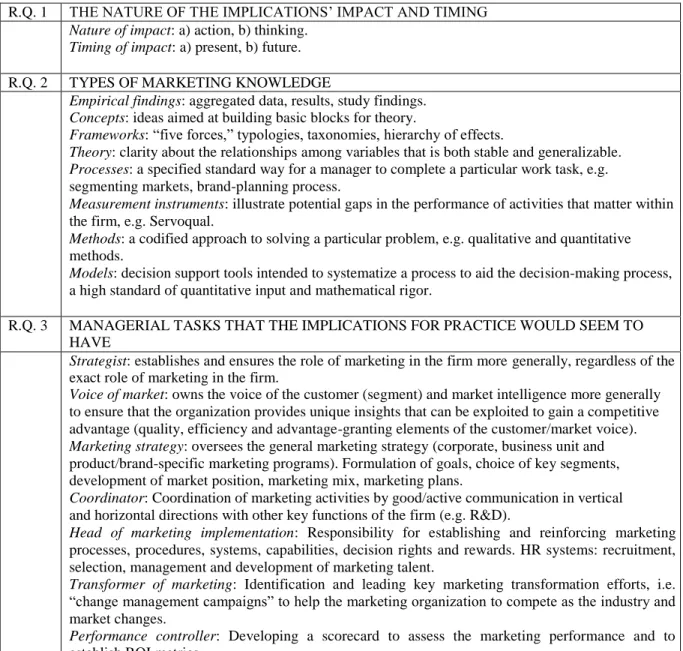
and nature of managerial impacts, he classifies managerial relevance into four classes (present action, present thinking, future action, future thinking). We used these three aspects (nature of impact, types of knowledge needs, types of managerial tasks) from Jaworski’s framework to pose our research questions as follows (see also Table 1). The reason for excluding Jaworski’s questions one and two from the present analysis was simply the notion that the analysis would have resulted in almost nothing. The selected articles were mostly not targeted to any specific manager. For most of the studied articles it was also quite difficult to identify certain role tasks that would have been the focus of the research. Hence, it was decided to focus on the three more easily analyzable questions as follows:
1) What kinds of managerial implications can be identified in the academic solution business literature in terms of the nature of the implications’ impact and its timing?
2) Which kinds of knowledge needs would the studied implications for practice seem to satisfy when analyzing them in the eight types of marketing knowledge (empirical findings, concepts, frameworks, theory, processes, measurement instruments, methods, models) proposed by Jaworski)?
3) On which kinds of managerial tasks would the studied implications for practice seem to have an impact when analyzing them in light of the types of managerial tasks (strategist, voice of market, marketing strategy, coordinator, head of marketing implementation, transformer of marketing, performance controller) proposed by Jaworski)?
RESEARCH DESIGN
The research design of the present study comprises 1) a systematic literature review of the selected academic literature on solution business and 2) content analysis of the selected literature. The content analysis was conducted by using qualitative analysis software called Nvivo10.
SYSTEMATIC LITERATURE REVIEW
First, peer-reviewed scholarly articles written in English were searched for in four different databases: 1) ABI/INFORM Global (Proquest), 2) EBSCO, 3) Elsevier (Science Direct) and 4) Emerald. The search was conducted in January 2013 and was limited to the title, abstract and keywords, or abstract only. The key words used – “integrated solution(s),” “customer solution(s)” and “solution(s) offering(s)” – resulted in 554 potential articles, the abstracts of which were scanned for relevancy. The articles that focused on solution business and solution characteristics were selected for the review. This procedure resulted in 40 potential papers for the full paper analysis. However, to guarantee the quality of the reviewed papers, we included only articles that were published in ISI impact factor journals. Thus, 5 articles that were lacking an impact factor were excluded. After reading the remaining 35 articles, 4 articles were excluded, as they were not relevant to our topic, resulting in 31 articles from the database search.
Table 1. Research questions and the coding framework for the analysis of the 29 selected articles R.Q. 1 THE NATURE OF THE IMPLICATIONS’ IMPACT AND TIMING
Nature of impact:a) action, b) thinking.
Timing of impact:a) present, b) future.
R.Q. 2 TYPES OF MARKETING KNOWLEDGE
Empirical findings:aggregated data, results, study findings.
Concepts:ideas aimed at building basic blocks for theory.
Frameworks:“five forces,” typologies, taxonomies, hierarchy of effects.
Theory:clarity about the relationships among variables that is both stable and generalizable.
Processes:a specified standard way for a manager to complete a particular work task, e.g. segmenting markets, brand-planning process.
Measurement instruments:illustrate potential gaps in the performance of activities that matter within the firm, e.g. Servoqual.
Methods:a codified approach to solving a particular problem, e.g. qualitative and quantitative methods.
Models:decision support tools intended to systematize a process to aid the decision-making process, a high standard of quantitative input and mathematical rigor.
R.Q. 3 MANAGERIAL TASKS THAT THE IMPLICATIONS FOR PRACTICE WOULD SEEM TO HAVE
AN IMPACT
Strategist: establishes and ensures the role of marketing in the firm more generally, regardless of the exact role of marketing in the firm.
Voice of market:owns the voice of the customer (segment) and market intelligence more generally to ensure that the organization provides unique insights that can be exploited to gain a competitive advantage (quality, efficiency and advantage-granting elements of the customer/market voice).
Marketing strategy:oversees the general marketing strategy (corporate, business unit and product/brand-specific marketing programs). Formulation of goals, choice of key segments, development of market position, marketing mix, marketing plans.
Coordinator:Coordination of marketing activities by good/active communication in vertical and horizontal directions with other key functions of the firm (e.g. R&D).
Head of marketing implementation: Responsibility for establishing and reinforcing marketing processes, procedures, systems, capabilities, decision rights and rewards. HR systems: recruitment, selection, management and development of marketing talent.
Transformer of marketing: Identification and leading key marketing transformation efforts, i.e. “change management campaigns” to help the marketing organization to compete as the industry and market changes.
Performance controller: Developing a scorecard to assess the marketing performance and to establish ROI metrics.
Second, potential articles were searched by using backward and forward snowballing (Bakker 2010). Scanning the reference lists of the 31 articles found resulted in 6 relevant articles; furthermore, a cited reference search in the ISI Web of Knowledge added 2 new articles to the review. Thus, we had 39 articles at this stage.
Third, potential articles were glimpsed in 2 special issues of Industrial Marketing Management (Vol. 36, Issue 2, 2007 and Vol. 40, Issue 5, 2011), which focused specifically on solutions. This analysis resulted in 2 new articles. Hence, after applying these 3 approaches to identifying relevant articles for our study, we ended up with 41 articles for the review.
PREPARING THE SELECTED ARTICLES FOR ANALYSIS
Next, these 41 articles were read summarily, focusing especially on the managerial implications provided by each article. If managerial implications/implications for practice seemed preliminarily not to exist, then the conclusions section was read and examined very carefully as a whole. The adopted perspective when reading these parts was “a manager’s view,” i.e. a manager searching for clear recommendations. We noticed that 12 articles did not provide managerial implications/implications for practice for 6 different reasons.
Consequently, those articles were excluded from further analysis, because 1) they were introductions to special issues on solution business; 2) they were conceptual articles in character; 3) they only summarily described the studied cases and/or made reflections on the relevant literature in the conclusion section; 4) no methodology and/or references were reported, i.e. the articles were published in a managerial-type journal (e.g. Harvard Business Review); 5) they did not provide any explicit or specific enough implications for managers, but only statements on a common level, such as “this business model categorization provides a useful tool…,” “these findings gave serious implications towards marketing full-service offerings…” or “a company has to combine elements from both goods and service logics”; or 6) they provided only propositions and not proper implications. As a result, 29 articles were accepted for the final analysis.
These remaining 29 articles were first converted from PDF format into Word format and printed on paper. Then the managerial implications of each article were identified and highlighted with pen. In most of the articles, managerial implications were not specifically listed and numbered, but were only written in text as separate paragraphs. We noticed that it partly depended on the journal in question whether the managerial implications were written under a specific heading and/or listed clearly. For this reason, each article’s conclusion section had to be read carefully and the managerial implications marked with a pen.
After this it was possible to outline a coding frame for the analysis with the Nvivo10 qualitative analysis software. The coding frame comprises descriptive classification criteria and analysis criteria derived from the study’s research questions.
CODING CRITERIA
The coding criteria fall into two classes: descriptive classification categories and categories for the analysis proper. The descriptive classification categories are threefold: 1) journal characteristics: journal name, journal category and whether the journal applies a structured abstract or not; 2) study characteristics: publication year, number of authors, whether a separate managerial implication section exists (yes/no), study type (single case, multiple case, longitudinal multiple case, quantitative (survey or other)); and 3) managerial implications’ characteristics: whether implications are written under a specific heading (managerial implications or implication for practice, etc.), the length of the whole implications text (measured as the number of words) and the number of managerial implications derived in the article. The categories for the analysis were derived from the purpose of the study, and ultimately from the three research questions posed. After reading the studied articles, it became clear that it would not have made sense to try to identify the target managers from the articles,
because only two articles provided implications specific to a certain manager (the key account manager). All the rest of the implications provided were implications more or less “for the companies.” Therefore, Jaworski’s first question was omitted (see Figure 1). Similarly, it would have been almost impossible to try to identify the role tasks that were the focus of the analyzed articles. Consequently, Jaworski’s second question was omitted. Instead, Jaworski’s framework’s questions three, four and five (in Figure 1) were the subject of the present study.
Respectively, these categories were used for coding: 1) the nature of the studied managerial implications’ impact and timing; 2) the types of marketing knowledge; and 3) the managerial tasks on which the implications for practice would seem to have an impact. The first analysis coding set includes the nature of the studied managerial implications’ impact and timing (action impact, thinking impact, present impact, future impact). Additionally, we followed Jaworski’s idea of grouping the impact nature into a 2 × 2 matrix (present action, present thinking, future action, future thinking).
The second coding set includes eight types of marketing knowledge on which the selected studies’ managerial implications should have an impact (empirical findings, concepts, frameworks, theory, processes, measurement instruments, methods, models). The third coding set comprises seven managerial tasks on which the managerial implications could have an impact (strategist, voice of market, marketing strategy, coordinator, head of marketing implementation, transformer of marketing, performance controller).
DESCRIPTIVE FINDINGS
First the results of the descriptive analysis are reported, followed by the results that were gained from the analysis conducted on the basis of the analysis criteria. The descriptive analysis comprises three parts: journal description, description of the studied 29 articles and managerial implications’ description.
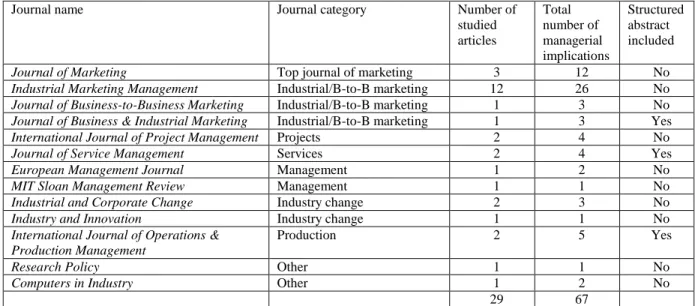
Journal description: the analyzed articles were published in thirteen different journals (see Table 2). For analysis and coding purposes, the journals were grouped into eight categories: first, there is the top journal in marketing (Journal of Marketing) and important journals of industrial/B2B marketing (Industrial Marketing Management, Journal of Business-to-Business Marketing and Journal of Business and Industrial Marketing).
Second, there is the project journal class (International Journal of Project Management), service journal class (Journal of Service Management), management journal class (European Management Journal, MIT Sloan Management Review), industry journals (Industrial and Corporate Change, Industry and Innovation) and production-related journal class (International Journal of Operations & Production Management).
Finally, there are two journals (Research Policy, Computers in Industry) that form the other journal class. Of these thirteen journals only three have a structured abstract – the Journal of Business and Industrial Marketing, Journal of Service Management and International Journal of Operations & Production Management. A structured abstract obliges authors to write down
the implications explicitly, at least in a general domain in the structured abstract.
Table 2. Description of the 13 studied journals and the distribution of the 67 studied managerial implications
Journal name Journal category Number of
studied articles Total number of managerial implications Structured abstract included Journal of Marketing Top journal of marketing 3 12 No Industrial Marketing Management Industrial/B-to-B marketing 12 26 No Journal of Business-to-Business Marketing Industrial/B-to-B marketing 1 3 No Journal of Business & Industrial Marketing Industrial/B-to-B marketing 1 3 Yes International Journal of Project Management Projects 2 4 No
Journal of Service Management Services 2 4 Yes
European Management Journal Management 1 2 No
MIT Sloan Management Review Management 1 1 No
Industrial and Corporate Change Industry change 2 3 No
Industry and Innovation Industry change 1 1 No
International Journal of Operations & Production Management
Production 2 5 Yes
Research Policy Other 1 1 No
Computers in Industry Other 1 2 No
29 67
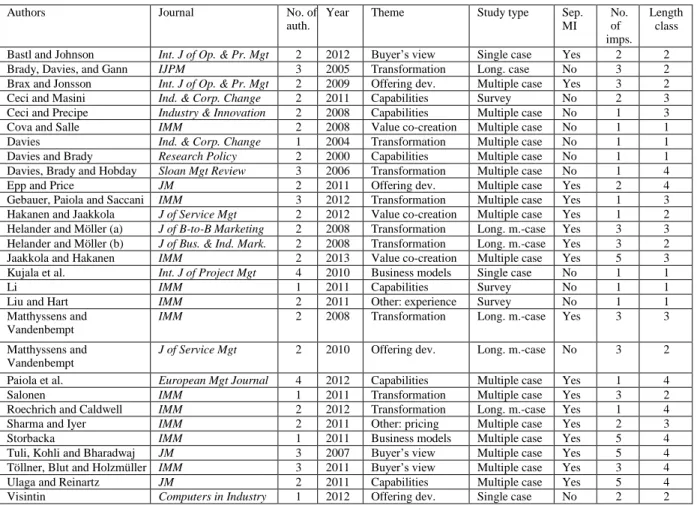
Description of the studied articles (see Table 3): The studied articles were published between 2000 and January 2013. The age distribution of the studied 29 articles is a little skewed, since more than half of the solution-related articles were published during the past 3 years (Figure 2). The reason for that is particularly the recent special issue of Industrial Marketing Management on solutions (2011).
Figure 2. Number of studied articles in each year between 2000 and January 2013 0 1 2 3 4 5 6 7 8 9 10 2000 2004 2005 2006 2007 2008 2009 2010 2011 2012 2013
Table 3. Characteristics of the studied articles and the studied managerial implications
Authors Journal No. of
auth.
Year Theme Study type Sep.
MI No. of imps. Length class Bastl and Johnson Int. J of Op. & Pr. Mgt 2 2012 Buyer’s view Single case Yes 2 2
Brady, Davies, and Gann IJPM 3 2005 Transformation Long. case No 3 2
Brax and Jonsson Int. J of Op. & Pr. Mgt 2 2009 Offering dev. Multiple case Yes 3 2
Ceci and Masini Ind. & Corp. Change 2 2011 Capabilities Survey No 2 3
Ceci and Precipe Industry & Innovation 2 2008 Capabilities Multiple case No 1 3
Cova and Salle IMM 2 2008 Value co-creation Multiple case No 1 1
Davies Ind. & Corp. Change 1 2004 Transformation Multiple case No 1 1
Davies and Brady Research Policy 2 2000 Capabilities Multiple case No 1 1
Davies, Brady and Hobday Sloan Mgt Review 3 2006 Transformation Multiple case No 1 4
Epp and Price JM 2 2011 Offering dev. Multiple case Yes 2 4
Gebauer, Paiola and Saccani IMM 3 2012 Transformation Multiple case Yes 1 3
Hakanen and Jaakkola J of Service Mgt 2 2012 Value co-creation Multiple case Yes 1 2 Helander and Möller (a) J of B-to-B Marketing 2 2008 Transformation Long. m.-case Yes 3 3 Helander and Möller (b) J of Bus. & Ind. Mark. 2 2008 Transformation Long. m.-case Yes 3 2
Jaakkola and Hakanen IMM 2 2013 Value co-creation Multiple case Yes 5 3
Kujala et al. Int. J of Project Mgt 4 2010 Business models Single case No 1 1
Li IMM 1 2011 Capabilities Survey No 1 1
Liu and Hart IMM 2 2011 Other: experience Survey No 1 1
Matthyssens and Vandenbempt
IMM 2 2008 Transformation Long. m.-case Yes 3 3
Matthyssens and Vandenbempt
J of Service Mgt 2 2010 Offering dev. Long. m.-case No 3 2
Paiola et al. European Mgt Journal 4 2012 Capabilities Multiple case Yes 1 4
Salonen IMM 1 2011 Transformation Multiple case Yes 3 2
Roechrich and Caldwell IMM 2 2012 Transformation Long. m.-case Yes 1 4
Sharma and Iyer IMM 2 2011 Other: pricing Multiple case Yes 2 3
Storbacka IMM 1 2011 Business models Multiple case Yes 5 4
Tuli, Kohli and Bharadwaj JM 3 2007 Buyer’s view Multiple case Yes 5 4
Töllner, Blut and Holzmüller IMM 3 2011 Buyer’s view Multiple case Yes 3 4
Ulaga and Reinartz JM 2 2011 Capabilities Multiple case Yes 5 4
Visintin Computers in Industry 1 2012 Offering dev. Single case No 2 2
The number of authors: The number of authors varies between 1 and 5. The most common number of authors is 2 (in 14 articles). A separate managerial implications section included: some journals’ policy dictates that authors have to write their implications under a “Managerial implications” heading. In some journals varying practices in writing can be seen, probably as the result of the review process and the reviewers’ opinions. It would seem that this issue depends on the authors in question, too. In the studied articles there is a separate managerial implications heading in 17 articles and in 12 there is no specific heading for managerial implications.
Study type:The majority of the articles (25/29) were qualitative case studies and only 3 studies were surveys. This is quite easy to understand, since solution business is a complex and dynamic type of business, and solution business as a research topic clearly favors the use of case studies from the researchers’ and companies’ point of view. More specifically, there are 15 multiple case studies, 8 longitudinal multiple case studies, 3 single case studies and 3 survey studies.
The themes of the 29 studied articles fall into seven classes: the transformation process of an industrial supplier to a solution provider (9), capabilities of a solution provider (6), offering development (4), co-creation of value (3), buyer’s view in the value creation process (3), solution business models (2) and other themes (solution pricing, experience’s role in innovating solutions).
Managerial implications’ description: In 17 of the 29 articles studied, the managerial implications were under a specifically named heading, “Managerial implications” or “Implications for practice.” The length of the managerial implications text was measured by using Word’s word count function. It was notable that the length of the managerial implications text varied considerably between the articles, from 17 to 2942 words. Classified into four “length classes,” the distribution of the lengths was as follows: class 1: 1–100 words (6 pcs), class 2: 101–250 words (8 pcs), class 3: 251–500 words (7 pcs) and class 4: over 500 words (8 pcs).
The number of managerial implications in an article varied between 1 and 5 implications. The distribution of implication numbers is as follows: 1 (12 articles), 2 (4 articles), 3 (9 articles), 4 (0 articles) and 5 (4 articles), meaning in total 67 managerial implications. In some articles, the main result of the study was a typology or a framework, and in the conclusions section some authors did not consider the resulting framework/typology itself as a managerial implication, but in some articles that kind of result was in fact the only managerial implication. Typically, a typology or process framework is aimed at stimulating managerial thinking; therefore, it is reasonable to consider that kind of result a managerial implication as a whole.
CONCLUSIONS
On the basis of the three research questions, three issues were analyzed: the nature of the implications’ impact and timing, the types of the marketing knowledge gained for managers and the managerial tasks on which the implications would seem to have an impact.
Research question 1: What kinds of managerial implications can be identified in solution business in terms of the nature of the implications’ impact and timing?
A total of 67 managerial implications were under examination in the present study. In terms of the implications’ timing and impact, we found that 40 implications are related to managerial actions and 24 implications are related to managerial thinking. Similarly, in terms of timing, we found that 64 implications are related to the present time and only 3 implications are related to a future time (see Table 4).
When combining the implications into the two-dimensional matrix, following Jaworski’s (2011) article, the resulting matrix is as follows: present – action (40), present – thinking (24), future action (2) and future thinking (1). These results are quite well in line with Jaworski’s notion that the majority of studies in marketing focus on research topics that result in study findings to aid the present actions needed in a company.
Table 4. The characteristics of the studied 64 managerial implications in terms of the nature/timing of impact
NATURE OF IMPACT Action Thinking Total
Future 2 1 3
Present 40 24 64
Total 42 25 67
Examples of present action types of implications, i.e. actions that can be undertaken immediately:
In order to create new value in business relationships, OEM manufacturers should make use of “live” communication tools like trade shows, technical seminars, and project meetings to translate its competence into relevant solutions, and let the customer involved to experience the value potential of such competence applications. (Li 2011)
Hence, it is important to assess all of the risks associated with the firm’s solution contract portfolio. (Storbacka 2011)
Examples of present thinking types of implications, i.e. thinking about issues that can be started immediately:
We introduce an identity goal typology in Table 2 that managers could use as a simple tool to appeal to prominent customer network identity goals. In the same way that companies design offerings around activities and amenities, they could customize offerings around these identity goals. The difference between this approach and the current design offerings is most prominent in the structural component of identity goals. (Epp and Price 2011)
The results highlight the importance of the key account manager’s capabilities. The system business is a very demanding context and requires at least three types of capabilities: strong leadership capabilities, consultative selling skills, and an adequate understanding of the customer’s industrial processes. In addition, he/she should ensure that the capability mix of the whole account team is sufficient and also continuously updated. (Helander and Möller 2008)
An example of future action types of implication, i.e. action that can be started in the future:
For many firms, the biggest challenge will be developing the capabilities to integrate different pieces of a system provided increasingly by an external network of specialized component suppliers, subcontractors and service providers. (Davies 2004)
An example of future thinking types of implication, i.e. an issue that can be thought of in the future:
The emergence of triadic relationships requires rethinking how suppliers are managed when they come in contact with customers. (Bastl and Johnson 2012)
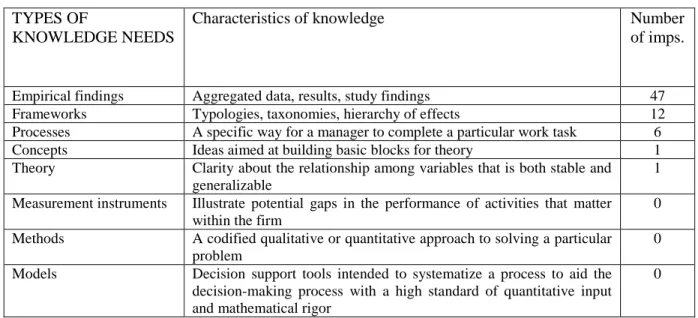
Research question 2: Which kinds of knowledge needs would the studied implications for practice seem to satisfy when analyzing them in light of the types of marketing knowledge? The types of marketing knowledge were coded according to Jaworski’s framework into eight classes. The analysis of the identified 67 implications resulted in the following classification of the types of knowledge needs (Table 5).
Table 5. The types of knowledge needs that the studied implications would seem to satisfy
TYPES OF
KNOWLEDGE NEEDS
Characteristics of knowledge Number
of imps.
Empirical findings Aggregated data, results, study findings 47 Frameworks Typologies, taxonomies, hierarchy of effects 12 Processes A specific way for a manager to complete a particular work task 6 Concepts Ideas aimed at building basic blocks for theory 1 Theory Clarity about the relationship among variables that is both stable and
generalizable
1
Measurement instruments Illustrate potential gaps in the performance of activities that matter within the firm
0
Methods A codified qualitative or quantitative approach to solving a particular problem
0
Models Decision support tools intended to systematize a process to aid the decision-making process with a high standard of quantitative input and mathematical rigor
0
As can be seen, the emphasis of the solution business research is very much on empirical findings, and to a certain extent on forming normative frameworks and processes. None of the studied articles resulted in measurement instruments, methods or mathematical models.
Research question 3: On which kinds of managerial tasks would the studied implications for practice seem to have an impact when analyzing them in the light of the seven types of managerial tasks?
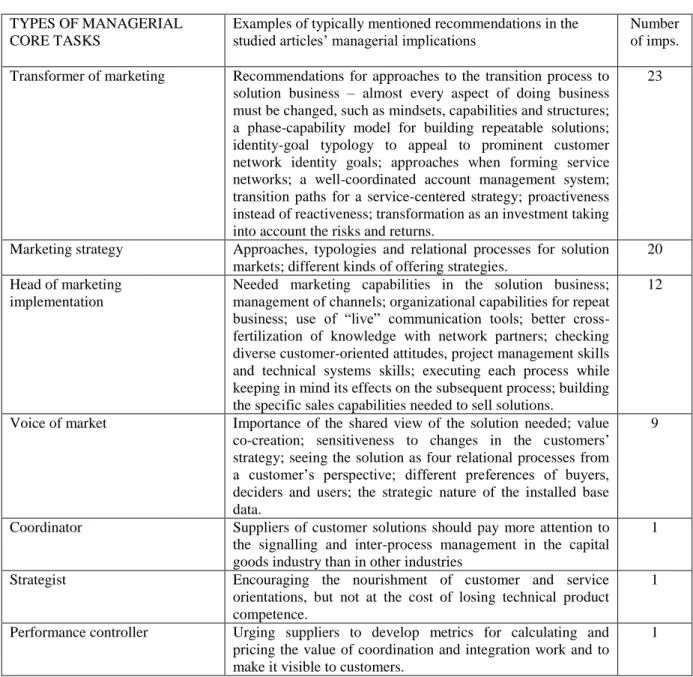
The types of managerial tasks on which the implications would seem to have an impact were coded into seven classes according to Jaworski’s framework. The results of the identification of the analyzed 67 implications are listed in Table 6. From that table we see that the emphasis of the implications is very much on recommendations to a manager in charge of the company’s transformation process when moving the business toward solution business, as well as on marketing strategy-related issues. Marketing strategy-related implications are for the most part different kinds of process recommendations for how to approach markets as well as offering strategies. The head of marketing implementation runs the marketing organization, and the capabilities needed especially in solution business were studied in several articles. One of the marketing CEO’s important tasks is to serve as a voice of the market within the company. This aspect was seen in several articles recommending for example careful value co-creation with the customer.
Three remaining managerial core tasks, i.e. coordinator, strategist and performance controller, were identified as one implication in each of these. It is notable that Jaworski (2011) considers the level of current knowledge as “low” on both the strategist’s task and the coordinator’s task, whereas the current knowledge on the performance controller is “medium-high” according to Jaworski.
It would seem that Jaworski’s notions are also quite valid in solution business research. Solution business is both dynamic and complex, and is thus a very demanding type of business to study, which might explain the evidently weak interest in performance-related studies.
Table 6. The types of managerial core tasks on which the studied implications for practice would seem to have an impact
TYPES OF MANAGERIAL CORE TASKS
Examples of typically mentioned recommendations in the studied articles’ managerial implications
Number of imps.
Transformer of marketing Recommendations for approaches to the transition process to solution business – almost every aspect of doing business must be changed, such as mindsets, capabilities and structures; a phase-capability model for building repeatable solutions; identity-goal typology to appeal to prominent customer network identity goals; approaches when forming service networks; a well-coordinated account management system; transition paths for a service-centered strategy; proactiveness instead of reactiveness; transformation as an investment taking into account the risks and returns.
23
Marketing strategy Approaches, typologies and relational processes for solution markets; different kinds of offering strategies.
20
Head of marketing implementation
Needed marketing capabilities in the solution business; management of channels; organizational capabilities for repeat business; use of “live” communication tools; better cross-fertilization of knowledge with network partners; checking diverse customer-oriented attitudes, project management skills and technical systems skills; executing each process while keeping in mind its effects on the subsequent process; building the specific sales capabilities needed to sell solutions.
12
Voice of market Importance of the shared view of the solution needed; value co-creation; sensitiveness to changes in the customers’ strategy; seeing the solution as four relational processes from a customer’s perspective; different preferences of buyers, deciders and users; the strategic nature of the installed base data.
9
Coordinator Suppliers of customer solutions should pay more attention to the signalling and inter-process management in the capital goods industry than in other industries
1
Strategist Encouraging the nourishment of customer and service orientations, but not at the cost of losing technical product competence.
1
Performance controller Urging suppliers to develop metrics for calculating and pricing the value of coordination and integration work and to make it visible to customers.
CONTRIBUTION TO THE RESEARCH ON MANAGERIAL RELEVANCE
The present study might be one of the first to examine managerial implications’ character in terms of role-relevance, especially by reflecting the managerial implications analytically onto a specific framework. The study has implications for research on managerial relevance and for research on how to evaluate/measure managerial implications’ role-relevance or relevance in general. It seems that at least in solution business research it is not a very common practice to derive implications for a particular manager type. This is probably due to the topicality and the importance of the transformation process in solution business that causes researchers to focus on the actions needed on the company level. In general, the study contributes to the literature on the rigour–relevance gap between business research and practice (Bennis and O’Toole 2005; Ghoshal 2005; Reibstein et al. 2009; Jaworski 2011; MacInnis 2011).
IMPLICATIONS FOR PRACTICE IN CONDUCTING RESEARCH
The study has implications both for the research on solution business and for the relevance research. First, what are lacking are studies devoted to the future thinking needed in solution business, i.e., studies that would result in measurement instruments and specific methods or mathematical models. Second, research on measurement instruments, methods or models for solution business (in Jaworski’s sense) does not seem to exist. Third, studies that would be role-relevant and thus relevant from a particular manager’s viewpoint do not seem to exist. Additionally, there do not seem to be any existing studies focusing specifically on the challenges of a manager in charge of coordinating solution business inside a company, studies for a strategist who establishes and ensures solution marketing’s overwhelming role in a company or studies aimed at a performance controller who tries to tackle the complex interdependencies of solution business from the profitability and effectiveness point of view.
Based on the obtained view of 67 managerial implications derived from solution business studies, it seems that in order to be clearly identified and easy to read for managers, 1) managerial implications should be written explicitly as recommendations and they should be numbered, 2) if possible, these implications should be targeted more specifically, not only “for the company” or “to managers” but to a particular manager, to be really role-relevant, 3) even if the only result of the study is a framework or typology, its use and value for a manager should be discussed and shown clearly. It is insufficient only to mention that framework in a vague way in the implications section.
LIMITATIONS
The limitations of the present study are quite evident. First, we have focused only on solution business studies, and our result might therefore give the impression that the research gaps that we found would exist in other areas of industrial marketing science as well. This is of course not the case. We feel that due to the holistic nature of solution business the problems in companies are also holistic in nature, and so are the conducted studies’ results. Second, our data
comprise 29 studies including 67 identified managerial implications. This number of implications is enough only to draw preliminary conclusions on the role-relevance of managerial implications in solution business studies.
FURTHER RESEARCH
The gathered data used in the present study could offer possibilities for more profound analyses. First, we have not fully utilized all the coded data (e.g. the journal category, the length class implications or the study type). Second, on the basis of the results of our study, future research efforts could be devoted more profoundly to the reasons behind the lacking role-relevance of academic studies on solution business.
Third, the gathered and coded data would make it possible to make many kinds of cross-tabulations either to reveal further potential research gaps or to analyze in-depth the managerial implications derived from the selected 29 qualified articles.
References
Ankers P. and Brennan R. (2002). Managerial relevance in academic research: An exploratory study. Marketing Intelligence and Planning, Vol. 20, No. 1, 15–21.
Bakker R. M. (2010). Taking stock of temporary organizational forms: A systematic review and research agenda. International Journal of Management Reviews, Vol. 12, No. 4, 466– 486.
Bennis W. and O’Toole J. (2011). How business schools lost their way. Harvard Business Review, May, 96–104.
Bonoma T. and Johnston W.J. (1978). The social psychology of industrial buying and selling. Industrial Marketing Management, Vol. 17, 213–224.
Brax S.A. and Jonsson K. (2009). Developing integrated solution offerings for remote diagnostics – A comparative case study of two manufacturers. International Journal of Operations & Production Management, Vol. 29, No. 5, 539–560.
Brennan R. and Turnbull P.W. (2002). Sophistry, relevance and technology transfer in management research: An IMP perspective. Journal of Business Research, Vol. 55, 596– 602.
Ceci F. and Masini A. (2011). Balancing specialized and generic capabilities in the provision of integrated solutions. Industrial and Corporate Change, Vol. 20, No. 1, 91–13.
Cova B. and Salle R. (2007). Introduction to the IMM special issue on “Project marketing and the marketing of solutions.” A comprehensive approach to project marketing and the marketing of solutions, Industrial Marketing Management, Vol. 36, 138–146.
Creswell J.W. (2003). Research Design – Qualitative, Quantitative and Mixed Methods Approaches, second edition. Sage Publications.
Davies A., Brady T. and Hobday M. (2006). Charting a path toward integrated solutions. MIT Sloan Management Review, Vol. 47, No. 3, 39–48.
Ghauri P. and Gronhaug K. (2002). Research Methods in Business Studies – A Practical Guide. Sage Publications.
Ghoshal S. (2005). Bad management theories are destroying good management practice. Academy of Management Learning & Education, Vol. 4, No. 1, 79–91.
Gummesson E. (2006). Qualitative research in management: Addressing complexity, context and persona. Management Decision, Vol. 44, No. 2, 167–179.
Helander A. and Möller K. (2008). How to become solution provider: System supplier’s strategic tools. Journal of Business-to-Business Marketing, Vol. 15, No. 3, 247–287. Håkansson H. (ed.) (1982). International Marketing and Purchasing of Industrial Goods.
Chicester, Wiley.
Jaworski B.J. (2011). On managerial relevance. Journal of Marketing, Vol. 75 (July), 211–224. Khurana R. (2007). From Higher Aims to Hired Hands: The Social Transformation of
American Business Schools and the Unfulfilled Promise of Management as Profession. Princeton University Press.
Kieser A. and Leiner L. (2009). Why the rigour-relevance gap in management research is unbridgeable. Journal of Management Studies, Vol. 46, No. 2, 366–371.
Kovalainen A. and Eriksson P. (2008). Qualitative Methods in Business Research. Sage Publications.
Lilien G. (2011). Bridging the academic-practitioner divide in marketing decision models. Journal of Marketing, Vol. 75, 196–210.
MacInnis D.J. (2011). A framework for conceptual contributions in marketing. Journal of Marketing, 75 (July), 136–154.
Mattsson L.-G. (1973). System selling as a strategy on industrial markets. Industrial Marketing Management,Vol.3, 107–120.
Mintzberg H. (2004). Managers, Not MBAs – A Hard Look at the Soft Practice of Managing and Management Development. BK.
Reibstein D.J., Day G. and Wind J. (2009). Guest editorial: Is marketing academia losing its way? Journal of Marketing, 73 (July), 1–3.
Roehrich J.K. and Caldwell N.D. (2012). Delivering integrated solutions in the public sector: The unbundling paradox. Industrial Marketing Management, Vol. 41, 995–1007.
Rogers E.M. (2003). Diffusion of Innovations. Free Press, New York.
Silverman D. (2004). Doing Qualitative Research – A Practical Handbook, second edition. Sage Publications.
Starkey K. and Madan P. (2001). Bridging the relevance gap: Aligning stakeholders in the future of management research. The British Journal of Management, Vol. 12, Iss. 1, 3-26. Storbacka K. (2011). A solution business model: Capabilities and management practices for
integrated solutions. Industrial Marketing Management, Vol. 40, 699–711.
Thorpe R., Holt R., Macpherson A. and Pittaway L. (2005). Using knowledge within small and medium-sized firms: A systematic review of the evidence. International Journal of
Management Reviews, Vol. 7, Iss. 4, 257–281.
Tuli K.R., Kohli A.K. and Bharadwaj S.G. (2007). Rethinking customer solutions: From product bundles to relational processes. Journal of Marketing, Vol. 71, 1–17.
Tuschman M.L., O’Reilly C.A., Fenollosa A., Kleinbaum A. and MacGrath D. (2007). Relevance and rigor: Executive education as a lever in shaping practice and research. Academy of Management Learning & Education, Vol. 6, No. 3, 345–362.
Appendix 1: Studied journal articles (data)
Bastl M. and Johnson M. (2012). Buyer-supplier relationships in a servitized environment - An examination with Cannon and Perreault’s framework. International Journal of Operations & Production Management, Vol. 32, No. 6, 650–675.
Brady T., Davies A. and Gann D.M. (2005). Creating value by delivering integrated solutions. International Journal of Project Management, Vol. 23, 360–365.
Brax S.A. and Jonsson K. (2009). Developing integrated solution offerings for remote diagnostics – A comparative case study of two manufacturers. International Journal of Operations & Production Management, Vol. 29, No. 5, 539–560.
Ceci F. and Masini A. (2011). Balancing specialized and generic capabilities in the provision of integrated solutions. Industrial and Corporate Change, Vol. 20, No. 1, 91–13.
Ceci F. and Prencipe A. (2008). Configuring capabilities for integrated solutions: Evidence from the IT sector. Industry and Innovation, Vol. 15, No. 3 (June), 277–296.
Cova B. and Salle R. (2008). Marketing solutions in accordance with the S-D logic: Co-creating value with customer network actors. Industrial Marketing Management, Vol. 37, 270–277.
Davies A. (2004). Moving base into high-value integrated solutions: A value stream approach. Industrial and Corporate Change, Vol. 13, No. 5, 727–756.
Davies A. and Brady T. (2000). Organisational capabilities and learning in complex product systems: Towards repeatable solutions. Research Policy, Vol. 29, 931–953.
Davies A., Brady T. and Hobday M. (2006). Charting a path toward integrated solutions. MIT Sloan Management Review, Vol. 47, No. 3, 39–48.
Epp A.M. and Price L.L. (2011). Designing solutions around customer network identity goals. Journal of Marketing, Vol. 75, 36–54.
Gebauer H., Paiola M. and Saccani N. (2012). Characterizing service networks for moving from products to solutions. Industrial Marketing Management, Vol. 42, No. 1, 31–46.
Hakanen T. and Jaakkola E. (2012). Co-creating customer-focused solutions within business networks: A service perspective. Journal of Service Management, Vol. 23, Iss. 4, 593–611. Helander A. and Möller K. (2008a). How to become solution provider: System supplier’s
strategic tools. Journal of Business-to-Business Marketing, Vol. 15, No. 3, 247–287. Helander A. and Möller K. (2008b). System supplier’s roles from equipment supplier to
performance provider. Industrial Marketing Management, Vol. 23, Iss. 8, 577–585. Jaakkola E. and Hakanen T. (2013). Value co-creation in solution networks. Industrial
Kujala S., Artto K., Aaltonen P. and Turkulainen V. (2010). Business models in project-based firms – Towards a typology of solution-specific business models. International Journal of Project Management, Vol. 28, 96–106.
Li L. (2011). Marketing of competence-based solutions to buyers in exploratory relationships: Perspective of OEM suppliers. Industrial Marketing Management, Vol. 28, 96–106.
Liu R. and Hart S. (2011). Does experience matter? – A study of knowledge processes and uncertainty reduction in solution innovation. Industrial Marketing Management, Vol. 40, 691–698.
Matthyssens P. and Vandenbempt K. (2008). Moving from basic offerings to value-added solutions: Strategies, barriers and alignment. Industrial Marketing Management, Vol. 37, 316–328.
Matthyssens P. and Vandenbempt K. (2010). Service addition as business market strategy: Identification of transition trajectories. Journal of Service Management, Vol. 21, No. 5, 693– 714.
Paiola M., Saccani N., Perona M. and Gebauer H. (2013). Moving from products to solutions: Strategic approaches for developing capabilities. European Management Journal, Vol. 31, Iss. 4, 390–409.
Roehrich J.K. and Caldwell N.D. (2012). Delivering integrated solutions in the public sector: The unbundling paradox. Industrial Marketing Management, Vol. 41, 995–1007.
Salonen A. (2011). Service transition strategies of industrial manufacturers. Industrial Marketing Management, Vol. 40, 683–690.
Sharma A. and Iyer G.R. (2011). Are pricing policies an impediment to the success of customer solutions? Industrial Marketing Management, Vol. 40, 723–729.
Storbacka K. (2011). A solution business model: Capabilities and management practices for integrated solutions. Industrial Marketing Management, Vol. 40, 699–711.
Tuli K.R., Kohli A.K. and Bharadwaj S.G. (2007). Rethinking customer solutions: From product bundles to relational processes. Journal of Marketing, Vol. 71, 1–17.
Töllner A., Blut M. and Holzmüller H.H. (2011). Customer solutions in the capital goods industry: Examining the impact of the buying center. Industrial Marketing Management, Vol. 40, 712–722.
Ulaga W. and Reinartz W.J. (2011). Hybrid offerings: How manufacturing firms combine goods and services successfully. Journal of Marketing, Vol. 75, 5–23.
Visintin F. (2012). Providing integrated solutions in the professional printing industry: The case of Océ. Computers in Industry, Vol. 63, 379–388.