VIEWPOINTS Pa
PE
rS
health
global
Xavier Bosch–Capblanch
1,2Claudine Marceau
31 Swiss Tropical and Public Health Institute, Basel, Switzerland
2 University of Basel, Basel, Switzerland 3 Freelance consultant, attached to the Swiss
Tropical and Public Health Institute, Basel, Switzerland
Correspondence to:
Xavier Bosch–CapblanchSwiss Tropical and Public Health Institute Socinstrasse 57
Basel, Switzerland [email protected]
Training, supervision and quality of care
in selected integrated community case
management (iCCM) programmes: a scoping
review of programmatic evidence
Aim To describe the training, supervision and quality of care
compo-nents of integrated Community Case Management (iCCM) programmes and to draw lessons learned from existing evaluations of those pro-grammes.
Methods Scoping review of reports from 29 selected iCCM pro-grammes purposively provided by stakeholders containing any infor-mation relevant to understand quality of care issues.
Results The number of people reached by iCCM programmes varied from the tens of thousands to more than a million. All programmes aimed at improving access of vulnerable populations to health care, fo-cusing on the main childhood illnesses, managed by Community Health Workers (CHW), often selected by communities. Training and supervision were widely implemented, in different ways and intensi-ties, and often complemented with tools (eg, guides, job aids), supplies, equipment and incentives. Quality of care was measured using many outcomes (eg, access or appropriate treatment). Overall, there seemed to be positive effects for those strategies that involved policy change, organisational change, standardisation of clinical practices, and align-ment with other programmes. Positive effects were mostly achieved in large multi–component programmes. Mild or no effects have been de-scribed on mortality reduction amongst the few programmes for which data on this outcome was available to us. Promising strategies included teaming–up of CHW, micro–franchising or social franchising. On–site training and supervision of CHW have been shown to improve clinical practices. Effects on caregivers seemed positive, with increases in knowledge, care seeking behaviour, or caregivers’ basic disease man-agement. Evidence on iCCM is often of low quality, cannot relate spe-cific interventions or the ways they are implemented with outcomes and lacks standardisation; this limits the capacity to identify promising strategies to improve quality of care.
Conclusion Large, multi–faceted, iCCM programmes, with strong
components of training, supervision, which included additional sup-port of equipment and supplies, seemed to improve selected quality of care outcomes. However, current evaluation and reporting practices need to be revised in a new research agenda to address the method-ological challenges of iCCM evaluations.
VIEWPOINTSPa
PE
rS
It is widely recognized that there are effective interventions to prevent, detect, control and manage the most common diseases in poorly developed contexts, such as those affect-ing children in low– and middle–income countries [1]. However, it is equally acknowledged that the delivery of these interventions is severely hampered by rudimentary or decayed health systems, where essential dimensions of quality of care, such as availability, access and utilisation of services [2], are hardly fulfilled [3].
Innovative approaches do exist to address health care de-livery faults, ultimately aiming at addressing quality of care shortcomings. The Integrated Community Case Manage-ment (iCCM) promoted by the World Health Organisation (WHO) / United Nations Children Fund (UNICEF) [4], encompasses a series of strategies and activities taking health care closer to communities. In this approach, Com-munity Health Workers (CHW) typically serve as the first point of contact between communities and services. As any other intervention or strategy, iCCM programmes have to be tested or evaluated in order to describe suc-cesses, failures and factors related to them. Rigorous re-search evidence on the effects of iCCM is scanty [5,6]. Furthermore, iCCM programmes often encompass mul-tiple components which complicates their evaluations. Often, evidence on iCCM programmes has to come from programmatic documents supported by operational re-search of varying quality.
The aims of this article are to report on the components of selected iCCM programmes and to draw lessons learned from existing evaluations of those programmes, through a scoping literature review of programmatic documentation. We will not attempt to estimate or synthesise the effects of iCCM interventions in primary or secondary programmat-ic or health–related outcomes, but will provide illustrative examples.
METHODS
A scoping, structured literature review of programmatic in-formation evidence was carried out. ‘Structured review’ re-fers to a review of the literature which pragmatically adapts standard systematic reviews’ methodology, such as the one used for Cochrane Review [7], yet remains transparent in relation to its methods and rationale for adaptations. This review was based on documents provided by stakeholders since UNICEF defined the focus and scope of the review. Outcomes were only generically predefined as human re-sources and quality of care related outcomes.
Included documents referred to programmes reported by selected partners proposed by UNICEF. There were no re-strictions based on the types of documents, types of
stud-ies or types of evidence within them. Quality of evidence was no formally assessed and therefore there were no ex-clusions based on this criterion. However, three levels of quality of evidence were defined to support the interpreta-tion of findings on the effects of the programmes: low qual-ity when the source of evidence was based on qualitative data or opinions; moderate quality when quantitative methods were used and described in the source docu-ments; and high quality when findings were presented with some measure of statistical significance (‘+’. ‘++’ and ‘+++’, respectively).
Twenty nine programmes were proposed and provided by UNICEF and partners. Three types of data were extracted: (a) features describing the programmes (eg, name, funding, objectives, time frame); (b) programme tools highlighted as promising approaches to improve health care; (c) evi-dence on the effects of tools and approaches. This informa-tion was synthesised across programmes into two themat-ic areas: human resources and quality of care (only the latter is reported in this article).
Descriptions of iCCM programmes and their features are presented narratively and, where data are available, quan-titative information is also included in the text or as tables. Due to the large variability in the amount and in the types and quality of evidence across iCCM programmes, no at-tempt has been made to carry out meta–analyses of quan-titative estimates across iCCM programmes. References to particular iCCM programmes are made within brackets with the terms used in the documents and the country names as appropriate.
There was no overreaching quality of care framework across all programmes and authors accepted an estimate or an indicator to be related to quality of care if it referred to the events in the delivery of care (from availability of care to effective coverage) and health related outcomes. Since this is not a review on the effects of iCCM interven-tions, we have selected only some indicators best related to quality of care or serving as illustrative examples, from the very large amount of indicators reported in some pro-grammes.
rESULTS
Overview of iCCM programmes’ objectives
and strategies
A total of 29 iCCM programmes were included in this re-view. All programmes were implemented in African
coun-tries, but one, in Myanmar. Table 1 lists the included
pro-grammes alongside the main implementing organisation, partners and programmes’ start and end years. The docu-mentation scrutinised referred to programmes or phases
VIEWPOINTS Pa
PE
rS
plementing Integrated Management of Childhood Illnesses (IMCI). 11 (40% of the 28 programmes with this informa-tion) included in their objectives morbidity and mortality targets (eg, ‘Backpack plus’, ‘Concern Niger’).
Basic clinical care was often complemented with other strategies (eg, ‘Backpack plus’, ‘MC Sudan South’), such as policy influence or advocacy (eg, ‘CORE–group’), health systems strengthening (eg, ‘Concern Niger’), provision of ending between 2010 and 2013 (66% of programmes), two
others were older (2005 and 2008), another one was on-going (ending in 2015) and for the remaining seven dates were missing
All programmes shared a common objective, which had to do with increasing access to good quality health services by poor populations, with a special focus on infants’ and children’s diseases, through the deployment of CHW,
im-Table 1. Programmes included in the review, partners and duration
Programme reference main organisation Partners Year start Year end
CHW Backpack Plus Frog UNICEF; MDG; Save the Children 2013 2013
Concern Burundi Concern; USAID; MOH National Malaria Program (PNILP), WHO,
UNICEF, the Global Fund, Pathfinder/MSH, and World Relief
2012 NA
Concern Niger USAID; Concern NA NA NA
Concern Rwanda KabehoMwana USAID; Concern International Rescue Committee; World Relief; Health Grants
Pro-gram
2006 2011
CORE group CORE Plan; USAID; Save the children NA NA
CORE group – Cameroon Plan USAID; Child Survival and Health Grants Program (CSHGP) 2000 2008
CORE group – Malawi World Relief USAID 2000 2005
IRC Sierra Leone International Rescue
Committee
CIDA (funding) 2005 NA
Living Goods Uganda Living Goods BRAC 2006 2013
MC South Sudan Malaria Consortium UNICEF; WHO; PSI; Save the Children; IRC; Catholic Dioscese of
Torit; BRAC
2010 2013
MC Uganda Malaria Consortium CIDA; MOH Uganda; UNICEF; WHO; ACCORDIA; Global Health
Foundation; USAID
2010 2015
MOH Ethiopia MOH Ethiopia Johns Hopkins Bloomberg School of Public Health (IIP–JHU); iCCM
evaluation: IIP–JHU, ABH Services, PLC
2011 2013
MOH Madagascar MOH Madagascar UNICEF; USAID/Santénet2 (SN2); Malaria National Strategic
Appli-cation (NSA) Grant of the Global Fund for HIV/AIDS, TB and Ma-laria (GFATM)
2008 2013
MOH Malawi MOH Malawi Global Fund grant for scale–up; WHO/UNICEF Training material 2008 2011
MOH Mozambique MOH Mozambique Evaluation: UNICEF, USAID/TRAction, UEM and JHSPH. UNICEF,
WHO, USAID, Save the Children and Malaria Consortium.
2012 2013
MOH Uganda MOH Uganda UNICEF; WHO; USAID NA 2010
PSI Cameroon CIDA CIDA; PSI CIDA 2009 2013
PSI DRC CIDA CIDA; PSI NA 2009 2013
PSI Malawi CIDA CIDA; PSI 2 other partners 2009 2013
PSI Mali CIDA CIDA; PSI NA 2009 2013
PSI Madagascar PSI NA NA 2011
PSI Myanmar SPH Franchise PSI/Myanmar Global Health Group 2008 2010
PSI South Sudan PSI Global Fund and CIDA; IRC; Save the Children; Malaria Consortium 2009 2013
PSI Uganda Five & Alive Franchise PSI PACE 2010 2013
Save Malawi Save the Children CIDA; MOH; (for study: JHU, NSO, Save the Children); (for
medi-cine: CIDA, Everyone campaign, Bank of America)
2009 2012
Save Mozambique Save the Children CIDA; INE Mozambique 2010 2012
Save South Sudan Save the Children Global Fund & CIDA 2009 2013
Save Zambia Save the Children NA 2008 2012
USAID BASICS DRC (tools only) USAID/BASICS, the
DRC, MOH
UNICEF, WHO, GTZ, IRC and MSH NA NA
IRC Ethiopia IRC NA NA NA
Last Mile Health Liberia Tyatien Health NA NA NA
CHW – community health worker, BRAC – Bangladesh Rural Advancement Committee, CIDA – Canadian International Development Agency, DRC – Democratic Republic Congo, GTZ – Deutsche Gesellschaft für Technische Zusammenarbeit, INE – Instituto Nacional de Estadística, IRC – Internation-al Red Cross, MC – MInternation-alaria Consortium, MDG – Millennium Development GoInternation-als, MOH – Ministry of HeInternation-alth, MSH – Management Sciences for HeInternation-alth, NSO – National Statistics Office, PNILP – Programme National Intégré de Lutte contre le Paludisme, PSI – Population Services International, SPH – Sun Primary Health, UEM – Universidade Eduardo Mondlane, NA – not applicable
VIEWPOINTSPa
PE
rS
supplies and supply management (eg, ‘MC Uganda’), good clinical practices (eg, ‘MC Uganda’) or improve data trans-mission (eg, ‘Sizika’). The most common conditions ad-dressed were, by far: malaria (or fever), diarrhoea and pneumonia (or respiratory symptoms), in children. Programmes were often rooted in the communities them-selves, but there were also examples where at least some services were integrated into the formal health sector at pri-mary health care level (eg, ‘MOH Ethiopia’, ‘MOH Mozam-bique’, ‘PSI Uganda’).
The size of the programmes in terms of the number of pop-ulation reached varied across programmes, phases within the same programme, population counted (ie, whole pop-ulation or children of different age groups) and ways of measuring it (ie, as population in the catchment area or as population effectively treated). Median population (some-times whole population, some(some-times under–fives) was 304 245 (interquartile range: 108 484 to 536 616), ranging from a few thousands (eg, ‘Concern Burundi’ 37 379 chil-dren; ‘CORE–Cameroon’ 38 009 children) to the hundreds of thousands (‘Save South Sudan’ 125 035 children; ‘PSI– Cameroon’ 372 460 children; ‘Concern Burundi’ 310 129 vulnerable women; ‘PSI Malawi’ 304 245 children; ‘IRC Si-erra Leone’ 605 981 population; ‘PSI DRC’ 636 000 popu-lation; ‘PSI South Sudan’ 722 708 population, ‘Save Mo-zambique’ 953 959 population); and beyond the million in ‘Save Malawi’ (1 435 219 population) and ‘PSI Malawi’ (2 336 255 population). In 14 programmes this piece of data was not retrievable. It is worth noting that studies evaluating iCCM strategies often used sub–samples of the covered population.
Community health workers
CHW are at the core of iCCM. They are designated in
dif-ferent ways depending on the iCCM programme (Table 2).
Names are in part descriptive of the functions CHW carry out but also respond to the names that may have been used in the past in certain countries (eg, Health Extension Work-ers in Ethiopian programmes). For the sake of clarity and simplification, we use the generic term CHW in this article. Activities carried out in the programmes (mainly by CHW) could fall into two main groups as identified in the pro-grammes documents:
1) provision of clinical care (with or without other compo-nents, such as health promotion and prevention); 2) provision of supplies, mainly medical supplies (eg,
drugs), through social franchising schemes (eg, ‘PSI Myanmar’, ‘PSI Uganda – Five & Alive’, ‘Living goods Uganda’) or using regular procurement schemes (Social franchising is the provision of affordable services by the non–profit health sector, complying with franchise
stan-dards targeting underserved communities [8]; micro–fran-chising refers to small scale entrepreneurship by CHW [9]). Treatment conditions included: malaria, diarrhoea and re-spiratory diseases assessment and early treatment, conjunc-tivitis, malnutrition, new–born at risk, ear infections, sexu-ally transmitted infections and HIV testing.
Health promotion and disease prevention focused on ma-laria, diarrhoea and respiratory diseases recognition and health seeking behaviours, immunisation, nutrition, water and sanitation, maternal and new–born care, reproductive health and family planning, breastfeeding, complementary feeding, insecticide treated nets, malaria preventive treat-ment, TB prevention and treatment.
CHW were selected using a wide range of different criteria. For example, the main cadres selected in ‘CHW Backpack plus’ were supervisors of primary care facilities. Some CHW had basic education (O–level graduates in ‘CORE – Malawi’), or a minimum of five years of formal education (‘MOH Madagascar’), grade 10 junior certificate (‘MOH Malawi’, ‘Save Malawi’), minimal literacy with basic nu-merical competence (‘MOH Mozambique’, ‘PSI Cameroon CIDA’, ‘PSI DRC CIDA’, ‘Save Mozambique’) or even it might not be required any level of literacy (‘IRC Sierra Le-one’).Occasionally, eligibility criteria could include already being a CHW, Traditional Birth Attendant (TBA), drug dis-tributors or alike, in order to become member of Villages Health Teams (‘MOH Uganda’). In ‘Concern Rwanda Ka-behoMwana’ CHW selected themselves a cell coordinator. More rarely, CHW were staff from the MOH (eg, PSI Ma-lawi CIDA, where the lowest rank of MOH employees are eligible).
CHW were selected by community members (10 pro-grammes), community leaders (4 propro-grammes), by the MOH (2 programmes), or by governments (1 programme) or NGOs (1 programme). In detail, CHW were selected by: MOH (‘MOH Malawi’), communities (Community Based Distributors in ‘IRC Sierra Leone’; ‘MC South Sudan’; ‘Save South Sudan’; by popular vote in ‘MOH Uganda’), both (‘PSI Cameroon CIDA’; in this case, though, the choice was made by their peers; ‘Save Mozambique’), government (‘Save Malawi’), or MOH and a local NGO (‘PSI DRC CIDA’, the final selection being made by the head nurse in collab-oration with community leaders). In ‘MOH Madagascar’ most CHW were selected by their communities with some involvement of the traditional chieftaincy or the Commu-nity Health Committee. Involvement of villagers and chief-taincy was also reported in ‘PSI Madagascar’ and in ‘PSI South Sudan’. In ‘PSI Myanmar SPH Franchise’ CHW were recruited among auxiliary midwives, already existing CHW, farmers, or from other areas of activity. Additional criteria included being residents in the villages they were meant to
VIEWPOINTS Pa
PE
rS
serve (‘PSI Cameroon CIDA’, ‘PSI DRC CIDA’, ‘Save Mala-wi’, ‘Save Mozambique’) or being married (‘PSI DRC CIDA’). Interestingly, there was some information on exclusion cri-teria (ie, candidates who were NOT eligible); eg, political leaders or those imposed by political leadership (‘MOH Uganda’).
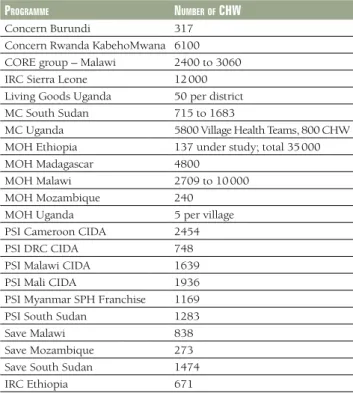
The number of CHW involved was difficult to assess because depended on the time–span of the programme, the degree of scaling up and the different types of health care workers
reached. Table 3 shows the approximate number of CHW
involved in the programmes, when available in the source documents (median 1441, interquartile range 732 to 2582). Disaggregation by CHW gender was only possible for a few programmes. For example, in ‘IRC Sierra Leone’ (26% fe-males and 74% fe-males of 2207 trained CHW), ‘MOH Ethi-opia’ and ‘Save Mozambique’ (all females in both pro-grammes, 137 and 273, respectively), ‘MOH Madagascar’ (half females and half males, of 4800), ‘PSI DRC CIDA’ (4% females and 96% males of 748 CHW), and in ‘Save Malawi’ (25% females and 75% males of 838 CHW).
Programme documents described several types of incen-tives. The majority of incentives were goods and even work equipment and tools (9 of the 17 programmes with data, 53%). Only in Malawi did CHW receive proper salaries. Incentives also included intangibles such as recognition and reputation. In detail:
• ‘incentives architecture’, similar to a career path (‘CHW
Backpack plus’);
• reputation and recognition: ‘MOH Madagascar’, ‘PSI DRC
CIDA’; increase in client flow using services (‘PSI Uganda Five & Alive Franchise’);
• performance–based financing mechanisms (‘Concern
Rwanda KabehoMwana’, ‘PSI Myanmar SPH Franchise’);
• goods: soaps and batteries (‘IRC Sierra Leone’); T–shirt
(‘Living Goods Uganda’); cap, T–shirt, torch, jerry cans, certificates, soap (‘MC Sudan South’); bicycles and T– shirts (‘MC Uganda’); bicycles, uniforms, T–shirts (‘PSI Malawi CIDA’); cellphone (‘PSI Mali CIDA’); sugar, salt, soap, bicycles, gumboots, clear bags and rain jackets (‘PSI South Sudan’); cycles, stainless steel spoons, medicine cups, water cups, plastic medicine bags, basins and a
wa-Table 2. Designation of community health workers (CHW) as documented in the programmes Programme designation of cHW
CHW Backpack Plus Community Health Worker
Concern Burundi Community Health Worker
Agents de Santé Communtaire
Concern Niger Community Health Worker
Concern Rwanda KabehoMwana Community health workers; Community Based Distributors
CORE group – Cameroon Community Health Worker
CORE group – Malawi Health Surveillance Associates
IRC Sierra Leone Community Based Distributors
Living Goods Uganda Sales Representatives or Health Promoters
MC South Sudan Community Drug Distributors; Community Based Distributor ; Community Health Workers
MC Uganda Village Health Team
MOH Ethiopia Health Extension Workers
MOH Madagascar Community Health Volunteers; Agents Communautaires
MOH Malawi Health Surveillance Associates; Community Health Based Workers;
MOH Mozambique Community Health Workers; Agente Polivalente Elementar; Traditional Birth Attendants
MOH Uganda Village Health Team members
PSI Cameroon CIDA Community relais
PSI DRC CIDA Community relais
PSI Malawi CIDA Health Survelliance Agents
PSI Mali CIDA Community Relais
PSI Madagascar Agent de Santé Communitaire
PSI Myanmar SPH Franchise Sun Primary Health
PSI South Sudan Community Based Distributors; front line workers; Home Health Promoters; Community Health Workers
PSI Uganda Five & Alive Franchise Community–based Village Health Team
Save Malawi Health Surveillance Assistants
Save Mozambique Agente Polivalente Elementar
Save South Sudan CBDs = Community Based Distributors
Save Zambia Community Health Workers
USAID BASICS DRC (tools only) Community Health Workers
IRC Ethiopia Health Extension Workers
CIDA – Canadian International Development Agency, DRC – Democratic Republic Congo; IRC – International Red Cross, MC – Malaria Consortium, MOH – Ministry of Health, PSI – Population Services International, SPH – Sun Primary Health
VIEWPOINTSPa
PE
rS
ter container (‘Save Malawi’); soap, jugs, spoons, jerry cans, pair of scissors, medicine bag, pens, lunch and transport during refresher trainings (‘Save South Sudan’);
• percentage of benefits: loan start–up bag with US$ 60
worth of merchandise and 15% to 20% percent of what-ever they sell (‘Living Goods Uganda’);
• per diem and allowances: for training (‘MOH
Madagas-car’); for reporting (‘PSI Cameroon CIDA’); travel allow-ance (‘PSI DRC CIDA’);
• cash: 1575 to 3150 South–Sudan pounds for staff; ‘MOH
Madagascar’ (some CHW); ‘PSI South Sudan’; ‘Save Mo-zambique’;
• salaries: ‘MOH Malawi’, ‘Save Malawi’.
Besides, in some programmes, the training itself (‘PSI Ma-lawi CIDA’) or certificates (‘PSI Madagascar’), supervision (‘PSI DRC CIDA’), supplies and working tools were men-tioned as motivators or incentives to improve CHW per-formance (‘MOH Uganda’, ‘PSI Madagascar’).
Training and supervision
Training schedules, length and approaches varied greatly
across programmes. Table 4 details the length of training
for those programmes which had this information
avail-able. Median training length was 2 weeks (interquartile range from 6 to 43 days), depending on the contents and competences to be achieved.
Training was mainly formal in 8 out of 15 programmes (53%) with information on this area. Other approaches were present in 1 or 2 programmes as detailed below: for-mal training courses or refreshments (eg, annual in Con-cern Rwanda KabehoMwana and IRC Sierra Leone; bian-nual in ‘PSI Cameroon CIDA’; monthly in ‘PSI DRC CIDA’; ‘MC Uganda’, ‘Save Mozambique’, ‘MOH Ethiopia’ or ‘Save South Sudan’), mentorship programmes (‘MOH Madagas-car’), including both theory and practical on–the–job train-ing (e,g. ‘CHW Backpack plus’). Other approaches includ-ed (‘Concern Burundi’): interactive lessons where CHW learned to fill the tools and used their experience, exercis-es, demonstrations and role plays; similarly in ‘MC South Sudan’, ‘PSI DRC CIDA’; or even practical cases in in–pa-tient health facilities (‘MOH Malawi’, ‘Save Malawi’). Only in ‘PSI DRC CIDA’ and ‘PSI Mali CIDA’ documentation it was mentioned that training was conducted using local lan-guages as well.
Training focused on CHW but included other personnel as well (eg, health facility staff and district–level officials in ‘Concern Niger’; caregivers in individual households in ‘CORE–Malawi’); and might have the active involvement of
Table 3. Number of community health workers (CHW) involved*
Programme number of cHW
Concern Burundi 317
Concern Rwanda KabehoMwana 6100
CORE group – Malawi 2400 to 3060
IRC Sierra Leone 12 000
Living Goods Uganda 50 per district
MC South Sudan 715 to 1683
MC Uganda 5800 Village Health Teams, 800 CHW
MOH Ethiopia 137 under study; total 35 000
MOH Madagascar 4800
MOH Malawi 2709 to 10 000
MOH Mozambique 240
MOH Uganda 5 per village
PSI Cameroon CIDA 2454
PSI DRC CIDA 748
PSI Malawi CIDA 1639
PSI Mali CIDA 1936
PSI Myanmar SPH Franchise 1169
PSI South Sudan 1283
Save Malawi 838
Save Mozambique 273
Save South Sudan 1474
IRC Ethiopia 671
CIDA – Canadian International Development Agency, DRC – Democrat-ic RepublDemocrat-ic Congo; IRC – International Red Cross, MC – Malaria Consor-tium, MOH – Ministry of Health, PSI – Population Services International, SPH – Sun Primary Health
*Not all programmes reported information on this area.
Table 4. Duration of training of community health workers (CHW)*
Programme training duration
Concern Burundi 3 weeks
IRC Sierra Leone 6 days
Living Goods Uganda 4 weeks
MC South Sudan 6 days
MC Uganda 5 days
MOH Malawi 10 weeks
MOH Uganda 6 days
MOH Ethiopia 1 year
MOH Madagascar 8 months
PSI Cameroon CIDA 3 days
CORE group – Malawi 8 weeks
PSI DRC CIDA From 2 to 3 days (depending on type of
CHW)
PSI Malawi CIDA 6 days to 10 weeks (depending on
competences)
PSI South Sudan 6 days
Save Malawi 6 days to 12 weeks (depending on
compe-tences)
Save Mozambique 6 days to 4 months
Save South Sudan 7 days
USAID BASICS DRC 6 days
CIDA – Canadian International Development Agency, DRC – Democrat-ic RepublDemocrat-ic Congo; IRC – International Red Cross, MC – Malaria Consor-tium, MOH – Ministry of Health, PSI – Population Services International *Not all programme reported information on this area.
VIEWPOINTS Pa
PE
rS
supervisors in the training (USAID BASICS DRC). A cascade training approach was implemented in ‘Concern Burundi’ where MOH staff trained programme staff and the District Health Team, and then those trained CHW and health cen-tre staff. In ‘MC Sudan South’, ‘MOH Uganda’ and ‘PSI DRC CIDA’ a cascade training was also implemented.
The contents of the training were mainly around clinical care; for example: to assess, classify, refer or treat sick chil-dren; to counsel the caretaker on home management fol-low up; to recognize and treat sick children aged 2 to 59 months with fever, diarrhoea, and pneumonia; to refer chil-dren to health facilities if they were less than 2 months, if they presented with illnesses other than fever, diarrhoea or pneumonia or if they showed any “danger signs”; if there were stock–outs, or if after treatment, the child’s condition failed to improve or worsened (IRC Sierra Leone). Similar skills were targeted in other programmes. Training includ-ed also the use of equipment (eg, respiratory timers in ‘MC Uganda’), Behaviour Change Communication (‘Concern Rwanda KabehoMwana’), reproductive health and family planning (‘MOH Madagascar’), managerial competences and supplies management (‘MOH Uganda’, ‘PSI Cameroon CIDA’, ‘PSI Malawi CIDA’) or gender based violence (‘PSI Malawi CIDA’).
Tools used in the training initiatives included full curricu-lums for clinical care, trainers–of–trainers manuals, facili-tators’ guides, job aids, algorithms or lists of supplies. Two programmes explicitly reported that materials were based on WHO/UNICEF or MOH materials which were adapted to local situations (eg, ‘MC Sudan South’, ‘MOH Malawi’). Supervision was designated or assimilated to several hu-man resources hu-management strategies (eg, hu-managerial su-pervision, clinical susu-pervision, mentorship). In some pro-grammes, several cadres could be responsible for CHW supervision: for example, in ‘Concern Burundi’ supervisors included Concern staff, District Health Teams and health centre staff; in ‘MC Uganda’ included health centres’ staff, Community Development Officers, Health Assistants or Health Inspectors; senior CHW, environmental officer or community nurses (‘MOH Malawi’);community based Health Area focal points and Animateurs District CCM fo-cal points (‘PSI Cameroon); senior CHW, Environmental Health Officers or Health Facility Staff (mentors) (‘PSI Ma-lawi’); senior CHW (routine supervision) and health cen-tres’ clinical staff (clinical mentors) (‘Save Malawi’) In other programmes, supervision was assigned to a single cadre: a community health in–charge (‘Concern Rwanda KabehoMwana’), a senior CHW (‘CORE Malawi’), health centre staff (‘IRC Sierra Leone’), programme officers (‘MC South Sudan’), nursing holders of health areas (‘PSI DRC’), or even community members (‘MOH Uganda’); centre technical director (‘PSI Mali’); field leader of township (‘PSI Myanmar’); CHW supervisors (‘PSI South Sudan’, ‘Save
South Sudan’); chief nurse (or medical technician) (‘Save Mozambique’, ‘USAID BASICS DRC’). No information data was available regarding the gender mix of supervisors. Supervisors undertook a specific training, which ranged from two to nine days, in the six programmes where this information was available. Tools used included guidelines, checklists and training manuals.
The supervisors: CHW ratios varied: 1:2 (‘PSI Malawi’), 1:6 (‘PSI DRC’), 1:6 to 7 (‘Save Mozambique’), 1:8 to 16 (‘IRC Sierra Leone’), 1:10 (‘PSI Cameroon’), 1:11 (‘Save Malawi’) or 1:18 (‘Save South Sudan’).
The frequency of supervisory visits ranged from once a year to three times a month (‘PSI South Sudan’); although in some cases there are reports of CHW not having received a single supervisory visit (eg, ‘MOH Madagascar’). Meetings were also mentioned as supervision–like strategies in seven programmes (37% of the 19 programmes with this infor-mation available) (eg, ‘MOH Ethiopia’ with biannual meet-ings; ‘PSI DRC’ monthly monitoring meetings).
Supervision activities could include any mix of the follow-ing areas of work: clinical skills, submission of reports, analysis of reports and feedback, medical supplies, logis-tics, site management, relations with the community, rec-ommendations or corrective actions.
Interestingly, there were programmes where CHW were working within a more or less formal network of CHW and other providers. For example, teams and team–work was heavily emphasised in ‘Save Zambia’; ‘Care Group Volun-teers’ were reported by ‘Concern Burundi’; and peer sup-port groups based on the Care Group model were imple-mented by ‘Concern Rwanda KabehoMwana’.
Several tools were identified across the documents, some-times clearly highlighted in programmes reports and some other times identified by the reviewers as potentially inno-vative or particularly important programme components. A total of 114 tools have been identified across the whole set of programmes. In summary, they included equipment (eg, a backpack and storage box, a drug calculator, sup-plies, as complements to CHW activities and to support motivation as well); guides (describing procedures or tasks, such as clinical tasks, assessments or supervision); job aids (eg, home–based management; peer–support groups; case management; counselling cards, mother reminder cards); templates for reporting (eg, register and referral forms; CCM register; CCM supervision form; follow–up visit form; medication stock management form); communica-tion tools (eg, home and community boards; flip charts). Other tools included an integrated analogue and digital mobile phone application for real–time stock tracking and reporting or an integrated toolkit map to facilitate the plan-ning of activities within the catchment area of CHW.
VIEWPOINTSPa
PE
rS
Quality of care
Eventually all programmes implemented IMCI care proto-cols in one way or another, which served as an overreach-ing framework for a number of activities with the main components being guidelines, expansion and training of CHW, supervision and often supplies.
Programmes were not uniform in their underlying ‘quality of care’ concept or framework, which was in most cases implicit. Therefore, ‘quality of care’ was approached under different perspectives and dimensions of care across pro-grammes. We extracted information on a limited number of outcomes related to access (ie, utilisation, coverage), ap-propriateness of care (eg, adherence to guidelines) and health outcomes. Programmes reported very different out-comes and there was no full consistency in measurements and reporting approaches.
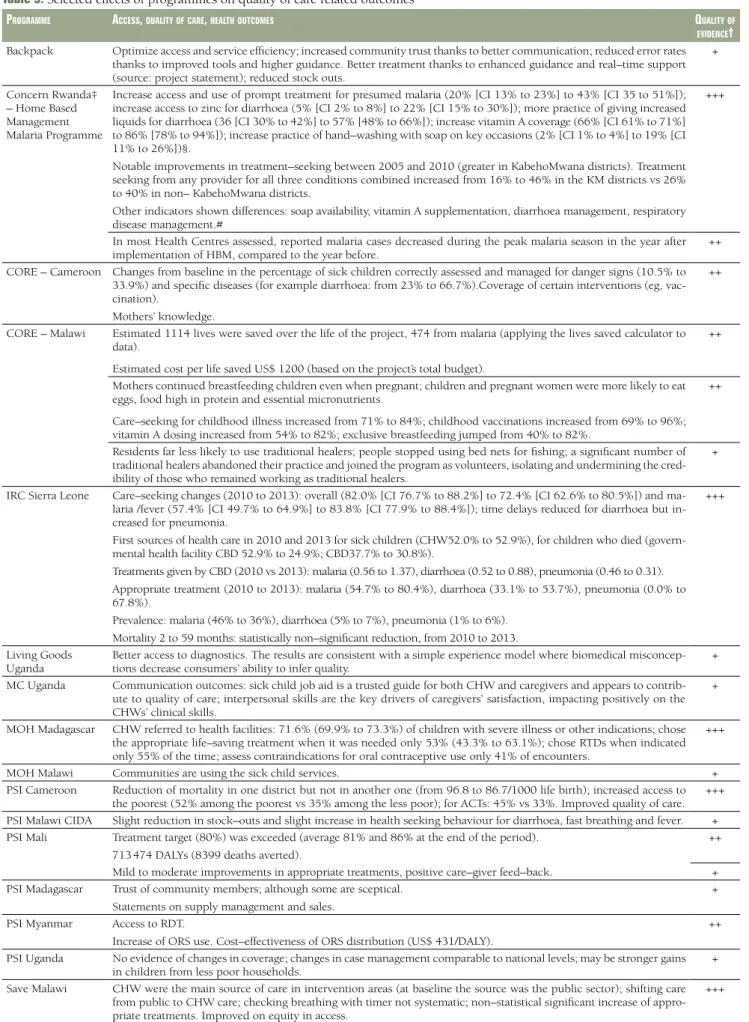
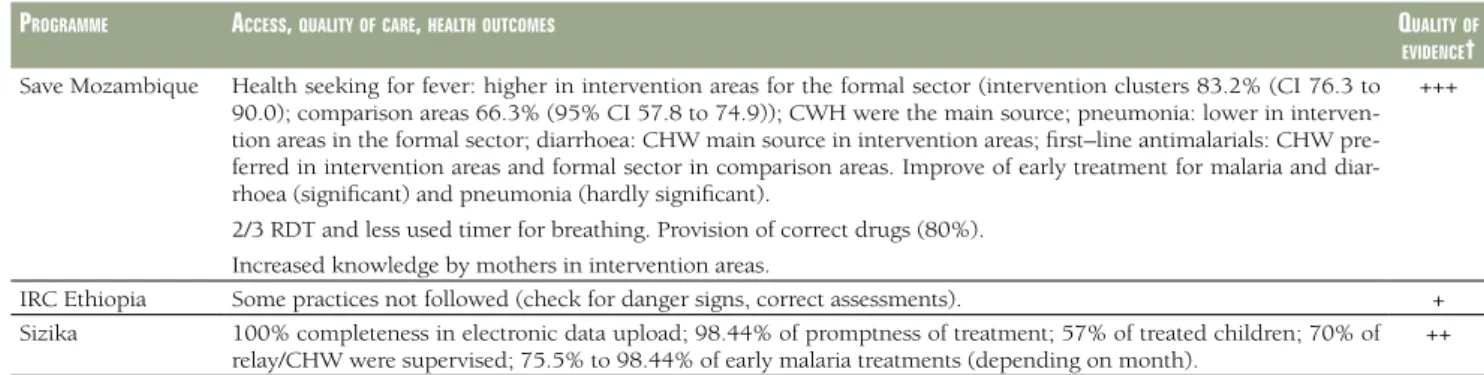
As shown in Table 5, we extracted and grouped reports on
outcomes, selecting those that seemed to be better related to quality of care indicators and better reported. 43% were categorised as qualitative (‘+’), 30% as quantitative (‘++’) and 26% as quantitative with some estimation of statistical significance.
The synthesis of effects on quality of care suggested that there were positive effects for those strategies that involved policy change (‘CORE Cameroon’), organisational change (eg, C–IMCI framework ‘CORE Cameroon’), standardisa-tion (‘Concern Rwanda’), integrastandardisa-tion with existing health care services and alignment with other programmes which may ease implementation and scaling up (‘CORE Malawi’, ‘PSI Mali’).
Quality changes seemed more remarkable in large multi– component programmes which included training of CHW, strengthened supervision and improvement of supply change management. Improvements in monitoring and evaluation procedures seemed to have had positive effects on utilisation rates (‘MOH Ethiopia’). Interestingly, access improved in most programmes, yet achievements were moderate in absolute terms or compared with formal health care (‘Save Malawi’). Geographic and effective access to care increased (‘Save Malawi’). A programme with a component of improvements of information transmission through mo-bile telephones seemed to have increased utilisation of CHW and more prompt management of illnesses.
Other strategies aimed at reinforcing the relations between CHW either with peers or supervisors. Peer–support groups provided a platform for more effective human re-sources interventions (eg, supervision, trust, accountabil-ity; ‘Concern Rwanda’); social franchising (‘PSI Myanmar’) seemed to strengthen networking of providers, alongside an increase in reputation of CHW. Micro–franchising seemed
to achieve affordable improvements in the availability of good quality medical products (‘Living Goods Uganda’). So-cial franchising increased the availability of services at equal or lower costs than regular formal services and supplies with specific data on Oral Rehydration Salts (ORS) distribution (‘PSI Myanmar’). Equity (differentials in access from differ-ent economic strata) was reported in terms of access to CHW, Artemisinin–based Combination Therapy (ACT) and treatments of diarrhoea (‘PSI Cameroon’); social franchising also seemed to improve equity, focusing on the most vul-nerable populations (‘PSI Myanmar’, ‘PSI Uganda’).Yet, at least one programme (‘Save Malawi’) could not find differ-ences in accessing CHW according to wealth.
Effects on caregivers seemed positive, with increases in knowledge, changes in care seeking behaviour (‘PSI Ma-lawi’, ‘PSI Mali’) and caregivers’ basic disease management (‘Concern Rwanda’); clients’ satisfaction with availability of medicines and care increased (‘PSI Cameroon’); and there were some indications that community ownership and ac-countability were strengthened.
Effects of iCCM interventions may not be sustained over time everywhere since there were examples of declining coverage of services (‘PSI Cameroon’) with time. Social franchising showed examples where coverage of services did not seem to increase (‘PSI Uganda’).
In contrast, some of the poor outcomes (eg, clinical man-agement) were related to the shift of care seeking between different types of providers; for example, from formal gov-ernmental services to CHW community based care. Train-ing large numbers of CHW led to the reduction in the use of traditional healers, although this was seen as a positive effect of the programme (‘CORE Malawi’). Introduction of an iCCM programme in an area where care seeking ap-peared generally high resulted in shifting of care from gov-ernment health centres, private health facilities and shops to village health clinics.
Although the aims of this review did not include reporting on mortality, it is worth noting that reductions in mortality were occasionally reported with findings suggesting reduc-tions in some geographical areas but not in others, within the same programme (‘PSI Cameroon’), or not statistically significant reductions (‘IRC Sierra Leone’).
DISCUSSION
We have reviewed 29 iCCM programmes in Sub–Saharan Africa and Myanmar. All programmes were based on iCCM guidelines and principles implemented by CHW, although the way programmes were implemented varied greatly. This review had some limitations: it is likely that more program-matic or research information could have been found with
VIEWPOINTS Pa
PE
rS
Table 5. Selected effects of programmes on quality of care related outcomes*
Programme access, qualitY of care, HealtH outcomes qualitY of
evidence†
Backpack Optimize access and service efficiency; increased community trust thanks to better communication; reduced error rates
thanks to improved tools and higher guidance. Better treatment thanks to enhanced guidance and real–time support (source: project statement); reduced stock outs.
+
Concern Rwanda‡ – Home Based Management Malaria Programme
Increase access and use of prompt treatment for presumed malaria (20% [CI 13% to 23%] to 43% [CI 35 to 51%]); increase access to zinc for diarrhoea (5% [CI 2% to 8%] to 22% [CI 15% to 30%]); more practice of giving increased liquids for diarrhoea (36 [CI 30% to 42%] to 57% [48% to 66%]); increase vitamin A coverage (66% [CI 61% to 71%] to 86% [78% to 94%]); increase practice of hand–washing with soap on key occasions (2% [CI 1% to 4%] to 19% [CI 11% to 26%])§.
Notable improvements in treatment–seeking between 2005 and 2010 (greater in KabehoMwana districts). Treatment seeking from any provider for all three conditions combined increased from 16% to 46% in the KM districts vs 26% to 40% in non– KabehoMwana districts.
Other indicators shown differences: soap availability, vitamin A supplementation, diarrhoea management, respiratory disease management.#
+++
In most Health Centres assessed, reported malaria cases decreased during the peak malaria season in the year after
implementation of HBM, compared to the year before. ++
CORE – Cameroon Changes from baseline in the percentage of sick children correctly assessed and managed for danger signs (10.5% to 33.9%) and specific diseases (for example diarrhoea: from 23% to 66.7%).Coverage of certain interventions (eg, vac-cination).
Mothers’ knowledge.
++
CORE – Malawi Estimated 1114 lives were saved over the life of the project, 474 from malaria (applying the lives saved calculator to
data).
Estimated cost per life saved US$ 1200 (based on the project’s total budget).
++
Mothers continued breastfeeding children even when pregnant; children and pregnant women were more likely to eat eggs, food high in protein and essential micronutrients.
Care–seeking for childhood illness increased from 71% to 84%; childhood vaccinations increased from 69% to 96%; vitamin A dosing increased from 54% to 82%; exclusive breastfeeding jumped from 40% to 82%.
++
Residents far less likely to use traditional healers; people stopped using bed nets for fishing; a significant number of traditional healers abandoned their practice and joined the program as volunteers, isolating and undermining the cred-ibility of those who remained working as traditional healers.
+
IRC Sierra Leone Care–seeking changes (2010 to 2013): overall (82.0% [CI 76.7% to 88.2%] to 72.4% [CI 62.6% to 80.5%]) and
ma-laria /fever (57.4% [CI 49.7% to 64.9%] to 83.8% [CI 77.9% to 88.4%]); time delays reduced for diarrhoea but in-creased for pneumonia.
First sources of health care in 2010 and 2013 for sick children (CHW52.0% to 52.9%), for children who died (govern-mental health facility CBD 52.9% to 24.9%; CBD37.7% to 30.8%).
Treatments given by CBD (2010 vs 2013): malaria (0.56 to 1.37), diarrhoea (0.52 to 0.88), pneumonia (0.46 to 0.31). Appropriate treatment (2010 to 2013): malaria (54.7% to 80.4%), diarrhoea (33.1% to 53.7%), pneumonia (0.0% to 67.8%).
Prevalence: malaria (46% to 36%), diarrhoea (5% to 7%), pneumonia (1% to 6%). Mortality 2 to 59 months: statistically non–significant reduction, from 2010 to 2013.
+++
Living Goods
Uganda Better access to diagnostics. The results are consistent with a simple experience model where biomedical misconcep-tions decrease consumers’ ability to infer quality. +
MC Uganda Communication outcomes: sick child job aid is a trusted guide for both CHW and caregivers and appears to
contrib-ute to quality of care; interpersonal skills are the key drivers of caregivers’ satisfaction, impacting positively on the CHWs’ clinical skills.
+
MOH Madagascar CHW referred to health facilities: 71.6% (69.9% to 73.3%) of children with severe illness or other indications; chose
the appropriate life–saving treatment when it was needed only 53% (43.3% to 63.1%); chose RTDs when indicated only 55% of the time; assess contraindications for oral contraceptive use only 41% of encounters.
+++
MOH Malawi Communities are using the sick child services. +
PSI Cameroon Reduction of mortality in one district but not in another one (from 96.8 to 86.7/1000 life birth); increased access to
the poorest (52% among the poorest vs 35% among the less poor); for ACTs: 45% vs 33%. Improved quality of care. +++
PSI Malawi CIDA Slight reduction in stock–outs and slight increase in health seeking behaviour for diarrhoea, fast breathing and fever. +
PSI Mali Treatment target (80%) was exceeded (average 81% and 86% at the end of the period).
713 474 DALYs (8399 deaths averted).
++
Mild to moderate improvements in appropriate treatments, positive care–giver feed–back. +
PSI Madagascar Trust of community members; although some are sceptical.
Statements on supply management and sales.
+
PSI Myanmar Access to RDT.
Increase of ORS use. Cost–effectiveness of ORS distribution (US$ 431/DALY).
++
PSI Uganda No evidence of changes in coverage; changes in case management comparable to national levels; may be stronger gains
in children from less poor households. +
Save Malawi CHW were the main source of care in intervention areas (at baseline the source was the public sector); shifting care
from public to CHW care; checking breathing with timer not systematic; non–statistical significant increase of appro-priate treatments. Improved on equity in access.
VIEWPOINTSPa
PE
rS
more time and resources; information was typically re-trieved from evaluation studies or programmatic docu-ments rather than experimental, controlled research studies providing moderate to low quality evidence; finally, report-ing bias could not be excluded since only reports provided by a selection of stakeholders were included in this review. While programmatic information provides invaluable evi-dence on processes, the lack of more robust evievi-dence on the effects of the programmes precludes any attempt to re-late processes with outcomes. Findings from this review are not and cannot be representative of iCCM programmes and cannot be extrapolated to any particular setting. However, they are meant to help to draw lessons from those pro-grammes proposed included in this review.
iCCM was defined by its objectives by WHO/UNICEF in 2012: “to train, supply and supervise front–line workers to treat children for both diarrhoea and pneumonia, as well as for malaria in malaria–affected countries, suing ORS and zinc, oral antibiotics, and artemisinin–based combination therapy (ACT) ... iCCM also enables community health workers to identify children with severe acute malnutrition through the assessment of mid–upper–arm circumference (MUAC)” [4]. This definition shares the objectives and re-sembles the old definition of selective primary health care (PHC) (1979): “a circumscribed number of diseases are
se-lected for prevention in a clearly defined population ... The principal recipients of care would be children up to three years old and women in the childbearing years. The care provided would be measles and diphtheria–pertussis–teta-nus (DPT) vaccination for children over six months old, tetanus toxoid to all women of childbearing age, encour-agement of long–term breast feeding, provision of chloro-quine for episodes of fever in children under three years old in areas where malaria is prevalent and, finally, oral re-hydration packets and instruction” [10].Similarities be-tween both approaches suggest that iCCM is not an entire-ly new strategy, but rather it shares and it may be inspired by key features of selective PHC.
In this article we focused on the description of programmes and quality of care issues. iCCM programmes are com-posed by a mix of multiple interventions or strategies; namely, disease portfolios, CHW arrangements, clinical skills, supplies, referral systems, training, supervision, community support and policy changes. These compo-nents are implemented in different combinations and in-tensities depending on the country or setting where pro-grammes operate, donors’ preferences and country health related policies, among other factors. It was appealing to us that, in fact, the term ‘iCCM’ embraced a large plethora of very different programmes which may have limited
com-Programme access, qualitY of care, HealtH outcomes qualitY of
evidence†
Save Mozambique Health seeking for fever: higher in intervention areas for the formal sector (intervention clusters 83.2% (CI 76.3 to
90.0); comparison areas 66.3% (95% CI 57.8 to 74.9)); CWH were the main source; pneumonia: lower in interven-tion areas in the formal sector; diarrhoea: CHW main source in interveninterven-tion areas; first–line antimalarials: CHW pre-ferred in intervention areas and formal sector in comparison areas. Improve of early treatment for malaria and diar-rhoea (significant) and pneumonia (hardly significant).
2/3 RDT and less used timer for breathing. Provision of correct drugs (80%). Increased knowledge by mothers in intervention areas.
+++
IRC Ethiopia Some practices not followed (check for danger signs, correct assessments). +
Sizika 100% completeness in electronic data upload; 98.44% of promptness of treatment; 57% of treated children; 70% of
relay/CHW were supervised; 75.5% to 98.44% of early malaria treatments (depending on month). ++
CI –confidence interval, CIDA – Canadian International Development Agency, DALY – disability adjusted life years, DRC – Democratic Republic Congo, HBM – home based management of malaria, IRC – International Red Cross, MC – Malaria Consortium, MOH – Ministry of Health, ORS – oral rehydra-tion salts, PSI – Popularehydra-tion Services Internarehydra-tional, RDT – rapid diagnostic test
*Not all programme reported information on this area.
†Sources of evidence are qualitative data or opinions (+), quantitative methods described in the source documents (++), or findings are presented with some measure of statistical significance (+++).
‡Two similar documents sharing a common author and similar sources were available on the Peer Support Group topic specifically so the outcomes were captured from the most comprehensive document (PSG Review paper). Case study on Peer Support Group drawing from primary and secondary data collected as part of the KabehoMwana project final evaluation, prepared for the iCCM Symposium evidence review; consists of an adaptation of a longer paper describing experiences from the USAID-funded KabehoMwana project in Rwanda. Review paper on Peer Support Group combining participant observations from designers and implementers of the CHW PSG model, with project monitoring and routine monitoring data, findings from primary and secondary data collected as part of the KabehoMwana final evaluation; and other available studies in the grey literature.
§Final project external evaluation (2011) with a knowledge, practice and coverage survey, comparison with 2007 baseline. Interviews were conducted with 120 mothers of children 0 to 23 mo, and 395 mothers of children 0 to 59 months who had been sick in the last two weeks with at least one the following conditions: fever or malaria, diarrhoea, respiratory symptoms. In total, 120 villages were sampled, and 473 households were interviewed. Household selection was made according to an algorithm.
#Demographic and Health Surveys 2005 and 2010. Table 5. Continued
VIEWPOINTS Pa
PE
rS
monalities between them in some cases. Most studies, trials or evaluations clearly deal with key factors affecting the performance of CHW, the quality of care they provide and, eventually, clinical outcomes. These factors included sup-plies, CHW supervision, training, quality of care and reten-tion of CHW [11], among others.
A contribution of this review of iCCM programmes has been to systematically identify and present innovative or promising approaches; such us: integration with other pro-grammes to boost effectiveness; integration with the pri-vate, public and traditional sectors, coordination with stakeholders to align resources and expertise in different areas of work. Stock management and availability of med-icines seemed to be key in several programmes in effective-ly supporting CHW activities and ensuring credibility. Measuring quality of care in the context of CCM is chal-lenging and different approaches and measurement meth-ods may lead to different descriptions of the same situations [12]. The number of quality of care indicators is very large and their types extremely varied, for example from the availability of inputs to the achievement of outputs and outcomes, from knowledge to health status outcomes, and the perspectives of supply– and demand–side. Therefore, one could argue that it is easy to find examples of positive effects when a large number of indicators are measured, as was the case in the programmes we have reviewed. As in other reviews, care seeking behaviour and utilisation of treatments tended to show positive, albeit variable, effects across the different programmes [5]. Not so often, exam-ples of no effect were found; even less frequently, negative effects were identified (reporting bias of positive outcomes could not be investigated nor ruled out). Interestingly, the shift of utilisation from traditional healers to CHW was re-ported as a positive outcome, when actually this might not necessarily be seen as a desirable outcome (‘Core Malawi’). We acknowledge, that quality of care is a means to achieve better health related outcomes, such as morbidity and tality [13]. Only limited evidence on morbidity and mor-tality has been included in the documents of the pro-grammes we have scrutinised. Interestingly, there are variations in the effects of community based management across conditions. For example, a review of the evidence on the effects of community based management of pneu-monia in Africa, which included published studies in Eng-lish or French (excluding non–pubEng-lished reports), using any primary study design, could not find evidence of im-pact on morbidity and mortality and raised several imple-mentation concerns related to CHW capacity to manage pneumonia [6]; although more promising findings were reported in another review which included studies from Asia [5]. More positive findings were reported in a system-atic review of experimental or quasi–experimental studies
in Sub–Saharan Africa on the effects of CCM on malaria outcomes [14]; for example, significant reduction of ma-laria deaths in Ethiopia and Uganda, although no effects were observed on other clinical outcomes (eg, hospitalisa-tions, anaemia). Often, though, the quality of evidence is not optimal [15].An additional issue to consider is the role of programme characteristics (ie, the specific implementa-tion approaches) and the context. The scope of our review does not allow to drawing conclusions about differences on iCCM performance in different geographical areas (eg, Africa or Asia); however, where evidence exists, these dif-ferences have not stood out [5].
CONCLUSIONS
We attempted to provide some insights on the effects of iCCM intervention in quality of care indicators, despite the fact that scoping reviews do not aim at establishing effects of interventions. Large, multi–faceted, integrated iCCM programmes, with strong components of training, supervi-sion, which included additional support of equipment and supplies, provided examples of improvements in selected quality of care outcomes. However, examples of modest, null and somehow adverse effects were also shown. We could not establish which mix of interventions or strat-egies (eg, supervision, training and incentives) produced which effects on quality of care. Evidence on the main com-ponents exists; for example, on lay health workers [16], supervision [17], training or job aids [18]; but not on the mix of those interventions which lead to better outcomes and under which conditions. We are afraid that this is also the case for the reviews and studies we have recently ac-cessed. Inevitably, the effects of innovative approaches (eg, networking between CHW peers, mentorship), which were used and seemed promising in some cases, remained di-luted in the body of low quality evidence that could be ex-tracted from programmatic documents. The lack of good quality evidence is not only a concern for the international health community, but also for policy makers [19] who may not recognise the value of an approach which may not have been robustly evaluated and reported. May be evi-dence on the strengths and limitations of selective PHC could have also informed more recent initiatives to imple-ment iCCM.
In the absence of good quality evidence, research evidence has to be produced [20] and, in the meantime, good qual-ity global guidance on what iCMM ‘formula(s)’ are more promising under different circumstances, needs to be elab-orated with tools to adapt it to local settings [21]. A re-search agenda, and eventually guidance developers, would benefit from a series of actions spearheaded by the iCCM task force; namely: (i) standardisation of iCCM concepts,
VIEWPOINTSPa
PE
rS
strategies and tools; (ii) establishment and reinforcement of evaluation methodological standards, including proto-cols for selecting and reporting on primary outcomes, harms and costs; (iii) mapping existing research to avoid duplications and search synergies, emphasising pragmatic
research of integral approaches rather than for individual diseases; (iv) establishing a few manageable priority re-search areas; (v) creating an open, structured, transparent and comprehensive online platform to share evidence on iCCM with quality assessments of the evidence presented.
Acknowledgements: To Helen Counihan (Malaria Consortium), Michelle Geiss, Abigail Pratt (PSI), Alyssa Sharkey (UNICEF) and Alexa Wharton-Smith, for their support and assistance in several phases of the review; their insights were instrumental to complete this work.
Funding: The study was funded by UNICEF, through the Swiss TPH.
Disclaimer: The views and ideas expressed herein are those of the author(s) and do not necessar-ily imply or reflect the opinion of the Institute.
Authorship declaration: XBC drafted the protocol, set up and supervised the data extraction tools, led the analyses and drafted the manuscript. CM contributed to the protocol, extracted the data, contributed to the analyses and commented on the manuscript.
Competing interests: All authors have completed the Unified Competing Interest form atwww.ic-mje.org/coi_disclosure.pdf (available on request from the corresponding author). Dr. Bosch-Cap-blanch reports grants from Swiss TPH, during the conduct of the study.
r E FE r E N C E S
1 Jones G, Steketee RW, Black RE, Bhutta ZA, Morris SS; Bellagio Child Survival Study Group. How many child
deaths can we prevent this year? Child survival II. Lancet. 2003;362:65-71. Medline:12853204doi:10.1016/
S0140-6736(03)13811-1
2 Donabedian A. Evaluating the quality of medical care, 1966. Milbank Q. 2005;83:691-729. Medline:16279964
doi:10.1111/j.1468-0009.2005.00397.x
3 Van Lerberghe W, Matthews Z, Achadi E, Ancona C, Campbell J, Channon A, et al. Country experience with
strengthening of health systems and deployment of midwives in countries with high maternal mortality. Lancet.
2014;384:1215-25. Medline:24965819doi:10.1016/S0140-6736(14)60919-3
4 Young M, Wolfheim C, Marsh DR, Hammamy D. World Health Organization/United Nations Children's Fund
Joint Statement on integrated community case management: An equity-focused strategy to improve access to
essential treatment services for children. Am J Trop Med Hyg. 2012;87(5 Suppl):6-10. Medline:23136272
doi:10.4269/ajtmh.2012.12-0221
5 Das JK, Lassi ZS, Salam RA, Bhutta ZA. Effect of community based interventions on childhood diarrhea and
pneumonia: uptake of treatment modalities and impact on mortality. BMC Public Health. 2013;13(Suppl 3):S29.
Medline:24564451doi:10.1186/1471-2458-13-S3-S29
6 Druetz T, Siekmans K, Goossens S, Ridde V, Haddad S. The community case management of pneumonia in
Af-rica: a review of the evidence. Health Policy Plan. 2013. Epub ahead of print. Medline:24371218doi:10.1093/
heapol/czt104
7 Higgins JPT, Green S, editors. Cochrane Handbook for Systematic Reviews of Interventions Version 5.1.0
[up-dated March 2011]. The Cochrane Collaboration, 2011. Available from: www.cochrane–handbook.org. Accessed: 5 October 2014.
8 Population Services International. What is social franchising? Available at: http://www.psi.org/social–franchis-ing–solution–inadequate–health–care–coverage–developing–world. Accessed: 5 October 2014.
9 Living Goods. Micro–franchising. Available at: http://livinggoods.org/what–we–do/micro–franchise–business–
model/. Accessed: 5 October 2014.
10 Walsh JA, Warren KS. Selective primary health care: an interim strategy for disease control in developing
coun-tries. N Engl J Med. 1979;301:967-74. Medline:114830doi:10.1056/NEJM197911013011804
11 United Nations Children’s Fund. Review of systematic challenges to the scale–up of integrated community case
management emerging lessons & recommendations from the catalytic initiative (CI/IHSS). New York: UNICEF, 2012. Available at: http://www.unicef.org/infobycountry/files/Analysis_of_Systematic_Barriers_cover_1163.pdf. Accessed: 10 October 2014.
12 Cardemil CV, Gilroy KE, Callaghan–Koru JA, Nsona H, Bryce J. Comparison of methods for assessing quality of
care for community case management of sick children: an application with community health workers in
VIEWPOINTS Pa
PE
rS
13 Marsh DR, Hamer DH, Pagnoni F, Peterson S. Introduction to a special supplement: Evidence for the
implemen-tation, effects, and impact of the integrated community case management strategy to treat childhood infection.
Am J Trop Med Hyg. 2012;87(5 Suppl):2-5. Medline:23136271doi:10.4269/ajtmh.2012.12-0504
14 Smith Paintain L, Willey B, Kedenge S, Sharkey A, Kim J, Buj V, et al. Community health workers and stand–
alone or integrated case management of malaria: A systematic literature review. Am J Trop Med Hyg. 2014;91:461-70. Medline:24957538doi:10.4269/ajtmh.14-0094
15 Ruizendaal E, Dierickx S, Peeters Grietens K, Schallig HD, Pagnoni F, Mens PF. Success or failure of critical steps in community case management of malaria with rapid diagnostic tests: a systematic review. Malar J. 2014;13:229.
Medline:24924295doi:10.1186/1475-2875-13-229
16 Lewin S, Munabi–Babigumira S, Glenton C, Daniels K, Bosch–Capblanch X, van Wyk BE, et al. Lay health
work-ers in primary and community health care for maternal and child health and the management of infectious
dis-eases. Cochrane Database Syst Rev. 2010;(3):CD004015. Medline:20238326
17 Bosch–Capblanch X, Liaqat S, Garner P. Managerial supervision to improve primary health care in low– and
middle–income countries. Cochrane Database Syst Rev. 2011;(9):CD006413. Medline:21901704
18 Jennings L, Yebadokpo AS, Affo J, Agbogbe M. Antenatal counseling in maternal and newborn care: use of job
aids to improve health worker performance and maternal understanding in Benin. BMC Pregnancy Childbirth.
2010;10:75. Medline:21092183doi:10.1186/1471-2393-10-75
19 Bennett S, George A, Rodriguez D, Shearer J, Diallo B, Konate M, et al. Policy challenges facing integrated
com-munity case management in Sub–Saharan Africa. Trop Med Int Health. 2014;19:872-82. Medline:24750516
doi:10.1111/tmi.12319
20 Hamer DH, Marsh DR, Peterson S, Pagnoni F. Integrated community case management: next steps in
address-ing the implementation research agenda. Am J Trop Med Hyg. 2012;87(5 Suppl):151-3. Medline:23136291
doi:10.4269/ajtmh.2012.12-0505
21 Lavis JN, Rrˇttingen JA, Bosch–Capblanch X, Atun R, El–Jardali F, Gilson L, et al. Guidance for evidence–informed policies about health systems: linking guidance development to policy development. PLoS Med. 2012;9:e1001186.
Medline:22427746doi:10.1371/journal.pmed.1001186 r E FE r E N C E S