Some Studies in Machine Learning
Using the Game of Checkers
Arthur L. Samuel
Abstract: Two machine-learning procedures have been investigated in some detail usi!Jg the game of checkers. Enough work has been done to verify the fact that a computer can be programmed so that it will learn to playa better game of checkers than can be played by the person who wrote the program. Further-more, it can learn to do this in a remarkably short period of time (8 or 10 hours of machine-playing time) when given only the rules of the game, a sense of direction, and a redundant and incomplete list of parameters which are thought to have something to do with the game, but whose correct signs and relative weights are unknown and unspecified. The principles of machine learning verified by these 'experiments are, of course, applicable to many other situations.
Introduction
The studies reported here have been concerned with the progr;Jmming of a uigital computer to behave in a way which. if done by human beings or animals, would be descrihcu as involving the process of learning. While this is not thc place to uwell on the importance of ma-chinc-learning proceuures. or to uiscourse on the philo-sophical aspccts,I there is obviously a very large amount nf \\'L)rk. now done hy people. which is quite trivial in its uemanus on the intellect hut does, nevertheless, involve some learning. We have at our command computers with adequate data-handling ahility and with sufficient ,com-putational specd to make use of machine-learning tech-niqucs. hut our knowledge of the basic principlcs of these tcchniqucs is still rudimentary. Lacking such knowledge, it is neccssary to spccify methods of problcm solution in minute anu ~xact uetaiL a time-consuming and costly pr0cedurc. Programming computers to learn from ex-perienec shoulu eventual Iv eliminatc the need for much of this dctailed programm'ing erfort.
• Ge/ll'l'lll /llelhodl' of llpproach
At thc outset it might he well to distinguish sharply be-twccn two gcncral approaches to thc problem of machine learning. One method. which might be called the Nellral-Xel ApproliCh. ueals with the possibility of inducing learncd hchavior into a randomly connected switching nct (or its simulation on a digital computer) as a result of a rewaru-and-punishment routine. A seconu. and 1l1uch Illorc ctlicient approach, is to prouucc the equiva-lent nf a highly organizeu network which has been de-signcd tn Icarn nnly certain specific things. The first
Originally published inIBMJournal, Vol. 3, No.3. July, 1959.
method should lead to the dcvelopmcnt of general-pur-pose learning machines. A comparison between the size of the switching nets that can be reas,?nably constructed or simulated at the present time and the size of the neural nets used by animals, suggests that we have a long way to go before we obtain practical devices.~ The second procedure requires rcprogramming for each new applica-tion. but it is capable of realization at the present time. The experimcnts to be describcd here were based on this second approach.
• Choice of prohlem
For some years the writer has devotcd his spare time to the subject of machine learning and has concentrated on the development of learning proccdures as applied to games.:: A game provides a convenient vehicle for such study as contrasted with a problem taken from life, since many of the complications of dctail are removed. Checkers. rather than chcss,4-7 was chosen because the simplicity of its rules permits greater emphasis to be placed on learning techniques. Regardless of the relative meritscfthe two games as intellectual pastimes, it is fair to state that checkers contains all of the basic characteris-tics of an intellectual activity in which heuristic proce-dures and learning processes can playa major role and in which these processes can be evaluated.
Some nf these· characteristics might well be enumer-ated. They are:
(l) The activity must not be deterministic in the prac-tical sense. Therc exists no known algorithm which will guarantee a win or a draw in checkers, and the complete
536
Improving the Efficiency of a Problem Solver
explorations of every possible path through a checker
game would involve perhaps 10.111 choices of moves
which. at 3 choices per millimicrosecond. would still take 1O~I centuries to consider.
(2) A definite goal must exist-the winning of the
game-and at least one criterion or intermediate goal must exist which has' a bearing on the achievement of the final goal and for which the sign should be known. In checkers the goal is to deprive the opponent of the pos-sibility of moving, and the dominant criterion is the number of pieces of each color on the board. The im-portance of having a known criterion will be discussed later.
(3) The rules of the activity must be definite and they should be known. Games satisfy this requirement. Un-fortunately, many problems of economic importance do not. While in principle the determination of the rules can be a part of the learning process, this is a complication which might well be left until later.
(4) There should be a background of knowledge con-cerning the activity against which the learning progress can be tested.
(5) The activity should be one that is familiar to a substantial body of people so that the behavior of the program can be made understandable to them. The ability to have the program play against human oppo-nents (or antagonists) adds spice to the study and, inci-dentally, provides a convincing demonstration for those who do not believe that machines can learn.
Having settled on the game of checkers for our learn-ing studies, we must, of course, first program the com-puter to play legal check~rs;that is, we must express the rules of the game in macl:Jine language and we must ar-range for the mechanics. of accepting an opponent's moves and of reporting the computer's moves, together with all pertinent data desired by the experimenter. The
general methods for doing this were described by
ShannonHin 1950 as applied to chess rather than check-ers. The basic program used in these experiments is quite
similar to the program described by Strachey9 in 1952.
The availability of a larger and faster machine (the IBM 704), coupled with many detailed changes in the programming procedure, leads to a fairly interesting game being played, even without any learning. The basic forms of the program will now be described.
The basic checker-playing program
The computer plays by looking ahead a few moves and by evaluating the resulting board positions much as a human player might do. Boal d positions are stored by sets of machine words. four words normally being used to represent any particular board position. Thirty-two bit positions (of the 36 available in an IBM 704 word) are, by convention, assigned to the 32 playing squares on the checkerboard, and pieces appearing on these squares are represented by I's appearing in the assigned bit positions of the corresponding word. "Looking-ahead" is prepared for by computing all possible next moves, starting with a
given board position. The indicated moves are explored in turn by producing new hoard-position records cor-responding .to the conditions after the move in question (the old board positions being saved to facilitate a return to the starting. poinn and the process can be repeated. This look-ahead procc;dure is carried several moves in advance, as illustrated in Fig. ·1.. The resulting board pe-sitions are then scored in terms of their relative value to the machine.
The standard method of scoring the resulting board positions has been in terms of a linear polynomial. A number of schemes of an abstract sort were tried for evaluating board positions without regard to the usual checker concepts, but none of these was suecessfuI.IO One way of looking at the various terms in the scoring polynomial is that those terms with numerically small coefficients should measure criteria related as intermedi-ate goals to the criteria measured l'y the larger terms. The achievement of these intermediate goals indicates that the machine is going in the right direction, such that the larger terms win. eventually increJse. If the program could look far enough ahead we need only ask, "Is the machine still in' 'the game?,~J.l Since it cannot look this far ahead in the usual situation, we must substitute some-thing else, say the piece ratio, and let the machine con-tinue the look-ahead until one side has gained a piece advantage. But even this is not always possible, so we have the program test to see if the machine has gained a positional advantage, et cetera. Numerical measures of these various properties of the board positions are then added together (each with an appropriate coefficient which defines its relative importance) to form the evalu-ation polynomial.
More 3pecifically, as defined by the rules for checkers, the dominant scoring parameter is the inability for one side or the other to move,12 Since this can occur but once in any game, it is tested for separately and is not included in the scoring polynomial as tabulated by the computer during play. The next parameter to be considered is the relative piece advantage. It is always assumed that it is to the machine's advantage to reduce the number of the opponent's pieces as compared to its own. A reversal of the sign of this. term will, in fact, cause the program to play "give-away" checkers, and with learning it can only learn to playa better and better give-away game. Were
the sign of this term not known by the programmer it
could. of course, be determined by tests, but it must be fixed by the experimenter and, in effect, it is one of the instructions to the machine defining its task. The nu-merical computation of the piece advantage has been ar-ranged in such a way as to account for the well-known property that it is usually to one's advantage to trade pieces when one is ahead and to avoid trades when behind. Furthermore, it is assumed that kings are more valuable than pieces, the relative weights assigned to
them being three to twO.13 This ratio means that the
program will trade three men for two kings, or two kings for three men. if by so doing it can obtain some positional advantage.
-4.3.3
Some Studies
in
Machine Learning Using the Game of Checkers
537
INITIAL BOARD POSITION - - -
•
.' !
....
.' j '. . \ ;\,
.
. i . i ., '. 3 4 / \ .I . '.
, .•
•
•
1
·
!
5 6 7 8 .,./ !\.
-
~\
•
•
•
, I ' .: :.' \ / 9 11 10/ A\
•
•
•
• •
•
•
• • • • •
Figure I A "tree" of moves which might be investigated during the look-ahead procedure. The actual branchings are much more numerous than those shown, and the "tree" is apt to extend to as many as 20 levels.
538
Improving the Efficiency of a Problem Solver
Th~ Chllic~ for lh~ paralllcl~rsto follow this first t~rlll
llf th~scoring polynlllllial and thcircocllici~nts th~n b~
Clllll~S a Illatter of concern. Two cours~s ar~
open-~ith~r the experilll~ntcr can d~cid~ what these suhse-ljuentt~rmsare to h~.or he can arrange for the program to make the s~kction.We will discuss the first case in some detail in connection with the rot~-Icarningstudies am! leave for a lat~r sedion the discussion of various program methods of s~lcctingparameters and adjusting their coetlicients.
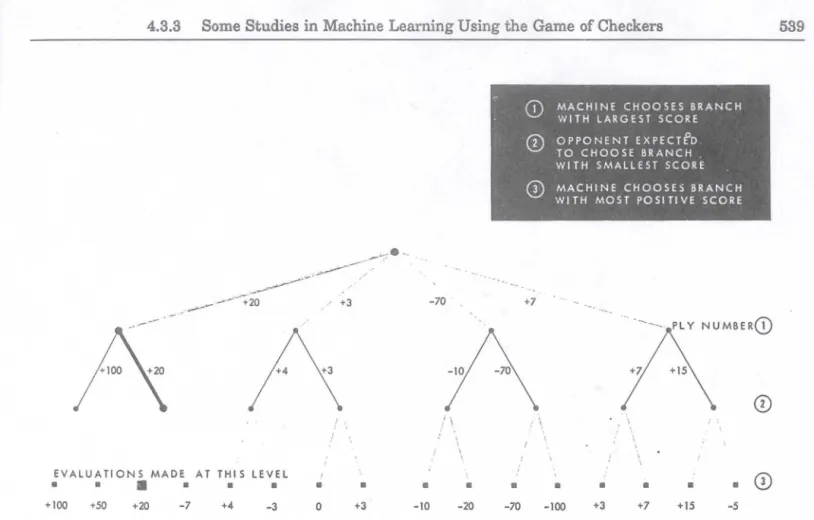
It is not satisfactory to s~lect the initial move which kads to the hoard position with the highest score, since to reach this position would require the cooperation of the opponent. Instead. an analysis must he made pro-ceeding h(/ck \I"(/rd from the evaluated board positions through the "tree" of possible moves, each time with consideration of the intent of the side whose move is being examined, assuming that the opponent would always attempt to minimize the machine's score while the machine acts to maximize its score. At each branch point, then. the corresponding hoard position is given the score of the hoard position which would result from the most favorahle move. Carrying this "minimax" pro-cedure hack to the starting point results in the selection of a "best move." The score of the board position at the end of the most likely chain is also brought back. and for learning purposes this score is now assigned to the pres-ent board position. This process is shown in Fig. 2. The best move is executed, reported on the console lights. and tabulated by the printer.
The opponent is then permitted to make his move, which can be communicated to the machine either by means of console switches or by means of punched cards. The computer verifies the legality of the oppo-nent's move, rejectingl-I or accepting it, and the process
is repeated. \Vhen the program can look ahead and pre-dict a win, this fact is reported on the printer. Similarly, the program concedes when it sees that it is going to lose.
• Ply lilllilatiolls
Playing-time considerations make it necessary to limit the look-ahead distance to some fairly small value. This distance is defined as the ply (a ply of 2. consisting of one proposed move hy the machine and the anticipated reply by the opponent). Th~ply is not fixed hut depends upon the dynamics of the situation. and it varies from move to move and from branch to branch during the move analysis. A great many schemes of adjusting the look-ahead distance have been tried at various times, some of them quite complicated. The most effective one. although quite detailed. is simple in concept and is as follows. The program always looks ahead a minimum Llistance. which for the op~ninggame and without learn-ing is usually set at three moves. At this minimum ply the program will evaluate the boarLl position if none of the following conditions llCCurS: (I) the next move is a jump. (2) the last move was a jump. or (3) an exchange olIcr is possihk. Ifanyon~of these conditions exists. the
program continues looking aheaLl. At a ply of 4 the program will stop and evaluate the resulting board posi-tion if condiposi-tions (I) and(3)ahove arc not met. At a ply of 5 or greater. the program stops the look-ahead when-ever the next ply level docs not offer a jump. At a ply of I I or greater. the 'program will terminate the look-aheaLl. even if the next move i,;"to he a jump, should one siLle at this time be ahead by more than two kings (to prevent the needless exploration of obviously losing or winning sequences), The program stops at a ply of 20 regardkss of all conditions (since the memory space for the look-ahead moves is then exhausted) and an adjust-ment in score is made to allow for the pending jump. Finally. an adjustment is made in the levels of the break points between the different conditions when time is saved through rotc learning (see below) and when the total number of pieces on the board falls below an arbi-trary number. All break points are determined by single data words which can be changed at any time by manual intervention.
This tying of the' ply with board conditions achieves three desired re~ults. In the first place. it permits board evaluations to be· made und'cr conditions of relative sta-bility for so-called dead positions. as defined byTuring.l~
Secondly, it causes greater surveillance of those paths which offer better opportunities for gaining or losing an advantage. Finally, since branching is usually seriously restricted by a jump situation. the total number of board positions and moves to be considered is still held down to a reasonable number and is more equitably distributed between the various pos~ible initial moves.
As a practical maller, machine-playing time usually has heen limited to appro;.:imately 3D seconds per move. Elaborate table-lookup procedures. fast sorting and searching procedures, and a variety of new programming tricks were developed, and full use was made of all of the resources of the IBM 704 to increase the operating speed as much as possible. One can, of course, set the playing time at any desired value by adjustments of the permitted ply; too small a ply results in a bad game and too large a ply makes the game unduly costly in terms of machine time.
• Other modes of play
For study purposes the program was written to accom-modate several variations of this basic plan. One of these permits the program to play against itself. that is. to play both sides of the game. This mode of play has been found to be especiaJly good during the early stages of learning.
The program can also follow book games presented to it either on cards or on magnetic tape. When operating in this mode. the program lkcides at each point in the game on its ncxt move in the usual way and rcports this proposeLl move. Instead of actually making this move. the program refers to the ~torcd record of a book game and makes the book move. The program r~cords its evaluation of the two moves. and it also counts and re-ports the number of possible moves which the program
-A
AA
.--;-
-.
-70 .1\ CDCD
CD
+7 , .:'.MACHINE CHOOSES BRANCH WITH LARGEST SCORE OPPONENT EXPECTfD TO CHOOSE BRANCH WITH SMALLEST SCORE MACHINE CHOOSES BRANCH WI TH MOST POSI TI VE SCORE
A
'·'--.,
PLY NUMBERCD
+7 +15
CD
EVALUATIONS MADE AT THIS LEVEL
•
•
•
•
•
•
•
•
•
•
•
•
•
•
•
•
+100 +50 +20 -7 +4 -3
o
+3 -lD -20 -70 -100 +3 +7 +15 -5Figure 2 Simplified diagram showing how the evaluations are backed-up through the "tree" of possible moves to arrive at the best next move. The evaluation process starts at
@.
rates as being better than the book move andth~number
it rates as being poorer. The sides are then reversed and the process is repeated. At the end of a book game a cor-rdation coefficient is computed, relating the machine's indicated moves to those moves adjudged best by the checker masters.!!;
It should be noted that the emphasis throughout all of these studies has been on learning techniques. The temptation to improve the machine's game by giving it standard openings or other man-generated knowledge of playing techniques has been consistently resisted. Even when book games are played, no weight is given to the fact that the moves as listed are presumably the best pos-sible moves under the circumstances.
For demonstration purposes, and also as a means of avoiding lost machine time while an opponent is think-ing. it is sometimes convenient to play several simul-taneous games against different opponents. With the program in its present .form the most convenient num-her for this purpose has been found to be six, although eight have been played on a number of occasions.
Games may be started with any initial configuration fllr the hoard position so that the program may be tested lIn end games. checkcr puzzles. et cetera. For nonstand-ani starting conditions, the program lists the initial piece arrangement. From time to time, and at the end of each game. the program also tabulates various bits of
statisti-cal information which assist in the evaluation of playing performance.
Numerous other features have also been added to make the program convenient to operate (for details see Appendix A), but these have no direct bearing on the problem of learning, to which we will now turn our attention.
Rote learning and its variants
Perhaps the most elementary type of learning worth dis-cussing would be a form of rote learning in which the program simply saved all of the board positions en-countered during play, together with their computed scores. Reference could then be made to this memory record and a certain amount of computing time might be saved. This can hardly be called a very advanced form of learning; nevertheless, if the program then util-izes the saved time to compute further in depth it will improve with time.
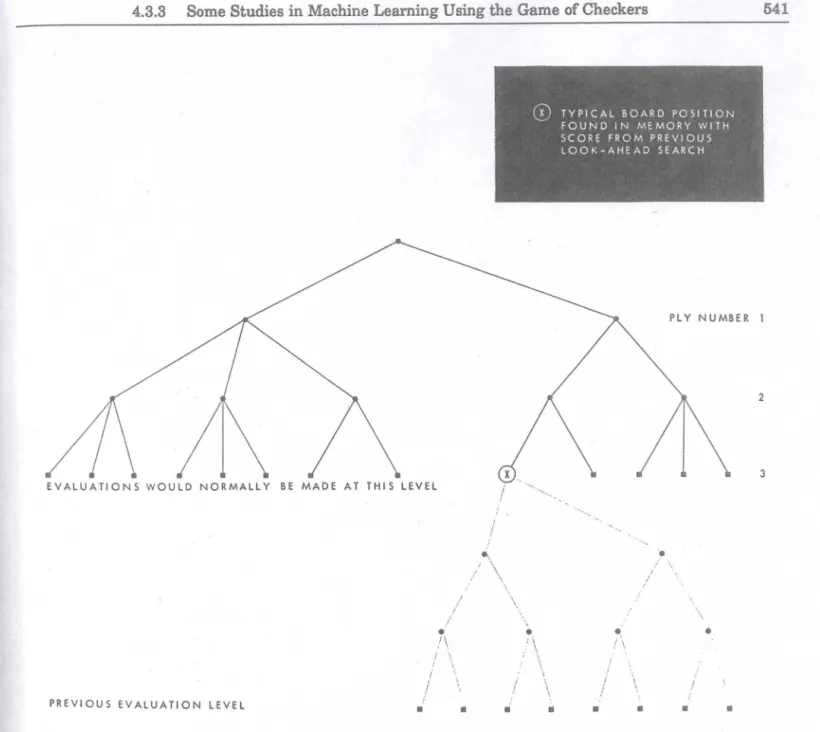
Fortunately, the ability to store board information at a ply of 0 and to look up boards at a larger ply provides the possibility of looking much farther in advance than might otherwise be possible. To understand this, con-sider a very simple case where the look-ahead is always terminated at a fixed ply, say 3. Assume further that the program saves only the board positions encountered during the actual play with their associated backed-up
540
Improving the Efficiency of a Problem Solver
scorcs. Now it is this list of previous board positions that is used to look up board positions while at a ply lev"cl of J in the suhsequent games. Ifa board position is ("ound, its score has, in clIeet. already been backed up by three levels. and if it hecomes etrective in determining the move to be made. it is a .(i-ply score rather than a simple J-ply score. This new initial board position with its (i-ply score is, in turn, saved and "(t may be encountered in a future game and the score backed up by an additional set of three levels, et cetera. This procedure is illustrated in Fig. 3. The incorporation of this variation. together with the simpler rotc-learning feature. results in a fairly powerful learning technique which has been studied in some detail.
Several additional features had to be incorporated into the program before it was practical to embark on learn-ing studies uslearn-ing this storage scheme. In the first place, it was necessary to impart a sense of direction to the pro-gram in order to force it to press on toward a win. To illustrate this, consider the situati9n of two kings against one king, which is a winning combination for practically all variations in board positions. In time, the program can be assumed to have stored all of these variations, each associated with a winning score. Now. if such a situation is encountered, the program will look ahead along all possible paths and each path will lead to a win-ning combination, in spite of the fact that only one of the possible initial moves may be along the direct path toward the win while all of the rest may be wasting time. How is the program to differentiate between these?
A good solution is to keep a record of the ply value of the ditrerent board positions at all times and to make a further choice between board positions on this basis. If ahead. the program can be arranged to push directly toward the win while. if behind, it can be arranged to adopt delaying' tactics. The most recent method used is to carry the effective ply along with the score by simply decreasing the magnitude of the score a small amount each time it is backed-up a ply level during the analyses. Ifthe program is now faced with a choice of board posi-tions whose scores differ only by the ply number, it will
automatically make the most advantageous choice,
choosing a low-ply alternative if winning and a high-ply alternative if losing. The significance of this concept of a direction sense should not be overlooked. Even without "learning," it is very important. Several of the early at-tempts at learning failed because the direction sense was not properly taken into account.
• Cawloging lind culling stored inlormatioll
Since practical considerations limit the number of board positions which can be saved, and since the time to search through those that are saved can easily become
unduly long. one must devisG systems (I) to catalog
hoards that arc saved. (2) to delete redundancies. and
(3) to discard board positions which are not believed to he of much value. The most effective cataloging system found to date starts hy standardizing all board positions. first by reversing the pieces and piece positions if it is a
board POSItion in which White is to move. so that all boards are reported as if it were Black's turn to move. This reduces by nearly a factor of two the numher of boards which must be saved. Board positions. in which all of the pieces 'are kings, can be reflected about the diagonals with a possible fourfold reduction in the num-ber which must be saved. A more' compact board repre-sentation than the one employed during play is also used so as to minimize the storage requirements.
After the board positions are standardized. they are
grouped into records on the basis of (I) the number of
pieces on the board, (2) the presence or absence of a piece advantage, (3) the side possessing this advantage, (4) the presence or absence of kings on the board.:(5) the side having the so-called "move," or .opposition advan-tage, and finally (6) the first moments of the pieces about normal and diagonal axes through the board. During play, newly acquired board positions are saved in the memory until a reasonable number have been accumu-lated. and they are then merged with those on the "mem-ory tape" and a new mem"mem-ory tape is produced. Board positions within a .record are listed in a serial fashion, being sorted with respect to the" words which define them. The records are arranged on the tape in the order that they are most likely to be needed during the course of a game; board positions with 12 pieces to a side coming first, et cetera. This method of cataloging is very impor-tant because it cuts tape-searching time to a minimum. Reference must be made. of course. to the board posi-tions already saved, and this is done by reading the
cor-rect record into the memory ane searching throughit by
a dichotomous search procedure. Usually five or more
records are held in memory aton\~ time. the exact
num-ber at any time depending upon the lengths of the par-ticular records in question. Normally, the program calls three or four new records into memory during each new move, making room for them as needed, by discarding the records which have been held the longest.
Two different procedures have been found to be of value in limiting the number of board positions that are saved; one based on the frequency of use. and the sec-ond on the ply. To keep track of the frequency of use, an age term is carried along with the score. Each new board position to be saved is arbitrarily assigned an age. When reference is made to a stored board position, either to update its score or to utilize it in the look-ahead procedure, the age recorded for this board position is divided by two. This is called relre~·hing. Offsetting this, each board position is automatically aged by one unit at the memory merge times (normally occurring about once every 20 moves). When the age of anyone board position reaches an arbitrary maximum value this
hoard position is expunged from the r~cord. This is a
form of lorgelling. New board positions which remain unused arc soon forgotten. while board positions which arc used several times in succession will be refreshed to such an extent that they will be remembered even if not used thereafter for a fairly long period of time. This form of refreshing and forgetting was adopted on the basis of
3 2 PLY NUMBER 1 ... ...~. i / EVALUATIONS WOULD NORMALLY BE MADE AT THIS LEVEL
\.
PREVIOUS EVALUATION LEVEL
•
!/
/
e.'\
i ' ii
\
•
i
~. .f \ \ \. \ ... i !•
•
:\\
\ \•
., e ! e.r
\ i Ii
•
•
•
•
•
Figure 3 Simplified representation of the rote-learning process, in which information saved from a pre-vious game is used to increase the effective ply of the .backed-up score.
retlections as to the frailty of human memories. It has proven to be very effective.
In addition to the limitations imposed by forgetting, it seemed desirable to place a restriction on the maximum size of anyone record. Whenever an arbitrary limit is reached. enough of the lowest-ply board positions are automatically culled from the record to bring the size well hclow the maximum.
Before embarking o~ a study of the learning
capa-hilities of the system as just described, it was, of course, first necessary to fix the terms and coefficients in the evaluation polynomial. To do this, a number of different sets of values were tested by playing through a series . of hook games ami computing the move correlation
co-efficients. These values varied from 0.2 for the poorest polynomial tested, to approximately 0.6 for the one finally adopted. The selected polynomial contained four terms (as contrasted with the use of 16 terms in later experiments). In decreasing order of importance these
were: (l) piece advantage, (2) denial of occupancy,
(3) mobility, and (4) a hybrid term which combined con-trol of the center and piece advancement.
• Rote-learning tests
After a scoring polynomial was arbitrarily picked, a series of games was played, both self-play and play against many different individuals (several of these being check-er mastcheck-ers). Many book games wcheck-ere also followed, some
542
improving the Efficiency of a Problem Solver
of these heing end games. The program lcarnel1 to 'play a very good opening game and to recognize most win- , ning and losing end positions many moves in advanc.:, although its midgame play was not greatly improved.
This program now qualifies as a rather
hetter-than-average novice. but definitely not as an expert.
At the present time the ,IJlemory tape contains some-thing over 53.000 board positions (averaging 3.X words each) which have been selected from a much larger numher of positions by means of the culling techniques described. While this is still far from the number which would tax the listing and searching procedures used in the program, rough estimates. based on the frequency with which the saved boards are utilized during normal play (these figures being tabulated automatically), indi-cate that a library tape containing at least 20 times the present number of board positions would he needed to improve the midgame play significantly. At the present rate of acquisition of new positions this would require an inordinate amount of play and, consequently. of machine timeY'
The general conclusions which can be drawn from these tests are that:
(I) An effective rote-learning technique must include a procedure to give the program a sense of direction. and it must contain a refined system for cataloging and storing information.
(2) Rote-learning procedures can be use'd etlectively on machines with the data-handling capacity of the
IBM 704 if the information which must be saved and
searched docs not occupy more than, wugh1v. one mil-lion words, and if not more than llne hundred or so ref-erences need to be made to this informatil'n per minute. These figures are, of course. highly dependent upon the exact etnciency of cataloging which can be a-:hieved.
(3) Thy game of checkers. when played with a simple
scoring scheme and with rote learning only, requires more than this number of words for master cal iber of play and. as a consequence. is not completely amenable to this treatment on the18i\'1 70-L
(4) A game, such as checkers. is a suitable vehicle for use during the development of learning techniques. and it is a very satisfactory device for demonstrating ma-chine-learning procedures to the unbelieving.
Learning procedure involving generalizations An obvious way to decrease the amount of storage needed to utilize past experience is to gen~ralizeon the hasis of cxperience and to save nnly the generalizatil1ns. This should. of course. be a continulllis process if it is to be truly e1fective. and it slllluld in\'l1lve se\'cral levels nf abstractillll. A start has been made in this direction by having the program select a subsL,t llf possible terms for use in the evaluation polyllllJllial and by having the
pro-gram determine the sign and ma~nitllde llf the
cnl'lli-cients which multiply these paran1L'ters. i\t the present time this subset consists of /(, tL'nn, c1lllsen frllm a list of JX parameters. The piece-advantage term needed to
define the task is computed separately anJ. of course. is not altered hy the program.
After a number of relatively unsuccessful attempts to havc thc program generalize while playing both sides of the gamc. the program was arranged to act as two dif-fe ..~nt players, for convenience called A Iplw and BetG.
Alph,~ gcneralizes on its experiertce after each m~ve bv
adjustin~the coefficients in its evaluation polynomial and
hy replacinb terms which appear to be unilTlPortant by
new parametel~ drawn from a reserve list. Beta. on the
contrary, uses th~ same evaluation polynomial for the
duration of any ont: game. Program Alpha is used to play against human opponents. and during self-play Alpha and Beta play each other.
At the end of each self-play game a determination is made of the relative playing ability of Alpha, as com-pared with Beta, by a neutral portion of the program. If Alpha wins-or is adjudged to be ahead when a game is otherwise terminated-the then current scoring system
used by Alpha is given to Beta. If, on the other hand,
Beta wins or is ahead; this fact is recorded as a black-mark for Alpha. 'Yhenever Alpha receives an arbitrary number of black marks (usu'rrlly set at three) it is as-sumed to be on the wrong track. and a fairly drastic and arbitrary change is made in its scoring polynomial (by reducing the coefficient of the leading term to zero). This action is necessary on occasion, since the entire learning process is an attempt to find the highest point in multidimensional scoring space in the presence of many secondary maxima on which the program can become trapped. By manual intervention it is possible to return to some previous condition or make some other change if it becomes apparent that the learning process is not functioning properly. In general, however, the program seeks to extricate itself from traps and to im-prove more or less continuously.
The capability of the program can be tested at any time by having Alpha play one or more book games (with the learning procedure temporarily immobilized) and by correlating its play with the recommendations of the masters or. more interestingly, by pitting it against a human player.
• Polynomial modification procedure
~f Alpha is to make changes in its scoring polynomial.
Itmust be given some trustworthy criteria for measurina performance. A logical difficulty presents itself, sinc; the only measuring parameter available is this same scoring polynomial that the process is desi!!ned to im-prove. Recourse is had to the peculiar pro;erty of the look-ahead procedure. which makes it less important for
the scoring polynomial to be particularlv good the
further ahead the process is continued. Thi~means that
one can evaluate the relative change in the positions of two players, when this evaluation is made over a fairly large number of moves, by using a scoring system which is much too gross to be significant on a move-Iw-move
basis.
is that we arc attempting to make the score, calculatet! for the current boart! position. look like that calculated for the terminal hoard position of the chain of moves which most probably will occur t!uring actual play. Of course, if one coult! t!evelop a perfect system of this sort it would be the equivalent of always looking ahead to the end of the game. The nearer this it!eal is approachet!, the better would be the play.l.~
In order to obtain a sufficiently large span to make use of this characteristic, Alpha keeps a record of the ap-parent goodness of its board positions as the game pro-gresses. This record is kept by computing the scoring polyno'mial for each board position encountered in actual play and by saving this polynomial in its entirety. At the same time, Alpha also computes the backed-up score for all board positions, using the look-ahead procedure de-scribed earlier. At each play by Alpha the initial board score, as saved from the previous Alpha move, is com-pared with the backed-up score for the current position. The difference between these scores, defined as delta, is used to check the scoring polynomial. Ifdelta is positive it is reasonable to assume that the initial board evalua-tion was in error and terms which contributed positively shoult! have been given more weight, while those that
contributed negatively should have been given less
weight. A converse statement can be made for the case where delta is negative. Presumably, in this case, either the initial board evaluation was incorrect, or a wrong choice of moves was made, and greater weight should have been given to terms making negative contributions, with less \veight to positive terms. These changes are not made directly but are brought about in an involved way which will now be described.
i\ record is kept of the correlation existing between the signs of the individual term contributions in the ini-tial sCl)rii1g polynomial and the sign of delta. After each play an adjustment is made in the values of the correla-tion cl)ellicients, due account being taken of the number of times that each particular term has been used and has hat! a nonzero value. The coefficient for the polynomial term (other than the piece-advantage term) with the then largest correlation coefficient is set at a prescribed maxi-mum value with proportionate values determined for all of the remaining coefficients. Actually, the term coeffi-cients arc fi:\et! at integral powers of 2, this power being t!efined by the ratio of the correlation coefficients. More precisely, if the ratio oCtwo correlation coefficients is equal to or larger than n hut less than
Il+
I, where n is an integer. then the ratio of the two term coefficients is set equal to 2". This procedure was adopted in order to increase the range in values of the term coefficients. \Vhenever a correlation-coefficient calculation leads to a negative sign, a corresponding reversal is made in the sign associated with the term itself.• IIl.l'w!>ilitie.\'
It should he noted that the span of moves over which delta is computet! consists of a remembered part and an anticipated portion. During the remembered play, use
had been made of Alpha's current scoring polynomial to determine Alpha's moves but not to determine the oppo-nent's moves, while during the anticipation play the moves for hoth sides are made using Alpha's scoring polynomial. One is tempted to increase the sensitivity of delta as an indicator of change by increasing the span of the remembered portion. This has been found to be dangerous since the coefficients in the evaluation poly-nomial and, indeed. the terms themselves, may change between the time of the remembered evaluation and the time at which the anticipation evaluation is made, As a matter of fact, this difficulty is present even for a span of one move-pair. Itis necessary to recompute the scor-ing polynomial for a given initial board position after a
move has been determined and after the indicated cor~
rections in the scoring polynomial have been made, and to save this score for future comparisons, rather than to save the score used to determine the move. This may seem a trivial point, but its neglect in the initial stages of these experiments led to oscillations quite analogous to the instability inouced iri electrical circuits by long delays in a feedback loop.
As a means of stabilizing against 'minor variations in the delta values, an arbitrary minimum value was set, and when delta fell below this minimum for any par-ticular move no change was made in the polynomial.
This same minimum value is used to set limits for the
initial board evaluation score to decide whether or not it will be assumed to be zero. This minimum is recom-puted each time and, normally, has been fixed at the average value of the coefficients for the terms in the cur-rently existing evaluation polynomial.
Still another type of instability can occur whenever
a new term is introduced into the scoring polynomial.
Obviously, after only a single move the correlation coeffi-cient of this new term will have a magnitude of 1, even though it might go to 0 after the very next move. To prevent violent fluctuations due to this cause, the corre-lation coefficients for newly introduced terms are com-puted as if these terms had already been used several times and had been found to have a zero correlation co-efficient. This is done by replacing the times-used num-ber .III the calculation by an arbitrary number (usuallys set at 16) until the usage does, in fact, equal this number. After a term has been in use for some time, quite the opposite action is desired so that the more recent experi-ence can outweigh earlier results. This is achieved, to-gether with a substantial reduction in calculation time, by using powers of 2 in place of the actual times-used and by limiting the maximum power that is used. To be
specific, at any stage of play defined as the Nth move,
corrections to the values of the correlation coefficients
Cx are made using 16 for N until N equals 32,
where-upon 32 is used until N equals 64, et cetera, using the
formula:
C~'_l±1
C.v=C.Y_l N
and a value for N larger than 256 is never used.
a-544
Improving the Efficiency of a Problem Solver
hie to attach greater weight to situations leading to large values of tlelta. Accortlingly, two atltlitional categories are ddinetl. If a contrihution to tlelta is matle hy the first term. meaning that a change has occurred in the piece ratio. the indicatetl changes in the correlation coetlicients arc tloubled, while .if the value of tlelta is so large as to indicate that an almost sure win or lose will result. the elfect on the correlation"~oefficientsis quadrupled.
• Term replacemellt
;\o[ention has been made several times of the procedure for replacing terms in the scoring polynomial. The pro-gram. as it is currently running, contains 38 different terms (in addition to the piece-advantage term), 16 of ·these being included in the scoring polynomial at anyone time and the remaining 22 being kept in reserve. After each move a low-term tally is recorded against that active term which has the lowest correlation coefficient and, at the same time, a test is made to see if this brings its tally count up to some arbitrary limit, usually set at 8. When this limit is reached for any specific term. this term is transferred to the bottom of the reserve list, and it is re-. placed by a term from the head of the reserve Jistre-. This new term enters the polynomial with zero values for
its correlation coefficient. times used, and low-tally
count. On the average, then, an active term is replaced once each eight moves and the replaced terms are given another chance after 176 moves. As a check on the ef-fectiveness of this procedure, the program reports on the usage which has accrued against each discarded term. Terms which are repeatedly rejected after a minimum amount of usage can be removed and replaced with com-pletely new terms.
It might be argued that this procedure of having the
program select terms for the evaluation polynomial from a supplied list is much too simple and that the program should generate the terms for itself. Unfortunately, no satisfactory scheme for doing this has yet been devised. With a man-generated list one might at least ask that the terms be members of an orthogonal set, assuming that this has some meaning as applied to the evaluation of a checker position. Apparently, no one knows enough about checkers to define such a set. The only practical solution seems to he that of including a relatively large number of possible terms in the hope that all of the contributing parameters get covered somehow, even though in an involved and redundant way. This is not an undesirable state of atfairs, however, since it simulates the situation which is likely to exist when an attempt is made to apply similar learning techniques to real-life situations.
:-'1any of the terms in the existing list arc related in some vague way to the parameters used by checker ex-perts. Some of the concepts which checker experts appear to use have elutled the writer's attempts at defi-nition, and he has heen unable to program them. Some of the terms are quite unrelated to the usual checker lore and have been discovered more or less by accident. The second moment ahout the diagonal axis through the
double corners is an example. Twenty-seven tlilferent simple terms are now in use, the rest being com hi national terms. as will he described later.
A word might be said about these terms with respect to the exact' way in which they arc definetl and the general procedures used for their evaluation. Each term relates to the relative standi~gsof the two sides. with respect to the parameter in question, and it is numeri-cally equal to the difference hetween the ratings for the individual sides. A reversal of the. sigh obviously cor-responds to a change of sides. As a further means of insuring symmetry the individual ratings of the respec-tive sides are determined at corresponding times in the playas viewed by the side in question. for example, consider a parameter which relates to the board condi-tions as left after one side has moved. The rating of Black for such a parameter would be made after Black had moved, and the rating of White would not be made until after White had moved. During anticipation play, these individual ratings are made after each move and saved for future reference. When an evaluation is de-sired the progrm)1 takes the differences between the most recent ratings and those mane a move earlier. In general, an attempt has been made to define all parameters so that the individual-side ratings are expressible as small positive integers.
• Binary connecti!'e terms
In addition to the simple terms of the type just described, a number of combinational terms have been introduced.
Without these terms the s.~oring polynomial would, of
course, be linear. A number of different ways of intro-ducing nonlinear terms have been devised but only one of these has been tested in any detail. This scheme pro-vides terms which have some of the properties of binarv logical connectives. Four such terms are formed fo'r each pair of simple terms which are to be related. This is done by making an arbitrary division of the range in values for each of the simple terms and assigning the binary values of 0 and 1 to these ranges. Since most of the simple terms are symmetrical about 0, this is easilv
done on a sign basis. The new terms are then of th~
form A-B, A-B, A-B. and
A-8,
yielding values either of'o
or I. These terms are introduced into the scorinapolynomial with adjustable coefficients and si!.!ns, and are thereafter indistinguishable from the other t~rms.
As it would require some 1404 such combinational terms to interrelate the 27 simple terms originallv used.
it was fountl desirable to limit the actual nlln~ber of
combinational terms used at anyone time to a small fraction of these and to introduce new terms onlv as it
became possible to retire older inetfectual tcrm~. The
terms actually used are given in Appendix C.
• Preliminary leamiflg-hy-geflerali;;ariofl tests
An idea of the learning ability of this procedure can he gained by analyzing an initial test series of 28 !.!amesUl
played with the program just described. At the ~tart an
arbitrary selection of 16 terms was chosen and all terms
-Alpha was assigned the White side, with Beta con-strained as to its first move (two cycles of the seven different initial moves). Thereafter, Alpha was assigned Black and White alternately. During this time a total of 29 different terms was dis·carded and replaced, the majority of these on two different- occasions.
Certain other figures obtained during these 2S games
~Ire of interest. At frequent intervals the program lists the 12 leading terms in Alpha's scoring polynomial with their correlation coefficients and a running count of the number of times these coefficients have been altered. Based on these samplings, one observes that at least 20 different terms were assigned the largest coefficient at some time or other, some of these alternating with other terms a number of times, and two even reappearing at the top of the list with their signs reversed. While these variations were more violent at the start of the series of games and decreased as time went on, their presence indicated that the learning procedure was still not com-pletely stable. During the first seven games there were at least 14 changes in occupancy at the top of the list involving 10 different terms. Alpha won three of these gamcs and lost four. The quality of the play was ex-trcmely poor. During the next seven games there were at least eight changes made in the top listing involving live different terms. Alpha lost the first of these games and won the next six. Quality of play improved steadily hut the machine still played rather badly. During Games 15 through 11 there were eight changes in the top listing involving five terms; Alpha winning five g;,mes and
losing two. Some fairly good amateur players who
played the machine during this period agreed that it lI'as"triek~' but beatable". During Games 22 through 28 there \\'ere at least four changes involving three terms. Alpha \\'on two games and lost five. The program ap-peared to be approaching a quality of play which caused it to he described as "a better-than-average player". A detailed~Inalysis of these results indicated that the learn-ing procedure did work and that the rate of learnlearn-ing \\as surprisingly high, but that the learning was quite erratic and none too stable.
• Second series oj tests
Some of the more obvious reasons for this erratic hehavior in the first series of tests have been identified.
The program was modified in several respects to
i~
prOve the situation, and additional tests were made. Four l\f these modifications are important enough to justify a uetaileu explanation.
In the first place, the program was frequently fooled hy bad play on the part of its opponent. A simple solu-tion was to chan!!e the correlasolu-tion coefficients less dras-tically when delta was positive than when delta was negative. The procedure finally adopted for the positive delta case was to make corrections to selected terms in the polynomial only. When the scoring polynomial was Positive. changes were made to coefficients associated lVith the negatively contributing terms, and when the
efficients associated with positively contributing terms. No changes were made to coefficients associated with terms which happened to. be zero. For the negative delta case, changes were made to the coefficients of all con-tributing terms, just as before.
A second defect seemed to be connected with the too frequent introduction of new terms into the scoring polynomial and the tendency for these new terms to assume dominant positions on the basis.·of insufficient evidence. This was remedied by the simple expedient of decreasing the rate of introduction of new terms from one every eight moves to one every 32 moves.
The third defect had to do with the complete exclusion from consideration of many of the board positions encountereq during play by reason of the minimum limit on delta. This resulted in the misassignment of credit to those board positions which permitted spec-tacular moves when the credit rightfully belonged to earlier board positions which. had permitted the neces-sary groundlaying moves. Although no precise way has yet been devised to insu,e the corr:ect assignment of credit, a very simple expedient was found to be most effective in minimizing the adverse effects of earlier assignments. This expedient was to allow the span of remembered moves, over which delta is computed, to increase until delta exceeded the arbitrary minimum value, and then to apply the corrections to the coeffi-cients as dictated by the terms in the retained poly-nomial for this earlier board position. In this case, the difficulty which was mentioned in the section on In-stabilities in connection with an arbitrary increase in span, does not occur after each correction, since no changes are made in the coefficients of the scoring polynomial as long as delta is below the minimum value. Of course, whenever delta does exceed the minimum value the program must then recompute the initial scor-ing polynomial for the then current board position and so restart the procedure with a span of a single remem-bered move-pair. This over-all procedure rectifies the defect of assigning credit to a board position that lies too far along the move chain, but it introduces the possibility of assigning credit to' a board position that is not far enough along.
As a partial expedient to compensate for this newly introduced danger, a change was made in the initial board evaluatio·n. Instead of evaluating the initial board positions directly, as was done before, a standard but rudimentary tree-search (terminated after the first non-jump move) was used. Errors due to impending non-jump situations were eliminated by this procedure, and be-cause of the greater accuracy of the evaluation it was possible to reouee the minimum delta limit by a small amount.
F.inally, to avoid the danger of having Beta adopt Alpha's polynomial as a result of a chance win on Alpha's part (or perhaps a situation in which Alpha had allowed its polynomial to degenerate after an early or midgame advantage had been gained), it was decided
546
Improving the Efficiency of a Problem Solver
to re4uire a majority of wins on Alpha's p;uI before Jkta would aLlopt Alpba's scoring polynomial.
\Vith these mollifications, a new series of t,~,>ts was maLIc. In order to reduce tbe learning time, the initial selection of terms was made on the has is of tl,,; results ohtaineLl during the carl ier tests, but no allent ion was paid to their previously assigned weights. In contrast with the earlier erratic behavior, the revised prol~ram ap-peared to be extremely stahle, perhaps at the ex pense of a somewhat lower initial learning rate. The way in which the character of the evaluation polynomial altered as learning progresseLl is shown in Fig. 4.
The most obvious change in behavior was in regard to the relative number of games won hy Alpha ;,nd the prevalence of draws. During the first 2H game'> of the earlier series Alpha won 16 and lost 12. The eorre-sponding figures for the first 2M games of the neW series were 18 won by Alpha, and four lost, with six draws. In all cases the names were terminated, if not finished, in 70 moves and'" a judgment made in terms of tIll; final p:>sitions. Unfortunately, these ligures arc not '>tric~ly comparable because of the decreased frequency With which Beta adopted Alpha's polynomial during the ,ccond series, both by design and hecause a programming crror immobilized the adoption procedure during part of the tests. Nevertheless, the great decrease in the nUlllhcr of losses and the prevalence of draws seemed to indicate that the learning process was much more stable. Some typical games from this second series arc given in Ap-pendix B.
As learning proceeds, it should become harder and harder for Alpha .to improve its game, and one would expect the number of wins hy Alpha to decrease with time. If secondary maxima in scoring space arc en-countered, one might even find siluations in which /\Ipha wins less than half of the games. With Beta at such a maximum a~y minor change ill Alpha's polynlJlllial would result in a degradation of ils play, and' several oscillations about the maximulll might occur 11l'IIlre Alpha landed at a point which WlHlll1 enable it to heat Beta. Some evidence of this trend is discernible in Ihe play, although many more games \\ill have 10 he I'I;p,ed before it can be ohserved with certainty.
The tentative conclusions which can be drawn InJlll these tests are:
(I) A simple generalization Schl'1l1e of the typl' hne used can be an effective learning device for pn1hll'nls amenable to tree-searching procedures.
(2) The memory requirements llf such schemes ;Ire quite modest and remain fixed with time.
(3) The operating times arc abll n:asonahle and rl'-main fixed. independent of the anll11ll1t of al'l'umulall'd learning.
(4) Incipient forms of instabilil\' in the s"IUlilHl l';lIl he expected hut, at least for Ihe chl'l'ker pr"gralll. Illl'w can be dealt with hy quite straighlf,l['ward pnlcl'lhlll·S .
(5) Even with the ineolllplete and redundant sl'l Ilf parameters which have been used III date. it is Pllssihle for the computer to learn to play ;I bl'tter-than-a\'l'r;l~e
game of checkers in a relatively short period 01 time. As a final precautionary note, it should be stateLl that these experiments have not encompassed a sulliciently large series of games to demonstrate unamhil!uouslv that the learning procedure is completely stable -or th;t it will necessarily lend to the best possible choice of parameters and coetlicients.' .
Rote learning vs. generalization
Some interesting comparisons can he niade between the playing style developed hy the learning-by-generalization program and that developed by the carl ier rotc-learning procedure. The program with rote learning soon learned to imitate master play during the opening moves. It was always quite poor during the middle game, b~t it easily learned how to avoid most of the obvious traps during end-game play and could usually drive on toward a win when left with a piece advantage. The program with the generalization procedure has never learned to play in a conventional manner and its openings are apt to be weak. On the other hand. it soon learned to play a good middle game: and with a piece advantage it usually polishes off its -opponent' in short order. Interestingly enough, after 28 games it had still not learned how to win an end game with two kings against one in a double corner.
Apparently, rote learning is of the greatest help, either under conditions when the results of any specific action are long delayed, or in those situations where highly specialized techniques are required. Contrasting with this, the generalization proceG'Jre is most helpful in situations in which the available permutations of con-ditions are large in number and when the consequences of any specific action 'are not long delayed.
•. Procedures i/ll'oll'ingboth forms of learning
The next obvious step is to combine the better features of the rote-learning procedure with a generalization scheme. This must be done with some care, since it is not practical to update the previously saved information after every change in the evaluation polynomial. A com-promise solution might be to save only a very limited amount of information during the early stages of learn-ing and to increase the amount as warranted by the increasing stability of the evaluation coetlicient with learning. For example, the program could he arranged to save only the piece-advantage term at the start. -At some stage in the learning process the next term could be added. perhaps when no change had been made in the parameter used for this tern; during some fairlv long period, say for three complete games~ If and whe~ the program is able to play an additional perioLl without changes in the next parameter, this could also be added. et cetera. \Vhenever a change does occur in a parameter previously assumed to be stable the entire memory tape could be reviewed, all terms involving the changed parameter and those lower on the list could be ex-punged, and the program could drop hack to the earlier condition with respect to its term-saving schedule.
-r-;--r , ,
;. ;.
" ;.
.
:. :. :. ;;;
548
Improving the Efficiency of a Problem Solver
Another solution woulll hc to utilize the generaliza-tion scheme alone until it hall hecomc fairly stable and to introduce rote learning at this time. It is, of course, perfectly feasible to salvage much of the learning which has been accumulated by both of the programs studicd to date. This could be done hy appending an abridged form of the present mcmory tape ,to the generalization scheme in its present stage of learning and by proceed-ing from there in accordance with the first solution proposed above.
• Future development
While it is believed that these tests have reached the stage of diminishing returns, some effort might well be expended in an attempt to get the program to generate its own parameters for the evaluation polynomial. Lack-ing a perfectly general procedure, it might still be possible to generate terms .based on theories as proposed hy students of the game. This procedure would be at variance with the writer's previous philosophy, but it is
Footnotes and References
1. Some of these are quite profound and have a bearing on the questions raised by Nelson Goodman in Fact, Fic-tiol/ I/I/d Fnrecas(. Harvard University Press, 1954.
Warre.~ S.~[cCulloch ("The Brain as a Computing Ma-.:hllle. £lee. £I/g. 69, 492, 1949) has compared the lligllal computer 10 the nervous system of a flatworm. T () extend this comparison to the situation under dis-cussion would he unfair to the worm since its nervous system is a':lLlally quite highly organ'ized as compared WIth the random-net studies by B. G. Farley and W. A. CI.;lrke \..··Simulation of Self-Organizing Systems by Digital Computers," IRE PGIT 4, 76, Sept. 1954), N. Ro.:hester, J. H. Holland, L. H. Haibt and W. L.
Duda ('"Tests on a Cell Assembly Theory of the Action
".1 the Brain Using a Large Digital Computer," IRE
7Tc/I/suel/o/ls Oil II/formation Theory IT-2 No.3 80.
S I(re) , , ,
-. cpt-. .'~'.' .and b~- F. Rosenblatt ("The Perceptron; A Probabilistic Model for Information Storage and Or-ganizatIOn III the Brain" Psych. Rev. 6 65 November
1958). ' " ,
The first operating checker program for the IBM 701 was wntten III 1952.This was recoded for the IBM 704 In 195_.:1. The first program with learning was completed III 19)5 and demonstrated on television on February 2-1. 1956.
-I. C. E. ~hannon. "Programming a Computer for Playing Chess. PllIl. Mag. 41, 256 (March 1950L
5. A.Ber~;~tein and M. deY. Roberts, "Computer vs. Chess-Player. Snellt..Amer. 198,6 (June 1958).
fl. 1. J;:.lster. P. Steill. S. Ulam, W. Walden, M. Wells, "Ex-penmentsIIIChess,"Journal of theACM 4 174 (April
1957"1. ' ,
7. A. Newell.1.C. Shaw and H. A. Simon, "Chess-Playing
Pro!!r~msand the Problem of Complexity," IBM J. of
Re.\".L~DCI'e!.2. 320 (October 1958). x. Shannon.loecit.
I). C. S. Strachey, "Logical or Non-Mathematical Pro-grammes," Proc. of ACM Meeting at Toronto, Ontario, pp. 46-49. Sept. 8-10, 1952. '
highly likely that similar compromises will havc to be made when one attempts to apply learning procedures to problems of economic importance.
Conclusions
As a result of thcse experiments one can. say with some certainty that it is now possible to devise learning schemes which will greatly outperform an average per-son and that such learning schemes may eventually be economically feasible as applied to real-life problems .
Acknowledgments
Many different people have contributed to these studies through stimulating discussions of the basic problems. From time to time the writer was assisted by several different programmers, although most of the detailed work was his own. The forbearance of the machine room operators and thei~ willingness to play the machine at all hours of the day and night are also greatly appreciated.
10. One of the more interesting of these was to express a board position in terms of the first and higher moments of the white and black pieces separately about two or-thogonal axes on the board. Two such sets of axes were tried, one set being parallel to the sides of the board and the second set being those through the diagonals. 11. This apt phraseology was suggested by John McCarthy. 12. Not the capture of all of the opponent's pieces, as popu-larly assumed, although- nearly all games end in this fashion.
13. The use of a weight ratio rather than this, conforming more closely to the values assumed by many players. can lead into certain logical complications, as found by Strachey,lac. cit.
14. The only departure from complete generality of the game as programmed is that the program requires the opponent to make a permissible move. including the taking of a capture if one is offered. "Huffing" is not per-mitted. .
15. B. V. Bowden, Faster Than Thought, Chapter 25, Pitman, 1953.
16. This coefficient is defined asC=(L-H)/(L+H),where
. L is the total number of different legal moves which the machine judged to be poorer than the indicated book moves, and H is the total number which it judged to be better than the book moves.
17. This playing-time requirement, while _large in terms of cost. would be less than the time which the checker master probably spends to acquire his proficiency. 18. There is a logical fallacy in this argument. The program
might save only invariant terms which have nothing to do with goodness of play; for example, it might count the squares on the checkerboard. The forced inclusion of the piece-advantage term prevents this.
19. Each game averaged 68 moves (34 to a side), of which approximately 20 caused changes to be made in the scoring polynomial.
Appendix A: Programming details
• ,..jpproxilllate siz.e of program
Basic chccker-playing routine .
Input. move verification and output Game starting and..\crminating routines Loaders. table generators, dumping, et cetera Statistical and analytical routincs
Rote-learning routines
Generalization-learning routines Tables and constants for basic play Working space for basic play .
\Vorking space for generalization learning Working space for rote learning
I 100instructions 1400instructions 600instructions H50 instructions 700 instructions 1500 instructions 650 instructions 700 words 2000 words 500 words balance of memory
• Approximate compllfation times
To find all available moves from given board position. To make a single move and find resulting board position To evaluate a board position (4 terms)
To find score for a saved board position (rote learning)
To evaluate position (with 16 terms for generalization learning)
2.6 milliseconds 1.5 milliseconds 2.4 milliseconds 2.3 milliseconds 7.5 milliseconds
Jump moves are computed by a simple extension of this procedure. Multiple jumps are handled as a sequence of single jumps separated by null-reply moves.
• Board representations
The standard checkerboard numbering system (see Appendix B) is used in communicating with the machine. A modi-fied numbering system is used for internal computations, the numbers shown on the squares in Fig. A-I corresponding
to the bit positions in an IBM 704 word. Any given board position is represented by four such worc1s; one word (FA)
containing 1's in those bit positions corresponding to squares containing pieces of the color whose turn it is to move and which normally move in a forward direction. To be specific. if it is Black's turn to move (i.e., i: Black is "active")
FA designates the location of all of Black's pieces, both men and kings. Conversely, if White is active, FA designates the location of White's kings only, since White's men can only move in the direction arbitrarily called backward. The other words designate, respectively: BA, backward active pieces; FP, forward passive pieces; and BP, backward passive pieces.
To conserve space when writing on tape, three words are used to record board positions with kings, and only two words are used for board positions without kings. These are saved in a standardized form, as explained in the text.
Possible moves are designated by five words; one word to indicate by its sign (with the word itself containing other
information) whether the moves are jumps or not. (If a jump is available, only jump moves are saved.) The other
four words designate the location of those pieces which can move in the four different diagonal directions: RF, for
right forward; LF, for left forward; LB, for left backward; and RB, for right backward, respectively.
By reference to Fig. A-I, it will be observed that a right-forward move results in an increase of 4 in the square
designation. while a left-forward move results in an increase of 5. Bit positions 9, 18 and 27 do not appear on the
board. This notation makes it possible to compute available moves fos all pieces simultaneously. Having previously.
computed a word called EMPTY, which contains 1's in locations corresponding to all unoccupied squares, one can
computeRF, for the normal move case, in four instructions, as listed below (in IBM 704 symbolic language):
CLA ALS ANA STO EMPTY 4 FA RF
(puts word EMPTY into the accumulator); (shifts word to left by 4 positions);
(forms logicalANDbetween EMPTY and FA);
550
Improving the Efficiency of a Problem Solver
WHITE!
I!
@
®
@
®
jI
I
I
®
I®
®
®
II
I ,I
I
I I®
!
@
®
®
Ii
®
!®
@
®
; I I II
I I , i i ,®
I
®
@
®
, II
!
i I I!
®
ii
®
®
@
II
I
!I
I
I ,CD
I
CD
CD
CD
I 1i
I
I
I
II
ICD
II
!
CD
CD
CD
iI
I
II
o 0< < 3: 0< o....
I BLACKFil:llr,' A -I Checkerboard notation for internal computations.
• ", ddilio//lIllillle-s(/\'ing expedie//Is
Ilit counting is done hy a table-lookup procedure in a closed subroutine of 16 executed instructions (408 microseconds).
'Ihis reLJuires a 156-word tahle which is generated at the start by a 13-word program. Similar table-lookup procedures arc used. 10 llIrn a word end-for-end. and to locate the l's in a word for move reporting.
.\Iulliplications are usually avoided. In several places where multiplication by small integers must be done, it is programmed in terms of shifts and logical operations.
During the look-ahead procedure a complete record is kept of the sequence of board positions currently under investigalion. As a result. no computing is needed to retract moves.
-Appendix B: Sample games from the second series with generalization learning
•
Typical opel/iI/R.I'The first eight moves of selected games in which Alpha played Black against Beta, showing the way in which different types of play were tried.
G-4 G-6 G-11 G-17 G-19 G-21 G-31 G-37 G-39 G-41 G-43 - - - - , - . - - -
- -
- -
-10 14 I I 16 11 16 I L 16 Ll 16 I L 16 I 1 16 12 16 11 16 10 14 11 16 14 19 22 1~ 21 17 24 20 24 20 24 20 23 18 24 20 24 20 24 20 23 19 14 18 16 20 16 20 10 14 7 11 8 11 7 11 8 12 10 15 1L 15 16 23 23 L4 18 14 17 13 10 11 21 17 2~ 24 27 23 28 24 20 11 17 24 26 19 9 IS 9 18 9 14 l) 15 10 14 10 14 16 20 10 14 7 16 7 10 8 11 22 15 23 14 13 18 21 17 17 10 23 18 23 19 23 1~ 21 17 13 18 22 17 II 18 10 17 14 23 7 11 6 15 14 23 20 27 14 23 6 10 14 23 10 14 21 17 21 14 27 18 17 10 28 24 27 18 31 24 27 1l) 23 19 26 19 17 10•
Typical gamesSample games in which Alpha played White against forced Beta openings.
G-I G-I8 G-30 G-40 " G-I G:~8 G-30 G--IU - - - -
- -
I'-
- -
-12 16 12 16 12 16 10 14 I' 9 13 11 16 9 1.+ .+ 8 24 19 24 20 24 20 24 20 1 6 24 20 1l) 9 1 6 8 12 8 12 8 12 I I IS I: 13 17 16 19 8 [ I 10 14 22 18 28 24 28 24 27 24 I' 31 27 19 25 15 8 6 10 :: 10 14 10 15 10 14 7 10 16 20 13 17 4 I I 14 17 26 22 22 18 22 18 23 18 18 14 LO 7 19 IS LO L5 16 20 15 22 6 10 14 23 j; 11 IS 1 1I IL 18 17 21 30 26 25 18 24 19 26 19
I:
6 10 14 10 23 14 32 28 j: 11 16 7 10 1 6 10 14 15 18 19 13 13 17 5 9 28 24 18 14 32 18 19 10 14 9 2L 14 9 5 27 14 7 I 1 10 17 3 8 6 15 "..
Terminated 13 26 11 16 20 17 i, 10 7 28 14 19 16 22 17 21 14 26 21 11 17 Manually 3 8 9 18 9 13 2 7 26 30 17 22 12 1~ 17 10 23 14 18 9 17 10 25 11 6 10 IS 12 31 6 15 22 6 9 5 L4 7 14 30 16 30 15 9 14 26 17 30 25 22 18 24 19 " 7 3 L 6 31 26 It 9 13 9 18 6 9 15 24 H I 1 '15 25 21 14 18 17 14 26 23 25 22 28 19 I',
14 to 5 I 18 24"
2 7 3 8 2 6 14 17 :l 5 9 21 17 8 lL 23 18 23 14 30 25 21 14 i' 10 6 24 20 24 19 1: 16 23 1 6 14 17 9 18 J! 15 19 16 19 21 25 14 10 27 23 21 14 5 25 22 II 6 I 20 16 30 21 7 14 6 9 6 9 18 25Ii
26 12 17 13 Beta Concedes ,I 18 9 14 10 L8 15 29 22 "Ii
1 6 6 2 5 14 9 13 IL 18 5 9 9 13 13 17 27 18 9 25 21 20 IL 2 31 17 20 16 10 6 20 27 11 15 10 14 1 5 19 23 Beta Concedes 31 24 20 11 22 IS 20 16 6 9 12 16 15 18 14 17 3 7 23 27 21 17 23 14 5 1 22 17 16 1I 13 22 8 IS 17 21 8 I I 22 15 25 18 24 19 25 22 17 13.,
i I I 7 1 5 IS 24 21 15 lL 20 jI 25 30 9 6 32 28 21 18 13 6 7 2 5 9 24 27 25 30 7 10 27 32 6 1 3 I 24 2 6 6 1 70 Move Termination552
Improving the Efficiency of a Problem Solver
WHITE )(•
• •
•
• • •
• • •
•
• • • •
•
•
•
BLACKFiC:/Ir,. B-1 Square designations used in reporting games.
Appendix C: Evaluation polynomial details for second series
• ,\fethod ofC()II/plllingterll/S
The 16 terms called for in the evaluation polynomial are computed, individually, by taking the value of the appropriate parameter, as L1etined below, for the board position under consideration and subtracting the value of this same parameter computeLl for the board position just prior to the last move (with the necessary reversal in the definitions
lIf active and passive sides). This difference is then multiplied by the corresponding program-computed coefficient.
which can vary between - 21" and
+
21x• and credited to the side which was passive on the board position undercllnsiLleration.
-• Dcjinitinns O!I'(/rtllIll'tl'rS
ADV (Advancemcnt)
The paramcter is crcdited with I for each passive man in thc 5th and 6th rows (counting in passi