Vol. 53, September 2006, pp. 126-133
Constraints for evaluation of acquisition operations and supplier
performance using LibSys
Sujata Mandai" and V K J Jeevanh
Indian Institute of Technology, Kharagpur, West Bengal 721 302 "Professional Trainee, Email: [email protected]
hAssistant Librarian, Email: [email protected]
The objective of this paper is to discuss the constraints faced while evaluating the book acquisition system at the Central Library of Indian Institute of Technology, Kharagpur using reporting options offered by the library automation package, LibSys. The study examines how the Acquisition Section of the Central Library, IIT Kharagpur meets the expectation of its users and suppliers using parameters such as time involved for ordering, accessioning for making payment. The Section is also interested in assessing the performance of its different suppliers considering the percentage of books supplied and the time required to supply them. Since the evaluation is to be conducted in a time bound manner, it has been decided not to use the manual registers to collect the required data considering the time involved in scanning and analyzing manual data. Only option left out is to use the LibSys that facilitates data outputting through its different reports. This paper discusses the constraints faced while collecting data and proposes the need for 'customer specific' report options in commercial software packages. The paper also highlights the importance of suitable provisions in automation packages for evaluating the performance of different sections of library and its various stake holders.
Introduction
Acquisition work is a back office kind of activity of
any library that regulates acquiring and preparing
materials for use into serviceable articles without delay
and at minimum costl. The acquisitions department
provides a vital service for the entire library processes
whereas methods of evaluation for the productivity of
the department are rare2• Alsbury makes interesting
comparisons about the acquisitions department of a
library with its suppliers and considers the degree to
which the criteria used to evaluate supplier performance
can be applied to the evaluation of acquisitions
functions3. The general concept of evaluation of the
acquisitions function is based on a traditional view of
acquisitions as a support activity for the building of
library collections, and as a transaction-based operation
full of routine tasks and detailed procedures which lead
to conflicts in the ways the quality and effectiveness of
the process are judged4• The basic elements in the
acquisition purchase procedure ares:
I.
Searching the library records to determine thatbook is not readily available,
II.
Checking the correctness of the bibliographicdescription, including the standardized entry,
Ill.
Ordering material and recording the order fortemporary internal control,
IV. Receiving material, updating the order records,
and approving the invoice for payment,
v. Forwarding it to the catalog department, and,
vi. After the title has been catalogued, clearing the
order record from the active files.
The Acquisition Section of the Central Library, lIT
Kharagpur conducts itself in a mix of manual and
computerized operations. The computer operations are
conducted through the library automation package,
LibSys (see URL http://www.libsys.co.in for details
about this package). This package is used to check for
duplicates to prevent procuring multiple copies of books,
generate order forms, process bills and complete
bibliographic details for onward processing of books in
the processing and circulation sections. Though order
files are still maintained using reports provided by the
LibSys, the accession and invoice registers are
maintained in handwritten forms because the
customizations provided by the LibSys are not fully in
agreement with the local requirements.
The manual and computer operations conducted in
tandem sometimes increases the time required to conduct
MANDAL S & JEEVAN V K J : CONSTRAINTS FOR EVALUATION OF ACQUISITION OPERATIONS 127
various tasks related to the acquisition operation thereby reducing the overall efficiency. Similarly, working with
different suppliers and in a totally decentralized fashion
in a large institute often leads to certain other difficulties.
Thus, to examine how the Acquisition Section meets
the expectation of users and book suppliers, an evaluative
study is conducted to assess the efficacy of the
acquisition operations. The success of the Acquisition
Section depends to a large extent upon its book suppliers
who take special efforts to arrange and supply books
recommended by the teachers and researchers at the
earliest possible time. Thus it is very crucial to assess
the performance of the different suppliers of books.
Performance evaluation studies have also become crucial as libraries are getting more quality conscious like other service institutions.
For the present study, since the evaluation was to be
conducted in a time bound manner, manual registers were
not used to collect the required data considering the time
involved in scanning and analyzing the same. The only
option left out was to use the data provided by LibSys
that facilitates data outputting through different reports.
Acquisition
Section of Central
Library,
lIT
Khargpur
The Acquisition Section of the Central Library, lIT
Kharagpur collects requests for books from about 500
faculty members attached to over 30 departments of the
Institute. The Section gets the required data entered in the LibSys software. It then interacts and places orders for these books with around 40 suppliers who are local as well as outstation, checks and accessions the procured
books and transfers them to the Technical Processing
Section for further processing such as classification,
cataloguing, and indexing. The current annual budget
allocation for purchasing general books (books meant
for research activities procured in single copies) as well as textbooks (books prescribed for courses and normally
procured in multiple copies for Text Book Library
(TBL)) is Rs. 1.5 crores and around 3000 books are
added to the collection. The section annually places
orders for purchasing over 1600 titles, generates about
1000 orders and processes around 700 bills. This
involves substantial professional and administrative
work, especially because books are ordered right from
the. first month of the financial year and books as well
as bills are processed till the last month of the financial
year.
The broad activities of the Acquisition Section are as
follows:
Receiving requisitions for purchasing newly
published books, reports and theses from library
users,
Checking for duplicate copies of books,
Generating control numbers by making the required
basic bibliographic entries in the LibSys,
Seeking the approval of recommended non-duplicate
titles from the Departmental Purchase Committee
(DPC),
Generating orders and sanction forms from the
package,
Despatching order forms to approved suppliers and
monitoring the status of books ordered,
Checking and receiving ordered books,
Assigning accession numbers manually and through LibSys,
Processing bills for payment,
Answering any intermediate queries from users,
suppliers and administration, and
Providing status report about book budget and
acquisition activities at any point of time.
Evaluation parameters for acquisition section and
supplier performance
As the focus of libraries has shifted from collection
building to providing access to information, acquisitions
are viewed as a service to meet the information needs of
library users6• It is in the interest of every acquisitions
or collection development librarian to develop for each
of the dealers serving the library a performance profile
to obtain the best service? The Acquisition Section of
Central Library, lIT Kharagpur, undertook to assess the
performance of its different suppliers as well as different
activities of the Section based on the following
parameters:
Evaluation parameters for acquisition section
• Time involved in ordering process
• Time involved in accession work
• Time involved in making payment to the
supplier
Evaluation parameters for supplier performance
• Percentage of books supplied
I
<.I'J (. 1:/1 1 1;:/11.1 !',j 11, I;" :);:; Lc', V:':; Ihil'd.;J' 1'--''/, L,l;1 L,'-j,--'V 1:;:-: :el ~::'c::- <~7(,r:' ~'::'J,':'ll:i
C<L 1'_ t21" pl:yc~cc: micellar : ,-, 1.1..1't,~;,.::',l't:' 1.11 ],;::.i',',·,.'I"i/, ti (:,::'
J [1.::"1:;: :::r::'Cl"lj(j(;C, .:U(t :-:: 'l OF', J. ,; KIli\,' " lil:,/ !'l'.: ,'i1', 11;: I' L,':' ~ :/11_,1. l'i) ,j,:[, (',il':/TI; I,' t •L '::11 __~_'; .'1 1'J ,'01 i'I" t'"J·'iL ;,:: ;:
t
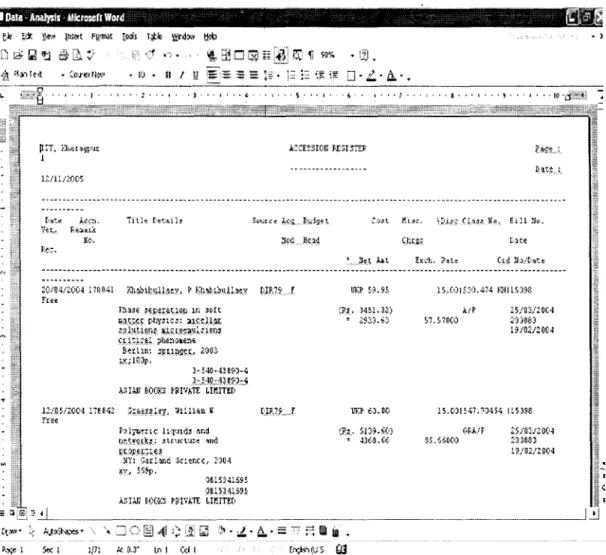
I'tll~'r,) I:Figure 1 - LibSys accession register with "Page Width = 80 cols"
Vendor profiling provides the librarian with a better
understanding of the limitations of a vendor's services,
take advantage of conditions in a buyer's market, and
use the information from vendor profiles to make
sensible decisions8.
The acquisition system in LibSys is designed to meet
all the requirements of a modern library in acquiring its
collection. The various functions related to acquisition
are: checking titles for duplication, procuring approval
for new titles, placing orders, receiving supplies,
invoicing and accessioning, requisitioning payment, etc.
Some items are received as gratis and though money
transaction is not involved, these also have to be
processed into the collection. Queries related to
acquisition may be by any of the following: title, order
no., invoice, vendor, the budget-head, accession register,
etc. Results may also be printed, if necessary. The
various reports generated by the system include an
Approval form, Purchase Orders, the Titles On-order
list, Payment Requisition Advice, Overdue Notices,
Accession Register, Bill/Invoice Register, etc. Records
are maintained for budget heads, vendors, exchange
rates for various currencies, etc. Acquisition related
functions are categorised as Title initiation, Approval
Procedure, Ordering, and Invoice processing/
Accessioning. The different submenus" under
Acquisition are: Enter Title, Approval Process, Place
Order, Receiving, Invoice Processing, Budgets, Queries,
Record Keeping, Reports, Housekeeping, System Setup
and Online searches. LibSys version 4 is used to generate
various reports discussed in this study.
Constraints faced with LibSys reports
The Accession register of the year 2004 - 05 was
generated using Libsys by selecting the option "Page
Width
=
80 cols". This Accession register (Figure 1)includes the following information
Accession Date / No Title Details Source A/C Head Cost Bill No / Date
Many fields required for the evaluation are absent in this
Accession Register. Then an attempt has been made to
generate the Accession Register by changing some
options and parameters in the corresponding LibSys
report with the option "Page Width
=
132
cols". Thisreport (Figure 2) generated some extra fields of Accession register. These extra fields are as follows:
MANDAL S& JEEVAN V K J : CONSTRAINTS FOR EVALUATION OF ACQUISITION OPERATIONS 129
EJe
;~j:
\j~" jJlieltFpt
rods Ttoo ~d:m !:ll\:>t;3; I;! ~ .I§> ~ ~? (f .-,. ~)m t:lria
i~
• J ~!T.tJ~i~gVJ::
!
12/11/2005 -C:iJ • ::: ~~ j~D·
L .
ll- .
'" 2:'" I' '1'" I' •• 1(1.
) Xc.. LS.(rJ1S:,10.474 t~llS39e:20l04/Z004 l?a 041 ?;h~ibJJlJ~ty, pKJ}nln~uJl~~>~~~X,R}$; __
J
fut! J'~-~s€:?'§;:'p:~;:?;~_:+_I,)_qW30!t .~};x:.,ph-,'''"<:
~~,,)J«,
;:R1MJ,,1{H)x_ ~,i;%.{~Q"~;!,;t;jQn;l ~~J':E_~~-?h.ezH'kena B~ttln: ;p;f.;ta~_~2:00'3. ;r,;le:Op. 3-540-4389)-4 3.o{,!9""'lU~);;.~ A$l;JI BO(~:SP~l'lj,T!: LI~m:r.'(~~", ).1-:'1 ~ 32) -~ 29X{~~:3 iL/P S~.5,0(':) 1,5/03/20('1 2'JJ6~) 19/02/2004 _12:l~,S/,2001 118 642 !~;_:a;g,;'~_Yi7Jllliab Ii fne UF.P ,.).00 l:HI'Jid:l \~rA :llnlct~J:e,,;nq P,t:q'p~+}~J:~ !H:Carl~d. SCHnee, 2:00·t ~}', $$9p. 0815341695 omHl.;~}
AH;JIf,o)O;:S P~I'i/'T!: L.lnmt'
(~;t.$1:>9.1)1):1 , 43('.'( 2SiOJ:JZ 0(.14 Z3)803 t'U02/2,O_04 " ::JCo ~ 41;;;Jt ~
).;l;.
il.. == :=;II II •IF; It0., Ln I Cell [N;i9l (V 5 W
Figure 2 - LibSys accession register with "Page Width=132 cols"
•
Acquisition mode
•
%Discount
•
Order No / date
•
Remark
•
Record
•
Budget Head
•
Class No.
•
Net amount
•
Ver
•
•
Exchange rate
Miscellaneous charges
But this Accession register alone is not enough to provide
all the data required for the evaluation work. The Bill
NoJDate, Order NoJDate, Accession NO./Dateetc., have
been identified in respect of a particular title. Rest of
the data like control no., its creation date and payment
request no., are not available in this accession register.
This warrants searching for alternative report options
in the package to extract the required data. There is no
such facility in LibSys to generate a single report
containing all the needed information. As a result, two
more reports had to be generated to collect the missing
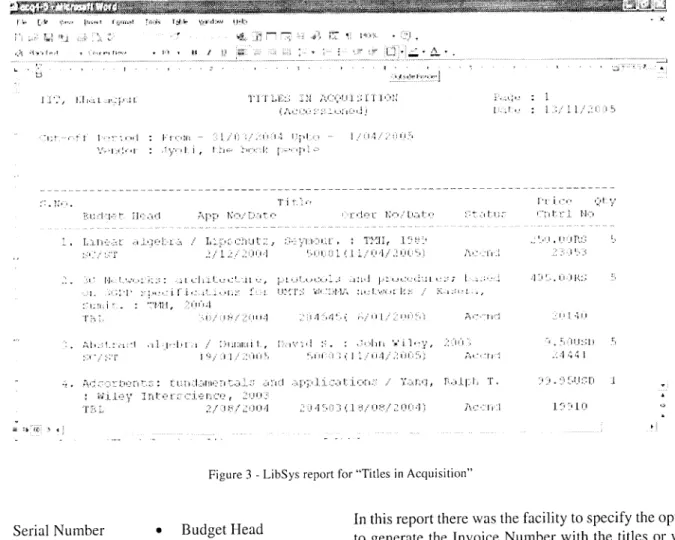
information. One of them is the "Title in Acquisition"
and the other is "Invoice Register". The report generated
through the option "Title in Acquisition" is shown in
Figure 3.
This report provides the list of "Accessioned titles"
supplied by a particular supplier. For example, the report
of "Titles in Acquisition" containing the information i.e.,
"Accessioned titles" of the book supplied by one supplier
for the year 2004 - 05 was generated. This report
contains the following information:
T'1'1' L]~:~;l:t ,t:.C(·UI :',:CTI(l?I (A,,,:i,~i:,, ::~:>:,1,.<1(",1)
I I.·
1 L / ,••• 1 v~'1:1:1"1 : Tim, 1 L ~11/ (1"1/}OC~:,) '1'; .I L:,te,:;'~~:~:I~l~;1 III /i.ll,i;l :1Io:.,:I••:iLt~ (;t,~Jt pt"~jCU":o;,,l3 cillO! I;tl,,,, •.,~(d_'dL '.::::;
IJ:<'!,:·; ·1{!':DH,c. 11(;L"';(;L k
;~,I
~;I:~! ~I""-111,
:~I;!L I
"1"\
:"b:<L:','::,:~1 .11'.1:.111 I .I ::lJiLIIUIL, ::;1\" Ii:' ; .)I>hrl '1!'il
:.;f' :'<'i' I IJ :~I'i(1 L,lll ! .;l / i_i:l,/
'-'111 .~I 'IU ::,:IJ .~ .:el ':~ I '~lrlcl 201);' (le/o'// 0('1:)) <I .!
Figure 3 - LibSys report for 'Titles in Acquisition"
•
Budget HeadSerial Number•
•
Title
•
Order Number / Date
•
Approval Number•
Price / Date•
Quantity•
Status•
Control NoThe Date of "Approval Number" has been treated as
"Control Number Creation" date. With the help of this
report the "Titles in Acquisition" for every supplier has
been generated.
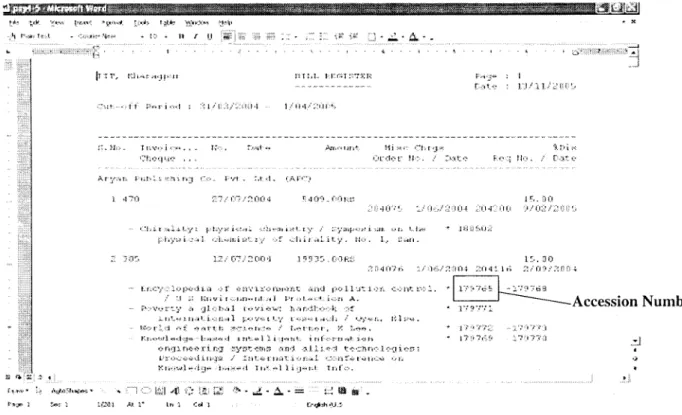
The report, "Invoice Register" shown in the Figure 4,
provides information on the fields as follows:
In this report there was the facility to specify the option
to generate the Invoice Number with the titles or with
the Accession Number or both of them.
Thus three different reports, i.e., "Accession Register",
"Invoice Register" and "Titles in Acquisition" were
generated. While comparing these three reports, it was
found that there is a common field "Order Number /
Date" in all these reports (table 1) using which data can be compared in more than one report and all the required
data for the proposed evaluation collected. In this table,
fields common in two reports are shown in italics and
those common to all three are in bold and italics.
• Serial Number • Invoice Number / Date
• Amount • Miscellaneous charges
• Order Number / Date • % Discount
• Request Number/ Date. Cheque No / Date
• Accession Number
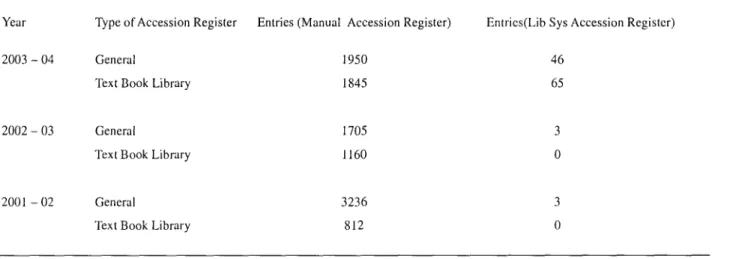
It was also observed that data was missing in "Accession
register" generated for previous years like 2003-04,
2002-03 and 2001-02. This is surprising because while
checking with individual accession numbers in the query
option, data for a particular book has been displayed,
whereas the same is shown in the report format of
MANDAL S& JEEVAN V K J : CONSTRAINTS FOR EVALUATION OF ACQUISITION OPERATIONS 131 11:: •. no 1 ~" JO "5.PlX E('q tk,. / [:,),1':(;< " ~l·"'·'··.· ·.··.••~.~·~·.D~ "1"'9':":1
Accession Number
. .a.. .. r-'J 11 I IJ[fiC'';!-: lop{f>Ji-<1 ,;.1" ;{:nyi::.;<)IL:lP'J:r~t (•.;nd polltl:i<>!; '::<:'1"1"::'t."-::.
l~livi r~~-••n'~I.I;l.j Pr,;·L"",,;:~i·;~tl A.
[(' '11O'k,', l'i'"IF,i!~<,,>~;,
~">'I":i,tLV t".>~,;h ,: ij/'Wh. Hl~,,'0~
""tArt h "(,~: n IY':"" ,.' r ••""t't>"" I~. V.;'''''?
Kr-';:_'~~ll<l<d9;1!,----l;:"lx~d l n~'.-#11!·A4:11 in (,"-::':'tl"",l:i>',:)' Ii.
vt~mo tUl·j t">·:'hn':'l';'>;"lio:·u;
1::P~4fni;(Li('lt0.t.l C<:-f!f'4f0Ii<-.J
F.1-"i\i,ll~d9"" bi,:",:..-d lli~_·",l )iU":"I:.l tnfc;>.
(·:I.ir h.l~Ly~ Fh)'xi~,:~ll ,;.::l"-:iiixLt)" :'~j>'.:r'l"Q",Jil;.u-, 01~ ~Ij#
i<;;;<1 ,~~h·"'in:i ...::I'j l.t
,~Li
l: ~'-. H<::'. l~ L:<-:t(l.td( ':~:-.\t-'M""; :·""h'#; U .•:i:. 1';;4>;0 t~1lfl
Figure 4 - LibSys report of Invoice/Bill Register for the year 2004 - 05 with Accession Number and Title
Table 1 - Field comparison of three different LibSys reports
Invoice Register Accession Register Titles in Acquisition
%Dis %Disc S. No. App No/Date
Accessioll No. Accessioll Date / No. Cntrl No
Amount Title Details Title details
Cheque No. Date Bill No / date Budget Head
Invoice No. Date Budget Head Price
Misc Chrgs Class No. Qty
Order No / Date Order No/Date Order No/Date
Req No. / Date Acq Mod Status
S.No. Cost - Misc charges - Net Amt - Exch. Rate Approval Number
Ver. Remark Source Rec.
Table 2 - Data mismatch in manual and LibSys accession register for 3 ycars Year
2003 - 04
2002 - 03
2001 - 02
Type of Accession Register Entries (Manual Accession Register)
General 1950
Text Book Library
1845
General
1705 Text Book Library
1160
General
3236 Text Book Library
812
Entrics(Lib Sys Accession Registcr)
46 65 3 o 3 o
accession register. The number of entries in the LibSys
Accession Register for these years is shown in Table 2.
It was noticed that there are minimum entries in the
automated "General Accession Register" and no entry
in the "TBLAccession Register" for the years 2001 - 02
and 2002 - 03. Actually the number of entries for these years is more as per the manual accession register. Thus it becomes very difficult to collect the required data from
the LibSys Accession Register and other reports are to
be explored to extract the relevant information from
LibSys. The reports are scanned again and found that
the four dates viz., Control Number creation date, Order
date, Bill/Invoice date and Payment Request date could
be collected from the reports, "Titles in Acquisition"
and "Invoice Register". The "Accession number" of a
particular title is collected from the "Invoice Register"
and put in the "Queries" option of the LibSys "Accession
Register" and identified the Accession Date of that
particular title identifi.ed. This paper has jj:.Jfposely
avoided giving details of actual data obtained from the study as it was not its main objective.
Performance
evaluation
options in automation
packages
Some constraints are faced in this work largely due to
the lack of suitable reporting options. If there is an option in the LibSys to generate the report in which all the five
required dates would be generated in a single window,
then the evaluation exercise would have been easier.
Further, if there is any option to generate report supplier
wise, then supplier analysis becomes easier for the
Acquisition Section as well as for the library authorities.
It has been felt that the commercial automation packages
should give such options through which librarian and
institution head can easily evaluate qualitatively
(supported by enough quantitative measures) the
performance of the different sections of the library.
The library automation packages like LibSys hold a huge
collection of data about various housekeeping activities
in the library. But there are problems in retrieving this
data as per the needs of the individual library essentially
due to the rigidity with which they incorporate data
retrieving options. These packages only provide options
to offer quantitative aspects of data and totally negate
options to make qualitative analysis of the quantitative
data assimilated. However these options have become
more crucial due to the quality and performance
consciousness gaining more prominence these days.
Library automation packages like LibSys can easily
provide these options for the following without any
drastic modification in their database structure or
associated programming:
I. Out of the requisitions received by the library, how
many books are ordered in one week, two weeks, three weeks, one month, and other time durations
with percentage out of the total requisitions handled
in a particular period or financial year?
2. Out of the ordered books, how many books are
supplied by each of the supplier in the time periods specified?
3. Out of the supplied books, how many books are
accessioned by the library during a specific duration
like in a week, fortnight, month, quarter, etc?
MANDAL S & JEEVAN V K J : CONSTRAINTS FOR EVALUATION OF ACQUISITION OPERATIONS 133
4.
Out of the accessioned and processed books, bills
for the same are processed after what duration?
Facility to elicit the above information in one or more
screens will be of immense help to assess the qualitative
performance of the Acquisition System and the suppliers.
The in-charge of the Section can thus easily ascertain
the percentage of supply and late supply which may lead
to placing unsupplied orders to the best performing
supplier leading to better realization of books ordered.
Similar features could also be included for other sections
which would help the librarian and head of institution
to qualitatively evaluate (supported well by quantitative
data at the same time) the different sections of the library.
This also helps to modify the operational procedures
and redeployment
of staff to increase the overall
efficiency of the different sections of the library. This
will also help to eliminate non-performing suppliers and
encourage
well performing
ones leading to better
performance both on the part of the library and its
suppliers.
Conclusion
The paper has discussed the practical problems faced in
collecting data from the LibSys package to evaluate the
acquisition system and book suppliers in the Central
Library of lIT, Kharagpur. The paper also attempted to
highlight the importance of 'customer specific' reporting
options in library automation packages WhiCh gather
qualitative
aspects
of a library
system using the
quantitative data assimilated from the different house
keeping operations. Such options no doubt make it more
convenient
for library authorities
to evaluate
the
performance of different sections of library and its
various stake holders.
This would also make the
automation packages more customer-friendly.
Acknowledgement: Authors are grateful to Ms. Minoo
Lohani,
Professional
Trainee,
whose project
on
"Paperless Acquisition Systems" inspired us to work in
this area.
References
1. Alessi D, Vendor selection, vendor collection, or vendor defection, Journal of Library Administration, 16 (3) (1992) 117 - 130.
2. O'Neil A L, Evaluating the success of acquisition: a literature review, Library acquisitions: practice and theory, 16 (3) (1992) 209 - 219.
3. Alsbury D, Vendor performance evaluation as a model for evaluating acquisitions, Acquisitions Librarian, (6) (1991) 93-103.
4. Chamberlain C E, Evaluating acquisitions service: new concepts and changing perception, Acquisitions Librarian, (6) (1991) 71-82.
5. Welch H M, Acquisitions, Encyclopedia of Library and Information Science, Edited by Allen Kent and Harold Lancour.
New York: Marcel Dekker, Vol I, 1968. p. 64-73. 6. Chamberlain C E, Gp. cit.
7. Barcken J K and Colhoun J C, Profiling vendor's performance,
Library Resources &Technical Services, 28 (2) (1984) 120
-128. 8. Ibid.