Bayesiaanse zelflerende algoritmes
voor kalibratieloze brein-computer-interfaces
A Bayesian Machine Learning Framework
for True Zero-Training Brain-Computer Interfaces
Pieter-Jan Kindermans
Promotor: prof. dr. ir. B. Schrauwen
Proefschrift ingediend tot het behalen van de graad van
Doctor in de Ingenieurswetenschappen: Computerwetenschappen Vakgroep Elektronica en Informatiesystemen
Voorzitter: prof. dr. ir. J. Van Campenhout
Faculteit Ingenieurswetenschappen en Architectuur Academiejaar 2013 - 2014
ISBN 978-90-8578-687-0 NUR 984
Acknowledgements
I would like to thank my supervisor Benjamin Schrauwen for giving me the opportunity, financial support and freedom to perform this research. He also taught us that, if you want to achieve something, you just have to go for it (and work hard to get to that goal). I am grateful to the other members of the PhD committee Jan Van Campenhout, Joni Dambre, Willem Waegeman, Klaus-Robert Müller and Michael Tangermann for their careful proofreading, discussions and suggestions to improve this dissertation.
Furthermore, without Klaus and Michael, this dissertation would be rather different (and less substantial). At the Machine Learning Summer School in Kyoto, Klaus invited me to visit his lab at the TU-Berlin. During this stay, we had not only several interesting and productive discussions, we also performed a thorough online evalua-tion of the proposed methods. For this, I collaborated closely with Michael, whose experience with online experiments was invaluable. Finally, I would like to thank Martijn for his help in getting the on-line experiment running, Arash and Jan-Eike for performing most of the online experiments.
Obviously, there was also a lot of support for the BCI research from our own Lab. Pieter, the go-to guinea pig, and David, thanks for listening patiently to my ideas and for proofreading a pile of manuscripts. Hannes, who was a master student in our lab, went far beyond what we could expect of him. His aid in getting the first online demonstration of the unsupervised speller working was greatly appreciated. I am grateful to Thibault, who joined us last summer,
for all his help related to the BCI work and the collaboration. I would also like to thank two people outside of the lab: Dieter Devlaminck, who guided us during our first real BCI experiments, and Patrick Santens, who lends us an EEG amplifier.
I would like to thank Sander, with whom I have shared an office for almost 4 years. There is simply no better person to have in the office with you. His calm nature, patience and cluster-maintenance work were greatly appreciated. Ken, with whom I started my univer-sity studies almost 9 years ago, is the polar opposite. Nevertheless, his remarks (in his own and rather unique style) and the interesting discussions were always welcome. Francis is the cornerstone of the lab. Not only do we appreciate his brownie and ice-cream making skills, he also ensures everything (from student affairs to the robot competition) runs smoothly. A different but still vital role in the lab is taken up by Aaron, my ET nemesis, who schedules all the mini team-building events. Obviously, the lab would not be the same without the other (some former) members. Therefore, I would also like to thank Tim, Michiel H., Philémon, Juan Pablo, Michiel D., Jonas and Michael.
I appreciate the hard work that goes on behind the scenes. With-out our local SAP guru Marnix and the administrative/technical staff Ronny, Jeroen, etc., we would not be able to perform our research.
I am grateful for my friends Valerie, Thomas, Nele, Nausikaä, Mira, Alex, for making attempts to keep me sane, for providing much appreciated funny moments, for their support and for their help.
Finally, I would like to thank my parents. Without them, I would never have gotten to this point. Their support was simply limitless.
Examencommissie
prof. Jan Van Campenhout, voorzitter
Vakgroep Elektronica en Informatiesystemen Faculteit Ingenieurswetenschappen en Architectuur Universiteit Gent
prof. Joni Dambre, secretaris
Vakgroep Elektronica en Informatiesystemen, Faculteit Ingenieurswetenschappen en Architectuur Universiteit Gent
prof. Benjamin Schrauwen, promotor
Vakgroep Elektronica en Informatiesystemen Faculteit Ingenieurswetenschappen en Architectuur Universiteit Gent
prof. Willem Waegeman
Vakgroep Wiskundige modellering, Statistiek en Bio-informatica Faculteit Bio-ingenieurswetenschappen
Universiteit Gent
prof. Klaus-Robert Müller
Department of Software Engineering and Theoretical Computer Science Fakultät Elektrotechnik und Informatik
Technische Universität Berlin
dr. Michael Tangermann
Institut für Informatik Technische Fakultät
Samenvatting
Dit werk is een uiteenzetting over de ontwikkeling van niet-gesuperviseerd lerende algoritmes voor een brein-computer-interfaces (BCI) gebaseerd op gebeurtenis-gerelateerde potentialen (ERP) (in het Engels Event-Related Potential).
Brein-computer-interfaces
Een BCI heeft als doel een gebruiker de mogelijkheid te geven om een computer (bv. een tekstverwerker) of randapparatuur (bv. een rob-otarm) rechtstreeks aan te sturen met hersensignalen. Het BCI con-cept bestaat sinds 1973. De eerste generatie van BCI’s vertrouwde op de gebruiker om zijn hersensignalen zo te controleren zodat de com-puter de juiste actie uitvoerdde. Het probleem met deze aanpak is dat de gebruiker een lange training moet ondergaan om te leren hoe de hersensignalen te controleren. De huidige generatie BCI’s daar-entegen is gebouwd rond het principe dat de machine moet leren de hersensignalen van de gebruiker te begrijpen. Om dit te bewerkstelli-gen worden lerende algoritmes gebruikt, die op basis van voorbeelden getraind worden om de specifieke hersenactiviteit te herkennen. Het verzamelen van deze voorbeelden vereist echter een omslachtige pro-cedure. Deze bestaat uit een kalibratieopname, waarbij de gebruiker op specifieke tijdstippen een mentale opdracht moet uitvoeren. Voor-beelden van zulke opdrachten zijn zich concentreren op een
stimu-lus, of het zich inbeelden van een beweging. Omdat men tijdens
opgenomen data gemarkeerd worden. Deze gemarkeerde data wordt dan gebruikt om het computerprogramma te trainen in het herken-nen van de hersensignalen. Natuurlijk is zo een kalibratieopname niet productief. Daarom wordt er onderzoek gevoerd naar methodes die deze kalibratie tot een minimum beperken of zelfs het volledig over-slaan ervan mogelijk maken. Dit is natuurlijk bijzonder belangrijk voor patiënten met een beperkte aandachtsspanne.
Een BCI op basis van ERP
Een van de meest gebruikte types BCI is de ERP gebaseerde BCI. Deze BCI werd reeds uitgevonden in 1988 door Farwell en Donchin. De BCI werkt als volgt. De gebruiker krijgt een stroom van stimuli te verwerken. Iedere stimulus is gekoppeld aan een specifieke actie. Wanneer de gebruiker zich concentreert op een bepaalde stimulus, dan zal er, na de presentatie van deze stimulus, een ERP doelrespons worden waargenomen in het EEG. Als de computer er in slaagt deze respons te herkennen, dan kan de correcte actie uitgevoerd worden. Bijgevolg slaagt de persoon er dus effectief in om de computer te besturen door middel van zijn hersensignalen. Oorspronkelijk waren de stimuli het oplichten van rijen en kolommen in een raster van letters op het scherm. Door zich simpelweg op de gewenste letter te concentr-eren kan de gebruiker deze letter schrijven. Hedendaagse versies van dit paradigma werken echter ook met auditieve of tactiele stimuli. Daarbovenop zijn de toepassingen voor dit type BCI ook uitgebreid. Bovenop het oorspronkelijke spellingsprogramma is het nu ook mo-gelijk om dit soort BCI te gebruiken om te tekenen, een robot te besturen, op het werelwijde web te surfen, enz. .
Een coherent model op basis van waarschijnlijkheidsleer Over de jaren heen hebben onderzoekers nieuwe technieken ontwikkeld om de ERP-BCI preciezer en sneller te maken. Het resultaat van dit onderzoek is een immer complexer wordend aanbod aan lerende algoritmes. Spijtig genoeg dienen deze algoritmes voor ieder indi-vidu geoptimaliseerd te worden. De huidige herkenners gebruiken niet enkel de hersensignalen, maar ook randinformatie zoals de voorheen gespelde tekst. Verder is een van de meest bruikbare uitbreidingen
het gebruik van een zogenaamde ”dynamic stopping” strategie. Hier-bij wordt de presentatie van de stimuli onderbroken op het moment dat de herkenner voldoende zeker is over de gewenste stimulus.
Deze uitbreidingen staan echter vaak op zichzelf. Bijgevolg wordt extra complexiteit geïntroduceerd wanneer de verschillende onderde-len moeten worden samengebracht. Dit brengt extra parameters met zich mee. Het resultaat is dat deze technieken moeilijk te optimalis-eren zijn en daarvoor extra gemarkeerde data nodig hebben.
Wij hebben dit probleem verholpen door een probabilistisch model voor te stellen dat al deze technieken op een samenhangende wijze kan combineren. Het resultaat is een herkenner die zeer efficiënt werkt, heel accuraat is, maar nog steeds eenvoudig te optimaliseren is. Het nadeel van deze methode is echter dat een verzameling van gemar-keerde voorbeelden per gebruiker nog steeds vereist is.
Een zelf-lerend algoritme voor ERP-BCI
Een tweede bijdrage van dit werk is de ontwikkeling van een zelf-lerend algoritme voor de ERP-BCI. In tegenstelling tot de typische herken-ners moet dit model niet getraind worden met gelabelde voorbeelden. Het zelf-lerend algoritme is in staat om, door de data te analyseren, uit te vissen hoe de hersensignalen gestructureerd zijn. Dat laat toe dat een nieuwe gebruiker de BCI kan benutten zonder voorafgaande kalibratie. Initieel maakt het zelf-lerend model nog een aantal fouten, maar tijdens het gebruik ervan wordt meer en meer data geanalyseerd. Uiteindelijk zal dit leiden tot een zeer betrouwbare herkenner die in staat is zijn eigen fouten te corrigeren.
Deze nieuwe methode is zeer uitgebreid getest, zowel in simulatie als tijdens zogenaamde online BCI-experimenten. Onze simulatiere-sultaten werden uitgevoerd op drie verschillende verzamelingen van data. Samen bevatten deze de data van de hersenactiviteit van 25 verschillende personen. Deze personen gebruikten bij de opname het originele ERP-BCI-systeem. Bovenop deze eerste simulatie hebben we ook een tweede test uitgevoerd op data van 21 personen die een audi-tieve BCI gebruiken. Uiteindelijk werd dit gevolgd door een echt BCI-experiment uitgevoerd in samenwerking met Michael Tangermann, Martijn Schreuder en Klaus-Robert Müller aan de Technische
Univer-siteit in Berlijn.
Onze experimenten hebben aangetoond dat het effectief mogelijk is om een zelf-lerende herkenner te bouwen die even accuraat is als een herkenner die op basis van voorbeelden mocht leren. Een zelf-lerende herkenner bouwen is uiteraard een veel grotere uitdaging. Verder kan een zelf-lerend systeem zich aanpassen aan wijzigingen in de structuur van de data. Dit kan gebeuren wanneer de gebruiker vermoeid raakt. Een standaard op voorbeelden getraind systeem zal dan slechter be-ginnen werken. Een zelf-lerend systeem kan echter deze wijzigingen detecteren en een nieuw verbeterd model bouwen.
Het delen van kennis over personen heen
Om een systeem te bouwen dat vanaf het begin betrouwbaar is hebben wij ons coherent probabilistisch model uitgebreid met een module die toelaat om kennis over hoe de hersensignalen te decoderen te delen over verschillende personen. Dit stelt ons in staat om een algemene herkenner te bouwen die voor verschillende personen bruikbaar is. Het nadeel van zo een algemene herkenner is dat deze niet even precies werkt als een persoonsgebonden herkenner. Echter, door dit alge-meen model te combineren met het zelf-lerende algoritme zijn we er in geslaagd een BCI te bouwen die meteen werkt, zonder enige vorm van training. We hebben dit eveneens zeer uitgebreid geëvalueerd. Zowel in een werkende experimentele opstelling als in een simulatie. Het begrijpen van het zelf-lerend en kennis-delend model De laatste wetenschappelijke bijdrage bestaat uit een theoretische analyse van het delen van decodeer-informatie over de gebruikers heen. De traditie bij BCI-onderzoekers is om persoon-specifieke modellen te gebruiken. Deels komt deze traditie door het feit dat de hersensignalen drastisch kunnen verschillen tussen de personen. Wij tonen echter aan dat dit verschil eerder oppervlakkig is. De informatie die in deze signalen is bevat bevindt zich immers in een kleine deelruimte van de gemeten signalen. Bovendien zijn de signalen in deze deelruimte zeer gelijkaardig over de verschillende personen heen. In onze kennis-delende aanpak wordt dit principe uitgebuit.
Summary
Brain-Computer Interfaces
Brain-Computer Interfaces (BCI) are developed to allow the user to take control of a computer (e.g. a spelling application) or a device (e.g. a robotic arm) by using just his brain signals. The concept of BCI was introduced in 1973 by Jacques Vidal. The early types of BCI relied on tedious user training to enable them to modulate their brain signals such that they can take control over the computer. Since then, training has shifted from the user to the computer. Hence, modern BCI systems rely on a calibration session, during which the user is instructed to perform specific tasks. The result of this calibration recording is a labelled data-set that can be used to train the (super-vised) machine learning algorithm. Such a calibration recording is, however, of no direct use for the end user. Hence, it is especially important for patients to limit this tedious process. For this reason, the BCI community has invested a lot of effort in reducing the depen-dency on calibration data. Nevertheless, despite these efforts, true zero-training BCIs are rather rare.
Event-Related Potential based spellers
One of the most common types of BCI is the Event-Related Poten-tials (ERP) based BCI, which was invented by Farwell and Donchin in 1988. In the ERP-BCI, actions, such as spelling a letter, are cou-pled to specific stimuli. The computer continuously presents these stimuli to the user. By attending a specific stimulus, the user is able
to select an action. More concretely, in the original ERP-BCI, these stimuli were the intensifications of rows and column in a matrix of symbols on a computer screen. By detecting which row and which column elicit an ERP response, the computer can infer which symbol the user wants to spell. Initially, the ERP-BCI was aimed at restor-ing communication, but novel applications have been proposed too. Examples are web browsing, gaming, navigation and painting. Ad-ditionally, current BCIs are not limited to using visual stimuli, but variations using auditory or tactile stimuli have been developed as well.
A unified probabilistic model
In their quest to improve decoding performance in the ERP-BCI, the BCI community has developed increasingly more complex machine learning algorithms. However, nearly all of them rely on intensive subject-specific fine-tuning. The current generation of decoders has gone beyond a standard ERP classifier and they incorporate language models, which are similar to a spelling corrector on a computer, and extensions to speed up the communication, commonly referred to as dynamic stopping. Typically, all these different components are sep-arate entities that have to be tied together by heuristics. This intro-duces an additional layer of complexity and the result is that these state of the art methods are difficult to optimise due to the large number of free parameters. We have proposed a single unified proba-bilistic model that integrates language models and a natural dynamic stopping strategy. This coherent model is able to achieve state of the art performance, while at the same time, minimising the complexity of subject-specific tuning on labelled data.
Unsupervised training for ERP-BCI
A second and major contribution of this thesis is the development of the first unsupervised decoder for ERP spellers. Recall that typical decoders have to be tuned on labelled data for each user individually. Moreover, recording this labelled data is a tedious process, which has no direct use for the end user. The unsupervised approach, which is an extension of our unified probabilistic model, is able to learn how to
decode a novel user’s brain signals without requiring such a labelled dataset. Instead, the user starts using the system and in the meantime the decoder is learning how to decode the brain signals.
This method has been evaluated extensively, both in an online and offline setting. Our offline validation was executed on three dif-ferent datasets of visual ERP data in the standard matrix speller. Combined, these datasets contain 25 different subjects. Additionally, we present the results of an offline evaluation on auditory ERP data from 21 subjects. Due to a less clear signal, this auditory ERP data present an even greater challenge than visual ERP data. On top of that we present the results from an online study on auditory ERP, which was conducted in cooperation with Michael Tangermann, Mar-tijn Schreuder and Klaus-Robert Müller at the TU-Berlin.
Our simulations indicate that when enough unlabelled data is available, the unsupervised method can compete with state of the art supervised approaches. Furthermore, when non-stationarity is present in the EEG recordings, e.g. due to fatigue during longer experiments, then the unsupervised approach can outperform supervised methods by adapting to these changes in the data. However, the limitation of the unsupervised method lies in the fact that while labelled data is not required, a substantial amount of unlabelled data must be pro-cessed before a reliable model can be found. Hence, during online experiments the model suffers from a warm-up period. During this warm-up period, the output is unreliable, but the mistakes made dur-ing this warm-up period can be corrected automatically when enough data is processed.
Transfer Learning for ERP-BCI
To maximise the usability of ERP-BCI, the warm-up of the unsuper-vised method has to be minimised. For this reason, we propose one of the first transfer learning methods for ERP-BCI. The idea behind transfer learning is to share information on how to decode the brain signals between users. The concept of transfer learning stands in stark contrast with the strong tradition of subject-specific decoders com-monly used by the BCI community. Nevertheless, by extending our unified model with inter-subject transfer learning, we are able to build
a decoder that can decode the brain signals of novel users without any subject-specific training. Unfortunately, basic transfer learning mod-els do perform as well as subject-specific (supervised modmod-els). For this reason, we have combined our transfer learning approach with our unsupervised learning approach to adapt it during usage to a highly accurate subject-specific model.
Analogous to our unsupervised model, we have performed an ex-tensive evaluation of transfer learning with unsupervised adaptation. We tested the model offline on visual ERP data from 22 subjects and on auditory ERP data from 21 subjects. Additionally, we present the results from an online study, which was also performed at the TU-Berlin, where we evaluate transfer learning online on the auditory AMUSE paradigm.
From these experiments, we can conclude that transfer learning in combination with unsupervised adaptation results in a true zero training BCI, that can compete with state of the art supervised mod-els, without needing a single data point from a calibration recording. This method allows us to build a BCI that works out of the box. Understanding transfer learning
Our final contribution considers a more theoretical evaluation of trans-fer learning to enhance our understanding of transtrans-fer learning in ERP-BCI. This is especially important given the high variability observed in the data of different users, which has partially driven the push for subject-specific models within the BCI community. Our analysis has shown that while the recorded brain signals appear to be distinct, the information present in the signal is limited to only a specific subspace of the signal. Moreover, this informative subspace of the signal can be shared across users.
List of Abbreviations
ALS Amyotrophic Lateral Sclerosis
AUC Area Under Curve in a Receiver Operator Characteristic
BCI Brain-Computer Interface
BLDA Bayesian Linear Discriminant Analysis
BLR Bayesian Linear Regression
CNN Convolutional Neural Network
CSP Common Spatial Patterns
EEG Electroencephalogram
EM Expectation Maximisation
ECoG Electrocorticogram
ERP Event-Related Potential
FMRI Functional Magnetic Resonance Imaging
GMM Gaussian Mixture Model
ITR Information Transfer Rate
ISI Inter-Stimulus Interval
kPCA Kernel Principal Component Analysis
LDA Linear Discriminant Analysis
LM Language Model
MAP Maximum A Posteriori
PCA Principal Component Analysis
RDE Relevant Dimensionality Estimation
ROC Receiver Operator Characteristic
SF Supervised, fixed decoder
SOA Stimulus Onset Asynchrony
SPM Symbols Per Minute
swLDA Stepwise Linear Discriminant Analysis
SVM Support Vector Machine
UA Unsupervised, randomly initialised decoder
UA-P Unsupervised, pre-trained decoder
UAU Re-evaluation of UA
UB Unsupervised, batch trained decoder
UB-P Unsupervised, batch trained decoder,
used an extended dataset
UF-P Unsupervised, fixed, pre-trained decoder
SSVEP Steady State Visually Evoked Potentials
TA Adaptive transfer learning decoder
TAU Re-evaluation of TA
Contents
1 Introduction 1
1.1 Brain-Computer Interfaces . . . 2
1.1.1 Recording the brain signals . . . 3
1.1.2 Decoding the brain signals . . . 4
1.1.3 BCI Applications . . . 6
1.2 Event-Related Potential based BCI . . . 7
1.2.1 The P300-BCI . . . 9
1.2.2 Auditory ERP (AMUSE) . . . 11
1.2.3 Measuring performance . . . 12
1.3 State of the art . . . 15
1.3.1 Feature engineering . . . 15
1.3.2 Classifiers . . . 16
1.3.3 Adaptive methods . . . 17
1.3.4 Transfer learning in BCI . . . 18
1.3.5 Incorporating side information . . . 19
1.3.6 Improving the efficiency through dynamic stop-ping . . . 20
1.4 Research contributions and structure . . . 21
1.5 List of publications . . . 24
2 Machine learning 29 2.1 Over-fitting, regularisation and cross-validation . . . . 31
2.2 Supervised Learning . . . 33
Contents
2.2.2 A probabilistic interpretation of linear regression 35
2.2.3 Linear Discriminant Analysis . . . 39
2.3 Unsupervised Learning . . . 42
2.3.1 Gaussian Mixture Models . . . 42
2.3.2 Expectation Maximisation . . . 44
2.4 Conclusion . . . 50
3 A unified probabilistic model for ERP based BCI 51 3.1 Building a unified model . . . 53
3.1.1 Defining the basic model . . . 53
3.1.2 Training the model . . . 56
3.1.3 Inferring the attended symbol . . . 56
3.1.4 Incorporating language information . . . 57
3.1.5 Increasing the communication speed . . . 60
3.2 Offline evaluation . . . 63
3.2.1 Experimental setup . . . 63
3.2.2 Results and Discussion . . . 66
3.3 Conclusion . . . 73
4 Unsupervised Learning in an ERP based BCI 75 4.1 Learning without label information . . . 77
4.1.1 The probabilistic model . . . 78
4.1.2 Unsupervised training . . . 81
4.1.3 Post-hoc classification . . . 83
4.1.4 Unsupervised classifier ranking . . . 83
4.2 Offline evaluation . . . 85
4.2.1 Experimental Setup . . . 85
4.2.2 Results and Discussion . . . 92
4.2.3 Summary . . . 100
4.3 Online evaluation . . . 101
4.3.1 Experimental setup . . . 101
4.3.2 Results and discussion . . . 108
4.4 Conclusion . . . 118
5 A true zero-training BCI based on transfer learning 121 5.1 Building a zero-training model . . . 122
5.1.1 Transfer learning . . . 123
Contents
5.1.3 Dynamic stopping . . . 129
5.2 Offline evaluation . . . 129
5.2.1 Experimental setup . . . 130
5.2.2 Results and Discussion . . . 134
5.2.3 Summary . . . 141
5.3 Online evaluation . . . 141
5.3.1 Experimental setup . . . 142
5.3.2 Results and discussion . . . 143
5.4 Conclusion . . . 151
6 Understanding unsupervised transfer learning for ERP based BCI 153 6.1 Understanding transfer learning . . . 155
6.2 Finding the informative subspace . . . 156
6.3 Recovering the activation pattern . . . 160
6.4 Experimental evaluation . . . 161
6.4.1 Experimental setup . . . 161
6.4.2 Results and discussion . . . 163
6.5 Conclusion . . . 171
7 Conclusions and future perspectives 173 7.1 Research conclusions . . . 173
7.1.1 A unified model for ERP-BCI . . . 173
7.1.2 Unsupervised learning is a valid training strategy174 7.1.3 Zero-training is a reality for ERP based BCI . 175 7.1.4 A better understanding of unsupervised transfer learning in ERP based BCI . . . 176
7.2 Future directions . . . 177
7.2.1 The synergy between man and machine . . . . 177
7.2.2 The need for adaptation . . . 178
7.2.3 Constraint-based learning . . . 178
7.2.4 Combining transfer learning and unsupervised learning . . . 179
A Unsupervised (transfer) learning update equations 181
Contents
C Datasets 187
1
Introduction
Brain-Computer Interfaces (BCI) provide a direct communication
chan-nel between the brain and a computer (Vidal, 1973). This extra
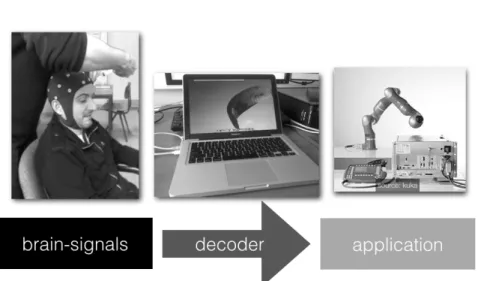
communication channel makes it possible to control the computer by thought alone. To facilitate this, a typical BCI entails three compo-nents, as illustrated in Figure 1.1. First, we have a recording device, e.g. an EEG cap, to measure brain signals, second, a computer that is able to understand these brain signals, and third the intended end-user application, e.g. a word processor, or device, such as a robotic
arm, to be controlled. One of the most common types of BCI is
the Event-Related Potential (ERP) based BCI (Farwell and Donchin, 1988) which aims at providing a new means of communication and control to patients who cannot communicate directly with their en-vironment. A key problem of BCIs is that they have to rely on a calibration recording to train the computer on how to decode the user’s brain signals. Moreover, this calibration session is rather te-dious and time-consuming. This can be problematic for patients with a limited attention span (Li et al., 2011). For this reason, the BCI community has spent considerable effort on reducing the need for a calibration session and has worked towards developing so-called zero-training BCIs. The goal for these zero-zero-training BCIs is that they can be used reliably without any user-specific calibration. Despite the sig-nificant effort, true zero-training BCIs are rather rare. This doctoral thesis details the development of novel machine learning algorithms to facilitate a true zero- training approach for ERP-based BCI.
2 1 Introduction
Figure 1.1: Schematic overview of a BCI system. A typical BCI comprises three components. The first component is re-sponsible for recording the brain signals, the second component, the decoder has to understand these brain signals and use them to perform the correct action in the application, which is the third component.
introduction to BCI, where I will illustrate the necessity of machine learning in BCI research. This will be followed by a section that focuses on ERP-based BCI. Afterwards, I will present an overview of the state of the art in machine learning based decoding in BCI, with a focus on ERP-based BCI. To conclude, I will give an overview of my research contributions and highlight the structure of the subsequent chapters.
1.1
Brain-Computer Interfaces
The concept of BCI was introduced in the early seventies by Vidal (1973), and considers the control of a computer by thought alone. In general, BCI research is motivated by the desire to aid patients by restoring motor function (e.g. after spinal cord injury) or com-munication (e.g. locked-in patients). On top of that, a new target population is emerging: healthy people with the desire to use BCI
1.1 Brain-Computer Interfaces 3
for gaming (Müller et al., 2008; Lécuyer et al., 2008; Bonnet et al., 2013). The aforementioned BCIs require the user to be actively in-volved, a different type of BCI, so-called passive BCIs, can be used to assess workload (Brouwer et al., 2013) and for the evaluation of the perceived image or sound quality (Porbadnigk et al., 2013). At this point, I would like to stress that BCIs are not (yet) capable of reading a mind, although the fMRI based video reconstruction developed by Nishimoto et al. (2011) can create a fuzzy reconstruction of the video a user is watching by decoding the brain activity. Instead, BCIs rely on the detection of very specific brain signals. These specific signals can be the response to stimuli (Farwell and Donchin, 1988) or the voluntary modulation of brain rhythms, e.g. by imagined movement (Pfurtscheller et al., 1997).
1.1.1
Recording the brain signals
The first step in building a BCI is sensing (and almost always record-ing) the brain activity, for which a variety of devices can be used. A first example is functional magnetic resonance imaging (fMRI), which
measures the level of blood oxygenation. This method allows the
researcher to pinpoint precisely which specific brain-regions are acti-vated. However, while the spatial resolution is high (on the order of millimetres), the temporal resolution is quite low (on the order of sec-onds, which is slow considering that our brain is can recognise faces in less than two tenths of a second). Furthermore, fMRI devices are bulky (i.e. they can fill an entire room) and expensive. Near Infrared Spectroscopy (NIRS) is similar to fMRI in the sense that it can locate the active brain regions with high precision, but it is limited to the outer regions of the brain, up to a depth of a couple of centimetres. On the other hand, NIRS is portable and can be taken to the user, instead of the user coming to the lab. Both aforementioned methods are non-invasive, but it is also possible to measure brain activity di-rectly within the brain itself. Obviously, this requires an operative procedure to place an electrode array directly in the cortex, which is not without risk. Nevertheless, it has been shown that the signals recorded in the cortex can be used, in animals and more recently in humans too, to control a prosthetic device such as a robotic arm.
Fur-4 1 Introduction
thermore, it is also possible to place electrodes on top of the cortex but under the skull, which is called ECoG or electrocorticography. Quite often, users of ECoG based BCI are epilepsy patients who had the elec-trodes implanted to locate the epileptic seizure’s focal points precisely before removing them operatively. The most commonly used and one could say most user friendly1 approach to measuring brain activity is the electroencephalogram (EEG), which will be used throughout this work. Using EEG, electrical activity is measured on the scalp (Berger, 1929). The advantage of EEG is that it is a portable setup which re-quires only an amplifier the size of a tissue box and an EEG cap. Furthermore, it has a high temporal resolution, of up to a thousand samples per second. The signal, however, is very noisy, artefact prone and offers a spatial resolution of at best 3 cm (Nunez et al., 1997). Typical EEG caps are so-called wet caps, in which conductive gel is injected between the scalp and the electrode. This increases setup time but the measured signal is of better quality than with dry-caps where the conductive gel is not needed. Furthermore, there exists a range of consumer EEG devices, e.g. the Emotiv Epoc, which offer low quality EEG at a low price. Nevertheless, these devices are suitable for demonstrations and portable inexpensive EEG could eventually allow us to bring BCI to the masses. However, to build a truly reli-able system and for research purposes or in medical applications, high quality EEG is desired.
1.1.2
Decoding the brain signals
A BCI does not only requires raw brain data, but there also needs to be an informative signal within the recordings. For this informative component, BCIs rely on the voluntary generation of specific brain signals, such as imaginary movement, or on involuntary cortical re-sponses elicited by external stimuli. Examples of the latter are Steady state visually evoked potentials (i.e. an image flickering at a spe-cific frequency) and Event-Related Potentials, which will be discussed later. However, recognising these different responses is quite hard due to the large amount of noise, variability and the huge dimensionality
1
One could also argue that user friendly is not really applicable yet to devices designed to sense brain signals.
1.1 Brain-Computer Interfaces 5
of the signals.
To enable man-machine communication, early BCI prototypes re-lied on the users to modulate their brain signals such that they could easily be recognised by the computer (Wolpaw et al., 1991; Birbaumer et al., 1999). Here, the users were responsible for generating the cor-rect signals. As a result, the users had to follow an extensive training program just to learn how to modulate their brain signals. This was a very time consuming and exhausting process, which is not desir-able. Hence, over the years, based on the concept: let the machines
learn, which was promoted by the Berlin BCI group, the training
pro-cess shifted from the user towards the computer (Müller et al., 2004; Dornhege et al., 2007; Blankertz et al., 2007).
Machine learning (Bishop, 2007), which considers the development of algorithms that enable a computer to learn from data, is needed because difficult problems, such as decoding brain signals, cannot be solved by standard algorithms, not even when a team of engineers spends years on developing algorithms because they cannot predict all the variability in the data. To make this more intuitively clear, I would like to present the following analogy.
Imagine that you are lost in an unknown city and you have to find the train station. When you ask for directions, probably on Google Maps, you will be given a very specific set of instructions. Go to the end of this street, turn left, follow this street, . . . . If you execute the instructions rigorously then you will arrive at your destination. In a sense, you are executing a standard algorithm, there is no ambiguity. This was, however, an easy problem.
A much more difficult problem, that has been conquered by any-body who has gotten this far in the thesis, is reading. Reading involves the recognition of symbols, which can be quite hard, especially if the text is written by hand. Imagine that you have to explain (on the phone) to an illiterate person how to recognise a handwrittena. Fur-thermore, you have to make sure that he does not confuse it with any other symbol such as an 0 or a d. Coming up with a set of un-ambiguous steps that allow you to discriminate between all symbols regardless of how they are written is nigh on impossible. There is just too much variability to describe. Moreover, if you are not able to explain this recognition task to a human, you will certainly fail when
6 1 Introduction
you would have to formalise these steps in a computer algorithm. Nevertheless, for humans the solution is (reasonably) simple. All you have to do is teach them, by presenting them with examples of the symbols and telling them which is which. Eventually, they will learn how to recognise the symbols. What’s more, learning is not limited to humans: computers can learn as well. This is exactly the subject of study in machine learning. Machine learning methods allow us to train the computer on difficult tasks by presenting examples of the data and the corresponding solution. This allows us to recognise specific brain responses but also enables us to solve other (for a computer) challenging tasks such as image recognition (Krizhevsky et al., 2012), or music recommendation (van den Oord et al., 2013).
In the field of BCI, the machine learning algorithms are trained on data from a so-called calibration session, in which the user is re-quested to perform a specific task at a specific moment. This enables the experimenter to label the EEG data with the user’s actions. This labelled dataset is then fed to the machine learning algorithm, which analyses the data and learns how to decode this specific user his brain signals. Only after this training procedure, can the decoder be put to work by decoding the brain signals while the user actually uses the intended application. Obviously, such a calibration session is not a truly productive way for the user to spend his time. Furthermore, calibration sessions can significantly reduce the time available for us-ing the BCI, especially for patients with a limited attention span (Li et al., 2011). Therefore, a major challenge in the BCI community is to reduce or even remove the dependency on the calibration session. This is where this thesis contributes by developing a true zero-training approach for one such type of BCI, the ERP-based BCI.
1.1.3
BCI Applications
I would like to point to the wide variety of BCI applications already in existence. By far the most common application, which is also con-sidered in this thesis, is communication (Wolpaw et al., 2002). BCI spellers can be based on ERP paradigms (e.g. (Farwell and Donchin, 1988; Höhne et al., 2010; Schreuder et al., 2011b; Acqualagna and Blankertz, 2013)), SSVEP (Cheng et al., 2002; Müller-Putz et al.,
1.2 Event-Related Potential based BCI 7 0 0.2 0.4 0.6 0.8 1 −0.1 −0.05 0 0.05 0.1 0.15 time (s) P300 NON−P300
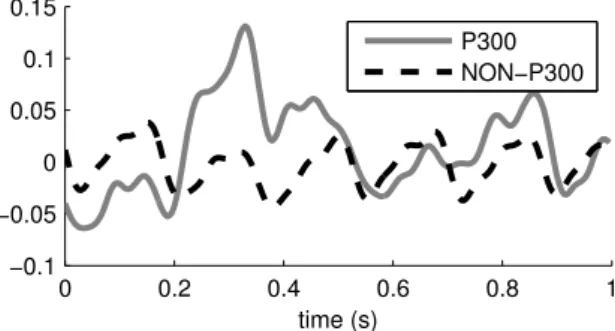
Figure 1.2: A depiction of an averaged ERP target response versus a non-target response from a dataset of visual ERP data.
2005) or motor imagery (Blankertz et al., 2006a). Cursor control is typically based on imagined movement (Wolpaw et al., 1991). More advanced applications of imagined movement include the control of a helicopter (LaFleur et al., 2013) and pinball (Tangermann et al., 2008). Additionally, BCIs have been developed to control robotic arms (Hochberg et al., 2006, 2012; Santhanam et al., 2006; Bishop et al., 2014), to decode finger movements (Kubanek et al., 2009; Wang et al., 2011), to perform speech reconstruction (Pasley et al., 2012) and to aid in rehabilitation (Pfurtscheller et al., 2008).
1.2
Event-Related Potential based BCI
One of the most common types of BCI based on Event-Related Poten-tials (ERP), and was introduced by Farwell and Donchin (1988). We will begin with a general introduction to the concept of ERP-based BCI, followed by a discussion of two specific ERP paradigms.
An ERP is a specific brain response to an event such as the presen-tation of a stimulus (e.g. a specific sound), a mistake, a motor event, . . . (Luck, 2005). In theory, these brain responses are, depending on the event, a positive or negative deflection of the scalp potential that is time-locked, this means that there is a fixed delay, to the event that evoked them. However, there can be quite a bit of variability be-tween different subjects and even bebe-tween different measurements of
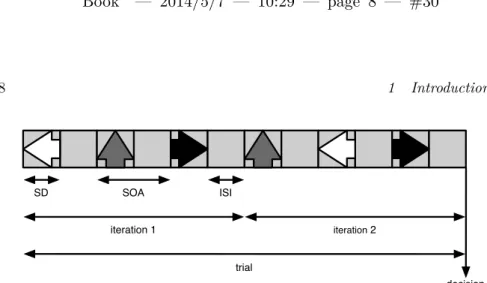
8 1 Introduction SOA ISI iteration 1 iteration 2 SD trial decision Figure 1.3: Schematic overview of an ERP-based paradigm that uses visual stimuli (arrows).
the same type of ERP response from the same user. Several of these ERP responses are described in literature and we will highlight just two of them. The first example is the N170 response, that is associ-ated with the processing of faces. This response consists of a negative deflection in the EEG, 170 ms post-stimulus. The second example is the P300 ERP, which is a positive deflection, 300 ms post stimulus, that can be generated by so-called oddball paradigms. In these odd-ball paradigms, the user has to focus his attention on a rare target stimulus that is embedded in a stream of more frequent non-target stimuli (Squires et al., 1977). When the target stimulus is presented, the P300 response is elicited. Furthermore, the P300 response can be modulated by a multitude of factors including its frequency of appearing (Squires et al., 1977), the discriminability of the stimulus (Johnson Jr and Donchin, 1978), but also by motivation when used in a BCI (Kleih et al., 2010).
ERPs can be utilised in a BCI by coupling stimuli to actions. We will use a toy example, shown in Figure 1.3, to explain this concept. In our toy ERP paradigm, we use three different stimuli: an arrow pointing to the left, which is assigned to the action of turning left, an upwards pointing arrow to move forward and to turn right an arrow pointing to the right. These stimuli are presented to the user, who has to focus on one of them. When the attended stimulus is presented, an ERP target response will appear. Hence, when the computer is able to correctly detect the ERP target responses, it can execute the desired action. As a result, the computer can be controlled simply
1.2 Event-Related Potential based BCI 9
by focussing on the stimuli. Unfortunately, it is not possible to de-tect the target ERP response reliably based on a single presentation of each stimulus. For this reason, the stimulus presentations are re-peated in an ERP-BCI. Only after each stimulus has been presented multiple times, a decision has to be made. Now, we will formalise this a bit and we will introduce some ERP terminology (also illustrated in Figure 1.3).
The control in an ERP-BCI is discrete and there has to be one decision at the end of atrial. Each trial consists of severaliterations, during which each individual stimulus is presented exactly once. The time between the onset of two subsequent stimuli is theStimulus Onset
Asynchrony(SOA). This is equal to the sum of theStimulus Duration
(SD) and the Inter-Stimulus Interval (ISI), which is defined as the time between the end of a stimulus and the beginning of the next stimulus. In a typical ERP-based BCI the SOA is in the range of 100-200 ms, which is considerably shorter than the time delay between the ERP response and the stimulus. As a result, there will be some overlap. This background knowledge allows us to move on to the P300-BCI, which is the first ERP-based BCI developed.
1.2.1
The P300-BCI
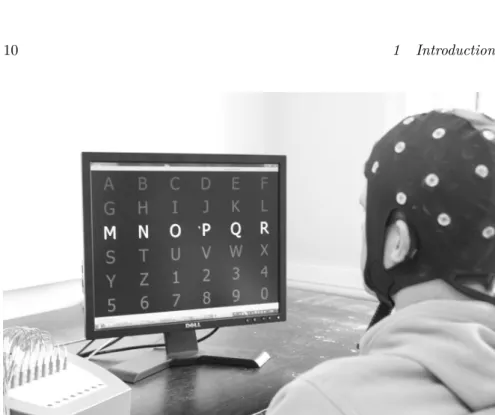
The first ERP-based BCI that was introduced is the P300-BCI, also known as the matrix speller, was introduced in the eighties by Farwell and Donchin (1988). The original matrix speller uses a 6×6 grid of symbols on a computer screen, as shown in Figure 1.4. By focussing his attention on a specific symbol, the user is able to select that sym-bol. The stimulus sequences are pseudo-random intensifications of rows and columns. Hence, each iteration consists of 12 stimuli, 6 for the rows and 6 for the columns. When the row or column containing the desired symbol is highlighted, a target ERP response is evoked. The intensification of non-target stimuli evokes a non-target response. An example of an average target and non-target response is given in Figure 1.2.
One of the appealing aspects of the P300 based BCI is the fact that it has been tested on patients, which are the true end users (Nijboer et al., 2008). In these experiments, research has shown that
10 1 Introduction
Figure 1.4: An experimental setup for visual ERP spelling. (photo: Francis wyffels)
patients are not only able to control the BCI, they can do so with high accuracy. In fact, the P300-BCI has already been taken out of the lab and found its way into the home of the patient (Vaughan et al., 2006). Since its inception, researchers have suggested improvements for the visual ERP-based BCI. Here we will focus on paradigm based improvements, whereas machine learning based improvement will be detailed in Section 1.3. First, it is possible to optimise the stimuli themselves (Kaufmann et al., 2011), for example by replacing the in-tensifications with face based stimuli, such that in addition to the nor-mal ERP response, an N170, related to the recognition of faces, can be observed and effectively enhances the signal to noise ratio. Another option is to optimise the stimulus sequence, where it is even possible to use fixed sequences in place of the common pseudo-random high-lighting structure (Tangermann et al., 2012). A different approach to improving the stimuli was presented by Townsend et al. (2010), where the row-column structure of the stimuli was abandoned in favour of groupings of pseudo-random stimulus groups. The goal here is to min-imize the most common error in the original matrix speller, where a
1.2 Event-Related Potential based BCI 11
neighbouring letter is selected erroneously. Currently, such improve-ments are also being investigated in our lab (Verhoeven, 2013). Ryan et al. (2010) proposed to incorporate words in the spelling matrix to enable the user to spell an entire word in a single selection.
Yet, neither of those improvements address the major limitation of the matrix speller: the dependency on eye-gaze, over which control can be lost in later stages of ALS. To alleviate this, a novel gener-ation of gaze independent visual ERP spellers have been proposed (Treder et al., 2011; Acqualagna and Blankertz, 2013). There are tactile (Brouwer and Van Erp, 2010; Cincotti, 2010; Kaufmann et al., 2013) and auditory variations (Hill et al., 2004; Schreuder et al., 2010, 2011b; Höhne et al., 2011) and a bi-modal version (Thurlings et al., 2012) as well. One of the auditory variations, the AMUSE paradigm (Schreuder et al., 2010, 2011b), is used extensively in this work and is the topic of our next discussion. For a complete overview of gaze independent ERP-BCI we refer the reader to (Riccio et al., 2012).
1.2.2
Auditory ERP (AMUSE)
The AMUSE paradigm is an auditory ERP-based paradigm. In AMUSE, each stimulus is a specific tone that originates from a specific direc-tion. Our implementation uses 6 unique auditory stimuli, each pro-duced by one of six speakers that are positioned on a ring of 130 cm diameter around the user, as shown in Figure 1.5. This gives the user two different options to discriminate between the stimuli: the tone and the direction. As is common in ERP paradigms, each stimulus is assigned to an action and by attending a specific stimulus, the user can execute the corresponding action. Since AMUSE is limited to 6 different stimuli, it has to rely on a hierarchical multi step process to perform additional actions. In the version of AMUSE that we have used, spelling is done in a two-step process. Each action in the first step allows the user to select a group of 6 stimuli. In the second step, one of these symbols can be selected. Thus, the two-step process al-lows for the spelling of 36 distinct symbols. In our study, we have omitted the backspace functionality, but it was present in a previous AMUSE study (Schreuder et al., 2011b). Moreover, in that study, it has been shown that AMUSE can be used solely in the auditory
12 1 Introduction
. Figure 1.5: The AMUSE spatial auditory ERP setup. The user
sits in the centre of a ring, on which 6 speakers are positioned. A specific tone is associated with each of the 6 speakers. By attending one of the six stimuli, the user can perform an action. This picture was taken at the TU-Berlin during the pilot study for the evaluation of the unsupervised algorithm that is proposed in this thesis. The eagle-eyed readers can spot a NIPS mug, which is a much needed accessory in a machine learning lab.
domain, which allowed a blind user to control the BCI.
AMUSE is not the only auditory ERP paradigm in existence and many variations exist (e.g. (Höhne et al., 2011; Hill et al., 2004)) The disadvantage of these Auditory ERP paradigms is that they have a lower signal to noise ratio than visual ERP paradigms, but ongoing research is investigating approaches to improve the raw signal to ratio of auditory ERP paradigms (Höhne et al., 2012; Tangermann and Höhne, 2011).
1.2.3
Measuring performance
In this work, we aim at improving performance of ERP-based BCI and we will develop zero-training methods for ERP-based BCI. Hence, the following question arises naturally: how is performance defined? Do we have to improve the discrimination between target and non-target responses? Do we have to improve the accuracy of the symbol/action selection? Which is more important, the speed of decision making or the accuracy of the BCI? When exactly is one approach better then
1.2 Event-Related Potential based BCI 13
another one? The answer to these question is rather subtle.
For this reason, we will utilise different performance metrics, based on the context. The metrics considered in this work are: area under curve (AUC), (selection) accuracy and Symbols Per Minute (SPM). Additionally, we will discuss the Information Transfer Rate (ITR) too, since it is often (mis-)used in BCI research.
Area Under Curve
A first performance measure is the Area Under Curve (AUC). The AUC measures the area under a receiver operator curve. In a re-ceiver operator characteristic, the true positive rate (y-axis) is plot-ted against the false positive rate (x-axis). The resulting area under the curve is equal to 0.5 when the classifier output is random. It is equal to 1 when the classifier works flawlessly and equal to 0 when the classifier assigns the opposite labels. To compute the AUC, one can use the following procedure.
1. Sort the classifier outputs for all data points
2. use each value of the classifier output as a threshold
(a) Assign all values above or equal to the threshold to the positive class, assign all values below the threshold to the negative class.
(b) Compute the true positive and false positive rate and plot it
3. compute the area under the resulting curve. Accuracy
Evaluating the number of mistakes made by an ERP-BCI is straight-forward by computing the accuracy (A):
A= correct selections selections made .
There is a remark to be made. When a two-step selection procedure is used in a spelling application the selection accuracy will differ from
14 1 Introduction
the spelling accuracy. Throughout this book we will use the selection accuracy unless specified otherwise.
Symbols per minute
The selection accuracy or the AUC do not convey how efficient the BCI actually is. To evaluate the efficiency, we will use the symbols per minute (SPM) approximation from Schreuder et al. (2011a), which is related to the utility metric from Dal Seno et al. (2010). The idea behind SPM is that a user wants to complete a (spelling) task without error. Hence, each error has to be corrected by an undo command. When we have succeeded in predicting the correct action, then we
have conveyed one unit of useful information. However, when we
made a mistake, then we will have to correct this mistake by the undo command. Therefore, a mistake counts as a negative unit of information. Furthermore, we want to measure efficiency, so we have to take the time per decision, for which the average is denoted by ∆t. When we bring this all together we get the SPM formula:
SPM = A−(1−A)
∆t
= 2A−1 ∆t
.
Clearly, when the accuracy increases, the SPM increases. Similarly, when the time per decision is shorter, we will be able to spell more symbols. Finally, we would like to link this back to the absolute reliability of the system. Imagine that we have a BCI which is correct 75% of the time. in this case, we will (on average) spend half the time correcting mistakes. More importantly, when the accuracy drops below 50 %, we will not make any progress at all.
Information Transfer Rate
A final performance measure is the Information Transfer Rate or ITR (Wolpaw et al., 2000). The Information Transfer Rate (ITR,bits /minute) is quite often (mis)used (Yuan et al., 2013) as the default metric for communication efficiency in a BCI. It can be computed as follows:
ITR = log2N +Alog2A+ (1−A) log2 1−A N−1
1.3 State of the art 15
whereN is the total number of options that can be selected. We will illustrate this measure in our first online evaluation ( Section 3.2.2). Its most important disadvantage is that it does not consider mistakes as a type of adverse (negative) information. It does not consider the fact that mistakes might have to be corrected. As a result, the information transfer rate favours very short times between decisions, even when the reliability of the system suffers drastically and makes the system unusable.
1.3
State of the art
In what follows, we give an overview of the current state of the art in machine learning methods for BCI, with a specific focus on ERP-based BCI. For the reader who is not familiar with the basic concepts of machine learning such as cross-validation, regularisation and over-fitting, it might be useful to read Section 2.1 first.
The major challenge in machine learning models is, paraphrasing Mak et al. (2011), to develop methods which perform accurately, but that are not overly complex to be used in a practical setting. To make this clear, the complexity of the underlying method does not actually matter, what matters is whether it can be packaged such that it can be used by the care-takers, which are in most cases rather unfamiliar with machine learning. For this reason, Kaufmann et al. (2012) have investigated the simplification of classifier calibration by developing an easy to use software package. Nevertheless, it should not prevent the machine learning enthusiast from developing novel advanced machine learning methods. But we do have to keep in mind that, in the end, they should be optimised automatically, without the intervention of an engineer.
1.3.1
Feature engineering
One of the major limitations of EEG based BCI is the low signal to noise ratio. For this reason, researchers have spent considerable effort on increasing the signal to noise ratio of the data, for example by performing sensor selection using machine learning based optimisation
16 1 Introduction
(Lal et al., 2004) For motor imagery based BCI, the well known CSP algorithm (Koles et al., 1990), or one of its more advanced successors that focus more on regularisation and generalisation (Lemm et al., 2005; Blankertz et al., 2008; Ang et al., 2012; Samek et al., 2012, 2014), is used in most current motor imagery decoders. However, these methods cannot be applied to ERP-based BCI. There does exist one spatial filtering approach that is designed for ERP paradigms: the XDawn algorithm (Rivet et al., 2009). However, it should be noted that supervised spatial filtering methods cannot be combined with true zero training BCI.
1.3.2
Classifiers
The work by Blankertz et al. (2011) shows that ERP features can be approximated well by a mixture of two multivariate Gaussian dis-tributions. In this mixture, the covariance matrix is shared between the classes but the mean is class-dependent. The optimal classifier in this case corresponds to Linear Discriminant Analysis (LDA). When applied in a machine learning context, proper regularisation must be used to control the model complexity. Moreover, recent work by Far-quhar and Hill (2013) has shown that the key to obtaining good per-formance is to use a properly regularised linear classifier. They have shown that these properly regularised models outperform the most common classifier used in BCI research: stepwise Linear Discrimi-nant Analsysis (swLDA), which is the default option in the BCI2000 software (Schalk et al., 2004).
On the BCI competition III dataset, the best performing method on the ERP dataset is the ensemble of SVMs approach from Rako-tomamonjy and Guigue (2008). They divided the training data into 17 parts. Subsequently, they optimised a classifier on each of these 17 subsets. To obtain the final prediction, they combined the outputs of all 17 classifiers. Currently, this method is still one of the best performing methods on the BCI Competition III dataset. While this is an excellent application of machine learning principles (especially related to the cross-validation), the extremely intensive optimisation procedure is rather data hungry and cumbersome. As a result it is not really suited for practical use.
1.3 State of the art 17
Cecotti and Gräser (2010) have investigated the use of convolu-tional neural networks (CNN) for ERP decoding. While CNNs are able to achieve state of the art performance on a multitude of tasks (Dieleman et al., 2011; Krizhevsky et al., 2012; van den Oord et al., 2013), they do not perform better than a linear classifier on ERP analysis (Kindermans et al., 2012b). Furthermore, they require large amounts of data to be trained properly, which is rarely available.
1.3.3
Adaptive methods
A major problem in many real-world application is non-stationarity of the data distributions (Sugiyama et al., 2007; Quionero-Candela et al., 2009). In BCI this non-stationarity can be caused by learning effects through co-adaptation (Shenoy et al., 2006; Vidaurre et al., 2011b), reduced attention or fatigue, as well as task-unrelated changes in the mental state. For this reason, the BCI community has investigated methods that can discover the stationary subspace which is stable over time (von Bünau et al., 2009), or over users, such that shared noise subspaces can be removed beforehand (Samek et al., 2013). A different strategy is to adapt the machine learning model on the fly. Adaptive methods have been investigated for many paradigms, including motor imagery (Vidaurre et al., 2011a; Xu et al., 2011) and prosthetic control (Bishop et al., 2014). We will highlight three selected methods that introduce adaptation in the ERP-BCI.
Dähne et al. (2011), inspired by Vidaurre et al. (2011a), have pro-posed an unsupervised LDA adaptation scheme. In LDA, the classifier is computed as follows
w= Σ−1(µ1−µ2),
where Σ is the estimated covariance matrix and µ1,µ2 are the esti-mated means of the target and non-target class. To counter a shift in the covariance structure of the data, they have adapted the covariance matrix by approximating it without using label information.
Panicker et al. (2010) have proposed an adaptive mechanism that is composed of two classifiers, where the output of each classifier is used to label the data to train the second classifier. The resulting
18 1 Introduction
method is rather complex and has to be pre-trained using labelled data.
Finally, the work by Lu et al. (2009) uses adaptation in combina-tion with transfer learning, which will be discussed next. They ini-tialised a model on data from other subjects and subsequently adapted it to a novel subject. The major limitation of this method is the high number of parameters and the need for labelled data in the pre-training of the general classifier.
The major difference with our work is that the method presented in this book can learn from scratch, without seeing a single labelled data point (Kindermans et al., 2012b)
1.3.4
Transfer learning in BCI
In transfer learning (Thrun and Pratt, 1998; Pan and Yang, 2010), the goal is to share information across related tasks. In a BCI set-ting, each user is considered to be a task and we aim to perform inter-subject transfer learning by sharing decoding information be-tween the different users. Most transfer learning methods are based on learning shared representations (Argyriou et al., 2008), building a hierarchical model of the task (Kemp et al., 2007; Salakhutdinov et al., 2011; Gopal et al., 2012) or integrating information from differ-ent sources (Palatucci et al., 2009; Frome et al., 2013; Socher et al., 2013).
Transfer learning in BCI is investigated mainly to improve decod-ing of motor imagination. Fazli et al. (2009, 2011) relied on large-scale optimisation and mixed effects models to leverage decoding knowl-edge for novel users. Devlaminck et al. (2011) have enhanced the CSP algorithm to directly incorporate multi-subject transfer learn-ing. Krauledat et al. (2008) have investigated the use of prototypical spatial filters that can be shared between users. Finally, Samek et al. (2013) have shown that, while it is possible to find shared subspaces of the signal that only contain noise, finding and sharing informative subspaces between users in motor imagery BCI is quite difficult.
The aforementioned work by Lu et al. (2009) was the first introduc-tion to transfer learning based classificaintroduc-tion in ERP-BCI. Additonally, Jin et al. (2012) have evaluated the use of an swLDA model trained
1.3 State of the art 19
on a set of subjects. However, to obtain a highly accurate model, they had to fine-tune it with additional labelled data. Furthermore, the dependency on labelled data remains a major limitation of most recent transfer learning models (Colwell et al., 2013; Herweg et al., 2013)
We contribute with a transfer learning model, that can be trained without using a labelled data point and that can be adapted to the novel user (Kindermans et al., 2012a, 2014)
1.3.5
Incorporating side information
Speier et al. (2012) propose to use a language model in combination with swLDA. To combine classifier, tri-gram language model and dy-namic stopping, the output of the linear classifier during training is used to fit a two component 1D Gaussian mixture model. This mix-ture model is used to transform the projected data into probabilities. These are combined with the language models and finally used in the dynamic stopping strategy. Just to tie the separate components together, 5 additional parameters have to be tuned. This contrasts with our model, which will be introduced in Chapter 3, where we have the same capabilities but without introducing additional param-eters. A different change to the input mechanism was proposed by Höhne et al. (2010), who used a T9-based predictive text system in an auditory BCI.
A different take on using side information was used by Wang et al. (2011) to improve the decoding performance of finger flexion based on ECoG. In their work, the authors presented a probabilistic model that was able to capture the dynamics of finger flexion in the evaluation dataset. This allowed them to filter the output to obtain a cleaner ver-sion of the predictions. In a sense, this approach is similar to language model based decoding. Both a language model and their probabilistic model define a prior expectation over the decoding output. Hence, we can optimise our prediction such that it fits our expectation.
20 1 Introduction
1.3.6
Improving the efficiency through dynamic
stopping
Dynamic stopping in ERP-based BCI considers techniques which stop the stimulus presentation sequence as soon as the classifier is confi-dent enough to predict the attended stimulus. As a result, dynamic stopping methods can increase the communication rate drastically. Many different dynamic stopping methods have been proposed, and for a detailed study, we refer to the excellent work of Schreuder et al. (2013). Here, we will briefly summarise a subset of the existing dy-namic stopping approaches.
Schreuder et al. (2011b) used the median between the projection of the data from the most likely and the second most likely symbol to measure the confidence level of the classifier. The stimulus presen-tation is stopped when the confidence level exceeds a pre-determined subject-specific value, which has to be optimised on labelled data.
A more involved approach was proposed by Lenhardt et al. (2008), where the average LDA output per element in the spelling matrix was computed across iterations. These values were subsequently nor-malised such that the maximum is mapped to 1 and the minimum is mapped to 0. The sum of these normalised values is used to measure the confidence level. When the sum of these values is low, the classi-fier is predicting a single symbol with high confidence. Hence, when the sum of all values drops below a subject-specific threshold, the stimulus presentation is halted and the computer makes a prediction. An SVM-specific method has been proposed by Liu et al. (2010). After supervised training, they compute the average distance between the ERP response and the separating hyperplane. During spelling, the EEG is averaged over the last three iterations. If the distance between the averaged EEG and the separating hyperplane is once or twice the average distance computed on the training data, the symbol is selected and stimulus presentation is stopped.
Jin et al. (2012) propose a classifier-independent dynamic stopping strategy. If the classifier predicts the same symbol twice in a row, they spell that symbol and move on to the next one.
From this overview, it is clear that most of the dynamic stopping strategies are additional post-processing procedures on the output.
1.4 Research contributions and structure 21
This contrasts with what we will propose in Chapter 3, where the dynamic stopping strategy is a natural extension of the classifier itself.
1.4
Research contributions and
struc-ture
In this section, I briefly discuss my research contributions and present an overview of the contents of the subsequent chapters.
A unified probabilistic model for Event-Related Potential based BCI
Machine learning approaches for ERP-BCI have become more and more complex. Today, most state of the art decoders incorporate lan-guage statistics to improve reliability and a dynamic stopping criterion to speed up the communication process. As a result, many of these approaches are made up of several components with many parame-ters each. On top of that, additional parameparame-ters are introduced to tie all components together. Consequently, properly optimising these models requires complicated cross-validation procedures. This is only possible when a large quantity of labelled data is available and this involves lengthy calibration sessions.
Our unified probabilistic model was developed to simplify the op-timisation of the decoder. It does not need extensive cross-validation procedures, but it does retain the reliability of a language model based method and the efficiency of dynamic stopping. We have achieved this by combining the basic decoder and the language model into a coher-ent probabilistic model. Hence, no additional parameters are needed to combine the decoder and the language model. Moreover, the pa-rameters of the decoder can be optimised without cross-validation. Last but not least, the probabilistic output generated by this unified model gives way to a natural dynamic stopping strategy.
We view this unified probabilistic model as a building block, onto which additional components can be seamlessly integrated. This uni-fied probabilistic model is the backbone of this thesis and will be extended with unsupervised and transfer learning.
22 1 Introduction
A novel unsupervised, constraint-based learning algorithm The aforementioned unified model relies on supervised training. It requires a calibration session to obtain the labelled data to train the subject-specific model. To remove the dependency on labelled data, we present what is to our knowledge the first unsupervised training algorithm for ERP-based BCI. Please note that this is different from adaptive methods, which are trained with label information and sub-sequently adapted without label information. The proposed model is able to learn from scratch, it does not require a single labelled data point. Instead it learns how to decode the user’s brain signals au-tomatically by analysing the unlabelled data. This novel algorithm exploits the constraint that in each trial only a single stimulus type can result in an ERP target response. The result is an approach that allows us to forego the calibration session completely. Moreover, when enough unlabelled data is available, the proposed algorithm is able to build a decoder that is as reliable as subject-specific supervised meth-ods. Hence, this novel algorithm contributes significantly by bringing us one step closer to true zero-training BCI. Moreover, the unsuper-vised learning method results in an inherently adaptive model, which can cope with effects of non-stationarity, e.g. due to fatigue, that can cause a supervised model to fail.
However, the drawback to this method, and the reason that it does not directly result in a true zero-training BCI, is that while it does not require labelled data, it still requires a substantial amount of data. During online experiments, the need for a substantial amount of data is manifested as a warm-up period at the beginning of an experiment. During this warm-up period the model is not reliable and makes decoding errors. However, as more and more data is processed, the quality of the model improves and the model is able to revise its mistakes.
The proposed learning method is evaluated extensively on data from auditory and visual ERP paradigms. On top of that, we also present the results from an online study, conducted at the TU-Berlin, using the AMUSE paradigm which demonstrates that our method can effectively be used in real BCI experiments.
1.4 Research contributions and structure 23
Transfer learning in ERP spellers
Clearly, the limitation of the unsupervised learning method is the warm-up period. Hence, in order to build a true zero-training BCI, the warm up period must be eliminated. To achieve this, we present an extension of our unified model that enables us to incorporate decoding knowledge from other users. The extension uses inter-subject transfer learning, which shares information on how to decode the EEG signals between the different users.
This approach can be used to build a subject-unspecific decoder, which is somewhat accurate, but cannot compete with subject-specific model. By combining this basic transfer learning model with the un-supervised learning algorithm, we are able to build a true zero-training BCI, which works reliably from the very first trial. Additionally, this model can be extended with language models and dynamic stopping. Our simulation results on this elaborate model indicate that in a vi-sual ERP speller, a user can, on average, spell 29 symbols in the time required to do the calibration recording. This increase in efficiency is potentially very rewarding for patient applications.
Similar to the unsupervised model, we have evaluated this method extensively. Data from 22 subjects using a visual ERP paradigm was used to assess the performance. On top of that, we have analysed the results from the data generated by the original AMUSE study, which comprises 21 subjects and we have performed an additional online evaluation using AMUSE with 20 additional users.
Understanding unsupervised and transfer learning
Transfer learning has gained much attention from the BCI community recently. However, it contrasts with the tradition of building
subject-specific supervised decoders. Furthermore, one would expect that
transfer learning should not be possible given the high inter-subject variability observed in typical BCI data. Therefore, we provide an additional understanding of the mechanism underlying transfer learn-ing, where we empirically show that while the subjects appear to be fundamentally different, the information content in their signals is ac-tually structured in a similar manner. On top of that, we demonstrate that the unsupervised learning rule is not only able to achieve state
24 1 Introduction
of the art decoding performance, it is able to identify the relevant underlying neurological activity as well.
Structure of this thesis
In the next chapter, we will give a brief and more mathematically inclined introduction to the most relevant machine learning methods and concepts. Afterwards in Chapter 3 we present our unified prob-abilistic model. In Chapter 4 we detail the unsupervised learning method, including an extensive offline and