Document Stage: W-Paper August 2012
Piloting a Results-Based Financing for Programs
Modality
ABBREVIATIONS
ADB – Asian Development Bank ADF – Asian Development Fund CCT – conditional cash transfer COD – cash on delivery
CAPE – Country Assistance Program Evaluation CPS – country partnership strategy
DFID – Department for International Development (UK) DLI – disbursement-linked indicator
DMC – developing member country
EC – European Commission
EPC – Electric Power Corporation
EU – European Union
FSS – franchise shipping scheme
GACAP – governance and anticorruption action plan GAVI – Global Alliance for Vaccines and Immunization HSDP – health sector development program
IDB – Inter-American Development Bank ISS – immunization services support M&E – monitoring and evaluation
MCC – Millennium Challenge Corporation MDB – multilateral development bank OBA – output-based aid
OCR – ordinary capital resources
OECD-DAC – Development Assistance Committee of the Organisation for Economic Co-operation and Development
PBC – performance-based contract PDL – performance-driven loan
PNG – Papua New Guinea
PPP – public–private partnership RBF – results-based financing
RBPSM – results-based public sector management SAI – supreme audit institution
SPSP – social protection support project SWAP – sector-wide approach
TA – technical assistance
UK – United Kingdom
US – United States
NOTE
In this report, ―$‖ refers to US dollars.
In preparing any country program or strategy, financing any project, or by making any designation of or reference to a particular territory or geographic area in this document, the Asian Development Bank does not intend to make any judgments as to the legal or other status of any territory or area.
CONTENTS
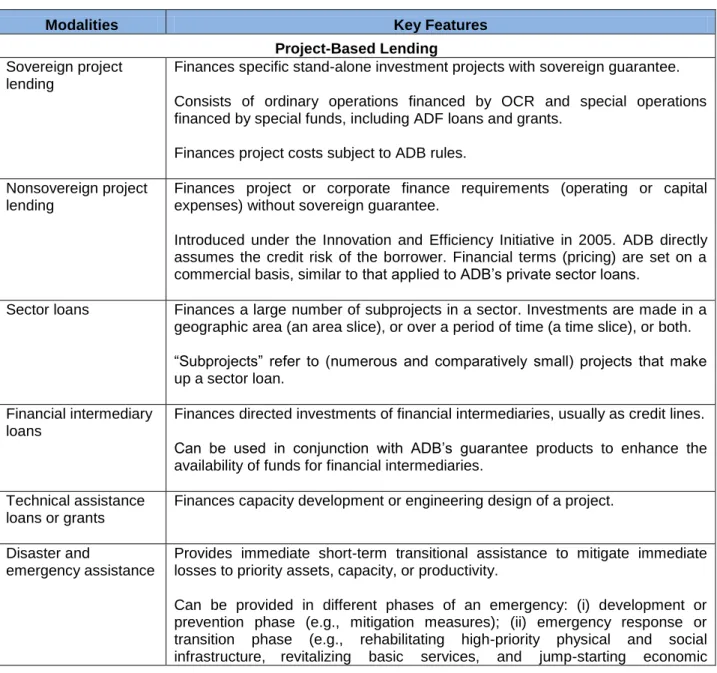
Page
EXECUTIVE SUMMARY i
I. PROPOSAL 1
II. WHAT IS RESULTS-BASED FINANCING? 1
III. WHY RESULTS-BASED FINANCING? 1
A. The Quest for Development Results 1
B. A New Development Paradigm 2
IV. RESULTS-BASED FINANCING IN MULTILATERAL DEVELOPMENT BANKS 2
A. World Bank 3
B. Inter-American Development Bank 4
C. Asian Development Bank 5
V. THE NEED FOR RESULTS-BASED FINANCING FOR PROGRAMS IN ADB 6
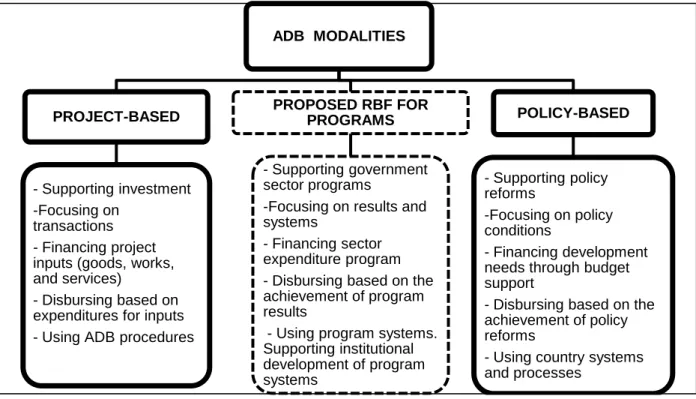
A. Existing ADB Modalities 6
B. The Need for a Results-Based Financing for Programs Modality 7 C. Results-Based Financing for Programs as a Third Lending Modality 8 D. Expected Benefits from Results-Based Financing for Programs 9 VI. CONSULTATION AND LEARNING LESSONS FOR THE RESULTS-BASED
FINANCING FOR PROGRAMS MODALITY 11
VII. PREPARING AND IMPLEMENTING RESULTS-BASED FINANCING FOR PROGRAMS12 A. Definition, Objectives, Key Features, and Building Blocks 12
B. Suitability and Identification 13
C. General Approaches and Considerations 15
D. Assessing the Building Blocks 16
E. Integrated Risk Assessments and Mitigating Measures 25
F. Capacity Development and Other Required Actions 25
VIII. APPROVING AND IMPLEMENTING RESULTS-BASED FINANCING FOR PROGRAMS 26
A. Application and Approval 26
B. Financing-Related Issues 27
C. Implementation-Related Issues 28
IX. RESPONSIBLITIES AND PARTNERSHIP 29
A. Roles and Responsibilities 29
X. CHALLENGES AND WAYS FORWARD 30
A. Risks and Mitigating Measures 30
B. Advancing the Results-Based Agenda 32
C. Piloting Results-Based Financing for Programs 32
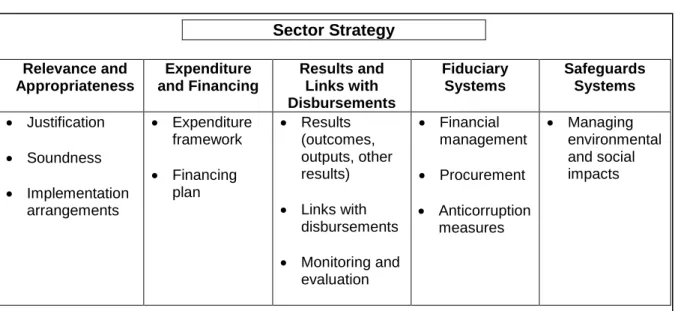
D. Resource Implications 32
XI. REQUEST FOR BOARD GUIDANCE 33
APPENDIXES
1. Summary of Results-Based Financing Approaches 34
2. Examples of ADB Operations with Results-Based Financing Features 49
3. Summary of ADB‘s Lending Modalities 58
4. Summary of Consultations 63
5. Proposed Guidelines to Prevent or Mitigate Fraud, Corruption, and Other Prohibited
EXECUTIVE SUMMARY
This working paper proposes that the Asian Development Bank (ADB) introduce a results-based financing (RBF) for programs modality. The RBF for programs will support government-owned sector programs, linking disbursements directly with the achievement of program results. The design and implementation of RBF for programs operations will be based on ex ante assessments and supported by ex post results verification, and will be underpinned by systematic institutional development. The objectives of RBF for programs are to increase accountability and incentives to deliver results, improve the effectiveness and efficiency of government-owned sector programs, promote institutional development, support development coordination and harmonization, and enhance development effectiveness.
RBF for programs operations will have the following key features:
(i) Supporting government sector programs. These operations will support government-owned sector programs, and finance the program‘s expenditure framework.
(ii) Linking disbursements to results. Disbursements will be linked to the achievements of the program results—the disbursement-linked indicators (DLIs). The DLIs can be sector outcomes, outputs, and other related results.
(iii) Strengthening institutional development. Institutional development is a key motivation and objective of the RBF for programs. The RBF for programs operations will focus on key program systems, including monitoring and evaluation, governance or fiduciary (financial management, procurement, and anticorruption measures), and safeguards. Institutional development will also include organizational and behavioral changes that strengthen the accountability and incentives for results. The aim of institutional development will be achieving and sustaining sector results. The close integration and feedback between institutional development and results will be designed to promote government ownership of institutional development.
(iv) Managing risks adequately. RBF for programs operations will include rigorous assessments of the systems to implement the program, follow-up capacity development measures, and implementation support. ADB and the borrower will agree on measures to improve the program and its systems to ensure that (a) the program achieves its development results, (b) funds are used for the program‘s expenditures with due consideration for economy and efficiency, and (c) potential environmental and social impacts are adequately addressed.
(v) Fostering partnerships. RBF for programs operations will support development partnerships by sharing a common government-owned results framework, using common systems, and financing common expenditure frameworks.
The achievement of results and institutional development will be the centerpieces of RBF for programs. ADB will assess a program, its financing, results, fiduciary systems, and safeguard systems, guided by commonly accepted good practice principles. The assessments will cover the whole program to be supported—not just the part financed by ADB—and will be used to identify risks and mitigating measures, the capacity development needed, and other implementation support required.
To enable learning-by-doing, it is proposed that ADB pilot the RBF for programs modality for 6 years. This is the minimum time frame required to yield sufficient information for a subsequent review of RBF for programs operations, including both their design and implementation aspects. During the pilot, ADB will put in place measures for training, dissemination, consultation, and
learning. ADB will also learn from and exchange experiences with other development agencies. The experiences derived from the pilot will inform the future policy direction of the RBF for programs modality.
To mitigate risks during the piloting, RBF for programs operations will exclude activities that would be classified as category A in the Safeguard Policy Statement (2009), and activities that would involve procurement of works, goods, and services under contracts whose estimated value exceeds specified monetary amounts (high-value contracts).
The RBF for programs modality is expected to deliver many potential benefits. It will complement ADB‘s existing project-based and policy-based lending operations. It will help ADB meet the needs of its developing member countries better, enrich ADB operations, support good governance, and contribute to realizing the goals of the aid effectiveness agenda.
I. PROPOSAL
1. This working paper proposes that the Asian Development Bank (ADB) introduce a results-based financing (RBF) for programs modality. The RBF for programs will support government-owned sector programs and link disbursements directly with the achievement of program results. The design and implementation of RBF for programs operations will be based on ex ante assessments and supported by ex post results verification, and will be underpinned by systematic institutional development. The objectives of the RBF for programs are to enhance the achievement and sustainability of development results from government-owned programs, promote institutional development in ADB‘s developing member countries (DMCs), foster development coordination, and strengthen development effectiveness.
II. WHAT IS RESULTS-BASED FINANCING?
2. All development operations share the same objective of delivering results. What distinguishes RBF is that it directly links disbursements with results. This differs from modalities that link disbursements with evidence of expenditures for inputs, and thus have an indirect relationship between disbursements and results.
3. While RBF approaches have been described in varying terms, they all essentially involve a financier making payments to a recipient based on results delivered through pre-agreed funding relationships. The results financing relationships can be defined in legally binding contracts, memorandums of understanding, or partnership arrangements.1
4. The results-based relationships can be between various agencies, for example between a development agency and a DMC government, between a government and a ministry, or between a national and a subnational government. The results under RBF operations can be outcomes, outputs, and system improvements that address sector performance bottlenecks. Many RBF operations use a combination of results at different levels. The design of RBF operations also stresses the importance of identifying the right results. Therefore, the results should be defined from the standpoint of the ultimate beneficiaries to ensure that results are relevant and meet their needs.
III. WHY RESULTS-BASED FINANCING?
A. The Quest for Development Results
5. Incentives and accountability for achieving results. RBF aims to strengthen incentives and accountability for achieving results. Payments are based on what is delivered, rather than on evidence of expenses incurred. As lack of results can mean reduced, delayed, or no payments, RBF helps align incentives of those who are responsible for delivering the results with the beneficiaries of the results.
6. Worldwide, demands are growing for governments and development agencies to deliver measurable results. Better results are essential for fiscal sustainability, economic growth, human development, and poverty reduction. These increasing demands have driven a wide range of public sector reforms since the 1980s. Many innovative instruments have emerged, in particular results-based public sector management (RBPSM).
1
S. Klingebiel. 2011. Results Based Aid: Limitations of New Approaches. Briefing Paper. No. 17. Bonn, Germany: German Development Institute.
7. RBPSM is especially relevant to development agencies because it shifts emphasis from inputs and activities to accountability for results through strategic planning, optimal allocation of resources, systematic implementation, effective use of resources, performance measurement, and monitoring and evaluation (M&E).2 Many countries in the Organisation for Economic Cooperation and Development (OECD) have implemented RBPSM. RBPSM has also gradually been adopted in Asian countries. For example, Malaysia‘s RBPSM reforms have provided greater autonomy to the heads of line departments to manage their budget appropriations— under a philosophy of letting the managers manage and holding them accountable for results. These efforts have been echoed by other DMC governments. For example, the government of Andhra Pradesh in India instituted the Performance Accountability Act in 2003.
8. RBPSM and similar public sector reforms have profound implications for the operations of development agencies. With the growing demand to demonstrate accountability and results, more and more DMCs are expected to adopt RBPSM. Development agencies are stepping up their efforts to lead or keep pace with these developments. Managing for development results has been adopted as a key component of the Paris Declaration on Aid Effectiveness.
9. Institutional development. Institutional development is the second objective behind the emergence of the RBF approach. Development effectiveness not only depends on the availability of resources, but also the soundness of government institutions to implement policies and manage public resources. The RBF approaches stress the importance of public institutions as cornerstones for achieving and sustaining results. RBF supports building sound institutions and delivering development results as two complementary elements of sustainable development.
B. A New Development Paradigm
10. The quest for results and institutional development has significantly shaped development financing since the 1990s.3 A consensus emerged through successive development forums, including the Monterrey Consensus in 2002, the Rome Declaration on Harmonization in 2003, the Marrakesh Roundtable on Results in 2004, the Paris Declaration on Aid Effectiveness in 2005, the Accra Agenda for Action in 2008, and the Busan Partnership for Effective Development and Cooperation in 2011. The international community, including multilateral development banks (MDBs), committed through these forums to measuring development effectiveness by achieving results, supporting institutional development, strengthening partnerships, enhancing country ownership, and harmonizing development initiatives.
IV. RESULTS-BASED FINANCING IN MULTILATERAL DEVELOPMENT BANKS
11. While bilateral agencies have spearheaded the use of the RBF approach, MDBs have also been pursuing this approach in recent years. The Inter-American Development Bank (IDB) introduced performance-driven loans (PDLs) in 2003. The World Bank added an RBF instrument to its tool kit with the approval of the Program-for-Results Financing policy in January 2012.4 Appendix 1 summarizes the operations with RBF features by MDBs and other development agencies.
2
K. Thomas. 2008. Integrated Results Based Management – Country Experiences from Asia and Africa. A paper prepared for the Asia Pacific Community of Practice on Managing for Development Results.
3
For example: OECD-Development Assistance Committee Working Party on Aid Effectiveness. 2005. Harmonisation, Alignment, Results: Report on Progress, Challenges and Opportunities. Paris.
4
World Bank. 2011. A New Instrument to Advance Development Effectiveness: Program-for-Results Financing. Washington, DC.
A. World Bank
12. Program-for-results financing. The World Bank‘s board of executive directors
approved a new program-for-results financing instrument in January 2012. Program-for-results financing supports government development programs, uses results as the basis for disbursements, and promotes institutional development.
13. Under program-for-results financing, the World Bank aligns its assistance with government programs and helps countries improve the design and implementation of their programs. Program–for-results financing finances government program expenditures. It focuses directly on systemic improvement and capacity development. The World Bank expects this instrument to increase the development impact and sustainability of the operations it finances. 14. Operations. While program-for-results financing is a new instrument, many operations at the World Bank have incorporated features of RBF since the late 1990s.5 Most of these were processed as investment lending operations (Appendix 1). These projects disburse against eligible expenditure programs based on the achievement of disbursement-linked indicators (DLIs), which include outcomes, outputs, and institutional change indicators. The number of these operations has increased since the 1990s because of strong demand from borrowers. The World Bank‘s review of these operations indicates that their performance compares favorably with the overall investment lending portfolio. In particular, the World Bank found that links between disbursements and results strengthened incentives for borrowers to deliver results. 15. Learning lessons and developing the program-for-results financing policy.
Although some operations had incorporated RBF features, the World Bank found that the absence of a dedicated policy framework created problems, necessitating the development of a dedicated instrument, the program-for-results financing, to mainstream these operations.
16. The World Bank‘s review concluded that RBF operations had been ―squeezed‖ into investment lending frameworks. This had several drawbacks (footnote 4):
(i) High transaction costs. A double layer of controls was often required to ensure the operations complied with both government and World Bank requirements, imposing additional transaction costs without additional value. Staff reported that internal processing costs were excessive and diverted time and attention away from substantive matters.
(ii) Inconsistency. The absence of clear policies and guidance led to confusion and inconsistent applications, as staff had to revisit the same sets of issues for each project.
(iii) Missed opportunities to improve the overall programs. Squeezing RBF operations into the investment lending framework resulted in missed opportunities. First, it led to operation designs biased towards activities that were easier to accommodate within the investment lending procedures rather than those driven by delivering results. This limited the World Bank‘s ability to partner with a country to improve the effectiveness and efficiency of the entire program. Second, because RBF operations had to be designed to comply with investment lending frameworks, many potential operations were designed as conventional investment lending to
5
Examples of projects with RBF features include the Punjab Education Project in Pakistan, the Sindh Education Project in Pakistan, the Rural Health Improvement Project in Brazil, the Decentralized Infrastructure Development Project in Mexico, the Bolsa Familia Program in Brazil, the School Operational Assistance - Knowledge Improvement for Transparency and Accountability Project (BOS-KITA) in Indonesia, the Private Housing Finance Markets Strengthening Project in Mexico, the Protection of Basic Services Project in Ethiopia, and the Pradhan Mantri Gram Sadak Yojana (PMGSY) Rural Roads Project in India.
avoid the high transaction costs. This approach deprived the World Bank of the opportunity to help borrowers improve their program systems.
(iv) Missed opportunities to address institutional issues. Because of concerns about applying the World Bank rules to country programs, more attention was given to procedural compliance than to institutional issues. This created missed opportunities to address institutional issues.
(v) High risks. Uncertainty about the World Bank policies and procedures heightened risks for both borrowing countries and the World Bank.
17. The World Bank‘s PMGSY Rural Roads Project in India highlights these problems.6 Although the World Bank accepted modified government procedures for procurement and safeguards, the project still encountered several problems. First, ongoing contracts were excluded at project effectiveness, reducing the World Bank‘s ability to influence these contracts positively. Second, much of the project preparation resources of the government and the World Bank were used to find an acceptable way for the government to conform to the World Bank‘s investment lending requirements, rather than on important design and implementation issues for achieving program efficiency and effectiveness. Third, because of the transaction focus of investment lending policies, the project had more than 7,000 contracts spread across about one-third of India. This has made project management difficult and risky for the World Bank and the government.
18. The program-for-results financing instrument benefitted from the World Bank‘s experience with investment lending operations that incorporated RBF features. After a careful review of the lessons learned, the World Bank concluded that a dedicated policy was required to (i) provide an enabling policy framework for RBF operations, (ii) lower transaction costs, (iii) reduce inconsistencies and confusion, and (iv) reduce missed opportunities to influence positively the entirety of government programs and improve program institutions. The World Bank has tentatively identified 13 operations that are likely to use program-for-results financing in the first year after policy approval. These operations cover a wide range of country incomes, program types, and sectors, including health, education, transport, rural infrastructure, and public sector management. In June 2012, the World Bank approved two programs under program-for-results financing.7
B. Inter-American Development Bank
19. Policy. The IDB adopted its policy on performance-driven loans (PDLs) in 2003.8 The main features of PDLs include (i) disbursement based on meeting results targets, except for advance payment, which can be up to 20% of the IDB financing; (ii) results defined by outcomes; (iii) results audited by independent performance reviewers; and (iv) use of country systems for procurement.
20. Operations. PDLs were used in many infrastructure and social sectors. A health sector PDL operation in Colombia played an important role in delivering vaccinations to many
6
World Bank. 2010. Project Appraisal Document on a Proposed Credit in the Amount of SDR 636.3 million (US$1,000 Million Equivalent) and a Proposed Loans in the Amount of US$500 Million to the Republic of India for the PMGSY Rural Roads Project. Washington, DC. Pradhan Mantri Gram Sadak Yojana (PMGSY) is the Prime Minister‘s Rural Road Program.
7
World Bank. 2012. Program Appraisal Document on a Proposed Credit in the Amount SDR 38.7 Million (US$60.0 Million) to Nepal for a Bridges Improvement and Maintenance Program. Washington, DC; and World Bank. 2012. Program Appraisal Document on a Proposed Loan in the Amount of Euro 227 Million (US$300 Million Equivalent) to the Kingdom of Morocco for a National Initiative for Human Development 2 Program. Washington, DC.
8
disadvantaged people.9 A solid waste management operation in Chile added flexibility in supporting a large number of subprojects.10 An agricultural operation in Paraguay helped farmers gain access to inputs and technological support.11
21. Lessons. The demand for PDLs had been moderate—17 operations from 2003 to
2009—for two main reasons. First, PDLs require the delivery of outcomes that often take longer to achieve. One lesson that can be derived from this experience is that while outcomes should drive RBF operations, basing disbursements largely on outcome can be problematic. Second, it is difficult to attribute outcomes directly to IDB financing, as these are achieved through financing from various sources. IDB assistance is only one of the financing sources contributing to the results. Third, PDLs require ex post performance as well as verification of expenditures to achieve results. Borrowers and project teams consider this burdensome as investment lending projects are generally only subject to financial accounting and reporting. Effectively, PDLs have added the result requirements on top of investment lending, which has increased transaction costs.
C. Asian Development Bank
22. Strategic transformation. Strategy 2020 is transforming ADB‘s core business model,
guided by a set of core corporate values including responsiveness to DMCs‘ needs, recognition of country ownership, commitment to partnerships with DMCs and other development partners, and accountability for results.12
23. In line with its commitment on aid effectiveness, ADB has defined an ambitious reform agenda to make the organization more effective, responsive, relevant, and result-focused. ADB has adopted a results framework with four result areas: (i) regional outcomes, (ii) contribution to country development outcomes, (iii) operational effectiveness, and (iv) organizational effectiveness.
24. The Development Effectiveness Review, started in 2008, annually tracks ADB‘s achievements in meeting results targets. Recent Development Effectiveness Reviews have shown both successes and opportunities for improvement in ADB operations, especially in delivering outcomes. Developing new financing modalities and improving operational efficiency constitute a major part of the ADB reforms to increase development effectiveness.
25. Operations. Even without a dedicated RBF modality, RBF features have been included in some recent ADB operations, such as the Third Primary Education Development Project in Bangladesh.13 This project is supported by 10 development partners, with ADB financing linked with clearly defined DLIs. The project uses the government‘s treasury system for financial management, thereby increasing development coordination and reducing transaction costs. The RBF features are in line with development partners‘ commitment to (i) results, (ii) a reduction in transaction costs, and (iii) enhanced government ownership and leadership. ADB has also been
9
IDB. 2005. Colombia: Strengthening the Expanded Program on Immunization (EPI) 2005–2008 (CO-L1002) – Loan Proposal. Washington, DC.
10
IDB. 2008. Chile: Integrated Solid Waste Management (CH-L1026) – Loan Proposal. Washington, DC.
11
IDB. 2006. Paraguay: Modernization of Agricultural Support Management (PR-L1001) – Loan Proposal. Washington, DC.
12
ADB. 2008. Strategy 2020: The Long-Term Strategic Framework of the Asian Development Bank, 2008–2020. Manila.
13
ADB. 2011. Report and Recommendation of the President to the Board of Directors: Proposed Loan to the People's Republic of Bangladesh for the Third Primary Education Development Project. Manila. (Loan 2761-BAN, $320 million, Asian Development Fund, approved on 5 July 2011).
involved in other sector-wide approach (SWAP) operations, including the Health Sector Development Program in the Philippines, approved in 2004;14 and the Urban Sanitation and Rural Infrastructure Support to the PNPM Mandiri Project in Indonesia, approved in 2011.15 26. Lessons. ADB‘s implementation of operations with RBF features has yielded similar lessons with those of the World Bank. For example, a lack of an enabling policy framework has led to high transaction costs and missed opportunities. Without a dedicated and clear policy and procedures, teams often had to search and reinvent ways to process these operations. Further, operations with RBF features are often provided as investment projects under governments programs, which means spending more time in setting up parallel implementation arrangements that would simultaneously meet both government and ADB policy and procedural requirements. It also means that disbursements in these operations are linked with both results and inputs. Lengthy and complex procedures limit ADB‘s impacts and timely contribution to government programs. Adopting an RBF for programs modality will address these problems. ADB‘s experience also indicates that flexibility in design and implementation is needed to promote continual improvements in a program.
27. Appendix 2 provides examples of ADB operations with RBF features.
V. THE NEED FOR RESULTS-BASED FINANCING FOR PROGRAMS IN ADB
28. Adopting a RBF for programs modality is expected to fill a gap in ADB‘s existing lending modalities and generate many benefits.
A. Existing ADB Modalities
29. ADB‘s existing lending modalities can be broadly categorized as project-based and policy-based loans.16
30. Project-based lending. ADB has various modalities that fall within the project lending ambit. Project-based lending finances expenditures for inputs in discrete investment projects, such as works, goods, and services. Project-based lending focuses on transactions and disburses funds incrementally based on evidence of expenditure. These operations are generally implemented by setting up project management units that follow ADB rules and procedures—a practice commonly referred to as ring-fencing.17 By ring-fencing project implementation systems, projects are generally implemented under parallel systems. In project-based lending, technical design and implementation challenges in procuring and using inputs are generally critical bottlenecks to achieving results. Therefore risk management and controls are needed on the inputs side, for example to ensure that the appropriate construction materials
14
ADB. 2004. Report and Recommendation of the President to the Board of Directors: Proposed Loans to the Republic of the Philippines for the Health Sector Development Program. Manila. (Loan 2136/2137-PHI, $213 million, ordinary capital resources, approved on 15 December 2004).
15
ADB. 2011. Report and Recommendation of the President to the Board of Directors: Proposed Loan and Administration of Technical Assistance Grant to the Republic of Indonesia for the Urban Sanitation and Rural Infrastructure Support to the PNPM Mandiri Project. Manila. (Loan 2768-INO, $100 million, ordinary capital resources, approved on 5 August 2011). PNPM Mandiri refers to Program Nasional Pemberdayaan Masyarakat which means National Program for Community Empowerment.
16 In this paper, ―instrument‖ (or ―product‖) refers to the generic means of providing or facilitating financing—debt
(mostly loans), equity, guarantees, or grants. A ―modality‖ involves the specific application of these instruments within a defined legal, policy, and operational structure, such as the multitranche financing facility and additional financing.
17
While projects are implemented using ADB rules and procedures in certain areas, projects are implemented by agencies from the borrowing countries. Thus, the ring-fencing is only partial.
and technology are in place. By using ADB rules, controlling the processes for procuring and using the inputs, and monitoring transactions, project-based lending seeks to ensure that the right inputs are in place and the operation is implemented as planned. Project-based lending is therefore suitable for discrete investment operations in which ADB‘s attention should be focused on monitoring all the transactions. The scope of a project should also make it feasible for ADB to monitor all the transactions.
31. Policy-based lending. Policy-based lending is used to support reforms.18 It usually provides budget support to governments to address development financing needs. ADB disburses funds based on evidence of the fulfillment of policy conditions. Country systems are used in policy-based lending. ADB does not track or monitor the specific transactions supported by its financing, which is disbursed into the government‘s general account. The utilization of country systems is based on the existence of a stable macroeconomic environment and knowledge of the financial management environment. Policy-based lending is suitable for improving policies and supporting reforms. Policy conditions such as enacting new regulations or adopting new policy frameworks aim to create an enabling environment for public and private sector operations, and improve growth prospects and economic efficiency.
32. Sector development programs. ADB‘s sector development program is not a separate lending modality. Rather, it combines project- and policy-based lending modalities. In a sector development program, the policy-based operations and investment operations follow the existing policy frameworks for these two modalities.19
33. Appendix 3 provides more details on ADB‘s lending modalities.
B. The Need for a Results-Based Financing for Programs Modality
34. ADB‘s project-based lending and policy-based lending modalities have an established track record in supporting investment projects and policy reforms. However, ADB does not have a dedicated modality to support government-owned sector programs in delivering results, building program institutions, and financing clearly defined expenditure frameworks. These programs are generally spread over large geographical areas and require a holistic package of measures to address sector-wide issues.
35. As the World Bank noted in its program-for-results financing policy paper (footnote 4), many of the development challenges DMCs face cannot be addressed just through discrete policy actions or investment projects. Improving the delivery of services (e.g., better maintained roads, functioning schools and health clinics, effective agricultural extension services) may require both policy actions (e.g., a decentralization law) and investment (e.g., constructing new schools or contracting out road maintenance work). In many cases, however, these measures are insufficient for the achievement of results. Schools can be built, but teachers may remain absent; health clinics may have new equipment, but essential drugs may not be available; and rural roads may not be maintained despite the existence of contracts. To address these challenges, operations must emphasize results that meet beneficiaries‘ needs. It also requires (i) sharpening results-orientation in public sector management; (ii) improving the governance of institutions and systems; and (iii) changing incentives and behavior by the government, service providers, and users. RBF for programs will be designed
18
Policy-based lending was referred to as program lending until the Board approved the revision of the program lending policy in July 2011. ADB. 2011. Review of ADB’s Policy-Based Lending. Manila.
19
ADB. 2003. Sector Development Programs. Operations Manual. OM Section D5/BP. Manila. Policy-based lending can also finance balance of payments.
to better address such development challenges, and improve the quality of government programs and their accompanying systems.
36. Despite the lack of a dedicated policy, ADB and other development agencies have implemented operations with RBF features in recent years—a testimony of the demand for, and usefulness of RBF for programs. In a sense, practice has preceded policy development. However, in the absence of a dedicated policy framework, these operations often have had to be squeezed into the project modalities. This is not the optimal approach as it leads to high transaction costs and requires teams to search for suitable policies and procedures in each operation. More importantly, the absence of a dedicated policy framework reduces the opportunities for ADB to (i) influence positively the design and implementation of entire government programs, (ii) strengthen their incentives and accountability for results, (iii) improve the program systems and institutions, and (iv) engage more effectively in development partnerships in a results-based and programmatic setting.
37. The proposed RBF for programs modality seeks to fill this policy gap. The RBF for programs modality will help ADB address sector-wide challenges more effectively, and provide ADB and DMCs with more choices to select the most suitable modality for different development challenges. It will also help ADB better clarify and define the boundaries of the three broad types of modalities: project-, program-, and policy-based operations.
38. The RBF for programs will guide RBF operations which are already gaining momentum in ADB. Feedback from staff indicates that RBF for programs will be well suited to many sectors. For example, these programs can help to integrate scattered interventions in some sectors. They are also suitable for some new sectors. For example, climate change interventions and carbon finance are usually results-based through disbursements for carbon emission reductions, energy efficiency, or increased use of renewable energy. As international negotiations on climate change focus more on measurable, reportable, and verifiable results, the adoption of RBF for programs in climate change mitigation operations will be increasingly relevant.
C. Results-Based Financing for Programs as a Third Lending Modality
39. If adopted, the RBF for programs modality would be a third lending modality for ADB, positioned between the two existing modalities: policy- and project-based lending modalities. RBF for programs would complement, not replace, policy- and project-based operations.
40. RBF for programs will be suitable for supporting the delivery of results in a sector program, and using and improving the program‘s institutions and systems to bring about behavioral and institutional changes necessary for delivering and sustaining results. An RBF for programs operation will require expenditures to deliver its results, which ADB financing will support. RBF for programs will disburse funds based on the achievement of results. Development financing and engagement will help positively shape the government program and its systems. The achievement of results and institutional development will be the centerpieces of RBF for programs. The willingness and commitment of the government to engage development partners in improving its program and institutions are essential for the decision to choose the RBF for programs modality. Overall, RBF for programs will be a practical choice when the objective of an operation is to support the performance of a government program using the government‘s systems, when the results require expenditures, and when the major risks to achieving the program‘s results relate to the capacity and performance of the program systems.
41. Figure 1 summarizes the key features of policy-based, project-based, and RBF for programs modalities. More details on the features of RBF for programs are in para. 59.
Figure 1: Key Features of Project-, Program-, and Policy-Based Modalities
ADB = Asian Development Bank, RBF = results-based financing. Source: ADB.
D. Expected Benefits from Results-Based Financing for Programs
42. Adopting RBF for programs will be a step forward in the evolution of a new development financing paradigm. It is expected to deliver many benefits.
1. Meeting Developing Member Country Needs
43. RBF for programs can assist DMCs in improving sector performance and results. Projects with RBF features have shown that DMCs are implementing holistic and comprehensive programs to improve the delivery of services and sector results. DMCs want an results-based approach from development partners that is integrated, focuses on results and system performance, and addresses system weaknesses. They need financing and expertise from their development partners to implement and improve these programs. During consultations for the proposed RBF for programs modality, DMCs expressed a strong desire for ADB to put in place such a programs modality.20 The experience of other MDBs, especially the World Bank, confirms this strong demand from borrowers.
20
ADB carried out missions to several DMCs to gauge their demand for RBF programs. DMCs stated that an RBF program approach from development partners is overdue. Further, ADB surveyed all of its DMCs and received 51 responses. All expressed support for the RBF for programs modality except one respondent, who stated that prefinancing by the government could be a constraint for the government.
ADB MODALITIES PROJECT-BASED - Supporting investment -Focusing on transactions - Financing project inputs (goods, works, and services)
- Disbursing based on expenditures for inputs - Using ADB procedures
PROPOSED RBF FOR PROGRAMS
- Supporting government sector programs
-Focusing on results and systems
- Financing sector expenditure program - Disbursing based on the achievement of program results
- Using program systems. Supporting institutional development of program systems POLICY-BASED - Supporting policy reforms -Focusing on policy conditions - Financing development needs through budget support
- Disbursing based on the achievement of policy reforms
- Using country systems and processes
2. Enriching ADB Operations
44. Supporting results-based reforms. ADB‘s development assistance has evolved to become more country-owned and results-focused. ADB‘s country partnership strategies (CPSs) are fully aligned with DMCs‘ strategies. At the operations level, ADB‘s lending modalities are becoming increasingly flexible and responsive. Developing an RBF for programs modality will enrich ADB operations and advance ADB‘s results-driven reform agenda.
45. Increasing ADB’s leverage. RBF for programs will enhance ADB‘s leverage in expanding the development impact of its operations. As DMCs grow, development financing as a share of DMCs‘ total public finance has become smaller. Development agencies are shifting from being primary providers of funds to being catalysts for development. RBF for programs will provide an opportunity for ADB to finance a portion of a large government program, while being able to influence the whole program positively, thereby increasing ADB‘s development impact. ADB assistance will help DMC systems converge with internationally accepted good practices, which can have far-reaching implications for sustaining results.
46. Mutual learning. RBF for programs will provide an added vehicle to deepen links between ADB‘s knowledge and lending products. By creating an additional opportunity for ADB to understand government sectors and systems, RBF for programs will help ADB to integrate its finance, knowledge, and expertise into a sector perspective. Under these programs, the emphasis will shift from knowledge transfer to DMCs based on training and equipment to mutual learning-by-doing by ADB and its DMCs.
3. Promoting Good Governance and Strengthening Results-Based Public Sector Management
47. By focusing on results and institutional development, RBF for programs will also provide an added opportunity for ADB to mainstream good governance and improve public sector management across an entire government-owned program. Accountability will increase as public funding is linked to the delivery of verified results. The disclosure of results and system-related information to the public will increase transparency. RBF for programs will cover the key components of governance: financial management, procurement, and anticorruption measures. Through rigorous assessments, capacity development, and fiduciary risk management, RBF for programs will support governments in developing adequate systems, as well as reducing the opportunities for fraud, corruption, and other prohibited activities in the programs. Delivering results will provide further assurance that funds are being used for their intended purposes.
4. Contributing to the Aid Effectiveness Agenda
48. RBF for programs will contribute to the achievement of the goals of the aid effectiveness agenda.
49. Sharpening the results focus. RBF for programs will makes achieving clearly defined results the basis for receiving ADB financing. It will provide a powerful incentive for borrowers to deliver the intended results. The adoption of RBF for programs is in line with the development community‘s broader emphasis on strengthening the link between disbursement and results, and providing DMCs with greater latitude to develop their own strategies and plans and to use of their results frameworks. RBF for programs will provide flexibility for DMCs to manage processes, thereby fostering country ownership and creating opportunities to discover new and
better ways to achieve desired results.21 ADB can add further value in assisting the DMCs‘ development journey by devoting more resources to program design, problem solving, and capacity development.
50. Strengthening program institutions. Institutional development and the achievement of results go hand in hand in RBF for programs. Institutional development serves as both a means to achieve results and as a vehicle for risk mitigation. Closely linking institutional development with development results helps ensure that the institutional development remains focused, purposeful, and owned by the governments. RBF for programs will directly confront institutional weaknesses and bring about incremental, positive, and sustainable changes. Organizational learning is an intrinsic part of RBF for programs. Through the Paris Declaration on Aid Effectiveness and other related declarations since 2002 (para. 10), the international development community has reached a consensus that using and strengthening country systems is an important part of the development agenda. Enhanced program systems will contribute to improvements in country systems.
51. Increasing alignment and harmonization. Under RBF for programs, development assistance will be aligned through shared results and common systems. RBF for programs are natural platforms for pooling resources and capacity development. In many development operations funded by multiple agencies, DMCs have to comply with the requirements of each agency, resulting in dual or multiple implementation arrangements. This stretches DMC administrative capacity and causes delays. Using the program systems will save resources and reduce transaction costs for DMCs, especially in the long run. RBF for programs will help institutionalize the scrutinizing and strengthening of government systems. This will enable development agencies‘ assistance to be seamlessly mainstreamed into existing government implementation arrangements.
52. For these reasons, RBF for programs have great potential to increase development effectiveness.
VI. CONSULTATION AND LEARNING LESSONS FOR THE RESULTS-BASED
FINANCING FOR PROGRAMS MODALITY
53. ADB has carried out extensive internal and external consultations on the proposed RBF for programs modality. An interdepartmental team was established, which has provided a forum for exchanging experiences and developing ideas. An informal Board seminar was held in November 2011. ADB surveyed all its DMCs to gauge their demand for an RBF for programs modality and to get their feedback on the proposal. ADB also fielded missions to selected DMCs in different sub-regions. A broad web-based public consultation was also conducted. All the stakeholders and the public were invited to submit comments and suggestions on the draft policy paper. ADB also used social media sites (Facebook and Twitter) to announce the consultation in order to increase outreach to the public and stakeholders.
54. ADB has consulted its development partners, especially the World Bank and the IDB, which both have rich experience in RBF operations and/or policies. During the development and implementation of the World Bank‘s program-for-results financing instrument, two World Bank missions visited ADB for consultation and dissemination of information. ADB carefully studied the stakeholder feedback to the World Bank‘s consultations on the program-for-results financing.
21
A program focus on education outcomes, for example, allows borrowers and service providers to implement a range of approaches that achieve better results.
55. Stakeholder feedback indicates broad support for developing an RBF for programs modality in ADB. Most appreciated the potential of this proposed modality for focusing on results, strengthening institutions, enhancing government ownership, and facilitating development coordination. Stakeholders also provided many constructive comments and suggestions, and asked many useful questions. Questions were raised about how to define results, how to monitor results, how to carry out effective capacity development, how to mitigate fiduciary risks, how to manage potential environmental and social impacts, and how to reduce transactions costs. Appendix 4 summarizes the key points from the consultations. All comments, suggestions, and questions were carefully considered in drafting the policy.
56. In addition to learning lessons from its own operations, ADB has carefully studied the lessons from implementing operations with RBF features in other MDBs (paras15, 16, 21, and 26). It also surveyed numerous publications on development effectiveness, especially by OECD‘s Development Assistance Committee (OECD-DAC). The practical experiences and analytical work point to numerous lessons that should be considered in designing an RBF for programs modality. Key lessons are summarized in Appendix 5.
VII. PREPARING AND IMPLEMENTING RESULTS-BASED FINANCING FOR
PROGRAMS
A. Definition, Objectives, Key Features, and Building Blocks
57. The proposed RBF for programs will support a government-owned sector program and disburse ADB financing based on the results of the program. A government program can cover the whole, part, or a time slice of a sector with the aim of improving sector performance, and can be new or ongoing.22 The term ―sector‖ can mean a sector, a subsector, or a cross-sectoral theme such as environmental protection, poverty reduction, women in development, public financial management, and private sector development. The government can be national or subnational.
58. The objectives of RBF for programs are to increase accountability and incentives for delivering sector results, improving the effectiveness and efficiency of a government-owned program, strengthening program institutions and systems, facilitating development coordination and harmonization, and enhancing development effectiveness.
59. RBF for programs operations will have the following key features:
(i) Supporting government sector programs. These operations will support government-owned sector programs, and finance the program‘s expenditure framework.
(ii) Linking disbursements to results. Disbursements will be linked to the achievements of the program results—the DLIs. The DLIs can be sector outcomes, outputs, and other related results.
(iii) Strengthening institutional development. Institutional development is a key motivation and objective of the RBF for programs. The RBF for programs operations will focus on key program systems, including M&E, governance or fiduciary (financial management, procurement, and anticorruption measures), and safeguards. Institutional development will also include organizational and
22
ADB may support in full or a slice of a government program. The program or the part that is supported by the ADB RBF for programs modality will be the ADB RBF for programs operation. The term ―program‖ in this policy refers to the ADB RBF for programs operation as defined unless otherwise specified.
behavioral changes that strengthen the accountability and incentives for results. The aim of institutional development will be achieving and sustaining sector results. The close integration and feedback between institutional development and results will be designed to promote government ownership of institutional development.
(iv) Managing risks adequately. RBF for programs operations will include rigorous assessments of the systems to implement the program, follow-up capacity development measures, and implementation support. ADB and the borrower will agree on measures to improve the program and its systems to ensure that (a) the program achieves its development results, (b) funds are used for the program‘s expenditures with due consideration for economy and efficiency, and (c) potential environmental and social impacts are adequately addressed.
(v) Fostering partnerships. RBF for programs operations will support development partnerships by sharing a common government-owned results framework, using common systems, and financing common expenditure frameworks.
60. An RBF for programs operation will have five building blocks: (i) relevance and appropriateness of the program, (ii) expenditures and financing, (iii) results and links with disbursements, (iv) fiduciary systems, and (v) safeguard systems (Figure 2).
Figure 2: Building Blocks of Results-Based Financing for Programs
Source: ADB.
B. Suitability and Identification
61. Identification and design of an RBF for programs operation may consider several factors. 62. Definition of the program. An RBF for programs operation will have a defined scope, expected results, expenditure framework, financing plan, and accompanying institutions and systems.
63. Development constraints. An RBF for programs operation will support the delivery of sector results and strengthen program institutions through a system-based approach. The two key development constraints that RBF for programs are well suited to address are (i) the need to strengthen incentives and accountability for results by directly linking financing with results,
Sector Strategy Relevance and Appropriateness Expenditure and Financing Results and Links with Disbursements Fiduciary Systems Safeguards Systems Justification Soundness Implementation arrangements Expenditure framework Financing plan Results (outcomes, outputs, other results) Links with disbursements Monitoring and evaluation Financial management Procurement Anticorruption measures Managing environmental and social impacts
and (ii) the need to use and, as appropriate, improve the program institutions and systems in order to deliver and sustain results through a system-based approach.
64. Strong government interest and ownership. Government commitment to delivering results and improving the program systems is vital to an RBF for programs operation. This commitment can be articulated through a government‘s sector strategy, resource allocation, or willingness to improve the overall systems by engaging with development partners.
65. Established engagement with development agencies. In sectors or programs where the government and development agencies have an established engagement, the RBF for programs approach may be appropriate to translate the discrete policy reforms, projects, or dialogues into sector results and to deepen sector engagement.
66. Knowledge and learning opportunities. ADB‘s knowledge of sector constraints and opportunities will be useful in selecting a program. However, the learning opportunity provided to ADB and the government by the program will also be valuable. A government‘s willingness to collaborate with development partners in learning will also support the program.
67. The institutional capacity. The capacity of the implementing institutions and the risks associated with a potential program should be considered. The program institutions and systems, through capacity development and other measures, should provide reasonable assurance that a program can be efficiently and effectively implemented, results can be achieved, fiduciary risks can be addressed, and environmental and social impacts can be managed. Both ―stock‖ and ―flow‖ perspectives need to be considered. The stock perspective will look at current institutional strengths and weaknesses, while the flow perspective will look at whether and how the capacity can be improved.
68. Exclusion. RBF for programs will exclude activities that would be classified as category A in the Safeguard Policy Statement (2009), and activities that would involve procurement of works, goods, and services under contracts whose estimated value exceeds specified monetary amounts (high-value contracts).23
69. Experience has shown that RBF for programs can be implemented in DMCs with different income levels. The experience of MDBs and other development agencies also shows that RBF operations have been used in increasingly diverse sectors. Thus, ADB will not limit the sector or country selections in piloting the RBF for programs. This will enable ADB to monitor what will emerge as the main sectors and countries for RBF for programs and learn a diverse range of lessons.
70. Similar to other ADB operations, a potential RBF for programs operation will be identified as a part of the CPS, country operations business plan, or policy dialogue process. A program should be underpinned by the government‘s sector strategy (or a similar document), which defines the sector objectives and strategies to achieve them.24 The sector strategy will be supported by a sector analysis. Typically, a sector analysis should cover a diagnosis of the constraints facing the sector, an assessment of key issues, and the roles of the public and
23
It is proposed that the specified monetary amounts be harmonized with the amount applied to the World Bank‘s program-for-results financing. This will increase development coordination and support program implementation. The amounts are currently $50 million for works, turnkey and supply, and installation contracts; $30 million for goods; $20 million for IT systems and non-consulting services; and $15 million for consulting services. The amounts may be changed from time to time.
24 DMCs may use different terms to describe a sector strategy or other terms used in this paper. ADB‘s assessments
private sectors. The sector analysis and strategy will form the basis for the identification of an RBF for programs operation. The sector strategy will not be a rigid blueprint; it will instead establish basic principles, objectives, and strategies for the sector. Accordingly, a transparent process for updating the strategy should be defined, which will help establish a practice that strikes a balance between planning and implementation.25
71. ADB will assess the quality of the sector analysis and strategy as a basis for preparing an RBF for programs operation, and will support required improvements where appropriate. ADB will identify the need for the RBF for programs operation in consultation with the borrower, taking into consideration factors such as the nature of development constraints.
C. General Approaches and Considerations
78. Each proposed RBF for programs operation will undergo a rigorous assessment covering the five building blocks (Figure 2). The assessments related to program relevance and appropriateness, financing, and results - will assess the degree to which the program achieves its development results. The fiduciary or governance systems assessment will assess the degree to which the program systems provide reasonable assurance that the program financing will be used for intended purposes, with due consideration to economy and efficiency. The environmental and social systems assessment will assess the degree to which the program systems manage and mitigate the environmental and social impacts. The assessments and related measures and assistance will be tailored to suit different operations and be appropriate to the nature and circumstance of a specific program.26 ADB will work closely with the borrower and development partners, as relevant, to undertake or deepen these assessments. The assessments will identify the weaknesses and strengths of the program, and inform the risk mitigating measures and capacity development needed.27 ADB will assist the borrower in strengthening the program systems, as appropriate.
79. The design and implementation of an RBF for programs operation will be guided by several considerations:
(i) Focusing on results and systems. It may not be feasible for a government or a development agency to direct and monitor each transaction in a program because of the geographic coverage, the volume of inputs and activities, and the number of agencies involved. Thus, ADB financing in an RBF for programs operation will not be linked to specific transactions and expenditures. To ensure that the program is carried out effectively and efficiently, a system-based and results-focused approach—rather than a transaction-based one—is necessary.
(ii) Guiding principles. The assessment and improvement of the program systems will be guided by commonly accepted good practice principles.28 Development
25
OECD-DAC. 2006. Harmonising Donor Practices for Effective Aid Delivery - Volume 2: Budget Support, Sector Wide Approaches and Capacity Development in Public Financial Management. DAC Guidelines and Reference Series. Paris.
26
For example, for a conditional cash transfer program, the main focus will be placed on the integrity of fund flows and the required behavior linked to the conditions. For a program that involves a large number of infrastructure activities, such as a rural road program, procurement and safeguard issues will be especially important.
27
The assessments will draw on and make best use of existing documentation, analytic work, work by other development partners, and other relevant sources as appropriate. ADB will also coordinate with other development partners in carrying out the assessments as appropriate.
28
The principles depend on the areas of assessments. Safeguard Policy Statement lists policy principles for environmental and social management. The procurement principles are embedded in ADB‘s procurement guidelines. They are competition, efficiency and economy, transparency, and fairness and equal opportunity. The principles for financial management are efficiency and economy, effectiveness, adequacy, accountability, and transparency, which are the same as those for other operations. See Section D for more details on the principles and assessments.
financing may account for a moderate share of total program financing.29 Further, a government program may have been in place before ADB‘s participation and involve multiple development agencies. System assessments and improvements, guided by the commonly accepted good practice principles, will help program systems to converge towards these principles, and allow adaptation of systems to the country context to ensure DMC ownerships.
(iii) Covering the whole program. ADB‘s assessments will cover the whole program
supported by the RBF for programs operation, not just the part financed by ADB. Helping to improve the systems in order to manage all resources for a program— domestic and external—will provide a productive development assistance route for expanded development impacts.
(iv) Avoiding prohibitive processing costs and setting overly ambitious targets. Bringing about incremental positive and sustainable changes will be more beneficial than setting up unachievable targets that stretch government and ADB capacity, demand large resources, and in the end achieve little. The incremental changes aim to yield material improvements in the medium to long run.
D. Assessing the Building Blocks
1. Relevance and Appropriateness
80. ADB‘s support for a government sector program can come at any time in a program‘s duration—from the conceptualization to an ongoing program. For a new program, ADB will support the borrower in designing the program. For an ongoing program, ADB will assist the borrower in improving the program design as necessary. ADB will assess the relevance and appropriateness of the program.
81. Justification. ADB will ascertain whether a program is strategically relevant and its outcomes are important. ADB will also determine the justification for the intended public interventions in supporting provision of public goods, addressing externalities, or addressing social and poverty concerns. If a public intervention is determined to be justified, ADB will assess whether it should take the form of regulation, financing, or public provisions. In view of limited public resources and efficiency issues, the program needs to explore the role of the private sector in contributing to the development results, including through public–private partnerships (PPPs). Ensuring that public financing has a sound justification is an important step towards efficient public expenditures.
82. Soundness. A sound program will adequately consider effectiveness, efficiency and economy, and sustainability dimensions. The effectiveness of a program is the extent to which it will achieve the intended results. ADB will determine whether the program scope and design is sound and can be expected to improve the sector performance and outcomes. It will assess whether the program addresses the right problems with the right instruments, i.e., whether the program design is adequate and appropriate for the intended program results. To achieve efficiency and economy, ADB will assess wither the program uses resources optimally. ADB will ascertain whether the program (i) will get the incentives right and induce the desired organizational and individual behaviors, (ii) will be likely to generate distortions, and (iii) will attract or crowd-out private sector participation. Sustainability requires that a program‘s results not be short-lived and
29
This is highlighted by operations to date. For example, the Bangladesh Education Program has development financing of $1 billion from 10 development partners for a government program totaling $8 billion. The Indian Rural Road Program was for $40 billion, of which World Bank financing was $1 billion.