Prior Experience, and Training
on Sales Agents’ Internet Utilization
and Performance
Rajesh Gulati Dennis N. Bristow
Wenyu Dou
ABSTRACT.Emerging literature on the impact of the Internet on busi-ness-to-business (B2B) marketing has primarily focused on examining this issue from the perspective of manufacturers and buyers. This study focuses on the sales agent, a third prominent actor in B2B markets, and tests a conceptual model that relates a sales agent’s personality, demo-graphic, and user-situational constructs to that sales agent’s Internet uti-lization for selling activities. Further, the model tested in this study relates a sales agent’s Internet utilization to perceived sales performance. Findings in this study indicate that internal locus of control, learning ori-entation, and sales related Internet training relate positively to a sales agent’s Internet utilization, and that a sales agent’s age relates negatively to Internet utilization. Further, the results support a positive relationship between a sales agent’s Internet utilization and sales performance. This study emphasizes that the Internet can be a productive tool for sales agents. Rajesh Gulati is Assistant Professor of Marketing, G. R. Herberger College of Busi-ness, St. Cloud State University, St. Cloud, MN 56301 (E-mail: rgulati@stcloudstate. edu).
Dennis N. Bristow is Associate Professor of Marketing, G. R. Herberger College of Business, St. Cloud State University, St. Cloud, MN 56301.
Wenyu Dou is Assistant Professor of Marketing, G. R. Herberger College of Busi-ness, St. Cloud State University, St. Cloud, MN 56301.
Journal of Business-to-Business Marketing, Vol. 11(1/2) 2004 http://www.haworthpress.com/web/JBBM
2004 by The Haworth Press, Inc. All rights reserved.
The implications of the results of this study for sales agents with respect to training and recruitment are discussed and avenues for future research are suggested.[Article copies available for a fee from The Haworth Document Delivery Service: 1-800-HAWORTH. E-mail address: <docdelivery@haworthpress. com> Website: <http://www.HaworthPress.com> © 2004 by The Haworth Press, Inc. All rights reserved.]
KEYWORDS.Internet utilization, locus of control, learning orienta-tion, experience, training, performance, sales agents
INTRODUCTION
The Internet is a unique communication medium (Hoffman & Novak, 1996) that facilitates storage and exchange of information avail-able interactively at a marginal cost (Peterson et al., 1997). Not surpris-ingly, the Internet has found extensive application in both consumer and business markets. The increase in the use of Internet resources in busi-ness-to-business (B2B) markets has truly been spectacular. Estimates regarding Internet B2B sales in 2004, for example, range from $2.7 tril-lion (Blackmon, 2000) to $7.3 triltril-lion (Shaw, 2001). Realization of the importance of the Internet in business-to-business marketing has re-sulted in increased efforts on the part of researchers to better understand its impact. Studies have initiated investigations regarding this issue from the perspective of suppliers (e.g., Avlonitis & Karayanni, 2000; Deeter-Schmelz et al., 2001), buyers (e.g., Kennedy & Deeter-Schmelz, 2001), and relationships between suppliers and buyers (e.g., Ling & Yen, 2001). Topics that have been studied include trends in B2B mar-keting (Sharma, 2002), strategic utilization of the Internet by firms (Sadowski et al., 2002), issues a firm should consider before developing a web business (Wilson & Abel, 2002), evaluation of B2B web-sites (Leong & Ewing, 2002), and management of channels of distribution (Webb, 2002).
As is evident from the literature cited above, extant research in business-to-business marketing has largely focused on the role the Internet plays as an innovative marketing channel that provides a di-rect link between suppliers and buyers. Didi-rect (proprietary) sales forces and independent intermediaries such as sales agents represent the other marketing channels that suppliers in business markets utilize to sell their products and services. Notwithstanding the trend where an
increasing number of suppliers are opting to sell over the Internet, the two alternative channels represent valuable links in business markets. However, scholars have paid scant attention to the impact the Internet may have either on the solvency or on the operations of direct sales forces or independent marketing intermediaries such as sales agents. This study addresses one of these gaps in current business-to-business marketing literature by examining one possible influence the Internet has on sales agents’ operations.
More than half a million independent intermediaries comprising manufacturer representative, broker or agent firms operate as distribu-tion channels in North America today (source: Manufacturer Represen-tatives Educational Research Foundation, 2002). The presence of these intermediaries such as sales agents in business markets offers suppliers with a viable and sometimes more profitable alternative to employing and compensating a direct (proprietary) sales force (cf. Anderson & Weitz, 1992; Weiss & Anderson, 1992). Such intermediaries are, there-fore, an important population from the perspective of both researchers and principals in business markets.
The relatively meager literature addressing the impact of the Internet on independent intermediaries include some conceptualizations (e.g., Learner & Storper, 2001; Stead & Gilbert, 2001) and empirical studies (e.g., Gulati, Bristow, & Dou, in press) that focus on Internet mediated disintermediation of independent sales agents. Some relevant issues that researchers have yet to address include examining (a) factors that influence the adoption and utilization of Internet resources by interme-diaries such as independent sales agents in business markets, and (b) the consequences to these intermediaries of such adoption and utilization. This study addresses the above research gap in the business-to-business marketing literature by investigating the influence of one plausible set of individual and situational determinants on, and one possible conse-quence of, an independent agent’s use of Internet resources.
Utilizing the emerging literature addressing the impact of the Internet on marketing, findings from information systems research, interviews with sales agents, and related theories, this study first conceptualizes and then empirically tests a model that seeks to answer the following re-search questions:
1. What relationships, if any, exist between an independent sales agent’s (a) internal locus of control orientation, (b) learning orien-tation, (c) age, (d) sales related Internet training, and (d) non-sales
related Internet use and the extent to which the sales agent utilizes the Internet for selling activities?
2. What is the relationship, if any, between an independent sales agent’s utilization of the Internet for selling activities and the con-sequent performance the agent attributes to such Internet utiliza-tion?
The above research questions, therefore, identify certain plausible determinants of a sales agent’s Internet utilization. The rationale behind selecting these specific determinants is as follows. A review of litera-tures addressing factors that influenced (a) attitudes toward technology as well as technology adoption and use (e.g., Agarwal & Prasad, 1999; Alavi & Joachimsthaler, 1992; Harrison & Rainer, 1992; Howell & Shea, 2001; Igbaria, Guimaraes, & Gordon, 1995; Morris & Venkatesh, 2000; Taylor & Todd, 1995; Thompson, Higgins, & Howell, 1994), and (b) learning (e.g., Colquitt & Simmering, 1998; Lang & Wittig-Berman, 2000; Sujan et al., 1994) indicated that plausible variables in-fluencing Internet use could be classified into three categories–person-ality traits, demographic variables, and user-situational variables. This review also identified two personality traits, i.e., learning orientation and locus of control (e.g., Colquitt & Simmering, 1998; Lang & Wittig-Berman, 2000; Lengnick-Hall & Sanders, 1997; Sujan et al., 1994), one demographic variable, age (e.g., Kerr & Hiltz, 1988; Morris & Venkatesh, 2000) and two-user situational variables, experience and training (e.g., Agarwal & Prasad, 1999; Alavi & Joachimsthaler, 1992; Igbaria, Guimaraes, & Davis, 1995; Igbaria, Pavri, & Huff, 1989) as prominent variables that may influence adoption and use of technology such as the Internet. This study, therefore, incorporated all three catego-ries of variables and selected the above stated specific variables within each category to reflect the emphasis placed on them in previous studies.
We recognize the possibility that other variables, not addressed by this study, may also influence an intermediary’s Internet utilization. We also acknowledge the existence of powerful theoretical frameworks that have guided research on adoption and utilization of information tech-nology, including the theories addressing the adoption and diffusion of innovation (e.g., Rogers, 1995), the theory of reasoned action (Ajzen & Fishbein, 1980), the theory of planned behavior (Ajzen & Madden, 1986), and the technology acceptance model (Davis, 1989). However, the purpose of this paper does not involve testing any one or more of these theoretical frameworks in the context of a sales agent’s Internet utilization. Rather, this study utilizes related findings and focuses on
identifying and testing for direct relationships (a) between selected variables and an intermediary’s Internet utilization, and (b) the impact such utilization has on the intermediary’s performance as implied by the research questions.
The next section introduces the conceptual model that relates a sales agent’s personality characteristics, experience, and training to that sales agent’s extent of Internet utilization and consequent performance (ab-breviated as the Sales Agent’s IUP model). The constructs the model in-cludes are defined and the hypothesized relationships the model implies are developed. Subsequently, descriptions of the procedures involved in developing the survey instrument, collecting the data, and analyzing the procured data are presented. The findings of this study are then pre-sented. This is followed by a discussion of the implications that flow from the results of the study. The final section lists some limitations of this study and suggests avenues for related future research.
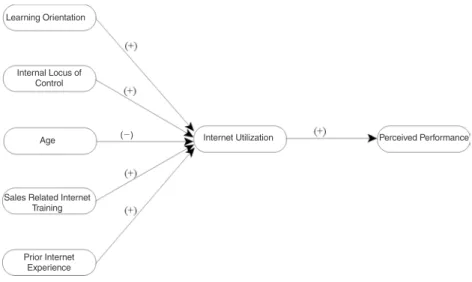
CONCEPTUAL FRAMEWORK AND HYPOTHESES The Sales Agent’s Internet Utilization and Performance model (i.e., the Sales Agent’s IUP model, Figure 1) forwards several constructs that influence directly the extent to which a sales agent utilizes the Internet for selling activities. As Figure 1 depicts, a sales agent’s internal locus of control orientation and learning orientation are two personality traits that relate positively to that sales agent’s Internet utilization. A demo-graphic variable, i.e., a sales agent’s age, is depicted in the IUP model as influencing a sales agent’s Internet utilization negatively. Further, the model depicts that two user-situational variables, i.e., a sales agent’s prior non-sales related Internet use and sales related Internet training in-fluence positively the sales agent’s use of the Internet for selling activi-ties. Finally, the Sales Agent’s IUP model depicts that a sales agent’s Internet utilization is directly and positively related to that agent’s per-ception regarding the impact such utilization has on performance.
Internet Utilization:Both business literature and academic journals emphasize that the Internet is an innovative medium that facilitates better communication between individuals or firms (e.g., Dos Santos & Kuzmitz, 2000; Hoffman & Novak, 1996; Pease, 2000; Peterson et al., 1997). In describing how the Internet can be utilized by salespersons, Weitz et al. (2001) state that the Internet aids salespersons in several selling activities such as prospecting, information gathering, and com-municating with principals and customers. In the context of sales
agents, Gulati, Bristow, and Dou (in press) define Internet utilization as the extent to which independent sales agents use the Internet to establish and maintain communication linkages with their principals, prospects, and current customers. This study adapts this definition of Internet utili-zation. For the purpose of this study, Internet utilization refers to the ex-tent the Internet is used for performing selling activities such as prospect-ing and providprospect-ing service to customers.
Learning Orientation and Internet Utilization:An individual’s learn-ing orientation is an intrinsic personality trait that motivates the individ-ual to learn in order to improve his or her abilities and become more competent at performing relevant tasks (Dweck & Legget, 1988; Lang & Wittig-Berman, 2000; Sujan et al., 1994). Prior research has related learning orientation positively to (a) an individual’s belief that abilities can be acquired (Elliot & Dweck, 1988), (b) a student’s functioning and learning (Lengnick-Hall & Sanders, 1997), (c) a salesperson’s ability to develop and apply selling knowledge and also to work hard at his or her job (Sujan et al., 1994), and (d) an individual’s motivation to learn (Colquitt & Simmering, 1998).
The above findings suggest that an individual with a high learning orientation is able to adapt and master new environments and situations
Learning Orientation
Internal Locus of Control
Age
Sales Related Internet Training
Prior Internet Experience
Internet Utilization Perceived Performance ( )⫺
FIGURE 1. A Conceptual Model Depicting the Impact of a Sales Agent’s Per-sonality, Demographic, and User-Situational Constructs on Internet Utilization and Perceived Performance (The Sales Agent’s IUP Model)
with relative ease. We now apply these findings to an independent sales agent’s utilization of the Internet. A sales agent who possesses a high learning orientation, in comparison to another sales agent who does not have the same degree of learning orientation, should be more willing and able to expend effort in learning to utilize Internet resources for business purposes. This sales agent should also utilize the Internet, a relatively new communication tool, to a greater extent in communicat-ing with customers. The Sales Agent’s IUP model (see Figure 1) depicts this relationship through a direct arrow leading from the construct learning orientation to Internet utilization.
H1: The higher is an independent sales agent’s learning orientation, the greater is the sales agent’s Internet utilization for selling ac-tivities.
Locus of Control and Internet Utilization:Rotter (1966) defines lo-cus of control as a personality trait that determines the extent to which an individual believes that his or her behavior directly influences the events that follow. Individuals with an internal locus of control, for ex-ample, believe that (a) they have direct influence over the events in their lives, and (b) outcomes are related to their efforts (Lefcourt, 1991). In-dividuals with external locus of control, on the other hand, believe that events in their lives are caused by forces not within their control. Ac-cording to Rotter (1966), internal locus of control is a personality trait that positively influences learning and is capable of influencing behav-ior in many situations.
Previous research findings that have looked at the relationships be-tween locus of control and organizational behavior have linked internal locus of control positively to an individual’s desire for autonomy, abil-ity to process complex tasks, and responsibilabil-ity (Abdel-Halim, 1980; Spector, 1982, 1986). Research also suggests that individuals with in-ternal locus of control orientation set higher goals for themselves (Hollenbeck & Klein, 1987; Phillips & Gully, 1997), are more likely to engage in managing issues themselves (Spector, 1982, 1986), are better suited to jobs that require initiative and problem solving capabilities (Abdel-Halim, 1980), and are more likely to view innovations as oppor-tunities (Howell & Shea, 2001).
The above findings can be usefully applied in postulating a relation-ship between internal locus of control orientation of independent sales agents and their Internet utilization. Sales agents with an internal locus of control are likely to view the availability of Internet resources as an
opportunity, are likely to take the initiative in adopting and utilizing the Internet, and are likely to be able to utilize the Internet resources in a constructive manner. This posited relationship is depicted in Figure 1 by a direct arrow linking locus of control and Internet utilization.
H2: For an independent sales agent, an internal locus of control ori-entation relates positively to that sales agent’s Internet utiliza-tion for selling activities.
Age and Internet utilization:Prior research addressing the impact of age on acceptance and use of new technology largely supports a nega-tive relationship between age and the other variables (e.g., Kerr & Hiltz, 1988; Morris & Venkatesh, 2000). For instance, Morris and Venkatesh (2000) found that an employee’s age was negatively related to both short term and long term utilization of a new software. In a related study, Harrison and Rainer (1992) found that younger individuals were more skilled at using computers. Elsewhere, employee age has been linked to a resistance to change in the work environment and an inclina-tion for familiar tasks (Myers & Conner, 1992; Sharit & Czaja, 1994). However, some studies have failed to find a significant relationship be-tween age and technology acceptance and use. For example, Zinkhan, Joachimsthaler, and Kinnear (1987) did not find a significant relation-ship between age and the use of a marketing decision support system. Agarwal and Prasad (1999) failed to find a negative relationship be-tween an employee’s length of tenure and the employee’s beliefs about the usefulness and ease of use of an information technology innovation.
For an independent sales agent, the Internet represents a new technol-ogy and the utilization of Internet resources for selling purposes pre-sents a departure from the customary way of doing business. Hence, the findings in literature with regard to the relationship between age and new technology adoption and use should apply to the sales agent also. In accordance with the bulk of research that suggests a negative rela-tionship, the Sales Agent’s IUP model depicts a negative relationship between a sales agent’s age and his/her Internet utilization.
H3: A sales agent’s age relates directly and negatively to that sales agent’s Internet utilization for selling purposes.
Training and Internet Utilization:As training provides relevant in-formation about various facets of a new technology, it helps in reducing uncertainty and anxiety about that innovation (Agarwal & Prasad,
1999). Reduced uncertainty and increased knowledge facilitates accep-tance and use of new technologies. Agarwal and Prasad (1999) found that an individual’s training on an information technology innovation was related positively to that individual’s beliefs regarding usefulness and ease of use of that technology. Other findings in information sys-tems literature strongly suggest a positive and direct relationship be-tween computer training and subsequent use (Igbaria, Guimaraes, & Davis, 1995; Igbaria, Pavri, & Huff, 1989). In a similar vein, a meta-analysis conducted by Alavi and Joachimsthaler (1992) found strong support in literature for a positive relationship between training and successful decision support system implementation including its utili-zation.
Applied to an independent sales agent, these findings suggest that a sales agent who receives training in utilizing the Internet for business purposes would have more information about such use, will have less uncertainty and anxiety with respect to utilizing the Internet resources available, and should utilize the Internet more fully in selling activities. The Sales Agent IUP model indicates this relationship through a direct and positive path between training and Internet utilization.
H4: Sales related Internet training is related directly and positively to a sales agent’s Internet utilization for selling activities.
Experience and Internet Utilization:The relationship between prior experience and behavior is well established in social psychology litera-ture (e.g., Ajzen & Fishbein, 1980; Bagozzi, 1981; Fishbein & Ajzen, 1975). Findings in information systems literature have linked prior ex-perience with computers positively to subsequent computer usage (Igbaria, Guimaraes, & Davis, 1995; Igbaria, Pavri, & Huff, 1989), and computer skills (Harrison & Rainer, 1992). Alavi and Joachimsthaler (1992), in their meta-analytic study, found support for a positive rela-tionship between prior experience in using decision support systems (DSS) and subsequent successful DSS implementation. Agarwal and Prasad (1999) hypothesized and established that an individual’s prior experience with similar technologies was related positively with that in-dividual’s beliefs about the usefulness and ease of use of an information technology innovation.
We argue that a similar relationship exists between an independent sales agent’s prior use of Internet resources for non-selling activities and that sales agent’s subsequent use of the Internet for selling pur-poses. A sales agent’s prior exposure to the Internet is likely to lead to
more favorable intentions and stronger beliefs about the utility of the Internet for business purposes. Such intentions and beliefs are likely to result in greater Internet utilization on the part of the sales agent in sell-ing activities. The Sales Agent’s IUP model, accordsell-ingly, depicts a pos-itive and direct relationship between non-sales related Internet use and Internet utilization for selling activities.
H5: The greater is an independent sales agents prior non-sales expe-rience with the Internet, the greater is that sales agent’s Internet utilization for selling activities.
Internet Utilization and Performance:In business-to-business mar-kets, buyer and seller firms that transact online are benefitting from in-creased efficiencies and effectiveness because of cost savings and improved productivity (Deeter-Schmelz et al., 2001; Sharma, 2002). The characteristics of the Internet such as interactivity, unlimited infor-mation storage capacity, low cost, and speed of inforinfor-mation transfer (Peterson et al., 1997) that provide these firms with such advantages should also assist intermediaries in conducting their business. Gulati, Bristow and Dou (in press), for example, concluded from their study that sales agents who utilized the Internet for business purposes achieved better information exchange with their principals. We postu-late that sales agents who utilize the Internet to prospect, communicate with and provide service to their customers will be able to perform these activities more effectively. The Sales Agent’s IUP model indicates this relationship by a direct path relating Internet utilization and perfor-mance.
H6: An independent sales agent’s Internet utilization for selling ac-tivities is directly and positively related to sales performance.
METHOD
Data for this study was collected through a survey of independent sales agents who belong to a national manufacturer’s agents associa-tion. The survey instrument gathered information pertaining to sales agents’ personality, age, and user-situational variables in addition to tapping their perceptions regarding Internet use and consequent perfor-mance.
Participants:The survey participants were independent sales agents who were randomly selected from the membership roster of a national manufacturer’s agents association. Out of a total of 1,500 surveys dis-tributed, 335 useable surveys were returned, resulting in a response rate of approximately 22 percent. An evaluation of early and late respon-dents revealed no response bias (see Armstrong & Overton, 1979). The average age of participating sales agents was 51 years, and approxi-mately 77% had completed a college education. These sales agents had, on average approximately 19 years of experience and employed 4 sales-people. The average annual sales achieved by the participants was $9.4 million.
Development of Survey Instrument and Testing:The process adopted for developing the survey instrument included in-depth discussions with the representatives from the national manufacturer’s association in order to better understand the operations of member sales agents and comprehend their Internet use. Additionally, marketing academicians were consulted to obtain their inputs regarding the issues of interest to the researchers. In order to obtain the item-sets that represented the con-structs of interest, the researchers consulted various available construct scales and reviewed the literatures in marketing, social psychology, and information systems. Construct measures that exhibited desirable reli-ability and validity were adapted to suit the current investigation. Where such scales could not be identified from the literature, the nomological nets for constructs were developed by tapping into the ex-pertise and experience of manufacturer’s association representatives and through consultation with academicians. These procedures led to the selection of the item-sets that represented the constructs in the Sales Agent’s IUP model.
A sales agent’s learning orientation was represented by a 6-item set adapted from a scale developed by Sujan, Weitz, and Kumar (1994) (Cronbach Alpha = .81). For example, the Learning Orientation Scale item “An important part of being a good salesperson is continually im-proving your sales skills,” was adapted in this study as “I continually work to improve my selling skills.” Similarly, the LOS item, “It is im-portant for me to learn from each selling experience” was adapted as “I learn something from each selling experience” in this study. A 4-item set, adapted from scales developed by Rotter (1966), MacDonald and Tseng (1971), and Spector (1988) (Cronbach Alpha = .82 to .87 across several studies) was used in this study to measure a sales agent’s inter-nal locus of control orientation. For instance, the following interinter-nal lo-cus of control scale items, “It isn’t wise to plan too far ahead because
most things turn out to be a matter of good or bad fortune anyhow” and “Many times I feel that I have little influence over things that happen to me,” were adapted as “I can pretty much determine what happens in my life”, and “My life is determined by my own action,” respectively. An agent’s sales related Internet training was represented by a 3-item set, and a 4-item set was generated in order to assess a sales agent’s prior non-sales related Internet experience.
The 6-item Internet Utilization scale developed by Gulati, Bristow, and Dou (in press) was adapted to this study by eliminating one item (my firm uses the Internet to communicate with our principals) that was deemed inappropriate for the sample used in this study. An 8-item set was identified as being representative of a sales agent’s Internet related performance perceptions. Interviews with representatives of the na-tional manufacturer’s agents association revealed that sales agents made all strategic, operational, and tactical decisions pertaining to their business operations, and correspondingly, equated their work related activities to those of the firms they owned. Accordingly, statements that measured a sales agent’s (a) Internet utilization, and (b) performance perceptions were worded to reflect the centralized nature of a sales agent’s operations (see Table 1). The chronological age of the partici-pating sales agents served as an objective measure of the final construct depicted in Figure 1.
The 7 constructs depicted in the Sales Agent’s IUP model, therefore, were initially represented in the survey instrument by thirty-one items (see Table 1). All the survey items were written into a 7-point Likert type format and were reviewed by marketing academicians with exper-tise in the areas of professional selling, e-commerce/Internet marketing, consumer behavior, and marketing research. The reviewers examined the survey items for potential problems in wording, phrasing, under-standability, or redundancy. This review process resulted in the revision of several items. The revised items and 8 demographic questions were subsequently reviewed by several manufacturers’ representatives. This procedure revealed no problems with the wording or understanding of the various item-sets.
Survey Administration:In order to maximize response rate, the re-searchers sought the assistance of the president and director of the membership of the national manufacturer’s agents association. With the cooperation of these individuals, a letter explaining the nature of the re-search and indicating the association’s support of the study was drafted. This letter served as the cover page of the survey instrument. Addi-tionally, this letter was also included in an issue of the association’s
Constructs and Items Cronbach's Alpha Sq. Multiple R Std. Loadings t-Value p < Learning Orientation
I continually work to improve my selling skills I continually work to improve my product knowledge I learn something from each selling experience I am always learning something new about my customers
Learning how to be a better manufacturer's rep is of fundamental importance to me There are few new things to learn about selling*
∝ 0.826 0.54 0.51 0.40 0.47 0.54 0.74 0.71 0.63 0.69 0.73 14.51 13.91 11.87 13.27 14.44 .001 .001 .001 .001 .001
Internal Locus of Control
I am almost certain to make my plans work I can pretty much determine what happens in my life When I get what I want, it's usually because I worked hard for it My life is determined by my own actions
∝ 0.803 0.37 0.55 0.59 0.55 0.60 0.74 0.77 0.74 11.17 14.39 15.13 14.40 .001 .001 .001 .001 Internet Utilization
My firm uses the Internet to find information about our customers My firm uses the Internet to find information about prospects My firm uses the Internet to communicate with prospects
The Internet is a tool that my firm uses to communicate with our customers* My firm uses the Internet to provide follow-up service to our customers*
∝ 0.840 0.85 0.81 0.40 0.92 0.90 0.63 20.96 20.25 12.45 .001 .001 .001
Sales Related Internet Training
I have had formal training in the use of e-mail as a form of communication in selling
I have had formal training in the use of the World Wide Web to find information relevant to selling I have had formal training in using the Internet to transfer documents
∝ 0.911 0.79 0.92 0.64 0.89 0.96 0.80 20.13 22.92 17.34 .001 .001 .001 165
TABLE 1 (continued)
Constructs and Items
Cronbach's Alpha Sq. Multiple R Std. Loadings t-Value p <
Prior Internet Experience
In the past, I have used the Internet to participate in chat rooms
In the past, I have used the Internet for on-line entertainment (i.e., games, audio, video) In the past, I have used the Internet to help me make purchase decisions
In the past, I have used the Internet as a communication tool*
∝ 0.550 0.21 0.26 0.41 0.46 0.51 0.64 7.01 7.75 9.40 .001 .001 .001 Perceived Performance
Using the Internet has resulted in an increase in sales for my firm
Using the Internet has enabled my firm to provide better service to our customers Using the Internet has made my firm more effective
Using the Internet has enabled my firm to reduce our selling costs Using the Internet has increased the efficiency of my firm
On average, using the Internet has reduced the amount of time required for my firm to make a sale
Using the Internet has enabled my firm to do a better job of prospecting* Using the Internet has enabled my firm to locate prospects more quickly*
∝ 0.916 0.57 0.78 0.90 0.42 0.77 0.44 0.76 0.88 0.95 0.65 0.88 0.66 16.07 20.29 23.08 12.99 20.13 13.43 .001 .001 .001 .001 .001 .001
*Denotes items that were removed from the analyses during scale purificiation.
Descriptive Goodness of Fit Indices:
x2(N = 335), p = .00 595.91 RMR 0.17 GFI 0.87 AGFI 0.84 NFI 0.87 CFI 0.92 AIC 719.68 RMSEA 0.067
monthly agency sales magazine which was sent to all association mem-bers approximately 2 weeks prior to the distribution of the survey in-strument. The agency administrators also e-mailed the member sales agents, giving them an advance of the questionnaire they might receive via the U.S. mail.
The survey instrument was mailed out (first class via the United States Post Office) to the 1,500 randomly selected sales agents three days after the e-mail message was distributed. A week and a half later, the selected sales agents received another e-mail from the director of membership of the manufacturers’ agents thanking them for their par-ticipation and requesting them to complete the survey if they had not al-ready done so. This e-mail message also included contact information so that sales agents could request a second copy of the survey instru-ment if they had not yet received it.
MEASURE PURIFICATION AND ANALYSIS
A correlation matrix of the thirty items representing the 7 constructs depicted by the Sales Agent’s IUP model (Figure 1) was generated after validating the data-set (i.e., ascertaining the correctness of the re-sponses, reverse coding, etc.). An examination of the inter-item correla-tions was undertaken to assess (a) the pattern of correlacorrela-tions between items representing unique constructs, and (b) the pattern of correlations between items representing distinct constructs. The procedure listed by Gerbing and Anderson (1988) was used to assess the dimensionality of the 6 constructs in the Sales Agent’s IUP model measured by multi-item scales. These items, therefore, were subjected to principal component analysis using the Kaiser criterion (eigenvalueⱖ1) with varimax rota-tion.
The resulting 8-factor structure was examined to assess the loadings and cross-loadings of the 30 items. Six items either (a) cross-loaded on more than one factor (loadings > .4), and/or (b) loaded on a factor that could not be identified. Further, these items exhibited low loadings (loading < .5) on the factor (construct) they represented. A re-examina-tion of the correlare-examina-tion matrix indicated that these 6 items had statisti-cally significant correlations with items representing other constructs but weak correlations with items representing the same constructs. Af-ter examining the content of these items, it was deAf-termined that the understandability of each of these items may be suspect, and that each was a poor representative of the associated construct. Consequently,
these 6 items were deleted from further analysis. A second principal component analysis with the twenty-four remaining items yielded a 6-factor structure with eigenvalues > 1 (total variance explained = 69%). The loadings of the twenty-four items corresponded to the con-structs they represented, suggesting that all the construct measures were unidimensional.
To purify and further assess the unidimensionality of the con-struct-measures, a confirmatory factor analysis was conducted using LISREL 8.3 (see Anderson & Gerbing, 1988; Gerbing & Anderson, 1988). Table 1 summarizes the findings of the measurement model in which 24 items were hypothesized to represent 6 constructs in the Sales Agent’s IUP model (Figure 1). For the measurement model analyzed, the following values were observed for the various fit indices: X2(237
N = 335) = 595.91; p = .00; Standardized RMR = .06; GFI = .87; AGFI = .84; NFI = .87; NNFI = .90; CFI = .92; and RMSEA = .067. The model, therefore, exhibited acceptable values for a majority of fit indices (see Bentler & Bonnet, 1980; Williams & Hollahan, 1994). Additionally, all but one standardized loading exceeded .50, and the squared multiple correlations were adequate suggesting an acceptable model fit. The sta-tistically significant standardized loadings exhibited by the twenty-four items representing the six constructs (see Table 1) established the con-vergent validity of the measures (see Anderson & Gerbing, 1988).
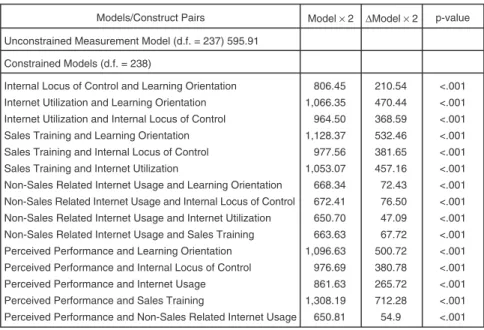
Chi-square difference tests were conducted to determine the discrimin-ant validity of the 6 multi-item constructs in the Sales Agent’s IUP model. Table 2 presents the results of these tests. The X2differences
be-tween all possible pairs of constructs are statistically significant (Over-all α= .05; critical α= .0034137; critical X2
(1 d.f.; p = .001) = 10.828),
implying that the item-sets representing the various constructs exhibit discriminant validity (see Anderson & Gerbing, 1988; Bagozzi & Phil-lips, 1982). Table 1 and Table 2 together indicate that the 6 multi-item measures possess both convergent and discriminant validity, i.e., the measures exhibit construct validity (Kerlinger, 1986).
Table 1 also depicts (a) the purified item sets that represent the 6 unidimensional constructs in the Sales Agent’s IUP model, and (b) the reliability of those item-sets. Five of the six measures exhibit good con-sistency (Cronbachα). The item-set representing a sales agent’s non-sales related Internet experience had an unacceptably low reliability (cf. Nunnally, 1978). This construct was deleted from the subsequent path analysis undertaken to test the relationships hypothesized in the IUP model. The relationship expressed in Hypothesis 5, therefore, could not
be formally tested. Table 3 reports the correlation matrix for the con-struct-measures computed by summating the item-sets representing the 6 constructs and the single item objective measure of a sales agent’s age.
This study followed the two-step structural equation modeling proce-dure advocated by Anderson and Gerbing (1988). After purifying the measures as described above, a covariance matrix of the 5 summated construct measures and one single item measure (age) was generated. The linear relationships posited by the Sales Agent’s IUP model were tested using a path-analytic technique in LISREL 8.3. The following val-ues were observed for the various fit indices: X2(4 N = 335) = 7.76, p =
.10; Standardized RMR = .024; GFI = .99; AGFI = .96; NFI = .98; CFI = .99; and RMSEA = .052. Based on the Chi-square value, and the values of various fit indices, the path model indicated an good fit for the tested model.
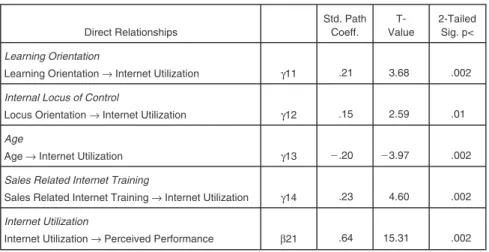
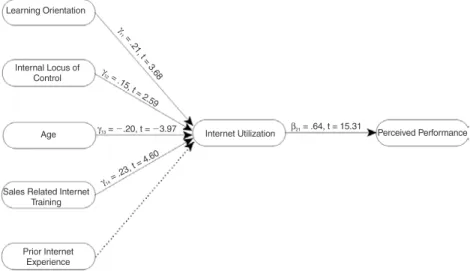
Table 4 reports the standardized path coefficients along with their t-values and statistical significance for the various hypothesized linear relationships. Figure 2 depicts the various paths that were tested along
TABLE 2. Assessing Discriminant Validity: Chi-Square Difference Tests Models/Construct Pairs Model¥2 ∆Model¥2 p-value Unconstrained Measurement Model (d.f. = 237) 595.91
Constrained Models (d.f. = 238)
Internal Locus of Control and Learning Orientation Internet Utilization and Learning Orientation Internet Utilization and Internal Locus of Control Sales Training and Learning Orientation Sales Training and Internal Locus of Control Sales Training and Internet Utilization
Non-Sales Related Internet Usage and Learning Orientation Non-Sales Related Internet Usage and Internal Locus of Control Non-Sales Related Internet Usage and Internet Utilization Non-Sales Related Internet Usage and Sales Training Perceived Performance and Learning Orientation Perceived Performance and Internal Locus of Control Perceived Performance and Internet Usage Perceived Performance and Sales Training
Perceived Performance and Non-Sales Related Internet Usage 806.45 1,066.35 964.50 1,128.37 977.56 1,053.07 668.34 672.41 650.70 663.63 1,096.63 976.69 861.63 1,308.19 650.81 210.54 470.44 368.59 532.46 381.65 457.16 72.43 76.50 47.09 67.72 500.72 380.78 265.72 712.28 54.9 <.001 <.001 <.001 <.001 <.001 <.001 <.001 <.001 <.001 <.001 <.001 <.001 <.001 <.001 <.001 Note: Criticalα= .0034137; Critical X2(1 d.f., p = .001)= 10.828;p = significance level.
TABLE 3. Correlation Matrix of Constructs Included in the Sales Agent’s IUP Model Construct Learning Orienta-tion Internal Locus of Control Age Sales Related Internet Training Prior Internet Experi-ence Internet Utilization Perceived Perfor-mance Learning Orientation 1.00 Internal Locus of Control .456** 1.00 Age .048 .024 1.00 Sales Related Internet Training .094 .017 .002 1.00 Prior Internet Experience ⫺.112* ⫺.094 ⫺.292** .208** 1.00 Internet Utilization .286** .239** ⫺.185** .249** .308** 1.00 Perceived Performance .214** .107* ⫺.072 .242** .332** .642** 1.00
Note: (*) implies correlation is significant at the .05 level (2-tailed); (**) implies correlation is significant at the .01 level (2-tailed).
TABLE 4. Path Model Estimation Results
Direct Relationships Std. Path Coeff. T-Value 2-Tailed Sig. p< Learning Orientation
Learning Orientation→Internet Utilization g11 .21 3.68 .002 Internal Locus of Control
Locus Orientation→Internet Utilization g12 .15 2.59 .01 Age
Age→Internet Utilization g13 ⫺.20 ⫺3.97 .002 Sales Related Internet Training
Sales Related Internet Training→Internet Utilization g14 .23 4.60 .002 Internet Utilization
with their standardized path coefficients. As Table 4 and Figure 2 indi-cate, the analysis supported the hypothesized relationships that were tested. The next section discusses the results of this study.
RESULTS
The path-analytic model (see Figure 2) tested the relationships be-tween 4 exogenous and 2 endogenous constructs depicted in the Sales Agent’s IUP model. A sales agent’s learning orientation related posi-tively and significantly to sales related Internet utilization (g11= .21, t = 3.68, p < .002), supporting Hypothesis 1. The results indicate that, for sales agents who participated in this study, the personality trait learning orientation was related directly and positively to the extent to which they utilized the Internet for selling purposes. A positive and statisti-cally significant path (g12= .15, t = 2.59, p < .01) between a sales agent’s internal locus of control orientation and Internet utilization suggested support for Hypothesis 2. For the sampled sales agents, then, the extent to which these agents perceived that they had control over future conse-quences influence positively the degree to which they utilized the Internet for selling purposes.
Sales Related Internet Training Prior Internet Experience Age Internal Locus of Control Learning Orientation
Internet Utilization Perceived Performance
γ11 = .21, t = 3. 68 γ12 = .15, t = 2.59 γ13=⫺.20, t =⫺3.97 γ14 = .23, t =4.60 β21= .64, t = 15.31
FIGURE 2. Path Diagram Depicting Standardized Path Coefficients in the Sales Agent’s IUP Model
The path analysis also supported Hypothesis 3 which posited a direct and positive relationship between a sales agent’s age and Internet utili-zation (g13=⫺.20, t =⫺3.97, p < .002). This result establishes that par-ticipating sales agents who were older did not utilize the Internet or utilized the Internet to a lesser extent in soliciting customers. The statis-tically significant positive path coefficient leading from sales related Internet training to Internet utilization (g14= .23, t = 4.60, p < .002) indi-cates support for Hypothesis 4. Among the sales agents who responded to the survey instrument, then, those that received more training in us-ing the Internet for sellus-ing activities ended up utilizus-ing the Internet to a greater extent than others.
Hypothesis 6, which posits a direct and positive relationship between a sales agent’s Internet utilization and perceived performance attributable to Internet use was also supported by the path analysis (g16 = .64, t = 15.31, p < .002). This result implies that responding sales agents who utilized the Internet to a greater extent for selling activities also per-ceived higher improvements in sales performance.
The path model (see Figure 2) also indicates the relative influence of the various personality, demographic, and user-situational constructs (see Loehlin, 1992). For example, among the relationships tested, a user-situational variable, i.e., Internet related training, was most strongly related to Internet utilization (g14 = .23) followed by a sales agent’s learning orientation, a personality trait (g11 = .21). Also, the analysis found that the positive influence of Internet related training (g14= .23) was greater than the negative influence age (g13=⫺.11) had on Internet utilization. A meta-analysis by Alavi and Joachimsthaler (1992) came to a similar conclusion regarding the primacy of user-situ-ational variables over other variables in the context of DSS implemen-tation. In addition to the above findings, the results of the path analysis revealed that the four exogenous variables had statistically significant indirect relationships with perceived performance through their direct relationships with Internet utilization. The next section discusses impli-cations that follow from the test of various relationships depicted in the Sales Agent’s IUP model.
DISCUSSION AND IMPLICATIONS
A direct implication of the findings in this study is that sales agents can enhance their sales performance by utilizing the Internet fully for
selling purposes. More specifically, sales agents who use Internet re-sources to prospect for, communicate with, and provide service to po-tential and current customers gain by building better relationships with their clients and this translates into enhanced sales for such sales agents. This implication that the Internet can be usefully utilized by sales agents stands in contrast to literature that suggests the possibility that sales agents may be disintermediated due to the Internet (e.g., Learner & Storper, 2001; Stead & Gilbert, 2001), or indicates that sales agents are fearful of being disintermediated due to the Internet (Gulati, Bristow, & Dou, in press). In other words, the findings of this study suggest that sales agents should view the Internet revolution as a positive develop-ment that can potentially advance their business goals.
The findings of this study regarding the influence of Internet related training on Internet utilization offers some enabling suggestions for sales agents who may be interested in utilizing the Internet more fully in their business operations. By participating in training related to the use of the Internet, and by providing such training to their salespeople, sales agents can increase the extent to which Internet resources are used in their firms to accomplish selling activities. This should have positive ramifications for sales agents in terms of increased sales and better cus-tomer service and support.
The finding that age is related negatively to Internet utilization, when taken in isolation, suggests that older sales agents have a harder time ad-justing to the Internet age and are unlikely to use the Internet resources available. However, evidence in this study that training relates posi-tively to Internet utilization suggests that, even for older sales agents, participation in Internet related training may reduce their doubts and hesitation and facilitate greater Internet utilization for selling activities by these agents. The relationship of training and age on Internet utiliza-tion of sales agents may also have some ramificautiliza-tions for the salespeo-ple that work for these sales agents. Specifically, sales agents who want their salespeople to utilize Internet resources for selling activities should keep in mind that older salespeople may have a harder time ac-cepting and adopting the Internet. Correspondingly, these older sales-people may require more input in the form of Internet related training so that they may overcome their reluctance to utilize the Internet to estab-lish links with and provide service to prospects and customers.
Although the low reliability of the item-set that measured a sales agent’s non-sales related Internet experience precluded a formal test of the relationship between this construct and the sales agent’s Internet uti-lization, an exploratory path analysis that included this construct
indi-cated a positive, statistically significant relationship between the two constructs. A confirmation of this result with a more reliable measure of non-sales related Internet experience would imply that by recruiting salespeople that have some experience in using Internet resources, sales agents can further ensure that salespeople utilize the Internet resources to the fullest. Findings of this study regarding the influence of personal-ity variables have additional implications for the recruitment of new salespeople. Sales agents should select salespeople with an internal lo-cus of control and a learning orientation. Such salespeople could be ex-pected to readily adopt the Internet as a tool for selling and providing service to customers.
LIMITATIONS AND FUTURE RESEARCH
Any conclusions regarding causal linkages in this study should be made with caution as this study utilized cross-sectional data to test pro-posed relationships. Also, the data was generated through self-reports, and therefore may be biased to an extent. This study utilized a list of sales agents belonging to one national manufacturer agents’ association. Al-though the selection of a random sample adds to the generalizability of the results, the conclusions of this study cannot be safely extended be-yond the members of the agents’ association. Another limitation derives from the fact that some constructs in the Sales Agent’s IUP model have been conceptualized specifically for this study, and therefore do not have previously validated measures.
This study restricted itself to examining the influence of selected per-sonality, demographic, and user-situational variables on the independ-ent sales agindepend-ent’s Internet utilization. Several personality traits such as self-efficacy, perceived behavioral control, and risk adverseness, other demographic variables such as education, and certain user-situational variables such as involvement that have been linked in literature to new technology adoption and implementation either directly or indirectly (see Alavi & Joachimsthaler, 1992; Taylor & Todd, 1995; Venkatesh & Davis, 1996) were not included in the Sales Agent’s IUP model. The conceptual model tested in this study, therefore, was not comprehen-sive. The exclusion of certain variables from the model, however, does not negate any of the findings in this study. This study measured Internet related training in terms of the extent to which sales agents re-ceived such training; the quality of the training rere-ceived was not mea-sured here. Hence, the variable, Internet training, addressed only one
dimension of training. Conceivably, the quality of training imparted, as well as the receptivity of sales agents to such training, could also influ-ence the degree to which Internet training is useful for sales agents.
One area for future research involves testing the influence of other anteceding variables on a sales agent’s Internet utilization. This may shed further light on the relative influence of different variables on Internet utilization and may identify other controllable variables that sales agents can use to better exploit this marketing channel to their ad-vantage. In addition, we would encourage researchers to test the Sales Agent’s IUP and other plausible models on dependent variables such as sales agent’s efficiency and satisfaction. Finally, further validation of the constructs and relationships tested in this study is warranted.
This study concerns itself with examining the influence of Internet uti-lization on perceived sales performance. An extension of this study would involve testing for the influence of Internet utilization on a sales agent’s performance vis-à-vis their principals. We also encourage re-searchers to further replicate and extend the findings of this study. While the population of sales agents utilized for this study consisted of sales agents belonging to over 100 different industries, the participants did in fact represent a rather specialized type of professional salesperson and a select type of channel relationship. Future research can test the model proposed here on a more diversified sample of sales professionals.
REFERENCES
Abdel-Halim, A. (1980), “Effects of Person-Job Compatibility on Managerial Reac-tion to Role Ambiguity,”Organizational Behavior and Human Performance, 26, 193-211.
Anderson, Erin and Barton Weitz (1992), “The Use of Pledges to Build and Sustain Commitment in Distribution Channels,”Journal of Marketing Research, 29 (Feb-ruary), 18-34.
Agarwal, Ritu and Jayesh Prasad (1999), “Are Individual Differences Germane to the Acceptance of New Information Technologies?”Decision Sciences, 30 (Spring), 361-391.
Ajzen, Icek and Martin Fishbein (1980),Understanding Attitudes and Predicting So-cial Behavior, Englewood Cliffs, NJ: Prentice-Hall
Ajzen, Icek and T. J. Madden (1986), “Prediction of Goal Directed Behaviors: Atti-tudes, Intentions, and Perceived Behavioral Control,”Journal of Experimental So-cial Psychology, 22, 453-474.
Alavi, Maryam and Erich A. Joachimsthaler (1992), “Revisiting DSS Implementation Research: A Meta-Analysis of the Literature and Suggestions for Researchers,” MIS Quarterly, 16 (March), 95-116.
Anderson, James C. and David W. Gerbing (1988), “Structural Equation Modeling in Practice: A Review and Recommended Two-Step Approach,”Psychological Bulle-tin, 103 (3), 411-423.
Armstrong, S. J. and T. S. Overton (1979), “Estimating Non-Response Bias in Mail Surveys,”Journal of Marketing Research, 14 (August), 396-402.
Avlonitis, George J. and Despina A. Karayanni (2000), “The Impact of Internet Use on Business-to-Business Marketing,” Industrial Marketing Management, 29, 441-459.
Bagozzi, Richard P. (1981), “Attitudes, Intentions, and Behaviors: A Test of Some Key Hypotheses,” Journal of Personality and Social Psychology, 41 (October), 607-627.
Bentler, Peter M. and Douglas C. Bonnet (1980), “Significance Tests and Goodness of Fit in the Analysis of Covariance Structures,” Psychological Bulletin, 80 (3), 588-606.
Blackmon, D. A. (200), “Where the Money Is,”The Wall Street Journal, (April 17), B1, B10.
Colquitt, Jason A. and Marcia J. Simmering (1998), “Conscientiousness, Goal Orien-tation, and Motivation to Learn During the Learning Process: A Longitudinal Study,”Journal of Applied Psychology, 83 (August), 654-665.
Davis, F. D. (1989), “Perceived Usefulness, Perceived Ease of Use, and User Accep-tance of Technology,”MIS Quarterly, 13 (3), 318-339.
Deeter-Schmelz, Dawn R., Aric Bizzari, Rebecca Graham, and Catherine Howdyshell (2001), “Business-to-Business Online Purchasing: Supplier’s Impact on Buyers’ Adoption and Usage Intent,”Journal of Supply Chain Management, 37 (Winter), 4-10.
Dos Santos, Brian L. and Frank E. Kuzmitz (1997), “The Internet: A Key Tool for To-day’s Human Resource Professional,”S.A.M. Advanced Management Journal, 62 (Spring), 33-40.
Dweck, Carol S. and Ellen L. Legget (1988), “A Social-Cognitive Approach to Moti-vation and Personality,”Psychological Review, 95 (2), 256-273.
Elliot, E. S. and Carol S. Dweck (1988), “Goals: An Approach to Motivation and Achievement,”Journal of Personality and Social Psychology, 54, 5-12.
Fishbein, Martin and Icek Ajzen (1975),Belief, Attitude, Intention, and Behavior: An
Introduction to Theory and Research, Reading, MA: Addison-Wesley Publishing
Company.
Gerbing, David W. and James C. Anderson (1988), “An Updated Paradigm for Scale Development Incorporating Unidimensionality and its Assessment,” Journal of Marketing Research, 25 (May), 186-192.
Gulati, Rajesh, Dennis N. Bristow, and Wenyu Dou (In Press), “A Three-Tier Model Representing the Impact of Internet Use and Other Environmental and Relation-ship-Specific Factors on a Sales Agent’s Fear of Disintermediation Due to the Internet Medium.”Journal of Marketing Channels.
Harrison, Allison W. and Kelly R. Rainer Jr. (1992), “The Influence of Individual Dif-ferences on Skill in End-User Computing,”Journal of Management Information Systems, 9 (Summer), 93-111.
Hoffman, Donna L., and Thomas P. Novak (1996), “Marketing in Hypermedia Com-puter-Mediated Environment: Conceptual Foundations,”Journal of Marketing, 60 (July), 50-68.
Hollenbeck, John R. and Howard J. Klein (1987), “Goal Commitment and Goal Setting Process: Problems, Prospects and Proposals for Future Research,”Journal of Ap-plied Psychology, 72 (April), 212-220.
Howell, Jane M. and Christine M. Shea (2001), “Individual Differences, Environmen-tal Scanning, Innovation Framing, and Champion Behavior: Key Predictors of Pro-ject Performance,”The Journal of Product Innovation Management, 18 (January), 15-27.
Igbaria, Magid, Tor Guimaraes, and Gordon B. Davis (1995), “Testing the Determi-nants of Microcomputer Usage Via a Structural Equation Model,”Journal of Man-agement Information Systems, 11 (Spring), 87-114.
Igbaria, Majid, F. Pavri, and S. Huff (1989), “Microcomputer Application: An Empiri-cal Look at Usage,”Information and Management, 16 (4), 187-196.
Kennedy, Karen N. and Dawn R. Deeter-Schmelz (2001), “Descriptive and Predictive Analyses of Industrial Buyers’ Use of Online Information for Purchasing,” The Journal of Personal Selling and Sales Management, 21 (Fall), 21-33.
Kerlinger, Fred N. (1986),Foundations of Behavioral Research(3rd ed.), Chicago, IL: Holt, Rinehart and Winston, Inc.
Kerr, E. B. and S. R. Hiltz (1988),Computer Mediated Communication Systems:
Sta-tus Report, New York: Academic Press.
Lang, Dorothy and Ursula Wittig-Berman (2000), “Managing Work-Related Learning for Employee and Organizational Growth,”S.A.M. Advanced Management Jour-nal, 65 (Autumn), 37-43.
Learner, Edward E. and Michael Storper (2001), “The Economic Geography of the Internet Age,”Journal of International Business Studies, 32 (Winter), 641-665. Lefcourt, Herbert M. (1991), “Locus of Control,”in Measures of Personality and
So-cial Psychological Attitudes, John P. Robinson, Phillip R. Shaver, and Lawrence C. Wrightsman, eds. San Diego: Academic Press, 413-499.
Lengnick, Cynthia A. and Martha M. Sanders (1997), “Designing Effective Learning Systems for Management Education: Student Roles, Requisite Variety and Prac-ticing What We Teach,”Academy of Management Journal, 40 (December), 1334-1368.
Leong, Elaine K. F. and Michael T. Ewing (2002), “E-Comprehension: Evaluating B2B Websites Using Readability Formulae,”Industrial Marketing Management, 31 (February), 125-131.
Ling, Raymond R. and David C. Yen (2001), “Extranet: A New Wave of Internet,”
S.A.M. Advanced Management Journal, 66 (Spring), 39-44.
Loehlin, John C. (1992),Latent Variable Models: An Introduction to Factor, Path, and Structural Analysis, Hillsdale, NJ: Lawrence Erlbaum Associates, Inc.
MacDonald, A. P. and M. Tseng (1971), “Dimensions of Internal versus External Con-trol Revisited: Toward the Development of a Measure of Generalized Expectancy,” unpublished paper, cited in the work of Cherry, John and John Fraedrich (2000), “An Empirical Investigation of Locus of Control and the Structure of Moral
Rea-soning: Examining the Ethical Decision-Making Processes of Sales Managers,” The Journal of Personal Selling and Sales Management, 20 (3), 173-185. Morris, Michael G., and Wiswanath Venkatesh (2000), “Age Differences in
Technol-ogy Adoption Decisions: Implications For a Changing Work Force,”Personnel
Psychology, 53 (Summer), 375-403.
Myers, C. and M. Conner (1992), “Age Differences in Skill Acquisition and Transfer in an Implicit Learning Paradigm,”Applied Cognitive Psychology, 6, 429-442. Nunnally, Jum C. (1978),Psychometric Theory(2nd ed.), New York, NY:
McGraw-Hill, Inc.
Pease, P. (2000), “Taking Time to Communicate Effectively with Technology,” Agency Sales Magazine, 30 (6), 68.
Peterson, Robert A., Sridhar Balasubramanian, and Bart J. Bronnenberg (1997), “Ex-ploring the Implications of Internet for Consumer Marketing,”Journal of the Acad-emy of Marketing Science, 25 (4), 329-346.
Phillips, Jean M. and Stanley M. Gully (1997), “Role of Goal Orientation, Ability, Need for Achievement and Locus of Control in the Self-Efficacy and Goal-Setting Process,”Journal of Applied Psychology, 82 (October), 792-802.
Rogers, E. M. (1995),Diffusion of Innovations (4th Ed.), New York: The Free Press. Rotter, Julian B. (1966), “Generalized Expectancies for Internal versus External
Con-trol of Reinforcement,”Psychological Monographs, 80 (1), (Whole No. 609) Sadowski, B. M., C. Maitland, and J. Van Dongen (2002), “Strategic Use of the
Internet by Small- and Medium-Sized Firms: An Exploratory Study,”Information Economics and Policy, 14 (March), 75-93.
Sharma, Arun (2002), “Trends in Internet-Based Business-to-Business Marketing,” Industrial Marketing Management, 31 (February), 77-84.
Sharit, J. and S. J. Czaja (1994), “Aging, Computer-Based Task Performance, and Stress: Issues and Challenges,”Ergonomics, 37, 559-577.
Shaw, Charles (2001), “The Rep and the Future–Which is Now,”Agency Sales, 31 (January), 28-30.
Spector, Paul. E. (1982), “Behavior in Organizations as a Function of Employee’s Lo-cus of Control,”Psychological Bulletin, 91, 482-497.
Spector, Paul E. (1986), “Perceived Control by Employees: A Meta-Analysis of Studies Concerning Autonomy and Participation at Work,”Human Relations, 39, 1005-1016.
Spector, Paul E. (1988), “Development of the Work Locus of Control Scale,”Journal of Occupational Psychology, 61, 335-340.
Stead, Bette A. and Jackie Gilbert (2001), “Ethical Issues in Electronic Commerce,” Journal of Business Ethics, 34 (November), 75-85.
Sujan, Harish, Barton A. Weitz, and Nirmalya Kumar (1994), “Learning Orientation, Working Smart, and Effective Selling,”Journal of Marketing, 58 (July), 39-52. Taylor, Shirley and Peter Todd (1995), “Assessing IT Usage: The Role of Prior
Experi-ence,”MIS Quarterly, 19 (December), 561-570.
Thompson, Ronald L., Christopher A Higgins, and Jane M. Howell (1994), “Influence of Experience on Personal Computer Utilization: Testing a Conceptual Model,”
Venkatesh, Vishwanath and Fred D. Davis (1996), “A Model of the Antecedents of Perceived Ease of Use: Development and Test,”Decision Sciences, 27 (Summer), 451-481.
Webb, Kevin L. (2002), “Managing Channels of Distribution in the Age of Electronic Commerce,”Industrial Marketing Management, 31 (February), 95-102.
Weiss, Allen M. and Erin Anderson (1992), “Converting From Independent to Em-ployee Salesforces: The Role of Perceived Switching Costs,”Journal of Marketing Research, 29 (February), 101-115.
Weitz, Barton A., Stephen B. Castleberry, and John F. Tanner (2001),Selling:
Build-ing Partnerships, Boston, MA: McGraw-Hill Inc.
Wilson, Susan G. and Ivan Abel (2002), “So You Want to Get Involved in E-Com-merce,”Industrial Marketing Management, 31 (February), 85-94.
Williams, Larry J. and Patricia J. Holahan (1994), “Parsimony-Based Indices for Mul-tiple-Indicator Models: Do They Work?” Structural Equation Modeling, 1 (2), 161-189.
Zinkhan, George M., Erich A. Joachimsthaler, and Thomas C. Kinnear (1987), “Indi-vidual Differences and Marketing Decision Support System Usage and Satisfac-tion,”Journal of Marketing Research, 24 (May), 208-214.