This article was downloaded by: [Bruno C. Vila Nova]
On: 07 January 2014, At: 09:33
Publisher: Taylor & Francis
Informa Ltd Registered in England and Wales Registered Number: 1072954 Registered office: Mortimer House,
37-41 Mortimer Street, London W1T 3JH, UK
Journal of Vertebrate Paleontology
Publication details, including instructions for authors and subscription information:
http://www.tandfonline.com/loi/ujvp20
Redescription of Cearadactylus atrox (Pterosauria,
Pterodactyloidea) from the Early Cretaceous Romualdo
Formation (Santana Group) of the Araripe Basin, Brazil
Bruno C. Vila Nova
a, Juliana M. Sayão
b, Virgínio H. M. L. Neumann
c& Alexander W. A.
Kellner
da
Laboratório de Paleontologia, Departamento de Biologia, Faculdade de Filosofia, Ciências
e Letras de Ribeirão Preto, Universidade de São Paulo (USP), Avenida Bandeirantes 3900,
Monte Alegre, 14040-901, Ribeirão Preto , São Paulo , Brazil
b
Laboratório de Biodiversidade do Nordeste, Núcleo de Biologia, Centro Acadêmico de
Vitória Universidade Federal de Pernambuco (UFPE), Rua do Alto do Reservatório s/n, Bela
Vista, 52050-480, Vitória de Santo Antão , Pernambuco , Brazil
c
Laboratório de Geologia Sedimentar e Ambiental, Departamento de Geologia, Centro de
Tecnologia e Geociências, Universidade Federal de Pernambuco (UFPE), Av. Acadêmico Hélio
Ramos s/n, Cidade Universitária, 50740-530 , Recife , Pernambuco , Brazil
d
Laboratório de Sistemática e Tafonomia de Vertebrados Fósseis, Departamento de Geologia
e Paleontologia, Museu Nacional, Universidade Federal do Rio de Janeiro (UFRJ), Quinta da
Boa Vista s/n, São Cristóvão, 20940-040, Rio de Janeiro , Rio de Janeiro , Brazil
Published online: 07 Jan 2014.
To cite this article: Bruno C. Vila Nova , Juliana M. Sayão , Virgínio H. M. L. Neumann & Alexander W. A. Kellner (2014)
Redescription of Cearadactylus atrox (Pterosauria, Pterodactyloidea) from the Early Cretaceous Romualdo Formation (Santana
Group) of the Araripe Basin, Brazil, Journal of Vertebrate Paleontology, 34:1, 126-134
To link to this article:
http://dx.doi.org/10.1080/02724634.2013.793694
PLEASE SCROLL DOWN FOR ARTICLE
Taylor & Francis makes every effort to ensure the accuracy of all the information (the “Content”) contained
in the publications on our platform. However, Taylor & Francis, our agents, and our licensors make no
representations or warranties whatsoever as to the accuracy, completeness, or suitability for any purpose of the
Content. Any opinions and views expressed in this publication are the opinions and views of the authors, and
are not the views of or endorsed by Taylor & Francis. The accuracy of the Content should not be relied upon and
should be independently verified with primary sources of information. Taylor and Francis shall not be liable for
any losses, actions, claims, proceedings, demands, costs, expenses, damages, and other liabilities whatsoever
or howsoever caused arising directly or indirectly in connection with, in relation to or arising out of the use of
the Content.
This article may be used for research, teaching, and private study purposes. Any substantial or systematic
reproduction, redistribution, reselling, loan, sub-licensing, systematic supply, or distribution in any
form to anyone is expressly forbidden. Terms & Conditions of access and use can be found at
http://
www.tandfonline.com/page/terms-and-conditions
ARTICLE
REDESCRIPTION OF
CEARADACTYLUS ATROX
(PTEROSAURIA, PTERODACTYLOIDEA)
FROM THE EARLY CRETACEOUS ROMUALDO FORMATION (SANTANA GROUP) OF THE
ARARIPE BASIN, BRAZIL
BRUNO C. VILA NOVA,*,1JULIANA M. SAY ˜AO,2VIRG´INIO H. M. L. NEUMANN,3and ALEXANDER W. A. KELLNER4 1Laborat ´orio de Paleontologia, Departamento de Biologia, Faculdade de Filosofia, Ci ˆencias e Letras de Ribeir ˜ao Preto, Universidade de S ˜ao Paulo (USP), Avenida Bandeirantes 3900, Monte Alegre, 14040-901, Ribeir ˜ao Preto, S ˜ao Paulo, Brazil,
2Laborat ´orio de Biodiversidade do Nordeste, N ´ucleo de Biologia, Centro Acad ˆemico de Vit ´oria Universidade Federal de Pernambuco (UFPE), Rua do Alto do Reservat ´orio s/n, Bela Vista, 52050-480, Vit ´oria de Santo Ant ˜ao, Pernambuco, Brazil,
3Laborat ´orio de Geologia Sedimentar e Ambiental, Departamento de Geologia, Centro de Tecnologia e Geoci ˆencias, Universidade Federal de Pernambuco (UFPE), Av. Acad ˆemico H ´elio Ramos s/n, Cidade Universit ´aria, 50740-530, Recife, Pernambuco, Brazil,
4Laborat ´orio de Sistem ´atica e Tafonomia de Vertebrados F ´osseis, Departamento de Geologia e Paleontologia, Museu Nacional, Universidade Federal do Rio de Janeiro (UFRJ), Quinta da Boa Vista s/n, S ˜ao Crist ´ov ˜ao, 20940-040, Rio de Janeiro, Rio de Janeiro,
Brazil, [email protected]
ABSTRACT—Based on one of the first cranial pterosaur specimens unearthed from the Romualdo Formation (Araripe Basin),Cearadactylus atroxhas caused disagreement among paleontologists regarding its relationships. Ranging from an ornithocheirid, an indeterminated pterodactyloid, to a ctenochasmatid, some authors even regarded this species as represent-ing a distinct suprageneric clade. Further preparation of the holotype that was transferred to the collections of the Museu Nacional/UFRJ (MN 7019-V) revealed several new features allowing a redescription and reevaluation of the phylogenetic position of this species. Among the new observations, it is clear that the rostral end of this specimen had been glued to the skull, rendering previous anatomical interpretations incorrect. There is no rostral gap, and the expanded rostral end of the premaxillae is larger than the dentary, rather than smaller.Cearadactylus atroxis here considered a valid taxon that can be diagnosed by a dentary groove that bifurcates at the rostral end, orbit and naris in a high position relative to the nasoantor-bital fenestra, and a comparatively small number of teeth (32–36 maxillary, 22–26 mandibular), decreasing in size towards the posterior end. Phylogeneticaly, it is placed as the sister group of the Anhangueridae, forming a large clade of Brazilian forms (TropeognathusandAnhanguera), which has a European taxon (‘Ornithocheirus’compressirostris) as its sister group. SUPPLEMENTAL DATA—Supplemental materials are available for this article for free at www.tandfonline.com/UJVP
INTRODUCTION
During the past 40 years the Araripe Basin has yielded some of the best-preserved pterosaur material found so far (e.g., Kellner, 2006). These specimens were unearthed from the Romualdo For-mation, which is regarded as Aptian/Albian in age (Pons et al., 1990). Many of the formally described taxa from this deposit have been included in phylogenetic analyses (e.g., Kellner, 2003), aero-dynamic and biomechanical studies (Costa et al., 2010; Palmer and Dyke, 2012), ecological studies (Martill, 2007; Vila Nova et al., 2011; Say ˜ao et al., 2012), and morphometric analyses (Vila Nova and Say ˜ao, 2012). Some even revealed the presence of ex-ceptionally well-preserved soft tissue (Martill and Unwin, 1989; Kellner, 1996).
One of the first species described from this basin was Cear-adactylus atrox, which is based on an almost complete skull (lack-ing the occipital region and the braincase) and an occluded lower jaw. First mentioned in an abstract by Leonardi and Borgo-manero (1983), the species was formally described 2 years later (Leonardi and Borgomanero, 1985).
Since its description, the systematic position of C. atrox has been disputed. First, Leonardi and Borgomanero (1983)
*Corresponding author.
referred this taxon to the Ornithocheiridae, but later regarded it as a pterodactyloid of unknown affinities (Leonardi and Borgomanero, 1985). In a popular review of the Pterosauria, Wellnhofer (1991) erected the family Cearadactylidae, compris-ing only Cearadactylus atrox. Reviewing part of the pterosaur fauna of the Araripe Basin, Kellner and Tomida (2000) con-sidered this species a member of the Pteranodontoidea, closely related to the anhanguerid clade. More recently Unwin (2002) referred Cearadactylus atrox to the Ctenochasmatidae and questioned the allocation ofCearadactylus? ligabuei, described by Dalla Vecchia (1993), to that genus, stating thatCearadactylus should be limited to the type species (i.e.,Cearadactylus atrox).
Initially part of the Borgomanero collection (F-PV-93; Leonardi and Borgomanero, 1985), this material was kindly do-nated by Ragnhild Borgomanero to the Museu Nacional/UFRJ (Rio de Janeiro, Brazil; MN 7019-V), after her husband, Dr. Guido Borgomanero, passed away.
In 2009, this specimen was fully prepared by one of the authors (B.C.V.-N.), and it became clear that the rostral end had been broken and glued back in an inversed position. Furthermore, this detailed preparation showed that several anatomical features were incorrectly described. Here we provide a detailed redescrip-tion of the holotype and only known material ofC. atrox, and dis-cuss its phylogenetic position within the Pterodactyloidea, testing previous hypotheses.
126
VILA NOVA ET AL.—REDESCRIPTION OFCEARADACTYLUS ATROX 127
FIGURE 1. Location map of the Araripe Basin and main cities. There is no further information regarding the provenance of the specimen (after Say ˜ao et al., 2011).
GEOLOGIC SETTING
The origin of the Araripe Basin is related to the separation of the South American and African continents, and the opening of the South Atlantic Ocean (Neumann and Cabrera, 1999). The stratigraphic arrangement of the deposits in the basin has been a subject of controversy, with many different (and sometimes con-flicting) proposals (Martill, 2007). Here we follow Valenc¸a et al. (2003), who elevated the former Santana Formation to a group and its three members, from the older to the younger, the Crato, Ipubi, and Romualdo members, to formation status.
The Romualdo Formation (Fig. 1) is composed of overlap-ping layers of shales, marls, and limestones (Assine, 2007), and has an extensive history of fossil discoveries (e.g., Maisey, 1991). Among the most interesting vertebrates are pterosaurs and fishes, whereas other tetrapods are less common (e.g., Bitten-court and Langer, 2011, 2012). The majority of fossils are found in carbonate concretions (Fara et al., 2005), which are responsi-ble for the exquisite preservation (e.g., Saraiva et al., 2007), con-trary to most other occurrences, where specimens are either very fragmentary or flattened (e.g., Wellnhofer, 1991; O’Connor et al., 2011).
SYSTEMATIC PALEONTOLOGY PTEROSAURIA Kaup, 1834 PTERODACTYLOIDEA Plieninger, 1901 PTERANODONTOIDEA sensu Kellner, 2003 CEARADACTYLUS ATROXLeonardi and Borgomanero,
1985 (Figs. 3–6)
Emended Diagnosis—Large pteranodontoid pterosaur with the following autapomorphies: dentary groove reaching the ros-tral tip of the bone, with a bifurcated end; posterior and venros-tral limits of the nasoantorbital fenestra forming a right angle. It can be further distinguished from other pteranodontoids by the fol-lowing combination of characters: orbit and naris above the mid-dle of the nasoantorbital fenestra; comparatively small number of teeth (16–18 maxillary, 11–13 mandibular on each side); teeth decreasing in size towards the posterior end.
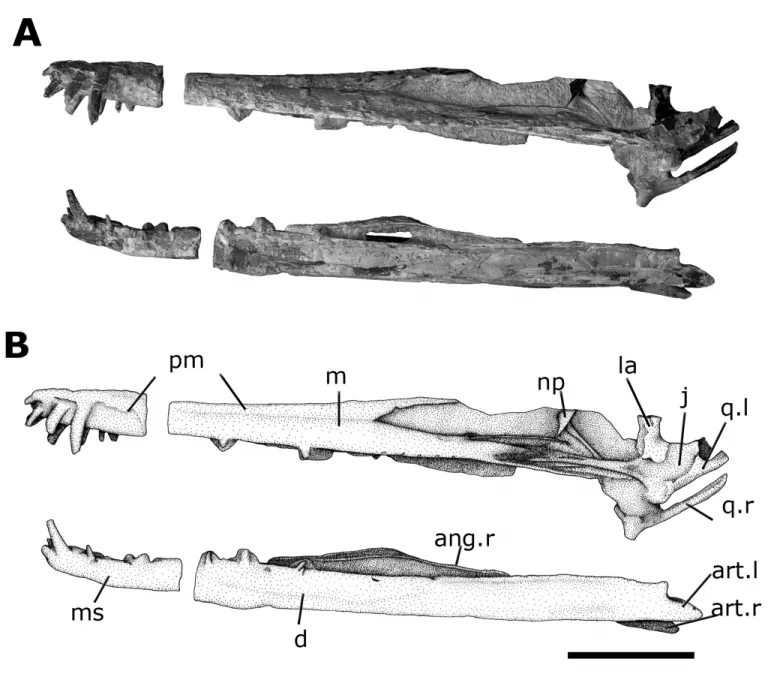
Description—The holotype ofC. atrox(MN 7019-V) is an al-most complete skull, lacking the occipital region and braincase. It is anteroposteriorly elongated, with a preserved length of 515 mm (Fig. 2). Although preserved three-dimensionally, the specimen shows some lateral distortion, with a few cranial elements dis-placed from their original anatomical position, including the right quadrate, which is below the dorsal margin of the nasoantorbital fenestra. The bone surface of the right side is not well preserved and shows signs of erosion due to weathering prior to collection. The lower jaw was isolated from the skull, allowing observation of the palate (Fig. 3). There are two fractures, one in the rostrum and another in the occipital region. These were restored using a resin paste (prior to being deposited in the museum’s collection), which was also used in the reconstruction of the rostral teeth, in-creasing their sizes and creating an artificial appearance that did not match the original anatomy of the skull. A small fragment of the rostral portion contact with the rest of the skull is missing. During preparation, it became clear that the rostral portion was glued back to the remaining part of the skull inverted, with the
FIGURE 2. Cearadactylus atroxholotype (MN 7019-V) before final preparation, as described by Leonardi and Borgomanero (1985). Scale bar equals 100 mm.
FIGURE 3. A, holotype ofCearadactylus atrox(MN 7019-V) after preparation in left lateral view. The rostral portion was broken, and is shown in the correct position;B, sketch ofCearadactylus atrox, showing the preserved bones.Abbreviations:ang.r, angular (right);art.l, articular (left);art.r, articular (right);d, dentary;j, jugal;la, lacrimal;m, maxilla;ms, mandibular symphysis;np, nasal process;pm, premaxilla;q.l, quadrate (left);q.r, quadrate (right). Scale bar equals 100 mm.
lower jaw attached to the maxilla and the premaxillae-maxillae connected with the dentary. The dentary groove, which starts an-terior to the rostral fracture, reaches the tip of the lower jaw. The palatal ridge also starts anterior to the fracture ending at the ros-tral tip of what was thought to be the dentary, confirming this inversion. This artificial appearance misled authors regarding the anatomy of this species.
As typical for the Pterodactyloidea, the nasoantorbital open-ing occupies a considerable portion of the skull, reachopen-ing around 38% of the preserved length, being estimated to occupy about one-third of the length between the squamosal and the rostral tip of the premaxilla. It reaches the 13th alveolus, and forms an al-most straight angle with the posteroventral corner of the jugal, differing from the obtuse angle seen in Anhanguera and ‘
Or-nithocheirus’compressirostris (Kellner and Tomida, 2000; An-dres and Ji, 2008).
The premaxilla is the main bone in the upper rostral portion, and reaches the dorsorostral margin of the nasoantorbital fen-estra. However, its caudal end is not preserved, being at least 330 mm long. In left lateral view, the contact between the pre-maxilla and pre-maxilla is delimited by a shallow groove. The rem-nant of a small sagittal crest is seen in the dorsal surface of the premaxilla, extending from the rostral tip to at least the 5th pre-maxillary alveolus (Fig. 4), indicating thatCearadactylushad such a cranial structure, contrary to previous descriptions (Leonardi and Borgomanero, 1985; Wellnhofer, 1991; Dalla Vecchia, 1993; Kellner and Tomida, 2000; Fastnacht, 2001; Unwin, 2002; Veld-meijer, 2003).
VILA NOVA ET AL.—REDESCRIPTION OFCEARADACTYLUS ATROX 129
FIGURE 4. A, rostral portion of theCearadactylus atroxpremaxilla in right lateral view;B, sketch of the rostral portion, where the basis of the premaxillary sagittal crest is indicated.Abbreviation:pmcr, premaxillary crest. Scale bar equals 10 mm.
In ventral view, the premaxilla shows an elevation (palatal ridge) starting at the rostral fracture, which continues caudally until the middle portion of the palate (Fig. 5), similar to other anhanguerids (Wellnhofer, 1987; Kellner and Tomida, 2000). It is smoother than the one present inTropeognathus mesembrinus, and disappears near the nasoantorbital fenestra.
The maxilla represents most of the ventral surface of the skull, a common feature within pterodactyloids. The right one is incomplete, with only a fragment preserved close to the nasoan-torbital fenestra. The alveoli are not well preserved, and it is dif-ficult to confirm their exact number, but around 16 alveoli are identified on the left side (only two with teeth). They extend un-til the midlength of the nasoantorbital fenestra.
All bones related to the braincase and upper part of the na-soantorbital fenestra are lacking, except for the process of the nasal, which is displaced inside this fenestra. This process is es-sentially a thin, well-developed bone blade that almost reaches the ventral surface of the skull, different from the reduced struc-ture seen in the Tapejaridae and Azhdarchidae, but similar to that in the Anhangueridae (Kellner and Langston, 1996; Kellner and Tomida, 2000; Kellner, 2004). At least in the preserved por-tion, it lacks foramina, contrary to the condition observed in An-hanguera piscatorandA. santanae(Kellner and Tomida, 2000).
Although incomplete, the jugal forms the lower margins of the orbit and the lower temporal fenestra. Its suture with the
quadra-FIGURE 5. A, rostral portion of theCearadactylus atroxpremaxilla in ventral view;B, sketch of the same, with palatal ridge indicated. Abbre-viation:prid, palatal ridge. Scale bar equals 10 mm.
tojugal is not discernible, and together with the quadrate, these bones form a single fused structure. The rostral ramus of the ju-gal narrows rostrally and ends as a thin bone plate.
As pointed out before, the right quadrate was displaced under-neath the left. Its posterior region connects with a long and thin prolongation of the bone, forming the helicoidal structure seen in many pterodactyloids (e.g., Campos and Kellner, 1985; Bennett, 2001).
The lower jaw is almost complete. The right side has most of the external surface badly preserved. Some jaw elements are displaced, and the surangulars cannot be observed. Most or-nithocheiroids with a premaxillary sagittal crest also show a den-tary crest, as seen inAnhangueraandTropeognathus; on the con-trary,C. atrox does not possess any trace of a dentary sagittal crest, being in this respect similar toBrasileodactylus(Kellner, 1984; Say ˜ao and Kellner, 2000). The dentaries are nearly com-plete and slightly compressed, forming most of the jaw. They are fused into a large symphysis, which is 110 mm long, occupy-ing about 20% of the total jaw length. This condition is similar toTropeognathus, but smaller than inAnhanguera(Wellnhofer, 1987; Kellner and Tomida, 2000). A medial groove is present and reaches the distal extremity of the dentaries, as observed in Brasileodactylus(Kellner, 1984; Say ˜ao and Kellner, 2000; Veld-meijer et al., 2005). In C. atrox, however, this groove does bi-furcate at the rostral tip, differing from that inBrasileodactylus araripensis(Fig. 6).
The symphysis bears six alveoli on each side, with teeth in the 1st, 3rd, and 5th alveoli of the left side. Five more alveoli are present anterior to the anterior margin of the left nasoantorbital fenestra, totaling 11 teeth on each side of the lower jaw. The an-gulars are thin bones, not fused to the dentaries, and are displaced from their original positions. Due to the taphonomy, they are positioned between the lower jaw and the maxilla, and the right
FIGURE 6. A,Cearadactylus atroxrostral portion of the dentary in dor-sal view;B, sketch showing the bifurcated end of the groove. Abbrevia-tions:al, alveolus;dg, dental groove;ms, mandibular symphysis. Scale bar equals 30 mm.
angular is partially displaced to lie inside the nasoantorbital fenestra.
The left articular is firmly connected to the dentary, but the suture between them is still evident. The right articular is dis-placed medially, with the rostral tip absent. Due to the position and thickness of this bone, it is possible to assume that it reached beyond the regions corresponding to the nasoantorbital fenestra. Rostrally, the articular extends as a long and thin element until at least the 10th dentary alveolus.
The rostral teeth are elongated, thin, and slightly curved pos-teriorly, and directed somewhat forward and outward. Starting from the 6th tooth, the teeth become smaller, more vertical, and straighter, so that they are less curved toward the posterior re-gion. Many alveoli are damaged, and only three dentary and seven premaxillary alveoli bear teeth. We identified 16 maxillary alveoli in the left side and 11 in the dentary. The portion lost from
the rostral fracture could bear one or at most two pairs of alveoli, so we state the dental formula ofC. atroxas 16–18 maxillary teeth per side and 11–13 in each dentary.
In both the maxilla and dentary, the first four pairs of teeth are larger than the others, but they are smaller than previously thought (Leonardi and Borgomanero, 1985; Unwin, 2002). The 3rd tooth measures 35 mm in height, whereas from the 6th alve-olus to the posterior end the teeth reach around 10 mm. The left upper 8th and 16th alveoli, as well as the left lower 5th and 11th show replacement teeth. The dentition gradually decreases in size posteriorly. This differs from the condition inAnhanguera, in which the 5th and 6th teeth are smaller than the 4th and 7th (Wellnhofer, 1977, 1985, 1991; Wellnhofer et al., 1983; Kellner, 1984, 2003; Kellner and Tomida, 2000).
PHYLOGENETIC ANALYSIS
In order to establish the phylogenetic position ofC. atrox(MN 7019-V), we used three different published matrices (Andres and Ji, 2008; Wang et al., 2009; L ¨u et al., 2010; see Suplementary Data for characters scores). All matrices were analyzed using the same parameters as used by the original authors, with heuristic searches implemented in the programs PAUP∗4.0b10 (Swofford, 2003) and TNT version 1.0 (Goloboff et al., 2008). Resampling was conducted with bootstraps and jackknifing, with 1000 repli-cates for each data set, and Bremer index support was calculated for each consensus tree.
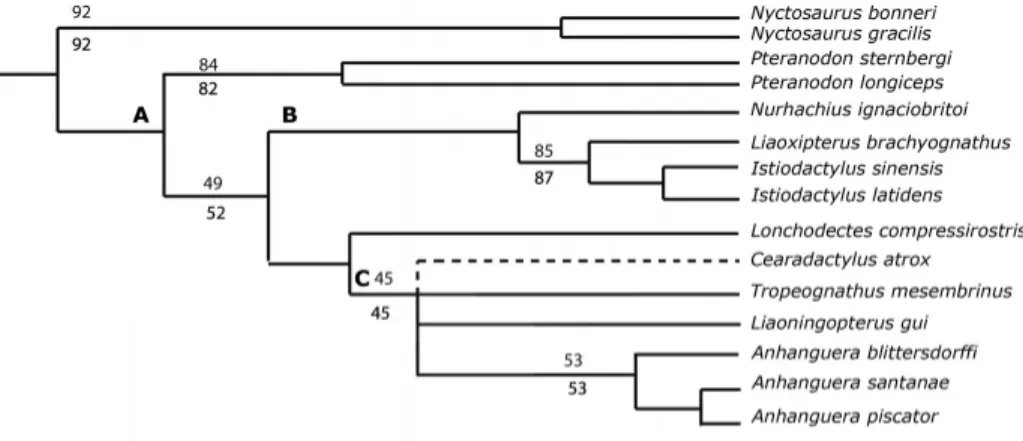
The analysis using the data set of Andres and Ji (2008) resulted in 334 most parsimonious trees (MPTs). The heuristic search placedC. atroxin a polytomy with the Anhangueridae (sensu An-dres and Ji, 2008), a clade consisting ofTropeognathus mesembri-nus,Liaoningopterus gui,Anhanguera blittersdorffi,A. santanae, andA. piscator(Fig. 7), with ‘Lonchodectes’ (or ‘Ornithocheirus,’ according to which author is followed)compressirostrisas its sis-ter group. This result was previously recovered by Say ˜ao et al. (2012) and the addition ofC. atroxdid not result in any change to their tree topology. The main characteristics that separateC. atroxfrom the Anhangueridae are as follows: lack of a dentary sagittal crest (character 45) and the posteroventral limit of the na-soantorbital fenestra forming a right angle (character 8; differing from the more rounded and concave condition in Anhangueri-dae).
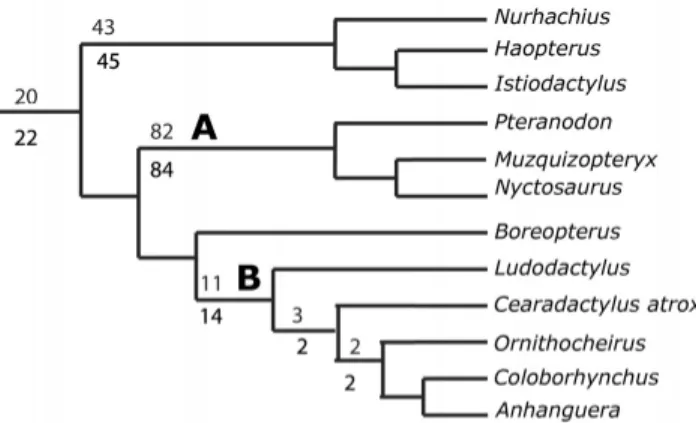
The majority consensus tree published by L ¨u et al. (2010) re-covered Cearadactylus as a member of the Ctenochasmatidae, probably as a result of incorporating the previous anatomical interpretations (and scoring) of Unwin (2002). By rescoringC. atroxin this data set, we recovered a different result. The search conducted with TNT found 392 MPTs (Fig. 8). The majority con-sensus tree of this analysis placedC. atroxwithin
Ornithocheiri-FIGURE 7. Detail of the strict consensus tree of 334 MPTs showing the position ofC. atrox using the Andres and Ji (2008) data set and clade names.A, Pteranodontoidea;
B, Istiodactylidae;C, Anhangueridae. Upper values are bootstraps and lower figures are jackknife values. Consistency index=0.486 and retention index=0.808 for the consensus tree.
VILA NOVA ET AL.—REDESCRIPTION OFCEARADACTYLUS ATROX 131
FIGURE 8. Detail of the majority consensus tree of 392 MPTs show-ing the position ofC. atroxusing the modified L ¨u et al. (2010) data set.
A, Istiodactylidae;B, Ornithocheiridae. Upper values are bootstraps and lower are figures are jackknife values. Consistency index=0.434 and re-tention index=0.798 for the consensus tree.
dae as the sister group ofOrnithocheirus(considered by L ¨u et al. [2010] as includingTropeognathus, but see Rodrigues and Kell-ner [2008]) + Coloborhynchus + Anhanguera. This result is mainly based on characters related to the nasoantorbital fenestra and dentition. InCearadactylus atrox, the dorsal margin of the na-soantorbital opening is delimited by a thin bone bar, whereas in Ornithocheirus,Coloborhynchus, andAnhanguerathis structure is absent (character 8).Cearadactylus atrox differs from Ludo-dactylus,Coloborhynchus, andAnhanguerain having a straight ventral margin of the skull (character 11). Furthermore, the pos-terior margin of the nasoantorbital fenestra in C. atrox forms a right angle, whereas inColoborhynchusandAnhanguerait is concave (character 22).C. atroxalso lacks a dentary sagittal crest (character 46).
The dentition also shows a distinct pattern in these closely re-lated species.C. atroxhas a dimorphodont pattern (character 48), with the preserved rostral teeth about three times the size of the maxillary ones. This rostral dentition is formed by less than 11 pairs of alveoli (character 51) and the maxillary teeth are small, spaced (character 49), and laterally compressed, with a slight tri-angular shape (character 62). Such a combination of character states is unique toC. atrox.
The position of C. atrox within the Ornithocheiridae as the sister taxon to (Ornithocheirus + (Coloborhynchus + An-hanguera)) has very low support, with bootstrap values of only 3%. The inclusion of an intermediate taxon should not highly influence this index, as has also been noted in other studies (e.g., Penny et al., 1992; Kearney and Clark, 2003; Strauss and Atanassov, 2006), indicating that this result should be viewed with caution. The clade Ornithocheiridae is weakly supported (11% bootstrap and 14% jackknife values) withLudodactylusas the basal taxon.Cearadactylus, however, changes position with other species in many trees. Despite that, it always falls close to Anhangueridae. This result contradicts the study of Unwin (2002), in whichC.atroxwas regarded as the sister taxon of the clade composed byGnathosaurus + Pterodactylus longicollum (Fig. 9).
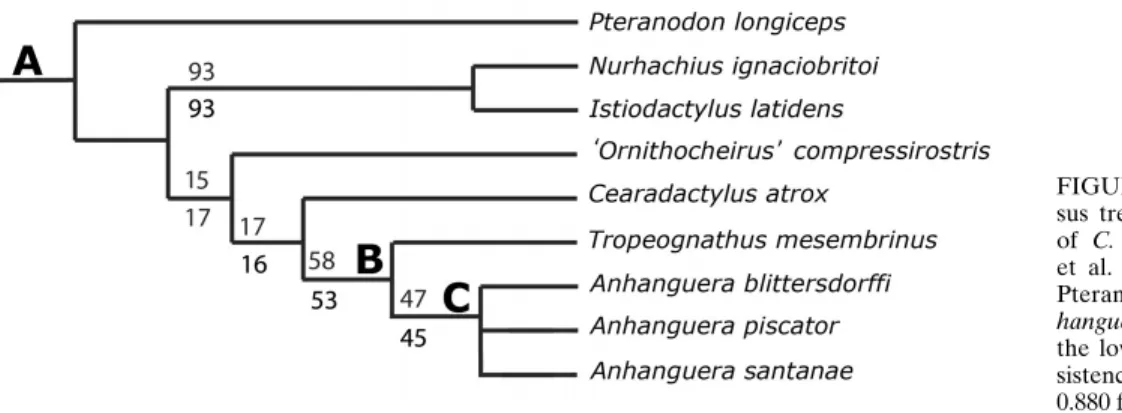
Wang et al. (2009) provided the smallest data set of the three phylogenetic proposals addressed here, being an expanded and updated version of Kellner’s (2003) matrix. Despite the compar-atively small number of characters, the topology of the consensus tree shows high support values, with some branches having boot-strap and jackknife values above 80%. This consensus tree is very
FIGURE 9. The putative phylogenetic position ofCearadactylus atrox
based on the L ¨u et al. (2010) data set, according to Unwin (2002). These relationships are changed here, due to new character data available from the more fully prepared holotype.
similar to the one obtained from the data set of Andres and Ji (2008).Cearadactylusfalls out as the sister group of Anhangueri-dae (sensu Kellner, 2003), with ‘Ornithocheirus’compressirostris as the sister taxon to them (C. atrox+Anhangueridae; Fig. 10). The support values of these branches are similar, being generally low (15% bootstrap and 17% jackknife values).
‘Ornithocheirus’compressirostrisdiffers fromC. atroxby lack-ing a premaxillary sagittal crest (character 15) and finely ser-rated teeth (character 48).Anhanguera piscatorandA. santanae show a foramen in the nasal process (character 21), which is ab-sent inC. atrox. The lacrimal process of the jugal (character 23) in C. atroxis subvertical, differing from that in closely related taxa. The palatal ridge (character 34) ofC. atroxis not as strong as inTropeognathus mesembrinus, being similar to that of An-hanguera. The absence of a dentary sagittal crest (character 41) separatesC. atroxfrom all known anhanguerids.
DISCUSSION
The high pterosaur diversity recorded from the Araripe Basin is well known (e.g., Kellner and Tomida, 2000; Barrett et al., 2008) and the possibility that it is overestimated has been noted several times (e.g., Campos and Kellner, 1985; Martill and Naish, 2006; Unwin and Martill, 2007). Some have made a potential par-allel with the initial stages of pterosaur studies based on material from the Cambridge Greensand and the Solnhofen Basin, where the great number of specimens fueled the establishment of many taxa (Bennett, 1995, 1996; Unwin, 2001). Taxonomic reviews of the specimens from these European deposits led several authors to propose a reduction in the number of species present (Ben-nett, 1996; Unwin, 2001). Indeed, Araripe pterosaurs were first named based on very fragmentary or incomplete specimens, po-tentially creating a similar scenario (Price, 1971; Wellhofer, 1977; Kellner, 1984; Witton, 2009). Taking this into account, the holo-type and only known specimen of C. atroxwas compared with other toothed pteranodontoids.
Regarding ontogeny, some sutures are not visible but the pres-ence of unfused elements such as the right articular and both an-gulars suggest that the holotype ofC. atroxrepresents a subadult individual (Bennett, 1993; Kellner and Tomida, 2000; ¨Osi and Prondvai, 2009).
The posterior limit of the nasoantorbital fenestra, forming a straight angle with the ventral border (as already observed in the original description; Leonardi and Borgomanero, 1985) distin-guishesC. atroxfrom all other species. The premaxillary teeth, however, are very different from how they were previously inter-preted, due to removal of the epoxy resin that was used to en-hance the fossil. Although we cannot establish the actual length of the largest tooth, it is unlikely to have been 48 mm long as pro-posed by Leonardi and Borgomanero (1985) and as subsequently followed by later studies (e.g., Unwin, 2002; Steel et al., 2005).
FIGURE 10. Detail of the strict consen-sus tree of 240 MPTs showing the position of C. atrox based on the modified Wang et al. (2009) data set and clade names. A, Pteranodontoidea;B, Anhangueridae;C, An-hanguera. Upper values are bootstraps and the lower figures are jackknife values. Con-sistency index=0.678 and retention index= 0.880 for the consensus tree.
Recently, Unwin (2002) reinterpreted several features of C. atrox, placing this species in the Ctenochasmatidae, a conclu-sion followed by other authors (e.g., Steel et al., 2005; L ¨u et al., 2010; Vidarte and Calvo, 2010). However, as noted above, the mandibular symphysis ofC. atroxwas glued to the rest of the skull inverted with respect to the premaxilla and, therefore, all char-acters related to these areas require revision.C. atroxdoes not possess a rostral portion of the mandible that is more expanded than the premaxilla (Kellner and Tomida, 2000; Unwin, 2002), and based on the preserved parts of the jugal, quadratojugal, and quadrate this species lacks a ‘high cheek,’ as has been proposed for Ctenochasmatidae (Unwin, 2002; Martill et al., 2006; Bennett, 2007; Andres et al., 2010).
The tooth dimorphism is not as conspicuous as proposed by Unwin (2002), with the largest premaxillary tooth (the 3rd) reaching at most three times the size of the smaller maxillary tooth (11th). Unwin (2002) also stated thatC. atroxhas a nonlin-ear pattern to the dentition, with the 5th tooth smaller than the 6th, 7th, and 8th. This relationship has not been observed by us and, despite the premaxillary teeth being larger than the others, the maxillary teeth diminish in size uniformly towards the poste-rior end. Although the dentition is similar in size to that of an-hanguerids andBrasileodactylus(Kellner and Tomida, 2000) the typicalAnhanguerafeature of the 5th and 6th teeth being smaller than the 4th and 7th (Kellner and Tomida, 2000; Kellner, 2003) is not observed inC. atrox. This species also has fewer teeth than in all anhanguerids, with the exception ofTropeognathus mesem-brinus(Wellnhofer, 1987; Kellner and Tomida, 2000).
One of the first jaws found in the Araripe Basin, Brasileodacty-lus araripensis(Kellner, 1984) bears many anatomical character-istics similar toC. atrox, indicating a possible systematic affin-ity. Both possess a groove on the dentary that is visible in ven-tral view and an expanded mandibular symphysis (Kellner, 1984; Veldmeijer et al., 2005, 2009). Some differences, however, con-firm that they are two distinct taxa. Among these is the spacing between the rostral alveoli that inB. araripensisexceeds the ac-tual diameter of the alveoli, whereas inC. atroxthe reverse is true (i.e., interalveolar spacing smaller than the alveoli diameter; Kellner, 1984; Veldmeijer et al., 2009). Furthermore, the dentary inB. araripensisis rather flat in its rostral portion, but this is less evident inC. atrox. Lastly, the dentary groove reaches the rostral tip of the bone in both taxa, but inC. atroxit terminates with a bifurcated end.
Tropeognathus mesembrinus differs from C. atroxin having a well-developed dentary sagittal crest, a better-developed and deeper palatal ridge, and a less expanded distal end to the ros-trum (Wellnhofer, 1987; Kellner and Tomida, 2000). ‘ Cearadacty-lus’ligabueiis based on an incomplete skull (Dalla Vecchia, 1993) that might comprise a mixture of different specimens. Therefore, Cearadactylus atrox is considered to be the only taxon of the
genus, a decision that has been proposed by other authors and that is followed herein (Steel et al., 2005; Veldmeijer et al., 2005; Wang et al., 2009). The main difference betweenAnhanguera pis-catorandC. atroxis the lack of a dentary sagittal crest in the lat-ter. Unfortunately, inAnhanguera piscatorthe jaws are occluded (Kellner and Tomida, 2000) and there is no information regard-ing the palatal ridge and dentary groove.
A pterosaur described recently from the Romualdo Forma-tion was first published asColoborhynchus spielbergiand later referred toAnhanguera (Veldmeijer, 2003; Kellner, 2006; Ro-drigues and Kellner, 2008). One of its most notable characteris-tics is the large premaxillary sagittal crest, which reaches the base of the nasoantorbital fenestra (Veldmeijer, 2003). Anhanguera spielbergipossesses a tooth pattern similar toC. atrox, both in terms of tooth numbers (at least 36 versus 32–36 inC. atrox) and distribution, with the tooth rows reaching a point level with the middle of the nasoantorbital fenestra (Veldmeijer, 2003). Despite these similarities,Anhanguera spielbergidiffers fromC. atroxin having a well-developed sagittal crest that reaches the base of the nasoantorbital fenestra, the presence of a dentary sagittal crest, and in the dentary groove not reaching the rostral tip of the jaw.
Regarding the phylogenetic placement ofC. atrox, reanalysis of all three phylogenetic data sets considered above suggests that this taxon is phylogenetically close to the anhanguerids and other toothed pteranodontoids, although the internal organization of these branches changes depending upon the characters and char-acter scores constituting the original data sets. None of these analyses recoversC. atroxas a member of the archaeopterodacty-loid clade Ctenochasmatidae, contrary to the proposal of Unwin (2002).
CONCLUSIONS
Additional preparation of the unique specimen of Cearadacty-lus atroxdemonstrates that the rostrum was glued back to the jaw in an inverted position, leading to several anatomical misin-terpretations. Among these is thatC. atroxpossesses a premaxil-lary sagittal crest and lacks a ‘high cheek’ (contra Unwin, 2002). Comparison with other toothed pterosaur taxa from the Araripe Basin shows thatCearadactylus atroxis a valid taxon. Further-more, incorporation of these new data into the data sets pub-lished by Andres and Ji (2008), Wang et al. (2009), and L ¨u et al. (2010) indicates thatCearadactylus atroxis the sister group of Anhangueridae (sensu Kellner, 2003), and is not a member of the archaeopterodactyloid clade Ctenochasmatidae (contra Un-win, 2002).
ACKNOWLEDGMENTS
We would like to thank H. P. Silva and J. Pontes (MN/UFRJ) for great help during preparation of the specimen; G. Oliveira
VILA NOVA ET AL.—REDESCRIPTION OFCEARADACTYLUS ATROX 133 (UFRPE), P. Romano (UFV), T. Rodrigues (UFES), and F.
Nunes (MN/UFRJ) for discussions regarding pterosaurs and phy-logeny; L. Fac ´o for specimen photography; M. Massarani (FF-CLRP/USP) for drawings; and M. Barbosa for figure editing. TNT is made available with the sponsorship of the Willi Hen-nig Society. C. Bennett, editor H.-L. You, and an anonymous referee greatly improved the manuscript. Also we would like to thank the Pr ´o-reitoria de Pesquisa e P ´os- Graduac¸ ˜ao (PROPESQ proc. UFPE 23076.027497/2010-13 to J.M.S.), FAPERJ (nos. E-26/111.273/2010 and E-26/102.737/2012 to A.W.A.K.), and CNPq (no. 307276/2009-0 to A.W.A.K.). This research was partially funded by CAPES (Masters fellowship to B.C.V.N.)
LITERATURE CITED
Andres, B., and Q. Ji. 2008. A new pterosaur from the Liaoning Province of China, the phylogeny of the Pterodactyloidea, and convergence in their cervical vertebrae. Palaeontology 51:453–469.
Andres, B., J. M. Clark, and X. Xing. 2010. A new rhamphorhynchid pterosaur from the Upper Jurassic of Xinjiang, China, and the phy-logenetic relationships of basal pterosaurs. Journal of Vertebrate Paleontology 30:163–187.
Assine, M. L. 2007. Bacia do Araripe. Boletim de Geoci ˆencias. Petrobras 15:371–389.
Barrett, P. M., R. J. Butler, N. P. Edwards, and A. R. Milner. 2008. Pterosaur distribution in time and space: an atlas. Zitteliana B 28:61–107.
Bennett, S. C. 1993. The ontogeny ofPteranodonand other pterosaurs. Paleobiology 19:92–106.
Bennett, S. C. 1995. A statistical study ofRhamphorhynchusfrom the Solnhofen Limestone of Germany: year-classes of a single large species. Journal of Paleontology 69:569–580.
Bennett, S. C. 1996. Year-classes of pterosaurs from the Solnhofen Lime-stone of Germany: taxonomic and systematic implications. Journal of Vertebrate Paleontology 16:432–444.
Bennett, S. C. 2001. The osteology and functional morphology of the Late Cretaceous pterosaurPteranodon. Palaeontographica, Abteilung A 260:1–112.
Bennett, S. C. 2007. A review of the pterosaurCtenochasma: taxonomy and ontogeny. Neues Jahrbuch f ¨ur Geologie und Pal ¨aontologie, Ab-handlungen 245:23–31.
Bittencourt, J. S., and M. C. Langer. 2011. Mesozoic dinosaurs from Brazil and their biogeographic implications. Anais da Academia Brasileira de Ci ˆencias 83:23–60.
Bittencourt, J. S., and M. C. Langer. 2012. Os dinossauros do Mesozoico brasileiro e as relac¸ ˜oes biogeogr ´aficas entre ´Africa e Am ´erica do Sul; pp. 299–321 in V. Gallo, H. M. A. Silva, P. M. Brito, and F. J. Figueiredo (eds.), Paleontologia de Vertebrados: Relac¸ ˜oes entre Am ´erica do Sul e ´Africa. Interci ˆencia, Rio de Janeiro.
Campos, D. A., and A. W. A. Kellner. 1985. Panorama of the flying reptiles study in Brazil and South America. Anais da Academia Brasileira de Ci ˆencias 57:453–466.
Costa, F. R., O. Rocha-Barbosa, and A. W. A. Kellner. 2010. Stance biomechanics ofAnhanguera piscatorKellner and Tomida, 2000 (Pterosauria, Pterodactyloidea) using tridimensional virtual anima-tion. Acta Geoscientica Sinica 31:15–16.
Dalla Vecchia, F. M. 1993. Cearadactylus? ligabuei, nov. sp., a new Early Cretaceous (Aptian) pterosaur from Chapada do Araripe (Northeastern Brazil). Bolletino della Societa Paleontologica Ital-iana 32:401–409.
Fara, E., A. A. F. Saraiva, D. A. Campos, J. K. R. Moreira, D. C. Siebra, and A. W. A. Kellner. 2005. Controlled excavations in the Romualdo Member of the Santana Formation (Early Creta-ceous, Araripe Basin, northeastern Brazil): stratigraphic, palaeoen-vironmental and palaeoecological implications. Palaeogeography, Palaeoclimatology, Palaeoecology 218:145–161.
Fastnacht, M. 2001. First record ofColoborhynchus(Pterosauria) from the Santana Formation (Lower Cretaceous) of the Chapada do Araripe, Brazil. Pal ¨aontologische Zeitschrift 75:23–36.
Goloboff, P., A. J. S. Farris, and K. C. Nixon. 2008. TNT, a free program for phylogenetic analysis. Cladistics 24:774–786.
Kaup, J. 1834. Versuch einer Eintheilung der Saugethiere in 6 St ¨amme und der Amphibien in 6 Ordnungen. Isis 3:311–315.
Kearney, M., and J. M. Clark. 2003. Problems due to missing data in phy-logenetic analyses including fossils: a critical review. Journal of Ver-tebrate Paleontology 23:263–275.
Kellner, A. W. A. 1984. Ocorr ˆencia de uma mand´ıbula de Pterosauria (Brasileodactylus araripensis, nov. gen.; nov. sp.) na formac¸ ˜ao San-tana, Cret ´aceo da Chapada do Araripe, Cear ´a, Brasil; pp. 578–590 in Sociedade Brasileira de Paleontologia (ed.), Anais do 33 Congresso Brasileiro de Geologia, Rio de Janeiro, 28 October–4 November 1984. Publicac¸ ˜oes Avulsas da Sociedade Brasileira de Geologia. Kellner, A. W. A. 1996. Fossilized theropod soft tissue. Nature 379:32. Kellner, A. W. A. 2003. Pterosaur phylogeny and comments on the
evo-lutionary history of the group; pp. 105–137 in E. Buffetaut and J. M. Mazin (eds.), Evolution and Palaeobiology of Pterosaurs. Geologi-cal Society Special Publications 217.
Kellner, A. W. A. 2004. New information on the Tapejaridae (Pterosauria, Pterodactyloidea) and discussion of the relationships of this clade. Ameghiniana 41:521–534.
Kellner, A. W. A. 2006. Pterossauros—Os Senhores do C ´eu do Brasil. Vieira and Lent Press, Rio de Janeiro, 176 pp.
Kellner, A. W. A., and W. Langston. 1996. Cranial remains of Quet-zalcoatlus(Pterosauria, Azhdarchidae) from Late Cretaceous sed-iments of Big Bend National Park, Texas. Journal of Vertebrate Pa-leontology 16:222–231.
Kellner, A. W. A., and Y. Tomida. 2000. Description of a new species of Anhangueridae (Pterodactyloidea) with comments on the pterosaur fauna from the Santana Formation (Aptian–Albian), northeastern Brazil. National Science Museum Monographs 17:1– 135.
Leonardi, G., and G. Borgomanero. 1983. Cearadactylus atrox nov. gen., nov. sp.; novo Pterosauria (Pterodactyloidea) da Chapada do Araripe, Cear ´a, Brasil; p. 17 in Minist ´erio de Minas e Energia–DNPM (ed.), Resumos do 8 Congresso Brasileiro de Pale-ontologia, Rio de Janeiro, 1–7 September 1983. Minist ´erio de Minas e Energia–DNPM, Rio de Janeiro, Brazil.
Leonardi, G., and G. Borgomanero. 1985. Cearadactylus atrox nov. gen., nov. sp.: novo Pterosauria (Pterodactyloidea) da Chapada do Araripe, Cear ´a, Brasil. Colet ˆanea de Trabalhos Paleontol ´ogicos, S ´erie Geologia 1:78–80.
L ¨u, J., D. M. Unwin, X. Jin, Y. Liu, and Q. Ji. 2010. Evidence for modu-lar evolution in a long-tailed pterosaur with a pterodactyloid skull. Proceedings of the Royal Society B 277:383–389.
Maisey, J. G. (ed.). 1991. Santana Fossils: An Illustrated Atlas. T. F. C. Publications, Neptune City, New Jersey, 459 pp.
Martill, D. M. 2007. The age of the Cretaceous Santana Formation fossil Konservat Lagerst ¨atte of northeast Brazil: a historical review and an appraisal of the biochronostratigraphic utility of its palaeobiota. Creteceous Research 28:895–920.
Martill, D. M., and D. Naish. 2006. Cranial crest development in the azh-darchoid pterosaurTupuxuara, with a review of the genus and tape-jarid monophyly. Palaeontology 49:925–941.
Martill, D. M., and D. M. Unwin. 1989. Exceptionally well preserved pterosaur wing membrane from the Cretaceous of Brazil. Nature 340:138–140.
Martill, D. M., E. Frey, C. M. Bell, and G. C. Diaz. 2006. Ctenochasmatid pterosaurs from Early Cretaceous deposits in Chile. Cretaceous Re-search 27:603–610.
Neumann, V. H., and L. Cabrera. 1999. Una Nueva Propuesta Es-tratigr ´afica para la tectonosecuencia post-rifte de la Cuenca de araripe, Noreste de Brasil. Atas do 5 Simp ´osio sobre o Cret ´aceo do Brasil e 1 Simp ´osio sobre el Cret ´acico de Am ´erica del Sur, 28 August–2 September 1999. Universidade Estadual Paulista, Rio Claro, Brazil.
O’Connor, P. M., J. J. W. Sertich, and F. K. Manthi. 2011. A ptero-dactyloid pterosaur from the Upper Cretaceous Lapurr sandstone, West Turkana, Kenya. Anais da Academia Brasileira de Ci ˆencias 83:309–315.
¨
Osi, A., and K. E. Prondvai. 2009. Forgotten pterosaurs in Hungarian collections: first description ofRhamphorhynchusand Pterodacty-lusspecimens. Neues Jahrbuch f ¨ur Geologie und Pal ¨aontologie, Ab-handlungen 252:167–180.
Palmer, C., and G. Dyke. 2012. Constraints on the wing morphology of pterosaurs. Proceedings of the Royal Society B 279:1218–1224. Penny, D., M. D. Hendy, and M. A. Steel. 1992. Progress with methods for
constructing evolutionary trees. Trends in Ecology and Evolution 7:73–79.
Plieninger, F. 1901. Beitrage zur Kenntnis der Flugsaurier. Palaeonto-graphica 48:65–90.
Pons, D., P. Y. Berthou, and D. A. Campos. 1990. Quelques observations sur la palynologie de l’Aptien sup ´erieur et de l’Albien do bassin d’Araripe (N-E Du Brasil); pp. 142–252 in Atas do 1ºSimposio so-bre a Bacia do Araripe e das Bacias interiores do Nordeste, Crato, 14–16 June 1990. Sociedade Brasileira de Paleontologia, Crato, Brazil.
Price, L. I. 1971. A presenc¸a de Pterosauria no Cret ´aceo Inferior da Cha-pada do Araripe, Brasil. Anais da Academia Brasileira de Ci ˆencias 43:451–461.
Rodrigues, T., and A. W. A. Kellner. 2008. Review of the pterodactyloid pterosaurColoborhynchus. Zitteliana B 28:219–228.
Saraiva, A. A. F., M. H. Hessel, N. C. Guerra, and E. Fara. 2007. Concrec¸ ˜oes Calcarias da Formac¸ ˜ao Santana, Bacia do Araripe: uma proposta de classificac¸ ˜ao. Estudos Geol ´ogicos 17:40–58.
Say ˜ao, J. M., and A. W. A. Kellner. 2000. Description of a pterosaur ros-trum from the Crato Member, Santana Formation (Aptian–Albian) northeastern, Brazil. Boletim do Museu Nacional 54:1–8.
Say ˜ao, J. M., A. A. F. Saraiva, and A. M. K. Uejima. 2011. New evi-dence of feathers in the Crato Formation supporting a reappraisal on the presence of Aves. Anais da Academia Brasileira de Ci ˆencias 83:197–210.
Say ˜ao, J. M., B. C. Vila Nova, and P. S. Romano. 2012. Considerac¸ ˜oes so-bre os padr ˜oes de distribuic¸ ˜ao geogr ´afica dos Pterodactyloidea (Ar-chosauria, Pterosauria); pp. 281–300 in V. Gallo, H. M. A. Silva, P. M. Brito, and F. J. Figueiredo (eds.), Paleontologia de Vertebra-dos: Relac¸ ˜oes entre Am ´erica do Sul e ´Africa. Interci ˆencia, Rio de Janeiro.
Steel, L., D. M. Martill, D. M. Unwin, and J. D. Winch. 2005. A new pterodactyloid pterosaur from the Wessex Formation (Lower Cretaceous) of the Isle of Wight, England. Cretaceous Research 26:686–699.
Strauss, R. E., and M. N. Atanassov. 2006. Determining best subsets of specimens and characters in the presence of large amounts of missing data. Biological Journal of the Linnean Society 88:309– 328.
Swofford, D. L. 2003. PAUP∗4.0. Sinauer Associates, Sunderland, Mas-sachusetts.
Unwin, D. M. 2001. An overview of the pterosaur assemblage from the Cambridge Greensand (Cretaceous) of Eastern England. Mitteilun-gen Museum f ¨ur Naturkunde Berlin, Geowissenschaftlichen Reihe 4:189–222.
Unwin, D. M. 2002. On the systematic relationships ofCearadactylus atrox, an enigmatic Early Cretaceous pterosaur from the Santana Formation of Brazil. Mitteilungen Museum f ¨ur Naturkunde Berlin, Geowissenschaftlichen Reihe 5:239–263.
Unwin, D. M., and D. M. Martill. 2007. Pterosaurs of the Crato Forma-tion; pp. 475–524 in D. M. Martill, G. Bechly, and R. F. Loveridge (eds.), The Crato Fossil Beds of Brazil—Window into an Ancient World. Cambridge University Press, New York.
Valenc¸a, L. M. M., V. H. Neumann, and J. M. Mabesoone. 2003. An overview on Callovian–Cenomanian intracratonic basins of Northeast Brazil: onshore stratrigraphic record of the opening of the southearn Atlantic. Geologica Acta 1:261–276.
Veldmeijer, A. J. 2003. Description ofColoborhynchus spielbergisp. nov. (Pterodactyloidea) from the Albian (Lower Cretaceous) of Brazil. Scripta Geologica 125:35–139.
Veldmeijer, A. J., H. J. M. Meijer, and M. Signore. 2009. Description of pterosaurian (Pterodactyloidea: Anhangueridae,Brasileodactylus) remains from the Lower Cretaceous of Brazil. Deinsea 13:9–40. Veldmeijer, A. J., M. Signore, and H. J. M. Meijer. 2005.Brasileodactylus
(Pterosauria, Pterodactyloidea, Anhangueridae); an update. Cra-nium 22:45–56.
Vidarte, C. F., and M. M. Calvo. 2010. Un nuevo pterosaurio (Ptero-dactyloidea) en el Cret ´acico Inferior de La Rioja (Espa ˜na). Bolet´ın Geol ´ogico y Minero 121:311–328.
Vila Nova, B. C., and J. M. Say ˜ao. 2012. On wing disparity and morpho-logical variation of the Santana Group pterosaurs. Historical Biol-ogy 24:567–574.
Vila Nova, B. C., A. A. F. Saraiva, J. K. R. Moreira, and J. M. Say ˜ao. 2011. Controlled excavations of the Romualdo Formation Lagerst ¨atte (Araripe Basin, Brazil) and pterosaur diversity: remarks due to new findings. Palaios 26:173–179.
Wang, X.-L., A. W. A. Kellner, S. Jiang, and X. Meng. 2009. An un-usual long-tailed pterosaur with elongated neck from western Liaon-ing of China. Anais da Academia Brasileira de Ci ˆencias 81:793– 812.
Wellnhofer, P. 1977.Araripedactylus dehmiNov. gen., Nov. sp., ein neuer Flugsaurier aus der Unterkreide Von Brasilian]. Mitteilungen der Bayerischen Staatssammlung f ¨ur Pal ¨aontologie und Historische Ge-ologie 17:157–167.
Wellnhofer, P. 1985. Neue Pterosaurier aus der Santana Formation (Apt.) der Chapada do Araripe, Brasilien. Palaeontographica, Abteilung A 187:105–182.
Wellnhofer, P. 1987. New crested pterosaurs from the Lower Cretaceous of Brasil. Mitteilungen der Bayerischen Statssammlung fur Paleon-tologie und Historische Geologie 27:175–186.
Wellnhofer, P. 1991. The Illustrated Encyclopedia of Prehistoric Flying Reptiles. Barnes and Noble Books, New York, 124 pp.
Wellnhofer, P., E. Buffetaut, and P. Gigase. 1983. A pterosaurian no-tarium from the Lower Cretaceous of Brazil. Pal ¨aontologische Zeitschrift 57:147–157.
Witton, M. P. 2009. A new species ofTupuxuara(Thalassodromidae, Azhdarchoidea) from the Lower Cretaceous Santana Formation of Brazil, with a note on the nomenclature of Thalassodromidae. Cre-taceous Research 30:1293–1300.
Submitted October 30, 2012; revisions received March 25, 2013; accepted April 2, 2013.
Handling editor: Hailu You.