225
-Open Source Software for Content Management System 7 International CALIBER 2009
Open Source Software for Content Management System
Umesha Naik D Shivalingaiah
Abstract
Information and documentation services available on the Internet through web servers are growing in an exponential manner. In recent times, open source software has been seen as an increasingly mainstream part of the market. The field of content management system has seen particularly strong growth in open source solutions, perhaps in direct response to the very high prices that commercial content management system have historically demanded. The increasing complexity of services and systems supporting has made it necessary to formulate a theoretical and practical corpus capable of combining classical information management techniques within organizations with the particular features of the digital environment. In this article the authors highlighted some of the most popular open source, free to download and use content management system tools. One can choose any of them for their website depending on their particular needs or organizational requirements. This article also highlights the different types, license, free or open source, database type, platforms, etc.
Keywords: Content Management, Web Content Management, Open Source Software, Web
Content Framework, Content Management Tools, Digital Content
1. Introduction
Content is in essence, any type or ‘unit’ of digital information. It can be text, images, graphics, video, sound, documents, records etc. or in other words anything that is likely to be managed in an electr onic format. Con ten t Man agemen t is effectively th e management of the con ten t described above, by combining rules, process and/ or workflows in such a way that its electronic storage is deemed to be ‘managed’ rather than ‘un-managed’. This intended to completely encompass the legacy problem domains that have traditionally been addressed by records management and document management. It also includes all of the additional problems involved in converting to and from digital content, to and from the traditional media of those problem domains (such as physical
and computerized filing and retrieval systems, often involving paper and microforms).
Usually the software provides authoring (and other) tools designed to allow users with little or no knowledge of programming languages or markup languages to create and manage content with relative ease of use. The new domain in its own right, as it has employed the technologies and strategies of digital content management to address business process issues, such as records and auditing, knowledge sharing, personalization and standardization of content, and so on. Content management refers to the process of creating, editing, storing, organising and publishing the various types of media (text, images, videos etc) that make up a website. A CMS is a software application that facilitates these tasks without the need for knowledge of HTML, CSS, or any other web programming language. Open software is a 7th International CALIBER-2009,
Pondicherry University, Puducherry, February 25-27, 2009 © INFLIBNET Centre, Ahmedabad
226
-Open Source Software for Content Management System 7 International CALIBER 2009
phenomenon which is called to revolutionize business models in the software industry. This article however will not attempt to carry out a detailed analysis of the world of open software, its technological platforms or the typology of existing licenses, as an abundance of information resources dealing with this matter are available elsewhere.
2. Content Management System (CMS)
CMS means a tool for managing content, usually on a web site, that separates the design, interactivity, and content from one another to make it easier for content authors to provide content. CMS is a computer application used to create, edit, manage, search and publish various kinds of digital media and electronic text. A CMS is responsible for the collection, management, and publishing of chunks of information known as content components. A CMS enables a variety of centralized technical and de-centralized non technical staff to create, edit, manage and finally publish in different formats, variety of content like text, graphics, video, documen ts etc, will being con strain ed by a centralized set of rules, process and workflows that ensure coherent, validated electronic content. CMS is a multifunctional application. It is capable to create a powerful portal website in a matter of minutes and it has wide supporting community. CMS consists of a content management application which enables the management and modification of content without advanced webmaster knowledge, and a content delivery application, that uses new information to update the website.
A CMS is a system used to manage the content of a Web site. Typically, a CMS consists of two elements: the Content Management Application (CMA) and the Content Delivery Application (CDA). The CMA element allows the content manager or author, who
may not know HTML, to manage the creation, modification, and removal of content from a Web site without needing the expertise of a Webmaster. Th e CDA elemen t uses an d compiles th at information to update the Web site. The features of a CMS system vary, but most include Web-based publishing, format management, revision control, and indexing, search, and retrieval. [2]
2.1. CMS Subsystems:
A CMS is composed of various subsystems that interact with these:
i. Collection: Subsystem which handles the creation and/or acquisition of information. It must provide support for the processes of content creation, workflows, syndication and integration of external sources. In addition, it must provide support to conversion processes between different formats as well as for the incorporation of contents from different sources within specific structures.
ii. Management: Subsystem in charge of the man agement and control of infor mation repositories, user groups, and support processes for other subsystems. It handles the defining and controlling of information flows used by other subsystems, as well as the definition of parameters for the functioning of the system. iii.Publishing: Subsystem in charge of final
pr oduction of publication s an d digital information products in an automatic or semiautomatic manner. It makes use of a model based on templates an d must pr ovide personalization options for users as well as the possibility of producin g for a variety of platforms and/or customers.
227
-Open Source Software for Content Management System 7 International CALIBER 2009
3. Enterprise Content Management (ECM)
ECM is a set of strategies, methods tools and technologies used to capture, manage, store, preserves and deliver content and documents related to organizational processes. ECM tools and str ategies allow th e man agemen t of an organization’s unstructured information, wherever that information exists.
ECM is working properly when it is effectively “in visible” to users. ECM tech nologies ar e infrastructures that support specialized applications as subordinate services. ECM thus is a collection of infrastructure components that fit into a multi-layer model and include all document related tech n ologies for h an dlin g, deliver in g, an d man aging structured data and un structured information jointly. As such, ECM is one of the necessary basic components of the overarching E-commerce application area. ECM also sets out to manage all the information of a WCM and covers archiving needs as an universal repository. ECM tools and strategies allow the management of an organization’s unstructured information, wherever that information exists. [3]
3.1. ECM Issues
A comparison of the definitions of the different application fields of ECM and WCM makes it clear that the existing system category distinctions cannot last long, whether for products and technical platforms or for usage models.
The content and structure of today’s outward-directed web portal will be the platform for tomorrow’s internal information system.
a. ECM as integrative middleware: ECM is used to overcome the restrictions of former vertical
applications and island architectures. The user is basically unaware of using an ECM solution. ECM offers the requisite infrastructure for the n ew wor ld of web-based IT, wh ich is establishing itself as a kind of third platform alongside conventional host and client/server systems.
b. ECM components as independent services: ECM is used to manage Information without regard to the source or the required use. The functionality is provided as a service that can be used from all kinds of applications. The advantage of a service concept is that for any given functionality only one general service is available, thus avoiding redundant, expensive and difficult to maintain parallel functions. c. ECM as a uniform repository for all types of
in for mation: ECM is used as a conten t warehouse (both data warehouse and document warehouse) that combines company information in a repository with a uniform structure. Expen sive r edun dancies an d associated problems with information consistency are eliminated. All applications deliver their content to a single repository, which in turn provides needed information to all applications.
4. Web Content Management System (WCM)
A WCM is a program that helps in maintaining, controlling, changing and reassembling the content on a web-page. The WCM is a bundled or stand-alone application used to create, manage, store and deploy content on web pages. Web content types can include text, graphics and photos, video or audio, and application code that renders other content or interacts with the visitor. WCM may also catalog or index content, select or assemble content
228
-Open Source Software for Content Management System 7 International CALIBER 2009
at runtime, or deliver content to specific visitors in a personalized way or in different languages. [4]
A WCM system is a CMS designed to simplify the publication of Web content to Web sites, in particular allowing content creators to submit content without requiring technical knowledge of HTML or the uploading of files.
WCM is what allows publishing new content to their web sites. These systems eliminate the need for content writers to be concerned with the technical details. And while at first glance, content publishing might not seem like it should be difficult, more detailed examination reveals some of the complexity.
4.1. Web Content Management System features:
A WCMS is a software system used to manage and control a large, dynamic collection of Web material (HTML documents and their associated images). A CMS facilitates document control, auditing, editing, and timeline management.
i. Automated templates: Create standard output templates (usually HTML and XML) that can be automatically applied to new and existing content, allowing the appearance of all of that content to be changed from one central place. ii. Easily editable content: Once con tent is
separated from the visual presentation of a site, it usually becomes much easier and quicker to edit and manipulate. Most WCMS software includes WYSIWYG editing tools allowing non-technical individuals to create and edit content.
iii.Scalable feature sets: Most WCMS software includes plug-ins or modules that can be easily in stalled to exten d an existin g site’s functionality.
iv. Web stan dar ds upgr ades: Active WCMS software usually receives regular updates that include new feature sets and keep the system up to current web standards.
v. Wor kflow management: Workflow is the process of creating cycles of sequential and parallel tasks that must be accomplished in the CMS. For example, a content creator can submit a story, but it is not published until the copy editor cleans it up and the editor-in-chief approves it.
vi. Document management: CMS software may provide a means of managing the life cycle of a document from initial creation time, through revisions, publication, archive, and document destruction.
vii.Content virtualization: CMS software may provide a means of allowing each user to work within a virtual copy of the entire Web site, document set, and/or code base. This enables changes to multiple interdependent resources to be viewed and/or executed in-context prior to submission.
4.2. Types of Web Content Management:
These terms describe the deployment pattern for the WCMS in terms of when presentation templates are applied to render web pages from structured content.
There are three major types of WCMS: offline processing, online processing, and hybrid systems. a. Offline processing: These systems pre-process all con ten t, applyin g templates befor e publication to generate Web pages. Since pre-processing systems do not require a server to apply the templates at request time, they may also exist purely as design-time tools; Adobe Contribute is an example of this approach.
229
-Open Source Software for Content Management System 7 International CALIBER 2009
b. On line processing: These systems apply templates on-demand. HTML may be generated when a user visits the page, or pulled from a cache. Most Web application frameworks perform template processing in this way, but they do not necessarily incorporate content management features. MediaWiki generally follow an online model with varying degrees of cach ing, but generally do not provide document workflow.
c. Hybrid Systems: Some systems combine the offline and online approaches. Some systems write out executable code e.g. JSP, ASP, PHP, PERL etc. pages rather than just static HTML, so that the CMS itself does not need to be deployed on every web server.
WCM is th e cr eation, captur e, deliver y, customization, and management of all web content. The strategy is a repeatable method for
a. Identifying content requirements
b. Creating consistently structured content for reuse
c. Managing content in a definitive source d. Ensuring content complies with corporate and
government standards and guidelines e. Assembling content on demand to meet your
customers’ needs
5. Collection Process:
A collection process collects several chain strings to form one string in the process chain maintenance a. Authoring: Creates the content from scratch. b. Acquisition: Gather the content from some
existing source.
c. Conversion: Strip unnecessary information from the con tent an d change its markup language.
d. Aggregation: Edit the content here, divide it into components, and augment it to fit within your desired metadata system.
e. Collection services: Programs and functions that aid the collection process.
6. Digital Libraries
Digital librar ies con stitute the paradigm of information services for the end of the 20th century
and beginning of the 21st. They are organized
around the triad formed by
users, collections, and value added services, and are developing as a highly specialized area for content management. The development of digital collections, the organization and creation of access mechanisms or metadata management benefit from the combination of processes of digital publication and the principles of information management. Moreover, they tend to configure collaborative spaces through the access to, and management of, distributed collections. The current state of the main tools varies greatly, as does their focus, for they range from federated record repositories (such as Fedora) to end user tools (such as Greenstone). [1]
7. Content Management Tools
Most systems use a database to store content, metadata, and/or artifacts that might be needed by th e system. Con ten t is fr equen tly, but n ot universally, stored as XML, to facilitate reuse and enable flexible presentation options. A presentation layer displays the content to regular Web-site visitors based on a set of templates. The templates are sometimes XSLT files.Administration is typically done through browser-based interfaces, but some systems require the use of a fat client. Unlike Web-site builders like Microsoft FrontPage or Adobe Dreamweaver, a WCMS allows
non 230 non
-Open Source Software for Content Management System 7 International CALIBER 2009
technical users to make changes to an existing website with little or no training. A WCMS typically requires an experienced coder to set up and add features, but is primarily a Web-site maintenance tool for non-technical administrators.
Content management tools allow anyone to edit their own website. Do not need to know HTML or any other web language. This Content management tools are a way for a privileged user to make updates or additions to a web page without the need for extensive technical knowledge. This allows a
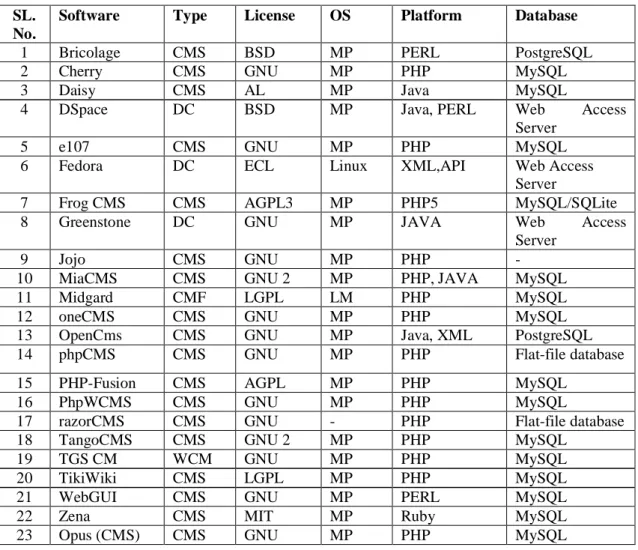
SL. No.
Software Type License OS Platform Database
1 Bricolage CMS BSD MP PERL PostgreSQL
2 Cherry CMS GNU MP PHP MySQL
3 Daisy CMS AL MP Java MySQL
4 DSpace DC BSD MP Java, PERL Web Access
Server
5 e107 CMS GNU MP PHP MySQL
6 Fedora DC ECL Linux XML,API Web Access Server
7 Frog CMS CMS AGPL3 MP PHP5 MySQL/SQLite
8 Greenstone DC GNU MP JAVA Web Access
Server
9 Jojo CMS GNU MP PHP -
10 MiaCMS CMS GNU 2 MP PHP, JAVA MySQL
11 Midgard CMF LGPL LM PHP MySQL
12 oneCMS CMS GNU MP PHP MySQL
13 OpenCms CMS GNU MP Java, XML PostgreSQL 14 phpCMS CMS GNU MP PHP Flat-file database
15 PHP-Fusion CMS AGPL MP PHP MySQL
16 PhpWCMS CMS GNU MP PHP MySQL
17 razorCMS CMS GNU - PHP Flat-file database
18 TangoCMS CMS GNU 2 MP PHP MySQL
19 TGS CM WCM GNU MP PHP MySQL
20 TikiWiki CMS LGPL MP PHP MySQL
21 WebGUI CMS GNU MP PERL MySQL
22 Zena CMS MIT MP Ruby MySQL
23 Opus (CMS) CMS GNU MP PHP MySQL
company to easily modify its site at any time through a simple web interface.
Content management tools allow companies to take control of their Web pages by managing the content as distinct from the design. The days of writing HTML for large Web sites may be numbered as content management tools take the floor.
Many organisations build the content management tools to meet the specific needs, but in the last few years, several organisations have come out with some good content management software.
231
-Open Source Software for Content Management System 7 International CALIBER 2009
SL. No.
Software Type License OS Platform Database
1 aqua CMS CMS GNU MP PHP MySQL
2 Cambio CMS GNU MP PHP MySQL
3 CMSimple CMS AGPL MP PHP Flat-file database
4 Quick.Cms CMS CCA 2.5 MP PHP Flat-file database
5 Radiant CMS MIT MP Ruby MySQL/Postgre
SQL
6 Scoop CMS GNU MP PERL MySQL
7 SPIP CMS GNU - PHP MySQL
8 whCMS CMS GNU MP PHP MySQL
9 Xaraya CMS GNU MP PHP/ XML MySQL
10 XOOPS CMS GNU MP PHP MySQL
11 Zikula WCM BSD PHP/Smarty PostgreSQL/My
SQL
Table -2: Free CMS software
SL. No.
Software Type License OS Platform Database
1 Alfresco ECM GPL MP Java, JSP PostgreSQL 2 Apache Lenya CMS AL J2P Java, XML -
3 CiviCRM CMS - MP PHP MySQL
4 Cyclone3 CMS GNU MP PERL MySQL
5 dotCMS CMS GNU MP Java PostgreSQL
6 Drupal CMS GNU MP PHP MySQL
7 eZ Publish CMS GNU MP PHP MySQL
8 ImpressCMS CMS GNU MP PHP MySQL
9 Joomla CMS GNU MP PHP MySQL
10 Mambo CMS GNU MP PHP MySQL
11 MODx CMS GNU MP PHP MySQL
12 Nuxeo ECM LGPL MP Java EE PostgreSQL
13 Nuxeo CPS CMS GNU MP Python ZODB
14 Plone CMS GNU MP Python MySQL/Postgre
SQL
15 PyLucid CMS GNU 3 MP Python MySQL/Postgre SQL
16 SilverStripe CMS BSD MP PHP MySQL
17 TYPO3 CMS GNU MP PHP MySQL
232
-Open Source Software for Content Management System 7 International CALIBER 2009
CMF: Content Management Framework EMS: Enterprise content management AGPL: Affero General Public License LGPL: GNU Lesser General Public License GNU: GPL General Public License
CPL: Common Public Attribution License MP: Multi-Platform
AL: Apache License 2.0 J2P: Java 2 Platform
BSD: Berkeley Software Distribution CCA: Creative Commons Attribution 2.5 ZODE: The Zope Object Database LM: Linux/Macintosh
DC: Digital Content
API: Application Programming Interfaces ECL: Educational Community License
8. Open Source Content Management
Software
8.1. http://bricolage.cc/
Bricolage, an open-source enterprise-class content management system, greatly simplifies the complex tasks of creating, managing, and publishing the vast libraries of content essential to any organization.
8.2 http://www.cherry-cms.de
Cherry is a CMS which can use for each website. This means, you can use Cherry for customer management, for your webradio or a download database. Cambio uses PHP as its scripting engine and MySQL as its database engine. For some features of Cherry you need Imagick.
3 http://www.daisycms.org
Daisy is a Java/XML open-source based on the Apache Cocoon content management framework. Today, Daisy is in use at major corporations for intranet knowledge bases, product and/or project documentation, and management of content-rich websites.
8.4 http://www.dspace.org
It is a gr oun dbr eakin g digital in stitutional repository that captures, stores, indexes, preserves, and redistributes the intellectual output of a university’s research faculty in digital formats. It manages and distributes digital items, made up of digital files and allows for the creation, indexing, and searching of associated metadata to locate and retrieve the items.
8.5 http://e107.org
e107 is an open source CMS that allows for the quick creation and management of websites or community portals. Built using PHP and database support via MySQL, it can be used for websites or for local intranet pages, it currently has support for sever al lan guages available as addition al downloads.
8.6 http://www.fedora.info/
Fedora is an acronym for Flexible Extensible Digital Object Repository Architecture. Fedora’s flexibility makes it capable of serving as a digital repository for a variety of use cases. Among these are digital asset management, institutional repositories, digital archives, content management systems, scholarly publishing enterprises, and digital libraries.
233
-Open Source Software for Content Management System 7 International CALIBER 2009
8.7 http://www.madebyfrog.com/
Frog CMS is an open source CMS originally developed by Philippe Archambault. The design decision taken from its start was to use PHP5 as the language for the software, along with a MySQL database backend, although it also has support for SQLite (version 3). It is a port of the Ruby on Rails CMS known as Radiant, although Frog has begun to take its own development direction.
8.8 http://www.greenstone.org/
english/home.html
It provides a new way of organizing information and publishing it on the Internet or on CD-ROM. It is open source, multilingual software, issued under the terms of the GNU. The system operates under UNIX, Windows, and Mac OS/X, and works with standard Web servers. The Unicode character set is used throughout, so documents - and interfaces - can be in any language.
8.9. http://www.jojocms.org
Jojo CMS is a open source CMS for building websites, distributed under the LGPL license. Jojo CMS provides a framework for developers to build websites, and an administration interface for editing page content. Jojo CMS can be extended using plugins and themes, and a number of these are supplied by the developers. Jojo can operate in a Multisite environment, allowing many websites to be run off a single codebase.
8.10 http://miacms.org
MiaCMS is a powerful, flexible, and easy to use open source CMS. It can be used to build websites of all shapes, sizes, and scenarios. MiaCMS features simple installation, graphical (WYSIWYG) HTML editors, RSS content syndication, a powerful 3rd
3.par ty exten sion system, flexible th emin g capabilities, site search, RESTful content access, user management, multilingual capabilities, plus much more.
8.11 http://www.midgard-project.org/
Midgard is an Open Source persistent storage framework. It provides an object-oriented and replicated environment for building data-intensive applications. Midgard also ships with MidCOM CMS built on the Midgard framework. MidCOM’s features include web-based authoring WYSIWYG interfaces and a component interface for installing additional web functionalities.
8.12 http://www.insanevisions.com
/onecms/
OneCMS is an open source CMS written in PHP, using a MySQL database. It can be used by webmasters to manage their website, allowing the user to upload files, add content and various other features. OneCMS, because of the way it was made, is most commonly used by gaming websites.
8.13. http://www.opencms .org/
OpenCms is an open source CMS written in Java. It is distributed by Alkacon Software under the LGPL license. OpenCms requires a JSP Servlet container such as Apache Tomcat. It is a CMS application with a br owser-based wor k environment, asset management, user management, workflow management, a WYSIWYG editor, internationalization support, content versioning, and more features.
8. 14. http://phpcms.de/index
234
-Open Source Software for Content Management System 7 International CALIBER 2009
phpCMS is an open source CMS written using PHP. Its creators describe phpCMS as a highly flexible flat file, no SQL, Web CMS with complete content/ logic separation. Like many content management systems, phpCMS intends to simplify a lot of tasks for the maintenance of complex web sites.
8. 15. http://php-fusion.co.uk/
news.php
PHP-Fusion is a light-weight open-source CMS written and developed by Nick Jones (also known as Digitanium) in PHP. It uses a MySQL database to store a web site’s content and comes with a simple but comprehensive administration system. PHP-Fusion includes features common in many other CMS packages.
8. 16. http://www.phpwcms.de
phpWCMS is an open source WCMS. It works on any web server platform that supports PHP with MySQL, havin g been successfully tested on Windows XP and 2000, Mac OS X, and Linux.
8. 17. http://razorcms.co.uk/
razorCMS is an open source CMS written in PHP, using a flat file database structure instead of having a separate database. It has been released under the GNU General Public License.
8. 18. http://www.tgs-cms.org/
TGS Content Management is an Open Source WCMS. It is a tool that allows users to easily create smaller and medium scale websites, intranet-portals and business portals on the internet. It was released under the terms of GNU General Public License (GPL) v3. Everybody can use it for free and develop extensions as desired. TGS is a combination of PHP and JavaScript.
8. 19 http://www.tikiwiki.org
TikiWiki CMS/Groupware, originally and more commonly known as TikiWiki, is an open source (LGPL) CMS / Geospatial Content Management System (GeoCMS) / Groupware web application enabling websites and portals on the internet and on intranets and extranets.
8. 20. http://www.webgui.org/
WebGUI is an open source CMS written in Perl and released under the GNU General Public License. The system permits non-technically minded users to arrange content in pages and layouts, containing ‘Assets’ (applets) which permit website visitors to view and interact with various types of data from basic Articles to full-blown CMS and custom applications.
8. 21. http://zenadmin.org
Zena is a CMS written in the Ruby programming language and built upon the Ruby on Rails web framework. Zena runs on the Apache web server as frontend to Mongrel web server on the Linux, BSD, Mac OS X and Solaris platforms. It uses MySQL as it’s primary database management system. Any other databases supported by Ruby on rails should also work but are not tested yet.
9. Free Content Management Software
9. 1 http://www.aquacms.net/
qua CMS is a CMS aimed at corporate companies and magazine publishers with advanced editing options. It allows users to edit pages in real time with what you see is what you get previews. It
235
-Open Source Software for Content Management System 7 International CALIBER 2009
includes a full e-commerce system and mail out tool.
9. 2 http://www.cambiocms.org
Cambio is the successor of whCMS and is a CMS which relies on in-page editing. This means, no separate administration section is present to edit site content. Simple content modules, such as headers, text or file downloads are added, sorted and edited directly in the website pages.
9.3 http://www.cmsimple.dk
It aims to be simple, small and fast. As it is written in PHP it runs on Linux/Apache servers or on Win32 with Apache or IIS. It does not need a database as it writes page data directly to a HTML file on the web server.
9.4 http://opensolution.org/quick.
cms,pl,10.html
Quick.Cms is a free CMS based on a Creative Commons Attribution 2.5 licence. It is written in PHP, so it runs on most internet servers. It does not require using SQL-type database as it writes all data to secure text files (plain text). It makes this tool easy to install.
9. 5 http://www.radiantcms.org
Radiant is a free-software CMS written in Ruby by John W. Long as a Ruby on Rails web application. Radiant is limited to basic functionality for a CMS. The intended users are small groups or teams and thus the software leaves much room for extensions. All the content is stored inside a database. It’s possible to use MySQL, PostgreSQL or SQLite. Radian t depends, like ever y Ruby on Rails
application, on the installed adapters for the database.
9. 6. http://scoop.kuro5hin.org/
Scoop is a CMS originally developed by Rusty Foster. Scoop’s focus is on collaborative publishing, and its feature set is geared toward encouraging user contributions and participation. Scoop is written in Perl and runs via mod_perl on Apache web servers with a MySQL database backend. Distributed under the GNU General Public License, Scoop is free software.
9. 7. http://www.spip.net
SPIP is a fr ee CMS designed for Web site publishing, oriented towards online collaborative editing. This known for its easy setup, use and maintenance, is widely used by networks of people, in public or private institutions.
9. 8. http://whcms.burolaga.nl/
whCMS is a CMS which relies on in-page editing. No separate administration section is present to edit site content. Simple content modules, such as headers, text or file downloads are added, sorted and edited directly in the website pages.
9. 9 http://www.xaraya.com
Xaraya is written in the programming language PHP. Xaraya shares basic ideas with PostNuke in the area of modularity and security, but it has been completely rewritten with a focus on separation between design and content in order to achieve a more modular and flexible product.
236
-Open Source Software for Content Management System 7 International CALIBER 2009
XOOPS is a free CMS, written in PHP, for websites. It uses a modular architecture allowing users to customize, update and theme their websites. XOOPS is released under the terms of the General Public License and is free to use, modify and redistribute.
9. 10 http://zikula.org/
Zikula is software that creates an impressive, dynamic web site and provides you with a site you can administer with a minimal amount of HTML knowledge through a web browser. One can also change how thier entire site looks by changing themes.
10. Free/OSS Content Management Software:
10.1 http://www.alfresco.com/
Alfresco is a open standards, enterprise scale CMS for Microsoft Windows and Unix-like operating systems. Its design is geared towards users who require a high degree of modularity and scalable performance.
10.2. http://lenya.apache.org
Apache Lenya is a Java/XML open-source CMS based on the Apache Cocoon content management framework. Features include revision control, scheduling, search capabilities, workflow support, and browser-based WYSIWYG editors. It was originally started by Michael Wechner in early 1999 to manage the content of the journal of pattern formation.
10. 3 http://civicrm.org/
CiviCRM is an open sour ce an d fr eely downloadable constituent relationship management solution. CiviCRM is web-based, open source,
internationalized, and designed specifically to meet th e needs of advocacy, profit an d non-governmental groups. Integration with both Drupal and Joomla! CMS gives you the tools to connect, communicate and activate your supporters and constituents.
10.4 http://www.cyclone3.org
Cyclone3 is the first open source CMS using Mozilla Application Framework and has XUL administration
frontend. It is licensed under the GNU General Public License. Cyclone3 XULadmin is a user-interface for Cyclone3 framework. With the help of XULadmin, normal people, editors etc. can easy manage the content of a website.
10.5 http://www.dotcms.org/
dotCMS is a WCMS for building/man aging websites, con ten t an d con ten t dr iven web applications. dotCMS includes enterprise CMS features such as support for virtual hosting, WebDav ,structured content, clustering and can run on multiple databases PostgreSQL, MySQL, MSSQL and Oracle, and is available as software that can be installed on a web server or via a hosting provider.
10. 6 http://drupal.org/node/9068
Dr upal is a fr ee an d open source modular framework and CMS written in the programming language PHP. It is used as a “back end” system for many different types of Web sites, ranging from small personal blogs to large corporate and political sites.
10.7 . http://ez.no/
237
-Open Source Software for Content Management System 7 International CALIBER 2009
developed by the Norwegian company eZ Systems. eZ Publish is freely available under the GPL licence, as well as under proprietary licenses that include commercial support. It supports the development of customized web applications.
10.8 http://www.impresscms.org/
ImpressCMS is a free, open source, community-developed CMS for building and maintaining dynamic web sites, written in the PHP programming language and using a MySQL database.
10. 9 http://www.joomla.org/
Joomla is a free open source CMS for publishing content on the World Wide Web and intranets. The system includes features such as page caching to improve performance, RSS feeds, printable versions of pages, news flashes, blogs, polls, website searching, and language internationalization.
10. 10 http://mambo-foundation.org/
Mambo (formerly named Mambo Open Source or MOS) is a free software / open source CMS for creating and managing websites through a simple web interface. It has attracted many users due to its ease of use. Mambo also includes more advanced featur es such as page cach in g to impr ove performance on busy sites, advanced templating techniques, and a fairly robust API.
10. 11 http://www.modxcms.com/
MODx is a free, open source CMS and application framework for publishing content on the WWW and intranets. MODx is licensed under the GPL. MODx is written with the PHP programming language and uses the MySQL database.
10. 12 http://www.nuxeo.org/
Nuxeo is a comprehensive free software / open source ECM platform. It has been designed to be robust, scalable and highly extensible, by using modern open source Java EE technologies, such as: the JCR, JSF, EJB3, JBoss Seam, OSGi, and a Service Oriented Approach. It can be used to develop both web-based server applications and Rich Client applications.
10. 13 http://www.cps-project.org/
Nuxeo Collaborative Portal Server (CPS) is a free and open-source CMS written in the Python programming language. It can be used as an intranet and extr anet server, as a document publishing system, and as a groupware tool for collaboration between separately located entities. Featur es in clude ver sion con tr ol, internationalization, workflows, and an easy-to-use Web administration interface.
10. 14 http://plone.org/
Plone is a free and open source CMS built on top of the Zope application server. It is suited for an internal website or may be used as a server on the Inter n et, playin g such r oles as a documen t publishing system and groupware collaboration tool.
10. 15 http://www.pylucid.org
PyLucid is a free CMS. It is written in Python using the Django Web framework. The first version of PyLucid released 2005. PyLucid has a web based installer, so the user needs no shell account. It’s works on a standard webserver with Python (at least v2.4) CGI and one of the supported database
238
-Open Source Software for Content Management System 7 International CALIBER 2009
engines (MySQL, SQLite3, Postgre, Oracle and MS-SQL). It is highly customizable via the powerful django template engine and CSS. It support a Plugin API and has some interesting build in Plugins (a file manager, RSS etc.)
10. 16. http://silverstripe.com
SilverStripe is a free and open source programming framework and CMS for creating and maintaining websites. The CMS provides an intuitive web-based administration panel, allowing any person to maintain their website without knowledge of markup or programming languages. SilverStripe offers a flexible MVC development framework known as Sapphire.
10. 17 http://razorcms.co.uk/
TangoCMS is a modular PHP CMS released free of charge under the GNU/GPL 2 license, and is part of the TangoCMS Project. One of the top priorities for the project is to stick to standards and best coding practices, such as making sure all mark-up complies to th e World Wide Web Consor tium HTML standards, using semantically correct mark-up
10. 18 http://www.typo3.com
TYPO3 is a free and open source CMS written in PHP. TYPO3 offers full flexibility and extendability while featuring an accomplished set of ready-made interfaces, functions and modules. More than 3300 extensions are available for download under the GNU General Public License from a repository called the TYPO3 Extension Repository, or TER.
11. Conclusion
Content management has many facets including enterprise content management, WCM, content
syndication and digital or media asset management. ECM is a vision, a strategy, or even a new industry, but it is not a closed system solution or a distinct product.
A CCM system is concerned with the content within documents. It can locate and link content at any level of organization, and it is used to build publications out of re-usable fragments of content. Whereas ECM and WCM systems frequently manage unstructured content (word processor and other desktop publishing files, rendered PDF and HTML, etc.), a CCM system manages structured content (usually XML), from which such documents are rendered and typically delivered to ECM and WCM systems.
A brief summary of content management tools distributed under open software licenses shows the existence of a large number of these offering a variety of capabilities and orientations. It also summarizes, their technical architecture based on the triad made up of web server, programming language interpreter and database manager.
References
1. Jesús Tramullas (2005) Open source tools for content management. Available at http:// www.h iper text.n et/en glish /pag1013.h tm (Accessed on 2/1/2009).
2. Whatis.com. Content Management System. Available at http://searchsoa.techtarget.com/ sDefin ition/0,,sid26_gci508916,00.html (Accessed on 5/1/2009).
3. AIIM. What is ECM?. Available at http:// www.aiim.org/What-is-ECM-Enter pr ise-Content-Management.aspx (Accessed on 6/1/ 2009).
239
-Open Source Software for Content Management System 7 International CALIBER 2009
4. Webopedia. Web con ten t man agemen t.
Available at http://www.webopedia.com/ TERM/W/Web_content_management.html (Accessed on 5/1/2009).
5. Wikipedia. Content management system.
Available ath ttp://en.wikipedia.org/wiki/ Content_managemen t_system (Accessed on 2/1/2009).
6. Wikipedia. Web content management system. Available at http://en.wikipedia.org/wiki/ Web_content_mana g e m e n t _ s y s t e m (Accessed on 9/1/2009).
7. Enterprise Content Management. Content man agemen t. Available at h ttp:// www.contentmana ger.eu.com/ (Accessed on 12/1/2009).
8. EzineArticles.com. En terprise Conten t Management Systems. Available at http:// ezi n ear t icles. com/?En ter pr ise- Con ten t-Management-Systems&id = 3 9 2 5 0 5 (Accessed on 10/1/2009).
9. Best Open Source Content Management Systems: Choose among the most popular CMS softwar e. Available at h ttp:// www.siteground.com/best_cms_
tools.htm (Accessed on 14/1/2009).
10. Content Management Tools. Available at http://web d e s i g n . a b o u t . c o m / o d / con t en t m a n a g em en t / a / a a 0 3 1 3 0 0 c. h t m (Accessed on 12/1/2009).
11. OneSmartClick.Com. Content Management
Softwar e Tool Web. Available at http:// w w w. o n e s m a r t c l i c k . c o m / c o n t e n t - management/content-management-software-tool-web.html (Accessed on 15/1/2009).
About Authors
Mr. Umesha Naik, Lecturer in the Department Library and Information Science, Mangalore University, Mangalore.
E-mail: [email protected]
Dr. D. Shivalingaiah is, Professor, Department of studies in LIS, Mangalore University, Mangalore. E-mail: [email protected]