CHAPTER FOURTEEN
ENABLING OPEN ACCESS TO PUBLIC SECTOR
INFORMATION WITH CREATIVE COMMONS LICENCES –
THE AUSTRALIAN EXPERIENCE
1Anne Fitzgerald, Neale Hooper and Brian Fitzgerald
Governments are coming to realize that they are one of the primary stewards of intellectual property, and that the wide dissemination of their work—statistics, research, reports, legislation, judicial decisions—can stimulate economic innovation, scientific progress, education, and cultural development.
David Bollier, “Viral Spiral: How the Commoners Built a Digital Republic of Their Own”, 2008, at p192 The management of informational works is one of the most significant issues for government in the current era.2 During the last decade much attention has focused on policies and practices to enable public sector information (PSI)3 to be more readily accessed and used,4 as governments have come to appreciate that significant social, cultural and economic benefits stand to be gained from doing so.5As Senator Kate Lundy
1We would like to thank the various individuals in Australia and overseas with whom we have consulted about open content licensing initiatives, in particular, Siu Ming Tam (Australian Bureau of Statistics), Jeff Kingwell (Geoscience Australia), Geoff Renton (Crown Law, Queensland Government), Keitha Booth (State Services Commission, New Zealand), Richard Best (NZ), Carol Tullo (OPSI and National Archives, UK), Jim Wretham (OPSI and National Archives, UK), Graham Vickery (OECD), Francis Gurry (WIPO) and Paul Uhlir (National Academies of Science, US). We are particularly appreciative of the efforts of Chris Corbin (UK) and Peter Suber (US) in tracking open access developments through the ePSI Platform and Open Access News websites, respectively. Thanks also to our research assistant, Cheryl Foong, who prepared the bibliographic materials for this chapter, and to Jessica Coates and Elliott Bledsoe of Creative Commons Australia for keeping us updated on the adoption of Creative Commons licences in the public sector.
2 See Brian Fitzgerald, Copyright 2010: The Future of Copyright, [2008] European Intellectual Property Review 43, http://eprints.qut.edu.au/archive/00013305/; Brian Fitzgerald and Ben Atkinson, Copyright as an Instrument of Information Flow and Dissemination: the case of IceTV Pty Ltd v Nine Network Australia Pty Ltd, http://eprints.qut.edu.au/view/person/Atkinson,_Benedict.html; Elliott Bledsoe, Jessica Coates and Brian Fitzgerald, Unlocking the Potential Through Creative Commons: and industry engagement and action agenda, (2007) ARC Centre of Creative Industries and Innovation http://creativecommons.org.au/unlockingthepotential.
3The term “public sector information” (PSI) is used here in a broad sense to include information and data produced by the public sector, including materials produced by government employees, materials commissioned by government from non-government parties, materials provided to non-government by non-non-government parties pursuant to a legislative obligation and materials that result from publicly-funded cultural, educational and scientific activities. It can include policy documents and reports of government departments, public registers, legislation and regulations, meteorological information, scientific research databases, statistical compilations and datasets, maps and geospatial information and numerous other data and information products produced by government for public purposes. Increasingly the term public sector information is being used globally to describe what was formerly often referred to as government information. See the European Directive on Access to and Reuse of Public Sector Information, http://ec.europa.eu/information_society/policy/psi/rules/eu/index_en.htm. See also the OECD’s
Seoul Declaration on the Future of the Internet Economy (2008) and the OECD Council’s Recommendation for Enhanced Access and More Effective Use of Public Sector Information (2008), available at http://www.oecd.org/dataoecd/0/27/40826024.pdf. The Seoul Declaration, in paragraph (b), refers to “public sector information and content” as including scientific data and works of cultural heritage.
4See Chapter 4 in this book, Open Access and Public Sector Information: Policy Development in Australia and Key Jurisdictions.
5 See: Venturous Australia - Building Strength in Innovation, report on the Review of the National Innovation System, Cutler & Company for the Australian Government Department of Innovation, Industry, Science and Research, 29 August 2008, available at http://www.innovation.gov.au/innovationreview/Pages/home.aspx; Powering Ideas: An Innovation Agenda for the 21st Century,
Department of Innovation, Industry, Science and Research, 12 May 2009, available at
http://www.innovation.gov.au/innovationreview/Documents/PoweringIdeas_fullreport.pdf; Australia’s Digital Economy: Future Directions, Department of Broadband, Communications and the Digital Economy, July 2009, available at
http://www.dbcde.gov.au/?a=117295; Information Policy and E-Governance in the Australian Government: Report: A report for the Department of Prime Minister and Cabinet, Ian Reinecke, March 2009 (updated to 31 July 2009), available at
http://www.dpmc.gov.au/publications/information_policy/index.cfm; National Government Information Sharing Strategy: Unlocking Government information assets to benefit the broader community, Australian Government Information Management Office (AGIMO), Department of Finance and Deregulation, at p 7, August 2009, available at http://www.finance.gov.au/publications/national-government-information-sharing-strategy/docs/ngiss.pdf.
observed at the 2009 Free and Open Source Software for Geospatial Conference, “open access to government data can dramatically increase the value created from the data both socially and economically [and] the society as a whole benefits from access to the data.”6
This chapter considers how open content licences - specifically, Creative Commons (CC) licences7 - can be used by governments as a simple and effective mechanism to support the reuse of their copyright-protected PSI, particularly where materials are made available in digital form online or distributed on disk. In Australia, as in other countries worldwide, there is a growing awareness at the governmental level of the advantages of using open content licences when distributing their copyright materials.8
In building frameworks to improve the flow of PSI, it is necessary to ensure not only the interoperability of technical systems and document formats but also that legal interests in PSI are understood and effectively managed.9The importance of identifying and managing the range of legal interests relevant to PSI, to ensure that they operate to support - not hinder - efforts to improve access and reuse is central to the Organisation for Economic Cooperation and Development (OECD) Recommendation for Enhanced Access and More Effective Use of Public Sector Information (“the OECD PSI Recommendation”).10 In establishing a primary principle of openness in order to maximise the availability of PSI for use and reuse, the OECD PSI Recommendation requires that any legal grounds that restrict the default presumption of openness should be clearly defined and justified.11Among the most commonly identified legal considerations displacing the presumption of openness are national security interests and obligations to maintain the privacy of personal information and to comply with undertakings regarding the confidentiality of information disclosed to a government agency during, for example, a tendering process. The OECD PSI Recommendation advocates making PSI available for access and reuse under transparent, broad, non-discriminatory and competitive conditions.12 Where possible, PSI
6Senator Kate Lundy, Geospatial: the lifeblood of data, address to the Free and Open Source Software for Geospatial Conference (FOSS4G), Darling Harbour, Sydney, 22 October 2009, available at http://www.katelundy.com.au/2009/10/22/geospatial-the-lifeblood=of=data/.
7Creative Commons licences are standardized, copyright licences which grant permission to use copyright works, in accordance with the terms of the particular set of template clauses applied by the licensor (who may be the copyright owner or another person who has the authority to license the use of the material). See generally www.creativecommons.org.au.
8In August 2009, the New Zealand Government released the Draft New Zealand Government Open Access and Licensing Framework (NZGOAL), available at http://www.e.govt.nz/policy/information-data/nzgoalframework.html(accessed 25 January 2010). NZGOAL proposes that government agencies provide open access to copyright works, applying “the most liberal of the New Zealand Creative Commons law licences to those of their copyright works that are appropriate for release, unless there is a restriction which would prevent this. This most liberal Creative Commons licence is the Attribution (BY) licence.” See also Keitha Booth, State Services Commission, Draft NZ Government Open Access and Licensing Framework (NZGOAL), Linux Miniconf, Wellington, 19 January 2010 at http://www.aupsi.org/news/LINUX2010.jsp(accessed 25 January 2010). In the December 2009 report, Putting the Frontline First: Smarter Government, (available at http://www.hmg.gov.uk/frontlinefirst.aspx) the UK Government indicated its intention to “establish a common licence to re-use data which is interoperable with the internationally recognised Creative Commons model”. Upon the launch of the data.gov.uk website on 22 January 2010, the UK Government announced that the datasets would be made available under new, straightforward, machine readable licensing terms and conditions that are interoperable with Creative Commons licences and permit both commercial and non-commercial reuse of the data. The new simple terms and conditions replace the existing Click-Use Licence and are the “first major step towards the adoption of a non-transactional, Creative Commons style approach to licensing the re-use of government information”. The National Archives is working with Creative Commons teams in the UK, the US, Australia and NZ to assess whether revised versions of the UK CC licences (due for release in May 2010) are suitable for licensing of UK government data and databases. See Perspectives blog (OPSI), 21 January 2010 at
http://perspectives.opsi.gov.uk/2010/01/licensing-and-datagovuk-launch.html(accessed 25 January 2010). Further information
on use of CC licences by governments worldwide is available at
http://wiki.creativecommons.org/Government_use_of_CC_licenses(accessed 25 January 2010).
9See A Fitzgerald and K Pappalardo, Building the Infrastructure for Data Access and Reuse in Collaborative Research: An Analysis of the
Legal Context, OAK Law Project and Legal Framework for e-Research Project (June 2007)
http://eprints.qut.edu.au/archive/00008865/01/8865.pdf; and A Fitzgerald, K Pappalardo and A Austin, Practical Data Management: A Legal and Policy Guide, OAK Law Project and Legal Framework for e-Research Project (September 2008), available at http://eprints.qut.edu.au/14923/1/Microsoft_Word_-_Practical_Data_Management_-_A_Legal_and_Policy_Guide_doc.pdf
10OECD, Recommendation of the Council for Enhanced Access and More Effective Use of Public Sector Information, C(2008)36, OECD, Paris, 2008, available athttp://www.oecd.org/dataoecd/0/27/40826024.pdf.
11OECD PSI Recommendation, the “Openness” principle states: “Maximising the availability of public sector information for use and re-use based upon presumption of openness as the default rule to facilitate access and re-use. Developing a regime of access principles or assuming openness in public sector information as a default rule wherever possible no matter what the model of funding is for the development and maintenance of the information. Defining grounds of refusal or limitations, such as for protection of national security interests, personal privacy, preservation of private interests for example where protected by copyright, or the application of national access legislation and rules.”
12OECD PSI Recommendation, the “Access and transparent conditions for re-use” principle states: “Encouraging broad non-discriminatory competitive access and conditions for re-use of public sector information, eliminating exclusive arrangements, and
should be made available online and in electronic form, and unnecessary restrictions on access, use, reuse, combination and sharing should be removed, so that, in principle, all accessible information is open for all to reuse, for any purpose. As most governments worldwide claim copyright in at least some of their PSI (the most notable exception being the United States federal government), in order to give effect to an open access policy, it will be necessary to ensure that the government’s copyright is not relied upon to justify (or excuse) restrictions on access, reuse and sharing. While copyright protection does not extend to mere information or facts, many of the informational works created or held by government will fall within the groups of material to which copyright applies (literary, artistic, sound and video recordings) and will be sufficiently original to attract protection. The OECD PSI Recommendation acknowledges that intellectual property rights in PSI should be respected, and recommends that governments exercise their copyright in ways that facilitate reuse, by developing simple mechanisms to encourage wider access and reuse, such as simple and effective automated online licensing systems.13
CC licences offer the kind of “simple and effective licensing arrangement” envisaged by the OECD PSI Recommendation, providing non-discriminatory access and conditions of reuse for copyright-protected PSI. This Chapter gives an overview of the key features of the CC licences developed for use in Australia and considers their advantages for governments when distributing their copyright PSI. The experience of Australian governments in assessing the potential of CC licences and applying them in practice is described, beginning in 2005 with the collaborative project between Queensland University of Technology (QUT) and the Queensland Government (which became known as the Government Information Licensing Framework (GILF) project),14 through to the widespread adoption of CC licences by Australian federal, State and local government agencies. An account is given of several of the most significant projects in which CC licensing has been applied and the conclusions and recommendations of various government reviews that have considered and supported the use of CC licences on public sector materials.
THE COMPLEX FLOWS OF PUBLIC SECTOR INFORMATION
Improving the flow of PSI requires a detailed understanding of the kinds of materials produced, how they have been created, and by whom. As these factors all bear upon the existence, ownership and exercise of copyright, they need to be taken into account in any strategy for licensing PSI materials designed to enable PSI to move without impediment among government agencies and between government and the private sector.15
Governments at all levels develop, manage and distribute an array of PSI in the form of documents, reports, websites, datasets and databases on CD or DVD and files that can be downloaded from a website. PSI materials come into existence by various means. A large amount of PSI material is created within government, through the efforts of government employees and other persons who are not employed by government but produce copyright materials while working as volunteers (for example, interns, students on work experience placements and members of emergency services teams). However, a significant part of the materials held by government is produced externally, by recipients of government funding (such as research institutes) and parties who are required to provide certain documents and reports to government. Governments commonly
removing unnecessary restrictions on the ways in which it can be accessed, used, re-used, combined or shared, so that in principle all accessible information would be open to re-use by all. Improving access to information over the Internet and in electronic form. Making available and developing automated on-line licensing systems covering re-use in those cases where licensing is applied, taking into account the copyright principle below.”
13OECD PSI Recommendation, the “Copyright” principle states: “Intellectual property rights should be respected. There is a wide range of ways to deal with copyrights on public sector information, ranging from governments or private entities holding copyrights, to public sector information being copyright-free. Exercising copyright in ways that facilitate re-use (including waiving copyright and creating mechanisms that facilitate waiving of copyright where copyright owners are willing and able to do so, and developing mechanisms to deal with orphan works), and where copyright holders are in agreement, developing simple mechanisms to encourage wider access and use (including simple and effective licensing arrangements), and encouraging institutions and government agencies that fund works from outside sources to find ways to make these works widely accessible to the public.”
14All the authors of this chapter have been involved with the Government Information Licensing Framework (GILF) project since its inception in 2005. See generally http://www.gilf.gov.au. For the background to the GILF project, see Queensland Spatial Information Office, Office of Economic and Statistical Research, Queensland Treasury, Government Information and Open Content Licensing: An Access and Use Strategy, Government Information Licensing Framework Project Stage 2 Report, October 2006,
available at
http://www.qsic.qld.gov.au/QSIC/QSIC.nsf/0/F82522D9F23F6F1C4A2572EA007D57A6/$FILE/Stage%202%20Final%20Re port%20-%20PDF%20Format.pdf?openelement.
15See generally, B Atkinson and B Fitzgerald (2008) Copyright as an Instrument of Information Flow and Dissemination: the case of ICE
commission independent contractors to produce materials and enter into arrangements to fund work in universities and research institutes that results in output in the form of reports, academic publications and data. An important category of PSI is materials prepared by non-government parties which are lodged with government pursuant to a statutory or regulatory direction to provide information or a report (for example, environmental impact assessments and information about water use, greenhouse gas emissions and results of mineral or petroleum exploration activities).
Systems to facilitate PSI access and reuse must be designed so that government-produced materials can flow both to other government agencies as well as to non-government users. Materials provided to government by private sector parties need to be usable not only by the particular agency that receives them but also by other government bodies. However, the flow of PSI does not only involve government-generated materials flowing to other government agencies and the private sector. Government often needs to be able to on-distribute materials generated by a private sector party to others in the private sector. Any model for licensing of copyright PSI materials must be based on an understanding of how PSI is produced and how it flows, both within government and between government and the private sector.
As awareness has grown of the importance of enabling access to PSI, so have the barriers to achieving this objective become more readily apparent. The importance of clear policy frameworks and practices is increasingly well understood and is dealt with at length in Chapter 4. However, as well as developing a policy framework, it is necessary to address the impediments presented by cultural factors and inadequate information management practices. The complexities of PSI creation and use mean that unless the conditions of use are stated in clear and easily understood terms, licensing is likely to prove to be an impediment to information flows.16 To enable PSI to effectively flow to those who want to use it, the adoption of simple, clear and standardised licences and the transparency of the conditions on which the PSI can be accessed and reused is of crucial importance.17
CREATING A COMMMONS OF PUBLIC SECTOR MATERIALS
From a copyright law perspective, the concept of “public domain” traditionally connoted materials that were not subject to copyright protection, whether because copyright had expired or because they did not qualify for copyright in the first place (such as mere facts or information and, in the United States, works produced by the federal government).18 As David Bollier explains:
For decades, the public domain was regarded as something of a wasteland, a place where old books, faded posters, loopy music from the early twentieth century, and boring government reports go to die. It was a dump on the outskirts of respectable culture.19
During the last decade there has been a rethinking of what the public domain is20and how it functions,21such that it is now accepted that it has an intrinsic economic and cultural value,22 and that its openness can be structured and reinforced by law (including copyright and contract).23 With the changing role of knowledge in
16See M Heller, The Gridlock Economy – How Too Much Ownership Wrecks Markets, Stops Innovation and Costs Lives, Basic Books, New York, 2008.
17See KPMG Consulting, Executive Summary: Geospatial Data Policy Study – Project Report, 2001, Recommendation 5 at pp 24-25, available at http://www.geoconnections.org/publications/policyDocs/keyDocs/KPMG/KPMG_E.pdf.
18B Fitzgerald, A Fitzgerald et al, Internet and E-Commerce Law: Technology, Law, and Policy, Lawbook Co/Thomson, Sydney, 2007 at p 265.
19David Bollier, Viral Spiral: How the Commoners Built a Digital Republic of Their Own, The New Press, New York, 2008 at p 42, available at http://www.viralspiral.cc/download-book(accessed 10 December 2009).
20See D Lange, Recognising the Public Domain (1981) 44 Law and Contemporary Problems 147; T Ochoa, Origins and Meanings of the
Public Domain (2002) 28 University of Dayton L Rev 215 at p 237; E Lee, The Public’s Domain: the evolution of legal restraints on the government’s power to control public access through secrecy or intellectual property (2003) 55 Hastings L J 91 at pp 102-105.
21 See J Litman, The Public Domain (1990) 39 Emory L J 965; see also Elinor Ostrom, Governing the Commons: the evolution of
institutions for collective action,Cambridge University Press, Cambridge UK, 1990.
22 See J Boyle, The Second Enclosure Movement and the Construction of the Public Domain (2003) 66 Law and Contemporary Problems 33; P Samuelson, Enriching Discourse on Public Domains, (2006) 55 Duke L J 783; B Fitzgerald and I Oi, Free Culture: Cultivating the Creative Commons (2004) 9(2) Media and Arts LR 137; W Landes, Copyright, Borrowed Images, and Appropriation Art: An Economic Approach (2000) 9 George Mason LR 1; L Lessig, The Future of Ideas: The Fate of the Commons in a Connected World, Random House, New York, 2001; J Cohen, Copyright, Commodification and Culture: Locating the Public Domain, in L Guibault and P B Hugenholtz (eds),
The Future of the Public Domain: Identifying the Commons in Information Law, Kluwer, The Netherlands, 2006.
23J H Reichman and P F Uhlir, A Contractually Reconstructed Research Commons for Scientific Data in a Highly Protectionist Intellectual
society and the economy, the concept of public domain has been recast more broadly to mean “open” knowledge and content – that is, ideas, information and materials that can be accessed, reused and redistributed by participants in an online social community.24 This public domain – or commons – of openly accessible knowledge and content does not consist only of materials that are not subject to any rights whatsoever but, rather, encompasses materials that are protected by copyright but are made available for access and reuse under, for example, open source software and open content licences.25
Based on this broader conceptualisation of public domain, much of the effort directed towards improving access to public sector materials is not now driven by assumptions that improved access and reuse can only be achieved in situations where copyright does not exist.26 Although superficially attractive, the deficiencies of a
“no copyright” approach towards the structuring of the public domain are now fairly well understood. There is a growing awareness that the key to facilitating access to public sector materials revolves not so much around the issues of subsistence and ownership of copyright, but depends rather on the licensing and pricing arrangements for access to and reuse of the material.27 That the subsistence of copyright is not incompatible with promoting reuse of PSI is explicitly acknowledged in the OECD PSI Recommendation which accepts that “[t]here is a wide range of ways to deal with copyrights on public sector information, ranging from governments or private entities holding copyrights, to public sector information being copyright-free”.28 In fact, there are very few jurisdictions worldwide that do not recognise copyright in government-produced materials, the most prominent example being the United States federal government.29 Like Australia, many governments adopt a position with respect to copyright that is at the opposite end of the spectrum, continuing to recognize the subsistence and ownership of copyright in all or most works produced or commissioned by the government.30 Others, such as New Zealand, have excluded a range of public materials from the scope of government copyright, but continue to assert government ownership of copyright in other
for Data Access and Reuse in Collaborative Research: An Analysis of the Legal Context,OAK Law Project and Legal Framework for e-Research Project, QUT, Brisbane, July 2007, available online at http://www.oaklaw.qut.edu.au/files/Data_Report_final_web.pdf. 24Yochai Benkler refers to “that most precious of all public domains – our knowledge of the world that surrounds us”. See Yochai Benkler, Constitutional Bounds of Database Protection: The Role of Judicial Review in the Creation and Definition of Private Rights in Information,(2000) 15 Berkley Tech. L J 535.
25For a discussion of the concept of “public domain”, see R Pollock, The Value of the Public Domain, Institute for Public Policy Research, July 2006, available at http://www.ippr.org/publicationsandreports/publication.asp?id=482 (accessed 22 October 2008).
26See Intrallect Ltd (E Barker and C Duncan) and AHRC Research Centre (A Guadamuz, J Hatcher and C Waelde), The Common
Information Environment and Creative Commons, Final Report, October 2005, Ch 3.6, available at
http://www.intrallect.com/index.php/intrallect/knowledge_base/general_articles/creative_commons_licensing_solutions_for_t he_common_information_environment__1/ (accessed 29 January 2010); UK Government, Office of Fair Trading, The Commercial Use of Public Information, (December 2006), available at
http://www.oft.gov.uk/advice_and_resources/publications/reports/consumer-protection/oft861(accessed 29 January 2010). 27Section 105 of the US Copyright Actstates: “Copyright protection under this title is not available for any work of the United States Government, but the United States Government is not precluded from receiving and holding copyrights transferred to it by assignment, bequest, or otherwise.” For a US perspective on s 105, see Maj. B W Mitchell, Works of the United States Government: Time to Consider Copyright Protection?, LLM Thesis, George Washington University School of Law, Washington DC, 2002, available at http://www.stormingmedia.us/81/8166/A816604.html(accessed 10 December 2009).
28 The “Copyright” principle, OECD, Recommendation of the Council for Enhanced Access and More Effective Use of Public Sector
Information, C(2008)36, OECD, Paris, 2008, available athttp://www.oecd.org/dataoecd/0/27/40826024.pdf..
29The United States Copyright Act 1976, s 105 states: “Copyright protection under this title is not available for any work of the United States Government, but the United States Government is not precluded from receiving and holding copyrights transferred to it by assignment, bequest, or otherwise.” A “work of the United States Government” is defined in s 101 as “a work prepared by an officer or employee of the United States Government as part of that person’s official duties”. The closest to this approach is found in the Philippines’ copyright law, the Intellectual Property Code of the Philippines (Republic Act No. 8293)which is influenced by US copyright law. Section 176.1 (“Works of the Government”) provides that “no copyright shall subsist in any work of the Government of the Philippines”, but goes on to state that “prior approval of the government agency or office wherein the work is created shall be necessary for exploitation of such work for profit [and that] such agency or office may, among other things, impose as a condition the payment of royalties.” However, no prior approval or conditions are required for the use of “statutes, rules and regulations, and speeches, lectures, sermons, addresses, and dissertations, pronounced, read or rendered in courts of justice, before administrative agencies, in deliberative assemblies and in meetings of public character”. Available at
http://www.congress.gov.ph/download/ra_10/RA08293.pdf(accessed 02 February 2010).
30For a comprehensive survey of the copyright position in different countries and the states of the United States, see Appendix A and Appendix B in B W Mitchell, Works of the United States Government: Time to Consider Copyright Protection?, LLM Thesis, George
Washington University School of Law, Washington DC, 2002, available at
materials.31 Even within the United States, the majority of States continue to recognize government copyright in a large proportion of their materials.32 As Bradley Mitchell observes:
The [US federal government’s] prohibition on [copyright] in federal government works is fairly unique. Other countries have different policies, but none as extreme as that of the United States. The U.S. policy also applies only to the federal government; most states protect their government works through copyright law. And the policy applies only to copyrights, with the federal government able – and quite willing – to patent the results of federal research.33
United States’ experience has led to a reappraisal of the appropriateness of the blanket “no copyright” rule, particularly where such works are subsequently included in proprietary products, often without any indication of the source, currency or accuracy of the PSI and absent its accompanying metadata or an explanation of what the material represents.34 Even if no copyright subsists in PSI and the government’s policy favours open access and reuse, barriers such as the expense of obtaining the material, making copies of it and converting it into reusable formats may mean that only a small proportion of potential reusers will have the resources or expertise to convert the raw (non-copyright) material obtained from the government into new, value-added copyright works. Increasingly, it is apparent that restrictions on access to and reuse of PSI are due less to the subsistence and ownership of copyright in government materials than to the failure to adopt a clear policy position on access and reuse and the lack of established practices (ranging from licensing to use of interoperable file formats) supporting open access and reuse.
The point that the management of copyright to enable dissemination and reuse of PSI should not simply revolve around considerations about the subsistence or otherwise of copyright was made in submissions to the CLRC’s Crown Copyright review. Professor Brian Fitzgerald’s submission stated:
Ten years ago the question would simply have been whether the Crown should or should not have copyright. Many advocating for no copyright would have been seeking open access to information. However, today we know more about the intricacies of open content licensing. It is arguable that a broader and more robust information commons can be developed by leveraging off copyright rather than merely “giving away” material.35
On the specific issue of copyright in judgments, Judge McGill of the District Court of Queensland commented that while abolishing copyright would bring “no obvious practical advantage” (since judgments are already widely disseminated), it could result in unforeseen disadvantages. His Honour stated that copyright ownership of judicial materials was not necessarily “inconsistent with having them readily available, but would be useful in discouraging inappropriate use of them.36 Judge McGill pointed out that abolishing copyright in judgments “may well be a huge incentive to plagiarism”, noting:
Any judge would be pleased to see his exposition of any particular legal point or principle cited by others, but would I think be less pleased to see it claimed by others as their own.37
Advocates of the abolition of copyright in most or all government materials typically suggest that governments can exercise sufficient control over their PSI by other means, such as imposing contractual obligations on users, technological mechanisms and jurisdiction-specific laws governing the use of official
31Under the Copyright Act 1994 (NZ), there is no copyright in Bills, Acts, regulations, bylaws, Parliamentary Debates, reports of select committees tables before the House of Representatives, judgments of any court or tribunal, reports of Royal commissions, commissions of inquiry, ministerial inquiries or statutory inquiries.
32See Appendix B in B W Mitchell, Works of the United States Government: Time to Consider Copyright Protection?, LLM Thesis, George
Washington University School of Law, Washington DC, 2002, available at
linkinghub.elsevier.com/retrieve/pii/S1352023704000279. 33See B W Mitchell at p 17 and Table 1 at pp 20-21.
34 See Maj. B W Mitchell, Works of the United States Government: Time to Consider Copyright Protection?, LLM Thesis, George
Washington University School of Law, Washington DC, 2002, available at
http://www.stormingmedia.us/81/8166/A816604.html(accessed 10 December 2009).
35See further B Fitzgerald, The Australian Creative Commons Project, (2005) 22(4) Copyright Reporter 138 at p 143. Professor Brian Fitzgerald’s submission to the Copyright Law Review Committee’s review of Crown Copyright (2004) is reproduced in Chapter
18. It is also available at
http://www.ag.gov.au/agd/WWW/clrHome.nsf/Page/Present_Inquiries_Crown_copyright_Submissions_2004_Sub_No_17_-_Professor_Brian_Fitzgerald.
36Submission 70, p2, referred to in CLRC, Crown Copyright, 2005 at p 42, para 4.50. 37Ibid, referred to in CLRC, Crown Copyright, 2005, para 4.71 at p 54.
government insignia (such as crests and shields) displayed on government materials. These arguments were considered, but rejected, by the Victorian Parliament’s Economic Development and Infrastructure Committee (EDIC) in its Inquiry into Improving Access to Victorian Public Sector Information and Data.38 The Committee concluded:
The removal of copyright from Victorian Government public sector information (PSI) is unlikely to simplify access to and re-use of PSI. Access to and re-use of PSI will be best facilitated by issuing licences in accordance with existing copyright provisions.39[emphasis added]
Advantages of a copyright-based licensing approach
Adoption of a copyright-based, licensing approach for PSI has some distinct advantages that are not readily achievable otherwise. The most readily identified benefits of this approach are that it enables governments to achieve their open access policy objectives, ensures that information about the provenance of PSI is distributed along with it and avoids government and citizens being locked out (through pricing or technical barriers) from accessing and using materials produced with public funding.
Supports government’s open access policy objectives
Where, as in Australia, governments own copyright in a very extensive range of materials, they are in the position of being able to manage their copyright interests through open content licensing strategies (such as Creative Commons licences), to create what amounts to a “commons” of PSI that can be readily accessed, used and reused by individuals, not for profit organisations and businesses. As government materials are increasingly distributed online in digital form, governments can contribute to the public domain by applying simple, automated, computer-readable licences which grant extensive rights to users to access, use, reuse and share the licensed materials.
While permitting a broad range of uses of PSI, government may often, justifiably, want to continue to be able to control the use of its material, even though that power may only rarely be exercised. This is especially the case where PSI takes the form of materials that are part of the official record or have authoritative status. An integral aspect of governmental responsibility is ensuring that important records and documents are distributed in an accurate and reliable form. Government policy may support unrestricted access to these materials and encourage users to copy and widely distribute them, provided that the copies circulated are accurate, or, if altered, are not misrepresented as being the original versions released by government. For such materials, the continued recognition of copyright is regarded as central to ensuring the integrity and authenticity of PSI, so that the public can be aware of the status of each publication.40Distribution of PSI under copyright licensing conditions provides governments with a means of ensuring the integrity and authenticity of their materials, whether by terminating the licence and/or bringing an action for copyright infringement if materials are misused or misrepresented.41
Fully a decade before the implementation of CC licences in Australia, the advantages of a copyright-based licensing approach were recognised by Australian governments42 which issued general copyright licences to promote the widespread accessibility of judicial and legislative materials.43 Under what are (somewhat misleadingly) referred to as “copyright waivers”, the New South Wales government granted general licences,
38Victorian Parliament, Economic Development and Infrastructure Committee, Inquiry into Improving Access to Victorian Public Sector
Information and Data (Final Report), June 2009, available at
http://www.parliament.vic.gov.au/edic/inquiries/access_to_PSI/final_report.htmlaccessed on 30 June 2009. See para 6.1.2 at p 66 and para 6.1.2.2 at p 67.
39Ibid.
40See CLRC, Crown Copyright, 2005, footnote 93, para 4.66 at p 53 and para 4.68, at p 53, referring to Submission 64 (Victorian Government) at p 1.
41 See J Gilchrist, The role of government as proprietor and disseminator of information, (1996) Vol. 7, No. 1, Australian Journal of Corporate Law pp 62-79, at p 79. On this point, see also J Bannister, Open Access to Legal Sources in Australasia: Current Debate on Crown Copyright and the Case of the Anthropomorphic Postbox (1996) 3 Journal of Information, Law and Technology (JILT), available athttp://www2.warwick.ac.uk/fac/soc/law/elj/jilt/1996_3/bannister(accessed 9 November 2009), commenting on Baillieu and Poggioli (of and on behalf of the Liberal Party of Australia, Victorian Division) v Australian Electoral Commission and Commonwealth of Australia [1996] FCA 1202.
42New South Wales and the Northern Territory. 43See CLRC, Crown Copyright, 2005 at pp 58-59.
initially just for legislation (1993)44 but later extended to judgments (1995),45 authorising any publisher to “publish and otherwise deal with” these materials, subject to compliance with specified conditions. Importantly, the New South Wales government did not relinquish or abandon its copyright interests in the licensed materials. Rather, the notices published in the Government Gazette make it clear that copyright continues to reside with the New South Wales government but that it will not be enforced if the material is published or otherwise dealt with in accordance with the authorisation. In publishing the materials, publishers are prohibited from indicating (directly or indirectly) that their publication is an official version of the material and must ensure that it is “accurately reproduced in proper context and [is] of an appropriate standard”.46 While publishers are granted extensive rights to publish legal materials, the government retains rights which can be exercised to ensure the accuracy and integrity of the published versions of its material, through the express reservation of the right to revoke, vary or withdraw its permission if the conditions of the grant are breached.
Provenance and attribution
For much PSI, it is important that information about its origin, quality, currency and significance continues to be displayed on or in association with it, for example, by means of a metadata description accompanying the document or accessible via hyperlink. The credibility a user gives to information (whether generated by the public sector or otherwise) relates directly to who has created it and how, and what it represents. Ensuring that the provenance of PSI is properly documented is even more important for authoritative or official materials and in circumstances where correct attribution of ideas and information is a prerequisite to its public release, such as with scientific research results.47 Using copyright-based licence conditions to ensure that provenance and attribution information is retained with PSI not only enhances its reliability but also significantly improves its discoverability by search engines. Where PSI represents the findings of scientific research, the inclusion of an attribution requirement in a copyright-based open content licence provides formal legal expression of the well-established normative practice of attribution that is central to “the traditional system under which [scientific] ideas and research output are shared”.48 As Victoria Stodden observes:
[t]his mechanism largely mirrors how scientific work is typically cited and built upon, with the difference that the attribution process is formalised in a legal licence, as opposed to academic citation.49
Avoids financial and technical lock-up of taxpayer-funded materials
In the absence of copyright protection for PSI, any recipient of PSI that is distributed without restrictions as to its reuse50is free to incorporate it into a new work. The newly created independent work may consist primarily of PSI which has been value added, for example, through features which better organise the base material and make it more easily searchable, or may consist largely of new materials produced by third parties. In either situation, the creator of the new work will own copyright and may assert their rights against all other parties, including the government, notwithstanding that the work has been produced by drawing on, and incorporates, PSI.51 PSI is produced at taxpayers’ expense. Yet, if PSI is distributed without copyright-based or other
44 NSW Government Gazette, 27 August 1993, No. 94 of 1993, at p 5115; this was replaced by another Notice in 1996: The Hon JW Shaw QC, MLC, Attorney General,Notice: Copyright in legislation and other material, NSW Government Gazette No. 110 (27 September 1996) p. 6611, which was in turn varied in 2001 (Gazette No 20 of 19 January 2001), available at
http://www.legislation.nsw.gov.au/copyleg_2001.pdf.
45The Hon John Hannaford MLC, Attorney General, Notice: Copyright in judicial decisions, NSW Government Gazette No.23 (3 March 1995) p. 1087.
46Clause 2, Notice: Copyright in legislation and other material, NSW Government Gazette No. 110 (27 September 1996) p. 6611; and Clause 2, Notice: Copyright in judicial decisions, NSW Government Gazette No.23 (3 March 1995) p. 1087.
47See V Stodden, Enabling Reproducible Research: Licensing for Scientific Innovation(2009) 13 International J of Communications Law & Policy at pp 18-19.
48V Stodden, Enabling Reproducible Research: Licensing for Scientific Innovation(2009) 13 International J of Communications Law & Policy at p 18.
49Ibid at p19.
50Such restrictions could apply under a contract between the government and a particular recipient or could apply generally under legislative provisions.
51David Bollier explains: “[A]s Anne Fitzgerald, Brian Fitzgerald, and Jessica Coates of Australia have pointed out, “putting all such material into the public domain runs the risk that material which is essentially a public and national asset will be appropriated by the private sector, without any benefit to either the government or the taxpayers.” For example, the private sector may incorporate the public-domain material into a value-added proprietary model and find other means to take the information private. …. Open-content licenses offer a solution by ensuring that taxpayer financed works will be available to and benefit the
obligations designed to ensure that it continues to be freely accessible and reusable, there is nothing to prevent a private entity from including it in a new, copyright-protected work access to which is restricted by legal and technological controls. It is desirable to avoid creating a situation where government and taxpayers are precluded from accessing and using materials that have been produced at public expense and released into the public domain by the government without any legal or technical encumbrance. Retaining copyright in PSI and distributing it under open content licences such as Creative Commons ensures that PSI released by the government continues to be freely available for access and reuse, even where it has been included in a value added commercial product or locked up behind technological measures. Importantly, copyright preserves the openness of PSI and avoids the situation which would see governments and citizens alike having to obtain permission and pay for the pleasure of using their publicly funded democratic and cultural heritage. Concerns that, in the absence of Crown copyright, governments may pay more than once for PSI were raised by the Federal and State governments in their submissions to the Copyright Law Review Committee’s (CLRC) review of Crown Copyright in 2004-05:
[T]he absence of Crown copyright could lead to the public paying for the production of information by government and then its secondary sale by private vendors.52
GOVERNMENT (“CROWN”) COPYRIGHT
Under Australian law, copyright protects much of the creative, cultural, educational, scientific and informational material generated by federal, State/Territory and local governments and their constituent departments and agencies. Ownership of copyright by the government agencies is dealt with in Part VII of the
Copyright Act 1968 (the “Crown copyright” provisions). The principal provisions on which government (“Crown”) copyright is based are ss 176 – 179 of the Copyright Act1968. Sections 176 and 178 provide that the government owns copyright in literary, dramatic, musical and artistic works, sound recordings and films “made by, or under the direction or control of the Commonwealth or a State”. Section 177 further provides that the government owns copyright in a literary, dramatic, musical or artistic work that is first published in Australia “by, or under the direction or control of, the Commonwealth or a State”.53 The operation of ss 176 – 178 can be displaced by an agreement between the government and the person who created the copyright material that copyright is to belong to that person or some other party specified in the agreement.54
The meaning of the phrase “by, or under the direction or control of, [the Crown]” was considered by the Full Federal Court in Copyright Agency Limited v State of New South Wales [2007] FCAFC 80, which made it clear that governments will own copyright not only in works produced by their employees but by a more extensive (but not clearly defined) group:
[122] “By” is concerned with those circumstances where a servant or agent of the Crown brings the work into existence for and on behalf of the Crown. “Direction” and “control” are not concerned with the situation where the work is made by the Crown but with situations where the person making the work is subject to either the direction or control of the Crown as to how the work is to be made. In the copyright context, that may mean how the work is to be expressed in a material form.
[123] Direction might mean order or command, or management or control (Macquarie Dictionary Online). Direction might also mean instructing how to proceed or act, authoritative guidance or instruction, or keeping in right order management or administration (Oxford English Dictionary Online).
[124] Control might mean the act or power of controlling, regulation, domination or command (Macquarie Dictionary Online). Control might also mean the fact of controlling or of checking and directing action, the function or power of directing and regulating, domination, command, sway: Shorter Oxford English Dictionary (5th ed, Oxford University 2002).
general public”: David Bollier, Viral Spiral: How the Commoners Built a Digital Republic of Their Own, The New Press, New York, 2008 at pp 192-193, available athttp://www.viralspiral.cc/download-book(accessed 10 December 2009).
52See Copyright Law Review Committee, Crown Copyright, 2005 at p 81, para 5.66, quoting from the submission by the New South Wales Attorney General’s Department. A similar concern was expressed by the Federal government’s Department of Finance and Administration.
53Sections 176-178 are subject to any agreement between the Crown and the maker of the work or subject matter under which it is agreed that copyright is to belong to the author or maker or some other specified person (s 179).
[125] Thus, when the provisions refer to a work being made under the direction or control of the Crown, in contrast to being made by the Crown, the provisions must involve the concept of the Crown bringing about the making of the work. It does not extend to the Crown laying down how a work is to be made, if a citizen chooses to make a work, without having any obligation to do so.55
Governments own copyright in a vast range of written and other materials (including legislation, judgments, parliamentary materials and reports of government-commissioned review bodies).56As the Copyright Act 1968 does not generally differentiate between the rights of government as copyright owner and the rights of private parties who own copyright, government can exercise the same range of rights as non-government copyright owners.57 One of the few points of difference between the rights of government and private sector copyright owners is that the duration of copyright for materials within the scope of ss 176 – 178 is 50 years from the end of the calendar year in which the copyright item is first published or is made.58 Consequently, to give effect to their information access and reuse policies, governments need to develop and implement copyright management strategies to ensure that their exclusive rights are exercised consistently with their open access objectives.
The primary rights of copyright are the rights to reproduce (copy), first publish, publicly perform, make an adaptation59 of the work and to communicate it to the public in digital form (e.g. on a website).60 Other important rights of copyright owners in the digital era are the rights to ensure that electronic rights management information (ERMI) is not removed or altered and to prevent the circumvention of technological protection measures (TPM) they apply to their copyright materials to control access to or copying of it.61 ERMI is electronic information (including numbers or codes representing such information) which is either attached to or embodied in the copyright material, or appears in connection with a communication or the making available of the copyright material.62 It typically includes information identifying the copyright work, its author or copyright owner or indicating the terms and conditions on which the material can be used, or that the use of the material is subject to terms or conditions of use.63 It is an infringement of the copyright owner’s rights to remove or alter ERMI relating to a copyright work or other subject matter without the permission of the copyright owner or exclusive licensee, if the person doing the act knows or ought reasonably to have known that the removal or alteration would induce, enable, facilitate or conceal an infringement of copyright.64 In certain circumstances the removal or alteration of ERMI relating to a copyright work may be a criminal offence under the Copyright Act.65 The anti-circumvention provisions enable copyright owners to protect their materials by applying technical measures that control access to or copying of the work. It is an infringement to
55Copyright Agency Limited v State of New South Wales [2007] FCAFC 80, paras 122 – 125.
56For a listing of the various kinds of copyright materials produced by or for governments, see CLRC, Crown Copyright, 2005 at pp 10-11, available at http://www.clrc.gov.au/www/agd/agd.nsf/Page/RWPBB79ED8E4858F514CA25735100827559(accessed 9 November 2009). Whilst the view that ownership of copyright in judgments vests in the Crown is generally non-controversial the contrary view is expressed (usually by the judges themselves) from time to time. See the CLRC’s Crown Copyright report, 2005, at pp 46 – 48, for discussion of submissions from members of the judiciary on whether copyright in judgments is owned by the Crown or by the judges: Chief Justice Black (Federal Court) at para 4.47; Chief Justice Doyle (Supreme Court of South Australia) at para 4.49; and Judge McGill (District Court of Queensland) at para 4.50.
57Section 182 specifically states that, apart from the provisions in Part VII of the Copyright Act 1968 (in ss 176-181) relating to the subsistence, duration and ownership of copyright, the provisions of Part III and Part IV of the Act apply.
58Copyright Act 1968, ss 180, 181.
59For literary, dramatic and musical works: Copyright Act 1968, s 31(1)(a)(vi). 60Copyright Act 1968, ss 31, 85-88.
61For an overview of the operation of these provisions, see Chapter 4, “Copyright” in B Fitzgerald, A Fitzgerald et al, Internet and
E-Commerce Law: Technology, Law, and Policy, Lawbook Co/Thomson, Sydney, 2007, at pp 216- 244.
62The main provisions dealing with ERMI are set out in Division 2A, Subdivision B of the Copyright Act1968. Section 116D sets out the legal remedies (including an injunction or damages) available for the removal of and interference with ERMI.
63Copyright Act 1968, s10(1) defines it as information that: (a) is electronic; and
(b) either: (i) is or was attached to, or is or was embodied in, a copy of the work or subject-matter; or (ii) appears or appeared in connection with a communication, or the making available, of the work or subject-matter; and
(c) either: (i) identifies the work or subject-matter, and its author or copyright owner (including such information represented as numbers or codes); or (ii) identifies or indicates some or all of the terms and conditions on which the work or subject-matter may be used, or indicates that the use of the work or subject-matter is subject to terms or conditions (including such information represented as numbers or codes).
64Copyright Act1968, ss 116B-116D. 65Copyright Act1968, ss 132AQ-132AS.
knowingly deal in devices designed to circumvent TPMs66and, where the TPM controls access to a copyright work, it is an infringement to knowingly circumvent the TPM.67
As well as the rights described above, individual authors of copyright works can also exercise moral rights, which are personal to the author and cannot be transferred. An author’s moral rights are the rights:
of attribution, that is to be attributed (accredited) as the author of the work, where reasonable; to object to false attribution, that is to prevent someone else being wrongly identified as the
author of the work; and
of integrity, that is to prevent derogatory treatment of the work that would prejudice the author’s reputation.68
Although government does not, itself, have moral rights, government may own copyright in materials in respect of which individual authors can exercise moral rights. This situation can arise where copyright ownership vests in the government (including through an assignment of rights) but the individual creator of the materials has not consented that their moral rights will not be respected.69 As moral rights are not transferred along with the economic rights, the individual creator will still be able to exercise their moral rights unless they have agreed not to exercise them.
While government, as copyright owner, enjoys the same exclusive economic rights as other copyright owners, the nature and purpose of government copyright means that these rights should not be exercised in a way that restricts the flow of PSI. It seems to be widely acknowledged, in Australia and other jurisdictions that at least part of the original rationale for government copyright ownership was to “promote the accuracy and integrity of official government publications”.70 However, it is also apparent that the concept of Crown copyright in the United Kingdom and Australia is inextricably connected with what is now known as open content licensing. The earliest House of Commons documents explaining Crown copyright make it clear that publications such as reports of Select Committees or Royal Commissions, and Acts of Parliament were produced for the “use and information of the public and it [was] desirable that the knowledge of their contents should be diffused as widely as possible. A “general rule permitting full and free reproduction” of such copyright works would apply and, while the rights of the Crown would continue, no steps would ordinarily be taken to enforce the Crown’s copyright.71 Consequently, the exclusive rights to copy, publish, perform and distribute electronically to the public would not usually be exercised by governments to restrict the distribution of accurate and integral copies of the vast majority of government copyright materials. The exercise of these rights to prevent others from using government works would occur only in a narrow and distinct range of circumstances, such as to halt the circulation of erroneous or falsely attributed materials or where it is necessary for national security reasons.
Copyright should not, as a general practice, be relied upon by governments for secondary purposes not directly related to the exercise of Crown copyright (such as to restrict access to government documents containing confidential or otherwise sensitive information).72 Where, under an open access policy, PSI has been identified
66Copyright Act 1968, s 116AO(1).
67Copyright Act 1968, s 116AN(1). The meaning of the statutory definition “access control technological protection measure” (TPM), appearing in section 10(1) of the Copyright Act1968, was considered at first instance by Sackville J. in Kabushiki Kaisha Sony Computer Entertainment v Stevens[2002] FCA 906; on appeal to the Full Court of the Federal Court in, Kabushiki Kaisha Sony Computer Entertainment v Stevens[2003] FCAFC 157; and on appeal to the High Court in Stevens v Kabushiki Kaisha Sony Computer Entertainment [2005] HCA 58. See Chapter 4, “Copyright” in B Fitzgerald, A Fitzgerald et al, Internet and E-Commerce Law: Technology, Law, and Policy, Lawbook Co/Thomson, Sydney, 2007, at pp 223-230.
68Copyright Act 1968, Part IX, ss 189-195AZR.
69
Subject to their terms of employment, government employees may be entitled to moral rights in respect of copyright works which they authored.
70 See Copyright Law Review Committee, Crown Copyright, 2005 at p xxiv, available at
http://www.clrc.gov.au/www/agd/agd.nsf/Page/RWPBB79ED8E4858F514CA25735100827559.
71See B Fitzgerald, A Fitzgerald et al, Internet and E-Commerce Law: Technology, Law, and Policy, Lawbook Co/Thomson, Sydney, 2007 at pp 267-268.
72See CLRC, Crown Copyright, 2005 at p 39. Note that in Commonwealth v Fairfax (1980) 147 CLR 39, the High Court of Australia (Mason J) granted an interim injunction to restrain the publication of certain documents produced by the Department of Defence and the Department of Foreign Affairs on the basis that publication would infringe copyright. However, the case has been criticised as a “poor exercise of government copyright…because it was essentially used for an ulterior purpose, that of preserving the confidentiality of documents. In the governmental sphere this is more appropriately dealt with by specific laws
as suitable to make available for access and reuse, the government should not rely on copyright to control use of the work (such as by copying, digitisation, electronic distribution or inclusion in new works), irrespective of the purpose for which the PSI is used.
CREATIVE COMMONS LICENCES
Creative Commons licences are standardized, “open content” copyright licences which grant permission to use copyright works, in accordance with the terms of the particular set of template clauses applied by the licensor (who may be the copyright owner or another person who has the authority to license the material). “Open content” licences are based on copyright, with the copyright owner retaining ownership and exercising their rights liberally to ensure that the work can be accessed and used. While copyright is claimed in the work, under the terms of an open content licence, the copyright owner exercises their exclusive rights to permit the copying, publication and distribution by users for a wide range of purposes, subject only to restrictions on certain kinds of reuse.73
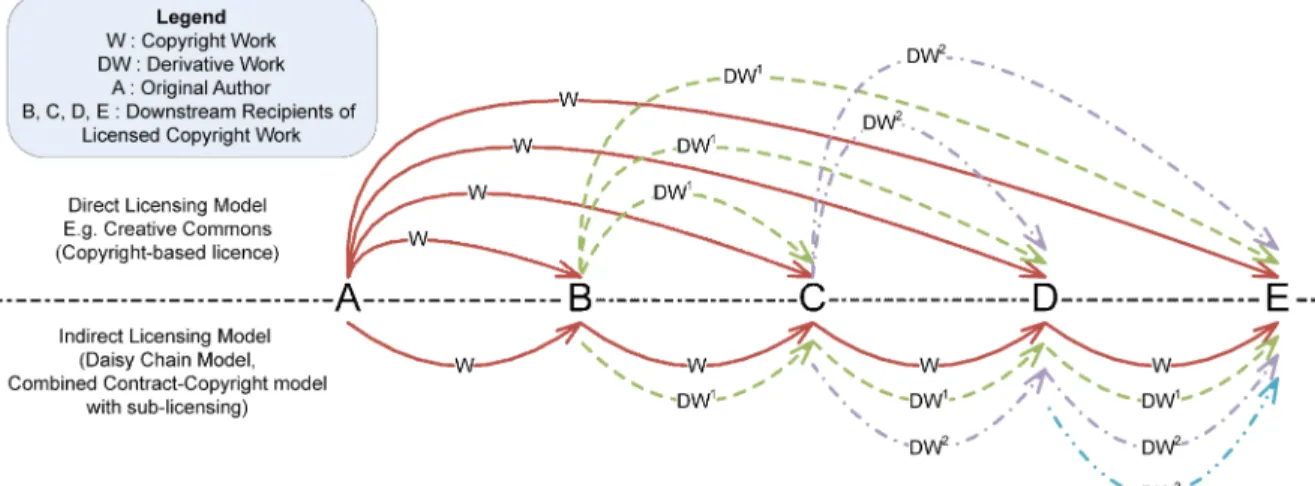
The open content model of copyright licensing can be contrasted with traditional, “all rights reserved” copyright licensing practices in which the copyright owner exercises their rights by limiting the use of the copyright material to specified persons and purposes. The focus of traditional copyright licensing is on the exercise of the exclusive rights to reproduce and distribute copies of the work, with rights being granted to specific parties, on certain conditions and often for some economic return to the licensor. Open content licensing, by contrast, is predicated on the exercise of the exclusive rights to permit reproduction and distribution by all users, subject to specific conditions applying to use of the copyright work.74 Another important point of difference is that traditional licences of informational copyright works often seek to impose, by contractual means, additional obligations or constraints on users. Such obligations commonly relate to how the information contained in a copyright work can be used, with the recipient required to maintain the confidentiality of the information or to impose the same reuse restrictions on parties to whom the licensee passes the material, through a contractual “daisy chain”.75
As open content licensing starts from the premise that copyright will be exercised to permit reproduction and distribution of the copyright material by users (although there may be other conditions of use), it is particularly relevant in systems designed to facilitate access to and re-use of PSI, especially where material is distributed online in digital form. While acknowledging the government’s ownership of copyright in the material, open content licences enable a government to give effect to its open access policy and to set the conditions on which PSI may be accessed and reused. Open access licences such as CC can be seen as both the legal expression of a policy supporting access and reuse and the means of implementing the policy. Although it was not initially envisaged or intended that CC licences would be used on government materials, their potential for use by governments and publicly funded research institutes was soon recognised, particularly in jurisdictions such as Australia where copyright subsists in a vast range of PSI.76
dealing with disclosure..: J Gilchrist, The role of government as proprietor and disseminator of information, (1996) vol. 7, no. 1, Australian Journal of Corporate Law pp 62-79, at p 62.
73 See N Suzor and B Fitzgerald, “The Role of Open Content Licences in Building Open Content Communities: Creative Commons, GFDL and Other Licences”, in C Kapitzke and M Peters (eds.) Global knowledge cultures, 2007, Sense Publishers, Rotterdam, Netherlands, pp 145-159. For the background to the Creative Commons licences, see David Bollier, Viral Spiral: How the Commoners Built a Digital Republic of their Own, The New Press, New York, 2008, available at http://www.viralspiral.cc/download-book (accessed 10 December 2009).
74Whilst there are 6 types of Creative Commons licences, the most appropriate for use with most PSI in practice is the CC-BY (attribution) licence, with CC- BY- ND (no derivatives) being appropriate for a more limited segment of PSI. By contrast, the use by government of either of the Share Alike licences may in practice result in more restricted reuse than intended.
75Government Information and Open Content Licensing: An Access and Use Strategy. Government Information Licensing Framework Project (Stage
2 Report), at p 7, para 5.6. See
http://www.qsic.qld.gov.au/qsic/QSIC.nsf/CPByUNID/BFDC06236FADB6814A25727B0013C7EE. See the representation of the Indirect Licensing Model (the “daisy chain” model) in Figure 1 below.
76 An early Australian example of recognition of the potential for applying CC licences to PSI is the GILF project. See Queensland Government, Queensland Spatial Information Council, Government Information and Open Content Licensing: An access and use strategy (Government Information Licensing Framework Project Stage 2 Report), October 2006, available at
http://www.qsic.qld.gov.au/qsic/QSIC.nsf/CPByUNID/BFDC06236FADB6814A25727B0013C7EE accessed 14 November 2009. See the submission by Professor Brian Fitzgerald to the Copyright Law Review Committee in Chapter 18 of this book; also
available at
http://www.ag.gov.au/agd/WWW/clrHome.nsf/Page/Present_Inquiries_Crown_copyright_Submissions_2004_Sub_No_17_-_Professor_Brian_Fitzgerald. In the UK, see The Common Information Environment and Creative Commons. Final Report to the Common Information Environment Members of a study on the applicability of Creative Commons licences (October 2005), available at