M.S.Ed. in Early Childhood Research Projects Graduate Works
2019
Barriers to Parental Involvement
Emily J. BerryFollow this and additional works at:https://scholarworks.umf.maine.edu/ech_projects Part of theEarly Childhood Education Commons
Barriers to Parental Involvement Emily J. Berry
Abstract
The research discussed in this paper explores parent and educator perspectives towards family involvement activities, and the barriers that cause lower participation rates. The
foundation of this research is built from Bronfenbrenner’s (1977) ecological theory, asserting that children have more meaningful experiences when there is a positive connection between their mesosystems. This study surveys pre-k families regarding their perspective on the importance of parental involvement in school activities. Such activities include class
celebrations, family activity nights, parent trainings/workshops, volunteering in the classroom, and attending pre-k parent groups. Parents report on the barriers preventing them from being able to attend school activities. Other factors, like the time of day, season, and external incentives are also explored. Educators were interviewed to gain insight about their perspective on parental involvement in the activities they offer at school. Parents and educators agree that work schedules are the most common barriers that parents confront.
Introduction
As Bronfenbrenner’s theory asserts, children learn best when their surrounding systems positively interact with each other (Hampden-Thompson & Galindo, 2017). Bronfenbrenner (1977) encourages us to consider the relationship between multiple settings, as that may have an effect on behavior. In this current study, the children’s family and educators are the two systems that should be interacting together. When the quality of this partnership is strong, it brings many benefits to both the parents and the students (Hampden-Thompson & Galindo, 2017). For educators, it is important to remember that parents are a child’s first teacher. Therefore, through a partnership, educators are able to learn more about the children, which aides in their
interactions and teaching (Kirkwood, 2016).
For the sake of this study, the researcher has defined partnership as an ongoing
relationship with open communication from all people involved. Such communication should include positive contact from teachers to parents, rather than just when the child behaves negatively. According to Gonzalez-DeHass, Willems, and Doan Holbein (2005), parents report that they are contacted by their child’s teacher mainly to discuss the child’s behavior concerns. Positive communication promotes a stronger relationship between educators and parents, resulting in better participation (Baker, Wise, Kelley, & Skiba, 2016).
Another part of this partnership includes inviting families to school for different family involvement opportunities. Family involvement, for the purposes of this study, refers to family participation within their child’s school. Such school activities may include parent/teacher conferences, parent meetings/workshops, family nights, classroom celebrations, or volunteering within the school.
Williams, Williams, and Ullman (2002), surveyed mothers in the UK and found that 72% wanted more involvement opportunities in their child’s school. Family involvement in school activities leads to increased benefits for children’s learning, both academically and socially (Kirkwood, 2016). Historically there have been gains in the level of family involvement within schools, however such progress differs depending on income status. In 2016, 62% of families living in poverty attended a school event, compared to 93% of higher class families. Twenty seven percent of families living in poverty volunteered within the school or joined a committee, compared to 47% of higher class families (Child Trends, 2018). There clearly are some barriers, especially for lower income families with fewer resources, that prevents them from attending school activities (Hampden-Thompson & Galindo, 2017). This needs to be addressed. Families should have access to participate in school activities regardless of their income status. As data informs, family involvement leads to increased success for children in school (Baker et al., 2016). Therefore, researching the barriers that families face should be of high priority so
educators can begin to create plans to address such barriers and support family involvement. This study will address the following questions:
● What are early education teachers currently doing to promote family involvement in school?
● What types of engagement opportunities are families most motivated to attend, and what do they perceive as barriers to being involved in their child’s education?
Answering these questions will provide information for educators to begin brainstorming ideas to increase family involvement. Learning about what teachers are currently doing to promote family involvement is a strategy to gain new ideas. Educators can examine patterns in
the types of successful experiences teachers have seen in comparison to the activities that
resulted in low family participation. By surveying families, we learn new information about how they value family involvement, how to meet their personal needs, and how to support them through whatever barriers are preventing their participation. Pre-k families are the main subjects of this study so they can contribute to the existing research around this topic and ensure there is education regarding what families with some of the youngest children face. By learning about the family's values and addressing barriers when children are young, hopefully schools can make changes to increase involvement as children are growing from grade to grade.
Literature Review
As parents are engaging in a two-way partnership with their child’s teacher, they gain a better understanding about their role in their child’s education (Baker et al., 2016). Once parents realize they can make an impact on their child’s learning, they may be more motivated to be involved (Hoover-Dempsey, 2011). Teachers can encourage parent involvement by inviting them to participate in different school activities. When children observe their parents participating in school events, they conclude that their learning is important, which is more likely to motivate them to try harder in school. This also leads to social/emotional benefits such as increased levels of effort, focus, and attention (Gonzalez-DeHass, Willems, & Doan Holbein, 2005), along with stronger relationships, fewer behavior concerns (Baker et al., 2016), and more positive attitudes and school climate (Hornby & Lafaele, 2011).
Academic attendance also tends to be more regular with stronger parent/teacher
partnerships (Gonzalez-DeHass et al., 2005), and smoother kindergarten transitions occur (Kang, Horn, & Palmer, 2017). Galindo and Sheldon (2011) researched the academic benefits of parent
involvement with kindergarteners and found that the children’s math and reading scores increased when there was a stronger partnership between home and school. As families are attending school activities, they also strengthen the partnership they have with their child’s teacher. By doing so, they are bridging the child’s home life with their school life, which supports a more holistic approach (Ada, 2003 as cited in Arndt & McGuire-Schwartz, 2012). Parents perception of barriers to involvement
While it is ideal for parents to be involved in school activities, there are also some barriers that decrease participation. Baker et al., (2016) spoke with parents to gain an understanding of such barriers that prevent parent involvement at school. Parents identified language and communication barriers, which included insufficient notice of school events. Parents prefer more notice than they were given. They also reported that they received contact from the teachers more often when their child was demonstrating negative behaviors, rather than sharing positive information (Baker et al., 2016). Parents of children with disabilities stated that they hear more negative feedback from the teachers than positive (Darch, Miao, & Shippen, 2004 as cited in Al-Dababneh, 2018).
Parents also expressed that it was difficult to be involved due to their work schedules. In another study, 70% of participants stated that their work schedules or own school schedules were the number one barrier preventing participation in school activities with their children (La Paro, Kraft-Sayre & Pianta, 2003). If both parents work, there is typically less time for school
activities, or sometimes the job itself does not allow for much time off. On the other hand, parents who are not working may be trying to cope with financial stress and are unable to afford the resources to get to the school (Hornby & Lafaele, 2011).
Other barriers described by parents included time conflicts, a lack of resources (Reece, Staudt, & Ogle, 2013), scheduling conflicts with older siblings (Kang, Horn, & Palmer, 2017), or feeling nervous about going to the school due to their own personal experiences (Baker et al., 2016).
Educator perception of barriers to involvement
Educators identified what they believe to be barriers to parent involvement based on their experiences and observations. In some instances their responses aligned with what parents identified, but they also made their own determinations. One area of agreement was
communication. Teachers believe it is a barrier because they often struggle to get in contact with some families. Therefore, resulting in a lack of general communication (Baker et al., 2016).
Teachers also believe that a parent’s own negative experiences in school could be a barrier. Parents might feel uncomfortable or intimidated by just being at school if they struggled with education when they were younger (Baker et al., 2016). It is possible to see a difference in the level of involvement between parents who did not complete high school versus those who attended college. Parents who did not attend college may also feel less qualified to support their child as they know the teacher has a degree (Hornby & Lafaele, 2011). Along with their personal feelings about school, parents may have conflict occurring in their personal lives such as divorce or social anxieties that results in less involvement (Hornby & Blackwell, 2018). Parent stressors may lead to an overall lack of interest in school activities (Baker et al., 2016).
A lack of time was identified as another barrier. Teachers feel that they do not have enough time to fully communicate with and support parents. They expressed a need for more training around supporting the family more holistically (Hornby & Blackwell, 2018).
Effects of poverty on parent involvement
Hampden-Thompson and Galindo (2017), determined that families with low
socioeconomic status may be harder for teachers to engage with because they tend to be less involved in school activities. They take a more hands off approach, even if teachers personally invite them, as they believe that it is the teacher’s responsibility to teach, and their role is to provide for children at home. Since this type of relationship is not a partnership, parents may disagree with what the educator is teaching because they are not on the same page due to the lack in communication (Fan, Li, & Sandoval, 2011).
Working class parents may also feel less comfortable helping their children with homework depending on their own education (Gordon & Cui, 2014), or they may not be as familiar with schools or their role in their child’s education (Ingram, Wolfe, & Lieberman, 2007 as cited in Fan, Li, & Sandoval, 2011). Some families may experience increased barriers due to a lack of resources or time. This could be because they are working multiple jobs
(Hampden-Thompson & Galindo, 2017), or single parents who are trying to balance work with their family responsibilities, or parents who are caring for many children (Hornby & Lafaele, 2011).
Solutions to increase parent involvement
Improved communication was identified as an area of need by parents and educators. Increased, positive communication makes parents feel more comfortable and welcomed into the school. Parents want to hear beyond the negative and learn about their child’s achievements (Baker et al., 2016). Also, teachers can show that they value parent involvement by
When parents feel that the school really values and encourages parent involvement, they are more likely to participate (Hornby & Lafaele, 2011).
Providing a sense of openness and welcoming parents is another important piece of making parents feel comfortable. When parents feel comfortable they are more likely to be involved. Welcoming them as they enter the building or personally inviting them into classrooms are simple steps to breaking down the barrier of discomfort for parents (Baker et al., 2016). However, parents are required to complete a background check before regularly volunteering in a classroom, which poses another barrier for some. Teachers expressed frustration because they have lost good volunteers who were afraid to complete the background check. No solutions were offered to address this concern (Baker et al., 2016).
Parents provided suggestions to address the concern of scheduling conflicts. They believe that by providing weekend activities, schools are more likely to accommodate working families. Providing childcare could alleviate the challenge of working around siblings schedules, as well as checking with other schools to make sure their events are spread out on separate days. Parents and educators also agree that providing food makes events more enticing (Baker et al., 2016).
Teachers are also requesting professional development training so that they feel better equipped to support families. Without the training, it is difficult for teachers to have the understanding and knowledge to guide families when they need help in their personal lives (Hornby & Blackwell, 2018).
Other factors to consider
Kang, Horn, and Palmer (2017), found that quantity was less important than quality in regards to parent involvement. It did not matter how many school activities parents chose to
participate in, but just that there was some level of involvement, which lead to positive academic results for kindergarten children. This is important for teachers to consider as it means that they do not need to stress about whether or not parents participate in every single activity. Instead, encourage parents to attend one to start and work on strengthening the home-school partnership.
Hornby and Lafaele (2011), found that parents tend to be more involved in education when their children are younger. As children grow older, they are less likely to want their parents to be part of their school as they are working towards independence (Hornby & Lafaele, 2011). It is also easier for parents to be involved when their child is doing well at school. When children are consistently struggling, parents may feel defeated and leave it up to the teachers to provide the support (Hampden-Thompson & Galindo, 2017).
Over all, the research presented here promotes parent involvement in school activities. Unfortunately, as discussed in this paper, there are barriers preventing parents from participating. One goal of this study is to begin thinking about ways to break down the barriers and provide support to families. By asking families directly about the barriers they face, we can gather more accurate information.
Methods Research Design
Pre-k families and educators from three schools in central Maine were invited to participate in this mixed-methods study. A mixed methods approach was selected because it allowed the researcher to gather and review data from the multiple perspectives involved in the home-school partnership. Families were sent an anonymous survey which collected information directly from children’s parents regarding their thoughts and struggles with involvement.
Educators were invited to participate in an interview that would identify their experiences with parent involvement. The interview provided useful data for other educators to learn from in terms of successful involvement strategies versus the less productive types. With both sets of data, the researcher can compare the educator’s perspective to the results of the parent survey to see if families and their child’s teacher had similar ideas or not.
Population and Sample
Each school is part of the same school district where poverty rates are high, which is why all children receive free breakfast and lunch at school. Each pre-k classroom is part of a
collaboration between the district and Head Start. All of the pre-k students receive the same Head Start services. The study participants consisted of two groups: families who have a child in pre-k, and pre-k educators at each school. This group of participants is considered part of a convenient sampling as all the schools were located within close range of each other and the researcher. This population is considered to be quite small, but the results will provide information for educators and administrators to consider.
Protection of Human Rights
In order to ensure that this study was ethical and respectful of the human participants, the research proposal was approved by an Institutional Review Board. The proposal outlined how the researchers would gain consents and ensure confidentiality. The parent participants were told how to complete and return the survey anonymously. Educator participants were invited to take part in the interview via email, phone call, or in person. The interviewees names and other identifiable information were not used as part of data collection.
One instrument used in this study was the survey titled, Family Involvement in School Activities. This survey asked parents questions related to their priorities in terms of involvement at school, and about the barriers they confront. The last part of the survey also collected
suggestions about the time of the year and the incentives that would support parents to be more involved.
The second instrument used in this study was the interview questionnaire for educators. The questions gathered data about the types of parent involvement activities educators use and find successful. It also asked for the educators perspective about the barriers preventing parent involvement.
Procedures:
Subject recruitment.
The three elementary schools were chosen for this study out of convenience and location. The purpose of this study was explained to the principals at each school and they agreed to allow their pre-k programs to participate. Pre-k teachers at each school were informed of the research, at which point they were asked to send the surveys and consent forms home with each of their students. The teachers were entrusted to send home the reminder messages provided and encourage the return of the surveys, recruiting parents to be part of the participant pool. Educators were also invited to participate in the interview process, but they were aware that it was optional and voluntary.
Procedures for data collection and analysis.
The results of the parent survey were analyzed one question at a time to compile parents’ answers. The mode score was identified in order to discuss the most common answers. Parent
answers are represented in numerical form, and then displayed in a chart or histogram. Percentages were also used to compare the data and determine the results. The results of the educators interviews were broken down into common themes and also displayed using a
histogram. In some cases, like identifying barriers, these themes were compared to the results of the parent survey.
Reliability and validity.
With survey research, there is always a risk for parents to misinterpret the questions, but efforts were made to minimize that threat. Survey questions were direct and brief in an effort to be as clear as possible. To ensure that the parents understood the survey, the researcher provided an explanation for the scales of measurement (Creswell, 2011). This type of self-report survey relies on the answers of the parents. Assurances were made to parents on the consent forms, survey, and reminder notices, that the survey was anonymous so parents could feel free to be honest in their answers. It is also important to consider that inevitably parents will communicate about the survey, which may influence some of their answers.
Surveys and consent forms were dispersed on March 1, 2019 to all classrooms except for one. In this one particular classroom, the teacher was unable to send surveys home, so they went home on Monday March 4, 2019. Therefore some families had less time to complete the survey than others. However, the researcher gave ample time for families to participate without feeling rushed. The survey was purposefully created to be brief so that families would not be deterred by having to spending a large amount of time completing it.
Results
The results of the parent survey answer the following research questions: What types of engagement opportunities are families most motivated to attend, and what do they perceive as barriers to being involved in their child’s education? Twenty-eight families responded to the survey, providing information about their potential involvement in school activities.
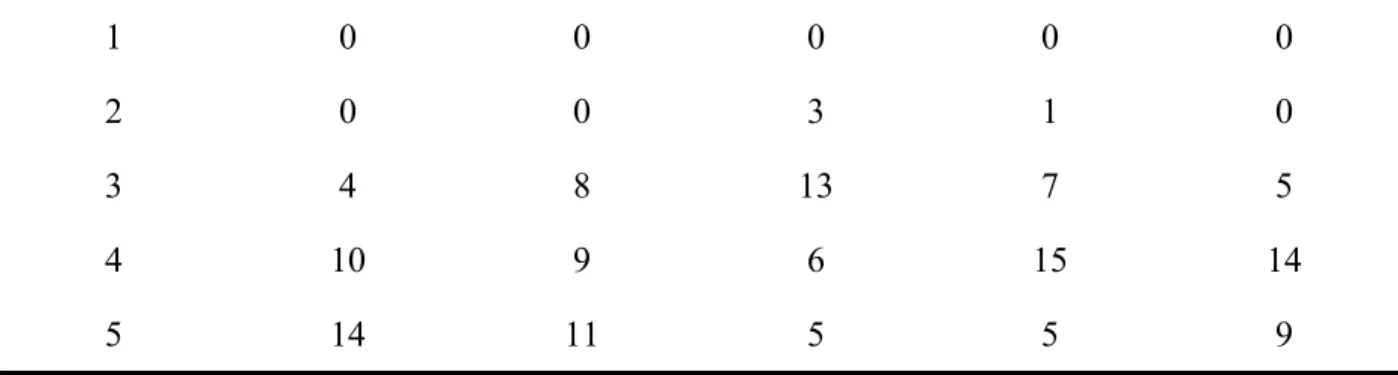
Families were asked to rate how important they felt each type of school activity was, level 1 being not important and level 5 being most important. Table 1 shows the 5 different involvement activities assessed in this study. Class celebrations had the highest response rate with 14 families rating it at a level 5. In other words, 50% of participants believe class
celebrations are the most important type of school involvement activity. Table 2 shows which type of activity parents thought they were most likely participate in. The majority of families, with fifteen votes, reported that they are most likely to attend class celebrations. Therefore, 54% of families are most motivated to attend class celebrations.
Table 1. Parent Opinion on the Importance of School Involvement Activities Level of
Importance Type of School Activity
Class
Celebration ActivityFamily Nights Parent Trainings/ Workshops Volunteering in the Classroom Parent Meeting
1 0 0 0 0 0 2 0 0 3 1 0 3 4 8 13 7 5 4 10 9 6 15 14 5 14 11 5 5 9
Table 2. How Likely Parents are to Participate Level of
Likelihood Type of School Activity
Class
Celebration ActivityFamily Nights Parent Trainings/ Workshops Volunteering in the Classroom Parent Meeting 1 1 1 5 3 3 2 0 3 6 4 3 3 4 7 8 9 7 4 8 7 4 4 4 5 15 10 5 8 11
Parent Survey: Barriers
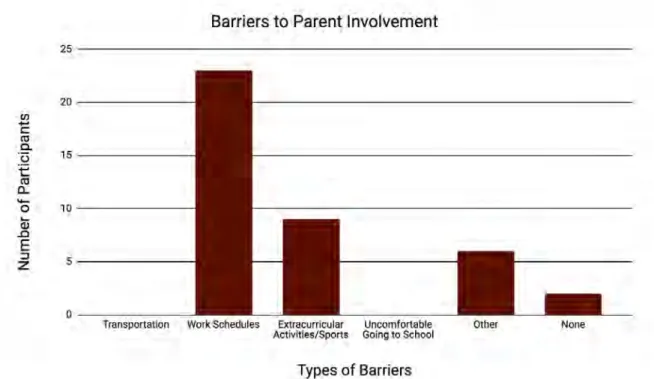
The second part of the research question asks parents what they perceive as barriers to participating in school activities. Figure 1 shows the types of barriers that participants may confront. Twenty-three participants identified work schedules as a barrier for their family, making this the most common barrier identified by 82% of families. Six participants identified other barriers and then were asked to specify what the other barriers were. These included conflicts with childcare, having younger siblings, or having many children in the family with
different schedules. The weather, the times that activities are offered, and anxiety within the family were all indicated as barriers as well. Transportation and family comfort levels were not considered barriers by any of the participants.
Figure 1: Barriers to Parent Involvement
Parent Survey: Other Factors
Other factors, such as the time of day and season, were considered when thinking about how to promote participation in school activities and begin to address the barriers. Figure 2 shows that a large majority, 66.7%, of participants are more likely to attend activities after school. Some participants commented specifically that after 5:00 pm works best due to their work schedules. Other participants made statements like, “I have to work, so reducing time I have to miss work is important.” Other comments included, “After school is nice so the entire
family can attend” and “after school gives more time and less rushing.” Only 11% of families indicated they would attend activities before school because they could attend before going to work. One parent chose before school because it is a quieter time of the day. Time of day barriers were not specified in this study.
Figure 2: Time of Day Parents are Most Likely to Attend School Activities
Figure 3 shows that parents prefer to attend school activities that are planned for the fall or spring instead of during the winter months. Participants advocated for fall or spring by commenting, “It’s light out and I don’t have to worry about the weather.” “I don’t particularly care to drive in the winter. It’s cold and yucky usually.” Fall and spring are “warmer and longer daylight.” One participant said, “fall is an exciting time of year at the beginning of the school year. Spring, we are ready to get out after a long winter.” Another participant expressed concern
about cold and flu season being during the winter months, which would decrease overall participation.
Figure 3: Time of Year Parents are Most Likely to Attend School Activities
Parent Survey: Parent Group
The last part of the parent survey asked specifically about parent group and what kinds of incentives would motivate parents to attend. Parent group did not rate as a high priority for parents earlier in the survey, but it is a required component of Head Start programs, including the schools who participated in this study. Therefore, this section of the survey was intended to provide information about how educators can increase parent participation. The incentives included in the survey were childcare, food, door prizes, and doing an activity with their child during the group. The majority of participants, 13 out of 28, said they were more likely to attend parent group if child care was offered. Nine out of 28 participants said they were more likely to
attend parent group if they could do an activity with their child during the meeting. Currently, all of the parent group meetings are designed for parents only. Food and door prizes were not rated as motivating for many families.
Teacher Interview:
The results of the teacher interviews address the question: what are early education teachers doing to promote family involvement in school? Teacher responses were divided into four categories: communication, evening events/celebrations, daytime events/celebrations, parent meetings, and volunteer opportunities. Teacher’s clarified communication as newsletters, phone calls, in person contact, parent/teacher conferences, and applications like Class Dojo or Remind. Evening or daytime events included an open house, pinata party, math or literacy nights, and end of the year celebrations. Parent meetings referred to the pre-k parent group, and volunteer
opportunities included in the classroom as well as preparing materials.
Fifty-five percent of teachers identified the pinata party and/or the end of the year
celebration as the most successful involvement activity with the most family participation. When asked why they thought the pinata party was so successful, many teachers made comments like, “the kids make invitations to invite families so when the kids are invested the parents are more likely to be invested.” One teacher described the party saying, it was “at the end of the day during school, in the cafeteria. Families signed up to bring snacks, we read the book, and then broke the pinata.”
Fifty-five percent of teachers identified the pre-k parent group as having the least
participation. When asking the other 45% of teachers about their parent group, they also admitted to having very little or no participation. Teacher’s brainstormed why they thought parent group
had such low participation rates. They thought parents might not be interested or comfortable, and they might not be available at the time of the meeting due to scheduling conflicts. One teacher said, “Maybe if kids were making invitations for their family to come to parent group and do something together we might get more. Parent group always feels like so much business. They come early in the year to see what it’s all about and it’s so much information instead of doing something fun.” The school district’s partnering organization, who oversees the Head Start services, dictates part of the parent group agendas. This promotes a more formal meeting for families, especially early in the school year.
Teachers were also asked to consider the barriers they believe their families confront, preventing participation in school activities. A lack of transportation and parents work schedules were most commonly identified. Other thoughts included that parents just might not be interested or they might feel intimidated. One teacher commented, “they don’t know what they can do. There’s a lot that they can do, but they don’t know that.” This teacher spoke on the importance of teaching families about their possible roles in children’s education.
Discussion
What types of engagement opportunities are families most motivated to attend?
Of all the different types of engagement opportunities offered by educators, families reported class celebrations to be the most important. It is difficult to speculate why families chose class celebrations since the responses came from a Likert rating scale. One limitation of this type of scale is that families were not asked to specify their answers. However, educators did provide their opinions during their interviews.
engagement opportunity offered. In terms of class celebrations, a pinata party was mentioned in multiple interviews. Educators held the party during school hours in celebration of the children’s learning around pinatas. This learning was part of a larger unit on friendship. Eductors described the pinata party as a time where they read a story, broke a pinata that the children had created, ate food, and families mingled with each other. One educator explained her theory about why the pinata party was so successful. She said, “the kids make invitations to invite families so when the kids are invested the parents are more likely to be invested.”
The researcher concluded that the pinata party was a time that was truly centered around the children. It was a time to celebrate everything that the children had accomplished at school, which was something the parents were proud about. When families were in attendance, the children got to see that their learning and accomplishments were valued by their parents. This is likely going to motivate children to want to succeed in school, (Gonzalez, Willems, & Doan Holbein, 2005), therefore, by offering class celebrations, educators are enhancing children’s learning. The children had made invitations ahead of time, which was part of the curriculum. They brought the invitations home and gave them to their families. This promoted excitement in the children, which may have been a motivator for families to attend.
Multiple educators also talked about the end of the year celebration. This type of event occurred in the evening and included games and food for children and their families. Some educators included a program where children got certificates and a parting gift for completing pre-k. This is another example of an event that is centered around the children’s
accomplishments. Families attended to show their support and sense of pride for their children. The pinata party and end of the year celebration were the only two celebrations discussed
during the interviews. Since families have now expressed that classroom celebrations are the most motivating, and educators have identified class celebrations to be most successful, it is recommended that educators begin to think about how to incorporate more celebrations of
student learning. This might include planning more events like the pinata party that coincide with the units of the OWL curriculum, which will allow families to celebrate what the children are learning at that time. During the planning stages of the events, have children make invitations and get children excited so that they are talking about it at home with their families to help motivate them to attend. According to Baker et al., (2016), families are requesting better communication. Families want to have more notice about school events and receive more communication in general. Having children send home invitations well before the event is one way to provide more communication.
What are early education teachers doing to promote family involvement in school? The 11 teachers who participated in this study provided a list of the involvement activities that they offer. Activities included an open house, a pinata party, math or literacy nights, parent/teacher conferences, parent group, volunteering in the classroom, end of the year celebrations, and various modes of communication. Knowing now that families prefer class celebrations, educators may want to take a look at the list of opportunities they offer and adjust their current practices. Consider offering more celebrations or adjust current activities to feel more like celebrations of children’s learning. For example, turn math night into a celebration of math learning by offering activities that children have been working hard on and that they can teach their families about. Work with children on how they would teach their families to play, and include making invitations to get children excited and talking about the activities at home.
Parents want to learn more about their children’s accomplishments, rather than just receive communication about the negative behaviors their children exhibit at school (Baker et al., 2016). Class celebrations are a great way to utilize school events to highlight children’s
accomplishments.
Based on survey results, educators may be able to plan more successful celebration opportunities during the fall or spring time. Families expressed concern about traveling to school in winter weather. With that said, it is well known that t-ball is offered in the spring for pre-k children. While families did not specify t-ball to be a barrier in the spring, 32% of families did indicate after school sports and activities to be a barrier. Educators should be aware of the sports schedules when planning the dates and times of their events.
All educators indicated that they have low participation rates within their parent group meetings. It is unclear why parent group has such low participation. Parent group is a Head Start requirement and includes making decisions for the children and the program. According to Hampden-Thompson and Galindo (2017), low income families tend to believe that their role is to take care of the children at home, and it is the teachers role to take care of the children at school. This might explain why parent group is not a priority for families as they may not feel that it is their responsibility to make decisions for the classroom.
Families were asked through the survey about incentives that would motivate them to participate in the meetings. Incentives included childcare, food, door prizes, and engaging in an activity with their child. Childcare was the top rated incentive, although each center already offers childcare during the meetings. Most meetings occur right after school around 3:30, but families already specified their work schedules as a barrier. Perhaps offering the meetings in the
evening with childcare would be more successful. Families also indicated that they would be more likely to attend if they could engage in an activity with their child during the meeting. Teachers described parent group as “business-like.” Perhaps educators can promote better attendance if parent group began with a time for parents and children to do a learning activity together. Then the second part of the meeting could offer childcare, and parents and teachers could conclude with the business-like agenda. As we learned from this study, it is apparent that families want to attend events that are centered around their children. With this in mind,
educators need to find ways to center parent group around the children too, and offering an activity for families to do together is one suggestion.
What do families perceive as barriers to being involved in their child’s education? The majority of families indicated that their work schedule is the largest barrier they confront. These results match the results of another study, which found that 70 % of participants indicated their work schedules to be the biggest barrier (La Paro, Kraft-Sayre & Pianta, 2003). Many families are working during the school day, making it difficult for them to attend daytime events. Now that the results are validated, educators can begin thinking about solutions for families. By planning activities for evening hours, such as 5:30, educators can address this
barrier for many families as evening celebrations allow working families to attend. The educators who planned their end of the year celebration for the evening shared that almost all of their families were in attendance, validating this recommendation.
Educators should expand on their current success of high attendance at the end of the year celebration by planning more celebrations for evening hours. However it is worth noting that all of the pinata parties were scheduled during the day, and all teachers said they had high
attendance rates. Therefore, it is difficult to say whether it is the time of day or the type of activity that will have the biggest impact for families. It is possible that some families might find it worth taking time off work to celebrate their child’s accomplishments during the day, but this is not necessarily possible for all families.
Interestingly, 9 out of the 11 educators said they believed transportation to be a barrier for families. However, not one single parent indicated transportation to be a barrier on their survey. With only 31% of the surveys returned, it is impossible to say that none of the families within the pre-k programs experience transportation barriers. If educators are aware of specific families who lack access to transportation, they should consider this when planning school events. Limitations
This was a very small scale study, making it difficult to generalize the results for other populations. However, the researcher hoped that the results would provide accurate information for the families within the rural area of Maine of which they all live. Ninety-one families
received surveys and 28 families returned them. With only a 31% return rate, it is difficult to say if the results can be generalized for the remaining 69 percent of families who chose not to participate.
Using a paper survey provides its own limitations as well. The surveys were sent home in children’s folders and most children ride the school bus home. There was no guarantee that the families received the survey in a timely fashion or at all. If families chose not to check children’s folders everyday, they may have had less time to complete the surveys. There is also a risk of misinterpretation when reading the survey questions. The researcher kept the questions simple and brief, and provided an explanation of the rating scales to limit misinterpretation, but it still
could be a limitation. Conclusion
Overall, the researcher was able to gather enough data to answer each of the research questions. Even though the data collected cannot be generalized to other populations, it can be reviewed in addition to other current research. Educators can use this research to enhance their current practices with family involvement. It is well known that children benefit when their families are involved and support their learning. The research discovered in this study informs readers about the value of implementing more classroom celebration activities since that is what families specified as most important. The researcher was also able to highlight the importance of keeping family involvement activities centered completely around the children and getting children motivated and excited to attend. By adapting current activities or adding new
opportunities around classroom celebrations, educators are supporting what families value and in turn, enhancing children’s learning.
References
Al-Dababneh, K. (2018). Barriers preventing parental involvement in mainstream education of children with specific learning disabilities: Parent perspectives. European Journal of Special Needs Education, 33(5), 615-630. doi: 10.1080/08856257.2017.1391013 Arndt, J. & McGuire-Schwartz, M. E. (2012). Early childhood school success: Recognizing
families as integral partners. Childhood Education, 84:5, 281-285. DOI: 10.1080/00094056.2008.10523025
Baker, L., Wise, J., Kelley, G., & Skiba, R. (2016). Identifying barriers: Creating solutions to family engagement. School Community Journal, 26(2). Retrieved from
http://www.schoolcommunitynetwork.org/SCJ.aspx
Bronfenbrenner, U. (1977). Toward an experimental ecology of human development. American Psychologist, 513-531. doi:10.1.1.458.7039
Child Trends. (2018). Parent involvement in school. Retrieved from
https://www.childtrends.org/indicators/parental-involvement-in-schools
Creswell, J.W. & Guetterman, T.C., 2019. Education Research: planning, conducting, and evaluating quantitative and qualitative research. Loose-leaf version with enhanced Pearson e-text-access card package, 6/E. Pearson Publishers.
Fan, W., Li, N., & Sandoval, J. (2018). A reformulated model of barriers to parental involvement in education: Comment on hornby and lafaele (2011). Educational Review, 70(1),
120-127. doi: 10.1080/00131911.2018.1388614
Galindo, C., & Sheldon, S. (2011). School and home connections and children’s kindergarten achievement gains: The mediating role of family involvement. Early Childhood Research Quarterly, 27, 90-103. doi: 10.1016/j.ecresq.2011.05.004
Gonzalez-DeHass, A., Willems, P., & Holbein, M. (2005). Examining the relationship between parental involvement and student motivation. Educational Psychology Review, 17(2), 99-123. doi: 10.1007/s10648-005-3949-7
Gordon, M., & Cui, M. (2014). School-related parental involvement and adolescent academic achievement: The role of community poverty. Family Relations, 63, 616-626. Doi: 10.111/fare.12090
Hampden-Thompson, G., & Galindo, C. (2017). School-family relationships, school satisfaction and then academic achievement of young people. Educational Review, 69(2), 248-265. doi: 10.1080/00131911.2016.1207613
Hoover-Dempsey, K. (2011). Self-efficacy: Up to the challenge. InRedding, S., Murphy, M., & Sheley,P. (Eds.) Handbook on familyand community engagement (pp. 61-17). Lincoln, IL: Academic Development Institute. Retrieved from
http://www.schoolcommunitynetwork.org/downloads/FACEHandbook.pdf
Hornby, G., & Blackwell, I. (2018). Barriers to parental involvement in education: An update. Educational Review, 70(1), 109-119. doi: 10.1080/00131911.2018.1388612
Hornby, G., & Lafaele, R. (2011). Barriers to parental involvement in education: An explanatory model. Educational Review, 63(1), 37-52. doi: 10.1080/00131911.2010.488049
Kang, J., Horn, E., & Palmer, S. (2017). Influences of family involvement in kindergarten transition activities on children’s early school adjustment. Early Childhood Education Journal, 45(6), 789-800. doi 10.1007/s10643-016-0828-4
Kirkwood, D. (2016). Understanding the power of parent involvement. National Association for the Education of Young Children.
La Paro, K. M., Kraft-Sayre, M., & Pianta, R. C. (2003). Preschool to Kindergarten Transition Activities: Involvement and Satisfaction of Families and Teachers. Journal of Research in Childhood Education, 17(2), 147-158.
http://dx.doi.org/10.1080/02568540309595006
Reece, C., Staudt, M., & Ogle, A. (2013). Lessons learned from a neighborhood-based
collaboration to increase parent engagement. School Community Journal. 23:2, 207-224. Williams, B., Williams, J., Ullman, A. (2002). Parental involvement in education. Research