Faculty of Science and Engineering the Manchester Metropolitan University
A THESIS SUBMITTED IN PARTIAL FULFILMENT OF THE REQUIREMENTS OF THE
MANCHESTER METROPOLITAN UNIVERSITY FOR THE DEGREE OF DOCTOR OF PHILOSOPHY
Preference Focussed Many-Objective
Evolutionary Computation
Doctoral Thesis of
Shahin Rostami
Statement of Originality
Unless otherwise stated in the text, the work described in this thesis was carried out solely by the candidate. None of this work has already been accepted for any other degree, nor is it being concurrently submitted in candidature for any degree.
Signed ... Date ...
This thesis is dedicated to Keith Edwards
Acknowledgements
I would like to thank my first supervisor Dr Alex Shenfield, for giving me the opportunity to pursue my doctorate and for the very much appreciated guidance throughout the past few years. I would also like to thank Professor Nick Bowring for adopting me as his Ph.D. student and supporting me through the final hurdles of the thesis write-up and submission process.
I would like to thank my annual reviewer Dr Stephen Sigurnjak for keeping me on track and offering me support throughout the years of research.
I would like to thank those who were on the Ph.D. journey with me, Dean O’Reilly for offering an interesting collaboration between our research, and Peter Delves for the support we gave each other throughout the highs and the lows.
I would of course like to thank my parents for their love and support throughout my research.
I would like to thank Samuel Riddell, for keeping me sane.
Finally I would like to thank my lovely wife, Sam Rostami, for her love, un-derstanding, support, and most of all her patience throughout my research and write-up.
Abstract
Solving complex real-world problems often involves the simultaneous opti-misation of multiple conflicting performance criteria, these real-world problems occur in the fields of engineering, economics, chemistry, manufacturing, physics and many more. The optimisation process usually involves some design challenges in the form of the optimisation of a number of objectives and constraints. There exist many traditional optimisation methods (calculus based, random search, enumerative, etc...), however, these only offer a single solution in either adequate performance in a narrow problem domain or inadequate performance across a broad problem domain.
Evolutionary Multi-objective Optimisation (EMO) algorithms are robust op-timisers which are suitable for solving complex real-world multi-objective opti-misation problems, as they are able to address each of the conflicting objectives simultaneously. Typically, these EMO algorithms are run non-interactively with a Decision Maker (DM) setting the initial parameters of the algorithm and then analysing the results at the end of the optimisation process. When EMO is applied to real-world optimisation problems there is often a DM who is only in-terested in a portion of the Pareto-optimal front, however, incorporation of DM preferences is often neglected in the EMO literature.
In this thesis, the incorporation of DM preferences into EMO search methods has been explored. This has been achieved through the review of EMO litera-ture to identify a powerful method of variation, Covariance Matrix Adaptation (CMA), and its computationally infeasible EMO implementation, MO-CMA-ES. A CMA driven EMO algorithm, CMA-PAES, capable of optimisation in the presence of many objectives has been developed, benchmarked, and statistically verified to outperform MO-CMA-ES and MOEA/D-DRA on selected test suites. CMA-PAES and MOEA/D-DRA with the incorporation of the novel Weighted Z-score (WZ) preference articulation operator (supporting a priori, a posteriori or progressive incorporation) are then benchmarked on a range of synthetic and real-world problems. WZ-CMA-PAES is then successfully applied to a real-world problem regarding the optimisation of a classifier for concealed weapon detection, outperforming previously published classifier implementations.
Abbreviations
-MOEA Domination Based Multi-Objective Evolu-tionary Algorithm.
AGA Adaptive Grid Algorithm.
AIS Artificial Immune System. ANN Artificial Neural Network. CI Computational Intelligence. CMA Covariance Matrix Adaptation.
CMA-ES Covariance Matrix Adaptation Evolutionary Strategy.
CMA-PAES Covariance Matrix Adaptation Pareto Archived Evolution Strategy.
CMA-PAES-II Covariance Matrix Adaptation Pareto Archived Evolution Strategy II.
CWD Concealed Weapon Detection.
DEMO Differential Evolution for Multi-objective Op-timisation.
DEMOwSA Differential Evolution for Multi-objective Op-timisation with Self Adaptation.
DM Decision Maker.
EA Evolutionary Algorithm.
EC Evolutionary Computation.
EMO Evolutionary Multi-Objective Optimisation.
EP Evolutionary Programming.
ES Evolution Strategies.
FSM Finite State Machine.
GA Genetic Algorithm.
GD Generational Distance.
HypE Hypervolume Estimation Algorithm for Multi-Objective Optimisation.
IBC Indicator Based Conformation.
IBEA Indicator-Based Evolutionary Algorithm. IGD Inverted Generational Distance.
m-CMA-PAES Multi-tier Covariance Matrix Adaptation Pareto Archived Evolution Strategy.
MO-CMA-ES Multi-Objective Covariance Matrix Adapta-tion EvoluAdapta-tion Strategy.
MOEA/D Multi-Objective Evolutionary Algorithm Based on Decomposition.
MOEA/D-DRA Multi-Objective Evolutionary Algorithm Based on Decomposition with Dynamical Resource Allocation.
MOGA Multi-Objective Genetic Algorithm.
NFL No Free Lunch.
NPGA Niched Pareto Genetic Algorithm.
NSGA Nondominated Sorting Genetic Algorithm. NSGA-II Nondominated Sorting Genetic Algorithm II. NSGA-III Nondominated Sorting Genetic Algorithm
III.
PAES Pareto Archived Evolution Strategy. PBEA Preference-Based Evolutionary Algorithm. PESA Pareto Envelope-based Selection Algorithm. PPA Progressive Preference Articulation.
R-NSGA-II Reference-point-based Nondominated Sort-ing Genetic Algorithm II.
ROI Region of Interest.
SMS-EMOA s-metric Selection Evolutionary Multi-Objective Algorithm.
Abbreviations xi
WZ-CMA-PAES Weighted Z-score Covariance Matrix Adapta-tion Pareto Archived EvoluAdapta-tion Strategy. WZ-MOEA/D-DRA Weighted Z-score Multi-Objective
Evolution-ary Algorithm Based on Decomposition with Dynamical Resource Allocation.
List of Figures
2.1 A mythical effectiveness index across a problem continuum for opti-misation schemes. . . 20 2.2 General execution life-cycle diagram of a basic Evolutionary Algorithm. 21 2.3 An example of a binary encoded chromosome. . . 22 2.4 An illustration of four solutions subjected to roulette wheel selection. 23 2.5 An example of single-point binary crossover. . . 24 2.6 Adaptation of the covariance matrix for a multivariate normal
distri-bution. . . 26 2.7 Proximity, diversity, and pertinence characteristics in an
approxima-tion set in bi-objective space. . . 29 2.8 A Pareto-optimal approximation set containing 10 solutions with ideal
diversity. . . 33 2.9 A Pareto-optimal approximation set containing 10 solutions with
un-desirable diversity. . . 33 2.10 An illustration of the trade-off between proximity and diversity to the
Pareto-optimal front of an objective function. . . 35 2.11 An example plot of a population and visualisation of grid divisions
managed by an AGA. . . 36
2.12 An example of the contributing hypervolume indicator in two-dimensional objective space. . . 38 2.13 Calculation of the crowding-distance. . . 39 2.14 A Pareto-optimal approximation set containing five solutions with
ideal pertinence. . . 41 2.15 A Pareto-optimal approximation set containing seven solutions with
undesirable pertinence. . . 41 2.16 Execution life-cycle for the PAES optimisation process. . . 48 2.17 Execution life-cycle for the MO-CMA-ES optimisation process. . . 50 2.18 Uniformly distributed random weight values generated for use with
MOEA/D-DRA. . . 53 2.19 Plots of the Pareto-optimal fronts for all ZDT test functions excluding
ZDT5, from the ZDT test suite. . . 57 2.20 Plots of the true Pareto-optimal fronts for the bi-objective DTLZ test
functions from the DTLZ test suite. . . 60 2.21 Plots of the true Pareto-optimal fronts for the three-objective DTLZ
test functions from the DTLZ test suite. . . 61 2.22 Plots of the true Pareto-optimal fronts for the bi-objective WFG test
functions from the WFG test suite. . . 63 2.23 Plots of the true Pareto-optimal fronts for the three-objective WFG
test functions from the WFG test suite. . . 64 2.24 Plots of the true Pareto-optimal fronts for the bi-objective CEC09 test
functions from the CEC09 competition test suite. . . 66 2.25 Plots of the true Pareto-optimal fronts for the three-objective CEC09
List of Figures xv
2.26 An example of the hypervolume indicator in two-dimensional objective space. . . 69 2.27 Histogram showing the distribution of the hypervolume indicator
val-ues from WZ-MOEA/D-DRA on the WFG6 test problem. . . 74 2.28 Relationship between SEM and the sample size of hypervolume
indi-cator values from WZ-MOEA/D-DRA on the WFG6 test problem. . 75 3.1 Execution life-cycle for the CMA-PAES algorithm. . . 81 3.2 Box plots of hypervolume indicator results for 2-objective ZDT
prob-lems. . . 86 3.3 Hypervolume indicator values at each generation for CMA-PAES and
MO-CMA-ES on the considered ZDT test problems. . . 87 3.4 An approximation set found using MO-CMA-ES after 300,000
func-tion evaluafunc-tions on CEC09 UF1. . . 89 3.5 The true Pareto-optimal front and Pareto-optimal set for CEC09 UF1. 90 3.6 An example of elitist and non-dominated selection, circled points
in-dicate a selected individual. . . 91 3.7 Execution life-cycle for the m-CMA-PAES algorithm. . . 93 3.8 An example of the multi-tiered grid selection. . . 96 3.9 IGD results at each generation visualising performance of
m-CMA-PAES and MO-CMA-ES on two-objective test problems. . . 102 3.10 IGD results at each generation visualising performance of
m-CMA-PAES and MO-CMA-ES on three objective test problems. . . 104 3.11 Box plots of IGD indicator results for two-objective test problems. . . 105 3.12 Box plots of IGD indicator results for three-objective test problems. . 106
3.13 Disjoint true Pareto-optimal fronts plotted for problems ZDT3, UF6, and UF9. . . 106 4.1 Plot of the hypervolume indicator performance at each generation of
CMA-PAES on the WFG3 synthetic test problem. . . 113 4.2 Execution life-cycle for the IBC mechanism. . . 117 4.3 Plot of the hypervolume indicator performance at each generation of
CMA-PAES-II with and without IBC on the WFG3 test problem. . . 122 4.4 Plot of the hypervolume indicator performance at each generation of
CMA-PAES-II with and without IBC and sigma restart on the WFG3 test problem. . . 124 4.5 Parallel-coordinate plot of the Population X used in the improved
AGA example. . . 127 4.6 One dimensional plots illustrating the grid locations resolved by the
AGA scheme for objective values. . . 128 4.7 Parallel-coordinate plot of the Population X used in the improved
AGA example. . . 131 4.8 Execution life-cycle for the CMA-PAES-II algorithm. . . 132 4.9 Box plots of hypervolume indicator results from WFG problems for
CMA-PAES-II and MOEA/D-DRA. . . 138 4.10 Hypervolume indicator values at each generation for CMA-PAES-II
and MOEA/D-DRA on the considered two-objective WFG test prob-lems. . . 143
List of Figures xvii
4.11 Hypervolume indicator values at each generation for CMA-PAES-II and MOEA/D-DRA on the considered three-objective WFG test problems. . . 148 4.12 Hypervolume indicator values at each generation for CMA-PAES-II
and MOEA/D-DRA on the considered five-objective WFG test prob-lems. . . 152 4.13 Hypervolume indicator values at each generation for
CMA-PAES-II and MOEA/D-DRA on the considered seven-objective WFG test problems. . . 155 4.14 Hypervolume indicator values at each generation for CMA-PAES-II
and MOEA/D-DRA on the considered 10D WFG test problems. . . . 158 5.1 Basic Z-score preference articulation applied to an initial population
generated by MOEA/D-DRA for the synthetic test problem ZDT1. . 165 5.2 Population generated by MOEA/D-DRA combined with basic Z-score
preference articulation for the ZDT1 test problem. . . 166 5.3 Basic Z-score preference articulation applied to an initial population
generated by MOEA/D-DRA for the synthetic test problem WFG5. . 166 5.4 Population generated by MOEA/D-DRA combined with basic Z-score
preference articulation for the WFG5 test problem. . . 167 5.5 WZ preference articulation applied to an initial population generated
by MOEA/D-DRA for the synthetic test problem WFG5. . . 171 5.6 Population generated by MOEA/D-DRA combined with WZ after
5.7 Population generated by MOEA/D-DRA combined with WZ after 300 function evaluations for the WFG5 test problem. . . 173 5.8 Population generated by MOEA/D-DRA without preference
articula-tion after 2000 funcarticula-tion evaluaarticula-tions for the WFG5 test problem. . . . 173 5.9 Basic Z-score preference articulation applied to an initial population
generated by CMA-PAES for the ZDT4 test problem. . . 174 5.10 Population generated by CMA-PAES combined with basic Z-score
preference articulation for the ZDT4 test problem. . . 175 5.11 Parallel-coordinate plot of the PopulationX and preference vector P
used in the W-Phase example. . . 177 5.12 Parallel-coordinate plot of the PopulationX and preference vector P
used in the Z-Phase example. . . 180 5.13 Box plots of hypervolume indicator results for two-objective ZDT
problems. . . 191 5.14 The mean hypervolume indicator values of WZ-MOEA/D-DRA and
MOEA/D-DRA populations at each generation for two-objective ZDT test suite. . . 193 5.15 Population generated by a run of MOEA/D-DRA and
WZ-MOEA/D-DRA on ZDT4 within the ROI. . . 194 5.16 Population generated by worst run of MOEA/D-DRA and
WZ-MOEA/D-DRA on ZDT4 within the ROI. . . 195 5.17 Box plots of hypervolume indicator results for five-objective WFG test
cases. . . 198 5.18 The mean hypervolume indicator value of populations from considered
List of Figures xix
5.19 Population generated by worst run of WZ-MOEA/D-DRA on WFG6. 202 5.20 Population generated by worst run of MOEA/D-DRA on WFG6. . . 203 5.21 The mean hypervolume indicator value of WZ-CMA-PAES (a priori)
and WZ-CMA-PAES (PPA) populations at each generation for the ZDT1 PPA test case. . . 206 5.22 The mean hypervolume indicator value of WZ-CMA-PAES (a priori)
and WZ-CMA-PAES (PPA) populations at each generation for the LATCON PPA test case. . . 207 6.1 System block diagram illustrating the arrangement of the transmitted
and receiver horn antennas. . . 212 6.2 Encoded chromosome for an ANN consisting of 2 hidden layers, input
layer, 2 neurons on the output layer, and associated biases. . . 214 6.3 Typical co polarised radar signals from a body alone, a body with a
concealed gun, and finally a body with a concealed knife. . . 219 6.4 Typical cross polarised radar signals from a body alone, a body with
a concealed gun, and finally a body with a concealed knife. . . 219 6.5 Encoded chromosome for the two-objective ANN consisting of 2
hid-den layers, input layer, 1 neuron on the output layer, and associated biases. . . 221 6.6 Population generated by WZ-MOEA/D-DRA after 500 function
eval-uations for the two-objective concealed weapons detection classifier. . 223 6.7 Population of candidate solutions presented to the Decision Maker
6.8 Encoded chromosome for the five-objective ANN consisting of 3 hid-den layers, input layer, 3 neurons on the output layer, and associated biases. . . 229 6.9 Encoded chromosome for the seven-objective ANN consisting of 4
hid-den layers, input layer, 4 neurons on the output layer, and associated biases. . . 229 6.10 Parallel-coordinates plot illustrating objective value results for
five-objective threat detection. . . 235 6.11 Colour-map illustrating objective value results for five-objective threat
detection, for use by the DM. . . 235 6.12 Parallel-coordinates plot illustrating objective value results for
seven-objective threat detection. . . 237 6.13 Colour-map illustrating objective value results for seven-objective threat
Contents
1 Introduction 1
1.1 Motivation . . . 1 1.2 Outline of Thesis . . . 5 1.3 Contributions and Objectives . . . 8 1.3.1 Research Objectives . . . 12
2 Review of Evolutionary Multi-Objective Optimisation 15
2.1 History of Evolutionary Computation . . . 16 2.2 Evolutionary Algorithms . . . 19 2.2.1 Genetic Algorithms . . . 22 2.2.2 Evolution Strategies . . . 25 2.2.3 Covariance Matrix Adaptation Evolution Strategy . . . 25 2.3 Multi-Objective Optimisation . . . 27 2.4 Evolutionary Multi-Objective Optimisation . . . 30 2.5 Diversity Preservation in Evolutionary Multi-Objective
Optimisa-tion Algorithms . . . 32 2.5.1 Conflicts between Proximity and Diversity . . . 34 2.5.2 Methods of Diversity Preservation . . . 35
2.6 Preference Articulation in Evolutionary Multi-Objective Optimi-sation . . . 40 2.7 State of the art Evolutionary Multi-Objective Optimisation
Algo-rithms . . . 45 2.7.1 Non-dominated Sorting Genetic Algorithm II . . . 45 2.7.2 Pareto Archived Evolution Strategy . . . 46 2.7.3 Multi-Objective Covariance Matrix Adaptation Strategy . 49 2.7.4 Multi-Objective Evolutionary Algorithm Based on
Decom-position . . . 51 2.8 Objective Functions . . . 53 2.9 Multi-Objective Test Suites . . . 55 2.9.1 The ZDT Test Suite . . . 55 2.9.2 The DTLZ Test Suite . . . 58 2.9.3 The WFG Tool-kit . . . 61 2.9.4 The CEC2009 Competition Test Suite . . . 65 2.10 Performance Assessment . . . 68 2.10.1 The Hypervolume Indicator . . . 68 2.10.2 The Generational Distance . . . 70 2.10.3 Inverted Generational Distance . . . 71 2.10.4 Non-Parametric Testing . . . 72 2.10.5 Sample Size Sufficiency . . . 74
3 The Covariance Matrix Adaptation Pareto Archived Evolution
Strategy 77
Contents xxiii
3.1.1 Comparison Between CMA-PAES and MO-CMA-ES . . . 81 3.1.2 Results . . . 84 3.1.3 Conclusion . . . 88 3.2 m-CMA-PAES . . . 88 3.2.1 New Multi-Tier AGA . . . 94 3.2.2 Comparison Between m-CMA-PAES and MO-CMA-ES . . 96 3.2.3 Results . . . 99 3.2.4 Conclusion . . . 107 3.3 Conclusion . . . 108
4 The Covariance Matrix Adaptation Pareto Archived Evolution
Strategy II 111
4.1 CMA-PAES on Many-objective Problems . . . 112 4.2 Indicator Based Conformation . . . 114 4.3 Sigma Restart . . . 122 4.4 Improved Adaptive Grid Algorithm . . . 125 4.5 CMA-PAES-II Design . . . 131 4.6 Comparison between CMA-PAES-II and MOEA/D-DRA . . . 135 4.7 Results . . . 137 4.7.1 Two-Objective Results . . . 140 4.7.2 Three-Objective Results . . . 144 4.7.3 Five-Objective Results . . . 150 4.7.4 Seven-Objective Results . . . 153 4.7.5 Ten-Objective Results . . . 156 4.8 Conclusion . . . 159
5 Weighted Z-Score Preference Articulation 161
5.1 Weighted Z-Score Preference Articulation Operator . . . 163 5.1.1 WZ Preference Articulation Operator Worked-Example . . 176 5.2 Incorporation of the WZ Preference Articulation Operator into
CMA-PAES-II . . . 181 5.3 Incorporation of the WZ Preference Articulation Operator into
MOEA/D-DRA . . . 183 5.4 Comparison of WZ-CMA-PAES and WZ-MOEA/D-DRA . . . 185 5.4.1 Test Cases . . . 186 5.4.2 Performance Assessment . . . 188 5.5 Results . . . 190 5.5.1 Two-Objective Results . . . 190 5.5.2 Five-Objective Results . . . 196 5.5.3 Progressive Preference Articulation Results . . . 204 5.6 Conclusion . . . 208
6 Application to Concealed Weapon Detection 209
6.1 Concealed Weapon Detection . . . 211 6.2 Encoding the Problem . . . 214 6.3 Comparison to Existing Solution . . . 218 6.3.1 Experiment . . . 220 6.3.2 Results . . . 222 6.4 Detection and Classification of Multiple Types of Threat . . . 225 6.4.1 Experiment . . . 228 6.4.2 Results . . . 234
Contents xxv 6.4.3 Conclusion . . . 238 6.5 Conclusion . . . 238 7 Conclusion 241 7.1 Main Findings . . . 242 7.2 Summary of Contributions . . . 244 7.3 Recommendations for Future Research . . . 248
References 251
Appendix A Algorithm Pseudo-code 275
A.1 MO-CMA-ES . . . 276 A.2 Weighted Z-score Operator . . . 277
Appendix B Algorithms not considered 279
B.1 NSGA-III . . . 279 B.2 DEMO and DEMOwSA . . . 282
Chapter 1
Introduction
This chapter is an introduction to the thesis entitled “Preference Focussed Many-Objective Evolutionary Computation”, beginning with a description of the moti-vation for the research direction in Section 1.1, followed by an outline of the thesis in Section 1.2, and concluding with a listing of the contributions and research objectives in Section 1.3.
1.1
Motivation
Solving complex real-world problems often involves the simultaneous optimisation of multiple conflicting performance criteria, these real-world problems occur in the fields of engineering, economics, chemistry, manufacturing, physics, and many more. Typically the optimisation process involves some design challenges in the form of the optimisation of a number of objectives and constraints. There exist many traditional optimisation methods (calculus based, random search, enumer-ative, etc...), however, these only offer either adequate performance in a narrow problem domain or inadequate performance across a broad problem domain. The result of such traditional optimisation methods is often a single solution, and in
the presence of multiple conflicting objectives it is highly likely that this solution is bias towards a certain subset of objectives. An ideal solution to a real-world optimisation problem is an approximation set which contains multiple trade-off solutions that satisfy the Decision Maker (DM)’s preferences.
One approach to solving complex real-world problems is to use Evolutionary Multi-Objective Optimisation (EMO) algorithms to address each of the conflict-ing objectives simultaneously. EMO algorithms are robust optimisers which are suitable for solving multi-objective optimisation problems due to being popu-lation based, therefore being able to generate and exploit more than a single solution per iteration of the optimisation process. In addition, EMO techniques do not require any auxiliary or derivative information regarding the problem, do not require aggregation of multiple objectives into a single objective, and are less susceptible to the shape or continuity of the Pareto-optimal front. Typically, these EMO algorithms are run non-interactively with a DM setting the initial parameters of the algorithm and then analysing the results at the end of the optimisation process (which can often take hours or days to complete). This approach has been common since the late 1990s (e.g. in [1, 2, 3, 4, 5]) and will lead to an approximation set of potential solutions distributed across the whole Pareto-optimal set in a single algorithm execution [6].
Whilst classical EMO techniques produce promising results when applied to problems of multiple objectives (involving three or less problem objectives), ap-plying these classical techniques to complex real-world problems of many objec-tives negatively impacts the behaviour of the EMO process, resulting in poor performance and delayed convergence. One research direction is to consider the use of a performance indicator [7] (e.g. the hypervolume indicator) as an
al-1.1. Motivation 3
ternative to the commonly employed Pareto dominance concept which widely governs the selection process of many EMO algorithms, because it has been sug-gested that Pareto dominance struggles to produce a strong selection pressure towards the Pareto-optimal front in the presence of many objectives (e.g. in [8, 9, 10, 11, 12, 13, 14]). In these many-objective cases, the DM is usually more interested in a sub-region of this solution space that satisfies some domain specific criteria. A good EMO algorithm satisfies goals of convergence proximity, diver-sity preservation, and pertinence to a DM’s Region of Interest (ROI) adequately, giving the DM knowledge of the trade-off of solutions within their ROI.
It is therefore desirable to use EMO techniques combined with the incorpora-tion of DM preferences through preference articulaincorpora-tion methods. Such a combi-nation would be capable of solving complex real-world many-objective problems and arrive at approximation sets that offer adequate proximity, diversity, and pertinence, whilst reducing the computational cost of the optimisation process so that it does not take an infeasible amount of time to complete the search.
In this thesis, research is presented for enhancing the state of the art in the field of EMO. This is achieved by reviewing the Multi-Objective Covariance Ma-trix Adaptation Evolution Strategy (MO-CMA-ES), an existing multi-objective implementation of a powerful method for problem variable variation (Covari-ance Matrix Adaptation (CMA)), which is not feasible past the optimisation of four objectives (due to computational cost), and then developing a new CMA driven EMO algorithm under the name Covariance Matrix Adaptation Pareto Archived Evolution Strategy II (CMA-PAES-II), with the capability to optimise in the presence of many objectives. A new and novel method of preference ar-ticulation (the Weighted Z-score (WZ) preference arar-ticulation operator) is then
developed and incorporated into CMA-PAES-II and the Multi-Objective Evolu-tionary Algorithm Based on Decomposition with Dynamical Resource Allocation (MOEA/D-DRA) (a well-regarded EMO algorithm), and a series of test cases and real-world optimisation problems are used to demonstrate the advantages of the WZ preference articulation operator. A real-world optimisation problem involv-ing the optimisation of an Artificial Neural Network (ANN) for the classification of radar signals for the purpose of concealed weapon detection is then optimised, using the Weighted Z-score Covariance Matrix Adaptation Pareto Archived Evo-lution Strategy (WZ-CMA-PAES) (an implementation of CMA-PAES-II with the incorporation of the WZ preference articulation operator).
1.2. Outline of Thesis 5
1.2
Outline of Thesis
In Chapter 2, a review of evolutionary computation literature is presented, with conceptual emphasis on the use of evolutionary algorithms to solve multi-objective problems. The chapter begins with a brief history of the field of evolutionary computation, before moving onto an introduction to evolutionary algorithms, multi-objective optimisation, and EMO. There is an introduction to diversity preservation and preference articulation, followed by the description of a selection of state of the art EMO algorithms. The chapter concludes with an introduction to objective functions, a description of a selection of multi-objective test suites, and an introduction to EMO performance assessment methods.
In Chapter 3, the development of a new algorithm named the Covariance Ma-trix Adaptation Pareto Archived Evolution Strategy (CMA-PAES) is described, which is intended by design for fast convergence within a small function evalua-tion budget. This algorithm builds upon existing EMO algorithms and concepts in the EMO literature (e.g. CMA and Adaptive Grid Algorithm (AGA)) and is shown to perform comparably to MO-CMA-ES (another CMA driven algorithm) without the computational inefficiency which comes from relying entirely on the hypervolume indicator as a selection criterion. The development of a multi-tier variant of CMA-PAES, named the Multi-multi-tier Covariance Matrix Adaptation Pareto Archived Evolution Strategy (m-CMA-PAES), is also described and shown to outperform MO-CMA-ES on a selection of difficult multi-objective synthetic test functions with complex Pareto-optimal sets.
In Chapter 4, CMA-PAES-II is described, combining design elements from CMA-PAES and m-CMA-PAES in combination with new concepts such as
In-dicator Based Conformation (IBC), sigma restart, and an improved AGA, to develop an algorithm designed specifically for the optimisation of many-objective problems. The algorithm is benchmarked against the popular and CEC2009 com-petition winning MOEA/D-DRA on a selection of many-objective synthetic test problems ranging from two to ten objectives. MO-CMA-ES is no longer consid-ered in the comparison due to its infeasible computational cost on test problems consisting of greater than three objectives.
In Chapter 5, a novel method of preference articulation for EMO is introduced. This method, named the WZ preference articulation operator, is shown to provide improved performance in both the rate of convergence and pertinence in the solutions an EMO algorithm produces. As a demonstration, it is incorporated into two state of the art EMO algorithms and shown to improve both algorithms in the presence of DM preferences, through the pairwise statistical comparison of results from their execution on a selection of synthetic test problems and one real-world problem.
In Chapter 6, the WZ preference articulation operator is incorporated into CMA-PAES-II and used to optimise the architecture of an ANN used for con-cealed weapon detection in a two-objective, five-objective, and seven-objective problem. The chapter introduces the field of concealed weapon detection, and suggests a method for encoding and decoding the problem for use by the op-timisation process. The results of the two-objective problem are compared to previously published results and shown to offer an improvement in performance of the classification of items of threat. The chapter then moves onto experiments on the detection and classification of multiple types of threat.
1.2. Outline of Thesis 7
Finally, Chapter 7 presents a number of conclusions that have been drawn from the research presented in this thesis and suggests a number of directions for future work.
1.3
Contributions and Objectives
Publications and presentations resulting from the pursuit of achieving the re-search aims and objectives defined in Section 1.3.1 are:
• Journal Article Shahin Rostami; Dean O’Reilly; Alex Shenfield; Nick Bowring, “A Novel Preference Articulation Operator for the Evolutionary Multi-Objective Optimisation of Classifiers in Concealed Weapon Detec-tion”, DOI: 10.1016/j.ins.2014.10.031, Volume 295, 20 February 2015, Pages 494520, Information Sciences, Elsevier.
• Conference PaperShahin Rostami; Alex Shenfield, “CMA-PAES: Pareto archived evolution strategy using covariance matrix adaptation for Multi-Objective Optimisation.” Computational Intelligence (UKCI), 2012 12th UK Workshop on. IEEE, 2012.
• Conference Paper Shahin Rostami; Peter Delves; Alex Shenfield, “Evo-lutionary Multi-Objective Optimisation of an Automotive Active Steering Controller”, DOI: 10.13140/2.1.1202.6240 Conference: Manchester Metropoli-tan University Research Symposium 2013.
• Seminar Presentation“Evolutionary Algorithms in Control Systems En-gineering”, 2011 16th November, Seminar, University of Manchester.
• Poster Presentation Shahin Rostami; Alex Shenfield, “Adaptive Grid Archiving Combined with the Covariance Matrix Adaptation Evolution Strategy”, Conference: Manchester Metropolitan University Research Sym-posium 2012.
1.3. Contributions and Objectives 9
The main contributions of this thesis resulting from the pursuit of achieving the research aims and objectives defined in Section 1.3.1 are:
• Development of CMA-PAES, a fast converging EMO algorithm.
This EMO algorithm is inspired by the Pareto Archived Evolution Strategy (PAES) algorithm structure, the AGA method for diversity preservation, and the CMA scheme for variation, with the aim to be light in compu-tational cost, simple in structure, and provide a fast rate of convergence. CMA-PAES has been shown to outperform MO-CMA-ES in this thesis in regards to the quality of the final approximation set paired with the low computational cost of the algorithm overhead. CMA-PAES has been pub-lished in [15] where it is shown to outperform the Nondominated Sorting Genetic Algorithm II (NSGA-II) and PAES, and has been successfully ap-plied to the optimisation of an automotive active steering controller in [16]. A multi-tier variant of CMA-PAES (m-CMA-PAES) is also developed as an EMO algorithm intended for the optimisation of problems containing complex Pareto-optimal sets, by combining a non-elitist AGA based selec-tion scheme with the efficient strategy parameter adaptaselec-tion of the elitist Covariance Matrix Adaptation Evolutionary Strategy (CMA-ES).
• Development of CMA-PAES-II, a robust many-objective EMO algorithm. This EMO algorithm builds upon the work in CMA-PAES and m-CMA-PAES combined with the new IBC mechanism, sigma restart, and improved AGA. Unlike MO-CMA-ES, CMA-PAES-II allows for the use of CMA in EMO with a computational cost that does not restrict it to
execution on computing clusters or problems consisting of fewer than four objectives.
• Development of the algorithm agnostic1 and novel WZ Preference
Articulation Operator. The operator has the flexibility of being incor-porated a priori, a posteriori or progressively, and as either a primary or auxiliary fitness operator. The two-phase operator has demonstrated the ability to successfully direct the optimisation process closer in proximity to a DM’s expressed ROI, and then proceed to minimise solutions within it. This reduces the computational cost of the optimisation process by re-ducing the scope of the search-space exploration and produces pertinent optimisation sets.
• Incorporation of preference articulation techniques into state of the art EMO algorithms. In this thesis the WZ preference articulation operator has been incorporated into MOEA/D-DRA and CMA-PAES-II, which has shown to improve their performance and the quality in the final approximation set when searching in the presence of DM preferences.
• Successful optimisation of classifiers used for concealed weapon detection. Weighted Z-score Multi-Objective Evolutionary Algorithm Based on Decomposition with Dynamical Resource Allocation (WZ-MOEA/D-DRA) and WZ-CMA-PAES are successfully applied to a real-world opti-misation problem regarding the optiopti-misation of a classifier for concealed 1An operator can be referred to as algorithm agnostic if it has been designed to be easily incorporated into any optimisation framework or algorithm.
1.3. Contributions and Objectives 11
weapon detection, producing better results than previously published clas-sifier implementations. With the confidence instilled from the successful optimisation of the existing solution, new solutions were designed to allow the classification of radar signals into categories of threat objects (e.g. gun, knife, or explosive), which has produced a classifier which would allow for a better response to the detection of a concealed weapon.
Additional contributions that have arisen as a result of this research but are not included in this thesis are:
• Creation of the “EMOLibrary” Evolutionary Multi-Objective Op-timisation Toolbox for MATLAB. The EMOLibrary provides many features that can be utilised in the design of new EMO algorithms, imple-mentation of existing EMO algorithms, or conducting pairwise comparisons of EMO algorithms. The library was inspired by [17] which lacks modern features since it was released in 1994. Features of the EMOLibrary include:
– Performance Metrics, such as the hypervolume indicator, spread, epsilon indicator, generational distance, and inverted generational dis-tance.
– Selection/Sorting Operators, such as non-dominated sorting, the contributing hypervolume indicator, AGA, and the WZ preference ar-ticulation operator.
– Test Problems, such as problems from the following test suites: ZDT, DTLZ, WFG Toolkit, CEC09, and ELLI/CIGTAB test
func-tions. The objective function used for the design of lateral stability controllers (LATCON) for aircraft is also included.
– Parameter Settings, such as problem boundary defaults, suggested reference points, test cases for benchmarking of preference articulation techniques, problem encoding and decoding, problem dimensionality defaults, variable initialisers, and weight generators.
– True Pareto-optimal Fronts for the following test suites: ZDT, DTLZ, WFG Toolkit, and CEC09, with the ability to retrieve the portion of the true Pareto-optimal front within a defined ROI.
• Successful Evolutionary Multi-Objective Optimisation of an Au-tomotive Active Steering Controller. The presented work [16] in-vestigates the use of EMO to optimise the performance of a closed loop feedback Proportional Integral (PI) vehicle yaw controller on a non-linear vehicle. This is done by comparing results against traditional empirical tun-ing methods relattun-ing to rise time, settltun-ing time, overshoot, and steady-state error. The EMO application showed improvement on the original control tuning and also brought to light the difficulty control engineers face with objective interaction for complex problems.
1.3.1
Research Objectives
With the motivation described in Section 1.1, a number of aims and objectives were defined to guide the direction of work throughout the duration of this re-search. This thesis claims to have achieved every aim and objective in the chapters following. A listing of the aims and objectives are as follows:
1.3. Contributions and Objectives 13
Research Aim
To investigate the incorporation of decision maker preferences into multi-objective evolutionary search methods, so as to improve the quality of final solutions pro-duced by the optimisation process.
Research Objectives
1. To produce a critical review of the field of evolutionary computation with a particular emphasis on using evolutionary computation methods to solve multi-objective problems.
2. To develop and benchmark a state of the art evolutionary multi-objective optimisation algorithm for solving real-world engineering problems, and to provide a basis for incorporating decision maker preferences by enhancing the preservation of diversity across the entire approximation set.
3. To develop a novel algorithm for focussing on regions of interest in multi-objective search spaces.
4. To evaluate the effectiveness of incorporating decision maker preferences into current state-of-the-art evolutionary optimisation routines, using sta-tistically rigorous analysis.
5. To benchmark the new algorithms using synthetic test suites and real-world optimisation problems.
Chapter 2
Review of Evolutionary
Multi-Objective Optimisation
The evolutionary computation literature is a rich source of knowledge which has been expanded upon every year since it was established as a field of research. In this chapter, a review of the literature within the field of evolutionary computa-tion is presented with conceptual emphasis on the use of evolucomputa-tionary algorithms to solve multi-objective problems.
The chapter begins with a brief historical overview of the field of evolutionary computation in Section 2.1. Section 2.2 provides a description of evolutionary algorithms, followed by an introduction to multi-objective optimisation (Section 2.3) and Evolutionary Multi-Objective Optimisation (EMO) (Section 2.4). The concept of diversity preservation is introduced in Section 2.5, followed by the concept of preference articulation in Section 2.6. Section 2.7 describes a selection of EMO algorithms considered to be state of the art which are relevant to this thesis. Section 2.8 describes the purpose of objective functions, followed by an overview of multi-objective synthetic test suites. The chapter is concluded with Section 2.10 on methods of EMO performance assessment.
2.1
History of Evolutionary Computation
Evolutionary Computation (EC) refers to a methodology concerning adaptive search and optimisation techniques, derived from the mechanics of natural selec-tion [18] and modern biological genetics [19]. EC is a sub-field of Computaselec-tional Intelligence (CI) alongside other biologically inspired computing techniques such as Artificial Neural Networks (ANNs) and Artificial Immune Systems (AISs). EC is an interdisciplinary field, bringing together theories of evolutionary biol-ogy, computation, mathematics, and physics.
The emergence of EC can be traced back as far as the early 1930s, when the American geneticist Sewall Wright visualised evolution as a search through a landscape of gene combinations graded by their adaptive values [20]. This was later referred to as a “fitness landscape”, containing multiple peaks and valleys representing the fitness of individuals [21]. This provided mathematicians and computer scientists with the notion that evolution is a form of optimisation, and harnessing such an optimisation technique within a computer could potentially solve complex optimisation problems, which traditional algorithms would struggle with.
With evolution portrayed in a manner that was appealing to computer scien-tists, early contributions were made using computers combined with evolutionary approaches. This dates back as far as the 1950s with work concerning evolution-ary robotics [22], an evolutionevolution-ary method for increasing industrial productivity [23], and evolving sets of machine language instructions to create a learning ma-chine [24, 25]. However, due to the unavailability of powerful computers to the broader scientific community, the field remained unexplored by many.
2.1. History of Evolutionary Computation 17
During the 1960s, the field began to grow exponentially as a result of in-expensive - yet powerful - computers increasing in availability to the scientific community. This led to the pioneering work by three independent groups, each with unique yet related ideas. Ideas of solving real-valued optimisation problems using the evolutionary process were considered by [26] and [27]. These ideas re-sulted in the formation of a set of algorithms named Evolution Strategies (ES). Simultaneously, an evolutionary framework named Evolutionary Programming (EP) was introduced in [28] and was originally intended to evolve Finite State Machines (FSMs). However, since its introduction to the field, expansion and refinement of the framework has opened the application of EP to problems well beyond evolving FSMs. Holland, inspired by evolutionary processes, proposed a general model of adaptive processes [29]. This led to an initial set of reproductive plans, which formed the basis of what is today referred to as the simple genetic algorithm.
The same basic process involving a fixed-size population of solutions, stochas-tic events of recombination, and the concept of solution fitness could be recognised in the manifestation of ideas from each of these groups. However, it wasn’t until the early 1970s that it became evident that these parameters and their associ-ated rates made a significant impact on the convergence of these algorithms when implemented [30]. This notion was expanded upon by [31] with an investigation into the alteration of parameters and the possible stochastic side-effects. It was concluded that the slight variation of these parameters could provide a more ro-bust overall search at the expense of a slower initial response. This resulted in an overall improvement in the performance of Genetic Algorithms (GAs).
Throughout the 1970s and 1980s the individual models (ES, EP and GA) were developed individually by their respective groups, until the early 1990s. Representatives of each group had begun attending Evolutionary Algorithm (EA) conferences, where they discussed their viewpoints and challenged each others ideas. These interactions resulted in an agreement on the term Evolutionary Computation as the name to unify the general field, as well as the hybridisation of the ideas between the three models [32, 33].
Since the late 1990s and the 21st century many developments in the field have been made. Some of these developments have been made in the form of new EMO algorithms such as the Pareto Archived Evolution Strategy (PAES) [34], the Nondominated Sorting Genetic Algorithm II (NSGA-II) [35], the Multi-Objective Covariance Matrix Adaptation Evolution Strategy (MO-CMA-ES) [36], and the Multi-Objective Evolutionary Algorithm Based on Decomposition (MOEA/D) [37]. With the development of so many new EMO algorithms, it became necessary to have a standard set of synthetic test functions to allow for the assessment of their performance, this resulted in multi-objective test suites such as ZDT [38], DTLZ [39], and WFG [40].
More recently, hybrid EAs have been realised through embedding local search into the framework of EAs. Memetic Algorithms (which also go under the name Hybrid EAs or Cultural Algorithms), are inspired not only by Darwinian princi-ples of natural evolution, but also by Dawkin’s notion of a meme [41]. A meme, analogously to a gene, defines the basic unit of cultural transmission or imita-tion. Memetic algorithms have shown promise in solving single-objective and multi-objective problems [42]. Hyper-heuristics are a methodology in search and optimisation which are concerned with choosing an appropriate heuristic or
algo-2.2. Evolutionary Algorithms 19
rithm in any given optimisation context [43], and can operate on meta-heuristics. Hybrid algorithms, memetic algorithms, and hyper-heuristics, all indicate the benefits of using an approach which aim to combine existing algorithms and heuristics such that a more general approach can be taken to optimisation.
2.2
Evolutionary Algorithms
EAs are a powerful class of stochastic optimisation techniques that incorporate some of the principles of natural selection and population genetics to converge towards global optima [44]. They provide an iterative and population-based ap-proach to optimisation that is capable of both exploring the search space of a problem and exploiting promising solutions found in previous generations. Typi-cally the exploration of the search space is performed by using variation operators (such as mutation), which introduce an element of stochasticity into the optimi-sation process and aim to prevent premature convergence to local optima. In contrast, exploitation of promising solutions from previous generations is per-formed using a selection operator (and in part, recombination operators) that ensures preference is given to solutions that are considered fittest from the pre-vious generation.
The robustness of EAs to multi-modal search landscapes containing many lo-cal optima (and other difficulties present in multi-objective search spaces) and the direct use of objective function information (rather than auxiliary knowl-edge such as derivative information) ensures that EAs are effective when applied to many problem types in which conventional optimisation methods may have difficulty, this is put in perspective in Figure 2.1.
In regards to EAs, there are many different algorithms which exist for the purpose of optimisation, and there exists no “best” algorithm. This is shown in the No Free Lunch (NFL) theorem described in [45], such that if algorithms are averaged over all possible optimisation problems, no algorithm has a performance advantage over any other. This theorem has be confirmed to hold for EAs [46].
The population-based nature of EAs helps to ensure that they are resilient when faced with noisy search spaces, as each generation contains more informa-tion about the shape of the fitness landscape than would be available to conven-tional, non-population based methods such as hill-climbing [47].
Figure 2.1: “A mythical effectiveness index is plotted across a problem contin-uum for a specialised scheme, an enumerative scheme, and an idealised robust scheme.”
David E. Goldberg. Genetic Algorithms in Search, Optimisation & Machine Learning, 1989. [44]
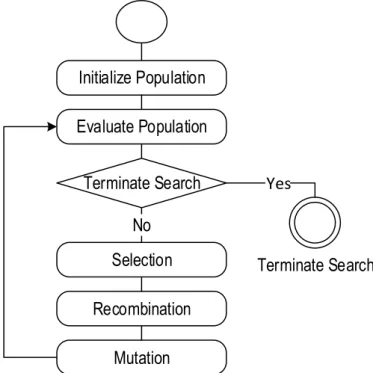
The execution life-cycle of a general and basic EA is shown in Figure 2.2. The optimisation process begins by generating an initial population of random
2.2. Evolutionary Algorithms 21
candidate solutions, which are then evaluated using problem specific objective functions and assigned fitness values based on the objective values and other potential indicator values which may be considered. The fitness values of the population solutions are then checked to identify whether any of the current solutions satisfy the termination criteria to terminate the optimisation process, otherwise the process will continue onto the selection of the fittest individuals from the current population, in order to exploit the genetic information contained within the best current solutions. The selected candidate solutions are then used for recombination to exploit the best solution information, and mutation to allow for exploration of the search space beyond the available solution information present in the population and attempts to prevent the possibility of getting stuck in a local optima.
Initialize Population Evaluate Population
Mutation Recombination
Selection Terminate Search Terminate Search Yes
No
Figure 2.2: General execution life-cycle diagram of a basic Evolutionary Algo-rithm.
2.2.1
Genetic Algorithms
A Genetic Algorithm is a single-objective optimisation algorithm which operates using a large population of solutions [44]. These solutions are encoded as a string of real numbers or traditionally as a binary bit string (sometimes referred to as a chromosome), an example of a binary chromosome is illustrated in Figure 2.3.
Parent 1 1 0 1 1 1 0 1 1 0 0 Parent 2
Offspring 1 1 0 1 0 0 0 1 1 1 0 Offspring 2
Mutated Offspring 2 0 1 1 1 1
Figure 2.3: An example of a binary encoded chromosome.
Initially, a predefined number of solutions are generated (limited by the pop-ulation size parameter) and evaluated using a fitness function to identify which solutions are better suited to solving the problem. An example of a simple fitness function is described in Equation 2.1. When putting the solution from Figure 2.3 through the fitness function it is assigned the fitness value 12.83, in a minimisa-tion problem, a smaller value indicates a better soluminimisa-tion. The fitness values of all the solutions are evaluated to check whether predefined termination criteria has been satisfied, this can be reaching a threshold fitness value or completing a number of generational iterations. If the criteria has not been satisfied the algorithm continues.
f itnessf unction(a, b, c, d, e) = ((a×32) + (b× −26) + (c× −5) + 50
(d+ 1)×(e+ 2) (2.1) Once each solution has been assigned a fitness value, new offspring solutions are typically generated by the selection and recombination of parent solutions. Selection can be achieved through various selection schemes, in this example roulette wheel selection [48] is used. In roulette wheel selection, the probability
2.2. Evolutionary Algorithms 23
of a solution being selected is proportional to their fitness, although it is not certain that the fittest solutions will be selected, only that they have a higher chance. To select an individual, a random number is generated between 0 and 100, this number is then checked against the roulette wheel to see which solution is selected. This has been illustrated in Figure 2.4, where if the randomly generated number is 17, then solution (1) is selected.
Figure 2.4: An illustration of four solutions subjected to roulette wheel selec-tion.
A random number is then generated between 0 and 1 to decide whether to perform the crossover process on the two selected parent individuals, this random number is checked against a predefined crossover rate parameter (controlling the probability that crossover will occur), and if the randomly generated number is lower, then the crossover is performed. A simple binary crossover regards the swapping of bits between the two binary chromosomes after a certain point in the binary bit string (single point crossover), this has been illustrated in Figure 2.5.
The example given in Figure 2.5 illustrates the crossover and mutation of two parent solutions in order to create two offspring solutions, one of which receives a mutation. In order to determine the position of the crossover point a number between 0 and the length of the binary bit string is randomly generated, the bit strings of the two parent solutions are then swapped at this point to produce two new offspring solutions. A random number between 0 and 1 is then generated and compared to see if it is lower than a pre-defined mutation rate parameter to decide whether mutation is to take place, the mutation rate is often very low for a binary encoded chromosome (e.g. 0.001). If mutation is to take place on either of the offspring solutions, a random position in the binary bit string is selected and the binary value is flipped (either from 0 to 1 or 1 to 0), in this example only Offspring 2 has received a mutation. This process of selection, recombination and mutation continues until the populations solution capacity has been met, and another iteration of the GA continues from the evaluation of solutions.
Parent 1 1 0 1 1 0 0 1 1 0 0 Parent 2
Offspring 1 1 0 1 0 0 0 1 1 1 0 Offspring 2
Mutated Offspring 2 0 1 1 1 1
Figure 2.5: An example of single-point binary crossover from position 3 in the binary bit string, and the mutation of binary position 5 in Offspring 2.
2.2. Evolutionary Algorithms 25
2.2.2
Evolution Strategies
Ideas of solving real-valued optimisation problems using an evolutionary process were considered by [26] and [27]. These ideas resulted in the formation of a set of algorithms named Evolution Strategies (ES), which differed from other EA methods in two ways: ES used real parameter values; and they did not use re-combination operators, instead the variation of solutions during the optimisation process is driven entirely by mutation. ES were typically implemented in two forms: two-member ES (1 + 1), in which a single parent is used to create a single offspring using a mutation operator; and multi-member ES (µ+λ) or (µ, λ), in which more than one parent solution (µ) is used to create λ offspring solutions using a mutation operator. In the (µ+λ) variation of the multi-member ES, both parent and offspring populations are considered in selection for the next parent population, where as in the (µ, λ) variation, only the offspring population is considered, making the (µ+λ) an elitist procedure.
2.2.3
Covariance Matrix Adaptation Evolution Strategy
The Covariance Matrix Adaptation Evolutionary Strategy (CMA-ES) is a state of the art single objective ES first introduced in [49, 50] and later improved upon in [51, 52]. ES typically use a multivariate normal distribution and rank-based selection to apply mutations to a population of solutions in order to continue searching to the next generation. The CMA-ES adapts the mean and full covari-ance matrix of this multivariate normal distribution (illustrated in Figure 2.6) to direct the search towards new solutions.
The CMA-ES is invariant against linear transformations of the search space, it has been shown to perform extremely well across a broad range of problems
Figure 2.6: “Six ellipsoids, depicting one-σ lines of equal density of six different normal distributions, whereσ ∈R+D is a diagonal matrix, and C is a positive definite full covariance matrix. Thin lines depict exemplary objective function contour lines.”
Nikolaus Hansen. The CMA evolution strategy: A comparing review, 2006. [53] in the continuous domain [54], and it is robust to the initial parameter set used due to its self-adaptive nature. CMA-ES can be used independently as a primary optimiser, but is often incorporated into other optimisation algorithms as a local optimiser. One of the key properties of CMA-ES is the speed at which it can find good approximations to (and in many cases the actual value of) the global minimum.
CMA-ES is an ES and therefore implements mutation as the only scheme for problem variable variation, in contrast to a GA which implements both a recombination and mutation scheme. This difference is an advantage for CMA-ES if it is to be extended for multi-objective and many-objective problems, as recombination operations often become inefficient as the number of problem ob-jectives increase. Solutions become more likely to be distant from each other in objective space as the number of objectives increase, such that two distant parent solutions are likely to produce offspring solutions that are also distant from the
2.3. Multi-Objective Optimisation 27
parents [55]. A disadvantage to CMA-ES is that it does not inherit any of the benefits from implementing recombination, which allows the exploitation of genes through the mixing of chromosomes. However, implementing recombination in CMA-ES would disrupt the sophisticated mutation scheme. Additionally, it has been shown in [56] that the NFL theorem does not hold in continuous search domains, meaning CMA-ES, which performs extremely well in the continuous domain, has an advantage over other algorithms.
Through many performance comparisons across different test suites of bench-mark problems (e.g. the competition results in [57, 54, 58]) the CMA-ES has been proven to be a powerful and robust optimiser.
2.3
Multi-Objective Optimisation
Multi-objective optimisation, as implied by the name, refers to problems with two or more objective functions, this is often the case with real-world problems in search and optimisation which naturally involve multiple objectives or multiple criteria [59].
A fundamental difference between single-objective optimisation and multi-objective optimisation is that in single-multi-objective optimisation problems, the ob-jective is to find a single solution which represents the global optimum in the entire search space, where as multi-objective optimisation problems often involve conflicts between multiple objectives, and as a result it is unlikely that there exists a single optimal solution. Therefore, in multi-objective optimisation a so-lution is an approximation set of candidate soso-lutions which offers a representation of the trade-offs between the multiple objectives, where any improvement in one
objective value will result in the degradation in one or more of the other objective values. This notion of “optimum” solutions is called Pareto-optimality.
x= (x1, x2, . . . , xn) (2.2) optimise fm(x), m= 1,2, . . . , M; subject to gj(x)≥0, j = 1,2, . . . , J; hk(x) = 0, k= 1,2, . . . , K; xi(L)≤xi ≤xi(U) i= 1,2, . . . , n; (2.3) f(x) = (f1(x), f2(x), f3(x), . . . , fM(x)) (2.4)
A solution x is defined in Equation 2.2 as a vector ofn decision variables. In Equation 2.3, a multi-objective optimisation problem is described in its general form, taken from [59]. There are M objective functions with the definition in Equation 2.4, these objective functions can be either minimised or maximised. The constraint functions gj(x) and hk(x) impose inequality and equality
con-straints that must be satisfied by a solution x in order for it to be considered a feasible solution. Another condition which affects the feasibility of a solution regards the adherence of a solutionxto values between the lowerx(iL) and upper
x(iU) boundaries within the decision space.
A set of non-dominated solutions1 generated by the optimiser is known as an
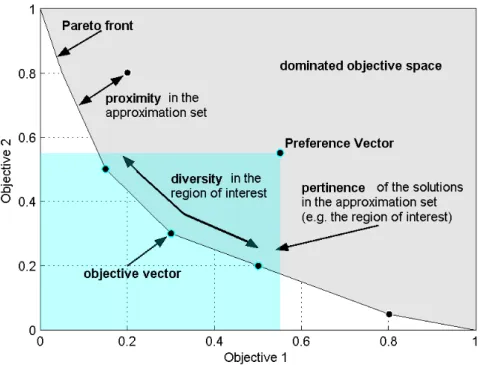
approximation set [60] and can be characterised in three key areas [61]. These are illustrated graphically in Figure 2.7 and listed in the following:
1A solution is termed non-dominated if there exists no other solution in the population that is superior to it in all considered problem objectives.
2.3. Multi-Objective Optimisation 29
• Proximity. This tells the Decision Maker (DM) how close the approximation set is to the true Pareto-optimal front. An ideal approximation set should be as close as possible in proximity to the true Pareto-optimal front.
• Diversity. This characterises the distribution of the approximation set both in the extent and uniformity of that distribution. The ideal approxima-tion set should be uniformly distributed across the trade-off surface of the problem.
• Pertinence. This criteria measures the relevance of the approximation set to the DM. Ideally the approximation set should contain a number of solutions which satisfy the DM’s expressed preferences.
Figure 2.7: Proximity, diversity, and pertinence characteristics in an approxi-mation set in bi-objective space.
Conventional multi-objective optimisation techniques often fail to satisfy these criteria. For example, the goal-attainment method [62] and the weighted-sum method [63] both only provide single solutions to the optimisation problem -thus failing to provide a diverse distribution of solutions. However, EAs are well suited to this kind of multi-objective optimisation since they search a population of candidate solutions and are thus capable of presenting a diverse approximation set to a DM [59].
Many theoretical EMO studies only consider a small number of objectives, with most of the published literature focussing on the bi-objective case. However complex real-world problems often require the consideration of a higher number of objectives. This has led to much interest amongst the research community in many-objective2 optimisation. The increased scale of a many-objective
optimi-sation problem means that thepertinence of the approximation set presented to a DM is especially important. The global trade-off surface for a problem with many conflicting objectives frequently contains many Pareto-optimal solutions, the majority of which may not be in the DM’s Region of Interest (ROI) [61]. In this case the exploration of those undesirable regions of the objective space results in inefficiency in terms of the use of computational resources and the quality of the final approximation set produced.
2.4
Evolutionary Multi-Objective Optimisation
Multi-objective optimisation problems had previously been solved by being en-capsulated as single-objective optimisation problems using techniques such as the 2The phrase many-objective has been used in the operations research community to refer to problems with more than the standard two or three objectives [64].
2.4. Evolutionary Multi-Objective Optimisation 31
weighted sum approach [65]. In this approach, different weights are assigned to each objective function based on their configured level of importance and pri-ority, these weighted objectives are then aggregated into a single weighted sum, allowing the use of conventional optimisation techniques to solve the problem. A major disadvantage of using the weighted sum approach and other conventional multi-objective optimisation approaches, is that they can only produce a single candidate solution per execution, and therefore require multiple executions to generate a set of trade-off solutions.
In contrast, EMO algorithms have inherited beneficial properties from the principles upon which they are based. EAs are suitable for solving multi-objective optimisation problems, due to being population based and therefore being able to generate and exploit more than a single solution per generational iteration, this allows EAs to find several solutions in the Pareto-optimal set in a single algorithm execution [6]. In addition, EMO algorithms do not require auxiliary or derivative information regarding the problem, do not require the aggregation of problem objectives into a single objective, and are less susceptible to the shape or continuity of the Pareto-optimal front.
Within the last decade there have been major advances in the field of EMO. Whilst the first generation of Pareto-based EMO’s algorithms (such as the Multi-Objective Genetic Algorithm (MOGA), the Niched Pareto Genetic Algorithm (NPGA), and the Nondominated Sorting Genetic Algorithm (NSGA)) were char-acterised by the simplicity of the algorithms and lack of rigorous methodology for their analysis [66], the latest generation of EMO algorithms have focussed on efficient convergence to the whole of the true Pareto-optimal front. This has been accomplished by incorporating elitism (ensuring that the best solutions are never
lost during the optimisation process) and advanced methods for the preservation of diversity (to ensure a good spread of solutions across the whole Pareto-optimal front) into the selection-for-survival process. There are two main strategies for incorporating elitism into EMO algorithms — maintaining an archive of non-dominated solutions, and using a (µ+λ) type selection-for-survival mechanism.
2.5
Diversity Preservation in Evolutionary
Multi-Objective Optimisation Algorithms
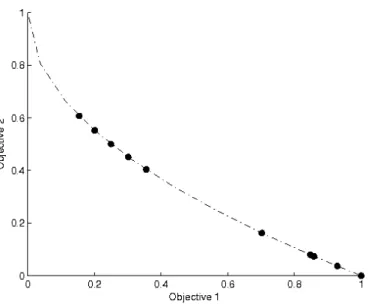
After proximity to the true Pareto-optimal front, diversity of solutions in the Pareto-optimal approximation set is the most desired quality in a robust EMO algorithm. The reason for this is because in EMO and multi-objective optimisa-tion in general, there exists no single ideal soluoptimisa-tion to a problem. Instead there exists many Pareto-optimal solutions, and in the Pareto-optimal approximation set the minimisation of one objective will result in the increase of another ob-jective. For this reason, the DM requires a set of Pareto-optimal solutions that are uniformly spread along the objective space, to allow the DM to observe the trade-off information and use domain specific expert knowledge to select a final solution.Figure 2.8 presents an ideal Pareto-optimal approximation set of solutions uniformly distributed along the Pareto-optimal front, this is a Pareto-optimal approximation set with both ideal proximity and diversity. In another scenario presented in Figure 2.9, the EMO process has successfully converged to solutions along the Pareto-optimal front, however it has not achieved a satisfactory level of diversity amongst solutions in the Pareto-optimal approximation set. This
2.5. Diversity Preservation in Evolutionary Multi-Objective Optimisation
Algorithms 33
scenario does not offer the DM with adequate information to make a well-informed decision.
Figure 2.8: A Pareto-optimal approximation set containing 10 solutions with ideal diversity.
Figure 2.9: A Pareto-optimal approximation set containing 10 solutions with undesirable diversity.
2.5.1
Conflicts between Proximity and Diversity
The EMO process (and multi-objective optimisation process in general) is pre-sented with a multi-objective trade-off of its own. This trade-off arises due to the conflict between attaining ideal proximity and diversity in an approximation set. This is a bi-objective trade-off which exists in most cases where the true Pareto-optimal front is not known. In such a case it is not possible to determine whether the approximation set has converged to the true Pareto-optimal front, and therefore diversity preservation cannot become the focus of the remainder of the search. However, diversity preservation usually comes second to obtaining a good approximation set, as stated in [67]. The goal of diversity preservation is to preserve diversity along an approximation set as close to the Pareto-optimal front as possible.
The example in Figure 2.10 illustrates the trade-off between proximity and diversity. Set 2 has a more diverse population of solutions in comparison to Set 1; however Set 1 is closer in proximity to the Pareto-optimal front than Set 2. In this case, the better diversity offered by Set 2 is not as valuable as the proximity offered by Set 1.
2.5. Diversity Preservation in Evolutionary Multi-Objective Optimisation
Algorithms 35
Figure 2.10: An illustration of the trade-off between proximity and diversity to the Pareto-optimal front of an objective function.
2.5.2
Methods of Diversity Preservation
There exist many novel concepts and variants of these concepts for the preserva-tion of diversity in a populapreserva-tion throughout the EMO process. In this secpreserva-tion a selection of methods of diversity preservation are described.
Adaptive Grid Algorithm
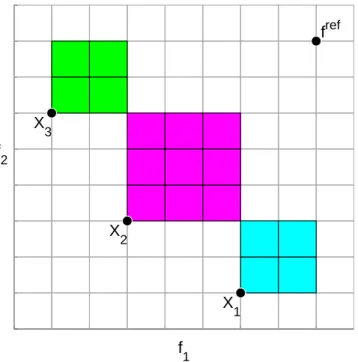
Bounded Pareto archiving (as in the Adaptive Grid Algorithm (AGA) strat-egy used in the PAES algorithm) is a simple yet powerful diversity preservation scheme which uses an adaptive grid to keep track of the density of solutions within divisions of the objective space [34]. To achieve this, a grid with a pre-set number of divisions is used to divide the objective space and when a solution is generated, its grid location is identified and associated with it. Each grid location is considered to contain its own sub-population, and information on how many
solutions in the archive are located within a certain grid location is available during the optimisation process, this has been illustrated in Figure 2.11.
0 0.2 0.4 0.6 0.8 −0.8 −0.6 −0.4 −0.2 0 0.2 0.4 0.6 0.8 1 1 2 3 4 5 6 7 8 9 10 11 12 13 14 15 16 17 18 19 20 21 22 23 24 25 26 27 28 29 30 31 32 33 34 35 36 37 38 39 40 41 42 43 44 45 46 47 48 49 50 51 52 53 54 55 56 57 58 59 60 61 62 63 64 65 66 67 68 69 70 71 72 73 74 75 76 77 78 79 80 81 82 83 84 85 86 87 88 89 90 91 92 93 94 95 96 97 98 99 100 Objective 1 Objective 2 1 2 3 4 5 6 7 8 9 10 11 12 13 14 15 16 17 18 19 20 21 22 23 24 25 26 27 28 29 30 31 32 33 34 35 36 37 38 39 40 41 42 43 44 45 46 47 48 49 50 51 52 53 54 55 56 57 58 59 60 61 62 63 64 65 66 67 68 69 70 71 72 73 74 75 76 77 78 79 80 81 82 83 84 85 86 87 88 89 90 91 92 93 94 95 96 97 98 99 100
Figure 2.11: An example plot of a population and visualisation of grid divisions managed by an AGA.
When an archive has reached capacity and a new candidate solution is to be archived, the information tracked by the AGA is used to replace a solution in a grid location containing the highest number of solutions. When a candidate solution is non-dominated in regards to the current solution and the archive, the grid information is used to select the solution from the least populated grid location as the current (and parent) solution.
The AGA concept used in PAES (described in Section 2.7.2) later inspired several researchers, and was altered and deployed in multiple EMO algorithms such as the Pareto Envelope-based Selection Algorithm (PESA) (a population