Phylogenetics
Accelerating Bayesian inference for evolutionary
biology models
Xavier Meyer
1,2,3, Bastien Chopard
2,3and Nicolas Salamin
1,2,*
1
Department of Ecology and Evolution, University of Lausanne, 1015 Lausanne, Switzerland,
2Swiss Institute of
Bioinformatics, Quartier Sorge, 1015 Lausanne, Switzerland and
3Department of Computer Science, University of
Geneva, 1211 Geneva, Switzerland
*To whom correspondence should be addressed. Associate Editor: Janet Kelso
Received on May 9, 2016; revised on October 12, 2016; editorial decision on November 7, 2016; accepted on November 11, 2016
Abstract
Motivation:
Bayesian inference is widely used nowadays and relies largely on Markov chain Monte
Carlo (MCMC) methods. Evolutionary biology has greatly benefited from the developments of
MCMC methods, but the design of more complex and realistic models and the ever growing
avail-ability of novel data is pushing the limits of the current use of these methods.
Results:
We present a parallel Metropolis-Hastings (M-H) framework built with a novel combination
of enhancements aimed towards rich and complex models. We show on a
parameter-rich macroevolutionary model increases of the sampling speed up to 35 times with 32 processors
when compared to a sequential M-H process. More importantly, our framework achieves up to a
twentyfold faster convergence to estimate the posterior probability of phylogenetic trees using 32
processors when compared to the well-known software
MrBayes
for Bayesian inference of
phylo-genetic trees.
Availability and Implementation:
https://bitbucket.org/XavMeyer/hogan
Contact:
Supplementary information:
Supplementary data
are available at
Bioinformatics
online.
1 Introduction
Model inference and hypothesis testing is nowadays widely per-formed using Bayesian inference. The surge of popularity of this statistical method is tightly linked with the theoretical and computa-tional developments of Markov chain Monte Carlo methods (MCMC;Hastings, 1970;Metropoliset al., 1953). Indeed, MCMC made possible the numerical approximation or sampling of high-dimensional posterior distribution, thus broadening the inference of more complex statistical models. Evolutionary biology particularly benefited from this progress and a large number of applications, ranging from phylogenetic reconstructions (Lartillot et al., 2013;
Ronquistet al., 2012), divergence time analyses (Drummondet al., 2006), molecular evolution (Dibet al., 2014), comparative methods (Beaulieu et al., 2012; FitzJohn, 2012) or population genetics (Kuhner, 2006;Fischeret al., 2011), makes extensive use of these MCMC approaches.
While popular, MCMC is limited by its inherent sequential na-ture and its dependency on user defined transition kernels. Moreover, complex models require costly computational evalu-ations of their likelihood function and their high-dimensional par-ameter-space is usually difficult to explore efficiently. A wide variety of approaches have been proposed to improve the sampling of some of these complex models. These solutions range from avoiding the evaluation of the likelihood function (Marjoram et al., 2003;
Mengersenet al., 2013) to using sequential Monte Carlo (Andrieu
et al., 2010;Cappeet al., 2007) or Hamiltonian Monte Carlo meth-ods (Duaneet al., 1987;Neal, 2011). However, these methods suffer from limitations that make them less generally applicable. For ex-ample, some have to be applied on a model-specific basis, may prove difficult to apply to high-dimensional parameter-space or require continuous parameters. These limitations are typical of Bayesian in-ference in phylogenetics. Indeed, the computational complexity of tree building grows with the length of the sequence data available as
VCThe Author 2016. Published by Oxford University Press. 669
This is an Open Access article distributed under the terms of the Creative Commons Attribution Non-Commercial License (http://creativecommons.org/licenses/by-nc/4.0/), which permits non-commercial re-use, distribution, and reproduction in any medium, provided the original work is properly cited. For commercial re-use, please contact [email protected]
doi: 10.1093/bioinformatics/btw712 Advance Access Publication Date: 7 December 2016 Original Paper
well as with the number of taxa, which also defines the amount of parameters and potential phylogenetic trees to consider (Felsenstein, 2004). Moreover, it is well known that sampling from this discrete space of phylogenetic trees is a particularly difficult task ( Bouchard-Coˆte´et al., 2012;Lakneret al., 2008).
Current approaches to build phylogenetic trees therefore still heavily relies on MCMC and any enhancements of these methods would be extremely useful for evolutionary biologists. Several stud-ies focused on the sampling effectiveness (or mixing) of the MCMC process and helped to propose theoretical guidelines to specify the optimal size for transition kernels based on normal distributions (Gelmanet al., 1996;Robertset al., 1997). These guidelines were used to develop the adaptive Metropolis algorithm (Haarioet al., 2001), which aims at optimally tuning a transition kernel using the observed empirical covariance of the Markov chain. The adaptive Metropolis method has been further improved by using component-wise scaling (Haarioet al., 2005), adaptively tuning the proposal size to target an optimal acceptance rate (Andrieu and Thoms, 2008) or exploiting the parameter covariance (Roberts and Rosenthal, 2009;Vihola, 2012). Some of these improvements have been implemented in the main software to build phylogenetic trees (Abereret al., 2014;Drummondet al., 2012;Ronquistet al., 2012).
However, few strategies were explored to improve MCMC effi-ciency by exploiting parallel computing. While some of these methods offer interesting properties, they usually suffer from limitations that hinder their general use on applied problems. For example, prefec-thing (Brockwell, 2006) aims at predicting the future states of the Markov chain to pre-process them in parallel. This method is however limited by the difficulty of accurately predicting the path of the Markov chain. We refer the reader to the recent review ofGreenet al.
(2015)for an extensive state-of-the-art description of this domain. We present here a novel combination of enhancements of the Metropolis-Hastings (M-H) framework specifically designed to ob-tain an efficient sampling of parameter-rich and complex models. We first present a multivariate adaptive proposal that coerces the ac-ceptance rate, balances the mixing among all parameters and ex-ploits their potential correlations. We then show that under a precise coupling of both adaptive MCMC and pre-fetching, we can achieve synergetic performance gains that exceed the sum of its parts. Finally, the framework properties are validated on various test cases and is then challenged on two real biological applications: a macroevolutionary model (Silvestroet al., 2014b) and on a model for Bayesian inference of the phylogeny (Felsenstein, 2004).
2 Methods
2.1 Background and notation
Starting from data X and a modelM with unknown parameters
H2Rd, we are interested in sampling the posterior distribution
pðHjXÞ ¼ÐfðHÞ fðXjHÞ fðHÞ fðXjHÞ
or its unnormalized density pðHÞ /fðHÞ fðXjHÞ. Sampling this distribution can be done by setting a Markov chain withpðHÞas sta-tionary distribution. This is done by considering a reversible Markov chain whose transition kernelpðU;HÞsatisfies the detailed balance equation
pðHÞpðH;UÞ ¼pðUÞpðU;HÞ 8 ðH;UÞ
The kernelpis based on two functions: an arbitrary transition kernelqðU;HÞ, also known as proposal window, and an acceptance
probabilityaðH;UÞ. The probability of leaving the stateHis given by
pðH;UÞ ¼qðH;UÞaðH;UÞ
withH6¼U, while the probability of staying in the same state is then given by
pðH;HÞ ¼1 ð
qðH;UÞaðH;UÞdU
Hastings (1970)proposed the following acceptance ratio aðH;UÞ ¼min 1;pðUÞqðU;HÞ
pðHÞqðH;UÞ
which simplifies to the original algorithm of Metropolis et al. (Metropoliset al., 1953) if the transition kernelqis symmetrical.
2.2 An efficient multivariate adaptive proposal
Our framework uses its own multivariate adaptive proposal specific-ally designed to maintain a low computational cost while exploiting the potential correlations between parameters in complex and parameter-rich models.
The original adaptive method presented byHaarioet al.(2001)
defines the proposal asU N ðH;kRÞwithkbeing the optimal scal-ing factor (Gelmanet al., 1996) andRthe observed empirical co-variance of the Markov chain. While being based on the same concepts, our adaptive process approximates the covariance matrix
Rusing stochastic approximation methods and optimizes the mixing by coercing the acceptance rate (Andrieu and Thoms, 2008). Given the sampleHtobserved at iterationtof the MCMC process, the glo-bal scaling factork, the parameter meanH and covarianceRare updated as follow Hðtþ1Þ¼HðtÞþcðtÞ ðHðtÞHðtÞ Þ Rðtþ1Þ¼RðtÞþcðtÞ ½ðHðtÞ HðtÞÞ ðHðtÞHðtÞ Þ RðtÞ logðkðtþ1ÞÞ ¼logðkðtÞÞ þcðtÞðaðtÞa?Þ (1)
witha?defining the target acceptance rate that optimizes the mixing (Robertset al., 1997) andaðtÞbeing the average observed acceptance rate aftertiterations.
The step sizec impacts the convergence of the approximation process and must have the following two properties (Robbins and Monro, 1951): P1t¼0cðtÞ¼ 1 and P1 t¼0ðcðtÞÞ 2 < 1. Sequences defined ascðtÞ¼C=tbwithb2 ½ð1þgÞ1
;1satisfy these conditions and their rate of convergence is determined by the two user-defined constantsCandg.
Coercing the global scaling factorkguarantees that the overall proposal acceptance rate is optimal by taking advantage of the in-formation made available by the MCMC process. However, it does not ensure a balanced mixing over all parameters. Component-wise scaling is able to solve this problem at the cost of dadditional likelihood evaluations (Haarioet al., 2005). The new component-wise or local scaling factorsK¼diagðk1;. . .;kdÞ,
esti-mated separately for each parameters, can then be used to scale the proposal over each dimension (corresponding to a parameter) as follows:
U N ðH;K1=2RK1=2Þ
This approach guarantees a more balanced mixing over all par-ameters while inducing a significant increase in computational cost.
A second drawback is the loss of control on the global acceptance rate. Indeed, independent parameters would lead to a global accept-ance rate defined asa¼Qdi¼1ai. However, in the more frequent case
of correlated parameters, the relation between local acceptance rates aiand the global acceptance ratearemains undefined.
In order to efficiently balance the mixing along all parameters, our adaptive proposal combines both local and global scaling vari-ants. This proposal maintains the coercion of the global acceptance rate by using the global scalingk, which is updated at each iteration. Component-wise updates are made periodically and the normalized scaling factors wi¼ki=Pdk¼1kk form the local scaling matrix
W¼diagðw1;. . .;wdÞ. The proposal then uses the global scaling to
target the overall size of the move while the normalized local scaling ensures a balanced mixing over all directions.
U N ðH;kW1=2RW1=2Þ (2)
The method that we propose can still be improved when the par-ametersHare correlated (Gilkset al., 1995). These correlations are exploited by using the geometric interpretation of the multivariate normal distribution. Since this distribution belongs to the family of elliptical distributions, it can be expressed by the directions of the principal axes of the ellipsoids. The spectral decomposition of the covariance matrix
R¼QEQ0¼QE1=2ðQE1=2Þ0
gives these directions as the eigenvectorsQ¼ ðV1; ::;VdÞand their
scaling as the eigenvaluesE¼diagðe1; ::;edÞ. We can then sample
from the distribution
X N ðl;RÞ lþQE1=2N ð0;IÞ
The component-wise scaling factors are used in this case to scale the size of the moves along the direction of the eigenvectorViand the
scaled eigenvectors ðkWE~ Þ1=2
can be used to build the following proposal
UHþQðkWE~ Þ1=2N ð0;IÞ (3) Our method is still limited by its additional computational cost that grows polynomially with the number of dimensionsd. The co-variance matrix is costly to learn since it requires linear algebra functions with complexityOðd2Þ. In addition, the generation of
ran-dom moves based on multivariate distributions requires the Cholesky or eigen-decomposition of the scaled covariance matrix at a computational cost ofOðd3Þ. The decomposition must be updated
wheneverRandKchange.
We created smaller blocks of parameters to reduce the computa-tional burden and monitored the convergence of the adaptive phase (see supporting materials). Moreover, our adaptive proposal evolves with the information contained in the covariance matrix. In the initial
phase, parameters are considered independent. The covariance matrix is learned as usual but moves are independently generated from
U N ðH;kW1=2R~W1=2
Þ with R~¼diagðr2
1;. . .;r 2
dÞ; (4)
which avoids the Cholesky or eigen-decomposition step. Upon con-vergence detection ofR, the observed degree of correlation between parameters is assessed. If no significant correlations are detected, the training phase ends. Otherwise the proposal is switched to a pro-posal based on the fullRmatrix (Eqs. (2)or (3)) and the training phase is prolonged until a second convergence is reached.
2.3 Securing an optimal pre-fetching
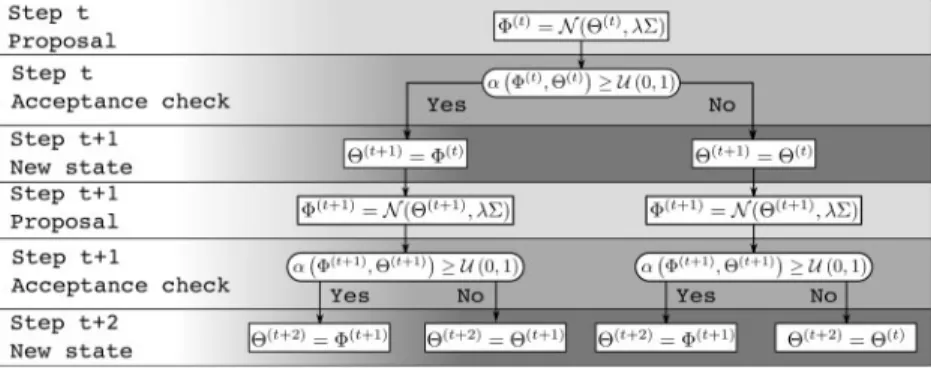
Our adaptive proposal greatly improves the mixing properties of the MCMC, but it can also enhance the performances of a parallel MCMC method. Markov chains are an inherently sequential process due to the dependencies between states in two subsequent iterations of a chain. Obtaining speed improvements by using parallel computing techniques is therefore an important challenge. Pre-fetching (Brockwell, 2006) overcomes this limitation by pre-processing the pos-sible paths that the Markov chain could take during a set of iterations. The future path of a MCMC can be represented as a decision tree (Fig. 1). Given that the chain at timetis in stateHðtÞ, a new state
UðtÞ is proposed. This new state is then accepted or rejected with probability aðHðtÞ;UðtÞÞ. Branches of the tree represent these two possible paths of the MCMC process. Each state, or node, leads to two subtrees corresponding to either an acceptance or a rejection.
The likelihood computation of the future possible statesUcan then be distributed over multiple processors. Given that several samples are generated during the same amount of time that it pre-viously took for one, this results in a significant speed up. However, given the tree structure of the possible paths of the Markov chain, an exhaustive approach to getD¼kuseful sam-ples, or draws, per pre-fetching iterations would requirenp¼2k
1 processors. This strategy scales poorly since the number of wasted likelihood computations corresponding to unvisited state grows exponentially withk.
Various strategies (Strid, 2010) aiming at determining the most probable path in the decision tree have been proposed to improve the scaling of this method. One of these strategies uses the mean observed acceptance rate of the chainaas a predictor for the most probable paths. As definedin (Strid, 2010, Eq. 8), the efficiency of this method can be estimated by a performance model that depends on the acceptance rate and the number of available processors:
Eða;npÞ ¼E1ðaÞ Dða;npÞ (5)
whereE1ðaÞdefines the mixing efficiency for an i.i.d normal
distrib-uted proposal withd! 1(Strid, 2010, Eq. 7) andDða;npÞis the
expected number of draws per pre-fetching iterations (Strid, 2010,
Eq. 1).
The expected number of drawsDða;npÞis equal tonpand thus
optimal fora¼0 ora¼1. With sucha, pre-fetching is indeed able to exactly predict the path of the Markov chain by considering moves as being always rejected, respectively accepted. Such predic-tion would be represented by the right most, respectively left most, branch in the decision tree (Fig. 1). The expected number of draws Dða;npÞreduces asaapproaches 0.5, since predictions are less
ac-curate. Whenareaches 0.5, any path in the decision tree is equally probable and thus pre-fetching is back to using the inefficient ex-haustive approach of computing all the possible paths (D¼log2np).
On the other hand, the mixing efficiency of a proposalE1ðaÞ
peaks at an optimal avalue of 0.234 with d! 1 (Roberts and Rosenthal, 2001). Therefore, the optimal acceptance ratea? for a given number of processors can be derived from equation 5and expresses the optimal trade-off between an efficient mixing and ac-curate predictions for pre-fetching. In others words, the efficiency of both method is then controlled by the average acceptance rateaof the proposals and is optimal fora?.
Therefore, we coupled pre-fetching to our adaptive proposals by coercing their acceptance rate to the valuea?optimizingequation 5 through the global scaling factork. Although we do not know a pri-ori the acceptance rate of the MCMC process, this approach ensure that it will quickly reach the vicinity of the target acceptance ratea?. This combination of methods will optimize the efficiency of the pre-fetching method by finding the optimal size of the proposal window in function of the number of available processors and regardless of the model.
In return of providing these optimal conditions for the pre-fetching method, the adaptive proposal also benefits from this cou-pling. During a fetching iteration, only a certain number of pre-dicted states are retained, while the remaining unused ones are discarded. However, our adaptive proposal takes advantage of these wasted likelihood evaluations. During one iteration, all the accept-ance ratesaestimated to predict the chain path in the decision tree offer usable information that can help the updating ofk. The advan-tage is that the training process becomes more accurate and adapts more quickly to the parameter space, becausekis adapted more fre-quently. This results in a better sampling efficiency and reduces the time required to reach the equilibrium of the Markov chain, also known as burn-in phase. These improvements apply equally well, if not better, to the local scaling factorsKby processing the unidimen-sional moves in parallel and thus offering a nearly ideal speed-up of this costly operation (see Algorithm 1 in the supplementary materialsfor an outline of the main steps taking place during an iter-ation of the presented method).
2.4 Assessing the framework performance
In a first phase, we compare, using simple models, multiple strat-egies to highlight the contributions of each enhancement that are at the core of our new framework. Two strategies using non-adaptive random walk M-H with pre-fetching method are used as reference: thePFmethod emulates user-defined proposal windows by using relevant but sub-optimal size of the proposals, whileOPPFuses opti-malproposal windows that are scaled based onEq. (5)and guide-lines from Roberts and Rosenthal (2001) to target the optimal acceptance ratea?. These two methods are compared with variants of our new framework based on pre-fetching and adaptive proposal scaled locally and globally. The three variantsSTD,MIXEDandPCA correspond to the three proposals described byEqs. (4),(2)and(3),
respectively. These experiments and their results are detailed and discussed in thesupplementary materials.
In a second phase, we challenge our best strategy PCA on a macro-evolutionary model (Silvestroet al., 2014a) on a large em-piric dataset. Then, our framework is compared with the widely used MrBayes software (Ronquist et al., 2012) on a codon-substitution model with fixed tree topology as well as on the task of inferring trees with a nucleotide model. The complexity of these models and the fact thatMrBayesalready incorporate a form of adaptive proposals offer a more instructive benchmark (all measures were made usingMrBayes3.2.5 compiled with SSE support and MPI enabled). Furthermore, whileMrBayeswas chosen as a refer-ence, the performance gains measured in this benchmark result from the presented enhancements of the MCMC method and thus should apply similarly to any alternative software independently of the effi-ciency of the likelihood computations.
2.4.1 Performance measures
We measured the efficiency in two ways. We first estimated the sam-ple size (ESS;Liu, 2008) that gives an indication of the potential number of usable samples. This number is defined as the ratio be-tween the total number of samples and their integrated auto-correlation time (ACT). Then, in order to properly assess the per-formance of our framework on the inference of trees, we measured the convergence rate of the phylogenetic tree distribution using the average standard deviation of split frequency (ASDSF;Lakneret al., 2008). The overall performance of the framework is measured using the speedupSdefined as
S¼gðnp;MÞ tðnp;MÞ
gð1;MRÞ tð1;MRÞ
(6) with thegðnp;MÞbeing the averaged measures (i.e. ACT or ASDSF),
tðnp;MÞthe averaged run time fornpprocessors and the methodM.
We mainly compare the measures of each methodMto the reference methodMRwith 1 processor. The speedup indicates the gain
pro-vided by the increase in mixing or rate of convergence in addition of the loss caused by the additional time spent during the adaptive phase plus the overhead of the communications between processors. 2.4.2 Hierarchical bayesian model
The modelPyRate(Silvestroet al., 2014a) is used to illustrate the actual performance of our methods on simulated and real datasets. This hierarchical Bayesian model analyses speciation and extinction rates of large collections of fossils and estimates large numbers of parameters including the preservation rate, the time of speciation and extinction of each species and the speciation and extinction rates with their variation trough time. This model has a complexity order ofOðNÞand only few parameters are correlated. These prop-erties are particularly interesting because the relatively inexpensive likelihood will highlight the overhead of the framework, while the low amount of correlations will illustrate its ability to exploit correlations.
Our framework was challenged on a large dataset of plant fossils (Silvestroet al., 2015). This dataset contains 22 415 fossil occur-rences assigned to 443 plant genera. It spans over a hundred millions of years divided in 31 predefined epochs, which were defined by the stratigraphic geological time scale.
2.4.3 Codon-substitution model
We use the well-known model of codon substitutionsM2a, which was developed to identify positive selection on protein coding genes,
to illustrate the mixing performance of our framework on methods for molecular evolution (Yanget al., 2000). Given a fixed phylogen-etic tree and a set of protein coding sequences, theM2amodel esti-mates the selective pressure on codon sites through the use of a mixture of three site-classes having different synonymous to non-synonymous substitution ratesx: purifying selection (x0< 0),
neu-tral evolution (x1¼1) and positive selection (x2>1). Beside the
es-timation of the parameter values for each site-class x and their respective proportions, this model estimates the overall transition-transversion rate and the branch lengths of the tree. The computa-tional cost of theM2amodel exceeds significantly the cost of the PyRatemodel since it requires matrix exponentiations and matrix-matrix operations (both having a complexity order ofOðN3Þ) that
depends on the alignment length and the tree size. It thus offers a completely different sampling challenge than the one ofPyRate.
The performance of our framework was tested by computer simulations. We used two simulated datasets created using INDELible(Fletcher and Yang, 2009). These datasets represented alignments formed of 100 codons simulated under mild purifying se-lection (x¼0:8) on phylogenetic trees having 16 taxa (Dataset 1) and 32 taxa (Dataset 2). We took particular care to ensure an in-formative comparison of our implementation withMrBayes. The simulated phylogenetic tree was used as a fixed tree topology and the MC3method was disabled. Under this circumstance, our imple-mentations andMrBayessampled the same set of parameters and both used adaptive proposals.
2.4.4 Estimating phylogenetic trees distribution
As a final illustration, we challenged our framework with the esti-mation of the posterior distributions of phylogenetic trees with their branch lengths and parameters of a general time reversible (GTR) model of nucleotide substitution (Tavare´, 1986). This substitution model presents a lesser computational challenge than the codon modelM2a. However, the major difficulty resides in properly sam-pling the space of potential phylogenetic trees. This tree space grows exponentially with the number of taxa and can only be explored with specific tree proposals (Felsenstein, 2004). For that matter, we implemented two widely used tree proposals: the Stochastic Nearest Neighbor Interchange (stNNI) and the Extending Subtree Pruning and Regrafting (eSPR) in our framework.
We compared our framework performance toMrBayesunder two different settings. In the first setting, later referred as Ref
MrBayes, only the stNNI and eSPR tree proposals were enabled to mimic our own implementation. In the second setting, later referred asFull MrBayes, the default configuration ofMrBayeswas used.
All the aforementioned settings (including our framework) were compared with and without the MC3method on two empirical DNA datasets used in Lakner et al. (2008) and available in TreeBASE (http://www.treebase.org). The first one, M2017(legacy ID M336) has 27 taxa and 1949 sites, while the second dataset,M2152(legacy IDM520) has 67 taxa and 1098 sites. Finally, to give an insight of our method potential on larger dataset, we used a DNA empirical dataset published byPyron and Wiens (2011)representing over 2800 species of amphibians with more than 10 000 sites.
3 Results and discussion
3.1 Performance gain on
PyRate
model
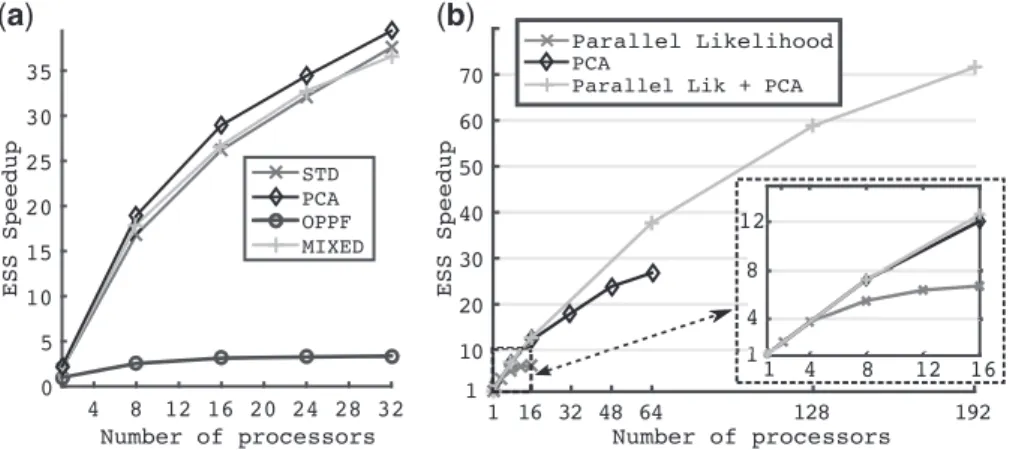
We challenged our new framework by analysing a large dataset of plant fossils (Silvestroet al., 2015) withPyRate. The complex and heterogeneous parameter space of the empirical model highlighted the full potential of our new framework. Adaptive methods revealed speedups between 2 to over 35 times when compared to the non-adaptiveOPPFmethod depending on the number of processors used (Fig. 2a).PCAsurpassed the other adaptive methods by exploiting the small amount of correlation that existed in the model.
In this application, the number of free parameters to estimate was approximately 1000, which makes it almost impossible for a user to guess a sensible set of proposal distribution for this real data-set. Indeed, the mean variance of the observed chain for species birth and death times ranged from 1 to 425 with average value of 138 and standard deviation of 110. Using the average variance to define the proposal distribution would result in some parameters being nearly never sampled. Actually moves configured with the observed aver-age variance would be rejected almost all the times when applied to parameters with variances one hundred-fold smaller. We therefore fixed an arbitrary size for proposal distribution of 5 for OPPF, which allowed each parameter to be sampled.
To illustrate the gains of the adaptive methods, let us consider the case where we would like to sample this model with an average ESS of 500 per parameter. The runtime of such a task can be esti-mated by adding the timeTBIspent in the burn-in to the estimated sampling timeTS. The former is directly measurable, while the latter
can be estimated based on the desired numberNESSof ESS and the
(
a
)
(
b
)
Fig. 2. Result forPyRatemodel on plant fossils data. The figure on the left shows the speedup of each method usingOPPFwith 1 processor as the reference. The right figure shows the parallel scalability of the framework when compared or combined to a parallel computation of thePyRatelikelihood. Settings for these simulations wered 1000;8106iterations and 3 runs
average observed timeTESSrequired to produce one ESS. Therefore,
the time to produce an average of 500 ESS using thePF method with one processor would be given by
TPF¼TBIþTS¼TBIþNESSTESS
¼1600þ50047¼2:35104seconds
(i.e. 7 h). Switching to thePCAmethod, it would take only two and a half hours to reach the same level of ESS on one processor (TBI¼2670;S¼12) and the time would reduce to 17 minutes if 16
processors (TBI¼230;S¼1:6) would be used.
Beside the differences in computation time, theOPPF method would further produce a highly uneven sampling of all parameters due to the suboptimal proposal distributions. This was illustrated by the variation of ACT over all parameters. We observed an average ACT of 740 with standard deviation of 877 for thePFmethod. The PCAmethod produced in contrast a far more reliable quality of sam-pling and its ACT variation reached only 1936273 for 1 processor and 2196177 for 16 processors.
3.1.1 Comparison with parallel likelihood
We measured the raw parallel performance gain of our framework when confronted or combined to a parallel computation of the PyRatelikelihood. We thus compared the performance of thePCA adaptive proposal combined witha) a parallel likelihood,b) pre-fetching (our framework) andc)both methods.
Our framework performance (variantb) clearly surpassed the parallel likelihood one. It showed a nearly linear speedup up to 8 processors and notable gains up to 48 processors, while the parallel likelihood (varianta) showed a nearly linear speedup up to 4–6 pro-cessors before reaching a plateau with no gain in performance (Fig. 2b). The combination of both methods (variantc) showed the poten-tial of coupling model dependent improvements with our frame-work by greatly increasing the parallel scalability and reaching speedups of 40 for 64 processors and 60 for 128 processors.
For this measures, we used thePCA proposal as the reference method in order to measure the parallel scalability without being biased by the gain induced by our adaptive proposals. Thus the speedup was measured according toEq. (6)withMR¼PCAusing
thePyRatemodel on the plant fossil dataset.
3.2 Performance gain on phylogenetic models
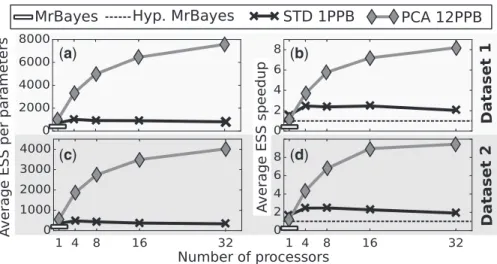
3.2.1 Mixing on codon-substitution modelsWe assessed the performance of our framework on theM2amodel of codon substitutions with simulated data. As a reference, we compared a sequential execution ofSTDwith one parameter per block against the adaptive MCMC based algorithm implemented inMrBayes. The average ESS obtained were comparable, yet slightly better for our STDvariant (Fig. 3a and c). We then compared our best method,PCA, with 12 parameters per block and showed an improvement in sam-pling performances. Indeed, the increase of average ESS when com-pared to MrBayes went from more than a twofold factor on a sequential execution up to a twentyfold factor with 32 processors.
While representing the mixing efficiency of these methods, the ESS does not take into account the added computational complexity brought by moving multiple parameters at once. Indeed, Bayesian software for phylogenetic inference such asMrBayesare taking ad-vantage of the possibility to partially update the likelihood when one or few parameters are changed. The computational cost during an iteration is then linked to the amount of parameters updated. Therefore, using the ESS speedup defined byEq. 6is more appropri-ate given that it encompasses these increases in computational cost by normalizing the ESS by the execution time. However, since our implementation outperformedMrBayeson this model (see support-ing materials), we had to define as reference, MR, an
Hypothetical MrBayesby defining the average reference ESS,
gð1;MRÞ, as the one ofMrBayesand the average runtime,tð1;MRÞ,
as the one of ourSTDimplementation. The reference thus represents the effective sample size ofMrBayesnormalized by the runtime of our method with settings closest toMrBayes(i.e. updating only one parameter per iteration).
The obtained ESS speedups (Fig. 3b and d) show that our imple-mentation were still outperforming the hypothetical reference method from close to a twofold factor on a sequential execution and up to ap-proximately a tenfold factor with 32 processors. However, in the se-quential case, the simpleSTDmethod was more efficient than thePCA variant. This is explained by considering the overhead of more costly partial likelihood computations and the added cost of learning param-eters correlation. However, as soon as several processors were used, and thus our coupling of the adaptive proposals with the pre-fetching method was employed, the PCA variant was more efficient by
(
a
)
(
b
)
(
c
)
(
d
)
Fig. 3. Result for the ESS and ESS speedup comparison with MrBayes on theM2acodon substitution model with simulated data. (a) and (c) The average ESS per parameter on the first, respectively second, datasets for MrBayes, theSTDmethod using single parameter moves and thePCAmethod with multiples parameters per block. (c) and (d) The ESS speedup for the same methods on the same datasets using an hypothetical MrBayes implementation as reference. Simulations were run for 2105iterations
proposing bolder moves and using the parallel resources to learn cor-relations more accurately and quickly.
3.2.2 Convergence on phylogenetic tree distributions
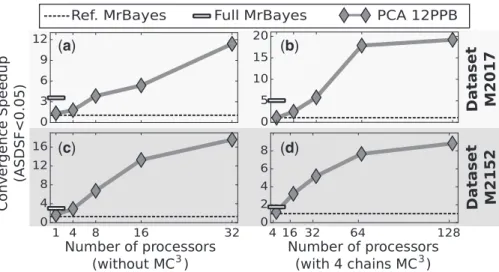
Our framework was finally evaluated on the sampling of the poster-ior distributions of trees and parameters of the model of nucleotide substitution. At this task, our best method,PCAwith 32 processors, was able (Fig. 4) to converge towards the posterior distribution up to 10-20 times faster than its equivalentRef MrBayes. When com-pared to the default settings ofMrBayes (Full MrBayes) with more advanced tree proposals, our method still showed faster con-vergence rate as soon as 4–8 processors were used. Against this MrBayessetting, the convergence speedup reached approximately a fourfold factor with 32 processors.
Figure 4a and cillustrate the speedup in ASDSF convergence on datasets M2017 and M2152, respectively, usingRef MrBayes set-ting without MC3as reference. Indeed, theRef MrBayessetting showed similar execution time and convergence performance as our STDvariant with updates on one parameter per iteration (see appen-dix).PCAslightly outperformedRef MrBayesin the sequential case but was still far from the performance offered byFull MrBayes. However as the number of processors used increased, the perform-ance ofPCAexceeded bothMrBayessettings. To highlight the ver-satility of our framework, we applied the same experiment but with MC3 enabled on our framework andMrBayes. Figure 4b and d
show the speedup in ASDSF convergence on both datasets with four parallel tempered chains. The trend shown in this second experiment is consistent with our previous results and the speedup of PCA increased with the number of processors used and surpassed the per-formance ofRef MrBayesandFull MrBayes.
The improvement on convergence rates brought by our frame-work on this problem is linked with the difficulty of moving through the phylogenetic tree space. Tree proposals are usually suffering from a low acceptance rate and are thus frequently re-jected. Indeed, in our experiment, the acceptance rates for tree pro-posals were lower than 0.05. Such moves are not currently adaptive, but they remain easily predictable and therefore exploit-able by the pre-fetching method. While this assumption of low ac-ceptance rate on tree proposals is true for most datasets, it might falter on some of them. To get around this limitation, tree
proposals could be made adaptive by tuning the extension prob-ability (e.g. for eSPR) or the proposals on branch lengths that are jointly applied to tree modifications.
Our results suggest that the approach that we propose has large potentials on more challenging datasets, but the datasets used in previous experiments were easily analyzable using existing soft-ware. We therefore used a large dataset representing more than 2800 species with 12 genes of the amphibian family (Pyron and Wiens, 2011) to challenge bothFull MrBayesandPCA. For this experiment, we compared four separate runs ofFull MrBayes using each four tempered chains with four separate runs of our best method,PCA, with 4 tempered chains having each 32 proces-sors dedicated to our coupling of adaptive MCMC and pre-fetching. WhileFull MrBayestook more than five days to ap-proach a likelihood plateau (Fig. 5),PCAreached it in less than one day. It is worthwhile to mention that ifPCAwould be augmented with the advanced tree proposals present inFull MrBayes, fur-ther performance gains could be observed.
4 Conclusion
Building an efficient MCMC sampler for parameter-rich and complex models is challenging given their inherent expensive computational cost and high parameter-dimensiond. Indeed, most of the existing MCMC enhancements may prove inefficient due to their increase in computational effort caused by additional likelihood evaluations or complex operations depending ond(OðdxÞ;x>1) (e.g.Haarioet al.,
Fig. 5. Trace of the log likelihood when estimating the posterior distribution of the phylogenetic tree, branch lengths and nucleotide substitution parameters on an empiric dataset having 2800 species with 12 genes of the amphibian familiy. Average trace and 95% confidence interval are shown for 4 independent runs with of 4 parallel tempered chains of Full MrBayes and PCA with 32 processors
(
a
)
(
b
)
(
c
)
(
d
)
Fig. 4. Results for the ASDSF convergence speedup comparison with MrBayes when estimating the posterior distribution of the phylogenetic tree and the nucleo-tide substitution parameters on empiric datasets (TreeBASE M2017 and M2152). (a) and (c) The ASDSF speedup the first, respectively second, datasets for two settings of MrBayes and ourPCAmethod with multiples parameters per block. (c) and (d) illustrate the ASDSF speedup on the same datasets when the previous methods are augmented withPCA
2005). We presented a M-H framework that overcomes this difficul-ties by using the coupling of a novel adaptive proposal and pre-fetching. We showed that our new framework improved the mixing, reduced the burn-in phase and speed up the sampling by an order of magnitude when applied to several models of varying complexity including the difficult task of estimating the posterior probability of phylogenetic trees using evolutionary models.
Model dependent enhancements can be used to further improve the performance gain highlighted, as demonstrated by the addition of parallel likelihood computations (Fig. 2b) or MC3(Fig. 4). Therefore existing evolutionary biology state-of-the-art software, such as MrBayes(Ronquistet al., 2012) or ExaBayes (Abereret al., 2014), could directly benefit from this framework. Furthermore, since this method is based on speeding up a single M-H process, it could be used as the core of more advanced MCMC methods such as trans-dimensional MCMC (Sisson, 2005) or even Bayes factors computa-tion using thermodynamic integracomputa-tion (Lartillot and Philippe, 2006).
Further capabilities could be built on top of this framework by exploring new approaches such as adaptive tree proposals or an automatic clustering of parameters into optimal blocks. Therefore, beside broadening the range of evolutionary hypothesis tractable using Bayesian inference, our parallel M-H framework provides a potential basis for a new generation of efficient parallel MCMC samplers for parameter-rich models such as those that are currently developed in biological studies.
Acknowledgments
We would like to thank Daniele Silvestro and Orestis Malaspinas for useful discussions on initial versions of this manuscript. We also thank the Vital-IT facilities of the Swiss Institute of Bioinformatics, the Center of Advanced Modeling of Sciences and the University of Geneva HPC team for providing the computational resources for this study.
Funding
This work was supported by a Swiss National Science Foundation grant CR32I3_143768 to N.S. and B.C.
Conflict of Interest: none declared.
References
Aberer,A.J.et al. (2014) Exabayes: massively parallel Bayesian tree inference for the whole-genome era.Mol. Biol. Evol.,31, 2553–2556.
Andrieu,C. and Thoms,J. (2008) A tutorial on adaptive MCMC. Stat.
Comput.,18, 343–373.
Andrieu,C.et al. (2010) Particle Markov chain Monte Carlo methods.J. R.
Stat. Soc. Ser. B (Stat. Methodol.),72, 269–342.
Beaulieu,J.M. et al. (2012) Modeling stabilizing selection: expanding the
OrnsteinUhlenbeck Model of adaptive evolution.Evolution,66, 2369–2383. Bouchard-Coˆte´,A.et al. (2012) Phylogenetic inference via sequential Monte
Carlo.Syst. Biol., syr131.
Brockwell,A.E. (2006) Parallel Markov chain Monte Carlo Simulation by Pre-Fetching.J. Comput. Graph. Stat.,15, 246–261.
Brooks,S. et al. (2011)Handbook of Markov Chain Monte Carlo. CRC press,
Boca Raton.
Cappe,O.et al. (2007) An overview of existing methods and recent advances
in Sequential Monte Carlo.Proc. IEEE,95, 899–924.
Dib,L.et al. (2014) Evolutionary footprint of coevolving positions in genes.
Bioinformatics,30, 1241–1249.
Drummond,A.J.et al. (2006) Relaxed Phylogenetics and dating with
confi-dence.PLoS Biol.,4, e88.
Drummond,A.J.et al. (2012) Bayesian phylogenetics with beauti and the beast 1.7.Mol. Biol. Evol.,29, 1969–1973.
Duane,S.et al. (1987) Hybrid Monte Carlo.Phys. Lett. B,195, 216–222. Felsenstein,J. (2004)Inferring phylogenies. Sinauer Associates, Sunderland.
Fischer,M.C.et al. (2011) Enhanced AFLP genome scans detect local
adapta-tion in high-altitude populaadapta-tions of a small rodent (Microtus arvalis).Mol. Ecol.,20, 1450–1462.
FitzJohn,R.G. (2012) Diversitree: comparative phylogenetic analyses of diver-sification in R.Methods Ecol. Evol.,3, 1084–1092.
Fletcher,W. and Yang,Z. (2009) INDELible: a flexible simulator of biological sequence evolution.Mol. Biol. Evol.,26, 1879–1888.
Gelman,A.et al. (1996) Efficient metropolis jumping rules.Bayesian statistics, 5, 599–608.
Gilks,W.R.et al. (1995).Markov Chain Monte Carlo in Practice. CRC Press,
London.
Green,P.J.et al. (2015) Bayesian computation: a summary of the current state,
and samples backwards and forwards.Stat. Comput.,25, 835–862.
Haario,H.et al. (2001) An adaptive Metropolis algorithm.Bernoulli,7, 223–242.
Haario,H.et al. (2005) Componentwise adaptation for high dimensional
MCMC.Comput. Stat.,20, 265–273.
Hastings,W.K. (1970) Monte Carlo sampling methods using Markov chains and their applications.Biometrika,57, 97–109.
Kuhner,M.K. (2006) LAMARC 2.0: maximum likelihood and Bayesian esti-mation of population parameters.Bioinformatics,22, 768–770.
Lakner,C.et al. (2008) Efficiency of Markov chain Monte Carlo tree proposals in Bayesian phylogenetics.Syst. Biol.,57, 86–103.
Lartillot,N. and Philippe,H. (2006) Computing Bayes factors using thermo-dynamic integration.Syst. Biol.,55, 195–207.
Lartillot,N.et al. (2013) PhyloBayes MPI. Phylogenetic reconstruction with infinite mixtures of profiles in a parallel environment.Syst. Biol., syt022.
Liu,J.S. (2008)Monte Carlo Strategies in Scientific Computing. Springer
Science & Business Media, New York.
Marjoram,P.et al. (2003) Markov chain Monte Carlo without likelihoods.
Proc. Natl. Acad. Sci. U. S. A.,100, 15324–15328.
Mengersen,K.L.et al. (2013) Bayesian computation via empirical likelihood.
Proc. Natl. Acad. Sci. U. S. A.,110, 1321–1326.
Metropolis,N.et al. (1953) Equation of state calculations by fast computing machines.J. Chem. Phys.,21, 1087–1092.
Pyron,R.A. and Wiens,J.J. (2011) A large-scale phylogeny of amphibia includ-ing over 2800 species, and a revised classification of extant frogs, salaman-ders, and caecilians.Mol. Phylogenet. Evol.,61, 543–583.
Robbins,H. and Monro,S. (1951) A stochastic approximation method.Ann.
Math. Stat.,22, 400–407.
Roberts,G.O. and Rosenthal,J.S. (2001) Optimal scaling for various Metropolis-Hastings algorithms.Stat. Sci.,16, 351–367.
Roberts,G.O. and Rosenthal,J.S. (2009) Examples of adaptive MCMC.J.
Comput. Graph. Stat.,18, 349–367.
Roberts,G.O.et al. (1997) Weak convergence and optimal scaling of random
walk Metropolis algorithms.Ann. Appl. Probab.,7, 110–120.
Ronquist,F.et al. (2012)MrBayes3.2: efficient bayesian phylogenetic infer-ence and model choice across a large model space.Syst. Biol.,61, 539–542. Silvestro,D.et al. (2014a) Bayesian estimation of speciation and extinction
from incomplete fossil occurrence data.Syst. Biol., syu006.
Silvestro,D.et al. (2014b) PyRate: a new program to estimate speciation and
extinction rates from incomplete fossil data. Methods Ecol. Evol., 5,
1126–1131.
Silvestro,D.et al. (2015) Revisiting the origin and diversification of vascular plants through a comprehensive Bayesian analysis of the fossil record.New Phytol,2, 425–436.
Sisson,S.A. (2005) Transdimensional Markov Chains. A decade of progress and future perspectives.J. Am. Stat. Assoc.,100, 1077–1089.
Strid,I. (2010) Efficient parallelisation of Metropolis-Hastings algorithms
using a prefetching approach.Comput. Stat. Data Anal.,54, 2814–2835.
Tavare´,S. (1986) Some probabilistic and statistical problems in the analysis of DNA sequences.Lect. Math. Life Sci.,17, 57–86.
Vihola,M. (2012) Robust adaptive Metropolis algorithm with coerced accept-ance rate.Stat. Comput.,22, 997–1008.
Yang,Z.et al. (2000) Codon-substitution models for heterogeneous selection pressure at amino acid sites.Genetics,155, 431–449.