U
NIVERSITÀ DI
P
ADOVA
F
ACOLTÀ DI
I
NGEGNERIA
DIPARTIMENTO DI
INGEGNERIA DELL’I
NFORMAZIONESCUOLA DI
DOTTORATO IN
INGEGNERIA DELL’INFORMAZIONE
INDIRIZZO IN
SCIENZA E
T
ECNOLOGIA DELL’INFORMAZIONEXXV Ciclo
Coping with spectrum and energy scarcity
in Wireless Networks:
a Stochastic Optimization approach to
Cognitive Radio and Energy Harvesting
Dottorando
NICOLÒ
MICHELUSI
Supervisore: Direttore della Scuola:
Chiar.moProf. Michele Zorzi Chiar.moProf. Matteo Bertocco
Coordinatore di Indirizzo:
Chiar.moProf. Carlo Ferrari
To my family: my parents, Adriana and Michele and my siblings Mattia, Angelica, and Giulio for supporting me with love and for being part of myself, wherever I am
To Beatrice for being my best half
Alla mia famiglia: i miei genitori, Adriana e Michele e i miei fratelli Mattia, Angelica e Giulio per sostenermi sempre con amore e per essere parte di me ovunque io sia
A Beatrice per essere la mia miglior metà
Contents
Abstract ix
Sommario xi
List of Acronyms xiii
1 Introduction 1
1.1 Organization of the Thesis . . . 5
2 Optimal Secondary Access in Cognitive Radio Networks 7 2.1 Introduction . . . 7
2.1.1 Contributions . . . 10
2.1.2 Structure of the chapter . . . 11
2.2 System Model . . . 12
2.2.1 Operation of the SU . . . 13
2.2.1.1 PU message unknown to SUrx (Φ = U) . . . 15
2.2.1.2 PU message known to SUrx (Φ = K) . . . 16
2.3 Policy Definition and Optimization Problem . . . 18
2.4 Optimal Policy . . . 20
2.4.1 Low SU Access Rate Regime . . . 21
2.4.2 High SU Access Rate Regime . . . 21
2.5 Special Case: degenerate cognitive radio network scenario . . . 23
2.6 Numerical Results . . . 27 iii
2.7 Conclusions . . . 32
Appendix 2.A: SU and PU performance metrics and properties . . . 33
Appendix 2.B: SU access efficiency . . . 38
Appendix 2.C: Proof of Theorem 2.4.2 . . . 39
Appendix 2.D: Proof of Lemma 2.5.1 . . . 43
3 Optimal Management Policies for Energy Harvesting Wireless Sensor Networks 47 3.1 Introduction . . . 47
3.1.1 Contributions . . . 50
3.1.2 Structure of the chapter . . . 51
3.2 System Model: single EHS . . . 51
3.3 Optimization Problem and Policy Definitions . . . 55
3.3.1 Optimization Problem . . . 55
3.3.2 Policy Definitions . . . 56
3.4 Performance Analysis of the BP . . . 58
3.5 Continuous-Time Model with Deterministic EH process . . . 63
3.6 Numerical Results: single EHS . . . 66
3.7 Multiaccess model: multiple EHSs . . . 71
3.8 Policy Definition and Optimization Problem . . . 72
3.9 Optimization and Analysis . . . 76
3.10 Low Complexity Policies . . . 83
3.10.1 Low complexity approximation ofη(λ) . . . 83
3.10.2 Large battery capacity approximation . . . 85
3.11 Numerical Results . . . 87
3.12 Conclusions . . . 91
Appendix 3.A: Proof of Lemma 3.3.1 . . . 92
Appendix 3.B: Proof of Theorem 3.4.1 . . . 93
Appendix 3.C: Proof of Theorem 3.4.3 . . . 95
Appendix 3.D: Proof of Lemma 3.4.4 . . . 98
Appendix 3.E: Proof of Lemma 3.5.1 . . . 100
Appendix 3.F: Proof of Lemma 3.5.2 . . . 101
CONTENTS v
Appendix 3.H: Proof of Theorem 3.10.1 . . . 103
4 Battery-lifetime maximization in Energy Harvesting Wireless Sensor Networks 111 4.1 Introduction . . . 111
4.1.1 Contributions . . . 113
4.1.2 Structure of the chapter . . . 114
4.2 System Model . . . 114
4.2.1 Policy definition and Optimization problem . . . 116
4.3 Optimization . . . 119
4.4 Extrapolation of the Degradation Probabilities from Experimental Data . . . 122
4.4.1 Deterministic Degradation Model . . . 122
4.4.2 Stochastic Degradation Model . . . 124
4.5 Numerical Results . . . 125
4.6 Conclusions . . . 132
Appendix 4.A: Proof of Theorem 4.3.1 . . . 133
5 Conclusions 139 A UWB Sparse/Diffuse Channel Estimation 141 A.1 Introduction . . . 141
A.1.1 Contributions . . . 142
A.1.2 Structure of the chapter . . . 143
A.2 Notation . . . 144
A.3 UWB channel propagation and modeling overview . . . 144
A.4 System Model and Hybrid Sparse-Diffuse channel model . . . 147
A.4.1 HSD Channel Model . . . 148
A.4.2 Channel Estimation scenarios . . . 150
A.4.3 Single Snapshot of the channel . . . 151
A.4.4 Averaging over the Small scale fading . . . 151
A.4.5 Averaging over the Small scale and the Large scale fading . . . 152
A.5 HSD estimators . . . 152
A.5.1 MMSE Estimator . . . 152
A.5.3 Generalized MMSE Estimator . . . 154
A.5.4 Generalized Thresholding Estimator . . . 155
A.6 MSE analysis . . . 155
A.6.1 Generalized MMSE estimator . . . 156
A.6.1.1 High SNR with no diffuse component:S →+∞,Pd= 0 . . . 157
A.6.1.2 High SNR with diffuse component: S→+∞,Pd>0 . . . 157
A.6.1.3 Low SNR:S →0 . . . 158
A.6.2 Generalized Thresholding estimator . . . 158
A.6.2.1 High SNR with no diffuse component:S →+∞,Pd= 0 . . . 159
A.6.2.2 High SNR with diffuse component: S→+∞,Pd>0 . . . 159
A.6.2.3 Low SNR:S →0 . . . 160
A.6.3 Discussion . . . 160
A.7 Structured PDP Estimation of the diffuse component . . . 163
A.8 Orthogonality vs non-Orthogonality of the pilot sequence . . . 168
A.8.1 GMMSEandGThresestimators with non-orthogonal pilot sequence . . . . 168
A.8.2 Exploiting the non-orthogonality of the pilot sequence . . . 170
A.9 Simulation results . . . 172
A.9.1 Hybrid Sparse/Diffuse channel model . . . 172
A.9.2 Validation of the MSE analysis . . . 173
A.9.3 Evaluation of the PDP estimator . . . 175
A.9.4 Non-orthogonal pilot sequence . . . 178
A.9.5 BER performance . . . 179
A.9.6 Realistic UWB channel model . . . 181
A.9.7 K&P model . . . 181
A.9.8 MSE performance . . . 183
A.9.9 BER performance . . . 185
A.10 Conclusions . . . 187
Appendix A.A: Proofs for Section A.6 . . . 188
A.10.1 Generalized MMSE Estimator . . . 189
A.10.2 Generalized Thresholding Estimator . . . 190
List of Publications 193
Bibliography 195
Abstract
In the last decades, we have witnessed an explosion of wireless communications and networking, spurring a great interest in the research community. The design of wireless networks is challenged by the scarcity of resources, especially spectrum and energy. In this thesis, we explore the potential offered by two novel technologies to cope with spectrum and energy scarcity: Cognitive Radio (CR) and Energy Harvesting (EH). CR is a novel paradigm for improving the spectral efficiency in wireless networks, by enabling the coexistence of an incumbent legacy system and an opportunistic system with CR capability. We investigate a technique where the CR system exploits the temporal redundancy introduced by the Hybrid Automatic Retransmission reQuest (HARQ) protocol implemented by the legacy system to perform interference cancellation, thus enhancing its own throughput.
Recently, EH has been proposed to cope with energy scarcity in Wireless Sensor Networks (WSNs). Devices with EH capability harvest energy from the environment, e.g., solar, wind, heat
or piezo-electric, to power their circuitry and to perform data sensing, processing and communication tasks. Due to the random energy supply, how to best manage the available energy is an open research issue. In the second part of this thesis, we design control policies for EH devices, and investigate the impact of factors such as the finite battery storage, time-correlation in the EH process and battery degradation phenomena on the performance of such systems.
We cast both paradigms in a stochastic optimization framework, and investigate techniques to cope with spectrum and energy scarcity by opportunistically leveraging interference and ambient energy, respectively, whose benefits are demonstrated both by theoretical analysis and numerically.
As an additional topic, we investigate the issue of channel estimation in Ultra Wide-Band (UWB) systems. Due to the large transmission bandwidth, the channel has been typically modeled as sparse. However, some propagation phenomena,e.g., scattering from rough surfaces and frequency
distor-tion, are better modeled by a diffuse channel. We propose a novel Hybrid Sparse/Diffuse (HSD) channel model which captures both components, and design channel estimators based on it.
Sommario
Negli ultimi decenni, abbiamo assistito alla diffusione delle comunicazioni e reti wireless, susci-tando un crescente interesse nella comunità scientifica. Tuttavia, la progettazione delle reti wireless è resa difficile dalla scarsità di risorse, in particolare, spettro ed energia. In questa tesi, si esplora il potenziale offerto da due nuove tecnologie nell’affrontare il problema della scarsità di spettro e di energia nelle future reti wireless: "Cognitive Radio" (CR) ed "Energy Harvesting" (EH). CR è un nuovo paradigma che consente di migliorare l’efficienza di utilizzo dello spettro nelle reti wireless, abilitando la coesistenza di un preesistente sistema titolare dello spettro, comunemente denominato
Utente Primario, e un sistema opportunistico "intelligente", noto comeUtente Secondario. In questa
tesi, si sviluppa una tecnica per sfruttare, da parte di un utente secondario, la ridondanza temporale in-trodotta dal protocollo "Hybrid Automatic Retransmission reQuest" (HARQ) utilizzato da un Utente Primario, per eseguire tecniche di cancellazione di interferenza, consentendo così di migliorare il throuhgput secondario.
Recentemente, EH è stato proposto per superare il problema della scarsità di energia nelle "Wire-less Sensor Networks" (WSNs). I dispositivi con capacità di EH accumulano energia resa disponibile nell’ambiente circostante, come, per esempio, energia solare, eolica, termica o piezo-elettrica, per alimentare il dispositivo e per eseguire compiti di "data sensing", processamento e comunicazione. Dato che la disponibilità di energia è aleatoria e intermittente, il problema di come utilizzare al meglio l’energia disponibile è di grande interesse nella comunità scientifica. Nella seconda parte di questa tesi, si propongono politiche di controllo per dispositivi con capacità di EH, e si analizza l’impatto di vari fattori quali la capacità finita della batteria, la correlazione temporale nel processo di EH, la conoscenza imperfetta dello stato di carica della batteria e i fenomeni di degrado della batteria.
Si studiano entrambi i paradigmi in un framework di ottimizzazione stocastica, e vengono pro-poste tecniche per far fronte alla scarsità di spettro ed energia sfruttando in modo opportunistico, rispettivamente, l’interferenza e l’energia ambientale. Si dimostrano i benefici delle tecniche
pro-stima di canale nei sistemi Ultra Wide-Band (UWB). Data la larga banda di trasmissione utilizzata in questi sistemi, il canale è stato tipicamente modellato come sparso. Tuttavia, alcuni fenomeni di propagazione come, per esempio, la dispersione dovuta a superfici scabrose e la distorsione in frequenza, sono modellabili in modo più accurato da un canale diffuso. Si propone un nuovo modello di canale denominato "Hybrid Sparse/Diffuse" (HSD) che cattura entrambe le componenti di canale, e si propongono stimatori di canale basati sul modello proposto.
List of Acronyms
ACK AcknowledgmentAWGN Additive White Gaussian Noise ARQ Automatic Repeat reQuest BER Bit Error Rate
CDF Cumulative Distribution Function CIR Channel Impulse Response CR Cognitive Radio
CSI Channel State Information EH Energy Harvesting
EHS Energy Harvesting Sensor
EH-WSN Energy Harvesting Wireless Sensor Network FC Fusion Center
FCC Federal Communications Commission HARQ Hybrid Automatic Repeat reQuest HSD Hybrid Sparse Diffuse
i.i.d. Independent and Identically Distributed LS Least Squares
MAP Maximum A Posteriori ML Maximum Likelihood
MMSE Minimum Mean Square Error MSE Mean Square Error
NACK Not Acknowledgment NE Nash Equilibrium
p.d.f. Probability Density Function PDP Power Delay Profile
PU Primary User QoS Quality of Service
SINR Signal to Interference and Noise Ratio SNR Signal-to-Noise Ratio
SU Secondary User UWB Ultra-WideBand
Chapter
1
Introduction
The development of wireless communications and networking in the last decades has enabled ap-plications such as ubiquitous and mobile access to the internet, wireless sensor and cellular networks. However, the widespread and pervasive diffusion of these technologies is challenged by the scarcity of resources, most importantly, spectrum and energy. Thespectrum licensingapproach, commonly
em-ployed to reserve spectrum usage to specific classes of wireless users, has lead to a spectrum scarcity problem. On the other hand, the design of wireless systems has typically relied on the use of batteries to sustain the operation of the wireless terminals, posing an energy scarcity problem in those systems,
e.g., Wireless Sensor Networks (WSNs), where long-term and autonomous operation is required, and
factors such as the sheer number of nodes or inaccessibility render battery replacement unrealistic and cost-prohibitive.
In this thesis, we investigate the potential offered by two approaches to cope with spectrum and energy scarcity in wireless networks: Cognitive Radio (CR) and Energy Harvesting (EH). CR is a novel paradigm for improving the efficiency of spectrum usage in wireless networks, by enabling the coexistence of an incumbent legacy system, commonly referred to asPrimary Users(PU), and an
opportunistic system with CR capability, known asSecondary Users(SU). The latter adapt their
oper-ation by opportunistically leveraging the informoper-ation collected about the PUs,e.g., primary message,
channel state, idle/busy state, protocols, so as to earn a performance gain,e.g., in terms of secondary
throughput. In a widely used model for cognitive radio, the legacy system is oblivious to the presence of the SUs, which need to satisfy given constraints on the performance loss caused to the PUs.
Within this framework, in Chapter 2, we investigate a technique to exploit the Type-I Hybrid Automatic Retransmission reQuest (Type-I HARQ) protocol implemented by the PU. In fact, HARQ
time
PU: PM1 PM1 PM1 PM2
NACK NACK ACK
time
SU: SM1 SM2 SM3
Figure 1.1. PU with HARQ scheme
introduces temporal redundancy in the wireless channel, in that copies of the same primary data packet are retransmitted over subsequent time-slots. Opportunities thus arise for the SU to improve its throughput, as explained in the following example. Consider the scenario depicted in Fig. 1.1, where a PU subsequently retransmits the same packet PM1, in response to retransmission requests by its intended receiver. Different options are available for the SU, depending on the side information about the PU: if the SU does not know the codebook employed by the PU, then the secondary receiver treats the signal coming from the primary transmitter as noise, which degrades the secondary outage performance. If the primary codebook is known at the secondary receiver, such knowledge can be leveraged for interference cancellation. For instance, if the signal from the primary transmitter is strong, the secondary receiver can, in sequence, decode the primary message, remove its interference from the received signal, and then take advantage of a "clean" channel to decode its intended message. If, in addition, the secondary receiver is able to track the retransmission process of the PU then, after decoding the primary message in the first time-slot, it can leverage this knowledge to perform interference cancellation in the following PU retransmissions of PM1, not only in the first time-slot where the actual decoding of PM1 takes place. It is thus clear that the use of HARQ by the PU opens up intriguing opportunities for a more efficient utilization of the spectrum. We employ a stochastic optimization approach to optimize the control policy of the SU, which determines its access pattern, based on the state of the system, so as to maximize its own throughput, while bounding the performance degradation incurred to the PU.
Recently, EH has been proposed to cope with energy scarcity in wireless systems. Devices with EH capability harvest energy from the environment,e.g., solar, wind, heat or piezo-electric, to power
their circuitry and to perform data sensing, processing and communication tasks. By relying on a potentially unlimited energy reservoir, the ambient energy, the EH technology is particularly appeal-ing in the deployment of WSNs, where battery replacement is typically prohibitive. In contrast to battery-operated sensors, where energy efficiency and conservation are crucial to prolong lifetime, in EH powered systems the energy supply is unlimited, but its availability is random and intermittent
3
Day Night Day Night
time Energy
level
0 emax
(a)p(t)from battery-powered systems
Day Night Day Night
time Energy
level
0 emax
(b)p(t)optimized for the EH setting
Figure 1.2. The battery is recharged during daylight, and discharged during night. Light gray boxes denote time intervals during which part of the harvested energy is lost due to overflow. Gray boxes denote time intervals during which the battery is depleted, hence the transmit power is forced to zero (p(t) = 0)
over time. The objective thus shifts from energy efficiency and conservation to the management of the harvested energy, so as to provide a stable energy supply to the sensor node by minimizing the deleterious impact of energy depletion. We remark that the random and intermittent nature of the EH supply gives rise to new dynamics and trade-offs with respect to traditional battery powered systems. For example, one aspect which plays a crucial role in determining the performance is the interplay between the finite battery capacity and the intermittent EH process. Consider, for instance, a device which aims at maximizing a time-average of a concave functiong(p(t))of the transmit powerp(t). In traditional battery powered systems, where energy conservation is typically handled as a time-average power constraintβ, the device should transmit with constant powerβ, owing to the concavity ofg(p(t)). In contrast, such solution may not be optimal for an EH powered device as can be seen
with the help of Fig. 1.2: assuming the device is powered by solar energy with average EH rateβ
(i.e., the power supplied by the environment is, on average, β), by transmitting with constant power p(t) =β, the device may quickly run out of energy during night (gray boxes in the figure), when the power is solely supplied by the rechargeable battery, thus forcing the transmit power to zero; on the other hand, the battery may be quickly recharged during daylight and, upon fully charging it, part of the harvested energy may be lost due to overflow (light gray boxes in the figure). A better approach would be, instead, to adapt the transmit power to the state of the EH process (day,night), hence to transmit with a smaller power p(t) < β during night, so as to avoid energy depletion, and with a
larger powerp(t)> βduring daylight, in such a way as to avoid energy overflow.
In Chapter 3 of this thesis, we present a general model for EH-WSN where an EH Sensor (EHS) needs to report data of varying importance to a Fusion Center (FC). The importance models, for ex-ample, the priority of data packets, the importance of the sensed events,e.g., temperature or humidity,
the channel fading state, or the achievable rate in a Rayleigh fading channel. Using a stochastic op-timization approach, we design control policies for EH devices, which determine, based on the state of the system (energy level in the battery, state of the EH process and importance of the current data
packet), whether to report the data packet to the FC or to drop it. In particular, due to the limited processing capability typically found in practical WSN deployments, we focus on the design of low-complexity control policies, which are shown to achieve close-to-optimal performance with respect to the globally optimal policy. We investigate the impact of factors such as the finite battery storage and time-correlation in the EH process.
While in Chapter 3 it is ideally assumed that the battery used by the EH device to store the incoming ambient energy can perpetually operate without incurring a performance degradation, in Chapter 4 we investigate the impact of degradation phenomena, which cause the storage capability of a battery to diminish over time. This poses a problem to the operation of the EH device, hence of the WSN as a whole, since, the smaller the battery capacity, the faster the battery depletion during periods of limited ambient energy supply, hence, in turn, the worse the performance. We propose a stochastic framework, suitable for policy optimization, which captures the trade-off between QoS and battery degradation, and its interplay with the control policy implemented by the EHS controller. We believe that acknowledging the degradation of the battery capacity represents an important step towards the realistic characterization of rechargeable batteries and, by extension, of WSNs and their management strategies.
Despite the different objectives and application scenarios which CR and EH have been envisioned to, in this thesis we employ similar methodologies and techniques based onstochastic optimizationto
address the problem of spectrum and energy scarcity in wireless networks. In particular, we will resort to the theory of Markov Decision Processes [1]. Stochastic optimization is of crucial importance to optimize the operation of the wireless terminals and achieve the best performance in resource limited settings, as the ones considered in this thesis. In fact, the common feature of CR and EH isresource limitation. In CR, the SU is required to communicate over a shared wireless channel,
posing the problem of how to best manage the knowledge about the incumbent PU (e.g., the primary
HARQ process), and the interference to the PU, in order to maximize its own performance, while bounding the performance loss to the PU. On the other hand, EH devices are required to operate under a stochastic and intermittent energy supply, which poses the problem of how to best utilize the available energy (as seen in the previous example, depicted in Fig. 1.2), in order to minimize the deleterious impact of energy depletion and overflow.
As an additional topic, in the last part of this thesis, we investigate the issue of channel esti-mation in Ultra Wide-Band (UWB) systems. This work is the result of my visit at the University
of Southern California, Los Angeles, USA, from January to July 2011, under the supervision of Prof. Urbashi Mitra. Due to the large transmission bandwidth, the channel has been typically mod-eled as sparse. However, some propagation phenomena, e.g., scattering from rough surfaces and
frequency distortion, are better modeled by a diffuse channel. In this context, we propose a novel Hybrid Sparse/Diffuse (HSD) channel model, and design channel estimators based on it. Moreover, we provide a Mean Square Error (MSE) analysis of the proposed estimators, and demonstrate, based on a realistic channel emulator, the benefits in terms of MSE and Bit-Error-Rate performance, with respect to unstructured and purely sparse estimators.
1.1
Organization of the Thesis
The rest of the thesis is subdivided into four chapters, each addressing a specific topic and the corresponding results. Each chapter can be read separately.
In Chapter 2, we study the problem of designing optimal secondary access strategies in cognitive radio networks, which leverage the HARQ protocol implemented by the primary user. This work is based on the journal paper [J1] and on the conference papers [C1], [C2] (see page 193 for a list of my publications).
In Chapter 3, we focus on the design of energy management polices for EH devices, and we evaluate, both theoretically and numerically, the impact of factors such as the finite battery capacity and time-correlation in the EH process. This work is based on the journal paper [J2] and on the conference papers [C3], [C4] and [C5].
In Chapter 4, we investigate the impact of battery degradation on the lifetime of EH devices. This work is based on the journal paper [J3] and on the conference paper [C6].
Chapter 5 concludes this thesis.
In Appendix A, we investigate the issue of channel estimation in UWB systems, which is based on the journal papers [J4], [J5].
Chapter
2
Optimal Secondary Access in Cognitive
Radio Networks
2.1
Introduction
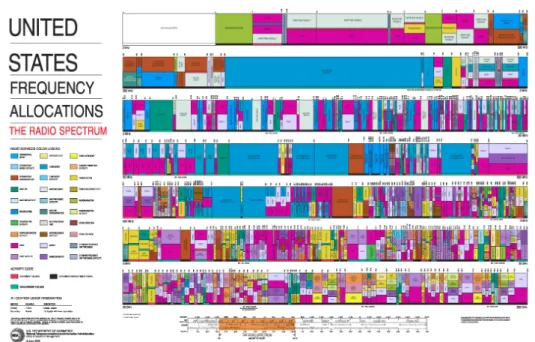
Spectrum licensing has been traditionally employed to protect wireless systems against mutual interference. While effective in avoiding multi user interference, this approach has led to an inef-ficient utilization of the available resources, hence to spectrum scarcity [2–4], as can be seen from the 2003 FCC spectrum allocation chart, depicted in Fig. 2.1. Cognitive radio networks, a concept first proposed by Mitola in his seminal work [5], hold the promise to improve the spectral efficiency of wireless networks with respect to conventional licensing, by allowing the coexistence of Primary (licensed) and Secondary (unlicensed) Users (PUs and SUs, respectively) on the same radio band. In order to achieve such objective, SUs are equipped with smart, cognitive radios through which they can sense the radio environment and collect side information about the presence and the operation of active primary transmitters. This information is then used by the cognitive radios to make decisions and dynamically adapt their operation, so as to optimize a given performance metric, while limit-ing their interference to the incumbent licensed system. For a survey on cognitive radio, dynamic spectrum access and the related research challenges, we refer the interested reader to [4, 6–8].
Most prior works on cognitive radio networks are based on the assumption that the SUs are al-lowed to operate only in time-frequency slots left unused by the licensed system (interweavecognitive
radio paradigm [7]). A crucial aspect in these systems is the ability of SUs to detect, as accurately and quickly as possible, the activity of licensed users in a given time-frequency slot [9], so that
lit-Figure 2.1. 2003 FCC spectrum allocation chart, from http://www.ntia.doc.gov/files/ntia/publications/2003-allochrt.pdf
tle or no harm is caused to the licensed radios. Inoverlaysystems, on the other hand, the SUs use
sophisticated signal processing and coding to maintain or even improve the performance of the PUs, while also obtaining some additional bandwidth for their own communication. A more general and advanced paradigm than interweave cognitive radio isunderlay cognitive radio [7], where the SUs
are allowed to operate also in time-frequency slots used by PUs, but need to satisfy given constraints on the performance loss caused to the PU, e.g., the interference to each PU should be kept within
a tolerable limit [4, 10]. Within this framework, the problem of how the SUs should best utilize the side information about the primary system,e.g., codebook, protocol, retransmission schemes, channel
state information, is still an open research issue.
In the information theoretic community, cognitive radio network models have often been proposed by assuming a genie-aided SU with non-causal access to the whole or part of the active primary message (side information about the primary message) [7, 11, 12]. While this assumption allows for analysis of information-theoretic optimal transmission strategies and codebook design, it is not able to capture critical aspects of a cognitive radio network, related to the imperfect sensing and the dynamic acquisition of the knowledge about the primary message. Another line of inquiry is resource management, which employs various tools from stochastic optimization or machine learning to design optimal secondary strategies which best utilize the available resources and the side information,e.g.,
2.1. Introduction 9
see [13] and references therein. This approach allows to consider network constraints, such as delay or other QoS guarantees, as well as to model the dynamic acquisition of the side information by the SUs,e.g., by a proper Markov chain representation of the system.
Based on the interweave cognitive radio paradigm, we propose to exploit the Hybrid Automatic Retransmission reQuest (HARQ [14]) protocol implemented by the PU. The use of such protocol introduces temporal redundancy in the wireless channel, in the form of copies of primary packets transmitted in subsequent time-slots in response to retransmission requests by the primary receiver. Opportunities for secondary access thus arise: by tracking the retransmission process of the PU and by decoding the current primary message, the secondary receiver can remove its interference by em-ploying Interference Cancellation (IC) techniques over the entire interval over which retransmissions of the same primary message take place, thus enhancing the secondary outage performance and im-proving the spectral efficiency of the system. We believe that the ability of the SU to best manage the interference from nearby terminals is crucial to achieve high spectral efficiency in cognitive radio networks, since interference is a limiting factor in wireless networks. For this reason, the strategy of the SU, which prescribes whether to access the channel or remain idle, based on the HARQ state of the PU and on the state of the SU, is optimized by using stochastic optimization tools. However, interference cancellation may not be successfully employed by the PUs, which are typically assumed to be oblivious to the presence of SUs in the network. Hence, the interference produced by the SUs to the PUs should be kept within tolerable limits.
We consider a simple network topology consisting of a pair of PUs and a pair of SUs (transmitter and receiver), as depicted in Fig. 2.2. Despite the simplicity of such network topology, understanding its fundamental limits is still an open research issue which requires in-depth investigation. Moreover, we believe that this topology represents a building block of more general network settings, consisting of multiple primary and SU pairs.
The idea of exploiting the primary HARQ process to perform IC on future packets was put forth by [15], which devises several cognitive radio protocols exploiting the HARQ protocol of the PU. Therein, the PU employs HARQ with incremental redundancy and the ARQ mechanism is limited to at most one retransmission. The SU receiver attempts to decode the PU message in the first time-slot. If successful, the SU transmitter sends its packet and the SU receiver decodes it by using IC on the received signal. In contrast, in this chapter, we address the more general case of an arbitrary number of primary ARQ retransmissions, and we allow a more general access pattern for the SU pair over the
entire primary ARQ window, as detailed in the next section.
Other related works include [16], which devises an opportunistic sharing scheme with channel probing based on the ARQ feedback from the PU receiver. An information theoretic framework for cognitive radio is investigated in [12], where the SU transmitter has non-casual knowledge of the PU’s codeword. In [17], the data transmitted by the PU is obtained causally at the SU receiver. However, this model requires a joint design of the PU and SU signaling and channel state information at the transmitters. In contrast, we explicitly model the dynamic acquisition of the PU message at the SU receiver, which enables IC. Moreover, the PU is oblivious to the presence of the SU.
2.1.1 Contributions
Within this framework, we propose to exploit the primary HARQ process and introduce two IC schemes that work in concert, both enabled by the underlying retransmission process of the PU. With
Forward IC(FIC), SUrx, after decoding the PU message, performs IC in the next PU retransmission
attempts, if these occur. While FIC provides IC on SU transmissions performed in future time-slots,
Backward IC (BIC) provides IC on SU transmissions performed in previous time-slots within the
same primary ARQ retransmission window, whose decoding failed due to severe interference from the PU. BIC relies on buffering of the received signals at the SU receiver. Based on these IC schemes, we model the state evolution of the PU-SU network as a Markov Decision Process [1,18], induced by the specific access policy used by the SU, which determines its access probability in each state of the network.
As an application of this framework, we study the problem of designing optimal secondary access policies that maximize the average long-term SU throughput by opportunistically leveraging FIC and BIC, while causing a bounded average long-term throughput loss to the PU and a bounded average long-term SU power expenditure. A similar problem has been studied in [19]. However, therein the secondary receiver is not allowed to perform interference cancellation based on decoding of the PU’s message. This aspect plays instead a central role in our work. We show that the optimal strategy dictates that the SU prioritizes its channel access in the states where SUrx knows the PU message, thus enabling IC; moreover, we provide an algorithm to optimally allocate additional secondary access opportunities in the states where the PU message is unknown. In order to derive further insights in the interaction between the PU and SU in the network, we consider adegenerate cognitive radionetwork
2.1. Introduction 11
Table 2.1. List of symbols.
D Primary HARQ deadline
t∈N(1, D) primary ARQ state (retransmission index)
b∈N(0, B) SU buffer state (number of received signals currently buffered at SUrx)
Φ∈ {K,U} PU message knowledge state
(Φ = K, if the current PU message is known to SUrx; otherwise,Φ = U)
Rp PU transmission rate
RsU SU transmission rate when PU message is unknown at SUrx
RsK SU transmission rate when PU message is known at SUrx
Tp(I) PU throughput when SU is idle
Tp(A) PU throughput when SU is active
TsU SU throughput whenΦ = U
TsK PU throughput whenΦ = K
µ SU access policy
¯
Ts(µ) average long-term SU throughput under policyµ
¯
Ws(µ) average long-term SU access rate under policyµ
¯
Tp(µ) average long-term PU throughput under policyµ
q(I)pp outage prob. at PUrx, when SU is idle
q(A)pp outage prob. at PUrx, when SU is active
q(I)ps prob. that current PU message is in outage at SUrx, given that SU is idle
q(A)ps prob. that current PU message is in outage at SUrx, given that SU is active
ps,buf prob. that current SU message is buffered (it can be decoded via BIC)
scenario, where the SU transmitter isfar away from the PU receiver and thus generates negligible
interference to the PU.
2.1.2 Structure of the chapter
This chapter is organized as follows. Sec. 2.2 presents the system model. Sec. 2.3 introduces the secondary access policy, the performance metrics and the optimization problem, which is addressed in Sec. 2.4. Sec. 2.5 discusses and analyzes the degenerate cognitive radio network scenario. Sec. 2.6 presents and discusses the numerical results. Finally, Sec. 2.7 concludes the chapter. The proofs of the theorems and lemmas are provided in the appendices at the end of the chapter.
The main symbols used in this chapter are listed in Table 2.1. The notationN(x, y)for integers
SUtx SUrx PUtx PUrx γs γp γsp γps ACK/NACK
Buffering/PU message knowledge Figure 2.2. System model
2.2
System Model
We consider a two-user interference network, depicted in Fig. 2.2, where a primary transmitter and a secondary transmitter, denoted by PUtx and SUtx, respectively, transmit to their respective receivers, PUrx and SUrx, over the direct links PUtx→PUrx and SUtx→SUrx. Their transmissions generate mutual interference over the links PUtx→SUrx and SUtx→PUrx.
Time is divided into time-slots of fixed duration. Each time-slot matches the length of the PU and SU packets, and the transmissions of the PU and SU are assumed to be perfectly synchronized. We adopt the block-fading channel model,i.e., the channel gains are constant within the time-slot
duration, and change from time-slot to time-slot. Assuming that the SU and the PU transmit with constant powerPsandPp, respectively, and that noise at the receivers is zero mean Gaussian with
varianceσ2w, we define the instantaneous Signal to Noise Ratios (SNR) of the links SUtx→SUrx, PUtx→PUrx, SUtx→PUrx and PUtx→SUrx, during thenth time-slot, asγs(n), γp(n),γsp(n)and
γps(n), respectively. We model the SNR process{γx(n), n= 0,1, . . .}, wherex ∈ {s, p, sp, ps},
as i.i.d. over time-slots and independent over the different links, and we denote the average SNR as
¯
γx =E[γx].
We assume that no Channel State Information (CSI) is available at the transmitters, so that the latter cannot allocate their rate based on the instantaneous link quality, to ensure correct delivery of the packets to their respective receivers. Transmissions may thus undergo outage, when the selected rate is not supported by the current channel quality.
In order to improve reliability, the PU employs Type-I HARQ [14] with deadlineD≥1,i.e., at
2.2. System Model 13
and a new transmission is performed (the PU is assumed to be backlogged). We define theprimary ARQ state t ∈ N(1, D)1 as the number of ARQ transmission attempts already performed on the
current PU message, plus the current one. Namely,t= 1indicates a new PU transmission, and the
countertis increased at each ARQ retransmission, until the deadlineDis reached. We assume that the ARQ feedback is received at the PU transmitter by the end of the time-slot, so that, if requested, a retransmission can be performed in the next time-slot.
On the other hand, the SU, in each time-slot, either accesses the channel by transmitting its own message, or stays idle. This decision is based on the access policyµ, defined in Sec. 2.3. The activity of the SU, which is governed byµ, affects the outage performance of the PU, by creating interference
to the PU over the link SUtx→PUrx. We denote the primary outage probability when the SU is idle and accesses the channel, respectively, as2
qpp(I)(Rp),Pr Rp> C(γp) , q(A)pp (Rp),Pr Rp > C γp 1 +γsp , (2.1)
whereRp denotes the PU transmission rate, measured in bits/s/Hz,C(x),log2(1 +x)is the
(nor-malized) capacity of the Gaussian channel with SNRx at the receiver [20]. This outage definition, as well as the ones introduced later on, assume the use of Gaussian signaling and capacity-achieving coding with sufficiently long codewords. However, our analysis can be extended to include prac-tical codes by computing the outage probabilities for the specific code considered. In (2.1), it is assumed that SU transmissions are treated as background Gaussian noise by the PU. This is a rea-sonable assumption in CRs in which the PU is oblivious to the presence of SUs. In general, we have
qpp(A)(Rp) ≥qpp(I)(Rp), where equality holds if and only ifγsp ≡ 0deterministically. We denote the
expected PU throughput accrued in each time-slot, when the SU is idle and accesses the channel, as
Tp(I)(Rp) =Rp[1−qpp(I)(Rp)]andTp(A)(Rp) =Rp[1−qpp(A)(Rp)], respectively.
2.2.1 Operation of the SU
Unlike the PU that uses a simple Type-I Hybrid ARQ mechanism, it is assumed that the SU uses "best effort" transmission. Moreover, the SU is provided with side-information about the PU,e.g.,
1We defineN(n
0, n1) ={t∈N, n0≤t≤n1}forn0≤n1∈N
2Herein, we denote the outage probability asq(Z)
xy , where xand yare the source and the recipient of the message,
respectively (PU ifx, y =p, SU ifx, y=s), andZ ∈ {A,I}denotes the action of the SU (Aif the SU is active and it accesses the channel,Iif the SU remains idle). For example,q(A)ps is the probability that the PU message is in outage at
ARQ deadlineD, PU codebook and feedback information from PUrx (ACK/NACK messages). This
is consistent with the common characterization of the PU as a legacy system, and of the SU as an opportunistic and cognitive system, which exploits the primary ARQ feedback to create a best-effort link with maximized throughput, while the flow control mechanisms are left to the upper layers. By overhearing the feedback information from PUrx, the SU can thus track the primary ARQ state
t. Moreover, by leveraging the PU codebook, SUrx attempts, in any time-slot, to decode the PU message, which enables the following IC techniques at SUrx:
• Forward IC(FIC): by decoding the PU message, SUrx can perform IC in the current as well as
in the following ARQ retransmissions, if these occur, to achieve a larger SU throughput;
• Backward IC (BIC): SUrx buffers the received signals corresponding to SU transmissions
which undergo outage due to severe interference from the PU. These transmissions can later be recovered using IC on the buffered received signals, if the interfering PU message is success-fully decoded by SUrx in a subsequent primary ARQ retransmission attempt.
We define the SU buffer state b ∈ N(0, B) as the number of received signals currently buffered
at SUrx, whereB ∈ N(0, D−1)3 denotes the buffer size. Moreover, we define the PU message knowledge stateΦ∈ {K,U}, which denotes the knowledge at SUrx about the PU message currently handled by the PU. Namely, ifΦ = K, then SUrx knows the PU message, thus enabling FIC/BIC; conversely (Φ = U), the PU message is unknown to SUrx.
Remark 2.2.1 (Feedback Information). Note that PUrx needs to report one feedback bit to inform
PUtx (and the SU, which overhears the feedback) on the transmission outcome (ACK/NACK). On the other hand, two feedback bits need to be reported by SUrx to SUtx: one bit to inform SUtx as to whether the PU message has been successfully decoded, so that SUtx can track the PU message knowledge stateΦ; and one bit to inform SUtx as to whether the received signal has been buffered,
so that SUtx can track the SU buffer stateb. Herein, we assume ideal (error-free) feedback channels, so that the SU can track(t, b,Φ), and the PU can track the ARQ state t. However, optimization is
possible with imperfect observations as well [21].
We now further detail the operation of the SU forΦ ∈ {K,U}.
3Note that
B≤D−1, since the same PU message is transmitted at mostDtimes by PUtx. Once the ARQ deadlineD
2.2. System Model 15
2.2.1.1 PU message unknown to SUrx (Φ = U)
When Φ = U and the SU is idle, SUrx attempts to decode the PU message, so as to enable FIC/BIC. A decoding failure occurs if the rate of the PU message, Rp, exceeds the capacity of the
channel PUtx→SUrx, with SNRγps. We denote the corresponding outage probability asq(I)ps(Rp) =
Pr(Rp> C(γps)).
If the SU accesses the channel, SU transmissions are performed with rateRsU (bits/s/Hz) and
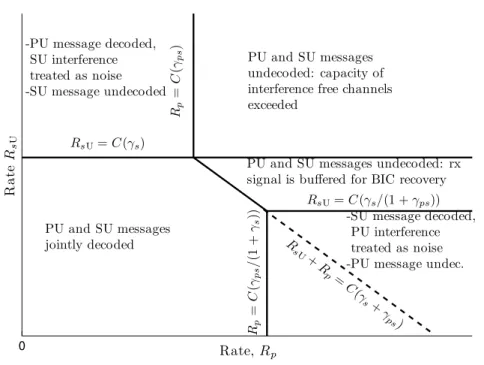
are interfered by the PU. SUrx thus attempts to decode both the SU and PU messages; moreover, if the decoding of the SU message fails due to severe interference from the PU, the received signal is buffered for future BIC recovery. Using standard information-theoretic results [20], with the help of Fig. 2.3, we define the following SNR regions associated with the decodability of the SU and PU messages at SUrx, whereAcdenotes the complementary set ofA:4
Γp(RsU, Rp), n (γs, γps) :RsU≤C(γs), Rp ≤C(γps), RsU+Rp ≤C(γs+γps) o , (2.2) [ (γs, γps) :RsU> C(γs), Rp ≤C γps 1 +γs , (2.3) Γs(RsU, Rp), n (γs, γps) :RsU≤C(γs), Rp ≤C(γps), RsU+Rp ≤C(γs+γps) o (2.4) [ (γs, γps) :Rp > C(γps), RsU≤C γps 1 +γs , (2.5) Γbuf(RsU, Rp), n Γp(RsU, Rp)∪Γs(RsU, Rp) oc\ n (γs, γps) :RsU≤C(γs) o . (2.6)
The SNR regions (2.2) and (2.4) guarantee that the two ratesRp andRsU are within the multiple
access channel region formed by the two transmitters (PUtx and SUtx) and SUrx [20], so that both the SU and PU messages are correctly decoded via joint decoding techniques. On the other hand, in the SNR region (2.5) (respectively, (2.3)), only the SU (PU) message is successfully decoded at SUrx by treating the interference from the PU (SU) as background noise. If the SNR pair falls outside the two regions (2.4) and (2.5) (respectively, (2.2) and (2.3)), then SUrx incurs a failure in decoding the SU (PU) message. Therefore, when(γs, γps)∈Γs(RsU, Rp), SUrx successfully decodes the SU
message. The corresponding expected SU throughput is thus given by
TsU(RsU, Rp),RsUPr ((γs, γps)∈Γs(RsU, Rp)). (2.7)
4Herein, we assume optimal joint decoding techniques of the SU and PU messages. Using other techniques,
e.g., successive IC, the SNR regions may change accordingly, without providing any further insights in the following analysis.
0 Rate,R p R a te Rs U Rp = C ( γps / (1 + γs )) Rp = C ( γp s ) R sU + R p= C( γs + γ ps) RsU=C(γs) PU and SU messages undecoded: capacity of interference free channels exceeded
PU and SU messages jointly decoded
PU and SU messages undecoded: rx signal is buffered for BIC recovery
RsU=C(γs/(1 +γps)) -SU message decoded,
PU interference treated as noise -PU message undec. -PU message decoded,
SU interference treated as noise -SU message undecoded
Figure 2.3. Decodability regions for PU message (rateRp) and SU message (rateRsU) at SUrx, for a
fixed SNR pair(γs, γps); these regions change according to the fading state(γs, γps)
Similarly, when(γs, γps) ∈ Γp(RsU, Rp), SUrx successfully decodes the PU message. We denote
the corresponding outage probability asqps(A)(RsU, Rp) , Pr ((γs, γps)∈/ Γp(RsU, Rp)). Note that
qps(A)(RsU, Rp)> qps(I)(Rp), since SU transmissions interfere with the decoding of the PU message.
Finally, in (2.6), the decoding of both the SU and PU messages fails, since the SNR pair(γs, γps)
falls outside both regionsΓp(RsU, Rp)andΓs(RsU, Rp). However, the rateRsUis within the capacity
region of the interference free channel (RsU≤C(γs)), so that the SU message can be recovered via
BIC, should the PU message become available in a future ARQ retransmission attempt. The received signal is thus buffered at SUrx. We denote thebuffering probabilityas
ps,buf(RsU, Rp),Pr ((γs, γps)∈Γbuf(RsU, Rp))
= Pr ((γs, γps)∈Γs(RsU,0))−Pr ((γs, γps)∈Γs(RsU, Rp))>0, (2.8)
where the second equality follows from inspection of Fig. 2.3.
2.2.1.2 PU message known to SUrx (Φ = K)
When Φ = K, SUrx performs FIC on the received signal, thus enabling interference free SU transmissions. The SU transmits with rateRsK, and the accrued throughput is given by
2.2. System Model 17
time
PU: PM1 PM1 PM1 PM2
NACK NACK ACK
time SU: SM1 SM2 SM3 SM1&PM1 undec.; signal buffered PM1 decoded;
SM1 via BIC PM1 known;SM3 via FIC
Figure 2.4. Example of operation of FIC/BIC schemes
TsK(RsK) =RsKPr (RsK< C(γs)).
We now provide an example to illustrate the use of FIC/BIC at SUrx.
Example 1. Consider a sequence of3primary retransmission attempts in which the SU always ac-cesses the channel, as depicted in Fig. 2.4. Initially, the PU message is unknown to SUrx, hence the PU message knowledge state is set to Φ = Uin the first time-slot, and the SU transmits with rate
RsU. Assume that the SNR pair(γs(1), γps(1))falls in Γbuf(RsU, Rp). Then, neither the SU nor the PU messages are successfully decoded by SUrx, but the received signal is buffered for future BIC recovery. In the second time-slot,(γs(2), γps(2))∈Γs(RsU, Rp)∩Γp(RsU, Rp), hence both the SU and PU messages are correctly decoded by SUrx, and the PU message knowledge state switches to
Φ = K. At this point, SUrx performs BIC on the previously buffered received signal to recover the corresponding SU message. In the third time-slot, SUtx transmits with rate RsK, and decoding at SUrx takes place after cancellation of the interference from the PU via FIC.
We now briefly elaborate on the choice of the transmission rateRsK. Since its value does not
affect the outage performance at PUrx (2.1) and the evolution of the ARQ process,RsKis chosen so
as to maximizeTsK(RsK). Therefore, from (2.8) we obtain
TsK(RsK)≥TsK(RsU) =TsU(RsU, Rp) +ps,buf(RsU, Rp)RsU> TsU(RsU, Rp). (2.9)
Conversely, the choice of the rate RsU is not as straightforward, since its value reflects a
trade-off between the potentially larger throughput accrued with a larger rateRsUand the corresponding
diminished capabilities for IC caused by the more difficult decoding of the PU message by SUrx. In the following treatment, the ratesRsK,RsUandRp are assumed to be fixed parameters of the
system, and they are not considered part of the optimization (see Sec. 2.6 for further elaboration in this regard). For the sake of notational convenience, we omit the dependence of the quantities defined
above on them. Moreover, for clarity, we consider the caseB =D−1in which SUrx can buffer up
toD−1received signals. However, the following analysis can be extended to a generic value ofB.
2.3
Policy Definition and Optimization Problem
We model the evolution of the network as a Markov Decision Process [1, 18]. Namely, we denote the state of the PU-SU system by the tuple(t, b,Φ), where t ∈ N(1, D) is the primary ARQ state,
b∈N(0, B)is the SU buffer state andΦ∈ {U,K}is the PU message knowledge state.(t, b,Φ)takes
values in the state spaceS ≡ SU∪ SK, whereSK ≡ {(t,0,K) : t∈N(2, D)}andSU≡ {(t, b,U) :
t∈N(1, D), b∈N(0, t−1)}are the sets of states where the PU message is known and unknown to
SUrx, respectively.
The SU follows a stationary randomized access policyµ ∈ U ≡ {µ:S 7→[0,1]}, which de-termines the secondary access probability for each states ∈ S. Note that, from [22], this choice is
without loss of optimality for the specific problem at hand. Namely, in state(t, b,Φ) ∈ S, the SU is "active",i.e., it accesses the channel, with probability µ(t, b,Φ)and stays "idle" with probability
1−µ(t, b,Φ). We denote the "active" and "idle" actions asAandI, respectively.
With these definitions at hand, we define the following average long-term metrics underµ: the
SU throughputT¯s(µ), the SU power expenditureP¯s(µ)and the PU throughputT¯p(µ), given by
¯ Ts(µ) = lim N→+∞ 1 NE "N−1 X n=0 RsΦn1 {Qn= A} ∩O c s,n +RsUBn1(Ops,nc ) s0 # , (2.10) ¯ Ps(µ) =Ps lim N→+∞ 1 NE "N−1 X n=0 1({Qn= A}) s0 # , (2.11) ¯ Tp(µ) = lim N→+∞ 1 NE "N−1 X n=0 Rp1 Ocp,n s0 # , (2.12)
wheren is the time-slot index, s0 ∈ S is the initial state in time-slot0; Φn ∈ {K,U}is the PU
message knowledge state andBnis the SU buffer state in time-slotn;Qn ∈ {A,I}is the action of
the SU, drawn according to the access policyµ;Os,n andOps,n denote the outage events at SUrx
for the decoding of the SU and PU messages, so thatOcs,nandOcps,n denote successful decoding of the SU and PU messages by SUrx, respectively;Op,ndenotes the outage event at PUrx, so thatOp,nc
denotes successful decoding of the PU message by PUrx; and1(E) is the indicator function of the eventE. Note that all the quantities defined above are independent of the initial states0. In fact,
2.3. Policy Definition and Optimization Problem 19
starting from anys0 ∈ S, the system reaches with probability1the positive recurrent state(1,0,U)
(new PU transmission) within a finite number of time-slots, due to the ARQ deadline. Due to the Markov property, from this state on, the evolution of the process is independent of the initial transient behavior, which has no effect on the time averages defined in (2.10), (2.11) and (2.12).
We study the problem of maximizing the average long-term SU throughput subject to constraints on the average long-term PU throughput loss and SU power. Specifically,
µ∗= arg max
µ
¯
Ts(µ) s.t.T¯p(µ)≥Tp(I)(1−ǫPU), P¯s(µ)≤ Ps(th), (2.13)
whereǫPU∈[0,1]andPs(th)∈[0, Ps]represent the (normalized) maximum tolerated PU throughput
loss with respect to the case in which the SU is idle and the SU power constraint, respectively. This problem entails a trade-off in the operation of the SU. On the one hand, the SU is incentivized to transmit in order to increase its throughput and to optimize the buffer occupancy at SUrx (i.e., failed
SU transmissions which are potentially recovered via BIC). On the other hand, SU transmissions might jeopardize the correct decoding of the PU message at SUrx, thus impairing the use of FIC/BIC, and might violate the constraints in (2.13).
Under µ ∈ U, the state process is a stationary Markov chain, with steady state distribution
πµ[18, 23]. πµ(s),s ∈ S, is the long-term fraction of the time-slots spent in state s, i.e.,πµ(s) =
lim N→+∞ 1 N PN−1 n=0 Pr (n)
µ (s|s0), wherePrµ(n)(s|s0)is then-step transition probability of the chain from
states0.5 In state(t, b,U), the SU accesses the channel with probabilityµ(t, b,U), thus accruing the
throughputµ(t, b,U)TsU. Moreover, if SUrx successfully decodes the PU message (with
probabil-ity 1−qps(I)−µ(t, b,U)(qps(A) −qps(I))),bRsUbits are recovered by performing BIC on the buffered
received signals, yielding an additional BIC throughput. Similarly, in state(t,0,K), the SU accrues the throughput µ(t,0,K)TsK. Then, we can rewrite (2.10) and (2.11) in terms of the steady state
distribution and of the cost/reward in each state as
¯
Ts(µ) =TsUW¯s(µ)+ ¯Fs(µ)+ ¯Bs(µ), P¯s(µ) =PsW¯s(µ), (2.14)
where theSU access rateW¯s(µ),i.e., the average long-term number of secondary channel accesses
5Similarly to (2.10), (2.11) and (2.12),π
per time-slot, theFIC throughputF¯s(µ)and theBIC throughputB¯s(µ)are defined as ¯ Ws(µ), X s∈S πµ(s)µ(s), (2.15) ¯ Fs(µ), D X t=2 πµ(t,0,K)µ(t,0,K) (TsK−TsU), (2.16) ¯ Bs(µ), D X t=1 t−1 X b=0 πµ(t, b,U)bRsU h
1−q(I)ps −µ(t, b,U)q(A)ps −q(I)psi. (2.17)
In (2.14), TsUW¯s(µ) is the SU throughput attained without FIC/BIC, while the terms F¯s(µ) and
¯
Bs(µ)account for the throughput gains of FIC and BIC, respectively. Conversely, the PU accrues the
throughputTp(I) if the SU is idle andTp(A)if the SU accesses the channel, so that (2.12) is given by
¯
Tp(µ) =Tp(I)−(Tp(I)−Tp(A)) ¯Ws(µ). (2.18)
The quantity(Tp(I)−Tp(A)) ¯Ws(µ)is referred to as thePU throughput lossinduced by the secondary
access policyµ[19]. The following result follows directly from (2.13), (2.14) and (2.18).
Lemma 2.3.1. The problem (2.13) is equivalent to
µ∗= arg maxµ∈UT¯s(µ) s.t.W¯s(µ)≤min ( (1−q(I)pp)ǫPU qpp(A)−q(I)pp ,P (th) s Ps ) ,ǫW. (2.19)
In the next section, we characterize the solution of (2.19). We will need the following definition.
Definition 2.3.1. Let µbe the policy such that secondary access takes place if and only if the PU message is known to SUrx,i.e.,µ(s) = 1, ∀s ∈ SK,µ(s) = 0, ∀s ∈ SU. We denote the SU access
rate achieved by such policy asǫth = ¯W(µ). The system is in the low SU access rate regime if
ǫW ≤ǫthin (2.19). Otherwise, the system is in thehigh SU access rate regime.
2.4
Optimal Policy
In this section, we characterize in closed form the optimal policy in the low SU access rate regime, and we present an algorithm to derive the optimal policy in the high SU access rate regime.
2.4. Optimal Policy 21
2.4.1 Low SU Access Rate Regime
The next lemma shows that, in the low SU access rate regime, an optimal policy prescribes that secondary access only takes place in the states where the PU message is known to SUrx, with an equal probability in all such states. It follows that only FIC, and not BIC, is needed in this regime to attain optimal performance.
Lemma 2.4.1. In the low SU access rate regimeǫW≤ǫth, an optimal policy is given by6
µ∗(s) = ǫW ǫth
, ∀s∈ SK, µ∗(s) = 0, ∀s∈ SU. (2.20)
Moreover,T¯s(µ∗) =TsKǫW,P¯s(µ∗) =PsǫW, andT¯p(µ∗) =Tp(I)−(Tp(I)−Tp(A))ǫW.
Proof. For any policyµ∈ U obeying the SU access rate constraintW¯s(µ)≤ǫW, we haveT¯s(µ) ≤ ¯
Ws(µ)TsK≤ǫWTsK. The first inequality holds sinceW¯s(µ)TsKis the long-term throughput
achiev-able when the PU message is knowna prioriat SUrx, which is an upper bound to the performance;
the second from the SU access rate constraint. The upper boundǫWTsKis achieved by policy (2.20),
as can be directly seen by substituting (2.20) in (2.14), (2.15).
Remark 2.4.1. Note that secondary accesses in states SU, where the PU message is unknown to
SUrx, would obtain a smaller throughput, namely at mostTsU+ps,bufRsU ≤ TsK, whereTsU is
the "instantaneous" throughput andps,bufRsUis the BIC throughput,possiblyrecovered via BIC in a
future ARQ retransmission. Therefore, SU accesses in statesSKare more "cost effective".
2.4.2 High SU Access Rate Regime
In this section, we study the high SU access rate regime in whichǫW > ǫth, thus complementing
the analysis above for the regime whereǫW ≤ǫth. It will be seen that, ifǫW> ǫth, unlike in the low
SU access rate regime, the SU should generally access the channel also in states SUwhere the PU
message is unknown to SUrx in order to achieve the optimal performance. Therefore, both BIC and FIC are necessary to attain optimality. In this section, we derive the optimal policy. We first introduce some necessary definitions and notations.
6The optimal policy in the low SU access rate is not unique. In fact, any policy
µsuch thatµ(s) = 0, ∀s∈ SUand ¯
Definition 2.4.1(Secondary access efficiency). We define thesecondary access efficiencyunder pol-icyµ∈ Uin states∈ S as ηµ(s) = d ¯Ts(µ) dµ(s) d ¯Ws(µ) dµ(s) . (2.21)
The secondary access efficiency can be interpreted as follows. If the secondary access probability is increased in state s ∈ S by a small amount δ, then the PU throughput loss is increased by an amount equal toδ(Tp(I)−Tp(A))d ¯dWµs((sµ)) (from (2.18)), the SU power is increased by an amount equal
toδPsd ¯dWµs((sµ)) (from (2.14)), and the SU throughput augments or diminishes by an amount equal to
δd ¯Ts(µ)
dµ(s) (depending on the sign of the derivative). Therefore,ηµ(s) yields the rate of increase (or
decrease if ηµ(s) < 0) of the SU throughput per unit increase of the SU access rate, as induced
by augmenting the secondary channel access probability in states. Equivalently, it measures how
efficiently the SU can access the channel in states, in terms of maximizing the SU throughput gain
while minimizing its negative impact on the PU throughput and on the SU power expenditure.
Remark2.4.2. It is worth noting that the definition of ηµ(s) given in Def. 2.4.1 is not completely
rigorous. In fact, under a generic policy µ, the Markov chain of the PU-SU system may not be
irreducible [23], so that states may not be accessible, henceπµ(s) = 0and d ¯dTµs((sµ)) = d ¯Ws(µ)
dµ(s) = 0.
One example is the idle policyµ(s) = 0, ∀s: since the SU is always idle, the buffer at SUrx is always
empty, hence states (t, b,U)with b > 0 are never accessed. To overcome this problem, a formal definition is given in Appendix 2.B, by treating the Markov chain of the PU-SU system as the limit of an irreducible Markov chain.ηµ(s)is explicitly derived in Lemma 2.7.3 in Appendix 2.B.
We denote the indicator function of statesasδs :S 7→ {0,1}, withδs(s) = 1,δs(σ) = 0, ∀σ 6= s. Moreover, we denote the policy at theith iteration of the algorithm asµ(i). We are now ready to
describe the algorithm that obtains an optimal policy in the high SU access rate regime. An intuitive explanation of the algorithm can be found below.
Algorithm 1(Derivation of the optimal policy).
1. INIT:
• Letµ(0)be the policyµ(0)(s) = 0, ∀s∈ SU,µ(0)(s) = 1, ∀s∈ SK, andi= 0.
• LetSidle(0) ≡ {s∈ S :µ(0)(s) = 0} ≡ S
2.5. Special Case: degenerate cognitive radio network scenario 23
2. STAGE i:
(a) Computeηµ(i)(s),∀s∈ Sidle(i) and lets(i) ,arg maxs
∈Sidle(i)
ηµ(i)(s).
(b) STAGE i ηµ(i)(s(i)) ≤ 0, go to STEP 3). Otherwise, let µ(i+1) = µ(i) +δs(i), Sidle(i+1)≡S
(i) idle\
s(i) .
(c) Seti:=i+ 1. IfSidle(i) ≡ ∅,go to STEP 3). Otherwise,repeat from STEP 2).
3. LetN =i, the sequence of states(s(0), . . . ,s(N−1))and of policies(µ(0), . . . , µ(N−1)). 4. Optimal policy: givenǫW,
(a) IfW¯s(µ(N−1))≤ǫ
W, thenµ∗=µ(N−1).
(b) Otherwise,µ∗=λµ(j)+(1−λ)µ(j+1), wherej,max
i: ¯Ws µ(i)≤ǫW andλ∈ (0,1]
uniquely solvesW¯s(λµ(j)+ (1−λ)µ(j+1)) =ǫ W.
The algorithm, starting from the optimal policy for the caseǫW =ǫth(Lemma 2.4.1), ranks the
states in the setSU in decreasing order of secondary access efficiency, and iteratively allocates the
secondary access to the state with the highest efficiency, among the states where the SU is idle. The rationale of this step is that secondary access in the most efficient state yields the steepest increase of the SU throughput, per unit increase of the SU access rate or, equivalently, of the PU throughput loss and of the SU power expenditure. The optimality of Algorithm 1 is established in the following theorem.
Theorem 2.4.2. Algorithm 1 returns an optimal policy for the optimization problem (2.19).
Proof. See Appendix 2.C.
2.5
Special Case: degenerate cognitive radio network scenario
We point out that Algorithm 1 determines the optimal policy for a generic set of system parame-ters. However, the resulting optimal policy does not always have a structure that is easily interpreted. In this section, we consider a special case of the general model discussed so far, adegenerate cogni-tive radio network, where the activity of the PU is unaffected by the transmissions of the SU,i.e., the
SUtx SUrx PUtx PUrx
TXran ge
TXran ge
Figure 2.5. Degenerate cognitive radio network
Consider the scenario depicted in Fig. 2.5, where PUrx is outside the transmission range of SUtx, whereas SUrx is inside the transmission range of both SUtx and SUrx. In this scenario, the interfer-ence produced by SU to PU is negligible. In contrast, the PU produces significant interferinterfer-ence at the SU receiver. The SU thus potentially benefits by employing the BIC and FIC mechanisms. We denote this scenario as aDegenerate cognitive radio network, and we model it by assuming that the SNR of
the interfering link SUtx→PUrx is deterministically equal to zero,i.e.,γsp = 0. From (2.1), we then
haveqpp(I)=qpp(A),qpp,i.e., the outage performance of the PU is unaffected by the activity of the SU,
and the primary ARQ process is independent of the secondary access policy. We define
∆s,
TsK−TsU−ps,bufRsU
RsU
. (2.22)
From (2.9), it follows that∆s ≥0, with equality ifRsU= RsK. Therefore,RsU∆sis the marginal
throughput gain accrued in the states where the PU message is known to SUrx, over the throughput accrued in the states where the PU message is unknown (instantaneous throughputTsU plus BIC
throughputps,bufRsU, possibly recovered in a future ARQ retransmission). The following lemma
proves that, if the marginal throughput gain∆s is "small", the secondary accesses in the high SU
access rate regime in a degenerate cognitive radio network are allocated, in order, to the states inSK
(Lemma 2.4.1), then to the idle states(t, b,U)inSU, giving priority to states with lowbandtover
states with highbandt, respectively. An illustrative example of the optimal policy for this scenario
2.5. Special Case: degenerate cognitive radio network scenario 25
Lemma 2.5.1. In the degenerate cognitive radio network scenario withq(A)pp =q(I)pp =qpp, if
∆s<
1−qps(A)
q(A)ps −q(I)ps
ps,buf, (2.23)
the sequence of policies(µ(0), . . . , µ(N−1))returned by Algorithm 1 is such that,∀i∈N(0, N −1),
µ(i)(s) =1, ∀s∈ SK, (2.24) µ(i)(t, b,U) = 1 b < b(i)(t) 0 b≥b(i)(t), , ∀(t, b,U)∈ SU, (2.25)
where b(i)(t) is non-increasing in t and non-decreasing in i, with b(0)(t) = 0 and b(N−1)(t) = ¯ bmax(t),i.e., ¯b max(t) =b(N−1)(t)≥ · · · ≥b(i)(t)≥b(i−1)(t)≥ · · · ≥b(0)(t) = 0. (2.26) b(i)(1)≥b(i)(2)≥ · · · ≥b(i)(t−1)≥b(i)(t)≥ · · · ≥b(i)(D), (2.27) where ¯bmax(t) = TsU RsU h 1−qpp qps(A)−qps(I) A0(t+ 1) i + 1−q(A)ps q(A)ps −qps(I) ps,buf −∆s qpp q(A)ps −q(I)ps A0(t+ 1)
q(A)ps −q(I)ps 1−qpp(1−q(I)ps)A0(t+ 1)
−1 (2.28)
and we have defined
A0(τ), 1−qDpp−τ+1qps(I)(D−τ+1) 1−qppqps(I) , (2.29) A1(τ), 1−qD−τ+1 pp 1−qpp . (2.30)
Proof. See Appendix 2.D.
Remark 2.5.1. Interestingly, this is the same result derived in our work [24] for D = 2. However, therein the result was shown to hold for generalqpp(A) ≥ qpp(I) (not necessarily a degenerate cognitive
1,0,U 2,0,U 3,0,U 4,0,U 5,0,U 2,1,U 3,1,U 4,1,U 5,1,U 3,2,U 4,2,U 5,2,U 4,3,U 5,3,U 5,4,U 5,0,K 4,0,K 3,0,K 2,0,K
Figure 2.6. Illustrative example of the structure of the optimal secondary access policy for the degenerate cognitive radio network; the SU is active in the black states, idle in the white ones, and randomly accesses the channel in the gray state; the arrows indicate the possible state transitions (transitions to state(1,0,U) are omitted).
radio network), whereas Lemma 2.5.1 holds for generalDbut only for a degenerate cognitive radio network scenario.
The lemma dictates that, in the degenerate cognitive radio network scenario, the SU should re-strict its channel accesses to the states corresponding to a low primary ARQ index and small buffer occupancy at the SU receiver. Alternatively, the larger the ARQ index or the buffer occupancy, the smaller the incentive to access the channel. By doing so, the SU maximizes the buffer occupancy in the early HARQ retransmission attempts, and invests in the future BIC recovery. When the pri-mary ARQ statetapproaches the deadline D, the SU is incentivized to idle so as to help SUrx to decode the PU message, thus enabling the recovery of the failed SU transmissions from the buffered received signals via BIC, before the ARQ deadlineDis reached and the buffer is depleted. Moreover, when the buffer statebgrows, sinceq(A)ps > qps(I), the instantaneous reward accrued by staying idle
((1−q(I)ps)bRsU) approaches and, at some point, becomes larger than the reward accrued by
2.6. Numerical Results 27
is large, then the marginal throughput gain accrued in the states where the PU message is known to SUrx, over the throughput accrued in the states where the PU message is unknown, is large. The SU is thus incentivized to stay idle in the initial ARQ rounds, so as to help SUrx decode the PU message. Therefore, for large∆s, the optimal policy may not obey the structure of Lemma 2.5.1.
As a final remark, note that, in the degenerate cognitive radio network scenario, the only limitation to the activity of the SU is the secondary power expenditureP¯s(µ), since the primary throughput is
unaffected. In the special casePs(th) = Ps in (2.13), neither the secondary power expenditure nor
the primary throughput degradation limit the activity of the SU, hence the optimal policy solves the unconstrained maximization problemµ∗ = arg maxµT¯s(µ), whose solution follows as a corollary of
Lemma 2.5.1.
Corollary 2.5.2. In the