Wishlade, Fiona and Michie, Rona (2017) Financial Instruments in
Practice : Uptake and Limitations. [Report] ,
This version is available at
https://strathprints.strath.ac.uk/65332/
Strathprints is designed to allow users to access the research output of the University of Strathclyde. Unless otherwise explicitly stated on the manuscript, Copyright © and Moral Rights for the papers on this site are retained by the individual authors and/or other copyright owners. Please check the manuscript for details of any other licences that may have been applied. You may not engage in further distribution of the material for any profitmaking activities or any
commercial gain. You may freely distribute both the url (https://strathprints.strath.ac.uk/) and the
content of this paper for research or private study, educational, or not-for-profit purposes without prior permission or charge.
Any correspondence concerning this service should be sent to the Strathprints administrator:
Financial Instruments
in Practice:
Uptake and Limitations
28 June 2017
Fiona WISHLADE
Professor and Director, European Policies Research Centre
Rona MICHIE
Senior Research Fellow, European Policies Research Centre
EC-OECD Seminar Series on Designing better
economic development policies for regions and cities
Background information
This paper was prepared as a background document to the OECD-European Commission Seminar on ‘When to use financial instruments” held on 28 June 2017 at the OECD Headquarters in Paris, France. It sets a basis for reflection and discussion.
About the Project
This seminar is part of a five-part seminar series in the context of an EC-OECD project “Designing better economic
development policies for regions and cities”. Other sessions in the series addressed the use of: contracts for
flexibility/adaptability, performance indicators, financial instruments, and insights from behavioural science. The outcome of the seminars supports the work of the Regional Development Policy Committee and its mandate to promote the design and implementation of policies that are adapted to the relevant territorial scales or geographies, and that focus on the main factors that sustain the competitive advantages of regions and cities. The seminars also support the Directorate-General for Regional and Urban Policy (DG REGIO) of the European Commission in the preparation of the impact assessment for the post-2020 legislative proposals and to support broader discussion with stakeholders on the future direction of the delivery mechanisms of regional policy.
Follow us on Twitter:OECD SMEs, Regions, Cities (@OECD_local)
© OECD 2018
This work is published under the responsibility of the Secretary-General of the OECD. The opinions expressed and arguments employed herein do not necessarily reflect the official views of the OECD or of the governments of its member countries or those of the European Union. This document and any map included herein are without prejudice to the status or sovereignty over any territory, to the delimitation of international frontiers and boundaries and to the name of any territory, city, or area.
Table of contents
Introduction ... 4
Scope and context ... 5
For which policy areas and objectives are publicly backed financial instruments suited? ... 7
Theoretical rationales for public intervention ... 7
Grants vs. financial instruments? ... 9
How were financial instruments used under Cohesion Policy in 2007-13? ... 12
Overview of plans in 2014-20 ... 14
The potential for financial instruments in different areas of activity ... 17
What are the key preconditions for the implementation of financial instruments? ... 17
Conclusions ... 26
1. Which sectors would benefit most from financial instruments, what limits the uptake of financial instruments in these sectors and how can they be encouraged to make greater use of them? ... 26
2. What are the institutional framework conditions and complementary policy measures that need to be in place to use financial instruments? ... 28
3. How do regulatory frameworks promote or limit the use of financial instruments? ... 29
4. What capacity do businesses and public administrations need to apply for and use financial instruments and how can it be strengthened? ... 30
5. How can the administrative burden of applying for and using financial instruments be reduced? ... 30
Tables Table 1. “Absorption” of funds through financing instruments ... 13
Table 2. Linking objectives, market imperfections, target recipients and financial products ... 18
Figures Figure 1. Amounts dispersed to final recipients and share of total by end 2015 ... 13
Figure 2. Operational programme contributions to financial instruments, selected EU countries ... 14
Figure 3. Operational programme commitments in selected EU countries to financial instruments, 2007-13 and 2014-20 ... 15
Figure 4. Operational programme indicative allocations to financial instruments by thematic objective ... 16
Boxes Box 1. Canada Small Business Financing Program ... 23
Box 2. Scottish Co-Investment Fund ... 24
Introduction
Financial instruments in the form of loans, guarantees and equity have long been important economic development policy measures in many countries, but have only recently become prominent in EU Cohesion Policy. The growing interest in financial instruments at the EU level partly owes to the perceived “sustainability” benefits of repayable instruments against the backdrop of budgetary constraints. Reflecting this, the European Commission has increasingly emphasised the role that financial instruments can play in the delivery of Cohesion Policy. In 1994-99, European Regional Development Fund (ERDF) spend in the form of financial instruments was estimated at just EUR 300 million, rising to some EUR 1.2 billion in 2000-06 (CSES, 2007); the most recent summary of financial instrument spend for 2007-13 (European Commission, 2016) shows ERDF and European Social Fund (ESF) Operational Programme (OP) commitments to financial instruments of just over EUR 12 billion.1 In 2014-20, the role of financial instruments is being reinforced further, with the Commission encouraging member states to double the use of financial instruments in European Structural and Investment Funds (ESIF), in line with the objectives of the Investment Plan for Europe (European Commission, 2014). Implementation of the 2014-20 plans remains at a comparatively early stage, especially in the case of financial instruments, but indications from the operational programmes are that member states planned to commit over EUR 20 billion on financial instruments.2 That said, it is important to note that the vast bulk of ESIF spend remains in the form of grants: even if the increase in ESIF financial instrument commitments from EUR 12 billion to EUR 20 billion materialises in 2014-20, this will only represent around 6% of total ESIF commitments, as opposed to about 4% in 2007-13.
Against this background, the aim of this paper is to explore the experiences related to the use of financial instruments and policies to encourage their uptake, as relevant to the remit of the Directorate-General for Regional and Urban Policy (DG REGIO) of the European Commission.3 It draws on the experiences with financial instruments, principally in the EU member states, and considers both purely domestic and co-financed instruments. This paper complements a contribution by Ross Brown and Neil Lee which offers a theoretical perspective on the circumstances in which financial instruments are particularly effective and the limits to their usefulness (Brown and Lee, 2017). By contrast, the present paper has a more practical focus and aims to address the following questions posed by the European Commission and the OECD in advance of the seminar:
Which sectors would benefit the most from financial instruments, what limits the uptake of financial instruments in these sectors and how can they be encouraged to make greater use of them?
What are the institutional framework conditions and complementary policy measures that need to be in place to use financial instruments?
How do regulatory frameworks promote or limit the use of financial instruments?
What capacity do businesses and public administrations need to apply for and use financial instruments and how can it be strengthened?
How can the administrative burden of applying for and using financial instruments be reduced?
In considering these questions, the paper is structured as follows: the next section sets out some key issues of scope and context in considering the use of financial instruments; the following section considers the kinds of activities for which financial instruments are relevant, the extent to which they are currently used for these purposes under Cohesion Policy and illustrates the main areas where financial instruments might be relevant and drawing on domestic and co-financed examples; the paper then identifies some of the key preconditions for the successful implementation of financial instruments, focusing especially on support for enterprises, for which there is most experience, but also drawing on practice in other policy areas; the final section concludes.
Scope and context
The term “financial instrument”4 is now firmly embedded in Cohesion Policy parlance,5 but in fact embraces an array of financial products that not only operate in diverse ways, but are of widely differing orders of scale, address a variety of policy objectives, use various modes of governance and function within assorted socio-economic, institutional and geographic contexts. The common thread is essentially that financial instruments provide funding that is intended to be repayable. The important issue here is that a high degree of granularity is required in analysing the key issues involved in the design and implementation of financial instruments.
The conventional breakdown of financial products distinguishes loans, guarantees and equity, but there are a number of possible variants on these, as well as scope to combine measures to meet the needs of both the funder and the final recipient.
Loans are the most widely used source of private finance for small and medium-sized enterprises (SMEs) and are offered almost everywhere in domestic and/or co-financed economic development policies; loans are also widely used by other project promoters, such as local authorities, for upgrading public buildings and spaces and other capital investments, and householders and landlords for energy renovation. Loans are comparatively easy to administer from a public administration perspective, to the extent that the implementation of a loan fund can be “outsourced” or funds can essentially be used to increase the volume of finance available through existing commercial sources. Loan products can help address credit rationing, as well as cost-of-credit issues (through interest rate subsidies or easier terms). Loans are often preferred by SMEs because there is no loss of control or ownership, as with equity, but they can lack the flexibility required by young firms.
Guarantees are arguably the most straightforward financial product to design, implement and recalibrate as economic development needs change. They have most potential for impact where collateral-based lending is the norm and the business population is not asset-rich. The use of guarantees (in domestic and Cohesion Policy) is significant in only a few countries, and the sums covered are, on average, often modest, partly because they are frequently combined with loans in microfinance packages for start-ups and young firms. However, where they are used, their reach can be significant, with many thousands of publicly backed guarantees offered annually in some countries.
Publicly backed equity or venture capital is the least used of the three “conventionally defined” financial products and is often regarded as a “niche” product for potentially fast-growing innovative firms. Private equity markets vary widely across Europe and equity and venture capital are not prominent sources of
finance for SMEs, especially smaller ones. Indeed, across Europe, over 80% of SMEs consider that “equity is not applicable to my firm” (European Commission, 2013). Equity products can provide significant amounts of medium- to long-term capital, but imply at least some loss of management control by founders and are typically more difficult to manage for public authorities.
The scale of financial instruments also varies widely. Summary information on co-financed financial instruments (European Commission, 2016) suggests that some 975 funds were set up in the 2007-13 programming period, but the 15 largest of these account for approaching half of all payments to funds. There are several funds which exceed EUR 200 million – the largest being the Italian Research and Competiveness OP Guarantee Fund, which totalled EUR 871 million; however, the average fund size is around EUR 20 million and there are large numbers of funds of less than EUR 1 million. Differences in financial scale partly reflect their geographical scope, with most of the very large funds (over EUR 200 million) operating on a national or multi-regional basis. There is no comparative or systematic source of information on non-cofinanced financial instruments; indeed such instruments are both diverse and opaque, in part owing to the rebranding of financial products (Whittle, Malan and Bianchini, 2016), which renders an overall quantification of public funds for financial instruments an impossible task (Michie and Wishlade, 2015).
The policy objectives of financial instruments for economic development embrace a spectrum of specific aims. The principal focus is on addressing perceived gaps in the availability of finance to SMEs, but this itself is a varied segment, with prospective recipients including high-growth firms, high-tech spin-out companies, “mainstream” SMEs and well as individuals seeking self-employment. Within the overarching aim of supporting business development, these groups require quite different approaches in terms of financial product and delivery mechanisms, with specialised fund managers required for some, but relatively standardised banking products suitable for others. The 2007-13 Structural Fund regulations also made explicit provision for financial instruments for urban development and later for those for energy efficiency and renewable energy sources. The substance of financial instruments for these policy areas, and the way in which the instruments function, is different again from support for businesses, with final recipients also including public authorities, housing associations, landlords and private householders. As discussed below, the 2014-20 Regulations open the possibility of using financial instruments for all of the so-called thematic objectives covered by the ESIF.
The governance of financial instruments is very much context-driven: co-financed funds can be operated within holding funds, or “funds of funds”, or as specific funds outwith a fund of funds. Often the European Investment Bank plays a significant role in holding fund management. In some countries, the implementation of co-financed instruments relies heavily on existing institutions – especially promotional banks – providing an additional block of funding to supplement domestic sources. In others, holding funds and/or specific funds maybe be procured and/or established as separate legal entities.
Away from ESIF co-financed measures, the domestic scene is varied, but three main approaches can be distinguished (Michie and Wishlade, 2015):
1. investment funds with a remit essentially limited to SME development: Innovation SME+ (Netherlands), Vaekstfonden (Denmark) and Industrifonden (Sweden) fall into this category
2. public financial institutions which operate more than one fund (or funds of funds) and often collaborate with other organisations, but whose focus remains on business development, especially SMEs: Finnvera (Finland), Land business banks (Germany), Bpi (France), Strategic Banking Corporation of Ireland (Ireland), Finance Wales and British Business Bank (United Kingdom)
3. public banks whose operations are on a more significant scale and extend into areas beyond SME development into infrastructure, lending to local authorities and potentially international operations: KfW (Germany), BGK (Poland), ICO (Spain), Land banks (Germany).
A notable trend is the emergence of new promotional banks in countries where they did not exist previously, and a strengthening of their mandates, largely in response to the impact of the financial crisis and the loss of investor confidence in the aftermath.
Last, it is important to emphasise the variety of contexts in which financial instruments operate and to which, at least in part, they are intended to respond. There are significant differences between countries in terms of levels of economic development, administrative capacity and the nature of private finance. There is also an inherent spatial basis in access to finance within countries (Martin, 1999). This is true in terms of the capacity of would-be entrepreneurs to raise their own finance (from family, friends or secured on property), bank lending, business angels, and the operation of the venture capital and stock markets. Financial systems are characterised by complex institutional geographies that both reflect and influence their functioning. This, in turn, produces geographical effects on the ability of entrepreneurs to access finance, which typically work to the disadvantage of peripheral regional economies. The geography of finance is an important part of this context. This is not just because Cohesion Policy seeks to address disparities between countries and regions, but also because institutional and administrative capacity, both public and private, are typically weaker in less-advantaged regions, which in turn has implications for the capacity successfully to implement financial instruments. In the Cohesion Policy context, it is also important to note that the scale of funding varies greatly between countries and regions: in some countries, notably in central and eastern Europe, the scale of Cohesion Policy is of macroeconomic significance and is the principal source of economic development funding. In others, especially in northern and western Europe, the scale of funding can be relatively marginal to the wider domestic economic development policy effort.
For which policy areas and objectives are publicly backed financial instruments
suited?
Theoretical rationales for public intervention
This paper mainly deals with the practical experiences with financial instruments, the companion paper by Brown and Lee focusing on the theoretical dimension. Nevertheless, it is worth recalling some issues of principle here since the nature of the justification for public intervention has a direct bearing on whether financial instruments are an appropriate delivery mechanism for policy.6
In broad terms, the justification for public intervention in economic development policy is to support activities that market operators cannot or will not undertake alone, but which are considered in the wider public interest. This is sometimes characterised as “market failure”, but in fact can arise in situations where there simply is no market and
the private sector is operating quite rationally, or where the market is imperfect and operating suboptimally. These include the following (Meiklejohn, 1999):
The provision of public goods. These are generally defined as “non-excludable” and “non-rivalrous”, meaning that access to the goods concerned cannot be limited to those who pay for them and their use by one party does not diminish their availability to others. Classic examples of public goods include lighthouses and street lighting, but clean air and certain types of public infrastructure such as flood defences might also be considered public goods since there is no scope to create an efficient market for them.
The supply of merit goods, that is, those goods and services which governments consider would be consumed at a lower level than desirable if determined solely by the free market, and where public authorities should intervene in order to ensure uptake at optimal levels. Examples include aspects of education, culture, health services, museums and libraries.
The presence of externalities, the notion that the activities of an individual or a firm have spillovers which affect others and that these are not reflected in market prices. In other words, commercial assessments of returns on investment do not necessarily capture the wider social or longer term benefits. The conventional example of a positive externality is research and development. Firms may be deterred from investing in R&D because they cannot reap all the gains from their investment (assuming a successful outcome) and there are risks that others will “free ride” on their innovation. This may result in suboptimal levels of investment in R&D, and yet the dissemination of new technology has wider societal benefits justifying public sector intervention to provide, among other things, the “patient long-term finance” important for innovation (Mazzucato and Penna, 2015). Similarly, firms may be discouraged from bearing the costs of vocational training to the extent that it increases the likelihood of staff being “poached” by other employers who have made no such investment, and yet there are wider benefits to society (and individuals) of a better skilled workforce. Urban development is another area where there is potential for longer term societal and environmental gains, but where the cost and/or risk means that insufficient commercial funding can be attracted to deliver on these wider benefits (Nadler and Nadler, 2017). Of particular relevance in the present context are energy efficiency and renewable energy sources (RES). The market alone is not currently delivering sufficient energy from RES to meet agreed climate change targets. RES often requires significant upfront capital investment, but in contexts where returns are uncertain, partly owing to market and regulatory imperfections and the risks associated with different technologies. Energy efficiency may also require significant investment, but a number of barriers impede investment at levels needed to achieve energy-saving targets – they include cultural barriers among lenders whose mindset is more oriented towards growth than cost optimisation, payback times that exceed the time that home owners expect to live in the property and split incentives – for example, in the case of rented property where the investment cost is born by the landlord but the savings accrue to tenants (Wishlade, Michie and Vernon, 2017).
Imperfect information in financial markets. Of course, “perfect” information is a purely theoretical construct, and risk aversion where insufficient information is available is a rational market response by an investor. However, information asymmetries can be particularly acute among start-ups which have no track record
and new firms in high-technology sectors, where the risks are difficult to assess precisely because their activities are innovative. Such firms often lack the collateral needed to secure capital or the cost of capital is too high because of their risk profile; analysis has suggested that access to finance is likely to be especially difficult for certain categories of SME, notably start-ups, small and/or young firms, and high-tech enterprises (Siedschlag et al., 2014). This is an important policy consideration because there has been increasing policy focus, at European, national and subnational levels, on the nurturing of high-growth firms (OECD, 2010). This reflects the fact that a very small proportion of new firm starts will account for the majority of benefits in terms of investment, employment and exports (Henrekson and Johansson, 2010), but significant numbers of ambitious new firms cite access to finance as a constraint on their development (Maula, Murray and Jääskeläinen, 2007). This focus also partly reflects the role that private venture capital is considered to have played in the development of new technology firms in certain locations – like Silicon Valley and Israel – and in the development of some high-profile firms such as Google and Facebook (Gompers and Lerner, 2001). Indeed, concern has long been expressed at the relative underdevelopment of venture capital markets in European countries (Phillippon and Veron, 2008), and at the role of space and place in the availability of capital, with capital heavily concentrated in the more prosperous areas.
In practice, two or more of these situations justifying public intervention may be present simultaneously. For example, information asymmetries may mean that assessments of very small projects requiring microfinance incur disproportionate transaction costs for investors, leading to a dearth of funds for initiatives that could have a positive impact on society by reintegrating individuals into the labour market, supporting disadvantaged groups and/or reducing welfare dependency. Similarly, investments in renewable energy sources could have positive environmental impact, but information asymmetries arising from the capacity to assess the risk involved in new technologies can mean suboptimal investment.
Grants vs. financial instruments?
From a policy design perspective, financial instruments are an alternative delivery mechanism to grants. It is important to highlight this since the use of financial instruments is often cast in terms of addressing a “gap” in access to finance – typically difficulties that SMEs have in accessing loan funding or investment capital. However, grants can also be used to address gaps in access to finance and the key issue here lies not in the objective of funding per se, but rather in what difference the delivery mechanism can make to the achievement of that objective and wider policy effects.
In practical terms, a role for financial instruments is only feasible where the ultimate investment is income-generating or cost-saving, enabling the initial support to be repaid. This means that where public intervention is justified by the need for public goods, repayable support is unlikely to be well-suited. In other words, appropriate forms of finance need to be tailored to the market imperfection being addressed. Three principal benefits of financial instruments as opposed to grants are conventionally highlighted (European Commission, 2012).
First, financial instruments are more sustainable because funds are repaid, creating a legacy to invest again. For policy makers with long experience of financial instruments, this is often regarded as the key benefit, even if it is not always the primary consideration
among newer practitioners (Wishlade et al., 2016a). Importantly, however, the scale of returns depends not only on the presence of sufficient numbers and scale of viable projects that are not commercially funded and the scope for timely exits and repayments, but also on the extent to which management costs and fees, defaults and losses erode returns.
Second, financial instruments can improve project quality – this may be partly through the due diligence involved in private sector project assessment, but also because the recipient is more focused on project viability because of the obligation to repay. This rationale is partly founded on the idea that the level of deadweight involved in financial instruments is lower than for grants; there is also a psychological dimension as both investee and investor share the risk, though how this is distributed will depend on how the instrument is designed. In addition, the use of financial instruments is influenced by the view that private sector expertise in assessing business plans improves the viability of projects compared to grants.
Third, and partly related to the sustainability argument, financial instruments can make more cost-effective use of public funds partly because funds may be recycled, but also because of their potential to attract private funds. This argument was particularly significant in the context of the financial crisis, which affected not only public spending, but also the willingness of the private sector to lend and invest. That said, there is limited evidence of the capacity of public financial instruments to draw in private capital, and many ESIF co-funded instruments use public capital alone (Wishlade et al., 2016a). Moreover, and as discussed in the seminar, it is important to note that the ESIF aim to promote convergence between regions and countries and as such co-financed financial instruments are an investment tool and not a countercyclical instrument.
A secondary benefit related to private capital is the scope for publicly backed financial instruments to support the development of local (or sometimes larger) private financial markets and there is some evidence of success in this area. For example, in Lithuania and in the North-East of England, ERDF co-financed financial instruments for enterprises are considered to have had a positive impact on the development of the market (Wishlade et al., 2016a), while in Estonia, ERDF co-financing of a renovation loan for energy efficiency in housing in 2007-13 has been phased out in 2014-20 on the basis that the private market for such funding had developed to the extent that public financing was no longer required (Wishlade, Michie and Vernon, 2017).
The relationship between grants and financial instruments and their respective roles is rarely well-articulated in policy – whether in the domestic arena or in the implementation of Cohesion Policy by national and regional authorities. There is a need for the SME support offer to be co-ordinated – financial instruments are not attractive when grants are available for similar purposes (Faiña et al., 2012), but as discussed in the seminar, financial instruments are considered to play an important role in limiting grant dependency, provided that financial instruments and grants are appropriately dovetailed. While this has not received much attention in the past, the recent evaluation of financial instruments for enterprises in Cohesion Policy in 2007-13 suggests that this is rising up the agenda following the wider use of such instruments in 2007-13. Some managing authorities perceived financial instruments as improving the capacity of Cohesion Policy to meet targets, in comparison with grants (Wishlade et al., 2016b), with a key benefit being that financial instruments discourage grant dependency, promote an “entrepreneurial culture” and may support (niche) market development. Moreover, they require more corporate finance expertise, potentially improving sound decision making among applicants and
policy makers (Regeneris Consulting and Old Bell 3, 2014). That said, grants are generally considered easier to administer by policy makers, though there is not necessarily a substantial difference between the two for recipients and some policy makers note that good-quality applicants may prefer loans because a larger proportion of their cost can be covered (Wishlade et al., 2016a). Moreover, as discussed in the seminar, financial instruments are not universally considered more complex by managing authorities, with one participant noting that they can, in fact, be simpler than grants at the audit stage, provided that procurement processes are compliant. The scope to combine different forms of support has been given limited consideration in Cohesion Policy, but blending loans and grants has become common practice in international development finance (Bilal and Krätke, 2013). This involves the combination of grant aid from official development assistance with other public or private sources of finance such as loans and risk capital. This approach is perceived to offer a number of advantages, in particular:
the scope to do “more with less”, as already mentioned
the possibility to ensure the uptake of international political and technical standards
the ability to enhance “ownership” through close involvement in the design and implementation of the funding
the capacity to open up and provide incentives for entry into new or otherwise too risky markets for the private sector, and lever in private funds.
Potential downsides are also identified, including:
the risk that financial incentives outweigh development objectives
the possibility that finance becomes too concentrated on certain sectors if funding follows “market-led” trends
ill-defined monitoring and evaluation
inefficiencies in the way in which private investment is incentivised.
As discussed later, financial instruments should not be viewed in isolation, or purely as part of a funding package; instead, a holistic approach that combines advice and other support, whether training, consultancy, energy audits, etc. is needed to optimise intervention.
It is important to note that financial instruments are not suitable for all types of intervention. As outlined earlier, the justifications for intervening vary and these in turn affect the choice of delivery mode (whether non-repayable or financial instruments). In practice, however, the academic and policy literature reveals little research on the relative merits of grants versus financial instruments in different situations. A recent “think piece” posited that there should be a presumption in favour of using financial instruments in supporting SMEs, but that grants might be appropriate in four scenarios (Regeneris Consulting and Old Bell 3, 2014):
For early-stage research and development (where there is an established precedent for the provision of grants to new ventures to support proof of concept and provide seed funding, and grants may be appropriate for early rounds of funding for young, small technology-based SMEs).
To encourage change in behaviour, such as investment in energy-saving measures (using a grant to incentivise behaviour change to tackle an important market failure and to deliver public goods).
At key points in their development, for social enterprises and charities (some of which will never be traded on markets or be financially self-sustaining).
Addressing a viability gap to enable a project to proceed (where own contributions and commercial sources are insufficient but additionality and value-for-money criteria are met). In these circumstances there may be a case for a grant to fill the viability gap and enable the project to go ahead, if additionality and value-for-money criteria are met.
How were financial instruments used under Cohesion Policy in 2007-13?
As already mentioned, the emphasis on the use of financial instruments in Cohesion Policy has been reinforced for 2014-20, with the Commission promoting both high levels of financial commitment to financial instruments, and the use of financial instruments potentially across all policy areas. In looking at 2007-13, the following “headline” figures emerge, based on the situation at the end of 2015 (Wishlade and Michie, 2016):
Twenty-five member states had established co-financed financial instruments in 2007-15 (Croatia, Ireland and Luxembourg had not) involving support from 188 operational programmes.
EUR 17.9 billion in operational programme contributions had been committed to financial instruments, of which EUR 16.9 billion had been paid into holding funds or specific funds and EUR 12.7 billion had reached final recipients – an overall “absorption rate” of 75% of operational programme contributions.
Seventy-seven holding funds and 975 “specific” funds (i.e. loan, guarantee, equity or other funds) had been set up; of the specific funds, 513 were established within holding funds and 462 were implemented directly.
The average holding fund size was just over EUR 100 million; 25 holding funds were larger than EUR 100 million and the largest (in Hungary) has received allocations of EUR 873 million. In contrast, five holding funds were below EUR 15 million, with the smallest being just over EUR 7 million (in Poland).
Specific funds had an average size of just over EUR 20 million, but ranged from over EUR 100 million (15 financial instruments) to under EUR 1 million (86 financial instruments – of which 53 were in France).
Most of the funds (887 specific funds) provided support to enterprises – and all member states using financial instruments supported enterprises; 11 member states financed urban development through a total 51 specific funds; and 10 member states supported energy efficiency through 27 specific funds.
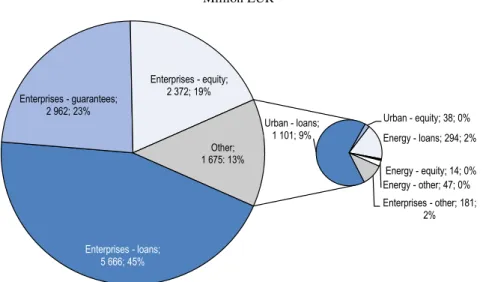
Of the total dispersed by the end of 2015, some 45% was in the form of loans to enterprises (Figure 1).
There were significant differences in scale and absorption rates between the different policy areas targeted, as indicated in Table 1. However, in all cases, there was an improvement in the rate of absorption between the end of 2014 and 2015 (European Commission, 2016).
Figure 1. Amounts dispersed to final recipients and share of total by end 2015 Million EUR
Source:Own calculations from European Commission (2016).
Table 1. “Absorption” of funds through financing instruments Million EUR as at end December 2015
Operational programme contributions paid to holding funds or specific
funds Operational programme contributions paid to final recipients Operational programme contributions remaining in
holding funds or specific funds
“Absorption” rate
Enterprises 14 543 11 181 3 292 76.9%
Urban development 1 658 1 138 275 68.6%
Energy efficiency 703 355 291 50.5%
Note: The operational programme contributions here include both EU funds and domestic co-financing. Source:European Commission (2016).
There were also wide variations between member states, both in their use of financial instruments and in the levels of absorption:
Italy alone accounted for over 29% of operational programme contributions paid to financial instruments (almost EUR 5 billion) by the end of 2015; however, only 53% of this was actually invested in final recipients.
Other large member states had also made significant payments to financial instruments by the end of 2015, including Germany (EUR 1.7 billion) and the United Kingdom (EUR 1.6 billion), but payments were not directly related to country size, with Poland and Spain also each paying over EUR 1.2 billion to funds, but France just EUR 461 million.
By the end of 2015, 90 financial instruments had either not yet made any investments in final recipients or had not reported them. Of these, 56 were in France and 17 in Italy.
In nine countries, over 90% of monies paid to financial instruments had been paid to final recipients – Bulgaria, Denmark, Estonia, Finland, Germany,
Enterprises - loans; 5 666; 45% Enterprises - guarantees; 2 962; 23% Enterprises - equity; 2 372; 19% Enterprises - other; 181; 2% Urban - loans; 1 101; 9% Urban - equity; 38; 0% Energy - loans; 294; 2% Energy - equity; 14; 0% Energy - other; 47; 0% Autre; 1 675; 13% Other; 1 675; 13%
Hungary, Lithuania, Poland and Portugal; the lowest absorption rates were found in the Slovak Republic and Spain (37%) and Italy (53%). The large scale of sums paid to financial instruments in Italy and Spain (EUR 6.2 billion and over 36% of all payments to financial instruments), coupled with these low levels of investment in final recipients, meant that over 73% of the amounts remaining in holding funds or specific funds were accounted for by these two countries. In the reporting for 2007-13, there is limited information on measures of performance. For example, little is known about leverage: the data suggest that private co-financing at the level of the operational programmes only plays a significant role in Austria, Latvia, the Netherlands and the United Kingdom; however, private sector contributions are not limited to this level, so these data may underplay private sector involvement. Other important indicators were not collected, or not collected systematically for 2007-13 because their reporting was not mandatory. This includes data on defaults and repayments, management costs and fees, as well as broader indicators of the wider impacts, such as investment or jobs associated.
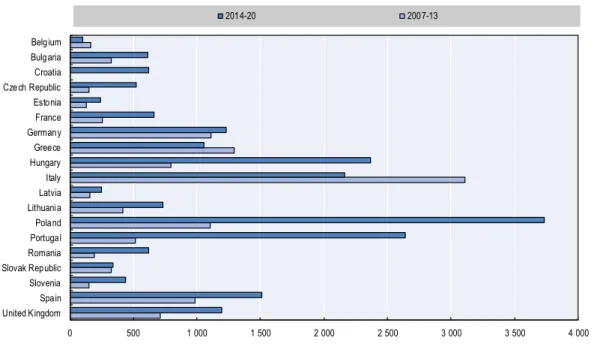
In 2007-13, the vast majority of financial instruments under Cohesion Policy were ERDF co-financed, and used for supporting enterprise development, especially SMEs, notably in the form of loans (Figure 2). A total of 11 countries used financial instruments for urban development; and 11 used them for energy efficiency and renewables.
Overview of plans in 2014-20
Turning to how financial instruments are being used in the 2014-20 planning period, data on plans to use them in the operational programmes reveal that overall member states plan to almost double their spend on financial instruments in 2014-20, to over EUR 20 billion from ESIF resources, compared to around EUR 12 billion committed to financial instruments in 2007-13.
Figure 2. Operational programme contributions to financial instruments, selected EU countries EU funds only, million EUR
Source: Authors’ calculations from European Commission (2016); and OP data available at:
https://cohesiondata.ec.europa.eu. 0 500 1 000 1 500 2 000 2 500 3 000 3 500 4 000 United Kingdom Spain Slovenia Slovak Republic Romania Portugal Poland Lithuania Latvia Italy Hungary Greece Germany France Estonia Czech Republic Croatia Bulgaria Belgium 2014-20 2007-13
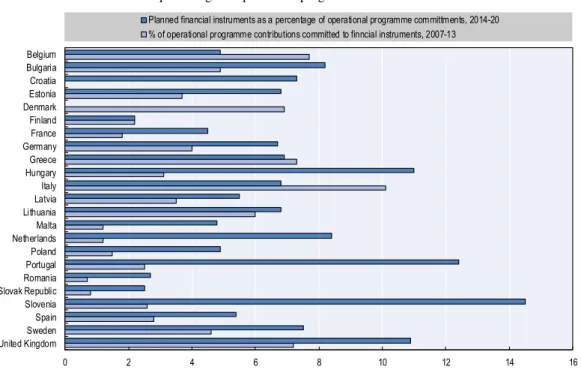
Plans vary widely between countries, as Figure 3 shows:
Nineteen countries plan to increase allocations to financial instruments in absolute terms. In some cases these increases are substantial – in the Czech Republic, the Netherlands, Poland and Portugal, for example, financial instrument allocations for 2014-20 are more than three times those for 2007-13.
Several member states plan lower contributions to financial instruments in 2014-20 than in the previous period (Austria, Belgium, Denmark, Finland, Greece and Italy) with significant reductions foreseen in Italy. As in 2007-13, Ireland and Luxembourg do not currently plan to use financial instruments.
Figure 3. Operational programme commitments in selected EU countries to financial instruments, 2007-13 and 2014-20
As a percentage of operational programme commitments
Source: Authors’ calculations from European Commission (2016); and OP data available at:
https://cohesiondata.ec.europa.eu.
At the EU level, calculations based on the summary report (European Commission, 2016) suggest that about 4% of operational programme contributions were committed to financial instruments in 2007-13; for 2014-20, the operational programme data indicate that this is planned to rise to over 6% for 2014-20. However, the share earmarked for financial instruments also varies widely between countries, as indicated in Figure 3:
seven countries intend to commit more than 8% of operational programme contributions in the form of financial instruments (Bulgaria, Hungary, Lithuania, the Netherlands, Portugal, Slovenia and the United Kingdom)
Italy, Belgium and Denmark committed the largest shares of operational programme contributions to financial instruments in 2007-13, but planned amounts are considerably reduced in 2014-20 0 2 4 6 8 10 12 14 16 United Kingdom Sweden Spain Slovenia Slovak Republic Romania Portugal Poland Netherlands Malta Lithuania Latvia Italy Hungary Greece Germany France Finland Denmark Estonia Croatia Bulgaria Belgium
Planned financial instruments as a percentage of operational programme committments, 2014-20
A total of fourteen operational programmes have planned financial instrument spend exceeding EUR 400 million;7 collectively these programmes alone account for over 55% of planned financial instrument spend across the EU-28. At the opposite end of the spectrum, some fifty programmes plan to allocate around EUR 20 million or less to financial instruments (though this may account for a large share of spend in operational programmes with small budgets).
These data provide an interesting snapshot of intent, but must be treated with caution, as managing authorities have dealt differently with the obligation to “set down a marker” for financial instruments in their operational programmes: some provided an indicative amount, others recorded “zero” against financial instruments as form of finance or left the entry blank, though the narrative of the operational programme left the possibility of using such tools in the future open. Plans for using financial instruments will also be affected by the outcomes of the now mandatory ex ante assessments, which can increase or decrease financial allocations or alter their thematic profile. Changes to the operational programme plans for financial instruments may also occur if economic conditions change, or local domestic priorities shift. Decisions to contribute to joint and EU-level instruments such as the SME Initiative are not reflected in these data, but so far, six member states are implementing the SME Initiative (Bulgaria, Finland, Italy, Malta, Romania and Spain). Under this approach an entire OP allocation is in the form of a financial instrument and a separate operational programme document must be prepared for the member state’s contribution to the SME Initiative.
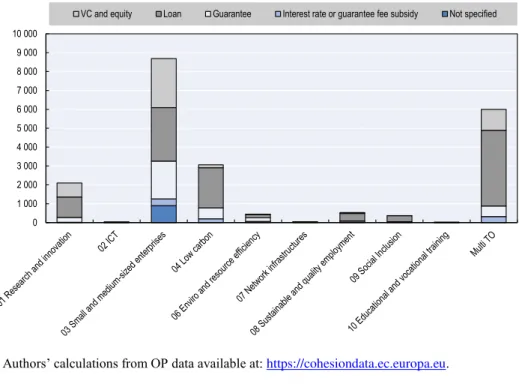
As already mentioned, a feature of the reforms was extension of financial instruments beyond enterprises, urban development and energy efficiency to embrace all of the Commission’s thematic objectives. The information available in the operational programmes is indicative, but as Figure 4 shows, early indications are that SME support is likely to continue to dominate the use of financial instruments. That said, financial instruments for low carbon are also significant.
Figure 4. Operational programme indicative allocations to financial instruments by thematic objective
Source:Authors’ calculations from OP data available at: https://cohesiondata.ec.europa.eu. 0 1 000 2 000 3 000 4 000 5 000 6 000 7 000 8 000 9 000 10 000
A number of financial instruments are set within operational programme priority axes which address multiple thematic objectives (Multi TO in Figure 4), making it difficult to determine how financial instruments will be targeted until they are closer to the implementation stage. However, it seems that most will either address TO1 and TO3, focusing on innovation and SMEs; or TO3, TO4 and TO9, focusing on urban development, including support for start-ups and disadvantaged groups in regeneration areas. The precise composition cannot be known at this stage of implementation.
The potential for financial instruments in different areas of activity
One of the research questions posed for this paper concerns the potential for financial instruments and activities that could benefit from their use. This is not a straightforward question to address. However, Table 2 summarises the main policy areas relevant to DG REGIO where financial instruments are used domestically and/or with co-financing from the ESI funds.
The key point to emerge from this is the high degree of granularity involved. This applies to the more specific goals relevant to each theme and to the categories of final recipient. For example, within the broad goal of encouraging SME growth, different approaches would be relevant to firms that had been identified as potential high-growth SMEs, compared with those interested in undertaking routine investment but not on an expansion trajectory. These different requirements translate not only into needs for different financial products, but also to different forms of governance, with some financial products involving bespoke risk assessment and project appraisal (especially equity-based products), while others, such as guarantees, and potentially, energy efficiency loans for householders, can be deployed on a relatively standardised basis through the retail banking sector.
Table 2 also provides examples of domestic and co-financed instruments relevant to the various policy objectives – more information on these is provided in Annex A. Importantly, however, even where measures seemingly address the same goals and same target recipients, the approach taken may vary widely.
What are the key preconditions for the implementation of financial instruments?
Framework conditions relevant to the implementation of financial instruments include the existing financial ecosystem/economic context, institutional capacity, the regulatory framework and a range of more operational issues. In considering these contextual issues in the discussion that follows, the main focus is on support for SMEs, where there is most experience in the use of financial instruments across EU member states, but these factors are also relevant to the use of financial instruments in other policy areas, together with more specific elements.The context within which financial instruments are implemented will affect how and how well they work. Circumstances vary between member states and regions, so there is no “one-size-fits-all” approach (Wishlade et al., 2016a). Financial instrument models are seldom transferable without modification to take local, regional or national conditions into account. These include differences in local economic conditions, in banking and legal systems, previous experience with implementing financial instruments, etc. The financial intrument model must be shaped by local circumstances and needs. Various academic studies have emphasised the need for instruments to be tailored to different areas (Veugelers, 2011; Tykvová, Borell and Kroencke, 2012; Berggren and Silver, 2012). In short, financial instrument design must be alert to context and take it into consideration (Wilson and Silva, 2013).
Table 2. Linking objectives, market imperfections, target recipients and financial products
Theme Goal Target recipient Market imperfection/
finance gap Financial products
Standardisation/ specialisation Examples In no va tio n Development and commercialisation of new products, processes, services
High tech firms; spin-out companies
Asymmetric information; difficulty of risk assessment; scale of capital required in relation to cash flow; externalities
Equity: seed, start-up or early-stage capital; loans; guarantees
Small numbers of specialised investment decisions involving fund manager expertise; potentially large investments
France: Breizh up (ERDF)
Spain: ICO Technological Innovation Fund (ERDF)
S M E c om pe tit iv en es s Promoting entrepreneurship
Start-ups/individuals Lack of collateral, track record; transaction costs; credit rationing
Loans, guarantees, microfinance
Potentially large numbers of investment decisions involving small sums; standard products
Germany: NRW Micro Loan Fund (ERDF) Hungary: Combined Microcredit scheme (ERDF) United Kingdom: Start-up loans (Nat)
Supporting SME growth High-growth firms Difficulty of risk assessment; credit rationing
Loans, guarantees, equity; mezzanine finance
Bespoke decisions France: JEREMIE Languedoc-Roussillon (ERDF) Sweden: Regional venture capital funds (ERDF) United Kingdom: Scottish Co-Investment Fund (ERDF)
Supporting SME growth Mainstream SMEs Credit rationing; asymmetric information
Loans, guarantees Standardised products Austria: ERP loan fund (Nat)
France: JEREMIE Languedoc-Roussillon (ERDF) Lithuania: INVEGA Guarantee Fund (ERDF) Portugal: Venture capital funds under the OP COMPETE (ERDF)
Spain: ICO Guarantee Fund (ERDF)
United Kingdom: Enterprise Guarantee Fund (Nat)
Low -c ar bo n e co no m y Promoting energy efficiency and renewable energy sources in enterprises
SMEs Credit rationing; asymmetric
information; externalities
Loans, guarantees Standardised products, supported by energy audits
Germany: KfW Energy efficiency programme (Nat) United Kingdom: Green Deal (Nat)
Energy efficient buildings Householders Transaction costs; cost of credit; externalities
Long-term loans, guarantees
Standardised products, supported by energy audits
Estonia: Renovation loan (ERDF) Greece: JESSICA (ERDF) United Kingdom: Green Deal (Nat) Private landlords Split incentives; externalities Long-term loans Standardised products,
supported by energy audits
Estonia: Renovation Loan (ERDF) Slovak Republic: JESSICA (ERDF) Public authorities Split incentives; cost of credit;
externalities
Long-term loans Bespoke decisions Lithuania: ENEF (ERDF) Housing associations Split incentives; cost of credit;
externalities
Long-term loans Standardised products, supported by energy audits
Estonia: Renovation Loan (ERDF) Slovak Republic: JESSICA (ERDF) Energy efficient public
infrastructure, e.g. transport, street lighting
Public authorities Cost of credit; positive externalities
Long-term loans Bespoke investment decisions
Table 2. Linking objectives, market imperfections, target recipients and financial products (continued)
Theme Goal Target recipient Market imperfection/
finance gap Financial products
Standardisation/ specialisation Examples Low -c ar bo n e co no m y ( c o n ti n u e d )
Renewables infrastructure Enterprises Risk; externalities Loans, guarantees, equity
Bespoke decisions – specific to technology involved
Germany: KfW Renewables energy programme (Nat)
Spain: FIDAE (ERDF) Development and
commercialisation of new energy efficiency and renewable energy source technologies
High-tech firms, spin-out companies
Asymmetric information; difficulty of risk assessment; externalities
Equity: seed, start-up or early-stage capital
Bespoke decisions involving specialised fund management
Sweden: Green Fund (ERDF)
United Kingdom: Low carbon innovation fund (ERDF) T ra ns po rt an d ne tw or k in fr as tr uc tu re Development of low-carbon transport systems
Public authorities Cost of credit; externalities Long-term loans Bespoke decisions involving specialised fund management
Spain: FIDAE (ERDF)
Improving energy efficiency and security of supply
Energy suppliers/ distributors
Externalities; credit rationing Long-term loans and financing packages
Bespoke decisions involving specialised fund management
Germany: KfW syndicated loan for energy and environment (Nat) E m pl oy m en t Supporting self-employment, micro-enterprises Individuals, especially in disadvantaged groups – unemployed, women, minorities
Lack of collateral, track record; transaction costs; credit rationing
Loans, guarantees, microfinance
Potentially large numbers of investment decisions involving small sums; standard products
Belgium: BRUSOC (ERDF)
S oc ia l i nc lu si on Regenerating deprived communities in urban areas Public authorities, public-private partnerships property developers, firms
Externalities; risk Loans, guarantees, equity
Bespoke decisions involving specialised fund management
France: Bpi – Prêt entreprises et quartiers (Nat)
Supporting social enterprise
New and existing social enterprises
Risk; lack of collateral; credit rationing Loans, guarantees, microfinance Standardised decision making and products
France: Bpi – Prêt économie sociale et solidaire (Nat) E du ca tio n a nd tr ai ni ng
Individuals Lack of collateral; risk;
externalities
Loans, guarantees Standardised products DE: Aufstiegs-BAfoG loans (Nat) UK: Career development loans (Nat)
As part of this, it is fundamental that financial instrument implementation builds on anaccurate assessment of the market situation, which provides clear evidence of the need for public intervention. Because market conditions are so diverse, research on market gaps and economic structures is key to accurate instrument design and the allocation of funds (Cowling, 2012). Managing authorities implementing financial instruments in 2007-13 identified three main shortcomings to the approaches taken to market assessment at the start of that period.8 These were: insufficient involvement of local actors; inadequate analyses of the market situation leading to under- or over-allocation of funds to financial instruments, or inappropriately targeted instruments because the analyses were not detailed or comprehensive enough to provide a basis for policy; and failure to anticipate economic change (Michie, Wishlade and Gloazzo, 2014). Several key lessons emerged from this experience, which implied the following specific needs to support the implementation of financial instruments:
a thorough understanding of the locality in order to take account of the specific characteristics of a region and the impact of this context on market failures and potential
specialist analysis of the SME financing market to improve the reliability of the overall assessment
involvement of public and private stakeholders to facilitate the market analysis and help to ensure a balanced perspective on the market situation
assessment of the administrative and technical capacity of the stakeholders within that particular territory to set up and run appropriate instruments
the development of an investment strategy based on an in-depth analysis that takes account of strategic objectives, funding sources (including proportion of private co-funding), options for fund structure and management, financial and legal aspects
a forward-looking element to take account of changing economic conditions and the funding needs of firms
a regular review to check economic circumstances and market needs.
Many of these conditions are now mandatory elements of the ex ante assessment process required before ESIF are committed to financial instruments.
More generally, market conditions must be favourable for the implementation of financial instruments – there must be sufficient “density” in terms of numbers of suitable projects/final recipients/investee companies, as well as potential co-investors, and appropriate financial intermediaries, whether these are banks or fund managers. The lack of a functioning ecosystem of project promoters/investors, or the lack of stakeholders with the required expertise, may lead to an uneven dissemination of instruments, such as urban development funds under the Joint European Support for Sustainable Investment in City Areas (JESSICA) initiatives (Nadler and Nadler, 2017). On the other hand, financial instruments can be used to build up the market, e.g. by encouraging co-investors, business angels or fund managers to invest in and perhaps move or relocate to an area. For example, the Scottish Co-Investment Fund has been found to have grown both capacity and capability in the market; it has had an observable effect on the development of the financial community, especially angel syndicates, and the encouragement of new lenders to enter the Scottish market (CSES, 2008). The presence of an appropriate “ecosystem” of
firms and investors to generate a critical mass of activity is less likely in disadvantaged regions – highlighting the need to address other dimensions of the business environment to ensure an adequate flow of investor-ready projects, including training, pre- and post-investment advice, and perhaps non-repayable support to complement the financial instrument.
Stability and predictability are also key contextual factors. Financial instruments require a long-term perspective and predictability to work well; irregular public sector interventions, uncertainty as to whether ongoing interventions will be continued, changes in terms and conditions, etc. affect both the willingness of the private sector to invest and the ability to build up competence and capacity (growth analysis, 2016).
The implementation of financial instruments requires considerable institutional and administrative capacity. This is not unique to financial instruments and also applies to grants, but some aspects of financial instrument implementation may be more demanding. For example, while the state aid rules are relatively straightforward in relation to grants, they are much more complex for financial instruments, for which there must be an assessment of the presence of state aid at several levels – not just the final recipient but also financial intermediaries. Urban development plans implemented through JESSICA proved particularly challenging from a state aid point of view, but also required an understanding of the complex and sometimes conflicting motivations of parties involved in urban regeneration, including an understanding of property markets and the impact of issues such as pollution on investment decisions. More generally, the increased use of financial instruments under Cohesion Policy in 2007-13 created significant challenges for managing authorities with limited experience in implementing financial instruments, and it was demanding in terms of the administrative capacity required at national and regional levels (Wishlade et al., 2017a). The extension of financial instruments to all ESIF thematic objectives in 2014-20 means that managing authorities may have to engage with different stakeholders, and involves considerations for the use of financial instruments which are quite distinct from those for SME support. For example, experts may be required to play a role in conducting energy audits or assessments and projects may be very technical, so applications take longer to prepare and specific expertise is required (Vironen, 2016). In some cases, the chain of responsibility is lengthy and involves relying on expertise that is somewhat removed from those responsible for the funds and risks conflicts of interest. Where specialist input is required, this must be credible. For example, for the UK Green Deal scheme (a domestic programme), accredited assessors determined the scope and financing needs for energy efficiency investments in households, but some 10% of certified assessors were struck off for non-compliance with the Green Deal code, undermining public confidence in the scheme (Chandler, 2015). This was one of the factors underpinning low take-up and the ultimate demise of the scheme.
The creation of successful financial instruments is an iterative process, involving trial and error, so implementation that builds on previous experience/existing structures can gain an important advantage. In Nordrhein-Westfalen (Germany), for example, when co-financing financial instruments under the ERDF OP in 2007-13, it was considered to make more sense to draw on the existing expertise and structures within the NRW Land-owned public investment bank, NRW.BANK, rather than setting up a parallel institutional framework. It was also hoped that the use of the Land investment bank would ensure that the fund was fully neutral and would not favour any particular lending institutions. The perceived advantages of the Land investment bank are that it is very familiar with the financial situation and difficulties of local firms and that it is used to
working closely and constructively with the different Land ministries and playing a bridging role between the Land government, commercial/co-operative banks and local SMEs (Michie and Wishlade, 2011).
The regulatory framework within which financial instruments are implemented has a crucial role to play in providing the framework conditions for the successful implementation of financial instruments. The ability of the public sector to intervene in markets through the introduction of financial instruments must be rooted in legislation, the nature of which (complex, slow to change, stringently monitored, and subject to a heavy reporting and audit burden) may conflict with private sector/commercial practices. The regulatory framework under which ESIF financial instruments are implemented has changed significantly over successive programming periods – from essentially being implemented under legislation designed for grants to a more detailed framework within the main regulations along with numerous associated delegated acts and implementing regulations. As a result, the regulatory framework for ESIF financial instruments in 2014-20 now provides more clarity and certainty, but also considerable complexity. However, the regulatory framework has consolidated lessons learnt during previous periods, and, through the regulations, the Commission has encouraged the use of financial instruments by introducing changes such as:
increasing the implementation options available (e.g. providing options for contributing to EU-level financial instruments, or using “off-the-shelf” template financial instruments which are pre-cleared for state aid)
increasing certainty by incorporating into the legislation detail which had previously been provided in guidance
ensuring accurate assessment of the market before ESIF are committed to financial instruments by introducing a mandatory ex ante assessment process.
At a policy level, European Commissioners responsible for ESIF have encouraged the use of financial instruments by suggesting that member states meet spending targets linked to the thematic objectives; however, it may be difficult to reconcile minimum targets or ring-fencing with the findings of an ex ante assessment, which is now intended to underpin the design, scale and governance of co-financed financial instruments.
Despite these improvements, managing authorities still find some aspects of the regulatory framework to be barriers to the use of financial instruments, including the administrative burden, the restrictions imposed by the seven-year programming period (in reality, it is much shorter than this given the protracted set-up time for financial instruments), and the restrictions on management costs and fees. These constraints are not limited to ESIF financial instruments – for example, an internal evaluation of the Canada Small Business Program in 2014 found that the demands placed by the programme’s regulatory and legislative framework, coupled with the slow pace of change to the framework, was placing its relationships with private sector stakeholders under stress, and had diminished the programme’s appeal for lenders (Box 1). That said, many consider that the administrative burden is primarily carried by financial intermediaries and managing authorities, with limited impact on final recipients.
On a more operational level, there are various framework pre-conditions that facilitate the success of financial instrument implementation, including management of the relationship with the private sector, rigorous monitoring including of returned funds, effective publicity activity to communicate the existence of the financial instrument, and complementary policy activities such as advice, consultancy support, technical assistance and complementary grants.