Understanding and Predicting Image Memorability at a Large Scale
Aditya Khosla
MIT
[email protected]Akhil S. Raju
MIT
[email protected]Antonio Torralba
MIT
[email protected]Aude Oliva
MIT
[email protected]Abstract
Progress in estimating visual memorability has been lim-ited by the small scale and lack of variety of benchmark data. Here, we introduce a novel experimental procedure to objectively measure human memory, allowing us to build LaMem, the largest annotated image memorability dataset to date (containing 60,000 images from diverse sources). Using Convolutional Neural Networks (CNNs), we show that fine-tuned deep features outperform all other features by a large margin, reaching a rank correlation of 0.64, near human consistency (0.68). Analysis of the responses of the high-level CNN layers shows which objects and regions are positively, and negatively, correlated with memorability, al-lowing us to create memorability maps for each image and provide a concrete method to perform image memorability manipulation. This work demonstrates that one can now ro-bustly estimate the memorability of images from many dif-ferent classes, positioning memorability and deep memora-bility features as prime candidates to estimate the utility of information for cognitive systems. Our model and data are available at:http://memorability.csail.mit.edu
1. Introduction
One hallmark of human cognition is our massive
capac-ity for remembering lots of different images [2,20], many
in great detail, and after only a single view. Interestingly, we also tend to remember and forget the same pictures and
faces as each other [1,13]. This suggests that despite
dif-ferent personal experiences, people naturally encode and discard the same types of information. For example, pic-tures with people, salient actions and events, or central ob-jects are more memorable to all of us than natural land-scapes. Images that are consistently forgotten seem to lack distinctiveness and a fine-grained representation in human
memory [2,20]. These results suggest that memorable and
forgettable images have different intrinsic visual features, making some information easier to remember than others.
Indeed, computer vision works [12,18, 15,7] have been
able to reliably estimate the memorability ranks of novel
pictures, or faces, accounting for half of the variance in hu-man consistency. However, to date, experiments and mod-els for predicting visual memorability have been limited to very small datasets and specific image domains.
Intuitively, the question of an artificial system success-fully predicting human visual memory seems out of reach. Unlike visual classification, images that are memorable, or forgettable, do not even look alike: an elephant, a kitchen, an abstract painting, a face and a billboard can all share the same level of memorability, but no visual recognition algorithms would cluster these images together. What are the common visual features of memorable, or forgettable, images? How far we can we go in predicting with high ac-curacy which images people will remember, or not?
In this work, we demonstrate that a deep network trained to represent the diversity of human visual experience can reach astonishing performance in predicting visual memo-rability, at a near-human level, and for a large variety of im-ages. Combining the versatility of many benchmarks and a novel experimental method for efficiently collecting human
memory scores (about one-tenth the cost of [13]), we
in-troduce the LaMem dataset, containing 60,000 images with memorability scores from human observers (about 27 times larger than the previous dataset [13]).
By fine-tuning Hybrid-CNN [37], a convolutional
neu-ral network (CNN) [23,21] trained to classify more than
a thousand categories of objects and scenes, we show that our model, MemNet, achieves a rank correlation of 0.64 on novel images, reaching near human consistency rank corre-lation (0.68) for memorability. By visualizing the learned representation of the layers of MemNet, we discover the emergent representations, or diagnostic objects, that explain what makes an image memorable or forgettable. We then apply MemNet to overlapping image regions to produce a memorability map. We propose a simple technique based on non-photorealistic rendering to evaluate these memora-bility maps. We find a causal effect of this manipulation on human memory performance, demonstrating that our deep memorability network has been able to isolate the correct components of visual memorability.
Altogether, this work stands as the first near-human
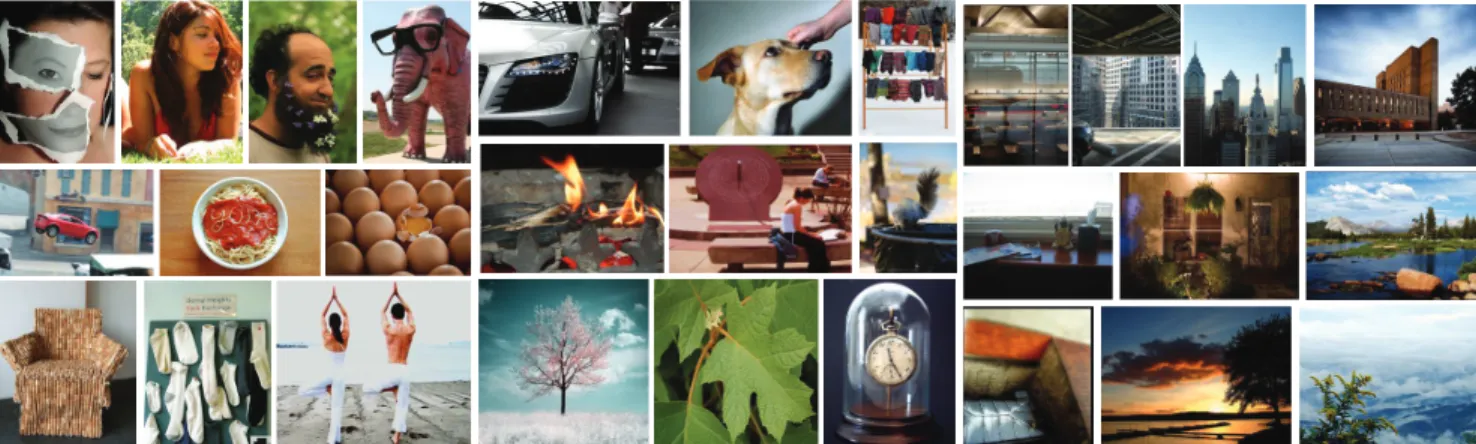
Figure 1. Sample images from LaMem arranged by their memorability score (decreasing from left to right). LaMem contains a very large variety of images ranging from object-centric to scene-centric images, and objects from unconventional viewpoints.
formance benchmark of human visual memory, offering an understanding and a concrete algorithm for predicting the memorability of an image and its regions. We envision that many applications can be developed out of deep memorabil-ity features, akin to the recent astonishing impact that deep networks have had on object and scene classification tasks. Our work shows that predicting human cognitive abilities is within reach for the field of computer vision.
2. LaMem: Large-scale Memorability Dataset
Here, we introduce an optimized protocol of the memory
game introduced by [13] to collect human memory scores.
In this game, images are presented successively, and some are repeated. Observers must press a key when they recog-nize an image seen before. This allows us to collect ground truth scores on how memorable images are. The basic idea of our novel procedure is to allow the second occurrence of an image to occur at variable time intervals. This procedure is based on the finding that the memorability ranks of
im-ages are time-independent [13]. We propose an algorithm
to account for this varied time interval allowing us to obtain
high consistency with the existing benchmark [13].
Fur-thermore, using this new experimental setting, we build a
novel massive memorability dataset, with scores on60,000
images (∼27times the previous largest benchmark), while
keeping a low cost. Our dataset contains significantly more
variety in the types of images (see Fig.1), while still
main-taining a high human consistency on memorability.
First, in Sec.2.1, we briefly describe the sources of
im-ages used for building the dataset to demonstrate its variety
as compared to existing datasets. Then, in Sec.2.2, we
de-scribe the efficient visual memory game for obtaining
large-scale memorability annotations. Last, in Sec.2.3, we
pro-vide experimental validation of the proposed method.
2.1. Collecting images
To create a varied dataset, we sampled images from
a number of existing datasets such as MIR Flickr [11],
AVA dataset [27], affective images dataset [25]
(consist-ing of Art and Abstract datasets), image saliency datasets
(MIT1003 [14] and NUSEF [28]), SUN [34], image
popu-larity dataset [16], Abnormal Objects dataset [31] and
aPas-cal dataset [9]. Thus, our dataset contains scene-centric
im-ages, object-centric images and other types such as images of art, images evoking certain emotions, and other user-generated images such as ‘selfies’. We explore the correla-tion between a variety of these attributes and memorability in Sec.3.2.
2.2. Efficient Visual Memory Game
Our experimental procedure consists of showing target repeats (the second occurrence of an image) at variable time intervals. For example, some targets may be repeated af-ter just 30 images, while others are repeated afaf-ter 100. As
shown in [13], memorability scores change predictably as a
function of the time interval between repeats, while memo-rability ranks are largely conserved i.e., if the time between the showing of a target and its repeat is increased, the mem-orability scores of all images decrease by a similar amount, thereby preserving the rank ordering. In our method, we use this information to propose a method based on coordinate descent that explicitly accounts for the difference in interval lengths. This allowed us to collect ground truth
memorabil-ity scores for a large number of images (here60,000), in a
short amount of time, and at a very reasonable cost.
Model: We first describe one possible interpretation of
the memorability score computation proposed by [13], and
extend that to our setting. Let us definem(i)as the
mem-orability of imagei. For imagei, we have somen(i)
ob-servations given by x(ji) ∈ {0,1} andt(ji) wherexj = 1
target filler repeat
+
target filler repeat
…
target repeat
35 images
…
+
+
+
+
+
vigilance filler vig. repeat
vigilance repeat 1 -‐ 7 images target repeat 150 images 0.6 s 0.8 s 4me
(a) The efficient visual memory game. Each image is shown for 600ms, separated by a blank fixation of 800ms. The worker can press a key anytime during this 1.4s.
0 20 40 60 80 0 0.1 0.2 0.3 0.4 0.5 0.6 0.7
Mean number of scores per image
Spearman’s Rank Correlation
(b) Human consistency.
Figure 2. Illustration of the efficient visual memory game (left), and the resulting human consistency averaged over 25 random splits (right) obtained using the proposed method on the LaMem dataset.
it was shown after time tj. The memorability score
pro-posed by [13] is the average hit rate per image, which
can also be seen as the value that minimizes the `2 error
P j||x (i) j −m(i)||22 =⇒ m(i)= 1 ni P jx (i) j . In this case,
the different times of repeat presentation,tj, are not taken
into account explicitly as all repeats are shown at about the same delay to all participants. Next, we modify the above model to suit our new scenario with variable delays.
Memorability follows a log-linear relationship with time
delay between images [13]. Let us assume that the
memo-rability of imageiism(Ti)when the time interval between
repeated displays isT. Thus, we can write the
memorabil-ity of imageiasm(Ti) =αlog(T) +c(i), wherec(i)is the
base memorabilityfor the given image andαis the decay factor of memorability over time. Similarly, for some other
timet, we can write the memorability of the same image as
m(ti)=αlog(t) +c(i). Thus, we obtain the relationship:
m(ti)−m(Ti)=αlog(t)−αlog(T) (1) =⇒ m(ti)=m (i) T +αlog t(i) T (2)
As before, we have some n observations for image i
given byx(ji) ∈ {0,1}andt(ji)wherexj = 1implies that
the image repeat was correctly detected when it was shown
after timetj. ForN images, we can now write the overall
`2error,E, as: E(α, m(Ti)) = N X i=1 n(i) X j=1 ||x(ji)−m(ti) j || 2 2 (3) = N X i=1 n(i) X j=1 x(ji)− " m(Ti)+αlog t (i) j T !# 2 2 (4)
Note that we write the combined error (as compared to
in-dividual errors per image) as the decay factor αis shared
across all images. Our goal is to findm(Ti)andαthat
min-imize E. By adjusting the value ofT, we can adjust the
time delay at which we want to find the memorability score.
Also, by finding all scores at a fixed delayT, the scores for
all images become comparable, as is the case in the model proposed by [13].
Optimization: We observe that we can find the global
minima ofE with respect tom(Ti)if we fix the value ofα,
and similarly, we can find αif we fix the value ofm(Ti).
Thus, we can minimize E by iteratively updating α,
fol-lowed bym(Ti)and so on. By differentiatingEwith respect
to each of the variables, and setting it to0, we can find the
update equations: α← PN i=1 1 n(i) Pn(i) j=1log(t (i) j /T) h x(ji)−m(Ti)i PN i=1 1 n(i) Pn(i) j=1 h log(t(ji)/T)i 2 (5) and m(Ti)← 1 n(i) n(i) X j=1 " x(ji)−αlog t (i) j T !# (6)
As the update equations find the global optima of E
when keeping the other fixed, we ensure that the error is al-ways decreasing, guaranteeing convergence. In practice, we initializem(Ti)to the mean hit rate ignoring time delay, and find that approximately 10 iterations are enough for conver-gence. Note that our model has no hyperparameters.
2.3. Dataset experiments
In this section, we describe in detail the experimental setup of our efficient visual memory game, and conduct several experiments comparing the results of the proposed
methodology with [13]. Further, we demonstrate that the
proposed model can increase human consistency by ac-counting for variable time delays between repeats and it re-sults in a consistent decay factor,α, across splits.
Experimental setup: The efficient visual memory game
is summarized in Fig. 2(a). We conducted memorability
experiments using Amazon’s Mechanical Turk (AMT) on
the60,000target images obtained by sampling the various
datasets mentioned in Sec.2.1. Each task lasted about 4.5
targets, 30 fillers, and 12 vigilance repeats. Targets were re-peated after at least 35 images, and at most 150 images. Vigilance repeats were shown within 7 images from the first showing. The vigilance repeats ensured that workers were paying attention leading to a higher quality of results.
Workers who failed more than25%of the vigilance repeats
were blocked, and all their results discarded. Further, we used a qualification test to ensure the workers understood the task well. We obtained 80 scores per image on average, resulting in a total of about 5 million data points. Similar
to [13], we use rank correlation to measure consistency.
Comparison with [13]: Before describing the results on our new dataset, we first compare the performance of our
method to the one proposed by Isola et al [13] on the SUN
memorability dataset to ensure that our modifications are valid. We randomly selected 500 images from their dataset, and collected 80 scores per image. After applying our
al-gorithm to correct the memorability scores, we obtained
a within-dataset human rank correlation of 0.77 (averaged over 25 random splits), as compared to 0.75 using the data
provided by [13]. Further, we obtain a rank correlation
of 0.76 when comparing the independently obtained scores from the two methods. This shows that our method is well suited for collecting memorability scores.
Results on LaMem: Fig. 2(b) shows the human con-sistency as the number of number of human annotations per image increases. At 80 scores per image, we obtain a human rank correlation of 0.67 (averaged over 25 random splits) if we simply take the average of the correct responses ignoring the difference in time delays (i.e., same formula
as [13]) which increases to 0.68 after applying our method.
Note that the impact of using our method is small in this case as the range of average delays of each image is rela-tively small, ranging only from 62 to 101 intervening im-ages. While our method can rectify the errors caused by variable delays, the error here is rather insignificant.
To further verify our algorithm, we createdadversarial
splits of the data where the responses for each image are di-vided based on the delays i.e., all the responses when delays are low go into one split, and all the responses when delays are high go into the other split. We randomly assign the low and high delay split of each image to different overall
splits. Using the method of [13] (i.e., simple averaging) in
this case significantly reduces the human rank correlation to 0.61, which can be restored to 0.67 using our method. This demonstrates the importance of applying our method when the interval distribution is more diverse.
Interestingly, we find that the decay factor, α, found
by our method is largely consistent across various splits
of data, having a standard deviation of less than 1%from
the mean. This further verifies the finding made by [13]
that memorability decays consistently over time, and our method provides a robust way to estimate this decay factor.
0 0.2 0.4 0.6 0.8 1 0.4 0.5 0.6 0.7 0.8 0.9 1 Image index Memorability score Abnormal (An) Popularity (P) MIRFlickr (M) COCO (C) Abstract (At) Fixation Flickr (FF) SUN (S)
(a) Memorability scores
An At C FF M P S An At C FF M P S (b) Statistical differences in mean
Figure 3. (a) Memorability scores of images from different datasets. For each dataset, the memorability scores of the images are independently sorted from low to high i.e., image index 0 to 1. Note that the image index ranges from 0 to 1 (instead of 1 toN) as each dataset has a different number of images. (b) Matrix indicat-ing if the differences in the mean memorability scores of different datasets are statistically significant at the 5% level of significance.
Blueindicates no difference,redindicatescol>row, whilegreen
indicatesrow>col.
Overall, the high human consistency obtained on LaMem despite the large variety of images strengthens the importance of the concept of memorability and shows that it is a universal and intrinsic property of each image.
3. Understanding Memorability
As described in Sec.2.1, LaMem is composed of a
vari-ety of other datasets that contain additional annotation such as aesthetics, popularity, image emotions, objects, and so on. In this section, we explore the relationship of some of these image attributes to memorability.
3.1. Differences across datasets
In Fig.3(a), we plot the memorability scores of some of
the datasets contained in LaMem1. We find that the
distribu-tion of memorability scores for the different datasets tends to look rather different. While images from the
Abnor-mal Objects dataset [31] and image popularity dataset [16]
tend to be extremely memorable, those from the SUN
dataset [34] tend to be rather forgettable. In Fig.3(b)we
evaluate whether these perceived differences are statisti-cally significant using a one-sided t-test. We find that most of the differences are significant at the 5% level.
3.2. Image attributes
In this section, we explore how some of the image at-tributes, such as popularity, saliency, emotions and aes-thetics, affect the memorability of images and vice-versa. We would like to highlight that the significant diversity of LaMem allows for this exploration at a large-scale.
1For clarity, we only show the plots for a subset of the datasets. The full set of plots are provided in the supplemental material.
0 0.2 0.4 0.6 0.8 1 7.2 7.4 7.6 7.8 8 8.2 8.4 8.6 8.8 9 Image Index Popularity score 1st Mem. Quartile 2nd Mem. Quartile 3rd Mem. Quartile 4th Mem. Quartile
(a) Memorability vs popularity
0 0.2 0.4 0.6 0.8 1 0.8 0.85 0.9 0.95 1 Image index Human consistency 25% Most Memorable 25% Least Memorable (b) Memorability vs saliency 0 0.2 0.4 0.6 0.8 1 0.4 0.5 0.6 0.7 0.8 0.9 1 Image index Memorability score disgust amusement fear anger excitement sad awe contentment (c) Memorability vs emotions 0 0.2 0.4 0.6 0.8 1 2 3 4 5 6 7 8 Image Index Aesthetic score 25% Most Memorable 25% Least Memorable (d) Memorability vs aesthetics
Figure 4. Plots showing the relationship of memorability and var-ious image attributes. For each curve, the images are sorted inde-pendently using ground-truth memorability scores. As each curve may contain a different number of images, the image index above has been normalized to be from 0 to 1.
Popularity: In [16], popularity is defined as thelog -normalized view-count of an image on Flickr. Using the 5000 images from this dataset contained in LaMem, in
Fig.4(a), we plot the popularity scores of the images
di-vided into quartiles based on their ground-truth memora-bility scores. We find that the popularity scores of the most memorable images (1st quartile) are statistically higher than
those of the other quartiles2. On the other hand, when the
memorability scores are low-medium, there is little differ-ence in the popularity scores. This could be an insightful finding for people attempting to design images that become popular. Note that even though these images are popular on Flickr, we do not expect the AMT workers to have seen them before in general as the most popular image had fewer than 100k views. Furthermore, if they had seen the image before, they would have generated a false alarm on the first presentation of the image resulting in a lower memorability score for the image.
Saliency: Using images from the Fixation Flickr [14] dataset, we explore the relationship between human
fixa-tions and memorability. As shown in Fig.4(b), we find that
images that are more memorable tend to have more con-2The same holds if we plot the memorability scores of the 25% most and least popular images. This is included in the supplemental material.
sistent human fixations. In fact, we find that human fixa-tion consistency and memorability have a reasonable rank correlation of 0.24. A high human consistency on saliency often occurs when humans have one or a few specific ob-jects to fixate on, which would tend to imply that the image contains more close-ups or larger objects. Essentially, this suggests that when humans have a specific point of focus in an image, they are better able to remember it and vice versa. These findings are similar to those of [26] and [3].
Emotions:In Fig.4(c), we plot the memorability scores of images portraying various emotions from the affective
images dataset [25]. We find that images that evokedisgust
are statistically more memorable than images showing most
other emotions, except foramusement. Further, images
por-traying emotions likeaweandcontentment tend to be the
least memorable. This is similar to the findings in [12]
where they show attributes like ‘peaceful’ are strongly neg-atively correlated with memorability. Overall, we find that
images that evoke negative emotions such asangerandfear
tend to be more memorable than those portraying positive ones. The analysis on the statistical differences between the memorability of emotions is in the supplemental material.
Aesthetics: Fig.4(d)shows the aesthetic scores of the 25% most and least memorable images from the AVA dataset [27]. As in [1,13], we find that the aesthetic score of an image and its memorability have little to no correlation.
4. Predicting Memorability
In this section, we focus on predicting image
memora-bility using deep networks. In Sec. 4.1, we describe the
experimental setup and our approach, MemNet, for
predict-ing memorability. Then, in Sec.4.2and4.3, we apply the
proposed algorithms to the SUN memorability dataset and
our new LaMem dataset respectively. Last, in Sec.4.4we
provide additional analysis such as visualizing the internal representation learned by MemNet.
4.1. MemNet: CNN for Memorability
Given the recent success of convolutional neural
net-works (CNN) in various visual recognition tasks [10,21,
29,35,32,37], we use them here for memorability
predic-tion. As memorability depends on both scenes and objects, we initialize the training using the pre-trained Hybrid-CNN
from [37], trained on both ILSVRC 2012 [30] and Places
dataset [37]. Memorability is a single real-valued output, so
we use a Euclidean loss layer to fine-tune the Hybrid-CNN.
We call our final networkMemNet.
Setup and baseline: We followed the same
experimen-tal procedure as [13] where we distribute the data into
ran-dom train and test splits: the train split is scored by one half of the workers, and the test split by the other half. For the SUN Memorability dataset, we repeat the experiment for
Test set: Train set: SUN Memorability Train set: LaMem
fc6 fc7 fc8 fine-tune HOG2x2 fc6 fc7 fc8 MemNet HOG2x2
SUN Mem no FA 0.57 0.60 0.58 0.51 0.45 0.56 0.59 0.57 0.59 0.47
with FA 0.61 0.63 0.62 0.53 0.48 0.57 0.59 0.58 0.61 0.48
LaMem no FA 0.46 0.48 0.46 0.43 0.35 0.54 0.55 0.53 0.57 0.40
with FA 0.52 0.54 0.55 0.47 0.43 0.61 0.61 0.60 0.64 0.47
Table 1. Rank correlation of training and testing on both LaMem and SUN Memorability datasets. The reported performance is averaged over various train/test splits of the data. For cross-dataset evaluation, we use the full dataset for training and evaluate on the same test splits to ensure results are comparable. ‘fc6’, ‘fc7’ and ‘fc8’ refer to the different layers of the Hybrid-CNN [37], and ‘FA’ refers to false alarms. Please refer to Sec.4.1for additional details.
25 splits, but for LaMem, we use 5 splits due to the com-putationally expensive fine-tuning step. As the baseline, we report performance when using HOG2x2 features that are
extracted in a similar manner to [18] i.e., we densely sample
HOG [4] in a regular grid and use locality-constrained
lin-ear coding [33] to assign descriptors to a dictionary of size
256. Then, we combine features in a spatial pyramid [22]
resulting in a feature of dimension 5376. This is the best performing feature for predicting memorability as reported
by various previous works [15,18,13]. For both HOG2x2
and features from CNNs, we train a linear Support Vector
Regression machine [8,6] to predict memorability. We used
validation data to find the bestBandChyperparameters3.
As proposed in [15], we evaluate two notions of
memo-rability - one that does not account for false alarms (no FA), and one that does (with FA). It can be important to account
for false alarms to reduce thenoisein the signal as people
may remember some images simply because they are
famil-iar, but notmemorable. Indeed, we find that this greatly
improves the prediction rank correlation despite using the same features. In our experiments, we evaluate performance using both metrics. Note that the models for ‘no FA’ and
‘with FA’ as mentioned in Tbl.1are trained independently.
4.2. SUN Memorability dataset
Tbl. 1 (left) shows the results of training on the SUN
Memorability dataset and testing on both datasets. We ob-serve that deep features significantly outperform the
ex-isting state-of-the-art by about 0.15 (0.63 vs 0.48 with
FA, and 0.60 vs 0.45 no FA). This demonstrates the strength of the deep features as shown by a variety of other
works. Similar to [15], we observe that the performance
increases significantly when accounting for false alarms. Apart from high performance on the SUN Memorability dataset, the features learned by CNNs generalize well to the larger LaMem dataset. Despite having significantly less va-riety in the type of images, the representational power of the features allow the model to perform well.
Fine-tuning has been shown to be important for
improv-ing performance [29], but we find that it reduces
perfor-3Note that, since Liblinear [8] regularizes the bias term,B, we found that it was important to vary it to maximize performance.
mance when using the SUN Memorability dataset. This is due to the limited size of the data, and the large number of network parameters, leading to severe overfitting of the training data. While the rank correlation of the training ex-amples increases over backpropagation iterations, the vali-dation performance remains constant or decreases slightly. This shows the importance of having a large-scale dataset for training a robust model of memorability.
Note that Tbl.1only compares against having the single
best feature (HOG2x2), but even with multiple features the
best reported performance [18] is0.50(no FA), which we
outperform significantly. Interestingly, our method also
out-performs [13] (0.54, no FA) and [19] (0.58, no FA) which
use various ground truth annotations such as objects, scenes and attributes.
4.3. LaMem dataset
Tbl. 1 (right) shows the results of training on
the LaMem dataset, and testing on both datasets. In this case, we split the data to 45k examples for training, 4k ex-amples for validation and 10k exex-amples for testing. We ran-domly split the data 5 times and average the results. Overall, we obtain the best rank correlation of 0.64 using MemNet. This is remarkably high given the human rank correlation of 0.68 for LaMem. Importantly, with a large-scale dataset, we are able to successfully fine-tune deep networks with-out overfitting severely to the training data, and preserving generalization ability in the process.
Additionally, we find that the learned models generalize well to the SUN Memorability dataset achieving a compa-rable performance to training on the original dataset (0.61 vs 0.63, with FA). Further, similar to the SUN Memorabil-ity dataset, we find that higher performances can be attained when accounting for the observed false alarms.
4.4. Analysis
In this section, we investigate the internal representation
learned by MemNet. Fig. 5 shows the average of images
that maximally activate the neurons in two layers near the output of MemNet, ordered by their correlation to
mem-orability. We see that many units near the top of conv5
decreasing correlation with memorabilit
y
conv5 fc7
Figure 5. Visualizing the CNN features after fine-tuning, arranged in the order of their correlation to memorability from highest (top) to lowest (bottom). The visualization is obtained by computing a weighted average of the top 30 scoring image regions (for conv5, this corresponds to its theoretical receptive field size of163∗163, while for fc7 it corresponds to the full image) for each neuron in the two layers. From top to bottom, we find the neurons could be specializing for the following: people, busy images (lots of gra-dients), specific objects, buildings, and finally open scenes. This matches our intuition of what objects might make an image mem-orable. Note that fc7 consists of 4096 units, and we only visualize a random subset of those here.
near the bottom (so associated with more forgettable ob-jects) look more like open and natural scenes, landscapes and textured surfaces. A similar trend has been observed
in previous studies [13]. Additionally, to better understand
the internal representations of the units, in Fig.6, we apply
the methodology from [36] to visualize the segmentation
produced by five neurons fromconv5that are strongly
cor-related with memorability (both positively and negatively). We observe that the neurons with the highest positive corre-lation correspond to body parts and faces, while those with a strong negative correlation correspond to snapshots of nat-ural scenes. Interestingly, these units emerge automatically in MemNet without any explicit training to identify these particular categories.
5. Applications
In this section, we investigate whether our model can be applied to understanding the contribution of image regions
to memorability [18]. Predicting the memorability of
im-age regions could allow us to build tools for automatically
modifying the memorability of images [17], which could
have far-reaching applications in various domains ranging from advertising and gaming to education and social net-working. First, we describe the method of obtaining mem-orability maps, and then propose a method to evaluate them using human experiments. Overall, using MemNet, we can accurately predict the memorability of image regions.
strong p
ositiv
e
strong negativ
e
Figure 6. The segmentations produced by neurons in conv5 that are strongly correlated, either positively or negatively, with memora-bility. Each row corresponds to a different neuron. The segmen-tations are obtained using the data-driven receptive field method proposed in [36].
To generate memorability maps, we simply scale up the image and apply MemNet to overlapping regions of the im-age. We do this for multiple scales of the image and av-erage the resulting memorability maps. To make this pro-cess computationally efficient, we use an approach similar
to [24]: we convert the fully-connected layers, fc6 and
fc7 to convolutional layers of size1∗1, making the
net-work fully-convolutional. This fully-convolutional netnet-work can now be applied to images of arbitrary sizes to gener-ate different sized memorability maps e.g., an image of size
451×451would generate an output of size8×8. We do this
for several different image sizes and average the outputs to generate the final memorability map (takes ~1s on a typical
GPU). The second column of Fig.7shows some of the
re-sulting memorability maps. As expected, the memorability maps tend to capture cognitively salient regions that contain meaningful objects such as people, animals or text.
While the maps appear semantically meaningful, we still need to evaluate whether the highlighted regions are truly the ones leading to the high/low memorability scores of the images. Given the difficulty of generating photorealistic renderings of varying details, we use non-realistic
photo-renderings or cartoonization [5] to emphasize/de-emphasize
different parts of an image based on the memorability maps, and evaluate its impact on the memorability of an image. Specifically, given an image and a heatmap, we investigate the difference in human memory for the following
scenar-ios: (1)high−emphasizing regions of high memorability
and de-emphasizing regions of low memorability (Fig.7col
3), (2) medium −having anaverageemphasis across the
entire image (Fig.7col 4), and (3)low−emphasizing
re-gions of low memorability and de-emphasizing rere-gions of
identi-fying thecorrectmemorability of image regions, we would expect the memorability of the images from the above three scenarios to rank ashigh>medium>low.
Following the above procedure, we generate three car-toonized versions of 250 randomly sampled images based on the memorability maps generated by our algorithm. We
use our efficient visual memory game (Sec. 2) to collect
memorability scores of the cartoonized images on AMT. We ensure that a specific worker can see exactly one modifica-tion of each image. Further, we also cartoonize the filler and vigilance images to ensure that our target images do not stand out. We collect 80 scores per image, on average.
The results of this experiment are summarized in Fig. 8.
Interestingly, we find that our algorithm is able to reliably identify the memorability of image regions. All pairwise relationships, low<medium, low<highandmedium<high
are statistically significant (5% level). This shows that the memorability maps produced with our method are reliable estimates of what makes an image memorable or forget-table, serving as a building block for future applications. We also observe that the memorability of all cartoonized versions of an image tends to be lower than the original
image, even though thehighversion emphasizes the more
memorable regions. We expect that this is because even the
highversion of the image loses significant details of objects
as compared to the original photograph. This might make it harder for people to distinguish between images and/or identify the objects.
6. Conclusion
Using deep learning and LaMem, a novel diverse dataset, we show unprecedented performance at estimat-ing the memorability ranks of images, and introduce a novel method to evaluate memorability maps. We envision that many applications can be developed out of this work. For instance, for visual understanding systems, leveraging memorability would be an efficient way to concisely repre-sent or alter information while skipping over irrelevant (for-gettable) information. Understanding why certain things are memorable could lead to making systems and devices that preferentially encode or seek out this kind of information, or that store the important information that humans will cer-tainly forget. For learning and education, new visual mate-rials could be enhanced using the memorability maps ap-proach, to reinforce forgettable aspects of an image while also maintaining memorable ones. In general, consistently identifying which images and which parts of an image are memorable or forgettable could be used as a proxy for iden-tifying visual data useful for people, concisely representing information, and allowing people to consume information more efficiently.
0.63 0.84 0.75 0.33 0.81 0.72 0.62 0.46 0.80 0.84 0.51 0.37
original image memorability map high medium low
Figure 7. The memorability maps for several images. The mem-orability maps are shown in the jet color scheme where the color ranges from blue to red (lowest to highest). Note that the mem-orability maps are independently normalized to lie from 0 to 1. The last three columns show the same image modified using [5] based on the predicted memorability map: highimage−regions of high memorability are emphasized while those of low memora-bility are de-emphasized e.g., in the first image text is visible but leaves are indistinguishable,mediumimage−half the image is emphasized at random while the other half is de-emphasized e.g., some text and some leaves are visible for the first image, andlow
image−regions of low memorability are emphasized while those of high memorability are de-emphasized e.g., text is not visible in first image but leaves have high detail. The numbers in white are the resulting memorability scores of the corresponding images.
0 0.1 0.2 0.3 0.4 0.5 0.6 0.7 0.8 0.9 1 0.1 0.2 0.3 0.4 0.5 0.6 0.7 0.8 0.9 1 image index
memorability score low medium high
Figure 8. Memorability scores of the cartoonized images for the three settings shown in Fig.7. Note that the scores forlow,medium
andhighare independently sorted. Additional results are provided in the supplemental material.
Acknowledgements. We thank Wilma Bainbridge, Phillip Isola and Hamed Pirsiavash for helpful discussions. This work is supported by a National Science Foundation grant (1532591), the McGovern Institute Neurotechnology Pro-gram (MINT), MIT Big Data Initiative at CSAIL, research awards from Google and Xerox, and a hardware donation from Nvidia.
References
[1] W. A. Bainbridge, P. Isola, and A. Oliva. The intrinsic mem-orability of face photographs.JEPG, 2013.1,5
[2] T. F. Brady, T. Konkle, G. A. Alvarez, and A. Oliva. Visual long-term memory has a massive storage capacity for object details.Proc Natl Acad Sci, USA, 105(38), 2008.1
[3] B. Celikkale, A. T. Erdem, and E. Erdem. Visual attention-driven spatial pooling for image memorability. In CVPR
Workshop. IEEE, 2013.5
[4] N. Dalal and B. Triggs. Histograms of oriented gradients for human detection. InCVPR, 2005.6
[5] D. DeCarlo and A. Santella. Stylization and abstraction of photographs. InACM Transactions on Graphics (TOG), vol-ume 21, pages 769–776. ACM, 2002.7,8
[6] H. Drucker, C. J. Burges, L. Kaufman, A. Smola, and V. Vap-nik. Support vector regression machines.NIPS, 1997.6
[7] R. Dubey, J. Peterson, A. Khosla, M.-H. Yang, and B. Ghanem. What makes an object memorable? In
Inter-national Conference on Computer Vision (ICCV), 2015.1
[8] R.-E. Fan, K.-W. Chang, J. Hsieh, X.-R. Wang, and C.-J. Lin. Liblinear: A library for large linear classification.
JMLR, 2008.6
[9] A. Farhadi, I. Endres, D. Hoiem, and D. Forsyth. Describing objects by their attributes. InCVPR, 2009.2
[10] R. Girshick, J. Donahue, T. Darrell, and J. Malik. Rich fea-ture hierarchies for accurate object detection and semantic segmentation.CVPR, 2014.5
[11] M. J. Huiskes and M. S. Lew. The MIR Flickr retrieval eval-uation. InACM MIR, 2008.2
[12] P. Isola, D. Parikh, A. Torralba, and A. Oliva. Understanding the instrinsic memorability of images. InNIPS, 2011.1,5
[13] P. Isola, J. Xiao, D. Parikh, A. Torralba, and A. Oliva. What makes a photograph memorable?IEEE PAMI, 2014.1,2,3,
4,5,6,7
[14] T. Judd, K. Ehinger, F. Durand, and A. Torralba. Learning to predict where humans look. InCVPR, 2009.2,5
[15] A. Khosla, W. A. Bainbridge, A. Torralba, and A. Oliva. Modifying the memorability of face photographs. InICCV, 2013.1,6
[16] A. Khosla, A. Das Sarma, and R. Hamid. What makes an image popular? InWWW, 2014.2,4,5
[17] A. Khosla, J. Xiao, P. Isola, A. Torralba, and A. Oliva. Image memorability and visual inception. InSIGGRAPH Asia 2012
Technical Briefs, page 35. ACM, 2012.7
[18] A. Khosla, J. Xiao, A. Torralba, and A. Oliva. Memorability of image regions. InNIPS, 2012.1,6,7
[19] J. Kim, S. Yoon, and V. Pavlovic. Relative spatial features for image memorability. InACM MM, 2013.6
[20] T. Konkle, T. F. Brady, G. A. Alvarez, and A. Oliva. Scene memory is more detailed than you think: the role of cate-gories in visual long-term memory. Psych Science, 21(11), 2010.1
[21] A. Krizhevsky, I. Sutskever, and G. E. Hinton. Imagenet classification with deep convolutional neural networks. In
NIPS, 2012.1,5
[22] S. Lazebnik, C. Schmid, and J. Ponce. Beyond bags of features: Spatial pyramid matching for recognizing natural scene categories. InCVPR, 2006.6
[23] Y. LeCun and Y. Bengio. Convolutional networks for images, speech, and time series. The handbook of brain theory and
neural networks, 3361, 1995.1
[24] J. Long, E. Shelhamer, and T. Darrell. Fully convolutional networks for semantic segmentation.CVPR, 2015.7
[25] J. Machajdik and A. Hanbury. Affective image classification using features inspired by psychology and art theory. InACM MM, 2010.2,5
[26] M. Mancas and O. Le Meur. Memorability of natural scenes: The role of attention. InICIP. IEEE, 2013.5
[27] N. Murray, L. Marchesotti, and F. Perronnin. AVA: A large-scale database for aesthetic visual analysis.CVPR, 2012. 2,
5
[28] S. Ramanathan, H. Katti, N. Sebe, M. Kankanhalli, and T.-S. Chua. An eye fixation database for saliency detection in images. InECCV. 2010.2
[29] A. S. Razavian, H. Azizpour, J. Sullivan, and S. Carls-son. CNN features off-the-shelf: an astounding baseline for recognition.arXiv preprint arXiv:1403.6382, 2014.5,6
[30] O. Russakovsky, J. Deng, H. Su, J. Krause, S. Satheesh, S. Ma, Z. Huang, A. Karpathy, A. Khosla, M. Bernstein, et al. Imagenet large scale visual recognition challenge.
IJCV, 2015.5
[31] B. Saleh, A. Farhadi, and A. Elgammal. Object-centric anomaly detection by attribute-based reasoning. InCVPR, 2013.2,4
[32] Y. Taigman, M. Yang, M. Ranzato, and L. Wolf. Deep-face: Closing the gap to human-level performance in face verifica-tion. InCVPR, 2014.5
[33] J. Wang, J. Yang, K. Yu, F. Lv, T. Huang, and Y. Gong. Locality-constrained linear coding for image classification. InCVPR, 2010.6
[34] J. Xiao, J. Hays, K. A. Ehinger, A. Oliva, and A. Torralba. SUN database: Large-scale scene recognition from abbey to zoo. InCVPR, 2010.2,4
[35] N. Zhang, M. Paluri, M. Ranzato, T. Darrell, and L. Bourdev. Panda: Pose aligned networks for deep attribute modeling.
CVPR, 2014.5
[36] B. Zhou, A. Khosla, A. Lapedriza, A. Oliva, and A. Torralba. Object detectors emerge in deep scene cnns.ICLR, 2015.7
[37] B. Zhou, A. Lapedriza, J. Xiao, A. Torralba, and A. Oliva. Learning deep features for scene recognition using places database. InNIPS, 2014.1,5,6