mate
milano
,
Mathematical Explorations of the City
Marina CazzolaDipartimento di Matematica e Applicazioni Università degli Studi di Milano–Bicocca
Via R. Cozzi 53 20125 Milano MI — Italy [email protected]
Key-Words: mathematical exhibitions, interactive exhibitions
Abstract
matemilano is an interactive exhibition which aims to introduce mathematics to a wider public by building upon mathematical ideas which originated from the city of Milan.
The original exhibition was held at the Museo Nazionale della Scienza e della Tecnologia “Leonardo da Vinci” in Milan, from September 2003 until May 2004. It suggested an itinerary starting from the application of mathematics in the day-to-day life of the city, through the artistic expressions of its inhabitants, finally leading visitors to “experience mathematics” by means of interactive exhibits.
Next to the “real” interactive exhibits, matemilano also offered a set of “virtual” exhibits, as an attempt to make a good use of the modern technologies; the visitors are thus helped into giving a shape to a few mathematical abstractions. These virtual exhibits have now been collected in a CD-ROM. In this talk we will try to offer an insight into the spirit of matemilano by illustrating the contents of the CD-ROM.
1. The ideas behind
mate
milano
1.1. Either you love it or you hate it. This is a common statement about mathematics. And (we are talking about the situation in Italy, but we are ready to bet that this is the case in many other countries) it is not so unlikely to hear somebody say “Maths was always my worst subject”. On the other hand, recent experiences have shown that there is a common wish to get acquainted with such a controversial subject. The exhibition matemilano is not the first attempt of the Italian mathematical community to react to this wish. According to Simonetta Di Sieno (see [4]) we can date back to 1989, with the exhibition L'occhio di Horus. Itinerari nell'immaginario matematico, by Michele Emmer, when you could actually “see people queuing”. What is the key to promote experiences of this kind? Simonetta Di Sieno goes on: “not simply the proposal of a encyclopedic excursus, but rather the presentation of a tour with different stops (Topology, Knots, Dimension, Numbers, Minimal surfaces, Labyrinths, ...) during which images, explanation, videos and artworks interact one with the other offering an evocative and not too simplified view of mathematics”. In the horizon of numerous experiences of this kind (well described in [4]), a second miliar stone for the Italian area is the exhibition Oltre il compasso (Beyond the compass) created in 1992 with the idea of a museum for mathematics. “Thought for a non specialist public, Oltre il compasso had the ambition to illustrate examples of maths facts hidden in our everyday life [...] The public would have left the exhibition having learned something, having guessed something more, and having gained interest on something else. [...] Mathematics can be told, with obvious expedients, to whoever gets over his/her initial inhibition and follow his/her own curiosity. Which such an aim, it turned out that the winning move is to involve as much as possible the visitor into the mechanism of the objects”, not simply by pressing a button, as “you learn math with your head, but also with your eyes and with your hands”. If we share this idea of presenting maths through interactive exhibits, we have to face the problem of actually constructing such exhibits: “the making of the exhibits seems to be a simple and natural thing, almost obvious, but this is not the case and you can build successful exhibit only with a strong mathematical experience” (see [4]). We thus need to find branches of mathematics and problems that can easily be told to the general public. The staff involved in the ideation and the realization of
matemilano is personally involved with the exhibition Simmetria, giochi di specchi (Symmetry, playing with mirrors), characterized by its interactivity and permanently held at the Dipartimento di
Matematica of the Università degli Studi of Milan. This location is allowing a monitoring of the visitors' reactions, trying to hit a change in their attitude towards the subject. “All an experience of this kind offers is in fact a behavior and a working method that we believe is useful” Maria Dedò says in [3], and goes on “all the different kinds of visitors pass through four different steps [...] It is indeed surprising the fact that these steps can be identified for every category of visitors, from elementary school kids, through high school students, up to their teachers, adults with any level of education”. These stages are well described in [3]: “1. The first reaction is wonder; 2. secondly the visitor get involved and tries to «do» things, and not simply observe things made by others; 3. afterwards they start asking questions, wondering «why» the things they have observed worked that way; 4. finally they try to answer these questions”. What Maria Dedò points out is that “the crucial step is the one from the first to the second: it is not automatic and sometimes the passage from «watching» to «doing» fails, [...] while, for every category of public, the passage from the second to the third and from the third to the fourth steps turn out to be indeed natural (provided each one is given its own timing)”. As Di Sieno, Dedò too stresses on the choice of the subject “the depth of the subject is what makes the same objects and the same phenomena useful to illustrate mathematical facts at different levels [...] the different viewpoints make it possible for everyone to get experience at their own level of maturity”. These are the foundations on which
matemilano was built.
1.2. matemilano. The exhibitionmatemilano was held at the Museo Nazionale della Scienza e della Tecnologia “Leonardo da Vinci” starting from September 2003, accompanying the XVII Congress of the Unione Matematica Italiana (Italian Mathematical Union). Originally scheduled until February 2004, its enormous success urged the museum to extend it until the end of May 2004. In matemilano the city of Milan becomes the “excuse” to talk about mathematics. The exhibition is built as a path divided into four sections (Maximum and minimum, Visualization, Topology, and Symmetry) and counts roughly 27 exhibits, each presenting a different problem. The museum estimates that
matemilano had around 50,000 visitors. In the next section, we will focus on the structure of a single exhibit, and later in this paper we will describe a few more exhibits. We refer to the exhibition catalog [1] for a full description of matemilano. What we want to point out now is that matemilano was the first experience in Italy with a “virtual” section: the modern technologies were used to help the visitors to complete their tours. Not all the mathematical problems presented could be solved “with hands”, but the visitor had to use his/her imagination to figure out the solution. This is the point where a “virtual”
counterpart to the “real” exhibit could help. The “virtual” section of matemilano is now available in the CD-ROM [2] and will be described in our talk.
1.3. Doing mathematics. The key idea is thus: you do not appreciate and learn mathematics if you do not do mathematics. The aim of exhibitions of this kind is to illustrate mathematical problems to the visitor. First the problem is stated in a poster (possibly in a
simplified form) and visitors are asked to solve it, using the tools provided. As we had visitors of many levels (from elementary school to university professors and researchers) the problem had to be stated in different forms: a simplified form for the younger, but still we wanted the higher level visitors to find the “correct” statement of the problem. Let's look at an example: we start from the shape of the map of the city of Milan. The shape of the city is indeed quite common: many cities in the world have an almost circular shape. What we find out is that there is a mathematical reason for this:
the mathematical problem behind human architecture can be stated as follows: “among all the possible city shapes which one allows the biggest area with the shortest walls?” Visitors are invited to experience. Given a flexible wall, they are asked to fill in the city, to make it “bigger”, and to look at the shape it assumes. They find out the “natural” shape is a circular one. The “young” visitor is thus lead to an “intuitive” answer to the question. But still the general mathematical problem is stated “among all the plane figure of a
given area which one has the shortest perimeter?”. The solution of the general problem is visually given in a poster, and all the mathematical details can be found in a leaflet next to the exhibit:
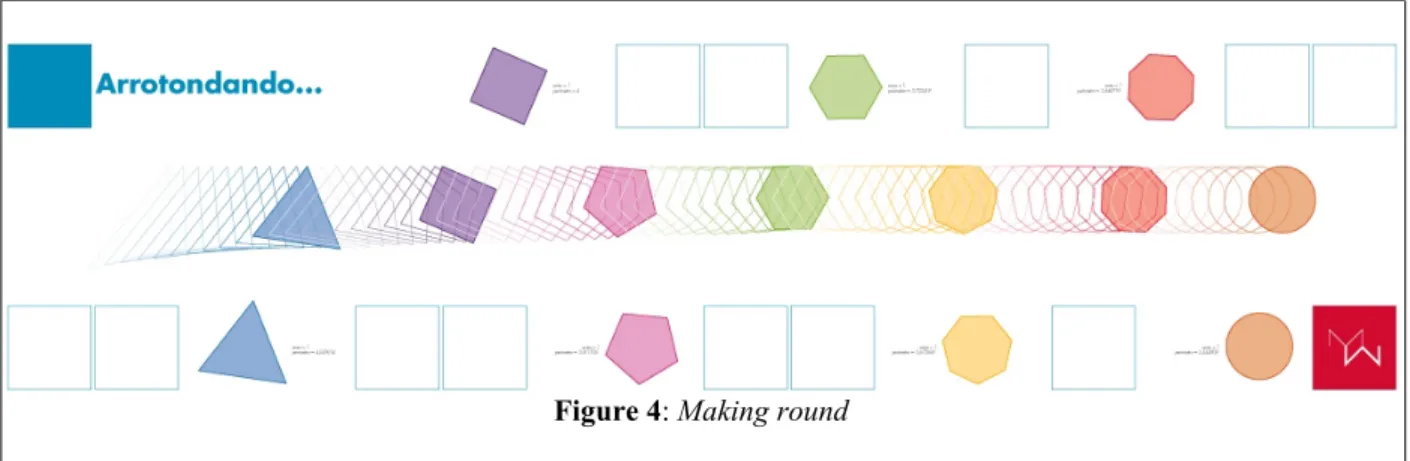
Finally a “virtual” exhibit provide an animated movie showing the morphing of a triangle into a circle, keeping the area unchanged.
2. A few examples from
matemilano2.1. From the territory to maths. As we already said, the city of Milan is just an “excuse” to talk about mathematics: starting from its shape we found out such a shape was indeed the solution of a minimum and maximum problem. The territory offers many such hints, provided we “see” them. Some are quite unexpected. For instance, it is quite common to have images of knots drawn or carved around Milan and knot theory is a non trivial branch of topology. We can focus on a particular knot that can often be found throughout the region of Lombardy as it was taken as the family crest of the powerful Borromeo family. The so called “Borromean rings” consist of three elements and have a peculiar
Figure 4:Making round
Figure 2: An old map of Milan
property: if we pick any two of these three elements we find that they are not interlocked, while the set of all three components cannot be disengaged. Strangely enough, the knot is not always correctly carved: sometimes it appears that one branch crosses over the other where it should pass under. From the mathematical point of view, this corresponds to very different kinds of knots. This fact is shown in a “real” exhibit, where visitors can handle strings to make the knots. The
virtual section of matemilano contains two different interactive animations playing with the borromean rings. In the first one you can actually see the effect of exchanging the over/under branches have the effect of altering the knot entirely; the second one shows a way to generate the Borromean rings.
2.2. Symmetry. Symmetry nicely interacts with art as it is a “natural” way of producing beautiful pictures. But there is more than this: the idea behind symmetry (groups and classifying objects according to a property) is one of the deepest concepts in mathematics. The
two four-flags patterns shown in Figure 6 are similar at a first glance, but if you look at them better you can spot a difference. Indeed they correspond to quite different mathematical objects (even the number “four” turns out to be misleading). The aim of the Symmetry section of matemilano is to teach how to spot differences and similarities between pictures according to their
symmetry. One learns that you can have “rosettes”, “freezes” and “wallpaper patterns”, and that these categories are well determined (and somehow these patterns are fewer than what one expects). The virtual section offers an Image gallery, in which pictures taken around the city (portraying not only beautiful pieces of arts, but also objects taken from everyday life) are classified according these patterns (or to say it better according to their symmetry group). Movies show how these patterns can be generated, and attempt to persuade the visitor that the “moves” you used to generate the drawings are indeed symmetries for the final result. Virtual “machines” to produce freezes and mosts of the wallpaper patterns are provided; moreover you can find two virtual tools to help you recognize the different patterns.
Figure 6: Four-flags patterns
Figure 5: Borromean or not borromean?
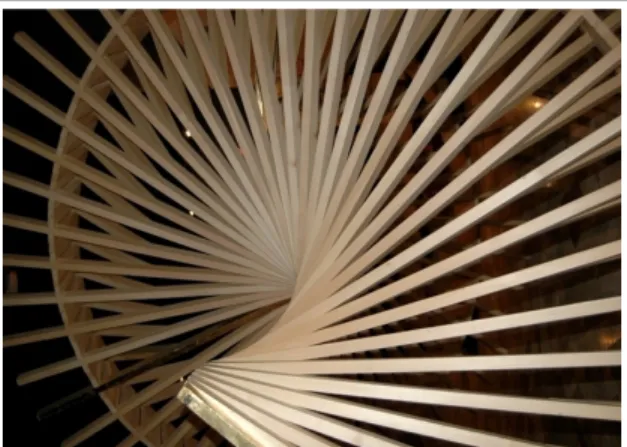
2.3. “Art+Math=X”. In this talk we are not trying (as many other would do it better) to illustrate all the links between maths and art. On the other hand, we cannot remain completely silent, as mathematics can offer so many ideas to build pieces of art. matemilano actually contained some art objects inspired by maths. It is surprising how such an abstract concept as a minimal surface, an helicoid, can inspire an amazing sculpture. The huge Helicoid by Michele Ciribifera (see Figure 8) was in fact the first thing that visitors could see entering the exhibition room. We could observe that these objects well fitted in the path of the exhibition and had the effect of catching the visitor curiosity and attract them to the mathematical examples that surrounded the sculptures.
2.4. Visualization. A section of matemilano was devoted to the mathematical techniques used for art. The most known is probably perspective, widely used since renaissance. Probably everybody would feel confident with the problem of drawing on a piece of paper a 3-dimensional object, in a way that the 3-d look is rendered. Not so many people know that the converse problem is far from soluble. That is given a 2-dimensional drawing of a 3-dimensional object, are you sure you can reconstruct the original object? The mathematical answer is that in general there are infinite such objects, and the virtual exhibition shows a few examples. Moreover, starting from a famous painting by Piero della Francesca, the 3-dimensional setting that was portrayed in the painting is reconstructed (or, should we say “a possible” such setting is reconstructed). Mathematics drives us in a virtual journey in Piero's painting, allowing us to see the portrayed characters from different points of view. The journey (and the maths behind the reconstruction) is well documented in [1].
3. Beyond Milan
At the end of this experience we are able to draw a few conclusions. The format “mathematical exploration of the cities” seems to be responding to the recent common wish for mathematics and we strongly recommend others to reuse this format for their own town. We repeat it once again: Milan is only an “excuse” to talk about mathematics, but the fact that the visitors had to face with familiar places made easier for them to get involved with the exercise of abstraction that mathematics requires. But there is more. The surprising fact is that people were visiting matemilano to watch their city from a different perspective; they were visiting the exhibition to (re)discover sights of the city they often overlooked due to the hurry of their lives, and they came to the museum to show these sights to their children or to their friends. Hopefully many other localities could give their inhabitants the occasion to see their own environment “with different eyes”. The first appointment is for next February in Trento.
References
[1] M. Bertolini, M. Cazzola, M. Dedò, S. Di Sieno, E. Frigerio, D. Luminati, G. Poldi, M. Rampichini, I. Tamanini, G. M. Todesco, C. Turrini, matemilano, percorsi matematici in città, Springer-Verlag Italia (2005, second edition revised)
[2] M. Bertolini, M. Cazzola, M. Dedò, S. Di Sieno, E. Frigerio, D. Luminati, G. Poldi, M. Rampichini, I. Tamanini, G. M. Todesco, C. Turrini, matemilano, CD-ROM multimediale, Kangourou Italia (2004) [3] M. Dedò, Mostre di matematica: divulgazione e rinnovamento didattico, BUMI, sez. A, serie VIII, Vol. VII-A, aprile 2004, pp. 77-99.
[4] S. Di Sieno, Mostre di matematica: soltanto una nuova moda o una strategia interessante?, BUMI, sez. A, serie VIII, vol. V-A, dicembre 2002, pp. 491-514.