S. Renner. Gymnosperms. Pp. 157–160 in Th e Timetree of Life, S. B. Hedges and S. Kumar, Eds. (Oxford University Press, 2009).
species in the mou ntains of Japan; and Taxaceae (4–5 genera, 20–25 species) are again widespread, althou gh nowhere abundant. Th e cycads, Cycadophyta, contain c. 300 species in the Families Cycadaceae (one genus, 97 species), Stangeriaceae (two genera, three species), and Zamiaceae (eight genera, 200 species) (3). Ginkgophyta contain only Ginkgo biloba, while Gnetophyta com-prise three genera with together 80 species, Ephedra (50 species), Gnetum (30–35 species), and Welwitschia (one species).
Molecular phylogenetic evidence for the close relation-ship between gymnosperms and angiosperms is strong. A study of seven genes (from the chloroplast, mitochon-drial, and nuclear genome), with a sampling of 18 gymno-sperms, 19 angiogymno-sperms, and numerous other landplants (192 species total), yielded maximu m likelihood (ML) bootstrap values of 87% and 100%, respectively, for the monophyly of gymnosperms and angiosperms (4). With Susanne Renner
Department of Biology, Menzingerstr. 67, University of Munich, Munich, Germany ([email protected])
Abstract
Gymnosperms (~1010 sp.) a re grouped into four ta xa : Coniferophyta, Cycadophyta, Ginkgophyta, and Gneto-phyta. Most molecular phylogenetic analyses support the monophyly of exta nt gymnosperms, a lthough rela tion-ships of the groups are not resolved. Some analyses place the root of gymnosperms between cycads and the remain-ing groups, while others place it between a cycad-Ginkgo clade and a conifer-gnetophyte clade. A nesting of gneto-phytes inside conifers, closest to Pinaceae, is supported by some molecula r a na lyses, but contra dicted by others a nd morphological data. Most major gymnosperm lineages are extinct, a nd the a bunda nt fossil record ha s not yet been well-integrated with molecular time estimates.
Gymnosperms, also called Acrogymnospermae (1), are a group of seed-bearing plants (spermatophytes) with ovu les on the edge or blade of an open sporophyll or ovuliferous scale (Fig. 1). Th eir closest extant relatives are the angiosperms, which have ovules enclosed in a carpel. Gymnospermae is a problematic name because, when fossils are included as is usually the case, the name is widely understood to apply to a paraphyletic group of seed plants from which the angiosperms also arose (1). Th ere are just over a 1000 living species of gymnosperms in the taxa Cycadophyta, Ginkgophyta, Coniferophyta, and Gnetophyta. Here, the relationships and divergence times of families in these phyla are reviewed.
Th e conifers, Coniferophyta, inclu de ~630 species in seven families of which Pinaceae is by far the lar-gest and most widespread (12 genera, 225 species) (2). Araucariaceae (three genera, about 35 species) mostly occur in the tropics and subtropics, and are absent from Africa. Cephalotaxaceae (two genera, 10–12 species) are confi ned to Asia; Cupressaceae (including Taxodiaceae, 31 genera, 173 species) occu r in mesic habitats world-wide; Podocarpaceae (including Phyllocladaceae and Nageiaceae, 17–19 genera, 180 species) occur mostly in the Southern Hemisphere; Sciadopityaceae comprise a single
Gymnosperms
Fig. 1 Female strobili of a gymnosperm (Pinus sylvestris) Credit: R. B. Zimmer.
Hedges.indb 157
158 THE TIMETREE OF LIFE
probably arise from the inclusion of fossil taxa in mor-phological studies; there are many more extinct gymno-sperm lineages than living ones. With fossils included, gnetophytes oft en group with Bennettitales, Pentoxylon, Caytonia, and angiosperms (10–16). However, trees that are a few steps longer place gnetophytes in conifers (11) or in a clade with living and extinct conifers and Ginkgo (10, 16).
Th e absence of a solid gymnosperm phylogeny almost certainly is the reason that no stu dy has focu sed on deep divergence times in this clade, in spite of the gen-erally good fossil record of woods and cones that might be used for calibration. Whether the true topology is (cycads (Ginkgo (conifers inclu ding gnetophytes)), ((cycads, Ginkgo)(conifers, gnetophytes)), or the antho-phyte topology will aff ect molecular dating to a larger or smaller degree depending on the node of interest. For example, in a study focusing on divergence times in the gnetophyte genus Gnetum (17) estimates for the ingroup barely diff ered with either of four alternative seed plant topologies (the approach used was a Bayesian relaxed molecular clock approach with ancestor-descendent cor-related rates).
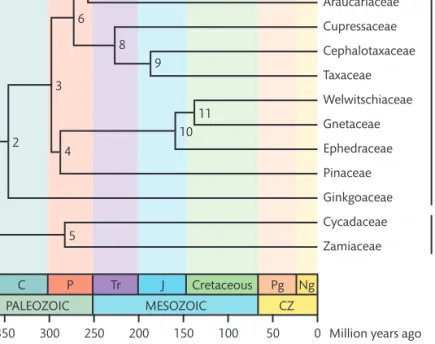
Table 1 summarizes molecular divergence time esti-mates among gymnosperms and Fig. 2 presents a time-tree. Th e age of the root node, that is, the split between extant angiosperms and gymnosperms has not been the 12 genes (from all three genomes) and 23 exemplars (10
of them gymnosperms), and with nine genes (from the three genomes) and 12 exemplars (nine of them gymno-sperms), the mu tu al monophyly of gymnosperms and angiosperms had 100% ML bootstrap support (5, 6). A parsimony analysis of 42 genes (from the three genomes) plus morphological data for seven land plants (four of them gymnosperms) yielded a support of, respectively, 97% and 100% for gymnosperms and angiosperms (7), and a Bayesian analysis of 56 chloroplast genes from 36 exemplars (fi ve of them gymnosperms) yielded posterior probabilities of 1.0 for mutu al monophyly angiosperms and gymnosperms (8).
While extant gymnosperms thu s appear monophy-letic, the relative positions of cycads, Ginkgo, and gne-tophytes remain unresolved. Most recent analyses place the deepest split between cycads and all remaining clades (4–7), but the 56-gene study placed cycads as closest to Ginkgo (8). Th e placement of gnetophytes as closest to Pinaceae and thus embedded in conifers is still weakly supported (4–6, 8).
Morphological cladistic analyses (e.g., of 102 inform-ative characters for 48 taxa, 25 extinct and 23 partly extant; 10) usually yield the so-called anthophyte topology (cycads (Ginkgo (conifers (gnetophytes, angiosperms)))), in contradiction to the DNA-based studies (for reviews of the contradictory results, see 5, 10, 11). Contradictions
Ng Pg Cretaceous MESOZOIC J Tr PALEOZOIC P C CZ Podocarpaceae Araucariaceae Cupressaceae Cephalotaxaceae Taxaceae Welwitschiaceae Gnetaceae Ephedraceae Pinaceae Ginkgoaceae Cycadaceae Zamiaceae 7 9 8 6 11 10 4 3 2 5 0 50 100 150 200 250 300
350 Million years ago
1
Conifers (including Gnetales)
Cy
cads
Fig. 2 A timetree of gymnosperms. Divergence times are shown in Table 1. Abbreviations: C (Carboniferous), CZ (Cenozoic), J (Jurassic), Ng (Neogene), P (Permian), Pg (Paleogene), and Tr (Triassic).
Hedges.indb 158
Th e split between Arau cariaceae and Podocarpaceae may be at least 160 Ma based on Middle Jurassic Araucariaceae cones from Argentina; probable stem relatives of Podocarpaceae (Rissikia) date to the Triassic (J. Doyle, personal communication, July 2005). Th e old-est fossils of modern Araucariaceae are Albian (112–100 Ma) pollen grains that resemble those of Wollemia (26), the closest relative of Agathis. An age of 89 Ma from slightly younger pollen was used as the root constraint in a study of within-Agathis divergence times (27). Th e divergence between Cu pressaceae and the Taxaceae/ Cephalotaxaceae clade has been dated to 227 Ma (Table 1) and that between Taxaceae and Cephalotaxaceae to 187 (Table 1) or 230–192 Ma (28). Th e divergence of extant Ephedraceae from the remaining gnetophytes is esti-mated at 159 Ma old; the oldest Ephedra seeds are Barremian–Albian (29, 30). Th e split between extant Welwitschiaceae and Gnetaceae may date back to 138 Ma ago (Table 1); the earliest fossils of Welwitschia are 110 Ma old (31).
Acknowledgment
For critical comments, I thank J. Doyle, G. Grimm, and J. Hilton.
References
1. P. D. Cantino et al., Taxon 56, 822 (2007).
2. A. Farjon, World Checklist and Bibliography of Conifers, 2nd ed. (Royal Botanic Gardens, Kew, 2001).
3. L. M. Whitelock, Th e Cycads (Timber Press, Portland, OR, 2002), pp. 374.
4. Y.-L. Qiu et al., Int. J. Plant Sci. 168, 691 (2007).
5. J. G. Burleigh, S. Mathews, Int. J. Plant. Sci. 168, 111 (2007).
6. M. Hajibabaei, J. Xia, G. Drouin, Mol. Phylogenet. Evol.
40, 208 (2006).
7. J. E. B. de la Torre et al., BMC Evol. Biol. 6, 48 (2006). 8. C.-S. Wu, Y.-N. Wang, S.-M. Liu, S.-M. Chaw, Mol. Biol.
Evol. 24, 1366 (2007).
9. S.-M. Chaw, C. L. Parkinson, Y. Cheng, T. M. Vincent, J. D. Palmer, Proc. Natl. Acad. Sci. U.S.A. 97, 4086 (2000).
10. J. Hilton, R. M. Bateman, J. Torrey Bot. Soc. 133, 119 (2006).
11. J. A. Doyle, J. Torrey Bot. Soc. 133, 169 (2006). 12. P. Crane, Ann. Missouri Bot. Gard. 72, 716 (1985). 13. K. C. Nixon, W. L. Crepet, D. Stevenson, E. M. Friis, Ann.
Missouri Bot. Gard. 81, 484 (1994).
14. G. W. Rothwell, R. Serbet, Syst. Bot. 19, 443 (1994). focus of any study. Th e oldest seed precursors are 385 Ma
(18). Th ese early seeds, which have lobed integu ments that are thought to refl ect their origin from fused ster-ile telomes, are quite diff erent from the seeds of “mod-ern” seed plants. Modern seeds with completely fu sed integuments are not known until the late Mississippian (~325 Ma; J. Doyle, personal communication, July 2005). Modern seed plants thus arose 385–325 Ma.
Divergence time estimates for the deepest splits in extant conifers requ ire mu ch larger gene and taxon sampling than currently available. Conifers are docu-mented from the middle Pennsylvanian (~310 Ma), and Cordaitales, which are probably basal stem relatives of conifers that existed in the earliest Pennsylvanian (~318 Ma). Th e deepest split among extant cycadophytes, shou ld be at least 270 Ma, based on Crossozamia from the early Permian, which is similar to modern cycads (19). Th e rbcL-based estimate of 92.5 Ma for the split between Cycadaceae and Zamiaceae (20) is almost cer-tainly an underestimate.
Th e oldest Pinaceae-type cones are 225 Ma (21), and early Tertiary fossils are oft en assigned to extant genera of Pinaceae (22). Very young divergence time estimates within Pinaceae (23, 24) are probably unreliable because of miscalibration (25).
Table 1. Divergence times (Ma) and their confi dence/credibility intervals (CI) among gymnosperms, from ref (17).
Timetree Node Time CI 1 366 382–344 2 346 369–319 3 298 324–270 4 288 316–258 5 283 307–271 6 273 303–243 7 257 287–228 8 227 265–189 9 187 231–144 10 159 196–132 11 138 175–112
Note: Time estimates are based on rbcLandmatK genetic distances analyzed with a Bayesian autocorrelated rates approach. The matrix included angiosperms and was rooted on the fern Psilotum. The unconstrained topology resulting from ML analysis of these data shows gnetophytes as the closest relative of all remaining seed plants. A conifer family not represented here, Sciadopityaceae, branches off below Cupressaceae + Taxaceae (4).
Hedges.indb 159
160 THE TIMETREE OF LIFE
25. A. Willyard et al., Mol. Biol. Evol. 24, 90 (2007).
26. D. J. Cantrill, J. I. Raine, Int. J. Plant Sci. 167, 1259 (2006).
27. M. Knapp, R. Mudaliar, D. Havell, S. J. Wagstaff , P. J. Lockhart, Syst. Biol. 56, 862 (2007).
28. Y. Cheng, R. G. Nicolson, K. Tripp, S.-M. Chaw, Mol. Phylogenet. Evol. 14, 353 (2000).
29. C. Rydin, K. R. Pedersen, E. M. Friis, Proc. Natl. Acad. Sci. U.S.A. 101, 16571 (2004).
30. Y. Yang, et al., Am. J. Bot. 92, 231 (2005).
31. C. Rydin, B. Mohr, E. M. Friis, Proc. Roy. Soc. Lond. Ser. B. 270 (Suppl.), 29 (2003).
15. J. A. Doyle, Int. J. Plant Sci. 157(Suppl.), S3 (1996). 16. E. M. Friis et al., Nature 450, 549 (2007).
17. H. Won, S. S. Renner, Syst. Biol. 55, 610 (2006). 18. P. Gerrienne et al., Science 306, 856 (2004).
19. E. D. Brenner, D. W. Stevenson, R. W. Twigg, Trends Plant Sci. 8, 446 (2003).
20. J. Treutlein, M. Wink, Naturwissenschaft en 89, 221 (2002).
21. C. N. Miller, Bot. Rev. 65, 239 (1999). 22. B. A. LePage, Acta Hort. 615, 29 (2003).
23. X.-Q. Wang, D. Tank, T. Sang, Mol. Biol. Evol. 17, 773 (2000).
24. A. Eckert, B. Hall, Mol. Phylogenet. Evol. 40, 166 (2006).
Hedges.indb 160