Hadoop Performance Modeling and Job
Optimization for Big Data Analytics
A Thesis submitted for the Degree of
Doctor of Philosophy
By
Mukhtaj Khan
Department of Electronic and Computer Engineering
College of Engineering, Design and Physical Sciences
Brunel University London, UK
March 2015
Abstract
Big data has received a momentum from both academia and industry. The MapReduce model has emerged into a major computing model in support of big data analytics. Hadoop, which is an open source implementation of the MapReduce model, has been widely taken up by the community. Cloud service providers such as Amazon EC2 cloud have now supported Hadoop user applications. However, a key challenge is that the cloud service providers do not a have resource provisioning mechanism to satisfy user jobs with deadline requirements. Currently, it is solely the user responsibility to estimate the require amount of resources for their job running in a public cloud. This thesis presents a Hadoop performance model that accurately estimates the execution duration of a job and further provisions the required amount of resources for a job to be completed within a deadline. The proposed model employs Locally Weighted Linear Regression (LWLR) model to estimate execution time of a job and Lagrange Multiplier technique for resource provisioning to satisfy user job with a given deadline. The performance of the propose model is extensively evaluated in both in-house Hadoop cluster and Amazon EC2 Cloud. Experimental results show that the proposed model is highly accurate in job execution estimation and jobs are completed within the required deadlines following on the resource provisioning scheme of the proposed model.
In addition, the Hadoop framework has over 190 configuration parameters and some of them have significant effects on the performance of a Hadoop job. Manually setting the optimum values for these parameters is a challenging task and also a time consuming process. This thesis presents optimization works that enhances the performance of Hadoop by automatically tuning its parameter values. It employs Gene Expression Programming (GEP) technique to build an objective function that represents the performance of a job and the correlation among the configuration parameters. For the purpose of optimization, Particle Swarm Optimization (PSO) is employed to find automatically an optimal or a near optimal configuration settings. The performance of the proposed work is intensively evaluated on a Hadoop cluster and the experimental results show that the proposed work enhances the performance of Hadoop significantly compared with the default settings.
Acknowledgements
Firstly, I would like to express my gratitude to Prof. Maozhen Li who supervised my research and guided me with great dedication throughout the years. His view of research has proved precious to my research and supporting work. His personality, together with his high standards for research, makes him an ideal advisor. I would also like to thank to Prof. Gareth A. Taylor for his valuable help and guidance during my research.
I would like to thank my parents and all my family members. They helped me to pass through the toughest time of my life. Without their continuous encouragement and help, I will never reach the place where I am stand.
I am appreciative to the Abdul Wali Khan University Mardan, Pakistan for supporting my research.
In addition, I would like to thank Mr. Izaz, Mr. Suleman, Mr. Jahanzeb and Mr. Bilal for their sincere support and take care of me in my study period.
Declaration of Authorship
The work detailed in this thesis has not been previously submitted for a degree in this University or at any other and unless otherwise referenced it is the authors own work.
List of Publications
The following papers have been accepted / to be submitted for publication as a direct or indirect result of the research discussed in this thesis.
Journal Papers:
Yang Liu, Maozhen Li, Mukhtaj Khan and Man Qi, “A MapReduce based Distributed LSI for Scalable Information Retrieval “, Journal of Computing and Informatics, vol. 33, no. 2, pp. 2014.
M. Khan, P. M. Ashton, M. Li, G. A. Taylor, I. Pisica, and J. Liu, “Parallel
Detrended Fluctuation Analysis for Fast Event Detection on Massive PMU Data,” IEEE Transactions on Smart Grid, vol. 6, no. 1, pp. 360–368, Jan. 2015.
M. Khan, Y. Jin, M. Li, Y. Xiang, and C. Jiang, “Hadoop Performance Modeling
for Job Estimation and Resource Provisioning,” Parallel Distrib. Syst. IEEE Trans., vol. PP, no. 99, p. 1, 2015 (in press, DOI: 10.1109/TPDS.2015.2405552).
M.Khan, Z.Huang, M.Li and G.A. Taylor, “Optimizing Hadoop Parameter Settings with Gene Expression Programming Guided PSO” submitted to Parallel Distrib. Syst. IEEE Trans.
Conference Papers:
M. Khan, M. Li, P. Ashton, G. Taylor, and J. Liu, “Big data analytics on PMU
measurements,” in Proceedings of the 2014 11th International Conference on Fuzzy Systems and Knowledge Discovery (FSKD), , 2014, pp. 715–719.
M. Khan, Y. Liu and M. Li, “Data locality in Hadoop cluster systems,” in Fuzzy Systems and Knowledge Discovery (FSKD), 2014 11th International Conference on, 2014, pp. 720-724.
Contents
Abstract ... i
Ackmowledgement ... ii
Declaration of Authorship ... iii
List of Publications ... iv
Table of Contents ... v
List of Figures ... x
List of Tables ... xiii
1 Introduction ... 1
1.1 Motivations ... 3
1.2 Methodology ... 5
1.3 Major Contributions to Knowledge ... 6
1.4 Thesis Organization ... 7
References ... 8
2 Background ... 12
2.1 MapReduce Programming Model ... 12
2.2 Hadoop MapReduce Framework ... 15
2.2.1 Hadoop Architecture ... 16
2.2.1.1 MapReduce System ... 17
2.2.2 Hadoop MapReduce Framework Optimization Approaches ... 20
2.2.2.1 Job Scheduling or Task Scheduling ... 20
2.2.2.2 Data Locality Algorithms ... 23
2.2.2.3 Configuration Parameters Tunings ... 30
2.3 Hadoop Ecosystem ... 31
2.4 Hadoop 2 ... 33
2.5 Summary ... 34
References ... 35
3 Parallel Detrended Fluctuation Analysis for Fast Event Detection on Massive PMU Data ... 41
3.1 Introduction ... 41
3.2 Over View of HPC and Big Data Analytics ... 43
3.3 Wide Area Monitoring GB System ... 45
3.4 Design of PDFA ... 47
3.4.1 MapReduce Programming Model ... 48
3.4.2 MapReduce Implementation with Hadoop ... 49
3.4.3 PDFA Implementation ... 51
3.5 Evaluation and Experiment Results ... 55
3.5.1 Experiment Setup ... 55
3.5.3 Speedup Analysis ... 59
3.6 Summary ... 62
References ... 63
4 Hadoop Performance Modeling for Job Estimation and Resource Provisioning... 68
4.1 Introduction ... 68
4.2 Modeling Job Phases in Hadoop ... 71
4.2.1 Modeling Map Phase ... 72
4.2.2 Modeling Shuffle Phase ... 73
4.2.3 Modeling Reduce Phase ... 75
4.3 An Improved HP Performance Model ... 75
4.3.1 Design Rationale ... 75
4.3.2 Mathematical Expression ... 78
4.3.3 Job Execution Estimation ... 81
4.4 Resource Provisioning ... 85
4.5 Performance Evaluation ... 88
4.5.1 Experimental Setup ... 88
4.5.2 Job Profile Information ... 89
4.5.2.1 Evaluating the Impact of the Number of Reduce Tasks on Job Performance ... 90
4.5.2.2 Estimating the Execution Times of Shuffle Tasks and Reduce
Tasks ... 92
4.5.3 Job Execution Estimation ... 94
4.5.4 Resource Provisioning ... 98
4.6 Related Work ... 103
4.7 Summary ... 106
References ... 106
5 Optimization Hadoop Congiguration Parameter Settings for Enhance Performance ... 110
5.1 Introduction ... 110
5.2 Hadoop Core Parameters ... 113
5.3 Mining Hadoop Parameter Correlations with GEP... 116
5.3.1 GEP Design ... 116
5.3.2 GEP Implementation ... 121
5.4 Hadoop Parameter Optimization with PSO...………..124
5.5 Performance Evaluation ... 129
5.5.1 Experimental Setup ... 130
5.5.2 The Impact of Hadoop Parameters on Performance ... 131
5.5.3 PSO Setup ... 136
5.5.5 Experimental Results and Hadoop Performance ... 139
5.6 Related Work ... 143
5.7 Summary ... 146
References ... 147
6 Conclusion and Future Work ... 153
6.1 Conclusion ... 153
6.2 Future Work ... 155
List of Figures
Figure 2.1:. Logical data flow of the MapReduce programming model. ... 13
Figure 2.2. Architecture of the Hadoop MapReduce ... 16
Figure 2.3 The Hadoop MapReduce job execution flow ... 18
Figure 2.4 The HDFS architecture ... 20
Figure 2.5. A Hadoop cluster with 3 nodes. ... 25
Figure 2.6. Task 3 is assigned without data locality. ... 26
Figure 2.7. All the 3 tasks are assigned with data locality. ... 26
Figure 3.1: MapReduce model ... 49
Figure 3.2: Hadoop framework. ... 50
Figure 3.3: Architecture of PDFA implementation. ... 52
Figure 3.4: Analysis of PDFA efficiency ... 56
Figure 3.5: Relative accuracy of PDFA compared to DFA. ... 57
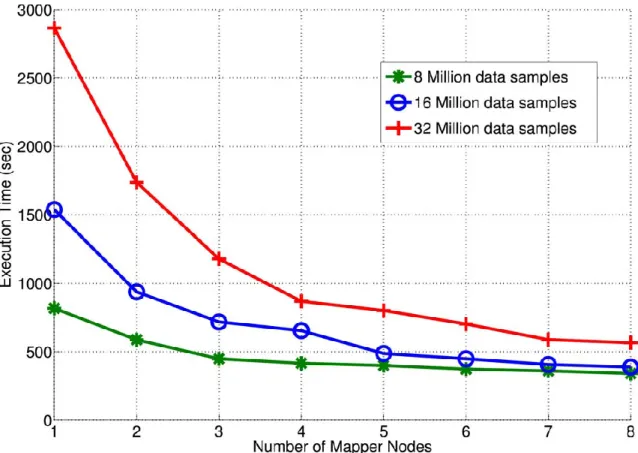
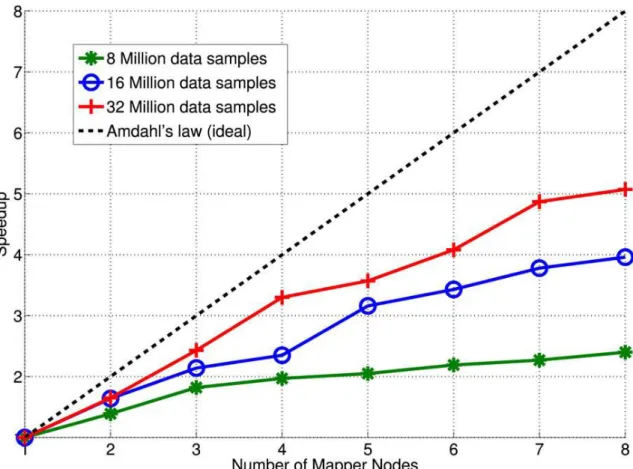
Figure 3.6: Scalability of PDFA, execution time against number of mapper nodes (VMs)58 Figure 3.7: Speedup analysis of the PDFA algorithm. ... 59
Figure 3.8: Computational overhead of PDFA against data block size. ... 61
Figure 3.9: Speedup of PDFA against data block size... 62
Figure 4.1: Hadoop job execution flow. ... 73
Figure 4.2: A Hadoop job running in a single wave (16 map tasks and 16 reduce tasks). 76 Figure 4.3: A Hadoop job running in multiple waves (80 map tasks, 32 reduce tasks). .. 77
Figure 4.4: The architecture of the improved HP model. ... 85
Figure 4.5: The performance of the WordCount application with a varied number of reduce tasks. ... 91
Figure 4.6: The performance of the Sort application with a varied number of reduce tasks... 92
Figure 4.7: The estimated durations of both the shuffle phase (non-overlapping stage) and the reduce phase in the WordCount application. The points represent the actual execution time and dashed lines represent the estimated durations. ... 93
Figure 4.8:The estimated durations of both the shuffle phase (non-overlapping stage) and the reduce phase in the Sort application. The points represent the actual execution time and dashed lines represent the estimated duration. ... 93
Figure 4.9: The performance of the improved HP model in job estimation of running the
WordCount application on the in-house cluster... 94
Figure 4.10: The performance of the improved HP model in job estimation of running the Sort application on the in-house cluster. ... 95
Figure 4.11: The performance of the improved HP model in job estimation of running the WordCount application on the EC2 Cloud. ... 96
Figure 4.12: The performance of the improved HP model in job estimation of running the Sort application on the EC2 Cloud. ... 96
Figure 4.13: A performance comparison among the improved HP model, the HP model and Starfish in running the WordCount application on the EC2 Cloud. ... 97
Figure 4.14:A performance comparison among the improved HP model, the HP model and Starfish in running the Sort application on the EC2 Cloud. ... 98
Figure 4.15: Resource provisioning in Scenario 1 ... 100
Figure 4.16: Resource provisioning in Scenario 2. ... 100
Figure 4.17: Resource provisioning in Scenario 3. ... 101
Figure 4.18: Resource provisioning in Scenario 4. ... 102
Figure 5.1: An example of parameter correlation mining ... 119
Figure 5.2:An example of chromosome and expression tree structure. ... 120
Figure 5.3: The impact of the io.sort.mb.parameter. ... 131
Figure 5.4:The impacts of the io-sort-factor parameter. ... 132
Figure 5.5: The impact of the number of reduce tasks. ... 133
Figure 5.6:The impact of the number of map and reduce slots ... 134
Figure 5.7: The impact of the Java_opts parameter. ... 135
Figure 5.8: The impact of the compression parameter. ... 136
Figure 5.9 : The performance of the PSO optimized WordCount applications using 8 VMs... 139
Figure 5.10: The performance of the PSO optimized Sort application using 8 VMs ... 140
Figure 5.11: The performance of the PSO optimized WordCount application using 16 VMs... 142
List of Tables
Table 3.1: Experimental configuration of Hadoop cluster... 55
Table 4.1: Defined variables in modeling job phases ... 74
Table 4.2: Defined variables in the improved HP model ... 78
Table 4.3: Experimental Hadoop cluster ... 89
Table 4.4: The job profile of the WordCount application in EC2 environment. ... 90
Table 4.5:The profile of the Sort application in EC2 environment ... 90
Table 4.6:Scenario configurations. ... 99
Table 4.7: The amounts of resources estimated by the HP model and the improved HP model. ... 103
Table 5.1: Hadoop core configuration parameters ... 113
Table 5.2: Hadoop core configuration parameters in GEP ... 117
Table 5.3: Mathematic functions used in GEP ... 118
Table 5.4: Training data samples ... 122
Table 5.5: GEP parameter settings... 124
Table 5.6: Hadoop parameter settings in PSO ... 127
Table 5.7: Hadoop cluster setup ... 130
Table 5.8: PSO parameter settings ... 137
Table 5.9: PSO recommended Hadoop parameter settings on 8 VMs ... 137
Table 5.10: Starfish recommended parameter settings for the WordCount application on 8 VMs. ... 138
Table 5.11: Starfish recommended parameter settings for the Sort application on 8 VMs.138
Chapter 1
Introduction
We are living in the era of Big Data. Today a vast amount of data is generating everywhere due to advances in the Internet and communication technologies and the interests of people using smartphones, social media, Internet of Things, sensor devices, online services and many more. Similarly, in improvements in data applications and wide distribution of software, several government and commercial organizations such as financial institutions, healthcare organization, education and research department, energy sectors, retail sectors, life sciences and environmental departments are all producing a large amount of data every day. For examples, International Data Corporation (IDC) reported that 2.8 ZB (zettabytes) data of universe were stored in the year of 2012 and this will reach up to 40 ZB by 2020 [1]. Similarly Facebook processes around 500 TB (terabytes) data per day [2] and Twitter generates 8 TB data every day [3]. The huge datasets not only include structured form of data but more than 75% of the dataset includes raw, semi-structured and unstructured form of data [4]. This massive amount of data with different formats can be considered as Big Data.
The derivation of Big Data is vague and there are a lot of definitions on Big Data. For examples, Matt Aslett defined Big Data as “Big Data is now almost universally understood to refer to the realization of greater business intelligence by storing, processing, and analyzing data that was previously ignored due to limitation of traditional data management technologies” [5]. Recently, the term of Big Data has received a remarkable momentum from governments, industry and research communities. In [6], Big Data is defined as a term that encompasses the use of techniques to capture, process, analyse and visualize potentially large datasets in a reasonable timeframe not accessible to standard IT technologies. The term Big Data is basically characterized with 3 Vs [4]:
Volume, the sheer amount of data generated (i.e. from terabytes to zettabytes),
Velocity, the rate the data is being generated (i.e. from batch data to streaming data), and
Variety, the heterogeneity of data sources (i.e. from structured data to unstructured data).
There are several factors that are involved in producing Big Data. One factor is the Internet and communication technology as it has been advanced to enable people and devices to be increasingly interconnected not only some time but all the time. Small integrated circuits are now so economical that people are using in almost every object to make them intelligent which is another reason of generating of mountains of data. The continuous reduction in the prices of storage devices is also a factor for Big Data.
Many organizations have realized the real-value benefits of Big Data and today they do have access to Big Data but they are facing significant challenges in processing and analyzing the wealth amount of data timely and effectively. More importantly, how to extract important information and knowledge from Big Data due to the sheer volume of the data in different forms (i.e. structured, semi-structured and unstructured) is a extremely challenging task. For many decades, the organizations have successfully applied relational database management systems (DBMS) for data storage and analysis. However, managing Big Data with its associative characteristics such as volume, velocity and variety is a challenging task for traditional DBMS because DBMS are hard to scale with ever increasing data and only support structured data format. However, opportunity is available with the right technology platform, to store and analyze the Big Data timely and effectively. The recent studies show that the right technology platform could be the use of a massive parallel and distributed computing platform. This platform can be found by implementing Hadoop MapReduce framework on cloud computing environment.
Cloud computing is a concept that involves sharing of computer resources over the Internet among multiple users in order to maximized effectiveness and utilization of the resources. The resources are not only shared among the users but it can be dynamically
allocated and de-allocated on a demand basis. Normally, the users acquire the virtual computation resources from cloud service providers following a pay-as-you-go policy and run their applications on the allocated resources [7]–[9]. The MapReduce computing model has become a representative enabling technology in support of data intensive Cloud computing applications [10].
The Hadoop framework [11] is an open-source implementation of the MapReduce paradigm that is originally proposed by Google [12]. It offers an effective distributed computing environment that is capable of storing and processing a huge amount of unstructured data. Hadoop has received a wide acceptance from the community due to its opens source nature and extensively used for data intensive applications [13]–[19]. It offers remarkable features such as scalability, fault-tolerance and automatic code parallelization using commodity computers. Furthermore, cloud service providers such as Amazon has designed Elastic MapReduce (EMR) that enables users to execute their Hadoop applications across its Elastic Cloud Computing (EC2) nodes [20].
1.1
Motivations
There were three major motivations that drove the PhD research.
Sustainability in power systems is so vital that an enormous effort must be made to avert power system breakdown scenarios. The blackout in North East America (August, 14 2003) and previous critical events all over the world are driving the industry to develop more automatic, adaptive and efficient computational tools for power system stability and monitoring analysis. It is becoming highly impossible for traditional supervisory control and data acquisition (SCADA) systems to predict or avert eventualities in a timely manner which may lead to power system catastrophes [21], [22]. One solution to these challenges is the development of the Wide Area Monitoring System (WAMS). A WAMS consists of a network of synchronized Phasor Measurement Units (PMUs) [21], [23] which provide a high sampling rate up to 60 samples per second that can be used to enhance the
reliability, stability and security of the power systems. For this reason the PMUs are being rapidly deployed in the power systems globally. Tang et al. [24] pointed out that hundreds of PMUs have been deployed in the U.S. power grid and worldwide in the past few years. The large scale and rapid deployment of PMUs in power grids has led to Big Data issues. A PMU sampling at 60 samples per second generates about 300MB per day. A reasonable size of a power grid network with a few hundred PMUs would generate a big data at TB scale per day. The UK National Grid expects the measurements of the PMUs to be stored for a minimum period of one year which will pose a huge challenge for computation, analysis and storage. In addition, the power system community is expecting a scalable, resilient and fault-tolerant computing platform that can effectively store and timely process massive volumes of PMU data.
As the Hadoop framework supports public Cloud computing such as Amazon EC2. This feature enables the organization to utilize the Cloud services as a pay-as-you-go manner. To use the EC2 Cloud, users have to configure the required amount of resources (virtual nodes) for their applications. However, the EC2 Cloud in its current form does not support Hadoop jobs with deadline requirements. It is purely the user's responsibility to estimate their job execution time and the amount of require resources to complete their jobs within deadline. Hence, Hadoop performance modeling has become a necessity in estimating the job completion time and provisioning the right amount of resources for a user jobs with deadline requirements.
Hadoop MapReduce has become the most widely adopted computing framework for big data analytics. However, the performance of a Hadoop job is highly affected by configuration parameter settings. The recent research shows that the configuration parameter settings play a key role in the performance of a Hadoop, i.e. a small change on one of the parameter settings can have a huge impact on the performance of a Hadoop job. Hadoop has more than 190 configuration parameters that manage the execution flow of a Hadoop job. Most of Hadoop users even do not know about these configuration parameters and if they do not
supply any values to the configuration parameters, the system will automatically assign default values. However, on default configuration settings a Hadoop job does not effectively utilize the underlying resources and as a result Hadoop might not produce an optimal or a near optimal performance. Furthermore, it is highly challenging to find a mathematical model or a fitness function that can correlate the inter-dependencies among the Hadoop parameters. Moreover, the large set of parameters and the complex inter-connections among the configuration parameters further increase the complexity of manually tuning these parameter settings. Hence, an efficient, effective and automatic approach to parameter tuning is highly needed.
1.2
Methodology
This research first evaluates the performance of Hadoop in parallelization of detrended fluctuation analysis for fast event detection on massive PMU data [28]. It investigates in-depth the execution principles of Hadoop and mathematically models the three core execution phases of Hadoop (the map phase, the reduce phase and the shuffle phase) and based on that it applies locally weighted linear regression to estimate the execution time of a Hadoop job [29]. It employs Lagrange Multipliers technique for resource provisioning to satisfy jobs with deadline requirements. Finally, it employs particle swarm optimization technique to enhance the performance of Hadoop by automatically optimizing its parameter settings.
An experimental Hadoop cluster with two Intel servers was set up to evaluate the proposed works presented in this thesis. The specifications and configurations of the two server machines are presented in Chapter 4. The Oracle Virtual Box was installed on the two server machines and 8 Virtual Machines (VMs) were configured on each server machine. Each VM was assigned with 4 CPU cores, 8GB RAM and 150GB hard disk storage. The Ubuntu 12.04 TLS operating system was installed on every VM. The Hadoop-1.2.1 version was configured on VMs and Starfish [30] software was used to collect jobs profile information whenever is required.
To further evaluate the works presented in this study, another Hadoop cluster was setup on Amazon EC2 Cloud using 20 m1.large instances. Each instance was configured with 2vCPUs, 420GB hard disk and 7.5GB physical memory. The same Hadoop version, operating system and Starfish were installed on each instance.
1.3
Major Contributions to Knowledge
The major contributions of the thesis can be summarized as follows:
The thesis presents a scalable, resilient and fault-tolerant computing framework for massive PMU data storage and analysis. The proposed framework is based on the Hadoop framework and the open-source OpenPDC software [27]. A small Java based application is developed to automatically stream the PMU data into the Hadoop Distributed File System (HDFS). An event detection algorithm based on Detrended Fluctuation Analysis (DFA) is parallelized in the Hadoop MapReduce cluster to process large volumes of PMU data. The parallel DFA algorithm is evaluated from the aspect of speedup, scalability and accuracy in comparison with standard DFA. The speedup of parallel DFA in computation is initially analysed through Amdahl’s Law, a revision to the law is then proposed, suggesting enhancement to its capability to analyse the performance gain in computation when parallelizing data intensive application in a cluster computing environment.
It presents an improved HP model for Hadoop job execution estimation and resource provisioning. The improved HP model mathematically models all the three core phases of a Hadoop job including the overlapping and non-overlapping stages of the job. Furthermore, the model employs Locally Weighted Linear Regression (LWLR) technique to estimate the execution time of a Hadoop job with a varied number of reduce tasks. Based on job execution estimation, the improved HP model employs Lagrange Multipliers technique to provision the amount of resources for a Hadoop job to complete within a given
deadline. The performance of the purpose model is extensively evaluated on both the in-house Hadoop cluster and the Amazon EC2 cloud.
The thesis optimizes the performance of Hadoop by automatically tuning its parameter configuration settings. This work employs Gene Expression Programming (GEP) to build an objective function based on a training dataset. The objective function represents the correlations and inter-dependencies of the parameters. The fitness function is used to work as an objective function for Hadoop performance optimization. For this purpose of optimization Particle Swarm Optimization technique is employed to search for a set of optimum values of the configuration parameters within a search space. Unlike other works which divide the search space into sub-spaces, the proposed work considers the entire search space in the optimization process in order to maintain the inter-dependencies among the configuration parameters.
The proposed works presented in this thesis have been intensively evaluated on both an in-house Hadoop cluster and the Amazon EC2 Cloud. Evaluation results are presented and analyzed in depth.
1.4
Thesis Organization
The remainder of the thesis is organized as follows:
Chapter 2 provides a general background on both the MapReduce programming model and the Hadoop MapReduce computing framework. It also introduces the Hadoop framework optimization approaches from the aspects of job scheduling, data locality and configuration parameter settings.
Chapter 3 introduces the design and implementation of a Parallel Detrended Fluctuation Analysis (PDFA) algorithm. The performance of the PDFA is evaluated from the aspects of speedup, accuracy and salability in comparison with the sequential DFA approach. The speedup of the PDFA is analyzed following Amdahl’s Law. This Chapter also presents a
revision to the Amdahl’s Law to enhance its capability in analyzing the performance gain in computation when computation is parallelized in cluster environments.
Chapter 4 presents the design, implementation and evaluation of a Hadoop job performance model that accurately estimates a job execution time and further provisions the require amount of resource for a job to be completed within a deadline. The proposed model mathematically models three core phases of a job execution and employs Locally Weighted Linear Regression (LWLR) model to estimates the job completion time. Furthermore, the proposed model employs Lagrange Multipliers for the resource provisions to satisfy jobs with deadline requirements.
Chapter 5 first presents empirical evidence that configuration parameters do have significant effects on the performance of Hadoop. It then presents the design and implementation of a Hadoop job optimization model that improve the performance of a Hadoop by automatically tuning the configuration parameter settings. The model employs Gene Expression Programming (GEP) technique to develop a fitness function based on historical job profile information. Particle Swarm Optimization is employed to search for the optimal or near optimal values for these configuration parameters. The performance of the proposed work is compared with the default settings, Rule-of-Thumb settings and Starfish recommendations for Hadoop jobs.
Chapter 6 concludes the thesis and discusses some limitations of the research. In addition, a number of future works are pointed out for further improvements and extensions.
References
[1] “How much data is out there,” webopedia.com. [Online]. Available: http://www.webopedia.com/quick_ref/just-how-much-data-is-out-there.html. [Accessed: 26-Feb-2015].
[2] “Facebook data grows by over 500 TB daily,” slashgear.com. [Online]. Available: http://www.slashgear.com/facebook-data-grows-by-over-500-tb-daily-23243691/. [Accessed: 26-Feb-2015].
[3] “Twitter by the Numbers,” slideshare.net. [Online]. Available: http://www.slideshare.net/raffikrikorian/twitter-by-the-numbers. [Accessed: 26-Feb-2015].
[4] P. zikopoulos, C., C. Eaton, D. DeRoos, T. Deutsch, and G. Lapis, Understanding Big Data-Analytics for Enterprise Class Hadoop and Streaming Data. New York, Chicago,San Francisco, USA: The McGraw-Hill Companies, 2012.
[5] T. Lubos, “Big Data Hadoop NoSQL DB -Introduction,” academia.edu, 2013.
[Online]. Available:
https://www.academia.edu/5107042/Big_Data_Hadoop_NoSQL_DB_-_Introduction. [Accessed: 26-Feb-2015].
[6] “Big data, a new world of opportunities,” Networked European Software and Services Initiative (NESSI), 2012. [Online]. Available: http://www.nessi-europe.com/Files/Private/NESSI_WhitePaper_BigData.pdf. [Accessed: 25-Feb-2015].
[7] R. Ranjan, L. Zhao, X. Wu, A. Liu, A. Quiroz, and M. Parashar, “Peer-to-Peer Cloud Provisioning: Service Discovery and Load-Balancing,” in Cloud Computing, N. Antonopoulos and L. Gillam, Eds. Springer London, 2010, pp. 195–217.
[8] L. Wang, M. Kunze, J. Tao, and G. von Laszewski, “Towards Building a Cloud for Scientific Applications,” Adv. Eng. Softw., vol. 42, no. 9, pp. 714–722, Sep. 2011. [9] L. Wang, G. von Laszewski, A. Younge, X. He, M. Kunze, J. Tao, and C. Fu,
“Cloud Computing: a Perspective Study,” New Gener. Comput., vol. 28, no. 2, pp. 137–146, 2010.
[10] L. Wang, J. Tao, R. Ranjan, H. Marten, A. Streit, J. Chen, and D. Chen, “G-Hadoop: MapReduce Across Distributed Data Centers for Data-intensive Computing,” Futur. Gener. Comput. Syst., vol. 29, no. 3, pp. 739–750, Mar. 2013. [11] “Apache Hadoop,” Apache. [Online]. Available: http://hadoop.apache.org/.
[Accessed: 18-Feb-2015].
[12] J. Dean and S. Ghemawat, “MapReduce: Simplified Data Processing on Large Clusters,” in Proceedings of the 6th Conference on Symposium on Opearting Systems Design & Implementation - Volume 6, 2004, p. 10.
[13] Y. Lee, W. Kang, and H. Son, “An Internet traffic analysis method with MapReduce,” in Network Operations and Management Symposium Workshops (NOMS Wksps), 2010 IEEE/IFIP, 2010, pp. 357–361.
[14] A. Kimball, S. Michels-Slettvet, and C. Bisciglia, “Cluster computing for web-scale data processing,” ACM SIGCSE Bull., pp. 116–120, 2008.
[15] B. White, T. Yeh, J. Lin, and L. Davis, “Web-Scale Computer Vision using MapReduce for Multimedia Data Mining,” University of Maryland, 2010. [Online]. Available: http://www.umiacs.umd.edu/~lsd/papers/brandyn-kdd-cloud.pdf. [Accessed: 28-Feb-2015].
[16] S. K and V. MS, “Mining of Web Server Logs in a Distributed Cluster Using Big Data Technologies,” Int. J. Comput. Sci. Appl., vol. 5, no. 1, pp. 137–142, 2014. [17] U. Kang, C. E. Tsourakakis, and C. Faloutsos, “PEGASUS: Mining Peta-scale
Graphs,” Knowl. Inf. Syst., vol. 27, no. 2, pp. 303–325, May 2011.
[18] B. Panda, J. S. Herbach, S. Basu, and R. J. Bayardo, “PLANET: Massively Parallel Learning of Tree Ensembles with MapReduce,” Proc. VLDB Endow., vol. 2, no. 2, pp. 1426–1437, Aug. 2009.
[19] M. Khan, P. M. Ashton, M. Li, G. A. Taylor, I. Pisica, and J. Liu, “Parallel Detrended Fluctuation Analysis for Fast Event Detection on Massive PMU Data,” Smart Grid, IEEE Trans., vol. 6, no. 1, pp. 360–368, Jan. 2015.
[20] “Amazon Elastic MapReduce,” Amazon. [Online]. Available: http://aws.amazon.com/elasticmapreduce/. [Accessed: 28-Feb-2015].
[21] M. Zima, M. Larsson, P. Korba, C. Rehtanz, and G. Andersson, “Design Aspects for Wide-Area Monitoring and Control Systems,” Proc. IEEE, vol. 93, no. 5, pp. 980–996, 2005.
[22] P. M. Ashton, G. A. Taylor, M. R. Irving, A. M. Carter, and M. E. Bradley, “Prospective Wide Area Monitoring of the Great Britain Transmission System using Phasor Measurement Units,” in Power and Energy Society General Meeting, 2012 IEEE, 2012, pp. 1–8.
[23] M. Rihan, M. Ahmad, and M. Salim Beg, “Phasor measurement units in the Indian smart grid,” in Innovative Smart Grid Technologies - India (ISGT India), 2011 IEEE PES, 2011, pp. 261–267.
[24] Y. Tang and G. N. Stenbakken, “Traceability of calibration for Phasor Measurement Unit,” in Power and Energy Society General Meeting, 2012 IEEE, 2012, pp. 1–5.
[25] P. Trachian, “Machine learning and windowed subsecond event detection on PMU data via Hadoop and the openPDC,” in Power and Energy Society General Meeting, 2010 IEEE, 2010, pp. 1–5.
[26] M. Edwards, A. Rambani, Y. Zhu, and M. Musavi, “Design of Hadoop-based Framework for Analytics of Large Synchrophasor Datasets,” Procedia Comput. Sci., vol. 12, no. 0, pp. 254–258, 2012.
[27] “OpenPDC,” CodePlex. [Online]. Available: http://openpdc.codeplex.com/. [Accessed: 28-Feb-2015].
[28] M. Khan, P. M. Ashton, M. Li, G. A. Taylor, I. Pisica, and J. Liu, “Parallel Detrended Fluctuation Analysis for Fast Event Detection on Massive PMU Data,” Smart Grid, IEEE Trans., vol. 6, no. 1, pp. 360–368, Jan. 2015.
[29] M. Khan, Y. Jin, M. Li, Y. Xiang, and C. Jiang, “Hadoop Performance Modeling for Job Estimation and Resource Provisioning,” Parallel Distrib. Syst. IEEE Trans., vol. PP, no. 99, p. 1, 2015.
[30] H. Herodotou, H. Lim, G. Luo, N. Borisov, L. Dong, F. B. Cetin, and S. Babu, “Starfish: A Self-tuning System for Big Data Analytics,” in In CIDR, 2011, pp. 261–272.
Chapter 2
Background
The MapReduce programming model has become a major computing platform that supports parallel and distributed processing for data-intensive applications such as network traffic analysis, machine learning, web data processing, and scientific simulation. Hadoop is the most prevalent open-source implementation of the MapReduce programming model and it has been taken up by an increasingly wide user community for big data analytics. This chapter first provides an overview of the MapReduce programming model and its implementation systems. It then introduces the Hadoop MapReduce framework and its optimization techniques. This Chapter also describes some recent developments of Hadoop including Hadoop 2 and the eco-system of Hadoop.
2.1
MapReduce Programming Model
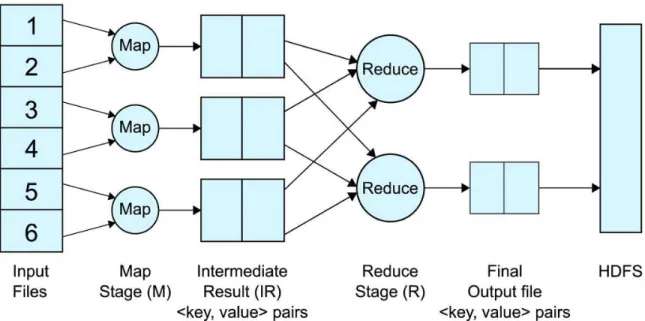
The MapReduce programming model originally proposed by Google in 2004, has become a major programming model for parallel and distributed process of a large scale dataset in computer cluster environments [1]. In the MapReduce programming model, the computation is specified in the form of a map function and a reduce function. The map function process a block of dataset as a (key, value) pair and produces map output in the form of a list of (key, value) pairs. The intermediate values are grouped together based on the same key e.g. k2and then pass to the reduce function. The reduce function takes the intermediate key k2 along with its associated values and processes them to produce a new list of values as final output. The map function and the reduce function are executed independently on allocated resources which shows high parallelism.
) ( )) ( , ( _ ) , ( ) , ( _ 3 2 2 2 2 1 1 v list v list k function reduce v k list v k function map
The logical dataflow diagram of the MapReduce programming model is shown in Figure 2.1 which presents a weather dataset with various air temperatures in different years. The program needs to find the highest air temperature in each year. The year is represented as the key and the air temperature is represented as the value in the dataset [2].
Figure 2.1: A logical data flow of the MapReduce programming model.
The MapReduce programming model was initially developed for Web base data processing but now it has been applied in other domains of data intensive applications such as machine learning, scientific simulation, healthcare data analysis, and Web data
(0,200037) (1,200438) (2,200026) (3,200030) (4,200432) (5,200427) Map Function Map Function (2000,37) (2004,38) (2000,26) (2000,30) (2004,32) (2004,27) (2000,[37,26,30]) (2004,[38,32,27]) Reduce Function (2000,37) (2004,38)
Input dataset (key , value) pairs.
Here the keys are line offsets within the file
User defined map function extract the year and associative
temperature from the data file
Group the value on similar key (key , [values]) pairs
Final Output (key , values) Map Output (key , value) pairs
User defined reduce function iterate through the map output
and finds highest temperature for each year
mining. The remarkable features of the MapReduce programming model include fault-tolerance, simplicity and scalability. MapReduce is a highly scalable computing model to enable thousands of inexpensive commodity computers to be used as an effective computing platform for distributed and parallel computing. The model provides facilities to automatically detect and handle node failures scenario without any effect on the computation completion. It is a simple programming model because it allows the application developers to provide only a sequential implementation of application logic expressed in functional-style (i.e. map function and reduce function) and the runtime system deals with low-level parallelization details, i.e. partitioning input dataset, scheduling program execution across multiple nodes of a computer cluster, handling node failures and managing inter-nodes communications. Hence, the MapReduce programming model reduces difficulties of parallel programming, so that programmers can easily achieve the low level parallelism on cluster nodes for complex tasks.
The MapReduce programming model has a number of implementations such as Hadoop [3], Dryad [4], Phoenix [5], Mars [6] and Sector/Sphere [7]. The Dryad [4] is a general purpose distributed execution system proposed by Microsoft. The Dryad engine is based on dataflow graph where computations are expressed as vertices. The vertices can be executed on a set of computers and inter-computer communication can be achieved through channels that connect the vertices. The Phoenix [5] was proposed by Stanford University, a programming API and runtime system based on Google MapReduce programming model. It can automatically create threads and dynamically schedule the threads on multiple processors. The processor failure is automatically handled in the Phoenix system for fault tolerance. It is mainly designed for multi-core and multiprocessor systems [8]. He et al. proposed Mars [6], a MapReduce implementation on Graphic Processor Unites (GPUs). The Mars APIs automatically parallelize the map function and the reduce function on GPUs threads. The Mars can perform better than CPU-based MapReduce implementations because GPUs can provide massive parallelism. Gu et al. proposed Sector/Sphere [7] for graphic processing applications. In the Sector/Sphere system, sector is a distributed file system across commodity machines and
used for data storage. It also provides scalability and fault-tolerance facilities. The data parallel computation is achieved through sphere i.e. the sphere can be used to process data stored in the sector in parallel. Among the aforementioned implementation systems of the MapReduce programming model, the Hadoop framework is the most widely used MapReduce platform due to its open source nature. The details of the Hadoop framework are given in the next section.
2.2
Hadoop MapReduce Framework
Hadoop [3] is an opens source implementation of the MapReduce programming model and has become the foremost computing platform for big data analytics. It was originally developed by Doug Cutting1 and Mike Cafarella2 in 2005. Cutting was working that time at Yahoo. Since then, Hadoop has become a core project of Apache™. The Apache™ Hadoop is a framework written in Java that distributes and parallelizes computation on massive datasets across a cluster of computers using simple programming model (MapReduce programming model). It has become the most prevalent framework for big data analytics and it is being used by many organization such as Yahoo, Facebook, YouTube, Twitter, Google, LinkedIn [9] to process and analyze their massive amounts of data . Today popular big data analytics service providers such as IBM, Oracle, Microsoft, Dell, Cloudera and Hortonworks either have been offering Hadoop-related products (such as Infosphere BigInsights and Exadata) or providing support to users on Hadoop MapReduce (Cloudera, HortonWorks) [10]–[14].
The Hadoop MapReduce framework is highly scalable and it can be scaled up from a single machine to tens of thousands machines, each of which offering local computation and data storage. The size of the Hadoop cluster can shrink or expand dynamically based on workload. The Hadoop MapReduce framework is developed with fundamental hypothesis that machine failure is common in cluster computing and it should be handled
1 http://en.wikipedia.org/wiki/Doug_Cutting
automatically in software level by the framework. Therefore, fault-tolerance and automatically machine failure handling techniques are included in the framework.
2.2.1
Hadoop Architecture
The Hadoop MapReduce framework mainly includes: MapReduce and Hadoop Distributed File System (HDFS). The architecture of the Hadoop MapReduce framework is shown in Figure 2.2.
Figure 2.2. Architecture of the Hadoop MapReduce
The MapReduce divides the computation into map tasks and reduce tasks and executes them parallel on a cluster of nodes. It consist of a job tracker and a number of task trackers services. The job tracker is running on the master node (Name Node) and it is responsible for controlling the overall operation of the MapReduce framework. It manages the task tracker, assigns tasks to a task tracker, monitoring the progress of running tasks and dealing with node failure situations. The task trackers run on the slave
Task tracker
Job tracker
Task tracker
Name Node
Data Node Data Node
Task Tracker
Job Tracker
Task Tracker
Master Node Slave Node
Multi-Node Cluster HDFS
MapReduce Engine
nodes (worker nodes / Data Nodes) which actually execute all the map tasks and the reduce tasks i.e. all the map tasks and the reduce tasks run on the worker nodes. The task tracker periodically coordinates with the job tracker through a heartbeat message to updates on the progress of the running tasks. If the job tracker is not receiving the heartbeat message from a particular task tracker for a certain period of time, then the job tracker declares that the particular task trackers is a dead worker and automatically assigns the running tasks to the next available worker node.
2.2.1.1 MapReduce
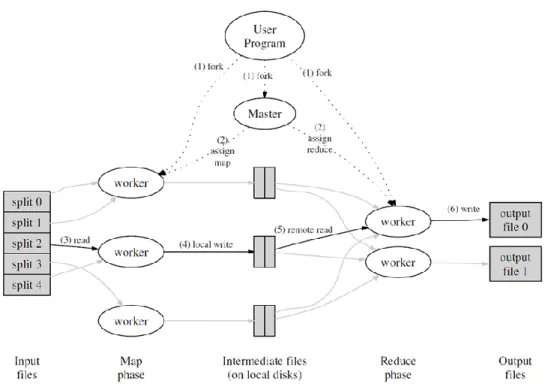
MapReduce is a processing engine of the Hadoop MapReduce framework. A Hadoop MapReduce job is a unit of works that executes across multiple computing nodes and it completes in multiple phases i.e. map phase and reduce phase. The details of these phases are available in Chapter 4. In the map phase, each map task processes a block of input dataset that is generally stored in a distributed file system. The input dataset is typically divided into blocks of pre-defined size (i.e. 64MB or 128MB), and distributed over cluster nodes. The map tasks read the data blocks and applies the user-defined map function. The map output (intermediate files) produced by the map function is collected in physical memory. It is written periodically from the physical memory into a local disk of a processing node that executes the map task. The locations of the map output are passed to the master node that is responsible to forward to a node that executes the reduce task. In the reduce phase, the reduce tasks read the map output from remote locations, sort it by the map output key, so that all the values of the same key are grouped together. After that, the reduce tasks iterate through sorted map output files and passes unique intermediate key and the associated values to the reduce function. The output of the reduce function is written into a distributed file system as a final output. The number of final output files are depended on the number of the reduce tasks initiated. The Hadoop job execution flow is shown in Figure 2.3.
Figure 2.3: The Hadoop MapReduce job execution flow3
The MapReduce programming model executes the map function and the reduce function on multiple computing nodes in order to achieve parallelism. The number of map tasks and the reduce tasks that can run simultaneously on a cluster nodes is depended on the number of map slots and reduce slots configured on the worker nodes. A slot is a unit of resources (CPU, physical memory) that can be assigned to a task. The number of slots (i.e. map slots and reduce slots) can be configured through a configuration file. For examples, a cluster has 10 worker nodes, and if 2 map slots and 2 reduce slots are configured on each worker node. Then total 20 map tasks and 20 reduce tasks will be executed parallel. If the number of map slots and the number of reduce slots are less than the number of map tasks and the number of reduce tasks then a job will be completed in multiple waves. The job waves are more explained in Chapter 4.
2.2.1.2Hadoop Distributed File System
When a dataset is continuously growing, it might not be possible for a single computer to store and process the continuously growing dataset. It becomes compulsory to partition the dataset and distributes across a network of computers. File systems that manage storage across a network of computers are called distributed file systems. Hadoop has its own distributed file system called HDFS (Hadoop Distributed File System) which is designed for storing massive amounts of data across a cluster of nodes [15][2] . The HDFS is designed based on Google File System (GFS) [16], [17] with the idea that the most effective way of data writing and reading as write-once and read-many times. It is a highly fault-tolerant system and provides high throughput access to application data. The HDFS system is mainly designed for batch processing rather than interactive system [18]. When a dataset is copied to the HDFS, the HDFS divides the dataset into blocks of an equal size, makes multiple replicas of each block and distributes throughout a cluster of nodes (Data Node) as an independent units. The replicas of the block are stored on different nodes and racks. The default size of a data block is 64MB and the number of replicas is 3, however, a user can change the size of block and number of replica in HDFS configuration file. The multiple replicas support fault-tolerance and availability of a data. For examples, if a node is crashed, the data blocks stored on it will be available on other nodes.
The HDFS system consists of a single Name Node service and several Data Node services as shown in Figure 2.4. The Name Node service is running on the master node and is responsible for managing the file system namespace and standardizes access to files. The Data Node services are running on slave nodes and are responsible for storing the data files, creating and deleting the blocks as well the replicas upon instructions received from the Name Node. A detail about the HDFS system is available in Chapter 3.
Figure 2.4: The HDFS architecture4
2.2.2
Hadoop MapReduce Framework Optimization Approaches
The performance of the Hadoop MapReduce framework can be improved from different aspects such as:
Job scheduling / Task scheduling
Data locality algorithms
Configuration parameters tunings
2.2.2.1 Job Scheduling or Task Scheduling
Job scheduling or task scheduling in the Hadoop MapReduce is employed to efficiently manage workload among the processing nodes and effectively share the resources of a Hadoop cluster between different jobs and users. With the help of scheduling techniques, more than one user can execute multiple jobs in parallel and as a result the cluster resources would be utilized effectively. On the other hand, without a sophisticated
scheduling mechanism, the performance of the Hadoop cluster can be affected due to imbalance workload distribution and unfair resources sharing. Moreover, the Hadoop framework supports both homogeneous and heterogamous environments. Distribution of the workload among the processing nodes in the homogeneous environment is relative simple and easy, however, in the heterogeneous environment, the workload is distributed based on the processing capacity of the nodes.
To effectively share the resources between the jobs and balance the workload among the processing nodes, Hadoop framework has come with default schedulers such as First-Come-First-Serve (FCFS) [19], [20], Fair Scheduler [21] and Capacity Scheduler [22] . The FCFS allocates all resources to a job on receipt, i.e. a job submitted first will get all the resources and a job submitted later will wait until the first job is completed. The Fair Scheduler divides the jobs into pools and fairly allocates the resource shares to each pool so that all jobs acquire an equal share of the cluster resources over time. It also solves the problem of FCFS where short execution jobs have to wait for a long execution job to complete. The Capacity Scheduler is similar to Fair Scheduler; however, the Capacity Scheduler is used in a large cluster and shares resources among multiple organization and organizes the jobs into queues. Apart from the default Hadoop scheduling, researchers have proposed job/task scheduling techniques to enhance the performance of the Hadoop framework. Sandholm et al. [23] proposed a dynamic priority mechanism that allows scheduler to allocate resources dynamically to multiple users based on their priorities and demands. It assigns the resources on a proportional basis in the form of map slots and reduce slots. It also gives incentives to users to optimize and customize their allocated resources in order to fulfill their job requirements. Kc et al. proposed [24] a constrain-based scheduler that considers the users deadlines as input and schedules only those jobs that meet the specified deadlines. It employed cost model that estimates the job execution time and it schedules the job if the job completes within a deadline. Nguyen [25] proposed a hybrid scheduling algorithm based on a dynamic priority to minimize the response time of a variable length of concurrent running jobs. The dynamic priority is calculated based on three factors, i.e. the waiting time of a job, the length of execution
time of the job, and unscheduled tasks of the job. The algorithm relaxes the ordering of tasks assignment in order to achieve data locality. The aforementioned schedulers try to improve the performance of a Hadoop framework with the assumption that the processing nodes of the cluster are homogeneous and thus they do not consider the heterogeneity of the underlying resources.
For a heterogeneous environment of the Hadoop cluster, several researchers have proposed scheduling algorithms in order to improve the performance of the Hadoop cluster. Zaharia et al. proposed LATE [26] and Chen et al. proposed SAMR [27] to improve the performance of the Hadoop in heterogeneous environment. Both approaches deals with straggler tasks (a task which has slow progress) and executes speculative tasks (backup task) of the straggler tasks on another machine in order to minimize the overall execution time of a job because the straggler tasks significantly increase the execution of the job. Both the approaches find strangler task by estimating the execution completion time of all the running tasks. The LATE algorithm estimates the execution time of the tasks in a static way while SAMR algorithm uses dynamic approach to estimate the execution time of the running tasks. Furthermore, SAMR classified the cluster nodes into fast nodes and slow nodes and initiates the backup task only on the fast nodes. Sun et al. further improved the SAMR and proposed ESAMR [28] which takes the types of the jobs into consideration because different types of the jobs have different task execution time in the map phase and reduce phase. The ESAMR employs k-mean to classify the jobs into different classes. Rasooli et al. [29] proposed a hybrid scheduling approach for Hadoop heterogeneous environments. The approach is based on three scheduling algorithm such as FCFS, Fair Scheduler and COSHH [30] scheduler. The selection of the scheduler is made based on the current utilization of the resources and the total number of waiting tasks. If the system is under-utilized (i.e. the number of available slots is greater than the number of submitted tasks) then the hybrid approach will pick up FCFS scheduler. If the system utilization is balanced then the system will use Fair Scheduler otherwise the system will employ COSHH scheduler. Kumar et al. [31] proposed a Context Aware Scheduler for Hadoop (CASH) to improve the performance of the
framework. The CASH schedules the tasks based on job characteristics (i.e. CPU-intensive or I/O CPU-intensive) and processing nodes characteristics (i.e. Computation good or I/O good). It classifies the jobs and the processing nodes based on their characteristics. The tasks are scheduled on the processing nodes that fulfill the requirements. Further readings on Hadoop scheduling are available in [32].
2.2.2.2 Data Locality Algorithms
Hadoop has become a major computing platform for intensive-data applications. To efficiently process a large amount of data, Hadoop should provide an efficient data locality scheduling mechanism for enhancing the performance of the Hadoop system in a shared cluster environment. One of the Hadoop principles is that moving computation is cheaper then moving data when dealing with large amounts of datasets. This principle indicates that it is often better to move the computation close to where the data is located rather than to move the data to the computation node where the application is running. This is especially true when the size of data is very large because migration of computation reduces the network congestion and improves the overall performance of the system. When a computation task is moved closer to data it consumes, this is called data locality. Today a cluster can have thousands of shared nodes which transmit massive data that impose network load and create congestion, so an efficient scheduler must avoid unnecessarily data transmission. Scheduler considers the data locality as it is a determining factor for the MapReduce performance mechanisms because network bandwidth is scarce resource for these systems. In fact, a high locality of data enhances the throughput of the system [61].
For each node, all map tasks are classified into three levels of locality according to the distance between the input data and computation nodes. The most efficient locality is the first level locality where the processing map task is launched on the node holding the task input data called the node level locality. When a task cannot achieve the first level locality then scheduler executes the task on the node where the computation node and data node located in the same rack called rack level locality (second level). If the task still
fails to achieve the second level locality then a scheduler launches the task on a node in a different rack which is called off-the-rack level locality (third level). If the data locality is not achieved, data transferring and I/O cost can seriously affect the performance because of the shared network bandwidth.
As the data locality is a determining factor in Hadoop. There are several factors that affect date locality such as the size of a Hadoop cluster, the number of data replications (replicas) and job execution stage. In a large cluster with a small number of jobs, the probability of the data locality is low. For example, if a job has 5 map tasks and is submitted to a cluster with 100 nodes, it is unlikely to get a high locality rate. Since each task has 3 copies of the input data which are distributed on 3 different nodes, therefore, at most 15 out of the 100 nodes have input data for the job. That is, the probability of the data locality for the job is 15%. If number of nodes is decreased to 50 then the data locality of the job will be increased to 30%.
Similarly, the number of replicas and job execution stage also affect the data locality. Increasing the number of replicas of input data improves the data locality but it consumes extra storage. At the job initialization stage, the probability of a job data locality is high because there are a large number of unmapped tasks and the required input data of these unmapped tasks are available on large number of nodes. While at the job end stag, the probability of a job data locality is low because a small number of unmapped tasks are left and the required input data of these tasks are available on small number of nodes.
The Hadoop default scheduler schedules jobs using FCFS and already considers data locality [33]. When the master node receives a heartbeat from a slave node which indicates that a free map slot is available, the job tracker on the master node first tries to find the map task in the head-of-line job whose input data is stored on that node. If it is found then a node level locality is achieved and task will be launched on that node. When node level locality is impossible then the job tracker tries to seek a rack level locality. If it is still fail then task is arbitrary picked up and launched on as off-the-rack node. This simple scheduling algorithm favors data locality but has deficiencies. For example, this
algorithm strictly follows the FCFS policy where tasks are scheduled one by one and each task is scheduled without considering its impact on other tasks.
Let us consider a Hadoop cluster of three nodes (N1, N2 and N3) as shown in Figure 2.5. Each node has at least one free map slot. Let us assume that there are three tasks (t1, t2 and t3). Each task input data has multiple copies which are stored over multiple nodes for reliability purpose. Task t1 input data is stored on nodes N1, N2 and N3 (DT1), task t2 input data is stored on nodes N1 and N2 (DT2) and task t3 input data is stored on node N1 (DT3) as shown in Figure 2.6.
Figure 2.5: A Hadoop cluster with 3 nodes.
The Hadoop scheduler assigns task t1 to node N1 and achieves the node level locality, task t2 is assigned to node N2 and it also achieves the node level locality. There is now only node C that has the idle slot and only one unscheduled task t3 and this task must be assigned to node C, as shown in the Figure 2.6. To summarize, both tasks t1 and t2 achieve data locality while task t3 loses data locality. The reason is that the Hadoop scheduler processes the tasks one by one rather than considers the tasks on all the
available idle slots. All the tasks can achieve the data locality if the scheduler processes all the tasks on all available idle slots at once as shown in Figure 2.7.
Figure 2.6: Task 3 is assigned without data locality.
The default Hadoop scheduler provides some mechanisms to improve data locality but have some inherent deficiencies. To improve the performance of the Hadoop system, researchers have proposed numerous data locality aware scheduling algorithms.
Abad et al. designed DARE (Adaptive Data Replication) algorithm [34] to improve data locality by dynamically replicating the popular data on different nodes. They have proposed (i) a greedy approach and (ii) a probabilistic approach. In the current implementation, when it is impossible for a map task to gain local data, the MapReduce framework fetches data from a remote node (data located at a different node) for processing and discards when map task is completed. The greedy approach takes the advantage of remotely fetched data, makes subset of that data and inserted into HDFS at the node that fetched it. However, the greedy approach cost huge disk storage due to replicating all the fetched data. To address this issue, the DARE using eviction mechanism using LRU (Least Recently Used) policy that delete least recently used data blocks to make space for the new replica. Unlike the greedy approach, the probabilistic approach does not replicate remotely fetched data immediately but replicate only popular data. In this approach, an individual node runs algorithm independently to generate replica of most popular data. The knowledge of dynamically replicated data is transmitted to the Name Node, so that this information will be made available to the scheduler and other users of file system to achieve better data locality. This approach also applies the aging eviction mechanism, to quickly evict the files with a decreasing popularity.
Zaharia et al. [33] developed an algorithm called delay scheduling to enhance the data locality rate in a Hadoop environment. The delay scheduler is applied into Fair Scheduler in Hadoop. Fair Scheduler has changed from allocating equal share (time slot) to each job to allocating equal share to each user. Each user has its own pool in a shared cluster and a minimum share (a minimum number of slots) is assigned to each user. If a user cannot use their time slots, other users can use these slots instead. If a user cannot get the minimum share, preemption occurs, which reallocates the resources among the users. There are two approaches of preemption (i) killing the running jobs or (ii) wait for running jobs to complete. Killing a running job immediately scarifies the time it had been
running while the waiting approach does not have such an issue but scarifies the fairness. The delay scheduling algorithm uses the waiting approach to achieve data locality and it defines as “when a job cannot launch a local-map task then it wait for small amount time, letting the other jobs launch the task instead”. The delay scheduling relaxes the strict job order for task assignment and delays jobs execution if the job has no map task local to the available slave node. The maximum delay time D is specified. If a job map task has been skipped for a longer time (i.e. longer than the D time unit), it is allowed to launch a rack-level task. If it is skipped for further longer times then it is allowed to launch an off-rack level task. These skip times are called delay times and are an important factor in this algorithm. The values of the delay time are set either by default which is 1.5 times to slave node heartbeat or based on a rate at which the slots free up which is less than average task length.
He et al [35] developed a matchmaking scheduling algorithm to enhance data locality in a MapReduce cluster. The main idea behind this algorithm is to give every node a fair chance to grab a local task before assigning a non-local task. Like the delay scheduling, the matchmaking algorithm also relaxes the strict job order when assigning a map task to a node. That is, if a node fails to find a local job in the queue; the algorithm will continue to search the succeeding jobs. To give a fair chance to every node to get a local map task, when a node cannot find a local map task for the first heartbeat, no non-local task will be assigned to the node i.e. the node gets no task for this heartbeat interval. If a node still fails to find a local map task for the second heartbeat interval, the matchmaking technique will assign a non-local task to the node to avoid wasting computation resources. This algorithm assigns a locality marker value to every node to mark its status. If none of jobs in the queue has a local map task to a node, depending on the status of this node (locality marker value), the matchmaking algorithm will decide whether or not to assign the node to a non-local task. When a new job is added, all the slave node locality marker values will be cleared because the new job may comprise a local map task for some slave nodes.
Sangwon et al. [36] proposed two innovative techniques, i.e. Prefetching and Pre-shuffling that can enhance the overall performance of a MapReduce cluster. The prefetching technique enhances data locality while the pre-shuffling reduces the shuffling of intermediate result data produced by a map function. The prefetching is a bi-directional technique where on one side the complex computation is performed and on the other side to be required data is prefetched and assigned to the corresponding task. This technique prefetched the required data block of map tasks close to the computation node or to the local rack in pipeline manner. The prefetcher module also monitors the synchronization status between the computation and prefetches as both activities are performed simultaneously. The pre-shuffling technique tries to predict the target reducer where the intermediate result data are partitioned before the execution of mapper, in order to reduce the network overhead.
Zhang at el. [37] designed Next-K-Node scheduling (NKS) algorithm to improve data locality of map task in homogeneous environment and has been implemented in Hadoop 0.20.2. The algorithm first preferentially schedules the tasks which satisfies the node level locality. If no such a map task is available then the NKS method calculates the probabilities of each task and schedules the one with the highest probability. The NKS method generates the low probabilities for the tasks of whose input data is stored on the next k nodes, so that it can reserve these tasks for these nodes. In this method the main factor is the next k node which is predicted node to issue requests for the next task. In this method the next k node is determined based on the progress report of the running task. In Hadoop, task trackers periodically report the progress of the running tasks to the job tracker. To calculate the progress of