Bayesian Network Classifiers versus
k
-NN Classifier using Sequential Feature
Selection
Franz Pernkopf
∗University of Washington, Department of Electrical Engineering M254 EE/CSE Building, Box 352500, Seattle, WA, 98195-2500, USA Graz University of Technology, Institute of Communications and Wave Propagation,
Inffeldgasse 12, A-8010 Graz, Austria, [email protected]
Abstract
The aim of this paper is to compare Bayesian network classi-fiers to thek-NN classifier based on a subset of features. This subset is established by means of sequential feature selection methods. Experimental results show that Bayesian network classifiers more often achieve a better classification rate on different data sets than selectivek-NN classifiers. Thek-NN classifier performs well in the case where the number of sam-ples for learning the parameters of the Bayesian network is small. Bayesian network classifiers outperform selectivek -NN methods in terms of memory requirements and compu-tational demands. This paper demonstrates the strength of Bayesian networks for classification.
Introduction
In most classification tasks the relevant features are often unknown a priori. Thus, many features are derived from a specific classification problem and those which do not con-tribute or even degrade the classification performance should be removed from the set of extracted features. Feature selec-tion has become important for numerous pattern recogniselec-tion and data analysis tasks (Jain & Zongker 1997), (Dash & Liu 1997), (Kohavi & John 1997). The main purpose of feature selection is to reduce the number of extracted features to a set of a few significant ones while maintaining the classifica-tion rate. The reducclassifica-tion of the feature set may even improve the classification rate by reducing estimation errors associ-ated with finite sample size effects (Jain & Chandrasekaran 1982).
Another approach to achieve an improvement of the clas-sification accuracy is to model statistical dependencies be-tween attributes. Therefore, the framework of Bayesian net-works (Pearl 1988) can be used to build classifiers (Fried-man, Geiger, & Goldszmidt 1997), (Singh & Provan 1996), (Keogh & Pazzani 1999) to address this effectively. Bayesian network classifiers have been applied in many dif-ferent domains. In this paper, we compare the performance
∗The author is grateful to Elisabeth Pernkopf and Prof. Djamel Bouchaffra for the valuable comments on this paper and to Ingo Reindl and Voest Alpine Donawitz Stahl for providing the data for the first experiment.
Copyright c 2004, American Association for Artificial Intelli-gence (www.aaai.org). All rights reserved.
of these approaches to the selectivek-NN classifier. The se-lectivek-NN classifier uses a subset of features which max-imize the classification performance. This subset is estab-lished by means of sequential feature selection methods.
Bayesian Network Classifier
A Bayesian network (Pearl 1988), (Cowell et al. 1999)
B = hG,Θi is a directed acyclic graph G which mod-els probabilistic relationships among a set of random vari-ables U = {X1, . . . , Xn,Ω} = {U1, . . . , Un+1}, where
each variable inUhas specific states or values denoted by lower case letters{x1, . . . , xn, ω}. The symbolndenotes
the number of attributes of the classifier. Each vertex (node) of the graph represents a random variable, while the edges capture the direct dependencies between the variables. The network encodes the conditional independence relationship that each node is independent of its nondescendants given its parents. These conditional independence relationships reduce the number of parameters needed to represent a prob-ability distribution. The symbolΘrepresents the set of pa-rameters which quantify the network. Each node contains a local probability distribution given its parents. The joint probability distribution of the network is uniquely deter-mined by these local probability distributions. Basically, two different techniques for parameter learning are avail-able, the maximum likelihood estimation and the Bayesian approach (Cowell et al. 1999). In this paper, the parame-ters of the network are estimated by the maximum likelihood method. In the following, three different types of Bayesian network classifiers are presented, the na¨ıve Bayes classifier, the tree augmented na¨ıve Bayes classifier, and the selective unrestricted Bayesian network classifier.
Na¨ıve Bayes Classifier
The na¨ıve Bayes (NB) decision rule (Duda, Hart, & Stork 2000) assumes that all the attributes are conditionally in-dependent given the class label. As reported in the liter-ature (Friedman, Geiger, & Goldszmidt 1997), the perfor-mance of the na¨ıve Bayes classifier is surprisingly good even if the independence assumption between attributes is un-realistic in most of the data sets. Independence between the features ignores any correlation among them. The at-tribute values of Xi andXj (Xi 6= Xj) are conditionally
is conditionally independent ofxjgiven classω, whenever P(xi|ω, xj) =P(xi|ω)for allxi ∈Xi, xj ∈Xj, ω∈Ω,
and whenP(xj, ω)> 0. The structure of the na¨ıve Bayes
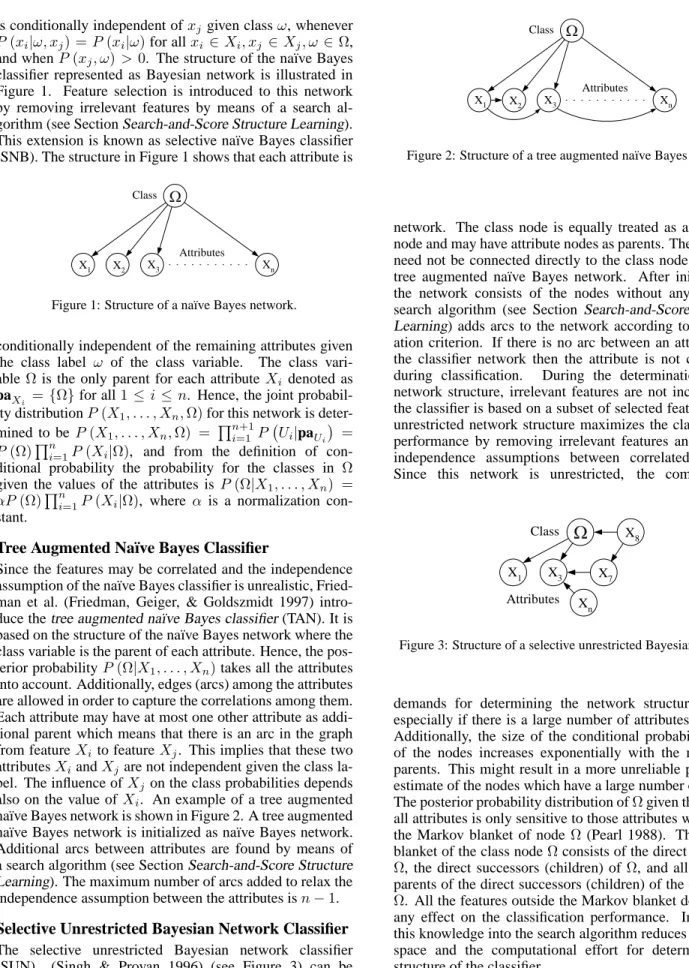
classifier represented as Bayesian network is illustrated in Figure 1. Feature selection is introduced to this network by removing irrelevant features by means of a search al-gorithm (see SectionSearch-and-Score Structure Learning). This extension is known as selective na¨ıve Bayes classifier (SNB). The structure in Figure 1 shows that each attribute is
Class
Attributes
X1 X2 X3 Xn
Figure 1: Structure of a na¨ıve Bayes network.
conditionally independent of the remaining attributes given the class label ω of the class variable. The class vari-ableΩis the only parent for each attribute Xi denoted as
paXi = {Ω}for all1 ≤i≤n. Hence, the joint probabil-ity distributionP(X1, . . . , Xn,Ω)for this network is
deter-mined to be P(X1, . . . , Xn,Ω) = Q n+1 i=1 P Ui|paUi = P(Ω)Qn
i=1P(Xi|Ω), and from the definition of
con-ditional probability the probability for the classes in Ω
given the values of the attributes is P(Ω|X1, . . . , Xn) = αP(Ω)Qn
i=1P(Xi|Ω), where α is a normalization
con-stant.
Tree Augmented Na¨ıve Bayes Classifier
Since the features may be correlated and the independence assumption of the na¨ıve Bayes classifier is unrealistic, Fried-man et al. (FriedFried-man, Geiger, & Goldszmidt 1997) intro-duce thetree augmented na¨ıve Bayes classifier(TAN). It is based on the structure of the na¨ıve Bayes network where the class variable is the parent of each attribute. Hence, the pos-terior probabilityP(Ω|X1, . . . , Xn)takes all the attributes
into account. Additionally, edges (arcs) among the attributes are allowed in order to capture the correlations among them. Each attribute may have at most one other attribute as addi-tional parent which means that there is an arc in the graph from featureXi to featureXj. This implies that these two
attributesXiandXjare not independent given the class
la-bel. The influence ofXj on the class probabilities depends
also on the value ofXi. An example of a tree augmented
na¨ıve Bayes network is shown in Figure 2. A tree augmented na¨ıve Bayes network is initialized as na¨ıve Bayes network. Additional arcs between attributes are found by means of a search algorithm (see SectionSearch-and-Score Structure Learning). The maximum number of arcs added to relax the independence assumption between the attributes isn−1.
Selective Unrestricted Bayesian Network Classifier
The selective unrestricted Bayesian network classifier (SUN) (Singh & Provan 1996) (see Figure 3) can be viewed as generalization of the tree augmented na¨ıve Bayes
Class
Attributes
X1 X2 X3 Xn
Figure 2: Structure of a tree augmented na¨ıve Bayes network.
network. The class node is equally treated as an attribute node and may have attribute nodes as parents. The attributes need not be connected directly to the class node as for the tree augmented na¨ıve Bayes network. After initialization the network consists of the nodes without any arcs. A search algorithm (see Section Search-and-Score Structure Learning) adds arcs to the network according to an evalu-ation criterion. If there is no arc between an attribute and the classifier network then the attribute is not considered during classification. During the determination of the network structure, irrelevant features are not included and the classifier is based on a subset of selected features. This unrestricted network structure maximizes the classification performance by removing irrelevant features and relaxing independence assumptions between correlated features. Since this network is unrestricted, the computational
Class
Attributes
X1 X3 X7 Xn
X8
Figure 3: Structure of a selective unrestricted Bayesian network.
demands for determining the network structure is huge especially if there is a large number of attributes available. Additionally, the size of the conditional probability tables of the nodes increases exponentially with the number of parents. This might result in a more unreliable probability estimate of the nodes which have a large number of parents. The posterior probability distribution ofΩgiven the value of all attributes is only sensitive to those attributes which form the Markov blanket of nodeΩ(Pearl 1988). The Markov blanket of the class nodeΩconsists of the direct parents of
Ω, the direct successors (children) ofΩ, and all the direct parents of the direct successors (children) of the class node
Ω. All the features outside the Markov blanket do not have any effect on the classification performance. Introducing this knowledge into the search algorithm reduces the search space and the computational effort for determining the structure of the classifier.
Search-and-Score Structure Learning
In order to learn the structure of the Bayesian net-work classifiers, Keogh and Pazzani propose hill climbing search (Keogh & Pazzani 1999). An improvement of the hill climbing search is to apply the classical floating search al-gorithm (CFS) used for feature selection applications (Pudil, Novovi˘cov´a, & Kittler 1994). This algorithm is adopted for learning the network structure of tree augmented na¨ıve Bayes classifiers and selective unrestricted Bayesian net-work classifiers (Pernkopf & O`Leary 2003). We use the cross-validation classification accuracy estimate as scoring functionJ for evaluating the performance of the networks. For the selective unrestricted Bayesian network this learning approach enables simultaneous feature selection and struc-ture learning. The main disadvantage of hill climbing search is that once an arc has been added to the network struc-ture, the algorithm has no mechanism for removing the arc at a later stage. Hence, this algorithm suffers from the
nestingeffect (Kittler 1978). To overcome this drawback, Pudil et al. (Pudil, Novovi˘cov´a, & Kittler 1994) present a floating search method for finding significant features which optimize the classification performance in feature selection tasks. This algorithm allows conditional exclusions of previ-ously added attributes and/or arcs from the network. Hence, this algorithm is able to correct disadvantageous decisions which were performed in previous steps. Therefore, it may approximate the optimal solution in a better way than hill climbing search, especially in case of data of great com-plexity and dimensionality. However, this search strategy uses more evaluations to obtain the network structure and therefore is computationally less efficient than hill climbing search. This floating search algorithm facilitates the correc-tion of disadvantageous decisions made in previous steps.
Sequential Feature Selection Algorithms
Sequential feature selection algorithms search in a sequen-tial deterministic manner for the best feature subset (sub-optimal). Basically, forward and backward algorithms are available. The forward methods start with an empty set and add features until a stopping criterion concludes the search. The backward algorithms begin with all features and remove features iteratively. The well-known suboptimal sequential algorithms are listed in the following.
• Sequential forward selection (SFS): The sequential for-ward selection algorithm (Kittler 1978) is a bottom up search method. With each iteration one feature among the remaining features is added to the subset, so that the subset maximizes the evaluation criterionJ.
• Sequential backward selection (SBS): Sequential back-ward selection (Kittler 1978) is the counterpart of the se-quential forward selection. In each step one feature is re-jected so that the remaining subset gives the best result of the evaluation criterionJ.
• Plusl-take awayr selection (PTA(l, r)): The PTA(l, r)
algorithm (Kittler 1978) partially avoids nesting of feature sets by allowing a low level backtracking in the selection process. The subset is enlarged by addinglfeatures using the SFS algorithm. Afterwards,rfeatures are rejected by
using the SBS method. Both steps are repeated until a particular predetermined subset size is obtained.
• Generalized sequential forward selection (GSFS(r)) (Kit-tler 1978): At each stage r features are added simulta-neously instead of adding just one feature to the subset at a time like the SFS method does. This algorithm and the following counterpart does not avoid nesting entirely, since successive added sets may be nested.
• Generalized sequential backward selection (GSBS(r)): This algorithm is the counterpart of the GSFS method.
• Generalized plus l-take away r selection (GPTA(l, r)) (Kittler 1978), (Devijver & Kittler 1982): The difference between the PTA and the GPTA method is that the former approach employs the SFS and the SBS procedures instead of the GSFS and GSBS algorithms.
• Sequential forward floating selection (SFFS): The se-quential forward floating algorithm is a bottom up search procedure introduced by Pudil et al. (Pudil, Novovi˘cov´a, & Kittler 1994). This method was adapted for learning the structure of Bayesian network classifiers (see Sec-tionSearch-and-Score Structure Learning) (Pernkopf & O`Leary 2003). The algorithm includes new features which maximize the criterionJ by means of the SFS pro-cedure starting from the current feature set. Afterwards, conditional exclusions of the previously updated subset take place. If no feature can be excluded anymore, the algorithm proceeds again with the SFS algorithm. The floating methods are allowed to correct wrong decisions made in previous steps and they approximate the optimal solution in a better way than the sequential feature selec-tion methods described above.
• Sequential backward floating selection (SBFS). This al-gorithm is the counterpart to the SFFS method.
• Adaptive sequential forward floating selection (ASFFS(rmax, b, d)): This search algorithm
sug-gested by Somol et al. (Somol et al. 1999) utilizes the best of both, generalized strategies and floating methods. This algorithm is similar to the SFFS procedure, where the SFS and the SBS methods are replaced by their generalized versions GSFS(r) and GSBS(r). The optimal value of r is determined dynamically. The maximum generalization level which is used is restricted by a user defined bound rmax. The current generalization level r
changes during the search depending on the subset size
k. Therefore, the parameters dandbare necessary. For a detailed description of the algorithm refer to Somol et al. (Somol et al. 1999). This algorithm is initialized with an empty subset.
• Adaptive sequential backward floating selection (ASBFS(rmax, b, d)) (Somol et al. 1999). This is
the counterpart of the ASFFS method.
Experiments
A comparative study has been performed on data of a surface inspection task (Pernkopf 2003) and data sets from the UCI repository (Merz, Murphy, & Aha 1997). Throughout the experiments, five-fold cross-validation classification accu-racy has been used for learning the structure of the Bayesian
networks. Similarly, the five-fold cross-validation classifi-cation rate of the k-NN approach is used as scoring func-tionJ for the feature selection methods. All the structure learning and feature selection experiments are based on ex-actly the same cross-validation folds of the data sets. The Bayesian network classifiers use discretized features, which were discretized using recursive minimal entropy partition-ing (Fayyad & Irani 1993). The partition boundaries for dis-cretization were established only through the training data set. Zero probabilities of the conditional probability tables of the Bayesian network classifiers are replaced with a small epsilonε= 0.00001. The following abbreviations are used for the different classification approaches:
• NB: Na¨ıve Bayes classifier.
• CFS-SNB: Selective Na¨ıve Bayes classifier using the classical floating search.
• HCS-TAN: Tree augmented na¨ıve Bayes classifier using hill-climbing search.
• CFS-TAN: Tree augmented na¨ıve Bayes classifier using classical floating search.
• CFS-SUN: Selective unrestricted Bayesian network using classical floating search.
• SFFS-k-NN-C: k-nearest neighbor classifier us-ing continuous-valued data and the SFFS method
(k∈ {1,3,5,9}).
• SFFS-k-NN-D: k-nearest neighbor classifier us-ing discrete-valued data and the SFFS method
(k∈ {1,3,5,9}).
The k-NN classifier requires a scaling of the features, whereby, the scaling parameters were determined only through the training data set of the corresponding cross-validation folds of the data set. Each feature is scaled to zero mean and unit variance (Kaufman & Rousseeuw 1990).
First Experiment
Data Experiments have been performed on a data setS
consisting of 516 surface segments from a surface inspec-tion task, uniformly distributed into three classes. Each sample (surface segment) is represented by 42 features which are described in more detail in (Pernkopf 2003). The data set is divided into six mutually exclusive sub-sets S = {D1,D2,D3,D4,D5,H}. The data set parts
D1,D2,D3,D4, and D5 are used for finding the optimal
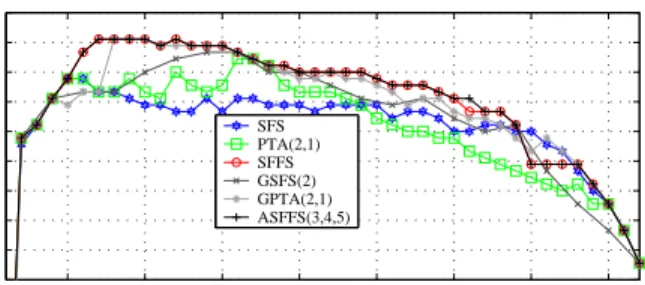
classifier (five-fold cross-validation). Each part is comprised of 90 samples. The established classifiers are validated on a separate hold-out data setHwhich was never employed dur-ing the optimization experiments (Kohavi & John 1997). Results First, the sequential forward feature selection al-gorithms are compared in terms of the achieved cross-validation classification performance using the 3 −N N
classifier (see Figure 4). Generally, the floating algorithms perform better than the methods without floating property. The sequential forward floating algorithm (SFFS) performs in a similar manner as the more complex adaptive floating method (ASFFS(3,4,5)) (With the given parameter setting of the ASFFS algorithm the classification performance of a subset size of 5 within a neighborhood of 4 is optimized
5 10 15 20 25 30 35 40 91 92 93 94 95 96 97 98 99 100
Feature subset size
Classification performance [%] SFS PTA(2,1) SFFS GSFS(2) GPTA(2,1) ASFFS(3,4,5)
Figure 4: Cross-validation classification performance of different sequential forward feature selection methods for a subset size up to 42.
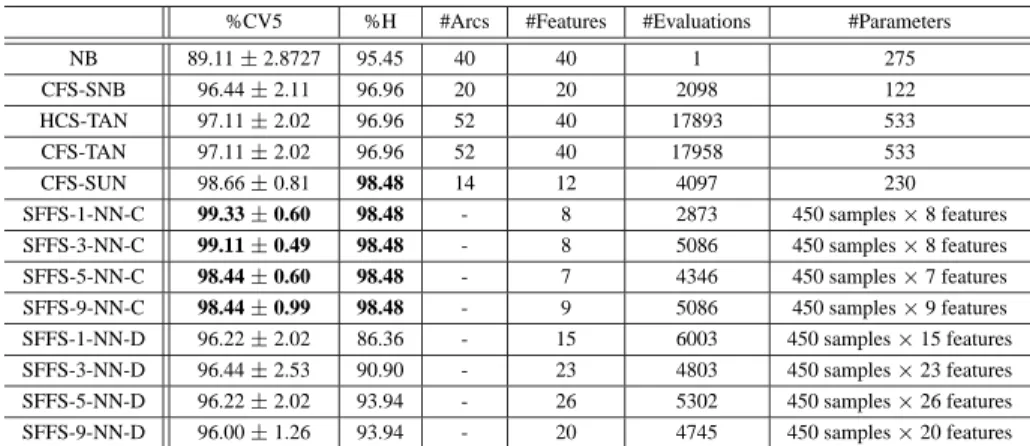
more thoroughly.). There is only a marginal difference of the result for the feature subset size of 31. However, the number of classifier evaluations used for establishing the optimal subset for classification is for the SFFS only 5086 compared to the ASFFS with 7768. For the floating algo-rithms, the computational costs depend on the characteristics of the data set due to the floating property. The generalized algorithms (GSFS and GPTA) perform slightly worse than the SFFS method with a computational requirement of 6391 and 13201, respectively. The number of evaluations used for obtaining the optimal subset for all non-floating algorithms is fixed for a given parameter setting. The PTA and SFS search strategies achieve the lowest scores for different sizes of subsets. Therefore, 2623 and 903 evaluations are nec-essary. Since the SFFS algorithm achieves a good tradeoff between computational demands and achieved classification score and due to the fact that the structure of the Bayesian network classifiers was trained with an equivalent algorithm further feature selection results consider only this method. Table 1 compares the feature selection results of the SFFS approach to the Bayesian network classification methods. The table shows the five-fold cross validation classification accuracy estimate (%CV5) and the performance on the hold-out data set (%H). It also depicts the number of classifier evaluations (#Evaluations) used for search, the number of independent probabilities (#Parameters), and the number of features (#Features) and/or arcs (#Arcs) used to achieve this classification accuracy estimate. The best achieved classifi-cation accuracy is emphasized by boldface letters.
The selective na¨ıve Bayes classifier (CFS-SNB) achieves a better %CV5 classification accuracy estimate than the na¨ıve Bayes (NB) approach based on all available attributes. How-ever, the performance on the hold-out data is similar. The computational demands for establishing the CFS-SNB clas-sifier is relatively small. For the tree augmented na¨ıve Bayes classifier the same result is achieved either with hill climbing or with the classical floating search algorithm. This means that the CFS method does not perform backward steps dur-ing the search. This is also observable in the number of used classifier evaluations. The TAN classifier uses all extracted features and 12 arcs are added to the na¨ıve Bayes structure (#Arcs=52). The TAN classifier uses 533 independent prob-abilities which have to be estimated from the data set and
%CV5 %H #Arcs #Features #Evaluations #Parameters NB 89.11±2.8727 95.45 40 40 1 275 CFS-SNB 96.44±2.11 96.96 20 20 2098 122 HCS-TAN 97.11±2.02 96.96 52 40 17893 533 CFS-TAN 97.11±2.02 96.96 52 40 17958 533 CFS-SUN 98.66±0.81 98.48 14 12 4097 230 SFFS-1-NN-C 99.33±0.60 98.48 - 8 2873 450 samples×8 features SFFS-3-NN-C 99.11±0.49 98.48 - 8 5086 450 samples×8 features SFFS-5-NN-C 98.44±0.60 98.48 - 7 4346 450 samples×7 features SFFS-9-NN-C 98.44±0.99 98.48 - 9 5086 450 samples×9 features SFFS-1-NN-D 96.22±2.02 86.36 - 15 6003 450 samples×15 features SFFS-3-NN-D 96.44±2.53 90.90 - 23 4803 450 samples×23 features SFFS-5-NN-D 96.22±2.02 93.94 - 26 5302 450 samples×26 features SFFS-9-NN-D 96.00±1.26 93.94 - 20 4745 450 samples×20 features
Table 1: Comparison of classification approaches (Experiment 1).
it is only slightly better than the selective na¨ıve Bayes clas-sifier. However, the CFS-SNB classifier has a much sim-pler structure and a smaller number of parameters is re-quired. The selective unrestricted Bayesian network (CFS-SUN) achieves the best classification accuracy estimate on the five-fold cross-validation and hold-out data set among the Bayesian network classifiers. For achieving this result, 230 probabilties have to be estimated and the structure con-sists of 12 attributes and 14 arcs, whereas the TAN and NB structure do not enable feature selection. Additionally, the number of classifier evaluations used for determining the structure of the TAN network is high compared to establish-ing the structure of the CFS-SUN since the Markov blanket is used during the search for the SUN network structure. The selective k-NN classifier on continuous attributes slightly outperforms the CFS-SUN classifier. However, the achieved classification performance on the hold-out data set is the same for both. As mentioned above, the Bayesian network classifiers use a discretized feature space. For dis-cretized features the performance of the SFFS-k-NN-D clas-sifier degrades. Basically, thek-NN decision rule searches through a labeled reference set for the nearest neighbors which might be time-consuming in case of a large number of samples. Additionally, a large amount of memory is re-quired. Bayesian network classifiers outperform selectivek -NN methods in terms of memory requirements and compu-tational demands during classification. Especially, the CFS-SUN is simple to evaluate but still maintains high predictive accuracy.
Second Experiment
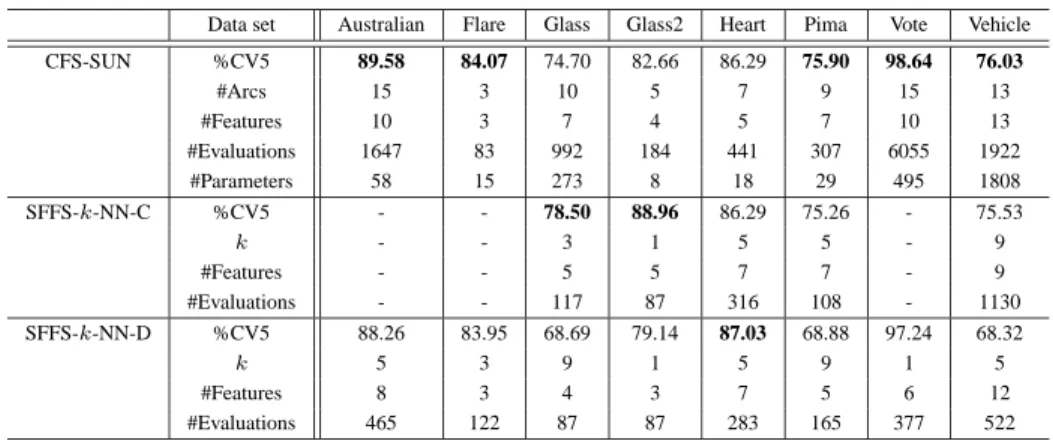
The second experiment has been performed on 8 data sets from the UCI repository (Merz, Murphy, & Aha 1997). The main characteristics are summarized in Table 2. The at-tributes in the data sets are multinomial and continuous-valued. Table 3 compares the CFS-SUN classifier to the SFFS method using the k-NN classifier. We select k ∈ {1,3,5,9} which gives the largest classification perfor-mance. Both classification approaches are based on the equivalent search algorithm. The table shows the five-fold cross validation classification accuracy estimate (%CV5),
Data set #Features #Classes #Instances Attributes australian 14 2 690 mixed flare 10 2 1066 mixed glass 9 7 214 continuous glass2 9 2 163 continuous heart 13 2 270 continuous pima 8 2 768 continuous vote 16 2 435 discrete vehicle 18 4 846 continuous
Table 2: Data sets (Experiment 2).
the number of classifier evaluations (#Evaluations) used for search, the number of independent probabilities (#Parame-ters), the number of nearest neighborsk, and the number of features (#Features) and/or arcs (#Arcs) used to achieve this classification accuracy estimate. The best achieved classifi-cation accuracy is emphasized by boldface letters. The CFS-SUN classifier outperforms the selective k-NN approach five times. In one case the selectivek-NN classifier using discretized attributes achieves the best classification perfor-mance. The selectivek-NN classifier performs well in do-mains such as Glass, Glass2, and Heart where the number of samples for learning the parameters (probabilities) of the Bayesian network is small (see Table 2). In general, it is interesting how few parameters are used by the CFS-SUN classifier, especially for the data sets Flare, Glass2, Heart, and Pima. The number of independent probabilities used for classifying the Vehicle data set is large. Basically, the size of the conditional probability tables of the nodes in the net-work increases exponentially with the number of parents. In this case, this might provide probability estimates that are not robust since the data set is relatively small.
Conclusion
This paper compares Bayesian network classifiers to the se-lectivek-NN classifier. The selectivek-NN classifier uses a subset of features which is established by means of sequen-tial feature selection methods. In order to learn the structure of the Bayesian networks, hill climbing search and the se-quential forward floating algorithm are used.
Data set Australian Flare Glass Glass2 Heart Pima Vote Vehicle CFS-SUN %CV5 89.58 84.07 74.70 82.66 86.29 75.90 98.64 76.03 #Arcs 15 3 10 5 7 9 15 13 #Features 10 3 7 4 5 7 10 13 #Evaluations 1647 83 992 184 441 307 6055 1922 #Parameters 58 15 273 8 18 29 495 1808 SFFS-k-NN-C %CV5 - - 78.50 88.96 86.29 75.26 - 75.53 k - - 3 1 5 5 - 9 #Features - - 5 5 7 7 - 9 #Evaluations - - 117 87 316 108 - 1130 SFFS-k-NN-D %CV5 88.26 83.95 68.69 79.14 87.03 68.88 97.24 68.32 k 5 3 9 1 5 9 1 5 #Features 8 3 4 3 7 5 6 12 #Evaluations 465 122 87 87 283 165 377 522
Table 3: Comparison of classification approaches (Experiment 2).
Experiments were performed on data of a surface inspec-tion task and data sets from the UCI repository. Bayesian network classifiers more often achieve a better classification rate on different data sets as selectivek-NN classifiers. The
k-NN classifier performs well in the case where the num-ber of samples for learning the parameters of the Bayesian network is small. It has been observed that only few pa-rameters are used by the selective unrestricted Bayesian net-work classifier for certain data sets. Bayesian netnet-work clas-sifiers outperform selectivek-NN methods in terms of mem-ory requirements and computational demands. Especially, the performance of the selective unrestricted Bayesian work classifier demonstrates the strength of Bayesian net-work classifiers.
References
Cowell, R.; Dawid, A.; Lauritzen, S.; and Spiegelhalter, D. 1999. Probabilistic networks and expert systems. Springer Verlag.
Dash, M., and Liu, H. 1997. Feature selection for classifi-cation. Intelligent Data Analysis 1(3):131–156.
Devijver, P., and Kittler, J. 1982. Pattern recognition: A statistical approach. Prentice Hall International.
Duda, R.; Hart, P.; and Stork, D. 2000. Pattern Classifica-tion. John Wiley & Sons.
Fayyad, U., and Irani, K. 1993. Multi-interval discretiza-ton of continuous-valued attributes for classification learn-ing. In Proceedings of the Thirteenth International Joint Conference on Artificial Intelligence, 1022–1027.
Friedman, N.; Geiger, D.; and Goldszmidt, M. 1997. Bayesian network classifiers. Machine Learning 29:131– 163.
Jain, A., and Chandrasekaran, B. 1982. Dimensionality and sample size considerations in pattern recognition in practice, volume 2 of Handbook of Statistics. Amsterdam: North-Holland.
Jain, A., and Zongker, D. 1997. Feature selection: Eval-uation, application, and small sample performance. IEEE Transactions on Pattern Analysis and Machine Intelligence 19(2):153–158.
Kaufman, L., and Rousseeuw, P. 1990. Finding groups in data: An introduction to cluster analysis. John Wiley & Sons.
Keogh, E., and Pazzani, M. 1999. Learning augmented Bayesian classifiers: A comparison of distribution-based and classification-based approaches. In Proceedings of 7th International Workshop on Artificial Intelligence and Statistics, 225–230.
Kittler, J. 1978. Feature set search algorithms. In Chen, C., ed., Pattern Recognition and Signal Processing. Sijtho and Noordho. 41–60.
Kohavi, R., and John, G. 1997. Wrappers for feature subset selection. Artificial Intelligence 97:273–324.
Merz, C.; Murphy, P.; and Aha, D. 1997. UCI repository of machine learning databases. Department of Information and Computer Science, University of California, Irvine, URL: www.ics.uci.edu/˜mlearn/MLRepository.html. Pearl, J. 1988. Probabilistic reasoning in intelligent sys-tems: Networks of plausible inference. Morgan Kaufmann. Pernkopf, F., and O`Leary, P. 2003. Floating search algo-rithm for structure learning of Bayesian network classifiers. Pattern Recognition Letters 24:2839–2848.
Pernkopf, F. 2003. 3D surface analysis using Bayesian network classifiers. Technical report, Graz University of Technology.
Pudil, P.; Novovi˘cov´a, J.; and Kittler, J. 1994. Floating search methods in feature selection. Pattern Recognition Letters 15:1119–1125.
Singh, M., and Provan, G. 1996. Efficient learning of se-lective Bayesian network classifiers. In International Con-ference of Machine Learning, 453–461.
Somol, P.; Pudil, P.; Novovi˘cov´a, J.; and Pacl´ik, P. 1999. Adaptive floating search methods in feature selection. Pat-tern Recognition Letters 20:1157–1163.