Consultation
draft
Choice Framework for local Policy and
Procedures
CFPP 01-01: Management and
decontamination of surgical
instruments used in acute care
Part B – Common elements
Consultation draft
Consultation
draft
Contents
1.0 Scope and introduction ... 4
2.0 Decontamination equipment: test equipment and materials ... 5
General considerations ... 5
Calibration and sources of error ... 5
Data recorders ... 6
Temperature measurement ... 8
Pressure measurement ... 10
Flow measurement ... 11
Other instruments ... 13
3.0 Design and pre-purchase considerations ... 15
General ... 15
Pre-purchase considerations ... 15
Protein removal and protein optimization ... 17
Procurement of equipment – an overview ... 17
Choice of equipment ... 20
Specification and contract ... 20
Siting ... 24
Engineering services ... 24
Information to be supplied by the manufacturer ... 29
4.0 Validation and verification ... 30
General ... 30
Testing of decontamination equipment ... 31
Responsibilities ... 32 Works tests ... 35 Validation ... 36 Loading ... 38 Documentation ... 39 Periodic tests ... 40
Consultation
draft
Revalidation ... 41
Repeat validation ... 41
Types of test ... 42
Procedure on failure of a test ... 43
Principles of installation and operational tests ... 43
Principles of performance qualification tests ... 44
Tests for performance requalification (PRQ) ... 48
Consultation
draft
1.0 Scope and introduction
1.1 CFPP 01-01 is divided into four parts. 1.2 Part A is on management and environment.
1.3 Part B (this document) is entitled “common elements” and will include: • test equipment and materials;
• design and pre-purchase considerations; • validation and verification.
1.4 Part C is entitled steam sterilization methods. 1.5 Part D covers washer-disinfectors.
1.6 Part E covers non-steam sterilizers.
1.7 Potential purchasers of reprocessing equipment should ensure that they know whether the load items they intend to decontaminate are classified as medical devices.
Medical devices
1.8 This document covers the various types of decontamination equipment to be used for the reprocessing of medical devices (for example porous load sterilizers, and washer-disinfectors).
1.9 Guidance on the application of medical devices legislation is beyond the scope of this document, and advice should be sought from the Medicines and Healthcare products Regulatory Agency (MHRA).
Definitions
1.10 For definitions of terms used in this guidance document, see ISO 11139:2006 ‘Sterilization of health care products – vocabulary’.
Consultation
draft
2.0 Decontamination
equipment: test
equipment and materials
Refer to the ‘Particular specifications’ for sterilizers (see Appendix A in CFPP 01-01 Part C) and washer-disinfectors (see Appendix A in CFPP 01-01 Part D).
General considerations
2.1 This chapter reviews the key items of portable test equipment necessary to carry out the test procedures described in this document. Specifications for instruments fitted permanently to decontamination equipment are given in the relevant British, European and International Standards.
2.2 Instrumentation technology continues to advance rapidly, making it increasingly difficult and undesirable to provide detailed specifications for the equipment to be used in testing equipment. There is a clear trend towards computer-controlled data recorders with software, which enables the system to verify attainment of the required conditions and then to produce a detailed written report accompanied by tabulated or graphed data. Although these new systems may offer advantages in clarity of presentation, as well as reduced operator time, the traditional instruments, such as chart recorders, remain equally acceptable where they meet the accuracy defined in this chapter.
Note: Data-recording equipment or chart recorders should be equipped with memory devices that enable data to be retrieved at any later date.
2.3 The objectives of this chapter are both to ensure that traditional
measurement methods are supported adequately and to define clearly the essential requirements that apply to the test equipment whether it is a traditional system or the latest technology.
2.4 When it is proposed to use measurement and/or recording techniques that are not covered in this guidance, the advice of the Authorising Engineer
(Decontamination) should be sought.
2.5 All test equipment should be calibrated by a UKAS accredited laboratory in accordance with ISO/IEC 17025, with traceability to the National Standard.
Calibration and sources of error
2.6 Errors of measurement occur for a number of reasons. These include inherent factors such as the design of the measuring equipment, common problems with sensors (such as loose or imperfect connections), damaged insulation, and broken conductors, combined with changes in the
environmental temperature around the instrument. Variations in the sensors themselves, the method of introducing the sensors into the machine and their location within the load may add to the error in the temperature measurement.
Consultation
draft
Changes in conditions other than the one being sensed may also lead to errors, for example temperature fluctuations within pressure sensing elements may lead to errors in pressure measurement.
2.7 Careful attention to detail including the location of the test instruments, effective maintenance and the skill of personnel trained in the application, handling and use of the instruments are required to eliminate or minimise these errors. Systematic errors can be reduced by careful calibration.
2.8 Instruments should be subject to a planned maintenance and calibration programme, in accordance with the instrument manufacturer’s
recommendations, occurring at least annually. Each instrument should be labelled with a calibration date and a reference from which its current calibration status may be traced.
2.9 Instrument calibration should be carried out in accordance with the instrument manufacturer’s instructions by a validated method, using a reference standard of suitable accuracy that has been certified within the previous twelve months by a UKAS test laboratory. The calibration laboratory should be instructed to adjust the instrument under test to read true values, and to report before and after calibration results so that instrument drift can be monitored. A full history record, including all maintenance and calibration details, should be kept for each instrument.
2.10 The instrument should have a valid test certificate and the calibration data should include a temperature within the process temperature band.
2.11 In use all test instruments should be located in a position protected from draughts and not subjected to rapid temperature variations. Test instruments should be allowed a period of time to stabilise within the environment of the test site. The manufacturer’s instructions should be followed.
Data recorders
2.12 Test recorders are required to measure temperature in all types of
decontamination equipment and may also be required for the measurement of pressure, flow rates, and other critical parameters. They should be designed for use with the appropriate sensors, independent of those fitted to the machine.
2.13 Sufficient connections to meet the testing requirements of the relevant CFPP section and EN standard should be provided.
2.14 Recorders should comply with the requirements of BS EN 285 or BS EN ISO 15883.
2.15 Data from digital recorders (dataloggers) can be presented graphically or as a listing of numerical values or as a combination of both. In many cases parts of the operating cycle can be expanded and replotted for closer examination.
Consultation
draft
2.16 Digital recorders should have the facility to record data immediately that can then be removed for secure storage. Alternatively, the recorder may be connected to a central computer and the data recorded to the hard drive. Software used with digital recorders should be developed and validated under a recognised quality system (see BS EN ISO 13485).
2.17 The detailed specification for a test recorder will depend upon the range of equipment with which it is to be used. The measurement system (recorder and sensors) should be capable of measuring cycle variables to the required accuracy of the instruments fitted to the machine.
2.18 The accuracy with which a variable can be read from the recorder will be affected not only by the sources of error discussed above but also by the precision of the calibration, the scale range, the integration time, the sampling interval and the intrinsic accuracy of the recorder. Digital instruments might display measured values with a greater level of discrimination than the accuracy of the system as a whole: care needs to be taken with the configuration of outputs and the interpretation of the measured values.
2.19 The accuracies quoted by recorder manufacturers are measured under controlled reference conditions and do not include the errors from connected sensors. Temperature measurement errors due to ambient temperature changes should not exceed 0.04ºC per ºC rise. The system should be calibrated as a whole also.
2.20 The scale ranges should include the expected maximum and minimum values of the cycle variables throughout the operating cycle, with sufficient leeway to accommodate any deviations resulting from a malfunctioning machine.
2.21 At all stages of the cycle, the values of the variables are critical and the recorder should be capable of measuring them to sufficient accuracy to confirm that the process conditions have been attained. The criteria are as follows:
a. For digital recorders, the sampling interval should be short enough for the holding time to contain at least 180 independent
measurements in each recording channel. This corresponds to a sampling interval of one second for the shortest holding time (three minutes, high-temperature steam sterilizers) for periodic testing. For pen recorders, the chart speed should be fast enough to allow fluctuations on that scale to be clearly resolved. The duration of the holding time should be measurable to within 1%.
b. The integration time of the recorder (the response time) should be short enough to enable the output to follow significant fluctuations in the cycle variables and to ensure that successive measurements are independent of each other, It should not be longer than the sampling interval.
Consultation
draft
c. The recorder should be accurate enough to show clearly whether the measured temperatures are within the band or not. For all the types of equipment covered by this document, the repeatability of the recorder should be ± 0.25ºC or better, and the limit of error of the complete measurement system (including sensors) should be no more than 0.5ºC.
d. For pressure measurement, the limit of error should be no more than 0.5% of the absolute pressure during the plateau period.
e. Attention should also be paid to the accuracy of the time base of the recording system, particularly on longer cycles where any error will become more obvious. This can be by means of a calibrated
stopwatch against a calibrated time signal (e.g. BT speaking clock).
2.22 The scale range for each variable to be measured should be optimised to cover all values occurring during the process. As well having calibration
certificates for each item of the measuring chain, the complete system should be calibrated in the working environment (e.g. sterile services department).
Temperature measurement
Temperature sensors
2.23 Temperature sensors should be used to sense the temperature in locations specified in the tests described in this document. The sensors should be either platinum resistance elements and comply with class A of BS EN 60751:1996, IEC 60751:1983, or thermocouples and comply with
Tolerance Class 1 of EN 60584-2 1993 and have a response time in water of τ90≤0.5 seconds. Other sensors of demonstrated equivalence can be used. 2.24 Thermocouple wire should be single-strand, not exceeding 0.7 mm diameter over the covering of one core of a twin cable. The width of the cable should not exceed 2 mm. If bulkier cable is used, the tracking of steam along the outside of the cable may invalidate certain tests, such as those which require temperatures to be measured in the centre of a standard test pack (see “Standard test pack” section in CFPP 01-01 Part C).
2.25 Thermocouples may be argon arc-welded or micro-welded. However, experience has shown that, provided the wires are cleaned, they may be satisfactorily twisted together to form the hot junction. Brazing, silver brazing and welding with filler rods may be no more reliable in respect of accuracy than freshly twisted wires. Thermocouples should not be fitted with a heat sink.
2.26 The performance characteristics of the temperature sensor should not be adversely affected by the environment in which it is placed, e.g. pressure, hot detergent solution etc. Certain environments in which thermocouples may be used may be corrosive to certain metals. Thermocouple junctions should be regularly inspected for corrosion and remade and recalibrated as necessary.
Consultation
draft
Thermometric recording instrument(s)
2.27 Thermometric recording instruments should be used in conjunction with the temperature sensors to record the temperatures measured in the locations specified in the tests described in this guidance.
2.28 Guidance on test apparatus designed to introduce thermometric measuring equipment into the sterilizer chamber and washer-disinfector chamber is provided in BS EN 285 and BS EN 15883 Parts 1 and 2 respectively. Other methods of introducing temperature sensors into a chamber, which guarantee a watertight or gas-tight seal, are equally acceptable.
2.29 All reporting software should be validated, backed-up (with backed-up data being kept in a secure location off-site) and secure to ensure no unauthorised access.
Use of sensors
2.30 Guidance on use of sensors for sterilizers andWDs is provided in BS EN 285 and BS EN 15883 Parts 1 and 2.
Instrument verification
2.31 Before and after each series of tests on any item of decontamination equipment, the measured temperature recording system should be verified by comparison with an independent reference temperature source at the process temperatures.
2.32 The temperature measured by all temperature sensors when immersed in a temperature source at a temperature known within ±0.1 K and within the process temperature band should not differ by more than 0.5 K. The reference instrument(s) used on site as the recording system should be calibrated
and/or adjusted in a controlled environment or laboratory with relevant UKAS traceable certification and laboratory references. Before and after each series of tests on any item or items of decontamination equipment the measured temperature-recording system should be verified by comparison with an independent reference temperature source at the required process temperatures. The comparison instrument used, such as a digital thermometer should be traceable to UKAS calibration standards. No adjustment to the test instrumentation should be made on site in an
uncontrolled environment unless the test contractor or organisation hold a UKAS site calibration procedure and certification that includes adjustment which should be available for inspection or audit. Any adjustments made to test instrumentation should be logged and included within the test report.
Self-contained systems
2.33 Where it is impractical to insert sensor leads into processing equipment, self-contained datalogging devices may be used.
Consultation
draft
2.34 A number of different designs of small self-contained single channel data loggers for the measurement of temperature are commercially available. They are independently powered, may be programmed to take readings at the required rate for the required duration and are downloaded onto a computer on completion of the datalogging period.
2.35 Care needs to be taken in selecting units that are capable of withstanding the high temperatures found in sterilizers and washer-disinfectors.
2.36 The accuracy, resolution and sampling rate requirements should be identical to those specified for conventional recorders (see Chapter 4).
2.37 Where two or more dataloggers are used together on the same process, the time bases of the instruments should be synchronised.
Pressure measurement
Measurement ranges
2.38 Pressure measurement ranges for WDs should be up to 1000 kPa (10 barA) (for example for the water supply pressure). Differential pressures of 0.1 to 10 kPa (–100 mbar) may need to be measured (for example for the
determination of the pressure drop across filters).
2.39 Pressure measurement ranges for steam sterilizers may be from 3 to 10 kPa (in vacuum leak testing) to typically 400 kPa at the working pressure of a high-temperature steam sterilizer.
Sensors and gauges
2.40 Pressure sensors should be used in the tests described in this document and should conform to BS 6447. The natural frequency of the sensor and connected tubing should be not less than 10 Hz and the time constant for rising pressure (0 to 63%) should be not greater than 0.04 seconds.
2.41 The performance characteristics of the pressure sensor should not be adversely affected by the environment in which it is placed (e.g. temperature, hot detergent solution etc). Certain environments in which sensors may be used may be corrosive to certain materials. Compatibility should be confirmed with manufacturers’ instructions.
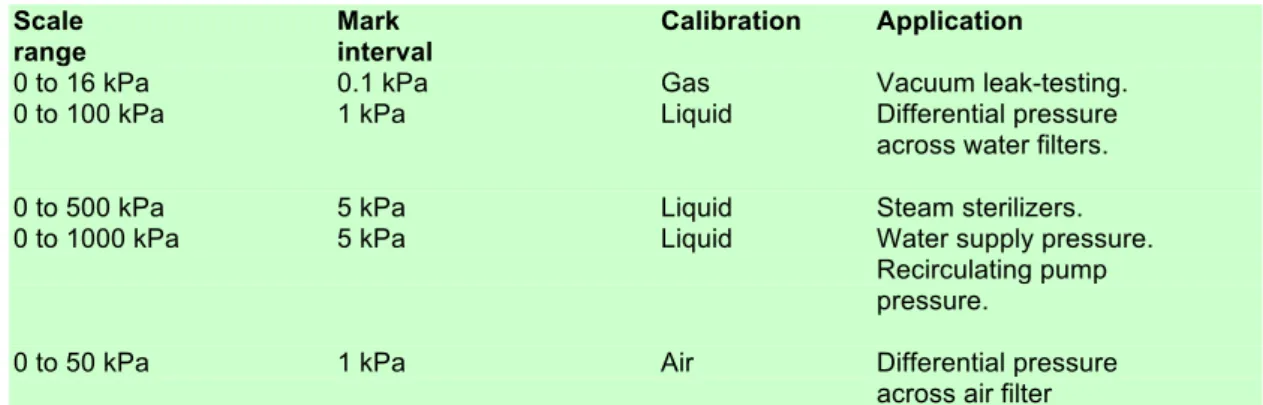
2.42 The requirements for gauges required for testing decontamination equipment are shown in Table 1.
2.43 Pressure gauges should be temperature-compensated and, except for the differential pressure gauge, be Bourdon-tube gauges conforming to BS EN 837-1 of nominal size 150 mm and accuracy class 0.25 (i.e. the error should not exceed 0.25% of full scale deflection).
Consultation
draft
Scale Mark Calibration Application
range interval
0 to 16 kPa 0.1 kPa Gas Vacuum leak-testing.
0 to 100 kPa 1 kPa Liquid Differential pressure
across water filters.
0 to 500 kPa 5 kPa Liquid Steam sterilizers.
0 to 1000 kPa 5 kPa Liquid Water supply pressure.
Recirculating pump pressure.
0 to 50 kPa 1 kPa Air Differential pressure
across air filter Table 1 Requirements for pressure measurement
2.44 Gauges not designed for direct connection to steam at 380 kPa (2.8 bar) should be connected via a siphon or similar device to ensure that the
accuracy of the gauge is maintained over the temperature range associated with changing steam pressure. If the low-pressure gauge used for vacuum leak testing cannot withstand the pressure in the chamber during sterilization an automatic valve should be provided to protect it.
Flow measurement
Water
2.45 The volume of water used for each stage of the operating cycle may be measured using a water meter complying with ISO 4064-1 Class A.
2.46 The meter should be designed to operate at temperatures up to 90ºC with a supply pressure up to 1700 kPa (16 bar).
2.47 The meter should have a minimum scale division of 0.1 L or less and be designed to measure flow rates over the range 1 L/min to 25 L/min.
2.48 A single jet turbine system is sufficiently accurate for the purpose. Other systems such as multi-jet turbine or semi-positive displacement systems complying with ISO 4064-1 Class B or Class C, or BS 5728 Class D, may also be used.
2.49 The calibration of the flow meter should be verified by comparing the indicated flow rate with a measured volume collected over a measured time period. The collected volume of liquid may be determined either by
gravimetric or volumetric measurement. The gravimetric method is generally more accurate as the temperature of the liquid increases.
Chemical additives
2.50 The volume of chemical additive used for each stage of the operating cycle may be measured using a flow meter. A number of commercially
available flow sensors designed to monitor flows in the range 0 to 2L/min are suitable for interfacing to a recorder or datalogger.
Consultation
draft
2.51 The sensor should be suitable for use with fluids having viscosity in the range 0.8 to 20 centiStokes and should be calibrated for the viscosity of the fluid to be measured.
2.52 The sensor should be designed to operate at temperatures up to 70ºC with a supply pressure up to 1100 kPa (10 bar).
2.53 The meter/recorder should have a minimum scale division of 10 mL or less and be designed to measure flow rates over the range 50 mL/min to 1500 mL/min.
2.54 The system should have an accuracy of ±2.5% of full scale or better.
2.55 The calibration of the meter should be verified by determining the indicated volume flowing to a collecting vessel and comparing this with the collected volume determined by gravimetric or volumetric measurement.
Note 1
When the meter is connected in the pipe there will be a noticeable pressure drop across the meter. Although this should be less than 1 bar it may interfere with the normal operation of the washer-disinfector and therefore should not be used during tests for other characteristics than the volume of water used.
Note 2
A meter of the rotating vane type calibrated using water at 20ºC as the flowing medium and then subsequently used to measure the flow of a detergent solution with a viscosity of 30 centiStokes would have an error of 15 to 20% if no correction was applied.
Volume measurement
2.56 The volume of chemical additives and the volume of water used in each stage are critical variables in the control of the washing-disinfecting process.
2.57 The volume used may be measured directly by collection in a graduated vessel of appropriate size.
2.58 Alternatively, for liquids of known density, the volume may be determined by collection in an appropriate size vessel of known mass (empty),
determination of the mass of the vessel and contents, calculation of the mass of the liquid and hence (by dividing this volume by the density) calculating the volume of liquid.
2.59 Whichever method is used, the accuracy should be such that the error is less than ±2%.
2.60 Volumetric measuring containers complying with BS 5898 (ISO 384) are suitable.
Consultation
draft
Other instruments
Sound level meter
2.61 An integrating sound level meter is required for the sound pressure test. It should comply with Type 2 of BS EN 61672-1 and BS EN 61672-2. Ten microphones are required for the test on a single piece of equipment.
Airflow metering device
2.62 A metering device (such as a needle valve) is required to admit air into the sterilizer chamber for the air detector tests, and vacuum and pressure leak tests. The device should be capable of controlling the flow of air into an
evacuated chamber. It should be adjustable and have a range which includes a flow of 0–5 mL/min per litre volume of the sterilizer chamber. The error in repeatability between 10% and 90% of the setting range should not exceed –5%. The device is connected to the chamber by a valved port provided by the sterilizer manufacturer.
Balance
2.63 A laboratory balance is required for steam dryness tests, load dryness tests, calibration of flow meters (for measuring the flow of water and/or chemical additives) and coolant quality tests. It should be capable of
measuring the mass of loads up to 4 kg to an accuracy of 0.1 g and up to 400 g to an accuracy of 0.01 g.
2.64 An analytical balance is required for determination of the TDS
(evaporative residue) in feed water. It should be capable of measuring a mass of up to 100 g with an accuracy of 0.1 mg.
2.65 A balance is also required for weighing the standard textile test pack (7 kg) and the metal load (15 to 20 kg) to a 10 g resolution.
Gas-monitoring equipment
2.66 A gas-monitoring instrument is required for tests on equipment using chemical additives that have a significant vapour pressure and are a potential risk.
2.67 The nature of the instrument will depend on the substance to be
monitored. In case of doubt, advice should be sought from the manufacturer of the chemical additive or the AE(D).
2.68The scale range of the measuring instrument should include the appropriate short-term exposure limit or occupational exposure limit and extend to at least ten times that exposure limit.
Consultation
draft
2.69 An aerosol generator is required for tests on machines incorporating air filters intended to deliver air free from microorganisms.
2.70 The device should be capable of generating a polydisperse aerosol with particles having the size distribution shown in Table 2.
Particle-counting photometer
2.71 A particle counter is required for tests on machines incorporating air filters intended to deliver air free from microorganisms. The device should be suitable for estimation or comparison of the mass concentration of airborne particles as defined in Table 2.
2.72 It should have an accuracy of better than ±5% over the range of a five expandable, six-decade resolution (that is 0.01% to 100% of the test cloud) as specified in BS EN ISO 14644-1.
2.73 The photometer should have a minimum threshold sensitivity of 0.0001
µg/L and should be capable of measuring aerosol concentration in the range 80 to 120 µg/L.
2.74 The sampling flow rate should be 0.40 ±0.05 L/s and sampling should be via a suitable probe.
Particle size [µm] Fraction % by mass
<0.5 >20
<0.7 >50
<1.0 >75
Source: BS EN ISO 14644-1
Consultation
draft
3.0 Design and pre-purchase
considerations
General
3.1 This section of the guidance provides advice on the specification,
purchase and installation equipment used for the decontamination of surgical instruments in hospitals, laboratories and other healthcare facilities.
Pre-purchase considerations
Introduction
3.2 It is essential that the purchase of an item of decontamination equipment is planned correctly. This section aims to help the purchaser with a step-by-step discussion of the issues to be included. As this section is designed to be universally applicable it might be necessary to vary the procedure according to local circumstance or requirements.
Specialist advice
3.3 The efficient completion of procurement documentation will require advice and help from a decontamination specialist, for example an AE(D).
3.4 This assistance should be sought in the following areas: • Determining initial User requirements;
• Choosing and completing the relevant ‘Particular specification’ (see Appendices in CFPP 01-01 Parts C and D);
• Determining throughput parameters;
• Advising on relevant performance qualification (PQ); • Post-tender analysis;
• Advising manufacturer/contractor on validation protocols; • Monitoring validation performance;
• Auditing validation report;
• Advising on Specification Qualification, Installation Qualification, Operational Qualification and PQ.
Consultation
draft
Quality systems
3.5 Adherence to engineering standards and quality systems ensure that decontamination equipment is manufactured, installed, validated and subject to the necessary periodic testing to establish the initial and then on-going satisfactory performance of the machine to ensure optimum decontamination of surgical instruments and safety of both operators and patients.
Product listing
3.6 The purchaser should list all load items proposed and projected to be re-processed by the decontamination equipment. This should include the following for each item:
• number; • size; • materials of construction; • temperature sensitivity; • moisture sensitivity; • pressure-variation sensitivity; • requirements for disassembly;
• manufacturer’s decontamination instructions;
• usage time constraints (to determine requirements for extra instrumentation only).
Spatial requirements
3.7 A full assessment of current space available should be made. It can be that additional machine numbers will require additional space. The
possibilities should be considered and checked once a throughput calculation has been made. The machine configuration (number of doors etc) can affect the spatial requirements. [text on safety inspections here]
Machine configuration
3.8 Advice on throughput calculations, equipment number determination, SSD design and floor suitable areas is given in Health Building Note 13 – ‘Sterile services department’.
Consultation
draft
Protein removal and protein optimization
3.9 All decontamination equipment should have the ability to have cycle parameters varied (e.g. for washer-disinfectors – time, temperature, number of stages of main wash, use of different detergents etc) to enable equipment to have cycles optimised as more data becomes available on more effective cycles and chemicals for protein removal.Specification preparation
3.10 The use of the ‘Particular specifications’ (see appendices in CFPP 01-01 Parts C and D) will enabledata provided by the tenderer on technical points as well as financial data to be compared. Not only will this enable the
purchaser to confirm the acceptability of current services, spatial requirements and porterage, but also it will enable a like-for-like tender analysis to be made. Tender analysis will be best achieved by formalising tender comparison with respect to performance and cost in all key areas. Qualifying statements by the tenderer should be taken into account. Their effect on tender content or
eligibility should be made before making a choice.
3.11 The specifications allow the purchaser to define post-validation service or contract work requirements. A choice on the relevance of these issues will need to be made prior to distribution of the procurement documentation.
Procurement of equipment – an overview
Introduction
3.12 This section gives a short overview of the process of purchasing decontamination equipment. It refers to more detailed information in subsequent sections, including information specific to each type of decontamination equipment given in subsequent sections.
Purchasing decontamination equipment
3.13 The purchase of decontamination equipment can be broken down into the following sequence of steps.
What type of load will be processed?
3.14 A knowledge of the load(s) to be processed is a prerequisite to make the correct decision about which piece of equipment to purchase; the difficulty in obtaining a clean product, the standard of cleanliness and the disinfection required vary for different product types. For example, some products with intricate interstices or long narrow lumens require specific provision if they are to be cleaned satisfactorily.
3.15 Purchasers should specify all the items to be processed to allow the tenderer to offer the most appropriate machine and accessories.
Consultation
draft
What type of machine is required?3.17 In this guidance, washer-disinfectors are classified by: • the product range which they are intended to process; • their configuration and load handling type;
• the nature of the cleaning and disinfection process.
3.18 Sterilizers are classified as either clinical or laboratory sterilizers. Clinical sterilizers can use one of a number of different sterilizing agents (sterilants): purchasers should give due consideration to the compatibility of the items to be processed with the process itself.
Where will the machine be sited?
3.19 The location available for the equipment will have a significant influence on the type of machine that can be used. Many of the larger continuous process machines require considerable space. Some machines will require considerable building work.
What services are available?
3.20 Decontamination equipment will require one or more of the following services: steam, electricity, water, compressed air, drainage, effluent handling, ventilation and bulk or integral storage/supply of chemical additives/sterilant gas supply. The manufacturers’ data will show which services are required for each model. Determine which of these are available at the proposed site and the capacities of each service. It might be necessary to plan for a new service, which would add greatly to the cost of the
installation.
Who will operate the equipment?
3.21 Equipment located in a centralised processing unit under the care of specially trained staff – whose sole or principal activity will be the operation of the machine – may be complex. Operators should thus be designated. Further requirements may be found in BS EN ISO 13485.
What capacity is required?
3.22 The likely daily and weekly work load, and the peak hourly work load, that the equipment will have to process should be established, then the number of machines required to process the workload should be calculated. Throughput figures for different manufacturer’s machines and different models within any given range vary considerably. For continuous process machines a distinction should be made between the time required to process one load and the total number of loads that can be processed in a period of one hour. Further guidance is given in Health Building Note 13. Consideration should be given to the time and spatial aspects of post-process conditioning.
Consultation
draft
What ancillary equipment will be needed?3.23 A sterilizer installation might require ancillary equipment such as special ventilation water treatment for steam generators, air compressors,
preconditioning facilities, degassing facilities and gas disposal plants.
3.24 A washer-disinfector might require ancillary equipment such as water softeners, deionization or reverse osmosis (RO) water treatment plants, steam generators, air compressors, extract ventilation (with or without condensers), bulk storage and dispensing facilities for process chemicals.
3.25 In addition some machines will require load staging facilities, before and after processing, purpose-built load carriers for different categories of product and means for returning load carriers from the unloading side of the machine back to the loading side.
What standards or specifications are relevant?
3.26 Most items of decontamination equipment will be constructed to either a BS, EN or ISO Standard. In some cases additional specifications will be required.
What sort of contract?
3.27 Once the specification has been completed, a contract should be drawn up for the supply and installation of the machine.
Which manufacturer?
3.28 Three or more manufacturers should be invited to tender for supplying the decontamination equipment. While no manufacturer should be excluded unnecessarily from the tendering process they should not be invited to tender unless there is a realistic prospect of their being awarded the contract.
What installation and commissioning arrangements?
3.29 After delivery and installation, the decontamination equipment should be subjected to a formal documented programme of validation.
What arrangements for service and repair?
3.30 It is common practice for the initial purchase contract to include all service and repair costs for the first year after installation, i.e. during the warranty period. A number of manufacturers also offer an extended warranty facility that, sometimes for an additional fee, provides an all-inclusive service and repair option.
What are the likely running costs?
3.31 Advice should be sought at the time of tender on the operational costs of the various machines that would be suitable. The operational costs should include the anticipated requirements for services (water, electricity, steam,
Consultation
draft
etc), consumable items (detergents, rinse aids, etc) and maintenance. This data should be used in the evaluation of the tender bids.
Choice of equipment
Introduction
3.32 This section contains information relevant to the choice of new
decontamination equipment. It discusses the types of machine and the loads for which they are suitable, and gives guidance on selecting the size and number of machines required for a given application.
Choice of equipment
3.33 The choice of machine should be governed by the nature of the loads to be reprocessed. Detailed guidance on appropriate processes for different load items can be obtained from the manufacturers of the medical devices.
Sizes and numbers
3.34 Precise information on the sizes and numbers of machines required for particular applications is difficult to give since there are considerable
variations in patterns of use. The number of machines required will depend on the cycle time and the loading capacity of the machine and in some
circumstances on the flexibility of operation that might be required, e.g. whether items to be processed can wait until there is a full load for the decontamination equipment or need to be processed immediately.
3.35 Consideration should be given to contingency plans for machine usage and sufficient time should be included for testing, maintenance and service. Thus reliance on a single item of equipment is not advisable.
Specification and contract
Introduction
3.36 This section discusses general specifications for decontamination equipment and the steps to be taken to invite tenders and issue a contract. Specific advice for sterilizers can be found in CFPP 01-01 Part C and for washer-disinfectors in CFPP 01-01 Part D.
Preparing a specification
3.37 Purchasers should seek assistance from the AE(D) when preparing a specification for decontamination equipment.
3.38 Standards and other specification documents are continually being updated and purchasers should ensure that they consult the latest editions of such documents, including any amendments issued after publication, to keep abreast of changing requirements. Advice should be sought from the AE(D).
Consultation
draft
General design considerations
3.39 The following design considerations are applicable to all or most types of decontamination equipment, but are not necessarily required by the current Standards. Where applicable they should be included in the specification for any decontamination equipment to be operated in the healthcare sector.
3.40 All decontamination equipment and associated equipment are classed as work equipment and should comply with the Provision and Use of Work
Equipment Regulations 1998 amended 2002. Purchasers are reminded that under the Regulations it is the responsibility of the employer, not the
manufacturer, to provide decontamination equipment that is “suitable for the purpose for which it is used or provided”. Further information is available in CFPP 01-01 Part A.
3.41 All decontamination equipment made or sold in the UK from 1 January 1996 should conform to the emission and immunity requirements of the current Electromagnetic Compatibility Regulations. This may be achieved by compliance with BS EN 50081 (emission) and EN 50082 (immunity). The manufacturer should be informed of any local sources of electromagnetic disturbance that could affect the operation of the machine.
3.42 For maintenance purposes one or more panels of free-standing WDs, and side, back and top panels on sterilizers should be easily removable and replaceable. Pressure regimes should not be affected by this.
Safety features
3.43 Safety features should be designed in accordance with the British Standard code of practice for safety of machinery, BS 5304, and the
European Standards for the safety of electrical equipment, IEC 61010 Parts 1 and 2, and IEC 61010-040.
3.44 The design of the control system should ensure that the door cannot be opened until the cycle is complete. When a fault is indicated the door should only be able to be opened by a key code or tool, when the equipment is returned to a safe condition.
3.45 Steam sterilizers should conform to the requirements listed under “Safeguards” and “Interlocking” in HSE Guidance Note PM73 “Safety at autoclaves”.
3.46 The manufacturer should provide a list of all safety devices together with their settings and methods of adjustment.
3.47 All safety devices should be designed to fail in a manner that does not cause a safety hazard to personnel.
3.48 Any error in the control or indication system should not cause a safety hazard.
Consultation
draft
Instrumentation
3.49 Where an instrument can be adjusted the adjustment should require the use of a key code or tool that is not available to the Operator.
3.50 Where a fault is indicated as an error message shown on a visual display unit, it should be clearly distinguishable from normal messages, for example by use of a different colour or larger size of text. The indication should remain displayed until acknowledged by the Operator.
3.51 Where required within the specification the Contractor should be required to carry out adjustments to the instruments on site so that the accuracies specified at the sterilization temperature can be met with the plant running and under the conditions normally prevailing on site.
3.52 There should be an indicator that shows which stage of the operating cycle is in progress and indicates “cycle complete” at the end of the cycle. For continuous process WDs, separate indication of the operational status should be provided for each chamber or section.
3.53 A counter with a minimum of five digits should be provided to indicate the cumulative total of cycles started. The counter should be tamper-evident or sealed. For continuous process WDs the counter should indicate the number of loads that have entered the machine.
3.54 For pressure or flow testing, test tees and valve cocks with sealing plugs should be fitted to permit connection of test instruments for the verification and calibration of all instruments permanently fitted to the machine. The connection should be as described in BS EN 285.
Programmable electronic systems
3.55 Modern decontamination equipment frequently uses programmable electronic systems (PES) for control and data recording. Where such systems are used, they should be designed in accordance with the principles set out in the HSE document “Programmable electronic systems in safety related
applications”.
3.56 Where a PES is used for control or monitoring of the process, the values of cycle variables critical to process performance and determined during validation should be documented in the validation report regardless of whether or not they are held in the PES memory. The version number of the software should be available for display when required.
3.57 Combined control and instrumentation systems that are wholly operated by means of PES should incorporate at least two timing systems, independent of each other, such that the timer used to control the holding time is verified by the other timer.
Consultation
draft
3.58 The choice of design for any particular installation will depend on the workload, space restrictions, price and ease of maintenance. With hinged doors there is a risk of the Operator touching the hot inside face as the door is opened. If hinged doors are required, the specification should state whether they are to be hinged on the left-hand or right-hand side or top or bottom of the opening. Where sliding doors are incorporated the direction of opening should be specified. The method of door opening will impact on load handling equipment design, the method of loading and unloading, the height of the chamber above floor level, and manual handling issues
3.59 It should be possible to clean the contact surfaces of the door seal without removing parts of the machine.
Invitation to tender
3.60 Once detailed specifications have been drawn up, manufacturers should be invited to tender for the supply and, if required, the installation of the decontamination equipment.
3.61 When inviting tenders, purchasers should follow the principles described in section 2 of “Contracts and commissions for the NHS estate”.
3.62 Prospective contractors should be given the following information: a. that each machine will be subject to a validation process as described in the validation and verification section (see Chapter 4); b. that unless otherwise specified the installation checks and tests specified in the validation process should be satisfactorily completed before the machine can be accepted;
c. whether the factory/works tests, site visits or installation checks and tests are to be witnessed by the appropriately-qualified purchaser’s representative (normally the AE(D), AP(D) or CP(D));
d. the date by which all services will be available;
e. the date by which the validation process is expected to be completed.
Contract
3.63 NHS Supply Chain has in place a national framework agreement that covers sterilizers and washer-disinfectors, water treatment systems, training, maintenance and validation. The framework enables procurement of these products and services tailored to specific reprocessing needs, without the need to instigate an OJEU tender.
3.64 Consideration may also be given to the use of alternative forms of contract, for example MF/1 (available from the Institution of Electrical
Consultation
draft
Engineers, the Institution of Mechanical Engineers or the Association of Consulting Engineers) or the Joint Contracts Tribunal (JCT) suite of documents (available from RIBA Publications).3.65 Purchasers using other forms of contract are strongly advised to seek legal advice. Purchasers should not purchase equipment or services under the supplier’s terms and conditions of contract.
3.66 Where currently not in place other contracts notably for the AE(D), the CP(D), the CP(PS) and the Microbiologist, may need to be considered at this time. In awarding these contracts, purchasers should ensure that there is no conflict of interest that would compromise the validation process.
Delivery
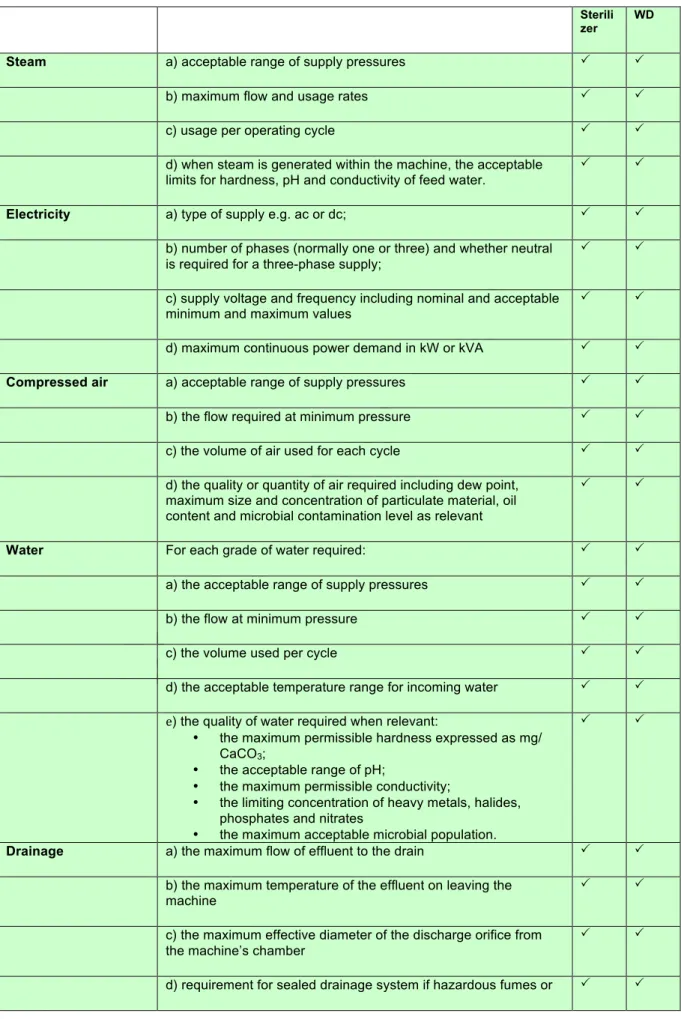
3.67 On or before delivery of the machine, the manufacturer should provide the purchaser with the information specified in Table 3.
3.68 Decontamination equipment for a particular scheme should not be ordered and stored on site for long periods prior to installation and validation. Disregard of this recommendation can invalidate the manufacturer’s warranty and cause deterioration of the machine prior to installation. Where a long delay is unavoidable, conditions for storage should be agreed with the manufacturer.
Siting
3.69 A comprehensive review of the requirements for SSDs is given in Health Building Note 13 and for operating departments in Health Building Note 26 – ‘Facilities for surgical procedures’.
3.70 The area in which decontamination equipment is installed should meet the requirements of the Workplace (Health, Safety and Welfare) Regulations 1992 amended 2002, which have far reaching implications for the design of decontamination equipment accommodation and services to be installed.
3.71 Fire safety precautions should comply with “Approved Document B (2000 with 2002 amendments) and the “Firecode” series [hyperlink to be inserted to FireCode on Space for Health website].
Engineering services
Introduction
3.72 Decontamination equipment installation will require one or more external services including steam, electricity, hot and cold water, compressed air, ballast air, drainage, ventilation and purified water. The manufacturer should make clear at an early stage which services will be needed and the detailed requirements for each, as outlined in Table 3.
Consultation
draft
Table 3 Information on services to be obtained from the manufacturer
Sterili zer
WD
Steam a) acceptable range of supply pressures P P
b) maximum flow and usage rates P P
c) usage per operating cycle P P
d) when steam is generated within the machine, the acceptable limits for hardness, pH and conductivity of feed water.
P P
Electricity a) type of supply e.g. ac or dc; P P
b) number of phases (normally one or three) and whether neutral is required for a three-phase supply;
P P
c) supply voltage and frequency including nominal and acceptable minimum and maximum values
P P
d) maximum continuous power demand in kW or kVA P P
Compressed air a) acceptable range of supply pressures P P
b) the flow required at minimum pressure P P
c) the volume of air used for each cycle P P
d) the quality or quantity of air required including dew point, maximum size and concentration of particulate material, oil content and microbial contamination level as relevant
P P
Water For each grade of water required: P P
a) the acceptable range of supply pressures P P
b) the flow at minimum pressure P P
c) the volume used per cycle P P
d) the acceptable temperature range for incoming water P P
e) the quality of water required when relevant:
• the maximum permissible hardness expressed as mg/
CaCO3;
• the acceptable range of pH;
• the maximum permissible conductivity;
• the limiting concentration of heavy metals, halides, phosphates and nitrates
• the maximum acceptable microbial population.
P P
Drainage a) the maximum flow of effluent to the drain P P
b) the maximum temperature of the effluent on leaving the machine
P P
c) the maximum effective diameter of the discharge orifice from the machine’s chamber
P P
Consultation
draft
gases are produced from chemicals used in the process
Ventilation a) the peak value during a cycle and the average value throughout a cycle of the heat in watts transmitted to the environment when the decontamination equipment is operated in still air at an ambient temperature of 23°C ±2°C
P P
b) the heat in watts transmitted by a full load being unloaded from the machine into still air at an ambient temperature of 23°C ±2°C
P P
c) the maximum flow of air extracted from the environment of the decontamination equipment as exhaust ventilation
P P
d) ventilation requirements for removal of fumes or gases from hazardous chemicals used in the process
P P
e) The impact on ventilation system design due to the air leakage from clean to dirty across built-in machines based on the design pressure differential across these rooms of, e.g., 15 Pa
Process chemicals Details of all process chemicals required (e.g. detergents, rinse aids, sequestering agents, descalers, microbicides, process gases) for the operation of the decontamination equipment, including any requirement for regeneration of integral water treatment system, the quantity required per cycle, the nature and size of containers in which they are supplied, the necessary storage conditions and instructions for safe handling.
P P
3.73 The specification should make it clear where services are to be connected. Care should be taken when contracts are awarded that
precautions regarding termination and availability of all engineering services are taken.
Electricity
3.74 The electrical power requirements will depend on a number of factors, such as the type of machine and the method used to heat water and hot air dryers, and generate steam. Local or integral electrical steam generators will result in a high electrical load. Some machines will require a three-phase supply. The manufacturer should provide details of the type of supply (AC or DC), number of phases, frequency, and voltages with tolerances and loading.
3.75 Each machine should be connected via an isolator. The type of isolator will depend on the nature of the supply:
a. where a three-phase-and-neutral supply is necessary, or where a maximum single-phase current demand is more than 13 A, the machine should be wired directly to the isolator. The switch should isolate all poles simultaneously and each pole should be fused separately. The cable from isolator to decontamination equipment should be fixed and protected from the effects of heat, water and if applicable steam.
3.76 Within the loading area an additional switch should be provided so that the Operator can electrically isolate the machine or group of machines in the
Consultation
draft
event of an emergency. The switch should be placed between the normal operating position and the exit door.
3.77 Sterilizers used to process heat-sensitive loads should be connected to the essential supplies circuit, if available, to avoid heat damage in the event of a power failure. It is not normally necessary for washer-disinfectors to be connected to the essential supplies circuit. Exceptions might include the decision to ensure that one washer-disinfector within the SSD remains on the essential supplies circuit.
3.78 All electrical installations should conform to the IEE Regulations contained in BS 7671. Further guidance is given in Health Technical Memorandum 06-01 – ‘Electrical services supply and distribution’.
Compressed air
3.79 A compressed-air supply may be required in some types of
decontamination equipment. Where the machine does not contain an integral air compressor, the air may be supplied from a piped service (mains supply) or from a local compressor.
Compressed air: mains supply
3.80 If air is supplied by pipeline from a central air-compressor system, a pressure gauge of the Bourdon type complying with BS EN 837 should be fitted inside the plantroom and terminated with an isolation valve.
3.81 A reducing valve or other automatic device should be fitted to reduce the pressure of air delivered to the machine to no more than the maximum supply pressure specified by the manufacturer. A pressure relief valve will normally be required.
Compressed air: local compressors
3.82 Where it is not practicable to obtain compressed air from a mains supply, a dedicated compressed-air facility should be installed to supply machines
3.83 At least two compressors should be provided, with auto-change between the two. The system should be sized to meet all the compressed air
requirements of the unit.
3.84 The compressors are likely to be too noisy to be installed with the machine, and it is better to place them in a dedicated location away from any noise-sensitive areas.
3.85 Components of the compressed air system that require servicing and maintenance, such as dryers and filters, should be located where they are readily accessible for service or exchange.
Consultation
draft
3.86 The quality of air can be critical for some applications and some machines will incorporate appropriate filters. When the purchaser is to be responsible for the provision of filtered air the CP(D) should ensure that the quality of air available meets the manufacturer’s specification or the
requirements given below.
a. air for controls should be free of liquid water, filtered to 25 µm (5 µm for precision controls) and lubricated with micro-fog oil particles of 2 µm or less; b. air that could come into direct contact with the load, such as air for pressure ballasting or drying the load, should be filtered to remove contaminating oil-mist and microorganisms. It should have not more than 0.5 mg of oil per cubic metre of free air (measured at 1013 mbar and 20°C; see ISO 554), be filtered to an efficiency of at least 95% when tested in accordance with BS 3928 and be free of bacteria.
Drainage
3.87 Condensate from the jacket, heat exchangers and steam traps is suitable for recovery and should be returned to the steam generating plant where there are means for recovery.
3.88 All other effluent from decontamination equipment is potentially contaminated and should be disposed of to the main drain. Effluent can originate from one or more of the following sources:
a. air, condensate and steam from the chamber drain, which might contain chemicals and microorganisms, especially those from a make-safe process;
b. discharge from a water-sealed vacuum pump, ejector or chamber vent, which might also contain microorganisms;
c. water from a chamber cooling system;
d. water introduced to cool and dilute the discharge from the chamber; e. effluent discharge to sewer/foul drainage
Ventilation
3.89 Ventilation of the area near the machines should be ensured, to remove excessive heat and odours, and sterilant gases or vapours from disinfectants.
3.90 General room ventilation will be sufficient for most machines; local exhaust ventilation will be required for chemical disinfection systems.
3.91 Electrical systems used in ventilation systems should take account of the high levels of humidity that might be discharged and the potential for this to condense within the ventilation system, as well as the explosion risk
associated with ethylene oxide and comply with the requirements of EN 61010-2-042.
Consultation
draft
3.92 All ventilation systems should meet the ventilation requirements of the Workplace (Health, Safety and Welfare) Regulations 1992.
3.93 Further guidance on ventilation systems can be found inHealth Technical Memorandum 03-01 – ‘Specialised ventilation in healthcare premises’.
Information to be supplied by the
manufacturer
3.94 For each purchase of decontamination equipment, the tenderer is bound to supply detailed information on items including construction, delivery,
service requirements, heat emissions and contract performance (see the ‘Particular specifications’ for sterilizers and washer-disinfectors in the appendices to CFPP 01-01 Parts C and D).
Consultation
draft
4.0 Validation and verification
General
4.1 This section of the guidance covers the validation and periodic testing of the various types of decontamination equipment used in hospitals,
laboratories and other healthcare facilities.
Permit-to-work
4.2 The use of permit-to-work system should be used for all maintenance and testing procedures on decontamination equipment. This should ensure the formal removal of equipment from, and return to, service and will provide certification of acceptance by the User. A suggested permit-to-work form is shown below.
Consultation
draft
Testing of decontamination equipment
Introduction
4.3 Good decontamination practice is based on four key aspects that ensure that the required standards of performance and safety are met and sustained:
a. all decontamination equipment is subjected to a programme of validation;
b. all decontamination equipment is subjected to a planned programme of periodic tests performance
Consultation
draft
c. all decontamination equipment is operated by trained staff in its use in accordance with a written procedure including
manufacturers’ instructions and local procedures. ;
d. all decontamination equipment is subjected to a programme of planned preventative maintenance irrespective of whether a preventative maintenance scheme is operated on the premises.
4.4 Expertise on all aspects of the operation and testing of decontamination equipment is available from several sources including: the AE(D), AP(D) CP(D) and User.
4.5 Schedules of tests for washer-disinfectors and sterilizers are included in CFPP 01-01 Parts C and D. Most tests are defined in the relevant British, European or International Standard. These documents should be used as the prime reference for such testing. Where there is no current Standard then testing protocols are defined within this document. Future publication of new Standards, or revisions of existing Standards, will render some of the content of this document no longer applicable. Advice should be sought from the AE(D) regarding the state of any relevant Standard and the current relevance of testing protocols defined within this CFPP.
4.6 Maintenance of all decontamination equipment is dealt with in CFPP 01-01 Parts C and D.
Responsibilities
4.7 Decontamination equipment should be subjected to a planned programme of testing both before delivery and on-site. The on-site testing should be carried out using the procedures described in this guidance and should include installation qualification, operational qualification and process qualification. The purchaser, manufacturer, contractor AE(D),AP(D) and CP(D) have distinct responsibilities.
Authorising Engineer (Decontamination) (AE(D))
4.8 Role and responsibilities
a. The AE(D) is defined as a person designated by Management to provide independent auditing and advice on washer-disinfectors, sterilizers and sterilization and to review and witness documentation on validation.
b. The AE(D) is required to liaise closely with other professionals in various disciplines and, consequently, the appointment should be made known in writing to all interested parties.
c. Role of the AE(D).This person should be fully independent of the organisation’s structure for maintenance, testing and management of the decontamination equipment.
Consultation
draft
d. The AE(D) should have a reporting route to the Decontamination Lead and should provide professional and technical advice to AP(D)s, CP(D)s, Users and other key personnel involved in the control of decontamination processes. e. The principal responsibilities of the AE(D) are as follows:
(i) To provide to Management and others, general and impartial advice on all matters concerned with decontamination
(ii) To advise Management and others on programmes of validation (iii) To audit reports on validation, revalidation and yearly tests submitted by the AP(D);
(iv) To advise Management and others on programmes of periodic tests and periodic maintenance;
(v) To advise Management and others on operational procedures for routine production;
(vi) To advise Management on the appointment of the AP(D). (vii) Only suitably qualified AE(D)s should be used.
Authorised Person (Decontamination) (AP(D))
4.9 Role and responsibilities
a. The AP(D) will be an individual possessing adequate technical knowledge and having received appropriate training, appointed in writing by the
Designated Person (in conjunction with the advice provided by the AE(D)), who is responsible for the practical implementation and operation of
Management’s safety policy and procedures relating to the engineering
aspects of decontamination equipment including the operation of the permit to work system (see paragraph 4.2)
b. The AP(D) should be able to undertake the safe and effective management aspects of the service
c. The role of AP(D) is intended to provide the organisation with an individual who, as part of the management infrastructure, will provide day-to-day
operational management responsibility for the safety of the system. This should be an internal l appointment from within the organisation. It is, however, recognised that in some organisations there are so few items of decontamination equipment in use that a service provided by a third party may be adequate. In most organisations the role of AP(D) would only be one of a number of areas of similar responsibility for the individual(s) concerned. However, any additional responsibilities should not reduce the importance of the role nor impair the ability of the AP(D) to carry out his/her duties
Consultation
draft
organisations may wish to consider the appointment of more than one AP(D) to ensure that appropriate cover is provided. In these circumstances the organisation should appoint a senior AP(D). In any event, organisations will need to ensure that cover is available during the absence of the AP(D) due to annual leave, sick leave etc. Larger organisations may be able to warrant the appointment of an AP(D) dedicated full-time to the role. Even where estates roles are contracted out, it is recommended that the AP(D) function remains the responsibility of the healthcare organisation. The AP(D) should report to the Designated Person.
d. The AP(D) will also be responsible for:
(i) The engineering management of decontamination equipment; (ii) Line management and/or appointment of the CP(D)
(iii) The safe and effective systems of work for all installed decontamination equipment within his/her area of responsibility; (iv) The acceptance criteria for operational and performance testing of all installed decontamination equipment
(v) Liaison with the AE(D), Decontamination Lead and other interested professionals
(vi) Authorising the use of decontamination equipment after major repair or refurbishment and after quarterly or annual tests
Competent Person (Decontamination) (CP(D))
4.10 The CP(D) is defined as a person designated by Management to carry out maintenance, validation and periodic testing of washer-disinfectors and sterilizers. The CP(D) should report directly to an appropriate member of the estates department (for example AP(D)) or should be subcontracted by them. The principal responsibilities of a CP(D) are:
(i) To carry out Maintenance tasks (ii) To carry out repair work
(iii) To conduct validation tests as given in CFPP 01-01 Parts B, C and D.
(iv) To conduct periodic tests as given in CFPP 01-01 Parts B, C and D.
Consultation
draft
4.11 Management should nominate an AE(D) to provide advice on validation, and an AP(D) and a CP(D) to carry out the checks and tests required.
4.12 The AE(D) should review the results of pre-delivery works tests carried out by the manufacturer, and review the test instruments provided by the contractor and/or the CP(D) to ensure that their accuracy, calibration and condition meet the standards for test instruments described in Chapter 4 of this document. The AE(D) should witness such Installation, Operational and Performance Qualification testing as appropriate to verify the requirements of the specification are met and that the equipment is fit for purpose. New equipment should only be bought into use after written Confirmation from the AE(D)
4.13 The CP(D) should witness the installation checks and tests carried out by the contractor, including ensuring that the calibration of each test instrument provided by the contractor has been checked on site and is satisfactory and arrange for test loads to be supplied as required. The CP(D) should carry out the Installation qualification tests, operational qualification and PQ
qualification.
Manufacturer
4.14 The manufacturer should ensure that the decontamination equipment is designed, manufactured and tested within a quality system. The manufacturer should also carry out pre-delivery works testing. The extent of testing will depend on whether the product is in serial production or a one-off and, for machines in serial production, whether the manufacturer has obtained a certificate of compliance with the relevant British or European Standard by means of a type test for the particular type and size of decontamination equipment. (Refer to BS EN 15883 Parts 1 and 2 for type-test details for washer-disinfectors and BS EN 285 for type-test details for sterilizers.)
Contractor
4.15 The contractor, who might also be the manufacturer, should complete the installation checks and tests specified in CFPP 01-01 Parts C and D to the satisfaction of the CP(D) before the decontamination equipment can undergo full validation to allow acceptance.
4.16 The contractor should provide the test instruments and equipment (but, unless otherwise specified in the contract, should not be expected to provide the test loads). The test instruments provided should meet the standards for test instruments described inChapter 4 of this document.
Works tests
4.17 Works tests before delivery of the decontamination equipment are intended to verify that the equipment performs in conformity with the results obtained from type testing in respect of various critical attributes. (Refer to BS
Consultation
draft
EN 15883 Parts 1 and 2 for works test details for washer-disinfectors and BS EN 285 for works test details for sterilizers.)
4.18 For one-off designs a more extensive programme of works tests, similar to the programme of type tests for machines in serial production, is required and the purchaser might wish to arrange for their representative (either the AE(D) or CP(D)) to attend the factory to witness these tests before accepting delivery of the decontamination equipment.
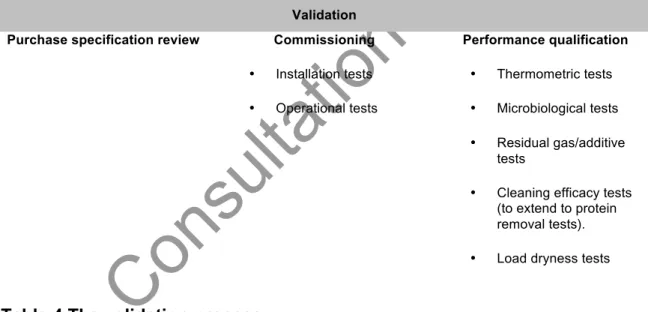
Validation
4.19 Validation is the documented procedure required for obtaining, recording and interpreting the results needed to show that a process will consistently yield a product complying with a pre-determined specification. Validation is a total process beginning with a review of the specification against which the equipment is purchased. This is to ensure that it will meet the User’s specified production needs including installation qualifica