Working Paper Series Congressional Budget Office
Washington, DC
IMPLICATIONS OF PAST CURRENCY CRISES FOR THE U.S. CURRENT ACCOUNT ADJUSTMENT
Juann H. Hung
Macroeconomic Analysis Division Congressional Budget Office
Young Jin Kim* Department of Economics Pennsylvania State University
June 2006 2006-07
Working papers in this series are preliminary and are circulated to stimulate discussion and critical comment. These papers are not subject to CBO’s formal review and editing processes. The analysis and conclusions expressed in them are those of the authors and should not be interpreted as those of the Congressional Budget Office. References in publications should be cleared with the authors. Papers in this series can be obtained at www.cbo.gov (select Publications and then Working Papers). * Young Jim Kim was a summer associate at the Congressional Budget Office in 2005. We thank Menzie Chinn of University of Wisconsin, and colleagues at the Congressional Budget Office, especially Bruce Arnold, Thomas DeLeire, Bob Dennis, Naomi Griffin, Doug Hamilton, Kim Kowalewski, and John Peterson for valuable input. Adam Weber’s valuable research assistance is much appreciated.
Abstract
This paper examines past currency crises to shed light on the likelihood that the adjustment of the U.S. current account deficit will involve a dollar crisis. A currency crisis is narrowly defined to be a depreciation that exceeds a critical threshold, regardless of whether it has an adverse effect on the real economy. The literature suggests that one should not infer from the experience of emerging economies what will happen to the dollar. This paper’s empirical findings lend support to that view. Everything else being equal, currencies are more likely to collapse in emerging economies than in industrial countries. The collapse of a currency in industrial countries actually helped to revive economic growth in some instances, even though it tended to cause severe output loss in emerging economies with a pegged currency.
The estimated probability of a dollar crisis, which contains a significant upward bias, has risen significantly from 2003 (about five percent) to 2006 (about 10 percent), a period during which both the current account deficit and the oil price rose substantially. That rise in the estimated probability, though in part due to the oil price hike, signals that the probability would keep increasing if the U.S. current account deficit continues to grow faster than GDP. Nevertheless, a more thorough analysis taking into account of many factors beyond the regressions suggests that the adjustment of the U.S. current account deficit is likely to be gradual rather than involving a dollar crisis; and, in the unlikely event of a dollar crisis, the U.S. economy should be able to withstand it without suffering a severe recession.
1. Introduction
Currency upheavals have been a recurring phenomenon since the end of the classical gold standard in 1914. The inter-war period witnessed numerous currency crises. Hopes for an international monetary system free of currency crises were raised by the creation of the Bretton Woods system in 1945, only to be dashed by that system’s demise in early 1973. Currency crashes have occurred frequently since then, sometimes with devastating real consequences. In the 10-year period between 1992 and 2002, the world again witnessed several currency collapses in quick succession: the crisis of the European Exchange Rate Mechanism (ERM) in 1992-93; the Mexican crisis in 1994-95; the Asian crisis in 1997-98; the Russian crisis of 1998; the Brazilian peso crisis of 1999; and Argentina’s crisis of 2002. Those developments have rekindled research interest in improving the understanding and management of currency crises and have spawned a large literature.
Against this backdrop, the large and growing global trade imbalances of recent years have raised the possibility of another sharp and sudden realignment of exchange rates. What insight can we draw from past currency crises to help assess the risk of a dollar crisis posed by the large U.S. current account deficit (6.5 percent of GDP in 2005)? Whether that large deficit may result in a hard-landing for the dollar has been a subject of much debate. Some analysts worry that if policies are not adopted to bring down the U.S. current account deficit, there is a high risk that a dollar crisis will ensue.1 At some point, investors may not want to continue holding dollar assets. If that scenario were to occur
1
For example, see Bergsten (2004), Martin Wolf (2004), Roubini and Setser (2004, 2005) and Obstfeld and Rogoff (2005).
suddenly, according to those analysts, the dollar could crash and cause serious consequences for the U.S. and the global economy.
Some analysts, however, argue that the risk of a hard landing for the dollar is small. They point out that precedents of high current account deficits leading to currency crises are mostly those of developing countries with inflexible exchange rate systems, hardly applicable to the United States, which is an advanced country with a freely floating exchange rate. Some argue that the large U.S. current account deficit is an endogenous result of some emerging economies’ attempt to avoid future currency crises in an international monetary system in which the dollar is the major reserve currency, not an imbalance that threatens an impending dollar crisis.2 Still others believe that the United States, in fact, does not have a problem of large external imbalances, once the value of “dark matter” is included in the measurement of U.S.-owned assets abroad.3
This paper looks to the experience of past crises in both emerging and industrial economies to shed light on these issues. We begin by identifying crisis events from a sample of 51 countries over the years from 1970 through 2004, pointing out stylized patterns displayed by those crisis events. Next, we briefly summarize prominent theories advanced in the literature to explain why and how currency crises occur and what factors make some crises more severe (in output loss) than others. We then conduct empirical
2
See Dooley, Folkerts-Landau, and Garber (2003, 2004, and 2005) for the so-called Bretton Woods II theory.
3Inferring from the fact that the United States has been earning more income from its assets abroad than paying foreign investors for assets they own in this country, Hausmann and Stuzenegger (2005) argue that the United States owns valuable “dark matter”—assets that must exist because they generate revenue but cannot be seen or measured, such as U.S. firms’ superior know-how, the liquidity service provided the U.S. dollar, and the lower risk of U.S. assets than emerging-country assets—that are not included in the official measurement of U.S. international assets. Counting their rough measure of “dark matter” as a part of U.S.-owned assets, the authors estimated the U.S. net international investment position to be about $600 billion, not -$2.5 trillion, at the end of 2004.
analyses to estimate the influence of economic fundamentals on the probability and the severity of a currency crisis, drawing explanatory variables from those theories.
Thus, rather than attempting to test some individual theories, we aim to bring the leading theories together to sort out the common fundamental factors that trigger a currency crisis as well as pre-crisis conditions that tend to deepen the severity a currency crisis. This approach is grounded in our view that, even though each crisis episode is unique in some way and may be better explained by one theory than by others, the factors focused on by each theory are not necessarily mutually exclusive. We also hope to find out whether some fundamental economic factors, if any, deserve particular attention because of their dominant role in causing the most severe crises.
Following Frankel and Rose (1996), we define a currency crisis as a currency’s depreciation that exceeds a critical threshold, regardless of whether there is a collapse of the currency regime, a large drop in foreign exchange reserves, or an adverse effect on economic activity. This approach allows us to investigate the influence of exchange-rate regimes and the development status of an economy, among other factors, on the
probability and economic effect of a currency crisis. With this definition, we identify 133 episodes of currency crisis in our sample. We then conduct probit regressions to estimate the effect of some commonly-cited fundamental variables on the probability of a currency crisis. Separately, we also conduct OLS and tobit regressions to estimate the effect of fundamental variables on the severity (in terms of output loss) of a currency crisis. The list of those fundamental variables includes the exchange rate regime, the current account balance, the budget balance, the origin of legal rules, inflation, trade openness, whether a country is industrialized, among others.
Our findings include the following. First, a rise in the current account deficit/GDP ratio indeed increases the probability of a crisis, as well as the severity of output losses resulting from a crisis. An increase in some other indicators of economic imbalances, such as fiscal deficit or inflation, also leads to a higher probability of a crisis. Second,
exchange-rate regimes have a significant effect, statistically and quantitatively, on both the probability and severity of a currency crisis. Countries with a currency-peg regime are less prone to a currency crisis than those with an intermediate regime (such as a crawling-peg or target-zone regime); however, once those countries are hit by a crisis they tend to suffer a larger output loss than those adopting either an intermediate regime or a free-floating regime. Third, countries with a higher degree of openness to international trade and capital flows are less prone to currency crises. Finally, industrial countries are less likely to experience currency crises and, in the event of a currency crisis, the impact of that crisis on the real economy tends to be less severe or even positive.
Our empirical results and overall analyses thus give rise to three broad-stroke implications. First, the large U.S. current account deficit cannot keep rising relative to GDP without triggering some kind of adjustment process some time down the road. Second, in the absence of policy blunders or other shocks, the U.S. current account adjustment is likely to evolve gradually rather than to entail a dollar crisis.4 Third, in the unlikely event of a dollar crisis, the U.S. economy should be able to withstand the crisis without suffering a severe recession in the absence of policy errors.
The remainder of this paper consists of six sections. Section 2 describes how we identify a crisis and measure the severity of its impact on output, and observes the
4
stylized patterns of the frequency and severity of currency crises since 1970. Section 3 synthesizes the most prominent theories in the literature regarding the causes and effects of currency crises. Section 4 reports the methods and results of our quantitative analyses. Section 5 discusses the implications of what we have learned from past currency crises for the U.S. current account adjustment. Section 6 concludes.
2. Measuring a Crisis: Definition, Frequency, and Severity
We follow Frankel and Rose (1996) and define a currency crisis as a nominal depreciation of a currency that meets two criteria: (1) it is at least a 25 percent
depreciation from a year ago, and (2) it represents an increase in the rate of depreciation from the previous year by a margin of at least 10 percentage points.5 This definition differs from those which regard a currency crisis as a balance-of-payments crisis, either successfully or unsuccessfully defended.6 By this definition, a sufficiently large
depreciation of a currency in a flexible exchange rate regime is counted as a crisis, allowing us to estimate the influence of exchange rate regimes on the probability and consequence of a currency crisis. By not including a successfully defended
balance-of-5
The requirement of a margin of 10 percentage points is to ensure that a 25 percent or more nominal currency depreciation in a country with high inflation rates (and correspondingly high rates of depreciation) is not automatically considered as an independent currency crisis; it is only counted as one if it also represents a sufficiently large increase in the rate of depreciation.
6
Generally, other methods in the literature identify a currency crisis when an index of exchange market pressure exceeds a critical threshold. The index is typically calculated as a weighted average of the exchange rate change, short-term interest rate change, and reserve change relative to the center country, usually the United States. For example, this type of method was used in Eichengreen et al. (1996a, 1996b), in Kaminsky, Lizondo, and Reinhart (1998), in Kaminsky and Reinhart (1999). In Bordo et al. (2001), the definition of a currency crisis is even broader, including a forced change in exchange rate parity, an abandonment of a pegged exchange rate, an international rescue, or when their index of exchange market pressure exceeds a critical threshold.
payments crisis in our sample, this definition also enables us to gauge the economic effects of allowing a currency to succumb to market forces.
We apply our definition of a currency crisis to 51 industrial and emerging economies over the period of 1970-2004. (See Appendix 1 for a list of those countries.) As in Frankel and Rose (1996), we use a three-year exclusion “window” to avoid counting the same crisis more than once. Any event occurring within three years of the first crisis is defined to be an extension of that crisis. Crises are counted by country and by period: if there are n currencies whose depreciation exceeds the threshold in period t, there would be n crises identified for period t. With this method, we identify a total of 133 crisis episodes in 48 countries over the entire sample period. Three countries---Canada, Singapore, and the United States---never experienced a currency crisis within the sample period. (See Appendix 1 for details of these crises and their pre-conditions.)
The economic effect of a crisis can be measured in several different ways, including the changes in jobs, output, or consumption. Because of data limitations, we choose to measure severity by output changes. We use two alternative measures:
(1) One-sided measure. This measure follows that used in Bordo et al. (2001), defining severity as the cumulative sum of the differences between the actual and trend growth rates of real GDP over the duration of the crisis. The trend rate is calculated as the average growth rate over the five years preceding the crisis event. Thus, one flaw of this measure is that it overstates (understates) severity if the average pre-crisis growth rate is higher (lower) than the true trend rate. The duration of a crisis is defined as the number of years from the onset of the crisis until the actual growth rate returns to the trend rate. When the growth rate in a crisis year is above the trend rate, output loss is
defined to be zero. Thus, by construction, this severity measure is censored to be less than or equal to zero, and the minimum duration is one year.
(2) Two-sided measure. In this measure, severity is defined as the cumulative sum of the difference between the actual rate of growth in each year during the (3-year) crisis period and the average growth rate in the (3-year) pre-crisis period. (To be
consistent with our using a three-year exclusion “window” to avoid multiple-counting the same crisis, each period is defined to be three years.) This measure of severity is not bounded below zero as in the one-sided measure. Instead, it can be positive (indicating an increase in the growth rate following the crisis event) or negative (indicating a
reduction in the growth rate). When there was not enough data to calculate the three-year averages, we exclude the observation. As in the one-sided measure, this measure
overstates (understates) severity if the average pre-crisis growth rate is higher (lower) than the true trend rate.
Several other notable observations regarding the frequency and severity of currency crisis emerge from an overview of the 133 currency crises that we have identified over the 1970-2004 period:
• Crises occurred with high frequency throughout the post-1973 period (Figure 1).
• Crises were more concentrated in the 1980s than in the 1990s. There were 60 crises in the 1980s, compared to 25 in the 1970s and 39 in the 1990s (Figure 1 and Table 1).
• The number of crises that were followed by growth recoveries has been rising. (During 1990-2004, the number of crises resulting in economic revivals has risen to rival those resulting in contraction. See Figures 2 and 3.)
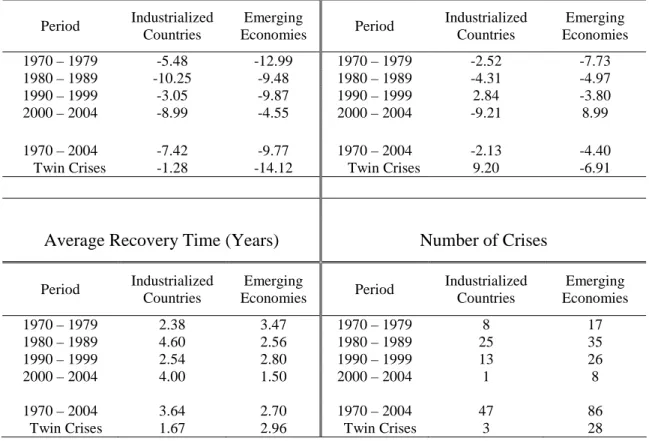
• The number of crises in emerging economies during the 1970-2004 period was almost double that in industrial economies. There were 86 crises in emerging economies, as compared to 47 crises in industrial countries (Table 3).
• Crises in emerging economies were considerably more severe than those in industrial countries.
•
More crises occurred, over the sample period, in an intermediate currency regime than in either a pure-peg or a free-floating regime. This pattern fits into the bi-polar view, which argues that either a hard peg (such as a currency board system) or a free-floating exchange rate regime is more sustainable than an intermediate regime, which is more prone to speculative attacks, for countries open to private capital flows.7o
By the de jure classification of regimes, which is based on the regimes declared by countries, the number of crises in an intermediate regime totaled 58 during 1970-1999, compared to 36 in a pegged regime and 27 in a floating regime (Table 1).o
By the de facto classification, which is based on the Natural Classification proposed in Rogoff et al. (2003), 89 crises occurred in an intermediate regime (either limited flexibility or managed float), compared to 16 in a pegged regime and 17 in a free-float regime (Table 2).8• Crises in a pegged regime were more severe and lasted longer than those in an intermediate regime, and even more so when compared to those in a floating regime (Tables 1 and 2).
• Twin (banking plus currency) crises were more severe than single (currency) crises in emerging economies, but this was not the case in industrial countries (Table 3).
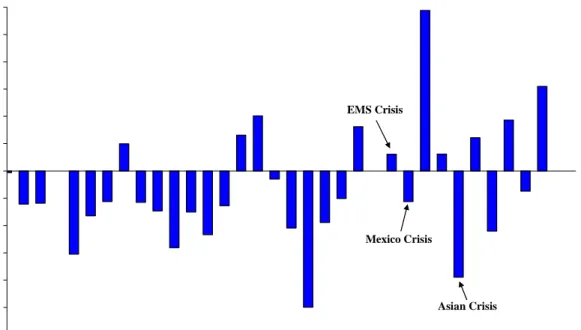
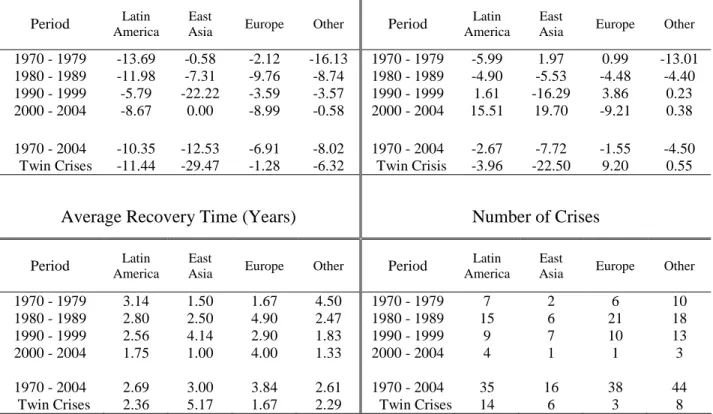
• Crises in Asia were fewer in number, but had more severe aftereffects on the economies, than those in Latin America and Europe (Table 4).
7The bipolar view gained much currency following the quick succession of currency crisis in the 1990s. See Summers (2000) and Fischer (2001).
8The IMF classifies de jure exchange rate regimes based on the regimes declared by countries. However, it has been noted that many countries actually do not follow their declared exchange rate arrangement. Many countries that say they float actually do not and many intermediate regimes, in fact, have de facto pegs. Thus, Reinhart and Rogoff (2004) classify countries’ de facto regimes based on the Natural Classification proposed in Rogoff et al. (2003). See Appendix 1 for detail.
3. Causes and Effects of Currency Crises: A Synthesis of Theories
Why have crises occurred so frequently in the post-1973 period?9 Why are some countries hit by crises more frequently than others? Why did some crises have more severe effects on the real economy than others? Many hypotheses have been proposed in the literature. While the factors stressed by each theory differ, they tend to complement rather than compete with each other. Some factors may explain some crises better than others; however, in many cases those factors actually reinforce each other in triggering, spreading and/or deepening a crisis. In this section, we synthesize the most prominent theories in the literature, grouping them into six categories.
Fundamental Imbalances. The first-generation models of speculative attacks,
pioneered by Krugman (1979) and developed by Flood and Garber (1984), stress the role of fundamental imbalances in causing a balance-of-payments crisis. These models typically attribute those imbalances to overly expansionary macroeconomic policies---most notably those manifested in large fiscal deficits or high inflation rates---that are incompatible with a country’s commitment to a currency peg. In a currency-peg regime, the government needs to hold a comfortable level of foreign exchange (FX) reserves in order to have the ability to prevent its currency from depreciating. If that country runs a large budget deficit and finances it by borrowing from abroad or by monetization, its currency will be under increasing pressure to depreciate. As long as the country continues to maintain its currency at the pegged value by selling its foreign exchange reserves, those reserves will continue to dwindle. Eventually, the country will run out of
9Bordo et al. (2001), which defined a crisis differently from this paper and analyzed a database spanning 120 years, also noted that crises have become more frequent since 1973 (doubling the number of the Bretton Woods and classical gold standard periods and rivaling those of the crisis-ridden 1920s and
foreign exchange reserves and be forced to devalue its currency. As soon as speculators are confident that a devaluation of its currency is inevitable, they would begin to shift money out of the country before those reserves run out. The government’s initial attempt to defend its currency will only deplete its FX reserves even more quickly, moving the time of the crisis forward.
Overall, such models have captured the basic elements of what typically triggers a balance-of-payments crisis. The Latin-American debt crisis of the 1980s is an important example of crises caused by large budget deficits, currency overvaluations and external debt accumulation. However, these models have fallen short of explaining why crises with similar degrees of fundamental imbalances can have vastly different degrees of severity.
Herding Behavior and Self-Fulfilling Expectations. Second-generation models,
first advanced by Obstfeld (1986, 1994), emphasize the effect of self-fulfilling expectations of a currency crisis. These effects arise from herding behavior, namely cases where investors act in response to what other investors do, not on the basis of fundamental analysis. For whatever reason, if the devaluation of a country’s currency is expected to be inevitable at some future date, then speculators would surely try to get out of the currency ahead of time. In so doing, they would lead to an earlier devaluation of that currency. When everyone tries to unload the currency before others do, the currency will plunge. Such herding behavior means a currency crisis can occur so long as a critical mass of investors has decided to sell a country’s currency, even if that country’s economic fundamentals are basically sound.
Many recent studies have lent support to this theory, even though they disagree on whether self-fulfilling behavior plays a dominant or supplemental role in triggering and
spreading currency crises.10 A prime example of crises better explained by the second-generation model than the first-second-generation model is the 1992-93 ERM crisis (see Appendix 2).
Herding behavior also helps to explain the so-called “contagion effect”: a domino effect among those countries that have anything less than immaculate fundamentals. Calvo and Reinhart (1996) present evidence of contagion in capital flows to Latin
American countries, while Eichengreen et al. (1996a) find evidence that knowing there is a crisis elsewhere increases the probability of a domestic currency crisis.
Radelet and Sachs (1998) argue that international financial markets are even more prone to self-fulfilling crises than domestic markets because there is no international lender of last resort. They argue that the lender of last resort helps prevent crises in two ways. First, it prevents outright default by providing liquidity on an elastic basis.11 Second, and perhaps more important, it can eliminate a self-fulfilling panic if investors believe that the lender of last resort will provide the credit needed to forestall the collapse of a solvent debtor. When the loans are denominated in a foreign currency, a country’s central bank is unable to fulfill its role as lender of last resort because it cannot create foreign money. The lack of an international lender of last resort means that, even though individual creditors may act rationally, market forces can produce capital-flow reversals that are sharper and
10For example, see Calvo and Mendoza (1996); Eichengreen, Rose, and Wyplosz (1996b); and Kaminsky and Reinhart (1999).
11
In an illiquidity-insolvency model, a liquidity crisis occurs if a solvent but illiquid borrower is unable to borrow fresh funds from capital markets to remain current on debt-servicing obligations. Asymmetric information among creditors is a main cause of market instability: each individual creditor may rationally respond more to the action of other creditors---now taken as signals---than to private information. See Banerjee (1992); Mishkin (1991); Stiglitz and Weiss (1981).
more costly than necessary to restore equilibrium.12 This theory helps to explain why the frequency of currency crises nearly doubled after the demise of the Bretton Woods system, which provided a semblance of an international lender of last resort.
Extra Vulnerability of Poor Countries. A currency crash tends to cause
economic hardship in an emerging economy, even though it has often helped to revive growth in an advanced country.13 Everything else being equal, an emerging economy is more prone to costly currency crises than an advanced economy because of two “curses.” The first is the original sin problem, namely a country’s inability to borrow abroad in its own currency.14 An emerging country’s external debt is typically denominated in foreign currency to avoid paying the exorbitant premium demanded by international investors to compensate for its currency risk. This situation means it is much harder for that country to pay off or service that debt through a real depreciation of its currency: even though a real depreciation will help improve its trade balance, it will also raise the domestic-currency values of that debt and interest payments on that debt. Recognizing that reality, foreigners are even less willing to roll over the existing debt or to provide new loans to that country than otherwise.
12
To support their view, the authors presented evidence that each of the three major currency crises in the 1990s---Mexico in 1994-95, Argentina in 1995, and East Asia in 1997---displays elements of a self-fulfilling crisis, in which capital withdrawals by creditors cascade into a financial panic and result in an unnecessarily deep contraction.
13Some currency crises are followed by a severe recession, but they need not be: a currency’s depreciation by itself is expansionary because it stimulates net exports. Take some crises in the 1990s as examples. Both the Mexican peso crisis of 1994-95 and the Asian currency crisis of 1997-1998 led to severe contractions of real GDP in the crisis countries. But the ERM crisis of 1992, which resulted in the withdrawal of the United Kingdom and Italy from the exchange rate mechanism, actually helped boost output growth for those two countries. Indeed, of all 47 crisis events that occurred in industrial countries over the sample period, 19 were followed by economic expansion, while 28 were followed by contraction. See Table A1.a of Appendix 1.
14
The second curse is the debt intolerance problem--- the inability of emerging countries to manage levels of external debt that are manageable for advanced countries.15 A level of debt that would not necessarily seem high by the standards of rich countries can get some “debt-intolerant” developing countries into repeated troubles. When an emerging country runs into difficulty, international institutions/investors tend to make demands that actually make the problem worse. For example, when crisis countries’ budgets turned into deficit (from roughly in balance) in response to economic contraction induced by the 1997-98 Asian crisis, the initial response of international community was to ask those governments to cut their budget deficits, making economic recession even more severe in the those countries. In contrast, investors tend to be more tolerant when advanced countries need to run larger deficits to combat recession.
These two “curses” also feed on each other. Emerging economies are more prone to the original sin problem because foreign investors tend to be reluctant to lend to a country in its own currency if that country has underdeveloped institutions and/or its government has low credibility. Moreover, Reinhart et al. (2003) find that a country’s credit ratings fall more rapidly when an emerging-market economy increases its debt than in the case of an advanced country, as though the former have less debt-management capacity. They attributed this “debt intolerance” to original sin, among several other factors.16
Premature Capital-Account Liberalization Amidst Domestic Financial
Fragility. Third-generation theories emphasize the central role of premature
capital-15
The term“ debt intolerance” was coined by Reinhart, Rogoff and Savastano (2003)
16The authors also show that countries that defaulted in the past and have histories of high inflation have lower credit ratings in the present. They conjecture that default on external debt may weaken a country’s financial system and that a weaker financial system increases the likelihood of subsequent default because countries with weaker financial systems suffer larger output losses when access to external finance is interrupted. Default on external debt may also weaken a country’s tax system by encouraging capital flight
account liberalization and domestic financial fragility in the deepening of a currency crisis. Even though those factors were common to a substantial number of crises before the Asian crisis, those third-generation theories mainly arose to help make sense of the Asian crises of 1997-98, an episode characterized by the severity of twin crises in many Asian economies that did not appear to have large fundamental imbalances.17 The interaction of capital-account liberalization, a fixed-exchange rate system, and an underdeveloped financial structure (including the prevalence of crony capitalism)
allowed hot money to first inundate and overheat many Asian economies, and then to flee and collapse those economies. (See Appendix 2 for a detailed discussion.) Authors subscribing to this view include Radelet and Sachs (1998), Kaminsky and Reinhart (1999), and Stiglitz (2000).
Nevertheless, empirical evidence appears mixed on whether capital controls protect governments and investors against currency crises. This conflict may be because
governments in countries with capital controls tend to run riskier policies and markets view their presence as unfavorable signals of official resolves, while a country more open to capital mobility sends a positive signal that its government is confident of its ability to withstand potential financial disciplines that are part and parcel of being open to foreign investment. Moreover, countries with weaker financial indicators, such as a low external debt/exports ratio, a low foreign exchange reserves/GDP ratio, and/or a high short-term debt/foreign reserves ratio, are more likely to suffer rather than benefit from capital mobility
17
For example, Kaminsky and Reinhart (1999) write: “Consider an economy that had
successfully stabilized inflation, enjoyed an economic boom, and was running fiscal surpluses. However, this economy had liberalized its capital account and its domestic financial sector amidst an environment of weak regulation and poor banking supervision. Banking-sector problems emerged and intensified, eventually undermining the ability of the central bank to maintain its exchange-rate commitment. While this profile fits Asia rather well, this was Diaz-Alejandro’s description of the antecedents to the fierce Chilean crisis of 1982. At the roots of the meltdown of the Thai baht, Korean Won, and Indonesian rupiah lay systemic banking problems.”
because they are more exposed to the risk of sudden changes in investors sentiment. In contrast, those with stronger financial indictors are more likely reap net benefits from capital mobility by lowering the risk of speculative attacks or herding behavior.
Abrupt and Large Changes in External Conditions. Adverse and large changes
in external conditions can hurt emerging economies that are linked with the world
economy through international trade and capital movements. For example, a sharp rise in oil prices could push the budget deficit and/or the current account deficit of many oil-importing countries beyond a level tolerated by international investors. Conversely, an abrupt fall in oil (or other commodity) prices could enlarge those deficits of countries heavily dependent on revenues from oil (or commodity) exports to levels that spook investors. Moreover, to the extent that some emerging countries export similar products, a currency crisis in one emerging country could spread to others because that first crisis constitutes an abrupt shift in external conditions to those other countries.
A sharp rise in U.S. interest rates could undermine the ability of countries with large external debts to service and/or repay outstanding loans. Financial crises were heavily bunched in the early 1980s, when real interest rates in the United States were at their highest level since the 1930s. This situation suggests that external factors (such as U.S. interest rates) matter a great deal, as argued in Calvo et al. (1993). Jeffrey Frankel and Rose (1996) also find that foreign interest rates play a significant role in predicting currency crashes.
Generally speaking, a country that is more open to international trade would be more vulnerable to external shocks such as a large shift in commodity prices or a crisis in another country, while a country more open to capital mobility would be more vulnerable
to a large increase in the U.S. interest rate or other changes in world financial conditions, as well herding behavior of international investors. However, an increase in trade
openness may also enhance creditors’ confidence in receiving real transfers for their financial claims on the debtor country, thereby reducing the probability of sudden reversals in capital flows and currency crashes in the debtor country.
Problems with a Currency-Peg Regime. Emerging economies tend to adopt a
currency-peg regime for several reasons, such as providing a stable exchange rate to facilitate international trade and investment or using it as a guarantor of credibility on controlling inflation.18 However, a currency-peg regime also breeds its own problems. First and foremost, the inability of the country’s exchange rate to adjust in response to external shocks may be very costly, especially for those that depend on export revenues or capital inflows heavily. For example, when an adverse shock---such as a plunge in the prices of commodities it exports, or an increase in U.S. interest rates---hits a country with a pegged currency, that country’s foreign exchange reserves are likely to keep falling until they dwindle to a level that is insufficient to fend off speculators. By not allowing the currency to depreciate in response to negative shocks, the eventual devaluation tends to occur in a more devastating fashion: a plunge of the currency that is much steeper than needed to restore equilibrium after the initial shock.
Second, a currency-peg regime constrains the array of policy tools at a
government’s disposal; consequently, fundamental imbalances tend to grow until they make it impossible for the country to keep that peg. Take Thailand and Argentina as examples. Large capital inflows kept pouring into Thailand for years prior to the 1997-98
18
See Hausmann, et al. (1999) for a comprehensive discussion of the potential benefits that fixed exchange rates could offer to developing economies.
crisis, resulted in rising inflation and current-account deficit; but that country’s currency-peg system constrained its central bank’s ability to put a lid on its economy’s unsustainable growth. Argentina’s currency-board system also rendered its monetary authority powerless in combating that country’s deep recession that began in 1999, a recession that did not end until 2003, a year after Argentina abandoned the currency-board regime and allowed its currency to float.19 Unless the government is able to successfully impose capital controls, its commitment to a currency peg would deprive it of the option of conducting monetary policy to fight inflation or combat recession. Moreover, crises also could be more costly in a currency-peg regime because that regime encourages the accumulation of unhedged exposures to currency risk (that was falsely assumed to be nonexistent) while frustrating the (domestic) lender of last resort function of its central bank by assigning monetary policy to goals other than the provision of liquidity.20
For the above reasons, the commitment to a currency peg appears to lower the frequency of currency crises in a country, but increase the severity of a crisis once it occurs. This result indeed is the broad-stroke picture we observed in the previous
section: the number of crises is higher in the intermediate regimes, as predicted by the bi-polar view, but crises occurring in pegged regimes are the most severe and have the longest duration. Both the severity and the duration of crises decrease as crisis countries
19Argentina entered a deep recession in 1999 in large part because the Asian crisis and (especially) the collapse of the Brazilian real adversely affected capital inflows to Argentina, while rendering its exports less price-competitive internationally.
20
Friedman and Schwartz (1963) and Wigmore (1987) argue convincingly that during the Great Depression, the Federal Reserve System refused its role as lender of last resort in part for fear of pushing the United States off the Gold Standard. More recently, a consensus view is that Argentina’s vulnerability to financial panic in 1995 in part came from its government’s limited capacity to act as a lender of last resort because of the currency board arrangement, which fixed the Argentine peso at one-to-one with the US dollar, and limited the government’s ability to issue credits that are not backed by dollar reserves.
move to a more flexible exchange rate regime; those results stay unchanged when data are sorted by de facto exchange rate regime.
4. Quantitative Analysis
The preceding synthesis suggests that a currency crisis is more likely to occur in an emerging economy with an intermediate exchange rate system that has weak economic fundamentals (such as a high current account deficit, high budget deficit, high inflation, etc.), and less likely to occur in an advanced economy with a flexible exchange rate that has strong economic fundamentals. Moreover, it suggests that the impact of a currency crisis is much more devastating for an emerging economy with a fixed exchange rate system and weak economic institutions than for an advanced economy with a more flexible exchange rate and stronger economic institutions; if anything, the crisis may even revive GDP growth in an advanced economy rather than cause a recession.
This section conducts an empirical analysis to see whether the above view receives discernable support from data. Our analysis consists of two parts. Part one uses probit regressions to estimates the impact of a country’s economic fundamentals---including its exchange rate system and whether it is an advanced economy---on the probability of a currency crisis. Part two uses OLS and tobit regressions to estimate the impact of an economy’s fundamentals on the severity of output loss following a crisis.
4a. The Probit Regression
We use a panel data of 49 countries over the period of 1970-2004 to estimate the impact of fundamental economic variables on the probability of a currency crisis. We do
so by estimating a probit regression equation that postulates the probability of a crisis (P) is a function of the variables listed in Box 1.
The dependent variable is the crisis indicator (P), which is a dummy variable. For each country i, Pit= 0 if no crisis occurred in period t, and Pit=1 if a crisis occurred. We
also construct dummy variables for each different exchange rate system. For example, the dummy variable representing the floating exchange rate system takes the value of 1 when a country is, and 0 when a country is not, under that system. The industrial country indicator is also a dummy variable which takes the value of 1 for industrial countries, and 0 for emerging countries.
We estimate the probit regression equation using three alternative samples: (1) the full sample (including both advanced and emerging economies); (2) the
advanced-economy sample; and (3) the emerging-advanced-economy sample. For each sample, we conduct two sets of regressions. In the first set, the exchange-rate regime dummy is set to equal 1 when the de jure regime is not a currency-peg regime. The results of this set of
regressions are reported in Table 5a.
In the second set of regressions, the exchange-rate regime dummy is set to equal 1 when the de facto regime is not a currency peg; the results are reported in Table 5b. In both Tables 5a and 5b, the coefficient estimate on variable X is its probit slope
derivatives (at the mean of X) in percent terms, or (100)*dF(x)/dx, which can be interpreted as the change in probability of a crisis caused by a one unit change in X around the mid-point of X.
The main results reported in Table 5a and Table 5b do not differ significantly, and most variables are estimated to have the expected effect on the probability of a crisis. An
increase in the current account balance/GDP is estimated to have a negative and significant effect on the probability of a currency crisis in the full-sample regression as well as in both sub-sample regressions.21 In Table 5a (Table 5b), a one percentage-point increase in the current account /GDP ratio is estimated to reduce the probability of a currency crisis by about 0.85 (0.75) percentage points in the full-sample regression, and by 0.87 (0.85) percentage points in the industrial-country regression. In the emerging-economy sample, a one percentage-point increase in the current account/GDP ratio is estimated to reduce the probability of a crisis by about 0.6 percentage points in both Tables 5a and 5b. (The difference between the coefficients in the two sub-sample regressions may in part arise from the fact that a one percentage-point increase in the ratio represents a larger percent increase in industrial countries than in emerging countries.) Clearly, the current account matters.
21We also tested whether the effect of a current account deficit on the probability of a crisis jumps up when it exceeds a threshold. We did so by including a constant dummy for episodes in which the current account deficit was greater than 4, 5, or 6 percent of GDP. But we found no threshold effects.
Box 1. Explanatory Variables in Probit Regressions
Variable Expected Effect
Exchange Rate Regime According to the bi-polar view, an intermediate regime is more prone to crisis than either a pegged or a floating regime.
Current Account Balance/GDP
A higher current account balance should reduce the probability of a crisis: a higher current account deficit subjects a country to a greater risk of sudden stop of foreign financing, raising the probability of a crisis.
Fiscal Balance/GDP A higher fiscal deficit either leads to a higher current account deficit or undermines investor's confidence in the country’s price stability, thus raising the probability of crisis.
Non-FDI Inflows/GDP This variable serves as a proxy for capital account openness. A lower level of non-FDI inflows, indicating a higher level of capital restrictions, may reduce the probability of a crisis by avoiding the large swings in hot moneys. However, it may also increase the risk of crisis by shielding the country’s financial system from benefits of healthy financial disciplines. Investors may also regard it as an adverse signal of the country’s poor economic fundamentals. The net effect of capital account openness on the crisis indicator is thus ambiguous ex ante.
Inflation Rate A sustained increase in the inflation rate can raise the probability of a crisis for two reasons: (1) It results in the overvaluation of currencies under a pegged exchange rate system; (2) It indicates macroeconomic mismanagement, thereby hurting investors’ confidence and economic growth.
Real Oil Price High oil prices hurt economic growth and generally increase inflation in oil-importing countries, raising the risk of a financial crisis. But they benefit the economic conditions of oil-exporting countries, lowering the risk of financial crisis. Real U.S. interest rate An increase in the real U.S. interest rates hurt debtor countries’ economy by raising
the interest burden of their external debt and lowering net capital inflows to those countries, thus increasing the probability of crisis.
Trade Openness An increase in trade openness may enhance creditors’ confidence in receiving real transfers for their financial claims on the debtor country, thereby reducing the probability of sudden reversals in capital flows and currency crashes in the debtor country.
Total External Debt/Exports
Higher indebtedness is expected to raise vulnerability to a reversal in capital flows and hence to raise the probability of a crisis.
Foreign Exchange Reserves/GDP
Higher ratios are assumed to lower vulnerability to liquidity problems and hence lower the probability of a financial crisis.
Industrial Country Dummy
Industrial countries have a lower probability of a crisis than emerging economies because of stronger fundamentals, less debt intolerance, and more free of original sin.
An increase in the fiscal balance/GDP ratio has the expected effect of lowering the probability of a crisis, but that effect is smaller (and estimated with a lower degree of statistical significance) than that of the current account. In full-sample regressions, a one percentage-point increase in the fiscal balance/GDP ratio lowers the probability by about 0.4 percentage points in both tables. In the advanced-economy sample, that effect is statistically significant in Table 5a, but not in Table 5b. In the emerging-economy sample, that effect is not statistically significant in either table. These results may in part reflect the fact that the correlation between the current account and the fiscal balance in emerging economies is higher than that in industrial economies.22
An increase in the non-FDI inflows/GDP ratio (a proxy for capital-account openness) helps to reduce the probability of a currency crisis for industrial countries, but does not have a significant net effect on the probability of a crisis for emerging
countries.23 (A one percentage-point increase in non-FDI inflows/GDP reduces the probability by 0.8 percentage points in industrial economies.) This difference between the coefficients on non-FDI inflows/GDP in the two sub-sample regressions may arise because those inflows tend to be better channeled to truly productive uses in industrial economies (because of better-established financial institutions), while they are more likely to lead to overinvestment and overpricing in financial and real-estate assets in emerging economies.
22
Our simple regressions of the current account on the fiscal account (and a constant term) show that the two variables are positively correlated, with a partial correlation coefficient of 0.27 for industrial economies and 0.37 for emerging economies.
23We also tried to test the effect of account openness by including the index of capital-account liberalization constructed by Chinn and Ito (2002). However, regressions including that index result in less reasonable coefficient estimates on many explanatory variables, including that index itself. A possible reason for these puzzling results may be that capital controls are correlated with the error term because countries more prone to crises are more likely to put on capital controls.
An increase in inflation has the expected effect of increasing the probability of a crisis, but that effect is bigger in advanced economies than in emerging economies. A one percentage-point increase in the inflation rate increases the probability about by 0.19 percentage points for advanced economies, but only by 0.003 percentage points for emerging economies (Table 5a). This result could be because, on average, a one
percentage-point increase in the inflation rate amounts to a much smaller percent increase in the inflation rate for emerging economies, many of which experienced hyperinflation for many years in the sample period, than for industrial economies.
An increase in the real oil price (i.e., oil prices deflated by the U.S. consumer price index) increases somewhat the probability of a currency crisis for all- and advanced economies (a one-dollar increase in the real oil price increases the probability by about 0.2 percentage points) but not for emerging countries. This result may be because there are more oil-exporting countries in the emerging-country group, and those countries’ economies tend to do better as the price of oil rises.24
An increase in the real U.S. interest rate raises the probability of a crisis for emerging economies significantly, both quantitatively and statistically. A one
percentage-point increase in the real U.S. interest rate is estimated to raise the probability of a crisis in an emerging economy by about 2.6 percentage points. Comparing this coefficient with those of other regressors suggests that an increase in the real US interest rate may be the single most critical factor, besides a currency regime, that could cause a currency crisis in an emerging economy. In comparison, an increase in the real U.S.
24There are 34 crises in our sample that occurred in emerging economies (Argentina, Columbia, Egypt, China, Indonesia, Malaysia, Mexico, Peru, Russia, and Venezuela) when they are net oil-exporters. There are only 5 crises that took place in advanced economies (Denmark, Norway, and the United
interest rate does not have a significant effect on the probability of a crisis in industrial economies. This difference may be in part because many emerging economies’ currencies are pegged to the dollar, while most industrial countries have a flexible exchange rate vis-à-vis the dollar. An increase in the real U.S. interest thus tends to attract immediate and large capital outflows from emerging countries by raising the expected rate-of-return differential in favor of dollar assets relative to those countries’ assets, but it will not necessarily increase the expected rate of return on dollar assets relative to assets of other industrial countries. (In general, the expected rate-of-return differential between U.S. assets and other countries’ assets equals the interest-rate
differential plus the expected rate of dollar depreciation. If an emerging country’s dollar-peg regime is credible, the expected rate of dollar depreciation against its currency is zero; if that regime is not credible, the expected rate of dollar depreciation against its currency is positive, further enhancing the expected return differential on dollar assets.)
The coefficient estimates on the dummies for exchange rate regimes suggest that, everything else being equal, a country under an intermediate regime is more prone to a currency crisis than that under currency-peg regime; but it is less clear whether a
country is more prone to crisis in a free-floating regime than in a currency-peg regime. The coefficient estimate on the intermediate exchange-rate regime is positive (4.14, at five percent significant level) in the full sample, while that on the floating exchange rate
regime is statistically insignificant (Table 5a). The coefficient estimates on the
in Table 5b suggest that these results do not change when we replace dummies of de jure exchange-rate regimes with dummies of de facto regimes in the regressions.25
Neither a decrease in the foreign exchange reserves/GDP ratio, nor an increase in the gross external debt/exports ratio, is estimated to increase the probability of a crisis in emerging economies.26 In Table 5b, the coefficient estimate on the external debt/exports ratio is statistically significant but has a “wrong” sign: a one percentage-point increase in that ratio lowers the probability of a crisis by 0.009 percentage percentage-points. These results suggest that the importance of these two variables are not unconditional; if the overall external condition---such as the oil price, the U.S. interest rate---is benign, and other economic fundamentals are sound, a low foreign reserves/GDP ratio or a low external debt/exports ratio is not likely to trigger a crisis by itself.
Finally, the coefficient estimate on the industrial-country dummy is negative (-3.92) and statistically significant at the 95 percent confidence level (in Table 5a), suggesting that being an industrial country by itself helps to lower the probability of a currency crisis. (The coefficient on that industrial-country dummy is also negative in Table 5b, but is statistically significant only at an 80 percent confidence level.)
It is important to note that the Pseudo-R2’s of the regressions reported in Tables 5a and 5b are quite low, suggesting that the origin of currency crises remains largely
unexplained by the included explanatory variables. This result is not surprising given that many factors cited in the literature---such as herding behavior, weak financial
25The free-floating/free-falling regime includes both the free-floating regime and the free-falling regime. Free-falling regimes are regimes that are managed-floating regimes based on the de jure
classification but are forced (for example, by hyperinflation) to allow the exchange rate to freely plunge. 26
institutions, capital openness, and crony capitalism, etc.---are either poorly measured (by use of proxy) or excluded (due to lack of data) all together.
Nevertheless, those regression results make a useful contribution by confirming the core of the theories we synthesized in the previous section:
• Countries under an intermediate exchange rate regime are more prone to currency crises than those under a fixed or free-float regime.
• Being an advanced country by itself appears to help reduce the probability of a currency crisis.
• Countries with stronger economic fundamentals (especially, the current account, the fiscal balance, and inflation) are less prone to currency crises.
• The effect of a shift in some fundamental variables on the probability of a crisis in an advanced economy could be quite different from than that in an emerging economy.
4b. The Severity Regressions
We run two alternative regressions to estimate the impact of selected fundamental variables on the severity of a currency crisis. The first is an OLS regression which uses the two-sided measure of severity as the dependent variable. The second is a tobit regression which uses the one-sided measure of severity as the dependent variable. A list of explanatory variables and why they are included are provided in Box 2. Since the difference made by using either de jure or and de facto exchange-rate regime in the probit regressions is not significant enough to cause concern, we use only de jure exchange rate dummies in all severity regressions to streamline the analysis.
Box 2. Explanatory Variables in the Severity Regressions
Variable Expected Effect
Current Account/GDP; Fiscal
Balance/GDP
A higher level of current account deficit or budget deficit may increase the severity of a crisis because it signals that the crisis country has poorer fiscal discipline, discouraging the speedy return of capital needed to revive economic growth.
Inflation Higher inflation before the crisis may deepen the severity of a crisis because (1) it undermines the credibility and effectiveness of monetary authorities, and (2) it places a constraint on using monetary policies to counter the contractionary effect of a crisis.
Real GDP per capita
A higher real GDP per capita is expected to lower the severity of a crisis because it serves as a proxy for soundness of economic fundamentals not captured by other explanatory variables.
Real Oil Prices Higher oil prices may deepen the severity of a crisis by making it harder to use expansionary fiscal/monetary policies to counter the contractionary effect of a crisis. Real U.S.
Interest rate
The higher the real U.S. interest rate, the more difficult emerging economies have in attracting net capital inflows to help revive its economy following a crisis.
Real GDP Growth in G7
Crisis in emerging economies may have more severe output loss if import demand of industrial economies is weak due to cyclical downturn.
Trade Openness The more an economy is open to trade, the more should a currency crisis help revive its net exports and real GDP after a 2-3 year lag.
Twin Crisis v A twin crisis (a combination of currency and banking crises) will tend to result in more severe output loss than a currency crisis alone. A steep currency depreciation, by itself, is expansionary after some time lag by boosting net exports. In contrast, a banking crisis drastically reduces liquidity needed for investment and consumption, thereby hampering economic recovery.
Origins of Legal rules
A currency crisis is less likely to trigger a banking crisis in countries with better legal and financial infrastructures Thus, origins of legal rules---serving as a proxy for market capitalization and the efficiency of financial institutions---could matter for the severity of a currency crisis. La Porta, Shleifer, Lopez-de-Silanes, and Vishny (1997) found that countries with poorer investor protections, measured by both the character of legal rules and the quality of law enforcement, have smaller and narrower equity and debt markets.
The results of OLS regressions are reported in Table 6, and those of tobit regressions are in Table 7. In both tables, the first two columns report the results of regressions using the full sample, and columns (3) and (4) those of the two sub-samples. Column (1) excludes the industrial-country dummy, while column (2) excludes the twin-crisis dummy.27
The coefficient estimates (and statistical significance) change somewhat from Table 6 to Table 7. Nevertheless, the qualitative results of both OLS and tobit
regressions are roughly similar and provide a solid support to the collective theory that we synthesized. First, countries having a more flexible exchange rate system tend to suffer less output loss once a currency crisis has occurred than those with a currency-peg system. The difference made by the free-floating regime is both quantitatively and statistically significant in regressions using the full-sample, and strikingly large for emerging countries alone. In table 6, for emerging countries, the cumulative growth rate of a floating-exchange-rate country during the 3-year crisis period (beyond that during the pre-crisis period) is estimated to be about 15 percentage points higher than that of a pegged-currency country. In Table 7, that difference is even bigger: the cumulative growth rate over the duration of the crisis in an emerging country adopting a floating regime is about 27 percentage points higher than that with a pegged-currency regime. For industrial countries, the difference made by the floating regime is not as striking. The cumulative growth rate in an industrial country with a floating exchange regime is about nine percentage points higher than that with a pegged-currency regime in Table 7
27Twin crises occurred much more frequently in emerging-market countries than in industrial countries. We circumvent the problem of multi-collinearity by not including both (twin-crisis and industrial-country) dummies in the same regression.
but not statistically significant in Table 6. These results, however, could be due to the fact that very few industrial countries had a floating exchange rate system in the pre-crisis period (Appendix 1).
Second, being an industrial economy helps. The significant and positive
coefficient estimate on the industrial-country dummy in Table 6 could have resulted from the fact that industrial economies tend to have stronger economic, financial, and legal infrastructures that are not sufficiently controlled by other variables included in the regression. It could also be because of the power of “brand name,” which affords added credibility to a country. (Foreign investors are less likely to panic at some unfavorable events and withdraw en masse funds that are critical to help a country stabilize the negative impact of a currency crisis.) If we believe that the real GDP per capita and the legal origin are sufficient as a proxy for the soundness of legal and economic
infrastructure, then we can probably attribute the estimated effect of the advanced-economy dummy (in Table 6) to that of “brand name” alone.
It is true that the coefficient estimate in column (2) of the tobit regressions (Table 7) indicates that being labeled an “advanced economy” by itself does not make a
significant difference. However, by using the one-sided measure of severity as the dependent variable, that result very likely underestimates the effect of being labeled an advanced economy. In several crisis episodes among advanced economies, the economic
growth rate is higher in the crisis period than in a pre-crisis period, largely because the large depreciation of their currencies helped to boost exports (an economic activity) by more than its depressive effect on the economy. But the one-sided measures of severity
in those episodes are set to be zero, rather than a positive number as in a two-sided measure.
Third, the severity of a twin crisis is much greater than that of a currency crisis alone. Both tobit and OLS regressions estimate a negative and significant coefficient on the twin-crisis dummy in the full sample and in the emerging-economy sample. For industrial countries, the coefficient estimate on the twin crisis dummy is negative and significant in the tobit regression but insignificant in the OLS regression. Again, this difference could be because the one-sided measures of severity in episodes with above-trend growth rates are set to be zero, artificially amplifying the degree of output losses in twin crises for industrial countries.28
Finally, macroeconomic conditions in the pre-crisis period matter, but they tend to matter differently for industrial versus emerging countries. First, countries with a larger
current account deficit suffer a larger output loss during the crisis period, but that
relationship is more pronounced among emerging economies than among industrial countries. (In Table 6, the full-sample OLS regression estimates that a one percentage-point increase in a country’s current account balance/GDP ratio during the pre-crisis period is estimated to increase (decrease) that country’s cumulative output growth (loss) over the crisis period by about one percentage point; that effect rises to nearly two percentage points for emerging countries and lowers to a statistically insignificant level for industrial countries.) In Table 7, the coefficients on the current account/GDP ratio estimated by the full-sample tobit regressions are nearly double those in the OLS
28
There are only three episodes of twin crises in the industrial countries, as indicated in Table 3. The average two-sided measure of severity in those three episodes was 9.2 percentage points, but the average one-sided measure was -1.3 percentage points (Tables 3 and 4).
regressions. The coefficients estimated by the two sub-sample regressions are also much larger than those estimated in the OLS regressions.
The effect the fiscal balance on the severity of a crisis in industrial countries also appears to be different than that in emerging countries. In both the OLS and tobit
regressions, the coefficient estimates on the fiscal balance/GDP ratio are statistically insignificant for all countries and for emerging economies. (Again, this result could be in part due to the correlation between the fiscal deficit and the current account deficit, especially in emerging economies.) For industrial economies, the coefficient estimate is negative and significant in the OLS regression, indicating that a larger fiscal surplus (deficit) in the pre-crisis period helps to lower output growth (loss) in a crisis. The seemingly perverse relationship may stem from the likelihood that a currency crisis in an advanced country tends to occur after economic growth has weakened, a time in which the fiscal deficit tend to rise; the crisis then revive growth by boosting net exports.
A higher inflation rate in the pre-crisis period is followed by a more severe crisis in industrial economies, but not so in emerging economies. This result may be because a higher inflation rate makes it more difficult for industrial countries to lower interest rates to combat output loss during the crisis, thus making the crisis more severe than otherwise. In comparison, this policy constraint may be less relevant for emerging economies where hyper-inflation and double-digit interest rates tend to be a common phenomenon.
Moreover, a one-percentage increase in inflation in countries that have persistent double-digit inflation is likely to matter less than the same increase in countries where inflation is generally kept around a low single-digit rate.
Origin of legal rules, which is included in the regressions as a proxy for the
soundness and efficiency of financial institutions, matter significantly for industrial countries both statistically and quantitatively, but not for emerging countries. Crises in industrial countries having the French civil law are estimated to suffer more severe output loss than those having the British common law or other legal origins.29 However, the legal origin dummy does not have a statistically significant coefficient in the regressions using the emerging-country samples.
Overall, the results indicate that the exchange rate regime is the most critical factors influencing the severity of a currency crisis, followed the current account, whether the country is labeled an “advanced economy,” and whether the country’s crisis is also accompanied by a banking crisis.30 For example, the current account/GDP ratio would need to increase 10 percentage points for it to have the same effect on severity as a currency-peg regime has (in comparison to a free-floating regime).
29
La Porta, Shleifer, Lopez-de-Silanes, and Vishny (1997) found that French civil law countries had weaker investor protections, and less developed capital markets, than the other three types of legal origins (i.e., the British common law, German civil law, and Scandinavian civil law). Common law countries provide companies with better access to equity finance than civil law countries, and particularly French civil law countries. They also found that the creditor-rights index is the highest in common law countries, intermediate in German and Scandinavian civil law countries, and the lowest in the French civil law countries.
30
The coefficient estimates on other explanatory variables---namely, real GDP per capita, real GDP growth in the G7 countries, real oil prices, the real U.S. interest rate, trade openness, the foreign exchange reserve/GDP ratio, and the external debt/exports ratio---are all statistically insignificant in the OLS regressions. In the tobit regressions, a higher real U.S. interest rate is estimated to increase the severity of a crisis (as expected) in the full-sample regression, but not in the sub-sample regression. An increase in real oil prices is estimated to reduce the severity of a crisis in emerging economies (most of them are net oil-exporters), but have no significant effect on the severity in industrial countries. An increase in the trade openness has the puzzling effect of increasing the severity in industrial countries, while having no effect on the severity in emerging economies.
5. Implications for the U.S. Current Account Adjustment
Overall, the literature and our empirical findings have three broad implications for how the U.S. current account adjustment might unfold. First, the large U.S. current account deficit cannot keep rising relative to GDP without triggering some kind of adjustment process some time down the road. Second, it is not very likely that the downward adjustment will involve massive capital outflows and a dollar crisis. Third, in the (unlikely) event of a dollar crisis, this country is not likely to be thrown into the type of recession that tends to be associated with a currency crisis in emerging economies.
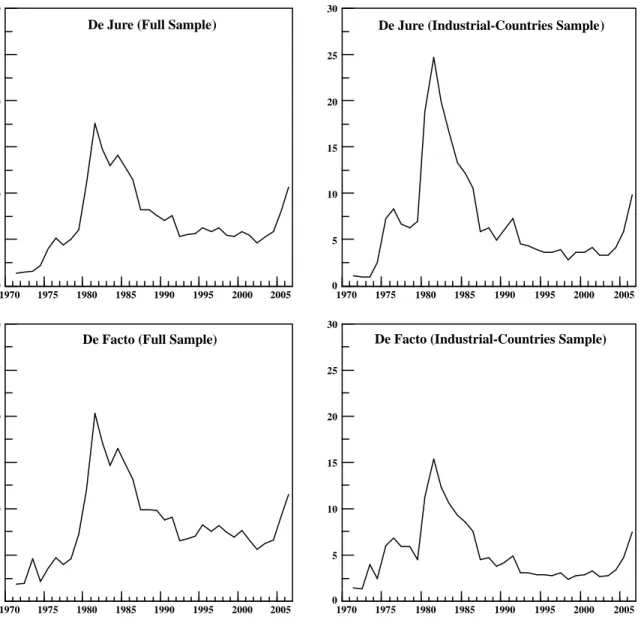
Our regression results indicates that a sharp fall of the dollar is a possible scenario of the U.S. current account adjustment, but they also confirm the collective insight of the literature that investors are more willing to allow the self-adjusting market mechanism to work out imbalances in industrial countries with sound financial and legal institutions than in emerging economies with weaker institutions. The average of the full-sample estimates of probit regressions (in both Tables 5a and 5b) indicates that the probability of a dollar crisis has grown to about 11 percent in 2006, up from the six percent estimated for 2003. The average estimates based on the industrial-country sample also indicate a large rise in the probability, from three percent in 2003 to nine percent in 2006 (Figure 4). If other factors remain the same, that probability will rise further if the U.S. current account deficit climbs higher. However, that probability rises only very modestly in response to an increase in that deficit: the estimated probability only rose to 11 percent in 2006 even though both the current account deficit and the oil prices surged to record levels.31 At 11 percent, the risk of a dollar crisis appears to be much lower than it was
31
back in 1981, when high oil prices and inflation were the scourges. The estimated probability of a dollar crisis was about 19 percent in 1981. However, at that time, the dollar actually rose rapidly until it peaked in late 1985 (Figure 4).
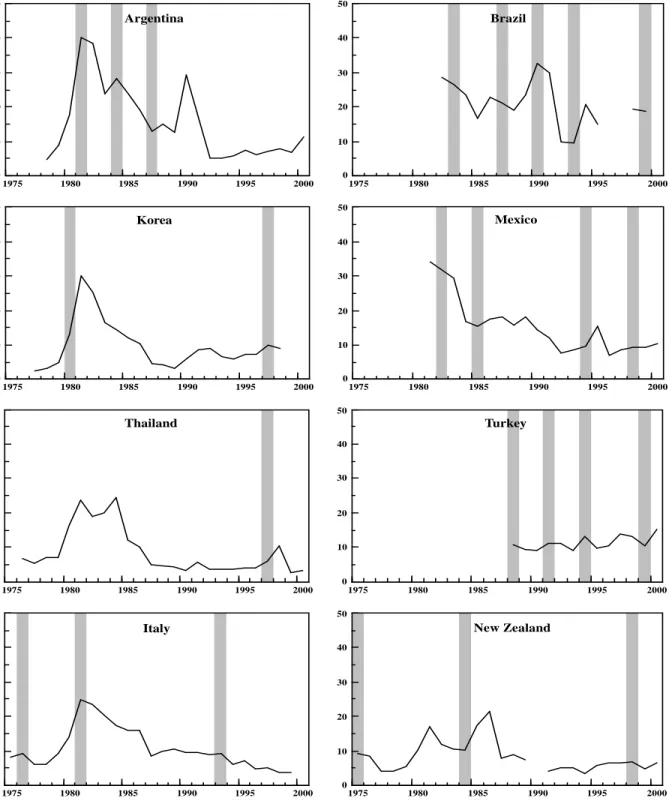
Considerable uncertainty surrounds the estimated probability of currency crises. Some emerging economies have experienced serious currency crises when the estimated probabilities of those crises were around or even below 11 percent (Figure 5). However, for the reasons discussed in section 3, emerging countries’ experiences are simply not applicable for forecasting what may happen to the U.S. dollar. Moreover, our probit regressions, which are designed to assess the relative importance of economic
fundamentals in the making and unfolding of a currency crisis, are grossly inadequate to serve as forecast models. Those regressions have a very low pseudo-R2, indicating that the included explanatory variables together explain only a very small part of the variation in the probability of a crisis. For example, Thailand did not have a currency crisis in 1981 when the probability of a baht crisis was about 23 percent in that year, but had one in 1997 when that probability was only six percent. This result is not surprising in light of the widely-shared view that it is inherently difficult to predict a currency crisis by using regression estimations. That inherent difficulty mainly arises from the fact that many potentially important contributors to a currency crisis---such as herding behavior, crony capitalism, weak financial institutions, financial-account openness---either can only be included in regressions with large measurement errors, by inadequate proxies, or are omitted from regression analyses altogether. We thus take into account factors in addition to those included in the regressions to assess the likely paths of U.S.
current-deficit/GDP ratio rose from 4.5 percent to 6.3 percent. In the full-sample regressions, the coefficient estimate on lagged oil prices is about 0.2, while that on the lagged current account/GDP ratio ranges is about 0.8.