Received February 1, 2020, accepted February 16, 2020, date of current version April 20, 2020. Digital Object Identifier 10.1109/ACCESS.2020.2983310
MATT: A Mobile Assisted Tense Tool for Flexible
m-Grammar Learning Based on Cloud-Fog-Edge
Collaborative Networking
NADIA REFAT 1, MD. ARAFATUR RAHMAN 2, (Senior Member, IEEE), A. TAUFIQ ASYHARI 3, (Senior Member, IEEE), HAFIZOAH KASSIM 1,
IBNU FEBRY KURNIAWAN 4, AND MAHBUBUR RAHMAN2
1Center for Modern Language and Human Sciences, University Malaysia Pahang, Gambang 26300, Malaysia 2Faculty of Computing, IBM CoE, ERAS, University Malaysia Pahang, Gambang 26300, Malaysia 3School of Computing and Digital Technology, Birmingham City University, Birmingham B4 7XG, U.K. 4Department of Informatics, Universitas Negeri Surabaya, Surabaya 60231, Indonesia
Corresponding authors: Md. Arafatur Rahman ([email protected]) and A. Taufiq Asyhari ([email protected])
The work of Md. Arafatur Rahman was supported in part by the University Malaysia Pahang under Grant RDU192215 and Grant RDU190374.
ABSTRACT The proliferation of modern mobile technologies on grammar learning (i.e., m-grammar learning) has generated a multitude of challenges in developing effective pedagogically-informed learning tools. The existing systems have mostly suffered from low motivation and poor learning effectiveness because of the three key reasons, namely: i) a weak tie to motivational theoretical principles, ii) a lack of proper instructional design, and iii) a lack of proper infrastructural design for data sharing between students and instructors. To deal with this issue, this paper presents MATT: a Mobile-Assisted Tense Tool that encapsulates an m-grammar instructional design leveraging upon cloud-fog-edge collaborative networking. Central to MATT is the incorporation of the Cognitive Theory of Multimedia Learning principles to minimize the extraneous cognitive load and a motivational model to increase motivation and learning effectiveness. To ensure effective instructional design, we exploit adaptive and dynamic approaches embodied in a flexible instructional paradigm that takes advantage of collective learning data exchange across cloud (central unit), fog (regional units) and edge (end devices/learners). To demonstrate the overall effectiveness of this system, we describe our findings in the evaluation of both the learning aspect (using a quantitative research design) and collaborative network performance (using numerical simulation). With an appropriate condition of delay-tolerant network-enabled learning data exchange, the results suggest that the students’ cognitive load is low and motivational nature is high after using this system, which led them to perform more positively in the post-test evaluation.
INDEX TERMS Cloud-fog-edge collaboration, cognitive load, collaborative interaction, cooperative networks, e-learning, m-grammar learning, motivation model, student learning experience.
I. INTRODUCTION
Grammar knowledge in English is essential for second language learners, and hence, the learning process and approaches should be catered to the needs of those learners. With the technological advancement, instructors and instruc-tional designers have tirelessly been bringing changes into the learning process and instructional design. One of the evolving areas in language learning is self-directed learning
The associate editor coordinating the review of this manuscript and approving it for publication was Xiaokang Wang.
where learners are the prime focus in learning [1]. To facilitate self-directed learning, modern technologies such as mobile-assisted learning tools have gained wide attention due to its ubiquity and ability to provide independent learning to learn-ers. Language learning is one of the fields that have continu-ously utilized these technologies for educational instructions and pedagogical research. Mobile assisted language learn-ing has been introduced to develop various language skills, including speaking, listening, vocabulary and grammar [2]. While the use of mobile technology to develop grammar learning materials is not new, the effectiveness of the existing
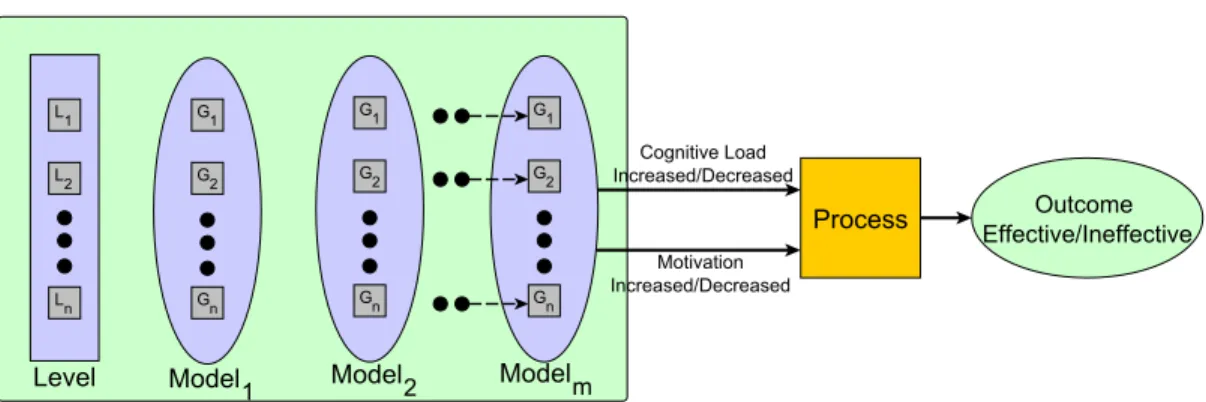
FIGURE 1. Approaches of existing grammar learning.
systems for grammar learning requires further concern and research. This includes a lack of theoretical reference, specif-ically in motivation and load on learning cognition, and poor instructional design of the learning system. It is the purpose of this study to investigate a potential solution to this concern. Adaptive and dynamic attributes are two learning charac-teristics that can enable learners to learn effectively according to their needs [3]–[5]. Herein adaptability refers to an intel-ligent tutoring system where the instructional learning can evaluate the actions of learners to guide them in the study pro-cess according to their knowledge [6]. The tool acts as a tutor rather than a teacher [7] and provides a wide range of learning opportunities and accesses to the students [8]. The dynamic part refers to system characteristics for being flexible and that can change its structure according to the demands [9]. Thus, learning instructions can be flexibly changed according to the needs and demands of the students [10]. Until the present time, a lot of works have been done on designing adaptive or dynamic language learning systems, although, limited attention has focused its effectiveness on the learn-ing achievement, especially for grammar learnlearn-ing. It needs not to further emphasize that language learning has to be adaptive and dynamic since it is necessary to jointly manage students’ motivation, cognitive load and learning performance [3], [9], [11]–[13].
Existing applications of mobile-assisted (m)-grammar learning can not fully ensure both the adaptive and dynamic attributes of learning [14]–[18]. Those works highlight the majority of available learning systems with a non-adaptive feature, especially in the system ability to maintain learners’ level of knowledge. While there are some directions that address learning adaptability, they have limited consideration on the motivational factor and cognitive load management.
Fig.1captures the current approaches in m-grammar learn-ing. Herein, while existing instructional tools may have dif-ferent levels of instructional content, all users need to fol-low parallel learning activities where the process of gaining knowledge does not maintain the heuristic characteristics of the learners. Therefore, when the same materials are provided to all students, the cognitive load is affected. If the learners are
intermediate users, they may feel bored or underestimating the learning material. This issue can cause boredom and has a strong correlation to cognitive load [19]–[21].
This paper considers improving the functionalities of the current m-grammar learning tools by proper accounting of the evolving learning characteristics, the learning motiva-tion model, cognitive load management and student learn-ing performance. We aim to advance our work in [13] by taking forward the previously-studied networking-assisted grammar system through comprehensive integration with the adaptive and dynamic learning attributes. More specifically, we present an instructional learning tool developed as an m-grammar learning system and call it a Mobile Assisted Tense Tool (MATT) due to an emphasis on the tense learn-ing of English grammar. The MATT is built by various learning components, ranging from modules and selectors to processes, that collectively exchange data to accomplish the learning goals. In order to facilitate this pervasive data handling that is beyond non-flexible interactions as in [13], we employ a recently emerging collaborative cloud-fog-edge networking architecture that enables flexible computational tasks and data distribution among the cloud, fog and edge devices.
The proposed MATT is then analyzed for its capacity in enabling effective learning data exchange and its impact by bringing the adaptive and dynamic features of learning, the motivational model and cognitive load management. The effectiveness of the instructional tool is demonstrated through an investigation in the following sections that aims at address-ing the followaddress-ing questions.
1) To what extent does the use of MATT increase students’ motivation?
2) To what extent does the use of MATT help students to learn English tenses and achieve better in tense learning?
3) To what extent is the design of MATT adaptive and dynamic?
4) How effective does the MATT manage cognitive load? 5) To what extent can the cloud-fog-edge collaborative
The organization of the rest of the paper is as fol-lows. SectionIIreviews related pedagogical and networking research. Section IIIdiscusses the cognitive load measure-ment and managemeasure-ment. SectionIVdescribes the associated methodology used in this work. SectionVexplains research observations from the educational perspective. Section VI details the cloud-fog-edge networking system simulation along with evaluation results. SectionVIIdiscusses the over-all findings and SectionVIIIsummarizes the main contribu-tions of this work.
II. RELATED WORKS
A. ADAPTIVE LANGUAGE LEARNING
Several studies focused on adaptive learning, wherein most of the cases they critically analyzed the adaptability of the learning system or theoretical basis of the work [11], [22]. Few of them have described empirical evidence on adaptive-mechanism based grammar learning [3], [5], [23]. Within this group of works, only several studies focused on the instructional design of the tool. Regardless of its common usage and despite the importance of learner categorization, grammar learning tools tend to neglect the adaptive quality in its instructional design. A few other studies on adaptive language learning systems [14]–[18] went through the knowl-edge level based instructional design but they did not focus on the issues of motivational factor and extrinsic cognitive load. The learning system must have the quality to motivate the learners by reducing the extrinsic cognitive load that is inter-related with the instructional design. However, to develop an adaptive tool, the design of instructions for grammar learning must be motivational, able to minimize cognitive load and therefore bring improvement in learning [3], [9], [11], [12].
B. MOTIVATIONAL MODEL AND LEARNING EFFECTIVENESS
One of the referred learning models for motivation is John Keller’s ARCS model [24], which considers four key ele-ments such as Attention, Relevance, Confidence and Sat-isfaction to promote motivation in the learning instruction and environment. This model has originally been intended to deal with issues in learning motivation and to devise ways of designing learning instructions. The model has a vast range of applications in different fields of study, bridging motivation and learning outcome [24].
Applying the four sub-scales of Keller’s motivational model can be found in the design of a language learning material through mobile tools and classroom implementa-tion. For instance, the utilization of versatile tools in the classroom invigorated the awareness of language learning procedures [25]. This model is likewise used to structure directions in order to build the inspiration and execution for language abilities, e.g., listening expertise [26], writing ability or English and culture study [27]. Yet, the use of the model in grammar learning is still lacking, and therefore, further investigation is required to better understand
motivation-based learning approaches in the grammar context.
Until the present time, grammar learning has been exer-cised through web-based technologies where tense plays a very important role. There are a few existing web-based tense learning tools, including Best Tense, Verbs Tutor and English tenses, but their instructional design is neglecting the motivational factor [28]. This issue can also be found in the multimedia-based instructional design across different subjects [29]–[31]. As a result, there is the need to design effective instructional materials that can motivate students especially when technologies such as mobile applications are used. It is as yet a less investigated but fascinating aspect to structure such a technology-aided tense tool using the ARCS model and explore its impact on motivation and learning outcome. Using the model, it is possible to increase the motivation level for learning English tenses, which in turn leads to an improved learning performance.
III. COGNITIVE LOAD
Considering the limited capacity of human cognitive architec-ture, it is necessary to manage the cognitive load. In learning experience where multimedia-based tools are used, it is fre-quent for learners to experience an extraneous cognitive load (ECL), which can be a result of the ineffective presentation of instructional materials.
Minimizing this ECL through exploitation of the instruc-tional design can enable learners to use the tool and learn the content effectively [32]. By applying the Cognitive Theory of Multimedia Learning (CTML) [33] and Cognitive Load The-ory (CLT) [32], researchers had suggested the use of design principles that can manage and reduce the ECL for mean-ingful learning. Design principles such as multi-presentation effect (combining instructions with presentations of pictures, tables and animations), congruity effect (verbal information is accompanied by related and well-coordinated visual informa-tion), coherence effect and redundancy effect in multimedia instructional design have been well investigated [32], [33].
CTML and CLT have been shown to successfully guide the design of learning materials [34]. However, most of the empirical evidence underpinning these models is quantity-related, with researchers interested in quantifying the amount of performance outcome [35]. The experimental outcome showed that the instructional variants have been derived from the cognitive theory, and such results are seen as empirical validation. However, to the best of our knowledge, no study is yet to use the NASA Task Load Index (NASA TLX) [36] as a self-directed method of measuring the ECL. This motivates investigation into ways to scale the ECL in language learning. Cognitive load can be measured using different types of measuring scale. Self-reporting is beneficial since the user can directly feedback the impact of the instructions. Two types of self-reporting are on: 1) stress level, and 2) difficulty of materials. One of the mainstream self-reporting measures in the literature is NASA TLX [36]. As a load measure, in particular, the NASA-TLX uses a multi-dimensional rating
scale, showing a distinctive result in estimating the requests looked by students under the setting of conventional and single inquiries with a short subjective instrument. Another study based on the Repertory Grid Technique was under-taken in contrasting technology-based grammar teaching to conventional book-oriented grammar teaching [37]. Herein, the outcome appears favorable since the student performed well in grammar. However, this study mainly focused on com-paring two mediums of instruction, rather than comcom-paring the instructional designs.
IV. METHODOLOGY
A. PARTICIPANT
In this study, there were 128 students from a Malaysian public university as participants. The students who were enrolled in a fundamental grammar course to enhance their English language skills were recruited. The demographic data show that most of the students are between 21 - 22 years old, and the majority are female students. We had 25 and 103 students in the control and experimental groups, respectively.
B. RESEARCH INSTRUMENT OR MEASURING SCALES
Four research instruments were used to investigate the moti-vational outcome and learning achievement of the students. These include: 1) Instructional Materials Motivation Survey (IMMS), 2) grammar test, 3) adaptive and dynamic question-naire, and 4) cognitive load measuring scale.
1) IMMS
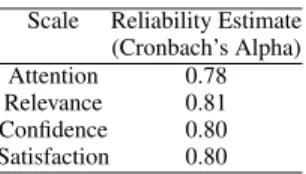
The IMMS was initially developed by Keller based on the four ARCS components as mentioned in SectionII-B. In this study, IMMS was used to measure the student motivational outcome as a result of the instructional design in the tense learning tool. The questionnaire consisted of 23 items that utilize the Likert-type scale of 5 scales, starting from 1=not true to 5=very true. The reliability test was measured for the internal consistency that is based on Cronbach’s alpha as shown in Table1.
TABLE 1. IMMS internal consistency estimates reference.
Note that in using this instrument, pre- and post-treatment was undertaken with the experimental group while we tested it only on the control group one time after the training with regular instructional materials.
2) PERFORMANCE ANALYSIS THROUGH PAPER BASED TEST The grammar test was used to investigate if the learning achievement on past tenses is increased after using the tool. The test script has 20 questions, containing multiple choices,
filling in the blanks and free handwriting. The questions were designed according to Bloom’s Taxonomy [37] to examine the student gradual improvement. The revised version of Bloom’s Taxonomy highlighted cognitive domain improve-ment from remembering to creating [37]. The multiple-choice questions were then developed, containing the first level of Bloom’s Taxonomy cognitive domain (remembering). The filling-in-the-blanks questions were subsequently organized for understanding and analysis levels while free writing ques-tions were set at analyzing and creating levels.
3) COGNITIVE LOAD MEASUREMENT VIA NASA-TLX
To measure cognitive load, NASA-TLX was used. It is one of the most widely used instruments to assess a subjective cognitive load. It has been extensively tested in human per-formance studies [36]. The objective of using NASA-TLX was to measure multi-dimensional cognitive load aspects on the learners. This includes the mental demand that refers to how much mental or perceptual activity was required. While physical and temporal demand explains the physical activity and time pressure in fulfilling the task, respectively. The performance was measured to understand learners’ sat-isfaction in performing the task while mental effort and frustration investigate the mental involvement and boredom while working with the instructional design for performing the task. The self-reported responses were the integration of subjective responses (emotional, cognitive, and physical) and weighted evaluation of behaviors. This instrument was based on a 5 semantic-type scale where students need to report their opinion through pointing on the scales, i.e., 1 (very low) to 5 (very high). The reliability outcome of Cronbach’s alpha value was 0.76, which is acceptable in this type of research. 4) QUESTIONNAIRE ON ADAPTIVE AND
DYNAMIC LEARNING
The questionnaire was used to explore the level-wise training, dynamic of the design, relevance of the illustrations, feedback of the evaluation system and motivational factor of the tool. There were 9 items with the scaling being designed based on a 5 Likert-type scale starting from not true to mostly true.
C. SYSTEMATIC ARCHITECTURE OF MATT
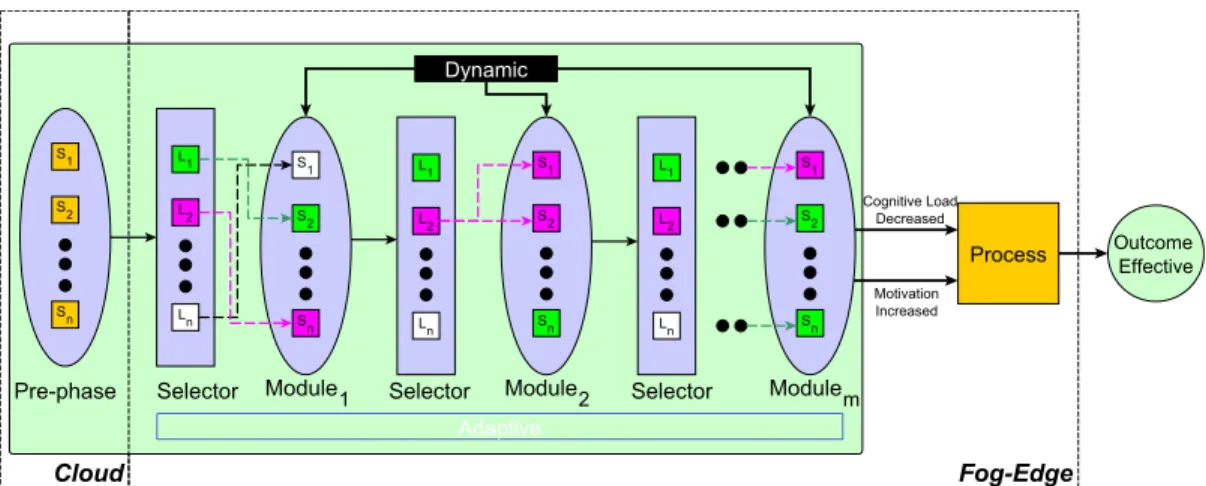
The proposed learning tool has been developed for the stu-dents to learn and enrich their knowledge of English tenses. This corresponds to a dynamic and adaptive learning process that aims to decrease the students’ cognitive load [38]–[41] and increase their motivation, which in turn lead to a better learning performance [42]–[44]. For better understanding, we present the system model as depicted in Fig.2.
As shown in Fig.2, there exist several knowledge levels. After the pre-phase test evaluation, the system automatically assigns the students to their appropriate level. This level estimation and assignment takes place at the beginning of the learning process and is computed centrally by cloud infras-tructure. In this diagram, we defineL1as the beginner level whileLn as the highest level. The criteria for assigning the
FIGURE 2. Proposed adaptive and dynamic learning with MATT.
levels are given by the correct answers of the pre-phase test questions. With a higher number of correct answers, students would be put into a better level.
The next step is to teach the students according to their knowledge levels. After this session, students would sit for another evaluation test from the tool. Based on this test result, students would be re-assigned to their corresponding levels. Depending on the result, three scenarios could happen. A Level 2 student could remain in Level 2 or be promoted to Level 3 or be demoted to Level 1. Another issue can appear and be mitigated through our proposed system, e.g., a student may achieve a good result beyond his/her skills, which leads to his assignment to an upper level. This would be a challenge for him/her to adjust to the level of teaching at the upper level. In such a case, the system would ensure to re-evaluate his/her next test result and might re-adjust his/her level subsequently. For this reason, we have introduced our system as a dynamic learning system.
The dynamic mechanism has been carried out mainly by the distributed infrastructure that could be placed geo-graphically or logically close to students and tutors. Typical deployment can take in the form of one school having one facility or several schools with similar specifications sharing the same resource. The facility has the capability to temporar-ily store class engagement and locally compute the learning achievement and progress of students. These valuable data may include minutes spent on a certain task, a correct answer for each question, or a student rank in a certain module. The facility could also asynchronously fetch personalized teaching assets from the central system to enrich the students learning experience.
The dynamic process continues and, at some point, stu-dents would be provided the exact level of teaching they need. That is why we call our system as an adaptive learning system too. In our application, there are three difficulty levels. The first one is for beginners. The second one belongs to intermediaries. The third one is for expert users. We use these three levels according to the understanding of the learners
and thus design the learning materials or instructions of the tool accordingly. We designed the instruction based on the complex-to-simple learning theory that refers to the design of instructions based on integrating learners’ knowledge, skills and attitudes [45]. It has been demonstrated that hypermedia frameworks are appropriate for giving customized learning supports or directions by distinguishing the individual quali-ties of students and adjusting the introduction styles or learn-ing ways accordlearn-ingly [21]. For the users at the first level, we provide more videos and images or animations since visual aid is helpful for better and effective cognition while at the intermediate level, we minimize the audio-visual effect as they have better comprehension even without much audio-visual presentation. In designing instructions for the users at the advanced level, more texts with elaboration are provided. Herein, the tutorials contain complexly structured sentences so that they can upgrade their knowledge and link it with prior knowledge.
D. RESEARCH MATERIAL
The research material used was a web-based tense learning platform to assist the learners in studying English tenses. The application was run in computers as well as in smart-phones. The instructional design of the application or tool was designed based on the motivational model (ARCS as mentioned in SectionII-B) by Keller in order to help motivate students in terms of bringing attention, finding relevancy and confidence, and feeling satisfied with the experience. The design also considered cognitive aspects depending on the CTML principles to manage the ECL.
1) INSTRUCTIONAL DESIGN BASED ON ARCS MODEL The instructional design of the tool considered two theoretical aspects, namely motivation and cognition. For the motiva-tional model, the ARCS model was implemented as instruc-tional design. The model is based on the theory that explains that instructions should captivate the attention or interest of the learners, which is the first criterion of the ARCS
model [46]. Therefore, different suggested tactics (based on the ARCS model) were included such as conversation and images in the instructions of the material.
The second criterion of the ARCS model is to bring rel-evance to the instructional material. To establish relrel-evance, relevant examples and illustrations were adopted in the tool.
The third criterion is confidence-building, which has been set up with the exercises that were designed with fill-in-the-blanks as well as multiple-choice questions (MCQ) and meaningful sentence constructions. The worksheets were developed to encourage the students to self-measuring their performance and learning practices. Practicing through dif-ferent types of exercises can aid the students to develop inter-nal confidence, which is important for any kind of learning.
The fourth criterion is to bring satisfaction through the instructional design of the tool. Herein the feedback system plays a strategic role since it can motivate learners to con-tinue learning [47]. To bring satisfaction in students, self-evaluation was introduced in this work by asking the students on several tense-related questions. This evaluation was given in relation to their performance outcome. Through the scoring system, the students are able to know their progress, which inherently acts as a learning reward.
2) CTML DESIGN PRINCIPLES
To consider the cognitive aspect, this study focused on the ECL that may be a result of the presentation of the instruc-tional materials. Therefore, the CTML plays a fundamental role in designing the materials so that it does not impose the ECL on learners. To do so, the present work emphasized only the extraneous principles of Mayer to design the tool [32].
The first principle we considered is the Coherence principle that asserts that people can better learn with less nonessential images, texts and sounds. To avoid a distracting background, we applied simple colors with no extra unneces-sary images in the tutorials or exercises. Video only provides visual and audio effects but no extra on-screen text that is unrelated to the learning goal is included.
The second principle reflected in the design is signaling. Herein we anticipate that signaling can help improve infor-mation transfer. It aims to lower down the ECL on both visual and auditory by material organization through the use of cues. Therefore, we have focused on the two aspects of signaling here, namely the word cue and audio help. Word cuing is a popular way to highlight important words and bring attention to the learners’ cognitive processing [48]–[50]. Secondly, audio is used through which students can concen-trate more on the tutorials and content. While genuine infor-mation may not present in the signals, more in-depth learning is possible when key terminologies are underlined within audio-visuals [51], [52].
The third principle is the redundancy principle, referring to the case where the instructional design contains text, audio and narration concurrently, which may hamper the working memory with too much load on information processing. The basic reason is that people cannot focus when they both hear
and see the same verbal message during a presentation. In this study, we avoided redundancy in instructional designing with effective uses of audio, text, graphics and narrations.
The fourth CTML guideline contemplated in this work is the contiguity standard. It expresses that better learning hap-pens while relating portrayal and activity are introduced at the same time, both transiently and spatially. In this instructional plan, we carefully keep up the standards to keep away from the ECL.
V. RESEARCH FINDINGS
A. INSTRUCTIONAL MATERIAL MOTIVATION SURVEY (IMMS)
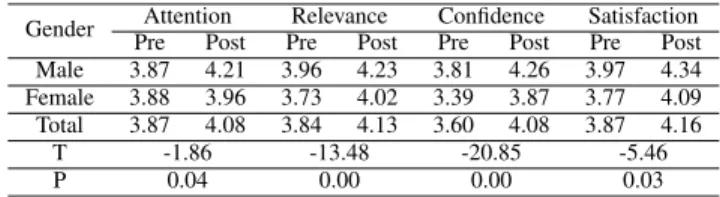
A paired sample T-test has been conducted to show the dif-ference between the means of two conditions, i.e., using pre and post version of the tool.
TABLE 2.Pre- and Post-IMMS outcome of experimental group.
It is observed from Table2that students of the experimen-tal group appear to have better attention, relevance, confi-dence and satisfaction in post IMMS with values given by ATTm = 4.08; RELm = 4.13; CONm =4.08 and SATm = 4.16, respectively, than those in pre IMMS with values given by ATTm = 3.87; RELm = 3.84; CONm = 3.60 and SATm=3.87, respectively. The difference is significant with
p<0.05. The motivational gap is noticed due to differences in the design of instructions. An independent sample T-test has also been carried out to compare the motivational difference between the control and experimental groups.
Table3shows a significant difference in every criterion of the motivational outcome between the control and experimen-tal groups. Concerning the first criterion, in attention (ATT), we have the control group (withm=2.98, SD=0.02) and the experimental group (withm = 3.93, SD = 0.41). The mean difference (df = −0.94, 95%Cl : −2.19 to 0.30) is very large and significant given the values ofd = 3.27 and
p<0.05.
The second criterion is relevance (REL) with the following results: the control group (m = 3.86, SD = 0.09) and the experimental group (m=4.14, SD=0.14). The discrepancy of the mean differences (f = 6.05, mean differencedf = −0.27, 95%Cl : −0.78 to 0.23) is very large and has a significant difference given the resulting values ofd =2.37 andp<0.05.
The third criterion is confidence (CON) where we have the control group (m=3.03, SD=0.08) and the experimental group (m=3.92, SD=0.50). Similar to the previous results, in this criterion, the magnitude of the differences in the means
TABLE 3. IMMS outcome of control and experimental group.
(f =4.29, mean differencedf = −0.89, 95%Cl : −2.44 to 0.65) is very large and captures a significant difference with the obtained values ofd =2.48 andp<0.05.
Finally, we have satisfaction (SAT) as the criterion where we read the results for the control group (m= 3.86, SD =
0.09) and the experimental group (m = 4.14, SD = 0.14). The magnitude of the differences in the means (f = 6.05, mean differencedf = −0.27, 95%Cl : −0.78 to 0.23) is very large and has a significant difference with the resulting values ofd =2.23 andp<0.05.
B. PAPER BASED TEST
Paper based test was designed to know the differences between pre-test and post-test outcomes based on a set of questions. It was also considered in this paper the differences of the paper-based results between the control and experimen-tal groups through a paired sample T-test.
In Table4, we analyze the results of pre- and post-test paper based evaluation for the experimental group.
TABLE 4. T-test outcome of experimental group.
The table indicates that the experimental group performed better in post-test (m = 15.24) of paper-based outcome where males did better in post-test (m=13.86) than females (m=12.46). The difference is significant sincep<0.05 with
df =2 andt = −5.98.
C. COGNITIVE LOAD
The CLT is an essential factor to be considered for instruc-tional design for learning. It asserts that the capacity of working memory to hold information during the process of learning is limited thus this memory can be overloaded. To measure the cognitive load in this study we utilized NASA TLX.
D. OUTCOME OF QUESTIONNAIRE ON ADAPTIVE AND DYNAMIC NATURE
To know the adaptability of the tool, a separate questionnaire has been designed consisting of 9 items with the Cronbach’s alpha given by 0.76. The gender based outcome is presented in Table 5 in the following.
TABLE 5.The gender based outcome of adaptive quality of the tool.
Table5signifies the result of the rating of adaptive quality for MATT. This shows male has a higher mean (m= 4.22, SD = 0.12) than female (m = 3.98, SD = 0.11). The distinction between the two variables is also significant with
p = 0.002 (p < 0.05). The item-wise outcome of the questionnaire represents the marking of the statements that illustrates the level-wise training, dynamic of the design, rel-evance of the illustrations, feedback of the evaluation system and motivational factor of the tool.
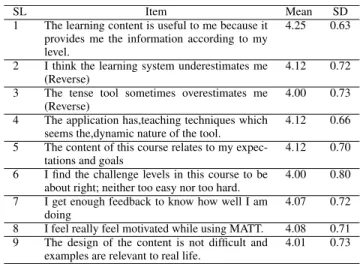
TABLE 6.The itemwise outcome of questionnaire.
Table6depicts the obervation that the students indicated the highest rating to the statement SL-1 with meanm=4.25, followed by SL-2 (m = 4.12, SD = 0.72) and SL-3 (m =
4.00, SD = 0.73). This demonstrates that the tool has the capability to provide the instructions on past tense according to the knowledge level of the students. Other elements achieve satisfactory levels, including the dynamic nature (m=4.12, SD = 0.66), the relevance (m = 4.12, SD = 0.70), the feedback of the evaluation system (m=4.00,SD=0.73) and the motivational factor (m=4.00, SD=0.73).
VI. SYSTEM SIMULATION
A. SETUPS
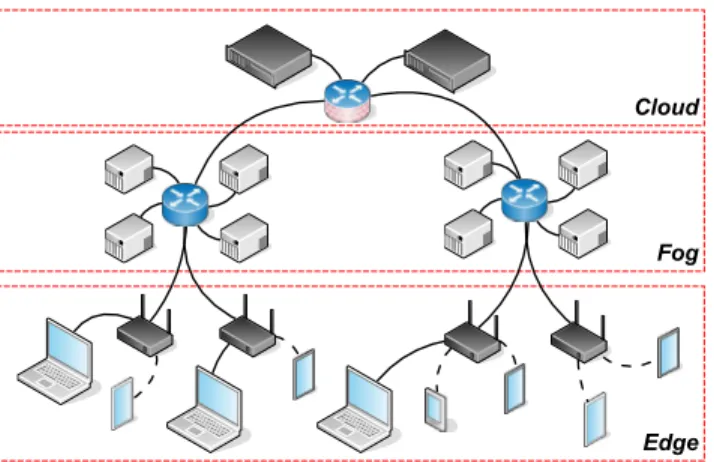
We have performed system simulation using topology shown in Fig.3to assess the network performance. The following NS-3 configurations have been applied during the process:
FIGURE 3. Networking system architecture.
1) A network infrastructure incorporating fog and cloud layers was deployed to process the learning data hierar-chically. The fog layer would have two tasks, i.e., data pre-processing and local computation. In the case of high complexity and global computation scope, this facility will provide initial data processing for the cloud facility. Meanwhile, the fog side can perform the local computation for the case of immediate results and per-sonalized contents/levels.
2) Clients’ activity data, including task completion time, module completion score and in-class engagement time, are seamlessly captured and monitored by the fog. 3) Clients are wirelessly connected using Wi-Fi 802.11n 2.4Ghz standards to the service using their own devices.
4) Fog-layer devices are connected by a reliable medium using the CSMA channel with a capacity of 100Mb/s. 5) Backbone routers interconnect two upper layers using
point-to-point protocols with a capacity of 1000Mb/s. 6) Learning services run over the UDP protocol with
each packet having the size of 10Kb. Each client will perform and pause packet transmission in a random fashion with a mean of 0.01 seconds and variance of 0.05 seconds.
B. RESULTS
A transmission probe is installed to monitor the transmission flow in the system. A flow is one transmission between two end-points and can end up either successful or failed. From the observation, network performance metrics can be obtained to justify network the performance. Our experiment mainly concerns on two metrics, namely delay and loss rate. Since the fog infrastructure has been featured in the pro-posed system, we varied how often the clients’ packets can be processed locally by their own devices. A 50:50 load means that the fog and cloud layers will share computing load equally. While a 70:30 load ensures that 70% of the processing is performed in the fog facility. These config-urations do not act as a load balancing feature, but they
FIGURE 4. CDF delay.
determine how likely a packet is forwarded to the core layer. Fig. 4 illustrates our findings as a cumulative distribution function (CDF) format where the CDF figures shift to the right as the number of clients increases. This is caused by a high number in the packet queue as well as packet collisions. Compared to Fig. 4a, graphs in Fig. 4b tend to shift to the right less slowly. This means that the end-to-end delay of the 70:30 load is less than that of the 50:50 load.
FIGURE 5. Rate loss.
Fig.5 depicts the packet loss ratio during the simulation process. The 70:30 load has a better packet loss when less than 80 clients are using the service due to the computing process in the queue. Meanwhile, the 50:50 load offers a less packet loss since the edge devices require less computing resources. For this load, half of the packets are forwarded to the core network. This is a different situation to the 70:30 load where the edge layer must process more local packets and send back the response. In such a condition, the wireless medium will be more crowded and packet loss is more likely to occur.
VII. DISCUSSION
The findings from IMMS and Paper-based test reveal that students are motivated towards using the tool and thereby improved their performance in grammar. In addition, the out-come from the survey with the adaptive questionnaire illus-trate the adaptive nature of the tool while NASA-TLX shows that the tool creates a less ECL on the students. Analyzing all the results from this study, it is shown that the tool was an adaptive tool that is capable to increase the motivation of the learners and manage cognitive load at a satisfactory level.
We first discuss the findings of the IMMS that represented students’ motivational associations towards the tool, which was designed according to the four criteria (Attention, Rele-vance, Confidence, and Satisfaction) in the ARCS model as mentioned in SectionII-B. The result of IMMS demonstrated that the students found the tool as a guide to learn English grammar, and the modules appear to be well designed from the tutorials level to evaluation part. The strategies used in the tool’s design according to the ARCS model helped them to sustained their attention, relevance, confidence and sat-isfaction. Students developed their interest to learn and use the knowledge through utilizing technology based language learning.
The second instrument applied in this study was a paper based test that measures the student learning performance. It was noticed that students did better in the post-test (m =
14.17, SD = 1.90) than the pre-test (m = 8.52, SD =
1.74). A significant difference was observed in their statistical results withp<0.05. It was also found in this study that the experimental group had improved much more in their learn-ing performance for English tenses than the control group where we havem=9.39, SD=2.44.
The third instrument used was NASA-TLX to measure the cognitive load, which played a significant role in this study. This instrument was used to directly measure the task load on the learners. It revealed that learners’ statistics showed low average values in the mental/physical/temporal demand as well as mental effort, whilst they had a higher mean in the performance. This result represents the validity of the CTML that highlights a less task load for learners as learning par-ticipants due to an instructional design that fulfil the design principles.
The fourth instrument was the survey questionnaire on the adaptive nature of the tool, which illustrates a positive and higher mean value (m = 4.10, SD = 0.11). The outcome of the survey is promising. This explicit approach of revealing knowledge level had been analyzed in other studies [14], [16]–[18]. It has been reported that the tech-nology that is adaptive can be beneficial to enhance learn-ing efficiency and retention whilst obtainlearn-ing comparable results [53], [54].
VIII. CONCLUSION
This work has proposed MATT as a novel m-grammar learning tool that utilizes technology-enhanced educational principles embedded across collaborative cloud-fog-edge networking elements. To motivate the learners, Keller’s ARCS model has been utilized to design and develop the tense tool and its instructions. To promote and maintain the student motivation, a different variety of audio-visual mate-rials have been incorporated in the MATT. On one hand, motivational learning should capture the learners’ attention, promote relevancy to the instructions, stimulate confidence and satisfy their needs. On the other hand, learning tech-nologies should facilitate effective data exchange and col-laboration in order to achieve these learning objectives.
The results have been affirmative with the motivational capacity of the tool through effective utilization of collective learning technologies.
Concerning the learning effectiveness, we have noticed that the tool has been able to increase the learning perfor-mance of the students. Students have improved their knowl-edge in a selected topic as evidenced by their post-test scores, which are higher than the pre-test scores. In reducing the cognitive load, the tool has been shown to make an impact on the learners. The students have shown to exhibit a low cognitive load while achieving a better performance in the scaling of NASA-TLX.
Our simulation has shown the overall network performance under a suitable network topology. The use of the network has been aimed to dynamically distribute the computing load of learning data. Results have shown that the fog facility can help the whole system achieve an acceptable amount of latency and a ratio of packet delivery, which indicate the feasibility of the proposed system.
REFERENCES
[1] M. Prince, ‘‘Does active learning work? A review of the research,’’J. Eng. Educ., vol. 93, no. 3, pp. 223–231, Jul. 2004.
[2] J. Gikas and M. M. Grant, ‘‘Mobile computing devices in higher education: Student perspectives on learning with cellphones, smartphones & social media,’’Internet Higher Educ., vol. 19, pp. 18–26, Oct. 2013.
[3] M. C. Murray and J. Pérez, ‘‘Informing and performing: A study compar-ingadaptive learning to traditional learning,’’Informing Sci., Int. J. Emerg. Transdiscipline, vol. 18, pp. 111–125, Jan. 2015.
[4] A. Paramythis and S. Loidl-Reisinger, ‘‘Adaptive learning environments and e-learning standards,’’ inProc. 2nd Eur. Conf. e-Learn., vol. 1, 2003, pp. 369–379.
[5] T.-C. Yang, G.-J. Hwang, and S. J.-H. Yang, ‘‘Development of an adap-tive learning system with multiple perspecadap-tives based on students’ learn-ing styles and cognitive styles,’’J. Educ. Technol. Soc., vol. 16, no. 4, pp. 185–200, 2013.
[6] F. Gutierrez and J. Atkinson, ‘‘Adaptive feedback selection for intelligent tutoring systems,’’ Expert Syst. Appl., vol. 38, no. 5, pp. 6146–6152, May 2011.
[7] J. Bourdeau and M. Grandbastien, ‘‘Modeling tutoring knowledge,’’ in Advances in Intelligent Tutoring Systems. Berlin, Germany: Springer, 2010, pp. 123–143.
[8] P. Brusilovsky, ‘‘Adaptive and intelligent technologies for Web-based eduction,’’Künstliche Intelligenz, vol. 13, no. 4, pp. 19–25, 1999. [9] K. De Bot, W. Lowie, and M. Verspoor, ‘‘A dynamic systems theory
approach to second language acquisition,’’Bilingualism, Lang. Cognition, vol. 10, no. 1, p. 7, Apr. 2007.
[10] N. Granberg, ‘‘The dynamics of second language learning: A longitudinal and qualitative study of an adult’s learning of Swedish,’’ Ph.D. dissertation, Umeå Univ., Umeå, Sweden, 2001.
[11] P. Ker. (2014). A Short Guide to Adaptive Learning in English Language Teaching. (Critique Edition 1), The Round. [Online]. Available: http://the- round.com/resource/a-short-guide-to-adaptive-learning-in-english-language-teaching/
[12] V. Slavuj, B. Kovačić, and I. Jugo, ‘‘Adaptive E-learning system for language learning: Architecture overview,’’ inProc. 39th Int. Conv. Inf. Commun. Technol., Electron. Microelectron. (MIPRO), 2016, pp. 951–955. [13] N. Refat, M. A. Rahman, A. T. Asyhari, I. F. Kurniawan, M. Z. A. Bhuiyan, and H. Kassim, ‘‘Interactive learning experience-driven smart commu-nications networks for cognitive load management in grammar learning context,’’IEEE Access, vol. 7, pp. 64545–64557, 2019.
[14] S. Arnold, J. Fujima, A. Karsten, and H. Simeit, ‘‘Adaptive behavior with user modeling and storyboarding in serious games,’’ inProc. Int. Conf. Signal-Image Technol. Internet-Based Syst., Dec. 2013, pp. 345–350. [15] A. Ewais and O. De Troyer, ‘‘Authoring storyline-based adaptive 3D virtual
[16] S. Leung, S. Virwaney, F. Lin, A. Armstrong, and A. Dubbelboer, ‘‘TSI-enhanced pedagogical agents to engage learners in virtual worlds,’’Int. J. Distance Educ. Technol., vol. 11, no. 1, pp. 1–13, Jan. 2013.
[17] K. A. McCusker, J. Harkin, S. Wilson, and M. Callaghan, ‘‘Intelligent assessment and content personalisation in adaptive educational systems,’’ in Proc. 12th Int. Conf. Inf. Technol. Based Higher Educ. Training (ITHET), 2013, pp. 1–7.
[18] T. D. Parsons and J. L. Reinebold, ‘‘Adaptive virtual environments for neuropsychological assessment in serious games,’’IEEE Trans. Consum. Electron., vol. 58, no. 2, pp. 197–204, May 2012.
[19] C. Gbollie and H. P. Keamu, ‘‘Student academic performance: The role of motivation, strategies, and perceived factors hindering liberian junior and senior high school students learning,’’Educ. Res. Int., vol. 2017, pp. 1–11, Mar. 2017.
[20] R. A. Kusurkar, T. J. T. Cate, C. M. P. Vos, P. Westers, and G. Croiset, ‘‘How motivation affects academic performance: A structural equation modelling analysis,’’Adv. Health Sci. Educ., vol. 18, no. 1, pp. 57–69, Mar. 2013.
[21] P.-C. Sun, R. J. Tsai, G. Finger, Y.-Y. Chen, and D. Yeh, ‘‘What drives a suc-cessful e-learning? An empirical investigation of the critical factors influ-encing learner satisfaction,’’Comput. Educ., vol. 50, no. 4, pp. 1183–1202, May 2008.
[22] E. Scott, A. Soria, and M. Campo, ‘‘Adaptive 3D virtual learning environments—A review of the literature,’’IEEE Trans. Learn. Technol., vol. 10, no. 3, pp. 262–276, Jul./Sep. 2016.
[23] E. de la Guía, V. L. Camacho, L. Orozco-Barbosa, V. M. B. Lujan, V. M. R. Penichet, and M. L. Perez, ‘‘Introducing IoT and wearable tech-nologies into task-based language learning for young children,’’IEEE Trans. Learn. Technol., vol. 9, no. 4, pp. 366–378, Oct. 2016.
[24] J. M. Keller, ‘‘Motivational design of instruction,’’ in Instructional Design Theories and Models: An Overview of Their Current Sta-tus, C. Reigeluth, Ed. Hillsdale, NJ, USA: Lawrence Erlbaum, 1983, pp. 383–434.
[25] Y. Ono, M. Ishihara, and M. Yamashiro, ‘‘Instant text-based feedback systems: The development of a text-based feedback system and its potential use in foreign language teaching,’’J. Inf. Technol. Appl. Educ., vol. 3, no. 1, pp. 1–8, 2014.
[26] Y. Zhang, ‘‘Project-based learning in Chinese college English listening and speaking course: From theory to practice,’’Can. Social Sci., vol. 11, no. 9, pp. 40–44, 2015.
[27] Z. Molaee and F. Dortaj, ‘‘Improving L2 learning: An ARCS instructional-motivational approach,’’ Procedia-Social Behav. Sci., vol. 171, pp. 1214–1222, Jan. 2015.
[28] I. Isnawati, ‘‘Students’ views on the use of book and Web-based materials for their ELT classes: A study on ICT-based education in Indonesian context,’’ inProc. KnE Social Sci., 2017, pp. 112–120.
[29] J. Pereira, A. Merí, C. Masdeu, M. Molina-Tomás, and A. Martínez-Carrió, ‘‘Using videoclips to improve theoretical anatomy teaching,’’ Eur. J. Anatomy, vol. 8, no. 3, pp. 143–146, 2020.
[30] D. D. Prasetya, A. P. Wibawa, and A. S. Ahmar, ‘‘Design of Web-based lightweight interactive multimedia for distance learning,’’J. Phys., Conf. Ser., vol. 1028, Jun. 2018, Art. no. 012059.
[31] I. Listiani, ‘‘Application of cultural-based interactive multimedia teaching materials through assure development model to improve critical thinking skills of primary school teacher education students,’’ inProc. Int. Conf. Islamic Educ. (ICIE), 2017, vol. 1, no. 1, pp. 1–13.
[32] J. Sweller, J. J. Van Merrienboer, and F. G. Paas, ‘‘Cognitive architecture and instructional design,’’Educ. Psychol. Rev., vol. 10, no. 3, pp. 251–296, 1998.
[33] R. E. Mayer and R. Moreno, ‘‘Nine ways to reduce cognitive load in multimedia learning,’’Educ. Psychol., vol. 38, no. 1, pp. 43–52, Mar. 2003. [34] R. C. Clark and R. E. Mayer,E-Learning and the Science of Instruction: Proven Guidelines for Consumers and Designers of Multimedia Learning. Wiley, 2016.
[35] P. Antonenko, F. Paas, R. Grabner, and T. van Gog, ‘‘Using electroen-cephalography to measure cognitive load,’’Educ. Psychol. Rev., vol. 22, no. 4, pp. 425–438, Dec. 2010.
[36] J. C. F. de Winter, ‘‘Controversy in human factors constructs and the explosive use of the NASA-TLX: A measurement perspective,’’Cognition, Technol. Work, vol. 16, no. 3, pp. 289–297, Aug. 2014.
[37] T. Barrett and S. Moore,New Approaches to Problem-based Learning: Revitalising Your Practice in Higher Education. Evanston, IL, USA: Routledge, 2010.
[38] T.-W. Chang, J. Kurcz, M. M. El-Bishouty, and S. Graf, ‘‘Adaptive and personalized learning based on students’ cognitive characteristics,’’ in Ubiquitous Learning Environments and Technologies. Berlin, Germany: Springer, 2015, pp. 77–97.
[39] H. J. Hassel, ‘‘Adaptive learning based on cognitive load using arti-ficial intelligence and electroencephalography,’’ M.S. thesis, NTNU, Trondheim, Norway, 2017.
[40] S. Kalyuga, ‘‘Effects of learner prior knowledge and working memory limitations on multimedia learning,’’Procedia-Social Behav. Sci., vol. 83, pp. 25–29, Jul. 2013.
[41] J. J. G. van Merriënboer and P. Ayres, ‘‘Research on cognitive load theory and its design implications for e-learning,’’Educ. Technol. Res. Develop., vol. 53, no. 3, pp. 5–13, Sep. 2005.
[42] G. D. Heyman and C. S. Dweck, ‘‘Achievement goals and intrinsic moti-vation: Their relation and their role in adaptive motivation,’’Motivat. Emotion, vol. 16, no. 3, pp. 231–247, Sep. 1992.
[43] W.-Y. Hwang, C.-B. Chang, and G.-J. Chen, ‘‘The relationship of learning traits, motivation and performance-learning response dynamics,’’Comput. Educ., vol. 42, no. 3, pp. 267–287, Apr. 2004.
[44] J. Papoušek and R. Pelánek, ‘‘Impact of adaptive educational system behaviour on student motivation,’’ inProc. Int. Conf. Artif. Intell. Educ., 2015, pp. 348–357.
[45] J. J. G. van Merriënboer and J. Sweller, ‘‘Cognitive load theory and com-plex learning: Recent developments and future directions,’’Educ. Psychol. Rev., vol. 17, pp. 147–177, 2005, doi:10.1007/s10648-005-3951-0. [46] R. Ghadirzadeh, F. P. Hashtroudi, and O. Shokri, ‘‘Study of the effective
factors on the university Students’ underachievement in English language learning,’’English Lang. Teach., vol. 6, no. 11, pp. 122–129, 2013. [47] M. Thurlings, M. Vermeulen, T. Bastiaens, and S. Stijnen, ‘‘Understanding
feedback: A learning theory perspective,’’Educ. Res. Rev., vol. 9, pp. 1–15, Jun. 2013.
[48] F. Wang, Z. Duan, Z. Zhou, and J. Chen, ‘‘The spatial contiguity effect in multimedia learning: The role of cueing,’’Acta Psychol. Sinica, vol. 47, no. 2, pp. 224–233, 2015.
[49] K. Scheiter and A. Eitel, ‘‘Signals foster multimedia learning by supporting integration of highlighted text and diagram elements,’’Learn. Instruct., vol. 36, pp. 11–26, Apr. 2015.
[50] C. S. Yee and A. M. Gazzali, ‘‘A pilot test on the application of an e-book with videos in the teaching and learning of compounding for pharmacy students,’’Pharmacy Educ., vol. 19, no. 1, pp. 206–211, 2019.
[51] J. Richter, K. Scheiter, and A. Eitel, ‘‘Signaling text-picture relations in multimedia learning: A comprehensive meta-analysis,’’Educ. Res. Rev., vol. 17, pp. 19–36, 2016.
[52] J. Richter, K. Scheiter, and A. Eitel, ‘‘Signaling text–picture relations in multimedia learning: The influence of prior knowledge,’’J. Educ. Psychol., vol. 110, no. 4, p. 544, 2018.
[53] L. Chittaro and R. Ration, ‘‘Adding adaptive features to virtual reality interfaces for E-commerce,’’ inAdaptive Hypermedia and Adaptive Web-Based Systems, P. Brusilovsky, O. Stock, and C. Strapparava, Eds. Berlin, Germany: Springer, 2000, pp. 86–97.
[54] H. O. den Akker, L. S. Moualed, V. M. Jones, and H. J. Hermens, ‘‘A self-learning personalized feedback agent for motivating physical activity,’’ in Proc. 4th Int. Symp. Appl. Sci. Biomed. Commun. Technol. (ISABEL), 2011, pp. 147:1–147:5.
NADIA REFAT is currently pursuing the Ph.D. degree with the Center for Modern Lan-guage and Human Sciences, University Malaysia Pahang. Her main areas of research interests are technology-based learning as well as social networking.
MD. ARAFATUR RAHMAN (Senior Member, IEEE) received the Ph.D. degree in electronic and telecommunications engineering from the Univer-sity of Naples Federico II, Naples, Italy, in 2013. He has more than ten years of research and teach-ing experience in the domain of computer and communications engineering. He is currently a Senior Lecturer (equivalent to Assistant Profes-sor) with the Faculty of Computing, University Malaysia Pahang. He worked as a Postdoctoral Research Fellow of the University of Naples Federico II, in 2014, and a Visiting Researcher with the Sapienza University of Rome, in 2016. He has developed excellent track record of academic leadership as well as management and execution of international ICT projects that are sup-ported by agencies in Italy, EU, and Malaysia. He has coauthored over the 80 prestigious IEEE and Elsevier journals, such as the IEEE TRANSACTIONS ONINDUSTRIALINFORMATICS, the IEEE TRANSACTIONS ONSERVICESCOMPUTING,
the IEEECommunications Magazine, JNCA (Elsevier), and FGCS (Else-vier), in conference publications such as the IEEE GLOBECOM and the IEEE DASC. His research interests include the Internet-of-Things (IoT), wireless communication networks, cognitive radio networks, 5G, vehicular communication, cyber physical system, big data, cloud-fog-edge comput-ing, and machine learning and security. He is a Fellow of IBM Center of Excellence and Earth Resources and Sustainability Center, Malaysia. He has received a number of prestigious international research awards, notably the Best Paper Award from ICNS 2015, Italy, the IC0902 Grant (France), Italy, the Government Ph.D. Research Scholarship and the IIUM Best Master’s Student Award, the Best Supervisor Award from UMP, awards in inter-national exhibitions, including Diamond and Gold from BiS 2017, U.K., the Best Innovation Award and Most Commercial IT Innovation Award, Malaysia, and Gold and Silver medals from iENA 2017, Germany. He has served as an Advisory Board Member, an Editor ofComputers(MDPI), a Lead Guest Editor of IEEE ACCESSandComputers, an Associate Editor of IEEE ACCESS, an Organizing Committee Member, the Chair, the Publicity Chair, the Session Chair, a Program Committee Member, and a member of Technical Program Committee (TPC) in numerous leading conferences and journals worldwide such as the IEEE GLOBECOM, the IEEE DASC, the IEEE iSCI.
A. TAUFIQ ASYHARI (Senior Member, IEEE) received the B.Eng. (Hons.) degree in Electrical and Electronic Engineering from NTU, Singapore, in 2007, and the Ph.D. degree in Information Engi-neering from the University of Cambridge, U.K., in 2012.
He is currently a Faculty Member of Birming-ham City University, U.K., where he is also an Associate Professor in Networks and Communi-cations with the School of Computing and Digital Technology. He previously held academic/research posts at Coventry Uni-versity, Cranfield University’s School of Defence and Security based at the Defence Academy, U.K., the University of Bradford, U.K., National Chiao Tung University,Taiwan, Bell Laboratories, Germany, and the University of Cambridge. He also held visiting appointments at the Institute of Telecom-munications, University of Stuttgart, Germany, in July 2016, and the Centre for Advanced Wireless Technologies,
Telkom University, Indonesia, in February and August 2018. His research interests are in the areas of information theory, communication and coding theory, and signal processing techniques with applications to wireless and molecular communication networks, the Internet of Things (IoT), and data analytics. He is a Fellow of the Higher Education Academy, U.K. He has served as the Program Track Chair of the DependSys 2018, Melbourne, Australia, the Demo/Poster/WiP Chair of the IEEE DASC 2018, Athens, Greece, and the Session Chair of the IEEE SSCI 2016, Athens, and the IEEE ISIT 2013, Istanbul, Turkey. He has also served on the Technical Program Committee of a number of leading international conferences and has been frequently invited to review articles in prestigious journals and conferences. He has been an Associate Editor of IEEE ACCESSjournal with
the Special Expertise on the Internet of Things, 5G Networks, and Error Control, and a Guest Editor ofComputersjournal with the Special Issue on the Emergence of Internet of Things: Connecting Anything, Anywhere, and the Special Issue on Machine Intelligence-Based Sensor Technologies for the Scalable IoT Network Infrastructure and Applications.
HAFIZOAH KASSIMreceived the Ph.D. degree. She is currently an Associate Professor with the Center for Modern Languages, University Malaysia Pahang. Her research expertise includes technology-integrated language education, multi-media learning, English for specific purposes, and creativity and cognitive studies.
IBNU FEBRY KURNIAWANreceived the M.Sc. degree in computer science and information engi-neering from the National Taiwan University of Science and Technology, in 2013. He is a Lecturer with the Department of Informatics, Universitas Negeri Surabaya. His main research interests are distributed computing and cyber physical systems.
MAHBUBUR RAHMAN is currently pursuing the Ph.D. degree with the Faculty of Computing, University Malaysia Pahang. His main areas of research interests are technology-based learning as well as computer networking.