Language-Specific Make Technology
for the Java
TMProgramming Language
Mikhail Dmitriev
Sun Microsystems Laboratories UMTV29-112, 2600 Casey AvenueMountain View, CA 94043, USA
[email protected]
ABSTRACT
Keeping the code of a JavaTM
application consistent (code is consistent if all of the project classes can be recompiled to-gether without errors) prevents late linking errors, and thus may significantly improve development turnaround time. In this paper we describe a make technology for the Java pro-gramming language, that is based on smart dependency checking, guarantees consistency of the project code, and at the same time reduces the number of source code recom-pilations to the minimum. After project code consistency is initially assured by complete recompilation, the informa-tion extracted from the binary classes is stored in a so-called project database. Whenever the source code for some class Cis changed, its recompiled binary is compared to the old version ofCpreserved in the project database. As a result, we find a minimum subset of classes that depend onCand may be affected by the particular change made to it. These are recompiled in turn, and absence of compilation errors at this phase guarantees the consistency of the new project code. To determine which dependent classes to recompile, we categorize all source incompatible changes, and for each category establish a criterion for finding the smallest possi-ble subset of dependent classes.
Categories and Subject Descriptors
K.6.3 [Software Management]: Software development; D.3.4 [Programming Languages]: Processors—Incremen-tal compilers
General Terms
Design, LanguagesKeywords
Java, dependency checking, make, development turnaround time
Permission to make digital or hard copies of all or part of this work for personal or classroom use is granted without fee provided that copies are not made or distributed for profit or commercial advantage and that copies bear this notice and the full citation on the first page. To copy otherwise, to republish, to post on servers or to redistribute to lists, requires prior specific permission and/or a fee.
OOPSLA’02, November 4-8, 2002, Seattle, Washington, USA.
Copyright 2002 ACM 1-58113-417-1/02/0011 ...$5.00.
1.
INTRODUCTION
Viewed in the beginning of its history as a language for relatively small applications, such as applets or those run-ning on hand-held devices, the Java programming language is now used in the implementation of a wide variety of ap-plications in just about any area. Recently there have been informal reports about some Java applications that exceed one million lines of code. Management of code volumes of this size can present a number of challenges. One of these is the time it takes to rebuild the application after changes have been made to the source code.
Though general build management may be concerned about a number of issues (e.g., think of an application written in more than one language, with parts of code generated au-tomatically, etc.), the aspect of it that we are focussing on in this paper is minimising the number of recompilations. Once the source code has been modified, all of the modules that have changed and those that depend on the changed ones should be recompiled. However, unnecessary recompi-lations, i.e. those that would not result in changed binary files, should be avoided.
From the point of view of build management, the Java platform is distinct from most of the other industrial-strength programming languages in at least one aspect, namely its lazy linking model. It converts the final linking phase into a lazy incremental resolution process that happens every time a new class is loaded by the Java VM1
. However, un-like e.g. Smalltalk which exploits the same linking model, the Java programming language is statically type checked. Therefore, the developers should either maintain strict bi-nary compatibility(see the Java Language Specification [12], or JLS, as we will refer to it from now) between succes-sive versions of the same class, or make sure that whenever an incompatible change occurs, all of the classes that de-pend on this change are fixed accordingly. For example, if the type of an argument of a public method m() of class C is changed from boolean to int (we are not consider-ing method overloadconsider-ing), the developer should change all the calls to C.m(boolean) from other classes. Otherwise a NoSuchMethodFoundException will be thrown when execu-tion reaches a call forC.m(int).
Another feature of the Java programming language is that 1
Some Java programming environments, e.g. Visual Cafe [19] have an option that allows the developer to compile an application into a single binary executable file. This, however, makes the application non-portable, eliminating one of the main advantages of the Java platform.
dependencies between programming modules (classes) can take many forms. ClassCcan call a method of class D, be D’s subclass, implement interfaceD, declare a local variable of typeDin one of its methods, to name a few. Some changes toDwill affectCand some not, depending on the actual kind of relation(s) betweenCandD. For example, consider what happens if the signature of methodD.m()is changed. IfC previously called this method, it, in most of the cases, should be updated and recompiled. However, ifCsimply declares a local variable of typeD, nothing need be done with it.
Combined together and applied to large, complex applica-tions with many internal dependencies, the above properties substantially reduce the ability of the developers to control the consistency of the resulting binary application when a change to some class is made. There is no linking of the en-tire application that could have diagnosed many of the prob-lems such as “referenced member is undefined”. In addition, the complex nature of dependencies between classes makes traditional hand-crafted makefiles very unreliable. Thus, de-velopers are often left with a choice between recompiling in-dividual changed classes (thus leaving type safety issues to be revealed at run time), or recompiling the whole appli-cation. Since the latter is time-consuming, developers tend to use mostly the former option, and only occasionally the latter. Thus the problems they experience are mostly due to broken, or, worse than that, working but now-incorrect links. This is especially true for developers who are not the original code authors and thus may not understand all of the implications of seemingly innocent changes that they make. Since linking happens lazily, a problem can manifest itself very late, significantly increasing development turnaround time, whereas using “recompile all” for large volumes of code all the time may become very annoying.
A solution that addresses this problem is called smart dependency checking, which can be viewed as a variant of the more generalsmart recompilationtechnique. The latter term was originally introduced by Tichy [18, 4] in his work that involved a Pascal compiler, though this method is gen-erally applicable to other languages as well. In Tichy’s work, the compiler’s symbol table was extended to keep track of finer granularity dependencies between declarations (type definitions, constants, variables, etc.) and the items in the compilation units referencing these declarations. The pos-sible changes to declarations were classified. For each kind of change, the dependency information was used in a test to decide whether recompilation is necessary. Later, an im-proved version of this technique was described in [17].
At present smart recompilation techniques are widely ado-pted in integrated development environments (IDE) prod-ucts for popular languages. Most of the IDEs for C/C++, e.g. Microsoft Visual C++ [16] or Borland C++ Builder [6], have this feature, as well as IDEs for Pascal and its descendants, e.g. Borland Delphi [8].
Smart dependency checking was implemented in several Java IDEs and command line compilers, e.g. VisualAge for Java, Eclipse, Borland JBuilder and Jikes (see Section 5 for details). The internal design, however, is disclosed for none of them.
In this paper, we describe language-specific make tech-nology for the Java programming language, based on smart dependency checking, and a command line tool that im-plements it, calledJavamake. The important point about this technology is that it does not depend on any
partic-ular Java compiler, i.e. it obtains all the information on class dependencies from binary.classfiles. Thus, any Java compiler can be used with our tool, provided that it satisfies the minimum requirement of returning an error code which tells whether the compiler invocation was successful (all of the source files passed to it were recompiled successfully), or not (errors were detected during compilation). The tool can be used as a make utility on its own for relatively simple projects, or within a more general build procedure, (such as building an Enterprise Java application) involving many more actions than just compilation of source files.
The tool is written in Java itself and thus can be used on any platform where a Java VM is available. We believe that it can be integrated with a Java IDE in a straightfor-ward way (for instance, this has already been done for the NetBeansTM
[3] IDE). Currently the binary code of this tool is available at the Sun Microsystems Laboratories Web site, http://www.experimentalstuff.com.
The rest of the paper is structured as follows. Section 2 describes our technology, from the general idea to the details of its core algorithm. Section 3 presents the complete list of allsource incompatiblechanges that can be made to classes. This list is used to determine dependent classes that need recompilation, based on the particular change made to a given class. In Section 4 we present some initial performance measurements. We then discuss the related work (Section 5), which, unfortunately, does not include any publications — only several software products with undisclosed internal design. Finally, we present our thoughts on future work and conclusions.
2.
JAVA-SPECIFIC MAKE TECHNOLOGY
In this section, we first present the general idea of our technology. Then we discuss the most important issues of its implementation, which are theproject databaseand the form of input. Finally we present the core algorithm of this technology.2.1
The Main Idea
The main idea of our technology is to keep track of changes that the developer makes to classes that initially form a consistent set, and, depending on these changes, selectively recompile the dependent sources. Recompilation of the de-pendent classes may reveal errors in them and/or update the links in binary classes such that they reflect the source code correctly. Let us consider this process in more detail.
Let us call a set of classes (i.e. sources and binaries) that we want to keep consistent aproject. We define a project to beconsistentif all of its sources can be recompiled together without problems, and the resulting binary classes will be the same as before. If this is the case, then two important conditions hold. First, there are no dangling links between classes, such as calls to methods that do not exist or have different signatures. Second, all of the links in the binary class files correspond exactly to what the programmer would expect from looking at the application source code (an ex-ample violating this is described in Section 3).
Suppose now that the developer makes a change to one of the classes. This change may be eithersource compatibleor not. Source compatibility is discussed in detail in Section 3. In short, source compatible changes are changes that do not break the contract between the changed class and other classes that reference it (its dependent classes). Changes to
private members, for example, are always source compatible, since no other top-level classes can reference such members2
. In contrast, a source incompatible change may (though not necessarily will in each particular case) break the contract between a class and some of its dependent classes. For exam-ple, changing the signature of a public method is generally source incompatible, and would make references from other classes to this method invalid.
It turns out that the standard binary class representa-tion (a.classfile) contains enough information about class members, and also about other classes and members that it references, to retrieve all of the dependencies between classes. The only exceptions known to us are references to compile-time constants(see Section 3 for details). Thus, by comparing two binary versions of the same class, we can find out exactly what changes have been made to it. Then, by scanning the old versions of other classes, we can determine which of them depend on the given change (for example, which old classes referenced a changed method of our class). If any class has not been updated and recompiled yet, we invoke the compiler on it, possibly causing an error message. If all of the recompilations pass successfully, we know that the project is now once again in a consistent state.
As always, there are a lot of details that we must take into account as we go from this high-level description to the actual implementation. In the following sections, we will discuss the most important of them.
2.2
The Project Database
The correct working of the algorithm just presented de-pends on the availability of information contained in all of the old versions of project binaries, that is, the classes that comprise the previous consistent project state. If this infor-mation is unavailable for some class, we are unable to deter-mine what changes have been made to it, and will have to recompile the entire project to ensure its consistency.
Since our technology is supposed to operate on sources and binaries within the file system, with the non-zero prob-ability of the user deleting some binaries occasionally or re-compiling them directly (i.e. not under control of our tool), the only reliable way to preserve the information contained in old binary versions is to save it separately, in a store which we call theproject database. Apart from guaranteed preservation of old versions of binaries, there are two addi-tional arguments justifying such a solution. First, even if we were absolutely sure that the user would never modify or delete the project binaries, we would inevitably have to save some or all of them before invoking the compiler (the number of old class versions to save would depend on how well we can predict which of them the compiler, once in-voked, will change). Second, when we save the classes into our custom database, we can save only the information that is relevant for us. We can, for example, omit the method bytecodes which we do not analyse, and present the rest in a form that is fast to retrieve and easy to search. This makes the database size quite acceptable (see Section 4) and the time required to analyse the differences between the old and the new class versions very short.
2
Nested classes (see Section 3.2) have access to private mem-bers of their enclosing classes. However, a nested class is always defined within the same source file as its enclosing class, so both classes are always compiled together. There-fore, no changes to one class can go unnoticed by the other.
The database main data structure is a hash table, which we call the Project Class Directory (PCD). The PCD maps each project class name to a record containing the following information about the respective class:
1. Full file system path for the.javafile. 2. The last modification date for the.classfile. 3. The fingerprint (essentially, a checksum) of the bytes
in the.classfile.
4. The reflection of a class calledClassInfo.
Items 1-3 above are used to determine which source and binary files have been changed. Information in item 4, ob-tained for the old and the new version of a changed class C, is used to determine what classes may be affected by the changes made toC. How this is done is described in detail in Section 2.4.
In addition to the above information, which is kept persis-tently in the database, thePCDEntryobject in memory also contains some secondary information obtained at run time, in particular, date and fingerprint for the new class version and the full path of the class file.
TheClassInfofor the class contains essentially the same information as theconstant pool(see Section 3.1), class dec-laration, and field and method declarations in the respective class file (see the description of the Java class file format in Chapter 4 of Java Virtual Machine Specification [15], or JVMS as we will refer to it from now). However, in contrast with the original class file format, where the data is tightly packed to minimise the total occupied space, we can af-ford saving this information in the form of specially grouped strings and arrays of them, which can be easily stored and retrieved, and can be searched quickly. For example, we rep-resent the constant pool of a class as, in essence, three ar-rays of strings that contain, respectively, textual references to other classes, fields and methods. Thus, to find out if a class references a certain method, it is enough to compare the combination of this method’s defining class, name and signature with each of the entries in the “referenced meth-ods” array. This is certainly much faster than searching the original constant pool structure. Of course, instead of an ar-ray searched sequentially, a data structure designed for fast searching, such as a hash table, could be used. However, we feel that currently the database search is fast enough (see Section 4), and thus the current solution, which imposes lower space overhead, is quite acceptable.
2.3
Input Form
Our technology guarantees consistency for the project. Now, there is a question of how to make the Javamake tool aware of exactly which classes the user wants to include in the project.
After some consideration, we came to the conclusion that the most convenient and reliable form of input to our com-mand line tool is a list of all of the source (.java) files for all of the project classes. This way, to add a class (or several classes, if in one source file there are definitions of a top-level class and a number of its nested classes) to the project, the user should simply add the source file to this list. To re-move a class from the project, its source should be rere-moved from the list. The tool currently assumes that there is one
top-level class corresponding to each source file3
, plus any number of nested classes.
The only minor problem with the above approach is that the tool has to guess about the actual full names of classes. That is because the name of the source file alone does not provide the precise information about the package name of the corresponding class. We solve this problem by making mandatory a convention suggested in the JLS, according to which the.java files should be placed by the programmer in directories that reflect package names of their respective classes. By enforcing this convention, we are able to de-termine package names for classes correctly without parsing their sources (see below for how this is done). We believe that in most cases following this strict convention should not be too inconvenient for developers.
A class file is placed by the compiler either in the same directory as its source file, or, if the-d <destdir> option is specified, in a subdirectory ofdestdir that reflects the class’s package name. Our tool accepts the-dcompiler op-tion and thus knows where class files produced by the com-piler should go. If-dis not specified, the class file location is unambiguous — it is the same directory that contains the respective.java file. Otherwise, the tool makes the best guess about the full class name by first assuming that the package name corresponds to the complete directory name of the.javafile. For example, if the source file full path is /a/b/C.javaand the destination directory is/classes, then we first try to find a file called/classes/a/b/C.class. Fail-ing that, we try/classes/b/C.classand/classes/C.class. The tool stops on a first successful attempt and, to be on the safe side, verifies that the guessed name and the actual class name contained in the .class file are the same. If none of the attempts are successful, the tool issues a warn-ing, assuming that the compiler did not manage to compile the given source successfully.
Nested classes also need attention, since, by their nature, there are no separate .java files for them, whereas each nested binary class is saved into a separate class file. Fortu-nately, each binary class file contains references to its direct nested classes in the form of a special class file attribute (see JVMS,§4.7.5). Thus, after parsing a class file, we can locate all of its direct nested classes and then repeat this recursively until nested classes for a given top-level class are found.
Further details of how to use the Javamake tool can be found on the web site mentioned in the introduction.
2.4
The Make Algorithm
Below is the algorithm used in our make technology. 1. The input isP J F— the set of all project source files,
and the PCD, containing the old project classes that are mutually consistent. On the first invocation of the tool for the given project,PCDis empty.
2. Initialize to the empty set the following sets: N J F - the set of new.javafiles;
U J F - the set of updated.javafiles; 3
The Java compiler does not prevent multiple top-level classes in one source file: the only requirement is that the first declared class has the same name as the source file. However, placing more than one top-level class in a single source file is considered bad programming practice and dis-couraged.
RJ F - the set of recompiled.javafiles; U C- the set of updated classes;
U CC - the set of updated classes for which version comparison has been performed;
3. For eachP J F element, if the.javafile does not have an entry in thePCD, add this .javafile to N J F and U J F.
4. For each PCDentry, if the.java file recorded in it is not inP J F, remove this entry from thePCD.
5. For eachPCDentry, if the .classfile recorded in it is not found in the file system where it should be (i.e. where the compiler would place it if it is invoked now, based on this class’s full name, its.javafile full path, and the-doption value), add the respective.javafile toU J F. If the.classfile is found, but is older than its.javafile, also add the.javafile toU J F. 6. Pass U J F to the compiler, which will produce a new
.classfile (more than one, if there are nested classes) for each.javasource. Add all of these.javafiles to RJ F.
7. For each file inN J F, find the corresponding top-level class, plus, possibly, nested classes, as explained in Sec-tion 2.3. If some source file did not compile success-fully, and thus no class files for it can be found, issue a warning. Otherwise, create a newPCDentry for this class and add it to thePCD. Remove the.javafile from U J F.
8. For the remaining files in U J F, check if new nested classes were created for the respective top-level classes, or any of previously created nested classes do not exist anymore. Create a newPCDentry for each new nested class and delete thePCDentry for each removed nested class. ClearU J F andN J F.
9. Initialize U Cas an empty set. Scan thePCDand put intoU Ceach class which is not inU CCand which has been changed compared to its preserved old version. First check if the class file on the file system is newer than its old version (whose timestamp is preserved in thePCD). If so, compare their fingerprints to find out if the class has actually been changed. Add each changed class toU CandU C C.
10. Check each class Ci inU C, i.e. compare its old and new versions and find out if the changes are source compatible(see next section). For each detected source incompatible change, find all potentially affected project classes. For each such class, check if the correspond-ing.javafile is inRJ F. If not, add the.javafile to U J F.
11. IfU J F is not empty, go to step 6.
This algorithm never aborts, unless a real problem that looks like an internal error is detected, such as different guessed and actual names for a binary class. However, the project database is updated to a different extent depending on the results of source compilation (the tool expects that any Java compiler that it uses returns at least a general error code, telling whether all of the passed sources were compiled
successfully or not). If any of the compilations were not en-tirely successful, it means that the new set of sources is in an inconsistent state now (a compilation error by definition means inconsistency). Since the project database should preserve only a consistent state of the project, a radical so-lution would be to not update any database information related to class files until after some later invocation of our tool all of the compilations are performed successfully.
However, if a lot of sources have been updated simultane-ously, and only one or two of them did not compile success-fully, such an approach leads to redundant checks, on sub-sequent Javamake invocations, for all of the class files cor-responding to the previously recompiled sources. To avoid this suboptimal behaviour, we use an observation that, on one hand, typically only a small proportion of all changed classes is modified in an incompatible way. On the other hand, a source compatible change to a class by definition never breaks the contract with any other classes, i.e. never violates project consistency. Thus, if for some class the old and the new versions are compared and no source incom-patible changes are found, we can always safely update this class’s representation in the database. However, we still up-date the information for classes changed in an incompatible way only if no compilation errors at all were detected.
3.
SOURCE INCOMPATIBLE CHANGES
A source incompatible change to a class is a change to its.javasource which, once made, may break the contract between this class and its dependent classes. This happens if either:
• successful joint compilation of the sources for this class and its dependent classes becomes impossible; or • an application that includes this class and its
depen-dent classes runs incorrectly, unless the dependepen-dent clas-ses are recompiled.
An example of a source incompatible change which causes the first of the above problems is a change to a signature of a public method in classC. In the general case, another class which calls this method and is not updated accordingly, will not pass compilation with the new version ofC. An example of the second kind of a source incompatible change is adding astatic methodm()to class C, which overloads a method with the same name and signature inC’s superclassS. The problem here is as follows: if there are any calls of the form C.m()in other sources, some compilers could have compiled them into hard-wired calls to S.m(). Therefore, even in presence of the actualC.m()method, these classes will still callS.m(), until they are recompiled.
We have formulated the above definition of source com-patibility after studying Chapter 13 of the JLS, which is the only place in this book where source compatibility is mentioned, though never detailed. JLS in fact describes onlybinary compatibilityissues. Quoting the JLS, “a change to a type is binary compatible with (equivalently, does not break binary compatibility with) existing binaries if pre-existing binaries that previously linked without error will continue to link without error”. So, binary compatibility is concerned about successful class linking and does not al-ways guarantee formally correct program execution, i.e. the execution that the programmer would expect looking at the source code of classes (for examples of such a behaviour
see e.g. JLS §13.4.23). Source compatibility, on the other hand, is about successful class compilation and correct pro-gram execution. Several examples in the JLS show that the requirement for source compatibility is stronger than the requirement for binary compatibility, i.e. every source compatible change is also binary compatible, but not every binary compatible change is source compatible.
Our choice to maintain source, rather than binary com-patibility, was made to ensure that the existing programs work precisely as expected after a change, and thus the ap-plication developers are given the most reliable support.
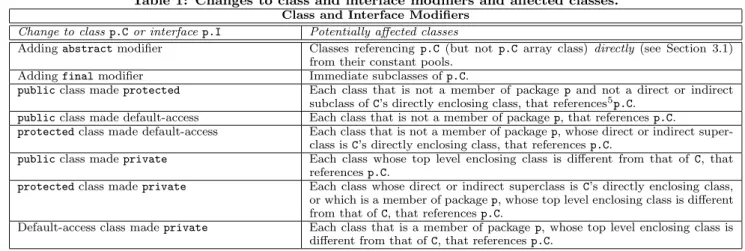
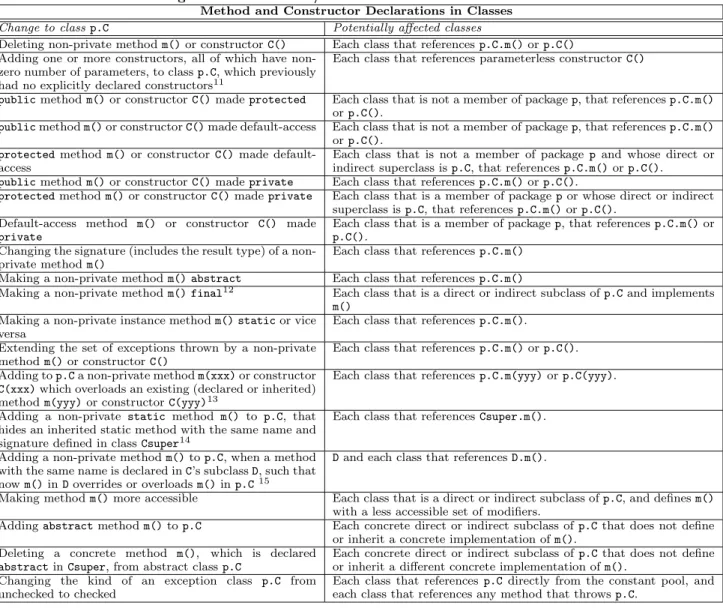
Tables 1 – 5 define all of the source incompatible changes to classes which are detected by Javamake, and for each such change the classes that may be affected by it. The list of source incompatible changes was created by studying Chapter 13 of JLS, and also the work by Drossopoulou et al. [11] (the latter group worked on issues related to for-mal verification of Java programs and has discovered some “holes” in the JLS). Then we determined what constructs in other classes, if not changed, will cause source incompatibil-ity problems. These statements refer to the class or interface being changed (denotedCorI) in one way or another. After compilation, these references are placed in various parts of the binary Java class (see details in the next section). Sum-marising the above information, we can finally derive criteria for determining a set of classes that are affected by a par-ticular change. In some cases, however, we extended these sets of classes, to avoid implementing complex procedures that parse method bytecodes. For example, it is clear that if class C is madeabstract, then only those classes which previously contained the “new C()” expression, need to be recompiled. We, however, replace the test for the presence of a bytecode corresponding to “new C()” with a simpler test for a reference to class C from the constant pool (see next section) of another class. Our observations show that usually this kind of change is rather rare. When it happens, the number of classes recompiled unnecessarily and, what is more important, the overall time overhead caused by such a lack of precision, is usually very tolerable, i.e. is of order of 10-20 per cent of the total execution time.
In these tables, we denote a changed class or interfacep.C orp.I, wherepis a full package name andCis the remainder of the class name (for top-level classes it is a simple class name, and for nested classes it is the combination of all of its enclosing class names plus its simple name).
Several different forms of the “classAreferencesclassB” expression are used throughout these tables. How binary Java classes can be referenced from other classes, and how we define several qualified kinds of such references (for example “class A references class B directly from the constant pool” or “as a thrown exception”) is explained in the next section. As for class members, i.e. fields and methods, they can be referenced from classes only through the constant pool, so for the sake of brevity we simply say that “classAreferences memberm” everywhere.
Whenever in the “Potentially affected classes” part it is not specified in which packages, subclasses of other classes, etc. we should look up affected classes, it is implied that the search is restricted to the applicable subset of classes determined by the accessibility of the class member under consideration. For example, if aprotectedfield of classp.C is deleted, it makes sense to look for references to this field only in classes in the same packagepor subclasses ofp.C.
Table 1: Changes to class and interface modifiers and affected classes. Class and Interface Modifiers
Change to class p.Cor interfacep.I Potentially affected classes
Addingabstractmodifier Classes referencingp.C (but not p.Carray class) directly (see Section 3.1) from their constant pools.
Addingfinalmodifier Immediate subclasses ofp.C.
publicclass madeprotected Each class that is not a member of packagep and not a direct or indirect subclass ofC’s directly enclosing class, that references5
p.C.
publicclass made default-access Each class that is not a member of packagep, that referencesp.C.
protectedclass made default-access Each class that is not a member of packagep, whose direct or indirect super-class isC’s directly enclosing class, that referencesp.C.
publicclass madeprivate Each class whose top level enclosing class is different from that ofC, that referencesp.C.
protectedclass madeprivate Each class whose direct or indirect superclass isC’s directly enclosing class, or which is a member of packagep, whose top level enclosing class is different from that ofC, that referencesp.C.
Default-access class madeprivate Each class that is a member of packagep, whose top level enclosing class is different from that ofC, that referencesp.C.
Table 2: Changes to superclass/superinterface declarations and affected classes. Superclasses and Superinterfaces
Change to class p.Cor interfacep.I Potentially affected classes
Deleting class (interface)Sfrom the list of super-classes (directly or indirectly implemented inter-faces) of classp.C
Each class that referencesbothSandp.C(or array classes for one or both) as follows: from their constant pools (directly orindirectly), as a type of a data field, as a type in a method (constructor) signature or a thrown exception, as a direct or indirect superclass or superinterface.
Table 3: Changes to field declarations and affected classes. Class and Interface Field Declarations
Change to class p.Cor interfacep.I Potentially affected classes
Adding a non-private field f to p.Cthat hides a non-private field with the same name inp.C’s su-perclassS6
Each class that referencesC.f
Deleting a non-private fieldffromp.C7
Each class that referencesp.C.f
publicfieldfmadeprotected Each class that is not a member of packagep, that referencesp.C.f8 .
publicfieldfmade default-access Each class that is not a member of packagep, that referenciesp.C.f.
protectedfieldfmade default-access Each class that is not a member of packagep and whose direct or indirect superclass isp.C, that referencesp.C.f.
publicfieldfmadeprivate Each class that referencesp.C.f
protectedfieldfmadeprivate Each class that is a member of packagepor whose direct or indirect superclass isp.C, that referencesp.C.f.
default-access fieldfmadeprivate Each class that is a member of packagepthat referencesp.C.f. Non-private fieldfmadefinal Each class that referencep.C.f
A final modifier is deleted for a non-private f
field which is acompile-time constant, or its initial value changed, or such a field is deleted9
Each class from whichp.C.fis accessible.
Non-private instance field fmadestaticor vice versa
Each class that referencesp.C.f. Non-private fieldfmadevolatileor vice versa Each class that referencesp.C.f.
Table 4: Changes to interface method declarations and affected classes. Method Declarations in Interfaces
Change to interfacep.I Potentially affected classes
Adding methodm()10
Each non-abstract class that directly implementsp.Ior some subtype ofp.I, or that is a direct subclass of an abstract class that implementsp.Idirectly or indirectly.
Table 5: Changes to class method/constructor declarations and affected classes. Method and Constructor Declarations in Classes
Change to class p.C Potentially affected classes
Deleting non-private methodm()or constructorC() Each class that referencesp.C.m()orp.C()
Adding one or more constructors, all of which have non-zero number of parameters, to classp.C, which previously had no explicitly declared constructors11
Each class that references parameterless constructorC()
publicmethodm()or constructorC()madeprotected Each class that is not a member of packagep, that referencesp.C.m()
orp.C().
publicmethodm()or constructorC()made default-access Each class that is not a member of packagep, that referencesp.C.m()
orp.C().
protectedmethodm()or constructor C()made default-access
Each class that is not a member of package p and whose direct or indirect superclass isp.C, that referencesp.C.m()orp.C().
publicmethodm()or constructorC()madeprivate Each class that referencesp.C.m()orp.C().
protectedmethodm()or constructorC()madeprivate Each class that is a member of packagepor whose direct or indirect superclass isp.C, that referencesp.C.m()orp.C().
Default-access method m() or constructor C() made
private
Each class that is a member of packagep, that referencesp.C.m()or
p.C(). Changing the signature (includes the result type) of a
non-private methodm()
Each class that referencesp.C.m()
Making a non-private methodm() abstract Each class that referencesp.C.m()
Making a non-private methodm() final12
Each class that is a direct or indirect subclass ofp.Cand implements
m()
Making a non-private instance methodm() staticor vice versa
Each class that referencesp.C.m(). Extending the set of exceptions thrown by a non-private
methodm()or constructorC()
Each class that referencesp.C.m()orp.C(). Adding top.Ca non-private methodm(xxx)or constructor
C(xxx)which overloads an existing (declared or inherited) methodm(yyy)or constructorC(yyy)13
Each class that referencesp.C.m(yyy)orp.C(yyy).
Adding a non-private static method m() to p.C, that hides an inherited static method with the same name and signature defined in classCsuper14
Each class that referencesCsuper.m().
Adding a non-private methodm()top.C, when a method with the same name is declared inC’s subclassD, such that nowm()inDoverrides or overloadsm()inp.C15
Dand each class that referencesD.m().
Making methodm()more accessible Each class that is a direct or indirect subclass ofp.C, and definesm()
with a less accessible set of modifiers.
Addingabstractmethodm()top.C Each concrete direct or indirect subclass ofp.Cthat does not define or inherit a concrete implementation ofm().
Deleting a concrete method m(), which is declared
abstractinCsuper, from abstract classp.C
Each concrete direct or indirect subclass ofp.Cthat does not define or inherit a different concrete implementation ofm().
Changing the kind of an exception class p.C from unchecked to checked
Each class that references p.Cdirectly from the constant pool, and each class that references any method that throwsp.C.
An unexpected conclusion that one can make looking at these tables is that most of the kinds of changes to Java classes are formally source incompatible, and under certain circumstances can break something in a particular project (in practice, though, this does not happen very often, since at least humans tend to make compatible changes much more often than incompatible ones). Another conclusion is that such properties of the Java language as nested classes, abstract and interface types, and various accessibility modi-fiers, result in most of the non-trivial content of these tables, i.e. entries saying more than just ”all classes referencing the changed member”. To some surprise, the “adding a method to an interface” change has resulted in the most complex criteria for determining affected classes.
5
From now and until the end of this table, “references” means “referencesp.C(or its array class) as follows: directly from the constant pool, as a type of a declared data field, as a type in a method (constructor) signature or a thrown exception, as a directly implemented interface or a direct superclass”.
6
This is a binary compatible change (JLS,§13.4.7). How-ever, it is source incompatible.
7
This means that the field is no longerdeclared in class C. According to the Java class bytecode specification, all refer-ences to a field in other classes have a strict formC.f, so even iffis moved to a superclass ofC, classes compiled against the old version ofCwill not run with the new version. 8
One may think that a more appropriate criterion could be “Each class that is not a member of packagepand is notC’s direct or indirect subclass, that referencesp.C.f”. However, according to the JLS§6.6.2, subclasses ofp.Cthat are not members of packagephave to follow additional restrictions to access protected members of p.C, so their code needs checking as well. The same comment applies toprotected methods.
9
A field is called compile-time constant if it isfinal,static and initialised with a compile-time constant expression. The above change is binary compatible (JLS,§13.4.8). However, it is source incompatible, since pre-existing Java binaries include thevalueof the constant, rather than a reference to it, and will not see any new value for the constant, unless they are recompiled. This is a side-effect of the support of conditional compilation in Java, as discussed in JLS§14.19. 10
This is a binary compatible change (JLS,§13.5.3). How-ever, it is source incompatible — for example, some class implementingImayalreadydefinem(), but non-public. 11
This is equivalent to deletion of the only existing parame-terless constructor.
12
Making a static method final is a binary compatible change (JLS,§13.4.16). However, it is source incompatible. 13
This is a binary compatible change (JLS,§13.4.22). How-ever, it is generally source incompatible, because for some dependent classes a problem of finding the most specific (JLS,§15.11.2.2) method or constructor can arise.
14
This is a binary compatible change (JLS,§13.4.23). How-ever, it is source incompatible, since due to possible strict references to methodCsuper.m()from bytecodes ofC’s de-pendent classes, their behaviour will be not as expected, if their sources are not recompiled.
15
Citing the JLS,§13.4.5, “Adding a method that has the same name, accessibility, signature, and return type as a method in a superclass or a subclass is a binary compatible change”. However, in a more general case, i.e. when the ac-cessibility or the signature of the added method may be dif-ferent, this kind of change is generally source incompatible. The compilation errors like “method made less accessible in a subclass” or “failure to find most specific method” may arise, or method calls can be re-bound to different methods during recompilation.
3.1
References in Java Class Files
Our tables of incompatible changes present the conditions under which classes should be recompiled in a technically precise form. Therefore, we use some special terms, first in-troduced in the specification of binary class format in JVMS, plus our own termsdirectand indirect references from one binary Java class to another. Below is a short summary of class referencing issues.
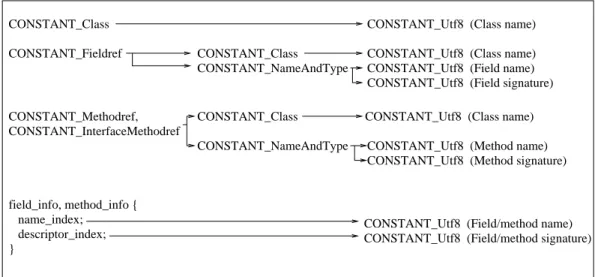
A binary Java class references other classes and their mem-bers only symbolically, i.e. by textual names. All these names are stored in the form of string constants in this class’sconstant pool, which is a table of variable-length struc-tures representing various constants that are referred to by the class. How can we find out which string constants con-tain real class names? We can do that firstly by tracing ref-erences from other entries of the constant pool, which have more explicit types, denoted as follows: CONSTANT Class, CONSTANT Fieldref, CONSTANT Methodref and CONSTANT InterfaceMethodref. These entries are added to the constant pool of class CifCreferences some other class Dexplicitly, or referencesD’s fields or methods. In addition, every class that declares its own fields or methods has a non-emptyField tableandMethod table. Entries of this ta-ble, denoted field infoand method info, contain indexes into the constant pool, and at these indexes there are string constants (constant pool entries of typeCONSTANT Utf8) rep-resenting the names and signatures of the respective fields and methods. The structure of each of the presented con-stant pool entry types, as well as of a Field/Method table entry, is depicted in Figure 1. Arrows represent indexes of other entries which the given entry references.
By saying that classCis referenceddirectlyfrom the con-stant pool of another class, sayD, we mean just that there is a separateCONSTANT Classentry for classCinD’s constant pool. This kind of reference appears, for example, if a “new C()” statement or a declaration of a local variable of typeC appears somewhere in the source code ofD.CONSTANT Class entries for C also appear in D’s constant pool (in addition to the relevantCONSTANT Fieldrefor CONSTANT Methodref entries), if classDuses a field or calls a method declared in classC.
On the other hand, if, for example, classDcalls a “void m(C c)” method of yet another class E, then the only ref-erence fromDtoCwill be through the signature of method m(C c), which is stored inD’s constant pool. We call this an indirectreference toCfrom the constant pool ofD.
One additional complexity that we have to cope with is due to a change in the Second Edition of the JLS, which, however, has only recently been reflected in the Sun’sjavac compiler (we are presently unaware of any other Java com-pilers changed in the same way). Consider the following example:
class A { public void m() { }; } class B extends A { }
class C {
public static void main(String args[]) { A a = new A(); a.m();
B b = new B(); b.m(); }
}
In binary classes created byjavac prior to JDKTM
ver-CONSTANT_Class
CONSTANT_InterfaceMethodref
CONSTANT_NameAndType
CONSTANT_Utf8 (Method signature) CONSTANT_Methodref,
field_info, method_info {
descriptor_index; }
name_index; CONSTANT_Utf8 (Field/method name) CONSTANT_Utf8 (Field/method signature)
CONSTANT_Utf8 (Class name)
CONSTANT_NameAndType
CONSTANT_Utf8 (Field signature) CONSTANT_Utf8 (Field name) CONSTANT_Fieldref CONSTANT_Class CONSTANT_Utf8 (Class name)
CONSTANT_Class CONSTANT_Utf8 (Class name)
CONSTANT_Utf8 (Method name)
Figure 1: Binary Class Constant Pool Entries Structure
sion 1.4, both of the calls tom()in the above example would result in the same reference to methodA.m()inC’s constant pool. However, since version 1.4,javac creates a separate, receiver type dependent, member reference in cases such as theb.m()call above. This call will now be compiled into the reference to (non-existent in this case) methodB.m(). At run time, the JVM resolves such a reference correctly, de-pending on the real structure of classesAandB. This change to the JLS was made in order to increase the robustness of applications assembled from classes coming from indepen-dent sources. However, to handle such, effectively “fake”, references in Javamake, we have to take special measures. If we detect a change to membermof classA, we scan project classes that may depend onA, looking for references to mem-berm. Whenever we find such a reference, we analyse its class part, checking whether the referenced class isA or a subclass ofA, sayB. In the latter case we check ifmis over-ridden inB, or in any class betweenAandBin the hierarchy. If not, then the reference is really to A.m and should be treated accordingly.
3.2
About Nested Classes
Nested classes are classes defined within bodies of other classes. They were first introduced in JDK 1.1 to support the new model of event handling in GUI (Graphical User Interface) programs. In such programs, nestedanonymous classes are used essentially as placeholders for methods that handle events. An instance of a nested class which defines methodm()is first passed to a GUI library (AWT or Swing) class, and thenm() is called when an appropriate event is generated. In effect, an instance of an anonymous class is used instead of what would be a function pointer in some other language. The advantage of using nested classes in-stead of top-level classes in this particular case is that we can define a number of classes with event handling meth-ods (the latter are typically very short) “in place”, within the body of a single top-level class. Otherwise this model of event handling would require us to create countless number of separate classes, each in a separate source file, and each responsible for handling, e.g., a single menu item.
Staticnested classes is another useful category of nested
classes. These are in all respects similar to top-level classes, but also have access to private members defined in their enclosing class. It is a good idea to make some class a static nested one if it is small and probably too insignificant to put in a separate source file, yet the developer would like to avoid the bad practice of putting multiple top-level classes in one source file.
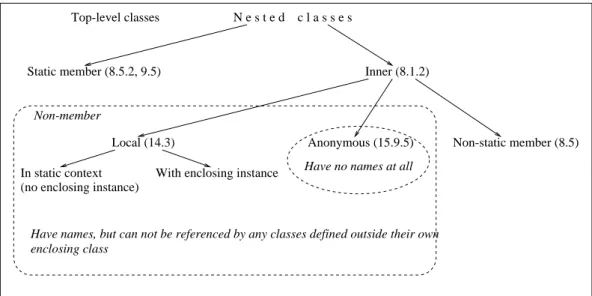
Nested classes introduce additional complexity that our tool has to deal with. First of all, they do not have their own source files, thus we must take additional steps to locate such classes and keep track of them (see Section 2.3). In addition, it turns out that not all kinds of nested classes should be treated in the same way as top-level classes — namely, it does not make sense to keep track of versions for some of them. To see why, and to better understand the issues related to nested classes, let us first present a general picture of nested classes in the Java programming language. The description of the various kinds of nested classes is scattered about the Java Language Specification, Second Edition [12] in a number of sections in different chapters. In-stead of reproducing their contents in this paper, we present a diagram (see Figure 2), on which the taxonomy of nested classes is depicted, with a reference to the appropriate sec-tion of the JLS for each item.
Any non-member nested class, which includes local and anonymous classes, may not be referenced by the source code of any class defined outside the immediately enclosing source code block for this class. Thus, no change made to a non-member classC, even its complete deletion, can affect any other class except those defined within the same source code block. These latter classes will be recompiled anyway when C changes, since they reside in the same source file asC. Therefore, versions of non-member nested classes need not be compared during step 10 of the Javamake algorithm (see Section 2.4). Instead, the new versions are saved uncon-ditionally in the project database whenever such a class is changed. We still have to keep track of non-member nested classes during other phases of Javamake execution since such classes themselves may reference other (top-level and mem-ber) classes, and thus may need recompilation in case of incompatible changes to the latter.
Top-level classes N e s t e d c l a s s e s
Inner (8.1.2)
Local (14.3) Anonymous (15.9.5) Non-static member (8.5)
In static context (no enclosing instance)
With enclosing instance Have no names at all
Non-member
Have names, but can not be referenced by any classes defined outside their own enclosing class
Static member (8.5.2, 9.5)
Figure 2: Taxonomy of nested classes in the Java programming language
4.
EVALUATION
In this section, we first present the results of performance measurements for Javamake. We then compare its “qual-ity”, measured as the number of correctly spotted inconsis-tent changes, with that for several other tools supporting smart dependency checking.
4.1
Performance
It is essential for a make tool like Javamake to keep the overhead above the time it takes to recompile the changed sources to the minimum, since, after all, such a tool is de-signed to minimise development turnaround time. However, certain kinds of overhead are inherent to all make tools that work with files, e.g. they all have to read time stamps of all of the project files, which is a relatively time-consuming op-eration. In our case it also makes sense to compare the time it takes to run our tool with the time it takes to recompile the whole project, since in the absence of smart dependency checking technology the latter is the only way to ensure that the project is consistent.
Our experimental setup consisted of a Sun EnterpriseTM 3500 machine with four UltraSparcTM
II processors, with 4 GB RAM, running the SolarisTM
Operating Environment, version 2.8. The HotSpotTM
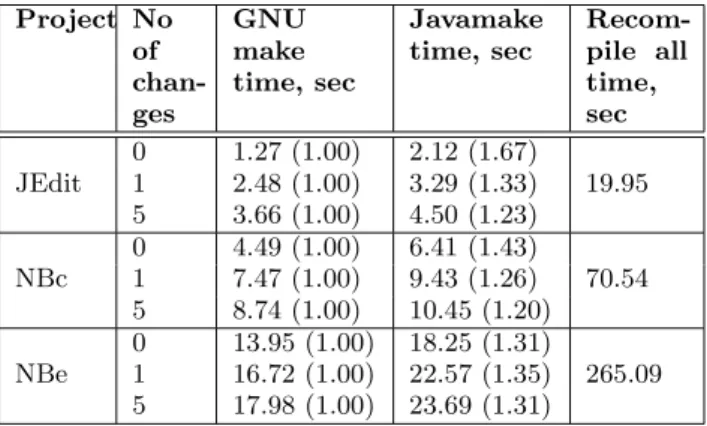
Java VM and thejavacJava compiler from JDK Version 1.4 were used. As compila-tion targets we used two projects,jEditandNetbeans, freely available on the Internet (at Web siteswww.sourceforge.net andwww.netbeans.orgrespectively). From the latter pro-ject, we compiled two code subsets: the “core” and the “ex-tended” one, differing by size. We refer to these subsets as NBc and NBe in the following discussion. The characteris-tics of these projects are presented in Table 6.
The results of the first set of our measurements are pre-sented in Table 7. We compared the time it takes Javamake and the popular make tool GNU make (version 3.78, avail-able fromwww.gnu.org) to run for the same project, and the time it takes to recompile the whole project from scratch. For each tool, we measured three values: the time it takes to run it over the completely unchanged set of sources, the time it takes to run the tool plus the compiler when an
incompat-Table 6: Target projects characteristics
Project KLOC Number
of sources Number of classes JEdit 72.2 246 466 Netbeans “core” (NBc) 230 843 2373 Netbeans “ex-tended” (NBe) 611 2580 6558
ible change is made to a single source file (though this par-ticular change does not break anything in the project), and the time when 5 incompatible changes are made to 5 source files (again, nothing is broken). The incompatible changes in each case were: making a public class package-private, mak-ing a public field package-private, makmak-ing a public method package-private, making a method final, and making pro-tected method public. In the zero changes case, we ob-serve the overhead due to functionality which is common to Javamake and GNU make (time stamp checking for files). Comparing the other two execution times for GNU make and Javamake indicates additional overhead due to depen-dency checking in Javamake, and can be viewed as a typical “response time” of this tool that one is likely to expect in practice.
The measurements show that Javamake runs slower than GNU make generally by a factor of 1.2...1.4, depending on the project characteristics. This is an expected, even a very good result, given that Javamake runs on top of a JVM16 and performs a number of operations, such as reading a project database from disk, that the traditional make utility does not perform. We believe that the absolute overhead of Javamake is also within acceptable bounds in all cases. 16
For small projects and small number of changes, the con-stant JVM startup time becomes a considerable part of the total Javamake execution time — hence a notable relative performance degradation of Javamake recorded in the first line of Table 7.
Table 7: Javamake vs. GNU make performance evaluation Project No of chan-ges GNU make time, sec Javamake time, sec Recom-pile all time, sec 0 1.27 (1.00) 2.12 (1.67) JEdit 1 2.48 (1.00) 3.29 (1.33) 19.95 5 3.66 (1.00) 4.50 (1.23) 0 4.49 (1.00) 6.41 (1.43) NBc 1 7.47 (1.00) 9.43 (1.26) 70.54 5 8.74 (1.00) 10.45 (1.20) 0 13.95 (1.00) 18.25 (1.31) NBe 1 16.72 (1.00) 22.57 (1.35) 265.09 5 17.98 (1.00) 23.69 (1.31)
Table 8: Project database characteristics
Project JEdit NBc NBe
PDB size, KB 404 1670 4011 PDB create time, sec 1.60 (41%) 7.81 (78%) 24.52 (106%) PDB read time, sec 0.34 (9%) 1.05 (11%) 1.92 (8%) PDB write time, sec 0.37 (10%) 1.07 (11%) 2.08 (9%)
That is, developers would be willing to pay this small cost for safety that they get — especially if it is compared to the much greater (by a factor of 5 to 10) time needed for complete recompilation of the whole project.
The data on the disk space and performance overhead due to the presence of a project database is presented in Table 8. We have measured the size of the project database and several performance characteristics. The first one is the initial time to create a project database on the first invoca-tion of the tool for the given project. This time is spent in parsing.classfiles and creating the corresponding internal data structures, and is a one-time overhead, since on subse-quent invocations usually only a fraction of classes changes, and the time to parse them is negligible. However, to read and write existing internal data structures to/from disk also requires time, and we present the corresponding measure-ments, both absolute and in percentage to the average total Javamake execution time for each project.
We have observed that project database size grows prac-tically linearly with the number of source code lines. The ratio between the above two values seems to vary little for all of the projects on which we tested our tool, and is be-tween 6.5 and 7.5 kbytes per 1 KLOC (thousand lines of source code). This yields e.g. a 4MB database for a project consisting of 611,000 lines of code, which we believe is quite modest overhead. For comparison, sources for this project occupy about 25MB of disk space, classes — about 10MB, and thejavac compiler should be invoked with the JVM heap size set to about 128MB to make it recompile all these sources in one go.
Table 9: Total dependency checking time, ms Number of
changes
JEdit NBc NBe
1 13 (0.40%) 21 (0.22%) 69 (0.31%) 5 49 (1.08%) 78 (0.74%) 211 (0.89%)
The time to create a project database can be quite sig-nificant, but since the project database is created once for a project, and after that a developer needs to re-create it rarely if at all, there is no practical reason to take this over-head into serious consideration. The time to read and write a project database appears to be pretty stable, each taking about 10 per cent of the average total execution time of the tool.
Dependency checking is the main part of our technology, so it was important to determine how much time it con-sumes. The results of the measurements, presented in Table 9, were a pleasant surprise for us (note that results in this ta-ble are in milliseconds, unlike in the other tata-bles). It appears that dependency checking, which may involve traversing the whole project database many times, nevertheless happens instantly compared to other operations. Its duration can vary depending on the project and on the particular change, but in none of our tests, and in further informal evaluation of our tool, did the proportion of time spent in dependency checking exceed 2 per cent of the total time. Thus it turns out that most of the time that our tool runs is spent in project database reading/writing, file timestamp checking, and source file recompilation. In Section 6 we explain that in certain circumstances the first two sources of overhead can be eliminated almost completely.
4.2
Detecting Incompatible Changes — How
Well Other Systems Do
A key characteristic of the quality of a dependency check-ing tool (provided that its performance is at least satisfac-tory) is its ability to correctly detect all possible incompat-ible changes and report inconsistencies caused by any such change. In order to determine how good in this respect our tool is, compared to others, we evaluated three presently available tools that support smart dependency checking: Bor-land JBuilder version 6.0, Eclipse version 2.5 and Jikes ver-sion 1.15 (detailed information on all these tools is presented in Section 5).
To compare the capability of these tools for detecting and handling incompatible changes, we created a set of test cases according to the tables given in Section 3. Each of these tests is a small set of Java classes that is initially consistent. Then an incompatible change is made, and the tool’s “smart make” command is invoked. We would then see if the re-sulting inconsistencies in dependent code were correctly de-tected, or, in case of a change which is binary compatible (though source incompatible), if dependent code was recom-piled properly.
Our evaluation has shown that of the three above tools, one tool could detect all of the incompatible changes as ef-ficiently as Javamake. One other tool was unable to detect one kind of change. As a result of this undetected change, the recompiled application would crash due to an unsatis-fied link error. Finally, the third tool was unable to detect
eight kinds of source incompatible changes. However, all these changes are binary compatible, so the resulting appli-cation would not crash. It would, however, work incorrectly, or an error would be reported by the compiler later, when attempting to explicitly recompile some dependent classes.
5.
RELATED WORK
So far we have found only three products supporting smart, or incremental, compilation of Java applications (for com-parison, the number of Java IDEs available now is nearly 20). Unfortunately, there are no publications on any of them, that would explain the internal details. Therefore the following discussion is based entirely on our own informal evaluation.
Borland JBuilder [7] Java IDE supports smart compilation (called “smart make” in its terminology), as one of the com-piler options, along with two others: “recompile the current file” and “recompile the whole project”. The implementa-tion of “smart make” seems to be based on the same princi-ples as our implementation: the so-calleddependency cache, which is equivalent to our project database, is created for each project and then used to determine which classes need recompilation.
IBM VisualAge for Java [14] is another Java IDE which provides smart (incremental, in their terminology) compi-lation. In VisualAge, the developer edits, saves and re-compiles methods individually, similar to the approach pi-oneered in Smalltalk, and is in contrast with most of the other IDEs which operate with the more traditional file-based source code representation. The incremental compiler is invoked automatically whenever a new Java class, inter-face, or method is created, or an existing one is changed. It recompiles the changed item, as well as all of the other items within the work space, that are affected by this change. If an incompatible change is made, the compiler immediately flags any inconsistencies created by that change.
Eclipse [2] is a highly extensible and configurable IDE (it is dubbed “a universal tool platform” by its creators), that is being developed as an open source project led by IBM. It has an incremental compiler, which is invoked every time a source file is changed and saved. The compiler checks any changed dependencies and flags all errors in sources that become inconsistent as a result of the change — much like in VisualAge.
The last product known to us that supports smart (incre-mental) compilation is the Java compiler called Jikes [13], an open source project being developed at IBM. This product is not an IDE, but a command-line compiler, which has an additional “incremental build” mode. The compiler enters this mode if it is invoked with a special “++” command-line option for a .java source file containing themain(String args[])method, e.g.
>jikes ++ myprog.java
This will compilemyprog.javaand other files that it de-pends on, as needed, and leave Jikes running. The developer can then changemyprog.javaor any of the source files it de-pends on, and simply hit “Enter” at the command line to tell Jikes to re-check the dependencies and only recompile files as required to bring the entire project up to date. The compiler will stay in this “hit Enter/rebuild” loop until the developer enters a “q”, which tells it to terminate. This ap-proach works well if the developer needs to just recompile the source files whenever they change, but, unfortunately,
is unusable if this recompilation is a part of a more general authomated make process.
As for other programming languages and academic works, we have managed to find only one relatively recent work [9] — a PhD thesis by Crelier describing design and im-plementation of fine-grain dependency checking for Oberon. Oberon supports dynamic loading and linking of software modules, but these modules themselves are machine-depen-dent object files. Therefore, a part of the problem solved in that work was to provide sufficient type information for symbols (called objects in this work) exported by modules, in such a way that if a type of an exported object changes, the change is reflected in the exported type information. This was achieved by using fingerprints which were calcu-lated as a function of, essentially, type name and structure information. Most of the complexity of this work lies in the area of correct fingerprint computation for complex type and their optimal storage in symbol files associated with mod-ules. Change to the fingerprint for an exported object nec-essarily leads to recompilation of clients that import this object. This is probably correct for Oberon, given that it does not provide e.g. various levels of member accessibility, such as protected or package-private access, or abstract, interface and nested types. The latter are the cause of most of the non-trivial entries in our tables of source incompatible changes. Determining how to calculate a fingerprint for an object in Crelier’s work seems quite similar to detecting an incompatible change and finding what can be affected by it, as it is done in our work.
6.
FUTURE WORK
The tables of source incompatible changes and affected classes presented in Section 3 were defined using the JLS, other works, and our own knowledge and experience, but, unfortunately, there is no formal proof of their complete-ness and correctcomplete-ness. Consequently, we cannot be absolutely sure that these tables identify all of the affected classes for each incompatible change. There is more confidence that they cover all possible incompatible changes to Java classes, since, after all, the number of class elements is limited and the taxonomy of changes is created as a series of additions, removals and changes to these elements. Formal proof of completeness and correctness can probably be achieved us-ing some kind of formal technique, e.g. similar to one used in [11] and other works by this group (see [1]).
It would also be very desirable to overcome the present problem with handling compile-time constants (see Table 3). At present, once such a constant changes, we have to recompile all classes that potentially can access it, because we have no way of finding out whether or not any class re-ally uses this constant. The only way to fix this problem is to make the Java compiler more cooperative. However, just changing it so that it starts to put referenced compile-time constants into the constant pool, will probably not work very well. That is because our tool will then have to guess whether the compiler that it is currently using is a “new” or the “old” one. With many Java compilers on the market, each evolving in its own way, this may be not an easy task. So a better solution may be to introduce a special binary class attribute that should always be present in a class file created by a “new” compiler, and should contain informa-tion on compile-time constants referenced by a class, if there are any (ornullotherwise).
One of our near-term goals is to provide an “incremen-tal” execution mode in our tool, which should be of partic-ular use when it is invoked from an IDE. In such a mode, Javamake reads the project database from disk once and then keeps it in memory permanently, until explicitly re-quested to terminate. Relatively high-cost database reading and writing operations are therefore performed only once each, upon the IDE startup and shutdown. Further speedup can be achieved if the IDE can provide Javamake the infor-mation on which sources have changed, so that the tool does not have to repeatedly perform another high-cost operation of checking all source file timestamps. Given that depen-dency checking itself is very fast (see Section 4), the “make” command of an IDE would impose virtually no overhead compared to the standard “compile” command.
7.
CONCLUSIONS
Optimum build management is very important, even vi-tal for developers of applications that consist of hundreds of thousands or millions lines of code. This issue is gener-ally understood, and smart dependency checking (also called smart make or incremental compilation — all viewed by us as variants of the general smart recompilation technique) is provided in several IDEs and compilers for the Java pro-gramming language. Despite that, there are, to our best knowledge, no publications that document such a technol-ogy for the Java language (or any other statically type-checked programming language that compiles source code into portable bytecodes) at the level of detail that would al-low to verify or improve it. This may be one reason why this technology does not seem to be implemented equally well in the few different tools where it is available. There are also very few contemporary academic publications in this area. With this paper, we hope to partially close this gap. We also hope that it may provide useful guidelines for designers of similar technologies for other programming languages.
8.
ACKNOWLEDGEMENTS
The approach to smart dependency checking presented in this paper, and the first version of the Javamake technol-ogy, was first designed and implemented by the author as a part of his work on persistent class evolution in the PJama project [5, 10], that was developed jointly by the Univer-sity of Glasgow, Scotland, and Sun Microsystems Laborato-ries. Professor Malcolm Atkinson, who was the author’s supervisor, provided support and valuable input for this work. Later at Sun Microsystems, Mario Wolczko and Gi-lad Bracha both supported the general Javamake technology implementation effort, have read the early drafts of this pa-per and provided valuable comments. The author is also grateful to Mick Jordan, Greg Czajkowski, and numerous early adopters of Javamake, in particular Nascif Abousalh-Neto from Nortel Networks, who reported several bugs in its early releases and provided other useful feedback.
9.
TRADEMARKS
Sun, Sun Microsystems Inc., Java, JVM, JDK, HotSpot, Solaris, Sun Enterprise 3500, and NetBeans are trademarks or registered trademarks of Sun Microsystems, Inc., in the United States and other countries. UltraSPARC is a trade-mark or registered tradetrade-mark of SPARC International, Inc. in the United States and other countries.
10.
REFERENCES
[1] Sound Languages Underpin Reliable Programming Project (SLURP), Imperial College, University of London, London, UK.
http://www-dse.doc.ic.ac.uk/Projects/slurp/index.html. [2] Eclipse Open Source Project.http://www.eclipse.org. [3] NetBeans Open Source Project.
http://www.netbeans.org.
[4] R. Adams, W. Tichy, and A. Weinert. The Cost of Selective Recompilation and Environment Processing. ACM Transactions on Software Engineering and Methodology, 3(1):3–28, January 1994.
[5] M.P. Atkinson and M.J. Jordan. A Review of the Rationale and Architectures of PJama: a Durable, Flexible, Evolvable and Scalable Orthogonally Persistent Programming Platform. Technical report, Sun Microsystems Laboratories Inc and Department of Computing Science, University of Glasgow, UK, 2000. TR-2000-90,
www.sun.com/research/forest/COM.Sun.Labs.Forest. doc.pjama review.abs.html.
[6] Borland Inprise Inc. C++ Builder 5.
http://www.inprise.com/bcppbuilder/. [7] Borland Inprise Inc. JBuilder.
http://www.inprise.com/jbuilder/. [8] Borland Inprise Inc. Delphi 5.
http://www.inprise.com/delphi/.
[9] R. Crelier.Separate Compilation and Module Extension. PhD thesis, ETH Zurich, Institute of Computer Systems, 1994.
[10] M. Dmitriev.Safe Evolution of Large and Long-Lived Java Applications. PhD thesis, Department of Computing Science, University of Glasgow, UK, 2001. Available athttp://www.dcs.gla.ac.uk/∼misha/papers. [11] S. Drossopoulou, D. Wragg, and S. Eisenbach. Whatis
Java Binary Compatibility? In C. Chambers, editor, Object Oriented Programing: Systems, Languages, and Applications (OOPSLA), volume 33(10) ofACM SIGPLAN Notices, Vancouver, BC, October 1998. [12] J. Gosling, B. Joy, G. Steele, and G. Bracha.The Java
Language Specification, Second Edition. Addison-Wesley, June 2000.
[13] IBM Inc. The Jikes Open Source Project.
http://oss.software.ibm.com/
developerworks/opensource/jikes/project/index.html. [14] IBM Inc. VisualAge for Java.
http://www-4.ibm.com/software/ad/vajava/.
[15] T. Lindholm and F. Yellin.The Java Virtual Machine Specification, Second Edition. Addison-Wesley, 1999. [16] Microsoft Corp. Microsoft Visual C++ Home Page.
http://msdn.microsoft.com/visualc/default.asp. [17] R.W. Schwanke and G.E. Kaiser. Smarter
Recompilation.ACM Transactions on Programming Languages and Systems, 10(4):627 – 632, October 1988.
[18] W. Tichy. Smart Recompilation.ACM Transactions on Programming Languages and Systems,
8(3):273–291, July 1986. [19] WebGain. Visual Cafe 4.0.