The International Journal of Game-Based Learning is indexed or listed in the following: Bacon’s Media Directory; Cabell’s Directories; DBLP; Google Scholar; INSPEC; JournalTOCs; MediaFinder; ProQuest Advanced Technologies & Aerospace Journals; ProQuest Computer Science Journals; ProQuest Illustrata: Technology; ProQuest SciTech Journals; ProQuest Technology Journals; PsycINFO®; SCOPUS; The Standard Periodical Directory; Ulrich’s Periodicals Directory
Copyright
The International Journal of Game-Based Learning (IJGBL) (ISSN 2155-6849; eISSN 2155-6857), Copyright © 2015 IGI Global. All rights, including translation into other languages reserved by the publisher. No part of this journal may be reproduced or used in any form or by any means without written permission from the publisher, except for noncommercial, educational use including classroom teaching purposes. Product or company names used in this journal are for identifi cation purposes only. Inclusion of the names of the products or companies does not indicate a claim of ownership by IGI Global of the trademark or registered trademark. The views expressed in this journal are those of the authors but not necessarily of IGI Global.
RESEARCH ARTICLES
1 Teachers’ Experience and Refl ections on Game-Based Learning in the Primary Classroom: Views from England and Italy
Yasemin Allsop, Manchester Metropolitan University, Manchester, UK John Jessel, Goldsmiths, University of London, London, UK
18 Making Smart Choices: A Serious Game for Sex Education for Young Adolescents Alvin C.M. Kwan, University of Hong Kong, Pokfulam, Hong Kong
Samuel K.W. Chu, University of Hong Kong, Pokfulam, Hong Kong
Athena W.L. Hong, School of Nursing, University of Hong Kong, Pokfulam, Hong Kong Frankie Tam, FifthWisdom Technology Limited, Hong Kong
Grace M.Y. Lee, The Family Planning Association of Hong Kong, Wanchai, Hong Kong
Robin Mellecker, Institute of Human Performance, University of Hong Kong, Pokfulam, Hong Kong 31 Mixed Reality Games
Jean-Charles Marty, LIRIS, UMR5205, F69621, Université de Lyon, France & Université de Savoie, France
Thibault Carron, LIP6, UMR7606, Sorbonne Universites, Paris 6, France & Université de Savoie, France Philippe Pernelle, DISP Lab, Université de Lyon, Lyon, France
Stéphane Talbot, Université de Savoie, Chambéry, France
Gregory Houzet, Imep-Lahc Lab, Université de Savoie, Chambéry, France
46 Transforming Classrooms through Game-Based Learning: A Feasibility Study in a Developing Country
Poonsri Vate-U-Lan, Graduate School of eLearning, Assumption University, Bangkok, Thailand
Table of Contents
January-March 2015, Vol. 5, No. 1
International Journal of
ABSTRACT
This study aims to provide a comparative account of teachers’ experience and views of their role when us-ing digital games in primary classrooms in England and Italy. Interviews and a survey administered online and in hardcopy were used to find out teachers’ perceptions of game-based learning and how these impact upon their role as a teacher. This research also considers the interview findings in relation to the dynamics between curriculum design, learning culture and practice when implementing game-based learning. A strong link was found between how learning is designed to incorporate digital games, the theories and strategies that have been used in the context of a given curriculum and how these are realised in practice within the classroom. The research also showed that teachers are aware that their roles when using new technologies in education have changed. However, because of the lack of necessary training, teachers are not clear on how to adopt these changes. In some respects the curriculum was regarded to be flexible enough to accommodate game-based learning, however, in other respects it was felt that a more radical reform this would be needed. The difference in country-specific curricula, pedagogy and practice highlights the need for a flexible model or approach of embedding digital games into primary classrooms in a way that is sensitive to context. Some practical guidelines based on the current work are also provided.
Teachers’ Experience and
Reflections on
Game-Based Learning in the
Primary Classroom:
Views from England and Italy
Yasemin Allsop, Manchester Metropolitan University, Manchester, UK John Jessel, Goldsmiths, University of London, London, UK
Keywords: Curriculum, Digital Game Design, Game-Based Learning, Pedagogy, Teachers’ Perceptions, Teacher’s Role in GBL
INTRODUCTION
Digital games, as with games in many other forms, provide a setting, rules and constraints within which players can interact, either with each other or an aspect of the game environment in order to achieve some form of goal. In addi-tion to the variety of commercial games aimed primarily at the entertainment market, there are many digital games that have been developed for educational purposes. These can present problems to be solved, allow exploration of a model of some aspect of our world, invite col-laboration, role play and so on. Drawing on these qualities, the scope for facilitating learning and the educational value of digital games has for some time been of interest to many reviewers (Allsop, 2012; Robertson & Howells, 2008; Spires, Rowe, Mott & Lester, 2011; Bucking-ham, 2007). However, the implementation of digital games into primary classrooms is still at the beginning phase. While it appears that many children spend hours playing digital games and researchers continue to investigate the potential for learning with this medium, teachers are still not fully clear about their role in the game-based learning (GBL) environment (Futurelab, 2006). Reasons for this may include a lack of estab-lished and clear policy for both learning through games and game making in schools with regard to the teacher’s role, or not providing enough time for teachers to become familiar with the mechanics of digital games. Another important reason, however, could be teachers not having the pedagogical knowledge that they need for teaching with digital games. According to Jessel (2012: 28), “Innovation arising from new tech-nologies makes a variety of demands upon the role of the teacher”. He continues, “At another level, the introduction of innovation makes major demands upon teachers’ pedagogical, professional and managerial skills” (ibid.: 28). Using traditional methods of teaching may not be the most effective approach if teachers aim to maximise the potential of learning with digital games. As new technologies evolve, it can be
argued that the focus point should be moved from the technology itself towards developing a model so that teachers can consider how it can be used in terms of what can be achieved in practice and which pedagogical strategies need to be adopted. If games can provide a dynamic learning space that is extended in time then ef-fective utilisation of this may require adoption of different teaching strategies and classroom management skills.
In a recent conversation during a Comenius project between one of the authors in her role as a teacher based in England, and educators from other European countries, an interest arose on the use of digital games. The similarities and differences in implementing technology into education across the curriculum, and the tools that are used including digital games for learning, were then discussed in detail with a teacher from Italy. This discussion laid the foundations for the present study, where the placement of digital games in the curricula for Italy and England and how they have been used by teachers in primary classrooms would be investigated.
AIMS
The current study aims to present a review of teachers’ perceptions on the use of computer games in primary schools in England and Italy. It also intends to find out the key factors which impact on teachers’ attitudes towards using digital games in teaching.
We first outline some aspects of the cur-ricula relating to the two countries and then consider the pedagogical approaches and demands that are relevant to the use of digital games. We then report on the data obtained from teachers regarding how digital games are recognised in relation to the primary curriculum for each of the two countries. Finally, we will explore what works well in supporting teach-ers to embed digital games into their teaching practice through investigating the interrelation between pedagogy, curriculum and practice.
ENGLAND
In England, Information and Communication Technology (ICT) was placed in the National Curriculum for England (1999) for children from the ages 5-16 as an individual subject and also as a tool for teaching and learning. Although the position of digital games in edu-cation was not defined, the potential of new technologies for developing thinking skills was emphasised. In the new Draft National Curriculum for England, which will be active from 2014, the term ICT has been replaced by Computing, and writing, designing and testing programs is included as part of the programme of study. The new focus is to teach pupils how digital systems are designed and programmed and then allow them to apply this knowledge to solve problems by designing solutions and creating products. Although it may be desirable to have programming as part of the curriculum, it places demands on schools whereby they now need to plan how to deliver the related attain-ment targets as lessons. The key technology skills that learners need to acquire are clearly stated, however decisions for the context they are to be taught or the tools that are used are left entirely to schools and teachers. There are also no clear indications on how many hours children should be taught technology.
While game design activities can be used to meet the aims of the new curriculum, in many cases game design activities have been limited to after school clubs mostly run by enthusiastic volunteer teachers. Preparing the whole school to meet this new demand may therefore present challenges. Budget cuts in the UK have impacted on the level of training services hitherto provided by local education authorities and ‘City Learning Centres’ which were established to offer ICT-based learning opportunities for schools and for the wider com-munity. A survey reported by Williamson (2009) shows that although many teachers in the UK are interested in game-based learning, the use of digital games in the classroom is seldom: a lack of teacher subject knowledge, not enough
training opportunities, technical problems, cost, e-safety concerns and learners not necessarily seeing a link between games and learning are seen as barriers to the use of digital games in education by teachers.
Including programming in the curriculum, then, does not guarantee it will be practised in schools. Having new technologies as part of the curriculum places demands on teachers which may require training in pedagogy as well as technology.
ITALY
In Italy, although games and their benefits are mentioned in the curriculum (la normativa itali-ana dal 2007), this does not necessarily point at the use of digital games. In general, the use of ICT in education to develop the knowledge and skills of pupils in this digital age was included in the curriculum under the title ‘Computer Sci-ence and Technology’. The role of ICT as a tool for learning has been well defined for primary levels. According to the curriculum document, by using ICT for learning, pupils will learn to present and share their work; they will also use educational games for communication and col-laboration. Although teachers in Italy are very interested in using new technologies including digital games in their teaching they do not feel confident enough to use them. According to a study of the impact of technology in primary schools, 62% of teachers think that they and their other teaching colleagues lack sufficient computer skills and that this is the main barrier for ICT use (STEPS, 2011). One interesting point is, the inclusion of ICT in initial teacher training in terms of both technical skills and pedagogical approaches. Although there are training opportunities for in-service teachers, these are not compulsory. There are no require-ments for teachers to have ICT skills. Innovative teachers are described as those who adopt active learning methodologies and use new digital technologies to meet students’ needs and learn-ing goals. However, the integration of ICT into
cross-curricular subjects especially for learning languages and basic skills in mathematics and literacy is still a work in progress.
In Italy, while the order of teaching is also left up to the schools and teachers, in compari-son to England there are limitations in that only small departures from an annual compulsory lesson timetable set out in the Italian Educa-tion Ministry are allowed. In Italy the statutory curriculum for ICT and Computing skills is introduced in the lower secondary phase, from age 14 (Sturman & Sizmur, 2011).
A DYNAMIC ALLIANCE:
CURRICULUM, PEDAGOGY
AND PRACTICE
The effective use of digital games in the class-room to promote learning does not, of course, occur in isolation. Pedagogical approaches within education are not necessarily detached from cultural traditions and beliefs; thus trans-forming education systems to accommodate game-based learning is a more complex task than re-arranging a classroom space. Pepin (2010) suggests that the cultural traditions and philosophical beliefs of countries determine the principles that a national curriculum is de-signed upon, along with teachers’ pedagogies in schools. Consequently, the content and aim of the curriculum itself places expectations on teachers. In many education systems where the curriculum is designed to evaluate learning through test scores, teachers use pedagogy to serve and meet this purpose rather than focusing on how to develop other forms of learning. This may not only limit teaching methods used, but may also limit the notion of meeting different learning needs of students which in most cases results as a failure in education.
Although we will refer to technology-specific aspects of the curriculum relating to Italy and England, we are also mindful that these are set amongst other notions, including those relating to the nature of knowledge and learning. If we regard pedagogy, for example, as ‘any conscious action by one person designed
to enhance learning in another’ (Mortimore, 1999: 3) then the perspective on learning that we take, consciously or unconsciously for that matter, will also feature. For example, in some curriculum contexts greater emphasis may be placed on knowledge as an objective entity while other curricula may place more empha-sis on knowledge being negotiated, subject to paradigm shifts (Kuhn 1962) or pertaining to a social reality. These views carry with them implications for learning approaches. A game that is designed to reinforce adherence to items regarded as fact will differ from another game that encourages learners to adopt a range of strategies that may lead to different outcomes. Within this latter setting, learners may either as individuals create mental structures represent-ing their understandrepresent-ings (McKendry, 2006) or pursue this in conjunction with a more experi-enced other (Vygotsky, 1978). These perspec-tives on learning also raise issues regarding those designated as ‘student’ or ‘teacher’. If one of these is regarded as more experienced or in some way more knowledgeable then the asymmetry in this relationship may also be reflected in what goes on within the classroom. Another possibility that can also be considered, particularly in terms of peer collaboration and dialogue that may take place in relation to a digital game, is the asynchronous or synchro-nous communication afforded through digital technology (Conole at al., 2004). The idea of dialogue, especially when conceived as a an interplay of ideas with no one voice being superior to another, places further emphasis on the negotiated, collective and social nature of learning where the outcomes are distributed amongst those who collaborate (Bakhtin, 2004; Vaagan, 2006).
Perspectives on learning such as those above intersect with pedagogy, curriculum and, ultimately, practice. Even within a given cur-riculum in a given location the understandings and assumptions carried by individuals such as the teachers and pupils operating within such a setting will not be uniform. A resource such as a digital game, in addition to being created by
designers, each with their own assumptions of curriculum and pedagogy and practice is also subject to different usages by different class-room practitioners who in turn will have their own assumptions. The digital game in itself may not dictate what goes on in the classroom. This raises a key principle that it is the way that a resource such as a digital game is used rather than merely the nature of the game itself that can have implications for learning (Jessel, 2012).
A further development that is open to take-up in many schools is the possibility of game design by students themselves. While most programming languages will allow this with different degrees of facility, languages such as Scratch, Alice and Python are available and used along with game design applications in primary schools in England. However, the use of such languages and applications in Italy is unlikely because the statutory curriculum for ICT and Computing skills is introduced in the lower secondary phase, from age 14 (Sturman & Sizmur, 2011). Such facilities also bring with them issues of curriculum, practice and pedagogy. At a more prosaic level, perhaps, the inclusion of programming as an item of content within a curriculum could also impact upon whether such possibilities are realised.
As Felicia (2011) advised, “unless proper resources and best practices are employed, educators may not obtain all the benefits that video games have to offer”. This may require teachers to be aware of the steps they need to follow in order to implement game-based learning into their teaching and also identify the strategies that work well for them.
EXISTING RESEARCH
IN THE FIELD
The literature on teachers’ perceptions of game-based learning and digital technologies in general presents mixed results. Gaffney (2010) explored the factors and design principles in technology adoption. He concluded, “Actions of governments, education authorities, schools, teachers and students are aligned and integrated
through the implementation process to increase teacher use of such resources for the benefit of students”. This suggests the importance of collaboration and communication between the stakeholders of education. We could add the universities and teacher training institutes into this list too, as they also play an important role in not only providing initial and in-service training, but also in developing a theoretical framework which involves teachers, learners and policy makers.
Egenfeldt-Nielsen (2011) used an online teacher survey to find out about game-based learning in schools. Participants were from Denmark, Finland, Norway, Portugal and the USA. The results were very similar for each country where most of the teachers only had limited experience; sixty per cent reporting the main reasons for using computer games are to provide some variety in teaching, and to increase learners’ levels of engagement and opportunities for differentiating teaching. Issues such as cost of games, lack of teachers’ subject knowledge and problems with evaluating learning were also listed as the foremost barriers towards teaching with games.
Razak et al. (2012) investigated teachers’ use of digital game-based learning and the use of game creation tools within the Curriculum for Excellence in primary schools across Renfrews-hire in Scotland. They used an online survey and also interviewed some of the teachers who had responded. A total of 49 primary schools were included in the research with 62 responses to the survey from the teachers (all of whom were female, with a mean age of 32.8). From their findings it was noted that 50% of the teachers reported that they had never used computer games or game creation tools, 39% stated that they used only computer games, 3% reported using only game creation tools and 8% using both computer games and game making tools. Most of the games that were used by the teachers were categorised as free online maths and language games. It was concluded that digital game-based learning and game design specifically was not widely used in the primary schools investigated.
The Teaching with Games report by Futurelab (2013) investigated the use of com-mercial off–the-shelf computer games in formal education both in the UK and the International arena through literature reviews from 2006 and onwards. The study found that the motivational power of games was the main reason teachers for their use in class. Although 59% of all teachers stated that they would use games in the future, 37% stated that they would not use games in education because games had little or no educational value. The reported barriers to the use of games in schools were; issues with equipment, difficulty in assessing learning, not having games relevant to the curriculum and games having no educational value. It was also noted from the findings that 72% of teachers reported never having played games outside of the school environment.
Within the above context, the current in-vestigation aims to offer a further portrait of the use and views on digital game-based learning both in England and in Italy.
METHOD
Data were gathered using a survey administered online and on paper, and supplemented using face to face semi-structured interviews. The online survey link was shared amongst primary teachers on social networks and professional groups in the UK and Italy. The interviews were carried out with five teachers from each country.
In line with the principles of informed consent and right of withdrawal, all participants were given information about the aims of the investigation and were aware that they may withdraw at any time. Direct talk regarding continued willingness to participate was also included in view of its importance (Cassell, 1982). It was also made clear that the names of the participants or their place of work would not be disclosed in reporting of the findings.
The Survey
Preliminary data were gathered in the survey using 10 closed questions. The survey was
writ-ten in English and placed online for teachers in England and Italy to complete. An Italian primary school teacher used a paper version of the same survey rather than the online version. She kept the questionnaires in English, but translated the questions into Italian, explain-ing them face-to-face for those teachers who required assistance when they completed the survey. This arose as a result of the issues in at-tempting to translate the questions from English into Italian, because although the words have a match, the concepts may not.
The survey was aimed towards primary school teachers in urban areas in both countries. When the advertisement for the survey was posted to invite teachers to complete the survey either online or offline, it was clearly stated that the survey was for primary school teachers. The questions were written in English and all responses indicated by checking one or more of the items from a list of optional answers that were also written in English. Figure 1 shows the format used for the majority of the questions.
Teachers were asked to indicate the country where they were located, their age-group and gender. They were also asked to indicate their level of experience (none, some, intermediate, lots, expert) in teaching with digital games and teaching game design. They were asked which subjects they had taught using digital games and, if not, whether or not they would consider using them in the future and indicating reasons for this. Teachers were also asked to indicate any barriers to using digital games in the classroom, whether the technology should be taught by a specialist teacher, and whether they thought there is a relationship between how technology is used and learning outcomes.
Findings from the Survey
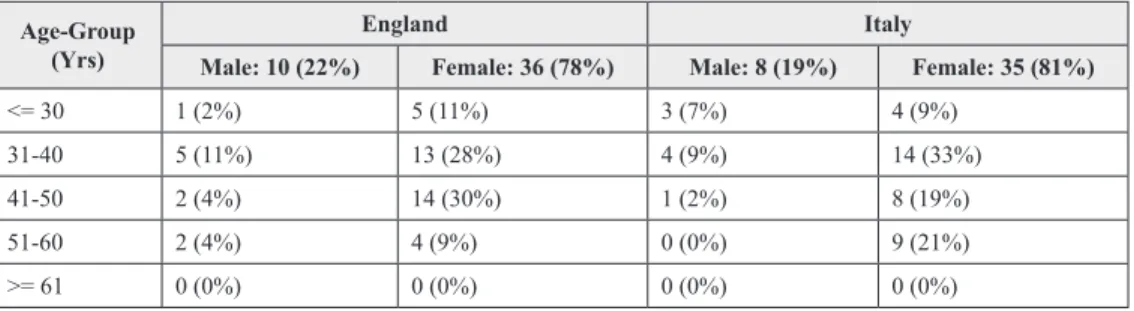
A total of 89 responses was obtained; 46 from England and 43 from Italy. Table 1 shows the number (and the nearest whole percentage of the total for each country) of teachers of each gender falling into the different age-groupings.
Approximately 13% of the teachers in England were below 30 years of age, 39%
were between 31-40, 34% between 41-50, 13% between 51-60 and 0% were 61 or above. The gender distribution was 78% female and 22% male. For Italy, approximately 16% of the teachers were below 30 years of age, 42% were between 31-40, 21% between 41-50 and 21% between 51-60 and 0% were 61 or above with the gender distribution being 81% female and 19% male. Although these figures show a slightly higher proportion of male respondents and a small weighting towards the lower end of the age-groupings for both countries, taken as a whole they are similar to recent OECD (2012) figures for primary teachers for Italy and for the UK. Considering this is a relatively small sample, the participants were regarded as rep-resentative of the primary teaching populations for both countries in terms of age and gender.
When asked about their own experiences of playing digital games, the majority of teachers (87% from England, 72% from Italy) reported that they had some experience. A similar pattern was evident regarding experience of teaching with digital games (89% for teachers from Eng-land, 61% from Italy). However, when asked about their experience of teaching game design, almost 70% of the teachers in both countries stated that they had no experience.
According to the survey data, digital games were mostly used for teaching mathematics, literacy, science and foreign languages (Figure 2). The wide availability of game software in Italy relating to subjects such as history and geography may have accounted for the relative high indication for the use of digital games for ‘other subjects’ for that country.
Table 1. Age and gender distribution for teachers completing the survey (percentages are of the total for each country and given to the nearest integer)
Age-Group (Yrs)
England Italy
Male: 10 (22%) Female: 36 (78%) Male: 8 (19%) Female: 35 (81%)
<= 30 1 (2%) 5 (11%) 3 (7%) 4 (9%)
31-40 5 (11%) 13 (28%) 4 (9%) 14 (33%)
41-50 2 (4%) 14 (30%) 1 (2%) 8 (19%)
51-60 2 (4%) 4 (9%) 0 (0%) 9 (21%)
>= 61 0 (0%) 0 (0%) 0 (0%) 0 (0%)
The majority of the teachers in both countries reported that they would use digital games for teaching in the future, around 10% were undecided and about 12% of the Italian teachers said they would not use digital games for teaching.
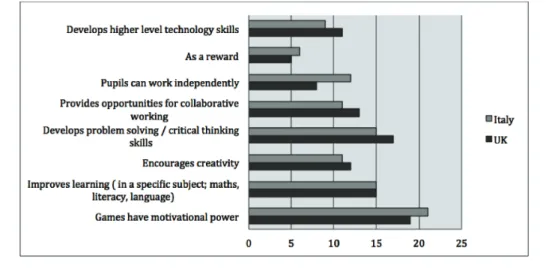
Figure 3 shows a count for each of the rea-sons for using digital games in the classroom. A similar trend was obtained for both countries, the reasons more frequently indicated were:
games have motivational power, games improve learning (In a specific subject; maths, literacy, language), develop problem solving and criti-cal thinking skills, encourage creativity, and games provide opportunities for collaborative working. The use of games as a reward, for developing higher level technology skills, and for independent work were cited slightly less.
When asked about the barriers to the use of digital games in the class (Figure 4), apart
Figure 2. Subjects taught using digital games
from one exception the frequency of responses for each question were very similar for both countries. Access to equipment in the classroom, teachers’ subject knowledge and the lack of schools’ ICT capability were indicated more frequently.
18 of the 43 (around 42%) of the teachers in Italy, as opposed to 9 of the 46 (just less than 20%) indicated that they saw relevance to the curriculum as a barrier. One possible explana-tion for this is that adherence not only to what is taught as well as when it is taught and how it is taught is a requirement in Italy, the curriculum in the UK being less prescriptive with regard to when and how. In this study only around 18% of the teachers who completed the survey selected evaluating learning as a barrier. This contrasts with previous research where the difficulty of assessing learning through game-based learning was seen as a main barrier to use digital games in the classroom (Egenfeldt-Nielsen, 2011; Fu-turelab, 2006, 2013). However, in the interview data discussed below, issues with assessing learning were mentioned by many teachers.
One noticeable outcome was the way that the teachers in both countries saw their role in teaching with digital games and in teaching
digital game design. Where around 64% of the responses indicated that class teachers should teach with digital games, around 70% of the total teachers indicated that a specialist teacher should teach game design. This may be related to either a lack of subject knowledge or to not having enough experience with game design or both and could be symptomatic of the perceived lack of relevant skills that are promoted in both the UK and Italian curricula. Another reason could be that game design is included in the computing skills in Italy, which is part of the statutory curriculum but only from the age of 14, therefore, it may not be seen as relevant to primary school teachers. It may be interesting to see how this might change in the UK as the new curriculum with its emphasis on programming at primary level becomes established.
Interviews
Face to face semi-structured interviews were carried out with five teachers from each coun-try. The questions were open ended and partly reflected those used in the survey questionnaire. For example, ‘What are the barriers to using digital games for educational purposes in the
classroom environment?’ was presented as the questionnaire version where respondents could tick one or more of a list of given reasons, and ‘Can you tell us about the barriers to teaching using digital games?’ being its counterpart in the interview. The questions used as the initial framework for the interview are shown in Box 1.
One of the research team members carried out three of the five interviews in the school where she works and the remaining two in other schools in England. A teacher in Italy carried out all five interviews in the school where she had been teaching game design. Some of the teachers interviewed had opportunities to watch her teaching on many occasions.
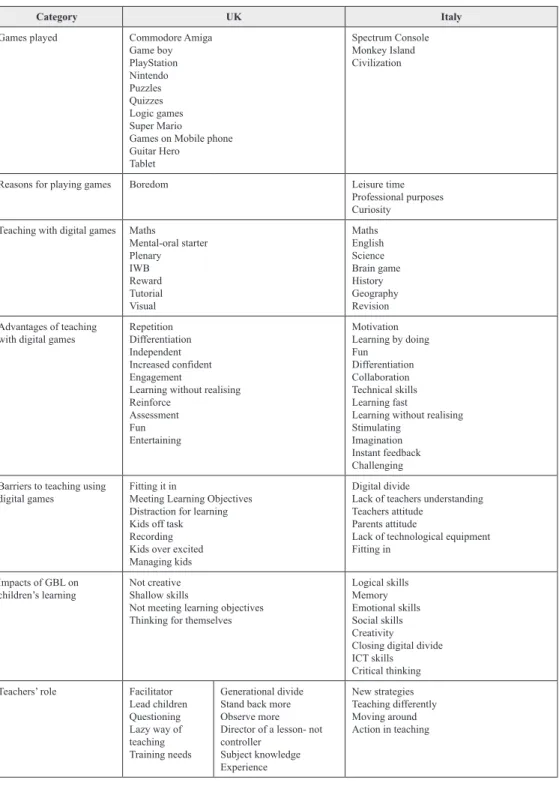
The interviews were transcribed and the responses categorised as: games played, reasons for playing games, teaching with digital games, advantages of teaching with digital games, bar-riers to teaching using digital games, impacts of GBL on children’s learning and, finally teacher’s
role. Table 2 shows the summary data from the interviews that have been grouped into these categories.
Inspection of the interview transcripts and the data entered into Table 2 suggests that teachers’ personal experience with gaming is similar in England and Italy in that teachers talk about playing with games from early ages. Boredom was given as the main reason for many teachers playing digital games. A few UK teachers also stated that they play games for professional purposes, such as trying out a game as preparation before using in class, and sometimes for curiosity.
In both countries digital games were used for teaching the main curriculum subjects; maths, literacy, science and languages, with uses in history and geography more prevalent in Italy. Motivation, differentiation and fun were listed as the main advantages of game-based
Table 2. Teachers’ interview responses grouped into categories
Category UK Italy
Games played Commodore Amiga Game boy PlayStation Nintendo Puzzles Quizzes Logic games Super Mario
Games on Mobile phone Guitar Hero
Tablet
Spectrum Console Monkey Island Civilization
Reasons for playing games Boredom Leisure time Professional purposes Curiosity
Teaching with digital games Maths
Mental-oral starter Plenary IWB Reward Tutorial Visual Maths English Science Brain game History Geography Revision Advantages of teaching
with digital games Repetition Differentiation Independent Increased confident Engagement
Learning without realising Reinforce Assessment Fun Entertaining Motivation Learning by doing Fun Differentiation Collaboration Technical skills Learning fast
Learning without realising Stimulating
Imagination Instant feedback Challenging Barriers to teaching using
digital games Fitting it in Meeting Learning Objectives Distraction for learning Kids off task Recording Kids over excited Managing kids
Digital divide
Lack of teachers understanding Teachers attitude
Parents attitude
Lack of technological equipment Fitting in
Impacts of GBL on
children’s learning Not creative Shallow skills
Not meeting learning objectives Thinking for themselves
Logical skills Memory Emotional skills Social skills Creativity Closing digital divide ICT skills Critical thinking Teachers’ role Facilitator
Lead children Questioning Lazy way of teaching Training needs Generational divide Stand back more Observe more Director of a lesson- not controller Subject knowledge Experience New strategies Teaching differently Moving around Action in teaching
learning. Learning without realising was also mentioned by teachers from both countries.
When discussing the barriers to game-based learning teachers from both countries talked about a lack of subject knowledge, not enough training, difficulties in the classroom and behaviour management, although the latter did not feature strongly in the survey responses.
Teachers cited many positive and negative impacts of game-based activities on pupils’ learning. Some teachers suggested that these develop problem solving, creativity, collabora-tive skills, thinking skills, and visual-spatial skills. However, other teachers in particular those from England, shared their worries of not meeting the learning objective, technology killing creativity and developing shallow skills rather than in-depth ones.
One teacher from England was quoted as
“I think, it should support teacher-led teaching rather than replacing it; It can become a lazy way of teaching if you are not careful. It needs to be targeted carefully. I am worried that it may take over traditional methods of children researching things, using books and reading. Rather than, sometimes, this not so much games as much, but sometimes they read on the Internet, they read just a snip of it, but when they use a book, they read more. You know, on the Internet, everything is so easy. There is a strong argument that, children should be taught traditional ways of researching. And they do copy. There is no way of checking that, they go to child friendly sites”.
Another teacher from England was quoted as “It needs to be targeted carefully. I am wor-ried that it may take over traditional methods of children researching things, using books and reading. Rather than, sometimes, this not so much games as much, but sometimes they read on the Internet, they read just a snip of it, but when they use a book, they read more. You know, on the Internet, everything is so easy. There is a strong argument that, children should be taught traditional ways of researching. And they do copy. There is no way of checking that, they go to child friendly sites”.
The relationship between the way the cur-riculum was designed and game-based learning accommodated was also clearly visible. Teach-ers from England talked about the strain that was put on them because they needed to cover so many objectives. They also suggested that if the curriculum was more flexible, they would have more opportunities to use game-based learning in the classroom. In the words of one teacher: “Year 3. 4. 5 a lot easier… You don’t have that, this week you need to finish this by Friday. You don’t have time to teach how to play a game. If it doesn’t go well, we can’t say oh well, we will do that again. We haven’t got that time”.
Assessment issues were also apparent: another teacher stated that she was worried about whether or not she could cover curriculum expectations, in case she needed to show some evidence. She stated; “I wonder whether I will be pulled up on, ok what is the learning that they are getting out of this, just play any game on the Internet. Have they met the objectives? How will I know? I try and say to them, if we do have free time, it is for the end of the term, we got the laptops, I say to them, you can find the game but make sure it has some educational context, there is an educational purpose to it, so it is justified”.
One interesting point was that the teachers made links between how learning manifests in the classroom and how digital games are taught. In other words, voicing their awareness of the relationship between the pedagogy and practice: “It is hard to say how digital games would impact learning. Outcome would very much depend on the person teaching it and their teaching approach. Because in my experience, it is really easy to get lost and carried away with digital games in the classroom. Kids can be / get absorbed, just a fact that it is quite a fun and dynamic lesson, and not actually taking learning objectives from it. If it is structured in a coherent way and appropriate strategies use then it can be very useful”.
Many teachers from both countries men-tioned the ‘learning without realising’ mode.
Teachers thought that this had a very positive impact on children’s attitudes to lessons as it made schools look like a less formal place. For example:
“... it doesn’t seem like you are learning, like school, it is not like write this down, copy this down. They enjoy it. It is entertaining. I don’t think they see it as learning, where we know that even though you are playing that game, you are learning how to do that maths activity, where they think they are just playing games. They think we have been nice.”
“...It keeps them interested, they all want to come and touch the IWB, it makes them pay attention, they are learning but they don’t even realize they are learning.”
A further interesting finding was the teach-ers’ knowledge and understanding of their role and the new strategies to use when teaching with games and teaching game design. Terms such as ‘facilitator’, ‘teaching differently’, ‘active learning’, and ‘stand back more’ were widely used. Regarding the need to stand back more, for example, the teachers were aware of their role as a coach or a guide in the classroom. They also discussed the importance of questioning rather than just showing learners what to do. One teacher who had watched one of the members of the research team teaching game design was quoted as saying:
“From what I can gather, watching others and you, it seems like you are much more of a direc-tor of the lesson more than a controller if that makes sense. You are pushing the kids towards the right direction, you gave them license to run as far as they can, if they get it wrong or they need support you sort of wheel them in. It seems to me you give kids more license to learn, which I think is a very positive thing to do.”
This also emphasises the importance of team teaching, or teachers having an opportunity
to watch others teaching with games or game design. This is especially useful when model-ling how pedagogy is put in practice through teaching strategies in the classroom:
“Because he was making sense of how children learn and how the pedagogical approach/class-room management style was used to manifest learning outcome by just watching me teaching. So if they were modelled how to use games in teaching, their understanding would develop.”
Teachers described their new role as more active and interactive when teaching with games or game design. One teacher from Italy stated:
“…Because teaching with games means teach-ing in a totally different way. No teacher sat at a teacher’s desk and pupils listening, but movement, action in teaching.”
Many teachers talked about how they use digital games to change students’ attitudes towards school by making learning fun. One teacher in particular mentioned that using games in teaching changes the way learners perceive the teachers:
“It changes the way students see you, you can be a hero in their eyes.”
Another teacher stated that digital games are like a second language to kids. Furthermore it was added that using games in teaching al-lows teachers to re-shape their communication with the learners, which then impacts on their behaviour and attitude to learning as a whole. Teachers in both countries had a similar view in almost all of the topics. Only one teacher talked about the negative impacts of teaching with games on the teacher rather than the learner. She expressed this as “I think, it should support teacher-led teaching rather than replacing it; It can become a lazy way of teaching if you are not careful”.
DISCUSSION AND
CONCLUSION
Our data indicate that teachers in England and Italy are interested in teaching with digital games and most of them see digital games as an effective educational tool. Their use of games in teaching varied both between each country and also between the teachers within the same country. Difficulty finding games that are rel-evant to the curriculum taught might have been a reason for this, which was often mentioned by Italian teachers. In both countries, not having a clear framework on game-based learning within the curriculum to guide them in the classroom, lack of subject knowledge and not knowing how to adopt new pedagogical approaches stopped them from using games in teaching, and it also impacted on their view of teaching with games.
Although not apparent from the survey data, digital games were often mentioned during interviews as a reward or a tool with which to achieve a specific curriculum target in a specific subject. Although some teachers mentioned the impact of games on developing transferable skills such as; problem solving, critical thinking, collaboration and creativity, there was no indication that the teachers knew how to design the game-based learning space to achieve this. It can be suggested that teachers need to be trained in the appropriate methods of teaching with games through practical ses-sions, in small steps where they can see how different pedagogical approaches can be used to manifest different outcomes. The reason we suggest practical sessions is because trying to teach teachers detailed theories that apply to the use of game-based learning is time consuming and is not always useful unless how it works in a classroom environment is demonstrated. Introducing a pedagogy using practical strate-gies such as; game evaluation, questioning, classroom and behaviour management, class-room design as a learning space, and planning lessons using game-based learning can be more effective.
A few teachers were worried about behav-iour management and monitoring children when
using digital games. It is evident that game-based learning transforms the way a classroom is arranged as a learning space physically, and also the way teachers manage it. For example, if students are told to be quiet, it is not realistic to expect them to develop any communication or collaborative skills. This can also have an impact on how students perceive learning with games. It can be fun or boring, depending on how it has been used.
Another important consideration from investigating the literature available to teachers was that in both countries it appears that the link between the policy makers, research institutes and schools seems to be either unclear or does not exist. Although there are organisations providing reports on game-based learning in schools and presenting the issues to focus on, this message is not necessarily reaching out to the schools and, more importantly, the teach-ers or policy makteach-ers. One interesting point is that teacher training, both in-service and initial teacher education in terms of using new tech-nologies, including game-based learning and pedagogies to support these, has not been seen as a priority in both countries mentioned here in that it is not mentioned in their curricula, or there are no teacher training sessions that focus on game-based learning. In other words teachers were left alone to work out how to teach with games. This is a worrying outcome, as the teach-ers’ attitudes to digital games can be negative and if they see digital games with no educational value, they will be very unlikely to include it in their teaching. One teacher described this as ‘enlarging the generational divide’.
Another valuable facet is how country-specific curriculum design affects the way teach-ers use digital games in practice. The national policies on the use of digital games in education differ considerably, not only from country to country but also from school to school, where the decision is left to school managers or in many cases the teachers individually. Interest-ingly in some countries, although technology is available, game-based learning still did not make its way into the classroom. Therefore it
will be useful to focus on developing flexible models of game-based learning spaces.
In this study we aimed to find out about teachers’ views of game-based learning and how these relate to curriculum, pedagogy and their practice. Where the curriculum and content of lessons was developed by policy makers and theories discussed by researchers, it is inevitable that teachers are confused about their direction in this cycle. It is vital that research institutes focusing on game-based learning establish a clear and constant two-way communication with teachers to develop game-based learning in primary schools. They should not only aim to train teachers but also start listening to them, and this will feed into their research. This will give an active role to teachers in developing game-based learning in theory and in practice and in turn may help them to keep up-to-date with the latest findings in the area. In a similar approach, policy makers should have clear aims and instructions on integrating digital games into classroom. They should involve the research institutes and also teachers from the classrooms directly when writing policies on game-based learning
Finally in order to support teachers in various countries developing game-based learn-ing practice, we would like to suggest some practical ideas:
Matching the Game to Curriculum Content and Objective
Teachers need to decide which games could be appropriate to specific learning outcomes and, importantly, how they could use games to manifest specific learning outcomes. This requires them to understand the different game genres, their key features and educational ben-efits (Felicia, 2009). Exploring the potential of commercial games for teaching cross-curricular topics is also vital. The matching process also should include awareness of digital games age-ratings. Evaluating the resources before the lesson will help teachers not only to prepare
themselves beforehand but also designing very clear activities with clear objectives that will make the assessment process easier.
Investigating Learning Theories that Work Well with Game-Based Learning
As much as knowing what you can do with digital games, knowing how to do and why it is also a very important part of using and adapting games for teaching and learning. From learning through play and the ways that learners can construct their understandings both as individu-als, or through dialogue and collaboration, it is vital for teachers to understand how these learning approaches can be used to realise the desired outcomes.
Classroom Organisation and Management
The way a classroom has been managed and organised will also have an impact on the learn-ing outcomes. It is difficult to expect children to work collaboratively when they were only given independent working as an option or setting a rule such as ‘no talking’. When learning with digital games, flexibility for moving around to communicate with friends could encourage children to collaborate actively and discuss their ideas.
Adapting a ‘Learning Together’ Approach
When we look at the role of the teacher, both when using digital games for teaching, or teaching through game design, we should be aware that teachers do not need to have all the answers. It is important to be part of the learning process by exploring together with the learn-ers and develop a shared undlearn-erstanding of the concepts. This may also be very helpful in terms of understanding how children experiment and learn with digital games.
REFERENCES
Allsop, Y. (2012). Exploring the Educational Value of Children’s Game Authoring Practices: A Primary School Case Study. Proceedings of the European Conference on Games Based Learning (pp. 21-30) Reading: Academic Publishing International Limited Avvisati, F., Hennessy, S., Kozma, R. B., & Vincent-Lancrin, S. (2013). Review of the Italian Strategy for Digital Schools. Retrieved November 17, 2013 from http://www.oecd.org/edu/ceri/Innovation%20 Strategy%20Working%20Paper%2090.pdf Bakhtin, M. M. (2004). Dialogic Origin and Dialogic Pedagogy of Grammar: Stylistics in Teaching Russian Language in Secondary School. Journal of Russian & East European Psychology, 42(6), 12–49. Buckingham, D. (2007). Beyond Technology: Children’s Learning in the Age of Digital Culture. Cambridge: Polity Press.
Cassell, J. (1982). Harms, benefits wrongs and rights in fieldwork. In J. Seiber (Ed.), The Ethics of Social research: Fieldwork, Regulation and Publication. New York: Springer Verlag. doi:10.1007/978-1-4612-5722-6_1
Conole, G., Dyke, M., Oliver, M., & Seale, J. (2004). Mapping pedagogy and tools for effective learning design. Computers & Education, 43(1-2), 17–33. doi:10.1016/j.compedu.2003.12.018
DfE. (2013). Computing Programmes of Study Key Stages 1-4. Retrieved September 28, 2013, from http://media.education.gov.uk/assets/files/pdf/c/ computing%2004-02-13_001.pdf
DfES (1999). The National Curriculum for England and Wales. DfES, London: DfES
Egenfeldt-Nielsen, S. (2011). International survey of the experience and perceptions of teachers. In S. Egenfeldt-Nielsen, B. H. Sørensen, & B. Meyer (Eds.), Serious Games in Education – a Global Perspective. Aarhus: Aarhus University Press. Felicia, P. (2009). Digital games in schools. A hand-book for teachers. Brussels, Belgium: European Schoolnet.
Felicia, P. (2011). How can digital games be used to teach the school curriculum? Retrieved November 12, 2013, from http://linked.eun.org/web/guest/ school-curriculum
Futurelab (2006). Teaching with games. Retrieved November 12, 2013, from http://archive.futurelab. org.uk/ projects/ teaching-with-games/
Gaffney, M. (2010). Enhancing teachers’ take-up of digital content: Factors and design principles in technology adoption. Retrieved November 15, 2013, from http://www.ndlrn.edu.au/verve/_resources/ Enhancing_Teacher_Takeup_of_Digital_Con-tent_Report.PDF
Hanks, P., McLeod, W., & Urdang, L. (Eds.). (1986).
Collins dictionary of the English language. London, Glasgow: Collins.
Jessel, J. (2012). Social, cultural and cognitive processes and new technologies in education. In O. Miglino, M. L. Nigrelli, & L. S. Sica (Eds.),
Role-games, computer simulations, robots and augmented reality as new learning technologies: A guide for teacher educators and trainers. Napoli: Liguori Editore.
Kuhn, T. S. (1962). The Structure of Scientific Revolutions. Chicago: University of Chicago Press. McKendry, E. (2006). Immersion Education: An Introductory Guide for Teachers. Belfast: School of Education, Queen’s University.
Mortimore, P. (Ed.). (1999). Understanding Peda-gogy and its Impact on Learning. London: Paul Chapman Publishing.
National Foundation for Educational Research. (2008). Comparison of the Core Primary Curriculum in England to those of Other High Performing Coun-tries. Retrieved November 10, 2013, from https:// www.gov.uk/government/uploads/system/uploads/ attachment_data/file/222307/DCSF-RW048v2.pdf OECD. (2012). Education at a Glance 2012: OECD Indicators. OECD Publishing. [online], doi:10.1787/ eag-2012-en
Pepin, B. (2010). How educational systems and cultures mediate teacher knowledge: teacher ‘listen-ing’ in English, French and German classrooms. In K. Ruthven & T. Rowlands (Eds.), Mathematical knowledge in teaching (pp. 119–138). Dordrecht: Springer. doi:10.1007/978-90-481-9766-8_8 Perrotta, C., Featherstone, G., Aston, H., & Houghton, E. (2013). Game-based Learning: Latest Evidence and Future Directions, NFER (FUTURELAB). Re-trieved November 12, 2013, from http://www.nfer. ac.uk/nfer/publications/GAME01/GAME01.pdf
Razak, A. A., Connolly, T. M., Baxter, G. J., Hainey, T., & Wilson, A. (2012, October). The Use of Games-based Learning at Primary Education Level within the Curriculum for Excellence: A Combined Result of Two Regional Teacher Surveys. Presented at 6th European Conference on Games-based Learning (ECGBL), Cork, Ireland.
Robertson, J., & Howell, C. (2008). Computer game design: Opportunities for successful learning. Com-puters & Education, 50(2), 559–578. doi:10.1016/j. compedu.2007.09.020
Spires, H. A., Rowe, J. P., Mott, B. W., & Lester, J. C. (2011). Problem solving and game based learn-ing: Effects of middle grade students’ hypothesis testing strategies on learning outcomes. Journal of Educational Computing Research, 44(4), 453–472. doi:10.2190/EC.44.4.e
Sturman, L. and Sizmur, J., (2011, January). In-ternational Comparison of Computing in Schools. Slough: NFER.
Vaagan, R. W. (2006). Open Access and Bakhtinian Dialogism, Proceedings ELPUB2006 Conference on Electronic Publishing – Bansko, Bulgaria – June 2006 Vygotsky, L. S. (1978). Mind in Society. Cambridge, MA: Harvard University Press.
Wainess, R. 2007. The potential of games & simu-lations for learning and assessment. Presented at 2007 CRESST Conference: The Future of Test-based Educational Accountability, Los Angeles, CA. Williamson, B. (2009) Computer Games, Schools and Young People: a Report for Educators on Using Games for Learning. Bristol: Futurelab. Retrieved November 12, 2013 from http://archive.futurelab. org.uk/resources/documents/project_reports/becta/ Games_and_Learning_educators_report.pdf
Yasemin Allsop worked as an ICT Coordinator in primary schools in London for almost 10 years. She is currently employed as Senior Lecturer in Primary Computing and ICT at Man-chester Metropolitan University. She has MA ICT in Education from the London Knowledge Lab, University of London. She is also an MPhil/PhD student, focusing on children’s thinking, learning and metacognition when designing digital games. She is the editor of an online maga-zine called ICT in Practice where educators from around the world share their experiences of using technology in education.
John Jessel is Reader and Head of the MPhil/PhD Programme in the Department of Educational Studies at Goldsmiths, University of London. His research activities focus on digital technolo-gies, connectivity, and the social and cognitive processes that underlie learning and development both inside and outside of formal educational settings. These include dialogical processes and the development of ideas in virtual communities and networks. He has published and presented widely at an international level and has directed numerous funded projects in the above areas and has also addressed the practices that lead to the effective take-up of new technologies within institutions and the impact upon curricula. John is the coordinator of a research network on new technologies and learning traditions, currently formed between Goldsmiths University and nine Latin American Universities.
CALL FOR ARTICLES
Please recommend this publication to your librarian. For a convenient
easy-to-use library recommendation form, please visit:
http://www.igi-global.com/IJGBL
Ideas for Special Theme Issues may be submitted to the Editor-in-Chief.
All inquiries regarding IJGBL should be directed to the attention of: Patrick Felicia, Editor-in-Chief
All manuscript submissions to IJGBL should be sent through the online submission system: http://www.igi-global.com/authorseditors/titlesubmission/newproject.aspx COVERAGE/MAJOR TOPICS:
• Adaptive games design for Game-Based Learning • Design of educational games for people with disabilities • Educational video games and learning management systems • Game design models and design patterns for Game-Based Learning • Instructional design for Game-Based Learning
• Integration and deployment of video games in the classroom • Intelligent Tutoring Systems and Game-Based Learning • Learning by designing and developing video games
• Learning styles, behaviors and personalities in educational video games • Mobile development and augmented reality for Game-Based Learning • Motivation, audio and emotions in educational video games
• Role of Instructors
• Virtual Worlds and Game-Based Learning
MISSION:
The mission of the International Journal of Game-Based Learning (IJGBL) is to promote knowledge pertinent to the design of Game-Based Learning environ-ments, and to provide relevant theoretical frameworks and the latest empirical research findings in the field of Game-Based Learning. The main goals of IJGBL are to identify, explain, and improve the interaction between learning outcomes and motivation in video games, and to promote best practices for the integra-tion of video games in instrucintegra-tional settings. The journal is multidisciplinary and addresses cognitive, psychological and emotional aspects of Game-Based Learning. It discusses innovative and cost-effective Game-Based Learning solu-tions. It also provides students, researchers, instructors, and policymakers with valuable information in Game-Based Learning, and increases their understanding of the process of designing, developing and deploying successful educational
games. IJGBL also identifies future directions in this new educational medium. ISSN 2155-6849 eISSN 2155-6857 Published quarterly
An offi cial publication of the Information Resources Management Association