Difference between TE and TM modal gain
in amplifying waveguides: analysis and
assessment of two perturbation approaches
J . H A E S , B . D E M E U L E N A E R E , R . B A E T S
University of Gent-IMEC, Department of Information Technology (INTEC),
St-Pietersnieuwstraat 41, 9000 Gent, Belgium
D . L E N S T R A
Free University, Department of Physics and Astronomy, De Boelelaan 1081,
1081 HV Amsterdam, The Netherlands
T . D . V I S S E R , H . B L O K
Delft University of Technology, Department of Electrical Engineering,
P.O. Box 5031, 2600 GA Delft, The Netherlands
Received 8 January; accepted 10 June 1996
The commonly used con®nement factor-based formula for modal gain in amplifying waveguides ±gmod=Ggmat, with Ga con®nement factor ± is well established and ac-curate for TE modes. The TM case is rarely, and sometimes erroneously, described in the literature. Using a variational formulation the fundamental difference between TE and TM modal gain is illustrated. An accurate expression, correct up to ®rst order, for the TM modal gain is then derived from a known general perturbation formula. However, as this does not lead to a true con®nement factor formulation, some approximations are introduced, leading to a uni®ed formulation of both TE and TM modal gain. A second method to calculate the modal gain, based on the analyticity of the dispersion equation, is also discussed. Simulation and comparison with modal gain values from a complex mode solver will ®nally illustrate the validity of the different approaches.
1. Introduction
One of the most important properties of amplifying waveguides, such as lasers or optical ampli®ers, is the modal gain experienced by dierent modes. It has been known for a long time [1] that for TE slab modes, the modal gain is given by a con®nement factor or ®lling factor-based expression. The modal gain can be written as a weighted sum of the con-®nement of the dominant TE ®eld component in each waveguide layer. The weighing coecients contain as the most important factor the material gain of each layer. Very often this formula is used as a perturbation approximation of the modal gain in the amplifying waveguide by using the con®nement factor of the ®eld in the waveguide without gain or loss. This avoids the need for a complex modal calculation and facilitates the simulation of the eects of dierent gain or loss levels in waveguide design.
As will be emphasized in this paper, TE and TM modal gain behave fundamentally dierently [2]. This fact is very often not recognized in the literature. In [1] and [3] the discussion is limited to TE polarization and in [4] and [5] the TE expression, using the con®nement factor for the dominant TM ®eld component, is without motivation applied to calculate the TM modal gain. In [6] the modal gain is derived under the assumption of weak guidance, where the dierence between TE and TM modes vanishes. Only in [7] and in [8] are the distinctions between both polarizations made. Furthermore in [8] a second possibility for modal gain calculation, including both polarization states, is suggested, but not applied. There it is remarked that the dispersion equation for the modal eective index is an analytic function of the refractive index pro®le. We will assess this approach and compare the results with mode solver and perturbation results.
In [9] it is shown that the correct modal gain formula for TM slab modes diers substantially from the TE expression. The expression derived in [9], although exact, is less useful as a starting point for a perturbation approach. Vassallo formulates in [8] a general perturbation expression for the modal gain based on a vectorial ®eld solution for the unperturbed waveguide with arbitrary two-dimensional cross-section. Unfortunately, this expression, simpli®ed to the case of a slab waveguide, cannot be recasted directly into a con®nement factor formalism. Several approximate expressions for the TM modal gain, each of them based on a dierent con®nement factor, will be derived and explored in this paper. It will be shown that it is possible to calculate accurately the TM modal gain using an expression which approximates Vassallo's formula and which is formally identical to the well-established TE formula and thereby retains its practical advantages. Finally, the theory of the analytic approach will be outlined and its accuracy will be proven. This approach has the same ¯exibility in terms of waveguide design as the perturbation for-mulation.
2. TE versus TM modal gain
Starting from the TE and TM wave equations for the dominant ®eld componentsey x
and hy x of the one-dimensional slab waveguide with complex refractive index pro®le n x, and withzthe propagation direction and k0 the wavenumber in vacuum
d2e y x dx2 k20n2 x ÿb2ey x 0 n2 x d dx 1 n2 x dhy x dx k2 0n2 x ÿb2hy x 0 1
it can be shown, using a variational approach that the imaginary part of the square of the eective index satis®es [9]
Im n2 eff R 1 ÿ1Im n 2 xe y x 2 dx R 1 ÿ1 ey x 2dx 2a
Im n2 eff R 1 ÿ1Im n 2 xh y x 2dx R 1 ÿ1 hy x 2 dx ÿIm R 1 ÿ1h y x dhy x dx d ln n2 x dx dx k2 0 R 1 ÿ1 hy x 2 dx 0 B B B @ 1 C C C A 2b for the TM case. It is seen that Im n2
eff
ÿ
is given by two dierent equations. The ®rst term in (2b) is the direct analogue of (2a) and the second term occurs because the TM wave equation describes a magnetic ®eld in a purely dielectric material: the derivative dhy x/dx is, unlike dey x/dx, discontinuous at a refractive index step. In typical III±V semi-conductor waveguides, the dominant TE and TM ®eld pro®les are very similar. The dierence between TE and TM modal gain values is therefore dominated by the second term in (2b). As we will see further on, this dierence can be as large as a factor of four. Equations 2 can be used in two ways. In the ®rst instance they may serve as a check on the accuracy of a complex mode solver. Given the calculated mode eective index, the ®eld pro®les can be constructed and Expressions 2a and 2b should return (in an implicit way) to the eective index itself. A more practical application can be found when interpreting Equations 2 in a perturbative way. Resetting the imaginary part of the refractive index pro®le to zero, calculating the real modes of the real index structure and substituting the obtained mode pro®les in (2a) and (2b), while taking into account the imaginary index pro®le, gives a ®rst-order estimate of the imaginary part of the eective index. However, Equation 2b is in practice not very useful. Typical input data for laser modelling consist of the con®nement factors of the dominant ®eld component in the dierent waveguide layers. It is immediately clear that (2a) as well as the ®rst term of (2b) lend themselves to a con®nement factor formulation.
3. Con®nement factor formulation of TE and TM modal gain
Consider a slab waveguide de®ned by a real valued refractive index pro®le n0(x) and suppose that a modal solution (e0(x),h0(x)) is known. The waveguide is now perturbed by a pure imaginary index contrast dn00 x. Applying standard perturbation theory on Maxwell's two curl equations it is shown in [10] that the ®rst-order correctiondneon the effective index of the mode is given by
dneff e0 l0 r crossRR -section n0 xdn00 xje0 xj2dxdy RR cross -section e0 x h0 x uzdxdydn 00 eff 3
and is therefore purely imaginary. If we limit the discussion to piecewise constant re-fractive index pro®les with layer indices n0,i, the general perturbation result (3) can be simpli®ed in the TE case to
gTE modnTE1 eff;0 XN i1 n0;iCeiygmat;i 4
where we introduced the modal gaingmod= 2k0Im(ne) = 2k0dn00eff and the material gain
of the ith layer gmat;i2k0 Im(ni) = 2k0dn00i and N, the number of layers. Ceiy is the con®nement factor of the dominant TE ®eld component in layer i of the unperturbed structure
Cey i R layer iey;0 x 2dx R 1 ÿ1 ey;0 x 2 dx 5
It follows immediately that
XN i1
Cey
i 1 6
Given the de®nition of the real part of the longitudinal component of the Poynting vector,
STE
z x Re S x uz 12Re e0 x h0 x uz2xlb0
0 ey;0 x
2
7 it is seen that the TE modal gain can also be expressed by means of the power ¯ux, as is frequently done (see for example [6]).
The result (4) is widely known and applied in practice, both for TE and TM polar-ization. One generally de®nes a con®nement factor based on the dominanthy®eld com-ponent in the latter case. The fact that this leads to erroneous results can be understood from (2b), as was explained in the previous section.
To express the TM modal gain the general result (3) is formulated explicitly for a TM mode of a layered slab
gTM modnTMeff;0 XN i1 n0;i R layeri ex;0 x 2 ez;0 x2 dx R 1 ÿ1n 2 0 xe2x;0 xdx gmat;i 8
By analogy with Equation 4, the TM `con®nement factor' should be de®ned as
CTM i nTMeff;0 2 R layeri ex;0 x 2e z;0 x 2 dx R 1 ÿ1 n 2 0 xe2x;0 xdx nTM eff;0 2 R layerietot;0 x 2dx R 1 ÿ1n 2 0 xe2x;0 xdx 9
This expression, although exact within the perturbation approximation, has two draw-backs. First, (9) does not describe a well-de®ned physical quantity with a clear inter-pretation of ®eld con®nement or power ¯ux con®nement, as was the case for TE polarization. Second, the property (6) is not ful®lled by CTM
i . We will now derive two approximate expressions from (9) with a physical meaning and which are true con®nement factors in the sense of (6) [11].
As we are only interested in guided modes, |kx||k0|. Hence
n2 0 x nTMeff;0 2 kx2 x k2 0 n TM eff;0 2 10 which corresponds physically to the replacement of the actual refractive index pro®le by the average index as it is seen by the mode pro®le. Furthermore, it follows from the TM equations that the inequality
e2 z;0 x e2 x;0 x dhy;0 x=dx 2 b2h2 y;0 x O k 2 x b2 1 11
holds for (well-) guided modes. Adding an extra termez;0 x2in the denominator leads to
the con®nement factorCTM;etot
i CTM i R layeri ex;0 x 2e z;0 x 2 dx R 1 ÿ1 ex;0 x 2 ez;0 x2 dx CTM;etot i 12
which approximates very well with the value of CTM
i . As we only consider unperturbed problems with pure real index pro®le, ex,0(x) is also real valued and hence e2x;0 x
jex;0 xj2. Alternatively, we can also neglect theez;0 x2term in the nominator to obtain CTM i R layeri ex;0 x 2dx R 1 ÿ1 ex;0 x 2 dx CTM;ex i 13
the con®nement factor of the ex,0(x) ®eld component. This approximation gets less accurate when the ratio k2
x=b2
increases, i.e. for the higher-order guided modes of a
multimode waveguide.
To summarize, we now have three perturbation formulae to calculate the TM modal gain gTM modnTM1 eff;0 XN i1 n0;iCTMi gmat;i nTM1 eff;0 XN i1 n0;iCTMi ;etotgmat;i 14 1 nTM eff;0 XN i1 n0;iCTMi ;exgmat;i
The con®nement factors of the last two equations have a clear physical meaning. The quantityCTM;etot
i expresses the con®nement of the total electric ®eld leading to the same formula for both TE and TM modal gain. In the case of very strong guidance, where the modal ®eld is completely con®ned into the core layer of the waveguide characterized by a complex refractive index, (14) predicts that the higher-order modes (with lowerne) ex-perience a higher modal gain. This result might seem rather surprising at ®rst glance, but can be intuitively understood by considering the ray picture of modal propagation. Higher-order modes have a more skewed angle with respect to the waveguide axis and therefore propagate a larger distance in the core layer. They see more gain per unit distance along the waveguide axis than a paraxial propagating mode.
The quantityCTM;ex
i is the con®nement of the, for TM modes, dominant electric ®eld
component. This con®nement factor has the advantage that it follows immediately from thehy-con®nement factorCTMi ;hy as
CTM;ex i CTM;hy i n40;i . PN j1C TM;hy j n40;j . 15
For waveguides with small index contrast it is clear thatCTM;ex
i CTMi ;hy. In homogeneous space this holds even exactly. The dierence between TE and TM modes vanishes in this case, so that the eective index almost equals all of the refractive indices. Hence, the ratio betweenn0,iandne,0can be neglected in both Equations 4 and 14, leading to the result derived by [1] (only TE). It also follows that under the conditions of extreme guidance (eective index approaches the core index and the con®nement in the cladding layers can be neglected) or when the mode evolves towards cuto (eective index approaches the cladding index and the con®nement in the core can be neglected), that CTM;ex
i CTMi ;hy. Under these circumstances, the modal gain calculated by CTM;hy
i will give an accurate result. This will also be the case for the con®nement of the power ¯uxCTM;Sz
i .
4. Analyticity of the dispersion relation
In the previous section we focused on a perturbation approach to calculate the in¯uence of a small imaginary perturbation of the refractive index pro®le of a slab waveguide on the modal eective index. In this section we will explore an alternative solution. It is known that the dispersion relation for the eective index as a function of the waveguide geometry and index pro®le is an analytic function [8, 12] in those parts of the complex plane where there are no branch points.
Suppose that layeriwith indexn0,iis perturbed by an imaginary indexdn00i. The modi®ed
eective index, due to the perturbation, is given by the Taylor expansion
neff ni neff n0;idn00i neff n0;i
dn00 i @@neffn i nin0;i 12dn002 i @ 2neff @n2 i nin0;i O dn3 i ÿ 16 The dispersion relation being an analytic function, the Cauchy±Riemann conditions [13]
@ Re neff @Re n @ Im neff @Im n ; @ Re neff @ Im n ÿ @ Im neff @ Re n 17
are ful®lled, expressing that the derivative in the complex plane of the dispersion relation in one refractive index point is independent of the direction. Practically, this means that the in¯uence of a small imaginary perturbation can be calculated by adding a real per-turbation to the index pro®le, as is shown by the ®rst equality in (17). It follows also from (16) that the ®rst-order correction on the eective index is purely imaginary (cf. (3)). This means that the trajectory of the effective index in the complexni-plane will move away from the real axis in a direction parallel to the imaginary axis. The difference between TE and TM polarization is accounted for by the dependence of the dispersion equation on the refractive index pro®le.
The third term in Equation 16 suggests that the theory can be extended to higher-order corrections. To evaluate this term it would be preferable to use again the analytic property (17). It is indeed true that the function@neff=@nis analytic. Knowledge of@neff=@nin the
second-order correction. Practically, the eective index in three real index points around n0,ide®nes a parabola. The coecient of the quadratic term determines the second-order correction, which is found to be real, see Equation 16.
In practical calculations, the derivative in (17) will be numerically evaluated, which may lead to a loss of accuracy. It is therefore not obvious at ®rst sight if this method predicts the modal gain correctly. From numerical simulations we found that if the normalized propagation constantB n2
effÿn2cl;2= n2cl;1ÿn2cl;2, withncl,1>ncl,2, is known up to three signi®cant digits, the imaginary part of the eective index is calculated within an accuracy of a few per cent, compared with the result of a complex mode solver.
Finally, we remark that the theory has been presented for the case where the refractive index varies in only one layer. Where dierent layers are perturbed one could apply the aforementioned theory separately to each layer and add up all the eective index cor-rections, or one could alternatively parametrize the refractive index pro®le as
nin0;iqdn00i 18
where i1;2;. . .;N and take the Taylor expansion with respect to the parameter q. Evaluating the ®rst-order term gives the modi®ed eective index in only one calculation.
5. Numerical examples
5.1. Modal gain calculation
We consider three dierent waveguide structures and calculate both TE and TM modal gain using the dierent perturbation approaches outlined in Section 3. The numerical results are compared with the gain values predicted by a complex mode solver and by making use of the analyticity. The waveguide structures are chosen as representative for a broad class of potential structures and are depicted schematically in Fig. 1. The numerical results are summarized in Table I for TE and Table II for TM polarization.
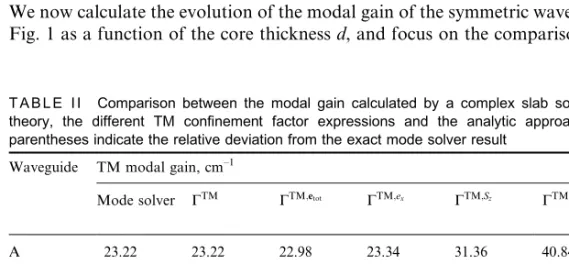
Table I shows that the modal gain values for waveguide A calculated by the complex mode solver and the TE perturbation formula coincide. The error of the analytic calcu-lation is very small. Turning to TM polarization, Table II reveals that only the pertur-bation result using GTM reproduces the mode solver result. It is also seen that the
perturbation approaches usingCTM;etot and CTM;ex approximate very well the correct
so-lution. Modal gain values predicted by CTM;Sz and CTM;hy are wrong. The error of the
analytic approach is again marginal. The same conclusion applies for the strongly asymmetric waveguide B. We also notice that TE and TM modal gain values differ by a factor of two for waveguide A and even a factor of four for structure B.
The last example is the symmetric trimodal waveguide C. According to Table I, the TE perturbation theory is correct for all three modes. For the TM case only the perturbation result GTM coincides with the mode solver value. The true con®nement factorCTM;etot is
able to predict the modal gain for all three guided modes with good accuracy and the
Figure 1 Waveguide geometries. The left waveguide is symmetric, the right strongly asymmetric.
expression based on CTM;ex underestimates the modal gain of the second-order mode
signi®cantly. This is expected, for the ez(x)-®eld component increases for higher-order modes. We further remark that for all modes TE and TM modal gain values are com-parable and thatCTM;Sz and CTM;hy lead to wrong results. The analytic approach proves
again to be solid.
In every example the TE modal gain is larger than the TM modal gain, which leads to the suggestion that bulk semiconductor laser diodes with bulk active layers lase pref-erentially in the TE regime, not only because of the dierent mirror characteristics for TE and TM, but also because of the dierence in modal gain.
5.2. Variation of TM modal gain as a function of the core thickness
We now calculate the evolution of the modal gain of the symmetric waveguide structure of Fig. 1 as a function of the core thicknessd, and focus on the comparison of the different
TABLE I Comparison between the modal gain calculated by a complex slab solver, TE perturbation theory and the analytic approach. The numbers in parentheses indicate the relative deviation from the exact mode solver result Waveguide TE modal gain, cm±1
Mode solver CTE;ey Analytic approach
A 48.68 48.68 (0%) 48.68 (0%)
B 52.76 52.76 (0%) 52.72 (±0.08%) C ± mode 0 191.6 191.6 (0%) 191.6 (0%) C ± mode 1 184.4 184.4 (0%) 184.3 (±0.05%) C ± mode 2 156.5 156.5 (0%) 156.4 (±0.06%)
TABLE II Comparison between the modal gain calculated by a complex slab solver, TM perturbation theory, the different TM con®nement factor expressions and the analytic approach. The numbers in parentheses indicate the relative deviation from the exact mode solver result
Waveguide TM modal gain, cm±1
Mode solver CTM CTM;etot CTM;ex CTM;Sz CTM;hy Analytic
approach A 23.22 23.22 (0%) 22.98(±1.1%) 23.34(0.5%) 31.36(+35%) 40.84(+76%) 23.21(±0.04%) B 12.93 12.93 (0%) 12.74(±1.4%) 12.70(±1.8%) 18.60(+44%) 25.72(+98%) 12.88(±0.39%) C ± mode 0 190.7 190.7 (0%) 190.3(±0.2%) 191.1(0.2%) 192.1(+0.8%) 192.9(+1.2%) 190.7(0%) C ± mode 1 179.5 179.5 (0%) 178.3(±0.7%) 179.9(0.2%) 184.6(+2.8%) 188.5(+5%) 179.5(0%) C ± mode 2 140.3 140.3 (0%) 139.1(±0.8%) 133.8(±4.6%) 146.6(+4.5%) 158.2(+13%) 140.2(±0.07%)
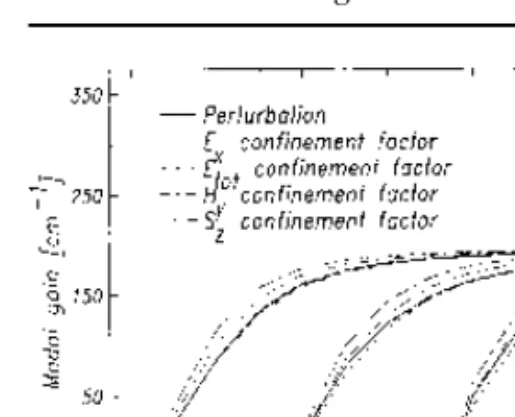
TM perturbation approaches. The results are summarized in Fig. 2. One may argue that it would be preferable to plot the normalized propagation constant versus the normalized frequency. However, both quantities are in this case complex numbers and in the nor-malized propagation constant the real and imaginary parts of the effective index are not separable.
From Fig. 2 it is concluded that the curves calculated by CTMand CTM;etot are hardly
distinguishable on the scale of the plot. The accuracy of the modal gain values based on
CTM;ex decreases progressively for higher-order modes. For the fundamental mode, the
dierence with the CTM;etot result is, as expected, negligible. The con®nement factor
ap-proaches based onCTM;SzandCTM;hy overestimate the modal gain signi®cantly. Only under
the conditions of cuto or extreme guidance is the correct value approximated.
5.3. Variation of the effective index as a function of the material gain
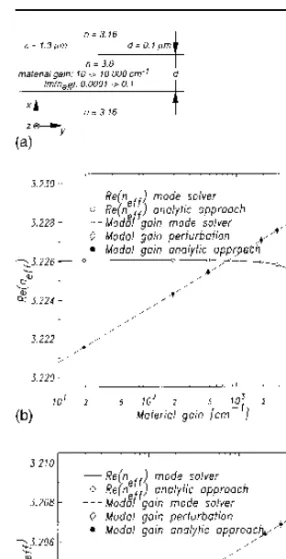
We investigate now the accuracy of the analytic approach. Therefore we consider a monomode waveguide, typical for semiconductor optical ampli®ers at 1.3lm and vary the material gain of the active layer in a very broad interval going from 10 cm±1to 104cm±1.
This extremely high (and physically unrealistic) upper boundary will enable us to explore the limits of the algorithm. The modal gain will be calculated using the analytic approach, perturbation theory and a complex mode solver. The in¯uence of the gain on the real part of the eective index will be calculated using (16) and a complex mode solver. The var-iation of the eective index as a function of the core index n is approximated, in the vicinity of the nominal core index 3.60, for both polarizations by the parabolas
nTM
eff 0:287n2ÿ1:778n5:908 nTM
eff 0:0915n2ÿ0:496n3:804
19 de®ned by the core index points 3.59, 3.60 and 3.61. Substitution of (19) in the Taylor expansion (16) leads to the curves labelled `analytic' in Fig. 3. The modal gain values obtained by the complex mode solver, the analytic approach and the perturbation theory coincide perfectly, both for TE and TM polarization. The modal gain varies linearly. Considering the real part of the eective index it is seen that the expansion (16) predicts accurate results. Additional simulations have shown that the numerical results are in-sensitive to the precise choice of the core indices for the calculation of the parabolas (19).
Figure 2 Variation of TM modal gain as a function of the core thickness of the waveguide. On the scale of the ®gure, the modal gain calculated by a complex slab sol-ver, the correct perturbation expression and the analytic approach are indistinguishable. The three curves corre-spond (from left to right) to the fundamental, the ®rst- and the second-order mode. The performance of the different con®nement factor expressions are also compared.
6. Conclusion
It has been shown from a simple variational calculation (see [9]) that TE and TM modal gain behave fundamentally dierently. Therefore, one has to be very cautious when generalizing TE formulae to the TM case, as is frequently done in the literature for the case of the con®nement factor formulation, which relates the material gain of the waveguide layers to the modal gain of the waveguide mode. Starting from a general perturbation formula, an accurate expression, correct up to ®rst order, for both TE and TM modal gain were derived. Unfortunately, the TM modal gain is not given by a true ®lling factor formulation. By approximating the TM relation we have shown that both TE and TM modal gain are given by the same expression
gmod neff1 ;0
XN i1
n0;iCettotgmat;i 20
which is exact for TE modes and approximate for TM modes.
Figure 3 Variation of real and imaginary (ex-pressed through the modal gain) parts of the ef-fective index of the fundamental mode as a function of the material gain of the core. The waveguide is depicted in (a). On the scale of the ®gure, the dif-ferences between the results obtained using a complex mode solver, the correct perturbation for-mula and the analytic approach disappear. TE re-sults can be found in (b) and TM rere-sults in (c).
An alternative way of calculating the modal gain to ®rst order has also been in-vestigated. This method relies on the fact that the dispersion equation for the eective index is an analytic function of the refractive index pro®le. The distinction between TE and TM polarization is accounted for in the form of the dispersion relation. Using this approach the eect of an imaginary index perturbation on the real part of the eective index can be calculated very accurately.
The advantage of both methods is that in order to obtain the complex eective index only a real index modal calculation has to be done and that the eect of dierent material gain or loss levels can be directly estimated without any additional simulation. The validity of the TM con®nement factor approximation, as well as that of the analytic approach, has been numerically veri®ed.
Acknowledgements
J. Haes and R. Baets wish to acknowledge partial support from the RACE-2069 and 2039 projects (UFOS and ATMOS). J. Haes holds a doctoral fellowship from the Flemish Institute for the promotion of scienti®c±technological research in industry (IWT) and B. Demeulenaere from the National Fund for Scienti®c Research of Belgium (NFWO). Partial support (T. D. Visser) by the Technology Foundation (STW) and (H. Blok) by the Schlumberger Fund for Science, Technology and Research is also acknowledged. D. F. G. Gallagher (Photon Design) and C. Vassallo (France Telecom CNET) are acknowledged for interesting discussions.
References
1.J. BUUSJ. BUUS,,IEEE J. Quantum Electron.IEEE J. Quantum Electron.1818(1982) 1083.(1982) 1083.
2.T. D. VISSER, H. BLOKT. D. VISSER, H. BLOKandandD. LENSTRAD. LENSTRA,,IEEE J. Quantum Electron.IEEE J. Quantum Electron.3131(1995) 1803.(1995) 1803. 3.D. BOTEZD. BOTEZ,,IEEE J. Quantum Electron.IEEE J. Quantum Electron.1414(1978) 230.(1978) 230.
4.S. ASADAS. ASADA,,IEEE J. Quantum Electron.IEEE J. Quantum Electron.2727(1991) 884.(1991) 884.
5.G. P. AGRAWALG. P. AGRAWALandandN. K. DUTTAN. K. DUTTA,,Long-Wavelength Semiconductor LasersLong-Wavelength Semiconductor Lasers(Van Nostrand Reinhold Elec-(Van Nostrand Reinhold Elec-trical/Computer Science and Engineering Series, New York, 1986).
trical/Computer Science and Engineering Series, New York, 1986).
6.M. J. ADAMSM. J. ADAMS,,An Introduction to Optical WaveguidesAn Introduction to Optical Waveguides(John Wiley, Chichester, 1981).(John Wiley, Chichester, 1981). 7.V. L. GUPTAV. L. GUPTAandandE. K. SHARMAE. K. SHARMA,,J. Opt. Soc. Am. AJ. Opt. Soc. Am. A99(1992) 953.(1992) 953.
8.C. VASSALLOC. VASSALLO,,IEEE J. Lightwave Technol.IEEE J. Lightwave Technol.88(1990) 1723.(1990) 1723.
9.T. D. VISSER, B. DEMEULENAERE, J. HAES, D. LENSTRA, R. BAETST. D. VISSER, B. DEMEULENAERE, J. HAES, D. LENSTRA, R. BAETSandandH. BLOKH. BLOK, accepted for publication, accepted for publication IEEE J. Lightwave Technol.
IEEE J. Lightwave Technol.1414(1996) 885.(1996) 885.
10.A. YARIVA. YARIVandandP. YEHP. YEH,,Optical Waves in CrystalsOptical Waves in Crystals(John Wiley, New York, 1984).(John Wiley, New York, 1984).
11.J. HAES, B. DEMEULENAERE, T. D. VISSER, D. LENSTRA, H. BLOKJ. HAES, B. DEMEULENAERE, T. D. VISSER, D. LENSTRA, H. BLOKandand R. BAETSR. BAETS,,Proceedings of theProceedings of the European Conference on Optical Communication
European Conference on Optical Communication(1995) 729.(1995) 729.
12.R. E. SMITH, S. N. HOUDE-WALTERR. E. SMITH, S. N. HOUDE-WALTERandandG. W. FORBESG. W. FORBES,,IEEE J. Quantum Electron.IEEE J. Quantum Electron.2828(1992) 1520.(1992) 1520. 13.P. M. MORSEP. M. MORSEandandH. FESHBACHH. FESHBACH,,Methods of Theoretical PhysicsMethods of Theoretical Physics(McGraw-Hill, New York, 1953).(McGraw-Hill, New York, 1953).