LTC4357
4357fdFeatures
applications
Description
Positive High Voltage
Ideal Diode Controller
The LTC®4357 is a positive high voltage ideal diode
control-ler that drives an external N-channel MOSFET to replace a Schottky diode. When used in diode-OR and high current diode applications, the LTC4357 reduces power consump-tion, heat dissipaconsump-tion, voltage loss and PC board area. The LTC4357 easily ORs power sources to increase total system reliability. In diode-OR applications, the LTC4357 controls the forward voltage drop across the MOSFET to ensure smooth current transfer from one path to the other without oscillation. If the power source fails or is shorted, a fast turn-off minimizes reverse current transients.
48V, 10A Diode-OR
n Reduces Power Dissipation by Replacing a Power
Schottky Diode with an N-Channel MOSFET
n 0.5µs Turn-Off Time Limits Peak Fault Current n Wide Operating Voltage Range: 9V to 80V n Smooth Switchover without Oscillation n No Reverse DC Current
n Available in 6-Lead (2mm × 3mm) DFN and 8-Lead MSOP Packages
n N + 1 Redundant Power Supplies n High Availability Systems
n AdvancedTCA Systems n Telecom Infrastructure n Automotive Systems 4357 TA01 LTC4357 GND IN OUT VDD GATE FDB3632 VINA 48V VOUT TO LOAD LTC4357 GND IN OUT VDD GATE FDB3632 VINB 48V
*SEE FIGURES 2 AND 3 FOR ADDITIONAL OPTIONAL COMPONENTS
Power Dissipation vs Load Current
typical application
CURRENT (A) 0 0 POWER DISSIP ATION (W) 1 2 3 4 5 6 2 4 6 8 4357 TA01b 10 DIODE (MBR10100) FET (FDB3632) POWER SAVEDL, LT, LTC, LTM, Linear Technology and the Linear logo are registered trademarks and
Hot Swap is a trademark of Linear Technology Corporation. All other trademarks are the property of their respective owners.
LTC4357
4357fd
absolute MaxiMuM ratings
Supply Voltages IN ... –1V to 100V OUT, VDD ... –0.3V to 100V Output Voltage GATE (Note 3) ... VIN – 0.2V to VIN + 10V (Notes 1, 2) TOP VIEW VDD NC GND OUT IN GATE DCB PACKAGE 6-LEAD (2mm s 3mm) PLASTIC DFN 4 5 7 GND 6 3 2 1 TJMAX = 125°C, θJA = 90°C/WEXPOSED PAD (PIN 7) PCB GND CONNECTION OPTIONAL
1 2 3 4 IN NC NC GATE 8 7 6 5 OUT VDD NC GND TOP VIEW MS8 PACKAGE 8-LEAD PLASTIC MSOP
TJMAX = 125°C, θJA = 163°C/W
Operating Ambient Temperature Range
LTC4357C ... 0°C to 70°C LTC4357I... –40°C to 85°C LTC4357H ... –40°C to 125°C LTC4357MP ... –55°C to 125°C Storage Temperature Range ... –65°C to 150°C Lead Temperature (Soldering, 10 sec)
MS Package ... 300°C
pin conFiguration
orDer inForMation
LEAD FREE FINISH
TAPE AND REEL (MINI) TAPE AND REEL PART MARKING* PACKAGE DESCRIPTION TEMPERATURE RANGE
LTC4357CDCB#TRMPBF LTC4357CDCB#TRPBF LCXF 6-Lead (2mm × 3mm) Plastic DFN 0°C to 70°C LTC4357IDCB#TRMPBF LTC4357IDCB#TRPBF LCXF 6-Lead (2mm × 3mm) Plastic DFN –40°C to 85°C LTC4357HDCB#TRMPBF LTC4357HDCB#TRPBF LCXF 6-Lead (2mm × 3mm) Plastic DFN –40°C to 125°C TRM = 500 pieces. *Temperature grades are identified by a label on the shipping container.
Consult LTC Marketing for parts specified with wider operating temperature ranges. Consult LTC Marketing for information on lead based finish parts.
For more information on lead free part marking, go to: http://www.linear.com/leadfree/
For more information on tape and reel specifications, go to: http://www.linear.com/tapeandreel/
LEAD FREE FINISH TAPE AND REEL PART MARKING* PACKAGE DESCRIPTION TEMPERATURE RANGE
LTC4357CMS8#PBF LTC4357CMS8#TRPBF LTCXD 8-Lead Plastic MSOP 0°C to 70°C LTC4357IMS8#PBF LTC4357IMS8#TRPBF LTCXD 8-Lead Plastic MSOP –40°C to 85°C LTC4357HMS8#PBF LTC4357HMS8#TRPBF LTCXD 8-Lead Plastic MSOP –40°C to 125°C LTC4357MPMS8#PBF LTC4357MPMS8#TRPBF LTFWZ 8-Lead Plastic MSOP –55°C to 125°C
LEAD BASED FINISH TAPE AND REEL PART MARKING* PACKAGE DESCRIPTION TEMPERATURE RANGE
LTC4357
4357fd
electrical characteristics
Note 1: Stresses beyond those listed under Absolute Maximum Ratings may cause permanent damage to the device. Exposure to any Absolute Maximum Rating condition for extended periods may affect device reliability and lifetime.
The l denotes the specifications which apply over the full operating
temperature range, otherwise specifications are at TA = 25°C. VOUT = VDD, VDD = 9V to 80V unless otherwise noted.
SYMBOL PARAMETER CONDITIONS MIN TYP MAX UNITS
VDD Operating Supply Range l 9 80 V
IDD Supply Current l 0.5 1.25 mA
IIN IN Pin Current VIN = VOUT ±1V l 150 350 500 µA
IOUT OUT Pin Current VIN = VOUT ±1V l 80 210 µA
DVGATE External N-Channel Gate Drive
(VGATE – VIN) VDD, VOUT = 20V to 80V VDD, VOUT = 9V to 20V l l 10 4.5 12 6 15 15 V V IGATE(UP) External N-Channel Gate Pull-Up Current VGATE = VIN, VIN – VOUT = 0.1V l –14 –20 –26 µA
IGATE(DOWN) External N-Channel Gate Pull-Down
Current in Fault Condition VGATE = VIN + 5V
l 1 2 A
tOFF Gate Turn-Off Time VIN – VOUT = 55mV–|––1V,
VGATE – VIN < 1V, CGATE = 0pF
l 300 500 ns
DVSD Source-Drain Regulation Voltage
(VIN – VOUT)
VGATE – VIN = 2.5V l 10 25 55 mV
Note 2: All currents into pins are positive, all voltages are referenced to GND unless otherwise specified.
Note 3: An internal clamp limits the GATE pin to a minimum of 10V above IN or 100V above GND. Driving this pin to voltages beyond this clamp may damage the device.
typical perForMance characteristics
VDD Current (IDD vs VDD) IN Current (IIN vs VIN) OUT Current (IOUT vs VOUT)
VDD (V) 0 IDD (µA) 400 600 80 4357 G01 200 0 20 40 60 800 VDD = VOUT = VIN ± 1V VIN (V) 0 IIN (µA) 200 300 80 4357 G02 100 0 20 40 60 400 VDD = VOUT = VIN + 1V VDD = VOUT = VIN – 1V VOUT (V) 0 IOUT (µA) 60 120 80 4357 G03 0 20 40 60 180 30 90 150 VDD = VOUT= VIN + 1V VDD = VOUT= VIN – 1V
LTC4357
4357fd
typical perForMance characteristics
OUT Current (IOUT vs VIN)
FET Turn-Off Time
vs GATE Capacitance FET Turn-Off Time vs Initial Overdrive GATE Current vs Forward Drop
(IGATE vs DVSD)
DVGATE vs GATE Current
(DVGATE vs IGATE) VSD (mV) –50 –50 IGATE (µA) –25 0 25 0 50 4357 G04 100 150 $VGATE = 2.5V IGATE (µA) 0 0 $ VGA TE (V) 5 10 15 5 10 15 20 4357 G05 25 VIN > 18V VIN = 12V VIN = 9V VIN (V) 0 IOUT (µA) 75 100 125 6 10 14 4357 G06 50 25 0 2 4 8 12 VOUT = 12V, VIN= VDD VINITIAL (V) 0 tPD (ns) 200 300 0.8 4357 G08 100 0 0.2 0.4 0.6 1.0 400 VIN= 48V $VSD = VINITIAL –1V
FET Turn-Off Time vs Final Overdrive VFINAL (V) –1 tPD (ns) 1000 1500 –0.2 4357 G09 500 0 –0.8 –0.6 –0.4 0 2000 VIN= 48V $VSD = 55mV VFINAL
FET Load Current vs DVSD
CGATE (nF) 0 tOFF (ns) 300 400 500 80 4357 G07 200 100 0 20 40 60 VGATE < VIN+ 1V $VSD = 55mV –1V ∆VSD (mV) 0
LOAD CURRENT (A)
6 8 10 75 4357 G10 4 2 0 25 50 VIN= 48V WITH FET (FDB3632)
LTC4357
4357fd
pin Functions
Exposed Pad: Exposed pad may be left open or connected to GND.
GATE: Gate Drive Output. The GATE pin pulls high, enhanc-ing the N-channel MOSFET when the load current creates more than 25mV of voltage drop across the MOSFET. When the load current is small, the gate is actively driven to maintain 25mV across the MOSFET. If reverse current develops more than –25mV of voltage drop across the MOSFET, a fast pull-down circuit quickly connects the GATE pin to the IN pin, turning off the MOSFET.
GND: Device Ground.
IN: Input Voltage and GATE Fast Pull-Down Return. IN is the anode of the ideal diode and connects to the source of the N-channel MOSFET. The voltage sensed at this pin
is used to control the source-drain voltage across the MOSFET. The GATE fast pull-down current is returned through the IN pin. Connect this pin as close as possible to the MOSFET source.
NC: No Connection. Not internally connected.
OUT: Drain Voltage Sense. OUT is the cathode of the ideal diode and the common output when multiple LTC4357s are configured as an ideal diode-OR. It connects to the drain of the N-channel MOSFET. The voltage sensed at this pin is used to control the source-drain voltage across the MOSFET.
VDD: Positive Supply Input. The LTC4357 is powered from the VDD pin. Connect this pin to OUT either directly or through an RC hold-up circuit.
4357 BD CHARGE PUMP – + – + + – FPD
COMP GATEAMP
25mV 25mV IN GATE 17V OUT GND IN VDD +–
block DiagraM
LTC4357
4357fd
operation
High availability systems often employ parallel-connected power supplies or battery feeds to achieve redundancy and enhance system reliability. ORing diodes have been a popular means of connecting these supplies at the point of load. The disadvantage of this approach is the forward voltage drop and resulting efficiency loss. This drop reduces the available supply voltage and dissipates significant power. Using an N-channel MOSFET to replace a Schottky diode reduces the power dissipation and eliminates the need for costly heat sinks or large thermal layouts in high power applications.
The LTC4357 controls an external N-channel MOSFET to form an ideal diode. The voltage across the source and drain is monitored by the IN and OUT pins, and the GATE pin drives the MOSFET to control its operation. In effect the MOSFET source and drain serve as the anode and cathode of an ideal diode.
At power-up, the load current initially flows through the body diode of the MOSFET. The resulting high forward
voltage is detected at the IN and OUT pins, and the LTC4357 drives the GATE pin to servo the forward drop to 25mV. If the load current causes more than 25mV of voltage drop when the MOSFET gate is driven fully on, the forward voltage is equal to RDS(ON) • ILOAD.
If the load current is reduced causing the forward drop to fall below 25mV, the MOSFET gate is driven lower by a weak pull-down in an attempt to maintain the drop at 25mV. If the load current reverses and the voltage across IN to OUT is more negative than –25mV the LTC4357 responds by pulling the MOSFET gate low with a strong pull-down.
In the event of a power supply failure, such as if the output of a fully loaded supply is suddenly shorted to ground, reverse current temporarily flows through the MOSFET that is on. This current is sourced from any load capacitance and from the other supplies. The LTC4357 quickly responds to this condition turning off the MOSFET in about 500ns, thus minimizing the disturbance to the output bus.
MOSFET Selection
The LTC4357 drives an N-channel MOSFET to conduct the load current. The important features of the MOSFET are on-resistance, RDS(ON), the maximum drain-source voltage, VDSS, and the gate threshold voltage.
Gate drive is compatible with 4.5V logic-level MOSFETs in low voltage applications (VDD = 9V to 20V). At higher voltages (VDD = 20V to 80V) standard 10V threshold MOS-FETs may be used. An internal clamp limits the gate drive to 15V between the GATE and IN pins. An external Zener clamp may be added between GATE and IN for MOSFETs with a VGS(MAX) of less than 15V.
The maximum allowable drain-source voltage, BVDSS, must be higher than the power supply voltage. If an input is connected to GND, the full supply voltage will appear across the MOSFET.
ORing Two-Supply Outputs
Where LTC4357s are used to combine the outputs of two power supplies, the supply with the highest output voltage sources most or all of the load current. If this supply’s output is quickly shorted to ground while delivering load current, the flow of current temporarily reverses and flows backwards through the LTC4357’s MOSFET. When the reverse current produces a voltage drop across the MOSFET of more than –25mV, the LTC4357’s fast pull-down activates and quickly turns off the MOSFET.
If the other, initially lower, supply was not delivering load current at the time of the fault, the output falls until the body diode of its ORing MOSFET conducts. Meanwhile, the LTC4357 charges its MOSFET gate with 20µA until the forward drop is reduced to 25mV. If instead this supply was delivering load current at the time of the fault, its associ-ated ORing MOSFET was already driven at least partially on, and the LTC4357 will simply drive the MOSFET gate harder in an effort to maintain a drop of 25mV.
LTC4357
4357fd
applications inForMation
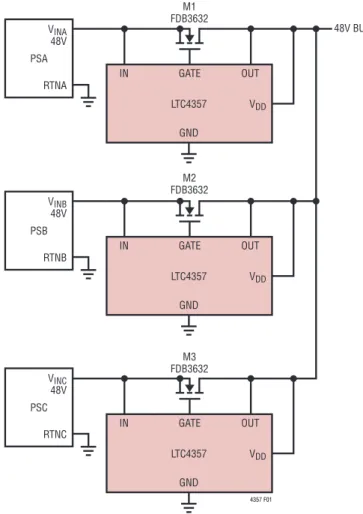
Figure 1. Droop Sharing Redundant Supplies
4357 F01 LTC4357 GND IN OUT VDD GATE M1 FDB3632 48V BUS LTC4357 GND IN OUT VDD GATE M2 FDB3632 LTC4357 GND IN OUT VDD PSA VINA 48V RTNA GATE M3 FDB3632 PSB VINB 48V RTNB PSC VINC 48V RTNC Load Sharing
The application in Figure 1 combines the outputs of multiple, redundant supplies using a simple technique known as droop sharing. Load current is first taken from the highest output, with the low outputs contributing as the output voltage falls under increased loading. The 25mV regulation technique ensures smooth load sharing between outputs without oscillation. The degree of sharing is a function of RDS(ON), the output impedance of the supplies and their initial output voltages.
Input Short-Circuit Faults
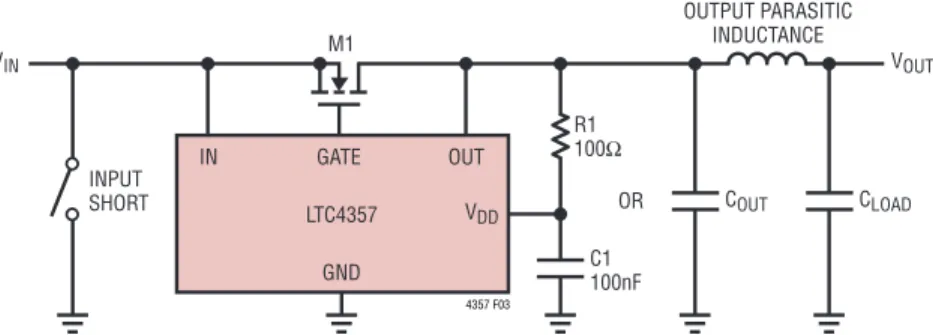
The dynamic behavior of an active, ideal diode entering reverse bias is most accurately characterized by a delay followed by a period of reverse recovery. During the delay phase some reverse current is built up, limited by parasitic resistances and inductances. During the reverse recovery phase, energy stored in the parasitic inductances is trans-ferred to other elements in the circuit. Current slew rates during reverse recovery may reach 100A/µs or higher. High slew rates coupled with parasitic inductances in se-ries with the input and output paths may cause potentially destructive transients to appear at the IN and OUT pins of the LTC4357 during reverse recovery. A zero imped-ance short-circuit directly across the input of the circuit is especially troublesome because it permits the highest possible reverse current to build up during the delay phase. When the MOSFET finally commutates the reverse current the LTC4357 IN pin experiences a negative voltage spike, while the OUT pin spikes in the positive direction. To prevent damage to the LTC4357 under conditions of input short-circuit, protect the IN pin and OUT pin as shown in Figure 2. The IN pin is protected by clamping to the GND pin in the negative direction. Protect the OUT pin with a clamp, such as with a TVS or TransZorb, or with a local bypass capacitor of at least 10µF. In low voltage applications the MOSFET's drain-source breakdown may be sufficient to protect the OUT pin, provided BVDSS + VIN < 100V.
Parasitic inductance between the load bypass and the LTC4357 allows a zero impedance input short to collapse the voltage at the VDD pin, which increases the total turn-off time (tOFF). For applications up to 30V, bypass the VDD pin with 39µF; above 30V use at least 100µF. If VDD is powered from the output side, one capacitor serves to guard against VDD collapse and also protect OUT from voltage spikes. If the OUT pin is protected by a diode clamp or if VDD is powered from the input side, decouple the VDD pin with a separate 100Ω, 100nF filter (see Figure 3). In applications above 10A increase the filter capacitor to 1µF.
LTC4357
4357fd
Design Example
The following design example demonstrates the calcula-tions involved for selecting components in a 12V system with 10A maximum load current (see Figure 4).
First, calculate the RDS(ON) of the MOSFET to achieve the de-sired forward drop at full load. Assuming VDROP = 0.1V,
RDS(ON)≤VDROP
ILOAD = 0.1V 10A RDS(ON)≤10mΩ
The Si4874DY offers a good solution, in an S8 package with RDS(ON) = 10mΩ(max) and BVDSS of 30V.
The maximum power dissipation in the MOSFET is: P = ILOAD2 • R
DS(ON) = (10A)2 • 10mΩ = 1W
With less than 39µF of local bypass, the recommended RC values of 100Ω and 0.1µF were used in Figure 4.
Since BVDSS + VIN is much less than 100V, output clamp-ing is unnecessary.
Figure 3. Protecting Against Collapse of VDD During Reverse Recovery
applications inForMation
Figure 2. Reverse Recovery Produces Inductive Spikes at the IN and OUT Pin. The Polarity of Step Recovery Spikes is Shown Across Parasitic Inductances
4357 F02 LTC4357 + – GND IN OUT VDD GATE M1
REVERSE RECOVERY CURRENT VIN INPUT SHORT DIN SBR1U-150SA INPUT PARASITIC INDUCTANCE COUT 10µF VOUT CLOAD DCLAMP SMAT70A OR + – OUTPUT PARASITIC INDUCTANCE 4357 F03 LTC4357 GND IN OUT VDD GATE M1 OUTPUT PARASITIC INDUCTANCE VIN R1 100Ω C1 100nF INPUT SHORT COUT VOUT CLOAD OR
Figure 4. 12V, 10A Diode-OR
4357 F04 LTC4357 GND IN OUT VDD GATE M2 Si4874DY VIN2 12V R1 100Ω C1 0.1µF R1 100Ω C1 0.1µF LTC4357 GND IN OUT VDD GATE M1 Si4874DY VIN1 12V VTO LOADOUT
LTC4357
4357fd
Layout Considerations
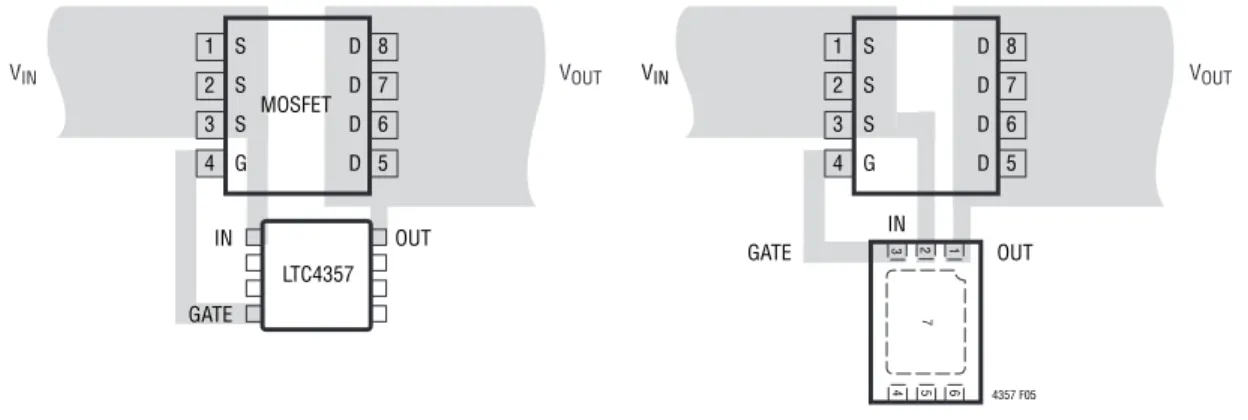
Connect the IN and OUT pins as close as possible to the MOSFET’s source and drain pins. Keep the traces to the MOSFET wide and short to minimize resistive losses. See Figure 5.
applications inForMation
Figure 5. Layout Considerations
For the DFN package, pin spacing may be a concern at voltages greater than 30V. Check creepage and clearance guidelines to determine if this is an issue. To increase the pin spacing between high voltage and ground pins, leave the exposed pad connection open. Use no-clean solder to minimize PCB contamination. LTC4357 S S S G 1 2 3 4 8 7 6 5 D D D D MOSFET IN GATE OUT VIN VOUT 4357 F05 S S S G 1 2 3 4 8 7 6 5 D D D D VIN OUT GATE IN 4 5 7 6 3 2 1 VOUT
LTC4357
0
4357fd
typical applications
–12V Reverse Input Protection
4357 TA03 LTC4357 GND IN OUT VDD GATE M1 Si4874DY VIN 12V D1 MMBD1205 CLOAD VOUT 12V 10A
–48V Reverse Input Protection
4357 TA04 LTC4357 GND IN OUT VDD GATE M1 FDB3632 VIN 48V D1 MMBD1205 CLOAD DCLAMP SMAT70A VOUT 48V 10A Solar Panel Charging a Battery
4357 TA02 LTC4357 GND IN OUT 12V BATTERY VDD GATE M1 FDB3632 C1 0.1µF R1 100Ω 14V SHUNT REGULATOR + LOAD 100W SOLAR PANEL 4357 TA05 LTC4357 GND IN OUT VDD GATE M1 FDS3672 10M VIN 48V 5A G1 BSS123 C1 0.1µF R1 100Ω DCLAMP SMAT70A VOUT ON OFF
LTC4357
4357fdpackage Description
DCB Package 6-Lead Plastic DFN (2mm × 3mm) (Reference LTC DWG # 05-08-1715 Rev A) 3.00p0.10 (2 SIDES) 2.00p0.10 (2 SIDES) NOTE:1. DRAWING TO BE MADE A JEDEC PACKAGE OUTLINE M0-229 VARIATION OF (TBD) 2. DRAWING NOT TO SCALE
3. ALL DIMENSIONS ARE IN MILLIMETERS
4. DIMENSIONS OF EXPOSED PAD ON BOTTOM OF PACKAGE DO NOT INCLUDE MOLD FLASH. MOLD FLASH, IF PRESENT, SHALL NOT EXCEED 0.15mm ON ANY SIDE 5. EXPOSED PAD SHALL BE SOLDER PLATED
6. SHADED AREA IS ONLY A REFERENCE FOR PIN 1 LOCATION ON THE TOP AND BOTTOM OF PACKAGE
0.40p 0.10
BOTTOM VIEW—EXPOSED PAD 1.65p 0.10 (2 SIDES) 0.75p0.05 R = 0.115 TYP R = 0.05 TYP 1.35p0.10 (2 SIDES) 1 3 6 4 PIN 1 BAR TOP MARK (SEE NOTE 6) 0.200 REF 0.00 – 0.05 (DCB6) DFN 0405 0.25p 0.05 0.50 BSC PIN 1 NOTCH R0.20 OR 0.25 s 45o CHAMFER 0.25p 0.05 1.35p0.05 (2 SIDES)
RECOMMENDED SOLDER PAD PITCH AND DIMENSIONS 1.65p0.05 (2 SIDES) 2.15p0.05 0.70p0.05 3.55p0.05 PACKAGE OUTLINE 0.50 BSC
LTC4357
4357fd
package Description
MS8 Package 8-Lead Plastic MSOP
(Reference LTC DWG # 05-08-1660 Rev F) MSOP (MS8) 0307 REV F 0.53p 0.152 (.021p .006) SEATING PLANE NOTE: 1. DIMENSIONS IN MILLIMETER/(INCH) 2. DRAWING NOT TO SCALE
3. DIMENSION DOES NOT INCLUDE MOLD FLASH, PROTRUSIONS OR GATE BURRS.
MOLD FLASH, PROTRUSIONS OR GATE BURRS SHALL NOT EXCEED 0.152mm (.006") PER SIDE 4. DIMENSION DOES NOT INCLUDE INTERLEAD FLASH OR PROTRUSIONS.
INTERLEAD FLASH OR PROTRUSIONS SHALL NOT EXCEED 0.152mm (.006") PER SIDE 5. LEAD COPLANARITY (BOTTOM OF LEADS AFTER FORMING) SHALL BE 0.102mm (.004") MAX
0.18 (.007) 0.254 (.010) 1.10 (.043) MAX 0.22 – 0.38 (.009 – .015) TYP 0.1016p 0.0508 (.004p .002) 0.86 (.034) REF 0.65 (.0256) BSC 0o – 6o TYP DETAIL “A” DETAIL “A” GAUGE PLANE 1 2 3 4 4.90p 0.152 (.193p .006) 8 7 6 5 3.00p 0.102 (.118p .004) (NOTE 3) 3.00p 0.102 (.118p .004) (NOTE 4) 0.52 (.0205) REF 5.23 (.206) MIN 3.20 – 3.45 (.126 – .136) 0.889p 0.127 (.035p .005)
RECOMMENDED SOLDER PAD LAYOUT 0.42p 0.038 (.0165p .0015) TYP 0.65 (.0256) BSC
LTC4357
4357fd
Information furnished by Linear Technology Corporation is believed to be accurate and reliable. However, no responsibility is assumed for its use. Linear Technology Corporation makes no representa-tion that the interconnecrepresenta-tion of its circuits as described herein will not infringe on existing patent rights.
revision history
REV DATE DESCRIPTION PAGE NUMBER
D 09/10 Revised θJA value for MS8 package in Pin Configuration section and added MP-grade to Order Information section 2
Added two new plots and revised remaining curves in Typical Performance Characteristics section 3, 4
Updated Electrical Characteristics section 4
Revised Figure 2 and Figure 4 in Applications Information section 8
LTC4357
4357fd
Linear Technology Corporation
1630 McCarthy Blvd., Milpitas, CA 95035-7417
(408) 432-1900 l FAX: (408) 434-0507 l www.linear.com LINEAR TECHNOLOGY CORPORATION 2007
LT 0910 REV D • PRINTED IN USA
relateD parts
typical application
Plug-In Card Input Diode for Supply Hold-Up
PART NUMBER DESCRIPTION COMMENTS
LT1641-1/LT1641-2 Positive High Voltage Hot Swap Controllers Active Current Limiting, Supplies from 9V to 80V LTC1921 Dual –48V Supply and Fuse Monitor UV/OV Monitor, –10V to –80V Operation, MSOP Package LT4250 –48V Hot Swap Controller Active Current Limiting, Supplies from –18V to –80V LTC4251/LTC4251-1/
LTC4251-2 –48V Hot Swap Controllers in SOT-23 Fast Active Current Limiting, Supplies from –15V LTC4252-1/LTC4252-2/
LTC4252-1A/LTC4252-2A –48V Hot Swap Controllers in MS8/MS10 Fast Active Current Limiting, Supplies from –15V, Drain Accelerated Response LTC4253 –48V Hot Swap Controller with Sequencer Fast Active Current Limiting, Supplies from –15V, Drain Accelerated
Response, Sequenced Power Good Outputs LT4256 Positive 48V Hot Swap Controller with
Open-Circuit Detect Foldback Current Limiting, Open-Circuit and Overcurrent Fault Output, Up to 80V Supply LTC4260 Positive High Voltage Hot Swap Controller With I2C and ADC, Supplies from 8.5V to 80V
LTC4261 Negative High Voltage Hot Swap Controller With I2C and 10-Bit ADC, Adjustable Inrush and Overcurrent Limits
LTC4352 Ideal Diode Controller with Monitor Controls N-Channel MOSFET, 0V to 18V Operation LTC4354 Negative Voltage Diode-OR Controller
and Monitor Controls Two N-Channel MOSFETs, 1µs Turn-Off, 80V Operation LTC4355 Positive Voltage Diode-OR Controller
and Monitor Controls Two N-Channel MOSFETs, 0.5µs Turn-Off, 80V Operation LT4356-1/LT4356-2/
LT4356-3 Surge Stopper, Overvoltage and Overcurrent Protection Regulator Wide Operation Range: 4V to 80V, Reverse Input Protection to –60V, Adjustable Output Clamp Voltage
4357 TA06 LTC4357 GND IN OUT VDD GATE FDB3632 PLUG-IN CARD CONNECTOR 1 BACKPLANE CONNECTORS PLUG-IN CARD CONNECTOR 2 48V VOUT1 VOUT2 GND SMAT70A SMAT70A CHOLDUP GND LTC4357 GND IN OUT VDD GATE FDB3632 GND Hot Swap CONTROLLER Hot Swap CONTROLLER + CHOLDUP +