SLIS Connecting
Volume 7Issue 1SLIS Connecting Special Issue: British Studies Article 6
2018
British Studies Interview
Martha Attridge Bufton
University of Alberta
Teresa S. Welsh
University of Southern Mississippi
Follow this and additional works at:https://aquila.usm.edu/slisconnecting
Part of theArchival Science Commons,Collection Development and Management Commons,
Information Literacy Commons,Scholarly Communication Commons, and theScholarly Publishing Commons
This Column is brought to you for free and open access by The Aquila Digital Community. It has been accepted for inclusion in SLIS Connecting by an authorized editor of The Aquila Digital Community. For more information, please [email protected].
Recommended Citation
Attridge Bufton, Martha and Welsh, Teresa S. (2018) "British Studies Interview,"SLIS Connecting: Vol. 7 : Iss. 1 , Article 6. DOI: 10.18785/slis.0701.06
Teresa S. Welsh, Ph.D.
British Studies Interview (Attridge Bufton, 2015) Interview by British Studies 2015 alumna Martha
Attridge Bufton, University of Alberta, for an article, "Crossing the Pond: MLIS Students Researching in the U.K." published in Open Shelf (http://open-shelf.ca/, March 2016), updated and used by permission. 1. Tell me about the British Studies Program at the
University of Southern Mississippi (how long it’s
been running, goals, structure).
The British Studies Program at The University of Southern Mississippi is one of the oldest and largest study-abroad programs in the country and celebrated its 40th year in 2015
(www.usm.edu/news/article/british-studies-program-begins-40th-year-registration-underway). The University is an accredited, Carnegie RU/H (Research University/Higher Research Activity), and our program is accredited by the American Library Association.
Before I taught LIS British Studies, it was taught by Dr. Joy Greiner - I believe the last time was in summer 1996. When I began preparing to teach the course in 2006, it had been 10 years since it was last taught. I first taught the course in 2007 (Figure 1) and 2016 was my 10th year. In many of these years, the LIS class has been the largest in British Studies, an average of 18 students per summer.
The goals of the program are:
1) to learn about historic and modern British libraries, archives, and special collections on-site from distinguished British librarians, archivists, and information specialists
2) to conduct research on an approved topic using primary sources and other resources available in the U.K. These two goals allow students to gain a general knowledge about the collections and operations of a variety of different libraries, archives, and collections and also become a subject specialist on a specific topic related to British libraries, archives, or collections.
Figure 1. Kings Cross Station, London British Studies 2007
Students earn 6 credit hours in British Studies LIS 580/587:
• LIS 580 class assignments include two scholarly book reviews from a list of recommended books and a journal (blog) of students’ experiences related to class on-site lectures/guided tours and selected visits on their own to sites of interest or sites related to their research.
• LIS 587 requires an in-depth research paper using the resources of metropolitan London and/or the United Kingdom. An approved problem statement and research questions are due while in London to guide research and data collection, then the completed research paper is submitted a couple of weeks after returning to the States.
Students and faculty are headquartered at university dorms in London and Edinburgh. Class visits include day trips to Oxford and Bletchley Part, required class visits to a variety of libraries, archives, and museums, and some optional visits to specialized sites of
interest. Students have time on their own, including some 3-day weekends and a mini-break of 4 days, to spend on research and to explore London and other nearby sites of interest such as Bath, Stonehenge, Winchester, or Brighton.
In 2016, there were several changes from past years. The program is now headquartered at a University of Westminster dorm, and the time frame will be during June 3 instead of July 3. Another change is that students are now furnished with an Oyster travel card for unlimited travel via tube and bus within London for one month.
Dr. Griffis and I have taught large classes together in 2014 and 2015 (Figure 2) but hope to teach in alternate summers at some time in the future.
Figure 2. Dr. Griffis, Dr. Welsh University of Oxford, 2015
2. What do you hope students take away from the program?
As an undergraduate, I had a British Studies study-abroad anthropology course on British culture and it was life-changing. Learning to find my way around London, one of the most sophisticated and
metropolitan cities in the world, walking in the footsteps of Shakespeare in Stratford-upon-Avon, then seeing a production of the Royal Shakespeare Company, was the experience of a lifetime. I grew up in a rural, sheltered environment and could only dream of seeing the world I read about in books. Actually experiencing this world gave me confidence to continue in academia and set me on a path that led to a Ph.D. and to participation in international conferences.
3. Tell me why you decided to open up the program to Canadian LIS students.
One unique feature of British Studies is that there are no out-of-state or out-of-country fees and it enriches the program to have geographic and cultural diversity among our students. We have always been open to having Canadian students but didn’t have the Canadian connections to market the program until Dr. Griffis joined our faculty, and we were very happy and excited to have our first two Canadians
participate in 2015.
4. What is an unexpected benefit of working
together, given that one of you is Canadian and the other is American?
I can only speak from my perspective but it was wonderful to have a colleague to share the workload as well as the adventure and to discuss issues as they arose. It was also great in that one of us could lead the way for the group on our excursions, and Dr. Griffis enjoyed that role, and I could bring up the rear with the slower ones, which I enjoyed. His
enthusiasm, encyclopedic knowledge, and joy in interacting with the students was both inspiring and gratifying. Lifelong bonds are created each summer among the students and between individual students and me so it was rewarding to share that with a colleague.
Figure 3. London Library British Studies Class of 2012
5. What are your “bests”?
a. Best library experience
So many unforgettable experiences…. among the top: • seeing dear Mr. Joseph Wisdom each summer at
the St. Paul Cathedral Library and Kevin Mehmet at the British Library, Southern Miss SLIS alumna Nikki Haley (a law librarian in London), British Studies and Simmons College alumna Jessica Green, and lovely British friends Stephen Doerr, Dr. Peter Allen, Stephen Thornton, Andrew Wiltshire, and the distinguished British librarians and archivists who lecture to our students • learning the stories of George Mallory, Ernest
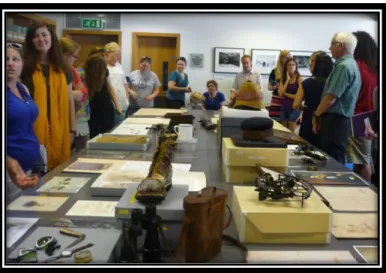
Shackleton, and Percy Fawcett at the Royal Geographical Society and seeing artifacts up close such as the brass instrument used by Darwin on the Beagle and iconic hats of Livingstone and Stanley (Figure 4)
www.rgs.org/about/our-collections/
Figure 4. Royal Geographical Society, London British Studies 2014
• visiting mysterious Rosslyn Chapel outside Edinburgh with a small group of students www.rosslynchapel.com/
• touching and turning the pages of a
Shakespeare’s First Folio with bare hands at the National Art Gallery (a rare treat)
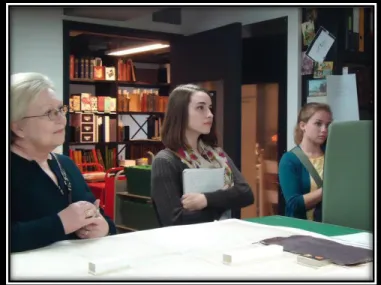
• touching rare books such as canvas-covered medical book used aboard the HMS Bounty, a pirate’s journal, and a signal book with lead weights in its spine at Greenwich Maritime Museum
Figure 5. University of Oxford Christ Church Academic Library, British Studies 2011 • watching a student find the name of his
ancestors, a signer of the Declaration of Independence, listed in documents at Temple Church and Middle Temple Library indicating he was educated in law at Middle Temple in London www.akronlegalnews.com/editorial/18071 • seeing a student who was a passionate Tudor
scholar almost cry with excitement with the chance discovery of “Edward VI’s Devise for the Succession” letter hanging in a frame on the wall at Inner Temple Library
www.innertemplelibrary.org.uk/collections/manu script-collection/devise.htm
• observing a student who was passionate about Beowulf burst into tears upon viewing the original manuscript on display at the British Library
Treasure Room www.bl.uk/british-library-treasures
• watching a student who was a Bede scholar examine a medieval manuscript by Bede at the British Library (with special permission and signed forms) and helping to arrange an overnight visit to Durham for her and another student to see Bede’s tomb at Durham Cathedral and visit the Durham University Library.
www.durhamcathedral.co.uk/
b. Best place to eat in London – some favorites: • Original Hard Rock Café for burgers and fries • Gourmet Pizza on the South Bank of the Thames • St. Paul’s Cathedral Café and St. Martin in the
Fields Church Café, London
•Chinatown near Leicester Square (so many great restaurants)
•Hot chocolate at the British Library Cafe •Fish n’ chips and Sticky Toffee Pudding at Old
Bank of England Pub or Blackfriars Pub in London or Eagle and Child Pub, Oxford
•Chicken Schnitzel at the White Horse Pub, Oxford •Sitar Indian Restaurant on the Strand
•Afternoon tea at Fortnum & Mason and at the Royal Horseguards
•Caprini Italian restaurant on Waterloo Road (love the lasagna)
• Thames Indian restaurant on Waterloo Road • Deacon Brodie’s Tavern and Greyfriars Bobby’s
Pub in Edinburgh
• Elephant House Coffee Shop, Edinburgh (Figure 6).
Figure 6. Elephant House Coffee Shop Edinburgh, British Studies 2016 c. Best entertainment
• Royal Shakespeare Company at Stratford-upon-Avon and at the Globe Theatre
• British Theatre, especially Les Miserables,
Mamma Mia, Let It Be, Million Dollar Quartet, Elephant Man, Rock of Ages, Lord of the Rings, Metropolis, Gaslight at the Old Vic, Nevermore at the Barbican Theatre.
Figure 7. National Archives of Scotland Edinburgh, British Studies 2013 d. Best place to walk
• Queen’s Walk along Thames South Bank
• From South Bank across Blackfriars Bridge, left on Fleet Street to the Strand
• Walk through the British Museum, particularly ancient Mesopotamian and Egyptian rooms • Path from Rosslyn Chapel to ruins of Rosslyn
Castle, Edinburgh
• Royal Mile from Edinburgh Castle to Holyrood Castle, then Holyrood Queen’s Garden
• Walk around Hereford Cathedral to see the Mappa Mundi and the Medieval Chained Library • Walk around Durham, Durham Cathedral,
Durham University Library
• Walks around Stonehenge, Winchester, Dover Castle grounds, and Canterbury.
Figure 8. Steps of Bodleian Library University of Oxford, British Studies 2012