Data-dependent Bucketing Improves Reference-free
Compression of Sequencing Reads
Rob Patro
1and Carl Kingsford
2 ∗1Department of Computer Science, Stony Brook University, Stony Brook, NY 11794-4400 USA 2Department Computational Biology, School of Computer Science, Carnegie Mellon University,
5000 Forbes Ave., Pittsburgh, PA 15213 USA
ABSTRACT
Motivation: The storage and transmission of high-throughput sequencing data consumes significant resources. As our capacity to produce such data continues to increase, this burden will only grow. One approach to reduce storage and transmission requirements is to compress this sequencing data.
Results:We present a novel technique to boost the compression of sequencing data that is based on the concept of bucketing similar reads so that they appear nearby in the file. We demonstrate that, by adopting a data-dependent bucketing scheme and employing a number of encoding ideas, we can achieve substantially better compression ratios than existing de novo sequence compression tools, including other bucketing and reordering schemes. Our method, Mince, achieves up to a45%reduction in file sizes (28%on average) compared to existing state-of-the-artde novocompression schemes. Availability: Mince is written in C++11, is open source and has been made available under the GPLv3 license. It is available at http://www.cs.cmu.edu/∼ckingsf/software/mince.
Contact:[email protected]
1 INTRODUCTION
The tremendous quantity of data generated by high-throughput sequencing experiments poses many challenges to data storage and transmission. The most common approach to reduce these space requirements is to use an “off-the-shelf” compression program such as gzip (by Gailly and Adler, http://www.gnu.org/software/gzip/) or bzip2 (by Seward, http://www.bzip.org) to compress the raw read files. This approach can result in substantial savings during storage and transmission. These programs are general purpose, well-tested, and highly-scalable. However, research over the past few years has demonstrated that approaches specifically tailored to compressing genomic data can achieve significantly better compression rates than general-purpose tools.
We introduce Mince, a compression method specifically designed for the compression of high-throughput sequencing reads, that achieves state-of-the-art compression ratios by encoding the read sequences in a manner that vastly increases the effectiveness of “off-the-shelf” compressors. This approach, known as compression boosting, has been effectively applied in other contexts, and is
∗To whom correspondence should be addressed. Email: [email protected]
responsible for the widely-observed phenomenon that BAM files become smaller when alignments are ordered by genomic location. This places more similar alignments nearby in the file and results in more effective compression being possible. Mince is able to produce
files that are 28% smaller than those of existing compression
methods in a comparable amount of time.
Existing work on compressing sequencing reads falls into
two main categories: reference-based and de novo compression.
Reference-based methods most often, but not always (Bonfield
and Mahoney, 2013; Rozov et al., 2014; Kingsford and Patro,
2015), attempt to compress aligned reads (e.g. BAM format files) rather than raw, unaligned sequences. They assume that the reference sequence used for alignment is available at both the sender and receiver. Most reference-based approaches attempt to take advantage of shared information between reads aligned
to genomically close regions, and to represent the aligned
reads via relatively small “edits” with respect to the reference
sequence (Bonfield and Mahoney, 2013; Campagne et al., 2013;
Kozanitiset al., 2011; Fritzet al., 2011; Liet al., 2013; Popitsch
and von Haeseler, 2013). These methods can, in general, be very effective at compressing alignments, but this does not necessarily imply effective compression of the original read sequences (Kingsford and Patro, 2015). Thus, if one is interested in the most efficient methods to compress the raw reads,
reference-based methods can have drawbacks when compared to de novo
approaches. They are generally slower, since they require that reads be mapped to a reference before being compressed. They assume that the sender and receiver have a copy of the reference (which, itself, would have to be transferred) and that the set of reads can be mapped with relatively high quality to this reference (such methods may perform poorly if there are many unmapped reads). Furthermore, since different types of analysis may require different types of alignments, recovering the original BAM file may not always be sufficient, in which case further processing, such as extracting the original sequences from the alignment file, may be required.
Conversely, de novo approaches compress the raw sequencing
reads directly, and because they do not require aligning the reads to a reference, are often able to compress the reads much more quickly.
De novo compression methods often work by trying to exploit redundancy within the set of reads themselves rather than between the reads and a particular reference (Bonfield and Mahoney, 2013;
1
© The Author(s) 2015. Published by Oxford University Press.
This is an Open Access article distributed under the terms of the Creative Commons Attribution
Non-Commercial License (http://creativecommons.org/licenses/by-nc/4.0/), which permits non-commercial
re-Associate Editor: Dr. Inanc Birol
Adjerohet al., 2002; Bholaet al., 2011; Brandonet al., 2009; Cox
et al., 2012; Deorowicz and Grabowski, 2013; Joneset al., 2012; Hachet al., 2012; Tembeet al., 2010).
While most approaches tend to fall into one or the other of these categories, some tools expose both based and
reference-free modes (Bonfield and Mahoney, 2013). Notably, Joneset al.
(2012) introduced a novel approach for obtaining some of the benefits of reference-based compression, even when no reference is available, by constructing one “on-the-fly”.
Another similar area of research is the compression of collections of related genomes (Rajarajeswari and Apparao, 2011; Pavlichin
et al., 2013; Deorowicz and Grabowski, 2011; Wang and Zhang,
2011; Pinhoet al., 2012; Christleyet al., 2009). These approaches
are able to achieve a very high degree of compression, but generally rely on encoding a sparse and relatively small set of differences between otherwise identical sequences. Unfortunately, the reads of a sequencing experiment are much more numerous and diverse than a collection of related genomes, and hence these methods do not apply to the compression of raw or aligned sequencing reads.
We focus on the problem of de novo compression of raw
sequencing reads, since it is the most generally applicable. Mince
was inspired by the approach of Hachet al.(2012) of compression
“boosting”. Mince only compresses the actual sequences, because the compression of quality scores and other metadata can be
delegated to other approaches (Ochoaet al., 2013; C´anovaset al.,
2014; Yuet al., 2015) that are specifically designed for compressing
those types of data.
At the core of Mince is the idea of bucketing, or grouping together, reads that share similar sub-sequences. After reads are assigned to buckets, they are reordered within each bucket to further expose similarities between nearby reads and deterministically transformed in a manner that explicitly removes a shared “core” substring, which is the label of the bucket to which they have been assigned. The information encoding this reordered collection of reads is then written to a number of different output streams, each of which is compressed with a general-purpose compressor. Depending on the type of read library being compressed, we also take advantage of the ability to reverse complement reads to gain better compression.
In the presence of a reference, placing reads in the order in which they appear when sorted by their position in the reference reveals their overlapping and shared sequences. Without a reference, we cannot directly know the reference order. The bucketing strategy described here attempts to recover an ordering that works as well as a reference-based order without the advantage of being able to examine the reference.
We demonstrate that the bucketing scheme originally introduced
by Hachet al.(2012), though very effective, can be substantially
improved (on average greater than15%) by grouping reads in a
data-dependent manner and choosing a more effective encoding scheme. Choosing a better downstream compressor, lzip (by Diaz, http://www.nongnu.org/lzip/lzip.html) leads to a further reduction
in size of 10%. Overall, Mince is able to obtain significantly
better compression ratios than otherde novosequence compressors,
yielding compressed sequences that are, on average,28%smaller
than those ofSCALCE.
2 ALGORITHM
Mince’s general approach to compression is to group together similar sequences to make the underlying compression algorithm more effective. Thus, we want to re-order the set of reads so that those that share similar sub-sequences will appear close to each other in the file.
To achieve this goal Mince encodes a set of reads in a few phases, which are described below. The result of this processing is to place a transformed set of the original reads into a collection of buckets, each of which is designed to expose coherent sequence to the downstream compressor. The contents of these buckets, along with the information required to invert any transformations that have been applied, are written to a set of different output streams and compressed using a general-purpose compression tool.
Local bucketing.The first phase of Mince aggregates reads into buckets. A bucketbconsists of a labelℓ(b)and a collection of reads. The goal is to place within each bucket a collection of reads that are “similar” to each other. In addition to being a difficult problem theoretically — bucketing is essentially clustering — the method we choose for bucket creation and assignment must be practically fast to handle the large number of reads we observe in most data sets. The approach we take to this problem is one of streaming bucket assignment based on a cost function that is designed to identify similar reads while simultaneously being quick to compute.
When a read, ris processed, we look through all k-mers (15-mers by default) in the read as well as its reverse complementrc (r)and check which k-mers, if any, correspond to the labels of existing buckets. Letbuckets (r)
be the set of existing buckets whose label matches some k-mer ofrorrc (r). The setbuckets (r)is a set ofcandidatebuckets against which we will score the newly processed readr. We will then assignrto the bucketb∗that satisfies
b∗= arg max b∈buckets(r)
ℓ-mers(r)∩ℓ-mers(b), (1) where ℓ-mers(r) denotes the set of allℓ-mers in the read r and, by slight abuse of notation, we denote the set of allℓ-mers in a bucketbby
ℓ-mers(b) = ∪r′∈bℓ-mers(r′). By defaultℓ= 8. In equation (1) we are
measuring the score of readrwith respect to each bucketbin which it can be placed. The score is simply the number of length-ℓsubstrings (ℓ-mers) that are shared between the readrand the set of all reads currently in bucket
b.
Ifb∗is labeled by a k-mer ofr, we placerin the bucketb∗, while if
b∗is labeled by a k-mer ofrc (r), we instead placerc (r)in the bucketb∗. We also record whetherror its reverse complement is being assigned to a bucket (see below). If no k-mer in this read is the label for an existing bucket (buckets (r) =∅), a new bucket is created. Initially, this new bucket will contain only this read, and its label will be theminimizer(Robertset al., 2004) of this read — the lexicographically smallest k-mer in among those in
randrc (r). We begin with no buckets.
Intuitively, we are trying to assign each read to the bucket whose contents share the most substrings with the read, with the hope that the compressor will be able to exploit the redundancy of these shared substrings. The set of
ℓ-mers in a bucket acts as a lightweight model of the bucket contents and allows us to quickly estimate the relative benefit of each bucket assignment. Because we only consider placingrin the buckets labeled with some k-mer ofr, we will only ever have to compute the score of assigningrto a relatively small number of buckets (never more than2 (|r| −k+ 1)— the factor of
2comes from considering bothrandrc (r)). This ensures that each read can be assigned to a bucket time independent of the number of buckets or reads. When readris assigned to a bucket, the set ofℓ-mers of this bucket is updated to include any newℓ-mers present inrthat did not previously exist in the bucket.
Reassigning singletons.The choice of the bucket into which a read ris placed is greedy, as the bucket contents themselves depend on the set of reads that have already been processed and the order in which they were observed. Thus, it is quite possible that, at the pointris observed, it will be bucketed using k-mersr, but subsequently some other strings′rcontained
within the read will actually correspond to a better bucket as determined by equation (1). In the most extreme case, the bucketsrmay contain onlyr. We
call these reads that are alone in a bucketsingleton readsand their buckets
singleton buckets. These buckets are likely to be poorly compressed. In an attempt to mitigate this effect, we perform a “rescue” step after the initial bucketing in which we attempt to re-assign singleton reads to some other non-empty bucket. Specifically, let the set of singleton reads be denotedS. We attempt to re-bucket each singleton read in light of the buckets containing all other observed reads. We remove all the singleton buckets and then re-process the reads inS, assigning each to the remaining bucket that satisfies equation (1). Because we now have a larger set of buckets than we did when initially processing the singleton reads, a number of these singletons can often be placed into non-empty buckets. This allows us to exploit shared sequence that occurs after the singleton read in the input file. If, during this rescue step, we are unable to place a read into any existing bucket, we place it into a special singleton bucket, which is labeled by the empty string. These remaining singletons will simply be2−bitencoded and written at the beginning of the compressed file.
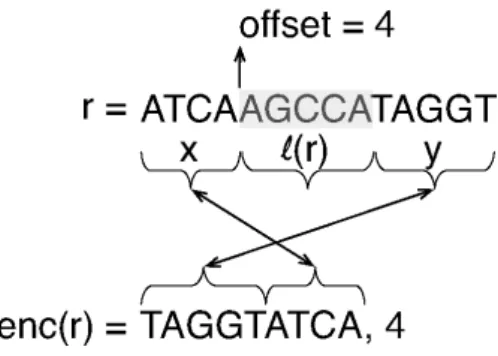
Read transformation.When a readris placed in a bucket, it is encoded using a transformationenc(r), illustrated in Figure 1 that was initially described in Hach (2013). This transformation partitions the readr, conceptually, into
3regions such thatr= x·ℓ(r)·y, where·represents string concatenation andℓ(r)is the label of the bucket into which this read is being placed. Given this partition,enc(r) = (y·x, o)whereois the offset into the original read where the first occurrence ofℓ(r)appears. We call this the split-swap read transformation, since it splits the read at a particular offset and swaps the second and first substrings produced by this split. Givenℓ(r)andenc(r), it is possible to reconstructr. The purpose of this transformation is two-fold. First, it removes explicit redundancy (i.e.ℓ(r)) that exists among the reads that have been bucketed together. Second, it moves to the front of each read in the bucket the region of the read that directly follows the shared substring. Prefixes of these regions are more likely to share similar sequence, and placing them at the front of every read may improve the ability of the downstream compressor to discover and exploit these shared substrings. Within each bucket, the reads are sorted by the offset of the first occurrence of the label string within the read, with ties being broken lexicographically.
Sub-bucketing and Bucket Ordering.Once each read has been assigned to a final bucket, the buckets are encoded and written to file. Since most buckets are small, we avoid using a relatively large4or8byte integer to record the size of each bucket. Rather, large buckets are broken up into sub-buckets, each with a maximum size of256reads. The sub-buckets belonging to a single bucket are written to file sequentially, and the order of the reads in the concatenation of these sub-buckets is the same as the order of the reads within the original bucket.
As it leads to improved compression, we choose to record the transformed read sequences, concatenated together, using2−bitencoding. The raw bitstream contains sequences of bits encoding the read sequences, separated by segments of control information encoding the label string for a bucket, its length, and the number of elements in the sub-bucket to follow.
Since the reads in each bucket are sorted according to the offset of the bucket label, these offsets will then be a non-decreasing list of positive integers. This allows us to encode them using delta encoding, which we find leads to improved compression. The lexicographic tie-breaking is performed with respect to the reads after they have been encoded, as described above.
2.1 Mince file format
The bucket information output by Mince consists of 2 required files and 2 optional files. The required files are fseq and foffset. fseq consists
of the read sequence and “control” information. This stream begins by recording the necessary meta-data about the entire set of reads such as the read length and the read library type, which signifies which types of read transformations may be performed lossily (see Section 2.2). This
Fig. 1. When a readris placed into a bucket, it is encoded by splitting it at the first occurrence of the bucket label inr, removing this substring, and placing the proceeding substring at the front of the encoded read.
information is then followed by the count of singletons (encoded as a32 -bit unsigned integer) and a -bitstream containing all singleton reads, sorted reverse lexicographically and2−bitencoded. The singleton reads are then followed by a collection of sub-buckets that constitute the remainder of the file.
Each sub-bucket contains the following control information: the size of the bucket label, the sequence of the bucket label (2−bitencoded), the number of elements,m, in the sub-bucket minus one (this is encoded with an8-bit unsigned integer and thus has a maximum value of255), and a sequence ofmencoded reads. Each read is written as the2−bitencoding of
split-swap (r, o). If a sub-bucket has the same core string as the preceding sub-bucket, we record a length of0for the bucket label, and we do not re-record this string for the current sub-bucket.
The filefoffsetsimply consists of a list of positions of the bucket labels
within each read, where the read order is the same as infseq. These offsets
are delta-encoded within each bucket. Since the reads within each sub-bucket are sorted by the sub-bucket label offset, this often exposes long runs of
0s in the offset stream that are encoded particularly well.
The two optional files are the reverse complement filefrcand the filefN
containing the location ofNs in the original reads.frcconsists of a simple
binary stream of0s and1s that encode, for each read infseqwhether we
encoded the original read (in which case we record a0) or the reverse-complement of the read (in which case we record a1). Since it may not be necessary to recover the original strand of the raw reads, which is often arbitrary, this stream can sometimes be discarded, though it is often of a negligible size. For example, when dealing with single-end reads that do not originate from a known strand of DNA or RNA, a given readrand its reverse complementrc (r)are often equivalent for the purpose of most analyses — the same is also true of non-strand-specific paired-end reads, though the
relativeorientation of these reads should be preserved (see 2.2).
Finally,fNconsists of the positions of all of the nucleotides that were
recorded asNin the original sequencing reads. This file is necessary because we rely, infseq, on a2−bitencoding of the sequences. To allow this,
we transform all Ns into a2−bitrepresentable character (we choseAs) when encoding the reads.fNis written in a binary format where each entry
consists of the index of the next read containing encodedNs, the number of
Ns in this read and then the positions, within this read, where theNs occur. ThefNfile is often optional because, if we are encoding aFASTQfile and
maintain the quality values, they can be used to recover the positions in each read whereNs have been called (Hachet al., 2012).
All of these output files —fseq,foffsetand optionallyfrcandfN— are
subsequently compressed independently using the lzip compressor as part of the Mince program.
2.2 Handling paired-end reads
There is significant diversity in the type of information that may be represented by a set of read sequences. For example, reads can be paired-end or single-paired-ended; they can have a prescribed strandedness, or originate from either strand. Paired-end read libraries, additionally, are prepared in a way that results in the mate pairs having a prescribed relative orientation — that is, they may face in the same direction, away from each other or toward each other.
Mince handles paired-end reads by first concatenating the left and right ends of the pair together in accordance with a user-provided library type. The library type specifies the relative orientation of the two reads as well as whether or not one of the reads is prescribed to originate from a particular strand (e.g. as in a stranded library preparation protocol). Specifically, Mince reverse complements one of the ends of the paired-end read, if necessary, to ensure that both pairs are oriented with respect to the same strand. For example, if the reads are sequenced according to the standard paired-end Illumina protocol, they will face toward each other and come from complementary strands of the molecule being sequenced. In this case, reverse complementing the second read of the pair will reverse its orientation and strand to be consistent with that of the first read in the pair. The library type is encoded as a1-byte number and placed at the beginning of the
fseq file. This allows the relative orientation of paired-end reads to be
properly recovered during decoding. After this transformation, the resulting sequences are then encoded simply as if they were single-end reads. By encoding the lengths of the left and right mates, the reads can then be separated into two streams during or after decoding to recover the original mated reads. Since Mince, likeSCALCE(Hachet al., 2012), re-orders the reads, if the mates were encoded separately, it would have to either re-order one end according to the order induced by the other, or record, explicitly, the permutation between the two encoded files. The first of these strategies usually results in a larger encoded size, while the latter limits the ability to perform streaming decompression, since the positions of the mates of a pair may be arbitrarily different in their respective encoded files. These considerations led us to choose the strategy of concatenating the mate pairs to handle paired-end reads.
3 RESULTS
3.1 Mince produces smaller files than otherde novo compressors
We compared Mince againstfastqz(in reference-free mode) and
SCALCE, both of which were among the topde novocompression tools in a recent survey (Bonfield and Mahoney, 2013). We also experimented with the fqzcomp (Bonfield and Mahoney, 2013)
program, but it performed worse thanfastqzin all of our tests,
and so the results are not reported here. We usedSCALCEversion
2.7, and encoded the read sets with the default options.
Paired-end reads were encoded bySCALCEusing the-roption. We used
fastqzversion1.5, and compressed reads using theccommand.
Fastqz does not handle paired-end reads in a special way, so
we providedfastqzwith a single file of the concatenated paired
reads, prepared as described in Section 2.2. Finally, we used Mince
version0.6and encoded reads with the default options (except for
the “no rc” sizes which were generated using the-nflag). and the
default k-mer size ofk= 15.
For a fair comparison, we extracted the sizes of the various encodings that represent the sequence only, ignoring sections of encoded files corresponding to quality values and names. This is
straightforward since the topde novocompressors against which we
compared write different parts of the encoded data (i.e. sequences, qualities and names) to different files, because data of a similar type tend to share more patterns and be more easily compressed
ERR233214 SRR034940 SRR037452 SRR1294122 SRR445718 SRR490961 SRR519063 SRR635193 SRR689233 0.80 0.85 0.90 0.95 1.00
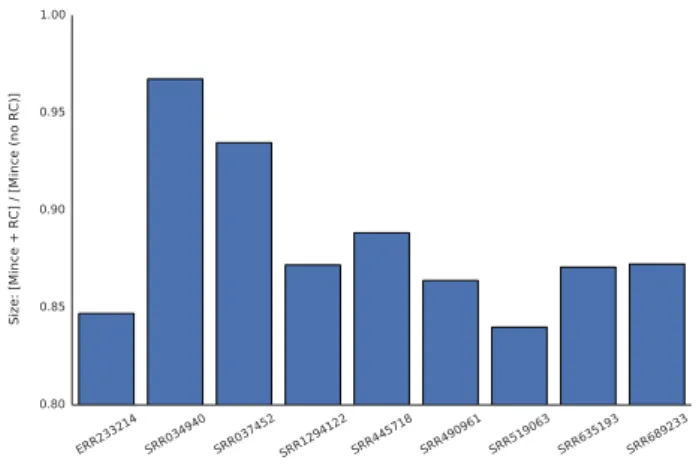
Size: [Mince + RC] / [Mince (no RC)]
Fig. 2.Even when the record of which reads were reverse-complemented needs to be maintained, Mince produces smaller files when it is allowed to consider both a read and its reverse complement.
than more heterogeneous data. For SCALCE, we report the size
of the.scalcerfile for single-end reads or the sum of the two
appropriate.scalcerfiles for paired-end reads. Forfastqz, we
report the size of the.fxb.zpaqfiles and for Mince we report the
sum of the.seqs,.offsand.nlocsfiles, which correspond to
fseq,foffset, andfN.
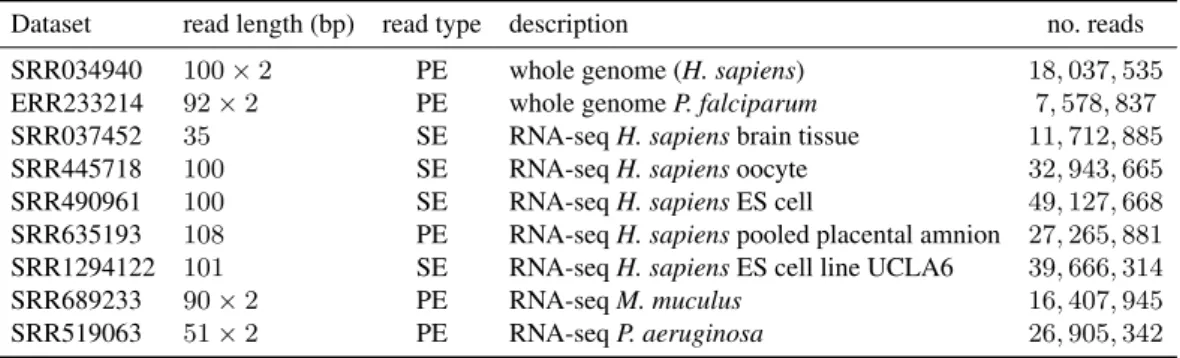
We measured compression performance on the diverse array of sequence files listed in Table 1. This collection of data represents sequences from a mix of different organisms and types of experiments. Further, there is substantial technical diversity among this set of files; the sequences vary significantly in read length and paired-endedness. We selected this set of data to explore the relative
performance of these differentde novocompression techniques on
data of varying type, quality and redundancy.
The resulting compressed file sizes are recorded in Table 2.
Over the 9 different test files, Mince always produces the
smallest encoding. This result holds regardless of the read-length, single/paired-endedness of the file, or the organism from which the reads were sequenced. In most cases, the Mince-encoded files are substantially smaller than those produced by competing methods, in
some cases achieving up to a66%reduction in file size offastqz
and a45%reduction in file size overSCALCE, which is generally
the next best method.
3.2 Exploiting reverse complementation leads to improved compression
If the reverse complement of reads is not considered during bucketing, Mince produces larger files (Figure 2) than when reverse complement sequences are considered. In fact, for each read set we use here, the sum of the sizes of the Mince encoded file and
frc, the file which encodes whether or not each read was reverse
complemented, is smaller — usually by a substantial amount — than the encoding size that we would be able to achieve if we did not allow reverse complementing of the reads in the first place.
This is due to the fact that thefrc file is very small — typically
only a few megabytes (Table 2, frc columns). Further, if we do
Table 1. Different read sets used in the experiments. “PE” indicates paired-end reads while “SE” indicates single-end reads.
Dataset read length (bp) read type description no. reads
SRR034940 100×2 PE whole genome (H. sapiens) 18,037,535
ERR233214 92×2 PE whole genomeP. falciparum 7,578,837
SRR037452 35 SE RNA-seqH. sapiensbrain tissue 11,712,885
SRR445718 100 SE RNA-seqH. sapiensoocyte 32,943,665
SRR490961 100 SE RNA-seqH. sapiensES cell 49,127,668
SRR635193 108 PE RNA-seqH. sapienspooled placental amnion 27,265,881
SRR1294122 101 SE RNA-seqH. sapiensES cell line UCLA6 39,666,314
SRR689233 90×2 PE RNA-seqM. muculus 16,407,945
SRR519063 51×2 PE RNA-seqP. aeruginosa 26,905,342
Table 2. Sizes (in bytes) of the compressed sequences from a number of different sequencing experiments, using both lzip and gzip compression as the downstream compressor. The numbers that appear in thefrccolumns are the sizes of the file that encodes which reads were reverse-complemented during
encoding, which is required if the original strand of the read needs to be preserved.
Using gzip Using lzip Read Set fastqz SCALCE Mince frc Mince no RC Mince frc
SRR034940 761,004,012 773,713,270 742,714,887 2,206,070 763,594,066 714,253,615 2,224,625 ERR233214 110,774,782 108,400,240 96,358,342 934,495 114,197,621 85,981,514 946,677 SRR037452 85,510,908 66,629,150 58,819,463 1,323,208 62,823,740 53,087,524 1,304,612 SRR445718 325,231,326 252,989,630 191,556,289 3,665,690 213,776,989 159,655,281 3,659,251 SRR490961 444,636,843 300,176,804 211,414,052 5,536,382 241,571,742 169,544,398 5,531,911 SRR635193 355,334,940 294,524,184 261,228,305 3,137,672 297,856,270 237,200,862 3,162,639 SRR1294122 441,798,609 299,329,596 230,388,405 4,284,749 260,421,919 201,020,800 4,208,551 SRR689233 247,811,387 233,812,318 199,160,825 1,945,419 225,423,423 175,824,235 1,944,118 SRR519063 162,308,902 100,399,410 66,749,829 3,347,952 78,356,214 55,514,875 3,386,879
file can be discarded completely. These results suggest that, even if a transformation cannot be performed lossily, such as reordering the reads, it may still prove beneficial to perform the lossy transformation and additionally encode the sideband information necessary to recover the original data completely.
3.3 Mince is better able to exploit k-mer redundancy
The number of duplicated k-mers (identical k-mers that appear multiple times) in a file is a strong indicator of the benefit of Mince over other methods. This indicates that Mince is better able to identify and exploit sequence similarity between the reads than other approaches. The lower the number of distinct k-mers-per-byte, the greater was Mince’s compression ratio relative to
SCALCE (Figure 3). Files with highly diverse sequences contain
little redundancy, and are thus more difficult to compress in ade
novosetting (although Mince is still able to compress them more
effectively than other methods).
3.4 Effect of bucket label size
The single user-tunable parameter to Mince is the size of the k-mer used to label the buckets into which reads are placed. Reads are only considered for placement in a bucket if they contain the k-mer that labels that bucket. Thus, using shorter bucket labels will, in general, increase the number of buckets we examine when trying to assign a read, potentially leading to a better match between the read and bucket. Conversely, because all of the reads belonging to a bucket have the bucket label explicitly removed when they are encoded and
Fig. 3. The more redundant the k-mer (15-mer) content of the file (as measured in distinct k-mers-per-byte along thex-axis), the better able Mince is to exploit this redundancy and produce smaller files. Even in read sets with high k-mer diversity, Mince produces smaller files thanSCALCE. However, as the level of redundancy increases, the data-driven bucketing scheme employed by Mince is better able to take advantage of sequence similar reads, resulting in better overall compression ratios and a larger marginal gain over the simpler bucketing approach ofSCALCE.
written to file, using longer labels may result in better compression because more redundancy is explicitly removed from the reads.
We use a default bucket label size of15in Mince and find that it works well over a wide range of different files. We investigated the effect of this parameter to ensure that the results we observe are robust to its setting. We encoded the same set of files from
Table 2 using a smaller bucket label size of12. This size was chosen
to match the length of the “core” strings used to label buckets in
SCALCE. We find that, though length15bucket labels generally
result in better compression than length12labels, the difference is
fairly minor. In fact, files encoded using length12bucket labels
are, on average, only1.5%larger than those encoded using length
15bucket labels. The single largest relative difference occurred
with the read setSRR490961, where the Mince encoding using
length15bucket labels was5.8%smaller than the encoding using
length12bucket labels. We also observed that the fileSRR037452
actually compressed better using length12bucket labels, and was
2.6%smaller than its counterpart encoded with the default bucket
label size. This indicates Mince’s advantage overSCALCE is not
due to simply choosing larger “core” strings. It is likely that small changes in the size of the label string will have only a small effect on the set of reads which appear close together in the final ordering, and, despite the fact that a small change in the label length will change the number of buckets, we expect that it will have a substantially smaller change on the distance in the final order among sets of similar reads.
3.5 Effect of read order on compression size
Because the bucketing schemes used by Mince andSCALCEare
both heuristic in nature, they are, in theory, affected by the order in which the reads are observed. We expect that in most files, the order of the reads will be random. However, a particularly beneficial or adversarial read order might result in significantly different compression ratios.
To explore the effect of read order on the ability of Mince and
SCALCEto compress reads, we performed two different tests. First,
we tested the ability of Mince andSCALCEto compress a given file
(SRR1294122) under10random permutations of the read order
within the file. We find that, across10 trials, neither Mince nor
SCALCE appears sensitive to the order of reads in the file. For Mince, the maximum difference in the compressed file size between
the largest and smallest files over the10trials was43,410bytes,
or0.02% of the average compressed file size. ForSCALCE, the
maximum difference was30,379bytes, or0.01%of the average
compressed file size.
To demonstrate that Mince and SCALCE both have relatively
effective bucketing heuristics that result in compression rates which are robust to the order in which reads are observed in the input, we attempted to create a particularly beneficial read order. Using
the same file, SRR1294122, we aligned the reads against the
Ensembl human transcriptome (Fliceket al., 2013) using the STAR
aligner (Dobinet al., 2013). The resultingBAMfile was then sorted
by alignment location and converted back into aFASTQfile, which
was then encoded with Mince,SCALCEand lzip.
Similar to the randomization tests described above, presenting the
reads to Mince andSCALCEin this favorable order has little effect
on the size of the resulting compressed files. Specifically, compared to the size of the file compressed in the given order (Table 2), the size of the compressed file produced by Mince when the reads were
given in alignment-sorted order was only0.2%smaller, while the
SCALCEfile was only3.2%smaller.
However, if we simply extract the sequences from the original
FASTQand compress them using lzip, the size difference between the random and alignment-ordered files is very large. Specifically, the size of the randomly-ordered sequences when compressed by
lzip is826,708,745bytes while the size of the alignment-ordered
raw sequences when compressed by lzip is only 309,463,739.
Thus, reordering the reads before compressing them with lzip
reduced the size of the file by63%percent. In this case, the
re-ordered reads, simply compressed with lzip approaches the size
of the original file as compressing withSCALCE; it is only about
9.6Mb or 3.4%larger. However, this file is still about 106.3Mb
or 56.3% larger than the Mince compressed file. This indicates
that Mince is better able to recover an ordering as good as the “reference-based” ordering.
These experiments suggest that the order in which reads are
observed by Mince andSCALCEhas little effect on their ability to
successfully compress a file. Overall, the difference in resulting file sizes when the underlying read order is permuted is very small.
3.6 The choice of downstream compressor can have a significant effect
Mince uses plzip, a parallel implementation of lzip, as its
downstream compressor. This is different fromSCALCE, which,
by default, boosts gzip compression. Our choice was motivated by the fact that lzip generally produces smaller files than either gzip or bzip2. Though lzip tends to be somewhat slower than gzip in terms of compression speed, it is still reasonably fast and has comparable speed during decompression, which is the more important factor in our case, as reads will generally only be compressed once, but may be decompressed many times. The choice of lzip as the downstream compressor leads to an improvement in the compression ratio of Mince over what might be obtained if we relied on the same
downstream compressor, gzip, asSCALCE.
To test the overall effect of boosting lzip rather than gzip compression, we ran Mince on all of the files from Table 2, but compressed the resulting files with gzip instead. This resulted in the file sizes reported in Table 2 in the middle columns. On average, the
lzip-compressed files are13%smaller than their gzip-compressed
counterparts. We note that the gzip-compressed Mince files are still
much smaller than theirSCALCEcounterparts, providing evidence
that Mince is generally a more effective compression booster regardless of downstream compressor.
In addition, Mince can be used to boost the compression of other read compression techniques. Supplementary Table 1 shows the
improved compression achieved byfastqz when it is provided
read files that have first been reordered using Mince. While Mince combined with lzip provides the best compression, Mince
combined with fastqz improves the fastqz compression by
a significant amount. This further indicates the usefulness of the Mince reordering strategy and is evidence that the Mince reordering may be useful to boost the compression of other tools.
3.7 Computational resources required
Supplementary Tables 2 and 3 provide detailed timing and memory
usage for both SCALCE and Mince for the compression and
SCALCE when using 4 threads. It also uses more memory than
SCALCE, although its memory usage is still within practical limits (3-16Gb). This is the tradeoff needed to achieve the significantly better compression of Mince. (When run with 20 threads, Mince runs on the order of a few minutes (3-15 minutes / file), making multi-core compression significantly more practical; see Supplementary Table 4). When decompressing, however,
Mince is often faster and uses less memory than SCALCE. This
is a reasonable tradeoff (slower, better compression but faster decompression) since decompression is the more common task.
4 DISCUSSION
We introduced Mince, a de novo approach to sequence read
compression that outperforms existing de novo compression
techniques and works by boosting the already impressive lzip general purpose compressor. Rather than rely on a set of
pre-specified “core substrings” likeSCALCE(Hachet al., 2012), Mince
takes a data-driven approach, by considering all k-mers of a read before deciding the bucket into which it should be placed. Further, Mince improves on the “heaviest bucket” heuristic used by
SCALCE, and instead defines a more representative model for the marginal benefit of particular bucket assignment. This model takes
into account theℓ-mer composition of the read and how similar it
is to the set ofℓ-mers of reads that have already been placed in this
bucket. Early on in the processing of a file, when little information exists about the relative abundance of different k-mers, ties between buckets are broken consistently by preferring to bucket a read based on its minimizer.
This approach allows the selection of core substrings that are among the most frequent k-mers in the provided set of reads, and the improved model for bucket assignment leads to more coherent buckets and better downstream compression. In the rare situations where a specific order is required for the reads, Mince is not the most appropriate compression approach. Further, in addition to re-ordering, Mince exploits other transformations of a read, such as reverse complementing, that may or may not be performed in a lossy fashion. Regardless of whether or not these transformations need to be reversed during decoding, they lead to improvements in compression that overcome the cost of storing the “sideband” information necessary to reverse them.
Mince only compresses the sequence portion of FASTQ files, requires all reads to have the same length, and ignores the quality values. The challenges associated with compression of quality values are quite different than those associated with compressing
sequence data, and other approaches (e.g. Yu et al., 2015) have
been developed that can be used to compress quality values well. Furthermore, quality values are often not needed for many analyses
— tools such as BWA (Li, 2013), STAR (Dobinet al., 2013) and
Sailfish (Patroet al., 2014) routinely ignore them during all or some
phases of their operation — while sequence data are, of course, the primary and central reason for the FASTQ file to exist to begin with. For these reasons, we have focused on developing better methods for sequence compression, leaving the problem of improving quality value compression to future work.
Additional future work includes speeding up the compression and decompression approaches presented here. While the current speed of Mince (particularly when decoding) is practical for many
applications, it is always desirable to minimize the time spent on data manipulation tasks such as compression and decompression. This is the reason, for example, that we have used a near-greedy heuristic for selecting buckets and assigning reads to them — this is
fast and produces reasonable results (differing by < 0.02% over
various random read orderings). However, interesting directions for future work include both speeding up the implementation of this near-greedy approach and designing faster, equally performant approaches for read bucketing. This will be especially important for larger files, such as produced by high-coverage whole-genome human sequencing, where the 2x–11x difference in Mince and
SCALCEruntimes will become more significant.
By capitalizing on an efficient, novel encoding of reads that leads to improved compression boosting, Mince is able to compress
sets of read sequences more effectively than exiting de novo
approaches. The compressed read sequences can be decompressed efficiently and in a streaming fashion. As the size and number of datasets that we analyze continues to grow, Mince will prove an effective tool for mitigating the ever-increasing cost of storage and transmission. Mince is written in C++11, it is open source and has been made available under the GPLv3 license at
http://www.cs.cmu.edu/∼ckingsf/software/mince.
5 ACKNOWLEDGEMENTS
We would like to thank Geet Duggal, Darya Filippova, Emre Sefer, Brad Solomon and Hao Wang for useful discussions relating to this work and for comments on the initial manuscript. We would also like to thank the anonymous reviewers for their helpful feedback on the manuscript and testing of the software.
Funding: This work has been partially funded by the US National
Science Foundation (CCF-1256087, CCF-1053918) and US
National Institutes of Health (R21HG006913 and R01HG007104). C.K. received support as an Alfred P. Sloan Research Fellow. This work is also funded in part by the Gordon and Betty Moore Foundation’s Data-Driven Discovery Initiative through Grant GBMF4554 to Carl Kingsford.
Conflict of interest statement: None declared.
REFERENCES
Adjeroh, D., Zhang, Y., Mukherjee, A., Powell, M., and Bell, T. (2002). DNA sequence compression using the Burrows-Wheeler
Transform. InBioinformatics Conference, 2002. Proceedings.
IEEE Computer Society, pages 303–313. IEEE.
Bhola, V., Bopardikar, A. S., Narayanan, R., Lee, K., and Ahna, T. (2011). No-reference compression of genomic data stored in
fastq format. InBioinformatics and Biomedicine (BIBM), 2011,
pages 147–150. IEEE.
Bonfield, J. K. and Mahoney, M. V. (2013). Compression of FASTQ
and SAM format sequencing data.PLoS One,8(3), e59190.
Brandon, M. C., Wallace, D. C., and Baldi, P. (2009). Data
structures and compression algorithms for genomic sequence
data.Bioinformatics,25(14), 1731–1738.
Campagne, F., Dorff, K. C., Chambwe, N., Robinson, J. T., and Mesirov, J. P. (2013). Compression of structured high-throughput
C´anovas, R., Moffat, A., and Turpin, A. (2014). Lossy compression
of quality scores in genomic data.Bioinformatics,30(15), 2130–
2136.
Christley, S., Lu, Y., Li, C., and Xie, X. (2009). Human genomes as
email attachments.Bioinformatics,25(2), 274–275.
Cox, A. J., Bauer, M. J., Jakobi, T., and Rosone, G. (2012). Large-scale compression of genomic sequence databases with
the Burrows–Wheeler transform. Bioinformatics,28(11), 1415–
1419.
Deorowicz, S. and Grabowski, S. (2011). Robust relative
compression of genomes with random access. Bioinformatics,
27(21), 2979–2986.
Deorowicz, S. and Grabowski, S. (2013). Data compression for
sequencing data.Algorithms for Molecular Biology,8(1), 25.
Dobin, A., Davis, C. A., Schlesinger, F., Drenkow, J., Zaleski, C., Jha, S., Batut, P., Chaisson, M., and Gingeras, T. R. (2013).
STAR: ultrafast universal RNA-seq aligner. Bioinformatics,
29(1), 15–21.
Flicek, P., Amode, M. R., Barrell, D., Beal, K., Billis, K., Brent, S.,
Carvalho-Silva, D., Clapham, P., Coates, G., Fitzgerald, S.,et al.
(2013). Ensembl 2014.Nucleic Acids Research, page gkt1196.
Fritz, M. H.-Y., Leinonen, R., Cochrane, G., and Birney, E. (2011). Efficient storage of high throughput DNA sequencing
data using reference-based compression. Genome Research,
21(5), 734–740.
Hach, F. (2013). Scalable mapping and compression of high
throughput genome sequencing data. Ph.D. thesis, Simon Fraser University.
Hach, F., Numanagi´c, I., Alkan, C., and Sahinalp, S. C. (2012). SCALCE: boosting Sequence Compression Algorithms using
Locally Consistent Encoding. Bioinformatics, 28(23), 3051–
3057.
Jones, D. C., Ruzzo, W. L., Peng, X., and Katze, M. G. (2012). Compression of next-generation sequencing reads aided
by highly efficient de novo assembly. Nucleic Acids Research,
40, e171.
Kingsford, C. and Patro, R. (2015). Reference-based compression
of short-read sequences using path encoding.Bioinformatics.
Kozanitis, C., Saunders, C., Kruglyak, S., Bafna, V., and Varghese,
G. (2011). Compressing genomic sequence fragments using
SlimGene.Journal of Computational Biology,18(3), 401–413.
Li, H. (2013). Aligning sequence reads, clone sequences
and assembly contigs with BWA-MEM. arXiv preprint
arXiv:1303.3997.
Li, P., Jiang, X., Wang, S., Kim, J., Xiong, H., and
Ohno-Machado, L. (2013). HUGO: Hierarchical mUlti-reference
Genome cOmpression for aligned reads.Journal of the American
Medical Informatics Association, pages amiajnl–2013.
Ochoa, I., Asnani, H., Bharadia, D., Chowdhury, M., Weissman, T., and Yona, G. (2013). Qualcomp: a new lossy compressor
for quality scores based on rate distortion theory. BMC
Bioinformatics,14(1), 187.
Patro, R., Mount, S. M., and Kingsford, C. (2014). Sailfish enables alignment-free isoform quantification from RNA-seq reads using
lightweight algorithms.Nature Biotechnology,32(5), 462–464.
Pavlichin, D. S., Weissman, T., and Yona, G. (2013). The human
genome contracts again. Bioinformatics,29(17), 2199–2202.
Pinho, A. J., Pratas, D., and Garcia, S. P. (2012). Green: a tool
for efficient compression of genome resequencing data. Nucleic
Acids Research,40(4), e27–e27.
Popitsch, N. and von Haeseler, A. (2013). NGC: lossless and
lossy compression of aligned high-throughput sequencing data.
Nucleic Acids Research,41(1), e27–e27.
Rajarajeswari, P. and Apparao, A. (2011). DNABIT Compress–
Genome compression algorithm.Bioinformation,5(8), 350.
Roberts, M., Hayes, W., Hunt, B. R., Mount, S. M., and Yorke, J. A. (2004). Reducing storage requirements for biological sequence
comparison.Bioinformatics,20(18), 3363–3369.
Rozov, R., Shamir, R., and Halperin, E. (2014). Fast lossless
compression via cascading bloom filters. BMC Bioinformatics,
15(Suppl 9), S7.
Tembe, W., Lowey, J., and Suh, E. (2010). G-SQZ: compact
encoding of genomic sequence and quality data. Bioinformatics,
26(17), 2192–2194.
Wang, C. and Zhang, D. (2011). A novel compression tool for
efficient storage of genome resequencing data. Nucleic Acids
Research,39(7), e45–e45.
Yu, Y. W., Yorukoglu, D., and Berger, B. (2015). Quality
score compression improves genotyping accuracy. Nature