Automatic Detection of Discourse Structure
by Checking Surface Information in Sentences
Sadao Kurohashi and Makoto Nagao
Dept. of Electrical Engineering, Kyoto University
Yoshida-honmachi, Sakyo, Kyoto, 606, Japan
Abstract
In this paper, we propose an automatic method for detecting discourse structure using a variety of clues existing in the surface information of sentences. We have considered three types of clue information: clue expressions, occurrence of identical/synonymous words/phrases, and similarity between two sentences. Experimental results have shown that, in the case of scientific and technical texts, considerable part of the discourse structure can be estimated by incorporating the three types of clue information, without perform-ing sentence understandperform-ing processes which requires giving knowledge to computers.
1
Introduction
To understand a text or dialogue, one must track the
discourse structure (DS), specifying how sentences are combined and what kind of relations (coherence relations) they have. Work on DS has mainly focused on such questions as what kind of knowledge should be employed, and how inference may be performed based on such knowledge (e.g., Grosz and Sidner 1986; Hobbs 1985; Zadrozny and Jensen 1991). However, by exam-ining the current status of work both on automatic ex-traction and on manual coding of knowledge, detailed knowledge with broad coverage availability to comput-ers is unlikely to be constructed for the present. On the other hand, recent rapid increase in the amount of on-line texts has forced us to analyze not only isolated sentences but also discourses using present available knowledge.
We propose here an automatic method for estimat-ing DS in scientific and technical texts by a variety of keys existing in the surface information of sentences. One important key for DS is clue words (e.g., Co-hen 1984; Grosz and Sidner 1986; Reichman 1985). Furthermore, we have considered two more important clues. One is the occurrence of identical/synonymous words/phrases for detectingtopic chainingor topic-dominant chainingrelation (Polanyi and Scha 1984); the other is a certain similarity between two sentences for detecting their coordinate relation. The judgment based on such clue information is not absolute but just probable. Therefore, we have incorporated the above mentioned three factors into one evaluation measure to estimate the most plausible DS.
2
Discourse
Structure
Model
and Coherence Relations
Studies of DS have been reported by a large number of researchers (e.g., Cohen 1984; Dalgren 1988; Grosz and Sidner 1986; Hobbs 1985; Mann 1984; Polanyi and Scha 1984; Reichman 1985; Zadrozny and Jensen 1991). What has been commonly suggested is that the DS resulting from the recursive embedding and se-quencing of discourse units has the form of a tree (discourse history parse tree). However, there has been a variety of definition for discourse units, constituents of the tree, and coherence relations. In this research we have adopted the simplest model in the interest of focusing on how to detect DS automatically. In our model, each sentence is considered a discourse unit, and each node of the discourse history parse tree is a sentence and each link a coherence relation.1Coherence relations existing in a text, as Reichman (1985) pointed out, greatly depend on the genre of the text; narrative, argument, news article, conversation, and scientific report. Among a number of the coher-ence relations suggested so far, we selected the follow-ing set of the relations which accounted for intuitions concerning our target texts, namely scientific and tech-nical texts (Sidenotes the former sentence andSjthe latter).
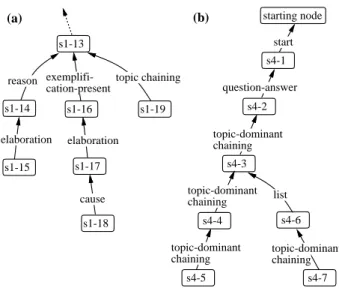
List : Si and Sj involve the same or similar events or states, or the same or similar important con-stituents, like s4-3 and s4-6 in Appendix.
Contrast : Si and Sj involve contrasting events or states, or contrasting important constituents.
Topic chaining : Si and Sj have distinct predica-tions about the same topic, like s1-13 and s1-19.
Topic-dominant chaining : A dominant constit-uent apart from a given topic inSibecomes a topic in Sj, like s4-4 and s4-5.
Elaboration : Sjgives details about a constituent in-troduced inSi, like s1-16 and s1-17.
Reason : Sjis the reason forSi, like s1-13 and s1-14.
Cause : Sj occurs as a result of Si, like s1-17 and s1-18.
1At present, we regard a sentence marked off by a period as
a discourse unit. Coherence relations are existing also between clauses in a sentence. We think our approach examining surface clue information can be adapted to extract their relations, and we intend to extend our system to handle them.
starting node s4-1 s4-5 s4-2 s4-6 s4-3 s4-7 s4-4 list topic-dominant chaining topic-dominant chaining topic-dominant chaining topic-dominant chaining question-answer start (b) s1-13 s1-14 s1-15 s1-16 s1-17 s1-18 s1-19 reason exemplifi-cation-present topic chaining elaboration elaboration cause (a)
Figure 1: Examples of discourse structures.
Change : The event or state inSichanges inSj (usu-ally as time passes).
Exemplification-present : An example of the event, state or constituent in Si is introduced in
Sj, like s1-13 and s1-16.
Exemplification-explain : An example of the event, state or constituent inSiis explained in Sj.
Question-answer : Sjis the answer to the question inSi, like s4-1 and s4-2.
The DSs for the sample text in Appendix is shown in Figure 1.
As in many previous approaches, we also make the following assumption in the DS model: a new sentence coming in can be connected to the node on the right most edge in the DS tree (hereafter, we call a new sentence anNS, and a possible connected sentence on the right edge in the DS tree a CS: Figure 2). This means that, after detailed explanations for one topic terminate, and a new topic is introduced, details of the old topic are hidden in inner nodes and are no longer referred to.
3
Automatic Detection of
Dis-course Structure
3.1
Outline
Considering our DS model, what the DS analysis should do is clear; for each NS, it tries to find the correct CS and the correct relation between them. In order to estimate them, we have directed our atten-tion to three types of clue informaatten-tion: 1) clue ex-pressions indicating some relations, 2) occurrence of identical/synonymous words/phrases in topic chaining or topic-dominant chaining relation, 3) similarity be-tween two sentences in list or contrast relation. By the method described later we can transform such infor-mation into reliable scores for some relations. As an
Start : 0 List : 8 Contrast : 8 . . Topic-dominant-c. : 25 . . Start : 10 List : 0 Contrast : 0 . . . Start : 0 List : 18 . . Topic-dominant-c. : 5 Elaboration : 15 . . NS
Detection of clue expressions. Detection of word/phrase chain. Calculation of similarity value.
Selected
CS1
CS2
CS3
Figure 2: Ranking relations to CSs by three types of clue information.
NS comes in, for each CS we calculate reliable scores for all relations by examining the above three types of clues. As a final result, we choose the CS and the relation having the maximum reliable score (Figure 2). As an initial state a DS has one node, starting node. We always give a certain score for the special relation,start, between an NS and the starting node. When any other relation to any CS does not have larger score for an NS, it is connected to the starting node by start relation. This means that the NS is the start-ing sentence of a new large segment, like paragraph or section, in the DS.
3.2
Detection of Clue Expressions
We prepared heuristic rules for finding clue expressions by pattern matching and relating them to proper re-lations with reliable scores. A rule consists of the fol-lowing parts:• conditionfor rule application :
– rule applicable range (how far in the se-quence of CSs the rule can be applied to)
– relation of CS to its previous DS – dependency structure pattern for CS – dependency structure pattern for NS • corresponding relationandreliable score.
Patterns for CS and NS are matched not for word sequences but for dependency structures of both sentences.2 We use a powerful pattern matching fa-cility for dependency structures, where a wild card matching any partial dependency structure, regular ex-pressions, AND-, OR-, NOT-operators, etc. are avail-able (Murata and Nagao 1993). We apply each rule for the pair of a CS and an NS. If the condition of the rule is satisfied, the specifiedreliable scoreis given 2Input to our system is a sequence of parsed sentences,
de-pendency structures, by our developed parser (Kurohashi and Nagao 1992a). In Japanese the dependency structure of a sen-tence consists of head/modifier relations between bunsetsus, each of which is composed of a content word and suffix words.
Table 1: Examples of heuristic rules for clue expressions. Rule-1 range : 1 relation of CS :∗ CS : ∗ NS : NAZE-NARA (because)
*
relation : reason score : 20 Rule-2 range : ∗ relation of CS :∗ CS :*
*
X*
NS :*
X-NO*
REI (of) (example)*
relation : exemplification-present score : 30 Rule-3 range : 1 relation of CS : exemplification-present CS :∗ NS :∗ relation : elaboration score : 25“A→B” denotes a head/modifier relation, where “A” depends on “B”.
“∗” denotes a wild card.
to thecorresponding relationbetween the CS and the NS.
For example, Rule-1 in Table 1 gives a score to the reason relation between two adjoining sentences (note the rule applicable range is ’1’) if the NS starts with the expression “NAZE-NARA (because)”. Rule-2 in Table 1 is applied not only for the neighboring CS but also for farther CSs, by specifying the occurrence of identical words (“X”) in thecondition. We also can specify the relation of CS to its previous DSas a condition, like Rule-3 in Table 1. This rule considers the fact that when some examples are introduced by exemplification-present relation, detailed explanations for them often follow.
3.3
Detection of Word/Phrase Chain
In general a sentence can be divided into two parts; a topic part and a non-topic part. When two sen-tences are in a topic chaining relation, the same topic is maintained through them. Therefore, the oc-currence of identical/synonymous words/phrases (the word/phrase chain) in topic parts of two sentences supports this relation. In the case of topic-dominant chaining relation, a dominant constituent introduced in a non-topic part of a prior sentence becomes a topic in a succeeding sentence. So, the word/phrase chain from a non-topic part of a prior sentence to a topic part of a succeeding sentence supports this relation.However, since there are many clues for an NS sup-porting other relations to some CSs, we must not only find such word/phrase chains but also give some reli-able score to topic chaining or topic-dominant chain-ing relation. In order to do this, we give scores to words/phrases in topic and non-topic parts according to the degree of their importance in sentences; we also give scores to the matching of identical/synonymous words/phrases according to the degree of their agree-ment. Then we give these relations the sum of the scores of two chained words/phrases and the score of their matching (Figure 3).
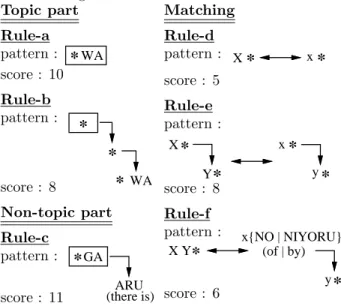
All of these are done by applying rules consisting of a pattern for a partial dependency structure and a score. For example, by Rule-a and b in Table 2, words in a phrase whose head word is followed by a topic mark-ing postposition “WA” are given some scores as topic
Give 28 points to topic chaining relation.
Give 30 points to topic-dominant chaining relation. Match : 10
Topic part Non-topic part
CS : 10
NS : 8
Topic part Non-topic part CS :
NS : 10
15 Match : 5
Figure 3: Scores for topic/topic-dominant chaining. parts. A word in a non-topic part in the sentential style, ”.. GA ARU(there is ...)” is given a large score by Rule-c in Table 2 because this word is an important new information in this sentence and topic-dominant chaining relation involving it often occur. Matching of phrases like “A of B” is given a larger score than that of word like “A” alone by Rule-d and e in Table 2. 3
3.4
Calculation of Similarity between
Sentences
When two sentences have list or contrast relation, they have a certain similarity. However, their similarity can-not be detected by rules like the above which see rel-atively small blocks in sentences, because it is not the simple similarity but the similarity in the sequence of words and their grammatical structures as a whole. In order to measure such a similarity, we extended our dynamic programming method for detecting the scope of a coordination in a sentence (Kurohashi and Nagao 1992b). This method can calculate the overall similarity value between two word-strings of arbitrary lengths. First, the similarity value between two words are calculated according to exact matching, matching of their parts of speech, and their closeness in a the-saurus dictionary. Then, the similarity value between two word-strings are calculated roughly by combining the similarity values between words in the two word-3One difficult problem is that authors often use subtly
dif-ferent expressions, not identical words/phrases, for such chains. While some of them can be caught by using a thesaurus and by rules like Rule-f in Table 2, there is a wide range of variety in their differences. Their complete treatment will be a target of our future work.
Table 2: Examples of rules for topic/non-topic parts and matching. Topic part Rule-a pattern :
*
WA score : 10 Rule-b pattern :*
WA*
*
score : 8 Non-topic part Rule-c pattern :*
GA ARU (there is) score : 11 Matching Rule-d pattern : X*
x*
score : 5 Rule-e pattern : Y*
X*
y*
x*
score : 8 Rule-f pattern : X Y y*
x{NO | NIYORU} (of | by)*
score : 6As for rules for topic/non-topic parts, the score is given to the bunsetsu marked by a square. As for rules for matching, “X” and “x” denote identical words or synonymous words from this Japanese thesaurus, “Bunrui Goi Hyou”. So do “Y” and “y”.
strings.
While originally we calculated the similarity value between possible conjuncts in a sentence, here we cal-culate the similarity value between two sentences, a CS and an NS, by this method. This can be done simply by connecting two sentences and calculating the simi-larity value between two imitative conjuncts consisting of the two sentences. We give the normalized similar-ity score between a CS and an NS (divided by their average length) to their list and contrast relations as a reliable score.
4
Experiments and Discussion
Experiments of detecting DS were done for nine sec-tions of an article of the popular science journal, “Sci-ence”, translated into Japanese (Vol.17,No.12 “Ad-vanced Computing for Science”, the original is “Sci-entific American” Vol.257,No.4). For the first three sections, we wrote rules for clue expressions and word/phrase chains, and adjusted their parameters through experimentation. Then we analyzed the re-maining six sections by adding rules only for the clue expressions. The analysis results are shown in Table 3. Here the NSs in the text were classified accord-ing to their correct relations in connectaccord-ing to proper CSs. “Success” means that the correct relation and CS were detected for an NS (correct relations and CSs were judged by authors).
Table 3 shows that many clues exist in a text so that much of the DS can be guessed without detailed knowl-edge. In order to construct rules for clue expressions with broad coverage, we need to consult and analyze a large volume of texts. However, in most cases rules
Table 3: Analysis results.
Training text Test Text
Relation (3 sections) (6 sections)
Success Failure Success Failure
Start 7 1 6 2 List 10 1 15 2 Contrast 6 1 2 2 Topic chaining 13 1 21 5 Topic-dominant c. 10 4 37 14 Elaboration 9 1 9 1 Reason 3 0 1 0 Cause 2 0 6 0 Change 3 0 0 0 Exemp.-present 1 0 0 0 Exemp.-explain 3 0 2 0 Question-answer 1 0 1 0 Total 68 9 100 26 (Success ratio) (88%) (79%)
for clue expressions can be written exclusively so that they scarcely interfere with each other. In our experi-ments, added rules for the remaining six sections had no influence on the analysis of the first three sections. The text from s1-13 to s1-19 in Appendix was trans-formed to the structure in Figure 1-a as follows.
s1-14: the clue expression, “-DAKARA-DEARU” which means “this is because”.
s1-15: the clue expression, “-WAKE-DEARU”.
s1-16: the clue expression “example of X”.
s1-17: the heuristic rule supporting elaboration rela-tion after exemplificarela-tion-present relarela-tion.
s1-18: the clue expression “(SONO)KEKKA(-WA), (the result is)” which corresponds to “lead” in se-mantics.
s1-19: the chain of “synthetic approach”.
The text from s4-1 to s4-7 in Appendix was also transformed to the structure in Figure 1-b as follows.
s4-2: the clue expressions: “-KA” (a suffix indicating an interrogative sentence) in s4-1 and “(the) an-swer” in s4-2.
s4-3: the chain of “double star”.
s4-4: the chain from “shrink” in s4-3 to “this pro-cess” in s4-4 (some expressions like “this propro-cess” are regarded as matching any verb in a previous sentence).
s4-5: the chain of “nuclear fusion”.
s4-6: the large similarity value between s4-3 and s4-6 and the clue expression “similarly”.
s4-7: this NS could not be analyzed correctly. List relation with s4-6 was detected incorrectly because of their similarity value.
In s4-6 and s4-7, while the same word “heat” is used in English, the prior “heat” was trans-lated into “ONDO(temperature)-GA JOUSHOU-SURU(rise)” in Japanese. In order to detect the chain for their topic-dominant chaining relation, we must in-fer that the rising of temperature produce a heat. Such a problem is ignored in this research.
5
Conclusion
We have proposed a method of detecting DS automat-ically using surface information in sentences: clue ex-pressions, word/phrase chains, and similarity between sentences. In the case of scientific and technical texts, considerable part of the DS can be estimated by incor-porating the three types of clue information, without performing sentence understanding processes which re-quires giving knowledge to computers. This approach can be smoothly integrated with the current NLP sys-tems dealing with large amounts of texts.
References
Cohen, R. (1984). ”A Computational Theory of the Function of Clue Words in Argument
Understanding.” InProceedings of 10th COLING. Dahlgren, K. (1988). Naive Semantics for Natural
Language Understanding. Kluwer Academic Publishers.
Grosz, B. J. and Sidner, C. L. (1986). ”Attention, Intentions, and the Structures of Discourse.” Computational Linguistics, 12-3.
Hobbs, J. R. (1985). On the Coherence and Structure of Discourse. Technical Report No. CSLI-85-37. Kurohashi, S. and Nagao, M. (1992a), ”A Syntactic
Analysis Method of Long Japanese Sentences based on Conjunctive Structures’ Detection.” (in
Japanese),IPSJ-WGNL 88-1.
Kurohashi, S. and Nagao, M. (1992b), ”Dynamic Programming Method for Analyzing Conjunctive Structures in Japanese.” In Proceedings of 14th COLING.
Mann, W. C. (1984). ”Discourse Structures for Text Generation.” InProceedings of 10th COLING. Murata, M. and Nagao, M. (1993). ”Determination of
referential property and number of nouns in Japanese sentences for machine translation into English.” InProceedings of TMI ’93.
Polanyi, L. and Scha, R. (1984). ”A syntactic Approach to Discourse Semantics.” InProceedings of 10th COLING.
Reichman, R. (1985). Getting Computers to Talk Like You and Me. Cambridge, MA, The MIT Press. Zadrozny, W. and Jensen, K. (1991). ”Semantics of
Paragraphs.”Computational Linguistics, 17-2.
Appendix: Sample Text
Title: Advanced Computing for Science
(‘i” and “j” in si-j denote the section number and the sentence number respectively)
· · ·
s1-13: 合成法は、「あるシステムの各部分の間の相互作用の 基本過程はわかっているが、当のシステムの細かな構成はわか らない」という場合に使われる(The synthetic approach is called for when the fundamental processes of the inter-actions among the parts of a system are known, but the detailed configuration of the system is not.)
s1-14: それにより、未知の構成を合成によって決定したり、 可能な構成を考えて、その結果を試してみることも可能だから である(One can attempt to determine the unknown configuration by synthesis: one can survey the pos-sible configurations and work out the consequences of each.)
s1-15: そうした結果を実験から得られる細かなデータとつき 合わせてみれば、観察の結果を最もよく説明できる構成を選ぶ ことができるわけである(By carefully matching the ob-servable details of the experimental situation with these consequences, one can choose the configuration that best accounts for the observations.)
s1-16: 19世紀以来の合成法の有名な例として、天王星の軌 道に見られる不可解な摂動を理解しようとした試みをあげるこ とができる(A famous example of the synthetic approach from the 19th century is the attempt that was made to understand the observed but unexplained perturba-tions in the orbit of Uranus.)
s1-17: 研究者たちは太陽系に仮想の惑星を加え、満足のい く摂動が得られるまで、その軌道のパラメーターを変化させて いった(Investigators added a hypothetical planet to the solar system and varied the parameters of its orbit un-til a satisfactory reconstruction of the perturbation was found.)
s1-18: その結果は、予想された位置の近くでの海王星の発 見という成果に直接結びついたのである(The work led di-rectly to the discovery of Neptune, found near the pre-dicted position.)
s1-19: この合成法が適用できるのは、過去には、比較的単純 な場合に限られていた(In the past the synthetic approach was limited to comparatively simple situations. )
· · ·
s4-1: 天文学者はこの種の衝突になぜ興味をもつのだろうか (Why are astronomers interested in this kind of col-lision?)
s4-2: その答えは、“熱”を発生させるのに連星が演じている 役割にある(The answer lies in the role of double stars in generating ”heat.” )
s4-3: 連星と単星が衝突する際、連星は縮んで小さくなり、単 星にエネルギーを与え、その周囲の星の集団を温めることがあ る(In a collision between a double star and a single star, the double star can shrink, transferring energy to the single star and thereby heating the pool of stars around them.)
s4-4: この過程は、原子核が衝突して融合し、より重い原子核 になる際、エネルギーを放出する核融合とよく似ている(This process is analogous to nuclear fusion, wherein atomic nuclei collide and fuse into heavier nuclei, releasing en-ergy.)
s4-5: 核融合は、太陽を含む恒星を光らせるメカニズムである (Nuclear fusion is the same phenomenon that makes the stars, including the sun, shine.)
s4-6: また、遭遇によって連星の軌道が縮小し、そのために 高密度の星団の中核の温度が上昇することも考えられる (Sim-ilarly, orbital shrinkage of double stars induced by en-counters can heat the core of dense star clusters.)
s4-7: この熱は、星が絶えず沸騰している星団の表面におけ る熱損失と釣り合うことのできるものである(This heat can balance the losses at the surface of star clusters, where stars boil off continuously.)