AN INTEGER PROGRAMMING APPROACH TO EQUITABLE COLORING PROBLEMS
Laura Bahiense
COPPE-Produ¸c˜ao/UFRJ, [email protected]
Clicia Valladares Peixoto Friedman FFP/UERJ, [email protected]
Samuel Jurkiewicz
COPPE-Produ¸c˜ao/UFRJ [email protected]
Abel Rodolfo Garcia Lozano FFP/UERJ, [email protected]
Milene Maria Drumond Pimenta NEAMI/UFF, [email protected] Christina Fraga Esteves Maciel Waga
IME/UERJ, [email protected] Resumo
Uma colora¸c˜ao equilibrada ´e uma colora¸c˜ao pr´opria de um GrafoGna qual, para quaisquer duas cores, a diferen¸ca entre as ocorrˆencias das cores ´e no m´aximo igual a uma unidade. Para muitas aplica¸c˜oes faz-se necess´ario resolver o problema associ-ado de encontrar a colora¸c˜ao equilibrada com o menor n ´mero de cores. O conceito de colora¸c˜ao equilibrada e o problema de minimiza¸c˜ao associado podem ser esten-didos para colora¸c˜ao de arestas e colora¸c˜ao total. Neste trabalho introduz-se uma formula ¸c˜ao por programa¸c˜ao inteira para o problema de colora¸c˜ao equilibrada, e tamb´em as transforma¸c˜oes necess´arias para se resolver os problemas correlatos de colora¸c˜ao de arestas e colora¸c˜ao total.
Palavras-chave: Colora¸c˜ao Equilibrada, Programa¸c˜ao Inteira. Abstract
An equitable coloring is a proper coloring of a graphGin which, for any two colors, the difference between color occurrence is at most one. For many applications it is necessary to solve the associated problem of finding the equitable coloring with the minimum number of colors. The concept of equitable coloring and the associated problem can be extended to edge and total coloring. In this work we introduce an integer programming formulation to the equitable coloring problem, as well as the necessary transformations to solve the correlated equitable edge coloring and equitable total coloring problems.
1. Introduction
The concept of equitable coloring has many applications, for example in sched-uling problems, when we need to distribute tasks among agents so that any two agents must have similar quantity of tasks.
Equitable coloring can be used also to solve load balancing problems, when we need to distribute process and communications activities evenly across a computer network so that no single device is overwhelmed. Load balancing is specially im-portant for networks where it is difficult to predict the number of requests that will be issued to a server. Load balancing can also refer to the communications channels themselves, in this case we can use equitable edge coloring or equitable total coloring, depending if we need or not to distribute the tasks only among the channels or consider the servers too.
Recently we have used balanced total coloring to create general algorithms for interconnecting networks. Total coloring of a graph can suitable represent intercon-necting networks, since the elements that can work at the same time are mapped to the classes of colors representing independents sets. This allows the creation of algorithms based on colors and not in topologies themselves. We can enumerate much more applications, but the precedent list is sufficient to show the importance of the concept and the necessity of finding the solution of the associate problem, i.e, find the equitable coloring of a graph with the minimum number of colors, in a reasonable computational time.
In the present work we introduce an integer programming formulation to the equitable coloring problem, as well as the necessary transformations to solve the correlated equitable edge coloring and equitable total coloring problems. It is im-portant to emphasize that, as far as we know, there is no another mathematical programming formulation for the problem in the literature.
This work is organized as follows. The second section is dedicated to formal definitions of equitable coloring problems, and the necessary transformations to convert the equitable edge coloring and the equitable total coloring problems into the equitable coloring problem. The third section is dedicated to present the in-teger programming formulation and in the last section we show some preliminary computational results.
2. Definitions
A proper coloring ϕof a graph G(V, E) is a mapping fromV to a set of colors C, such that no two adjacent vertices have the same image.
A proper edge coloring ϕ0 of a graph G(V, E) is a mapping from E to a set of colorsC, such that no two adjacent edges have the same image.
A proper total coloring ϕT of a graph G(V, E) is a mapping from VS
E to a set of colorsC, such that no two adjacent or incident elements have the same image.
Given a proper coloring of a graph G, we denote byy(c) the number of times that colorcappears in the coloring.
A proper coloring ofGis anequitable coloring if, for every two (node) colors c1 andc2ofC, we have|y(c1)−y(c2)| ≤1. The associatedequitable coloring problem consists in finding the equitable coloring ofGwith the minimum number of colors. This number is denoted byχeq(G).
A proper edge coloring ofGis anequitable edge coloring if, for every two (edge) colors c1 and c2 ofC, we have |y(c1)−y(c2)| ≤ 1. The associated equitable edge
coloring problem consists in finding the equitable edge coloring ofGwith the min-imum number of colors. This number is denoted byχ0eq(G).
A proper total coloring ofGis anequitable total coloring if, for every two (node or edge) colorsc1andc2ofC, we have|y(c1)−y(c2)| ≤1. The associatedequitable
total coloring problem consists in finding the equitable total coloring ofGwith the minimum number of colors. This number is denoted byχTeq(G).
The three problems are refereed asequitable coloring problems.
Given a graphG(V, E), theline graph ofGis a graph ˜G( ˜V ,E˜) in which ˜V =E andxw∈E˜ if and only ifxandwhas a common vertex inG.
Given a graphG(V, E) the total graph of G is a graph ˙G( ˙V ,E˙) in which ˙V = V SE andxw∈E˙ if and only if one of the following sentences is true:
(1) xandware edges ofGsharing a common vertex.
(2) xandware adjacent vertices inG.
(3) x∈V andw∈E and w is incident to x inG.
It is easy to see that an equitable coloring of the line graph of a graph G is equivalent to an equitable edge coloring ofG. It is also easy to see that an equitable coloring of the total graph of a graphGis equivalent to an equitable total coloring of G. Therefore, the integer programming formulation introduce in next section can be used to model all the equitable coloring problems.
3. Integer Programming Formulation
In this section we introduce the Integer Programming Formulation to The Eq-uitable Coloring Problem. It is important to emphasize that, as far as we know, there is no another mathematical programming formulation for this problem in the literature.
The first step consists in introducing the decision variables, all integer. There are three classes of variables: the binaryxvcvariables linking colorscto verticesv, the also binarywc variables related to colorscand the integer variables yc related also to colorsc.
The first class of binary variables,xvc, is widely used in the literature for coloring problems, and are defined as follows:
(1) xvc=
(
1 if color c is assigned to vertex v, 0 otherwise,
for allv∈V andc∈ {1, . . . ,∆ + 1}.
It is known [Hajnal-Szemeredi] that every graph G hasχeq(G)≤∆(G)+1. Then ∆ + 1 colors are sufficient to color a graph in an equitable way. So, in order to minimize the number of colors being used in the formulation, we define the class wc of binary variables as follows:
(2) wc=
(
1 if xvc = 1 for some vertex v, 0 otherwise,
for allc∈ {1, . . . ,∆ + 1}.
Until this point we have not address the equitable necessary condition stating that an equitable coloring of a graph G is a proper vertex coloring such that the sizes of every two used color classes differ by at most one unity. Here the size of a used color class is the number of vertices colored with that color. In order to address this question we introduce the class ofyc integer variables as follows:
(3) yc =
n
X
v=1
xvc, for all c∈ {1, . . . ,∆ + 1}.
The mathematical formulation is then stated as follows:
(4) min ∆+1 X c=1 wc ∆+1 X c=1 xvc = 1 , ∀v∈V (a) xvc + xuc ≤ wc , ∀(v, u)∈E , ∀c∈ {1, . . . ,∆ + 1}(b) yc = n X v=1 xvc , ∀c∈ {1, . . . ,∆ + 1} (c) |yc − yl| ≤ 1 , ∀c, l∈ {1, . . . ,∆ + 1} (d) xvc ∈ {0,1} , ∀v∈V , ∀c∈ {1, . . . ,∆ + 1} wc ∈ {0,1} , ∀c∈ {1, . . . ,∆ + 1} yc is integer , ∀c∈ {1, . . . ,∆ + 1}
Constraints (4a) assert that each vertex must receive exactly one color and con-straints (4b) say that no pair of adjacent vertices can share the same color. Variables yccount the number of vertices colored with colorc(constraints (4c)). Finally, con-straints (4d) guarantee that the sizes of every two used color classes differ by at most one unity. Clearly, the variables wc can be relaxed to wc ∈ [0,1] without changing the feasible solution set.
In order to model (4) becomes implementable, we need to drop the modulus function in constraints (4d). It is easy to observe that, in fact, we have only to force|yc − yl| ≤1 when bothwc andwlare different from zero. This leads to the following pair of integer disjoint constraints that, together, replace (4d):
(5) yc − yl ≤ 1 + M (2−wc−wl), ∀c, l∈ {1, . . . ,∆ + 1},
(6) yc − yl ≥ −1 − M (2−wc−wl), ∀c, l∈ {1, . . . ,∆ + 1},
where M has to be big enough to force | yc − yl | ≤1 only when both wc and
wl are different from zero. Besides, it is also sufficient to choose among all pairs c, l∈ {1, . . . ,∆ + 1} that ones satisfyingc6=landl > c.
The new model obtained from (4) by replacing constraints (4d) with the pair of disjoint constraints (5) and (6) is implementable and has (n+ 2)(∆ + 1) variables andn+ (m+ 3)(∆ + 1) constraints. The equitable coloring polytopeECP is defined by the convex hull of all feasible solutions to this new integer problem.
4. Computational Results
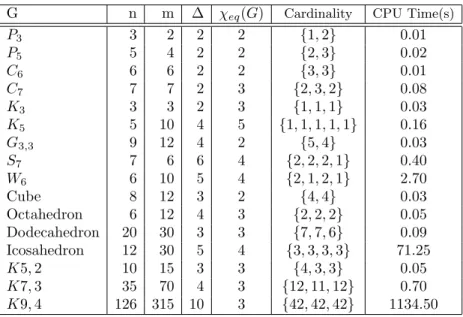
In order to validate the model presented in Section 3 we have tested the integer programming formulation over some popular examples of the literature having a priori known equitable chromatic numbers.
The value forM was settled toM = min{n,∆2}and the model was implemented using the commercial solver Xpress-MP 2006 with IVE 1.17.12, Mosel 1.6.3 and Optimizer 17.10.04. The computer used was a Pentium Intel Dual Core 2.66GHz, 960MB RAM with Windows XP Professional 2002.
Table 1 shows the obtained results in details. G3,3 is a grid graph,S7 is a star,
W6 is a wheel and the Kp, q graphs belong to the well known Kneser family of
graphs. It is important to emphasize that we have found all the knownχeq(G) for all graphsGtested. Therefore we have not shown gap column in this table.
G n m ∆ χeq(G) Cardinality CPU Time(s) P3 3 2 2 2 {1,2} 0.01 P5 5 4 2 2 {2,3} 0.02 C6 6 6 2 2 {3,3} 0.01 C7 7 7 2 3 {2,3,2} 0.08 K3 3 3 2 3 {1,1,1} 0.03 K5 5 10 4 5 {1,1,1,1,1} 0.16 G3,3 9 12 4 2 {5,4} 0.03 S7 7 6 6 4 {2,2,2,1} 0.40 W6 6 10 5 4 {2,1,2,1} 2.70 Cube 8 12 3 2 {4,4} 0.03 Octahedron 6 12 4 3 {2,2,2} 0.05 Dodecahedron 20 30 3 3 {7,7,6} 0.09 Icosahedron 12 30 5 4 {3,3,3,3} 71.25 K5,2 10 15 3 3 {4,3,3} 0.05 K7,3 35 70 4 3 {12,11,12} 0.70 K9,4 126 315 10 3 {42,42,42} 1134.50
Table 1. Preliminary Computational Results
5. Conclusions and Future Research
This work presents an initial effort in order to explore and solve equitable color-ing problems in an exact way. It is important to emphasize that, as far as we know, there was no another mathematical programming formulation for the problem in the literature.
Further experiments in heavier graphs (e.g. the DIMACS coloring benchmark graphs) will allow us to have a better appreciation of the real efficiency of our in-teger programming formulation.
Our future research will also address the characterization of the polytopeECP
trying to identify new families of valid inequalities and sufficient conditions for them to be facet-defining inequalities.
As a remark on the results in Kneser Graphs we can say they are somewhat surprising. In order to achieve the equitable coloration the Branch-and-Bound al-gorithm found coloring classes rather different from the canonical ones. This suggest a conjecture that, for Kneser graphs,χeq=χat least for the so called odd graphs, Kneser graphs of typeK(2n+ 1, n).
References
[1] Hajnal A., and Smezmeride E., “Proof of a conjecture of P. Erd¨os Combinatorial Theory and its Applications II”(Ed. P.Erd¨os, A. R´enyi e V.T. S´os ), Colloq. Soc. J. Bolyay4 (1970), 601–623.
[2] Kneser, M.,Aufgabe 360, Jahresbericht der Deutschen Mathematiker-Vereinigung, Abteilung, 2(1955), 58–27.
[3] Lov´asz, L.,“Kneser’s conjecture, chromatic number, and homotopy”, Journal of Combinato-rial Theory, Series A, 1978.
[4] Coll, P., Marenco, J., M´endez-D´ıaz, I., Zabala, P. , Facets of the graph coloring problem, Annals of Operations Research,116(2002), 79-90.