Computer Aided Design and Synthesis
of the RSCR Spatial Mechanism
by
Jeffrey M. Thompson
Thesis submitted to the Faculty of the Virginia Polytechnic Institute and State University
in
partial fulfillment of the requirements for the degree ofMaster of Science
m
Mechanical Engineering
APPROVED:
Dr. Arvid Mykle'1tst, Chairman
~--=-...,,:---=----,:--=--=-..,...,.~~·-~ Dr. Charles F. Reinholtz
April 28, 1987 Blacksburg, Virginia
Computer Aided Design and Synthesis
of the RSCR Spatial Mechanism
by
Jeffrey M. Thompson
Dr. Arvid Myklebust, Chairman
Mechanical Engineering
(ABSTRACT)
Recent efforts in computer aided design and computer aided manufacturing have
stressed the development of robotics. However, there are many applications where a
spatial mechanism could be used in place of a robot, but the mechanism design theory
has not been fully developed. This thesis presents the fundamentals of a computer aided
design system for the RSCR (revolute-spheric-cylindric-revolute) spatial mechanism.
Exact relationships for position, velocity, and acceleration analysis have been derived.
Closed form synthesis equations have been developed for the RS and RC dyads. The
theory developed in this thesis has been implemented on the digital computer in the form
of a FORTRAN77 computer program. This computer implementation includes
inter-faces with MECHIN, a graphical preprocessor for spatial mechanism synthesis and
analysis, and GENMOD, an automatic model generator for spatial mechanisms.
Acknowledgements
I would first like to express my gratitude to my advisor and major professor, Dr. Arvid
Myklebust for his guidance in the research and preparation of this thesis.
I also wish to thank Dr. Charles Reinholtz for his advice and suggestions.
I would also like to thank Dr. Hamilton Mabie for his service on my advisory
commit-tee.
I wish to thank my fellow M.E. graduate students for their help and suggestions. In
particular, I would like to thank Brian Thatch, Veeraraghavan Arun, Bob Williams,
Mitch Keil, and Harinder Singh Oberoi.
Last, and certainly not least, I would like to thank my parents, Joseph and Jean
Thompson, for their guidance and support throughout my education.
Table of Contents
INTRODUCTION . . . • . . . • . . . • . . 1
Objectives . . . 2
Literature Review . . . 3
ANALYSIS OF THE RSCR SPATIAL MECHANISM ... 7
Rotation Matrices . . . 7
Mechanism Description . . . 12
Displacement Analysis . . . 14
Velocity Analysis . . . 22
Acceleration Analysis . . . 25
SYNTHESIS OF THE RSCR SPATIAL MECHANISM ... 28
Function Generation . . . 29
Path Generation . . . 29
Rigid Body Guidance . . . 30
Dyadic Synthesis . . . 30
RS Dyad Synthesis . . . 31
RC Dyad Synthesis . . . 35
Additional Design Considerations . . . 42
Fixed Pivot Location and Link Length Ratio . . . 42
The Order Condition . . . 44
COMPUTER IMPLEMENTATION OF TIIE TIIEORY ...•... 45
Program Structure . . . 46
Program RSCR . . . 46
Subroutine SYNTH . . . 46
Subroutine ANALIN . . . 51
Subroutine RSCRAN ... 51
Interface with Graphical Preprocessor . . . 54
Interface for Automatic Model Generation . . . 61
Position and Attribute Files . . . 62
CONCLUSIONS AND RECOMMENDATIONS . . . 67
REFERENCES ... 70
SOLUTION OF A QUARTIC POLYNOMIAL . . . 74
Solution of the Quartic Polynomial . . . 74
Solution of the Resolvent Cubic Equation . . . 77
NUMERICAL EXAMPLE . . . 79
Synthesis Data . . . 79
Synthesis Data File . . . 81
Synthesis Output File . . . 82
MECHIN Restart File . . . 84
Position File . . . 88
Attribute File . . . 89
Analysis Data File . . . 90
Analysis Output File . . . 91
RSCR PROGRAM LISTING . . . • . . . . 101 PROGRAM RSCR . . .
102
SUBROUTINE ANALIN . . . 102 SUBROUTINE ANGDIR . . . 104 SUBROUTINE BUILD . . . ... . . .105
SUBROUTINE CROSS . . . 106 SUBROUTINE DEFMAT . . .106
SUBROUTINE DETERM . . . 107 SUBROUTINE DOT ... 107 SUBROUTINE FNDMAT . . .107
SUBROUTINE FNDVEL . . .108
SUBROUTINE FXPVT . . . 108 SUBROUTINE LNKLEN . . . 109 SUBROUTINE MATVEC . . . 109 SUBROUTINE MODGEN . . . 110 SUBROUTINE PANDQ . . .111
SUBROUTINE QUARTC . . .111
SUBROUTINE RCDY AD . . . 113 SUBROUTINE RESTRT . . .114
SUBROUTINE REVLOC . . . 118 SUBROUTINE ROTACC ...118
SUBROUTINE ROTMAT ... 119 SUBROUTINE RSCRAN . . . 119 Table of Contents viSUBROUTINE RSDY AD . . . 123
SUBROUTINE SPHLOC . . . 124
SUBROUTINE SYNTH . . . 124
SUBROUTINE UNIT . . . 126
SUBROUTINE VECSUB . . . 127
SUBROUTINE VMAG . . . 127
SUBROUTINE VMA T . . . 127
SUBROUTINE WDTMAT ... 127
SUBROUTINE WMAT . . . 128
SELECTED MECHIN SUBROUl1NES . . . • . . . 129
PROGRAM MECHIN . . . 130
SUBROUTINE ANIN . . . 130
SUBROUTINE DATA . . . 131
SUBROUTINE MENU . . . 132
SUBROUTINE RSCRA . . . 137
SUBROUTINE RSCRS ... 140
SUBROUTINE SDATA · . . . 143
SUBROUTINE SMENU . . . 143
SUBROUTINE SYNIN . . . 146
SUBROUTINE WRANAL ... ; . . . 147
SUBROUTINE WRSYN . . . 147
RSCR MODIFIED FOR MECHIN . . . 149
SUBROUTINE RSCRB . . . 149
SUBROUTINE SYNTHB . . . 150
SUBROUTINE ANALIB . . . 151
Vita
. . .
153
List of Illustrations
Figure 1. An RSCR Spatial Mechanism ... 4
Figure
2.
Schematic of the RSCR Spatial Mechanism ... 13
Figure
3.
The RS (revolute-spheric) Dyad ... 32
Figure
4.
The RC (revolute-cylindric) Dyad ... 36
Figure
5.
RC Dyad Synthesis Equations ... 43
Figure
6.
Flowchart of Program RSCR ... 47
Figure
7.
Flowchart of Subroutine SYNTH ... 48
Figure 8. Flowchart of Subroutine RSDYAD ... 49
Figure 9. Flowchart of Subroutine RCDY AD ... 50
Figure 10. Flowchart of Subroutine ANALIN ... 52
Figure 11. Flowchart of Subroutine RSC RAN ... 53
Figure 12. Flowchart of Main Program MECHIN ... 56
Figure 13. Flowchart of Subroutine ANIN ... 57
Figure 14. Flowchart of Subroutine WRANAL ... 58
Figure 15. Format of Analysis Data File ... 60
Figure 16. Local Coordinate Systems for a Binary Link ... 63
Figure 17. Position and Attribute Files for a Binary Link ... 64
Figure 18. Position and Attribute Files for an Entire Mechanism ... 65
Figure 19. RSCR Example ... 83
Chapter 1
INTRODUCTION
There has been a great deal of work done in recent years in the field of computer aided
design and computer aided manufacturing. In particular, efforts in computer aided
manufacturing have stressed the development of robotics. However, there are many
applications where a spatial mechanism could be employed in place of a robot.
Mech-anisms, with no electronic control system, are much less expensive. Closed loop spatial
mechanisms, as compared to robotic manipulators, are capable of carrying greater loads
with less deflection, can run at higher speeds, and have a greater mechanical efficiency.
Single degree of freedom mechanisms are less likely to malfunction than a multi-degree
of freedom, electronically controlled robot. The main drawback to spatial mechanisms
is their specialized nature. A new mechanism must be designed for each new application,
whereas a robot is merely reprogrammed.
The principle reason spatial mechanisms have not been employed for more applications
is the lack of a unified theory for mechanism design and analysis. The average machine
design engineer is not familiar enough with mechanism design theory to design spatial
mechanisms. Graphical methods, popular in dealing with planar mechanisms, are not
as useful in the design of spatial mechanisms, as at least two projections are required to
completely define the mechanism geometry. Analytical approaches have not been
pop-ular in the past due to the tediousness of calculations involved. However, the increased
availability of the digital computer has spurred the development of spatial mechanism
design theory.
Objectives
This thesis will present design software for the RSCR spatial mechanism. Specifically,
the objectives of this research are to derive in closed form, the displacement, velocity,
and acceleration relationships of the RSCR spatial mechanism using link constraint
equations, to synthesize an RSCR spatial mechanism for rigid body guidance using
dyadic synthesis, and to implement this theory on the computer. Included in this
com-puter implementation are interfaces to existing programs providing for graphical input
of mechanism data, and automatic model generation of a mechanism. Although the
synthesis section of this thesis deals primarily with rigid body guidance, the motion
characteristics presented are also applicable to function generation and path generation.
This thesis is intended to form a part of a computer aided design system for spatial
mechanisms currently being developed in the Mechanical Engineering Department of
Virginia Polytechnic Institute and State University under the direction of Dr. Arvid
Myklebust and Dr. Charles Reinholtz. Similar design software has been developed for
the RSSR[l], the RCCC[2], and RRSS[3] spatial mechanisms.
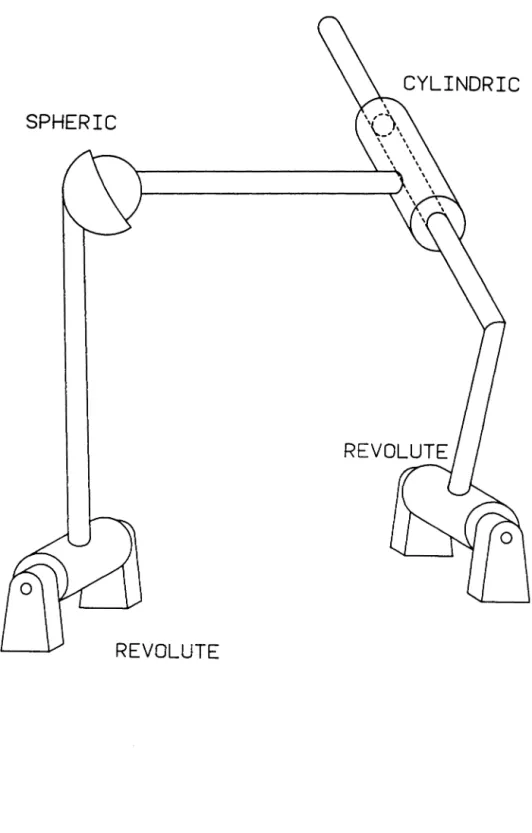
A diagram of an RSCR spatial mechanism is shown in Figure
1.
Literature Review
Before the early 1950's, most mechanism analysis and synthesis relied heavily on
graph-ical methods. Due to the difficulty in visualizing spatial mechanisms, the emphasis of
this graphical was on planar mechanisms. The long calculations involved often made
analytical methods impractical However, with the development of the digital computer
to handle these calculations, analytical methods began to receive more attention. This
naturally led to the development of analytical theories of spatial mechanism design.
Freudenstein played a major role in the development of modern kinematic theory in the
United States. He led the movement toward analytical methods with his landmark paper
"Approximate Synthesis of Four-Bar Linkages"[4], published
in
1955. In this paper,
Freudenstein established an analytical method for synthesizing a planar four-bar
func-tion generator using precision posifunc-tions. In 1959, Freudenstein and Sandor first brought
attention to the digital computer as a kinematic design tool by publishing the paper
"Synthesis of a Path Generating Mechanism by a Programmed Digital Computer"[5].
CYLINDRIC
SPHERIC
REVOLUTE
Figure I. An RSCR Spatial Mechanism
Denavit and Hartenburg[6] developed symbolic notation that has become the rule in
describing the kinematic characteristics of lower pair mechanisms. In 1960, the same
authors extended Freudenstein's work to the synthesis of four-bar spatial mechanisms,
specifically, the RSSR and RCCC spatial mechanisms[?].
A number of German and Russian authors were also active in this period. Beyer[8,9]
used descriptive geometry and vector algebra in spatial mechanism design.
Dimentberg[ 10, 11] developed the powerful screw method for synthesis of lower pair
spatial mechanisms. Other authors include Novodvorskii[12], Stepanov[13], and Levitsk.i
and Shakvazian[14]. English reviews of these works can be found by Beyer[15],
Yang[16], and Harrisberger[17].
For several years, only function generation for spatial mechanisms had been covered in
the literature. However, in 1965 Wilson[18] introduced the problem of rigid body
guid-ance for spatial mechanisms, and demonstrated that function generation could be treated
as a rigid body guidance problem using the principle of inversion. Suh and Radcliffe
developed a method using the 4x4 displacement matrix in the design of planar
linkages[ 19), and spherical linkages[20]. Suh also used the displacement matrix to
syn-thesize spatial mechanisms[21]. These works are based on Suh's doctoral research[22].
Sandor[23] and Sandor and Bisshopp[24] used dual number quarternions and stretch
rotation vectors to develop loop closure equation for spatial mechanisms.
In 1967, Roth studied rigid body motion through finitely separated positions[25], and
applied the results to synthesis of spatial mechanisms[26). Tsai and Roth[27] synthesized
open loop kinematic chains using screw triangle geometry. Kohli and Soni[28] used pair
geometry constraints and successive screw displacements as a basis for synthesizing
spatial mechanisms.
Some recent work has emphasized the optimization of spatial mechanisms. Perhaps the
most comprehensive work in this area is Reinholtz's doctoral dissertation[29].
Although the appearance of the RSCR spatial mechanism in the literature is rather
scarce, a few authors have used the RSCR as an example, though sometimes the
prob-lem is simplified by using a special configuration of the RSCR. Osman and Segev[30]
employed constant distance equations in analyzing spatial mechanisms. Osman, Bhagat
and Dukk.ipati[31] present a method based on train components. Both of these methods
are iterative, and both are based on the assumption that the axes of the cylindric joint
and second revolute joint are parallel.
Huang and Youm[32] present a method for the displacement analysis of spatial
mech-anisms based on the direction cosine matrix. Their example of the RSCR however, is
another special case, because it is based on the assumption that the axes of the cylindric
joint and second revolute joint intersect.
Funabashi, Ogawa and Hara[33] derive general transformation functions for four-bar
spatial function generators with fixed pivots that are either revolute or prismatic joints.
A general case of the RSCR is presented as an example.
The German authors Gunther, Kassamanjan, and Seyffarth[34] have developed a
graphical method based on projective geometry, and use this method to synthesize the
RSCR for 3 precision positions.
Chapter 2
ANALYSIS OF THE RSCR SPATIAL
MECHANISM
Rotation Matrices
A rigid body transformation can be defined to be any linear translation and/or rotation
of the body where all points within the body maintain the same relative position. In
other words, the scalar distance between any two points within the body remains the
same regardless of the translation. Any translation of a rigid body can be expressed as
a linear displacement of a reference point fixed in the body, plus an angular rotation of
the body. There are three popular methods of expressing this rotation. The first is a
series of three rotations about a set of Cartesian axes. The second method employs
Euler's angles, and is frequently used in describing the motion of spinning bodies.
The third method, and the method used in this thesis, consists of a single rotation
q>about an axis
.U
located arbitrarily in space. This can be best visualized by first rotating
the body about the x and y-axes to bring
u
parallel to the z-axis, rotating the body an
angle
q>about the z-axis, then reversing the previous rotations to bring
u
back to its
or-iginal position. Using this method, the spatial rotation matrix
[~.•
J
can be derived.
u;v<p
+
Cq>
Ux1'y Vip-
uz5<p UxuzV<p+
u,S<p[R<P.u]
=
UxU, V<p+
uz5q> u;v<p+
Cq>
U,Uz Vq> - uxS<p[2.1]
uxuzVq> - UyS<p u,uzVq>+
uxS<i> u;vq>+
Opwhere:
"
ux, uy, Uz
are the x,y, and z components of
JJ.Sq>
=
sin
q>Cq>
=
cos q>
V<p
=
versq>
= 1 - cos q>
Using this method, the components of the rotated vector .}!
1can be determined by
pre-multiplying it by the spatial rotation matrix [Rci.J .
[2.2]
This is one of the most useful forms for describing rotations in kinematics. The spatial
rotation matrix can also be expressed explicitly in q>:
[2.3]
where:
0
-uz Uy[Pu]=
Uz0
-ux -Uy Ux0
2 Ux Uxliy UxUz[Qu]
= UxUy Uy 2 UyUz2
Uxz UyUz Uz
Note that
where [/]is the 3x3 identity matrix.
The rate of change of position of a vector can be found
bydifferentiating Eq. 2.2
[2.4]
From Eq 2.2, and recognizing the rotation matrices to be orthogonal
Therefore
or, since
v
1 =0
I
=[~,uJ[~,uJT.l!
i
=[W].!!
where [
W]
is the spatial angular velocity matrix.
0
- 'Pz 'Py0
[W]
=
'Pz0
- <px=
<p Uz - 'Py 'Px0
-Uy
-uz Uy0
-ux Ux0
=~[Pu]
[2.5]
[2.6]
[2.7]
Alternatively, an expression for.!! in terms of
.!!1can be found. This is is quite simple
if
the axis of rotation is fixed. Differentiating the expanded form of the rotation matrix,
Eq. 2.3,
[2.8]
[2.9]
where:
[2.10]
Hence,
[2.11]
Note that if
Y.
is fixed, Eq. 2.6 and Eq. 2.11 are related in that
Thus,
[2.12]
An expression for the spatial angular acceleration matrix [
W]
is found
by
twice
differ-entiating the rotation matrix [
R.,,J
as
<papproaches zero.
[2.13]
where
[2.14]
if
.U
is fixed, a simple expression for
.ii
in terms of
J!1can be found. Differentiating Eq.
2.11
[2.15]
[2.16]
where
[2.17]
[2.18]
Mechanism Description
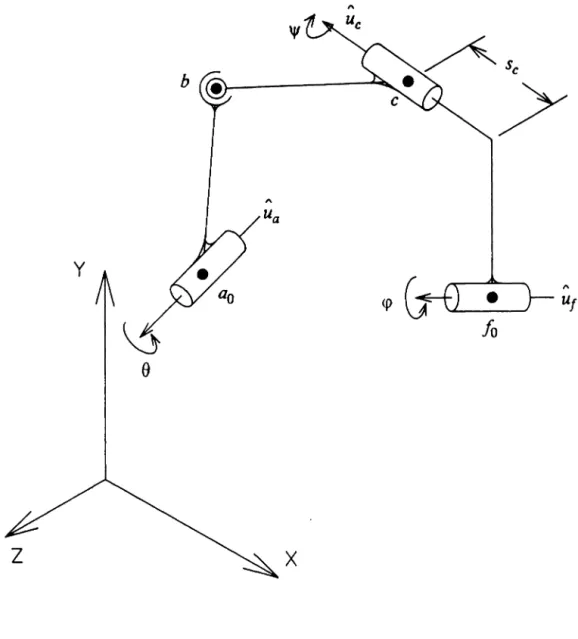
A schematic diagram of the RSCR spatial mechanism is shown in Figure 2. Note that
the vectors locating the various points in the global reference frame are not shown on
the figure.
The following notation is used in describing the mechanism in its initial position:
AQ, .fa-vectors defining the fixed location of the two r-evolut• joints." "
Ya' Yf-unit vectors defining the fixed axes of rotation of the two revolute joints. bi-vector defining the location of the spheric joint in its initial position. g1-vector defining the location of the cylindric joint in its initial position.
"
.ldcl-unit vector defining the axis of the cylindric joint in its initial position.
As the mechanism is displaced from its initial position, the following symbols are
·de-fined:
0-angle of rotation of input revolute joint about its axis.
b-vector defining the location of the spheric joint in its displaced position. g-vector defining the location of the cylindric joint in its displaced position.
"
ye-unit vector defining the axis of cylindric joint in its displaced position.
~-angle of rotation of input revolute joint about its axis.
Sc-scalar displacement of cylindric joint along its axis.
"
b
"
y
"
•
fo
x
Figure 2. Schematic of the RSCR Spatial Mechanism
As the mechanism is put in motion, the input (revolute-spheric)
link
rotates about its
axis, and the output (revolute-cylindric) link rotates about its axis. The motion of the
coupler link is more complicated. The coupler link pivots about the moving spheric
joint, and at the same time rotates about and slides along the moving cylindric joint axis.
Hence, the coupler link is subject to Coriolis acceleration, or acceleration relative to a
rotating reference frame.
Displacement Analysis
While based on existing kinematic theory, the remainder of the material presented in this
chapter is original, to the best of the author's knowledge. As the input link of the RSCR
spatial mechanism is displaced from its initial position, there are three unknown
anism parameters that must be determined to describe the displacement of the
mech-anism. These unknowns are the output angle
q>,and the cylindric joint rotation
'I'
and
displacement
sc.
Two constraint equations are used to determine these unknowns. The
first constraint states that the angle the coupler link makes with the cylindric joint axis
must remain constant through any displacement. This constraint is also known as the
plane equation, and is expressed mathematically in Eq. 2.19
"
"
(b_ -
-').Ye
=(121 - -'1).
Yet
[2.19]
or, rearranging
" " "
12..
Mc
-
.k •Mc
=(12.1
-
.k1) •Met
[2.20]
Note that the location of the displaced spheric joint can easily be found from the input
angle 0.
[2.21]
The displaced cylindric joint location can be expressed as a rotation
q>about
il,
combined
with a displacement
s.
along
ik.
or,
[2.22]
Substituting the expression for
.kfrom Eq.
2.22
for
.kin Eq.
2.20
and rearranging
"
- (b.1 - .k1).
Met
=0
[2.23]
Note that the following equalities hold:
and
Substituting these into Eq. 2.23 gives
}2
e
(R...,~~1
-
(-'1 -
J-0)
e
~I
-
Sc
- J-0
e(R...,~ikl
-
(.QI -
-'1)
e~I
=
0
[2.24]
Solving for
s.
The second constraint equation for the RSCR mechanism requires that the coupler link
maintain a constant length. Mathematically, this is expressed as the self scalar product.
Substituting from Eq.
2.22 for-'
Expanding Eq.
2.27
Q
•
Q
-
2.Q
•
[Rcr,u~{-'1
-
J-0) -
2.Q •
Sc[Rcr.u
1Jik1
-
2.Q
•
J-0
+
[~,u~(-'1
-
J-0) •
[RCl..,~(-'1
-
J-0)
+
2[Rcr,u~(-'1
-
J-0) •
sc[Rcr.u~~I
+
2[Rcr,u/](-'1 -
J-0) • J-0
+
sJRcr.u~ik1
esc[Rcr,u~~I
+
2sJR.,,u
1
1~1
•J-0
+f-0
•J-0
=(121 - -'1) • (121 - -'1)
Three terms of Eq.
2.28 can be simplified using the following identities:
ANALYSIS OF THE RSCR SPATIAL MECHAl'\/ISM[2.26]
[2.27]
[2.28]
[2.28a]
[2.28b]
[2.28c]
With these, Eq. 2.28 becomes
[2.29]
Substituting for
s"from Eq. 2.25, it can be shown that
[2.30]
where
A
represents those terms that are not a function of the output angle
q>A
=
12
•
12
-
212
•
J-0
+
(~1-
J-0) •
(~1-
J-0)
[2.31]
It is desired to develop an expression explicit in the output angle
<p.This can be
ac-complished by substituting the expanded form of the spatial rotation matrix from Eq.
2.3 into Eq. 2.30.
The result is an equation of the form
D
cos
2<p+
E
sin
2<p+
F
cos
<p+
G
sin
<p+
H
cos
<psin
<p+
K
=0
[2.32]
where:
F=
{
+2fl•[P"][P"](~
1
-J(i)}
+2{fl•[P"][P"J~1}{fl•[Q"J~1}
- 2{JO •
[P"][P"]~t}
{fl•
[Q"J~1}
- 2{JO •
[Q"]~
1
}
{fl•
[P"][P"]~t}
+ 2{('1 - JO)•
~
1
}
- 2{JO • [P"][P"](,1 - JO)}
+ 2{('1 - JO)•
~
1
}
{JO•
[P"][PJ~
1
}
+ 2{JO •
[P"][P"J~1}
{JO•
[Q"J~1}
G
=
-2fl
•
[P"](,1 - JO) -
2{fl
•
[P"J~1}{fl
•
[Q"J~1}
+ 2{JO •
[Q"]~t}
{fl•
[P"]~t}
+ 2{('1 - JO)•
~t}
{fl•
[P"]~t}
+ 2{JO •
[P"]~t}
{
b.
•
[Q"]~t}
+ 2{JO •
[Pu](,1
-
JO)}
- 2{('1 -
JO)•
~1}
{JO•
[P"]~t}
- 2{JO • [PJik1}
{JO•
[Q"]~t}
H
=
2{
b.
•
[P"][P"]~
1
}
{
b.
•
[P"]~
1
}
- 2{JO •
[P"][P"]~
1
}
{
b.
•
[P"]~
1
}
- 2{JO •
[P"]~
1
}
{
b.
•
[P"][P"]~t}
+2{JO •
[P"][P"]~t}
{JO• [Pu1rk1}
Using the tan half-angle substitution for cos
q>and sin
q>I - tan
2(T)
cos
q> =I
+
tan
2(T)
2tan(
T)
sin
q>=
---1
+
tan
2(T)
and some manipulation, the result is
(D
-
F
+
K)
tan
4 (T)
+
(2G -
2H)
tan
3 (T)
+ (
-2D
+
4E
+
2K)
tan
2(T)
+
(2G
+
2H)
tan(
T)
+
(D
+
F
+
K)
=0
[2.33]
After normalizing, the resultant quartic equation has the form
[2.34]
the roots of which can be found in closed form. The method used in solving this
equation is discussed in Appendix A. Note that
if
Eq. 2.34 has no real roots for a
par-ticular value of 0, then the mechanism can not assemble in that position.
Once
q>is known,
s.
and£ can be found from Eq. 2.22 and 2.25 respectively.
The method used in determining the cylindric joint angle
'V
may be somewhat difficult
to visualize. The vector
(b.
-
£) can be found by rotating the vector
(b.
1 -£
1)first an
angle
q>about the axis
.H,,
then an angle
'V
about the axis M_.
That is
[2.35]
Note that the translation
s.
does not enter into this equation, as it does not effect the
orientation of
(b.
- -')·
Defining
Then, from the definition of the scalar product
rearranging
(h1 - £1)'.
(.Q
-
£)
cos"'
=-I
Ch1 - £1Yl ICh - £)1
Since the length of the coupler link is constant,
ANALYSIS OF THE RSCR SPATIAL MECHANISM
[2.36]
[2.37]
[2.38]
[2.39]
The sign of
'I'
can be found by crossing [
R11
,11
~(lz1
--'i) into
(iz
- -')·
If
the direction of
the result is the same as that of
i,
'I'
is positive.
If
it is in the opposite direction, then
'I'
is negative. The direction of the cross product is found by taking the scalar product
of the cross product and
i.
If
they are the same direction, the scalar product will be
positive, while the scalar product will be negative if they are opposite directions.
"
{(b1 - k})'
x
(Q
-
k)}
·Ye>
0
0°
< "' <
180°
"
{ (b1 - k} )'
x
(b
-
k)} •
Ye
<
0
- 180°
< "' <
0°
Velocity Analysis
The velocity analysis of the RSCR mechanism is presented in this section.
It
is desired
to find the angular velocity
~of the second revolute joint, and the angular velocity
\jt
and sliding velocity
s.
of the cylindric joint. The velocity analysis is performed by taking
the time derivative of the displacement constraint equation and then algebraically
ma-nipulating it to get a result explicit in
~. Once
~is known,
s.
and
\jt
follow as shown.
The velocity constraint equation is found by taking the derivative of the displacement
constraint equation, Eq. 2.26.
[2.40]
.
}2
{ (b
-
~.)•
(b
-
~) =0
[2.41]
where
b.
is found from
b
= [W](ll
-
.«o)
=0 [
V~,u](ll1
-
.«o)
[2.42]
An expression for
~is found by differentiating Eq. 2.22:
[2.43]
[2.44]
An expression for
sc
is found by differentiating Eq. 2.25:
[2.45]
[2.46]
Substituting Eq. 2.46 into Eq. 2.44, and Eq. 2A4 into Eq. 2.41, and using the
relation-ships:
~
= [R~.u;J~i
A A
(ll
-
~).Mc =(ll1 -
~1).Yet
it can be shown that
.
x
<p = -
y
[2.47]
where:
The
quantities~and
sc
now can be found from Eq. 2.44 and Eq. 2.46 respectively. The
angular velocity of the cylindric joint is found by differentiating Eq. 2.38
Thus,
o/( -
sin 'I')
=
{
~[[
Vq>,uJcl21 - £1)] •
(12
-
£)
+
[Rq>,u_;l(l21
- £1) •
(12
-
£)}
1(121 - £1)1
2o/
= {~[[
V<1>,u](l21
-
£1)] •
(b.
-
£)
+
[Rci.u_;l(l21
-
£1) •
(12
-
£)}
( - sin 'I') 1(121 - £1)1
2ANALYSIS OF THE RSCR SPATIAL MECHANISM
[2.48]
[2.49]
[2.50]
Acceleration Analysis
The angular acceleration,
~, of the output link is found by differentiating Eq. 2.47:
where:
d
·
d
(x)
dt<<p)
=
dt
y
..
1
d
x
d
<p
=--X---Y
y
dt
y2
dt
d
..
.
.
-x
= -
12
•
(12
- -') -
12
•
(12
-
~)dt
b.
is found from the input acceleration and velocity:
..
d
.
..
. .
12
=
dt
(12)
=
9 [
Ve.J(/2
1 -~)
+
9 [
V
9,u](12
1 -~)
ANALYSIS OF THE RSCR SPATIAL MECHANISM
[2.51]
[2.52]
[2.53]
s.,
Q,
and 'if
are found by differentiating Eq. 2.46, 2.44, and 2.50 respectively
[2.54]
[2.55]
[2.56]
[2.57]
'if
is found by differentiating Eq. 2.50.
o/
= [[~.u](/21
- .k1) •
(12
-
.k)
+
2[
~.u](b1
- .k1) •
(k -
D
+
[R<p,u](b1 - .k1) •
(h
-
~)]
I
(b1 - .kt)
I
2sin o/
(cos
o/)o/
+ .
[2.58]
sm o/
Chapter 3
SYNTHESIS OF THE RSCR SPATIAL
MECHANISM
While the previous chapter dealt with analysis of a specified mechanism, this chapter
will deal with mechanism synthesis. Mechanism synthesis is the task of designing a
mechanism to perform a specified motion, while analysis is determining the motion of a
specified mechanism. There are usually three steps in synthesizing a mechanism. The
first step is
type
synthesis, determining the type of mechanism to solve a problem.
Pos-sibilities include gears, cams and linkages. The second step in the synthesis process is
number
synthesis: choosing the number of links in the mechanism. There is very little
theory available to the machine design engineer involved in these first two steps,
expe-rience and intuition are the designer's principle tools.
There has been much more work done in the third step of the synthesis problem:
di-mensional
synthesis.
It
is in this step that the necessary link lengths, joint positions and
orientations are determined. Since this thesis deals strictly with the RSCR spatial
mechanism, only dimensional synthesis will be investigated.
In general, there are three main categories of synthesis problems:
function generation,
path generation,
and
rigid body guidance.
A brief explanation of each category follows.
Function Generation
Function generation deals with coordinating motion of two or more links in the
mech-anism. This usually involves coordinating the angular orientations of the input and
output links. Through the principle of kinematic inversion, function generation may
also be treated as a problem in rigid body guidance.
Path Generation
A path generating mechanism guides a point, called the tracer point, on the mechanism
through a specified path. When the motion of the tracer point is coordinated with the
motion of the input link, it is called path generation
with prescribed input timing.
The
path generation problem may also be treated as an incompletely specified problem in
rigid body guidance.
Rigid Body Guidance
The third synthesis category involves guiding a rigid body through a specified motion.
This motion is usually specified as a series of finitely separated positions and orientations
of the body. The motion of the body is exact at these
precision
positions, and
approxi-mates the desired motion elsewhere. This thesis presents only synthesis procedures for
rigid body guidance,but since function generation and path generation problems may
be treated as body guidance problems, the techniques presented will have broad
appli-cation.
Dyadic Synthesis
A dyad is a two link kinematic chain, one link connected a known reference frame,
usually ground, and the other connected to the moving body. The dyadic synthesis
ap-proach is so named because the mechanism is designed in dyads; that is, each
con-straining link is determined independently, then assembled to form a closed loop
mechanism. Because of this, dyads are sometimes called the building blocks of
mech-anism synthesis.
Using dyadic synthesis, it is relatively easy to design a mechanism. The first step is to
determine the physical constraints of the dyad, express these physical constraints
math-ematically, write the constraint equations in terms of the unknown joint variables, then
solve the equations for the unknown joint locations and orientations. The theory
sented in this section is based on the work of Reinholtz[27] However, to provide
conti-nuity, the notation used in this thesis differs somewhat from that found in the source.
RS Dyad Synthesis
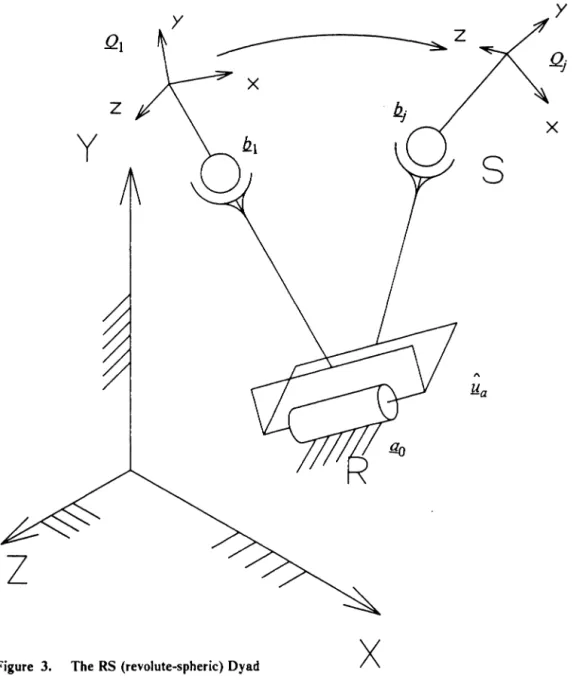
A diagram of the RS(revolute-spheric) dyad appears in Figure 3. Note that the vectors
locating the various points in the global reference frame are not shown. The notation
used is similar to that used earlier, and is defined as follows:
•o-fixed location of revolute joint in the global reference fr11111B.
"
y8-unit vector defining the revolute joint axis.
bi-initial location of the spheric joint in the global reference frame.
b;-location of the spheric joint in the j-th position, relative to global reference fra11111. Qi-initial location of moving reference frame (rigid body) relative to global reference frame. Q; -location of moving reference frame in the j-th position, relative to global reference f,...., [R1;J-rotation matrix describing the rotation of local reference frame
from first position to j-th position.
There are three constraint equations with the RS dyad. The first one requires the R-S
link to maintain constant length. This is expressed mathematically using the self-scalar
product.
y
y
QI
z
x
z
x
y
s
Figure 3. The RS (revolute-spheric) Dyad
x
j=
2,3
[3.1]
The second constraint requires the angle between the R-S
link
and the revolute joint axis
to remain constant. Since kinematically the R-S link will behave the same regardless of
the actual location of the revolute joint on its axis, it can be treated as
if
the R-S link is
perpendicular to the revolute joint axis. This can be expressed mathematically using the
scalar product.
j
=
1,2,3
[3.2]
The final constraint equation requires the spheric joint to be fixed in the moving
refer-ence frame.
j=
2,3
[3.3]
Equations 3.1, 3.2, and 3.3 yield 11 scalar equations in 14 unknowns. The unknowns
are
12.
1,12.
2,~
•.GJ,
and Mo·
Thus, there are three free choices. One option in choosing these
free choices is specifying the initial location of the spheric joint. The spheric locations
12.2
and
12.
3can then be easily found from Eq. 3.3.
12.2
=Q2
+
[R12J(12.1 -
Q1)
12.3
=Q3
+
[R13](12.1 -
Q1)
[3.4]
[3.5]
Thus, this effectively specifies the location of the spheric joint on the rigid body. The
revolute joint axis must be perpendicular to the plane defined by the endpoints of vectors
12.
1,12.
2, and~The expression is normalized to yield a unit vector.
[3.6]
Writing Eq. 3.1 for
j
=
2,3 and combining terms results in
[3.7]
[3.8]
Expanding Eq. 3.2 with
j
=I yields
[3.9]
Equations 3.7, 3.8, and 3.9 represent three linear equations in three unknowns:
-'lox•
.ao,,
.GJ..
This yields, after some manipulation, the following vector equation:
b1x - b1x b1y - b1y b2z - biz lloy b3x - b1x b3y - b1y b3z - biz lloz
[3.10]
which can be easily solved using a method such as Cramer's rule. After solving, the R-S
dyad is completely specified.
RC Dyad Synthesis
A schematic diagram of the RC dyad appears in Figure 4. Note that the vectors locating
the various points in the global and moving reference frames are not sho\vn on the
fig-ure. The notation used is defined below.
fo
-fixed location of revolute joint relative to global reference frame.Yf -111it vector vector defining revolute joint axis.
gl -initial location of cylindric joint relative to global reference frame.
gj -location of cylindric joint in j-th position.
Ycl -111it vector defining cylindric joint axis in initial position.
Ycj -111it vector defining cylindric joint axis in j-th position.
sj -scalar displacement of cylindric joint along its axis in j-th position.
rj -location of cylindric joint in j-th position relative to moving coordinate system.
y
z
x
y
R
Figure 4. The RC (revolute-cylindric) Dyad
x
SYNTHESIS OF THE RSCR SPATIAL MECHANISM
z
c
y
o.
-:Jx
36a;
-location of llDVing coordinate syst- in j-th position, relative to global referwioe f,...,[R1;J -rotation •trix defining rotation of moving coordinate syst- fro11 initial position to j-th position.
Note that the following defining equations hold:
[3.11]
[3.12]
[3.13]
[3.14]
The vector
(k/ -
k)
is constrained to remain perpendicular to both the revolute joint
axis and the cylindric joint axis. This constraint is also known as the plane equation·.
j
=
1,2,3
[3.15]
j
=1,2,3
[3.16]
The twist angle between the two axes is constant.
j=
2,3
[3.17]
A constant link length equation, Eq. 3.18, can also be written.
j=
2,3
[3.18]
However, these would not be linear in the components of .{;
1, -'l•
~.andk . Therefore,
an equivalent linear equation expressing the constant moment
of~
about
Mt
is written.
[3.19]
Thus for three position synthesis, there are 12 unknown parameters:
k.
£11M,,
i,
S221S
23•Equations 3.15, 3.16, 3.17, and 3.19 represent 10 scalar equations in these 12 unknowns,
hence there are 2 free choices. Since the revolute joint axis is defined by a unit vector,
choosing this vector will satisfy the two free choices.
The constant twist equations, Eq. 3.17, can be rewritten for j
=2,3
Mei
•
lJ.j=
Y.ct •
lJ.j[3.20]
[3.21]
substituting the defining equation, Eq. 3.13:
[3.22]
[3.23]
where
[3.24]
b11 b12
b13
[R13]
=
h21
h22 b23b31
b32 b33The following scalar equations can now be written.
a11 a12
a13
"ct.x "1.x "ct.x{
a11 a12 a13 "cty}·
"IY
=
Ucly•
all
a31 a33 Uclz Ulz "ctz b11 b12 b13 Ucl.x "1.x Ucl.x{
b21 b22 b23 Ucly}·
Uly=
Ucly•
b31 b32 b33 Uclz Ulz UclzExpanding Eq. 3.26 and combining terms,
(<a11 -
l)ucl.x+
a12Uc1y+
a13Uc1z)u1.x=
0
( a11Uc1.x
+
(a22 - l)ucly+
a13Uc1z)u1y=
0
(a31Uc1.x+
anucly+
(a33 - l)uc1z)u1z=
0
"1.x
"IY
Ulz "J.x"IY
"Jzadding Equations 3.28, 3.29, and 3.30 and some manipulation will show that
A similar result can be found using Eq. 3.27:
SYNTHESIS OF THE RSCR SPATIAL MECHANISM
[3.25]
[3.26]
[3.27]
[3.28]
[3.29]
[3.30]
[3.31]
[3.32]
39where:
[3.33]
[3.34]
[3.35]
[3.36]
[3.37]
[3.38]
Since
M.
1is a unit vector
2 2 2
Uclx
+
Ucly+
Uclz =l
[3.39]
Equations 3.31, 3.32, and 3.39 can then be solved for
uc1z
_
[(EC-FB) +(DC-FA)+
]-+
uctz -
±
DB
-
EA
EA
-
DB
l[3.40]
Uc1i
and
uc
1,are then given
by
( EC
-
FB)
Uclx =
DB
_
EA
Uclz[3.41]
( DC
-
FA)
Ucly =
EA
-
DB
Uclz[3.42]
Note that
ucband hence
ucixand
uc1,will
have two values. However, this will affect only
the sense of
i
11and not the direction, which defines the joint axis.
The defining equations, Eq. 3.11-3.14, can be written for each position:
[3.43]
[3.44]
[3.45]
.QI I=
~I=
QI
+
lt[3.46]
[3.47]
[3.48]
Substituting these results into the remaining constraint equations, Eq. 3.15-3.17, yields:
A
JJ1•
{Qt
+
l1 -fo}
=0
[3.49]
[3.50]
[3.51]
" Met • {01
+
lt -fo}
=0
[3.52]
[3.53]
[3.54]
"
= Y.1•
{Qt
+
lt -
.10}
x
Yet
[3.55]
"
= MJ
•{Qt
+
lt -
.10}
x
Met
[3.56]
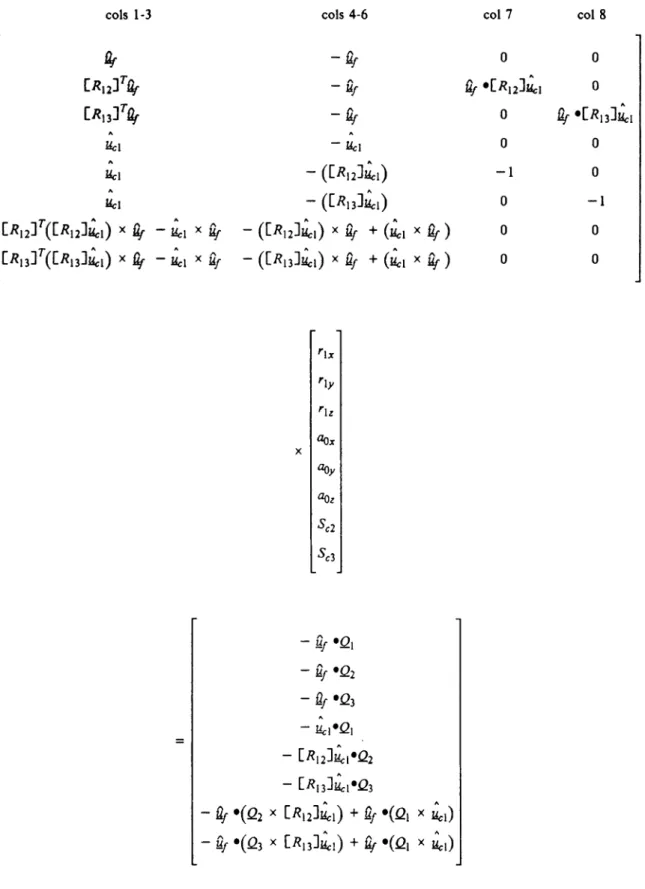
Expanding these equations using the rules of vector algebra produces a system of eight
equations linear in the eight unknowns
.Qo,r
1,S
22,and
S23 •Solving this system will
completely specify the dimensions and initial position of the RC dyad.
Additional Design Considerations
Fixed Pivot Location and Link Length Ratio
Those joints of a mechanism that are physically attached to the fixed reference frame
are called fixed pivots. The location of these points are usually defined relative to the
global reference frame. While constraints on the location of the fixed pivots will vary
with each particular problem, they are generally easy to apply. In the case of the RSCR
spatial mechanism, the fixed pivots are the two revolute joints, located by the vectors
.Qoand
f-0
.
A typical constraint might be:
-5
<
llox
<
5,
-5
<
lloy
<
5,
-5
<
lloz
<
5
cols 1-3 cols 4-6 col 7 col 8
!lj-
-ar
0 0[R12JT!lj- - 'JJ.f "
Yr
•[R12J~1
0[R13]TYr
-ar
0Yr
•[Ri3J~i
U.:1 - U.:1 0 0 U.:1 -
([R12J~1)
-1 0 U.:1 -([R13]~1)
0 -1T
A [R12J ([R12Ju.:1) xYr
-~l
xYr
-([R12J~1)
xYr
+
(~1
xYr)
0 0T
A[R13] ([R13]u.:1) x ~ -
~l
x Yf -([Ri3J~1)
xfl1
+
(~1
xYr)
0 0'ly x
-
Hf
•Qi
- fil•Q2
-
fl
1•Q3
A - u.:1•Q,=
-[Ri2J~1•Q2
-[R13]~i•Q3
-
Yr •(Q2
x[Ri2J~1)
+
ilr
•(Qi
x~i)
-
Hf
•(Q3
x[R13]~i)
+
Yr •(Qi
x~1)
Figure S. RC Dyad Synthesis Equations
This would restrict the location of the first revolute joint to a cube, centered at the
ori-gin, with edges 10 units in length.
The link length ratio affects the motion characteristics of the mechanism. Too large a
ratio will cause excessive accelerations and transmission forces, while too small a ratio
will limit link rotatability. As with the fixed pivot location, the link length ratio is also
quite easy to apply. For example, applying the constraint
/long
<
IO
I
shortwould limit the ratio of longest to shortest link length to be less than 10.
The Order Condition
It is possible to synthesize a mechanism which guides the rigid body through the
speci-fied precision position, but it does so in the wrong order. The
order
of positions the
body traverses depends on both the
sequence
of positions, and
sense
,
or direction, of
traversal. For example, positions 1,2,3 and 3,2, 1 have the same sequence, but opposite
senses. The sense can changed by simply reversing the direction of input link rotation.
It
should also be noted that there is only one possible sequence for three precision
po-sitions. That is, positions 1,2,3; 2,3,l; and 3,1,2 all have the same sequence, they just
start at different points. This can be corrected by altering the initial position of the input
link. Thus, the order condition poses a major problem only when four or more precision
positions are specified.
Chapter 4
COMPUTER IMPLEMENTATION OF THE
THEORY
The theory presented in the previous chapters has been implemented on the digital
computer in the form of a FORTRAN77 program. This program has been installed on
an IBM 4341 processing system at Virginia Tech. The program consists of one main
program and several subroutines. An explanation of the main program structure and
some significant subroutines is included in the following sections. A listing of the main
program and all subroutines appears in Appendix
C.
As part of this computer
imple-mentation, the program has been interfaced with a graphical preprocessor, and a
postprocessor for automatic model generation. Details of these interfaces are included
in this chapter.
Program Structure
Program RSCR
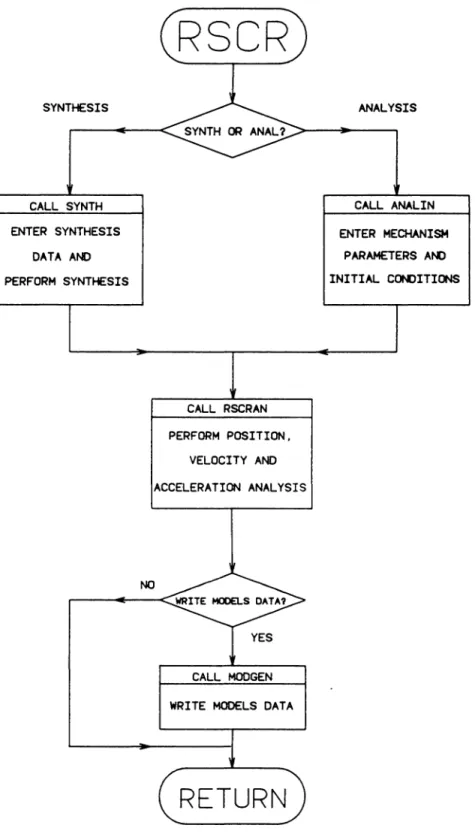
A flowchart of the main program, RSCR appears in Figure 6. This program controls
the overall structure of the entire program. The user has the option of synthesizing a
mechanism, or entering the joint and link data of a known mechanism. In either case,
position, velocity, and acceleration analysis is then performed. After analysis, the user
may choose to create the necessary data files for automatic model generation.
Subroutine SYNTH
A flowchart of subroutine SYNTH appears in Figure 7. This subroutine is called by the
main program to synthesize an RSCR mechanism. This subroutine is used mainly for
data input; actual calculations are performed in the various subroutines called by
SYNTH. The input data consists of three rigid body positions, the vectors and angles
defining the relative orientation of these positions, and the free choice parameters. The
actual format of the data files is given in the next section.
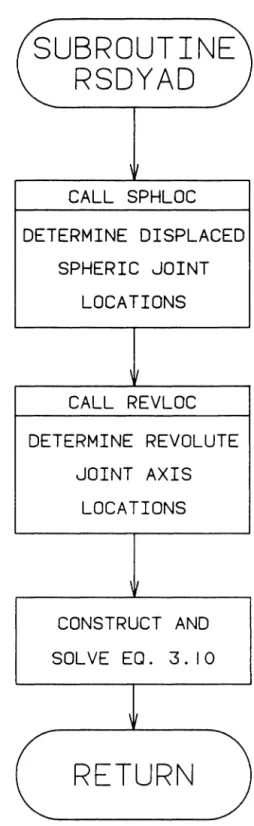
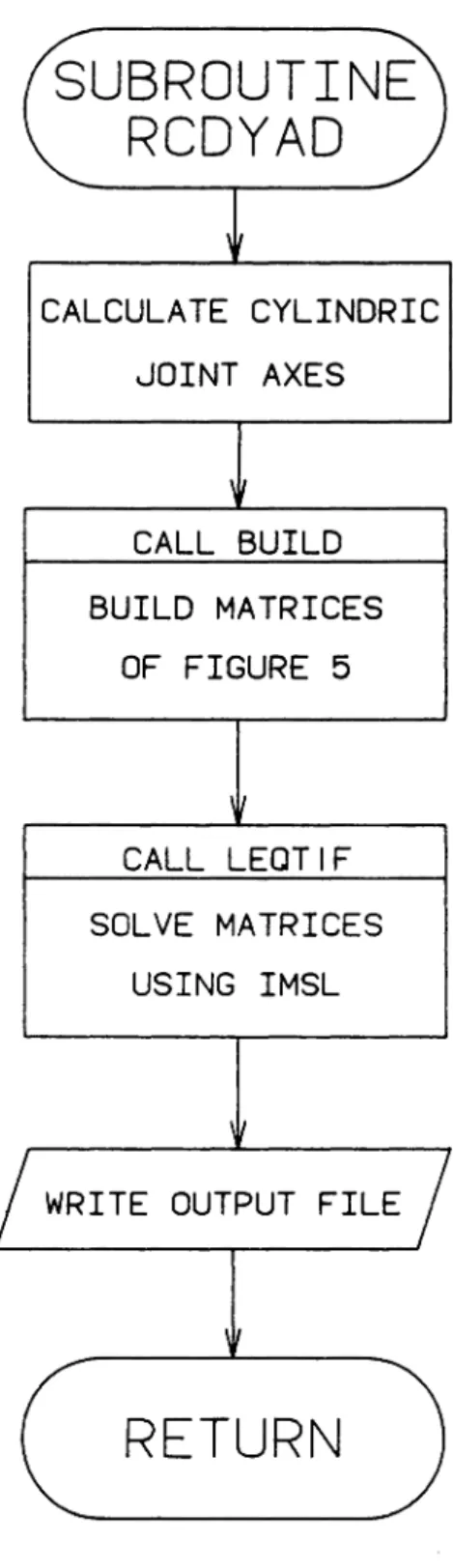
Subroutines RS DYAD and RCDY AD perform the calculations for closed form dyadic
synthesis detailed in Chapter 4. Flow charts of these two subroutines appear in Figures
8 and 9. The link-link length ratio and fixed-pivot locations are checked in subroutines
LNKLEN and FXPVT. A restart file for the graphical preprocessor, as discussed later,
may also be created.
SYNTHESIS CALL SYNTH ENTER SYNTHESIS DATA AND PERFORM SYNTHESIS
RSCR
CALL RSCRAN PERFORM POSITION, VELOCITY AND ACCELERATION ANALYSIS NO CALL MOOGEN WRITE MODELS DATARETURN
Figure 6. Flowchart of Program RSCR
COMPUTER IMPLEMENTATION OF THE THEORY
ANALYSIS CALL ANALIN ENTER MECHANISM PARAMETERS AND INITIAL C()lll)ITIONS
47
Figure 7. Flowchart of Subroutine SYNTH
SUBROUTINE
SY NTH
ENTER SYNTHESIS DATA BUILD ROTATION MATRICES CALL RSOYAD DETERMINE AN RS DYAD CALL RCDYAD DETERMINE AN RC DYAD CALL LNKLEN CHECK LINK-LENGTH RATIO CALL FXPVT CHECK FIXED PIVOT LOCATIONS CALL RESTRT WRITE MECHIN RESTART FILERETURN
CALL SPHLOC
DETERMINE DISPLACED
SPHERIC JOINT
LOCATIONS
CALL REVLOC
DETERMINE REVOLUTE
JOINT AXIS
LOCATIONS
CONSTRUCT AND
SOL VE EQ . 3 .
I
0
RETURN
Figure 8. Flowchart of Subroutine RSDY AD
CALCULATE CYLINDRIC
JOINT AXES
CALL BUILD
BUILD MATRICES
OF FIGURE 5
CALL LEQTIF
SOLVE MATRICES
USING IMSL
WRITE OUTPUT FILE
RETURN
Figure 9. Flowchart of Subroutine RCDYAD
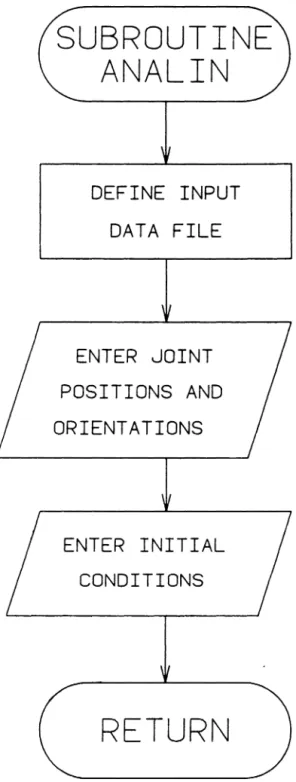
Subroutine ANALIN
A flowchart for subroutine ANALIN appears in Figure 10. This subroutine allows the
user to enter the parameters and initial conditions of a specified mechanism, rather than
synthesizing a mechanism. This subroutine is used strictly for data input; no
calcu-lations are performed.
Subroutine RSCRAN
A flowchart of subroutine RSCRAN appears in Figure 11. This subroutine performs
closed form position, velocity, and acceleration analysis based on the theory in Chapter
3. This analysis is based on default initial conditions if the mechanism synthesized in
SYNTH, or on user specified initial conditions from subroutine ANALIN. The output
of this subroutine consists of 0, 2, or 4 values of each output mechanism parameter at
each input link position, depending on the number of branches of the mechanism. The
output mechanism variables listed are
<p,tj>,
~.'I',
o/,
'if,
s.,
s.,
and
s.
as defined earlier in
this thesis. An appropriate message is written to the output file if the mechanism does
not assemble at a particular input link position.
SUBROUTINE
ANAL IN
DEFINE INPUT
DATA FILE
ENTER JOINT
POSITIONS AND
ORIENTATIONS
ENTER INITIAL
CONDITIONS
RETURN
Figure JO. Flowchart of Subroutine A'.'IALI~
LOOP DESIRED
NUMBER OF
INCREMENTS
Figure 11. Flowchart of Subroutine RSCRAN
COMPUTER IMPLEMENTATION OF THE THEORY
SUBROUTINE
RSCRAN
DETERMINE VECTORS
WHICH DEFINE
INITIAL LINK
LOCATIONS
CALCULATE COEFFICIENTS
OF EQUATION 2.34
AND SOLVE
NO
PERFORM POSITION,
VELOCITY AND
CCELERATION ANALYSIS
WRITE RESULTS TO
OUTPUT FILES
RETURN
53Inter/ ace with Graphical Preprocessor
A graphical preprocessor for spatial mechanisms, MECHIN, has been developed in the
Mechanical Engineering Department of Virginia Tech by Thatch[35]. MECH IN allows
the user to define analysis or synthesis problems using interactive computer graphics.
This greatly simplifies the task of problem definition, and drastically decreases the time
required to set up a problem.
MECHIN employs PHIGS(Programmers Hierarchical Interactive Graphics Systems) for
graphics software support, and is graphics device-independent. A wide range of
mech-anism processing code can be supported. The processing codes currently supported are
IMP[36] and RSCR--the code developed for this thesis. As is demonstrated later in this
section, it is relatively easy to modify MECHIN to support additional processing codes.
MECHIN has been designed to permit additional processing codes to be supported with
a minimum of changes to MECH IN. The basic alterations include modification of the
MECH IN menu to allow additional processing code selections, and creation of
subrou-tines to write the data files for the additional processing code. The purpose of this
sec-tion is the briefly explain the MECHIN program structure, and how it can be modified
to support additional processing codes. Though not required, some knowledge of
com-puter graphics may be helpful in understanding the modifications. The reader is referred
to the reference for a more detailed discusssion of MECHIN. All the MECHIN
sub-routines discussed here were written by Thatch as part of the original version of
MECH IN. A listing of selected MECH IN subroutines appears in Appendix D.
COMPUTER IMPLEMENTATION OF THE THEORY 54
I
I
I
I
I
I
I
I
I
I
I
I
I
I
I
I
I
I
I
I
I
I
The main program MECHIN is very high level. A flowchart appears in Figure 12. The
main program prompts the user to choose between mechanism synthesis or analysis,
then shifts control to the appropriate processor: ANIN for specification of analysis
data, or SYN IN for specification of synthesis data.
A flowchart of subroutine ANIN is shown in Figure 13. The user is queried to either
create a new model , or to modify a previously defined model. Actual model creation
and modification is controlled by subroutine DATA, which is called by ANIN.
ANIN calls subroutine WRANAL to create the data files for the mechanism processing
code. A flowchart of subroutine WRANAL is shown in Figure 14. The user is queried
by WRANAL to choose the appropriate processing code. WRANAL then calls an
ap-propriate subroutine to create a data file for that particular processing code.
The structure is very similar for SYNIN, with subroutines SDA TA and WRSYN taking
the places of DA TA and WRANAL respectively.
An explanation of how MECH IN was modified to support RSCR for mechanism
anal-ysis is presented in the following paragraphs.
The first step in modifying MECH IN to support RSCR was the addition of the choice
RSCR to the processing code choice menu. This was accomplished by slightly modifying
the MECHIN subroutine MENU, which is used to display menu items and process
menu picks. The processing code choices fill the 18th row of array TMENU. :vtany
blank choices have been included in this array to allow for future modifications.
Addi-tional choices may be included by simply replacing a existing blank choice with the new
choice.
ANALYSIS
CALL ANIN
INPUT ANALYSIS
PARAMETERS
WRITE RESTART
AND ANALYSIS
FILES
START
MECH IN
CALL SETUP
OPEN PHIGS
SET UP VIEWS
LOAD COLOR TABLE
DISPLAY TITLE
SYNTHESIS
CALL SYNIN
INPUT SYNTHESIS
PARAMETERS
CALL CLOSE
DELETE
STRUCTURES
CLOSE PHIGS
STOP
WRITE RESTART
AND SYNTHESIS
FILES
Figure 12. Flowchart of Main Program MECHIN