CHAPTER 17
High-Performance Concrete
• High modulus of elasticity • High abrasion resistance
• High durability and long life in severe environments • Low permeability and diffusion
• Resistance to chemical attack
• High resistance to frost and deicer scaling damage • Toughness and impact resistance
• Volume stability • Ease of placement
• Compaction without segregation • Inhibition of bacterial and mold growth
High-performance concretes are made with carefully selected high-quality ingredients and optimized mixture designs; these are batched, mixed, placed, compacted and cured to the highest industry standards. Typically, such concretes will have a low water-cementing materials ratio of 0.20 to 0.45. Plasticizers are usually used to make these concretes fluid and workable.
High-performance concrete almost always has a higher strength than normal concrete. However, strength is not always the primary re-quired property. For ex-ample, a normal strength concrete with very high durability and very low permeability is consid-ered to have high-performance properties. Bickley and Fung (2001) demonstrated that 40 MPa (6,000 psi) high-performance concrete for bridges could be eco-nomically made while Fig. 17-1. High-performance concrete is often
used in bridges (left) and tall buildings (right). (70017, 70023)
High-performance concrete (HPC) exceeds the properties and constructability of normal concrete. Normal and spe-cial materials are used to make these spespe-cially designed concretes that must meet a combination of performance requirements. Special mixing, placing, and curing prac-tices may be needed to produce and handle high-perform-ance concrete. Extensive performhigh-perform-ance tests are usually required to demonstrate compliance with specific project needs (ASCE 1993, Russell 1999, and Bickley and Mitchell 2001). High-performance concrete has been primarily used in tunnels, bridges, and tall buildings for its strength, dura-bility, and high modulus of elasticity (Fig. 17-1). It has also been used in shotcrete repair, poles, parking garages, and agricultural applications.
High-performance concrete characteristics are devel-oped for particular applications and environments; some of the properties that may be required include:
• High strength • High early strength
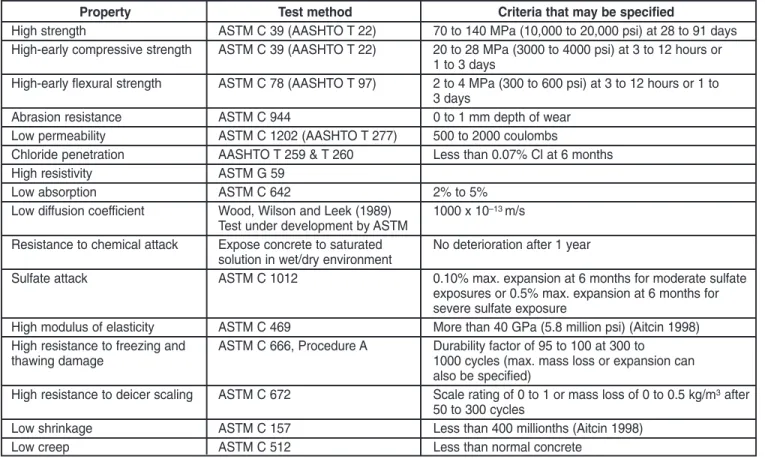
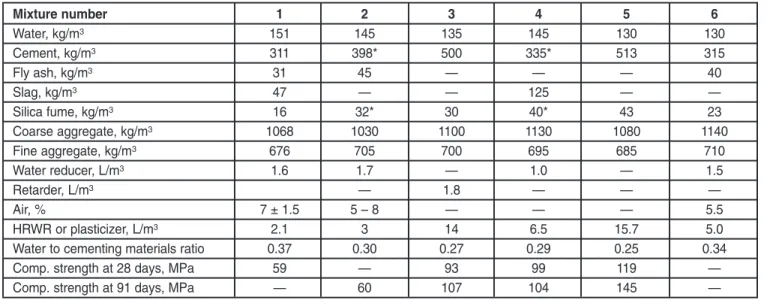
meeting durability factors for air-void sys-tem and resistance to chloride penetration. Table 17-1 lists materials often used in high-performance concrete and why they are selected. Table 17-2 lists properties that can be selected for high-performance con-crete. Not all properties can be achieved at the same time. High-performance concrete specifications ideally should be perform-ance oriented. Unfortunately, many speci-fications are a combination of performance requirements (such as permeability or strength limits) and prescriptive require-ments (such as air content limits or dosage of supplementary cementing material (Ferraris and Lobo 1998). Table 17-3 pro-vides examples of high-performance con-crete mixtures used in a variety of structures. Selected high-performance con-cretes are presented in this chapter.
HIGH-EARLY-STRENGTH
CONCRETE
High-early-strength concrete, also called fast-track concrete, achieves its specified strength at an earlier age than normal concrete. The time period in which a speci-fied strength should be achieved may range from a few Table 17-1. Materials Used in High-Performance Concrete
Material Primary contribution/Desired property
Portland cement Cementing material/durability
Blended cement Cementing material/durability/high strength Fly ash Cementing material/durability/high strength Slag Cementing material/durability/high strength Silica fume Cementing material/durability/high strength Calcined clay Cementing material/durability/high strength Metakaolin Cementing material/durability/high strength Calcined shale Cementing material/durability/high strength Superplasticizers Flowability
High-range water reducers Reduce water to cement ratio Hydration control admixtures Control setting
Retarders Control setting Accelerators Accelerate setting Corrosion inhibitors Control steel corrosion
Water reducers Reduce cement and water content Shrinkage reducers Reduce shrinkage
ASR inhibitors Control alkali-silica reactivity Polymer/latex modifiers Durability
Optimally graded aggregate Improve workability and reduce paste demand
Table 17-2. Selected Properties of High-Performance Concrete
Property Test method Criteria that may be specified
High strength ASTM C 39 (AASHTO T 22) 70 to 140 MPa (10,000 to 20,000 psi) at 28 to 91 days High-early compressive strength ASTM C 39 (AASHTO T 22) 20 to 28 MPa (3000 to 4000 psi) at 3 to 12 hours or
1 to 3 days
High-early flexural strength ASTM C 78 (AASHTO T 97) 2 to 4 MPa (300 to 600 psi) at 3 to 12 hours or 1 to 3 days
Abrasion resistance ASTM C 944 0 to 1 mm depth of wear Low permeability ASTM C 1202 (AASHTO T 277) 500 to 2000 coulombs
Chloride penetration AASHTO T 259 & T 260 Less than 0.07% Cl at 6 months High resistivity ASTM G 59
Low absorption ASTM C 642 2% to 5% Low diffusion coefficient Wood, Wilson and Leek (1989) 1000 x 10–13 m/s
Test under development by ASTM
Resistance to chemical attack Expose concrete to saturated No deterioration after 1 year solution in wet/dry environment
Sulfate attack ASTM C 1012 0.10% max. expansion at 6 months for moderate sulfate exposures or 0.5% max. expansion at 6 months for severe sulfate exposure
High modulus of elasticity ASTM C 469 More than 40 GPa (5.8 million psi) (Aitcin 1998) High resistance to freezing and ASTM C 666, Procedure A Durability factor of 95 to 100 at 300 to
thawing damage 1000 cycles (max. mass loss or expansion can also be specified)
High resistance to deicer scaling ASTM C 672 Scale rating of 0 to 1 or mass loss of 0 to 0.5 kg/m3after
50 to 300 cycles
Low shrinkage ASTM C 157 Less than 400 millionths (Aitcin 1998) Low creep ASTM C 512 Less than normal concrete
hours (or even minutes) to several days. High-early-strength can be attained by using traditional concrete ingredients and concreting practices, although sometimes special materials or techniques are needed.
High-early-strength can be obtained by using one or a combination of the following, depending on the age at
which the specified strength must be achieved and on job conditions:
1. Type III or HE high-early-strength cement
2. High cement content (400 to 600 kg/m3or 675 to 1000 lb/yd3)
Table 17-3 (Metric). Typical High-Performance Concretes Used in Structures
Mixture number 1 2 3 4 5 6 Water, kg/m3 151 145 135 145 130 130 Cement, kg/m3 311 398* 500 335* 513 315 Fly ash, kg/m3 31 45 — — — 40 Slag, kg/m3 47 — — 125 — — Silica fume, kg/m3 16 32* 30 40* 43 23 Coarse aggregate, kg/m3 1068 1030 1100 1130 1080 1140 Fine aggregate, kg/m3 676 705 700 695 685 710 Water reducer, L/m3 1.6 1.7 — 1.0 — 1.5 Retarder, L/m3 — 1.8 — — — Air, % 7 ± 1.5 5 – 8 — — — 5.5 HRWR or plasticizer, L/m3 2.1 3 14 6.5 15.7 5.0
Water to cementing materials ratio 0.37 0.30 0.27 0.29 0.25 0.34 Comp. strength at 28 days, MPa 59 — 93 99 119 — Comp. strength at 91 days, MPa — 60 107 104 145 —
1. Wacker Drive bi-level roadway, Chicago, 2001.
2. Confederation Bridge, Northumberland Strait, Prince Edward Island/New Brunswick, 1997. 3. La Laurentienne Building, Montreal, 1984.
4. BCE Place Phase 2, Toronto, 1993. 5. Two Union Square, Seattle, 1988.
6. Great Belt Link, East Bridge, Denmark, 1996.
* Originally used a blended cement containing silica fume. Portland cement and silica fume quantities have been separated for comparison purposes.
Table 17-3 (Inch-Pound Units). Typical High-Performance Concretes Used in Structures
Mixture number 1 2 3 4 5 6
Water, lb/yd3 254 244 227 244 219 219
Cement, lb/yd3 525 671* 843 565* 865 531
Fly ash, lb/yd3 53 76 — — — 67
Slag, lb/yd3 79 — — 211 — —
Silica fume, lb/yd3 27 54* 51 67* 72 39
Coarse aggregate, lb/yd3 1800 1736 1854 1905 1820 1921
Fine aggregate, lb/yd3 1140 1188 1180 1171 1155 1197
Water reducer, oz/yd3 41 47 — 27 — 38
Retarder, oz/yd3 — — 48 — — —
Air, % 7 ± 1.5 5 – 8 — — — 5.5
HRWR or plasticizer, oz/yd3 55 83 375 175 420 131
Water to cementing materials ratio 0.37 0.30 0.27 0.29 0.25 0.34 Comp. strength at 28 days, psi 8,590 — 13,500 14,360 17,250 — Comp. strength at 91 days, psi — 8700 15,300 15,080 21,000 —
1. Wacker Drive bi-level roadway, Chicago, 2001.
2. Confederation Bridge, Northumberland Strait, Prince Edward Island/New Brunswick, 1997. 3. La Laurentienne Building, Montreal, 1984.
4. BCE Place Phase 2, Toronto, 1993. 5. Two Union Square, Seattle, 1988.
6. Great Belt Link, East Bridge, Denmark, 1996.
* Originally used a blended cement containing silica fume. Portland cement and silica fume quantities have been separated for comparison purposes.
3. Low water-cementing materials ratio (0.20 to 0.45 by mass)
4. Higher freshly mixed concrete temperature 5. Higher curing temperature
6. Chemical admixtures
7. Silica fume (or other supplementary cementing mate-rials)
8. Steam or autoclave curing
9. Insulation to retain heat of hydration 10. Special rapid hardening cements.
High-early-strength concrete is used for prestressed concrete to allow for early stressing; precast concrete for rapid production of elements; high-speed cast-in-place construction; rapid form reuse; cold-weather construction; rapid repair of pavements to reduce traffic downtime; fast-track paving; and several other uses.
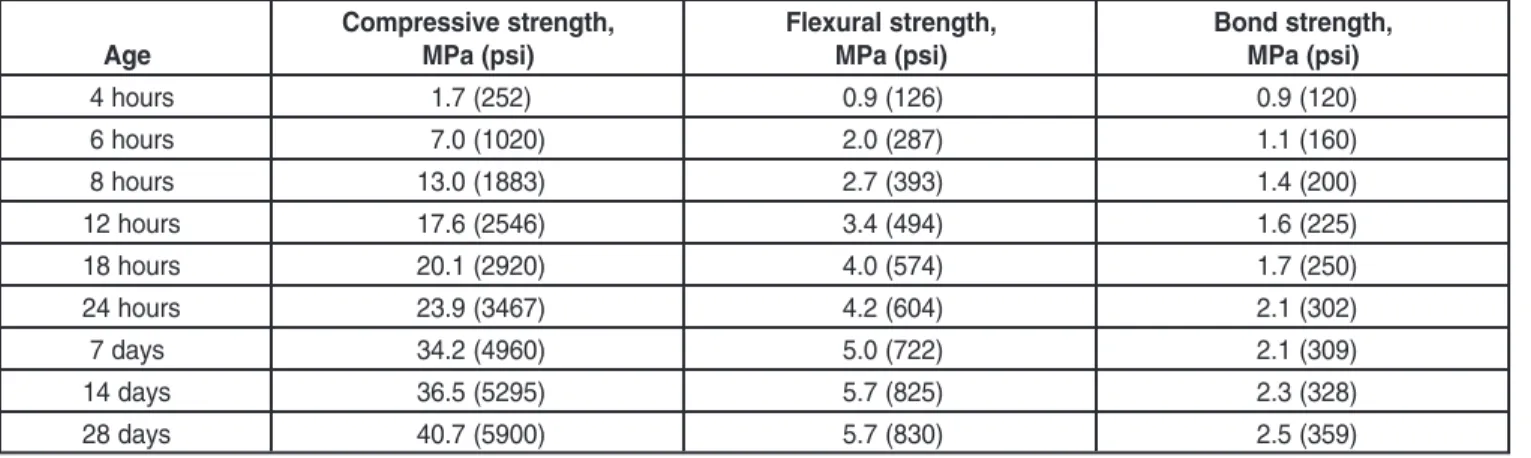
In fast-track paving, use of high-early-strength mix-tures allows traffic to open within a few hours after con-crete is placed. An example of a fast-track concon-crete mixture used for a bonded concrete highway overlay con-sisted of 380 kg (640 lb) of Type III cement, 42 kg (70 lb) of Type C fly ash, 61⁄
2% air, a water reducer, and a water-to-cementing materials ratio of 0.4. Strength data for this 40-mm (11⁄
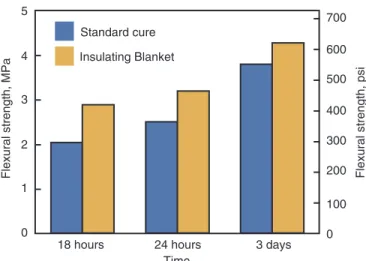
2-in.) slump concrete are given in Table 17-4. Figs. 17-2 and 17-3 illustrate early strength development of con-cretes designed to open to traffic within 4 hours after placement. Fig. 17-4 illustrates the benefits of blanket curing to develop early strength for patching or fast-track applications.
When designing early-strength mixtures, strength development is not the only criteria that should be evalu-ated; durability, early stiffening, autogenous shrinkage, drying shrinkage, temperature rise, and other properties also should be evaluated for compatibility with the project. Special curing procedures, such as fogging, may be needed to control plastic shrinkage cracking.
Table 17-4. Strength Data for Fast-Track Bonded Overlay
Compressive strength, Flexural strength, Bond strength,
Age MPa (psi) MPa (psi) MPa (psi)
4 hours 1.7 (252) 0.9 (126) 0.9 (120) 6 hours 7.0 (1020) 2.0 (287) 1.1 (160) 8 hours 13.0 (1883) 2.7 (393) 1.4 (200) 12 hours 17.6 (2546) 3.4 (494) 1.6 (225) 18 hours 20.1 (2920) 4.0 (574) 1.7 (250) 24 hours 23.9 (3467) 4.2 (604) 2.1 (302) 7 days 34.2 (4960) 5.0 (722) 2.1 (309) 14 days 36.5 (5295) 5.7 (825) 2.3 (328) 28 days 40.7 (5900) 5.7 (830) 2.5 (359)
Adapted from Knutson and Riley 1987
0 1 2 3 4 5 0 100 200 300 400 500 600 700
Flexural strength, MPa Flexural strength, psi
3 hours 4 hours 28 days Time
Fig. 17-2. Strength development of a high-early strength concrete mixture using 390 kg/m3 (657 lb/yd3) of rapid
hardening cement, 676 kg/m3 (1140 lb/yd3) of sand, 1115
kg/m3 (1879 lb/yd3) of 25 mm (1 in.) nominal max. size
coarse aggregate, a water to cement ratio of 0.46, a slump of 100 to 200 mm (4 to 8 in.), and a plasticizer and retarder. Initial set was at one hour (Pyle 2001).
Type III Type II/III 0 2 1 3 4 5 6 7 0 200 400 600 800 1000
Flexural strength, MPa Flexural strength, psi
3 hours 6 hours 7 days
Time
Fig. 17-3. Strength development of high-early strength concrete mixtures made with 504 to 528 kg/m3(850 to 890
lb/yd3) of Type III or Type II/III cement, a nominal maximum
size coarse aggregate of 25 mm (1 in.), a water to cement ratio of 0.30, a plasticizer, a hydration control admixture, and an accelerator. Initial set was at one hour (Pyle 2001).
HIGH-STRENGTH CONCRETE
The definition of high strength changes over the years as concrete strength used in the field increases. This publica-tion considers high-strength concrete (HSC) to have a strength significantly beyond what is used in normal prac-tice. For example, today about 90% of ready mixed con-crete has a 28-day specified compressive strength ranging from 20 MPa (3000 psi) to 40 MPa (6000 psi), with most of it between 28 MPa (4000 psi) and 35 MPa (5000 psi). Therefore, HSC considered here has a design strength of at least 70 MPa (10,000 psi).
Most high-strength concrete applications are designed for compressive strengths of 70 MPa (10,000 psi) or greater as shown in Tables 17-3 and 17-5. For strengths of 70 MPa (10,000 psi) and higher, stringent application of the best practices is required. Compliance with the guidelines and Standard cure Insulating Blanket 0 2 1 3 4 5 0 100 200 400 500 300 600 700
Flexural strength, MPa Flexural strength, psi
18 hours 24 hours 3 days Time
Fig. 17-4. Effect of blanket insulation on fast-track concrete. The concrete had a Type I cement content of 421kg/m3(710
lb/yd3) and a water to cement ratio of 0.30 (Grove 1989).
Mix number Units per m3 1 2 3 4 5 6 Cement, Type I, kg 564 475 487 564 475 327 Silica fume, kg — 24 47 89 74 27 Fly ash, kg — 59 — — 104 87 Coarse aggregate SSD (12.5 mm crushed limestone), kg 1068 1068 1068 1068 1068 1121 Fine aggregate SSD, kg 647 659 676 593 593 742 HRWR Type F, liters 11.6 11.6 11.22 20.11 16.44 6.3 HRWR Type G, liters — — — — — 3.24
Retarder, Type D, liters 1.12 1.05 0.97 1.46 1.5 — Water to cementing materials ratio 0.28 0.29 0.29 0.22 0.23 0.32
Fresh concrete properties
Slump, mm 197 248 216 254 235 203
Density, kg/ m3 2451 2453 2433 2486 2459 2454
Air content, % 1.6 0.7 1.3 1.1 1.4 1.2
Concrete temp., °C 24 24 18 17 17 23
Compressive strength, 100 x 200-mm moist-cured cylinders
3 days, MPa 57 54 55 72 53 43 7 days, MPa 67 71 71 92 77 63 28 days, MPa 79 92 90 117 100 85 56 days, MPa 84 94 95 122 116 — 91 days, MPa 88 105 96 124 120 92 182 days, MPa 97 105 97 128 120 — 426 days, MPa 103 118 100 133 119 — 1085 days, MPa 115 122 115 150 132 —
Modulus of elasticity in compression, 100 x 200-mm moist-cured cylinders
91 days, GPa 50.6 49.9 50.1 56.5 53.4 47.9
Drying shrinkage, 75 by 75 x 285-mm prisms
7 days, millionths 193 123 100 87 137 —
28 days, millionths 400 287 240 203 233 —
90 days, millionths 573 447 383 320 340 —
369 days, millionths 690 577 520 453 467 —
1075 days, millionths 753 677 603 527 523 —
Table 17-5 (Metric). Mixture Proportions and Properties of Commercially Available High-Strength Concrete (Burg and Ost 1994)
cementing materials are usually incorporated into the con-crete mixture. This produces additional benefits in the form of reduced heat generation during hydration.
With use of low-slump or no-slump mixes, high-compressive-strength concrete is produced routinely under careful control in precast and prestressed concrete plants. These stiff mixes are placed in ruggedly-built forms and consolidated by prolonged vibration or shock methods. However, cast-in-place concrete uses more fragile forms that do not permit the same compaction procedures, hence more workable concretes are necessary to achieve the required compaction and to avoid segrega-recommendations for preconstruction laboratory and
field-testing procedures described in ACI 363.2 are essen-tial. Concrete with a design strength of 131 MPa (19,000 psi) has been used in buildings (Fig. 17-5).
Traditionally, the specified strength of concrete has been based on 28-day test results. However, in high-rise concrete structures, the process of construction is such that the structural elements in lower floors are not fully loaded for periods of a year or more. For this reason, compressive strengths based on 56- or 91-day test results are commonly specified in order to achieve significant economy in mate-rial costs. When later ages are specified, supplementary
Mix number Units per yd3 1 2 3 4 5 6 Cement, Type I, lb 950 800 820 950 800 551 Silica fume, lb — 40 80 150 125 45 Fly ash, lb — 100 — — 175 147 Coarse aggregate SSD (1⁄ 2in. crushed limestone), lb 1800 1800 1800 1800 1800 1890 Fine aggregate SSD, lb 1090 1110 1140 1000 1000 1251 HRWR Type F, fl oz 300 300 290 520 425 163 HRWR Type G, fl oz — — — — — 84 Retarder, Type D, fl oz 29 27 25 38 39 —
Water to cementing materials ratio 0.28 0.29 0.29 0.22 0.23 0.32
Fresh concrete properties
Slump, in. 73⁄
4 93⁄4 81⁄2 10 91⁄4 8
Density, lb/ft3 153.0 153.1 151.9 155.2 153.5 153.2
Air content, % 1.6 0.7 1.3 1.1 1.4 1.2
Concrete temp., °F 75 75 65 63 62 74
Compressive strength, 4 x 8-in. moist-cured cylinders
3 days, psi 8,220 7,900 7,970 10,430 7,630 6,170 7 days, psi 9,660 10,230 10,360 13,280 11,150 9,170 28 days, psi 11,460 13,300 13,070 17,000 14,530 12,270 56 days, psi 12,230 13,660 13,840 17,630 16,760 — 91 days, psi 12,800 15,170 13,950 18,030 17,350 13,310 182 days, psi 14,110 15,160 14,140 18,590 17,400 — 426 days, psi 14,910 17,100 14,560 19,230 17,290 — 1085 days, psi 16,720 17,730 16,650 21,750 19,190 —
Modulus of elasticity in compression, 4 x 8-in. moist-cured cylinders
91 days, million psi 7.34 7.24 7.27 8.20 7.75 6.95
Drying shrinkage, 3 x 3 by 11.5-in. prisms
7 days, millionths 193 123 100 87 137 —
28 days, millionths 400 287 240 203 233 —
90 days, millionths 573 447 383 320 340 —
369 days, millionths 690 577 520 453 467 —
1075 days, millionths 753 677 603 527 523 —
Table 17-5 (Inch-Pound Units). Mixture Proportions and Properties of Commercially Available High-Strength Concrete (Burg and Ost 1994)
tion and honeycomb. Superplasticizing admixtures are invariably added to HPC mixtures to produce workable and often flowable mixtures.
Production of high-strength concrete may or may not require the purchase of special materials. The producer must know the factors affecting compressive strength and know how to vary those factors for best results. Each variable should be analyzed separately in developing a mix design. When an optimum or near optimum is estab-lished for each variable, it should be incorporated as the remaining variables are studied. An optimum mix design is then developed keeping in mind the economic advan-tages of using locally available materials. Many of the items discussed below also apply to most high-perform-ance concretes.
Cement
Selection of cement for high-strength concrete should not be based only on mortar-cube tests but should also include tests of comparative strengths of concrete at 28, 56, and 91 days. A cement that yields the highest concrete compressive strength at extended ages (91 days) is prefer-able. For high-strength concrete, a cement should produce a minimum 7-day mortar-cube strength of approximately 30 MPa (4350 psi).
Trial mixtures with cement contents between 400 and 550 kg/m3(675 to 930 lb/yd3) should be made for each
cement being considered for the project. Amounts will vary depending on target strengths. Other than decreases in sand content as cement content increases, the trial mixtures should be as nearly identical as possible.
Supplementary Cementing Materials
Fly ash, silica fume, or slag are often mandatory in the pro-duction of high-strength concrete; the strength gain obtained with these supplementary cementing materials cannot be attained by using additional cement alone. These supplementary cementing materials are usually added at dosage rates of 5% to 20% or higher by mass of cementing material. Some specifications only permit use of up to 10% silica fume, unless evidence is available indicating that concrete produced with a larger dosage rate will have sat-isfactory strength, durability, and volume stability. The water-to-cementing materials ratio should be adjusted so that equal workability becomes the basis of comparison between trial mixtures. For each set of materials, there will be an optimum cement-plus-supplementary cementing materials content at which strength does not continue to increase with greater amounts and the mixture becomes too sticky to handle properly. Blended cements containing fly ash, silica fume, slag, or calcined clay can be used to make high-strength concrete with or without the addition of supplementary cementing materials.
Aggregates
In high-strength concrete, careful attention must be given to aggregate size, shape, surface texture, mineralogy, and cleanness. For each source of aggregate and concrete strength level there is an optimum-size aggregate that will yield the most compressive strength per unit of cement. To find the optimum size, trial batches should be made with 19 mm (3⁄4in.) and smaller coarse aggregates and varying cement contents. Many studies have found that 9.5 mm to 12.5 mm (3⁄
8 in. to 1⁄2 in.) nominal maximum-size aggregates give optimum strength.
In high-strength concretes, the strength of the aggre-gate itself and the bond or adhesion between the paste and aggregate become important factors. Tests have shown that crushed-stone aggregates produce higher compressive strength in concrete than gravel aggregate using the same size aggregate and the same cementing materials content; this is probably due to a superior aggregate-to-paste bond when using rough, angular, crushed material. For specified concrete strengths of 70 MPa (10,000 psi) or higher, the potential of the aggregates to meet design requirements must be established prior to use.
Coarse aggregates used in high-strength concrete should be clean, that is, free from detrimental coatings of dust and clay. Removing dust is important since it may affect the quantity of fines and consequently the water demand of a concrete mix. Clay may affect the aggregate-Fig. 17-5. The Two Union Square building in Seattle used
concrete with a designed compressive strength of 131 MPa (19,000 psi) in its steel tube and concrete composite columns. High-strength concrete was used to meet a design criteria of 41 GPa (6 million psi) modulus of elasticity. (59577)
these trial batches, it will be possible to determine the workability, setting time, and amount of water reduction for given admixture dosage rates and times of addition.
The use of air-entraining admixtures is not necessary or desirable in high-strength concrete that is protected from the weather, such as interior columns and shearwalls of high-rise buildings. However, for bridges, concrete piles, piers, or parking structures, where durability in a freeze-thaw environment is required, entrained air is mandatory. Because air entrainment decreases concrete strength of rich mixtures, testing to establish optimum air contents and spacing factors may be required. Certain high-strength concretes may not need as much air as normal-strength concrete to be frost resistant. Pinto and Hover (2001) found that non-air-entrained, high-strength concretes had good frost and deicer-scaling resistance at a water to portland cement ratio of 0.25. Burg and Ost (1994) found good frost resistance with non-air-entrained concrete containing silica fume at a water to cementing materials ratio of 0.22 (Mix No. 4 in Table 17-5); however, this was not the case with other mixtures, including a portland-only mixture with a water to cement ratio of 0.28.
Proportioning
The trial mixture approach is best for selecting propor-tions for high-strength concrete. To obtain high strength, it is necessary to use a low water to cementing materials ratio and a high portland cement content. The unit strength obtained for each unit of cement used in a cubic meter (yard) of concrete can be plotted as strength effi-ciency to assist with mix designs.
The water requirement of concrete increases as the fine aggregate content is increased for any given size of coarse aggregate. Because of the high cementing materials content of these concretes, the fine aggregate content can be kept low. However, even with well-graded aggregates, a low water-cementing materials ratio may result in con-crete that is not sufficiently workable for the job. If a superplasticizer is not already being used, this may be the time to consider one. A slump of around 200 mm (8 in.) will provide adequate workability for most appli-cations. ACI Committee 211 (1998), Farny and Panarese (1994), and Nawy (2001) provide additional guidance on proportioning.
Mixing
High-strength concrete has been successfully mixed in transit mixers and central mixers; however, many of these concretes tend to be sticky and cause build-up in these mixers. Where dry, uncompacted silica fume has been batched into a mix, “balling” of the mix has occurred and mixing has been less than complete. In such instances it has been found necessary to experiment with the sequence in which solids and liquids are added, and the paste bond. Washing of coarse aggregates may be
neces-sary. Combining single sizes of aggregate to produce the required grading is recommended for close control and reduced variability in the concrete.
The quantity of coarse aggregate in high-strength concrete should be the maximum consistent with required workability. Because of the high percentage of cementitious material in high-strength concrete, an in-crease in coarse-aggregate content beyond values recom-mended in standards for normal-strength mixtures is necessary and allowable.
In high-rise buildings and in bridges, the stiffness of the structure is of interest to structural designers. On cer-tain projects a minimum static modulus of elasticity has been specified as a means of increasing the stiffness of a structure (Fig. 17-5). The modulus of elasticity is not neces-sarily proportional to the compressive strength of a con-crete. There are code formulas for normal-strength concrete and suggested formulas for high-strength con-crete. The modulus achievable is affected significantly by the properties of the aggregate and also by the mixture proportions (Baalbaki and others 1991). If an aggregate has the ability to produce a high modulus, then the optimum modulus in concrete can be obtained by using as much of this aggregate as practical, while still meeting workability and cohesiveness requirements. If the coarse aggregate being used is a crushed rock, and manufactured fine aggre-gate of good quality is available from the same source, then a combination of the two can be used to obtain the highest possible modulus.
Due to the high amount of cementitious material in high-strength concrete, the role of the fine aggregate (sand) in providing workability and good finishing char-acteristics is not as crucial as in conventional strength mixes. Sand with a fineness modulus (FM) of about 3.0— considered a coarse sand—has been found to be satisfac-tory for producing good workability and high compressive strength. For specified strengths of 70 MPa (10,000 psi) or greater, FM should be between 2.8 and 3.2 and not vary by more than 0.10 from the FM selected for the duration of the project. Finer sand, say with a FM of between 2.5 and 2.7, may produce lower-strength, sticky mixtures.
Admixtures
The use of chemical admixtures such as water reducers, retarders, high-range water reducers or superplasticizers is necessary. They make more efficient use of the large amount of cementitious material in high-strength concrete and help to obtain the lowest practical water to cementing materials ratio. Chemical admixture efficiency must be evaluated by comparing strengths of trial batches. Also, compatibility between cement and supplementary ce-menting materials, as well as water-reducing and other admixtures, must be investigated by trial batches. From
percentage of each material added at each step in the batching procedure. Batching and mixing sequences should be optimized during the trial mix phase. Where truck mixing is unavoidable, the best practice is to reduce loads to 90% of the rated capacity of the trucks.
Where there is no recent history of HSC or HPC mix-tures that meet specified requirements, it is essential to first make laboratory trial mixes to establish optimum proportions. At this stage, the properties of the mix, such as workability, air content, density, strength and modulus of elasticity can be determined. Once laboratory mixture proportions have been determined, field trials using full loads of concrete are essential; they should be delivered to the site or to a mock-up to establish and confirm the suit-ability of the batching, mixing, transporting and placing systems to be used.
Prequalification of concrete suppliers for high-strength concrete projects is recommended (Bickley 1993). In a prequalification procedure, one or more loads of the proposed mixture is cast into a trial mock-up. The fresh concrete is tested for slump, air content, temperature, and density. Casting the mock-up provides the opportunity to assess the suitability of the mix for placing and compaction. The mock-up can be instrumented to record temperatures and temperature gradients; it can also be cored and tested to provide correlation with standard cylinder test results. The cores can be tested to provide the designer with in-place strength and modulus values for reference during construction. The heat characteristics of the mixture can also be determined using a computer interactive program, and the data used to determine how curing technology should be applied to the project.
Placing, Consolidation, and Curing
Close liaison between the contractor and the concrete pro-ducer allows concrete to be discharged rapidly after arrival at the jobsite. Final adjustment of the concrete should be supervised by the concrete producer’s techni-cians at the site, by a concrete laboratory, or by a consultant familiar with the performance and use of high-strength concrete.
Delays in delivery and placing must be eliminated; sometimes it may be necessary to reduce batch sizes if placing procedures are slower than anticipated. Rigid sur-veillance must be exercised at the jobsite to prevent any addition of retempering water. Increases in workability should only be achieved by the addition of a superplasti-cizer. This should be done by the supplier’s technician. The contractor must be prepared to receive the concrete and understand the consequences of exceeding the speci-fied slump and water-cementitious materials ratio.
Consolidation is very important in achieving the po-tential strengths of high-strength concrete. Concrete must be vibrated as quickly as possible after placement in the forms. High-frequency vibrators should be small enough
to allow sufficient clearance between the vibrating head and reinforcing steel. Over-vibration of workable normal-strength concrete often results in segregation, loss of entrained air, or both. On the other hand, high-strength concrete without a superplasticizer, will be relatively stiff and contain little air. Consequently, inspectors should be more concerned with under-vibration rather than over-vibration. Most high-strength concrete, particularly very high-strength-concrete, is placed at slumps of 180 mm to 220 mm (7 in. to 9 in.). Even at these slumps, some vibra-tion is required to ensure compacvibra-tion. The amount of compaction should be determined by onsite trials.
High-strength concrete is often difficult to finish because of its sticky nature. High cementitious materials contents, large dosages of admixtures, low water contents, and air entrainment all contribute to the difficulty of finishing these concretes. Because the concrete sticks to the trowels and other finishing equipment, finishing activities should be minimized. The finishing sequence should be modified from that used for normal concrete.
Curing of high-strength concrete is even more impor-tant than curing normal-strength concrete. Providing ade-quate moisture and favorable temperature conditions is recommended for a prolonged period, particularly when 56- or 91-day concrete strengths are specified.
Additional curing considerations apply with HSC and HPC. Where very low water-cement ratios are used in flatwork (slabs and overlays), and particularly where silica fume is used in the mixture, there will be little if any bleeding before or after finishing. In these situations it is imperative that fog curing or evaporation retarders be applied to the concrete immediately after the surface has been struck off. This is necessary to avoid plastic shrinkage cracking of horizontal surfaces and to minimize crusting. Fog curing, followed by 7 days of wet curing, has proven to be very effective.
It is inevitable that some vertical surfaces, such as columns, may be difficult to cure effectively. Where projects are fast-tracked, columns are often stripped at an early age to allow raising of self-climbing form sys-tems. Concrete is thus exposed to early drying, sometimes within eleven hours after casting. Because of limited access, providing further curing is difficult and impractical.
Tests were conducted on column concrete to deter-mine if such early exposure and lack of curing have any harmful effects. The tests showed that for a portland cement-slag-silica fume mixture with a specified strength of 70 MPa (10,000 psi), the matrix was sound and a very high degree of impermeability to water and chloride ions had been achieved (Bickley and others 1994). Nevertheless, the best curing possible is recom-mended for all HPC.
The temperature history of HPC is an integral part of its curing process. Advantage should also be taken of recent developments in curing technology. Temperature
Confederation Bridge across the Northumberland Strait between Prince Edward Island and New Brunswick has a 100-year design life (see Mix No. 2 in Table 17-3). This bridge contains HPC designed to efficiently protect the embedded reinforcement. The concrete had a diffusion coefficient of 4.8 x 10⁻¹³ at six months (a value 10 to 30 times lower than that of conventional concrete). The elec-trical resistivity was measured at 470 to 530 ohm-m, compared to 50 for conventional concrete. The design required that the concrete be rated at less than 1000 coulombs. The high concrete resistivity in itself will result in a rate of corrosion that is potentially less than 10 percent of the corrosion rate for conventional concrete (Dunaszegi 1999). The following sections review durability issues that high-performance concrete can address.
Abrasion Resistance
Abrasion resistance is directly related to the strength of concrete. This makes high strength HPC ideal for abrasive environments. The abrasion resistance of HPC incorpo-rating silica fume is especially high. This makes silica-fume concrete particularly useful for spillways and stilling basins, and concrete pavements or concrete pave-ment overlays subjected to heavy or abrasive traffic.
Holland and others (1986) describe how severe abra-sion-erosion had occurred in the stilling basin of a dam; repairs using fiber-reinforced concrete had not proven to be durable. The new HPC mix used to repair the structure the second time contained 386 kg/m3(650 lb/yd3) of cement, 70 kg/m3(118 lb/yd3) of silica fume, admixtures, and had a water to cementing materials ratio of 0.28, and a 90-day compressive strength exceeding 103 MPa (15,000 psi).
Berra, Ferrara, and Tavano (1989) studied the addition of fibers to silica fume mortars to optimize abrasion resist-ance. The best results were obtained with a mix using slag cement, steel fibers, and silica fume. Mortar strengths ranged from 75 MPa to 100 MPa (11,000 psi to 14,500 psi). In addition to better erosion resistance, less drying shrinkage, high freeze-thaw resistance, and good bond to the substrate were achieved.
In Norway steel studs are allowed in tires; this causes severe abrasion wear on pavement surfaces, with resur-facing required within one to two years. Tests using an accelerated road-wear simulator showed that in the range of 100 MPa to 120 MPa (14,500 psi to 17,000 psi), concrete had the same abrasion resistance as granite (Helland 1990). Abrasion-resistant highway mixes usually contain between 320 and 450 kg/m3 (539 and 758 lb/yd3) of cement, plus silica fume or fly ash. They have water to cementing materials ratios of 0.22 to 0.36 and compressive strengths in the range of 85 to 130 MPa (12,000 to 19,000 psi). Applications have included new pavements and overlays to existing pavements.
increases and gradients that will occur in a concrete place-ment can be predicted by procedures that provide data for this purpose. With this technique, measures to heat, cool, or insulate a concrete placement can be determined and applied to significantly reduce both micro- and macro-cracking of the structure and assure durability. The increasing use of these techniques will be required in most structures using HPC to assure that the cover concrete provides long term protection to the steel, and results in the intended service life of the structure.
Quality Control
A comprehensive quality-control program is required at both the concrete plant and onsite to guarantee consistent production and placement of high-strength concrete. Inspection of concreting operations from stockpiling of aggregates through completion of curing is important. Closer production control than is normally obtained on most projects is necessary. Also, routine sampling and testing of all materials is particularly necessary to control uniformity of the concrete.
While tests on concrete should always be made in strict accordance with standard procedures, some addi-tional requirements are recommended, especially where specified strengths are 70 MPa (10,000 psi) or higher. In testing high-strength concrete, some changes and more attention to detail are required. For example, card-board cylinder molds, which can cause lower strength-test results, should be replaced with reusable steel or plastic molds. Capping of cylinders must be done with great care using appropriate capping compounds. Lapping (grinding) the cylinder ends is an alternative to capping. For specified strengths of 70 MPa (10,000 psi) or greater, end grinding to a flatness tolerance of 0.04 mm is recommended.
The physical characteristics of a testing machine can have a major impact on the result of a compression test. It is recommended that testing machines be extremely stiff, both longitudinally and laterally.
The quality control necessary for the production of high compressive strength concrete will, in most cases, lead to low variance in test results. Strict vigilance in all aspects of quality control on the part of the producer and quality testing on the part of the laboratory are necessary on high-strength concrete projects. For concretes with specified strengths of 70 MPa (10,000 psi), or greater, the coefficient of variation is the preferred measure of quality control.
HIGH-DURABILITY CONCRETE
Most of the attention in the 1970s and 1980s was directed toward high strength HPC; today the focus is more on concretes with high durability in severe environments resulting in structures with long life. For example, the
Blast Resistance
High-performance concrete can be designed to have excel-lent blast resistance properties. These concretes often have a compressive strength exceeding 120 MPa (14,500 psi) and contain steel fibers. Blast-resistant concretes are often used in bank vaults and military applications.
Permeability
The durability and service life of concrete exposed to weather is related to the permeability of the cover concrete protecting the reinforcement. HPC typically has very low permeability to air, water, and chloride ions. Low perme-ability is often specified through the use of a coulomb value, such as a maximum of 1000 coulombs.
Test results obtained on specimens from a concrete column specified to be 70 MPa (10,000 psi) at 91 days and which had not been subjected to any wet curing were as follows (Bickley and others):
Water permeability of vacuum-saturated specimens:
Age at test: 7 years
Applied water pressure: 0.69 MPa Permeability: 7.6 x 10⁻¹³cm/s Rapid chloride permeability (ASTM C 1202):
Age at test, years Coulombs 1 303 2 258
7 417
The dense pore structure of high-performance con-crete, which makes it so impermeable, gives it charac-teristics that make it eminently suitable for uses where a high quality concrete would not normally be considered. Latex-modified HPC is able to achieve these same low levels of permeability at normal strength levels without the use of supplementary cementing materials.
A large amount of concrete is used in farm structures. It typically is of low quality and often porous and with a rough surface, either when placed or after attack by farm-yard wastes.
Gagne, Chagnon, and Parizeau (1994) provided a case history of the successful application of high performance concrete for agricultural purposes. In one case a farmer raising pigs on a large scale was losing about 1 kg per pig through diarrhea. This problem was resolved by recon-structing the pig pens with high performance concrete. Cited as beneficial properties in this application were:
• Surface smoothness that is compatible with the sensi-tive skin of a piglet
• Non-slip surface
• Good thermal conductivity resulting in uniform distribution of heat
• Impermeable surface to resist the growth of bacteria and viruses
• Easy to place
• Resistant to attack by acid (farmyard) wastes • Price effective
The mix used had a water to portland cement ratio of 0.33 and had a 7-day compressive strength of 50 MPa (7,250 psi).
Diffusion
Aggressive ions, such as chloride, in contact with the surface of concrete will diffuse through the concrete until a state of equilibrium in ion concentration is achieved. If the concentration of ions at the surface is high, diffusion may result in corrosion-inducing concentrations at the level of the reinforcement.
The lower the water-cementing materials ratio the lower the diffusion coefficient will be for any given set of materials. Supplementary cementing materials, particu-larly silica fume, further reduce the diffusion coefficient. Typical values for diffusion for HPC are as follows: Type of Concrete Diffusion Coefficient Portland cement-fly-ash
silica fume mix: 1000 x 10-15m2/s Portland cement-fly ash mix: 1600 x 10-15m2/s
Carbonation
HPC has a very good resistance to carbonation due to its low permeability. It was determined that after 17 years the concrete in the CN Tower in Toronto had carbonated to an average depth of 6 mm (0.24 in.) (Bickley, Sarkar, and Langlois 1992). The concrete mixture in the CN Tower had a water-cement ratio of 0.42. For a cover to the reinforce-ment of 35 mm (1.4 in.), this concrete would provide corrosion protection for 500 years. For the lower water-cementing materials ratios common to HPC, significantly longer times to corrosion would result, assuming a crack free structure. In practical terms, uncracked HPC cover concrete is immune to carbonation to a depth that would cause corrosion.
Temperature Control
The quality, strength, and durability of HPC is highly dependent on its temperature history from the time of delivery to the completion of curing. In principle, favor-able construction and placing methods will enfavor-able: (1) a low temperature at the time of delivery; (2) the smallest possible maximum temperature after placing; (3) mini-mum temperature gradients after placing; and (4) a gradual reduction to ambient temperature after maximum temperature is reached. Excessively high temperatures and gradients can cause excessively fast hydration and micro- and macro-cracking of the concrete.
It has been a practice on major high-rise structures incorporating concretes with specified strengths of 70 MPa
crete (Mix 4) with a water to cementing materials ratio of 0.22 was frost resistant.
Sidewalks constructed in Chicago in the 1920s used 25-mm (1-in.) thick toppings made of no-slump dry-pack mortar that had to be rammed into place. The concrete contained no air entrainment. Many of these sidewalks are still in use today; they are in good condition (minus some surface paste exposing fine aggregate) after 60 years of exposure to frost and deicers. No documentation exists on the water to cement ratio; however, it can be assumed that the water to cement ratio was comparable to that of modern HPCs.
While the above experiences prove the excellent dura-bility of certain high-performance concretes to freeze-thaw damage and salt scaling, it is considered prudent to use air-entrainment. No well-documented field experi-ments have been made to prove that air-entrainment is not needed. Until such data are available, current practice for air-entrainment should be followed. It has been shown that the prime requirement of an air-void system for HPC is a preponderance of air bubbles of 200 µm size and smaller. If the correct air bubble size and spacing can be assured, then a moderate air content will ensure durability and minimize strength loss. The best measure of air-entrainment is the spacing factor.
Chemical Attack
For resistance to chemical attack on most structures, HPC offers a much improved performance. Resistance to various sulfates is achieved primarily by the use of a dense, strong concrete of very low permeability and low water-to-cementing materials ratio; these are all charac-teristics of HPC. Similarly, as discussed by Gagne and others (1994), resistance to acid from wastes is also much improved.
Alkali-Silica Reactivity
Reactivity between certain siliceous aggregates and alkali hydroxides can affect the long-term performance of concrete. Two characteristics of HPC that help combat alkali-silica reactivity are:
(1) HPC concretes at very low water to cement ratios can self desiccate (dry out) to a level that does not allow ASR to occur (relative humidity less than 80%). Burg and Ost (1994) observed relative humidity values ranging from 62% to 72% for their six mixes in Table 17-5. The low permeability of HPC also minimizes external moisture from entering the concrete.
(2) HPC concretes can use significant amounts of supplementary cementing materials that may have the ability to control alkali-silica reactivity. However, this must be demonstrated by test. HPC concretes can also use ASR inhibiting admixtures to control ASR.
HPC concretes are not immune to alkali-silica reac-tivity and appropriate precautions must be taken. to 85 MPa (10,000 psi to 12,000 psi) to specify a maximum
delivery temperature of 18°C (64°F) (Ryell and Bickley 1987). In summertime it is possible that this limit could only be met by using liquid nitrogen to cool the concrete. Experience with very-high-strength concrete suggests that a delivery temperature of no more than 25°C (77°F), prefer-ably 20°C (68°F), should be allowed. In addition to liquid nitrogen, measures to cool HPC in the summer may involve using ice or chilled water as part of the mix water. The spec-ifier should state the required delivery temperature.
In HPC applications such as high-rise buildings, column sizes are large enough to be classed as mass crete. Normally, excessive heat generation in mass con-crete is controlled by using a low cement content. When high-cement-content HPC mixes are used under these conditions, other methods of controlling maximum con-crete temperature must be employed. Burg and Ost (1994) recorded temperature rise for 1220-mm (4-ft) concrete cubes using the mixtures in Table 17-5. A maximum temperature rise of 9.4°C to 11.7°C for every 100 kg of cement per cubic meter of concrete (1°F to 12.5°F for every 100 lb of cement per cubic yard of concrete) was meas-ured. Burg and Fiorato (1999) monitored temperature rise in high-strength concrete caissons; they determined that in-place strength was not affected by temperature rise due to heat of hydration.
Freeze-Thaw Resistance
Because of its very low water-cementing materials ratio (less than 0.25), it is widely believed that HPC should be highly resistant to both scaling and physical breakup due to freezing and thawing. There is ample evidence that properly air-entrained high performance concretes are highly resistant to freezing and thawing and to scaling.
Gagne, Pigeon, and Aítcin (1990) tested 27 mixes using cement and silica fume with water-cementing materials ratios of 0.30, 0.26, and 0.23 and a wide range of quality in air-voids systems. All specimens performed exceptionally well in salt-scaling tests, confirming the durability of high-performance concrete, and suggesting that air-entrainment is not needed. Tachitana and others (1990) conducted ASTM C 666 (Procedure A) tests on non-air-entrained high performance concretes with water-cementing materials ratios between 0.22 and 0.31. All were found to be extremely resistant to freeze-thaw damage and again it was suggested that air-entrainment is not needed.
Pinto and Hover (2001) found that non-air-entrained concrete with a water to portland cement ratio of 0.25 was deicer-scaling resistant with no supplementary cementing materials present. They found that higher strength port-land cement concretes needed less air than normal concrete to be frost and scale resistant.
Burg and Ost (1994) found that of the six mixes tested in Table 17-5 using ASTM C 666, only the silica fume
con-Resistivity
HPC, particularly that formulated with silica fume, has very high resistivity, up to 20 to 25 times that of normal concrete. This increases resistance to the flow of electrical current and reduces corrosion rates. Particularly if dry, HPC acts as an effective dielectric. Where cracking occurs in HPC, the corrosion is localized and minor; this is due to the high resistivity of the concrete which suppresses the development of a macro corrosion cell.
SELF-COMPACTING CONCRETE
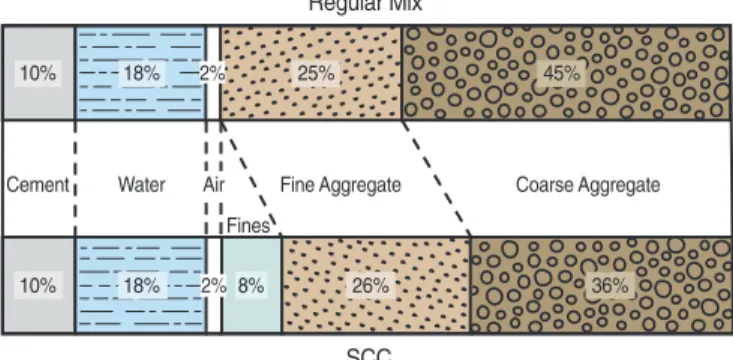
Self-compacting concrete (SCC), also referred to as self-consolidating concrete, is able to flow and consolidate under its own weight. At the same time it is cohesive enough to fill spaces of almost any size and shape without segregation or bleeding. This makes SCC particularly useful wherever placing is difficult, such as in heavily-reinforced concrete members or in complicated formwork. This technology, developed in Japan in the 1980s, is based on increasing the amount of fine material, for example fly ash or limestone filler, without changing the water content compared to common concrete. This changes the rheological behavior of the concrete. SCC has to have a low yield value to ensure high flowability; a low water content ensures high viscosity, so the coarse aggre-gate can float in the mortar without segregating. To achieve a balance between deformability and stability, the total content of particles finer than the 150 µm (No. 100) sieve has to be high, usually about 520 to 560 kg/m3(880 to 950 lb/yd3). High-range water reducers based on polycarboxy-late ethers are typically used to plasticize the mixture. SCC is very sensitive to fluctuation in water content; therefore, stabilizers such as polysaccarides are used. Fig. 17-6 shows an example of mix proportions used in self-compacting concrete as compared to a regular concrete mix.
In Japan, self-compacting concretes are divided into three different types according to the composition of the mortar:
• Powder type
• Viscosity agent (stabilizer) type • Combination type
For the powder type, a high proportion of fines produces the necessary mortar volume. In the stabilizer type, the fines content can be in the range admissible for vibrated concrete. The viscosity required to inhibit segregation will then be adjusted by using a stabilizer. The combination type is created by adding a small amount of stabilizer to the powder type to balance the moisture fluctuations in the manufacturing process.
Since SCC is characterized by special fresh concrete properties, many new tests have been developed to measure flowability, viscosity, blocking tendency, self-lev-eling, and stability of the mixture (Skarendahl and Peterson 1999 and Ludwig and others 2001). A simple test to measure the stable and unblocked flow is the J-Ring test, which is a modified slump test. The J-Ring—300 mm (12 in.) diameter with circular rods—is added to the slump test (Fig. 17-7). The number of rods has to be adjusted depending on the maximum size aggregate in the SCC mix. The SCC has to pass through the obstacles in the J-Ring without separation of paste and coarse aggregates. The slump diameter of a well-proportioned SCC is approximately the same with and without the J-Ring; it is usually about 750 mm (30 in.). Therefore, the test surface has to be at least 1000 mm (40 in.) in diameter.
Strength and durability of well-designed SCC are almost similar to conventional concrete. Without proper curing, SCC tends to have higher plastic shrinkage
Regular Mix
SCC
Cement Water Air Fine Aggregate Coarse Aggregate
10% 18% 2% 25% 45%
10% 18% 2% 8% 26% 36%
Fines
Fig. 17-6. Examples of materials used in regular concrete and self-compacting concrete by absolute volume.
300 mm (12 in.) 18 mm (0.7 in.)
severe structural service. Table 17-6 compares hardened concrete properties of RPC with those of an 80-MPa (11,600-psi) concrete.
RPC has found some applications in pedestrian bridges (Fig. 17-9) (Bickley and Mitchell 2001 and Semioli 2001). Also, the low porosity of RPC gives excellent dura-bility and transport properties, which makes it a suitable material for the storage of nuclear waste (Matte and Moranville 1999). A low-heat type of reactive-powder concrete has been developed to meet needs for mass con-crete pours for nuclear reactor foundation mats and underground containment of nuclear wastes (Gray and Shelton 1998).
cracking than conventional concrete (Grube and Rickert 2001). Research indicates greater tensile creep for SCC, resulting in a reduced tendency to crack (Bickley and Mitchell 2001). The use of fly ash as a filler seems to be advantageous compared to limestone filler; it results in higher strength and higher chloride resistance (Bouzoubaa and Lachemi 2001 and Ludwig and others 2001).
The production of SCC is more expensive than reg-ular concrete and it is difficult to keep SCC in the desired consistency over a long period of time. However, con-struction time is shorter and production of SCC is envi-ronmentally friendly (no noise, no vibration). Furthermore, SCC produces a good surface finish. These advantages make SCC particularly interesting for use in precasting plants. SCC has been successfully used in a number of rehabilitation projects in Canada (Bickley and Mitchell 2001).
REACTIVE-POWDER CONCRETE
Reactive-powder concrete (RPC) was first patented by a French construction company in 1994. It is characterized by high strength and very low porosity, which is obtained by optimized particle packing and low water content.
The properties of RPC are achieved by: (1) eliminating the coarse aggregates; just very fine powders are used such as sand, crushed quartz, and silica fume, all with par-ticle sizes between 0.02 and 300 µm; (2) optimizing the grain size distribution to densify the mixture; (3) post-set heat-treatment to improve the microstructure; (4) addition of steel and synthetic fibers (about 2% by volume); and (5) use of superplasticizers to decrease the water to cement ratio—usually to less than 0.2—while improving the rhe-ology of the paste. See Fig. 17-8 for a typical fresh RPC.
The compressive strength of reactive-powder con-crete is typically around 200 MPa (29,000 psi), but can be produced with compressive strengths up to 810 MPa (118,000 psi) (Semioli 2001). However, the low compara-tive tensile strength requires prestressing reinforcement in
Fig. 17-8. Freshly-mixed reactive-powder concrete.
Table 17-6. Typical Mechanical Properties of Reactive Powder Concrete (RPC) Compared to an 80-MPa Concrete (Perry 1998)
Property Unit 80 MPa RPC
Compressive strength MPa (psi) 80 (11,600) 200 (29,000) Flexural strength MPa (psi) 7 (1000) 40 (5800)
Tensile strength MPa (psi) 8 (1160)
Modulus of Elasticity GPa (psi) 40 (5.8 x 10⁶) 60 (8.7 x 10⁶)
Fracture Toughness 103J/m2 <1 30
Freeze-thaw, ASTM C 666 RDF 90 100
Carbonation depth: 36 days in CO2 mm 2 0
REFERENCES
ACI Committee 211, Guide for Selecting Proportions for High-Strength Concrete with Portland Cement and Fly Ash,ACI 211.4-93, reapproved 1998, American Concrete Institute, Farm-ington Hills, Michigan, 1998, 13 pages.
ACI Committee 363, Guide to Quality Control and Testing of High-Strength Concrete, 363.2R-98, American Concrete Institute, Farmington Hills, Michigan, 1998, 18 pages. ACI Committee 363, State-of-the-Art Report on High-Strength Concrete, 363R-92, reapproved 1997, American Concrete Institute, Farmington Hills, Michigan, 1997, 55 pages. ACPA, Fast-Track Concrete Pavements,TB004, American Con-crete Pavement Association, Skokie, Illinois, 1994, 32 pages. A¨ı tcin, P.-C., High-Performance Concrete, Modern Concrete Technology 5, E & FN Spon, London, 1998, 591 pages. A¨ı tcin, P.-C. and Richard, P., “The Pedestrian/Bikeway Bridge of Sherbrooke,” Proceedings of the 4th International Symposium on Utilization of High-Strength/High-Performance Concrete,Paris, 1996, pages 1399 to 1406.
ASCE, High-Performance Construction Materials and Systems,
Technical Report 93-5011, American Society of Civil Engineers, New York, April 1993.
Baalbaki, W.; Benmokrane, B.; Chaallal, O.; and Aítcin, P. C., “Influence of Coarse Aggregate on Elastic Properties of High-Performance Concrete,” ACI Materials Journal, American Concrete Institute, Farmington Hills, Michigan, September/ October 1991, page 499.
Bentz, Dale, CIKS for High Performance Concrete, http://ciks.cbt.nist.gov/bentz/welcome.html, National In- stitute of Standards and Technology, Gaithersburg, Mary-land, 2001.
Bentz, Dale, Concrete Optimization Software Tool, http://ciks.cbt.nist.gov/bentz/welcome.html, National In- stitute of Standards and Technology, Gaithersburg, Mary-land, 2001.
Berra, M.; Ferrara, G.; and Tavano, S., “Behaviour of high-erosion resistant silica fume: mortars for repair of hy-draulic structures,” Fly ash, silica fume, slag and natural
pozzolans in concrete: Proceedings, Third International Conference,Trondheim, Norway, (SP-114), vol. 2, American Concrete Institute, Farmington Hills, Michigan, 1989, pages 827 to 847.
Bickley, John A., and Fung, Rico, Optimizing the Economics of High-Performance Concrete,A Concrete Canada and Canadian Cement Industry Joint Research Project, Cement Association of Canada, Ottawa, Ontario, 2001, 21 pages.
Bickley, John A., and Mitchell, Denis, A State-of-the-Art Review of High Performance Concrete Structures Built in Canada: 1990— 2000,Cement Association of Canada, Ottawa, Ontario, May 2001, 122 pages.
Bickley, J. A.; Ryell, J.; Rogers, C.; and Hooton, R. D., “Some Characteristics of High-Strength Structural Concrete: Part 2,”
Canadian Journal for Civil Engineering, National Research Council of Canada, December 1994.
Bickley, J. A., Prequalification Requirements for the Supply and Testing of Very High Strength Concrete,Concrete Inter-national, American Concrete Institute, Farmington Hills, Michigan, February 1993, pages 62 to 64.
Bickley, J. A.; Sarkar, S.; and Langlois, M., The CN Tower,
Concrete International, American Concrete Institute, Farm-ington Hills, Michigan, August 1992, pages 51 to 55.
Bonneau, O.; Poulin, C.; Dugat, J.; Richard, P.; and Aitcin, P.-C., “Reactive Powder Concrete: From Theory to Practice,”
Concrete International, American Concrete Institute, Farmington Hills, Michigan, April 1996, pages 47 to 49. Bouzoubaa, N., and Lachemi, M., “Self-compacting concrete incorporating high volumes of class F fly ash. Preliminary results,” Vol. 31, Cement and Concrete Research, Pergamon-Elsevier Science, Oxford, 2001, pages 413 to 420.
Burg, R. G., and Fiorato, A. E., High-Strength Concrete in Mas-sive Foundation Elements,Research and Development Bulletin
RD117, Portland Cement Association, 1999, 28 pages. Burg, R. G., and Ost, B. W., Engineering Properties of Commer-cially Available High-Strength Concretes (Including Three-Year Data), Research and Development Bulletin RD104, Portland Cement Association, 1994, 62 pages.
Dunaszegi, Laszlo, “HPC for Durability of the Confederation Bridge,” HPC Bridge Views,Federal Highway Administration and National Concrete Bridge Council, Portland Cement Association, September/October 1999, page 2.
Farny, James A., and Panarese, William C., High-Strength Con-crete, EB114, Portland Cement Association, 1994, 60 pages. Ferraris, Chiara F., and Lobo, Colin L., “Processing of HPC,”
Concrete International,American Concrete Institute, Farming-ton Hills, Michigan, April 1998, pages 61 to 64.
Gagne, R.; Chagnon, D.; and Parizeau, R., “L’Utilization du Beton a Haute Performance dans l’Industrie Agricole,”
Proceedings of Seminar at Concrete Canada Annual Meeting,
Sherbrooke, Quebec, October 1994, pages 23 to 33.
Gagne, R.; Pigeon, M.; and Aítcin, P. C., “Durabilite au gel des betons de hautes performance mecaniques,” Materials and Structures,Vol. 23, 1990, pages 103 to 109.
Fig. 17-9. The Sherbrooke footbridge in Quebec, built in 1997, is North America’s first reactive-powder concrete structure. (68300)
NIST, Partnership for High Performance Concrete Technology, http://ciks.cbt.nist.gov/phpct, National Institute of Standards and Technology, Gaithersburg, Maryland, 2001. Okamura, H., and Ozawa, K., “Mix Design for Self-Compacting Concrete,” Concrete Library of JSCE No. 25,
(Translation of Proceedings of JSCE, No. 496/V-24, 1994.8), Tokyo, June 1995, pages 107 to 120.
Okamura, H.; Ozawa, K.; and Ouchi, M., “Self-Compacting Concrete,” Structural Concrete 1,2000, pages 3 to 17.
Perenchio, W. F., An Evaluation of Some of the Factors Involved in Producing Very-High-Strength Concrete, Research and Development Bulletin RD014, Portland Cement Association,
http://www.portcement.org/pdf_files/RD014.pdf, 1973. Perenchio, William F., and Klieger, Paul, Some Physical Prop-erties of High-Strength Concrete,Research and Development Bulletin RD056, Portland Cement Association, http://www. portcement.org/pdf_files/RD056.pdf, 1978.
Perry, V., “Industrialization of Ultra-High Performance Ductile Concrete,” Symposium on High-Strength/High-Perform-ance Concrete,University of Calgary, Alberta, November 1998. Pinto, Roberto C. A., and Hover, Kenneth C., Frost and Scaling Resistance of High-Strength Concrete, Research and Devel-opment Bulletin RD122, Portland Cement Association, 2001, 75 pages.
Pyle, Tom, Caltrans, Personal communication on early strength concretes used in California, 2001.
Russell, Henry G., “ACI Defines High-Performance Con-crete,” Concrete International, American Concrete Institute, Farmington Hills, Michigan, February 1999, pages 56 to 57. Ryell, J., and Bickley, J. A., “Scotia Plaza: High Strength Concrete for Tall Buildings,” Proceedings International Con-ference on Utilization of High Strength Concrete, Stavanger, Norway, June 1987, pages 641 to 654.
Saak, Aaron W.; Jennings, Hamlin M.; and Shah, Surendra P., “New Methodology for Designing Self-Compacting Concrete,” ACI Materials Journal,American Concrete Insti-tute, Farmington Hills, Michigan, November-December 2001, pages 429 to 439.
Semioli, William J., “The New Concrete Technology,”
Concrete International, American Concrete Institute, Farm-ington Hills, Michigan, November 2001, pages 75 to 79. Skarendahl, Å., and Peterson, Ö., Self-compacting concrete — Proceedings of the first international RILEM-Symposium, Stock-holm, 1999, 786 pages.
Tachitana, D.; Imai, M.; Yamazaki, N.; Kawai, T.; and Inada, Y., “High Strength Concrete Incorporating Several Admixtures,” Proceedings of the Second International Sympo-sium on High Strength Concrete,SP-121, American Concrete In-stitute, Farmington Hills, Michigan, 1990, pages 309 to 330. Wood, J. G. M.; Wilson, J. R.; and Leek, D. S., “Improved Testing of Chloride Ingress Resistance of Concretes and Rela-tion of Results to Calculated Behaviour,” Proceedings of the Third International Conference on Deterioration and Repair of Reinforced Concrete in the Arabian Gulf, Bahrain Society of Engineers and CIRIA, 1989.
Goodspeed, Charles H.; Vanikar, Suneel; and Cook, Raymond A., “High-Performance Concrete Defined for Highway Structures,” Concrete International, American Concrete Institute, Farmington Hills, Michigan, February 1996, pages 62 to 67.
Gray, M. N., and Shelton, B. S., “Design and Development of Low-Heat, High-Performance Reactive Powder Concrete,”
Proceedings, International Symposium on High-Performance and Reactive Powder Concretes,Sherbrooke, Quebec, August 1998, pages 203 to 230.
Grove, James D., “Blanket Curing to Promote Early Strength Concrete,” Concrete and Construction—New Developments and Management, Transportation Research Record, 1234, Transportation Research Board, Washington, D.C., 1989. Grube, Horst, and Rickert, Joerg, “Self compacting con-crete—another stage in the development of the 5-component system of concrete,” Betontechnische Berichte (Concrete Technology Reports), Verein Deutscher Zementwerke, Düsseldorf, 2001, pages 39 to 48.
Helland, S., “High Strength Concrete Used in Highway Pavements,” Proceedings of the Second International Symposium on High Strength Concrete, SP-121, American Concrete Institute, Farmington Hills, Michigan, 1990, pages 757 to 766. Holland, T. C.; Krysa, Anton; Luther, Mark D.; and Liu, Tony C., “Use of Silica-Fume Concrete to Repair Abrasion-Erosion Damage in the Kinzua Dam Stilling Basin,” Proceedings of the Second International Conference on Fly Ash, Silica Fume, Slag and Natural Pozzolans in Concrete, SP-91, American Concrete Institute, Farmington Hills, Michigan, 1986, pages 841 to 864. Khayat, K. H.; Bickley, J. A.; and Lessard, M., “Performance of Self-Consolidating Concrete for Casting Basement and Foundation Walls,” ACI Materials Journal,American Concrete Institute, Farmington Hills, Michigan, May-June 2000, pages 374 to 380.
Knutson, Martin, and Riley, Randall, “Fast-Track Concrete Paving Opens Door to Industry Future,” Concrete Construc-tion,Addison, Illinois, January 1987, pages 4 to 13.
Ludwig, Horst-Michael; Weise, Frank; Hemrich, Wolfgang; and Ehrlich, Norbert, “Self compacting concrete—principles and practice,” Betonwerk- und Fertigteil-Technik (Concrete Plant+Precast Technology), Wiesbaden, Germany, June 2001, pages 58 to 67.
Matte, V., and Moranville, M., ”Durability of Reactive Powder Composites: influence of silica fume on leaching properties of very low water/binder pastes,” Cement and Concrete Composites 21,1999, pages 1 to 9.
McCullough, B. Frank, and Rasmussen, Robert Otto, Fast-Track Paving: Concrete Temperature Control and Traffic Opening Criteria for Bonded Concrete Overlays, FHWA RD 98-167, Federal Highway Administration, Washington, D.C., October 1999, 205 pages.
Meschino, M., and Ryell, J., “Bottom-Up Construction of 31 Meter High Reinforced Concrete-Filled Steel Columns for the Greater Toronto Airports Authority New Terminal Building,” pre-sented at the ACI Convention, Toronto, October 2000. Nawy, Edward G., Fundamentals of High-Performance Concrete,
John Wiley and Sons, New York, 2001.
NIST, Bridge LCC, http://www.bfrl.nist.gov/bridgelcc, National Institute of Standards and Technology, 2001.