Applying
AI to Manufacturing:
Linear
Order Promising
and
Production
Planning
Yury Smirnov
Calico Commerce 333 West San Carlos st.San Jose, CA 95110 [email protected]
Abstract
Many vertical industries within Manufacturing have already entered or are about to enter a new era of mass-customization. Customers expect improved level of service, precise price and date quotes for their per-sonalized orders. Internet communications in gen-eral and dedicated e-commerce efforts in particular greatly facilitated the process of taking orders and shipping the requested products to anticipating cus-tomers. However, precise, scalable and effective Order Promising and Production Planning still constitute se-rious challenges for manufacturers.
Specialists in Manufacturing Modeling have already identified the deficiencies of the existing approaches that traditionally split production models into Bills of Materials (BOMs) and Routings (Goldratt 1990). Whereas Artificial Intelligence (AI) understood long ago the benefit of merging states and actions in a com-bined planning model, an alternative, constructive so-lution to the BOM/Routing modeling approach has not been explicitly proposed.
Re-configurable products may lead to an exponential explosion of the number of BOMs, if the standard modeling approach of listing all orderable products is followed. Another complication may come from the existence of alternative routings, which are different production processes (actions) that produce the same inventory items (lead to the same states). A selection of a different route may imply substituting already se-lected group of inventory items by a different group of items, for example, changing a monitor type for PC may require a different video card, which in its turn may need an upgrade of the power supply module. The above feature is called "kitting" in Manufactur-ing ModelManufactur-ing.
On one hand, a complicated nature of Manufacturing Modeling and a need to capture the AND/OR-logic in presenting inventory items and alternative routings makes it hard to efficiently derive precise price and date quote (Order Promising) and to construct the entire schedule (Production Planning). On the other hand, customers’ expectations and a broad spectrum of orderable products state an urgent need for scalable Order Promising and Production Planning functional-ities.
In this paper we introduce novel modeling approach
that applies some AI modeling techniques to Manu-facturing Modeling, allows to avoid the exponential blow-up for re-configurable products and captures the AND/OR-logic without additional modeling efforts. Furthermore, we state a simple, realistic resource shar-ing assumption. For the introduced type of mod-els, we construct Order Promising and resource al-location (scheduling) procedures that are linear under the stated assumption for any homogeneous objective function.
Introduction
Modern World has emerged a new era of mass cus-tomization. This trend is changing the way customers are making purchases, it also has a strong impact on how products are made. Known as on-demand manu-facturing, it spans already a diverse set of manufactur-ing areas from luxury cars, to computers, books and toys just to name few. Actually, the greatest stories of recent success are directly associated with the abil-ity of the vendor to satisfy customers on an individual basis without jeopardizing prices and delivery terms.
Traditional, make-to-stock manufacturing world is undergoing a significant transformation too. In re-cent years, an increased competition, changing eco-nomic environment, and new government regulations
have conspired to put pressure on process plant mar-gins. Computer components, for example, decline in value at a rate of about one percent a week. In such an intensive environment, the key test for the system is to ensure that the right products are delivered to the right place at the right time. This test determines the whole suite of requirements for planning, scheduling and execution systems that constitute the back-end of a customer-oriented manufacturer.
E-commerce came as a tool that facilitates accepting orders, captures the logic of customer/vendor commu-nication and tracks shipments. The vast majority of e-commerce efforts are intended for production-free busi-nesses. There are several serious issues of production-based e-commerce that have not been fully addressed. In this paper we attempt to identify those and resolve them effectively under realistic assumptions.
There seems to exist a shift of interest within the order entry process for customizable products. As
long as the complexity of the product is below a cer-tain, "Common Sense" level, customers are mostly in-terested in the availability of the product. However, as soon as the configuration process becomes compli-cated, non-intuitive, then customers are primarily in-terested in the correctness of their choices, in the com-patibility of the selections. Over time, the "Common Sense" level of the configuration complexity tends to grow along with the educational level of users. E-commerce provides a great hosting environment that promotes such type of education.
This paper introduces a set of order promising and production planning problems arising due to mass-customization and, hence, augmented by the popular-ity of e-commerce. Besides the problem introduction, we describe another way of modeling manufacturing environemnts in the AI style. We also show that un-der a simplifying assumption for such models one can build extremely efficient order promising, planning and scheduling algorithms.
Manufacturing Planning Problems Current state of manufacturing modeling is several dozen years old. Earlier Material Requirement Plan-ning (MRP) systems had to find a compromise between the modeling expressiveness, computational power and slow access to peripheral devices, such as tape-based memory systems. Although MRP itself was viewed as a "Copernican Revolution" (Vollmann, Berry, Whybark 1992), it has been identified that the cur-rent "state-of-the-art" manufacturing modeling used in plain MRP and its successor Manufacturing Resource Planning (MRP II) do not support anymore the grow-ing need in providgrow-ing efficient grounds for the enter-prise level of integration. One of the main question to be answered with respect to the modern state of com-puter equipment is as follows: "Why is the product structure’s file segmented into the BOM and Routing files?" (Goldratt 1990).
The inertia of the field keeps the above splitting principle untouched for old projects, as well for newly launched ones, thus adding even more to the inertia’s spinning momentum. However, it is becoming more and more obvious that such a modeling approach has certain limits, in particular when applied to a highly customized product line. For example, a PC with
15 types of hard drives, 10 types of RAM, 5 types of video cards, 5 types of modems, 5 types of I/O Buses, 10 types of monitors, etc. would require at least
15,10 ¯ 5 * 5 * 5 * 10 = 187,500 different Bills of Ma-terials (BOMs). Dealing with dozens and hundreds thousands of BOMs is a regular situation in on-demand manufacturing.
However, the traditional manufacturing modeling approach requires all BOMs for orderable products to be listed explicitly. This tough requirement leads to an exponential blow-up of the representation of the model, which significantly slows down search and
op-timization, thus, making an efficient production-based e-commerce an almost impossible problem.
On the other hand, Artificial Intelligence (AI) has evolved as a mature discipline, capable of solving a variety of realistically sized planning and scheduling problems. AI planning systems have gained a definite advantage in computationally intensive problem do-mains. Whereas previous successful implementations of MRP systems were relying primarily on Operations Research (OR) tools, for example Linear Program-ming, there are more and more successful examples of AI-based solutions (Ilog, i2, etc.). AI has accumu-lated enough knowledge to be applied across different engineering areas in a non-traditional manner. Manu-facturing modeling, planning and scheduling definitely provide a rich and responsive testing field for innova-tive AI technologies.
E.Goldradt identified the current manufacturing modeling system as obsolete (Goldratt 1990), even when one considers traditional manufacturing plan-ning driven by forecasts and actual sales orders. The requirement of reactive, on-demand architecture com-pletely rejects existing approaches. Thus, a latest shift from selling a standard suite of products, from a make-to-stock production to mass customization has added new tough requirements on order processing and quot-ing, on production planning and demand planning.
In this paper we apply a cross-fertilization approach (Smirnov 1997) between AI and manufacturing plan-ning. To be precise, we apply STRIPS-like AI mod-eling techniques (Filkes & Nilsson 1971) to combine BOMs and Routings in a single model. This novel manufacturing modeling approach allows to avoid the exponential blow-up for re-configurable products and captures the AND/OR inventory item logic without additional modeling efforts. Furthermore, for the in-troduced type of models, we construct order promising and resource allocation (scheduling) procedures that are linear under a simple, realistic assumption for any homogeneous objective function.
Manufacturing Modeling in the AI Style
AI and manufacturing modeling have a lot of common features. Nonetheless, the latter one still prefers to separate its key modeling items - Bills of Materials
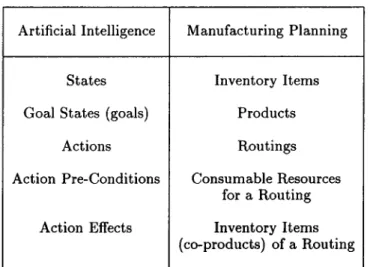
(BOMs) and Routings. BOM is a hierarchical collec-tion of inventory items that show all sub-assemblies and raw materials. BOM corresponds to a set of states in AI planning, with manufacturing products being equivalent to goal states in AI, and quantities-on-hand (QOH) - to an initial state. Table 1 presents a short glossary of differences in AI and manufacturing plan-ning terminology.
One of the main drawbacks of BOM/Routings sep-aration is the unnecessary complexity that a modeler has to introduce to maintain inventory items and rout-ing options separately. As we showed in an
exam-Artificial Intelligence Manufacturing Planning
States Inventory Items
Goal States (goals) Products
Actions Routings
Action Pre-Conditions Consumable Resources for a Routing Action Effects Inventory Items
(co-products) of a Routing
Table 1: A Comparison of Key Planning Terms.
ple in Section 1, the number of BOMs that an on-demand manufacturer needs to maintain, grows expo-nentially on the size of the input. Furthermore, an additional modeling effort is needed to properly rep-resent the logic of alternative Routings and kitting. Some of the inventory items may be built in several al-ternative way, purchased or transferred from another site. Certain groups of inventory items may form al-ternative kits that can be substituted only as groups of items. For example, a high-resolution monitor requires a more powerful video card, selection of an IBM’s In/o-Print as a faster device for printing the body of a book requires to apply IBM RIPing procedure to convert the Postscript format into an InfoPrint-readable format.
With BOMs on the scale of millions and special grouping (kitting) requirements, manufacturing plan-ning becomes a very inefficient procedure with expo-nential complexity, when modeled through separate BOMs and Routings. Thus, planning is not the only one to blame, the modeling phase itself transforms in-put data into BOMs and Routings, number of which may become exponential on the size of the input. Thus, the inefficiency of traditional manufacturing modeling and planning has become an important issue in the En-terprise Management, which has been identified in the literature on manufactUring planning (Goldratt 1990). On the other hand, AI planning has realized long ago that for certain problem types, it is beneficial to com-bine states and actions in a single model, thus, prevent-ing the exponential blow-up of the size of the problem domain. We identified that a well-known STRIPS-like modeling approach (Filkes & Nilsson 1971) provides the best fit for manufacturing purposes. Figure 1 shows an example of a Commercial Print Center model that specializes in printing books. States and actions form a directed graph, in which states alternate with ac-tions along any directed path from a book request to a finished product. To proceed with the analysis of
ben-Figure 1: An Example of a Book Publisher Model.
e/its of the novel manufacturing modeling approach, we need to state an important resource non-sharing assumption.
Resource Non-Sharing Assumption: List of all reusable resources that are applicable to the manufacturing process of any particular product does not have repeated entries.
Note that unlike a common assumption about non-repeated entries of inventory items in each BOM adopted by many planning and scheduling software providers, we relax this requirement and allow inven-tory items to repeat in BOMs as long as they do not induce repeated reusable resources.
Lemma 1 Under the resource non-sharing assump-tion, STRIPS-like model captures the AND/OR logic of alternative routings and kitting with the number of states that is linear on the number of different inven-tory item entries on all BOMs, and the number of actions is less or equal to the number of reusable
re-sources.
Proof: Each routing contains a list of reusable and consumable resources. Since reusable resources are not shared, the number of actions is equal to the
num-ber of routings. If item substitutions are not allowed, then for each routing, consumable resources form the set of required inventory items. Thus, satisfaction of pre-conditions of every action constitute mandatory
("AND") relations. They correspond to di-edges em-anating from inventory items (states). Each inventory item (state) is associated with a list of alternative rout-ings (actions) and carries the functionality of an effect of each such action. Thus, the effects of each action (routing) form a set of alternative ("OR" - one out many) relations.
If item substitution is allowed, then for every al-lowed substitute one introduces an auxiliary state that denotes one of the substitutes and an auxiliary action that selects a particular substitute. Thus, in the case when substitutes are allowed, the introduced modeling approach keeps track of the AND/OR logic without additional modeling efforts. ¯
As Lemma 1 shows, there is no need in listing all BOMs for all possible products. When applied to man-ufacturing planning, STRIPS-like modeling approach allows to represent the logic of manufacturing processes without explicit exploration of all BOMs and, further-more, captures the AND/OR logic of alternative rout-ings and kits without any additional modeling efforts.
Order Promising and Production
Planning
In Section 3 we introduced a novel manufacturing mod-eling approach based on AI modmod-eling techniques. This approach resolves the problem of unnecessary exponen-tial growth of the Bills of Materials and captures the logic of alternative routings without additional model-ing efforts. In this Section we describe on-line, smodel-ingle- single-request order promising and production planning algo-rithms that have linear worst-case complexity. These algorithms utilize the advantages of the newly intro-duced manufacturing modeling style and may be used as the back-end of an e-commerce system tailored to-wards re-configurable products.
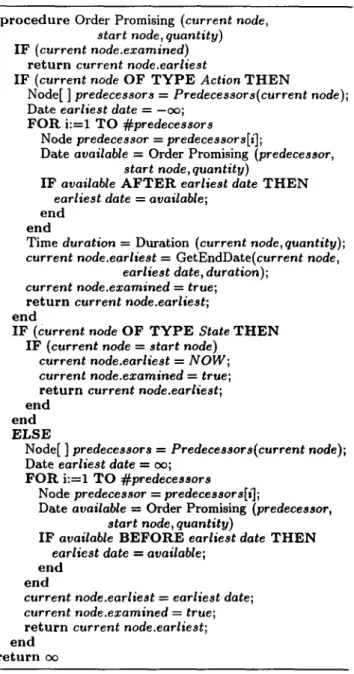
A modification of a simple, recursive order promis-ing algorithm (OPA) is presented in Table 2, it pro-vides an earliest possible date that a considered order can be satisfied. The difference between State and Ac-tion nodes is reflected in the date selecAc-tion mechanism. Since an action requires all pre-conditions to be satis-fied, OPA selects the latest date when all supplies are available. In case of the state node, if there are several alternative actions (alternative routings) that provide the same effect, OPA selects the one that finishes the earliest. GetEndDate method takes into consideration all tasks that are currently assigned to a reusable re-source that corresponds to the current action node and finds the earliest possible time that a pending produc-tion task can be executed.
In the original form, OPA has an exponential worst-case complexity, because the same state and action nodes of the directed graph can be investigated repeat-edly. However, this algorithm can be modified to avoid exponential complexity. If one introduces a flag that a node has been investigated, clears it before executing
OPA and memorizes the earliest date that an action can be finished or a state can be reached, then re-peated recursive requests will not proceed if the flag is already set. If a node has been investigated, the ear-liest execution date can be obtained from the earear-liest date member of the node object.
procedure Order Promising (current node, start node, quantity) IF (current node.examined)
return current node.earliest
IF (current node OF TYPE Action THEN
Node[
] predecessors
= Predecessors(current
node);
Date earliest date = -co; FOR i:=l TO #predecessors
Node predecessor = predecessors[i];
Date available = Order Promising (predecessor,
start node, quantity)
IF available AFTER earliest date THEN earliest date = available;
end end
Time duration = Duration (current node,quantity); current node.earliest = GetEndDate(current node,
earliest date, duration); current node.examined = true;
return current node.earliest; end
IF (current node OF TYPE State THEN IF (current node = start node)
current node.earliest = NOW; current node.examined = true; return current node.earliest; end
end
ELSE
Node[ ] predecessors = Predecessors(current node); Date earliest date = co;
FOR i:=l TO #predecessors
Node predecessor = predecessors[i/;
Date available = Order Promising (predecessor,
start node, quantity)
IF available BEFORE earliest date THEN earliest date = available;
end end
current node.earliest = earliest date; current node.examined = true;
return current node.earliest; end
return c~
Table 2: The Single-Request Modified Order Promis-ing Procedure.
Theorem 1 Under the resource non-sharing assump-tion, a modified Order Promising algorithm (MOPA) is linear on the number of states and actions.
Proof: After an edge is traversed for the first time,
both of its end nodes have "examined" flags set to true. This memorization "trick" prevents repeated
ex-ploration of edges. Hence, a modified Order Promising algorithm is linear on the number of edges. If the num-ber of edges is asymptotically less that the numnum-ber of nodes, then the entry point is disconnected from the end point and MOPA will figure out that the earliest date is infinite after examining a connected subset of nodes. ¯
MOPA outputs only the earliest date, when a cur-rent pending request can be satisfied. To perform a complete resource allocation with the earliest start and end dates assigned to tasks according to the best choices of alternative actions, one needs to add another selection flag, memorize the best (chosen) predecessors and perform one more sweep along the model to prop-agate the selection of best predecessors and assign the dates. This addition converts MOPA into a production planning (scheduling) algorithm- PPA.
Theorem 2 Under the resource non-sharing assump-tion, PPA is linear on the number of states and ac-tions.
In this section we discussed order promising and pro-duction planning approaches that find the earliest pos-sible date that a Sales Order (SO) can be furnished. The same approach remains true for many other ob-jective functions besides the earliest availability: Min-imal cost, maxMin-imal price, maximal profit, etc. We call those objective functions homogeneous. Unfortu-nately, a mixture of time and price/cost objectives or constraints may lead to an NP-hard class of problem.
Conclusions
We showed that the tradition of separating BOMs and Routings does not always lead to more expressive or compact manufacturing modeling. As the result, order promising and production planning approaches often have to deal with the exponential blow-up of the num-ber of Bills of Materials for re-configurable products. This is an especially hot issue for mass-customization production promoted through e-commerce applica-tions.
If AI modeling techniques are applied to model man-ufacturing processes, one can often avoid exponential exploration of BOMs and construct extremely efficient on-line order promising and production planning algo-rithms.
Novel manufacturing modeling approach, order promising and production planning algorithms based on this modeling technique has been filed in 1998 by the author of this paper to the US Beaurau of Patents.
References
Filkes, R., and Nilsson, N. 1971. Strips: a new ap-proach to the application of theorem proving to prob-lem solving. Artificial Intelligence 2(3-4).
Goldratt, E. 1990. The Haystack Syndrome. North River Press.
Smirnov, Y.V. 1997. PhD Thesis. Hybrid Algorithms for On-Line Seach and Combinatorial Optimization. Technical Report CMU-CS-97-171; School of Com-puter Science, Carnegie Mellon University; 131 pages. Vollmann, T.; Berry, W.; and Whybark, D. 1992. Manufacturing Planning and Control Systems. IR-WIN.