Accounting Instructors’ Report
A Journal for Accounting Educators
Winter 2012 AIR Newsletter TRENDS
Principles Versus Rules in Beginning Accounting: Understanding the Lehman Case Belverd E. Needles, Jr., Ph.D., CPA
ARTICLES
How to Develop an Inexpensive Online Course Dileep Dhavale
Clark University
Debtor Accounting for Troubled Debt Restructuring: A Classroom Example to Teach Theory vs. Practice Timothy Forsyth
Appalachian State University Philip Witmer
Appalachian State University TEACHING CASES
K&J Bakery Inc. A Simplified Management Accounting Course Raymond Elson
Valdosta State University Stephen M. Rice
Valdosta State University Tracey McGregor
Valdosta State University TEACHING TECHNIQUES
Presentations with Maximum Impact: Moving Faculty Forward Christina Ritsema
Montfort College of Business Tracy Manly*
University of Tulsa
Simultaneous Presentation of Debit/Credit Entries and Plus/Minus Transaction Worksheet – An Aid to Student Understanding Robert Derstine Kutztown University James Emig* Villanova University Thomas Grant Kutztown University *Corresponding author
TRENDS
PRINCIPLES VERSUS RULES IN BEGINNING ACCOUNTING:
UNDERSTANDING THE LEHMAN CASE1
Belverd E. Needles, Jr., Ph.D., CPA
Monday, September 15, 2008 followed, “One of the most tumultuous weekends in Wall Street’s history. . . There would be no bailout of Lehman Brothers Holdings Inc.”2 Lehman’s bankruptcy led to one of the largest runs of the Federal Reserve and U.S. banking system in history as it was followed almost immediately by federal bailouts of Goldman Sachs, Bank of America, Bear Sterns, Morgan Stanley, Citigroup, and Merrill Lynch. Lehman agreed to pay three of its departed executives more than $23 million. Chief Executive Richard Fuld was called before a congressional committee under accusations of deceiving investors about the financial health of Lehman. He was asked “about the juxtaposition of upbeat public comments he and other Lehman executives made about the firm and the dire internal review of Lehman’s growing problems.”3 Mr. Fuld denied misleading investors said that Lehman was brought down by outside forces including short sellers.4 By December 2010, with more $1.2 billion in fees already paid out to more than 40 firms of consultants, attorneys, accountants, restructuring firms and others to unwind the securities firm’s operations and derivatives contracts, there were more then $39 trillion in derivatives from 891,752 trades still needing to be unwound.5
1 This Trends is based on a longer study made by the author during his year (2010-2011) as the Wicklander Fellow in Business Ethics at DePaul University.
2 Solomon, D., Berman, D. K., Craig, S., & Mollenkamp, C. (2008, September 15). “Ultimatum By Paulson Sparked Frantic End.” The Wall Street Journal, A1.
3 Craig, S. (2008, October 7). “Lawmakers Lay Into Lehman CEO,” The Wall Street Journal, A3.
4 Ibid.
2
Lehman is only one of a number of high-profile cases that have highlighted the role of financial reporting and the issues surrounding earnings management in recent years. The flood of these so-called ‘accounting scandals’ and the alarming increase in accounting revisions and restatements has drawn the attention around the globe by accounting
researchers and the popular press alike. The principles-based versus rules-based standards debate is discussed and illustrated with the case of Lehman’s accounting for Repo 105 transactions, which clearly highlights the issues that this debate raises.
The Principles versus Rules debate. It is often asserted that U.S. GAAP is more rules-based than principles-rules-based.6
A precise definition of this distinction is elusive, but it generally means that U.S. GAAP relies more on “bright-line” demarcations of alternative accounting treatments than on judgment in the application of the conceptual framework.7
For instance, equity accounting is used for long-term investments less than 50 percent ownership and consolidation accounting is used for those with over 50 percent
ownership. Under principles-based standards, it is asserted that substance should rule over form and that judgment should be used to determine whether, for instance equity or consolidation accounting, should be used when the investment hovers around 50 percent. The movement to principles-based standards was given a lift by the Securities and Exchange Commission (SEC) when after Sarbanes-Oxley it endorsed principles-based standards in 2003 as providing “more transparent information about a company’s financial results and position. . . “and recommending that new standards “avoid use of
6 Excellent discussion of the merits of principles-based and rules-based standards may be
found in Nelson, Mark W. (2003, March). “Behavioral Evidence on the Effects of Principles- and Rules-Based Standards,” Accounting Horizons 17 (1): 91-104; Maines, L., Bartov, E., Fairfield, P., Hirst, E., Iannaconi, T., Mallett, R., Schrand, C., Skinner, D., & Vincent, L. (2003). “Evaluating Concepts-Based vs. Rules-Based Approaches to Standard Setting,” Accounting Horizons 17 (1): 73-89.; and Schipper, Katherine. (2003, March). “Principles-Based Accounting Standards,” Accounting Horizons 17 (1): 61-72.
7 Rebecca Toppe Shortridge and Mark Myring. (2004, August). “Defining
percentage tests--so-called bright lines—that allow financial engineers to achieve technical compliance with the standard while evading its intent.”8
It is thought that rules-based standards are more easily defended in the litigious U.S. economy. Donelson, McInnis, and Mergenthaler studied firms that restated their
financial statements. Some of these firms were sued, and some could have been credibly sued, but were not. They found that “firms are less likely to be sued when they violate standards that are more based, consistent with the view that the complexity of rules-based standards provides a credible—innocent misstatement—presumption. This result is not only statistically significant, but is also economically meaningful.”9 The authors showed that a one-unit increase in the RBC measure (i.e., the incremental presence of one of the four characteristics of rules-based standards) is associated with an 11-percentage point decrease in the likelihood of being sued.
On the other hand, they provide evidence of filed lawsuits that potential plaintiffs take into account the rules-based nature of standards violated when deciding whether to file a lawsuit. Given the--innocent misstatement--defense, many rules-based cases likely get screened out at the filing stage, leaving only relatively strong rules-based violation cases being filed. Thus, plaintiffs work to ensure that there is no relation between violations of rules-based standards and lawsuit outcomes once the filing decision is made. These findings suggest violations of rules-based standards are associated with a lower threat of litigation.10
Supporters of a more principles-based approach including SEC Chairman (at the time) William Donaldson argue that this is “an approach to setting accounting standards that should result in investors receiving more transparent information about a company’s
8 S. Taub. (2003, July 29). “SEC Study Endorses Principle-Based Accounting,” CFO.com.
<http://www.cfo.com/article.cfm/3010031/1/c_3043317?f=related&origin=arch...> 9 Donelson, Dain C., McInnis, John M. and Mergenthaler, Richard Dean. (2010,
December 1). “Rules-Based Accounting Standards and Litigation.” McCombs Research Paper Series No. ACC-06-10. Available at SSRN: http://ssrn.com/abstract=1531782
4
financial results and position.” The SEC adds that a principles-based approach “should ultimately result in more meaningful and informative financial reporting to investors and hold management and auditors responsible for ensuring that financial reporting complies with the objectives of the standards.”11 Two recent studies have provided empirical evidence supporting a principles-based approach. Mergenthaler (2009) finds that rules-based situations are associated with larger magnitude of earnings management and that there is a “negative correlation between rules-based characteristics and the probability of being penalized by the SEC.”12
Folsom et. al. (2011) find that “earnings are more
informative, are more persistent, and better predict future cash flows when the firm relies on principles-based standards.”13
The International Accounting Standards Board (IASB) has embraced the principles-based approach by basing its standards on the conceptual framework and by not proving detailed guidance or industry guidance in most cases. Sir David Tweedie, Chair of the IASB, is quoted as responding to a question about Repo 105: “We don’t allow it. That’s why we have principles, not rules, so you can’t do it.”14
The contrast between the FAS standard setting process and that of the IASB can be shown by the fact that there are approximate twenty-five FASB standards with much industry guidance for revenue recognition and only two IFRS with limited guidance for revenue recognition. The convergence project of the FASB and IASB is giving attention to the principle-based approach by focusing first on agreement as to the underlying conceptual framework of the standards.15
11 Taub S. (2003, July 29). “SEC Study Endorses Principle-Based Accounting,” CFO.com.
<http://www.cfo.com/article.cfm/3010031/1/c_3043317?f=related&origin=arch...> 12 Richard Mergenthaler, Jr., “Principles-Based Versus Rules-Based Standards and Earnings Management,” Social Science Research Network, December 26, 2009, 1. 13 David Folsom, Paul Hribar, Rick Mergenthaler, and Kyle Peterson, “Principles-Based Standards and The Informativeness of Earnings, Working Paper, (April, 2011), 2. 14 “Accounting Boards to Work on Repo Transactions,” (2010, April 17).
AccountingToday.com.
15 FASB, IASB. (2010, December 1). “Convergence Priorities on Target for 2011,” Journal of Accountancy. <http://www.journalofaccountancy.com/Web/20103607.htm>
Case study: Here, we will examine the case cited at the beginning of this paper as the key inflection point during the most critical phase of the recent financial crisis: the failure of Lehman Brothers in September 2008. Lehman provides a stark example of how rules-based standards allow financial firms to maneuver their operations to
“optimize” regulatory and accounting treatment. For internationally active firms,
differences between U.S. and foreign tax, accounting, and capital regimes have prompted firms to structure their activities to minimize these constraints. As the SEC has
acknowledged by attempting to regulate so-called “window-dressing” by proposing rules that helped investors identify firms that reduce debt before quarterly reports,16 its
voluntary oversight regime allowed Lehman and other investment banks to operate with too much leverage and risk. Accounting arbitrage has also been widespread. Lehman moved certain assets off-balance sheet through repo transactions executed in its London broker-dealer subsidiary. These transactions were designed to reduce the firm’s reported leverage ratio (debt to equity) at quarter-end.
Standard setters are attempting in different ways to address the issue of Repo-type transactions. The SEC has proposed rules that would require public companies to disclose additional information about their short-term borrowing, regardless of how such arrangements are accounted for.17 Similarly, the IASB amended IFRS 7 by proposing additional discloses if a disproportionate amount of financial-asset transfer transactions are undertaken around the end of the reporting period.18 The FASB, on the other hand, is considering dropping its “bright-line” criterion (the 102 Rule) that enabled Lehman to avoid by using Repo 105 transaction.19 It has also improved the criteria for effective control by eliminating consideration of the transferor’s ability to fulfill its contractual rights and obligations.20
16 Kara Scannell and Michael Rapoport. (2010, September 18-19). “United SEC Votes to
Propose Pulling Back Drapes on Debt,” The Wall Street Journal.
17 Securities and Exchange Commission. (2010, September 17). Release No 33-943.
18 International Accounting Standards Board. (2010, October 7). Amendment to IFRS No.
6
In spite of the above, the Lehman case to not as black and white as it might seem on the surface. Lehman did use Repo 105 to improve its leverage ratio (debt to equity) quarter after quarter until it imploded in the second quarter of 2008.21 Also, interestingly it is not strictly “earnings” management but is better called “debt or balance sheet” management. Also, Lehman followed US GAAP under SFAS 140. So, it raises the question of rules versus principles. Under this rule, to qualify for sales treatment, a firm has to show that it no longer controls securities being exchanged in repo transaction. A possible proof of transfer of control is that the securities exchanged are worth more than the cash received. Guidance in accounting standards (rules) suggest that transfers in excess of 102 percent would qualify as transfer of control. Thus, Lehman exchanged securities worth 105 percent of the cash received, which is why they are called Repo 105 transactions.22 Is it enough to follow the rule? Let us examine the difference between the
accounting for a typical repo transaction and the Repo 105 transaction.23 Under a typical Repo, cash is borrowed under a short-term payable as follows:
Cash 100M
Short-term payable 100M
As a consequence, the collateral assets behind the loan stay on Balance sheet with footnote disclosure. Thus, there is no effect on leverage ratio. When the loan is repaid within 30 days with interest, the repayment is recorded thusly:
Short Term Payable 100.0M Interest Expense .2M
Cash 100.2M
21 Lehman also engaged in Repo 108 transactions involving equity securities, which are accounted for similarly.
22 David Reilly. (2010, March 15). “Questions on Ernst Auditing,” The Wall Street Journal.
23 These examples are based on Dutta, S. K., Caplan, D., & Lawson R. (2010, August). “Lehman’s Shell Game,” Strategic Finance, 23-29.
Lehman, however, reconfigured the typical repo transaction into the repo 105 in which the collateral assets (in this case, investment securities) are actually transferred to the creditor with a future option to repurchase, as follows:
Cash 100M
Future Option to repurchase 5M
Investment Securities 105M
In this transaction, no liability is recorded and no gain or loss is recognized. Total assets and liabilities remain unchanged. Thus, Lehman meets the requirements of Para 218 of SFAS 140: A transfer of financial assets in which the transferor surrenders control over those assets is accounted for as a sale--not a loan. Lehman then uses the cash to pay liabilities, as follows:
Short-term Payable 100M Cash 100M
Thus, Lehman’s leverage ratio is improved through a reduction in debt and the company meets regulatory leverage requirements. Within thirty days after the end of the period, Lehman re-borrows the funds and repurchases the collateral assets, as follows:
Cash 100.0M
Short-term Payable 100.0M
Investment Securities 105.0M Interest Expense .2M
Cash 100.2M
Future Option to Repurchase 5.0M
Note that Lehman’s income does not differ materially in this transaction from those in an ordinary repo. However, if Lehman were not to exercise their option to “buy” the
investment securities, they would lose the 5 percent of the excess of the securities transferred over the amount of cash received. This heavy penalty ensures that the repurchase with interest will be made.
8
2008 2007 2006 Leverage ratio 21.1x 24.3x 31.7x Net leverage ratio 10.6x 12.1x 15.424
And in the last three quarters before bankruptcy, Lehman continued to use Repo 105 to improve its leverage, as follows:
• Nov. 07: 38.6M (10.6% improvement in leverage) • Feb. 08: 49.1M (13.3% improvement in leverage) • May 08: 50.4M (14.9% improvement in leverage)25 This treatment under SFAS No. 140 raises a number of questions:
• Even if Lehman’s use of Repo 105 meets the requirements of SFAS 140, does it represent the substance of situation?
• Does it meet the risks and rewards of a sale?
• Would a statement user be affected by knowledge of the repurchase agreement? • Should the auditor’s decision be different under IFRS where judgment plays more
of a role than rules under U.S. GAAP?
Repo 105 transactions were similar to repurchase agreements in the following ways: • Lehman continued to receive the stream of income from the securities it
transferred.
• As in an ordinary repos, Lehman was obligated to “repurchase” the transferred securities at a specified date.
• Lehman used the same documents as in an ordinary repo.
Thus, Repo 105 transactions were similar in substance to ordinary repo transactions. It is clear that Lehman’s balance sheet is shored up at the end of each period, but if we examine the quality of earnings as represented by the cash flow yield an entirely different story unfolds:
24 Lehman, Inc. (2009). 2008 Annual Report. 25 Dutta, Caplan, & Lawson, op.cit., 26.
2008 2007 2006 Net cash flows from operating activities ($43,595) ($36,376) ($12,205)
Net income $4,192 $4,007 $3,260
Cash flow yield (10.39x) (9.08x) (3.74x) Clearly, Lehman’s quality of earnings have been negative and become more negative in every year. Lehman has long been a train headed for a wreck. What is the auditor’s response to the repo 105 transactions? The following are key paragraphs from the auditor’s managing partner with regard to the Lehman accounting:
While no specific disclosures around Repo 105 transactions were reflected in Lehman’s financial statement footnotes, the 2007 audited financial statements were presented in accordance with U.S. GAAP, and clearly portrayed Lehman as a leveraged entity operating in a risky and volatile industry. Lehman’s 2007 audited financial statements included footnote disclosure of off balance sheet commitments of almost $1 trillion.
EY’s last audit was for the year ended November 30, 2007. Our opinion stated that Lehman’s financial statements were presented fairly in accordance with US GAAP, and we remain of that view. We reviewed but did not audit the interim periods for Lehman’s first and second quarters of fiscal 2008.26
This excerpt clearly states the rules-based defense of the accounting treatment whereas plaintiffs will likely emphasize the misjudgments made from principles-based substance-versus-form standpoint. Although it is clear that the interim statements were not audited, it is important to note that reviews, although involving less verification than an audit does, do, however, require the financial statements to be presented in conformity with US GAAP.
Nevertheless, in hindsight, there were warnings and missteps. In a May 2008 letter to chief financial officer and chief risk officer and only days before he was ousted, Matthew Lee, a Lehman Senior Vice-President, warned that he believed senior management may have violated Lehman’s internal code of ethics by misleading investors about the true
10
value of the firms assets.27 Amazingly, the chief executive officer and the chief financial officer have stated that they either did not know of the Repo 105 transactions or could not recall them.28 SEC Chair, Mary Shapiro, has acknowledged the SEC’s oversight of Lehman was inadequate during a critical time.29 Further the bankruptcy examiner in the Lehman case has raised questions about the auditor’s role in the conduct of the audit of Repo 105 transactions.30
It is reported that “SEC officials have grown increasingly doubtful they can prove that Lehman violated U.S. laws” by engaging in repo transactions.31 Since it is unlikely now that Lehman executives will face charges, attention is focused on the auditor including on a charge that the auditor allegedly failed to follow up on a whistleblower’s claim that Lehman was misstating the value and size of its assets.32 New York Attorney General Andrew Cuomo has sued Ernst & Young for allegedly helping Lehman mislead investors by helping to downplay Lehman’s liabilities.33 The Public Company Accounting
Oversight Board (PCAOB) has had little choice but to open an investigation of Ernst & Young and its role in the failure of Lehman Brothers. It joins the Securities and Exchange Commission in looking at how the firm handled the Repo 105 highest-profile
enforcement action since it began bringing cases in 2005. On December 21, 2010, the New York Attorney General sued Ernst & Young accusing the firm of facilitating a “major accounting fraud” by helping Lehman deceive the public about its financial
27 Michael Corkery. (2010, March 20-21). “Lehman Insider’s Letter Warned About Violating Code of Ethics,” The Wall Street Journal, B1, B3.
28 Mike Spector and Michael Corery. (2010, March 20-21). “What Lehman’s Central Players Knew,” The Wall Street Journal, B3.
29 Fawn Johnson. (2010, March 18). “SEC on Lehman: Not Good Enough,” The Wall
Street Journal. 30 David Reilly, op.cit.
31 Jean Eaglesham and Liz Rappaport. (2011, March 12). “Lehman Probe Stalls; Change
of No Changes,” The Wall Street Journal.
32 Steve Eder. (2011, March 14). “Lehman Auditor May Bear The Brunt,” The Wall Street Journal.
33 “Cuomo Sues Ernst & Young in Lehman Case.” (2010, December 21). Bloomberg News, 3B.
condition for seven years.34 Ernst & Young replied that there was no legal or factual basis for the legal claim against it.35
There are arguments in Ernst & Young’s favor in additional to the fact that Lehman did not violate the FASB “rule”:
• The securities in the Repo 105 transaction were not “Toxic or “junk,” but were the highest quality Lehman owned.
• Repo 105 transactions did not cause or contribute to Lehman’s bankruptcy. • Lehman did not attempt to hide its Repo 105 transactions from auditors or
regulators.36
Nevertheless, the PCAOB also issued a warning to auditors to be alert for unusual deals. "Significant unusual transactions, especially those close to period end that pose difficult 'substance over form' questions can provide opportunities for companies to engage in fraudulent financial reporting," the PCAOB said in the alert.37 That follows an alert about
improving communications between the board and the audit committee. Both seemed to flow from the Ernst & Young-Lehman Brothers situation. Further, the FASB has recently proposed changes in rules for repro-type transaction. In a statement, FASB Chair Leslie F. Seidman states, “The new guidance [in ASU No. 2011-03] improves transparency by eliminating consideration of the transferor’s ability to fulfill its contractual rights and obligations from the criteria in determining effective control.”38 Some people are mentioning Ernst & Young in the same breath as Arthur Andersen, which was given the death penalty after the Enron crisis. It is doubtful, however, that regulators will impose such a penalty, but the real harm may come from civil litigation.39
34 Ibid.
35 Liz Rapoport and Michael Rapoport. (2010, December 21). “Ernst Accused of
Whitewash,” The Wall Street Journal.
36 Bruce Pounder. (2011, January). “One Problem, Three Fixes,” Strategic Finance, 21. 37 Public Company Accounting Oversight Board. (2010, April 7). “Staff Audit Practice Alert No. 5: Auditor Considerations Regarding Significant Unusual Transactions.” 38 Michael Cohn. (2011, April 29). “FASB Changes Rules for Lehman-Like Repo Agreements, Accounting Today.
12
However, the judge in the Lehman case has ruled that Lehman did not violate accounting standards at the time (2008) and that there must be evidence that “the auditor did not actually hold the opinion it expressed or that it knew it had no reasonable basis for believing that those balance sheets fairly presented” the company’s financial position. The judge rule in other words, held that since Lehman followed the accounting rules at the time, there was no reasonable basis for Ernst & Young to know that the statements were misstated.40 Clearly, a rules-based approach, as opposed to a principles-based based approach, on the part of the judge.
< http://www.fiercecomplianceit.com/story/fallout-ernst-young-over-lehman-brothers-issues-continues/2010-04-13>
40 Floyd Norris. (2011, July 28, 2011) “Lehman Case Hints at Need to Stiffen Audit Rules,” NY Times.com.
HOW TO DEVELP AN INEXPENSIVE ONLINE COURSE
DILEEP DHAVALE CLARK UNIVERSITY
Mailing address:
Graduate School of Management Clark University
950 Main Street Worcester, MA 01610-1477
2
HOW TO DEVELP AN INEXPENSIVE ONLINE COURSE INTRODUCTION
In this article, I explain how to develop a quality, online beginning accounting course without a generous budget, dedicated studios, or extensive technical support. I show how to integrate learning management system (e.g., Moodle, Blackboard) with a book-publisher provided online resources (e.g., John Wiley’s WileyPLUS or McGraw Hills’ Connect). When I started to develop the online course material, I was a complete novice; I had used only the usual audio visual tools in my classes. In this article, I describe how I converted my course to an online course without sacrificing the rigor and demands of a class-taught accounting course.
PREFERENCE FOR ASYNCHRONOUS ONLINE DELIVERY Clark University is located in New England near Boston in a fiercely competitive graduate business education market. There are at least 30 MBA programs within 40 miles of Boston. Some of our competitors offer an online or part online and part in-class version of their MBA courses. This has proved to be a substantial draw for the part-time student population due to its convenience. Students do not have to face evening rush-hour traffic to get to classes. We decided to offer the online course as a choice to our part-time students. As many of you could envision, there were limited funds and facilities available for such a venture.
After discussions with the students who were deemed likely to take the course, it was discovered that streaming videos rather than live online classes would be preferable. Streaming video allows students tremendous flexibility as they can view the video at their convenience as many as times as they want and also have the ability to fast forward and rewind. The downside of this convenience is lack of interaction among the students and instructor while the material is being taught. We make amends for this shortcoming by holding some in-class sessions which allows the students to feel that they “belong” to a cohort group. Since our delivery system is not purely online, it is some time referred to as a hybrid system--a mixture of online and in-class instructions. For information about “live” or synchronous online class, see an article by Consolacion L. Fajardo in Winter 2011 issue of this journal titled “Synchronous (Live) Class Sessions in Online Accounting Courses”.
WHY NOT MAKE VIDEOS OF CLASS LECTURES?
A rather straightforward solution would have been to record the lectures using a video camera as the course is being taught during a regular semester and then have the videos available to the students on demand. To produce a first-class video of lectures, however, one really needs a studio instead of a class room, and a professional sound system, at least two cameras, and post-production editing and mixing. We video-recorded a few classroom lectures using a camcorder but as expected they quickly revealed that it was not the way to go. The sound quality was poor. It proved tricky to keep in the video recorder pointed at the correct object. For example, to go back and forth from the instructor, the blackboard, and the student who has just asked a question was difficult. In addition, a professional presentation needs teaching material that is
prepackaged to into exact time slots. It is a time-consuming task to get the material ready and moreover the spontaneity of a class room lecture is lost in such an arrangement. The lecture would need to be rerecorded whenever a new edition comes out if the textbook is explicitly referenced in the class lectures.
OUR SOLUTION
It become necessary to look for other options in technologies, which could deliver a product similar to a class room lecture, without requiring a fortune in budget. I decided to adhere to one basic requirement. The online lectures would as substantial, and class work and
homework would be as demanding as in-class lectures. That is, I did not want the online course to be viewed as an easy course compared to in-class course.
After much research of available technologies and with the help of our IT department, I selected a process best suited for my course delivery. I decided to use a tablet pc and software that would continuously record what is on the tablet pc screen. A tablet pc is a laptop that has a screen on which one can write with a special pen just as on a blackboard with a chalk. This written material can be changed in real time or saved for later use. The software that facilitates the use of screen has a variety of options including different fonts, colors, writing and drawing instruments, which can be selected to create all types of distinctive presentations, something really not possible with a simple blackboard and chalk. This software, Microsoft Windows Journal, came bundled with the tablet.
The other piece of the technology is software that continuously records what is on the tablet screen and also my voice explaining what is being done on the screen. Out of different software available for this purpose, we selected Camtasia. This application first generates raw files of the recordings. The application has a very useful editing interface, which allows one to add or remove any portion of recorded material. It can insert imported videos, PowerPoint slides, pictures and additional voice-over. It allows you to add titles to clips and special effects. Once the editing of raw files is complete, the application provides option of changing the proprietary raw file formats (.camrec and .camproj) into standard file formats that can be used for streaming video or creating DVD of the lectures. We used (.wmv) format. Exhibit 1 shows Camtasia screen when a chapter is in the process of being put together. The bottom most portion shows video and audio clips arranged to form chapter 5-2. They could be edited using the drop-down menus at the top of the screen. The clips in the raw file format could be viewed on the monitor at right. Left of the monitor shows the clips, their sizes, dimensions of the frames in pixels and the durations. Chapter 5-2 is sixteen minutes long as can be seen on the editing section at the bottom of the page. Camtasia allows the user to control the size of the frames, which means frames could be adjusted so that only pertinent portion of the laptop screen is recorded. Economy in pixels is helpful when students want to stream the video to their computers.
4
EXHIBIT 1: CAMTASIA SOFTWARE IS READY FOR EDITING THE PROCESS
The process of developing the videos was time-consuming although mostly routine once the methodology behind it was understood and mastered. I wanted the online lectures to mirror what I did in the class, so there was no separate preparation or set of handouts that I had to prepare. I needed a very quiet room to record my lectures without phones ringing or constant hum of air blowers. First, I would prepare lecture material in the same fashion as I normally would for an in-class lecture. Then I would isolate myself with the tablet pc and a headset (a mike with earphone) in the room to record lectures. What I would normally write on the blackboard, I would do so now on the screen of the laptop; I would continue speaking into the mike as I would in a class room situation. The only difference was I would be seated at the desk instead of walking in front of a blackboard and students.
I would keep each recording segment, which is called a clip, about 2 to 8 minutes long. The reason was the recording of lectures was extemporaneous, and many times I would discard the first recording because it did not come out the way I wanted or expected. I recorded some segments 4 - 5 times over before I got them just the way I wanted them. After the raw files are created they can be edited, appended, and voice-over changed as described above.
EXHIBIT 2: CAMTASIA IS RECORDING WHAT IS WRITTEN ON A TABLET LAPTOP Exhibit 2 is a screenshot of the tablet pc. I am using Microsoft Journal program. I have selected yellow legal paper as the background and using the special pen that came with the pc, I wrote the name of this journal. As I was writing it, it was recorded by the Camtasia program and it created a file, which can be played back later or added to the other similar files to create a larger file. The bright area of the screen is the area that is being recorded. This area can be adjusted using the square handles on the sides or moved to highlight different area of the screen. The black box at the top is Camtasia tool bar. It has a recording button which will start or stop the process. It contains many other controls including a camera button, which can turn on the camera in a tablet pc (one can also attach an external camera to pc) and record a picture-in-a-picture, which is inclusion of what the computer camera sees into the clips. This allows the instructor to let the students see his/her image (or whatever is in the camera’s vision field) as the clip is being recorded. Some instructors may prefer this arrangement, but majority of my students felt it was unnecessary and it was somewhat distracting. I think picture-in-a-picture of the
instructor might be a good option in a course that is taught solely online without in-class contact. The techniques and procedures mentioned are useful for any level of accounting courses or for that matter for any course where an instructor needs to use a blackboard or slides to convey ideas and concepts, and the course is primarily a lecture-type course. Thus, engineering and science courses would be also prime candidates.
6
DELIVERY OF ONLINE MATERIAL
Asynchronous setup of our online course allowed students the flexibility of retrieving and studying the material at their convenience. Additionally, the students were able to access the material from anywhere as long as they had Internet access. The textbook used for the class has a digital version, and a publisher-supported Website included much supplementary material such as quizzes, flash cards, solved exercises, etc. This allowed the part-time students, whose work required traveling, stay up-to-date with the class. Even though the asynchronous setup afforded a great deal of flexibility, it was important that the students completed their work on a timely basis. To avoid procrastination, which can easily creep into busy schedule of part-time students, the access to the lectures on any given chapter was limited to about 10 days. I used open access learning management system called Cicada to monitor and guide online activities. It is our university’s version of Moodle. Blackboard, for example, is another learning management system that is very popular. Cicada allowed me to control the access to the lectures as well as organize class handouts, assignments, schedules etc. in one place. All information the students needed about the course was either on the Cicada class page or there were links available which took them to the appropriate places.
Exhibit 3 shows top of the Cicada page for a class. Access to this page is limited to the students who are enrolled in the class. As mentioned earlier, this is the central location for all activities and resources needed for the course. Although not visible in the exhibit, there are many sections and subsections to this page where students can quickly find information about the course, textbook, instructor, teaching assistants and their office hours, how to send electronic submissions, etc. Exhibit 4 shows a partial view of a chapter on Cicada. Chapters segments appear after the general information mentioned above. Within each chapter there are following topics and corresponding links: Portions of the chapter to be omitted, Documents and
PowerPoint slides needed for the chapter, Comprehension assignment, Homework assignments, and quizzes. Then under the lecture assignment the links to streaming videos are provided. There are usually 3 to 6 video lectures per chapter, each between 30 to 50 minutes long. A separate direct link is provided for Mac computers since we have had some difficulty routing Mac Computer requests through our learning systems software.
EXHIBIT 3: LEARNING MANAGEMENT SYSTEM, CICADA
8
AN EXAMPLE OF STREAMING VIDEO LECTURES
Exhibit 5 shows what students see in an online lecture. The lecture is on a chapter on inventory. It is the fourth of six lectures on that chapter and runs 27 minutes. The following link will take you to my lecture. I hope you will enjoy it just as my students do (!).
http://tinyurl.com/my-lecture
EXHIBIT 5: AN EXAMPLE OF A LECTURE AS SEEN BY STUDENTS CONCLUSIONS
In this article I have outlined how one could establish a sound, rigorous, online-delivery system without substantial investment. Of course, I did not count the value of my time spent in getting the final product ready. I spent close to a year on this endeavor while continuing to teach our normal teaching load and performing other duties expected of me. In all I have about 35 hours of online lectures. In addition to that in a semester I hold four three-hour-long, in-class sessions. Students’ comments have been very favorable. Accounting is considered one of the harder courses and students like the ability to be able to go over the material again if they are not able to grasp it the first time. The online classes in our program are available to part-time
students only. Many of my full time students have asked me whether they could have access to the online lectures. It was a great learning experience for me. I have incorporated some of the techniques and technologies from online class into my regular classes.
REFERENCES
Fajardo, Consolacion L. ( 2011). “Synchronous (Live) Class Sessions in Online Accounting Courses” Accounting Instructors’ Report, Winter 2011
1
K&J BAKERY INC.
A SIMPLIFIED MANAGEMENT ACCOUNTING PROJECT
Raymond J Elson, DBA, CPA Associate Professor of Accounting
Langdale College of Business Valdosta State University
Valdosta, GA 31698 229-219-1214 (office)
[email protected] Stephen M. Rice, MAcc Langdale College of Business
Valdosta State University Valdosta, GA 31698 [email protected]
Tracey McGregor Graduate Student Langdale College of Business
Valdosta State University Valdosta, GA 31698 [email protected]
2
K&J BAKERY INC.
A SIMPLIFIED MANAGEMENT ACCOUNTING PROJECT INTRODUCTION
The objective of this project is to provide students with a practical application of some of the key concepts discuss in the managerial accounting course. It can be used as a half-semester long or concept driven project i.e., used along with the concepts/topics as they are introduced throughout the course.
LEARNING OUTCOMES
Students should be able to:
1. Identify the various costs that are part of a business environment and the three elements of product cost
2. Differentiate between the different costing systems 3. Illustrate business transactions using T-account analysis
4. Prepare the statement of cost of goods manufactured and an income statement
5. Calculate the break-even point in units and dollars, and target sales in units and dollars
K&J BAKERY INC. Business Background
As she sat in her Accounting I class bored while listening to the lecture on journal entries, Keisha Jones could not imagine being an accountant in the future. As a young girl, she remembered sitting in the kitchen while her mom and aunts baked those delicious Jamaican black cakes. She remembered that the cakes sold very quickly especially at Christmas time and that people were traveling from as far away as Florida to buy them. Her mom learned to bake from her mother, and she wrote down the cake recipes in case Keisha or one of her siblings decided to follow in her footsteps. However, Keisha chose to follow in her dad’s path and so she enrolled in college with plans to become an accountant. Her two older sisters where already studying to be a lawyer and a dentist.
Keisha had an epiphany as she sat in class, she would leave school at the end of the semester to open up a bakery specializing in Jamaican black cakes. Keisha anticipated that most of her business would be based on special order, customized cakes. She anticipated selling cakes for family weekend gatherings, birthday and wedding celebrations, and holiday gathering. She wanted to have a few cakes available in a store to appeal to the drop in customer.
In December 20x0 Keisha followed her plans; she dropped out of college, created a business plan, and incorporated as the K&J Bakery Inc. (K&J). The J is in honor of her mom Jezebel who passed away earlier in the year. Keisha planned to open her business on January 1, 20x1. She would use the $50,000 inheritance from her mom as start up capital and receive a minimal salary of $500 per month for the first year of business. Uncle David, a marketing executive with a
3 Keisha found the perfect location for her business. A take-out restaurant on the busy intersection of Jamaica and Hillside Avenues in Queens, NY, became available after a bitter divorce between the owners. The landlord was impressed with Keisha’s vision and agreed to pay for all
renovations and charge her $600 per month for rent.
Cost Classification (Assignment #1)
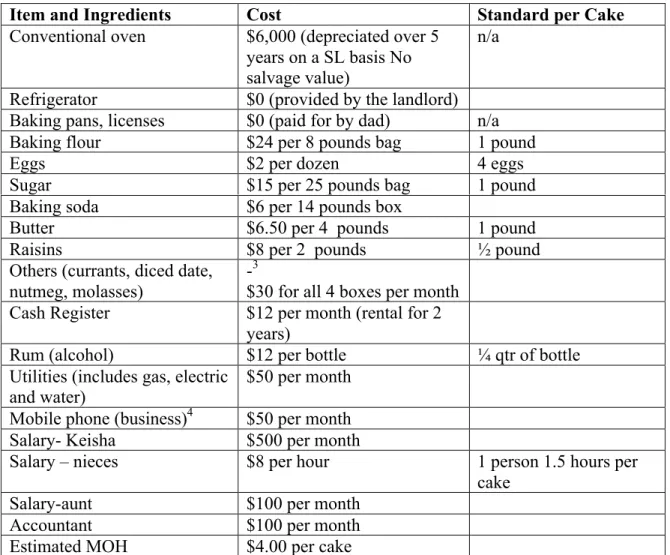
Her first action plan was to list all the key products or items that she would need to start the business. Keisha’s list1 included a conventional oven, a cash register, baking pans, business
licenses, health inspections, flour, sugar, baking soda, raisins, butter, eggs and rum. She also planned on hiring her accounting professor on a part time basis to perform bookkeeping services and her nieces Brianna and Alexis, to help her in the bakery. Aunt Sue Ellen would supervise the girls so that Keisha could focus on developing the business. K&J’s cost drivers are provided in Table 1.
Required: Keisha needs your help in classifying the various costs. In order to manage these costs, she wants them identified using the information below. She asked that you use Table 2 for your answers.
a) Behavior (fixed or variable) b) Traceability (direct or indirect)
c) Financial reporting (product or period)
d) If product cost, identify which items are direct materials, direct labor or manufacturing overhead.
Costing Systems (Assignment #2)
Keisha discussed the business plan with her accounting professor who agreed to serve as her part time accountant. His first advice was for the business to develop a budget. Since Keisha did not complete Accounting II, she was not aware of the various costing systems that exist in
businesses. Her accounting professor told Keisha of the three different types of costing systems that exist in organizations – job order, process costing and activity based costing.
Required: Which type of costing system is K&L Bakery most likely to use? Discuss?
Business Transactions (Assignment #3)
Keisha spent the month of December talking to various suppliers in order to determine her cost structure. She added cost data to the information in Table 1.
K&L Bakery Inc. opened for business on January 1, 20x1 as planned. During the month of January, the business purchased and used 200 pounds of flour, 200 pounds of sugar, 67 dozen eggs and had 4 bad eggs to dispose of during the month2, 20 baking soda boxes, 200 pounds of butter, 100 pounds of raisons, 50 bottles of rum, and the other ingredients (one box of each for a total of four) all from one supplier on account. Manufacturing overhead is applied to production
1 This is not an exhaustive list and instructors have the option of expanding it
4 at 4 dollars per cake. Keisha purchased the oven using the start up capital and paid all salaries. Her nieces worked 300 hours in total for the month. January was a very good month for the bakery since it baked 200 cakes and sold all for cash. The average selling price was $50 per cake. All manufacturing overhead is closed out at month end. The supplier was paid at month end.
Required: Document K&J Bakery Inc January transactions using T-accounts (round all
calculations to 2 decimal places) All other costs such as utilities, must be accounted for in the T-accounts (assume such transactions where applicable, are paid in cash) - 30 points
Reporting (Assignment #4)
Since Keisha was not paying much attention to the discussion on journal entries in her one accounting class, she does not understand the T-accounts that you provided. However, she heard through her accountant that there is a manufacturing report that would provide her with the same information as the T-accounts and is more user-friendly. She believes that the report is called the Statement of Cost of Goods Manufactured.
Required: Prepare the Statement of Cost of Goods Manufactured for January. Also, prepare an Income Statement for the month of January.
Breakeven Analysis/Target Sales (Assignment #5)
Although business was off to a good start in January, Keisha realized that she will need to be profitable in order to continue as a viable business. Keisha discussed the subject of profitability with her accountant who suggested that she first needs to determine her breakeven point in both unit sales and dollars. He explained to her that break even is the point where all costs are covered by sales and so, profit is equal to zero. He also suggested that the company should establish a monthly target profitability in order to determine the amount of cakes it would need to sell to achieve this level.
Since Keisha did not know how to perform this calculation and in order to save money, she asked you to calculate the company’s breakeven point and the target sales need to achieve a monthly profit of $500.
Required: Calculate K&J Bakery Inc’s breakeven point in both units and sales dollars. Also, calculate the sales needed in order to achieve a monthly profit of $500.
Note: Use four decimal places in converting from total to per unit cost.
IMPLEMENTATION
The project was piloted in summer 2011 in an undergraduate managerial accounting class and student feedback was used to clarify the project as necessary. It was class tested during fall 2011 in two sections of managerial accounting (n=89) taught by the authors. Students worked in
5 students. As expected, the discussion focused on the proper classification of cost objects in terms of traceability (direct or indirect) and financial reporting (product or period), which indicated that students were fully engaged in the project. Assignments 3 to 5 were awarded a maximum of 50 points to the group. Individual grades were determined based on group
participation as determined by group members. Students achieved an average of 42 points on the assignment.
CONCLUSION
The project achieved its goal of providing students with a comprehensive exercise that integrated the discrete subject matters in the managerial accounting course. Students
demonstrated the ability to classify cost based on traceability, financial reporting, behavior, and decision making. They were also able to identify the three elements of a product cost, to flow costs through the inventory accounts into the income statement, to prepare management and financial reports, and to calculate break even and target sales.
6
TABLE 1: COST INFORMATION
Item and Ingredients Cost Standard per Cake
Conventional oven $6,000 (depreciated over 5 years on a SL basis No salvage value)
n/a Refrigerator $0 (provided by the landlord) Baking pans, licenses $0 (paid for by dad) n/a
Baking flour $24 per 8 pounds bag 1 pound
Eggs $2 per dozen 4 eggs
Sugar $15 per 25 pounds bag 1 pound
Baking soda $6 per 14 pounds box
Butter $6.50 per 4 pounds 1 pound
Raisins $8 per 2 pounds ½ pound
Others (currants, diced date, nutmeg, molasses)
-3
$30 for all 4 boxes per month Cash Register $12 per month (rental for 2
years)
Rum (alcohol) $12 per bottle ¼ qtr of bottle
Utilities (includes gas, electric
and water) $50 per month
Mobile phone (business)4 $50 per month
Salary- Keisha $500 per month
Salary – nieces $8 per hour 1 person 1.5 hours per
cake
Salary-aunt $100 per month
Accountant $100 per month
7
Table 2
Cost Classification Chart
Fixed Variable Direct Indirect Product DM DL MOH Period
Oven Cash Register Baking pans Business License Health Inspections Rent Utilities Mobile Phone Flour Sugar Baking Soda Butter Raisons Eggs Rum Others Accountant Brianna Alexis Keisha Aunt Ellen
K&J BAKERY INC. SUGGESTED SOLUTIONS
Assignment #1
Assignment #2 Costing System
Answer: Job order costing
Due to the nature of the business each order is specialized and different from the other orders. Therefore, the logical choice of costing methods would be job order costing. Job order costing is a costing method used when many different products are produced in a given period. Even though the company is only making one product, Process costing would not be considered the best choice since each cake is made to specific order and therefore considered a different job. Activity Based Costing would not be considered the best choice because it is typically used as a supplement to the one of the other costing systems.
Assignment #3
Assignment # 4
Statement of Cost of Goods Manufactured
For the Month ended 1/31/x1
Direct Materials
Raw Materials Beginning $0
Add: Purchases of Raw Materials $2,179 Raw Materials available for use $2,179
Deduct: Ending raw Materials $0
Raw Materials used in production $2,179
Direct Labor $2,400
Manufacturing Overhead $800
Total Manufacturing Cost $5,379
Add: Beginning work in process inventory $0
$5,379
Deduct: Ending work in process inventory $0
Cost of goods Manufactured $5,379
Income Statement
For Month ending 1/31/x1
Sales $10,000 COGS $5,579 GM $4,421 $4,421 Expenses Cash Register $12 Salary Expense $500 Phone Expense $50 Acct Expense $100 Total Expenses $662 $662 Net Income $3,759
Assignment # 5
PRESENTATIONS WITH MAXIMUM IMPACT: MOVING FACULTY FORWARD
Christina M. Ritsema Lecturer
Department of Accounting & CIS Montfort College of Business University of Northern Colorado
Tracy S. Manly*
Associate Professor of Accounting & ONEOK Professor of Business
School of Accounting & MIS University of Tulsa 800 S. Tucker Dr. Tulsa, OK 74104 (918) 631-3992 [email protected] *Corresponding author
1
PRESENTATIONS WITH MAXIMUM IMPACT: MOVING FACULTY FORWARD INTRODUCTION
Public speaking is a way of life for almost all accounting faculty. We speak multiple times a week for student audiences in class. Further, we also present for groups of practicing professionals, to campus colleagues in administrative meetings, and for faculty peers at conferences related to our discipline. However, few of us have significant formal training in giving presentations (beyond high school speech class!). There appears to be an implicit assumption that accurate content is the main requirement for making an effective presentation. But as frequent audience members as well, we know that assumption is not true. We know there are speakers who are more compelling, interesting, and easy to follow. Is good speaking only a matter of raw talent, or is there some guidance available that could make us more effective in this venture?
In our search for current thinking and best practices related to giving effective presentations, we read a number of books on the topic. We provide reviews on three of the books most easily related to student readers in a companion article. We present each of the books separately so that instructors can use the reviews to select the books most suited to their needs and style.
Our objective in this article is to give accounting faculty a brief review of some of the best advice we found from three books targeted to a more experienced audience. We found the material to be very beneficial and it challenged our thinking and habits about the ways we present in class and in other settings. We organize this article by first giving short summaries of the three sources. We follow the summaries with the ‘Top Ten’ list of suggestions for
presenters.
BOOK SOURCES
Confessions of a Public Speaker, by Scott Berkun, 2010.
This book is an engaging and humorous reflection of one speaker’s personal presentation experiences. The author inspires teachers to decrease boredom and misery in the classroom in 10 stand-alone chapters that can easily be picked up and put down. The book provides easy-to-implement practical advice to engage the audience. Berkun provides an extensive list of additional book recommendations for the motivated reader as well.
Resonate: Present Visual Stories that Transform Audiences, by Nancy Duarte, 2010.
The book reads like a how-to manual for presentations. Through this comprehensive and visually pleasing book, Duarte teaches how to resonate with the audience. Her focus is on
storytelling that intellectually and emotionally connects with the audience. The book teaches nine resonance rules and is filled with case studies from famous speakers and companies that help illustrate her points.
The Naked Presenter: Delivering Powerful Presentations With or Without Slides, by Garr Reynolds, 2011.
This is a nicely illustrated book on how to use Zen art ideas in presentation delivery. The tone of the book reflects presenting as a conversation over giving a performance. The idea of Presenting Naked is about removing the unnecessary noise in the presentation to expose what is most important. The author provides ten core delivery principles and adds lessons from other experts to his own insights.
TOP TEN SUGGESTIONS
This list includes the ten pieces of advice we found most compelling. Some of the items originate from only one of the authors while others represent ideas that were addressed by more than one. The first five items deal with preparation while the last five focus on the delivery.
#1 Quiet your mind (Reynolds & Berkun).
Planning a presentation begins with time alone to think. A few of the suggestions are remove distractions, go for a walk, go ‘analogue’ and use pen and paper, sticky notes or a whiteboard to generate numerous ideas. Resist the urge to turn on the computer and instead simply think. From there, hone in on the main points and concentrate on expressing them simply and creatively. Berkun writes, “All good public speaking is based on good private thinking (p. 57).”
#2 Relentlessly build content that supports the aim (Duarte).
When the main idea is clearly established, meaningful content is added to transform the idea into a story. Each additional item of content must support the aim and propel the listener to the desired destination. Duarte requires presenters to simplify, be clear, and be concise. She writes that, “Audiences are screaming ‘make it clear’ not ‘cram more in’ (p. 119).” She reminds the reader that many presentations suffer from too many ideas and not too few. She also acknowledges this step requires a great deal of effort and time.
#3 Don’t report, tell a story (Duarte).
Speakers are wise to consider the difference between reports and presentations. Reports are distributed with the purpose of conveying information. Presentations produce an experience and persuade the audience. Persuasion occurs through telling an engaging story that flows clearly. Duarte likens it to a screenplay. Act 1 should set up unfulfilled desires. Act 2 presents the conflict or obstacles in achieving those desires. Act 3 resolves the conflict and calls the audience to action. The story should have a planned moment that the presenter wants the audience to always remember.
3
Use tension, conflict, and conflict resolution to connect with the audience. The story the speaker tells connects when contrasts are highlighted. Create contrasts using before and after, then and now, what is and what could be scenarios. Listeners are hard wired to notice
differences. Presenters should take advantage of this and motivate action through employing tension.
#5 Rehearse, rehearse, rehearse (Reynolds, Berkun).
Great presenters work at this. It takes a great deal of time, but rehearsing pays off. Practice techniques include giving the presentation aloud and finding the spots that do not flow, videotaping the presentation and reviewing it, asking a colleague or peer to listen and give feedback. Making adjustments and corrections each time improves the presentation tremendously.
#6 Pre-presentation activities are important (Berkun).
Speakers should arrive early to the location without being rushed. Take time to sit in the back row to assess what the audience can see and what the venue feels like. The presenter can increase his comfort level by walking on stage, checking the technology, sound and lighting. These details can make or break the presentation.
#7 Have a proper perspective (Berkun).
The listeners are really less judgmental than the speaker thinks they are, because they don’t care as much as the speaker thinks they do. Most people in the audience want the presentation to end, so don’t take it too seriously. Presenters benefit by keeping it light and focusing on the audience learning something. Berkun adds, “The best teachers use entertainment as a way to fuel teaching, not simply to make a student laugh (p. 117).” The goal is not
perfection, but usefulness.
#8 Crowd density is key (Berkun).
Forget about crowd size and room size. What the speaker really needs is a dense crowd. Do whatever it takes to get the audience together. He gives suggestions to achieve this such as simply asking from the microphone, offering prizes, or playing a game that gets them to move forward and sit together.
#9 Prevent boredom, get the audience involved (Berkun, Duarte & Reynolds).
All of the authors emphasize that presenters can only connect with the audience when the audience is not bored. Ideally, the listeners have a genuine interest in the content, but this is rarely enough to prevent boredom. Getting the audience involved, even in little ways, helps. Ways to perk up the presentation include taking a quick poll, asking for a show of hands in response to a question, inserting a trivia question, and asking for a volunteer. Berkun also suggests that every five minutes or so speakers should insert an example or break that grabs the audience’s attention. He says listeners are inherently interested in a number of things such as
things we like to eat, bright moving objects, puzzles to solve, things that explode, and things that are pretty.
#10 Connect with the audience by being natural (Reynolds).
Audiences yearn for authenticity from presenters. Therefore, speakers are advised to bring their own personality and naturalness. Presenters should not worry about a performance, but instead focus on having a conversation that connects emotionally with the audience. Be fully in the moment and tuned in to the listeners. When he focuses on the audience, the speaker can connect and get his message across in a powerful way.
SUMMARY
Given the volume of public speaking done by accounting faculty, the start-up cost to improving this skill can reap tremendous benefits. We can contribute to our students’ success by modeling effective presentations for them. In addition, we want to connect with audiences of colleagues and peers to communicate in an authentic and helpful way. The amount of good advice available on this topic means there is something for everyone. Each of us can find a style and method we can implement. While faculty members cannot integrate every idea into each presentation, we can make incremental improvements with each attempt. With practice and commitment, habits can be developed that move us forward to becoming exceptional.
REFERENCES
Berkun, Scott., 2010. Confessions of a Public Speaker, O’Reilly.
Duarte, Nancy., 2010. Resonate: Present Visual Stories that Transform Audiences, Wiley. Reynolds, Garr., 2011. The Naked Presenter: Delivering Powerful Presentations With or
SIMULTANEOUS PRESENTATION OF DEBIT/CREDIT ENTRIES AND PLUS/MINUS TRANSACTION WORKSHEET – AN AID TO STUDENT UNDERSTANDING
Dr. Robert Derstine Professor of Accounting 128 deFrancesco Building Kutztown University Kutztown, Pa. 19530 610-683-4588 [email protected]
Dr. James M. Emig (corresponding author) Associate Professor of Accountancy
3087 Bartley Hall Villanova University Villanova, Pa. 19085 610-519-4344 [email protected] Thomas J. Grant
Associate Professor of Accounting 129 deFrancesco Building
Kutztown University Kutztown, Pa. 19530
610-683-4572 [email protected]
SIMULTANEOUS PRESENTATION OF DEBIT/CREDIT ENTRIES AND PLUS/MINUS TRANSACTION WORKSHEET – AN AID TO STUDENT UNDERSTANDING
For many students, the introductory financial accounting course can be a frustrating experience. Rather than focusing on the more important aspects of the course, students become overwhelmed just trying to memorize debit and credit journal entries. In an effort to help the students understand transactions and their effects on the financial statements, we use a worksheet that simultaneously presents debit and credit journal entries and a ‘plus/minus’ transaction worksheet approach.
Our objective is to provide a learning tool for the instructor to use in illustrating: routine transactions (presented in Exhibit #1); adjusting entries (Exhibit #2); closing entries (Exhibit #3); and ultimately the financial statements (Exhibit #4). Our approach provides immediate feedback to the students on the impact of various transactions on the financial statements. This approach can be presented in the classroom using ‘chalk and talk’ or by using Excel.
Once students have correctly analyzed the impact of the transaction on the individual
accounts on the worksheet, we ask them how the journal entry for that transaction would be recorded using the debit and credit scheme. Having the completed worksheet entry in view (showing the required increases/decreases in the accounts) helps students determine which account gets ‘debited’ and which account gets ‘credited’ in the journal entry. We constructed the worksheet based on the accounting equation with a separate column (i.e., ledger account) for each specific asset, liability, and stockholders’ equity account.
In Exhibit #1, we present eight ‘routine’ transactions that occur during January 20X2. Obviously you could replace or supplement those presented with your ‘favorites’. As the students work through the transactions, the instructor can use the ‘rectangular’ shape from Excel’s drawings menu to ‘reveal the solution’ one transaction at a time. Note on the transaction worksheet that the revenue and expense accounts (the temporary retained earnings accounts) are shown in their own respective columns and NOT directly into Retained Earnings. Entering transactions directly into revenue and expense accounts (and including closing entries in Exhibit #3) greatly enhances student understanding of the role played by these temporary retained earnings accounts in the accounting process.
We include the totaling of the ledger account columns showing the accounting equation is in balance after routine entries, after adjusting entries, and after closing entries (in essence de facto trial balances). The number and variety of transactions that can be recorded (including adjusting entries and closing entries) is unlimited. Although the transaction worksheet approach could become unwieldy as the number of ledger accounts increases, we do find it is a very effective learning technique to use in the early chapters of a financial accounting course. Note we used one column for all expenses rather than a separate column for each individual expense in an attempt to keep the size of the worksheet manageable.
The instructor needs to emphasize to the students this is the first time during the accounting period that entries have been made directly to the Retained Earnings account. The closing entries provide an opportunity to observe the revenue earned during the accounting period is now increasing the Retained Earnings balance while the expenses are now resulting in a decrease in the Retained Earnings balance. In addition to illustrating (again on one line) both the debit/credit and plus/minus approaches, we reinforce the two simultaneously achieved needs for closing entries: (1) updating the Retained Earnings account to the correct end of period balance, and (2) reducing the balance in the temporary retained earnings accounts to zero in order to be ready to record the revenues and expenses for the next accounting period.
For each statement, we provide a reference to the location on our worksheets where that information appears. If a Statement of Cash Flows is to be prepared, an additional column (SCF) can be inserted in the worksheet. This column should be placed immediately adjacent to the Cash column. For every transaction that affects cash, we ask the students: is this an Operating Activity (OA), an Investing Activity (IA), or a Financing Activity (FA)? Their response (OA-IA-FA), if correct, is entered into this SCF column. Utilizing these classification results, and incorporating the beginning and ending balance in the Cash account, provides the information to prepare the Statement of Cash Flows. Note this would result in the Operating Activities section being presented under the direct method.
To reinforce student understanding, our approach can also be used for homework assignments and/or examination problems. If you would like copies of our Excel worksheets, with or without the drawing toolbar’s ‘rectangular’ shape (which allows for solutions to be hidden and revealed one at a time), please contact the primary author.
1
DEBTOR ACCOUNTING FOR TROUBLED-DEBT-RESTRUCTURING: A CLASSROOM EXAMPLE TO TEACH THEORY VS. PRACTICE
Timothy B. Forsyth
Kenneth E. Peacock Professor of Accounting Appalachian State University
Department of Accounting Boone, NC 28608 [email protected] (828) 262-6205 Philip R. Witmer Professor of Accounting Appalachian State University
Department of Accounting Boone, NC 28608
(828) 262-6232