Municipal Solid Waste
Incineration
The World Bank Washington, D.C.
W O R L D B A N K
and Development / THE WORLD BANK 1818 H Street, N.W.
Washington, D.C. 20433, U.S.A. All rights reserved
Manufactured in the United States of America First printing August 1999
This report has been prepared by the staff of the World Bank. The judgments expressed do not necessari-ly reflect the views of the Board of Executive Directors or of the governments they represent.
The material in this publication is copyrighted. The World Bank encourages dissemination of its work and will normally grant permission promptly.
Permission to photocopy items for internal or personal use, for the internal or personal use of specific clients, or for educational classroom use, is granted by the World Bank, provided that the appropriate fee is paid directly to the Copyright Clearance Center, Inc., 222 Rosewood Drive, Danvers, MA 01923, U.S.A., tele-phone 978-750-8400, fax 978-750-4470. Please contact the Copyright Clearance Center before photocopying items.
For permission to reprint individual articles or chapters, please fax your request with complete informa-tion to the Republicainforma-tion Department, Copyright Clearance Center, fax 978-750-4470.
All other queries on rights and licenses should be addressed to the World Bank at the address above or faxed to 202-522-2422.
iii
Foreword v
PART 1 — ASSESSMENT 1
1 Introduction 3 Methodology 3
The Flow and Management of Municipal Solid Waste 4 Incineration Project Summary 4
2 Waste as Fuel 9 Key Issues 9
Waste Generation and Composition 10 Heating Value 11 Waste Surveys/Forecasts 13 3 Institutional Framework 19 Key Issues 19 Waste Sector 20 Energy Sector 21
Incineration Plant Organization and Management 21 4 Incineration Plant Economics and Finance 25
Key Issues 25 Economics 25 Financing 29
Cost Benefit Assessment 31 5 The Project Cycle 33
Key Issues 33 Feasibility Phase 33
Project Preparation Phase 33 Project Implementation Phase 36
Socio-Economic Aspects and Stakeholder Participation 37 References 41
PART 2 — TECHNICAL 43 Technical Plant Overview 45 1 Plant Location 47
Key Issues 47
Site Feasibility Assessment 47 2 Incineration Technology 51
Key Issues 51
Pre-treatment of Waste 52
Design and Layout of the Mass Burning Incineration System 54 3 Energy Recovery 59
Key Issues 59
Emergy Recovery Technology 59 4 Air Pollution Control 65
Key Issues 65
Volume and Composition of the Flue Gas 66 Environmental Standards 67
Air Pollution Control Technology 68 APC Systems Overview 74
Induced Draught Fan and Stack 74 5 Incineration Residues 77
Key Issues 77
Slag 77
Grate Siftings 78 Boiler and Fly Ash 79
Residues from Dry and Semi-dry Flue Gas Treatment 79 Sludges from Water Treatment 80
Spent Adsorbent from Dioxin Filters 80 Other Materials 80
6 Operation and Maintenance 83
Key Issues 83
Typical Plant Organization and Staffing 83 Crucial Supplies and External Services 85
Training of Workers, Codes of Practice, and Occupational Safety and Health 85 7 Environmental Impact and Occupational Health 87
Key Issues 87
Environmental Impact 87
Occupational Safety and Health 90 References 93
v
Foreword
Solid waste management is in crisis in many of the world’s largest urban areas as populations attracted to cities continues to grow. This has led to ever increasing quantities of domestic solid waste while space for dis-posal decreases. Municipal managers are looking to the development of sanitary landfills around the periphery of their cities as a first solution. However, siting and preparation of a landfill requires the acquisition of large areas as well as good day to day operation in order to min-imize potential negative environmental impacts. Another approach that has recently caught the attention of decisionmakers is mass burn incineration similar to systems found in the OECD countries. However, capital and operating requirements for these plants are general-ly an order of magnitude greater than required for land-fills. Project developers armed with rosy financial fore-casts can be found in all corners of the globe encouraging municipal officials to consider incineration.
In order to assist local officials with developing cost effective strategies for dealing with solid waste
manage-ment, the World Bank has begun a program of provid-ing high level advice on approaches that are basically financially self supporting, socially and environmental-ly responsible. This Technical Guidance Report provides the foundation for such a detailed evaluation of solid waste incineration systems. A document for making a more preliminary assessment is the accompanying Decision Maker’s Guide to Incineration of Municipal Solid Waste.
This report should be used with caution since both technical and financial feasibility are very site-specif-ic. Readers with general interest and technical spe-cialists will find this report useful in making their assessments. A comprehensive solid waste manage-ment program may include several options phased in over a long period of time during which refuse quan-tities, constituents and the overall economic picture may change significantly. This uncertainty and asso-ciated risks must be incorporated into the planning process.
Kristalina Georgieva Sector Manager
Environment and Social Development Sector Unit East Asia and Pacific Region The World Bank
Washington, DC USA Keshav Varma Sector Manager Urban Development Sector Unit
East Asia and Pacific Region The World Bank
Washington, DC USA
The Report was made possible through the generous support of the Danish government. The report was prepared by Mr. J. Haukohl, Mr. T. Rand and Mr. U. Marxen of Rambøll. Three people were instrumental in encouraging the preparation of these publications, Lars Mikkel Johannessen, currently with the Danish government, Dr. Carl Bartone, Principal Environ-mental Specialist and Gabriel Boyer. The Task Manager
for this work was Jack Fritz, Environmental Engineer. The editors were Mellen Candage and Carol Levie of Grammarians, Inc.
In addition to internal reviewers, we also thank the external peer reviewers for their time and comments, specifically Stephen Schwarz, PE of Malcolm Pirnie, Inc. and Anil Chatterjee, PE of Chatterjee and Associates.
vi
Acknowledgments
vii
A Ash content per kg of dry sample APC Air pollution control
BO Build and operate BOO Build, own, and operate BOOT Build, own, operate, transfer
C Combustion fraction
°C Degrees Celsius
CBA Cost benefit assessment CHP Combined heat and power DBO Design, build, and operate DC Direct current
DS Dry substance
EA Environmental assessment EIA Environmental impact assessment ESP Electrostatic precipitator
EU European Union
GDP Gross domestic product
GR Growth rate
GWh Gigawatt hour
h Hour
Hawf Ash and water free calorific value Hinf Lower (inferior) calorific value Hinf, overall Overall lower calorific value HRD Human resource development Hsup Upper (superior) calorific value Hsup,DS Superior calorific value of dry sample kcal Kilocalories
K Kelvin
KF Key figure
kJ Kilojoule
kPa Kilopascal
LCV Lower calorific value LOI Loss of ignition
LP Low pressure
m Meter
MCW Weight of condensed water per kg of dry sample
1
PART 1
The Technical Guidance Report provides back-ground information for the Decision Makers’ Guide to Municipal Solid Waste (MSW) Incineration. The Report focuses on large-scale incineration plants for large urban areas or intermunicipal coopera-tives. It does not address hazardous and infectious wastes.
The Decision Makers’ Guide is a practical tool for a preliminary assessment of whether the key crite-ria for a solid waste incineration scheme are pre-sent.
The Technical Guidance Report provides decision makers and their advisers with more elaborate infor-mation on how to investigate and assess the degree to which the key criteria are fulfilled. Hence, the Report comprises a comprehensive account of many aspects of waste incineration. Part 1 of the Report provides information needed to assess the feasibility of MSW incineration. Part 2 covers technical aspects and the available technologies related to an MSW incineration plant.
The Decision Makers’ Guide primarily addresses an audience at the political level, whereas the Technical Guidance Report presumes some degree of general technical knowledge. However, no expertise within the field of waste incineration is required to understand the Technical Guidance Report.
Finally, note that the Technical Guidance Report is far from being a design manual for an MSW incinera-tion plant. The responsibility, the final feasibility assessment and the consecutive design of such a plant must be entrusted to experienced consultants and sup-pliers with an extensive track record in this complex subject.
Methodology
The Technical Guidance Report is organized as follows:
Part I
• Introduction • Waste as Fuel
• Institutional Framework
• Incineration Plant Economics and Finance • The Project Cycle
Part II
• Plant Location
• Incineration Technology • Energy Recovery
• Air Pollution Control • Incineration Residues • Operation and Maintenance
• Environmental Impact and Occupational Health Each chapter is standardized to make information easy to access, as follows:
• Key issues—Main points, critical issues, and deci-sions to be made.
• Key criteria—Key criteria are listed in order of importance, using the following symbols to empha-size priority: ✓ ✓ ✓ Mandatory ✓ ✓ Strongly Advisable ✓ Preferable 3
1 Introduction
If any mandatory key criteria are not expected to be fulfilled, it is advisable to stop planning the solid waste incineration plant.
• General principles—Elaboration of the general con-siderations.
The Technical Guidance Report is supplemented by an evaluation checklist for decision makers who are considering MSW incineration as part of their waste management strategy.
Furthermore, as an introduction, the following two sections provide a brief overview of the flow and man-agement of municipal solid waste, objectives and applicability of waste incineration, and the necessary institutional framework.
The Flow and Management of Municipal Solid Waste
Solid waste arises from human activities—domestic, commercial, industrial, agricultural, waste water treat-ment, and so on. If the waste is not properly handled and treated, it will have a negative impact on the hygienic conditions in urban areas and pollute the air and surface and ground water, as well as the soil and crops.
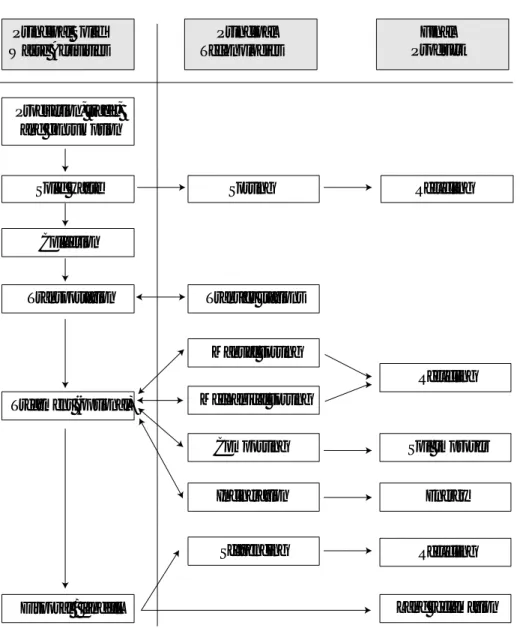
A hygienic and efficient system for collection and disposal of solid waste is therefore fundamental for any community. Generally, the demands on the solid waste management system increase with the size of the com-munity and its per capita income. Figure 1.1 shows that the final destination of waste is always a disposal site. Residues from waste treatment processes are returned to the waste mainstream and end up in the landfill with untreated waste. Hence, the backbone of any waste management system is an efficient collection system and an environmentally sound sanitary landfill.
The system’s resource recovery and recycling reflect that solid wastes are materials and by-products with potentially negative value for the possessor. Understanding what may be considered waste will thus change with the circumstances of the possessor as well as in time and place. Waste may be transformed into a resource simply by transportation to a new place or
through treatment. Such a transformation depends on the costs involved and whether the economy is looked upon as a private business, a national priority, or even globally.
Waste treatment involving mechanical plants requires large investments and operating costs. Hence, it should be only introduced after gaining profound knowledge of the existing system and waste genera-tion—which is quite a challenge, except in a highly organized waste management system. The most important factor in obtaining such information is that the waste is already disposed of in fully monitored and controlled landfills only.
Incineration Project Summary
MSW incineration is found at the most advanced level of the waste disposal/treatment hierarchy: indiscrimi-nate dumping, controlled dumping, landfilling, sani-tary landfilling, and mechanical treatment (for exam-ple, composting and incineration). Additional envi-ronmental control is introduced at each level and the disposal costs increase substantially. Introducing mechanical treatment of MSW entails a significant jump in technology and costs and is generally only fea-sible when all waste is already being disposed of in a sanitary landfill established and operated according to Decision Makers’ Guide to Solid Waste Landfills, WB/1/. Even so, many things can cause the project to fail and leave society with a huge bill to pay.
Deciding to incinerate waste instead of, for instance, dumping it, takes careful consideration of the criteria for success. In the mid 1980s, a number of Eastern European and Asian cities jumped directly from sim-ple dumping to MSW incineration. Any success was, however, questionable in many of these cities. In the former Soviet Union, several plants were commis-sioned in the late 1970s and early 1980s. Unfortunately, some of these plants were never completed, others were discontinued, and the rest are operating at reduced capacity because of financial, managerial, and opera-tional shortcomings.
In Asia, there is limited experience with waste incin-eration outside the industrialized countries of Japan, Singapore, and Taiwan. A few plants in other places
have experienced managerial, financial, or operational problems, including low calorific value of the waste due to scavenging, precipitation, or the basic composition of the generated waste.
The failure of MSW incineration plants is usually caused by one or more of the following:
• Inability or unwillingness to pay the full treatment fee, which results in insufficient revenue to cover loan installments and operation and maintenance costs
• Lack of convertible currency for purchase of spare parts
• Operation and maintenance failures (including lack of skilled workers)
• Problems with the waste characteristics and quan-tity
• Poor plant management
• Inadequate institutional arrangements • Overly optimistic projections by vendors.
Objectives and Applicability of MSW Incineration
In highly industrialized European countries, waste incineration plants have been used increasingly over the last 50 years, mainly because it has been more dif-ficult to find new sites for landfills in densely
populat-Introduction 5 Final Product Principal Technologies Principal Solid Waste Activities Production, trade, and consumption Recycling Sorting Solid waste Collection Transfer stations Transportation Manual sorting Recycling Mechanical sorting Treatment (optional) Soil improver Composting Energy Incineration Scavenging Recycling Land reclamation Disposal / landfill
ed areas. The public concern for the environmental impact of MSW incineration has, however, increased significantly over the last 20 years—forcing the manu-facturers to develop, and the plants to install and oper-ate, high-cost advanced technology for pollution con-trol (especially air pollution).
Incineration of MSW does not completely elimi-nate, but does significantly reduce, the volume of waste to be landfilled. The reductions are approximately 75 percent by weight and 90 percent by volume. The residues arising from air pollution control (APC) are, however, environmentally problematic, as they present a severe threat to ground and surface waters. Current technology is supposed to dispose of such residues in highly controlled sanitary landfills equipped with advanced leachate collection and treatment measures, or in former underground mines to prevent leaching of
heavy metals and, for some APC residues, chlorides. Fear of pollution often brings MSW incineration plants to the center of emotional public debate.
Incinerating solid waste fulfills two purposes in the advanced waste management system. Primarily, it reduces the amount of waste for sanitary landfilling; and it uses waste for energy production (power or dis-trict heating). Hence, waste incineration plants are generally introduced in areas where the siting of sani-tary landfills is in conflict with other interests such as city development, agriculture, and tourism.
Solid waste incineration is a highly complex technol-ogy, which involves large investments and high operat-ing costs. Income from sale of energy makes an impor-tant (and necessary) contribution to the total plant economy, and, consequently, the energy market plays an important role in deciding whether to establish a plant.
Several types of incineration technologies are avail-able today, and the most widely used is mass burning incineration—with a movable grate or, to a lesser extent, rotary kilns. Fluidized bed incineration is still at the experimental stage and should therefore not yet be applied. The mass burning technology with a movable grate has been successfully applied for decades and was developed to comply with the latest technical and envi-ronmental standards. Mass burning incineration can generally handle municipal waste without pre-treat-ment on an as-received basis.
Mass burning technologies are generally applied for large-scale incineration of mixed or source-separated municipal and industrial waste. Compared to movable grates the rotary kiln incineration plants have a small-er capacity and are mostly used for special types of waste unsuitable for burning on a grate, such as vari-ous types of hazardvari-ous, liquid, and infectivari-ous waste.
Institutional Framework—Overview
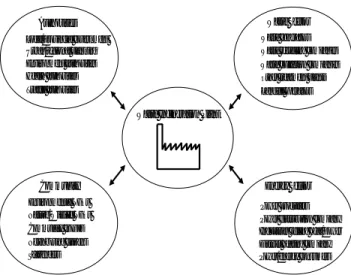
When considering the construction of an incineration plant, it is necessary to consult with many project stake-holders. The relevant stakeholders are usually authori-ties, the waste sector, community groups, and the ener-gy sector. A further subdivision of these stakeholders appears below.
It is important to review possible local stakeholders based on the actual local conditions, political and
financial situation, and other current and planned waste treatment and disposal facilities.
The most important issue, financially, could be generation of revenue from the sale of heat or power (or both), as well as the possibility of collecting fees from commercial, domestic, and public waste gener-ators.
Environmentally, important issues may be to define suitable standards for flue gas emissions, quality and disposal of solid outputs (slag, ash, and flue gas clean-ing residuals), as well as waste water in case a wet flue gas cleaning system is applied.
The most important question, institutionally, could be how to control the waste flow for optimum treatment and utilization of the available waste treat-ment and disposal facilities; and how to ensure the institutional and managerial capacity required to operate a multiple stringed waste management sys-tem.
Depending on local traditions and the level of envi-ronmental awareness, a special and transparent infor-mation campaign could be carried out for community groups and neighboring citizens.
The goals, strength, resources, and awareness of the stakeholders often differ among each other and with those of the proposed incineration plant owner/oper-ator. Reaching a solution that is acceptable to all may be difficult.
Introduction 7
Energy Sector Power producers Power distribution company Industries selling heat/power District heating company Power/energy consumers Community Environmental NGOs Nature/Wildlife NGOs Community groups Neighboring citizens Scavengers
Waste Incineration Plant
Waste Sector Waste generators Waste recycling companies Waste collection companies Other treatment plants Landfill operators Authorities Local/provincial government Urban/regional planning Environment authorities Health authorities Traffic authorities
Key Issues
The successful outcome of a waste incineration project first depends on fairly accurate data on the future waste quantities and characteristics that form the basis for the design of the incineration plant.
Waste for incineration must meet certain basic requirements. In particular, the energy content of the waste, the so-called lower calorific value (LCV), must be above a minimum level. The specific composition of the waste is also important. An extreme waste compo-sition of only sand and plastics is not suitable for incin-eration, even though the average lower calorific value is relatively high. Furthermore, in order to operate the incineration plant continuously, waste generation must be fairly stable during the year.
Hence, the amount and composition of solid waste generated in the collection area for a potential inciner-ation plant, and possible seasonal variinciner-ations, must be well established before the project is launched. Waste composition depends on variables such as cultural dif-ferences, climate, and socio-economic conditions. Therefore, data usually cannot be transferred from one place to another.
All waste studies and forecasts must focus on the waste ultimately supplied to the waste incineration plant. Consequently, the effect of recycling activities (for example, scavengers) that change the composition of the waste must always be considered.
In many developing countries, the domestic waste has a high moisture or ash content (or both). Therefore, a comprehensive survey must be taken to establish whether it is feasible to incinerate year-round, as seasonal variations may significantly affect the com-bustibility of the waste.
Waste from industries and the commercial sector (except for market waste) generally has a much higher calorific value than domestic waste. However, collec-tion of such wastes is often less organized or controlled, and delivery to an incineration plant can be difficult. Some types of waste, such as demolition waste and waste containing certain hazardous or explosive com-pounds, are not suitable for incineration.
The waste composition may change in time because of either additional recycling or economic growth in the collection area. Both changes can significantly alter the amount of waste and its calorific value.
Key criteria
✓ ✓ ✓ The average lower calorific value of the waste must be at least 6 MJ/kg throughout all seasons. The annual average lower calorific value must not be less than 7 MJ/kg. ✓ ✓ Forecasts of waste generation and composi-tion are established on the basis of waste surveys in the collection area for the planned incineration plant. This task must be carried out by an experienced (and inde-pendent) institution.
✓ ✓ Assumptions on the delivery of com-bustible industrial and commercial waste to an incineration plant should be founded on an assessment of positive and negative incentives for the various stakeholders to use the incineration facility.
✓ ✓ The annual amount of waste for incineration should not be less than 50,000 metric tons
9
2 Waste as Fuel
and the weekly variations in the waste supply to the plant should not exceed 20 percent.
Waste Generation and Composition
The quantity and composition of solid waste depend on how developed the community is and the state of its economy. Industrial growth is an important tool for raising the per capita income and welfare of the popu-lation. In return, industrial growth and higher per capi-ta income generate more waste, which, if not properly controlled, causes environmental degradation.
Key figures for generation of municipal solid waste (MSW) appear in Table 2.1. MSW is collected by, or on the order of, the authorities and commonly comprises waste disposed of at municipal collection facilities from households, commercial activities, office build-ings, public institutions, and small businesses. The actual definition of “municipal solid waste” may, how-ever, vary from place to place.
Urbanization and rapid growth of cities increase the amounts of waste generated in limited and densely
populated areas. This, in turn, may eliminate the pos-sibility of inexpensive disposal methods.
In more rural areas, crops and animal wastes are increasing as pesticides and fertilizers are applied more often. However, many of these biodegradable materials may be burned as fuel or easily converted into a soil conditioner and should not be regarded as true waste.
Table 2.1 Key figures—municipal solid waste (kg/capita/ year)
Waste generation
[kg/cap./year] Annual
Area Ref. Range Mean growth rate
OECD—total /2/ 263–864 513 1.9%
North America /2/ 826 2.0%
Japan /2/ 394 1.1%
OECD—Europe /2/ 336 1.5%
Europe (32 countries) /3/ 150–624 345 n.a. 8 Asian Capitals /4/ 185–1000 n.a. n.a. South and West Asia
(cities) /5/ 185–290 n.a. n.a.
Latin America and
the Caribbean /6/ 110–365 n.a. n.a.
Domestic Waste Waste from household activities, including food preparation, cleaning, fuel burning, old clothes and furniture, obsolete utensils and equipment, packaging, newsprint, and garden wastes.
In lower-income countries, domestic waste is dominated by food waste and ash. Middle- and higher-income countries have a larg-er proportion of paplarg-er, plastic, metal, glass, discarded items, and hazardous mattlarg-er.
Commercial Waste Waste from shops, offices, restaurants, hotels, and similar commercial establishments; typi-cally consisting of packaging materials, office supplies, and food waste and bearing a close resemblance to domestic waste.
In lower-income countries, food markets may contribute a large proportion of the commercial waste. Commercial waste may include hazardous components such as contaminated packaging materials.
Institutional Waste Waste from schools, hospitals, clinics, government offices, military bases, and so on. It is similar to both domestic and commercial waste, although there is generally more packaging materials than food waste. Hospital and clinical waste include potentially infectious and hazardous materials. It is important to separate the hazardous and non-hazardous components to reduce health risks.
Industrial Waste The composition of industrial waste depends on the kind of industries involved. Basically, industrial waste includes components similar to domestic and commercial source waste, including food wastes from kitchens and canteens, packaging materials, plastics, paper, and metal items. Some production processes, however, utilize or generate hazardous (chemical or infectious) substances. Disposal routes for hazardous wastes are usually different from those for non-hazardous waste and depend on the composition of the actual waste type.
Street Sweepings This waste is dominated by dust and soil together with varying amounts of paper, metal, and other litter from the streets. In lower-income countries, street sweepings may also include drain cleanings and domestic waste dumped along the roads, plant remains, and animal manure.
Construction and Demolition Waste The composition of this waste depends on the type of building materials, but typically includes soil, stone, brick, concrete and ceramic materials, wood, packaging materials, and the like.
Generally, construction, demolition, and street sweeping wastes are not suited for incineration.
The composition of the various types of MSW varies greatly by climate and seasonal variations and the socio-economy of the waste collection area.
In general, high-income areas generate more waste than low- or middle-income areas. Thus, waste gener-ation and composition may differ greatly even within the same metropolis.
Waste collected in affluent areas is typically less dense, as it contains more packaging and other lighter materials and less ash and food waste. This is because more ready-made products are consumed and the food processing takes place in the commercial/industrial sector.
The moisture is greater in lower-income areas due to the water content of the food waste and smaller amounts of paper and other dry materials. Annual variations in moisture content depend on climatic con-ditions such as precipitation and harvest seasons for vegetables and fruit.
Examples of the composition of waste from China, the Philippines, and European countries are presented in Table 2.2.
Heating Value
Once ignited, the ability of waste to sustain a combus-tion process without supplementary fuel depends on a
number of physical and chemical parameters, of which the lower (inferior) calorific value (Hinf) is the most important. The minimum required lower calorific value for a controlled incineration also depends on the furnace design. Low-grade fuels require a design that minimizes heat loss and allows the waste to dry before ignition.
During incineration, water vapors from the com-bustion process and the moisture content of the fuel disperse with the flue gasses. The energy content of the water vapors accounts for the difference between a fuel’s upper and the lower calorific values.
The upper (superior) calorific value (Hsup) of a fuel may, according to DIN 51900, be defined as the energy content released per unit weight through total com-bustion of the fuel. The temperature of the fuel before combustion and of the residues (including condensed water vapors) after combustion must be 25°C, and the air pressure 1 atmosphere. The combustion must result in complete oxidation of all carbon and sulfur to car-bon- and sulfur dioxide respectively, whereas no oxi-dation of nitrogen must take place.
The lower calorific value differs from the upper calorific value by the heat of condensation of the com-bined water vapors, which comes from the fuel’s mois-ture content and the hydrogen released through com-bustion.
The ash and water free calorific value (Hawf) express-es the lower calorific value of the combustible fraction (ignition loss of dry sample) as stated on page 12.
Waste as Fuel 11
Table 2.2 Composition of municipal wastes (percentage of wet weight)
% of waste Guangzhou, China, 8 districts Manila 22 European Countries
Year 1993 1997 1990
Ref. /7/ /9/ /3/
Fraction Range Mean Mean Range Mean
Food and organic waste 40.1 – 71.2 46.9 45.0 7.2 – 51.9 32.4
Plastics 0.9 – 9.5 4.9 23.1 2 – 15 7.5
Textiles 0.9 – 3.0 2.1 3.5 n.a. n.a.
Paper & cardboard 1.0 – 4.7 3.1 12.0 8.6 – 44 25.2
Leather & rubber .. .. 1.4 n.a. n.a.
Wood .. .. 8.0 n.a. n.a.
Metals 0.2 – 1.7 0.7 4.1 2 – 8 4.7
Glass 0.8 – 3.4 2.2 1.3 2.3 – 12 6.2
Inerts (slag, ash, soil, etc.) 14.0 – 59.2 40.2 0.8 .. ..
Others .. .. 0.7 6.6 – 63.4 24.0
Notes: n.a. = Not applicable .. = Negligible
As a rule of thumb, Hawfmay be estimated at 20,000 kJ/kg for ordinary MSW, except when the waste con-tains extreme amounts of a single material—such as polyethylene—which has about double the energy content.
Municipal waste is an inhomogeneous fuel that dif-fers greatly from conventional fossil fuels. Calculating the calorific value of MSW is, therefore, complex and may lead to gross errors if done incorrectly. The repre-sentativeness of the samples analyzed is most critical, and variations must be accounted for.
Assuming that it is not possible to assess the fuel characteristics of a particular waste from test runs at an
existing waste incineration plant, more or less sophis-ticated evaluation methods may be applied.
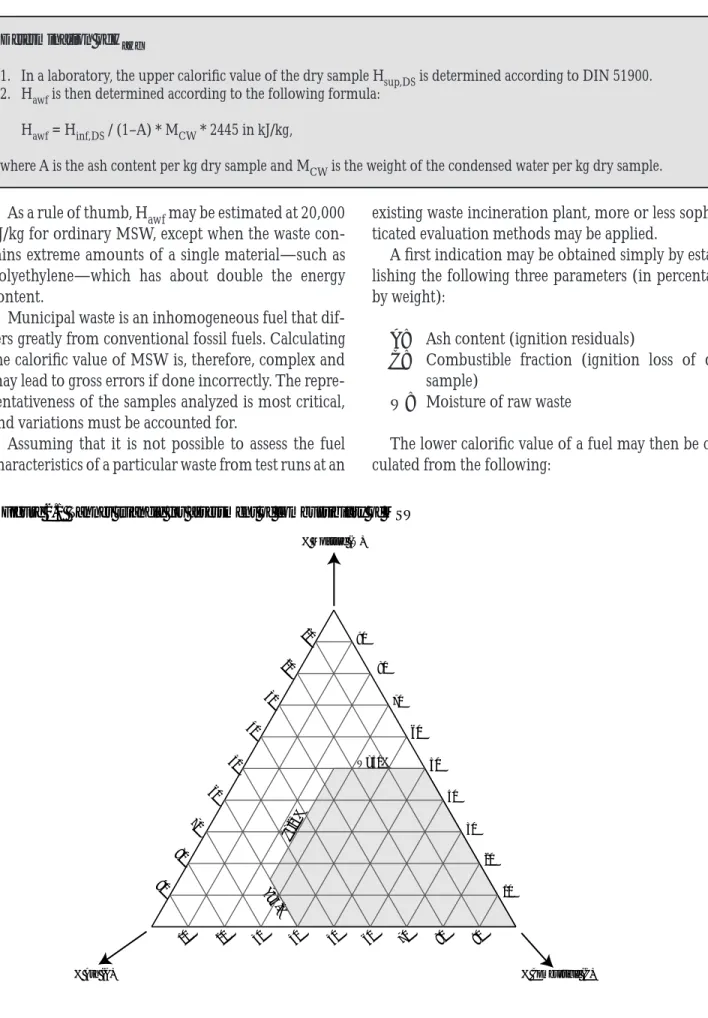
A first indication may be obtained simply by estab-lishing the following three parameters (in percentage by weight):
A: Ash content (ignition residuals)
C: Combustible fraction (ignition loss of dry sample)
W: Moisture of raw waste
The lower calorific value of a fuel may then be cal-culated from the following:
Determination of Hawf
1. In a laboratory, the upper calorific value of the dry sample Hsup,DSis determined according to DIN 51900. 2. Hawfis then determined according to the following formula:
Hawf= Hinf,DS/ (1–A) * MCW* 2445 in kJ/kg,
where A is the ash content per kg dry sample and MCWis the weight of the condensed water per kg dry sample.
80 70 60 50 80 90 70 60 50 40 C=25% 30 20 10 90 A=4-% 80 70 60 10 20 30 40 50 40 30 20 10 90 % Moisture (W) % Combustible (C) % Ash (A) W=50% Figure 2.1 Tanner triangle for assessment of combustibility of MSW
Hinf= Hawf* C – 2445 * W in kJ/kg
Assuming that the waste has no dominant fraction with an extremely low or high calorific value, the lower calorific value may be obtained by applying an approx-imate value of 20,000 kJ/kg for Hawf:
Hinf ≅20,000 * B - 2445 * W in kJ/kg
The result may also be plotted in a Tanner triangle dia-gram to see where it falls within the shaded area indicat-ing a combustible fuel (Figure 2.1). The waste is theoreti-cally feasible for combustion without auxiliary fuel when: W < 50 percent, A < 60 percent, and C > 25 percent.
A more accurate way to assess the fuel quality of a waste is to divide it into characteristic components (organic waste, plastics, cardboard, inerts, and the like), determine the water content (%W), the ash content (%A) and the combustible matter (%C). The lower calorific value for each component can be found in lab-oratory or literature values for Hawf for that
compo-nent. Finally, the overall lower calorific value and ash content are calculated as the weighted average for all components.
Table 2.3 provides examples of the results of this simple waste analysis, as well as the lower calorific value determined as the weighted average of the heat value for characteristic components of the waste. The waste from Manila has the highest combustible content and calorific value.
The method of calculating the calorific value as the weighted average of characteristic fractions of the waste is further illustrated in Table 2.4.
See “Waste Survey,” page 17, for more accurate liter-ature values on Hawf.
Waste Surveys/Forecasts
Estimating the amount and composition of solid waste requires in-depth knowledge of the waste col-lection area’s demographic and
commercial/industri-Waste as Fuel 13
Table 2.3 Fuel characteristics of municipal wastes
Guangzhou China
8 districts-93 /7/ 5 districts-94 /8/ Philippines
Parameter Units Range Mean Mean Manila - 97 /9/
Combustible % 14.6 – 25.5 22.3 31.4 37.6
Ash % 13.8 – 43.1 28.8 22.0 15.6
Moisture % 39.2 – 63.5 48.9 46.6 46.7
Lower calorific value kJ/kg 2555 – 3662 3359 5750 6800
Table 2.4 Example of calculation of lower calorific value from analysis of waste fractions and Hawfvalues from literature
Mass basis Fraction basis Calorific values
% of Moisture Solids Ash Combustible Hawf Hinf
Fraction Waste W % TS% A% C% kJ/kg kJ/kg
Food and organic waste 45.0 66 34 13.3 20.7 17,000 1,912
Plastics 23.1 29 71 7.8 63.2 33,000 20,144
Textiles 3.5 33 67 4.0 63.0 20,000 11,789
Paper & cardboard 12.0 47 53 5.6 47.4 16,000 6,440
Leather and rubber 1.4 11 89 25.8 63.2 23,000 14,265
Wood 8.0 35 65 5.2 59.8 17,000 9,310 Metals 4.1 6 94 94.0 0.0 0 –147 Glass 1.3 3 97 97.0 0.0 0 –73 Inerts 1.0 10 90 90.0 0.0 0 –245 Fines 0.6 32 68 45.6 22.4 15,000 2,584 Weighted average 100.0 46.7 53.3 10.2 43.1 7,650
al structure. Reliable waste generation data and fore-casts are scarce in most countries. Data and key figures are often related to the overall waste generation/dis-posal of large cities and municipalities. Significant dif-ferences will, however, exist between waste generation and composition in a city’s various zones such as its high or low income residential, commercial and industrial areas.
Literature is available on key figures for waste gen-eration and composition. When properly selected and applied, such data may be used for a preliminary assess-ment of the feasibility of various waste treatassess-ment methods. For design purposes, however, it is best to establish and apply specific data for the area. It is rec-ommended that waste quantity and quality be sur-veyed year-round to monitor the seasonal variation both in amounts and in waste characteristics. This may be particularly important in regions with distinct tourist seasons, high monsoon rains, and the like.
Waste Forecasts
To be economically feasible, waste incineration plants must have a life span of at least 15 to 20 years. Waste quantity and composition should be forecast over the lifetime of the incineration plant. A waste generation forecast requires a combination of data normally used for town planning purposes along with specific waste generation data.
Changes in waste composition will be influenced by government regulations of issues such as recycling and the overall economic development of society. However, possible development trends maybe obtained by study-ing the waste composition in different parts of the same metropolis—for instance, in high-, medium-, and
low-income areas. Literature on investigations from similar societies may also be useful. Annual variations are like-ly to continue according to the present pattern.
As an example, the forecast for the domestic waste for the year (n) may be calculated according to the for-mula below. Variables include the present population, the expected long-term annual growth, the most recent waste generation key figure, and the foreseen increase in this figure.
Domestic waste = PP ×(1+ GRPP)n×w
c×(1+GRKF)n PP is the present population, GR the growth rate and wc is the actual key figure, waste generation per capita.
If available, the per capita generation key figure (wc) should be determined by assessing reliable existing waste data. If reliable data is not available, an accurate waste survey should be carried out. An example of per capita generation key figures are shown in Table 2.6.
Waste Survey
If reliable waste data and recordkeeping systems are not available, a waste survey should be used to generate sta-tistically significant results. The survey must consider a large number of parameters selected according to the objective of the study—for example, waste quantity or composition. Also, to detect seasonal variations, the survey should be performed all through the year. Generally, continuous reliable waste data recording and recordkeeping are important for developing
real-Table 2.5 Waste generation forecast parameters
Parameter Development trend
Population Growth/year (overall and by district)
Industrial employment/industrial
area build up Growth/year
Commercial sector employment Growth/year
Gross domestic product (GDP) Annual general prosperity growth
Waste generation key figures Growth/year
Waste composition Function of socio-economic development
Table 2.6 Per Capita Generation Data for Selected Countries
Estimated Domestic Waste Generation
Country Year Ref. kg/capita/day
China general 1990–96 /10/ 0.5 cities 1990–96 /10/ 0.8–1.2 USA 1990 /11/ 2.0 1985 /11/ 1.8 Japan 1990 /11/ 1.1 1985 /11/ 1.0 France 1990 /11/ 1.0 1985 /11/ 0.8 Denmark 1996 /12/ 1.5 1990 /12/ 1.0
istic waste management plans, monitoring the effects of waste management strategies, and publicly control-ling waste flows and the performance of waste man-agement organizations.
The degrees of freedom are statistically reduced when the sampling point moves away from the origin of the waste and towards the disposal site—that is, fewer samples are required to obtain the desired preci-sion of the data. In return, a number of systematic errors may be introduced. For example, scavenging and other recycling activities will reduce weight and change the composition of the waste. In developing countries, where there is much scavenging, the calorific value of the waste may be reduced considerably due to recovery of wood, plastic, textiles, leather, cardboard, and paper. Plus, the weight of the waste may be influenced by cli-matic conditions on its way from the point of origin to ultimate disposal. During dry seasons, weight is lost through evaporation, and precipitation during the wet season may increase the weight.
Waste Quantity—Key Figures and Annual Variation For well-organized waste management systems where most of the waste ends up in controlled landfills, long-term systematic weighing of the incoming waste will allow a good estimate of the key figures for waste gen-eration and the annual variation. Thus, landfills and other facilities receiving waste must have weighing bridges to produce reliable waste data.
To establish waste generation key figures, waste quantity should be registered systematically and fairly accurately. For every load, the collection vehicles must submit information about the type of waste and its ori-gin. Further information about the district where the waste was collected can be obtained from town plan-ning sources and the socio-economic aspects can con-sequently be included in the key figure calculations. Table 2.7 indicates how a waste collection area may be
divided into collection districts to reflect characteris-tics of waste generation.
In places with no waste registration records, typical districts may be outlined according to Table 2.7. Then, the collected waste should be systematically weighed. The registration should continue for at least a full year to detect any seasonal variations. Great care must be taken to ensure that no changes are introduced in the collection districts, which could make the results ambiguous.
Introducing a waste incineration plant will reduce the livelihood of landfill scavengers. They may move to a new place in front of the treatment plant, thus chang-ing the composition and calorific value of the waste. It is important to assess the impact of such a change, according to the amount the scavengers remove at the existing landfill.
Waste Composition
Waste composition varies with the waste type, the socio-economic conditions of the collection area, and seasonal variations. Planning a comprehensive survey of the composition of waste types therefore requires input from a town planner, a waste management expert, and a statistician.
The survey planners should do at least the following: • Divide the waste collection area into zones
accord-ing to land use.
• Subdivide land-use zones according to types of waste generated (see Table 2.6).
• Identify well-defined and representative waste col-lection districts for the types of waste.
• Choose one or more representative districts to sur-vey for each type of waste.
• Select the point of waste interception in such a way that the waste will reflect what will reach a future treatment facility or incineration plant.
Waste as Fuel 15
Table 2.7 Waste types and collection districts
Waste type Collection District
Domestic High income Medium income Low income
Commercial Shopping/office complexes Department stores Markets
• Establish baseline data for the district (population, industry, trade, and such).
• Monitor the amount of waste generated in the dis-trict and the daily number of truck loads.
• Statistically assess the number of samples required to obtain a 95 percent confidence level on the waste composition. The distribution of the individual waste component can be assumed to be Gaussian. However, there should never be less than 25 of each type of waste.
• Assess whether the seasonal variation necessitates more than one round of sampling (for example, summer/winter or wet/dry).
Executing the practical part of the waste composi-tion survey requires addicomposi-tional careful planning. The physical facilities must be prepared to protect the staff performing the sorting and ensure that samples and results remain representative. Sorting is best carried out in well-vented buildings with concrete floors to ensure that no waste is lost. The sorting station must be furnished with sorting tables, a screen, easy-to-clean-buckets or containers, and at least one scale. The logis-tics are summarized in Table 2.8.
Sorting waste to a reasonable degree of accuracy requires that staff have advanced training. The pickers must learn to recognize the different waste categories—especially different types of plastics. They must empty cans, jars and bags before placing them in containers. To ensure consistency, the sam-pling and sorting process must be controlled and supervised by the same person throughout the waste survey. Furthermore, all procedures, includ-ing laboratory analyses and methods of calculation, must be described in detail in a waste characteriza-tion manual.
Sorting categories should be based on the amount of the characteristic categories and their influence on the calorific value. Table 2.9 presents some of the typical characteristic categories. The recommended minimum number of categories are presented together with optional subdivisions. Typical lower calorific values for the ash and water free samples (Hawf) are given for each type of material. These values are approximate, and laboratory measurements of Hawfshould to a certain extent be applied to supplement and confirm or sub-stitute literature values when calculating the overall heat value of the waste.
Table 2.8 Logistics and Principles of Sampling and Analysis of Waste Data
Sampling The collection vehicle from the representative collection district is intercepted according to the plan.
Weighing The vehicle is weighed full and later empty resulting in the total weight. The waste volume is determined/ esti-mated and the average density calculated.
Subsampling Sometimes sorting of full truck loads is too time consuming. Preparing a representative subsample (perhaps 100 kg) often makes it possible to sort waste from more trucks and thereby makes the result more significant. However, preparing a representative subsample is not simple, and a detailed procedure for this routine must be prepared – for example, accounting for drained-off water.
Sorting The waste is unloaded on the floor of the sorting building. It is then spread in layers about 0.1 meter thick on sorting tables covered by plastic sheets. The waste is manually sorted according to the predetermined material categories. The leftover on the table is screened (with a mesh size of about 12 mm). The screen residues are again sorted manually, and the rest is categorized as “fines.”
This procedure is followed until the entire load or subsample – including floor sweepings – has been divided into the appropriate fractions.
Physical Analysis All fractions are weighed and the moisture content determined through drying after shredding at 105˚ C until a constant weight is obtained (about 2 hours). The moisture content is determined on representative samples of all fractions on the day of collection.
Chemical Analysis The chemical analysis should be performed at a certified laboratory. The key parameters are ash content and combustible matter (loss of ignition at 550˚ C for the dried samples) and Net Calorific Value for at least the food and the fines fractions. Samples must be homogenized through proper repetitive mixing and grinding, and at least three analyses should be performed on each fraction to minimize analytical errors.
Ultimately, the waste survey allows a calculation of the average lower calorific value for each type of waste. The formula for determining the lower calorific value (Hinf) for each type of waste is:
Hinf= Hawf* C/100 – 2445 * C (kJ/kg)
By weighting these individual Hinffor each type of waste with the percentage wet weight (M), the overall lower calorific value can be found by applying the fol-lowing formula.
Hinf, overall= M1/100 * Hinf,1+ M2/100 * Hinf,2+ . . . . +Mn/100 * Hinf,n
Waste Load Design Calculation
The waste survey and forecast will establish the expect-ed amount and composition of waste generatexpect-ed during the lifetime of the facility (for example, a 20-year peri-od). The actual volume of waste arriving at the incin-eration plant will depend on the efficiency of the col-lection system, together with negative and positive incentives for supplying the waste to the plant. The most negative incentive may be an increased gate fee compared to fee of landfilling.
Before deciding on the plant’s design capacity, it is recommended to apply a factor for collection efficien-cy to the theoretical amounts. This is especially impor-tant for commercial and industrial waste, which may include a larger proportion of materials suitable for recovery and recycling.
Waste as Fuel 17
Table 2.9 Ash and Water Free Calorific Value (Hawf) for Selected Types of Waste
Component
Main category Subcategories Hawf
(mandatory) (optional) (MJ/kg)
Food scraps and vegetables 15–20
(to be analyzed in each case)
Plastics Polyethylene (bottles, foil, etc.) 45
PVC (bottles, etc.) 15–25
Polystyrene (wrapping) 40
Polypropylene 45
Textiles 19
Rubber and leather 20–25
Paper Dry 16–19
Wet 16–19
Cardboard Dry 16–19
Wet 16–19
Wood and straw 19
Other combustible *
Metals 0
Glass 0
Bones 0
Other non combustible 0
Hazardous wastes *
Fines (<12 mm mesh) 15
(to be analyzed in each case)
The waste load on the incineration facility will consist of a combination of domestic, commercial, and indus-trial waste.
The basic load will, however, be domestic waste, which can be assumed to be supplied almost entirely to the incineration plant.
Separate collection of waste with a high energy con-tent can theoretically increase the calorific value of the waste fuel. However, this method is likely to fail in the practical world due to a lack of efficient waste
separa-tion at the source and the addisepara-tional cost involved in the collection system. Incineration of waste from cer-tain areas (typically the more affluent ones) may, how-ever, be feasible.
Mechanical sorting is another way to raise the average calorific value before incineration. This is typically a step in the production of waste derived fuel, and suitable technology is available, but it usu-ally isn’t used before mass burning because of addi-tional costs.
Key Issues
The success of an MSW incineration plant depends as much on the institutional framework as on the waste and technology. There are four main institutional framework areas to consider: the waste sector, the orga-nization and management of the incineration plant itself, the energy sector, and the authorities responsible for control and enforcement.
The institutional framework for the waste sector and the waste management system must be sufficiently developed to ensure supply of the design waste flow and quality of waste for the life span of the incineration plant. The waste sector must further design and oper-ate a controlled landfill for environmentally safe dis-posal of the incineration residues.
An organizational set-up that can administer the plant and support the waste incineration project so that it becomes an integral part of the waste man-agement system is crucial. There should be a high degree of interaction between the different parts of the waste management system and the waste incin-eration plant either through ownership or long-term agreements.
Incineration is significantly more costly than using landfills. The waste generators—that is, the population and the commercial sector—must there-fore be willing to pay the additional cost, or else there must be a subsidy scheme. Insofar as the operator/ owner of the MSW incineration plant is supposed to collect treatment charges, there must be ways to enforce this.
When ownership is private, there may be institu-tional borderline problems in the delivery of a suffi-cient quantity and quality of waste, the pattern and price of sale of energy, or both. Waste flow must be
con-trolled, thus ensuring that it is delivered to the most appropriate plant and, in particular, that indiscrimi-nate dumping is avoided. Waste flow can be controlled by a combination of tariff policy (including cross-sub-sidization via the tipping fee at the licensed facilities), enacting and enforcing waste management legislation, and a waste data and recordkeeping system.
Traditionally, the waste management sector is viewed as an undesirable place to work. In some regions, this has resulted in poorly managed waste ser-vices. Plus, it has been difficult to recruit and maintain qualified staff—for instance, in rapidly growing economies where the public sector cannot match the salaries of private companies.
In particular, operating and maintaining waste incineration requires a highly skilled and effective management—which means that new and skilled managers may have to be attracted. Existing staff will have to be trained and capacity will have to be expand-ed. Also, it should be decided whether to involve the private sector in operation and maintenance. The nec-essary skills and education resemble the human resource demands in the energy sector, for example, management of power plants.
To ensure proper and environmentally safe opera-tion, authorities responsible for control and enforce-ment must be on hand. These authorities must be inde-pendent of the owner and operator of the waste incineration plant.
In general, incineration plants are influenced by and depend on numerous legal, institutional, and socio-economic factors in the environment. To assess fully the appropriateness of a proposed institutional frame-work, a comprehensive stakeholder analysis must be performed for both the existing and projected situa-tions.
19
Key Criteria
✓ ✓ ✓ A well-functioning solid waste manage-ment system, including a properly engi-neered and controlled landfill, has been pre-sent for a number of years.
✓ ✓ ✓ Solid waste collection and transportation (domestic, commercial, and industrial) are managed by a limited number of well-regu-lated and controlled organizations.
✓ ✓ ✓ There are signed and approved letters of intent or agreements for waste supply and energy sale.
✓ ✓ ✓ Consumers and public authorities are able and willing to pay for the increased cost of waste incineration.
✓ ✓ ✓ Authorities responsible for control, moni-toring, and enforcing operation are present. ✓ ✓ The authorities responsible for control, monitoring, and enforcement are indepen-dent of the ownership and operation of the plant.
✓ ✓ Skilled staff for plant operation are available at affordable salaries. Otherwise, reliable operation and/or maintenance contracts are in place either in the form of operation and service contracts or via BO/DBO/ BOOT/BOO schemes.
✓ The waste management authority owns the incineration plant.
✓ Municipal guarantees cover any shortfalls in the plant economy due to insufficient sup-ply or quality of waste.
Waste Sector
The waste sector includes public institutions and orga-nizations as well as private companies involved in
col-lection, transportation, and final disposal of all types of solid waste. Generally, collection of waste from house-holds and shops in residential areas is based on a pub-lic initiative. Large commercial centers, office com-plexes, and industries are, however, often required to arrange their own waste collection and disposal. Thus, there may be many operators involved in solid waste collection and transportation.
A fully developed and controlled solid waste man-agement system is a precondition for establishing an MSW incineration plant. A functional management system should have been in placefor at least a few years before implementing the incineration plant.
A well-functioning solid waste management system ensures that all domestic, commercial, and industrial wastes are collected, transported, and disposed of in a hygienic and environmentally safe manner at sanitary landfills. Where such systems do not exist, the collec-tion is much less efficient, and a significant part of the waste is likely to be disposed of through uncontrolled dumping.
If the waste management system is not fully con-trolled, increased incineration costs are likely to insti-gate more illegal waste disposal activities. The ultimate effect may be that the supply to the plant becomes insufficient in quantity or quality.
From waste generation to disposal, various kinds of more or less organized recycling activities take place. The commercial sector and the industries employ their own staff to salvage materials to sell and recycle. Scavengers may be found at any stage of the handling system. They search dust bins and containers close to the point of origin of the waste dump sites. Disturbing the waste flow by introducing solid waste treatment facilities may “force” the scavengers to shift their oper-ation from the end of the waste chain toward the begin-ning—thus changing the waste composition believed to be available.
The complexity of the waste management system has occasionally caused legal problems regarding the ownership of the waste. The crucial question is: When does waste change from private property to a public nuisance or asset? If this is not clear from a legal point of view, it is difficult to commit or ensure the supply of waste to the treatment facility. Thus, regulatory changes may be necessary.
Payment for services rendered is generally crucial in waste management. Public health protection requires waste to be collected and disposed of away from inhab-ited areas, but not all areas or sectors may be willing or able to pay for such services. The only secure way of recovering the costs is through mandatory service charges collected from the waste generators—possibly together with property taxes or service charges for water and electricity.
Private waste operators serving trade and industry are likely to dispose of waste in the cheapest possible way, even using an illegal method such as indiscrimi-nate dumping. Strict control and enforcement are required to prevent such activities.
Energy Sector
Incineration plants consume and generate large amounts of energy and are therefore important players in the local energy market—especially in relatively small communities. It is thus important to establish whether an incineration plant for solid waste can be integrated into the legal and institutional framework of the energy sector.
The energy sector is often heavily regulated. Concession to produce and sell electricity is generally granted only to a limited number of public or private operators. An incineration plant established by anoth-er organization may thanoth-erefore face opposition in obtaining necessary approval. Cooperation with exist-ing energy producers or consumers can therefore be useful.
Prices of energy paid by consumers may be subsi-dized or taxed rather than based solely on production costs. The prices of energy from waste incineration may therefore have to be fixed by the government—which brings up important political and socio-economic con-siderations. A high price resulting in a reduced gate fee will subsidize the waste sector, whereas a low price will favor the energy consumers.
It is most feasible when the energy can be sold to a single consumer for its own use or resale. The con-sumer may be a utility company with an existing dis-tribution network for district heating or power or a large steam-consuming industrial complex.
The purpose of solid waste incineration plants is to treat waste and hence reduce the waste volume for dis-posal. The design and layout of an incineration plant are based on continuous operation at 100 percent load. In principle, the energy output will be almost constant 24 hours a day. The waste energy can there-fore be regarded as a supplement to other fossil fuel-based energy sources that are operated at a load corre-sponding to the actual energy demand. Normally, the energy produced from incineration plants is regarded as base load. Depending on the price pattern, the price of the waste generated energy will reflect this base load status.
To use all the energy produced, incineration plants should mainly be established in large energy networks where they can function as base load units with both diurnal and seasonal variation.
Incineration Plant Organization and Management
Ownership and Operation
MSW incineration plant ownership and allocation of operational responsibility is of great importance. Different kinds of borderline problems may arise depending on the model. These problems are related to supply and quality of waste, as well as sale and distrib-ution of heat, or both—depending on whether the plant belongs within the waste sector, the energy sec-tor, or to a private operator.
Incineration plants belonging to the solid waste management organization responsible for waste col-lection, transportation, treatment, and ultimate dis-posal generally experience few problems regarding the supply of “fuel” or disposal of residuals. The main insti-tutional problems are related to the selling and distrib-uting energy.
Alternatively, the incineration plant may be located within the energy sector and belong to the power sup-ply companies. Here, there are no problems with sell-ing and distributsell-ing energy. However, there may be problematic cultural differences between the energy sector and the waste sector.
The energy sector is accustomed to a highly stan-dardized fuel quality and is not used to variations in quantity and quality of waste. Normally, energy
ducers modulate the operational pattern according to the energy demand. MSW incineration plants, howev-er, have to follow the pattern of supply rather than demand. They must therefore accept variations in quantity and quality of the fuel and energy output. An energy sector-based incineration plant owner will therefore try to exercise control over maximum and minimum waste supply and quality.
Privatization of incineration plants can include combined ownership and operation or operation only. Fully privatized facilities may experience borderline problems towards both the waste management and energy sectors. Establishing the necessary agreements is complicated, and problems monitoring and control-ling the waste supply and energy sale will develop.
The borderline problems between the sectors must be solved through firm and irrevocable agreements before plans are made to build the plant. Otherwise, the feasibility of the plant is jeopardized.
Staff recruitment and maintenance may be crucial when deciding on the plant’s ownership. In booming economies, the government often pays significantly smaller salaries than the private sector. In return, the government and other authorities often provide pen-sion schemes and greater job security than the private sector.
This may make it difficult for the public sector to attract enough qualified staff. Staff trained at the plant’s expense may leave for better paying jobs. The privately owned and operated facilities can better retain staff, since they can pay competitive salaries and incentives. Both private and publicly operated plants must, however, expect to have a continuous human resource development (HRD) program to maintain staff for plant operation and maintenance.
The organizational set-up and financial manage-ment system for the incineration plant can influence plant upkeep and maintenance. Several special equip-ment spares and components may be available only from abroad. Because spending foreign currency can be restricted or may require an extended approval process, procuring emergency replacement parts may cause the plant to shut down for long periods of time. It is preferable for the incineration plant to be an economic entity of its own, whether publicly or pri-vately owned and operated. This gives the plant
man-ager the freedom to acquire local spares and mainte-nance contracts quickly.
Waste incineration is significantly more costly than waste disposal in sanitary landfills, even after incorpo-rating the revenues from sale of energy. The addition-al costs can seldom be collected as a gate fee addition-alone, because the waste might be taken and disposed of in an uncontrolled manner. The budget deficiency must be covered by general waste service charges, otherwise col-lected or compensated for through subsidies.
Waste management charges should generally be col-lected by an authority which holds sufficient legal power to apply reprisals when payments are not made. Establishing new entities solely to collect incineration fees is costly and must be accompanied by an allocation of enforcement power to collect overdue payments.
Tender Models for Waste Incineration Plants
Table 3.1 outlines the principal tender models and ownership and management models for waste inciner-ation plants.
The traditional tender model is the multiple contract or single turnkey contract model. After commissioning the plant, the client—typically the municipality, a group of municipalities or a public waste management insti-tution—begins operating the plant.
These models ensure the most public control of ser-vice level, plant performance, plant finance, and tariff setting. However, the client must bear the financial bur-den of the investment and acquire the management and technical skills for implementing and operating the plant. A time-limited management and training (HRD) contract (about 1 or 2 years) must be included in the scope of supply.
If the multiple contract model is applied, the divi-sion into lots must be limited and respect the natural entities. The furnace and boiler, for instance, must be in one lot. However, unless the client has experienced personnel with firm knowledge of procurement and waste incineration skills, it is strongly advisable to divide the lots into no more than two main supplies: complete machinery and structural.
The operation contract has been applied where municipalities wish to free resources from opera-tional duties or where it has been more economical to let an experienced private contractor operate and
23
Table 3.1 Applicable Tender and Contracting Models for Waste Incineration Plants
Tender Model Client’s Obligations Contractor’s Obligations Advantages Constraints
Multiple contracts
Single turnkey contract
Operation contract Build Operate Design Build Operate Build Own Operate Transfer Build Own Operate
Financing. Function specifica-tions, tendering, project coordi-nation, and construction super-vision. Ownership and operation.
Financing. Function specifica-tions, tendering, and client’s supervision. Ownership and operation.
Multiple or single turnkey con-tract. Ownership. Supply of waste.
Financing, function specifica-tions, tendering, and client’s supervision. Ownership. Supply of waste.
Financing. Overall function specifications and tendering. Ownership. Supply of waste.
Overall function specifications and tendering. Ownership after transfer. Supply of waste.
Overall function specifications and tendering. Supply of waste.
Supply and detailed design of individual parts for the plant.
Responsible for all project design, coordination, and pro-curement activities.
Operation of the completed and functional plant in a certain peri-od.
Detailed design, project manage-ment, contractor’s supervision, operation, and maintenance.
Detailed design, project manage-ment, supervision, operation, and maintenance. Ownership.
Financing, design, project man-agement, supervision, operation, and maintenance. Ownership until transfer.
Financing, ownership, design, project management, supervi-sion, performance guarantees, operation, and maintenance.
Full client control of specifica-tions. Possible to create the optimum plant based on most feasible plant components.
One contractor has the full responsibility for design, erec-tion, and performance.
Limited strain on the client’s organization.
Contractor committed to well-functioning and effective solutions. Limited strain on client’s resources.
Contractor committed to well-functioning and effective solutions. Limited strain on client’s resources.
Contractor finances, con-structs, and operates the plant for a period after which the plant is transferred to the client. Very limited strain on client’s resources.
Client does not need to finance the project. Contractor committed to well-functioning and effective solutions. Very limited strain on client’s resources.
Absolute requirement for project management and waste incineration skills in the client’s organization.
Limited client control of choice of plant com-ponents.
Difficult for client to secure affordable tariffs, (put or pay contract), control finances, and monitor the contractor’s performance and ser-vice level.
Difficult for client to secure affordable tariffs (put or pay contract), control finances, and monitor the contractor’s performance and ser-vice level.
Difficult for client to secure affordable tariffs (put or pay contract), control finances, and monitor the contractor’s performance and ser-vice level. Limited client control of choice of plant components.
Difficult for client to secure affordable tariffs (put or pay contract), control finances, and monitor the contractor’s performance and ser-vice level. Limited client control of choice of plant components.
Difficult for client to secure affordable tariffs (put or pay contract), control finances, and monitor the contractor’s performance and ser-vice level. Limited client control of choice of plant components.
maintain the plant. It is also applicable where the client has established a plant according to one of the aforementioned models but wants a different con-tractor—for example, a local company—to operate the plant.
There are several variants for using private contrac-tors in designing, financing, and operating incinera-tion plants. In one common variant of privatizaincinera-tion, supervision and control of private contractors is per-formed by highly skilled clients (municipalities/ authorities). In particular, the client must have highly skilled legal, contractual, and financial specialists to set up contracts for implementing, operating, owning, and financing incineration plants with private contractors. Detailed and professional contracts must be estab-lished to protect the client’s obligation to provide effi-cient, affordable, and environmentally sustainable waste management services to the community.
In general, the client loses financial and technical maneuverability when entering into long-term service contracts with private contractors, but on the other hand, financial resources and staff are liberated for other purposes. The client must also offer guarantees on the supply of waste, sale of energy, and payments to the contractor (put or pay contracts). The put or pay contracts are the contractor’s insurance against increased net treatment cost if major preconditions fail—for example, minimum waste supply or calorific value of the waste. (For information on the conse-quences when preconditions fail, see chapter 4—par-ticularly Figure 4.4.)
The client will also be asked to issue guarantees for the servicing of the loans used by the contractor to finance building the plant.
Deciding whether to contract out the establishment, operation, financing, or ownership of incineration plants to private contractors should not be taken light-ly. It is important to weigh consciously the advantages and constraints of all options against the local condi-tions—in particular, the client’s creditworthiness and resources in terms of capital and staff skills, as well as the actual legal framework for publicly monitoring and controlling a private contractor.
Authorities
Authorities responsible for control, monitoring, and en