DOCTORAL DISSERTATION
Efficient Information
Dissemination Systems
Anton Riabov
Columbia University
Department of Industrial Engineeringand Operations Research
March 2004
Acknowledgements
I would like to thank my advisors Prof. Daniel Bienstock and Prof. Jay Sethuraman for their help and support in my studies and research. I am also very grateful to my coauthors and mentors Li Zhang, Zhen Liu, Sambit Sahu, Joel L. Wolf, and Philip Yu at T.J. Watson IBM Research Center for their help in finding and understanding exciting practical research problems. This work would not have been possible without them.
Contents
1 Introduction 5
1.1 Information Dissemination Systems . . . 5
1.2 Internet Infrastructure and Multicast . . . 6
1.3 Overlay Multicast and Performance Optimization . . . 8
1.4 Summary of Contributions . . . 10
1.5 Structure of the Thesis . . . 11
2 Reliable Overlay Multicast 12 2.1 Introduction . . . 12
2.2 Architecture of Reliable Overlay Multicast . . . 13
2.2.1 Reliable Transfer and Forwarding via Back-Pressure . . . 15
2.2.2 End-to-End Reliability and Backup Buffers . . . 15
2.2.3 Leave and Join Procedures . . . 16
2.3 End-to-End Reliability . . . 16
2.3.1 Guarantee of the End-to-End Reliability . . . 17
2.3.2 Handling Leave and Join and Restoring Connectivity . . . 18
2.4 Simulation and Experimental Results . . . 19
2.4.1 Scalability and Reliability: Internet Measurements . . . 19
2.4.2 Simulation of Tree Evolution . . . 22
2.5 Conclusions . . . 23
3 Minimum Radius Spanning Tree With Degree Constraints 24 3.1 Introduction . . . 24
3.3 Asymptotically Optimal Algorithm . . . 27
3.3.1 Constructing the polar grid. . . 28
3.3.2 Connecting the cells. . . 28
3.3.3 Connecting remaining points within cells. . . 29
3.3.4 Lemmas. . . 29
3.3.5 Solution analysis. . . 30
3.4 Generalization . . . 32
3.4.1 Out-Degree 2 . . . 32
3.4.2 Higher Dimensions . . . 32
3.4.3 General Convex Region . . . 33
3.5 Experiments . . . 33
3.6 Conclusion . . . 37
4 Throughput Maximization in Overlay Multicast 38 4.1 Introduction . . . 38
4.2 Degree-Constrained Spanning Tree Problem . . . 39
4.2.1 Witness Set Theorem . . . 39
4.2.2 Approximation Algorithm for DCST . . . 41
4.2.3 Analysis of the Algorithm . . . 42
4.3 Duplex Channel Problem . . . 42
4.3.1 Complexity Analysis . . . 43
4.3.2 Approximation Algorithm . . . 43
4.4 Separate Channel Problem . . . 44
4.4.1 Complexity Analysis . . . 45
4.4.2 Approximation Algorithm . . . 45
4.5 Upper Bounds . . . 47
4.5.1 Total Degree Bound . . . 47
4.5.2 Witness Set Bound . . . 47
4.6 Solving Throughput Maximization Problem Numerically . . . 48
4.6.1 Initial Relaxation . . . 49
4.6.3 Volume Algorithm . . . 52
4.7 Experiments . . . 53
4.8 Conclusion . . . 55
5 Multicast Group Membership 56 5.1 Introduction . . . 56
5.2 Problem Notation . . . 59
5.3 Preliminary Analyses . . . 59
5.4 Algorithms for Subscription Clustering . . . 63
5.4.1 Grid-Based Clustering Framework . . . 63
5.4.2 K-Means and Forgy K-Means Clustering . . . 65
5.4.3 Pairwise Grouping . . . 65
5.4.4 Minimum Spanning Tree Clustering . . . 66
5.4.5 No-Loss Algorithm . . . 66
5.4.6 Matching Subscriptions To Events . . . 67
5.5 Experiments . . . 68
5.5.1 Experiment Model . . . 68
5.5.2 Experiment Results . . . 70
5.6 Conclusions and Discussions . . . 72
6 Conclusions and Future Work 75 6.1 Contributions . . . 75
Chapter 1
Introduction
This thesis presents new models for analysis of overlay-based information dissemination systems and proposes new algorithms that allow these systems to achieve optimal performance, or performance that is provably close to optimal. In this work we study optimization problems associated with finding spanning trees that achieve optimal delay or throughput subject to degree constraints. Although we formulate these problems and describe algorithms with Internet overlay networks in mind, our methods can be applied for performance optimization in other types of information networks where node degrees can not exceed preset maximum, dictated by real-world constraints.
1.1
Information Dissemination Systems
The digital information era has brought incredible advances in computing and communication tech-nology, the advances that have made possible the advent of new methods of communication, such as web and email, and their penetration in all spheres of our life. Increasingly accessible electronic com-munication is changing the way businesses work and people live. The spread of the Internet reaches almost all parts of the world, and even in space astronauts can read and send email messages.
The most popular applications of these new communication technologies, including email and the web, are built upon reliable point-to-point connection-based data transmission provided by a family
of network protocols called TCP/IP. Traditionally this communication method is referred to as
uni-cast,to emphasize that each such transmission has only one destination. However, in many practical communication scenarios the same block or stream of data must be sent to more than one destination. Such applications as web seminars, video conferences, or online stock trading systems, use the network to push data streams from a source node to a set of subscribers. Increasingly available and widespread broadband Internet connections contribute to the growing interest in these new and important appli-cations that can efficiently support group interaction. These new appliappli-cations have the potential to shape the future of the Internet and change the way people communicate once again.
In this work we will use the termInformation Dissemination Systems to describe systems that deliver
individual copies of the same data from one source computer or a cluster of computers to client
computers (subscribers) via the Internet. Although we concentrate on developing methods for efficient
delivery of data from one source to multiple receivers, our results can be applied in cases where more than one group member can be a transmission source. For example, a straightforward extension to multiple sources is to construct a dissemination system for each source separately, and then use a
combination of these systems, assigning each source to the corresponding dissemination system. The typical applications that use group communication can impose different, and sometimes conflict-ing, requirements on the information dissemination system. Devising methods for designing efficient and reliable content dissemination systems that can satisfy these requirements is crucial for the de-velopment of the future generation of Internet communication.
The requirements typically presented to the content dissemination systems may demand to keep system performance above a fixed threshold, or may require the system to achieve best possible performance. Further, the requirements may impose constraints on reliability and other aspects of system behaviour. Many applications, such as real-time streaming applications, including video-over-Internet broadcasts
and video conferences, requirehigh throughput andlow latency of the dissemination system. Typically
in streaming applications group membership changes are relatively infrequent, and transmitted data size is large, so that configuration time is insignificant when compared to transmission time. This property allows to use models that assume steady data flow in the network, that is not affected by configuration traffic and associated computation. Similarly, in cache synchronization applications and multiplayer video games group membership can be considered static.
Examples where static group membership does not hold can include peer-to-peer networks and news distribution systems, such as stock price update distribution. In news distribution systems very small news messages are delivered to large groups of subscribers, however amount of data sent to each particular user of the system is small.
Reliable delivery is another important requirement, which must be satisfied by the dissemination sys-tem in most of the described applications. Finally, in addition to throughput and latency requirements,
which can be viewed as performance requirements, there is often also a requirement ofscalability: the
system must efficiently support communication within large groups, and small increase in group size should not lead to sharp decline in system performance.
1.2
Internet Infrastructure and Multicast
The Internet is a composition of a number of connected packet networks (subnets) supporting commu-nication between host computers via Internet protocols. All protocols used in the Internet are based on the Internet Protocol (IP), which provides a basic data transport mechanism. The routers (or gateways) forward IP datagrams between subnets based on IP address specified in the datagram and a routing table stored in the router. During delivery IP datagrams may be damaged, lost, or arrive out of order. Applications running on the host computers rely on transport protocols for end-to-end com-munication. There are two transport layer protocols: Transmission Control Protocol (TCP) and User Datagram Protocols (UDP). TCP provides reliable connection-based data delivery. It can resequence packets if needed and adapt to changing network conditions by reducing or increasing transmission rate. UDP is a connectionless transport protocol, which does not guarantee reliable datagram delivery, but does not have the overhead associated with reliable communication.
IP address is a 32-bit number, which identifies destination of a datagram. A newer version of the Internet Protocol (IPv6) can use 48-bit numbers for addressing. Longer addresses allow to address more hosts uniquely, and therefore to support larger networks. However, these extended addresses are used in a very similar addressing scheme, and in this discussion we will refer to 32-bit version, which is commonly used in the current Internet. There are five classes of IP addresses: class A through E.
Figure 1.1: IP Multicast Tree.
Class of the IP address is defined by first bits of the address (address prefix). IP addresses of classes A, B and C identify hosts, and are used to specify targets of unicast communication. The distinction between classes A, B and C is no longer important. Class E address are reserved for experimental use. A special address 255.255.255.255 is used for broadcast: a datagram addressed to this address
must be delivered to all hosts. And finally, class D addresses are used for multicast. A datagram sent
to a multicast address must be delivered to all hosts belonging to a group of hosts, called a multicast
group. Multicast group is identified by a 28-bit number encoded in class D address.
Multicast can be viewed as a middle point between unicast and broadcast: it implements one-to-many communication, as opposed to one-to-one in case of unicast or one-to-all in case of a broadcast. Mul-ticast provides a more efficient method of group communication, than unicast. If the communication network is not a complete graph, sending the same data from the same source to several destinations can involve sending multiple copies of the same packet (but with different destinations) on the same link. This may not pose a problem for small groups and small transmission sizes, but in many ap-plications limited bandwidth of the interface link connecting the source to the network may limit the size of the group. Multicast allows packets to follow a spanning tree reaching all destinations, while sending only one copy of a packet on each link, and creating a necessary number of copies at branching nodes.
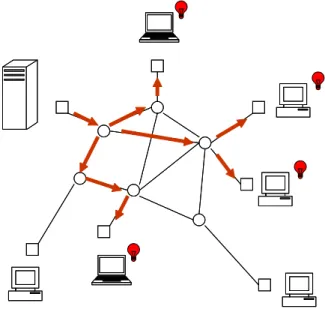
Figure 1.1 shows an IP multicast tree in a network connecting computers and routers. Routers are shown as circles, and computers as squares. Distribution tree is shown by arrows, and routers can forward packets they receive to one or more destinations, as required by multicast routing.
Although a special class of IP addresses had been reserved for multicast from the beginning, multicast was being adopted very slowly. Up to this day availability of IP multicast in the Internet is limited: not all routers can interact to provide necessary multicast service. In particular routers must be able to forward datagrams to more than one destination, and to support required data structures in routing tables. A number of multicast routing protocols, such as PIM, DVMRP, CBT, MOSPF, have been developed. A survey of IP multicast methods can be found in [42]. For more details about Internet protocols and IP multicast see e.g. [22]. For discussions of IP multicast applications and challenges see [47].
over the Internet:
1. Limited number of groups. Each multicast group must have a globally unique IP address. As a consequence, IP address range used by an application must be reserved in advance, and the number of groups that can coexist in the network is limited. This can result in service being denied to clients who attempt to establish a group when the allocated range of IP addresses is exhausted.
2. Scalability. Although multicast resolves the link congestion problem that exists in unicast case, discovery of group members and maintaining data structures in routing tables still presents challenges for large networks.
3. Interdomain Routing. Existing multicast routing protocols are deployed within isolated subnets within the Internet, and for large-scale multicast deployment it is required to connect the sub-nets via an interdomain multicast routing protocol. However, currently proposed protocols are considered too complicated and ineffective to be deployed [4].
4. Reliability vs. Scalability. IP multicast by itself does not provide reliable connection, and if reliability is desired, additional functionality must be implemented. However it has been shown that in such implementations throughput vanishes when group size increases [53, 16].
5. Security. IP multicast delivers a packet sent to multicast address to all destinations subscribed to the corresponding multicast group, while reducing traffic leaving the source to only one copy of the packet. Absence of access control makes IP multicast a target for Denial of Service (DoS) attacks.
1.3
Overlay Multicast and Performance Optimization
When it became apparent that IP multicast has very limited capacity as a means of information
dissemination over Internet, an alternative calledoverlay multicast was proposed. This new technology
is also referred to as end-system multicast or application level multicast. In overlay multicast the
multicast distribution tree is formed using point-to-point connections between end systems (hosts). Standard Internet transport protocols (TCP or UDP) are used to provide transport service between end systems, and therefore the network routers are not required to support any of the IP multicast routing protocols. However the end systems are now required not only to receive the data, but to forward it to other end systems located deeper in the distribution tree. Overlay multicast removes the burden of multicast routing and packet replication from the routers, which allows to utilize existing Internet infrastructure for efficient information dissemination.
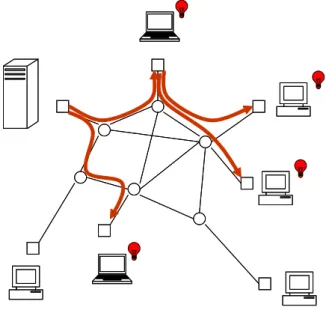
Figure 1.2 illustrates an implementation of overlay multicast in the network introduced in Figure 1.1. Arrows indicate unicast flows between end systems. An edge in the overlay network represents the path between the two nodes that it connects. While this path may traverse several routers in the physical network, this level of abstraction considers the path as a direct link in the overlay network. This new technology has become an area of extensive research. Various studies have been conducted with the primary focus on the protocol development for efficient overlay tree construction and main-tenance, such as Narada [19], Yoid [25], ALMI [46, 54], Host Multicast [64], NICE [9], Delauney graph [37], and [55, 56]. Some other work in peer to peer network area is also related to the tree construction in overlay multicast, see e.g. Chord [59] and CAN [48].
Figure 1.2: Overlay Multicast Tree.
Reliable multicast can also be implemented in overlay using point-to-point TCP connections. An examples of such systems include Overcast [33] and RMX [17]. The main advantage of such approaches is the ease of deployment. In addition, [17] argues that it is possible to better handle heterogeneity in receivers because of hop-by-hop congestion control and data recovery provided by TCP. Further, it has been shown that in contrast to reliable network-supported multicast, TCP-based overlay multicast is scalable [7, 6].
Performance characteristics of information dissemination system based on overlay multicast may vary depending on the choice of links that are used to build the multicast tree. Increasing the number of downstream connections for the source node, for example, may reduce latency of the system by reducing tree depth, but it may also reduce multicast throughput, since capacity of the link connecting the source node to the Internet must be shared between all outgoing links. Bandwidth sharing between point-to-point transmissions comprising the same multicast tree makes overlay multicast routing problem more difficult than its IP multicast counterpart, and hence wide range of performance optimization methods and models developed for IP multicast cannot be reused directly for overlay optimization.
In research papers that describe heuristics for optimal overlay routing, this throughput sharing phe-nomenon is modeled by imposing degree constraints on the nodes in multicast tree, see e.g. [39, 57, 54].
Degree constraints are also referred to as fanout constraints, due to the fact that multicast trees are
directed, and degree constraints can be replaced by equivalent constraints on out-degree. In other words, it is assumed that if a certain fixed level of throughput must be achieved, the maximum number of streams that can be forwarded to downlinks by a node can be determined based on the capacity of access link connecting the node to the Internet. This model ignores capacity sharing between streams that may occur on the links inside the Internet, which is usually justified by high capacity of these links and efficient routing algorithms.
Problems of finding spanning trees that satisfy degree constraints and, optionally, optimize an objective function were also studied in a few research papers not directly related to overlay multicast. In [15] a numerical solution approach based on branch-and-bound method is proposed for the problem of finding minimum spanning tree which is subject to degree constraints. In [34] an approximation algorithm is proposed for the minimum diameter spanning tree problem. Finally, in [26] and [27]
an approximation algorithm for finding a spanning tree of minimum degree is described. However, existing research of this topic does not provide ready solutions for optimal overlay routing problem, and further investigation of this class of problems is required.
1.4
Summary of Contributions
The main contribution of this dissertation is a family of efficient methods that can maximize scalability of an information dissemination system by configuring the system such that it achieves optimal or close to optimal performance. Our contributions lie in two areas related to large-scale information dissemination systems. First, we develop models and efficient methods for finding optimal overlay multicast trees with respect to throughput and latency. Second, we address the issue of forming multicast groups for the special case of information dissemination systems, where subscribers are interested in receiving only those messages that correspond to their interests – so called content-based publish-subscribe systems. We explain our results in more detail below.
Scalable and Reliable Overlay Multicast Architecture. We propose an architecture for reli-able overlay multicast, which can recover from node failures and provide support for clients joining and leaving an ongoing multicast session. We evaluate scalability and reliability characteristics of our prototype implementation in the Internet. We demonstrate that reliable multicast overlays can be deployed on top of the current TCP/IP by adding a light set of application layer back-pressure mecha-nisms that guarantee both end-to-end flow control and reliability. We further show that architectures can be used for group communications of large sizes and still provide a group throughput that is close to that of a single point to point connection with these minimal guarantees.
Minimum Latency Routing. We describe an algorithm for constructing a multicast tree with the objective of minimizing the maximum communication delay (i.e. the longest path in the tree), while satisfying degree constraints at nodes. We show that the algorithm is a constant-factor approximation algorithm. We further prove that the algorithm is asymptotically optimal if the communicating nodes can be mapped into Euclidean space such that the nodes are uniformly distributed in a convex region. We evaluate performance of the algorithm using randomly generated configurations of up to 5,000,000 nodes.
Maximum Throughput Routing. We formulate the optimization problem of maximizing through-put in overlay multicast, and prove that it NP-hard. We further prove a bound on best achievable approximation factor. Next, we develop a constant factor approximation algorithm for the problem, which achieves throughput close to the best possible. Our experiments show that the problem of finding optimal routing can be very hard even on small networks, and cannot be solved by standard numerical solvers. We then develop an approach, based on integer programming, volume algorithm and cutting planes, that allows to find the exact optimal routing numerically, and perform numeric experiments.
Interest-Based Grouping. We consider efficient communication schemes based on multicast tech-niques for content-based publication-subscription systems. We propose to use clustering algorithms to form multicast groups. We devise new algorithms and adapt partitional data clustering algorithms
for these content-based publication-subscription systems. These algorithms can be used to determine multicast groups with as much commonality as possible, based on the totality of subscribers’ inter-ests. These algorithms perform well in the context of highly heterogeneous subscriptions, and they also scale well. We demonstrate the quality of our algorithms via a set of simulation experiments.
1.5
Structure of the Thesis
This thesis is organized as follows. In Chapter 2 we introduce reliable overlay multicast architecture, and investigate scalability and reliability of the proposed system via experiments in the Internet. Chapter 3 studies minimum latency routing. We describe the model, and formulate an optimization problem that we call minimum radius spanning tree with degree constraints. We analyze existing work on mapping Internet delays to Euclidean space, and conclude that to solve the latency minimization problem it is sufficient to the minimum radius problem for the special case of Euclidean distances. We then describe a constant factor approximation algorithm. We prove that the algorithm constructs solutions that are asymptotically close to optimal if nodes are uniformly distributed in convex region. In Chapter 4 we study maximum throughput routing. We develop a constant factor approximation algorithm and a method for solving the problem exactly. Chapter 5 studies the problem of grouping subscribers based on interest, which arises in a special subset of information dissemination systems, namely content-based publish-subscribe systems. In this chapter approach the problem of grouping subscribers separately from the multicast routing problem due to its complexity. We propose and evaluate clustering heuristics for solving this problem. Finally, in Chapter 6 we summarize our results and propose directions for future work. Results presented in this thesis were published in [49, 50, 51, 7, 6].
Chapter 2
Reliable Overlay Multicast
2.1
Introduction
With the proliferation of broadband Internet access, end-system multicast becomes not only a prac-tically feasible approach, but also an appealing alternative to the IP-supported multicast which has been experiencing deployment obstacles. In many applications, such as cache synchronization, peer-to-peer systems, and online learning reliable delivery is very important. In this chapter we will describe system architecture for reliable overlay multicast, and discuss reliability and scalability of proposed architecture.
Reliable overlay multicast can be implemented using point-to-point TCP connections. In Overcast [33], HTTP connections are used in between end-systems. In RMX [17], TCP sessions are directly used. The main advantage of such approaches is the ease of deployment. In addition, [17] argues that it is possible to better handle heterogeneity in receivers because of hop-by-hop congestion control and data recovery.
Two issues arise from this approach. The first one is the end-to-end reliability. In case of failure of a interior node of the overlay multicast tree, the nodes in the subtree rooted at the failed node need, on one hand, to be re-attached to the remaining tree and, on the other hand, to get TCP sessions established from where they are stopped. The former is referred to as the resiliency issue in the literature, which, in this context, consists in the detection of failures and in the reconstruction of trees. Very recently resilient architectures have become a hot topic. For example, in [10], a resilient multicast architecture was proposed using random backup links. While it is relatively easy to find nodes of re-attachment and thus to reconstruct the tree, it is not guaranteed that the TCP sessions can be restarted from where they are stopped due to the fact that the forwarding buffers of the intermediate nodes in the overlay network have finite size. It may happen that the packets needed by the newly established TCP sessions are no longer in the forwarding buffers.
The second issue that arises in reliable multicast using overlays is the scalability. There is a lack of un-derstanding of the performance of TCP protocol when used in an overlay based group communication to provide reliable content delivery. Although studies in [17, 33] have advocated the usage of overlay networks of TCP connections, they do not address the scalability concerns, in terms of throughput, buffer requirements and latency of content delivery. In contrast, significant effort has been spent on the design and evaluation of IP-supported reliable multicast transport protocols in the last decade, see for example [24, 14, 36] and the references therein. It has been shown in various studies [53, 16]
that for such IP-supported reliable multicast schemes, group throughput vanishes when the group size increases. Thus these schemes suffer from scalability issues.
Some preliminary results have been reported recently on the scalability issue of overlay based reliable multicast. In [60], the authors investigated this scalability issues while considering a TCP-friendly con-gestion control mechanism with fixed window-size for the point-to-point reliable transfer. Simulation results were presented to show the effect of the size of end-system buffers on the group throughput. In recent work by F. Baccelli and others [7, 6] it was shown using max-plus algebra models that reliable overlay multicast based on point-to-point connections via TCP has scalable throughput in the sense that the group throughput is lower bounded by a constant independent of the group size. In this chapter, we show that end-to-end reliability of multicast using overlays can be achieved with
the native TCP back-pressure mechanism together with backup buffers. We call back-pressure the
ability for the receiver of a TCP connection to stop packets being sent by the source, in case its receiving buffer is full (see more details in the next section). More specifically, we propose a simple end-system multicast architecture where the transfers between end-systems are carried out using TCP. The intermediate nodes have finite size forwarding buffers. There is also a backup buffer with finite size in each of these intermediate nodes storing copies of packets which are copied out from the receiver window/buffer to the forwarding buffer. These backup buffers are used when TCP connections are re-established for the children nodes after their parent node fails. Using theoretical investigations, experimentations in the Internet, and simulations of large networks, we show that such an architecture provides end-to-end reliability and can tolerate multiple simultaneous node failures, provided the backup buffers are sized appropriately. We also confirm via experiments in the Internet that the theoretical scalability results presented in [6], namely that the throughput of this reliable group communication is always strictly positive for any group size and any buffer size. The back-pressure mechanism of TCP allows not only reliable point-to-point transfers, but also scalable end-system multicast.
In our architecture, we also propose leave and join procedures which guarantee the reliability and scalability of the group communication. These considerations of leave and join events are particularly motivated by the increasing interest in using TCP for real time applications, (see studies on multimedia streaming over TCP [31, 40]). TCP is an appealing alternative of UDP for such applications due to a number of advantages such as fair bandwidth sharing, in-order delivery and passing through client imposed firewalls, which may only permit HTTP traffic.
The chapter is organized as follows. Section 2.2 describes the core of the problem and the multicast overlay architecture. Section 2.3 describes the algorithms ensuring overall reliability and gives a proof of their end-to-end reliability properties. Simulation results and Planet-Lab experiments aiming at
showing the joint scalability and reliability properties of this kind of architecture are gathered in§2.4.
2.2
Architecture of Reliable Overlay Multicast
We consider the problem of reliable group communication where the same content has to be trans-ported in an efficient way from a source to a set of users. The broadcasting of this content is made efficient via the setting of a multicast tree where each node of the tree duplicates the packets it receives from its parent node and sends them to all its child nodes. In contrast to native reliable IP multicast where the nodes of the tree are Internet routers and where specific routing and control mechanisms are needed, overlay multicast uses a tree where the nodes are end-systems and where the currently
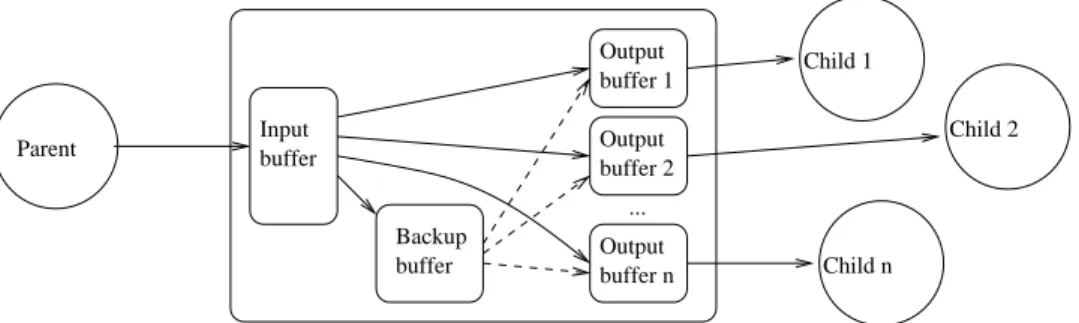
... Output buffer 1 Output buffer 2 Output buffer n buffer Input Parent Child 2 Child n Child 1 Backup buffer
Figure 2.1: Reliable Overlay Multicast: Different buffers in a node.
available point to point connections between end-systems are the only requirement.
An edge in the overlay network represents the path between the two nodes that it connects. While this path may traverse several routers in the physical network, this level of abstraction considers the path as a direct link in the overlay network. The end-systems participate explicitly in forwarding data to other nodes in a store-and-forward way. The point-to-point communication between a parent node and a child node is carried out by TCP. As illustrated in Figure 1.2, after receiving data from its parent node, a node will replicate the data on each of its outgoing links and forward it to each of its child nodes in the overlay tree.
In such an overlay network, except for leaf nodes, all the other nodes, which store and forward packets, need to provision buffers for the packet forwarding purpose. On each node (except for the source node), there is an input buffer, corresponding to the receiver window of the upstream TCP, and, except for the leaf nodes, there are several output buffers, also referred to as forwarding buffers, one for each downstream TCP connections. There is also a backup buffer in each of these intermediate nodes storing copies of packets which are copied out from the input buffer (receiver window) to the output (forwarding) buffers. These backup buffers are used when TCP connections are re-established for the children nodes after their parent node fails. Figure 2.1 illustrates these buffering mechanisms.
Throughout this chapter we shall assume that all these buffers have finite sizes BIN, BOUT, BBACK (for,
respectively, input buffer, output buffer and backup buffer).
Tree topology will have an effect on the performance of the group. If the depth of the tree is too big, the nodes deep in the tree will receive packets with long delay. On the other hand, if the (out)degree of the tree is too big, the downstream TCP connections will compete for the bandwidth of the shared links, especially that of the “last mile”. In this chapter, we will not consider the tree construction optimization issue, which is studied in Chapters 3 and 4. Rather, we assume that the tree topology
is given, and that the out-degrees (or fan-out) are bounded by a constantD.
From management perspective, the tree topology information needs to be stored and updated by the end-systems. Each node should at least have a partial view of the tree. Different architectures could be considered and implemented. In this work, we consider a simple, but not necessarily the most efficient, structure which consists in allowing each node to know its ancestor nodes and its entire subtree.
Notation We will consider several tree topologies, for which we introduce the following generic
notation: we number end-systems by a pair (k, l) designing their location in the multicast tree. The
first index k gives their distance to the root of the tree (or level). The second index l allows one to
the same distance k from the source are labeled by numbers l = 0, . . . ,2k−1.
The parent node of end-system (k, l) will be denoted (k−1,m(k, l)). The child nodes of end-system
(k, l) will be labeled (k+ 1, l0) with l0 ∈ d(k, l). For a complete binary tree, m(k, l) =bl
2c and d(k, l)
is {2l,2l+ 1}.
2.2.1
Reliable Transfer and Forwarding via Back-Pressure
There can be three different types of packet losses in the overlay multicast: (1) losses that occur in the path in-between the nodes (sender and receiver); (2) losses due to input buffer overflow; (3) losses due to output buffer overflow. The first type of losses are recovered by the TCP acknowledgment and retransmit mechanisms. The second type of losses will not occur thanks to the back-pressure mecha-nism of TCP (RENO, New RENO or SACK). Indeed, the available space in the input buffer at the receiver node is advertised to the sender through the acknowledgments of TCP. The acknowledgment packet sent by the receiver of the TCP connection contains the space currently available in the receiver window. The sender will not send a new packet unless the new packet and those “in-fly” packets will have room in the receiver window. In addition, when the available input buffer space differs from the last advertised size by two Maximal Segment Size (MSS) or more, which can occur when packets are copied to the output buffers, the receiver sends a notification to the source via special packet. The last type is avoided in our architecture. Indeed, a packet will be removed from the input buffer only when it is copied to all of the output buffers. The copy process is blocked when an output buffer is full and is resumed once there is room for one packet in that output buffer. Thus, due to this “blocking” back-pressure mechanism, there will be no overflow at the output buffers.
2.2.2
End-to-End Reliability and Backup Buffers
With end-system multicast scheme, an important issue to address is resiliency, i.e., handling node failures and/or departures (possibly without prior notice). For this, one first needs to detect failures. Unfortunately TCP does not provide a reliable and efficient mechanism for detecting nodes that are not responding. Different methods can however be deployed for this purpose, e.g. heartbeat probes, keep-alive signals, etc. A heartbeat message is sent using UDP at regular time intervals to all neighbors of a node, and missing heartbeats from a neighbor indicate a node failure. The keep-alive messaging system can be established in a similar way. We will assume that one of such mechanisms is deployed. The comparison of their efficiency is out of the scope of this work.
Once a failure is detected, the tree needs to reconfigure in such a way that the subtrees rooted at the child nodes of the failed node are re-attached to the original tree. A new TCP connection is established for each re-attachment. In other words, we need to find “step-fathers” for the child nodes of the failed node. There is a variety of ways to reconfigure the tree. We shall present some in Section 2.3 and study their impact in Section 2.4. This reconfiguration is completed by propagating the information of new subtrees up to the root, and by propagating the ancestor chain information down to the newly reconnected subtrees. This tree topology information update process is initiated by the parent node and the child nodes of the failed node; whereas the ancestor chain information update process is initiated by the “step-father” nodes. In order to achieve end-to-end reliability, we need to ensure the data integrity while providing resiliency. In other words, we need to make sure that when these child nodes (of the failed node) are attached to the remaining tree, the new parent nodes have the data that are old enough so that these child nodes, as well as their offspring, receive the entire
sequence of packets that the source sends out. For this purpose, we implement the backup buffers in the end-systems so that whenever a new TCP connection is established, the packets in the backup buffer of the sender will first be copied to the output buffer corresponding to this new connection. In this way, the sender starts with these packets that have smaller sequence numbers than those in the input buffer of the sender.
We will show in Section 2.3 that if the size of the backup buffer is large enough compared to those of input and output buffers, then the end-to-end reliability is guaranteed even if there are multiple
simultaneous failures. More precisely, Let Bmax
OUT and BINmax be the maximum sizes of output and input
buffers, respectively. Then the backup buffers should be of size
BBACK ≥m·(BOUTmax+BINmax) +BOUTmax (2.1)
in order to tolerate m simultaneous failures. Under such a condition, the child nodes of the failed
node can be re-attached to any of the nodes in the subtree rooted at the m-th generation ancestor of
the failed node.
It is worthwhile noticing that this backup buffer architecture for the end-to-end reliability is very simple. In particular, it can be implemented at the application level and there is no need of searching for nodes possessing the packets with the right sequence numbers that these child nodes need.
2.2.3
Leave and Join Procedures
While convention wisdom suggests that UDP should be used for real time applications, there has been increasing interest in multimedia streaming over TCP, see e.g. studies in [31, 40]. TCP is an appealing alternative of UDP for such applications due to a number of advantages such as fair bandwidth sharing, in-order delivery. Moreover, TCP could pass through client imposed firewalls, which may only permit HTTP traffic. We envision that the end-system based reliable multicast architecture described above can be deployed for broadcast of live events.
Thus, we also consider leave and join procedures. The leave procedure can simply be the notification of the departure to the parent node and to the child nodes, followed by the disconnect of the corre-sponding TCP sessions. The tree can then be reconfigured as in the node failure situation. When a node joins the group, it can first contact the source node which will inform the new node who should be its parent node. The new node can then establish a TCP connection with the designated parent node. In order to guarantee the end-to-end reliability in the new tree, the source also notifies the new node about the constraints on the buffer sizes such that the input and output buffer sizes should not
exceed Bmax
IN and BOUTmax, respectively; and the backup buffer size should satisfy inequality (2.1). These
leave and join procedures are completed by the topology information update process as described previously in the node failure case.
2.3
End-to-End Reliability
In this section we investigate into the end-to-end reliability issue. As we mentioned in Section 2.2, using TCP for point-to-point connections guarantees reliable transfers between the nodes of the group, but does not provide uninterrupted transmission in cases when a transit node suddenly stops functioning. Child nodes of the failing node must restore connection to the multicast group, and they should receive all stream packets. Throughout this chapter we shall assume that the source node never fails.
Avoiding interruption in packet sequence may not be trivial, especially for nodes distant from the root, since the packets that these nodes were receiving at the time of failure may have been already
processed and discarded by all other group members, except for the failed node. We employ backup
buffers to create copies of stream content which could be otherwise lost during node failure. Figure 2.1 illustrates our approach. While data is moved from the input buffer to the output buffers, a copy of data leaving input buffer is saved in the backup buffer. The backup buffer can then be used to restore packets which were lost during node failure.
We will show below that this end-to-end reliability can be achieved through the backup buffers, provided they are sized appropriately. We will formally derive a formula for the size of the backup buffer. We shall also present leave/join algorithms so as to keep the group throughput scalable.
2.3.1
Guarantee of the End-to-End Reliability
Definition of End-to-End Reliability. We define overlay multicast system to beend-to-end reli-able with tolerance tom failures, if after removingsimultaneously mnodes from the multicast tree and restoring connectivity, transmission can be continued, and all remaining nodes receive entire
trans-mission in the same sequence. In other words, failure of m nodes does not lead to any changes in the
sequence or content of the stream received at the remaining nodes. However recovering from failure may incur a delay, which is required to restore connectivity.
During the time when the system is recovering frommfailures, it is not guaranteed to recover correctly
from any additional failures. However if l, for some 1≤l ≤m, failures occur, the system will be able
to recover from additional (m−l) failures even if the failures happen before the system has completely
recovered. In such situations new failures occurring during recovery will increase total recovery time.
LetBmax
OUT and BINmax be the maximum sizes of output and input buffers in the system, respectively. A
backup buffer of order r has size (r·(Bmax
OUT +BINmax) +BOUTmax).
Failure Recovery Algorithm. We use the following simple algorithm to recover from failures. We shall call node (k0, l0)surviving ancestor of node (k, l), if the parent of node (k, l) did not survive the
failure, and (k0, l0) is the first surviving node on the path from (k, l) to the source. Each disconnected
end-system (k, l) must be reconnected to a node that belongs to the subtree of the surviving
ances-tor (k0, l0). After connection is restored, the node (k0, l0) retransmits all packets contained in its backup
buffer. Then it continues the transmission, reading from input buffer and writing to output buffer.
Intermediate nodes on the new path from (k0, l0) to (k, l), as well as all nodes in the entire subtree of
(k, l), must be able to ignore the packets that they have already received, and simply forward them
to downstream nodes.
Theorem 2.3.1. An overlay multicast system with backup buffer of size(m·(Bmax
OUT +BINmax) +BOUTmax)
is end-to-end reliable with tolerance to m failures.
Proof: To estimate required backup buffer size, we first consider a chain of nodes (k1, l1) →
(k2, l2)→(k3, l3). LetW(ki+1,li+1)be the size of the receiver window on the TCP Connection (ki+1, li+1),
fori=1,2. Suppose that node (k2, l2) fails. When failure is detected, node (k3, l3) will connect to node
(k1, l1) and request it to re-send packets starting from packet number t+1, wheret is the number of
the last packet that node (k3, l3) received. The number of packets stored in input and output buffers
This bound is guaranteed by TCP’s choice of receiver window size: at most W(k2,l2) packets will be
‘in-fly’ to node (k2, l2), and W(k2,l2) does not exceed the amount of free memory in the input buffer
of node (k2, l2). Similarly, at most W(k3,l3) packets will be ‘in-fly’ to node (k3, l3), but they are not
removed from the output buffer of node (k2, l2), until (k3, l3) acknowledges that it has received the
packets. Therefore the difference between the smallest packet number at node (k1, l1) and the highest
packet number at node (k3, l3) does not exceed the sum of buffer sizes at node (k2, l2). During
re-transmission the application at node (k1, l1) does not have access to the output socket buffer, and may
need to re-transmit the contents of this buffer as well. Hence the total number of packets that need to
be re-transmitted is bounded by Bmax
OUT + (BOUTmax+BINmax),which is the size of an order 1 backup buffer.
If (k2, l2) has more than one child node, each of the child nodes will require at mostBOUTmax+(BOUTmax+BINmax)
packets to be re-transmitted, and the same backup buffer of order 1 will provide all necessary packets. If more than one failure occurs, and there is more than one failing node on the path from disconnected
node (k, l) to it’s surviving ancestor node (k0, l0), the surviving ancestor node will need to re-transmit
the contents of input and output buffers at all failing nodes on the path, plus the contents of output
buffer at (k0, l0). Since the number of failing nodes is bounded by m, we have proven the theorem. ¤
Note that in our definition of tolerance of failures we used standard notion in the fault tolerance literature. The proof of Theorem 2.3.1 actually proves a much stronger result, which we state it as a corollary here:
Corollary 2.3.2. An overlay multicast system with backup buffer of size (m·(Bmax
OUT +BINmax) +BOUTmax)
is end-to-end reliable with tolerance to m simultaneous and consecutive failures in a chain of the tree.
2.3.2
Handling Leave and Join and Restoring Connectivity
In practice a multicast system should allow nodes to leave and join the group during transmission. Leaving nodes can be handled by the failure recovery scheme. Several different strategies can be used for joining the group. A node joining the transmission may want to connect to a distant leaf node, which is processing packets of the smallest sequence numbers, so that the newly joined node can capture the most of transmitted data. However, if delay is an important factor, a joining node will try to connect to a node as close to the root as possible. In practice, the maximum number of down-links for each node is limited, due in particular to the last-mile effect, and not every node in the multicast group can accept new connections. Therefore the up-link node for new connection is chosen among ”active” nodes, which have not yet exhausted their capacity.
The procedure for restoring connectivity after a failure is similar to the join procedure, but in this case the choice of nodes is further limited to the subtree of the surviving ancestor. In applications where communication delay is to be minimized, the goal is to maintain a tree as balanced as possible, subject to the degree constraint. We propose to use a greedy heuristic to restore connectivity. Our heuristic tries to minimize overall tree depth, subject to the degree constraint, by reconnecting longest subtrees to nodes that are as close to the root as possible. The algorithm description below is given for the case of one node failure, but the case of several failures can be handled as a sequence of single failures.
Algorithm GREEDY RECONNECT
1. Suppose node (k, l) fails. Let S be the set of orphaned subtrees, rooted at childs of (k, l). Let
2. Choose a node (k+ 1, l0)∈ S that has subtree of largest depth.
3. Choose a node (p, q)∈ A that is closest to the source.
4. Connect (k+ 1, l0) to (p, q).
5. Update S ← S \ {(k−1, l0)} and add active nodes from subtree of (k+ 1, l0) to A.
6. If S is not empty, go to Step 2.
Depending on the objective function, other approaches can be considered. For example, if throughput is to be maximized, and last-mile links have limited bandwidth, then lower fanout allows to achieve higher throughput, and the optimal topology could be a chain. On the other hand, if delay is to be minimized, the optimal configuration would likely be the star where all the nodes have direct connections with the source node. Finally, if no specific goals are set, a random choice of uplink node (still subject to fanout constraints) is feasible.
2.4
Simulation and Experimental Results
2.4.1
Scalability and Reliability: Internet Measurements
In order to evaluate practicality of our models, we have implemented a prototype of TCP overlay mul-ticasting system. We used Planet-Lab network, which gives access to computers located in universities and research centers over the world. Our implementation runs a separate process for each output and input buffer, which are synchronized via semaphores and pipes. As soon as data is read from input buffer, it is available for outgoing transmissions. A separate semaphore is used to ensure that data is not read from input socket, if it can not be sent to output buffers, which creates back-pressure. A dedicated central node was used to monitor and control progress of experiments.
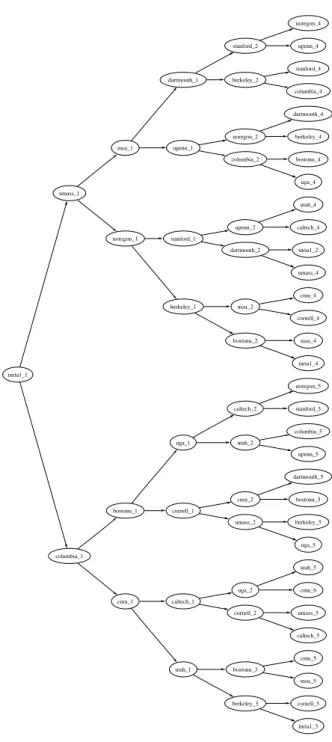
Scalability Analysis. To analyze scalability of throughput, we constructed a balanced binary tree of 63 nodes (Figure 2.2) connected to the Internet. We started simultaneously transmissions in balanced sub-trees of sizes 15, 31 and 63 with the same source. Running experiments simultaneously allowed us to avoid difficulties associated with fluctuation of networking conditions. In this way, link capacities are always shared between trees of different sizes in roughly equal proportions across the trees. We measured throughput in packets per second, achieved on each link during transmission of 10MB of data. Throughput of a link was measured by receiving node. In Table 2.1 we summarize group throughput measurements for 3 different tree sizes and 3 different settings for output buffer size. Group throughput is computed as the minimum value of link throughput observed in the tree. Similarly to our simulations presented above, size of each packet is 200 bytes, size of the input buffer is equal to 50 packets, and size of the output buffer is variable. Output buffer size is given in packets.
One can observe that the group throughput changes very little in the group size. This is consistent with the simulation results reported above, although as is quite expected, the absolute numbers are different.
inria1_1 umass_1 columbia_1 msu_1 uoregon_1 dartmouth_1 upenn_1 stanford_2 berkeley_2 uoregon_4 upenn_4 stanford_4 columbia_4 uoregon_2 columbia_2 dartmouth_4 berkeley_4 bostonu_4 uga_4 stanford_1 berkeley_1 upenn_2 dartmouth_2 utah_4 caltech_4 inria1_2 umass_4 msu_2 bostonu_2 cmu_4 cornell_4 msu_4 inria1_4 bostonu_1 cmu_1 uga_1 cornell_1 caltech_2 utah_2 uoregon_5 stanford_5 columbia_5 upenn_5 cmu_2 umass_2 dartmouth_5 bostonu_5 berkeley_5 uga_5 caltech_1 utah_1 uga_2 cornell_2 utah_5 cmu_6 umass_5 caltech_5 bostonu_3 berkeley_3 cmu_5 msu_5 cornell_5 inria1_5
Table 2.1: Scalability Experiments in Planet-Lab: Throughput in Pkts/sec
Group size: 15 31 63
Buffer=50 Pkts 95 86 88
Buffer=100 Pkts 82 88 77
Buffer=1000 Pkts 87 95 93
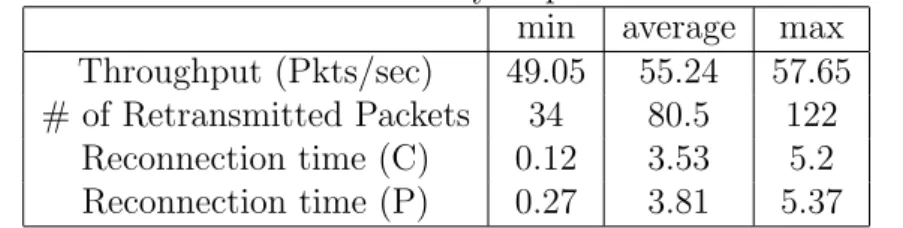
Reliability Analyses. To verify our approach to recovery after failures, we implemented a failure-resistant chain of 5 nodes running on Planet-Lab machines. During the transmission of 10 megabytes of data, two of 5 nodes fail. The failures are not simultaneous, and the system needs only to be resistant to one failure. In this experiment we limit both input and output buffer size to 50 packets. As in the previous experiment, size of each packet is 200 bytes (MSS=100 bytes). Our failure recovery algorithm needs a backup buffer of size 150 in this case. We have performed 10 runs of this experiment and measured group throughput, reconnection time and the number of redundant packets that are retransmitted after the connection is restored. Recall that in our architecture, the packet sequence numbers do not need to be advertised during the re-attachment procedure. Thus the child nodes of the failed node may receive duplicated packets after the connections are re-established. These redundant transmissions can impact the group throughput.
In our implementation, the failing node closes all its connections, and failure is detected by detecting dropped connections. After the failure is detected, the orphaned child node listens for an incoming connection from the surviving ancestor. We measure the interval between the time when failure is detected, and the time when connection is restored. This time interval is measured separately at the two participating nodes: surviving parent (P), and child (C). The results of our measurements are summarized in Table 2.2. The average reconnection time in seconds and number of retransmitted packets per one failure are given per one failure. The average group throughput is given per experiment. In these experiments, the average number of retransmitted packets is about half of the backup buffer size. The TCP sessions are re-established in a few seconds, in the same order as the TCP timeout. As the failure detection can be achieved in a few seconds as well, our experiment results show that the entire procedure of failure detection and reconnection can be completed in a few seconds.
Table 2.2: End-to-End Reliability Experiments in Planet-Lab
min average max
Throughput (Pkts/sec) 49.05 55.24 57.65
# of Retransmitted Packets 34 80.5 122
Reconnection time (C) 0.12 3.53 5.2
Reconnection time (P) 0.27 3.81 5.37
Scalability vs. Reliability. Simulation results presented above have shown that when there are no failures, the larger the buffers the more scalable the group throughput is. However, with larger buffers, the backup buffer size has to be increased proportionally in order to guarantee the end-to-end reliability. The above experiment showed that when failures do occur, the redundant transmissions will be increased as a consequence of larger backup buffers. These redundant transmissions will in turn reduce the group throughput. We here investigate into this issue. We consider a chain of 10 nodes and we generate 2, 4 and 6 failures (in a sequential way, so that the system just need to tolerate 1 failure). Table 2.3 reports the throughput measurements obtained with these settings and with different output
10 20 30 40 50 60 70 80 1 10 100 1000 10000 100000 Tree Depth
Number of Fail-Join Iterations greedy random 1.5 1.55 1.6 1.65 1.7 1.75 1.8 1.85 1.9 1.95 2 1 10 100 1000 10000 100000
Average Non-Leaf Fanout
Number of Fail-Join Iterations greedy random
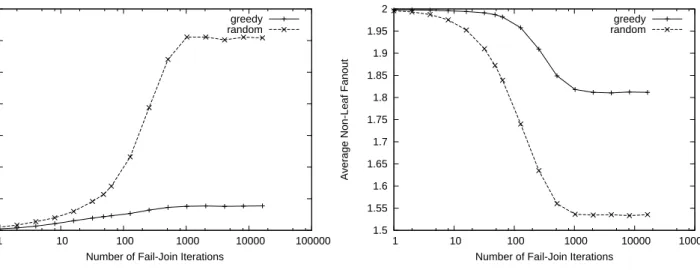
Figure 2.3: Evolution of tree depth (left) and evolution of average degree of non-leaf nodes (right). buffer sizes. The backup buffer size is set to the input buffer size and twice the output buffer size. It is interesting to see that when the buffer sizes increase, the group throughput can actually decrease. While we cannot make general claims based on these observations alone, these experiments do show that the throughput monotonicity in buffer size no longer holds in the presence of failures. The more frequent the failures are, the more severe (negative) impact large buffers would have on the group throughput.
Table 2.3: Scalability vs. End-to-End Reliability. Throughput in KB/s buf=50 buf=200 buf=500 buf=1000
2 failures 25.6 26.8 45.2 31.5
4 failures 29.2 28.8 36.4 27.2
6 failures 30.9 28.8 30.8 24.0
2.4.2
Simulation of Tree Evolution
To complement the simulations and experiments presented above, we further developed a discrete-event simulator to simulate the evolution of tree topology with failures and recovery under different algorithms. In particular, we evaluate the heuristics presented in Section 2.3 for the tree reconstruc-tion.
Starting with a balanced binary tree of 1023 nodes, we uniformly choose a failing node, apply random or greedy heuristic to restore connectivity, and add the node back using best-join. The tree must remain binary, joins are only allowed at nodes with out-degree less than 2. We measure the length of longest path and average degree of non-leaf nodes. The two methods used for restoring connectivity are GREEDY RECONNECT and a randomized procedure, that reconnects orphaned subtrees to randomly chosen nodes with out-degree less than 2.
The results are presented in Figure 2.3. The plots show average tree depth and inner node fanout over 500 runs. We observe that GREEDY RECONNECT helps to maintain significantly lower tree depth, and higher inner node degree, compared to the trivial approach that chooses active nodes randomly.
2.5
Conclusions
Our first conclusion is that reliable multicast overlays can be deployed on top of the current TCP/IP by adding a light set of application layer back-pressure mechanisms that guarantee both end-to-end flow control and reliability. A second important observation concerns the fear that as more and more TCP connections get interconnected in such a multicast overlay, some slow down experienced by distant connections might propagate to the root via back-pressure, leading the group throughput to vanish as the number of end-system grows. We have shown that such a fear has no grounds, provided all point to point connections that are used within the overlay offer minimal quality guarantees. Such architectures can be used for group communications of arbitrarily large sizes and still provide a group throughput that is close to that of a single point to point connection with these minimal guarantees. Surprisingly, this conclusion holds true even in the case of moderate input and output buffers. Mod-erate buffers even seem to be a good tradeoff within this context: they allow more efficient recovery mechanisms in case of failures and, according to our simulation results, they do not affect too severely the group throughput if not too small. An optimal buffer size offering a good compromise between throughput and reliability could in principle be advertised to the group.
Chapter 3
Minimum Radius Spanning Tree With
Degree Constraints
3.1
Introduction
In simplest multicast scenario, a dedicated source host delivers information to a group of receiving hosts. Overlay multicast is implemented in application layer, and all the data is transmitted via unicast delivery supported in underlying network. Because of bandwidth limitations, it may not be possible to simultaneously send data from source to each receiving host via unicast. An implementation of overlay multicast uses receiving hosts to forward information to other receivers. If the data stream intensity does not change, it is natural to assume that each participating host has a fixed bound on the number of hosts it can communicate to. This kind of bandwidth capacity constraints translate into degree constraints on the nodes of the multicast tree. In this case, to initiate overlay multicast, one needs to construct a degree-constrained spanning tree in a complete graph, where the nodes correspond to the hosts, and the edges correspond to the unicast communication paths.
An important practical problem in this context is to construct a multicast tree, which minimizes the largest communication delay observed by receiving hosts during multicast. Various studies have been conducted with the primary focus on the protocol development for efficient overlay tree construction and maintenance, such as Narada [19], Yoid [25], ALMI [46], Host Multicast [64], NICE [9], Delauney graph [37]. Some other work in peer to peer network is also related to the tree construction in application level multicast, see e.g. Chord [59] and CAN [48]. Most of such studies have been experimental in nature, see e.g. [18, 19, 17, 33, 46, 20]. In particular, Chu et al [18] use a heuristic
calledBandwidth-Latencyto build the multicast overlay tree. This heuristic, described in more detail
in [61], selects paths by choosing those with the greatest available bandwidth (i.e., maximum possible fanout).
We note that this tree construction problem corresponds to a graph-theoretic problem of constructing a rooted spanning tree of minimum radius with degree constraints. This problem is known in literature. The famous Travelling Salesman Problem [5] is a special case, but in general the degree-constrained spanning tree problem is harder than the TSP.
In [58], and later [57] and [54], the authors describe an NP-hard minimum diameter, degree-limited
spanning tree problem (MDDL), and propose heuristics for solving it. In the minimum-diameter version they consider, the objective is to minimize largest communication delay between any pair of
participating nodes. However, the quality of heuristic solution observed in simulations described in [58] decreases, as the number of nodes increases.
In [39], Malouch et al. introduce the radius minimization version, where the distance to the root is
minimized. The authors prove that the problem in general is NP-hard, and show that in the special case of unit node-to-node delays the problem can be solved optimally in polynomial time. For the case of general distances a set of heuristics is described.
Another approximation algorithm for the radius minimization problem was proposed in a recent work by K¨onemann, Levin and Singha [34]. The algorithm produces a spanning tree with diameter within
factor of O(√logn) for a graph of n nodes, if distances between nodes satisfy triangle inequality.
However this worst-case bound, similarly to that derived in [58], increases with the size of the network. In this chapter we assume that each node can be mapped to a point in Euclidean space, and node-to-node delays can be approximated by Euclidean distances between these points. Under this assumption, we describe an algorithm for constructing a degree-constrained spanning tree, and show that it arrives at asymptotically optimal solution. The asymptotic optimality result holds if points are uniformly distributed inside a convex region in Euclidean space, and at least 2 outgoing links are allowed at each node. This result easily extends to non-uniform distribution case, with the only requirement
that density function is strictly more than some constant ² > 0 inside the convex region, and is zero
everywhere else.
The method of mapping hosts to points in Euclidean space, and delays to Euclidean distances, is often used in analysis of overlay networks. For example, [57] and [37] use geographical locations of computers to create a mapping of hosts to the two-dimensional plane. The advantage of this method is that no actual network delays need to be measured to construct the mapping, and subsequently the multicast tree. Another approach, proposed in work by Global Network Positioning group [44], achieves higher accuracy by measuring some of the delays, and mapping hosts into Euclidean spaces of dimension 3 and above. In our work, we assume that the mapping has already been done, for example, using one of the methods above. We will concentrate on constructing degree-constrained spanning tree with minimal radius.
Our approach to the problem is similar in spirit to that used for other routing problems in Euclidean space, for example vehicle routing and traveling salesman problem [5]. The region covering destination points is divided in smaller sub-regions (cells) with a regular grid, and then the problem is solved within these small sub-regions. The size of grid cell is then used to estimate worst-case length of the path contained in the cell. However, in our algorithm we are constructing a routing tree that satisfies degree constraints, rather than a path connecting the end points. Therefore, we use a grid and connection methods significantly different from those used in previously studied geometric problems.
We organize our presentation in four parts. First, we present a simple constant-factor approximation algorithm for solving the problem in Euclidean space. We use constant-factor algorithm as a subroutine of the asymptotically optimal algorithm, to connect points inside cells of a polar grid. Next, we describe our asymptotically optimal algorithm for the special case of out-degree at least 6 at each node, and points uniformly distributed in a two-dimensional disk, and prove asymptotic optimality. We follow by describing how to extend the algorithm to work in higher dimensions, with general degree constraints, and with general convex regions. Finally, we analyze algorithm performance using simulation.
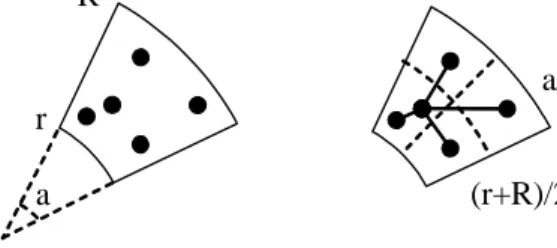
a) a r R b) (r+R)/2 a/2
Figure 3.1: Constant factor approximation algorithm.
3.2
Constant Factor Approximation
Before we can describe the asymptotically optimal algorithm, which is the main focus of this chapter, we need to introduce a subroutine for connecting points within cells of a polar grid. This subroutine in itself is an approximation algorithm. It creates a valid degree-constrained spanning tree for a given set of points in Euclidean space. The length of the longest path in the tree is within a constant factor of the best solution among all the possible degree-constrained spanning trees. This constant approximation factor is independent of the number of points in the region. Although it is easy to describe a version of the algorithm for a square, we will describe a polar version, which is more suitable for this setting.
Consider ring segment shown on Figure 3.1 a), with inner radius r, outer radius R, and angle a.
Suppose all the points are contained within this segment. Assume that the source point, which is the root of the tree, is also specified. The algorithm proceeds recursively as following:
Bisection Algorithm
1. Divide the segment into 4 sub-segments, by splitting it with an arc of radius (R+r)/2 and a
ray dividing angle a into two halves.
2. Pick a representative point in each non-empty sub-segment, such that its’ radius in polar coor-dinates is closest to the radius of the source node. Connect the source to all the representatives. See Figure 3.1 b).
3. Repeat the procedure within each non-empty sub-segment, to connect the points inside the sub-segment, using the representative point as a local source.
The algorithm constructs a spanning tree, in which each node has at most 4 children. We observe that each path always moves monotonously along the radius axis. The steps along the angle axis at
each level can be bounded by the angle of the sub-segment. Therefore, the length of each path lp can
be bounded from above using the triangle inequality as follows:
lp ≤max(R−q, q−r) +Ra+Ra/2 +Ra/4 +...≤
≤max(R−q, q−r) + 2Ra, (3.1)
where q is the radius of the source node.
We will now show that this algorithm can be used to construct a constant factor approximation for a given set of nodes. We first construct a ring segment to cover all these points. We pick the center of
the ring to be very far, so that the angle a is small, (sina >5/6a), and both R and r are large, such that r >0.6R. Pick R and r such thatR−r can not be reduced, without leaving some nodes out of
the ring segment. Similarly, assume that acan not be reduced. Then, since any path must connect to
extreme nodes, and using triangle inequality, it is easy to see, that for the optimal longest path OP T
the following holds:
OP T ≥max(R−q, q−r), OP T ≥rsina≥1/2Ra.
Combining this with (3.1), for any tree pathp, we obtain:
lp ≤5·OP T,
and therefore this algorithm can be used to produce solutions within constant factor of the best possible.
It is not difficult to modify the algorithm to produce a spanning tree with out-degree 2. To do this, during each recursive call, connect the source to two points from the same segment. Points should be chosen to have radius closest to the source. Then each of the two points can be used to connect 2 of the 4 sub-segments, so that all sub-segments are connected. In this case, upper bound on the solution doubles the angle term, since on each level of the path we now use 2 links instead of one:
lp ≤max(R−q, q−r) + 4Ra. (3.2)
Theorem 3.2.1. The Bisection Algorithm provides a solution within a factor of 5 optimal for the minimum radius problem when maximum out-degree is restricted to be 4. The approximation factor becomes 9 if the maximum out-degree is restricted to be 2.
3.3
Asymptotically Optimal Algorithm
In this section we describe our hierarchical algorithm to recursively build multicast trees. We will prove that it is asymptotically optimal. To simplify the presentation, we will make several assumptions. These assumptions will be lifted in the next section.
We assume that the n points corresponding to the communicating hosts are uniformly distributed
inside a disk of radius 1 and the source is located at the center of the disk. We assume each node can forward transmission to at least 6 down-stream links. The main idea of the algorithm is to divide the disk into a hierarchy of smaller and smaller grid cells. The algorithm builds a tree based on the hierarchy to connect the points in the grid cells. At high level, our grid partitioning algorithm proceeds in three stages:
Algorithm Polar Grid
1. Creates a grid of equal area cells, covering the disk.
2. Connects the cells, using cell representatives, and forming a core network.
3. Connects points within the cells, using the constant factor approximation algorithm.
We next describe the details of each step of the algorithm in the following subsections. We then evaluate the performance of the algorithm and prove the asymptotic optimality results.
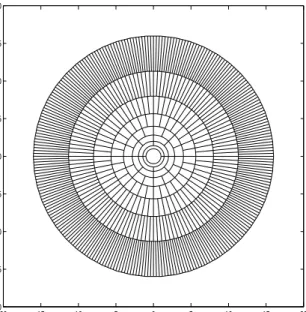
−20 −15 −10 −5 0 5 10 15 20 −20 −15 −10 −5 0 5 10 15 20
Figure 3.2: Dividing the disk into ring segments of equal area.
3.3.1
Constructing the polar grid.
First, the algorithm creates a polar grid covering the unit disk. This grid must have the following properties:
1. All cells of the grid have the same area.
2. Cells are organized in rings. Each containing ring has twice more cells than the ring immediately inside it.
3. There is at least one point in each cell of the grid, except for the cells in the outermost ring.
For a fixed number of rings k, we construct the grid by dividing the unit disk using k circles with the